Chemistry for Changing Times, 14e (Hill/McCreary)
Chapter 10 Polymers
10.1 Multiple Choice Questions
1) Monomers
A) are small building blocks of polymers.
B) are small polymers.
C) are ethylene.
D) cannot form polymers.
2) The word polymer means
A) many parts.
B) many sides.
C) many rings.
D) many carbons.
3) The word monomer means
A) one bond.
B) one unit.
C) many bonds.
D) many rings.
4) Which statement relating monomers and polymers is correct?
A) They have the same chemical and physical properties.
B) They have different chemical and physical properties.
C) The monomer is usually a solid, while the polymer is usually a liquid or gas.
D) They have the same chemical formula.
5) Which of the following roots means “many”?
A) mer
B) mono
C) poly
D) tetra
6) Natural polymers which carry the coded genetic information that makes each individual unique are
A) proteins.
B) carboxylic acids.
C) esters.
D) nucleic acids.
7) Which of the following is NOT a naturally occurring polymer?
A) celluloid
B) cellulose
C) starch
D) wool
8) Which of the following is a naturally occurring polymer?
A) celluloid
B) nylon
C) starch
D) None of the above is a naturally occurring polymer.
9) Wool and silk are examples of which type of naturally occurring polymer?
A) cellulose
B) polyesters
C) nucleic acids
D) proteins
10) Celluloid is a chemical modification of which natural product?
A) cellulose
B) cells
C) ivory
D) cellophane
11) The first “practical” application of celluloid was
A) billiard balls.
B) movie film.
C) stiff collars.
D) airplane wings.
12) Polyethylene terephthalate is used for
A) nonstick frying pans.
B) automobile frames.
C) drink.
D) stiff collars on men’s shirts that are out of fashion.
13) The first attempts to make synthetic polymers involved
A) combining monomers of ethylene to form polyethylene.
B) modifying a naturally occurring polymer to form celluloid.
C) compression molding.
D) the synthesis of polyamides.
14) The first synthetic polymer was produced in 1909 and is known as
A) polyethylene.
B) celluloid.
C) bakelite.
D) plexiglass.
15) Which of the following is the simplest synthetic polymer?
A) polymethane
B) polyethylene
C) polyvinyl chloride
D) polystyrene
16) Polyethylene is NOT
A) tough.
B) flexible.
C) a thermoplastic polymer.
D) a thermosetting polymer.
17) One of the first applications of polyethylene was
A) billiard balls.
B) garbage bags.
C) electrical insulation.
D) parachutes.
18) High-density polyethylene is composed of
A) primarily linear, unbranched chains of polyethylene in a close packing arrangement.
B) primarily highly branched, non-linear chains of polyethylene in a diffuse packing arrangement.
C) a mixture of polyethylene and polystyrene.
D) polyethylene with high density plasticizers added to increase density.
19) Low-density polyethylene is composed of
A) primarily linear, unbranched chains of polyethylene in a close packing arrangement.
B) primarily highly branched, non-linear chains of polyethylene in a diffuse packing arrangement.
C) a mixture of polyethylene and polystyrene.
D) polyethylene with low density plasticizers added to increase density.
20) HDPE finds applications in
A) waxed paper.
B) threaded bottle caps.
C) baggies.
D) cans.
21) LDPE finds applications as
A) plastic film.
B) threaded bottle caps.
C) drain pipes.
D) plastic television trays.
22) LDPE stands for
A) linearly dense polyethylene.
B) light diffuse polyethylene.
C) low-density polyethylene.
D) lightly doped polyethylene.
23) HDPE stands for
A) high-density polyethylene.
B) hot-dipped polyethylene.
C) high-dose polyethylene.
D) highly-diffuse polyethylene.
24) Thermoplastic polymers may be
A) heated and reformed.
B) heated, but not reformed.
C) decomposed by heating.
D) changed in color by heating.
25) The most widely used synthetic polymer is
A) polyethylene.
B) polyvinyl chloride.
C) polystyrene.
D) polytetrafluoroethylene (Teflon).
26) The development of which polymer enabled the British to have effective radar equipment and thus
contributed to the British success in the Battle of Britain in World War II?
A) polystyrene
B) polyvinyl chloride
C) Teflon
D) polyethylene
27) A copolymer is composed of
A) two or more different monomers.
B) different polymers linked end to end.
C) different polymers cross-linked.
D) none of the above
28) Which of the following is a copolymer?
A) celluloid
B) cellulose
C) linear low-density polyethylene
D) carbon nanotubes
29) The polymer segment ~CH2CH2CH2CH2CH2CH2CH2~ represents
A) polyethylene.
B) polypropylene.
C) polystyrene.
D) polyvinyl chloride.
30) Which of the following statements about ethylene and polyethylene is true?
A) The polymer has the same properties as the monomer.
B) The polymer has alternating double and single bonds between carbons, while the monomer has only
single bonds between carbons.
C) The polymer has alternating double and single bonds between carbons, while the monomer has only
double bonds between carbons.
D) The polymer has only single bonds between carbons, while the monomer has only double bonds
between carbons.
31) Which of the following statements about the difference between HDPE and LDPE is NOT correct?
A) HDPE has a higher density than LDPE does.
B) HDPE holds its shape better than LDPE does when they are put into boiling water.
C) HDPE is more flexible than LDPE is.
D) HDPE has fewer side chains branching off from the main chains than LDPE does.
32) Carbon can exist is several forms. Which of the following is a form of carbon and does not contain
other atoms besides carbon?
A) fullerenes
B) celluloid
C) cellulose
D) starch
33) Which of the following types of carbon consists of one-atom-thick planar sheets of carbons?
A) buckyballs
B) graphene
C) graphite
D) nanotubes
34) The monomer of polypropylene is
A) CH2CH2.
B) CH2CH—CH3.
C) CH3CH3.
D) CH3CH2CH3.
35) Polystyrene is not used for
A) condiment bottles.
B) disposable coffee cups.
C) material for packing.
D) home insulation.
36) Polyvinyl chloride is used for drain pipes in plumbing applications. It has replaced traditional cast
iron pipe for this purpose. The major advantage of PVC in replacing cast iron for this application
(particularly if you are a plumber or homeowner) is that PVC
A) is of lighter weight.
B) is easier to handle and cut.
C) is more resistant to corrosion.
D) All of the above are advantages of PVC.
37) Another name for Teflon is
A) LDPE.
B) PVC.
C) PTFE.
D) HDPE.
38) The monomer used to make Teflon is
A) H2CCH2.
B) Cl2CCH2.
C) H2CCHCl.
D) F2CCF2.
39) The monomer used to make PVC is
A) H2CCH2.
B) Cl2CCH2.
C) H2CCHCl.
D) F2CCF2.
40) One of the problems in the production of PVC is that
A) vinyl chloride is explosive.
B) vinyl chloride is carcinogenic.
C) vinyl chloride is toxic.
D) vinyl chloride is a solid at room temperature.
41) A polymer that conducts electricity is
A) polyacetylene.
B) polyethylene.
C) polyvinyl chloride.
D) polystyrene.
42) Plexiglass is
A) polyvinyl chloride.
B) polymethyl methacrylate.
C) polytetrafluoroethylene.
D) polyvinyl acetate.
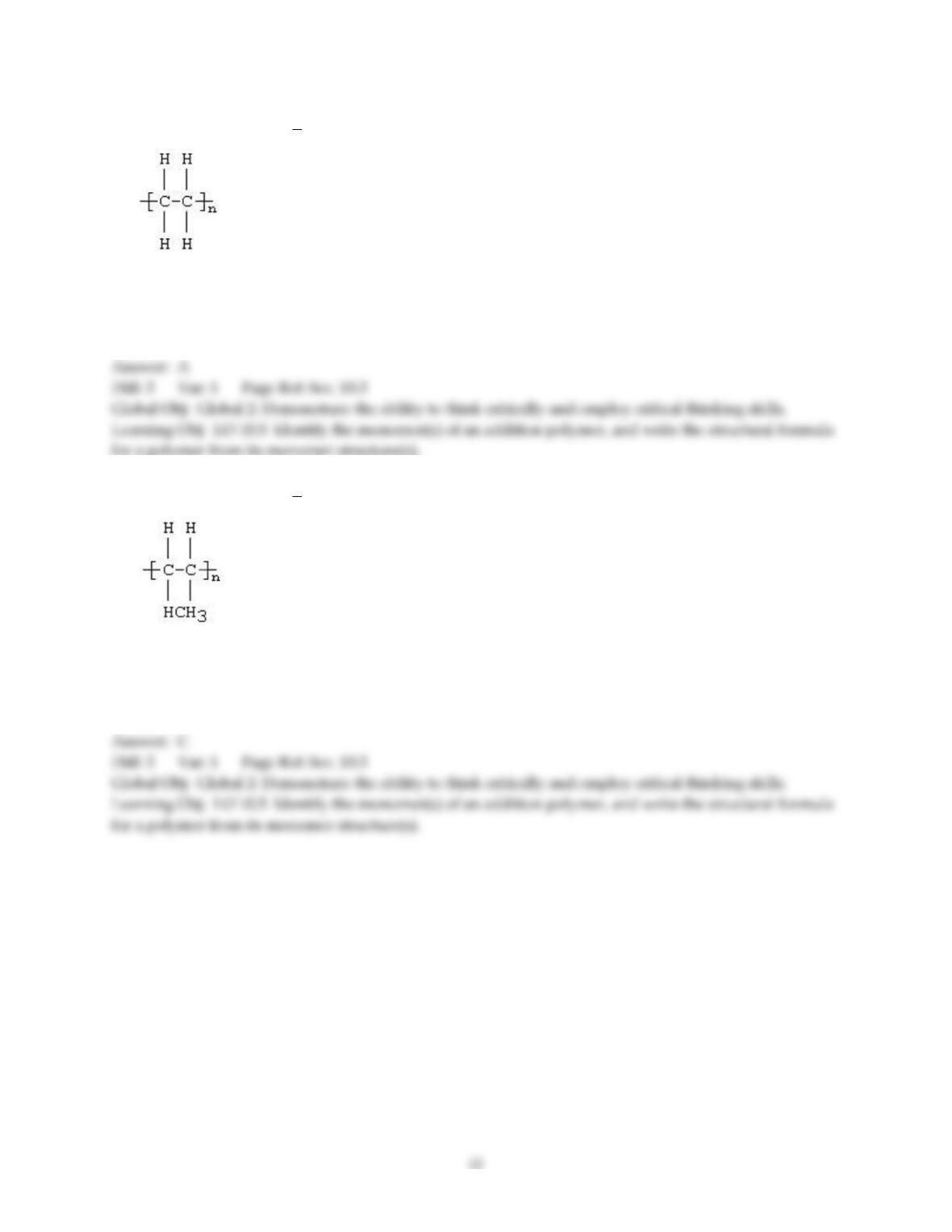
43) This formula in which n can be a very large number represents which of the following polymers?
A) polyethylene
B) polyvinyl chloride
C) polypropylene
D) teflon
44) This formula in which n can be a very large number represents which of the following polymers?
A) polyethylene
B) polyvinyl chloride
C) polypropylene
D) Teflon
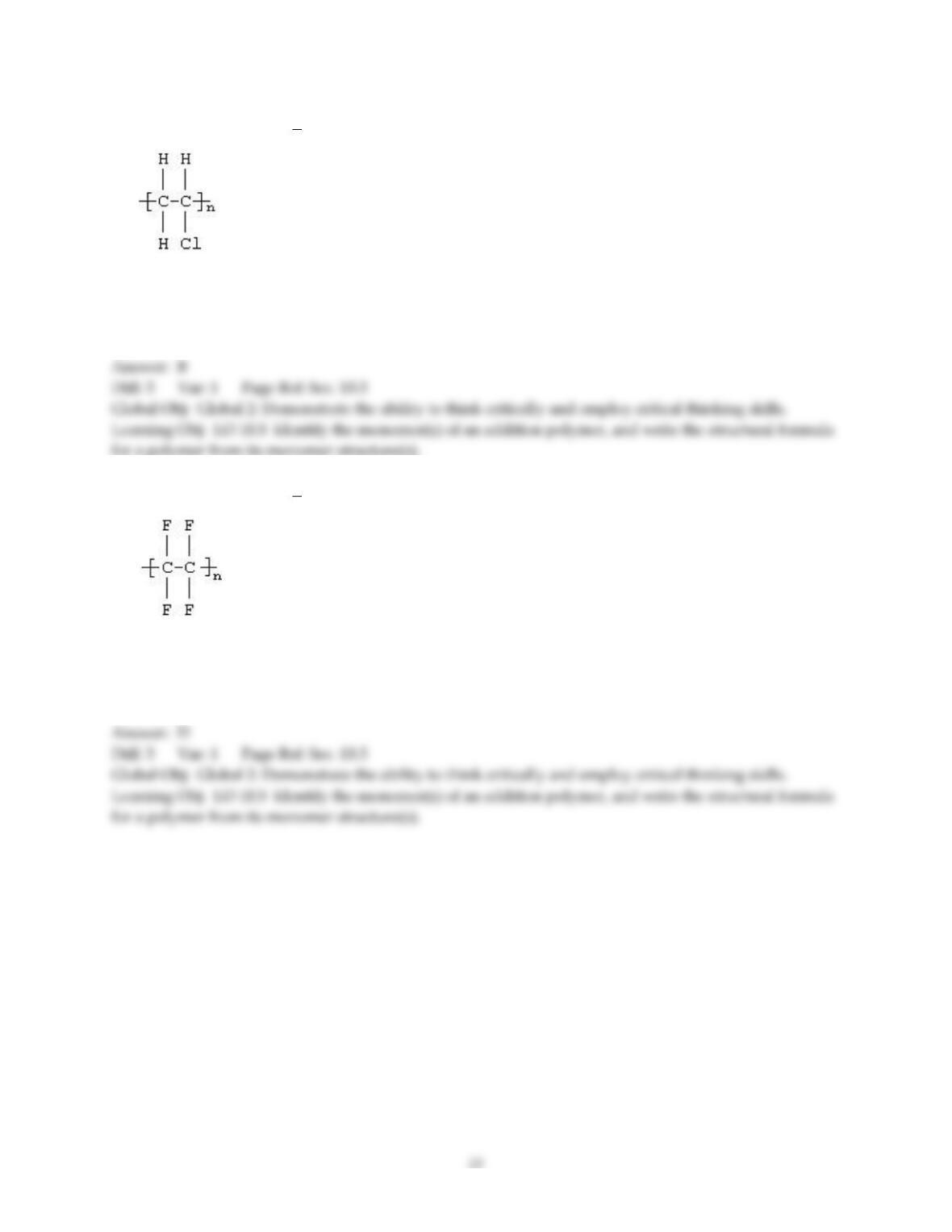
45) This formula in which n can be a very large number represents which of the following polymers?
A) polyethylene
B) polyvinyl chloride
C) polypropylene
D) teflon
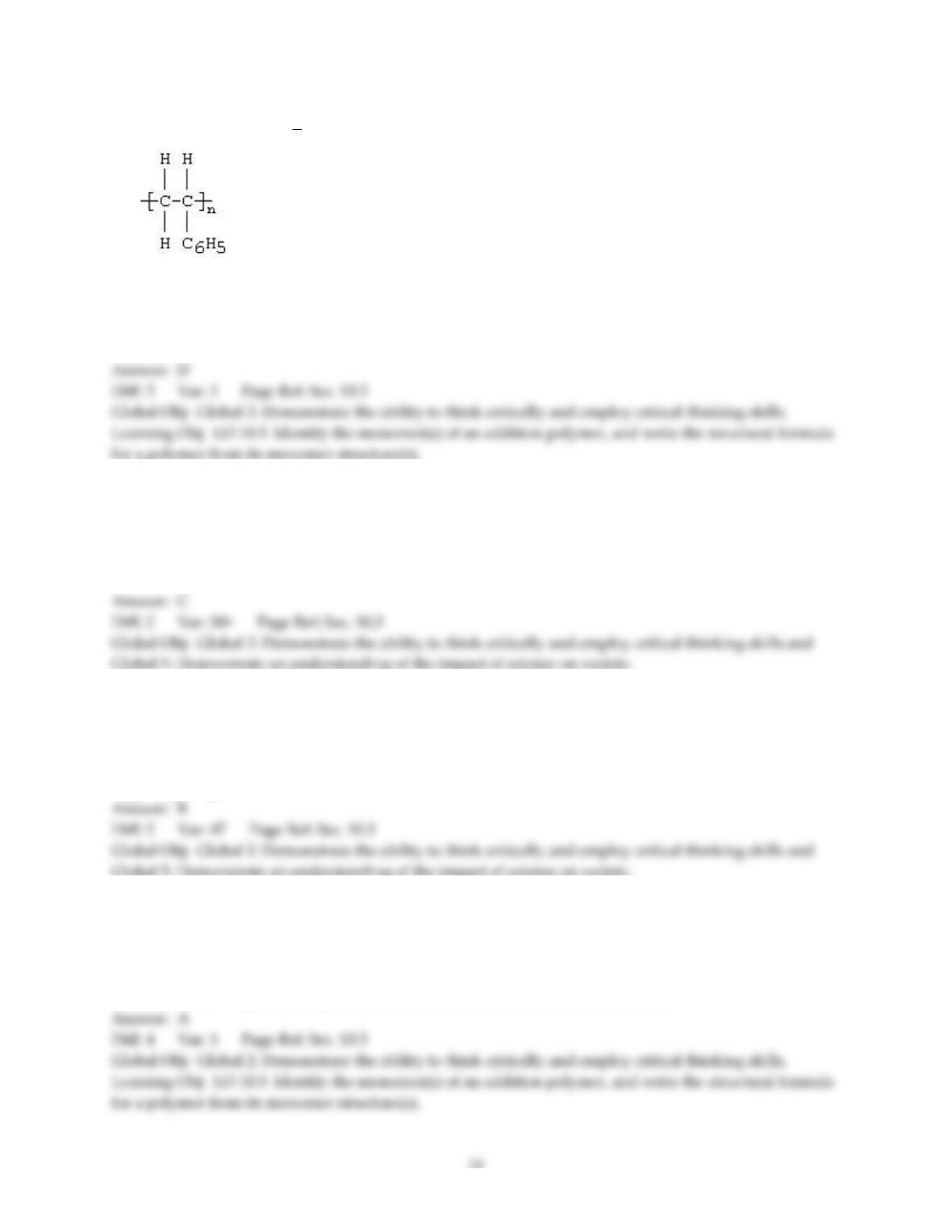
46) This formula in which n can be a very large number represents which of the following polymers?
A) polyethylene
B) polyvinyl chloride
C) polypropylene
D) Teflon
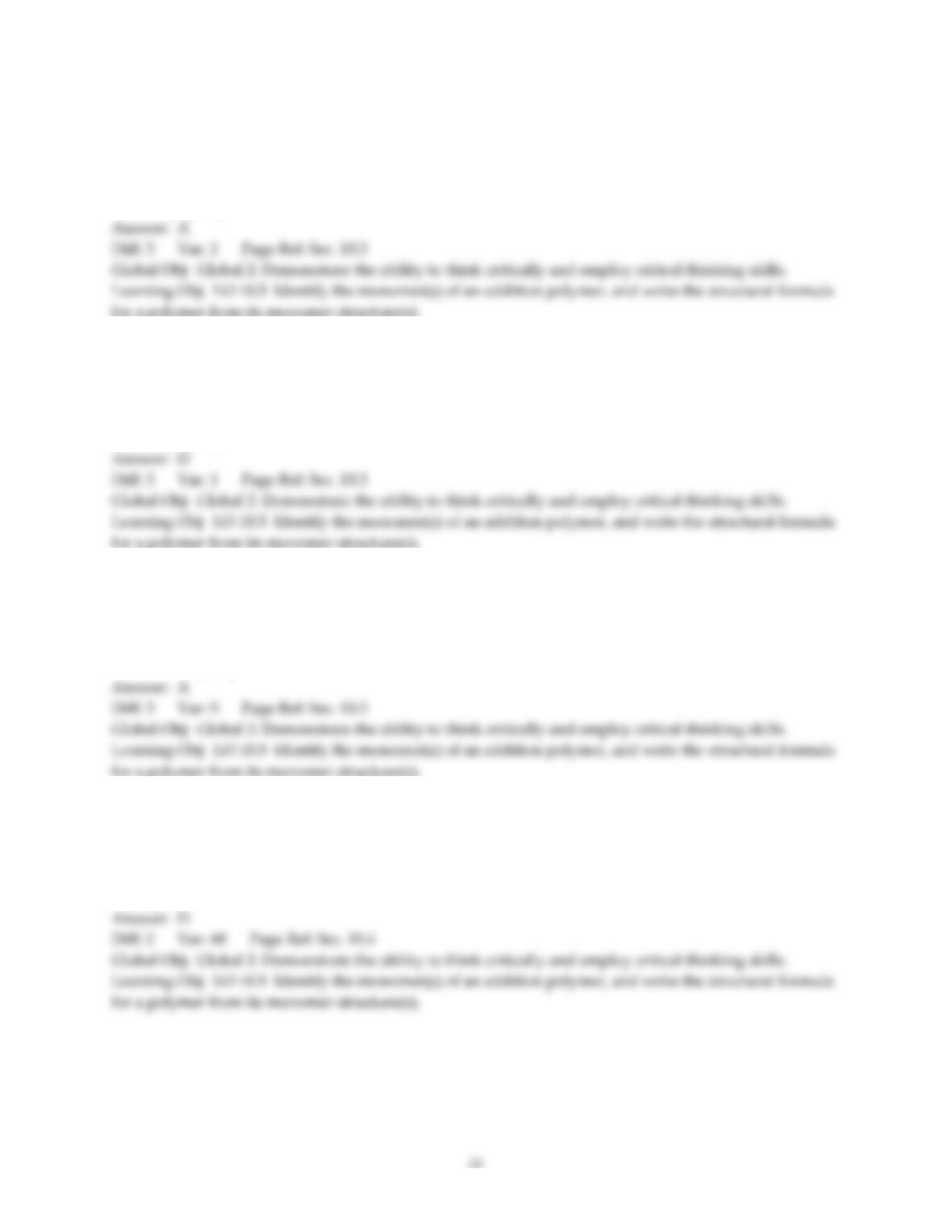
47) This formula in which n can be a very large number represents which of the following polymers?
A) polyethylene
B) polyvinyl chloride
C) polypropylene
D) polystyrene
48) Polyvinyl acetate is used for
A) carpet.
B) chewing gum resin.
C) yarns.
D) floor tile.
49) What is Teflon used for?
A) food wrap
B) nonstick cookware
C) bullet-proof vests
D) garbage bags
50) How does the monomer of polyvinyl chloride (PVC) differ from the monomer of polyethylene (PE)?
A) The PVC monomer has a chlorine atom, but the PE monomer does not.
B) The PVC monomer has two chlorine atoms, but the PE monomer does not.
C) The PE monomer has one chlorine atom, and the PVC monomer has two chlorine atoms.
D) The PVC monomer has a triple bond, and the PE monomer has a double bond.
51) The pendant group in polystyrene is a(n)
A) benzene ring.
B) chlorine atom.
C) ethyl group.
D) methyl group.
52) The pendant group in polypropylene is a(n)
A) benzene ring.
B) chlorine atom.
C) ethyl group.
D) methyl group.
53) The monomer from which polyethylene is made has ________ attached to the C=C.
A) only H atoms
B) a Cl atom
C) a benzene ring
D) a methyl group
54) Natural rubber can be made from the monomer
A) propylene.
B) polybutylene.
C) polyvinyl acetate.
D) isoprene.
55) Vulcanization of rubber was discovered by
A) Charles Goodrich.
B) Charles Goodyear.
C) Charles Firestone.
D) Charles Vulcan.
56) Vulcanization makes rubber
A) hard.
B) sticky.
C) soft.
D) less elastic.
57) In the vulcanization of rubber, sulfur
A) is inserted into the carbon chain.
B) breaks long carbon chains into smaller chains.
C) forms links between polymer chains.
D) links all chains into one long chain.
58) Elastomers are synthetic polymers that mimic the properties of
A) vulcanized rubber.
B) polyethylene.
C) celluloid.
D) PVC.
59) Styrene-butadiene rubber (SBR) is a
A) condensation polymer.
B) vulcanized rubber.
C) copolymer.
D) all of the above
60) The main use of elastomers is
A) automobile tires.
B) synthetic body parts.
C) waxed paper.
D) wigs.
61) One of the disadvantages of polybutadiene rubber for automobile tires is
A) poor resistance to gasoline and oils.
B) its color.
C) density.
D) expense.
62) The substance in paints that hardens to form a continuous surface coating is called a
A) pigment.
B) binder.
C) solvent.
D) thinner.