CHAPTER 10
ACQUISITION AND DISPOSITION OF
PROPERTY, PLANT, AND EQUIPMENT
IFRS questions are available at the end of this chapter.
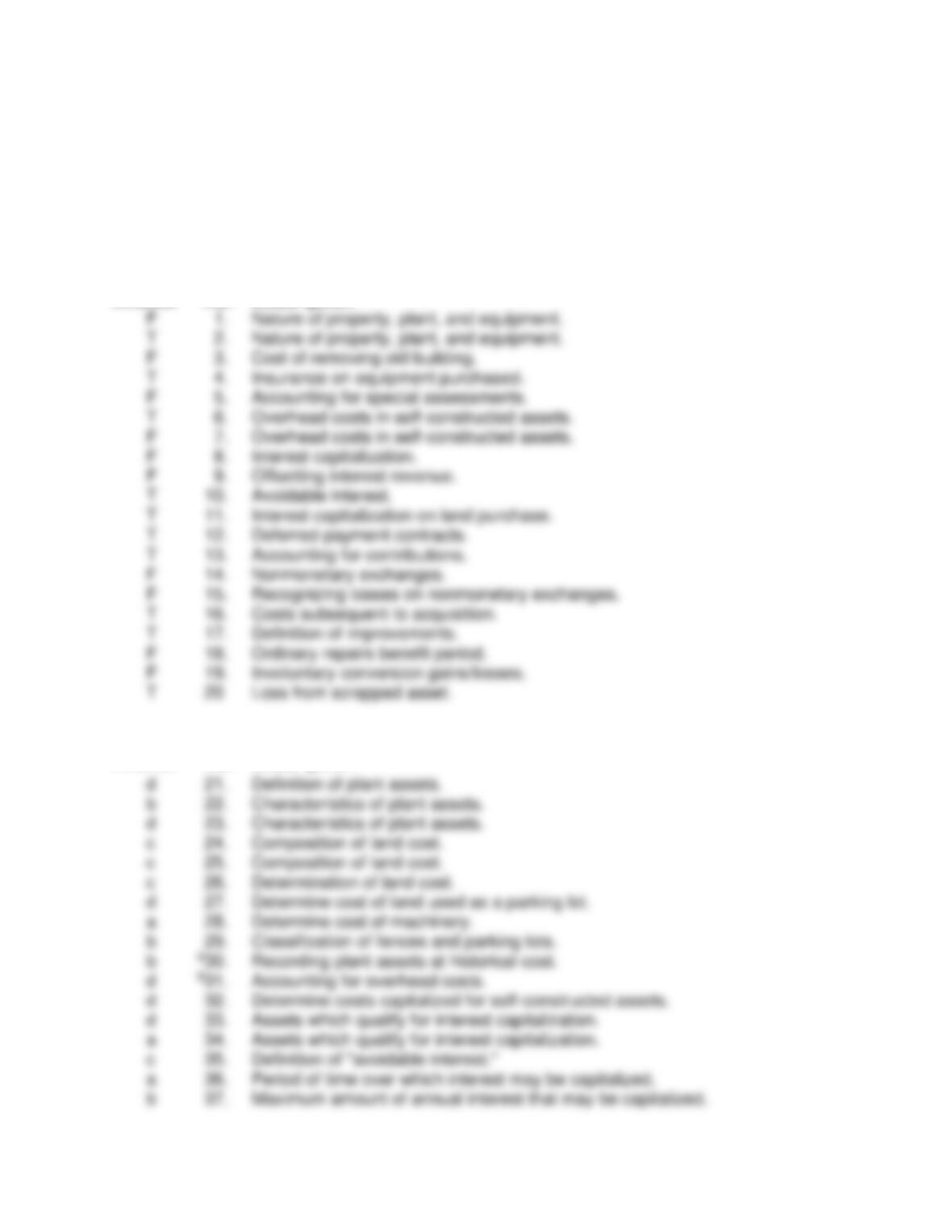
TRUE-FALSE—Conceptual
Answer No. Description
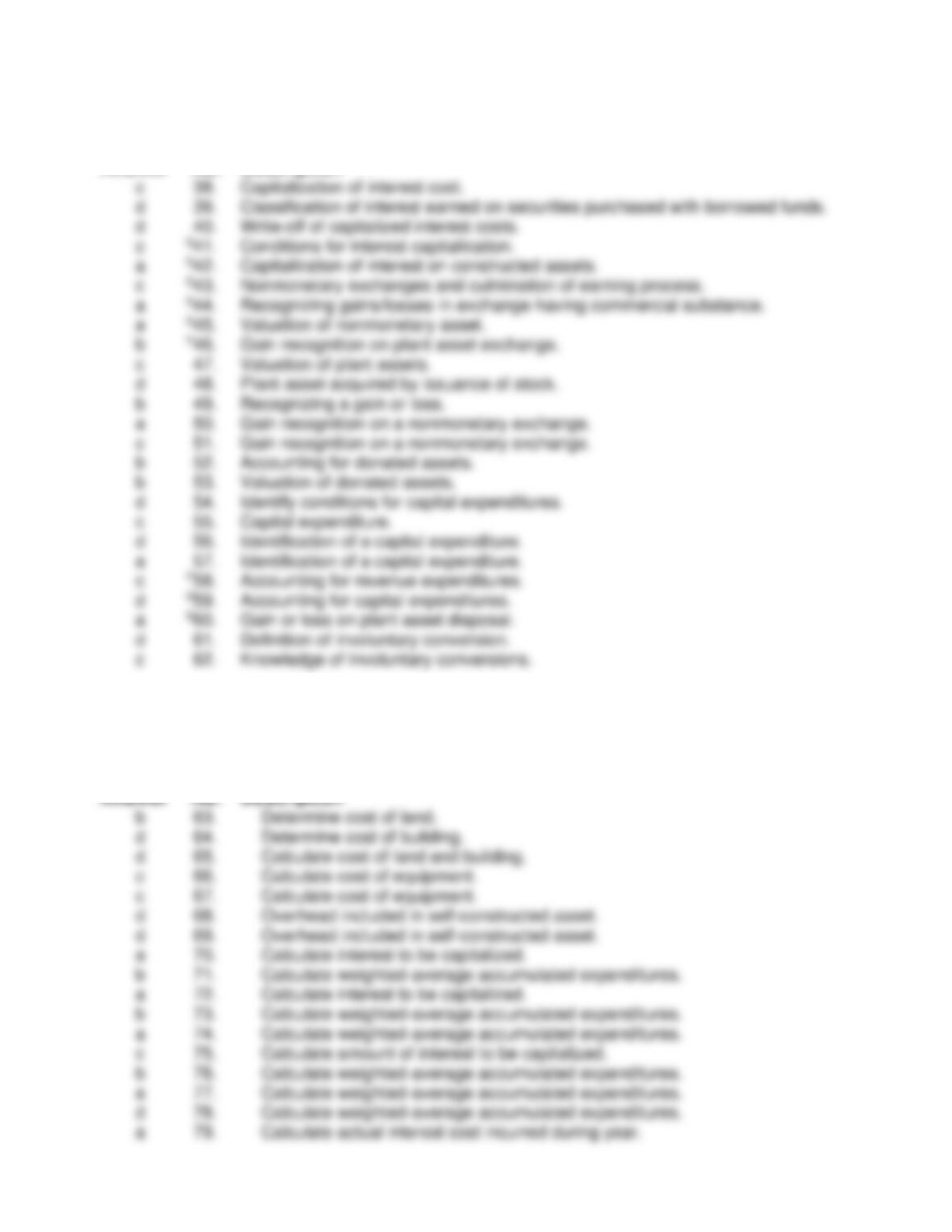
MULTIPLE CHOICE—Conceptual
Answer No. Description
Test Bank for Intermediate Accounting, Fifteenth Edition
10 – 2
MULTIPLE CHOICE—Conceptual (cont.)
Answer No. Description
P These questions also appear in the Problem-Solving Survival Guide.
S These questions also appear in the Study Guide.
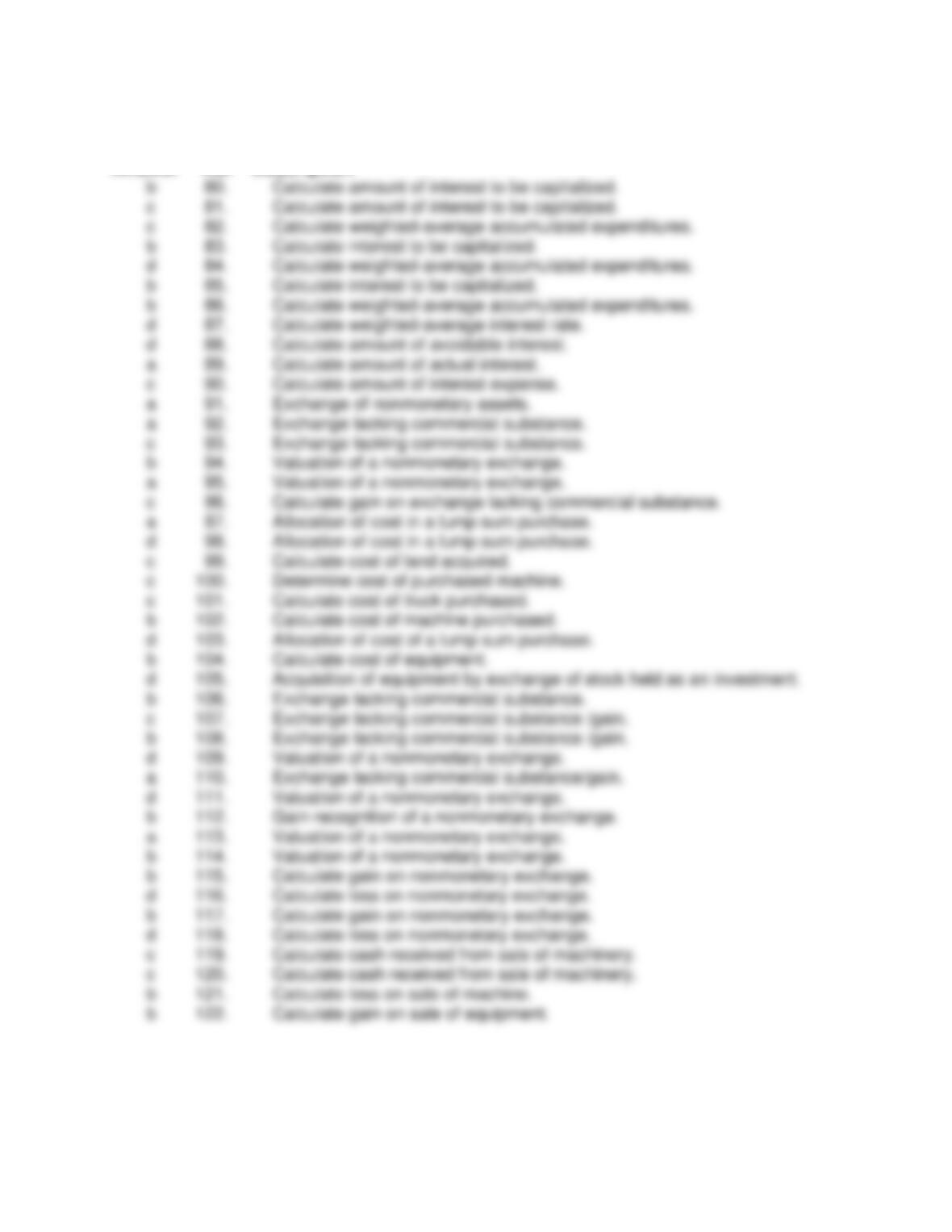
MULTIPLE CHOICE—Computational
Acquisition and Disposition of Property, Plant, and Equipment
10 – 3
MULTIPLE CHOICE—Computational (cont.)
Answer No. Description
Test Bank for Intermediate Accounting, Fifteenth Edition
10 – 4
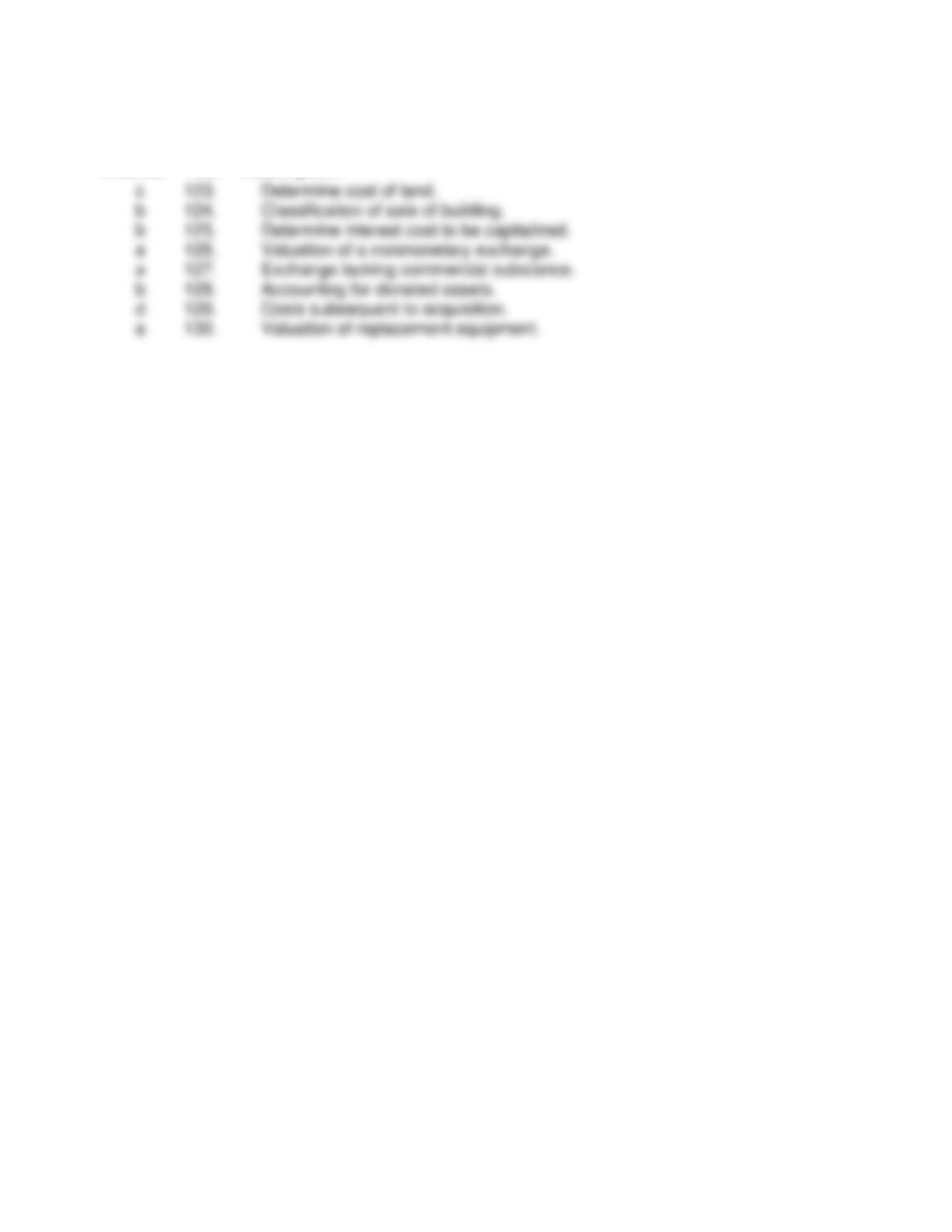
MULTIPLE CHOICE—CPA Adapted
Answer No. Description
BRIEF EXERCISES
Item Description
BE10-131 Plant asset accounting.
BE10-132 Weighted-average accumulated expenditures.
BE10-133 Capitalization of interest.
EXERCISES
E10-134 Nonmonetary exchange.
E10-135 Nonmonetary exchange.
E10-136 Donated assets.
E10-137 Capitalizing vs. expensing.
PROBLEMS
Item Description
P10-138 Capitalizing acquisition costs.
P10-139 Capitalization of interest.
P10-140 Capitalization of interest.
P10-141 Asset acquisition
P10-142 Nonmonetary exchange.
P10-143 Nonmonetary exchange.
P10-144 Nonmonetary exchange.
P10-145 Nonmonetary exchange.
P10-146 Nonmonetary exchange.
CHAPTER LEARNING OBJECTIVES
1. Describe property, plant, and equipment.
2. Identify the costs to include in initial valuation of property, plant, and equipment.
3. Describe the accounting problems associated with self-constructed assets.
4. Describe the accounting problems associated with interest capitalization.
5. Understand accounting issues related to acquiring and valuing plant assets.

Acquisition and Disposition of Property, Plant, and Equipment
10 – 5
6. Describe the accounting treatment for costs subsequent to acquisition.
7. Describe the accounting treatment for the disposal of property, plant, and equipment.
Test Bank for Intermediate Accounting, Fifteenth Edition
10 – 6
SUMMARY OF LEARNING OBJECTIVES BY QUESTIONS
Item
Type
Item
Type
Item
Type
Item
Type
Item
Type
Item
Type
Item
Type
Learning Objective 1
1.
TF
2.
TF
21.
MC
22.
MC
23.
MC
Learning Objective 2
3.
TF
24.
MC
27.
MC
30.
MC
65.
MC
123.
MC
137.
E
4.
TF
25.
MC
28.
MC
63.
MC
66.
MC
124.
MC
138.
P
5.
TF
26.
MC
29.
MC
64.
MC
67.
MC
131.
BE
Learning Objective 3
6.
TF
S31.
MC
68.
MC
132.
BE
7.
TF
S32.
MC
69.
MC
Learning Objective 4
8.
TF
35.
MC
S41.
MC
74.
MC
80.
MC
86.
MC
131.
BE-
CT
9.
TF
36.
MC
S42.
MC
75.
MC
81.
MC
87.
MC
133.
BE
10.
TF
37.
MC
70.
MC
76.
MC
82.
MC
88.
MC
137.
E
11.
TF
38.
MC
71.
MC
77.
MC
83.
MC
89.
MC
139.
P
33.
MC
39.
MC
72.
MC
78.
MC
84.
MC
90.
MC
140.
P
34.
MC
40.
MC
73.
MC
79.
MC
85.
MC
125.
MC
Learning Objective 5
12.
TF
48.
MC
94.
MC
103.
MC
112.
MC
128.
MC
144.
P
13.
TF
49.
MC
95.
MC
104.
MC
113.
MC
131.
BE
145.
P
14.
TF
50.
MC
96.
MC
105.
MC
114.
MC
134.
E
146.
P
15.
TF
51.
MC
97.
MC
106.
MC
115.
MC
135.
E
S43.
MC
52.
MC
98.
MC
107.
MC
116.
MC
136.
E
S44.
MC
53.
MC
99.
MC
108.
MC
117.
MC
137.
E
S45.
MC
91.
MC
100.
MC
109.
MC
118.
MC
141.
P-
CT
P46.
MC
92.
MC
101.
MC
110.
MC
126.
MC
142.
P
47.
MC
93.
MC
102.
MC
111.
MC
127.
MC
143.
P
Learning Objective 6
16.
TF
18.
TF
55.
MC
57.
MC
S59.
MC
130.
MC
137.
E
17.
TF
54.
MC
56.
MC
P58.
MC
129.
MC
131.
BE
Learning Objective 7
19.
TF
S60.
MC
62.
MC
120.
MC
122.
MC
20.
TF
61.
MC
119.
MC
121.
MC
Note: TF = True-False CT= Critical Thinking
MC = Multiple Choice BE = Brief Exercises
P = Problem
E = Exercise

Acquisition and Disposition of Property, Plant, and Equipment
10 – 7
TRUE-FALSE—Conceptual
1. Assets classified as Property, Plant, and Equipment can be either acquired for use in
operations, or acquired for resale.
2. Assets classified as Property, Plant, and Equipment must be both long-term in nature and
possess physical substance.
3. When land with an old building is purchased as a future building site, the cost of removing
the old building is part of the cost of the new building.
4. Insurance on equipment purchased, while the equipment is in transit, is part of the cost of
the equipment.
5. Special assessments for local improvements such as street lights and sewers should be
accounted for as land improvements.
6. Variable overhead costs incurred to self-construct an asset should be included in the cost
of the asset.
7. Companies should assign no portion of fixed overhead to self-constructed assets.
8. When capitalizing interest during construction of an asset, an imputed interest cost on
stock financing must be included.
9. Companies should always offset interest revenue against interest cost when determining
the amount of interest to be capitalized as part of the construction cost of assets.
10. Avoidable interest is the amount of interest cost that a company could theoretically avoid if
it had not made expenditures for the asset.
11. When a company purchases land with the intention of developing it for a particular use,
interest costs associated with those expenditures qualify for interest capitalization.
12. Assets purchased on long-term credit contracts should be recorded at the present value of
the consideration exchanged.
13. When a company makes an unconditional promise to pledge an asset in the future, the
company should report the contribution expense and related payable immediately.
14. If a nonmonetary exchange lacks commercial substance, and cash is received, a partial
gain or loss is recognized.
15. When a company exchanges nonmonetary assets and a loss results, the company
recognizes the loss only if the exchange has commercial substance.
16. Costs incurred subsequent to the acquisition of an asset are capitalized if they provide
future benefits.
17. Improvements are often referred to as betterments and involve the substitution of a better
asset for the one currently used.
Test Bank for Intermediate Accounting, Fifteenth Edition
10 – 8
18. When an ordinary repair occurs, several periods will usually benefit.
19. Companies always treat gains or losses from an involuntary conversion as extraordinary
items.
20. If a company scraps an asset without any cash recovery, it recognizes a loss equal to the
asset’s book value.
True False Answers—Conceptual
Item
Ans.
Item
Ans.
Item
Ans.
Item
Ans.
MULTIPLE CHOICE—Conceptual
21. Plant assets may properly include
a. deposits on machinery not yet received.
b. idle equipment awaiting sale.
c. land held for possible use as a future plant site.
d. None of these answers are correct.
22. Which of the following is not a major characteristic of a plant asset?
a. Possesses physical substance
b. Acquired for resale
c. Acquired for use
d. Yields services over a number of years
23. Which of these is not a major characteristic of a plant asset?
a. Possesses physical substance
b. Acquired for use in operations
c. Yields services over a number of years
d. All of these are major characteristics of a plant asset.
24. Cotton Hotel Corporation recently purchased Emporia Hotel and the land on which it is
located with the plan to tear down the Emporia Hotel and build a new luxury hotel on the
site. The cost of the Emporia Hotel should be
a. depreciated over the period from acquisition to the date the hotel is scheduled to be
torn down.
b. written off as an extraordinary loss in the year the hotel is torn down.
c. capitalized as part of the cost of the land.
d. capitalized as part of the cost of the new hotel.

Acquisition and Disposition of Property, Plant, and Equipment
10 – 9
25. The cost of land does not include
a. costs of grading, filling, draining, and clearing.
b. costs of removing old buildings.
c. costs of improvements with limited lives.
d. special assessments.
26. The cost of land typically includes the purchase price and all of the following costs except
a. grading, filling, draining, and clearing costs.
b. street lights, sewers, and drainage systems cost.
c. private driveways and parking lots.
d. assumption of any liens or mortgages on the property.
27. If a corporation purchases land and building and subsequently tears down the building
and uses the property as a parking lot, the proper accounting treatment of the cost of the
building would depend on
a. the significance of the cost allocated to the building in relation to the combined cost of
the land and building.
b. the length of time for which the building was held prior to its demolition.
c. the contemplated future use of the parking lot.
d. the intention of management for the property when the building was acquired.
28. The debit for a sales tax properly levied and paid on the purchase of machinery preferably
would be a charge to
a. the machinery account.
b. a separate deferred charge account.
c. miscellaneous tax expense (which includes all taxes other than those on income).
d. accumulated depreciation—machinery.
29. Fences and parking lots are reported on the balance sheet as
a. current assets.
b. land improvements.
c. land.
d. property and equipment.
S30. Historical cost is the basis advocated for recording the acquisition of property, plant, and
equipment for all of the following reasons except
a. at the date of acquisition, cost reflects fair value.
b. property, plant, and equipment items are always acquired at their original historical
cost.
c. historical cost involves actual transactions and, as such, is the most reliable basis.
d. gains and losses should not be anticipated but should be recognized when the asset
is sold.
S31. To be consistent with the historical cost principle, overhead costs incurred by an
enterprise constructing its own building should be
a. allocated on the basis of lost production.
b. eliminated completely from the cost of the asset.
c. allocated on an opportunity cost basis.
d. allocated on a pro rata basis between the asset and normal operations.

Test Bank for Intermediate Accounting, Fifteenth Edition
10 – 10
32. Which of the following costs are capitalized for self-constructed assets?
a. Materials and labor only
b. Labor and overhead only
c. Materials and overhead only
d. Materials, labor, and overhead
33. Which of the following assets do not qualify for capitalization of interest costs incurred
during construction of the assets?
a. Assets under construction for an enterprise’s own use.
b. Assets intended for sale or lease that are produced as discrete projects.
c. Assets financed through the issuance of long-term debt.
d. Assets not currently undergoing the activities necessary to get them ready for use.
34. Assets that qualify for interest cost capitalization include
a. assets under construction for a company’s own use.
b. assets that are ready for their intended use in the earnings of the company.
c. assets that are not currently being used because of excess capacity.
d. All of these assets qualify for interest cost capitalization.
35. When computing the amount of interest cost to be capitalized, the concept of “avoidable
interest” refers to
a. the total interest cost actually incurred.
b. a cost of capital charge for stockholders’ equity.
c. that portion of total interest cost which would not have been incurred if expenditures
for asset construction had not been made.
d. that portion of weighted-average accumulated expenditures on which no interest cost
was incurred.
36. The period of time during which interest must be capitalized ends when
a. the asset is substantially complete and ready for its intended use.
b. no further interest cost is being incurred.
c. the asset is fully depreciated.
d. the activities that are necessary to get the asset ready for its intended use have
begun.
37. Which of the following statements is true regarding capitalization of interest?
a. Interest cost capitalized in connection with the purchase of land to be used as a
building site should be debited to the land account and not to the building account.
b. The amount of interest cost capitalized during the period should not exceed the actual
interest cost incurred.
c. When excess borrowed funds not immediately needed for construction are temporarily
invested, any interest earned should be offset against interest cost incurred when
determining the amount of interest cost to be capitalized.
d. The minimum amount of interest to be capitalized is determined by multiplying a
weighted average interest rate by the amount of average accumulated expenditures
on qualifying assets during the period.

Acquisition and Disposition of Property, Plant, and Equipment
10 – 11
38. When a company purchases land as a site for a plant, interest costs capitalized during the
period of construction are part of the:
a. period cost.
b. cost of acquisition.
c. cost of the plant.
d. cost of the land.
39. When funds are borrowed to pay for construction of assets that qualify for capitalization of
interest, the excess funds not needed to pay for construction may be temporarily invested
in interest-bearing securities. Interest earned on these temporary investments should be
a. offset against interest cost incurred during construction.
b. used to reduce the cost of assets being constructed.
c. multiplied by an appropriate interest rate to determine the amount of interest to be
capitalized.
d. recognized as revenue of the period.
40. Interest cost that is capitalized should
a. be written off over the remaining term of the debt.
b. be accumulated in a separate deferred charge account and written off equally over a
40-year period.
c. not be written off until the related asset is fully depreciated or disposed of.
d. None of these answers are correct.
S41. Which of the following is not a condition that must be satisfied before interest
capitalization can begin on a qualifying asset?
a. Interest cost is being incurred.
b. Expenditures for the assets have been made.
c. The interest rate is equal to or greater than the company’s cost of capital.
d. Activities that are necessary to get the asset ready for its intended use are in
progress.
S42. Which of the following is the recommended approach to handling interest incurred in
financing the construction of property, plant and equipment?
a. Capitalize only the actual interest costs incurred during construction.
b. Charge construction with all costs of funds employed, whether identifiable or not.
c. Capitalize no interest during construction.
d. Capitalize interest costs equal to the prime interest rate times the estimated cost of the
asset being constructed.
S43. Which of the following nonmonetary exchange transactions represents a culmination of
the earning process?
a. Exchange of assets with no difference in future cash flows.
b. Exchange of products by companies in the same line of business with no difference in
future cash flows.
c. Exchange of assets with a difference in future cash flows.
d. Exchange of an equivalent interest in similar productive assets that causes the
companies involved to remain in essentially the same economic position.

Test Bank for Intermediate Accounting, Fifteenth Edition
10 – 12
S44. When boot is involved in an exchange having commercial substance
a. gains or losses are recognized in their entirely.
b. a gain or loss is computed by comparing the fair value of the asset received with the
fair value of the asset given up.
c. only gains should be recognized.
d. only losses should be recognized.
S45. The cost of a nonmonetary asset acquired in exchange for another nonmonetary asset
when the exchange has commercial substance is usually recorded at
a. the fair value of the asset given up, and a gain or loss is recognized.
b. the fair value of the asset given up, and a gain but not a loss may be recognized.
c. the fair value of the asset received if it is equally reliable as the fair value of the asset
given up.
d. either the fair value of the asset given up or the asset received, whichever one results
in the largest gain (smallest loss) to the company.
P46. Ringler Corporation exchanges one plant asset for a similar plant asset and gives cash in
the exchange. The exchange is not expected to cause a material change in the future
cash flows for either entity. If a gain on the disposal of the old asset is indicated, the gain
will
a. be reported in the Other Revenues and Gains section of the income statement.
b. effectively reduce the amount to be recorded as the cost of the new asset.
c. effectively increase the amount to be recorded as the cost of the new asset.
d. be credited directly to the owner’s capital account.
47. Plant assets purchased on long-term credit contracts should be accounted for at
a. the total value of the future payments.
b. the future amount of the future payments.
c. the present value of the future payments.
d. None of these answers are correct.
48. When a plant asset is acquired by issuance of common stock, the cost of the plant asset
is properly measured by the
a. par value of the stock.
b. stated value of the stock.
c. book value of the stock.
d. fair value of the stock.
49. A company should immediately recognize:
a. any gain when it makes a bargain purchase.
b. any loss when it ignorantly pays too much for an asset originally.
c. any gain when it constructs a piece of equipment at a cost savings.
d. any loss when it receives any asset lower than its book value.
50. Accounting recognition should be given to some or all of the gain realized on a
nonmonetary exchange of plant assets except when the exchange has
a. no commercial substance and additional cash is paid.
b. no commercial substance and additional cash is received.
c. commercial substance and additional cash is paid.
d. commercial substance and additional cash is received.

Acquisition and Disposition of Property, Plant, and Equipment
10 – 13
51. For a nonmonetary exchange of plant assets, accounting recognition should not be given to
a. a loss when the exchange has no commercial substance.
b. a gain when the exchange has commercial substance.
c. part of a gain when the exchange has no commercial substance and cash is paid
(cash paid/received is less than 25% of the fair value of the exchange).
d. part of a gain when the exchange has no commercial substance and cash is received
(cash paid or received is less than 25% of the fair value of the exchange).
52. When a company is the recipient of a donated asset, the account credited may be a
a. paid-in capital account.
b. revenue account.
c. deferred revenue account.
d. All of these answers are correct.
53. A plant site donated by a township to a manufacturer that plans to open a new factory
should be recorded on the manufacturer’s books at
a. the nominal cost of taking title to it.
b. its fair value.
c. one dollar (since the site cost nothing but should be included in the balance sheet).
d. the value assigned to it by the company’s directors.
54. In order for a cost to be capitalized (capital expenditure), the following must be present:
a. The useful life of an asset must be increased.
b. The quantity of assets must be increased.
c. The quality of assets must be increased.
d. Any of these answers are correct.
55. An improvement made to a machine increased its fair value and its production capacity by
25% without extending the machine’s useful life. The cost of the improvement should be
a. expensed.
b. debited to accumulated depreciation.
c. capitalized in the machine account.
d. allocated between accumulated depreciation and the machine account.
56. Which of the following is a capital expenditure?
a. Payment of an account payable
b. Retirement of bonds payable
c. Payment of Federal income taxes
d. None of these answers are correct.
57. Which of the following is not a capital expenditure?
a. Repairs that maintain an asset in operating condition
b. An addition
c. A betterment
d. A replacement

Test Bank for Intermediate Accounting, Fifteenth Edition
10 – 14
P58. In accounting for plant assets, which of the following outlays made subsequent to
acquisition should be fully expensed in the period the expenditure is made?
a. Expenditure made to increase the efficiency or effectiveness of an existing asset
b. Expenditure made to extend the useful life of an existing asset beyond the time frame
originally anticipated
c. Expenditure made to maintain an existing asset so that it can function in the manner
intended
d. Expenditure made to add new asset services
S59. An expenditure made in connection with a machine being used by an enterprise should be
a. expensed immediately if it merely extends the useful life but does not improve the
quality.
b. expensed immediately if it merely improves the quality but does not extend the useful
life.
c. capitalized if it maintains the machine in normal operating condition.
d. capitalized if it increases the quantity of units produced by the machine.
S60. When a plant asset is disposed of, a gain or loss may result. The gain or loss would be
classified as an extraordinary item on the income statement if it resulted from
a. an involuntary conversion and the conditions of the disposition are unusual and
infrequent in nature.
b. a sale prior to the completion of the estimated useful life of the asset.
c. the sale of a fully depreciated asset.
d. an abandonment of the asset.
61. Termination of an asset’s service due to theft, fire, etc, is called:
a. special assessment.
b. nonreciprocal transfers.
c. speculation.
d. involuntary conversion.
62. Which of the following statements about involuntary conversions is false?
a. An involuntary conversion may result from condemnation or fire.
b. The gain or loss from an involuntary conversion may be reported as an extraordinary
item.
c. The gain or loss from an involuntary conversion should not be recognized when the
enterprise reinvests in replacement assets.
d. All of these answers are correct.
Acquisition and Disposition of Property, Plant, and Equipment
10 – 15
Multiple Choice Answers—Conceptual
Item
Ans.
Item
Ans.
Item
Ans.
Item
Ans.
Item
Ans.
Item
Ans.
Item
Ans.
Solutions to those Multiple Choice questions for which the answer is “none of these.”
21. Long–lived tangible assets used in the enterprise’s operations.
40. Capitalized interest is depreciated over the related asset’s useful life.
56. Capital expenditures include additions, betterments, improvements, and extraordinary
repairs.
MULTIPLE CHOICE—Computational
Use the following information for questions 63 and 64.
Wilson Co. purchased land as a factory site for $900,000. Wilson paid $80,000 to tear down two
buildings on the land. Salvage was sold for $5,400. Legal fees of $3,480 were paid for title
investigation and making the purchase. Architect’s fees were $31,200. Title insurance cost
$2,400, and liability insurance during construction cost $2,600. Excavation cost $10,440. The
contractor was paid $2,800,000. An assessment made by the city for pavement was $6,400.
Interest costs during construction were $170,000.
63. The cost of the land that should be recorded by Wilson Co. is
a. $980,480.
b. $986,880.
c. $989,880.
d. $996,280.
64. The cost of the building that should be recorded by Wilson Co. is
a. $2,803,800.
b. $2, 804,840.
c. $2, 813,200.
d. $3,014,240.

Test Bank for Intermediate Accounting, Fifteenth Edition
10 – 16
65. On February 1, 2014, Nelson Corporation purchased a parcel of land as a factory site for
$280,000. An old building on the property was demolished, and construction began on a
new building which was completed on November 1, 2014. Costs incurred during this
period are listed below:
Demolition of old building $ 20,000
Architect’s fees 35,000
Legal fees for title investigation and purchase contract 5,000
Construction costs 1,340,000
(Salvaged materials resulting from demolition were sold for $10,000.)
Nelson should record the cost of the land and new building, respectively, as
a. $305,000 and $1,365,000.
b. $290,000 and $1,380,000.
c. $290,000 and $1,375,000.
d. $295,000 and $1,375,000.
66. Worthington Chandler Company purchased equipment for $36,000. Sales tax on the
purchase was $2,400. Other costs incurred were freight charges of $600, repairs of $350
for damage during installation, and installation costs of $675. What is the cost of the
equipment?
a. $36,000
b. $38,400
c. $39,675
d. $40,725
67. Fogelberg Company purchased equipment for $25,000. Sales tax on the purchase was
$1,500. Other costs incurred were freight charges of $400, repairs of $700 for damage
during installation, and installation costs of $450. What is the cost of the equipment?
a. $25,000.
b. $26,500.
c. $27,350.
d. $28,050.
68. During self-construction of an asset by Samuelson Company, the following were among
the costs incurred:
Fixed overhead for the year $1,000,000
Portion of $1,000,000 fixed overhead that would
be allocated to asset if it were normal production 70,000
Variable overhead attributable to self-construction 50,000
What amount of overhead should be included in the cost of the self-constructed asset?
a. $ -0-
b. $50,000
c. $70,000
d. $120,000

Acquisition and Disposition of Property, Plant, and Equipment
10 – 17
69. During self-construction of an asset by Richardson Company, the following were among
the costs incurred:
Fixed overhead for the year $1,000,000
Portion of $1,000,000 fixed overhead that would
be allocated to asset if it were normal production 80,000
Variable overhead attributable to self-construction 100,000
What amount of overhead should be included in the cost of the self-constructed asset?
a. $ -0-
b. $ 80,000
c. $100,000
d. $180,000
70. Mendenhall Corporation constructed a building at a cost of $10,000,000. Weighted-
average accumulated expenditures were $4,000,000, actual interest was $400,000, and
avoidable interest was $200,000. If the salvage value is $800,000, and the useful life is 40
years, depreciation expense for the first full year using the straight-line method is
a. $235,000.
b. $240,000.
c. $255,000.
d. $335,000.
71. Messersmith Company is constructing a building. Construction began in 2014 and the
building was completed 12/31/14. Messersmith made payments to the construction
company of $2,000,000 on 7/1, $4,200,000 on 9/1, and $4,000,000 on 12/31. Weighted-
average accumulated expenditures were
a. $2,050,000.
b. $2,400,000.
c. $6,200,000.
d. $10,200,000.
72. Huffman Corporation constructed a building at a cost of $20,000,000. Weighted-average
accumulated expenditures were $8,000,000, actual interest was $800,000, and avoidable
interest was $400,000. If the salvage value is $1,600,000, and the useful life is 40 years,
depreciation expense for the first full year using the straight-line method is
a. $470,000.
b. $490,000.
c. $510,000.
d. $670,000.
73. Gutierrez Company is constructing a building. Construction began in 2014 and the
building was completed 12/31/14. Gutierrez made payments to the construction company
of $2,500,000 on 7/1, $5,500,000 on 9/1, and $5,000,000 on 12/31. Weighted-average
accumulated expenditures were
a. $2,625,000.
b. $3,083,333.
c. $8,000,000.
d. $13,000,000.

Test Bank for Intermediate Accounting, Fifteenth Edition
10 – 18
74. On May 1, 2014, Goodman Company began construction of a building. Expenditures of
$360,000 were incurred monthly for 5 months beginning on May 1. The building was
completed and ready for occupancy on September 1, 2014. For the purpose of
determining the amount of interest cost to be capitalized, the weighted-average
accumulated expenditures on the building during 2014 were
a. $300,000.
b. $360,000.
c. $1,440,000.
d. $1,800,000.
75. During 2014, Kimmel Co. incurred weighted-average accumulated expenditures of
$800,000 during construction of assets that qualified for capitalization of interest. The only
debt outstanding during 2014 was a $1,000,000, 10%, 5-year note payable dated January
1, 2012. What is the amount of interest that should be capitalized by Kimmel during 2014?
a. $0.
b. $20,000.
c. $80,000.
d. $100,000.
76. On March 1, Felt Co. began construction of a small building. Payments of $320,000 were
made monthly for three months beginning March 1. The building was completed and
ready for occupancy on June 1. In determining the amount of interest cost to be
capitalized, the weighted-average accumulated expenditures are
a. $80,000.
b. $160,000.
c. $320,000.
d. $640,000.
77. On March 1, Imhoff Co. began construction of a small building. Payments of $400,000
were made monthly for four months beginning March 1. The building was completed and
ready for occupancy on June 1. In determining the amount of interest cost to be
capitalized, the weighted-average accumulated expenditures are
a. $200,000.
b. $400,000.
c. $800,000.
d. $1,600,000.
Use the following information for questions 78 through 80.
On March 1, 2014, Newton Company purchased land for an office site by paying $1,800,000
cash. Newton began construction on the office building on March 1. The following expenditures
were incurred for construction:
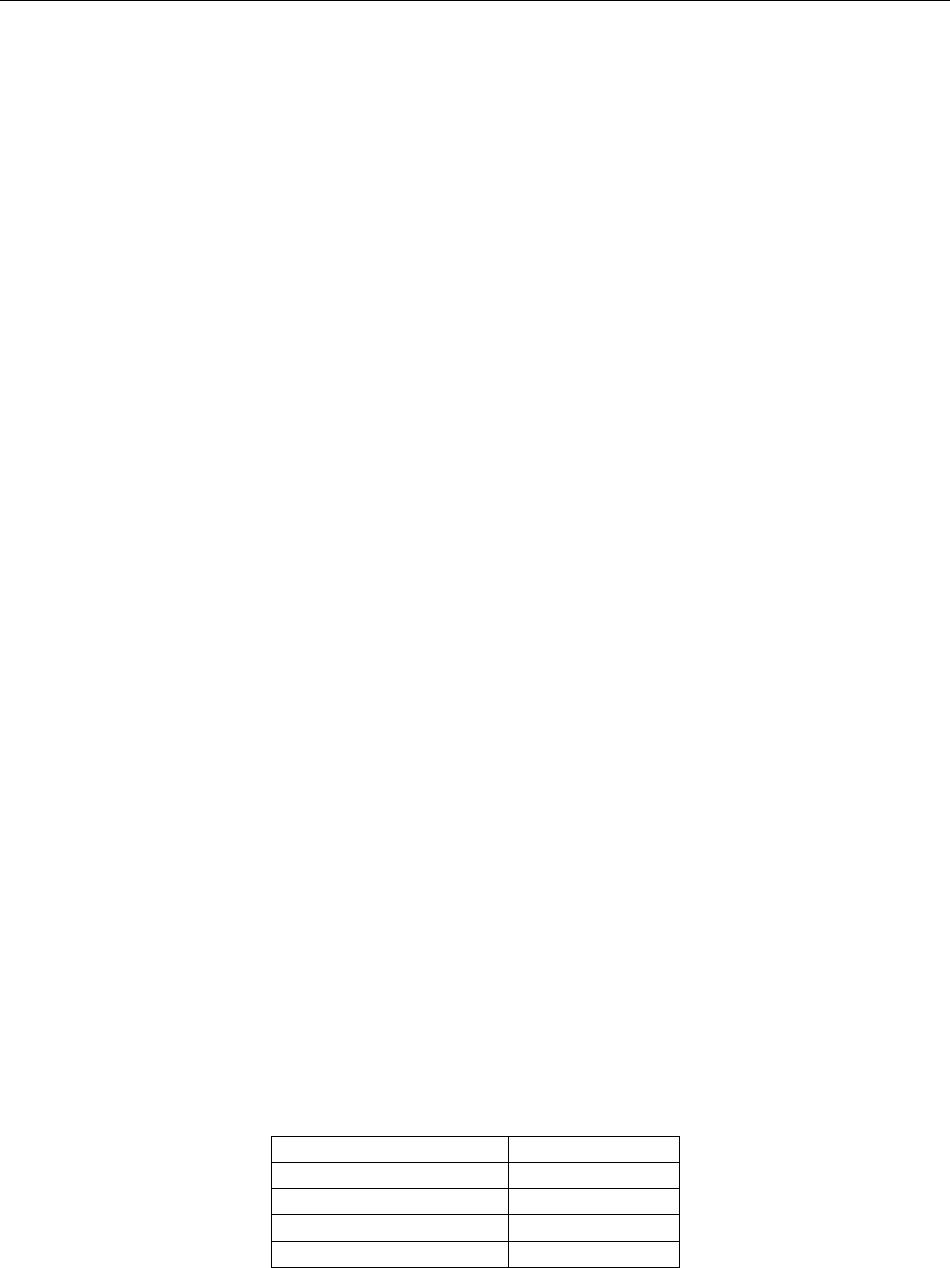
Date Expenditures
March 1, 2014 $ 1,200,000
April 1, 2014 1,680,000
May 1, 2014 3,000,000
June 1, 2014 4,800,000
Acquisition and Disposition of Property, Plant, and Equipment
10 – 19
The office was completed and ready for occupancy on July 1. To help pay for construction, and
purchase of land $2,400,000 was borrowed on March 1, 2014 on a 9%, 3-year note payable.
Other than the construction note, the only debt outstanding during 2014 was a $1,000,000, 12%,
6-year note payable dated January 1, 2014.
78. The weighted-average accumulated expenditures on the construction project during 2014
were
a. $1,280,000.
b. $9,780,000.
c. $1,040,000.
d. $2,320,000.
79. The actual interest cost incurred during 2014 was
a. $300,000.
b. $336,000.
c. $168,000.
d. $280,000.
80. Assume the weighted-average accumulated expenditures for the construction project are
$2,900,000. The amount of interest cost to be capitalized during 2014 is
a. $261,000.
b. $276,000.
c. $300,000.
d. $336,000.
81. During 2014, Bass Corporation constructed assets costing $3,000,000. The weighted-
average accumulated expenditures on these assets during 2014 was $1,800,000. To help
pay for construction, $1,320,000 was borrowed at 10% on January 1, 2014, and funds not
needed for construction were temporarily invested in short-term securities, yielding
$27,000 in interest revenue. Other than the construction funds borrowed, the only other
debt outstanding during the year was a $1,500,000, 10-year, 9% note payable dated
January 1, 2008. What is the amount of interest that should be capitalized by Bass during
2014?
a. $180,000.
b. $90,000.
c. $175,200.
d. $283,200.
Use the following information for questions 82 through 85.
On January 2, 2014, Indian River Groves began construction of a new citrus processing plant.
The automated plant was finished and ready for use on September 30, 2015. Expenditures for
the construction were as follows:
January 2, 2014
$ 400,000
September 1, 2014
1,200,000
December 31, 2014
1,200,000
March 31, 2015
1,200,000
September 30, 2015
800,000

Test Bank for Intermediate Accounting, Fifteenth Edition
10 – 20
Indian River Groves borrowed $2,200,000 on a construction loan at 12% interest on January 2,
2014. This loan was outstanding during the construction period. The company also had
$8,000,000 in 9% bonds outstanding in 2014 and 2015.
82. What were the weighted-average accumulated expenditures for 2014?
a. $1,066,667
b. $1,000,000
c. $800,000
d. $2,000,000
83. The interest capitalized for 2014 was:
a. $360,000
b. $96,000
c. $304,000
d. $120,000
84. What were the weighted-average accumulated expenditures for 2015 by the end of the
construction period?
a. $780,000
b. $3,270,000
c. $3,972,000
d. $2,772,000
85. The interest capitalized for 2015 was:
a. $249,480
b. $236,610
c. $ 51,480
d. $ 198,000
Use the following information to answer questions 86 – 90.
Arlington Company is constructing a building. Construction began on January 1 and was
completed on December 31. Expenditures were $4,800,000 on March 1, $3,960,000 on June 1,
and $6,000,000 on December 31. Arlington Company borrowed $2,400,000 on January 1 on a 5-
year, 12% note to help finance construction of the building. In addition, the company had
outstanding all year a 10%, 3-year, $4,800,000 note payable and an 11%, 4-year, $9,000,000
note payable.
86. What are the weighted-average accumulated expenditures?
a. $8,760,000
b. $6,310,000
c. $14,760,000
d. $7,380,000
87. What is the weighted-average interest rate used for interest capitalization purposes?
a. 11%
b. 10.85%
c. 10.5%
d. 10.65%