
Chapter 10: Long-Lived Tangible and Intangible Assets Key
1. With the exception of internally developed software costs, U.S. GAAP requires that the firm expense both
research and development expenditures as incurred.
2. Market-to-book-value ratios tend to be large for firms that make substantial expenditures on internally
developed assets, including research and development, advertising, and employee development.
3. U.S. GAAP and IFRS require firms to treat expenditures for maintenance and repairs as expenses of the
period as incurred but treat expenditures for improvements as assets (which firms subsequently depreciate or
amortize).
4. U.S. GAAP requires firms to expense research and development (R&D) costs in the period incurred.
5. Long-lived financial assets include investments in securities.
6. Firms must expense when incurred the transactions cost of acquiring a firm in a business combination under
both U.S. GAAP and IFRS.
7. Opportunity costs are forgone profits, and U.S. GAAP and IFRS recognize this cost as part of an assets
acquisition cost.
8. Firms sometimes acquire assets by exchanging an asset other than cash or by issuing common stock. In these
cases, acquisition cost is either the fair value of the consideration given or the fair value of the asset received,
depending on which value the firms can more reliably measure.
9. The capitalization of interest in the acquisition cost of assets during construction delays expense recognition
from the time periods of borrowing to the time periods of using the asset.
10. The amount of goodwill represents the excess of the total purchase price over the fair value of identifiable
tangible and intangible net assets.
11. The laws governing patent protection are both jurisdiction-specific and subject to change, as is the process
for obtaining approval to market a new drug. As a general rule, the longer the drug approval process, the longer
is the useful life of the patent.
12. Long-lived assets with extremely long useful lives, such as land and works of art, are treated as having an
indefinite life.
13. Depreciation is the accounting term used to refer to the periodic write-off of intangible assets.
14. Depreciation and amortization is a measure of the decline in economic value of a long-lived asset.
15. Although the legal life of a drug patent is 20 years, the expected economic life of the drug is often less than
half of that period.

16. The depreciable or amortizable basis of long-lived assets is the acquisition cost less salvage value.
17. For buildings, common depreciation practice assumes a zero salvage value on the assumption that the costs
a firm will incur in tearing down the building will approximate the sales value of the scrap materials recovered.
18. Expenditures for maintenance or repair of tangible long-lived assets are treated as asset improvements and
subsequently depreciated.
19. The straight-line (use) method is the most common depreciation method for financial reporting.
20. U.S. GAAP and IFRS provide firms considerable flexibility in choosing their depreciation method(s).
21. U.S. GAAP permits firms to increase the balance sheet carrying values of tangible and intangible long-lived
assets when the fair values of their assets increase.
22. IFRS permits upward asset revaluations, the recognition of unrealized increases in the fair value of
long-lived assets under certain conditions.
23. Tangible long-lived assets typically appear under the title Property, Plant, and Equipment, among the
current assets.
24. Gains and losses on disposals of property, plant, and equipment and intangible assets appear on the income
statement, often in “Other income and expense.”
25. U.S. GAAP and IFRS distinguish three categories of long-lived assets for purposes of measuring and
recognizing impairment losses.
26. Both U.S. GAAP and IFRS distinguish the same three categories of long-lived assets for impairment
analysis, and have the same procedures for assessing an asset for impairment and measuring the impairment
loss.
27. U.S. GAAP requires firms to recognize an impairment loss on a nonamortized intangible other than
goodwill whenever the carrying value of the asset exceeds its fair value.
28. Accounting for the impairment of long-lived assets is complex because U.S. GAAP and IFRS requirements
differ for various assets.
29. Firms with tangible long-term assets and predictable cash flows, such as electric utilities, tend to have
balance sheets with a
30. Firms with tangible long-term assets and less predictable cash flows, such as auto manufacturers and steel
companies, whose sales vary with changes in economic conditions, tend to use
31. During Year 3, Carrington Company made the following expenditures relating to plant machinery and
equipment:
·
Continuing, frequent, and low cost repairs
$46,000
·
Special long-term protection devices were attached to ten machines
11,000
·
A broken gear on a machine was replaced
5,000
How much should be charged to repairs and maintenance in Year 3?
32. Which of the following is/are not capitalized as an intangible asset?
33. Repairs and maintenance do not include
34. Flagler Corporation replaces a roof damaged in a hurricane. The new roof is purposefully designed to be
stronger than the old one so that it will support the air conditioning equipment the firm plans to install. Which
of the following is/are true?
35. Firms often incur costs to maintain, repair, and improve their tangible assets. U.S. GAAP and IFRS require
firms to treat expenditures for _____ as _____ as incurred but _____ treat as _____.
36. Which of the following is/are not true regarding maintenance?
37. Which of the following is/are not true regarding repairs?
38. Which of the following is not true regarding expenditures for improvements?
39. Which of the following is/are not true regarding expenditures for improvements?
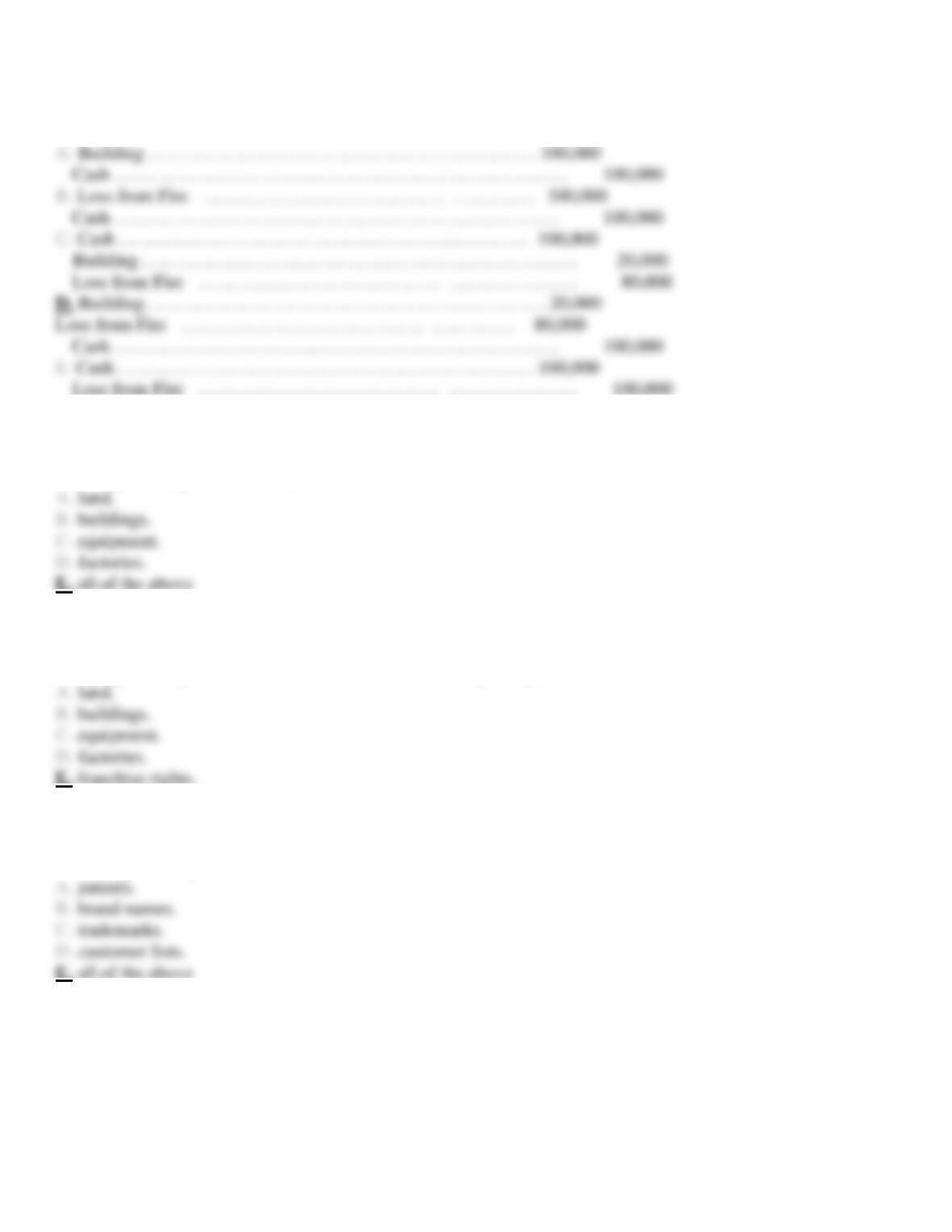
40. Sigma Company suffers a loss to its building in a fire and spends $100,000 on repairs and improvements. It
judges that $80,000 of the expenditure replaces long-lived assets lost in the fire, and $20,000 represents
improvements to the building. Which of the following is the single journal entry that Sigma Company will
make?
41. Tangible long-lived assets include
42. Tangible long-lived assets include all of the following except
43. Intangible long-lived assets include:
44. Firms treat expenditures as assets when they:
45. An expenditure qualifies as a(n) _____ if it has the following characteristics:
1. It embodies a probable future benefit.
2. A particular entity can obtain the benefit and control others’ access to it.
3. The transaction or other event giving rise to the entity’s right to, or control of, the benefit has already
occurred.
4. The fair value of the item at the time of initial recognition can be measured with sufficient reliability.
46. An expenditure qualifies as an asset if it has which of the following characteristics?
47. For many technology and pharmaceutical firms:
48. How are tangible long-lived assets’ acquisition cost and accumulated depreciation disclosed?
49. Why is analysis of intangible assets more challenging than the analysis of tangible long-lived assets?
50. Clarion Realty
Clarion Realty has decided to construct its own office building. The construction will be partially financed
through a construction loan and any remainder will be financed from internally generated funds. The internal
accountants have collected the following information concerning the construction.
Average Balance
Construction
Other
Year
Construction Account
Debt @ 6%
Debt @ 10%
1
$2,000,000
$1,000,000
$500,000
2
$4,000,000
$1,000,000
$250,000
3
$3,000,000
$800,000
$200,000
The amount, if any, of capitalized interest cost for Year 1 is
51. Clarion Realty
Clarion Realty has decided to construct its own office building. The construction will be partially financed
through a construction loan and any remainder will be financed from internally generated funds. The internal
accountants have collected the following information concerning the construction.
Average Balance
Construction
Other
Year
Construction Account
Debt @ 6%
Debt @ 10%
1
$2,000,000
$1,000,000
$500,000
2
$4,000,000
$1,000,000
$250,000
3
$3,000,000
$800,000
$200,000
The amount, if any, of capitalized interest cost for Year 2 is
52. Focus Company decided to construct its own manufacturing building. Focus Company should capitalize
which of the following interest costs?
53. The Perma Company spent $300,000 on research and development during Year 8 to generate new product
lines. One of the three projects looks like it will ultimately be technologically feasible while the other two
projects resulted in unsuccessful efforts. For the project which may become technologically feasible, a total of
$125,000 was incurred during Year 8. Under U. S. GAAP, how much of the $300,000 should be recognized as
an expense in Year 8?
54. Firms that incur research and development costs to develop a patented product:
55. In a corporate acquisition the:
56. Firms generally treat expenditures to develop intangibles internally as
57. Firms treat expenditures to develop intangibles internally as assets under U.S. GAAP when _____ the
point of technological feasibility; and under IFRS when _____ the point of technological feasibility.
58. Firms recognize expenditures to acquire intangibles externally from third parties as _____ if the intangibles
are either separable or arise from contractual or other legal rights.
59. Springfield Company purchases new factory equipment. Per the terms of the contract, Springfield must pay
the freight charges, will receive a manufacturer’s discount off the invoice price on the equipment, and will have
some setup expenses to pay. As a result, the acquisition cost of equipment recorded on Springfield’s books will
be the sum of the invoice price
60. Firms sometimes acquire assets by exchanging an asset other than cash or by issuing common stock. In
these cases, acquisition cost is
61. When a firm constructs its own buildings or equipment:
62. The capitalization of interest in the acquisition cost of assets during construction
63. Assume the following long-term debt structure for Parton Stores:
Construction Loan at 5% on Building Under Construction . . . . . . . ..$2,000,000
Other Borrowings at 6% Average Rate . . . . . . . . . . . . . . . . . . . . . . . . .7,200,000
Total Long-Term Debt . . . . . . . . . . . . . . . . . . . . . . . . . . . . . . . . . . . . $9,200,000
The account Building Under Construction has an average balance during the year of $6,000,000. Parton Stores
bases the amount of interest capitalized on the new construction-related borrowing, $2,000,000, and enough of
the other borrowing to bring the total to $6,000,000.
How much does Parton Stores capitalize interest on the new construction?
64. The _____ of a long-lived asset is the cost of a series of future services.
65. Which of the following is/are intangible assets with a finite useful life?
66. Which of the following is not true regarding long-lived assets with a finite life?
67. Which of the following is/are true regarding long-lived assets with a finite life?
68. The cost of long-lived assets with an indefinite life
69. Long-lived assets with an indefinite life include:
70. Depreciation is the accounting term used to refer to
71. Which of the following is/are true about goodwill?
72. Which of the following is not true about goodwill?
73. Which of the following is not true about goodwill?
74. Which of the following is/are true about holding gains on assets?
75. Which of the following is/are true about holding gains on assets?
76. Which of the following is/are true regarding the fair value of long-lived assets?
77. Which of the following is/are not true regarding the fair value of long-lived assets?
78. Which of the following is/are true regarding measuring changes in the fair values of long-lived assets?
79. Goodwill that was internally developed should be amortized over a life not to exceed
80. (CMA adapted, Dec 86 #12) A patent is granted by the federal government to an inventor for a period of
several years. Costs that are capitalized with regard to a patent would include
81. The Llama Company spent $300,000 on research and development during Year 8 to generate new product
lines. One of the three projects resulted in a successful patented product while the other two projects resulted in
unsuccessful efforts. How much of the $300,000 should be recognized as an expense in Year 8?
82. Montana Company reports its net assets at a book value of $150,000. Recent investigation revealed that the
net assets had a market value of $175,000. In addition, Montana had been offered $220,000 for the net assets by
a company named Supply.Com. What is the amount of goodwill that should be recorded by Montana Co.?
83. U.S. GAAP and IFRS distinguish three categories of long-lived assets for purposes of measuring and
recognizing impairment losses. The first category addresses long-lived assets except intangible assets not
subject to amortization and goodwill. This category does not include:
84. Firms with high proportions of intangibles, whether recognized as assets on the balance sheet or not, tend to
rely more on
85. Intangible assets make up 40 percent of the total assets of a particular firm. This firm is most likely to be:
86. U.S. GAAP and IFRS distinguish three categories of long-lived assets for purposes of measuring and
recognizing impairment losses. The second category addresses intangibles, other than goodwill, not subject to
amortization. This category does not include:
88. Depreciation and amortization expenses appear in the income statement, and are sometimes
89. The financial statements and notes provide information for analyzing changes in property, plant, and
equipment. What ratio(s) is/are used by analysts?
90. First Third Company depreciates an asset with a cost of $55,000 over 10 years using the straight-line
method of depreciation and the yearly depreciation expense is $4,000, what is the estimated salvage value of the
asset?
91. Which method of depreciation will result in the greatest depreciation charge in the last year of the asset’s
life?
93. When calculating the depreciation or amortization of long-lived assets management must
94. The terms salvage value and residual value refer to the estimated proceeds on the disposition of an
95. Which of the following is/are not true?
96. Some assets, such as a nuclear power plant, are not readily salable at the end of their useful lives, and
retiring them may impose substantial costs. Which of the following is/are true?
97. Some assets, such as a space shuttle, are not readily salable at the end of their useful lives, and retiring them
may impose substantial costs. Which of the following is true?