10-1: Variable and Absorption Costing
Varilux manufactures a single product and sells it for $10 per unit. At the beginning of the
year there were 1,000 units in inventory. Upon further investigation, you discover that units
produced last year had $3.00 of fixed manufacturing cost and $2.00 of variable manufacturing
cost. During the year Varilux produced 10,000 units of product. Each unit produced generated
$3.00 of variable manufacturing cost. Total fixed manufacturing cost for the current year was
$40,000. There were no inventories at the end of the year.
Required:
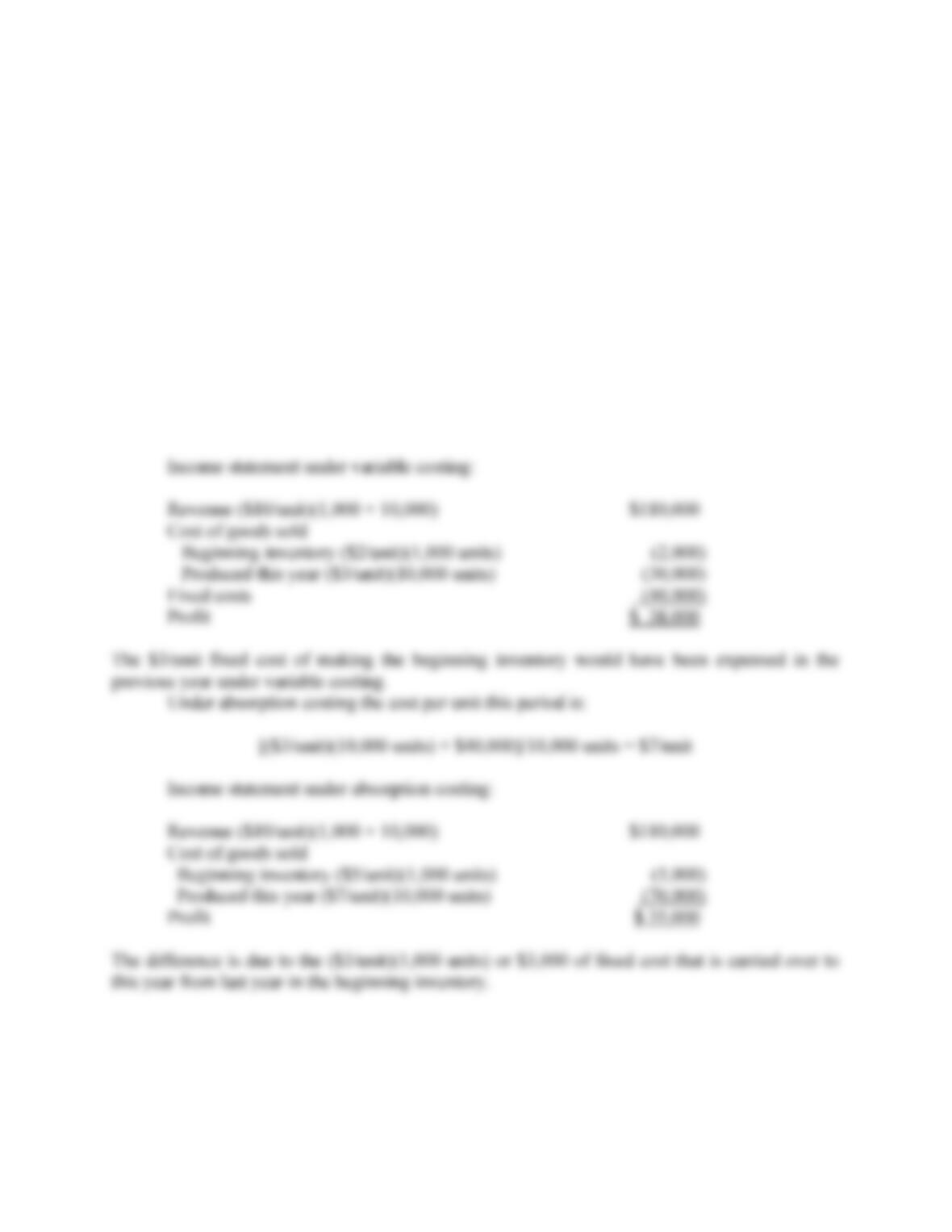
Prepare two income statements for the current year, one on a variable cost basis and the
other on an absorption cost basis. Explain any difference between the two net income numbers
and provide calculations supporting your explanation of the difference.
10-1: Solution to Variable and Absorption Costing (15 minutes)
10-2: Average Costs and Variable Costs as Performance Measures
The manager of the manufacturing unit of a company is responsible for the costs of the
manufacturing unit. The president is in the process of deciding whether to evaluate the manager
of the manufacturing unit by the average cost per unit or the variable cost per unit. Quality and
timely delivery would be used in conjunction with the cost measure to reward the manager.
Required:
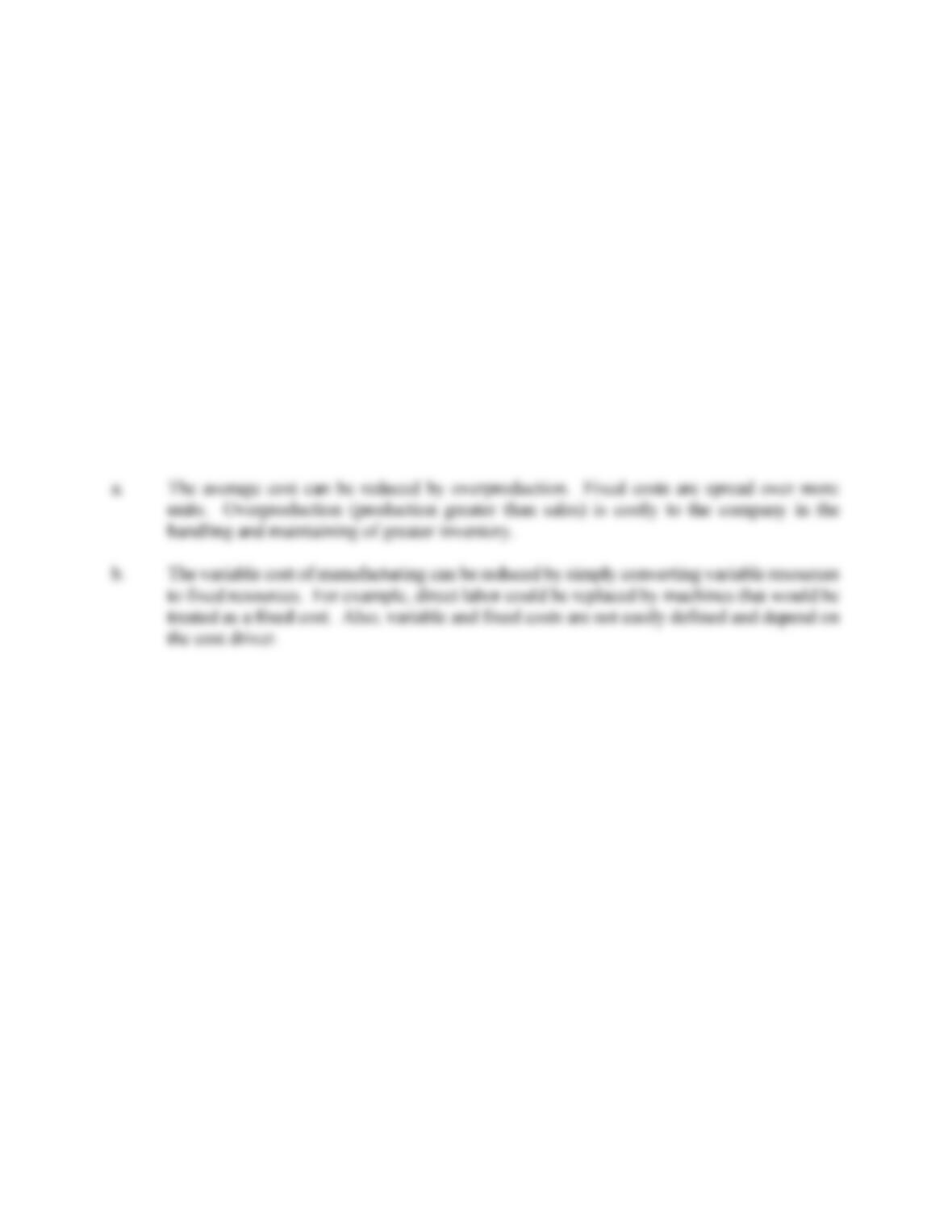
a. What problems are associated with using the average cost per unit as a performance
measure?
b. What problems are associated with using the variable cost per unit as a performance
measure?
10-2: Solution to Average Costs and Variable Costs as Performance Measures (10 minutes)
10-3: An Extreme Version of Variable Costing
Eli Goldratt advocates that all manufacturing costs other than materials be treated as
operating expenses for the period. Periodic profits would be calculated as:
Sales
xxx
Less cost of material
xxx
Less all nonmaterial operating expense
xxx
Net income
xxx
Operating data for last year are
Units produced
12,000
Unit sales
10,000
Material cost/unit produced
$0.45 per unit
Labor cost/unit produced
0.35
Overhead/unit produced
0.38
There is no beginning inventory.
Required:
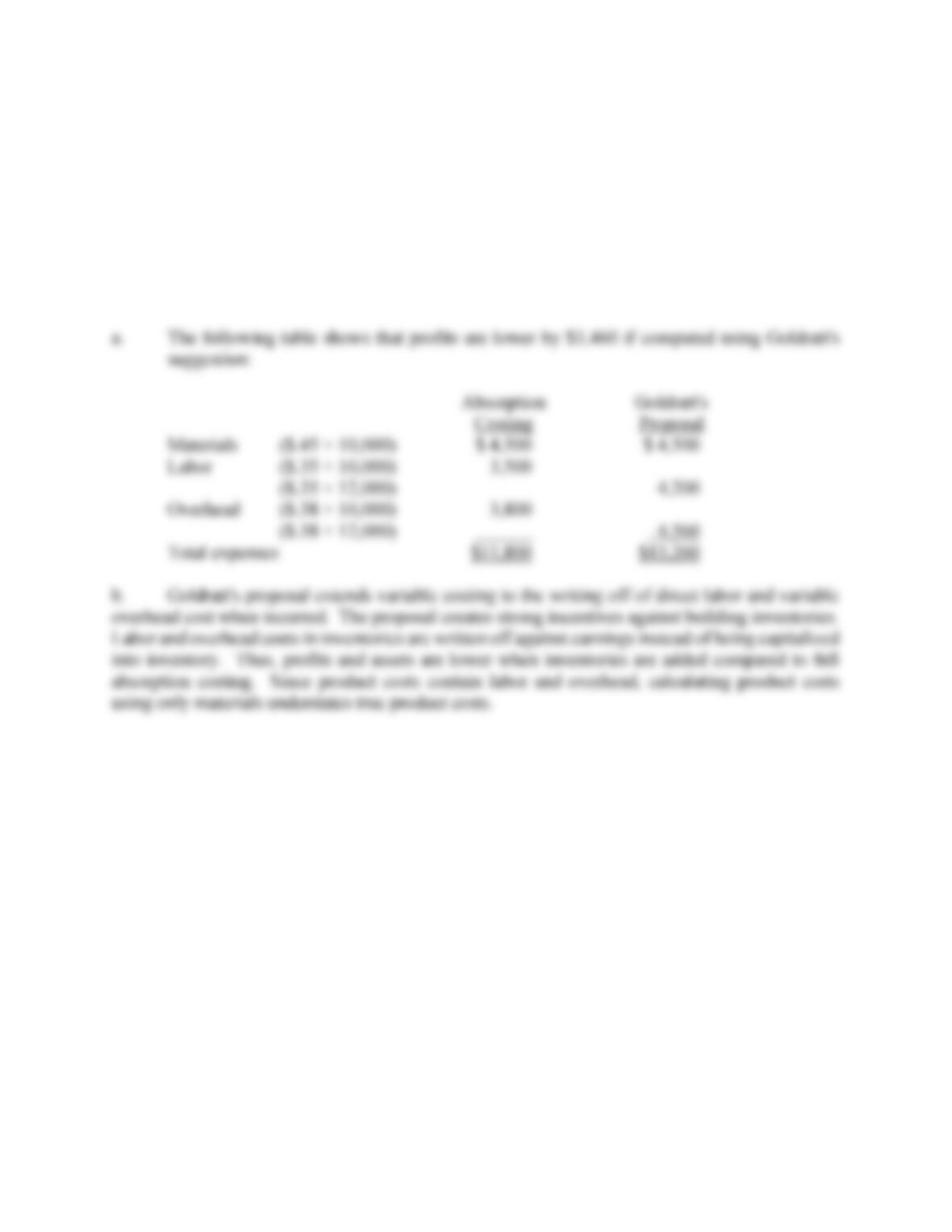
a. Compare profits under absorption costing and Goldratt’s method.
b. Evaluate Goldratt’s proposal.
10–3: Solution to An Extreme Version of Variable Costing (20 minutes)
10-4: Absorption Costing’s Effect on Earnings when Volumes Fluctuate
BBG Corporation is a manufacturer of a synthetic chemical. Gary Voss, president of the
company, has been eager to get the operating results for the just-completed fiscal year. He was
surprised when the income statement revealed that income before taxes had dropped to $885,500
from $900,000, even though sales volume had increased by 100,000 kilograms. The drop in net
income occurred even though Voss had implemented two changes during the past 12 months to
improve the company’s profitability:
1. In response to a 10 percent increase in production costs, the sales price of the
company’s product was increased by 12 percent. This action took place on
December 1, 1994, the first day of the current fiscal year.
2. The managers of the selling and administrative departments were given strict
instructions to spend no more in the current fiscal year than last year.

BBG’s accounting department prepared and distributed to top management the comparative
income statements presented below.
BBG CORPORATION
Statements of Operating Income
For the Years Ended November 30
($000s)
Last
Year
Current
Year
Sales revenue
$9,000
$11,200
Cost of goods sold
$7,200
$ 8,320
Under/overabsorbed overhead
(600)
495
Adjusted cost of goods sold
$6,600
$8,815
Gross margin
$2,400
$2,385
Selling and administrative expenses
1,500
1,500
Income before taxes
$900
$885
The accounting staff also prepared related financial information to assist management in
evaluating the company’s performance. BBG uses the FIFO inventory method for finished goods.
Budgeted and fixed overhead are equal and the beginning inventory last year has $3.00/kg. of fixed
overhead.
BBG CORPORATION
Selected Operating and Financial Data
Last Year
Current Year
Sales price
$10.00/kg.
$11.20/kg.
Material cost
1.50/kg.
1.65/kg.
Direct labor cost
2.50/kg.
2.75/kg.
Variable overhead cost
1.00/kg.
1.10/kg.
Fixed overhead cost
3.00/kg.
3.30/kg.
Total fixed overhead costs
$3,000,000
$3,300,000
Normal production volume
1,000,000 kg.
1,000,000 kg.
Selling and administrative
(all fixed)
$1,500,000
$1,500,000
Sales volume
900,000 kg.
1,000,000 kg.
Beginning inventory
300,000 kg.
600,000 kg.
Production
1,200,000 kg.
850,000 kg.
Required:
a. Explain to Gary Voss why BBG Corporation’s net income decreased in the current fiscal
year despite the sales price and sales volume increases.
b. A member of BBG’s accounting department has suggested that the company adopt variable
(direct) costing for internal reporting purposes.
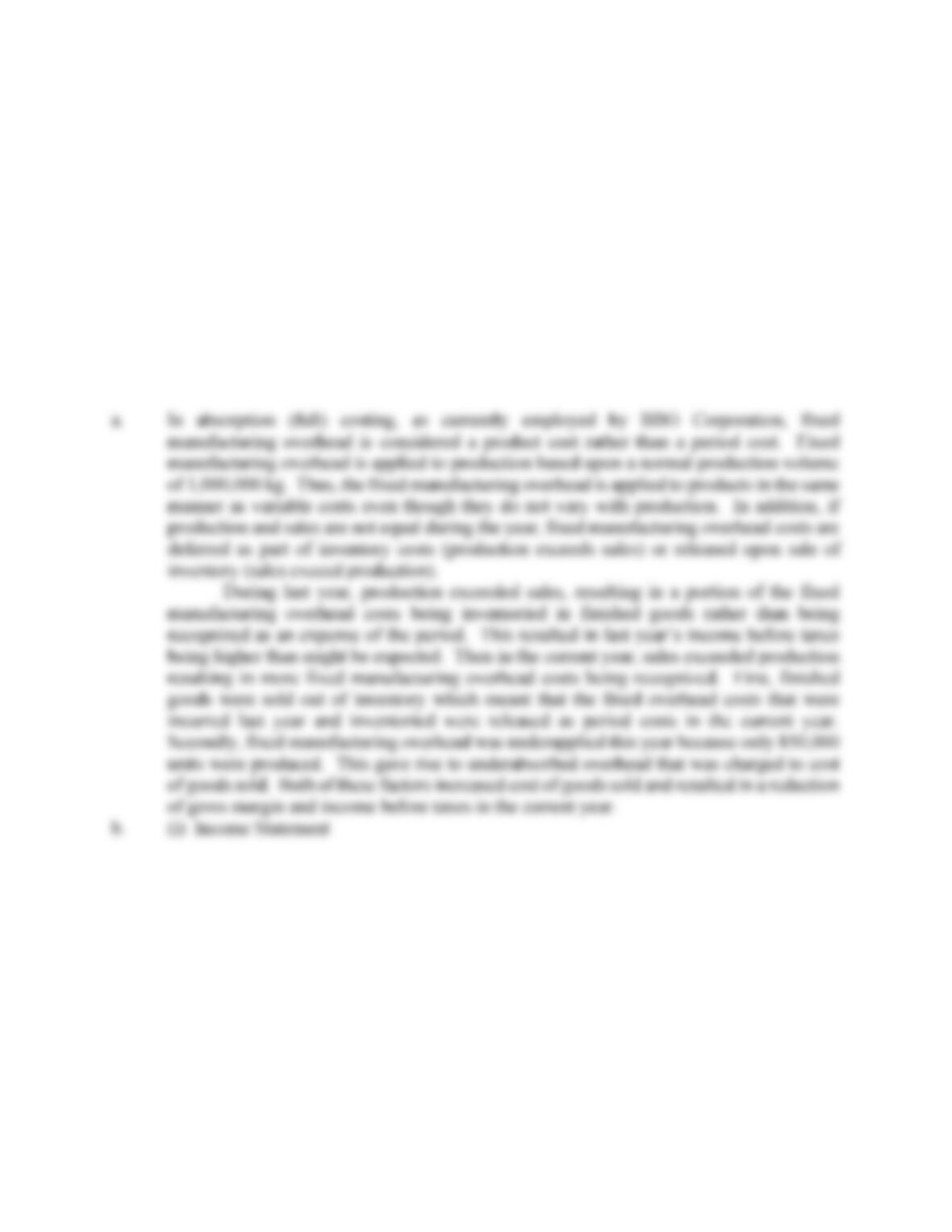
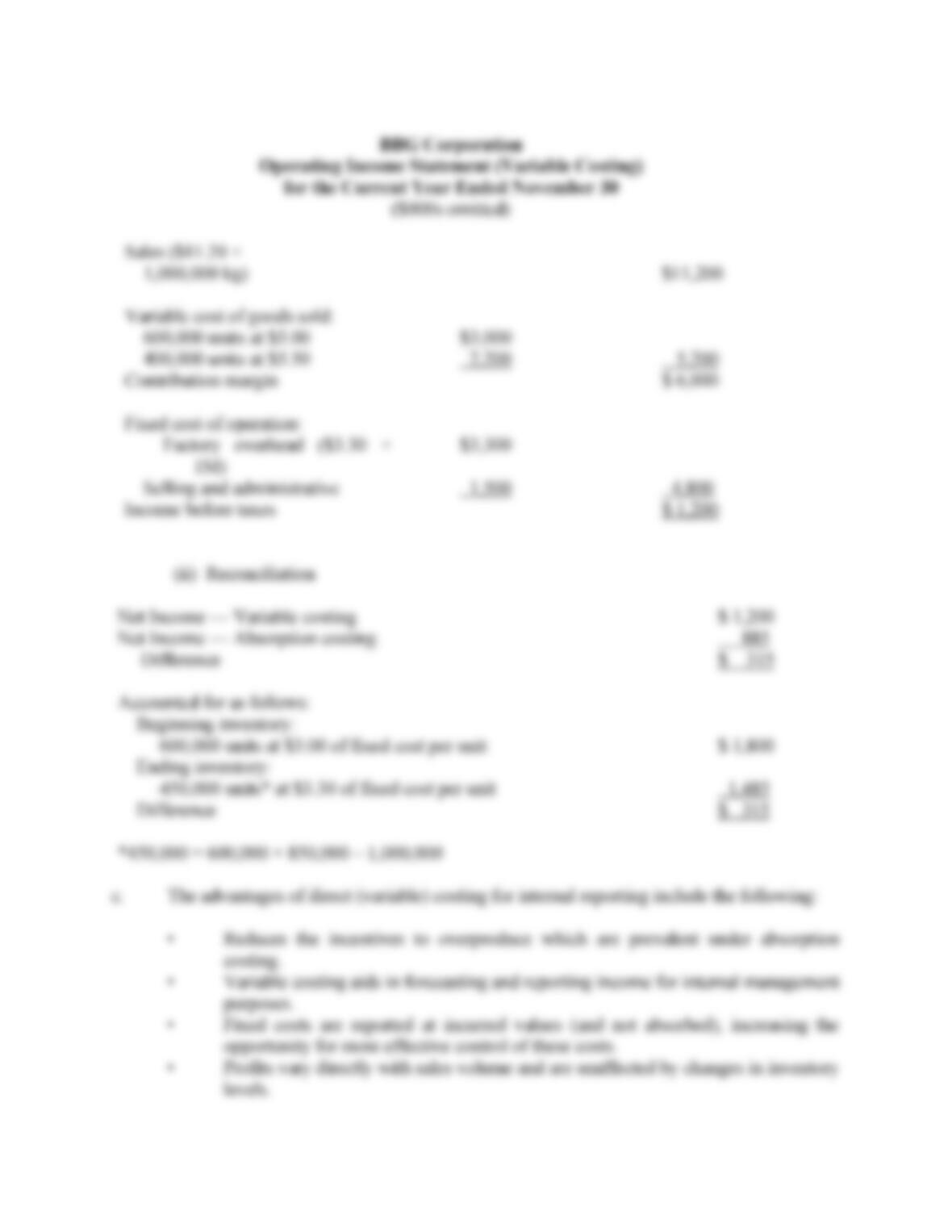
(i) Prepare an operating income statement through income before taxes for the current
year ended November 30, using the variable (direct) costing method.
(ii) Present a numerical reconciliation of the difference in income before taxes using
the absorption costing method as currently employed by BBG and the proposed
variable costing method.
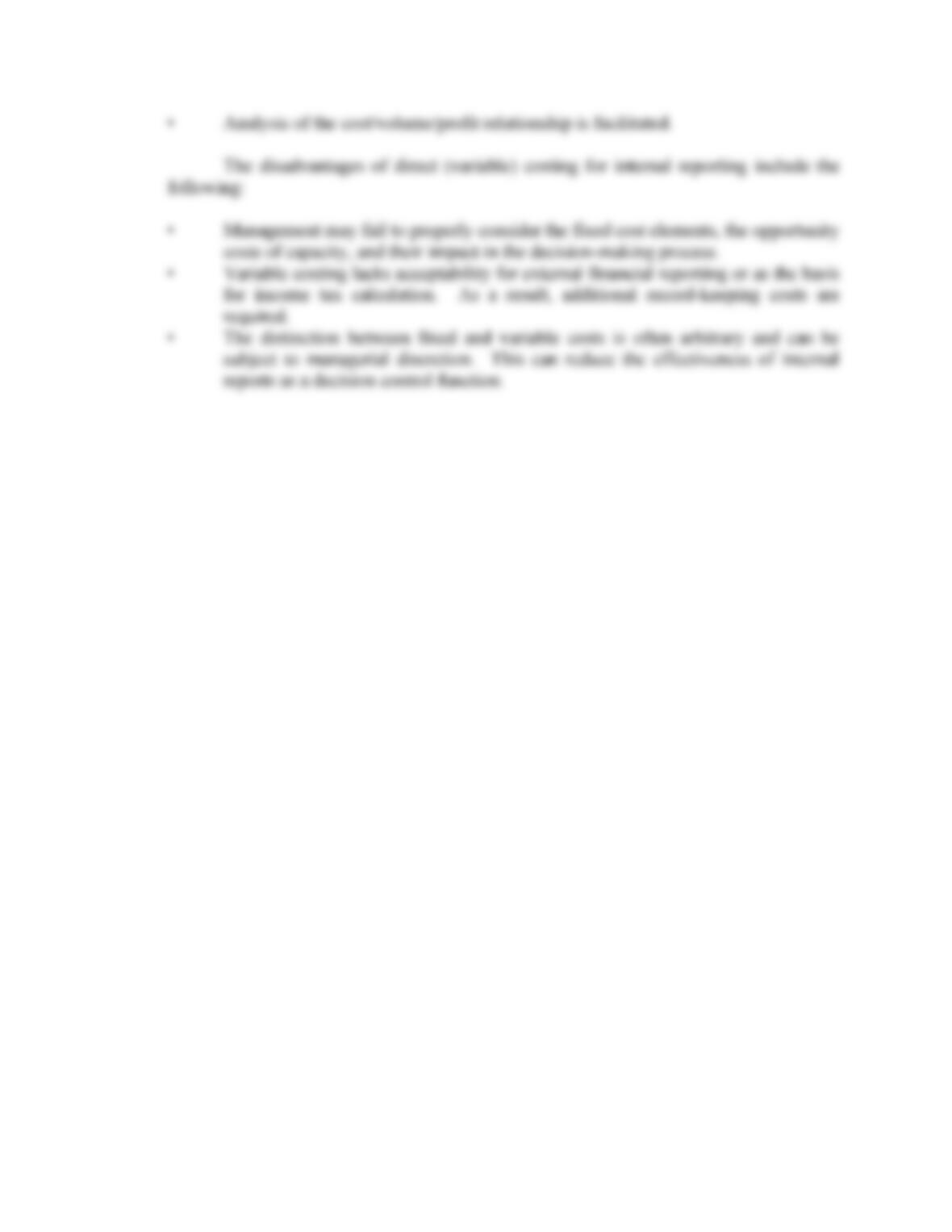
c. Identify and discuss the advantages and disadvantages of using variable costing for internal
reporting purposes.
Source: CMA adapted.
10–4: Solution to Absorption Costing’s Effect on Earnings When Volumes Fluctuate (CMA
adapted) (50 minutes)