Chemistry: The Central Science, 12e (Brown et al.)
Chapter 10 Gases
10.1 Multiple Choice Questions
1) Which of the following statements about gases is false?
A) Gases are highly compressible.
B) Distances between molecules of gas are very large compared to bond distances within molecules.
C) Non-reacting gas mixtures are homogeneous.
D) Gases expand spontaneously to fill the container they are placed in.
E) All gases are colorless and odorless at room temperature.
2) Of the following, __________ has a slight odor of bitter almonds and is toxic.
A) NH3
B) N2O
C) CO
D) CH4
E) HCN
3) Of the following, __________ has the odor of rotting eggs.
A) NH3
B) H2S
C) CO
D) NO2
E) HCN
4) One significant difference between gases and liquids is that __________.
A) a gas is made up of molecules
B) a gas assumes the volume of its container
C) a gas may consist of both elements and compounds
D) gases are always mixtures
E) All of the above answers are correct.
5) Molecular compounds of low molecular weight tend to be gases at room temperature. Which of the
following is most likely not a gas at room temperature?
A) Cl2
B) HCl
C) LiCl
D) H2
E) CH4
6) Gaseous mixtures __________.
A) can only contain molecules
B) are all heterogeneous
C) can only contain isolated atoms
D) are all homogeneous
E) must contain both isolated atoms and molecules
7) Which of the following equations shows an incorrect relationship between pressures given in terms of
different units?
A) 1.20 atm = 122 kPa
B) 152 mm Hg = 2.03 × 10⁴Pa
C) 0.760 atm = 578 mm Hg
D) 1.0 torr = 2.00 mm Hg
E) 1.00 atm = 760 torr
8) The pressure exerted by a column of liquid is equal to the product of the height of the column times
the gravitational constant times the density of the liquid, P = ghd. How high a column of water (d = 1.0
g/mL) would be supported by a pressure that supports a 713 mm column of mercury (d = 13.6 g/mL)?
A) 14 mm
B) 52 mm
C) 713 mm
D) 1.2 × 104 mm
E) 9.7 × 103 mm
9) The pressure exerted by a column of liquid is equal to the product of the height of the column times
the gravitational constant times the density of the liquid, P = ghd. How high a column of methanol (d =
0.79 g/mL) would be supported by a pressure that supports a 713 mm column of mercury (d = 13.6
g/mL)?
A) 713 mm
B) 41 mm
C) 1.2 × 104 mm
D) 9.7 × 103 mm
E) 17 mm
10) If one was told that their blood pressure was 130/80, their systolic pressure was __________.
A) 130 Pa
B) 130 mm Hg
C) 80 Pa
D) 80 mm Hg
E) 80 psi
11) Which statement about atmospheric pressure is false?
A) As air becomes thinner, its density decreases.
B) Air actually has weight.
C) With an increase in altitude, atmospheric pressure increases as well.
D) The warmer the air, the lower the atmospheric pressure.
E) Atmospheric pressure prevents water in lakes, rivers, and oceans from boiling away.
12) In ideal gas equation calculations, expressing pressure in Pascals (Pa), necessitates the use of the gas
constant, R, equal to __________.
A) 0.08206 atm L mol-1K-1
B) 8.314 J mol-1K-1
C) 62.36 L torr mol-1K-1
D) 1.987 cal mol-1K-1
E) none of the above
13) The first person to investigate the relationship between the pressure of a gas and its volume was
__________.
A) Amadeo Avogadro
B) Lord Kelvin
C) Jacques Charles
D) Robert Boyle
E) Joseph Louis Gay-Lussac
14) Of the following, __________ is a correct statement of Boyle’s law.
A) PV = constant
B)
P
V
= constant
C)
V
P
= constant
D)
V
T
= constant
E)
n
P
= constant
15) “Isothermal” means __________.
A) at constant pressure
B) at constant temperature
C) at variable temperature and pressure conditions
D) at ideal temperature and pressure conditions
E) that
rxn
H
= 0
16) Of the following, __________ is a valid statement of Charles’ law.
A)
P
T
= constant
B)
V
T
= constant
C) PV = constant
D) V = constant × n
E) V = constant × P
17) Which one of the following is a valid statement of Avogadro’s law?
A)
P
T
= constant
B)
V
T
= constant
C) PV = constant
D) V = constant × n
E) V = constant × P
18) The volume of an ideal gas is zero at __________.
A) 0 °C
B) -45 °F
C) -273 K
D) -363 K
E) -273 °C
19) Of the following, only __________ is impossible for an ideal gas.
A)
12
12
VV
=
TT
B) V1T1 = V2T2
C)
11
22
VT
=
VT
D)
2
21
1
T
V = V
T
E)
11
22
VT
=0
VT
=
20) The molar volume of a gas at STP is __________ L.
A) 0.08206
B) 62.36
C) 1.00
D) 22.4
E) 14.7
21) How many moles of gas are there in a 45.0 L container at 25.0°C and 500.0 mm Hg?
A) 0.630
B) 6.11
C) 18.4
D) 1.21
E) 207
22) How many moles of gas are there in a 50.0 L container at 22.0°C and 825 torr?
A) 2.29 × 10⁴
B) 1.70 × 10³
C) 2.23
D) 0.603
E) 18.4
23) Standard temperature and pressure (STP), in the context of gases, refers to __________.
A) 298.15 K and 1 atm
B) 273.15 K and 1 atm
C) 298.15 K and 1 torr
D) 273.15 K and 1 pascal
E) 273.15 K and 1 torr
24) The volume of 1.20 mol of gas at 61.3 kPa and 25.0°C is __________ L.
A) 135
B) 48.5
C) 52.4
D) 108
E) 55.7
25) Sodium bicarbonate is reacted with concentrated hydrochloric acid at 37.0°C and 1.00 atm. The
reaction of 6.00 kg of bicarbonate with excess hydrochloric acid under these conditions will produce
__________ L of CO2.
A) 1.09 × 10²
B) 2.85 × 10⁴
C) 1.82 × 10⁴
D) 8.70 × 10²
E) 1.82 × 10³
26) Sodium bicarbonate is reacted with concentrated hydrochloric acid at 25.0°C and 1.50 atm. The
reaction of 7.75 kg of bicarbonate with excess hydrochloric acid under these conditions will produce
__________ L of CO2.
A) 1.82 x 10³
B) 2.85 x 10⁴
C) 1.82 x 10⁴
D) 1.50 x 10³
E) 8.70 x 10²
27) The volume of a sample of gas (2.49 g) was 752 mL at 1.98 atm and 62°C. The gas is __________.
A) SO2
B) SO3
C) NH3
D) NO2
E) Ne
28) The density of __________ is 0.900 g/L at STP.
A) CH4
B) Ne
C) CO
D) N2
E) NO
29) The density of NO2 in a 3.50 L tank at 780.0 torr and 37.0°C is __________ g/L.
A) 1.64
B) 9.30
C) 1.86
D) 2.92
E) 3.27
30) The density of NO2 in a 4.50 L tank at 760.0 torr and 25.0°C is __________ g/L.
A) 1.64
B) 9.30
C) 1.68
D) 1.88
E) 3.27
31) The density (in g/L) of CO2 at 1140 torr and 60.0°C is __________.
A) 2.42
B) 16.2
C) 5.70
D) 44.0
E) 10.9
32) Of the following gases, __________ has density of 2.104 g/L at 303 K and 1.31 atm.
A) He
B) Ne
C) Ar
D) Kr
E) Xe
33) A 255 mL round-bottom flask is weighed and found to have a mass of 114.85 g. A few milliliters of
an easily vaporized liquid are added to the flask and the flask is immersed in a boiling water bath. All of
the liquid vaporizes at the boiling temperature of water, filling the flask with vapor. When all of the
liquid has vaporized, the flask is removed from the bath, cooled, dried, and reweighed. The new mass of
the flask and the condensed vapor is 115.23 g. Which of the following compounds could the liquid be?
(Assume the ambient pressure is 1 atm.)
A) C4H10
B) C3H7OH
C) C2H6
D) C2H5OH
E) C4H9OH
34) A sample of an unknown volatile liquid was injected into a Dumas flask (mflask = 27.0928 g,
Vflask = 0.1040 L) and heated until no visible traces of the liquid could be found. The flask and its
contents were then rapidly cooled and reweighed (mflask+vapor = 27.4593 g). The atmospheric pressure
and temperature during the experiment were 0.976 atm and 18.0 °C, respectively. The unknown volatile
liquid was __________.
A) C6H12
B) C6H14
C) C7H14
D) C7H16
E) C6H6
35) The density of air at STP is 1.285 g/L. Which of the following cannot be used to fill a balloon that
will float in air at STP?
A) CH4
B) NO
C) Ne
D) N H3
E) HF
36) Removal of __________ from the natural gas both purifies the natural gas and serves as an
alternative method of production of an industrially important chemical element.
A) CO2
B) H2S
C) NH3
D) As2O3
E) He
37) 10.0 grams of argon and 20.0 grams of neon are placed in a 1200.0 ml container at 25.0°C. The
partial pressure of neon is __________ atm.
A) 20.4
B) 8.70
C) 0.700
D) 3.40
E) 5.60
38) 30.0 grams of argon and 15.0 grams of xenon are placed in a 120.0 ml container at 22.0°C. The
partial pressure of xenon is __________ atm.
A) 8.70
B) 22.9
C) 0.700
D) 174
E) 5.60
39) A mixture of Xe, Kr, and Ar has a total pressure of 6.70 atm. What is the mole fraction of Kr if the
partial pressures of Xe and Ar are 1.60 atm and 2.80 atm, respectively.
A) 0.174
B) 0.256
C) 0.343
D) 0.481
E) 0.570
40) The average kinetic energy of the particles of a gas is directly proportional to __________.
A) the rms speed
B) the square of the rms speed
C) the square root of the rms speed
D) the square of the particle mass
E) the particle mass
41) The kinetic-molecular theory predicts that pressure rises as the temperature of a gas increases
because __________.
A) the average kinetic energy of the gas molecules decreases
B) the gas molecules collide more frequently with the wall
C) the gas molecules collide less frequently with the wall
D) the gas molecules collide more energetically with the wall
E) both the gas molecules collide more frequently with the wall and the gas molecules collide more
energetically with the wall
42) According to kinetic-molecular theory, in which of the following gases will the root-mean-square
speed of the molecules be the highest at 200°C?
A) HCl
B) Cl2
C) H2O
D) SF6
E) None. The molecules of all gases have the same root-mean-square speed at any given temperature.
43) According to kinetic-molecular theory, if the temperature of a gas is raised from 100°C to 200°C,
the average kinetic energy of the gas will __________.
A) double
B) increase by a factor of 1.27
C) increase by a factor of 100
D) decrease by half
E) decrease by a factor of 100
44) Which of the following is not part of the kinetic-molecular theory?
A) Atoms are neither created nor destroyed by ordinary chemical reactions.
B) Attractive and repulsive forces between gas molecules are negligible.
C) Gases consist of molecules in continuous, random motion.
D) Collisions between gas molecules do not result in the loss of energy.
E) The volume occupied by all of the gas molecules in a container is negligible compared to the volume
of the container.
45) Of the following gases, __________ will have the greatest rate of effusion at a given temperature.
A) NH3
B) CH4
C) Ar
D) HBr
E) HCl
46) The root-mean-square speed of H2S at 26.0°C is __________ m/sec.
A) 334
B) 62.4
C) 468
D) 751
E) 214
47) A tank containing both HF and HBr gases developed a leak. The ratio of the rate of effusion of HF
to the rate of effusion of HBr is __________.
A) 4.04
B) 0.247
C) 2.01
D) 0.497
E) 16.3
48) At 333 K, which of the pairs of gases below would have the most nearly identical rates of effusion?
A) N2O and NO2
B) CO and N2
C) N2 and O2
D) CO and CO2
E) NO2 and N2O4
49) At STP, the ratio of the root-mean-square speed of CO2 to that of SO2 is __________.
A) 2.001
B) 2.119
C) 1.000
D) 1.207
E) 1.456
50) Arrange the following gases in order of increasing average molecular speed at 25°C.
He, O2, CO2, N2
A) He < N2 < O2 < CO2
B) He < O2 < N2 < CO2
C) CO2 < O2 < N2 < He
D) CO2 < N2 < O2 < He
E) CO2 < He < N2 < O2
51) Arrange the following gases in order of increasing average molecular speed at 25°C.
Cl2, O2, F2, N2
A) Cl2 < F2 < O2 < N2
B) Cl2 < O2 < F2 < N2
C) N2 < F2 < Cl2 < O2
D) Cl2 < F2 < N2 < O2
E) F2 < O2 < N2 < Cl2
52) Which one of the following gases would have the highest average molecular speed at 25°C?
A) O2
B) N2
C) CO2
D) CH4
E) SF6
53) A sample of oxygen gas (O2) was found to effuse at a rate equal to three times that of an unknown
gas. The molecular weight of the unknown gas is __________ g/mol.
A) 288
B) 96
C) 55
D) 4
E) 10.7
54) A sample of oxygen gas was found to effuse at a rate equal to two times that of an unknown gas.
The molecular weight of the unknown gas is __________ g/mol.
A) 64
B) 128
C) 8
D) 16
E) 8.0
55) A mixture of two gases was allowed to effuse from a container. One of the gases escaped from the
container 1.43 times as fast as the other one. The two gases could have been __________.
A) CO and SF6
B) O2 and Cl2
C) CO and CO2
D) Cl2 and SF6
E) O2 and SF6
56) A mixture of carbon dioxide and an unknown gas was allowed to effuse from a container. The
carbon dioxide took 1.25 times as long to escape as the unknown gas. Which one could be the unknown
gas?
A) Cl2
B) CO
C) HCl
D) H2
E) SO2
57) How much faster does 235UF6 effuse than 238UF6?
A) 1.013 times as fast
B) 1.009 times as fast
C) 1.004 times as fast
D) 1.006 times as fast
E) 1.018 times as fast
58) An ideal gas differs from a real gas in that the molecules of an ideal gas __________.
A) have no attraction for one another
B) have appreciable molecular volumes
C) have a molecular weight of zero
D) have no kinetic energy
E) have an average molecular mass
14
59) A real gas will behave most like an ideal gas under conditions of __________.
A) high temperature and high pressure
B) high temperature and low pressure
C) low temperature and high pressure
D) low temperature and low pressure
E) STP
60) Which one of the following gases would deviate the least from ideal gas behavior?
A) Ne
B) CH3Cl
C) Kr
D) CO2
E) F2
61) Which noble gas is expected to show the largest deviations from the ideal gas behavior?
A) helium
B) neon
C) argon
D) krypton
E) xenon
62) The van der Waals equation for real gases recognizes that __________.
A) gas particles have non-zero volumes and interact with each other
B) molar volumes of gases of different types are different
C) the non-zero volumes of gas particles effectively decrease the amount of “empty space” between
them
D) the molecular attractions between particles of gas decreases the pressure exerted by the gas
E) all of the above statements are true
63) When gases are treated as real, via use of the van der Waals equation, the actual volume occupied by
gas molecules __________ the pressure exerted and the attractive forces between gas molecules
__________ the pressure exerted, as compared to an ideal gas.
A) decreases, increases
B) increases, increases
C) increases, decreases
D) does not affect, decreases
E) does not affect, increases
10.2 Bimodal Questions
1) A gas at a pressure of 10.0 Pa exerts a force of __________ N on an area of 5.5 m2.
A) 55
B) 0.55
C) 5.5
D) 1.8
E) 18
2) A gas at a pressure of 325 torr exerts a force of __________ N on an area of 5.5 m2.
A) 1.8 × 10³
B) 59
C) 2.4 × 10⁵
D) 0.018
E) 2.4
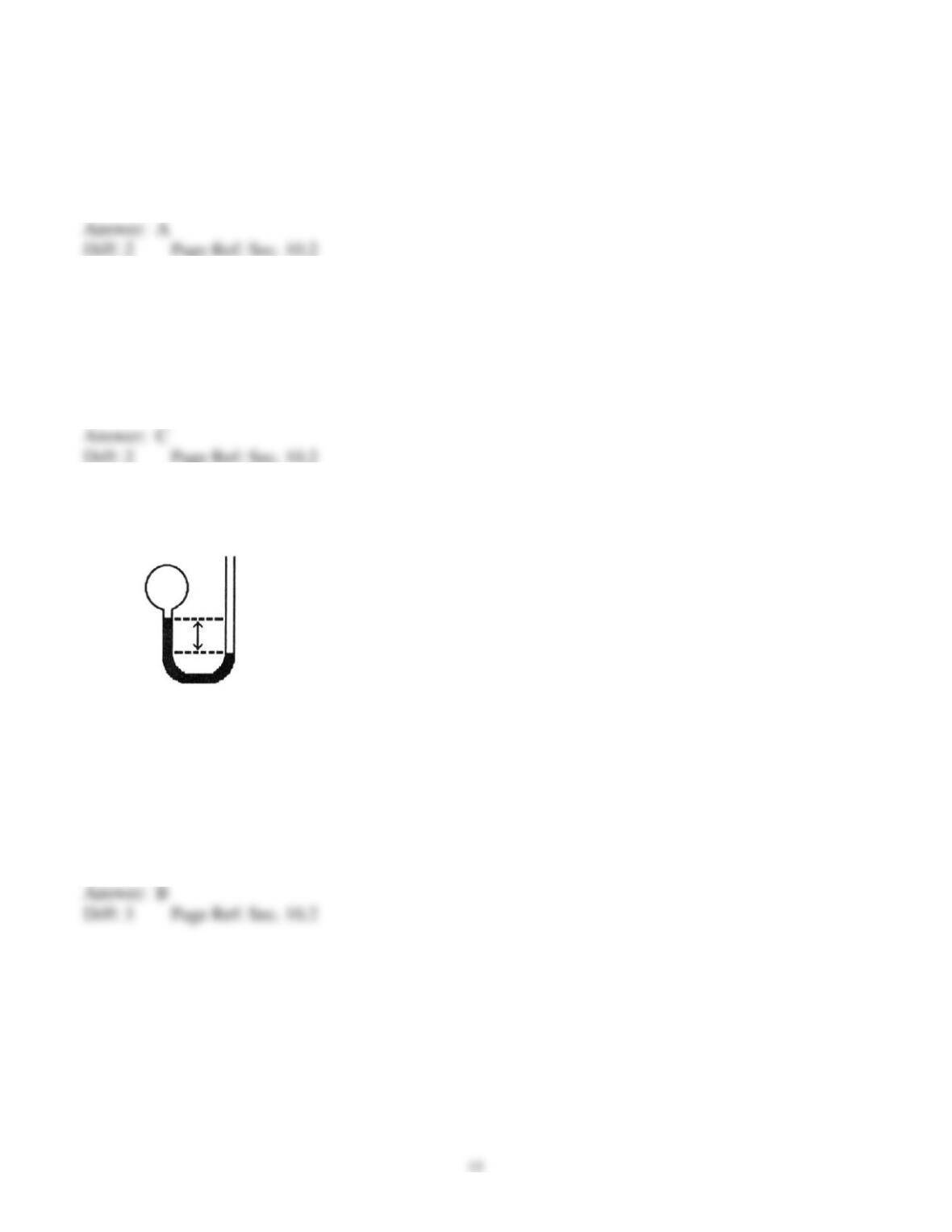
3) A gas vessel is attached to an open-end manometer containing a nonvolatile liquid of density 0.791
g/mL as shown below.
The difference in heights of the liquid in the two sides of the manometer is 43.4 cm when the
atmospheric pressure is 755 mm Hg. Given that the density of mercury is 13.6 g/mL, the pressure of the
enclosed gas is __________ atm.
A) 1.03
B) 0.967
C) 0.993
D) 0.990
E) 0.987
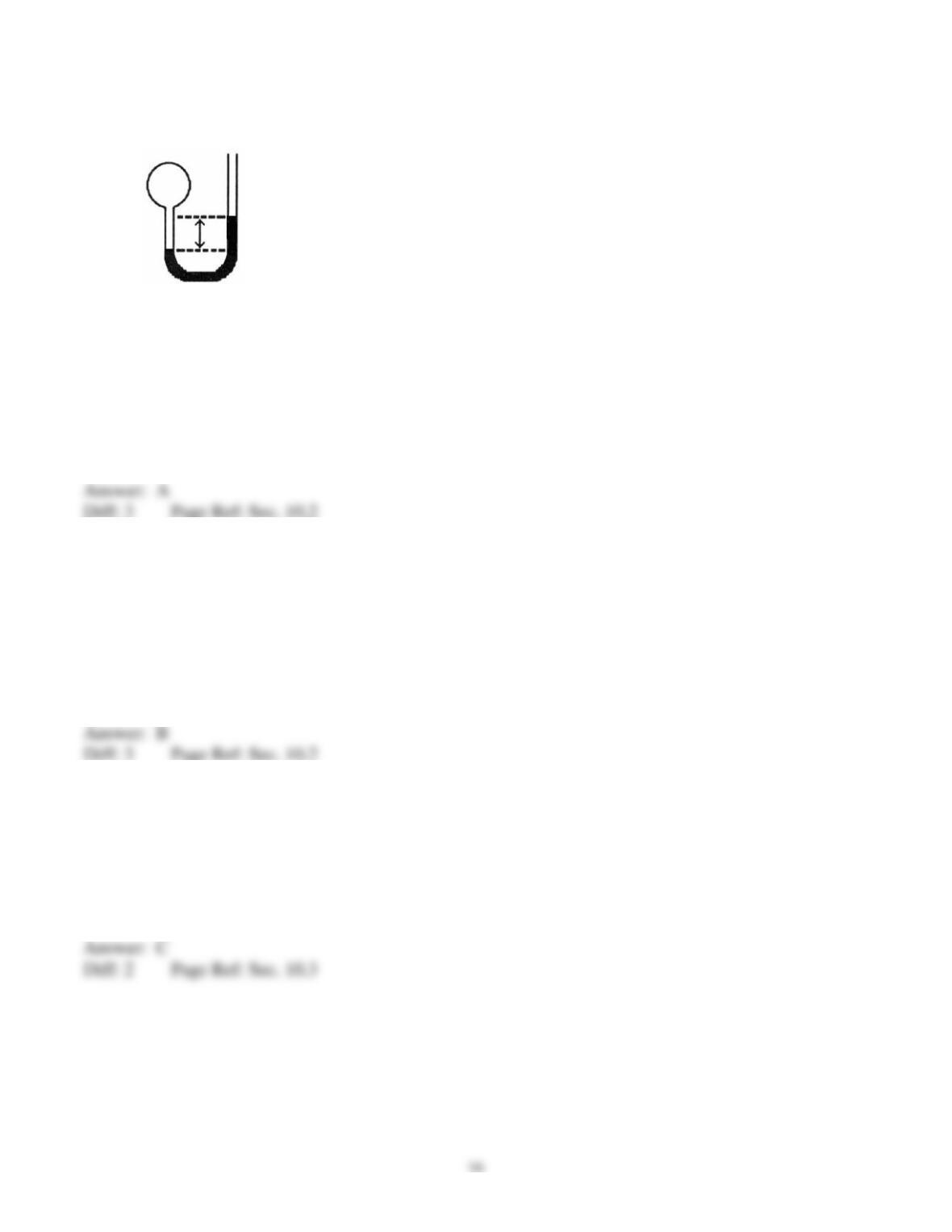
4) A gas vessel is attached to an open-end manometer filled with a nonvolatile liquid of density 0.993
g/mL as shown below.
The difference in heights of the liquid in the two sides of the manometer is 32.3 mm when the
atmospheric pressure is 765 mm Hg. Given that the density of mercury is 13.6 g/mL, the pressure of the
enclosed gas is __________ atm.
A) 1.05
B) 1.01
C) 0.976
D) 0.993
E) 1.08
5) In a Torricelli barometer, a pressure of one atmosphere supports a 760 mm column of mercury. If the
original tube containing the mercury is replaced with a tube having twice the diameter of the original,
the height of the mercury column at one atmosphere pressure is __________ mm.
A) 380
B) 760
C) 1.52 × 10³
D) 4.78 × 10³
E) 121
6) A sample of a gas (5.0 mol) at 1.0 atm is expanded at constant temperature from 10 L to 15 L. The
final pressure is __________ atm.
A) 1.5
B) 7.5
C) 0.67
D) 3.3
E) 15
7) If 50.75 g of a gas occupies 10.0 L at STP, 129.3 g of the gas will occupy __________ L at STP.
A) 3.92
B) 50.8
C) 12.9
D) 25.5
E) 5.08
8) A sample of H2 gas (12.28 g) occupies 100.0 L at 400.0 K and 2.00 atm. A sample weighing 9.49 g
occupies __________ L at 353 K and 2.00 atm.
A) 109
B) 68.2
C) 54.7
D) 147
E) 77.3
9) A sample of a gas (1.50 mol) is contained in a 15.0 L cylinder. The temperature is increased from
100°C to 150°C. The ratio of final pressure to initial pressure
2
1
P
P
is __________.
A) 1.50
B) 0.667
C) 0.882
D) 1.13
E) 1.00
10) A sample of a gas originally at 25°C and 1.00 atm pressure in a 2.5 L container is subject to a
pressure of 0.85 atm and a temperature of 15°C. The final volume of the gas is __________ L.
A) 3.0
B) 2.8
C) 2.6
D) 2.1
E) 0.38
11) A sample of a gas originally at 29°C and 1.25 atm pressure in a 3.0 L container is allowed to
contract until the volume is 2.2 L and the temperature is 11°C. The final pressure of the gas is
__________ atm.
A) 2.9
B) 2.8
C) 1.6
D) 2.1
E) 0.38
12) The reaction of 50 mL of Cl2 gas with 50 mL of CH4 gas via the equation:
Cl2 (g) + CH4 (g) → HCl (g) + CH3Cl (g)
will produce a total of __________ mL of products if pressure and temperature are kept constant.
A) 100
B) 50
C) 200
D) 150
E) 250
13) The reaction of 100 mL of Cl2 gas with 100 mL of CH4 gas via the equation:
Cl2 (g) + CH4 (g) → HCl (g) + CH3Cl (g)
will produce a total of __________ mL of products if pressure and temperature are kept constant.
A) 100
B) 50
C) 200
D) 150
E) 250
14) The reaction of 50 mL of N2 gas with 150 mL of H2 gas to form ammonia via the equation:
N2 (g) + 3H2 (g) → 2NH3 (g)
will produce __________ mL of ammonia if pressure and temperature are kept constant.
A) 250
B) 50
C) 200
D) 150
E) 100
15) The reaction of 25 mL of N2 gas with 75 mL of H2 gas to form ammonia via the equation:
N2 (g) + 3H2 (g) → 2NH3 (g)
will produce __________ mL of ammonia if pressure and temperature are kept constant.
A) 250
B) 50
C) 200
D) 150
E) 100
16) The reaction of 50 mL of Cl2 gas with 50 mL of C2H4 gas via the equation:
Cl2 (g) + C2H4 (g) → C2H4Cl2 (g)
will produce a total of __________ mL of products if pressure and temperature are kept constant.
A) 100
B) 50
C) 25
D) 125
E) 150
17) The amount of gas that occupies 60.82 L at 31.0°C and 367 mm Hg is __________ mol.
A) 1.18
B) 0.850
C) 894
D) 11.6
E) 0.120
18) The amount of gas that occupies 36.52 L at 68.0°C and 672 mm Hg is __________ mol.
A) 127
B) 1.15
C) 878
D) 24.4
E) 12.7
19) The pressure of a sample of CH4 gas (6.022 g) in a 30.0 L vessel at 402 K is __________ atm.
A) 2.42
B) 6.62
C) 0.413
D) 12.4
E) 22.4