Chemistry, 7e (McMurry/Fay)
Chapter 10 Gases: Their Properties and Behavior
10.1 Multiple-Choice Questions
1) Which of the following instruments directly measures the pressure of a gas?
A) spectrometer
B) manometer
C) polarimeter
D) gas chromatograph
2) Pressure is defined as
A) force divided by unit area.
B) force times unit area.
C) mass divided by acceleration.
D) mass times acceleration.
3) The SI unit for pressure is the
A) atmosphere.
B) MM Hg.
C) newton.
D) pascal.
4) Which is the smallest quantity of pressure?
A) 1 atm
B) 1 centimeter of Hg
C) 1 mm Hg
D) 1 pascal
2
5) Automobile tires are typically inflated to about 30 pounds of pressure per square inch. What is the
typical air pressure of a tire in kPa?
A) 2.0 × 10⁻³ kPa
B) 2.0 kPa
C) 2.1 × 10² kPa
D) 2.1 × 10⁵ kPa
6) If mercury (density = 13.6 g/cm3) at a height of 745 mm Hg in a mercury barometer is replaced with
water (density = 1.00 g/cm3), under the same conditions the height of water will be
A) 0.180 ft.
B) 2.44 ft.
C) 33.2 ft.
D) 399 ft.
7) Suppose you needed to closely monitor small changes in pressure inside a container using an open end
manometer. For the best accuracy, the substance in the manometer should
A) be a solid.
B) be mercury.
C) have a high density.
D) have a low density.
8) In an open end manometer, one end of a U-tube filled with mercury is attached to a gas-filled container
and the other end is open to the atmosphere. If the gas pressure in the container is less than atmospheric
pressure
A) Hg will be forced out of the open end of the U-tube.
B) the difference between the Hg levels in the two arms will be greater than 76 cm.
C) the Hg level will be higher in the arm connected to the container.
D) the Hg level will be higher in the arm open to the atmosphere.
9) What is the pressure in a gas container that is connected to an open-end U-tube manometer if the
pressure of the atmosphere is 752 torr and the level of mercury in the arm connected to the container is
9.60 cm higher than the level of mercury open to the atmosphere?
A) 656 mm Hg
B) 742 mm Hg
C) 762 mm Hg
D) 848 mm Hg
10) If the pressure in a gas container that is connected to an open-end U-tube manometer is 106 kPa and
the pressure of the atmosphere at the open end of the tube is 700 mm Hg, the level of mercury in the tube
will be
A) 95 mm higher in the arm open to the atmosphere.
B) 95 mm higher in the arm connected to the gas cylinder.
C) 795 mm higher in the arm open to the atmosphere.
D) 795 mm higher in the arm connected to the gas cylinder.
11) A container filled with gas is connected to an open-end U-tube manometer that is filled with mineral
oil. The pressure in the gas container is 770 mm Hg and atmospheric pressure is 754 mm Hg. What will
be the difference in the levels of mineral oil in the two arms of the manometer if the densities of Hg and
mineral oil are 13.6 g/mL and 0.822 g/mL respectively?
A) 1.15 mm
B) 15.6 mm
C) 16.0 mm
D) 264 mm
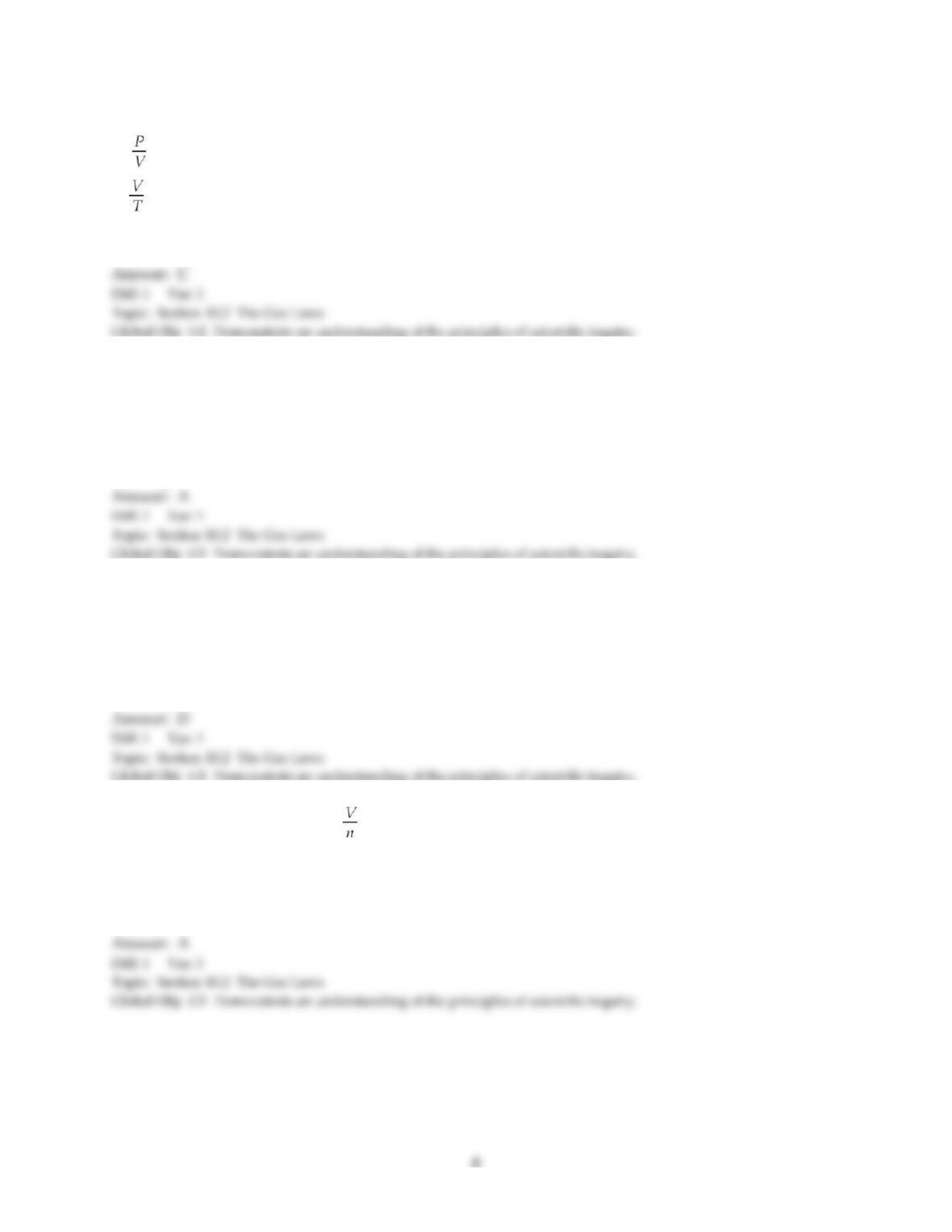
12) Which of the following equations represents “Boyle‘s law”?
A) = k
B) = k
C) PV = k
D) V = nk
13) When pressure-volume measurements are made on 1.0 mol of gas at constant temperature, a plot V
versus P results in a
A) hyperbola.
B) parabola.
C) sine curve.
D) straight line.
14) When temperature-volume measurements are made on 1.0 mol of gas at 1.0 atm, a plot V versus T
results in a
A) hyperbola.
B) parabola.
C) sine curve.
D) straight line.
15) Which law does the equation, = k represent?
A) Avogadro’s law
B) Boyle’s law
C) Charles’ law
D) Graham’s law
16) An approximation of absolute zero was made from an extrapolation of
A) P vs. 1/V.
B) V vs. T.
C) n vs. V.
D) V vs. 1/T.
17) “Equal volumes of different gases at the same temperature and pressure contain the same molar
amounts” is another way of stating
A) Avogadro’s law.
B) Boyle’s law.
C) Charles’ law.
D) Graham’s law.
18) A basketball is inflated to a pressure of 2.10 atm in a 20.0°C garage. What is the pressure of the
basketball outside where the temperature is –5.00°C?
A) 1.92 atm
B) 2.29 atm
C) 2.10 atm
D) 2.50 atm
19) A gas bottle contains 0.800 mol of gas at 730 mm Hg pressure. If the final pressure is 1.15 atm, how
many moles of gas were added to the bottle?
A) 0.0012 mol
B) 0.158 mol
C) 0.958 mol
D) 0.0668 mol
20) The volume of 350. mL of gas at 25°C is decreased to 250. mL at constant pressure. What is the final
temperature of the gas?
A) -60.1°C
B) 213°C
C) 17.8°C
D) 144°C
21) A balloon filled with helium gas at 20°C occupies 2.91 L at 1.00 atm. The balloon is immersed in liquid
nitrogen at -180°C, raising the pressure to 5.20 atm. What is the volume of the balloon in the liquid
nitrogen?
A) 0.178 L
B) 5.62 L
C) 5.04 L
D) 0.199 L
22) For an ideal gas, which pairs of variables are inversely proportional to each other (if all other factors
remain constant)?
I. P, T II. P, V III. V, T IV. n,T
A) I and II only
B) III and IV only
C) II only
D) I and III only
23) You have two samples of the same gas in the same size container, with the same pressure. The gas in
the first container has a Kelvin temperature four times that of the gas in the other container. The ratio of
the number of moles of gas in the first container compared to that in the second is
A) 1:1.
B) 1:2.
C) 1:4.
D) 4:1.
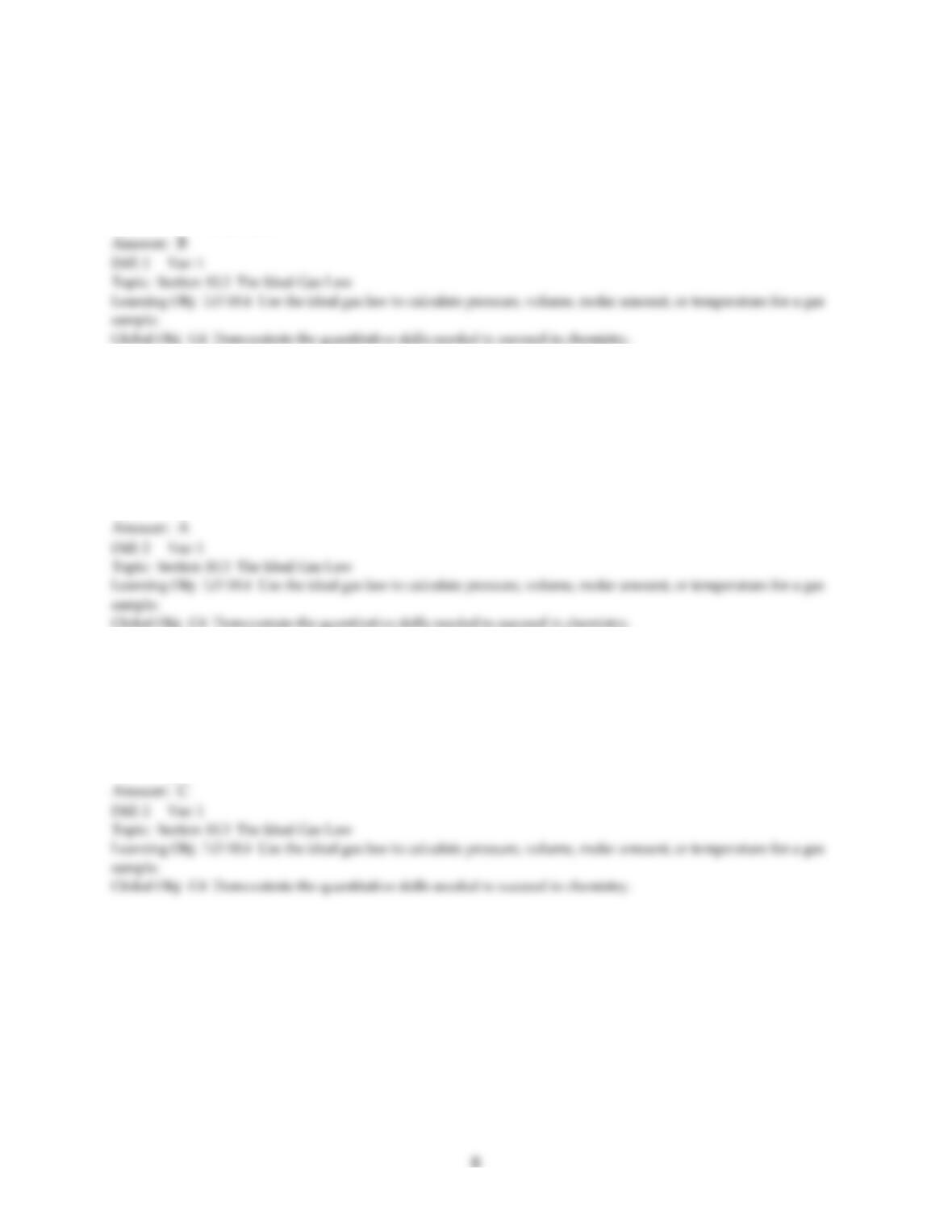
24) What is the value of the gas constant, R, in units of ?
A) 1.080 × 10⁻⁴
B) 0.1080
C) 62.36
D) 6.236 × 10⁴
25) Three identical flasks contain three different gases at standard temperature and pressure. Flask A
contains Ar, flask B contains Ne, flask C contains H2. Which flask contains the largest number of
molecules?
A) flask A
B) flask B
C) flask C
D) All flasks contain the same number of molecules.
26) How many molecules of N2 are in a 250.0 mL container at 780 mm Hg and 135°C?
A) 4.38 × 10²¹ molecules
B) 4.62 × 10²¹ molecules
C) 1.32 × 10²² molecules
D) 1.39 × 10²² molecules
27) A 1.75 L container filled with CO2 gas at 25°C and 225 kPa pressure springs a leak. When the
container is re-sealed, the pressure is 200 kPA and the temperature is 10°C. How many moles of gas were
lost?
A) 0.0101 mol
B) 0.149 mol
C) 6.71 mol
D) 99.0 mol
28) A 75.0 L steel tank at 20.0°C contains acetylene gas, C2H2, at a pressure of 1.20 atm. Assuming ideal
behavior, how many grams of acetylene are in the tank?
A) 3.74 g
B) 54.8 g
C) 97.3 g
D) 1425 g
29) A 1.00 L flask contains nitrogen gas at 25°C and 1.00 atm pressure. What is the final pressure in the
flask if an additional 0.50 g of N2 gas is added to the flask and the flask cooled to –55°C?
A) 1.01 atm
B) 1.05 atm
C) 0.319 atm
D) 3.13 atm
30) A steel bottle contains argon gas at STP. What is the final pressure if the temperature is changed to
85°C?
A) 0.666 atm
B) 0.762 atm
C) 0.850 atm
D) 1.31 atm
31) A gas occupies 22.4 L at STP and 9.85 L at 100.°C and 2.00 atm pressure. How many moles of gas did
the system gain or lose?
A) 1.36 moles gained
B) 1.64 moles gained
C) 0.644 moles lost
D) 0.356 moles lost
32) How many grams of H2 gas are there in a 5.00-L cylinder at 4.00 × 103 mm Hg and 23°C?
A) 1.08 g
B) 2.16 g
C) 0.542 g
D) 823 g
33) What is the volume of 10.0 g of oxygen gas at 157°C and 2.50 kPa pressure?
A) 51.5 L
B) 163 L
C) 1.61 L
D) 447 L
34) What is the Celsius temperature of 100.0 g of chlorine gas in a 4.00-L container at 800 mm Hg?
A) 309°C
B) -236°C
C) 236°C
D) -309°C
35) Cyanogen is a gas which contains 46.2% C and 53.8% N by mass. At a temperature of 25°C and a
pressure of 750 mm Hg, 1.50 g of cyanogen occupies 0.714 L. What is the molecular formula of cyanogen?
A) CN
B) C2N2
C) C3N4
D) C4N5
36) A 0.429-g sample of gas occupies 125 mL at 60. cm of Hg and 25°C. What is the molar mass of the gas?
A) 8.9 g/mol
B) 66 g/mol
C) 88 g/mol
D) 106 g/mol
37) What is the density of carbon monoxide gas at STP?
A) 0.510 g/L
B) 0.800 g/L
C) 1.96 g/L
D) 1.25 g/L
38) Which of the following would have a density of 1.89 g/L at 7.0°C and 0.987 atm?
A) Ar
B) CO2
C) CO
D) O2
39) Chloroform is a volatile liquid once commonly used in the laboratory but now being phased out due
to its ozone depletion potential. If the pressure of gaseous chloroform in a flask is 195 mm Hg at 25°C and
its density is 1.25 g/L, what is the molar mass of chloroform?
A) 10.0 g/mol
B) 76.3 g/mol
C) 119 g/mol
D) None of these
40) The action of some commercial drain cleaners is based on the following reaction:
2 NaOH(s) + 2 Al(s) + 6 H2O(l) → 2 NaAl(OH)4(s) + 3 H2(g)
What is the volume of H2 gas formed at STP when 8.64 g of Al reacts with excess NaOH?
A) 4.78 L
B) 7.18 L
C) 10.8 L
D) 11.7 L
41) When 30.0 g of zinc metal reacts with excess HCl, how many liters of H2 gas are produced at STP?
A) 0.229 L
B) 0.458 L
C) 5.14 L
D) 10.3 L
42) A lungful of air (500 mL) contains 4.1% CO2 by volume. How many grams of KO2(s) is needed to
remove the CO2 from a lungful of air at STP according to the following reaction?
4 KO2(s) + 2 CO2(g) → 2 K2CO3(s) + 3 O2(g)
A) 0.065 g
B) 0.13 g
C) 0.26 g
D) 1.2 g
43) How many liters of oxygen are needed to exactly react with 55.6 g of methane at STP?
CH4(g) + 2 O2(g) → CO2(g) + 2 H2O(l)
A) 19.5 L
B) 39.0 L
C) 156 L
D) 77.8 L
44) How many grams of XeF6 are required to react with 1.16 L of hydrogen gas at 2.46 atm and 45°C in
the reaction shown below?
XeF6(s) + 3 H2(g) → Xe(g) + 6 HF(g)
A) 7.30 g
B) 8.92 g
C) 26.8 g
D) 80.4 g
45) How many liters of SO3(g) are produced at 25°C and 1.00 atm from the combustion of 1.00 kg of coal
which is 1.00% S by weight? Assume all the sulfur in the coal ends up as SO3.
A) 0.640 L
B) 5.08 L
C) 7.63 L
D) 11.4 L
46) At STP how many liters of NH3 can be produced from the reaction of 6.00 mol of N2 with 6.00 mol of
H2?
N2(g) + 3 H2(g) → 2 NH3(g)
A) 44.8 L
B) 89.6 L
C) 134 L
D) 269 L
47) Two moles of neon gas at 20.0°C are heated to 350°C while the volume is kept constant. The density
of the gas
A) decreases.
B) increases.
C) remains the same.
D) Not enough information was given to answer the question.
48) A balloon contains 0.76 mol N2, 0.18 mol Ar, 0.031 mol He, and 0.026 mol H2 at 739 mm Hg. What is
the partial pressure of Ar?
A) 19 mm Hg
B) 23 mm Hg
C) 130 mm Hg
D) 560 mm Hg
49) What is the total pressure in a 10.0 L flask which contains 0.200 mol of H2(g) and 0.215 mol of N2(g) at
20.0°C?
A) 0.306 atm
B) 0.681 atm
C) 0.693 atm
D) 0.998 atm
50) A 2.000 kg sample of nitroglycerine, C3H5N3O9, explodes and releases gases with a temperature of
1985°C at 1.000 atm. What is the volume of gas produced?
4 C3H5N3O9(l) → 12 CO2(g) + 10 H2O(g) + 6 N2(g) + O2(g)
A) 1632 L
B) 7756 L
C) 10410 L
D) 11830 L
51) If the Earth’s ozone (O3) layer has a total volume of 1.00 × 10²⁰ km3, a partial pressure of 1.6 × 10⁻⁹
atm, and an average temperature of 230 K, how many ozone molecules are in the Earth’s ozone layer?
A) 2.3 × 1035 molecules
B) 5.1 × 1035 molecules
C) 2.3 × 1045 molecules
D) 5.1 × 1045 molecules
52) Hydrogen gas is collected over water in an inverted buret. If the atmospheric pressure is 745 mm Hg,
the vapor pressure of water is 18 mm Hg, and a 15.0 cm-high column of water remains in the buret, the
pressure of the hydrogen gas is
A) 763 mm.
B) 745 mm Hg.
C) 727 mm Hg.
D) less than 727 mm Hg.
16
53) In the laboratory, hydrogen gas is usually made by the following reaction:
Zn(s) + 2 HCl(aq) → H2(g) + ZnCl2(aq)
How many liters of H2 gas, collected over water at an atmospheric pressure of 752 mm Hg and a
temperature of 21.0°C, can be made from 3.132 g of Zn and excess HCl? The partial pressure of water
vapor is 18.65 mm Hg at 21.0°C.
A) 0.0856 L
B) 1.15 L
C) 1.17 L
D) 1.20 L
54) The ozone molecules in the stratosphere absorb much of the ultraviolet radiation from the sun,
protecting life on Earth. At a certain altitude, the temperature of the stratosphere is 240 K and the partial
pressure of ozone is 1.4 × 10⁻⁷ atm. Calculate the number of ozone molecules present in 1.00 L of
atmosphere at that altitude.
A) 2.1 × 10¹⁵ molecules of O3
B) 4.3 × 10¹⁵ molecules of O3
C) 8.0 × 1031 molecules of O3
D) 1.8 × 1032 molecules of O3
55) A 0.500 g sample containing Ag2O and inert material is heated, causing the silver oxide to decompose
according to the following equation:
2 Ag2O(s) → 4 Ag(s) + O2(g)
If 6.90 mL of gas are collected over water at 27°C and 1.00 atm external pressure, what is the percentage
of silver oxide in the sample? The partial pressure of water is 26.7 mm Hg at 27°C.
A) 6.25%
B) 12.5%
C) 25.0%
D) 26.0%
56) Some assumptions from the kinetic molecular theory are listed below. Which one is most frequently
cited to explain Charles’ law?
A) The average kinetic energy of gas particles is proportional to the Kelvin temperature.
B) Collisions of gas particles are elastic and total kinetic energy of the gas is constant.
C) A gas consists of tiny particles moving in random straight line motion.
D) The volume of the particles is negligible compared to the volume of the gas.
57) Some assumptions from the kinetic molecular theory are listed below. Which one is most frequently
cited to explain compressibility of a gas?
A) The average kinetic energy of gas particles is proportional to the Kelvin temperature.
B) Collisions of gas particles are elastic and total kinetic energy of the gas is constant.
C) A gas consist of tiny particles moving in random straight line motion.
D) The volume of the particles is negligible compared to the volume of the gas.
58) Some assumptions from the kinetic molecular theory are listed below. Which one is most frequently
cited to explain diffusion of a gas?
A) The average kinetic energy of gas particles is proportional to the Kelvin temperature.
B) Collisions of gas particles are elastic and total kinetic energy of the gas is constant.
C) A gas consist of tiny particles moving in random straight line motion.
D) The volume of the particles is negligible compared to the volume of the gas.
59) According to the kinetic molecular theory, the pressure of a gas in a container will decrease if the
A) number of collisions with the container wall increases.
B) number of moles of the gas increases.
C) temperature of the gas decreases.
D) volume of the container decreases.
60) What is the average speed (actually the root-mean-square speed) of a carbon monoxide molecule at
27°C?
A) 450 m/s
B) 412 m/s
C) 514 m/s
D) 517 m/s
61) What is the temperature of N2 gas if the average speed (actually the root-mean-square speed) of the
molecules is 750 m/s?
A) 0.842 K
B) 6.31 × 10² K
C) 3.16 × 10² K
D) 0.421 K
62) At what temperature will sulfur hexafluoride molecules have the same average speed as argon atoms
at 20°C?
A) -22.0°C
B) 73.2°C
C) 381°C
D) 799°C
63) You are given two flasks of equal volume. One contains H2 at 0°C and 1 atm while the other contains
CO2 at and 2 atm. Which of the following quantities will be the same for both flasks?
A) average molecular kinetic energy
B) average molecular speed
C) density
D) number of molecules present
19
64) Each of three identical 15.0-L gas cylinders contains 7.50 mol of gas at 295 K. Cylinder A contains Ar,
cylinder B contains Cl2, and cylinder C contains N2. According to the kinetic molecular theory, which gas
has the highest collision frequency?
A) Ar
B) Cl2
C) N2
D) All have identical collision frequencies
65) An unknown gas effuses 1.73 times faster than krypton. What is the molar mass of the gas?
A) 28.0 g/mol
B) 48.4 g/mol
C) 110 g/mol
D) 251 g/mol
66) An unknown gas effuses 2.3 times faster than N2O4 at the same temperature. What is the identity of
the unknown gas?
A) CN2
B) NH3
C) N2O
D) O3
67) If CO2 and NH3 are allowed to effuse through a porous membrane under identical conditions, the
rate of effusion for NH3 will be ________ times that of CO2.
A) 0.39
B) 0.62
C) 1.6
D) 2.6
68) An unknown gas contains 83% C and 17% H by mass. If effuses at 0.87 times the rate of CO2 gas
under the same conditions. What is the molecular formula of the unknown gas?
A) C2H5
B) C3H3
C) C4H10
D) C7H17
69) Which of the noble gases should show the greatest deviation from the ideal gas law at high pressures?
A) He
B) Ar
C) Rn
D) All deviate equally.
70) Which statement about real gases is true?
A) The volume of the gas particles is zero.
B) The mass of the gas particles is zero.
C) Forces of attraction and repulsion exist between gas particles at close range.
D) The behavior of real gases can be exactly predicted using the ideal gas law.
71) Which of the following regions of the earth’s atmosphere is farthest from the surface of the earth?
A) mesosphere
B) stratosphere
C) thermosphere
D) troposphere