
College Physics: A Strategic Approach, 3e (Knight)
Chapter 10 Energy and Work
10.1 Conceptual Questions
1) Person X pushes twice as hard against a stationary brick wall as person Y. Which one of the
following statements is correct?
A) Both do positive work, but person X does four times the work of person Y.
B) Both do positive work, but person X does twice the work of person Y.
C) Both do the same amount of positive work.
D) Both do zero work.
E) Both do positive work, but person X does one-half the work of person Y.
2) Two men, Joel and Jerry, push against a car that has stalled, trying unsuccessfully to get it
moving. Jerry stops after 10 min, while Joel is able to push for 5.0 min longer. Compare the
work they do on the car.
A) Joel does 75% more work than Jerry.
B) Joel does 50% more work than Jerry.
C) Jerry does 50% more work than Joel.
D) Joel does 25% more work than Jerry.
E) Neither of them does any work.
3) If the force on an object is in the negative direction, the work it does on the object must be
A) negative.
B) positive.
C) The work could be either positive or negative, depending on the direction the object moves.
4) A 35-N bucket of water is lifted vertically 3.0 m and then returned to its original position.
How much work did gravity do on the bucket during this process?
A) 180 J
B) 90 J
C) 45 J
D) 0 J
E) 900 J

5) You throw a baseball straight up. Compare the sign of the work done by gravity while the ball
goes up with the sign of the work done by gravity while it goes down.
A) The work is positive on the way up and positive on the way down.
B) The work is positive on the way up and negative on the way down.
C) The work is negative on the way up and positive on the way down.
D) The work is negative on the way up and on the way down because gravity is always
downward.
6) Which one has larger kinetic energy: a 500-kg object moving at 40 m/s or a 1000-kg object
moving at 20 m/s?
A) The 500-kg object
B) The 1000-kg object
C) Both have the same kinetic energy.
7) A truck has four times the mass of a car and is moving with twice the speed of the car. If Kt
and Kc refer to the kinetic energies of truck and car respectively, it is correct to say that
A) Kt = 16Kc.
B) Kt = 4Kc.
C) Kt = 2Kc.
D) Kt = Kc.
E) Kt = Kc.
8) Three cars (car F, car G, and car H) are moving with the same speed and slam on their brakes.
The most massive car is car F, and the least massive is car H. If the tires of all three cars have
identical coefficients of kinetic friction with the road surface, which car travels the longest
distance to skid to a stop?
A) They all travel the same distance in stopping.
B) Car F
C) Car G
D) Car H

9) Three cars (car L, car M, and car N) are moving with the same speed and slam on their brakes.
The most massive car is car L, and the least massive is car N. If the tires of all three cars have
identical coefficients of kinetic friction with the road surface, for which car is the amount of
work done by friction in stopping it the greatest?
A) The amount of work done by friction is the same for all cars.
B) Car L
C) Car M
D) Car N
10) A 4.0 kg object is moving with speed 2.0 m/s. A 1.0 kg object is moving with speed 4.0 m/s.
Both objects encounter the same constant braking force, and are brought to rest. Which object
travels the greater distance before stopping?
A) the 4.0 kg object
B) the 1.0 kg object
C) Both objects travel the same distance.
D) It cannot be determined from the information given.
11) You slam on the brakes of your car in a panic, and skid a certain distance on a straight level
road. If you had been traveling twice as fast, what distance would the car have skidded, under
the same conditions?
A) It would have skidded 4 times farther.
B) It would have skidded twice as far.
C) It would have skidded 1.4 times farther.
D) It would have skidded one half as far.
E) It is impossible to tell from the information given.
12) Which requires more work, increasing a car’s speed from 0 mph to 30 mph or from 50 mph
to 60 mph?
A) 0 mph to 30 mph
B) 50 mph to 60 mph
C) It is the same in both cases.

13) A stone is held at a height h above the ground. A second stone with four times the mass of
the first one is held at the same height. The gravitational potential energy of the second stone
compared to that of the first stone is
A) one-fourth as much.
B) one-half as much.
C) twice as much.
D) four times as much.
E) the same.
14) You and your friend, who weighs the same as you, want to go to the top of the Eiffel Tower.
Your friend takes the elevator straight up. You decide to walk up the spiral stairway, taking
longer to do so. Compare the gravitational potential energy of you and your friend, after you both
reach the top.
A) It is impossible to tell, since the times you both took are unknown.
B) It is impossible to tell, since the distances you both traveled are unknown.
C) Your friend’s gravitational potential energy is greater than yours, because he got to the top
faster.
D) Both of you have the same amount of gravitational potential energy at the top.
E) Your gravitational potential energy is greater than that of your friend, because you traveled a
greater distance in getting to the top.
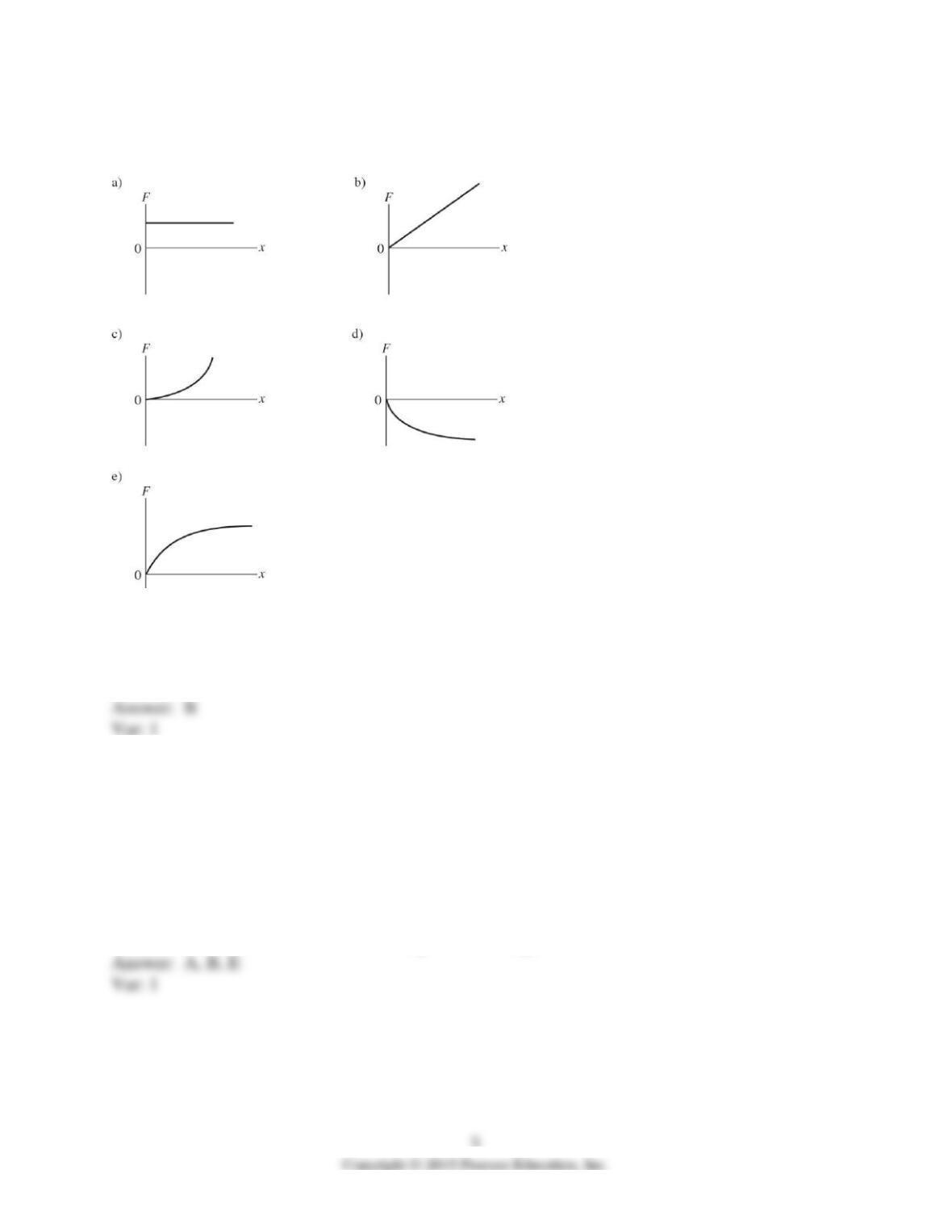
15) The graphs shown show the magnitude F of the force exerted by a spring as a function of the
distance x the spring has been stretched. For which one of the graphs does the spring obey
Hooke’s law?
A) Graph a
B) Graph b
C) Graph c
D) Graph d
E) Graph e
16) A heavy dart and a light dart are launched horizontally on a frictionless table by identical
ideal springs. Both springs were initially compressed by the same amount. Which of the
following statements about these darts are correct? (There could be more than one correct
choice.)
A) The darts both have the same kinetic energy just as they move free of the spring.
B) The lighter dart leaves the spring moving faster than the heavy dart.
C) The heavy dart had more initial elastic potential energy than the light dart.
D) Both darts move free of the spring with the same speed.
E) Both darts had the same initial elastic potential energy.

17) When you throw a pebble straight up with initial speed V, it reaches a maximum height H
with no air resistance. At what speed should you throw it up vertically so it will go twice as
high?
A) 16V
B) 8V
C) 4V
D) 2V
E) V
18) When you drop a pebble from height H, it reaches the ground with speed V if there is no air
resistance. From what height should you drop it so it will reach the ground with twice speed?
A) H
B) 2H
C) 4H
D) 8H
E) 16H
19) When you drop a pebble from height H, it reaches the ground with kinetic energy K if there
is no air resistance. From what height should you drop it so it will reach the ground with twice as
much kinetic energy?
A) H
B) 2H
C) 4H
D) 8H
E) 16H
20) Two objects, one of mass m and the other of mass 2m, are dropped from the top of a
building. If there is no air resistance, when they hit the ground
A) both will have the same kinetic energy.
B) the heavier one will have twice the kinetic energy of the lighter one.
C) the heavier one will have four times the kinetic energy of the lighter one.
D) the heavier one will have half the kinetic energy of the lighter one.
E) the heavier one will have one-fourth the kinetic energy of the lighter one.
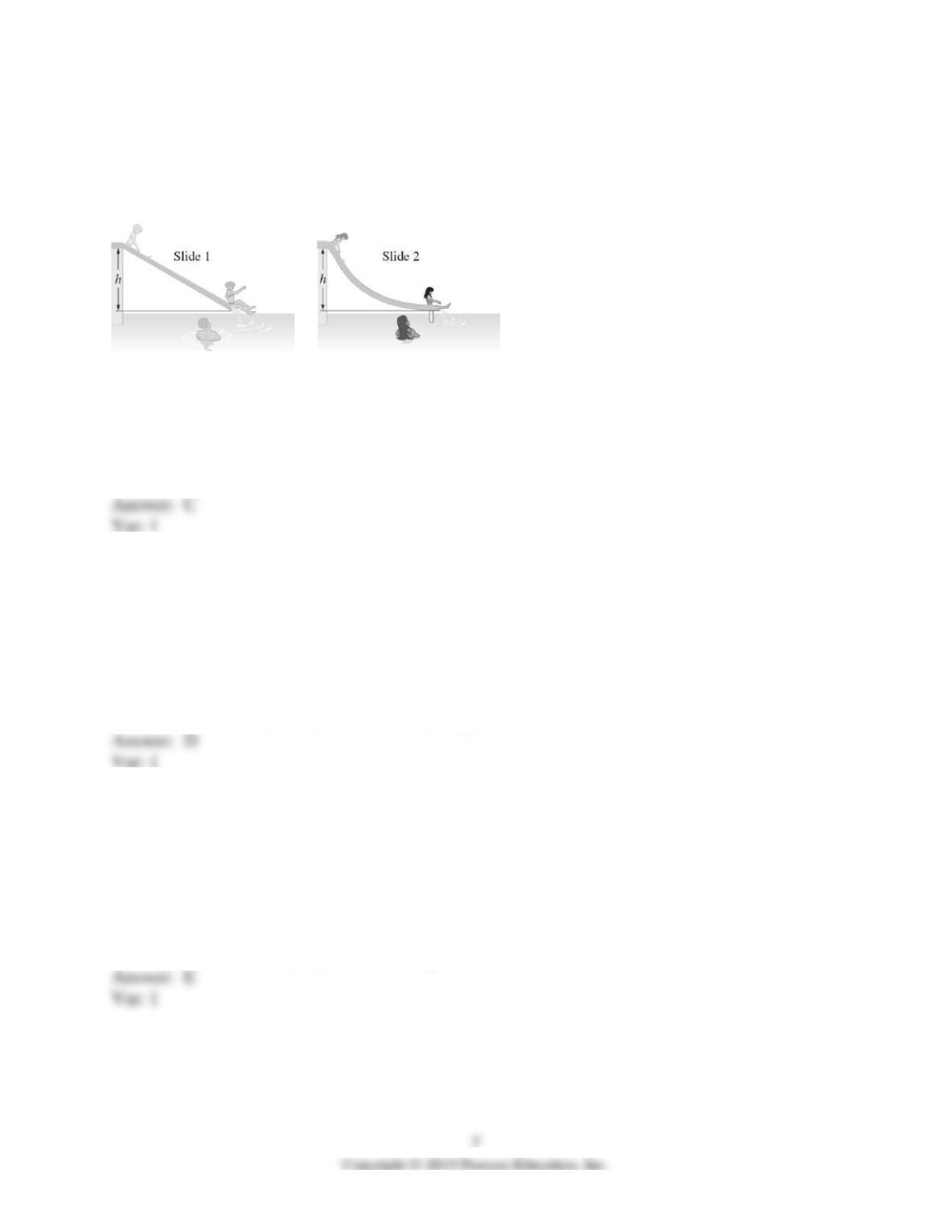
21) Swimmers at a water park have a choice of two frictionless water slides, as shown in the
figure. Although both slides drop over the same height h, slide 1 is straight while slide 2 is
curved, dropping quickly at first and then leveling out. How does the speed v1 of a swimmer
reaching the bottom of slide 1 compare with v2, the speed of a swimmer reaching the end of
slide 2?
A) v1 > v2
B) v1 < v2
C) v1 = v2
D) The heavier swimmer will have a greater speed than the lighter swimmer, no matter which
slide he uses.
E) No simple relationship exists between v1 and v2.
22) Two frisky otters slide down frictionless hillsides of the same height but different slopes. The
slope of the hill of otter 1 is 30°, while the slope of the hill of otter 2 is 60°. If both start from
rest, which otter is moving faster when she reaches the bottom of her hill?
A) Otter 1 is moving faster.
B) Otter 2 is moving faster.
C) The heavier otter is moving faster, no matter which hill she used.
D) Both otters have the same speed at the bottom.
E) The otter that took the shorter time is moving faster.
23) A lightweight object and a very heavy object are sliding with equal speeds along a level
frictionless surface. They both slide up the same frictionless hill with no air resistance. Which
object rises to a greater height?
A) The heavy object, because it has greater initial kinetic energy.
B) The light object, because gravity slows it down less.
C) The lightweight object, because the force of gravity on it is less.
D) The heavy object, because it has more mass to carry it up the hill.
E) They both slide to exactly the same height.
24) A person stands on the edge of a cliff. She throws three identical rocks with the same speed.
Rock X is thrown vertically upward, rock Y is thrown horizontally, and rock Z is thrown
vertically downward. If the ground at the base of the cliff is level, which rock hits the ground
with the greatest speed if there is no air resistance?
A) Rock X
B) Rock Y
C) Rock Z
D) They all hit the ground with the same speed.
25) Joe and Bill throw identical balls vertically upward. Joe throws his ball with an initial speed
twice as high as Bill. If there is no air resistance, the maximum height of Joe’s ball will be
A) four times that of Bill’s ball.
B) two times that of Bill’s ball.
C) equal to that of Bill’s ball.
D) eight times that of Bill’s ball.
E) roughly 1.4 times that of Bill’s ball.
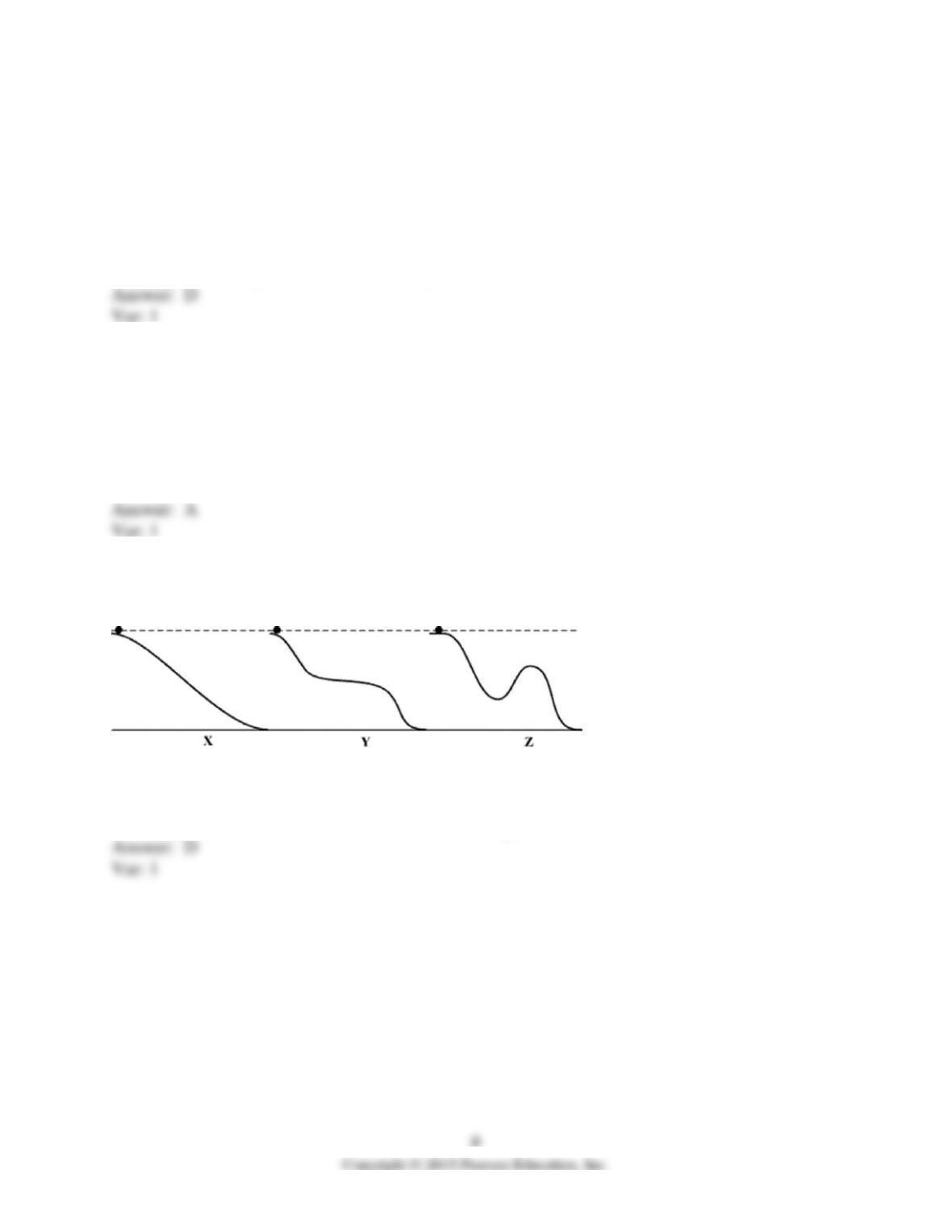
26) A stone can slide down one of four different frictionless ramps, as shown in the figure. For
which ramp will the speed of the ball be the greatest at the bottom?
A) Ramp X
B) Ramp Y
C) Ramp Z
D) The speed of the ball will be the same for all ramps.

27) A girl throws a stone from a bridge. Consider the following ways she might throw the stone.
The speed of the stone as it leaves her hand is the same in each case.
Case A: Thrown straight up.
Case B: Thrown straight down.
Case C: Thrown out at an angle of 45° above horizontal.
Case D: Thrown straight out horizontally.
In which case will the speed of the stone be greatest when it hits the water below if there is no
significant air resistance?
A) Case A
B) Case B
C) Case C
D) Case D
E) The speed will be the same in all cases.
28) A heavy frog and a light frog jump straight up into the air. They push off in such away that
they both have the same kinetic energy just as they leave the ground. Air resistance is negligible.
Which of the following statements about these frogs are correct? (There could be more than one
correct choice.)
A) Just as they leave the ground, the heavier frog is moving faster than the lighter frog.
B) Just as they leave the ground, the lighter frog is moving faster than the heavier frog.
C) They both leave the ground with the same speed.
D) The lighter frog goes higher than the heavier frog.
E) The heavier frog goes higher than the lighter frog.
F) Both frogs reach the same maximum height.
29) Two identical grasshoppers jump into the air with the same initial speed and experience no
air resistance. Grasshopper A goes straight up, but grasshopper B goes up at a 66° angle above
the horizontal. Which of the following statements about these grasshoppers are correct? (There
could be more than one correct choice.)
A) At their highest point, both of them have the same amount of gravitational potential energy.
B) At their highest point, both of them have the same amount of kinetic energy.
C) At their highest point, both of them have the same amount of mechanical energy.
D) At their highest point, grasshopper B is moving faster than grasshopper A.
E) At their highest point, grasshopper A has more gravitational potential energy than grasshopper
B.

30) A heavy rock and a light rock are dropped from the same height and experience no
significant air resistance as they fall. Which of the following statements about these rocks are
correct? (There could be more than one correct choice.)
A) Both rocks have the same kinetic energy when they reach the ground.
B) Both rocks have the same speed when they reach the ground.
C) The heavier rock reaches the ground before the lighter rock.
D) Just as they were released, both rocks had the same amount of gravitational potential energy.
E) When they reach the ground, the heavier rock has more kinetic energy than the lighter rock.
31) A heavy stone and a light stone are released from rest in such away that they both have the
same amount of gravitational potential energy just as they are released. Air resistance is
negligibly small. Which of the following statements about these stones are correct? (There could
be more than one correct choice.)
A) The initial height of the light stone is greater than the initial height of the heavy stone.
B) The stones must have been released from the same height.
C) The stones both have the same speed just as they reach the ground.
D) Just as it reaches the ground, the light stone is traveling faster than the heavy stone.
E) The stones both have the same kinetic energy just as they reach the ground.
32) A 1-kg ball is released from a height of 6 m, and a 2-kg ball is released from a height of 3 m.
Air resistance is negligible as they fall. Which of the following statements about these balls are
correct? (There could be more than one correct choice.)
A) As they reach the ground, the 1-kg ball will have more kinetic energy than the 2-kg ball
because it was dropped from a greater height.
B) As they reach the ground, the 1-kg ball will be moving faster than the 2-kg ball.
C) Both balls will reach the ground with the same speed.
D) Both balls will reach the ground with the same kinetic energy.
E) Both balls will take the same time to reach the ground.
33) A heavy dart and a light dart are launched vertically by identical ideal springs. Both springs
were initially compressed by the same amount. There is no significant air resistance. Which of
the following statements about these darts are correct? (There could be more than one correct
choice.)
A) The heavy dart goes higher than the light dart.
B) The light dart goes higher than the heavy dart.
C) Both darts reach the same maximum height.
D) At the maximum height, both darts have the same gravitational potential energy.
E) Both darts began moving upward with the same initial speed.

34) A heavy sled and a light sled, both moving horizontally with the same speed, suddenly slide
onto a rough patch of snow and eventually come to a stop. The coefficient of kinetic friction
between the sleds and the rough snow is the same for both of them. Which of the following
statements about these sleds are correct? (There could be more than one correct choice.)
A) Both sleds will slide the same distance on the rough snow before stopping.
B) The heavy sled will slide farther on the rough snow than the light sled.
C) The light sled will slide farther on the rough snow than the heavy sled.
D) The friction from the snow will do more negative work on the heavy sled than on the light
sled.
E) The friction from the snow will do the same amount of work on both sleds.
35) A heavy sled and a light sled, both moving horizontally with the same kinetic energy,
suddenly slide onto a rough patch of snow and eventually come to a stop. The coefficient of
kinetic friction between the sleds and the rough snow is the same for both of them. Which of the
following statements about these sleds are correct? (There could be more than one correct
choice.)
A) Both sleds will slide the same distance on the rough snow before stopping.
B) The heavy sled will slide farther on the rough snow than the light sled.
C) The light sled will slide farther on the rough snow than the heavy sled.
D) On the rough snow, the change in kinetic energy will be the same for both sleds.
E) The friction from the snow will do the same amount of work on both sleds.
36) If a stone is dropped with an initial gravitational potential energy of 100 J but reaches the
ground with a kinetic energy of only 75 J, this is a violation of the principle of conservation of
energy.
A) True
B) False
37) If the units of your answer are kg ∙ m2/s3, which of the following types of quantities could
your answer be? (There could be more than one correct choice.)
A) kinetic energy
B) potential energy
C) force
D) power
E) work

38) Two cyclists who weigh the same and have identical bicycles ride up the same mountain,
both starting at the same time. Joe rides straight up the mountain, and Bob rides up the longer
road that has a lower grade. Joe gets to the top before Bob. Ignoring friction and wind resistance,
which one of the following statements is true?
A) The amount of work done by Joe is equal to the amount of work done by Bob, but the average
power exerted by Joe is greater than that of Bob.
B) The amount of work done by Joe is greater than the amount of work done by Bob, and the
average power exerted by Joe is greater than that of Bob.
C) Bob and Joe exerted the same amount of work, and the average power of each cyclist was
also the same.
D) The average power exerted by Bob and Joe was the same, but Joe exerted more work in
getting there.
39) Jill does twice as much work as Jack does and in half the time. Jill’s power output is
A) the same as Jack’s power output.
B) one-fourth as much as Jack’s power output.
C) one-half as much as Jack’s power output.
D) twice Jack’s power output.
E) four times Jack’s power output.
40) A force produces power P by doing work W in a time T. What power will be produced by a
force that does six times as much work in half as much time?
A) 12P
B) 6P
C) P
D) P
E) P
41) In a game of pool, the white cue ball hits the #5 ball and stops, while the #5 ball moves away
with the same velocity as the cue ball had originally. Both balls have the same mass. This type of
collision is
A) somewhat inelastic.
B) elastic.
C) completely inelastic.

42) In the figure, determine the character of the collision. The masses of the blocks, and the
velocities before and after, are shown. The collision is
A) perfectly elastic.
B) partially inelastic.
C) completely inelastic.
D) characterized by an increase in kinetic energy.
E) not possible because momentum is not conserved.
43) In the figure showing an isolated system, determine the character of the collision. The
masses of the blocks, and the velocities before and after, are shown. The collision is
A) perfectly elastic.
B) partially inelastic.
C) completely inelastic.
D) characterized by an increase in kinetic energy.
E) not possible because momentum is not conserved.
44) In the figure, determine the character of the collision. The masses of the blocks, and the
velocities before and after, are shown. The collision is
A) perfectly elastic.
B) partially inelastic.
C) completely inelastic.
D) characterized by an increase in kinetic energy.
E) not possible because momentum is not conserved.

45) An egg falls from a bird’s nest in a tree and feels no effects due to the air. As it falls,
A) only its kinetic energy is conserved.
B) only its momentum is conserved.
C) both its kinetic energy and its momentum are conserved.
D) only its mechanical energy is conserved.
E) both its mechanical energy and its momentum are conserved.
46) If a quantity you calculated had units of kg ∙ m/s, what type of quantity could it be? (There
could be more than one correct choice.)
A) momentum
B) kinetic energy
C) work
D) impulse
E) force
47) A railroad car collides with and sticks to an identical railroad car that is initially at rest. After
the collision, the kinetic energy of the system
A) is the same as before.
B) is half as much as before.
C) is one third as much as before.
D) is one fourth as much as before.
E) is one quarter as much as before.
48) A rubber ball bounces off of a wall with an initial speed v and reverses its direction so its
speed is v right after the bounce. As a result of this bounce, which of the following quantities of
the ball are conserved? (There could be more than one correct choice.)
A) the kinetic energy of the ball
B) the momentum of the ball
C) both the momentum and the kinetic energy of the ball
D) None of the above quantities are conserved.

49) On a horizontal frictionless air table, a puck runs into an ideal horizontal spring that is
fastened to the table. The puck compresses the spring by 15 cm before coming to rest. During the
compression process, which quantities are conserved?
A) only the momentum of the puck
B) only the kinetic energy of the puck
C) only the mechanical energy (kinetic plus potential) of the puck
D) the momentum and the mechanical energy of the puck
E) the momentum and the kinetic energy of the puck
50) Two objects of different mass have equal, non-zero kinetic energies. Which object has the
greater magnitude momentum?
A) the heavier object
B) the lighter object
C) They both have the same magnitude momentum.
51) Two objects of different masses have momentum of equal, non-zero magnitude. Which
object has more kinetic energy?
A) the heavier object
B) the lighter object
C) They both have the same kinetic energy.
52) If you want to double the kinetic energy of a gas molecule, by what factor must you increase
its momentum?
A)
B) 2
C) 2
D) 4
E) 16
53) If you want to double the momentum of a gas molecule, by what factor must you increase its
kinetic energy?
A)
B) 2
C) 2
D) 4
E) 16

54) A firecracker explodes in midair and breaks up into many fragments. Which of the following
statements are true regarding conditions immediately before and immediately after the explosion:
I. The total momentum of the fragments is equal to the original momentum of the firecracker.
II. The total kinetic energy of the fragments is equal to the original kinetic energy of the
firecracker.
A) Statement I only
B) Statement II only
C) Both Statement I and Statement II
D) Neither statement is true.
55) Consider a uniform hoop of radius R and mass M rolling without slipping. Which is larger,
its translational kinetic energy or its rotational kinetic energy?
A) Translational kinetic energy is larger.
B) Rotational kinetic energy is larger.
C) Both are equal.
D) You need to know the speed of the hoop to tell.
56) Consider a solid uniform sphere of radius R and mass M rolling without slipping. Which
form of its kinetic energy is larger, translational or rotational?
A) Translational kinetic energy is larger.
B) Rotational kinetic energy is larger.
C) Both are equal.
D) You need to know the speed of the sphere to tell.
57) A solid sphere and a solid cylinder, both uniform and of the same mass and radius, roll
without slipping at the same forward speed. It is correct to say that the total kinetic energy of the
solid sphere is
A) more than the total kinetic energy of the cylinder.
B) less than the total kinetic energy of the cylinder.
C) equal to the total kinetic energy of the cylinder.

58) A disk and a hoop of the same mass and radius are released at the same time at the top of an
inclined plane. If both are uniform, which one reaches the bottom of the incline first if there is no
slipping?
A) The hoop
B) The disk
C) Both reach the bottom at the same time.
59) A solid sphere, solid cylinder, and a hollow pipe all have equal masses and radii. If the three
of them are released simultaneously at the top of an inclined plane and do not slip, which one
will reach the bottom first?
A) sphere
B) pipe
C) cylinder
D) The pipe and cylinder arrive together before the sphere.
E) They all reach the bottom at the same time.
60) A disk, a hoop, and a solid sphere are released at the same time at the top of an inclined
plane. They are all uniform and roll without slipping. In what order do they reach the bottom?
A) disk, hoop, sphere
B) hoop, sphere, disk
C) sphere, disk, hoop
D) hoop, disk, sphere
61) A small uniform disk and a small uniform sphere are released simultaneously at the top of a
high inclined plane, and they roll down without slipping. Which one will reach the bottom first?
A) the one of smallest diameter
B) the one of greatest mass
C) the disk
D) the sphere
E) They will reach the bottom at the same time.

62) Suppose a uniform solid sphere of mass M and radius R rolls without slipping down an
inclined plane starting from rest. The linear velocity of the sphere at the bottom of the incline
depends on
A) the mass of the sphere.
B) the radius of the sphere.
C) both the mass and the radius of the sphere.
D) neither the mass nor the radius of the sphere.
63) Suppose a solid uniform sphere of mass M and radius R rolls without slipping down an
inclined plane starting from rest. The angular velocity of the sphere at the bottom of the incline
depends on
A) the mass of the sphere.
B) the radius of the sphere.
C) both the mass and the radius of the sphere.
D) neither the mass nor the radius of the sphere.
64) A uniform ball is released from rest on a no-slip surface, as shown in the figure. After
reaching its lowest point, the ball begins to rise again, this time on a frictionless surface. When
the ball reaches its maximum height on the frictionless surface, it is
A) higher than when it was released.
B) lower than when it was released.
C) at the same height from which it was released.
D) It is impossible to tell without knowing the mass of the ball.
E) It is impossible to tell without knowing the radius of the ball.
65) Two uniform solid balls, one of radius R and mass M, the other of radius 2R and mass 8M,
roll down a high incline. They start together from rest at the top of the incline. Which one will
reach the bottom of the incline first?
A) The small sphere arrives first.
B) Both reach the bottom at the same time.
C) The large sphere arrives first.

66) If the answer to your calculation has units of kg ∙ m2/s, what type of quantity could it be?
(There could be more than one correct choice).
A) force
B) work
C) angular momentum
D) linear momentum
E) power
F) rotational kinetic energy
G) moment of inertia
H) torque
67) If the answer to your calculation has units of kg ∙ m2/s2 , what type of quantity could it be?
(There could be more than one correct choice.)
A) force
B) work
C) angular momentum
D) linear momentum
E) power
F) rotational kinetic energy
G) moment of inertia
H) torque
68) A ballet dancer is spinning in the middle of a horizontal frictionless stage. Which of the
following things could he change by moving parts of his body or his whole body? (There could
be more than one correct choice.)
A) his total kinetic energy
B) his translational kinetic energy
C) his rotational kinetic energy
D) his angular momentum
E) his moment of inertia
F) the horizontal component of his linear momentum
G) the location of his center of mass (or center of gravity)

69) A spinning ice skater on extremely smooth ice is able to control the rate at which she rotates
by pulling in her arms. Which of the following statements are true about the skater during this
process? (There could be more than one correct choice.)
A) Her angular momentum remains constant.
B) Her moment of inertia remains constant.
C) Her kinetic energy remains constant.
D) She is subject to a constant non-zero torque.
70) When is the angular momentum of a system constant?
A) Only when its total kinetic energy is constant.
B) Only when no net external force acts on the system.
C) Only when the linear momentum and the energy are constant.
D) Only when no net external torque acts on the system.
E) Only when the moment of inertia is constant.
10.2 Problems
1) How much work would a child do while pulling a 12-kg wagon a distance of with a
force?
A) 95 J
B) 52 J
C) 67 J
D) 109 J
2) A child does 350 J of work while pulling a box from the ground up to his tree house at a
steady speed with a light rope. The tree house is above the ground. What is the mass of the
box?
A) 8.9 kg
B) 5.3 kg
C) 6.7 kg
D) 8.0 kg