CHAPTER 10
Multiple-Choice and Matching Exercises
ITEMS
1. When crafting multiple-choice items it is important to ensure that the distractors are plausible to
students who do not know the answer.
(a) True
(b) False
2. Which part of a multiple-choice item should present a problem to be solved?
(a) Foil
(b) Key
(c) Options
(d) Stem
3. What type of item requires students to select the correct answer from a number of possible
responses?
(a) Fill-in-the-blank
(b) Completion
(c) Multiple-choice
(d) None of the above
4. In the construction of multiple-choice items it does not matter whether the options are arranged in
some logical order.
(a) True
(b) False
5. A good assessment task should help you to distinguish clearly between less knowledgeable and
knowledgeable students.
(a) True
(b) False
6. What is a context-dependent item?
(a) An item that is poorly written because the words are taken out of context.
(b) An item that is based on some information or material that precedes it.
(c) An item whose options are dependent on the content of the stem.
7. Which type of multiple-choice item type presents options of various degree of correctness?
(a) Correct-answer variety
(b) Best-answer variety
(c) Incomplete statement variety
(d) Negative variety
8. The correct answer variety of multiple-choice item is appropriate for directly assessing students’
patterns of reasoning.
(a) True
(b) False
9. Multiple-choice items are appropriate for indirectly assessing students’ ability to make inferences.
(a) True
(b) False
10. Which of the following item formats is most appropriate for assessing students’ ability to
organize personal thoughts?
(a) Completion
(b) Extended response
(c) Multiple-choice
11. The probability of randomly guessing the correct answer to a multiple-choice item increases as
the number of alternatives increases.
(a) True
(b) False
12. One advantage of the multiple-choice format over the true-false format is that a student’s chances
of guessing the correct answer are smaller.
(a) True
(b) False
13. Which of the following learning outcomes is LEAST meaningfully assessed by using the
multiple-choice format?
(a) Factual knowledge
(b) Creativity
(c) Ability to think
14. When should a teacher NOT use the multiple-choice format for classroom assessments?
(a) When there are only two possible answers
(b) The items require a numerical answer
(c) Both (a) and (b).
15. When a multiple-choice item is crafted using a complex sentence structure rather than simple
language, it is likely that the validity of the results will increase.
(a) True
(b) False
16. Options in a multiple-choice test function better when placed in the middle of the stem rather than
at the end of the stem.
(a) True
(b) False
17. The difficulty of a multiple-choice item can be increased by using distractors which are very
similar to the correct option.
(a) True
(b) False
18. Which of the following is an excellent basis for forming distractors when constructing multiple–
choice items?
(a) Faulty common knowledge typically held by students
(b) Mistakes made on homework by highly knowledgeable students
(c) Opinions of experts that are in dispute
19. A distractor functions best when it appears attractive to
(a) both highly knowledgeable and less knowledgeable students.
(b) highly knowledgeable students only.
(c) less knowledgeable students only.
20. In classroom assessment, it is acceptable to include on a test multiple-choice test items with
different numbers of alternatives.
(a) True
(b) False
21. All the distractors in multiple-choice test items should be grammatically consistent with the stem
except for the correct answer.
(a) True
(b) False
22. When the correct answers to multiple-choice items on a test form a pattern, the validity of the test
is lowered.
(a) True
(b) False
23. It is acceptable to have the correct answer to one multiple-choice item depend on choosing the
correct answer to another item.
(a) Yes
(b) No
24. When writing multiple-choice items you discover that several items have the same options. What
is the best thing to do?
(a) Rewrite the items as a matching exercise
(b) Consolidate the items as one or two multiple true-false items
(c) Replace some options with new ones.
(d) Keep the items as they are
25. Which of the following is an advantage of the matching set over multiple-choice items?
(a) Matching sets can be objectively scored.
(b) Matching sets save space.
(c) Matching sets measure more complex learning outcomes.
26. In classroom assessment, matching exercises are most useful when learning objectives involve
classification of some sort.
(a) True
(b) False
27. The longer the list of premises and responses, the more homogeneous the matching exercise is
likely to be.
(a) True
(b) False
28. When writing a matching exercise, it is important to ensure that the number of responses is equal
to the number of premises.
(a) True
(b) False
29. In assessing students’ comprehension of words and their meanings using a matching exercise,
what should serve as the premise?
(a) The words
(b) The meanings
(c) Either the words or meanings (i.e., it doesn’t matter)
30. Which of the following is the most discernible advantage of the greater-less-same format item
type over standard multiple-choice items?
(a) The greater-less-same format is better for assessing lower order learning outcomes.
(b) The greater-less-same format is relatively easy to craft.
(c) The greater-less-same format enables the teacher to assess students’ ability to order large
numbers of events or facts.
31. In organizing a set of masterlist items, the set of items is put before the masterlist of options.
(a) True
(b) False
32. The masterlist set of items is especially useful in assessing students’ ability to
(a) classify instances of concepts.
(b) make predictions.
(c) state their points of view.
33. Which sequence of steps is the best for crafting a masterlist set of items?
(a) Write the items, write the options, write the directions for the students.
(b) Write the directions for the students, write the items, and write the options.
(c) Write the options, write the items, write the directions for the students.
34. It does not make any difference whether the interpretive materials, the masterlist of options, and
the set of items appear on the same page or on different pages of the test.
(a) True
(b) False
35. Which of the following would you recommend to a history teacher who wants to assess students’
knowledge of the order of events during the American Civil War?
(a) Greater-same-less format
(b) Masterlist set of items
(c) Multiple-choice format
36. What is a unique disadvantage of the greater-same-less item format?
(a) Suffers from limited content sampling
(b) Restricts assessment to pairs of relationships
(c) Limits assessment to recall of factual information
(d) Items are relatively difficult to write
37. Items written in the greater-same-less or similar format tend to be self-explanatory and do not
require directions to students.
(a) True
(b) False
38. In writing best answer items, it is inappropriate to include “none of the above” as one of the
options.
(a) True
(b) False
39. Distractors for best answer items of an objectively scored format should be obtained from
(a) incomplete answers students give to similar questions on short answer items.
(b) mistakes students make when answering questions during the instructional period.
(c) Both (a) and (b).
40. Which of the following statements is characteristic of the best answer item?
(a) All options are incorrect except one.
(b) All options are stated in relative terms.
(c) All options have some degree of correctness.
41. Best answer items may lack objectivity if the correct answer varies from teacher to teacher.
(a) True
(b) False
42. When crafting best answer items, which of the following errors should the teacher guard against?
(a) Making the options of equal length.
(b) Making the options grammatically consistent with the stem.
(c) Making the best answer the longest option.
43. A best answer variety multiple choice item is most useful for assessing critical thinking when the
(a) criteria for evaluating the best answer have been explicitly taught.
(b) criteria for evaluating the best answer is a matter of common sense.
(c) problem is one that the students have solved in class.
44. Which of the following learning objectives can NOT be assessed using experiment-interpretation
items?
(a) Ability to evaluate an interpretation and the reason(s) underlying it.
(b) Ability to explain the results of an experiment and justify the explanation.
(c) Ability to carry out an experiment in the lab and explain the results.
45. What is the effect when you use experiment-interpretation items to assess students’ recall of a
correct interpretation of experimental results?
(a) It encourages them to learn skills required in interpreting experimental results.
(b) It discourages them from learning skills required in interpreting experimental results.
(c) It gives them the opportunity to demonstrate their critical thinking abilities.
46. Distractors in experiment-interpretation items should be based on the typical misconceptions
students have about why an experimental result came about.
(a) True
(b) False
47. Which one of the following formats assesses the ability to interpret statements effectively?
(a) Experiment-interpretation and greater-less-same formats
(b) Experiment-interpretation and statement-and-comment formats
(c) Statement-and-comment and greater-less-same formats
48. In tabular or matrix items, the students’ task is to organize heterogeneous responses into
homogeneous groups in a table.
(a) True
(b) False
49. Perfect matching in matrix items is not as much of a concern as in traditional matching exercises.
(a) True
(b) False
50. To assess the ability to write about one’s comprehension of a given statement, which variety of
the statement-and-comment items should the teacher use?
(a) Multiple-choice version
(b) Short-answer version
(c) Both (a) and (b)
51. The statement-and-comment format can be used to assess the students’ comprehension of
(a) an entire poem and its theme.
(b) selected lyrics of a poem.
(c) both (a) and (b).
52. In writing the multiple-choice version of statement-and-comment items, it is appropriate to use
students’ past responses on a short-answer version of the test as a basis for distractors.
(a) True
(b) False
53. What is the main way that the tabular item format is different from a matching exercise?
(a) The tabular item set uses more than one homogeneous set of responses.
(b) The tabular item set assesses ability to analyze relationships between concepts or events.
(c) The tabular item set assesses recall of information.
54. When crafting tabular items, which of the following should be the last step performed by the
teacher?
(a) Writing the premises
(b) Writing the directions to students
(c) Organizing responses into homogeneous groups
55. Which is the most appropriate order of the table and the list of responses in matrix items? Why?
(a) The blank table is followed by the list of responses because students should have an idea
of the premises before encountering the responses.
(b) The blank table is following by the list of responses because it is the logical arrangement
of materials of such nature.
(c) The list of responses followed by the blank table because it is easier to read and follow
the classification process.
56. Which of the two methods of scoring tabular items provides a more reliable result?
(a) Scoring each row as either completely correct or incorrect.
(b) Scoring each cell according to the correctness of the elements in it.
(c) The two methods provide equally reliable results.
57. What must be true about a masterlist item set in order for it to assess analytical reasoning?
(a) The examples in the stems must be new to the students.
(b) The options in the master list must be new to the students.
(c) Both (a) and (b).
(d) Neither (a) nor (b).
58. A good way to assess students’ knowledge of state capitals would be to construct a matching
exercise with the 50 states as premises.
(a) True
(b) False
59. In writing a masterlist item set, you should construct one item stem for each of the options in the
masterlist.
(a) True
(b) False
CHAPTER 10
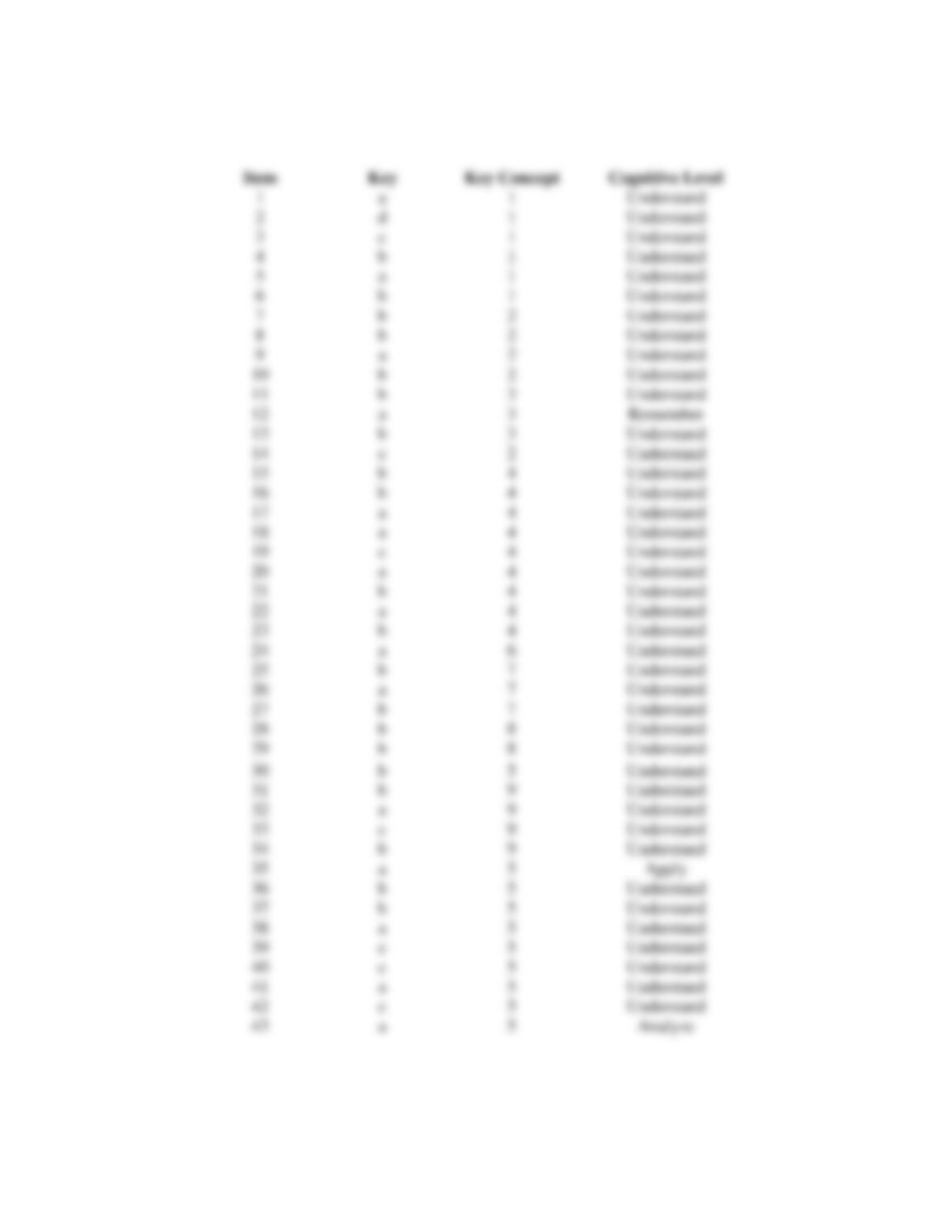
Answers and Classification of Items