
Chapter 10 Reporting and Interpreting Bond Securities Answer Key
True / False Questions
1.
An advantage of issuing a bond relative to stock is that the bond interest payments are tax
deductible.
2.
Issuing bonds dilutes the voting power of the common shareholders because bonds have
preferential voting rights.

3.
The major disadvantages of issuing a bond are the risk of bankruptcy and the negative impact
on cash flow because debt must be repaid at a specified date in the future.
4.
A bond’s interest payments are determined by multiplying the bond’s principal amount by the
coupon rate.

5.
A convertible bond can be called for early retirement at the option of the issuing company.
6.
When the market rate of interest is greater than the coupon rate, the bond will sell at a
discount.

7.
A bond will sell at a premium when the market rate of interest is greater than the coupon rate
of interest.
8.
The proceeds received from a bond issue will be greater than the bond maturity value when
the coupon rate exceeds the market rate of interest.
9.
Increases in the market rate of interest subsequent to a bond issue increase the discount on
the bond.
10.
A bond will sell at its par value when the market rate of interest equals the coupon rate of
interest.
11.
A company has a December 31 fiscal year-end. If the interest is paid annually on December
31, the bond interest expense on the income statement is the amount of the interest cash
payment when the bond initially sells at par value.
12.
The payment of bond interest on the interest payment date, for bonds issued at par value,
reduces both the bond liability and assets, assuming that interest expense is recorded at the
time of the cash payment.

13.
The issuing company and the bond underwriter determine the selling price of a bond.
14.
The issuance price of a bond is the present value of both the principal, plus the cash interest
to be received over the life of the bond, discounted at the coupon rate.
15.
Amortization of discount on bonds payable will make the amount of interest expense less than
the cash owed for interest for that year.
16.
Amortization of a discount on a bond payable will result in an increase in the book value of the
bond liability on the balance sheet.
17.
A bond issued at a discount will pay more cash for interest over the life of the bond than the
total interest expense recognized over the life of the bond.
18.
The journal entry for the cash payment of interest on a bond issued at a discount will result in
an increase in the book value of the bond liability.
19.
Either straight-line or effective-interest amortization may be used for bond premiums or
discounts regardless of the amounts involved.
20.
The journal entry for the cash payment of interest on a bond issued at a premium results in an
21.
A bond issued at a premium will pay periodic cash interest in excess of the amount of interest
expense recognized for accounting purposes.
22.
Interest expense decreases over time when a bond is initially issued at a premium and the
effective-interest method is used.
23.
Interest expense increases over time when a bond is initially issued at a premium and the
effective-interest method is used.
24.
The journal entry to record the issue of a bond when the coupon interest rate exceeds the
market rate of interest debits premium on bonds payable.

25.
The debt-to–equity ratio is calculated by dividing total liabilities by total liabilities plus
stockholders’ equity.
26.
The debt-to–equity ratio assesses the amount of capital provided by creditors relative to
stockholders’ equity.
27.
Issuing bonds rather than stock will result in an increase in the debt-to-equity ratio.
28.
If a company calls bonds with a $1,000,000 maturity value for $1,020,000 when the book value
is $950,000, a loss of $20,000 will be reported.
29.
When a company purchases and retires its outstanding bonds payable for an amount less
than their book value, a decrease in stockholders’ equity results.
30.
Issues of bonds in exchange for cash are reported as a cash flow from financing activities on
the statement of cash flows.
31.
The cash payment for interest on a bond payable is reported as a cash flow from financing
activities on the statement of cash flows.
Multiple Choice Questions
32.
When a company prepares a bond indenture, certain provisions of the bonds are included.
Which of the following is not specified in the indenture?
33.
Which of the following is the title of a regulatory document with regard to a bond offering?
34.
Which of the following types of bonds has specific assets pledged to guarantee repayment?
35.
Which of the following is not a reason that a company would want to issue bonds instead of
stock?
36.
The annual interest rate specified within a bond indenture is called which of the following?
37.
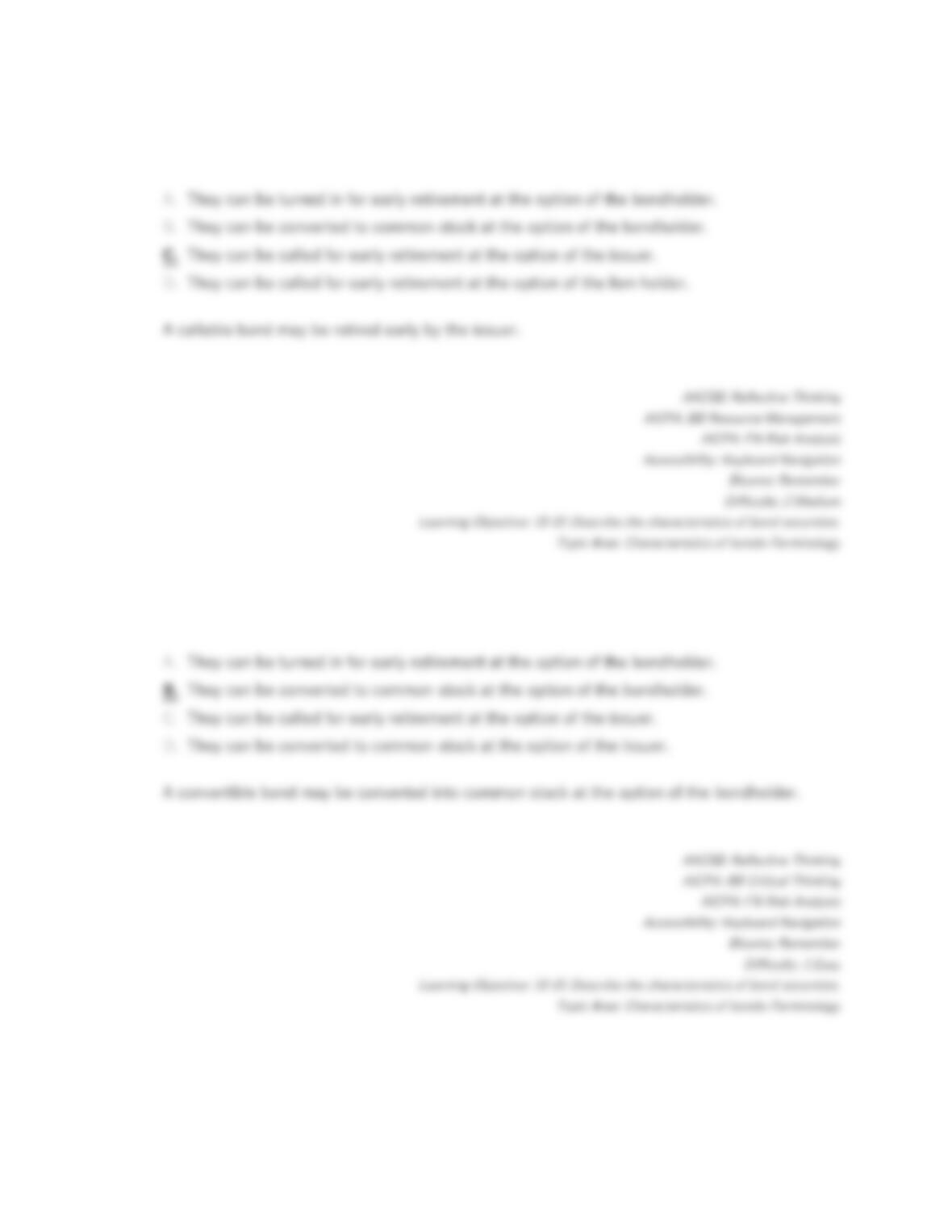
Which of the following statements best describes callable bonds?
38.
Which of the following statements best describes convertible bonds?
39.
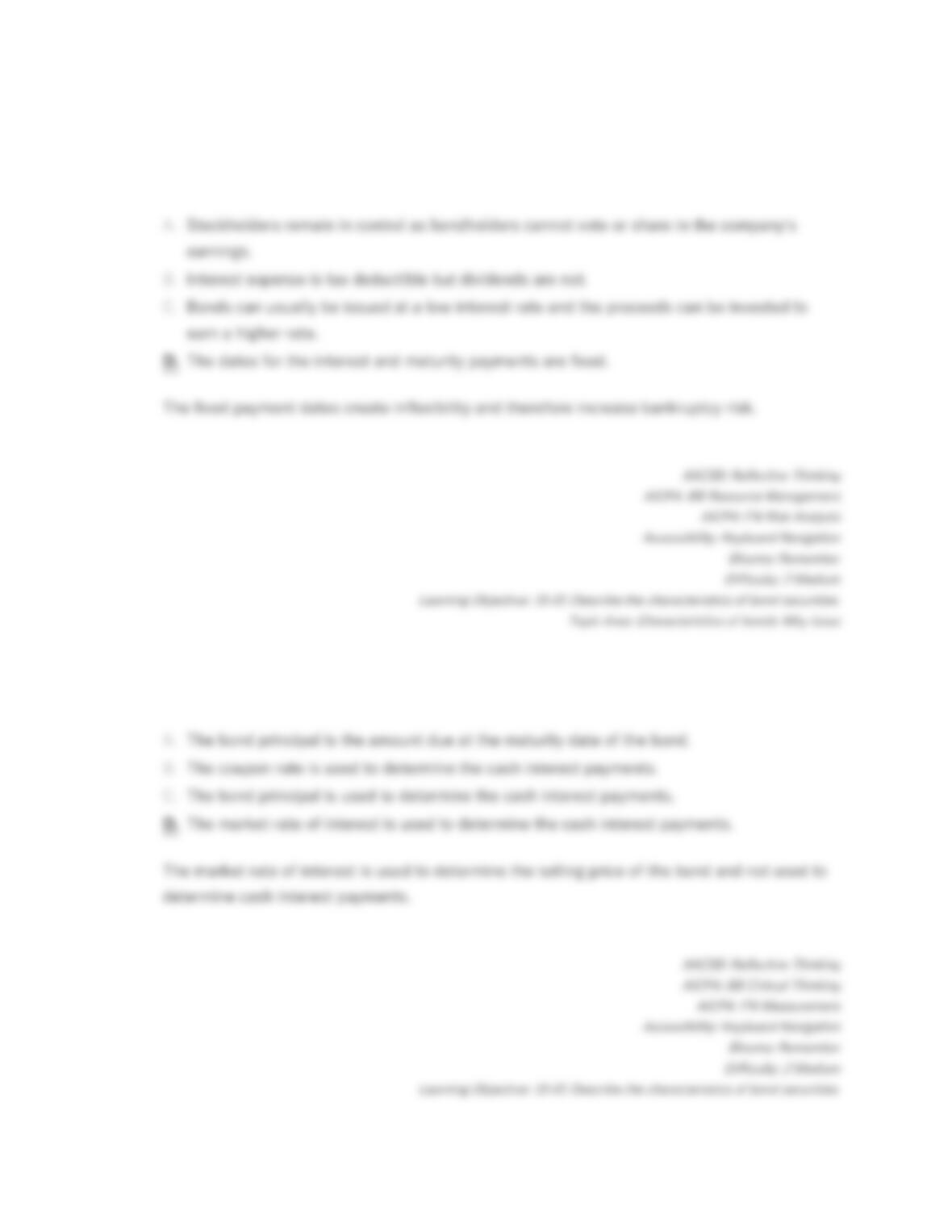
When a company needs funds to finance the expansion of its operations, which of the
following is not an advantage of issuing bonds rather than issuing stock?
40.
Which of the following statements is not correct?