Chapter 1
Currency Exchange Rates
Note: In the sixth edition of Global Investments, the exchange rate quotation symbols differ from previous
editions. We adopted the convention that the first currency is the quoted currency in terms of units
of the second currency.
For example, €:$ = 1.4 indicates that one euro is priced at 1.4 dollars. In previous editions we used
the reversed convention $/€ = 1.4, meaning 1.4 dollars per euro.
All problems in this test bank still use the old convention and have not been adapted to reflect the
new quotation symbols used in the 6th edition.
◼ Questions and Problems
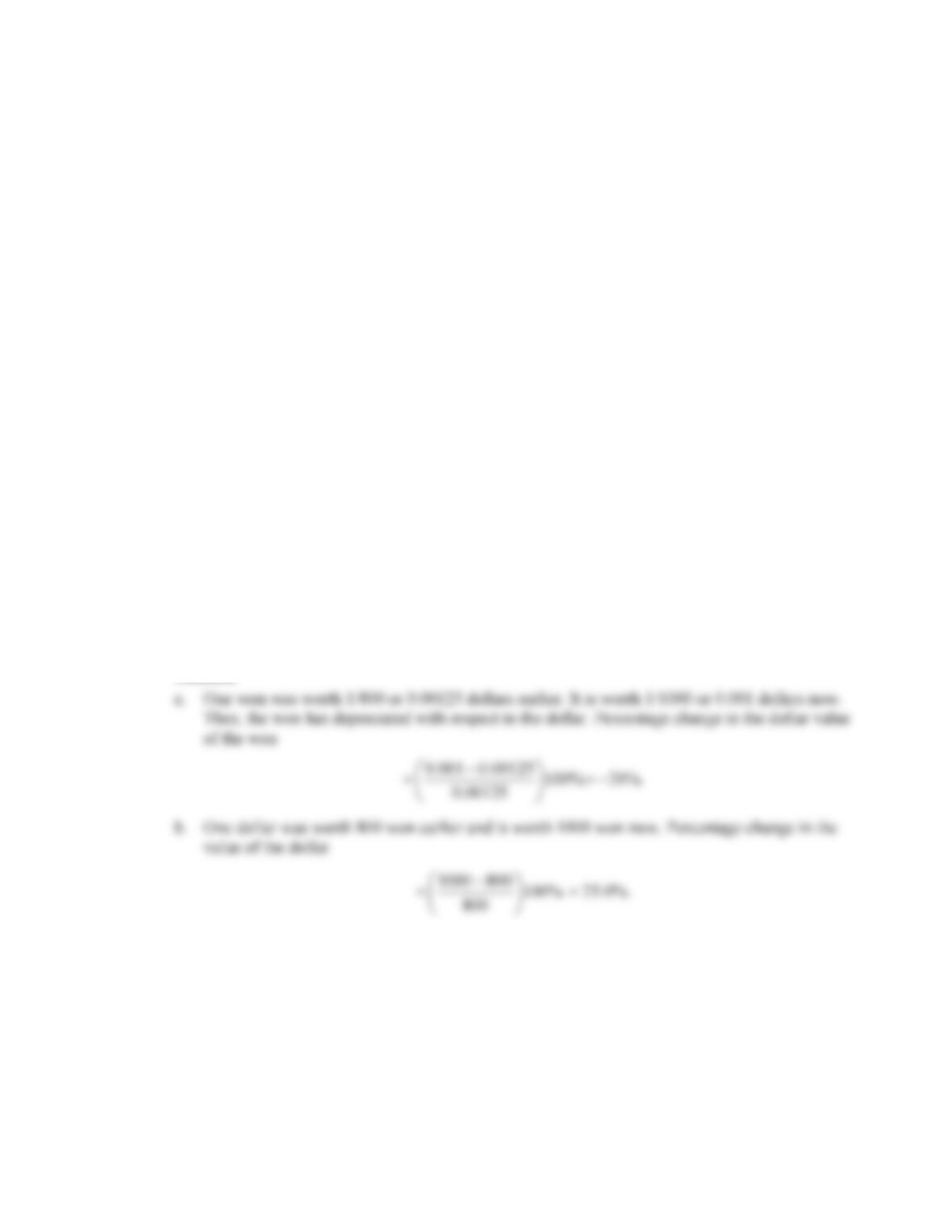
1. You noticed that the exchange rate between the Korean won and the U.S. dollar has changed
considerably. The won/dollar exchange rate has moved from 800 won per dollar to 1000 won per
dollar.
a. Has the Korean won appreciated or depreciated with respect to the dollar? By what percentage?
b. By what percentage has the value of the dollar changed with respect to the won?
Solution
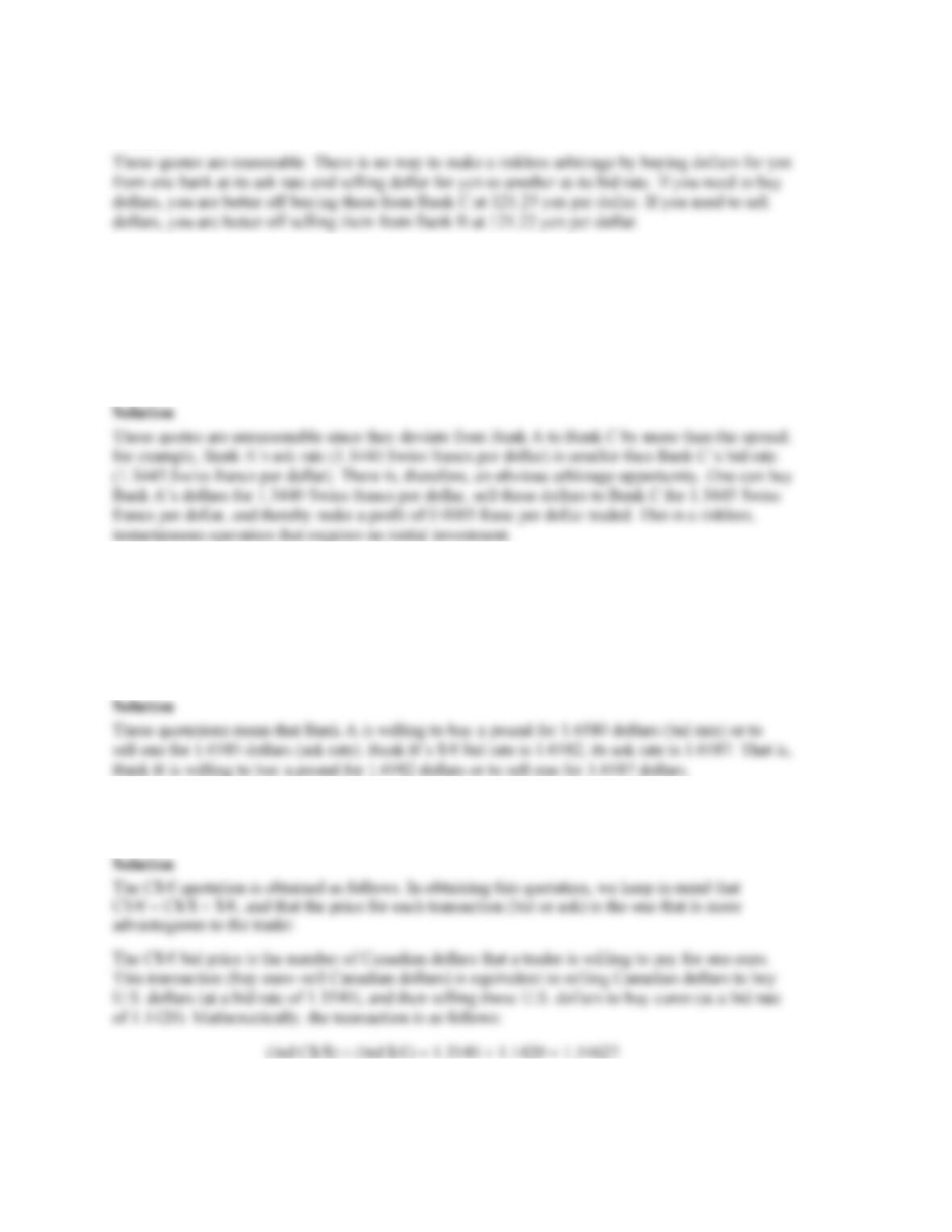
2. Here are some quotes of the Japanese yen/U.S. dollar spot exchange rate given simultaneously on the
phone by three banks:
Bank A: 121.15–121.30
Bank B: 121.22–121.35
Bank C: 121.20–121.25
Are these quotes reasonable? Do you have an arbitrage opportunity?
2 Solnik/McLeavey • Global Investments, Sixth Edition
Solution
3. Here are some quotes of the Swiss franc/U.S. dollar spot exchange rate given simultaneously on the
phone by three banks:
Bank A: 1.3435–1.3440
Bank B: 1.3435–1.3445
Bank C: 1.3445–1.3450
Are these quotes reasonable? Do you have an arbitrage opportunity?
4. You visit the foreign exchange trading room of a major bank. A trader asks for quotations of the
British pound from various correspondents and hears the following quotes:
From Bank A: 1.6580–1.6585
From Bank B: 1.6582–1.6587
What do they mean?
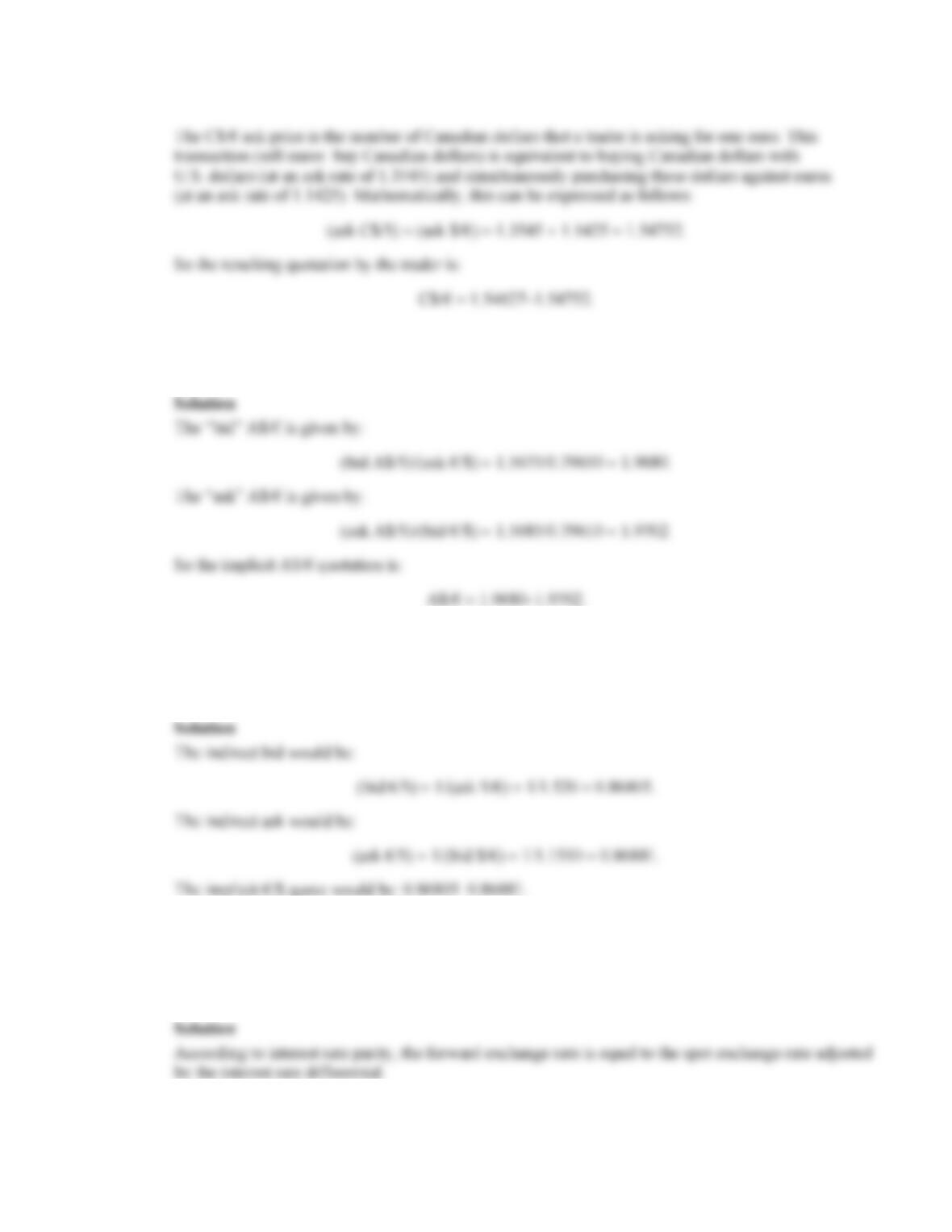
5. The euro is quoted as $/€ = 1.1420–1.1425, and the Canadian dollar is quoted as C$/US$ = 1.3540–
1.3545. What is the implicit C$/€ quotation?
Chapter 1 Currency Exchange Rates 3
6. The euro is quoted as €/$ = 0.79610–0.79650, and the Australian dollar is quoted as A$/$ = 1.5675–
1.5685. What is the implicit A$/€ quotation?
7. A foreign exchange trader quotes the dollar value of one euro as $/€ = 1.1510–1.1520.
These are direct bid–ask rates for a New York trader. What would be the implicit indirect
quotes for €/$?
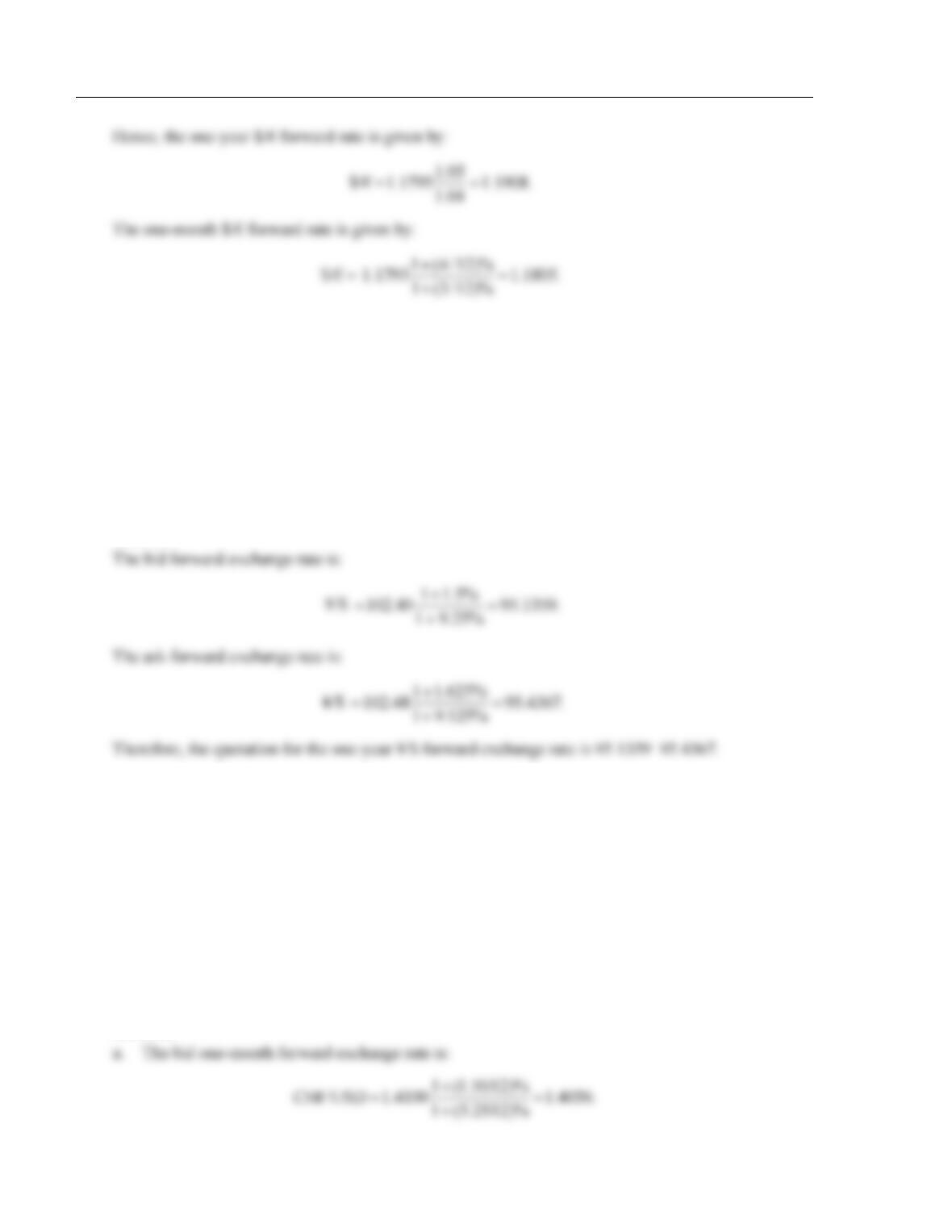
8. The spot $/€ is equal to 1.1795. The one-year interest rates on the Eurocurrency market are 4% in
euros and 5% in U.S. dollars. The one-month interest rates are 3% in euros and 4% in U.S. dollars.
a. What is the one-year forward exchange rate?
b. What is the one-month forward exchange rate?
4 Solnik/McLeavey • Global Investments, Sixth Edition
9. The bid–ask rates are as follows:
Spot exchange rate:
¥/$ 102.40–48
Interest rates:
One-year interest rate in ¥ 11/2 – 5/8
One-year interest rate in $ 91/8 – 1/4
What is the quotation for the one-year ¥/$ forward exchange rate?
Solution
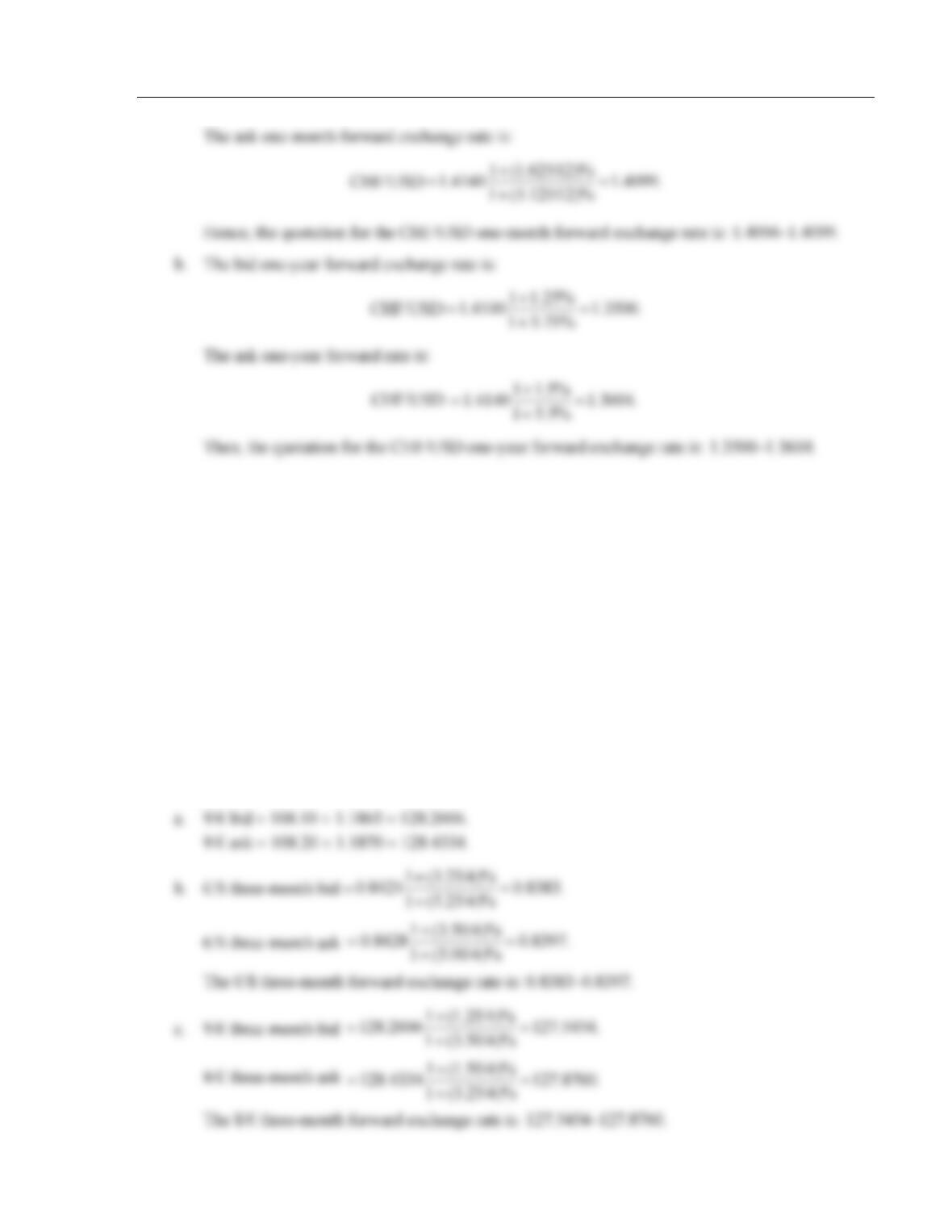
10. The bid–ask rates are as follows:
Spot exchange rate:
CHF/USD: 1.4100–1.4140
Interest rates:
One-month CHF 11/2 – 5/8
One-year CHF 11/4 – 1/2
One-month USD 51/8 – 1/4
One-year USD 51/2 – 3/4
What are the quotations for the one-month and one-year CHF/USD forward exchange rates?
Solution
Chapter 1 Currency Exchange Rates 5
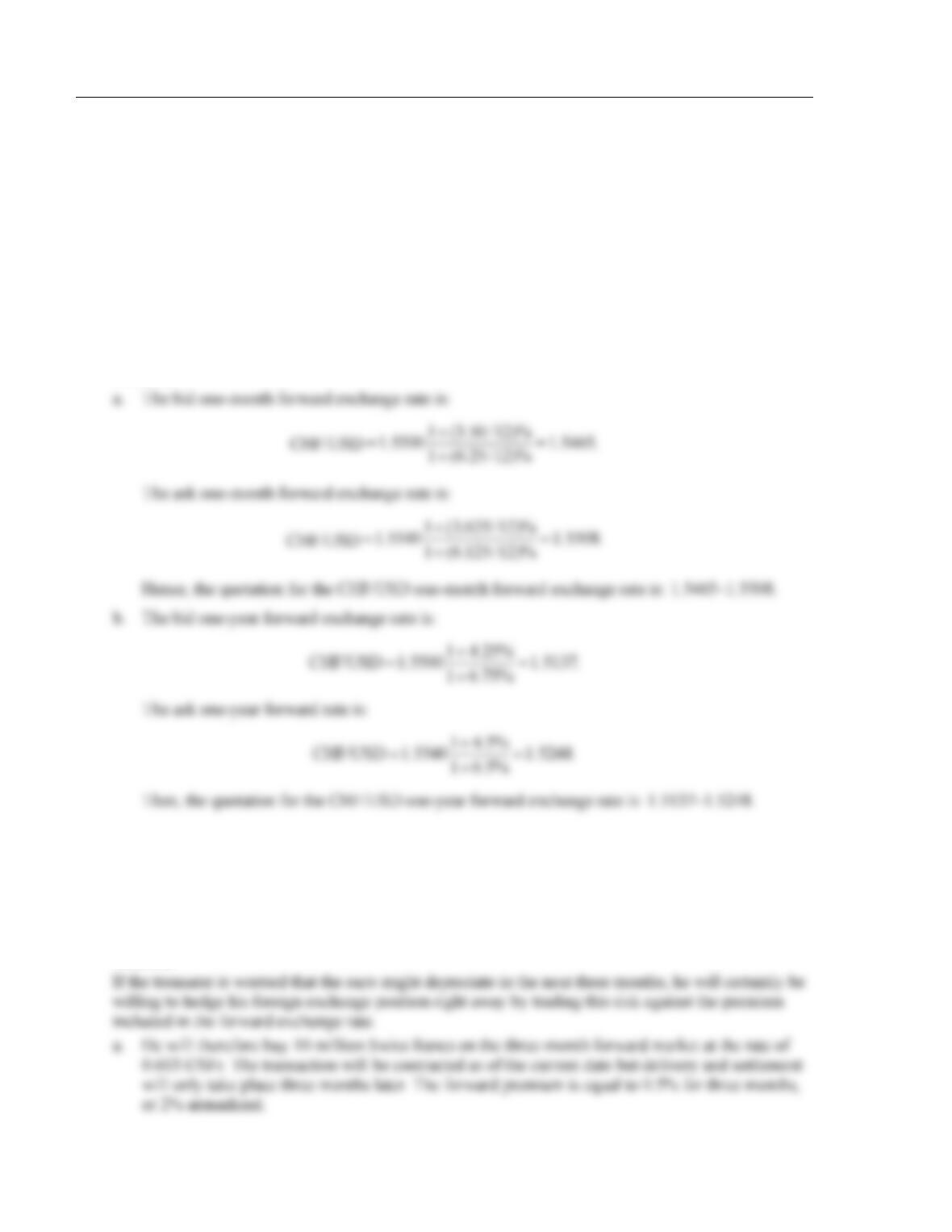
11. Here are some quotes for spot exchange rates and three-month interest rates:
Spot exchange rates:
$/€ 1.1865–1.1870
¥/$ 108.10–108.20
Interest rates:
Three-month euro-$ 5–51/4
Three-month euro-€ 31/4–31/2
Three-month euro-¥ 11/4–11/2
What should the quotes be for:
a. The ¥/€ spot exchange rate?
b. The €/$ three-month forward exchange rate?
c. The ¥/€ three-month forward exchange rate?
Solution
6 Solnik/McLeavey • Global Investments, Sixth Edition
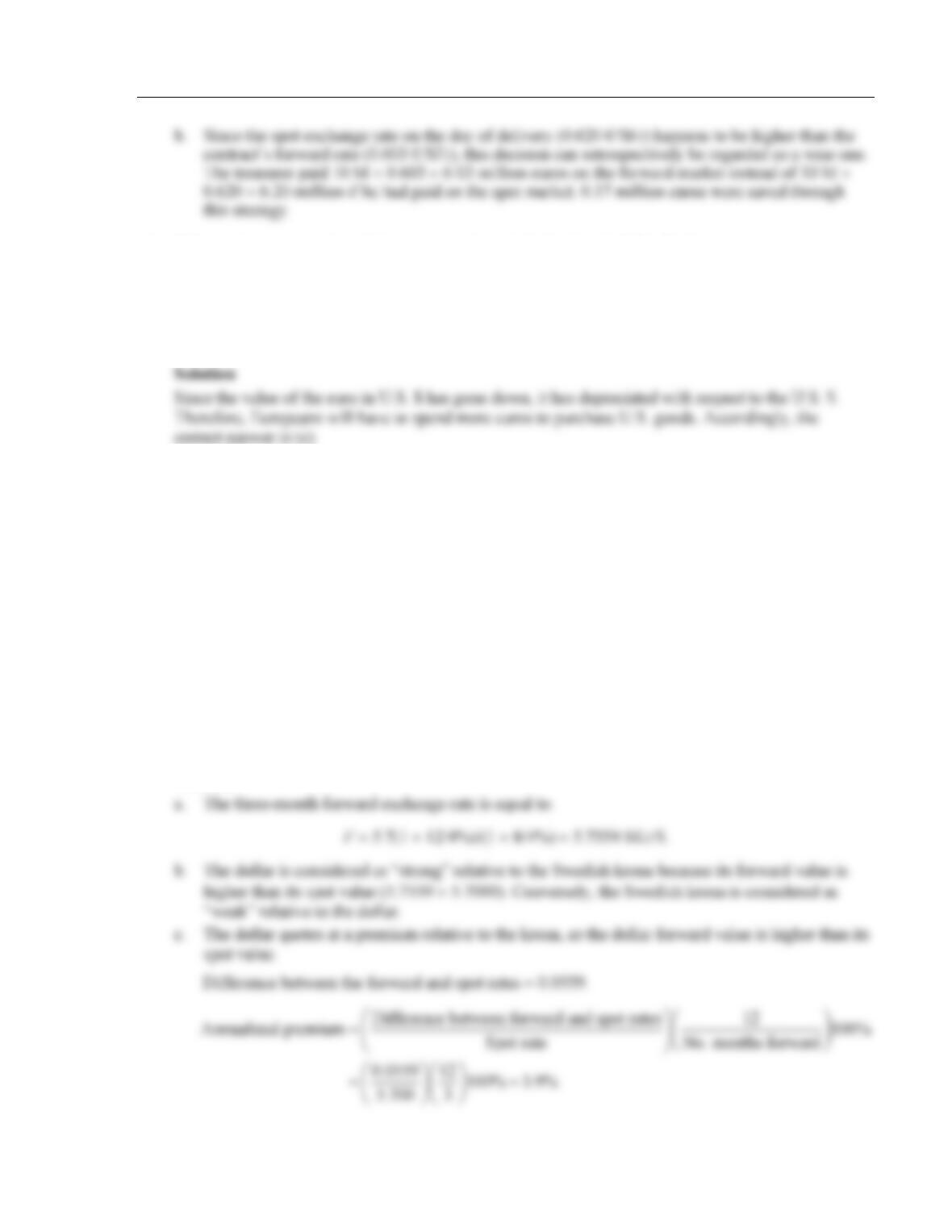
12. The bid–ask rates are as follows:
Spot exchange rate:
CHF/USD: 1.5500–1.5540
Interest rates:
One-month CHF 31/2 – 5/8
One-year CHF 41/4 – 1/2
One-month USD 61/8 – 1/4
One-year USD 61/2 – 3/4
What are the quotations for the one-month and one-year CHF/USD forward exchange rates?
Solution
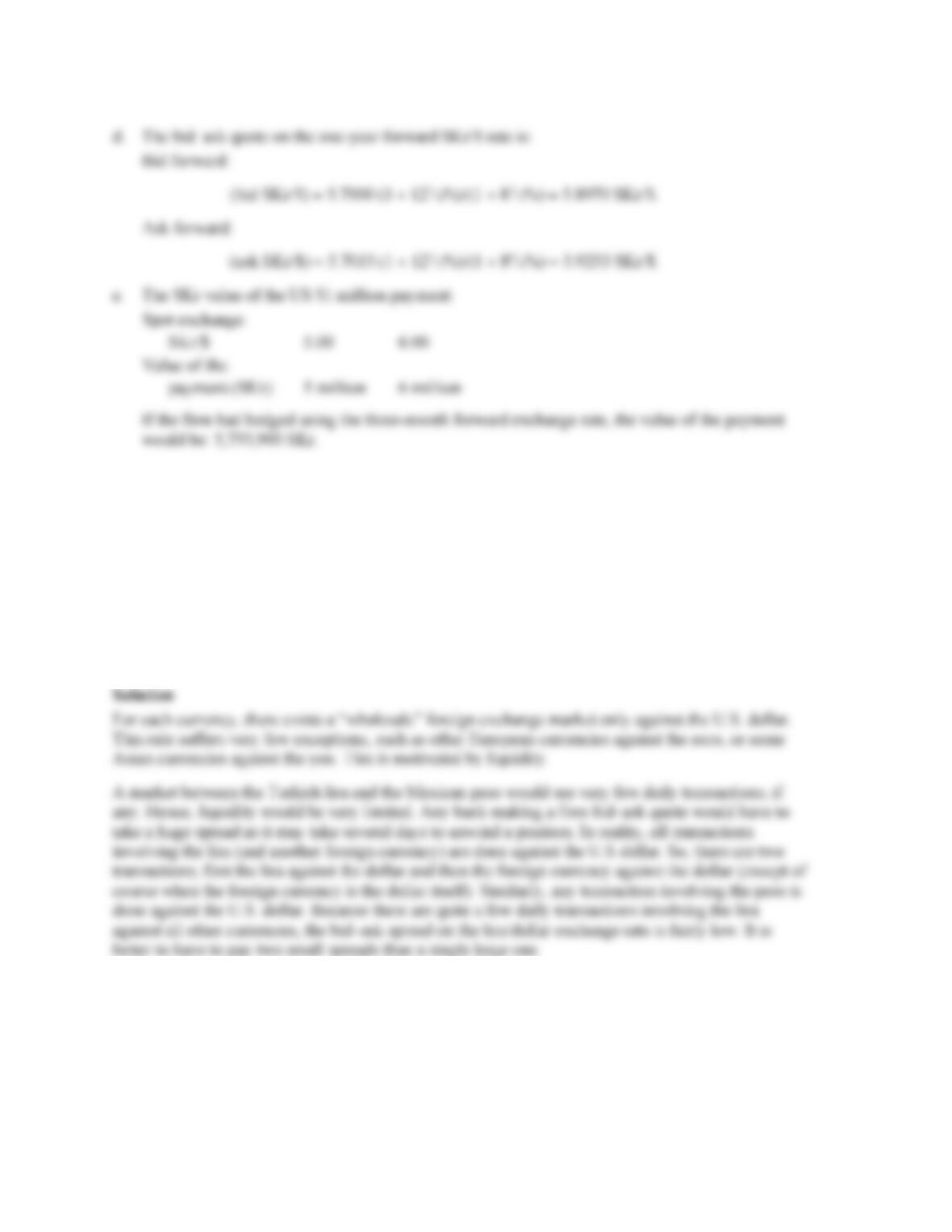
13. A French company knows that it will have to pay 10 million Swiss francs in three months. The
current spot exchange rate is 0.6000 €/SFr. The three-month forward rate is 0.603 €/SFr. The
treasurer is worried that the euro will depreciate in the next few weeks.
a. What action can be taken?
b. Three months later, the spot exchange rate turns out to be 0.620 €/SF; was it a wise decision?
Solution
Chapter 1 Currency Exchange Rates 7
14. If the exchange rate value of the euro goes from U.S. $1.15 to U.S. $1.05, then:
a. The euro has appreciated, and Europeans will find U.S. goods cheaper.
b. The euro has appreciated, and Europeans will find U.S. goods more expensive.
c. The euro has depreciated, and Europeans will find U.S. goods more expensive.
d. The euro has depreciated, and Europeans will find U.S. goods cheaper.
15. You are a foreign exchange dealer. You see the following quote on your Reuter’s screen:
a. The spot exchange rate of the Swedish krona is equal to 5.7 SKr per U.S. dollar. The three-month
interest rates are 12% in SKr and 8% in dollars. What is the three-month forward exchange that
you should quote?
b. In the language of currency traders would the Swedish krona be considered as “strong” or
“weak” relative to the U.S. dollar?
c. Compute the annualized discount or premium on the dollar relative to the krona.
d. After a careful look at your screen, you discover that the spot exchange rate is really 5.7000–
5.7015. The 12-month interest rates are 121/4 − 1/2% in SKr and 81/4 − 1/2% in U.S. dollars. What
should be the bid–ask quote on the one-year forward SKr/$ rate?
e. A Swedish exporting firm expects to be paid $1 million in three months. Please simulate the
SKr value of this payment if in three months, the spot exchange rate is equal to SKr/$ = 5 and
SKr/$ = 6. What would be the value of this payment if the firm had hedged against currency
movements using the forward rate calculated in (a)?
Solution
8 Solnik/McLeavey • Global Investments, Sixth Edition
16. A Turkish clothing company is buying material in Mexico. It needs to pay 1 million Mexican pesos.
The exchange rates published in a local newspaper are as follows:
• One U.S. dollar is worth 1356 Turkish liras.
• One U.S. dollar is worth 129.64 Mexican pesos.
The Turkish company calls its local banker, who advises that it needs to do two foreign exchange
transactions: One selling liras to buy dollars, and the other buying pesos with these dollars. The
company is surprised that its banker does not engage directly in a single transaction from liras to
pesos. Why would the bid–ask spread be much larger on the lira/peso transaction than the sum of the
bid–ask spread of the two lira/dollar and peso/dollar transactions?