Chapter 1: The Demand for and Supply of Financial Accounting Information
53. Notes to financial statements provide
a.
discussions that further explain items shown in the financial statements.
b.
comparative financial information with the previous year.
c.
management’s discussions about plans for the future.
d.
the report of the independent auditors.
a
1
Easy
ACCT.WHAL.16.1.6 – LO: 1.6
United States – BUSPROG: Reflective Thinking – BUSPROG: Analytic
United States – OH – Default City – AICPA: FN-Decision Modeling
54. What financial statement is considered the cornerstone of financial reporting?
a.
the income statement
b.
the statement of cash flows
c.
the statement of shareholders’ equity
d.
the balance sheet
d
1
Easy
ACCT.WHAL.16.1.6 – LO: 1.6
United States – BUSPROG: Reflective Thinking – BUSPROG: Analytic
United States – OH – Default City – AICPA: FN-Decision Modeling
55. The accounting equations is
a.
Assets + Liabilities = Shareholders’ Equity
b.
Assets -Liabilities = Shareholders’ Equity
c.
Assets = Liabilities – Shareholders’ Equity
d.
Assets + Shareholders’ Equity = Liabilities
b
1
Easy
ACCT.WHAL.16.1.6 – LO: 1.6
United States – BUSPROG: Reflective Thinking – BUSPROG: Analytic
United States – OH – Default City – AICPA: FN-Decision Modeling
56. Which statement measures and reports the financial results of a company’s performance for a period of time?
a.
income statement
b.
balance sheet
c.
statement of cash flows
d.
statement of financial position
a
1
Easy
ACCT.WHAL.16.1.6 – LO: 1.6
United States – BUSPROG: Reflective Thinking – BUSPROG: Analytic
United States – OH – Default City – AICPA: FN-Decision Modeling
57. The four major financial statements of a corporation consist of the
a.
income statement, balance sheet, statement of cash flows, and statement of changes in shareholders’ equity.
b.
balance sheet, statement of cash flows, statement of retained earnings, and income statement.
c.
income statement, statement of cash flows, statement of financial flexibility, and balance sheet.
d.
statement of cash flows, balance sheet, income statement, and statement of capital equity.
a
1
Easy
ACCT.WHAL.16.1.6 – LO: 1.6
United States – BUSPROG: Reflective Thinking – BUSPROG: Analytic
United States – OH – Default City – AICPA: FN-Reporting
58. What important topics are discussed in the Management Discussion and Analysis section of the financial statements?
a.
Business risk factors associated with the company.
b.
Management provides insight into key decisions implemented during that time period and future
developments.
c.
Management utilizes this area as a forum to discuss strategic motives.
d.
All of these choices are discussed.
d
1
Easy
ACCT.WHAL.16.1.6 – LO: 1.6
United States – BUSPROG: Reflective Thinking – BUSPROG: Analytic
United States – OH – Default City – AICPA: FN-Decision Modeling
59. What is the correct order of presentation for the statement of cash flows?
a.
Operating, Investing, Financing
b.
Financing, Operating, Investing
c.
Investing, Financing, Operating
d.
Operating, Financing, Investing
a
1
Easy
ACCT.WHAL.16.1.6 – LO: 1.6
United States – BUSPROG: Reflective Thinking – BUSPROG: Analytic
United States – OH – Default City – AICPA: FN-Decision Modeling
60. What is the correct presentation of the income statement?
a.
Revenues – expenses + gains – losses = Net Income
b.
Revenues – expenses = Net income – losses + gains
c.
Revenues – losses – expenses + gains = Net Income
d.
Revenues + gains – losses – expenses = Net Income
a
1
Easy
ACCT.WHAL.16.1.6 – LO: 1.6
United States – BUSPROG: Reflective Thinking – BUSPROG: Analytic
United States – OH – Default City – AICPA: FN-Decision Modeling
61. Dividends that are paid to owners would affect both the
a.
balance sheet and statement of cash flows.
b.
balance sheet and income statement.
c.
income statement and statement of changes in equity.
d.
income statement and statement of cash flows.
a
1
Moderate
ACCT.WHAL.16.1.6 – LO: 1.6
United States – BUSPROG: Reflective Thinking – BUSPROG: Analytic
United States – OH – Default City – AICPA: FN-Decision Modeling
62. Which of the following transactions would be reported in the cash flows from investing activities section in the
statement of cash flows for the Harlem Company?
a.
Harlem sold a piece of land for $600,000.
b.
Harlem borrowed $3,000,000
c.
Harlem issued common stock for $700,000 to investors.
d.
Harlem paid a cash dividend to its shareholders.
a
1
Moderate
ACCT.WHAL.16.1.6 – LO: 1.6
United States – BUSPROG: Reflective Thinking – BUSPROG: Analytic
63. Which Principle of the AICPA Code of Professional Conduct is: As a member one should continually strive to
improve competence and the quality of services, observe all technical and ethical standards, and provide professional
responsibility to the best of his/her ability?
a.
The Public Interest
b.
Responsibilities
c.
Scope and Nature of Services
d.
Due Care
d
1
Easy
ACCT.WHAL.16.1.7 – LO: 1.7
United States – BUSPROG: Reflective Thinking – BUSPROG: Analytic
United States – OH – Default City – AICPA: FN-Decision Modeling
64. Auditors face ethical issues because
a.
GAAP permits various standards to be used to produce profits.
b.
auditors may express an opinion that may impact employees of a company.
c.
auditors may not discover insider trading.
d.
GAAP does not permit fraud.
b
1
Easy
ACCT.WHAL.16.1.7 – LO: 1.7
United States – BUSPROG: Reflective Thinking – BUSPROG: Analytic
65. Unethical actions include which of the following?
a.
polluting lakes and streams
b.
overcharging on government contracts
c.
securities fraud
d.
All of these choices are unethical actions.
d
1
Medium
ACCT.WHAL.16.1.7 – LO: 1.7
United States – BUSPROG: Reflective Thinking – BUSPROG: Analytic
United States – OH – Default City – AICPA: FN-Decision Modeling
66. The stated principles of the AICPA Code of Professional Conduct do not include
a.
Integrity.
b.
Optimism.
c.
Objectivity and Independence.
d.
Responsibilities.
b
1
Easy
ACCT.WHAL.16.1.7 – LO: 1.7
United States – BUSPROG: Reflective Thinking – BUSPROG: Analytic
United States – OH – Default City – AICPA: FN-Decision Modeling
67. Which of the following is not considered an ethical issue in accounting?
a.
Biased financial statement presentation
b.
Accelerated revenue recognition
c.
Earnings manipulation
d.
Industry practices
d
1
Medium
ACCT.WHAL.16.1.7 – LO: 1.7
United States – BUSPROG: Reflective Thinking – BUSPROG: Analytic
United States – OH – Default City – AICPA: FN-Decision Modeling
68. The AICPA Code of Professional Conduct includes which of the following principles?
a.
Professionalism
b.
Conservatism
c.
Objectivity
d.
Quality
c
1
Easy
ACCT.WHAL.16.1.7 – LO: 1.7
United States – BUSPROG: Reflective Thinking – BUSPROG: Analytic
United States – OH – Default City – AICPA: FN-Decision Modeling
69. Which Principle of the AICPA Code of Professional Conduct is: A member, as a professional, should exercise
sensitive and moral judgments in all their activities?
a.
Objectivity and Independence
b.
Integrity
c.
Responsibilities
d.
Due Care
c
1
ACCT.WHAL.16.1.7 – LO: 1.7
United States – BUSPROG: Reflective Thinking – BUSPROG: Analytic
United States – OH – Default City – AICPA: FN-Decision Modeling
70. Which Principle of the AICPA Code of Professional Conduct is: Members should broaden and maintain public
confidence by performing all of their professional responsibilities with the highest sense of honesty possible?
a.
Scope and Nature of Services
b.
Due Care
c.
Integrity
d.
Objectivity and Independence
c
1
Easy
ACCT.WHAL.16.1.7 – LO: 1.7
United States – BUSPROG: Reflective Thinking – BUSPROG: Analytic
71. Listed below are the names of several organizations involved in the process of establishing standards for financial
reporting. Following the list is a series of statements.
a.
Securities and Exchange Commission (SEC)
b.
International Accounting Standards Board (IASB)
c.
Financial Accounting Standards Board
____
1.
Reporting standards issued by this organization are legally enforceable. Failure to
adhere to them is a violation of law.
____
2.
Reporting standards issued by this organization only apply to companies listed on
U.S. securities exchanges..
____
3.
Reporting standards issued by this organization apply to all U.S. companies,
whether publicly traded or privately held.
____
4.
This organization has the legal authority and the responsibility to oversee financial
reporting in the U.S.
____
5.
Requires 10 out of 16 board members’ approvals before a standard is issued.
____
6.
This organization is government agency established by the U.S. Congress.
Required:
Match each organization with its descriptive statement by placing the letter of the appropriate organization in the
space provided. (Note: Organizations may be used more than once or not at all.)
1.
2.
3.
4.
5.
6.
72. Listed below are some of the steps the FASB goes through before issuing a new standard.
____
a.
Conduct research
____
b.
Deliberate on findings
____
c.
Invitations to comment
____
d.
Identify topic
____
e.
Issue Exposure Draft
____
f.
Issue Statement
____
g.
Modify Exposure Draft
____
h.
Vote
Required:
Indicate the proper sequence of these steps.
a.
2
d.
1
g.
6
b.
4
e.
5
h.
7
c.
3
f.
8
73. Listed below are the Six Principles of AICPA’s Code of Professional Conduct.
a.
Responsibilities
b.
Scope and Nature of Services
c.
Due Care
d.
The Public Interest
e.
Objectivity and Independence
f.
Integrity
Required:
Match each principle with its descriptive statement by placing the appropriate letter in the space provided. Each
principle choice is used only once.
_______
1)
A member should be free from conflicts of interest and be objective.
A member should be free of bias and provide auditing and
attestation services in an independent manner.
_______
2)
A member is public practice should always consider the Code of
Professional Conduct in determining the nature and scope of
services which they have been asked to provide.
_______
3)
Members should perform all of their professional activities with the
highest sense of integrity possible. This maintains and broadens
public confidence in the profession.
_______
4)
Members should act in a way that demonstrates professionalism and
honors public trust.
_______
5)
As a member, one should continually strive to improve competence
and the quality of services to the best of their ability.
______
6)
Members should exercise sensitive professional and moral
judgments in when carrying out their activities as a professional.
1
Challenging
ACCT.WHAL.16.1.7 – LO: 1.7
United States – BUSPROG: Reflective Thinking – BUSPROG: Analytic
United States – OH – Default City – AICPA: FN-Decision Modeling
74. What types of resources do companies compete for and why?
75. The demand for accounting information arises from the informational needs of various stakeholders.
Required
List five internal stakeholders or external stakeholders.
76. What is the mission of the Securities and Exchange Commission? How did the SEC come into being?
77. What is the responsibility of FASB?
78. The FASB Codification consists of six components or levels, what are the components or levels?
79. What are the FASB operating procedures when reviewing whether to issue a new standard?
80. The FASB and IASB have some ambitious accounting standards projects to complete prior to their convergence. List
three of the projects currently on the agenda.
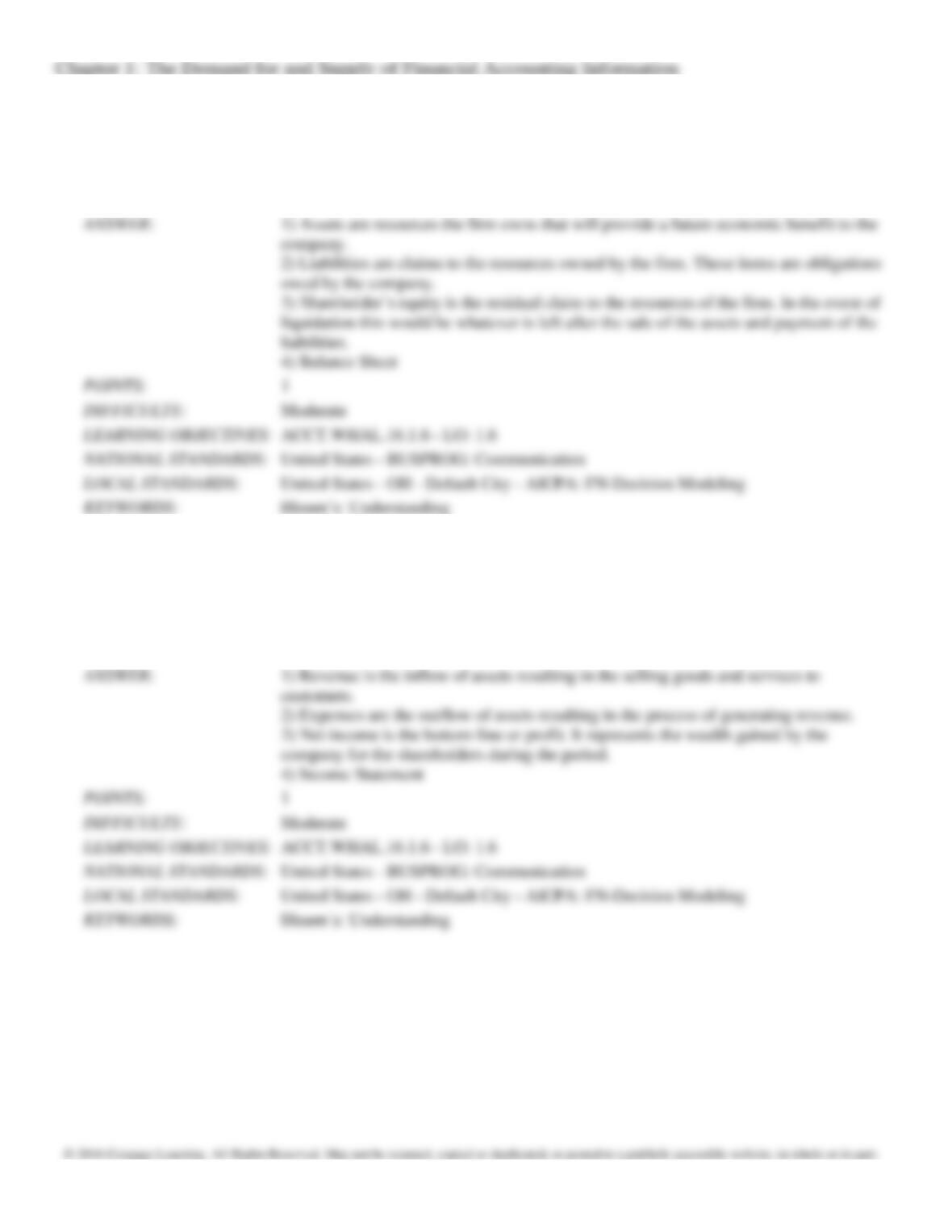
81. Define:
1) What are assets?
2) What are liabilities?
3) What is shareholder’s equity?
4) In which financial statement would one find assets, liabilities and shareholder’s equity?
82. Define:
1) What are revenues?
2) What are expenses?
3) What is net income?
4) In which financial statement would one find revenues, expenses, and net income?
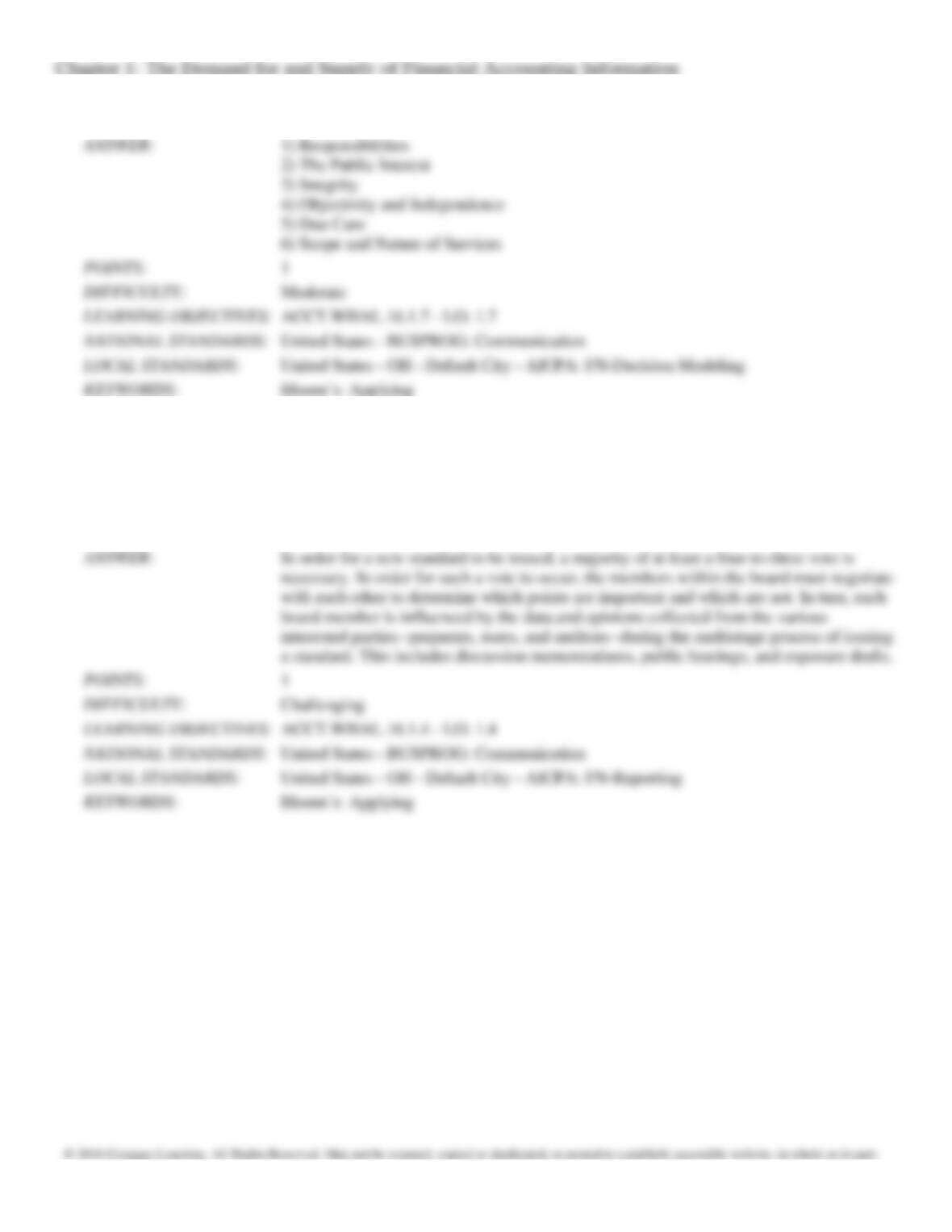
83. What are the six areas covered in the AICPA Code of Professional Conduct?
84. Assume you are tutoring a beginning accounting student who tells you that the members of the FASB must have a
great deal of power because they have the authority to issue standards that dictate accounting procedure.
Required:
Explain why accounting standards are the result of compromise and how such compromises are reached.
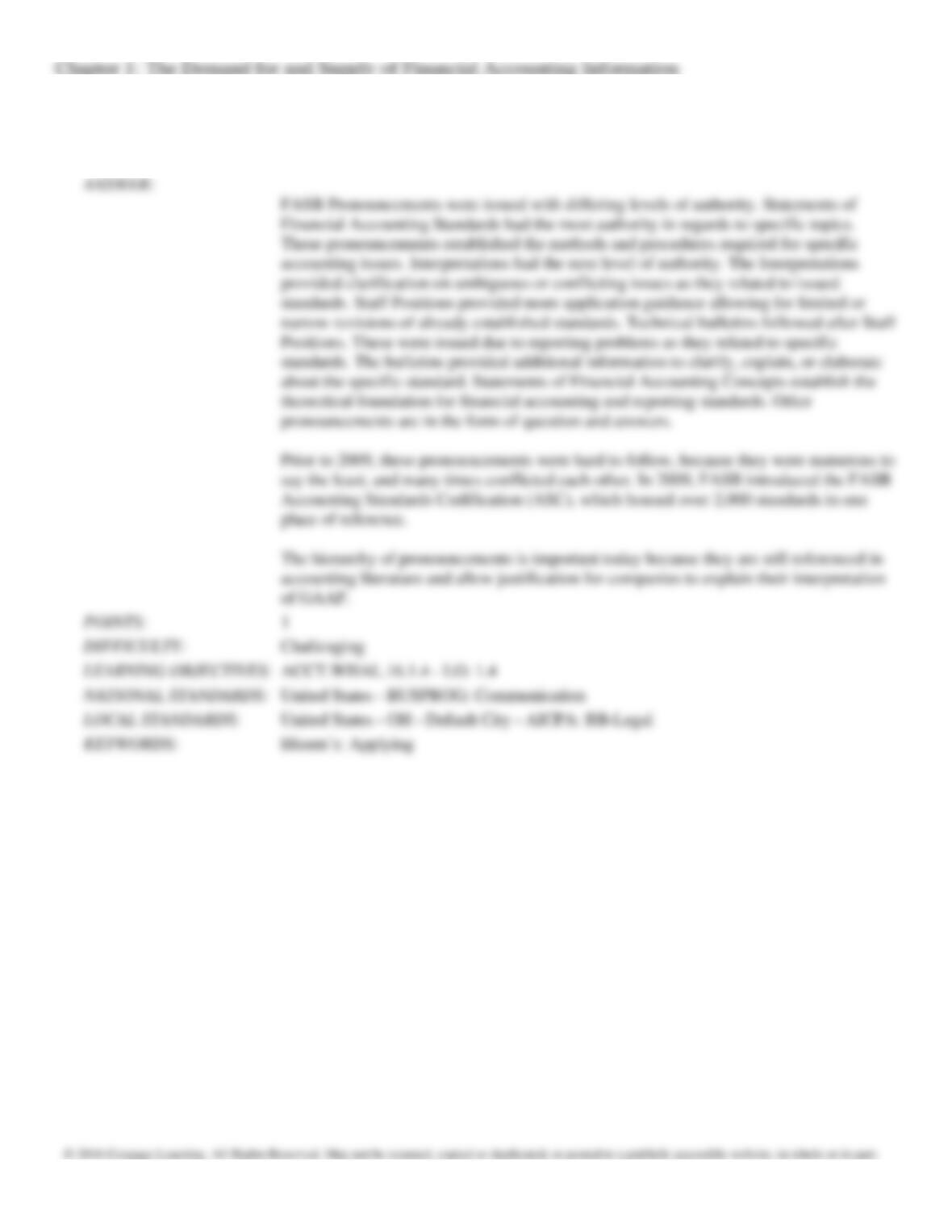
85. Prior to 2009, the FASB issued several types of pronouncements which had differing levels of authority. Explain the
differing types of pronouncements, provide a brief explanation as to what changed after 2009 and why is it still
important today?
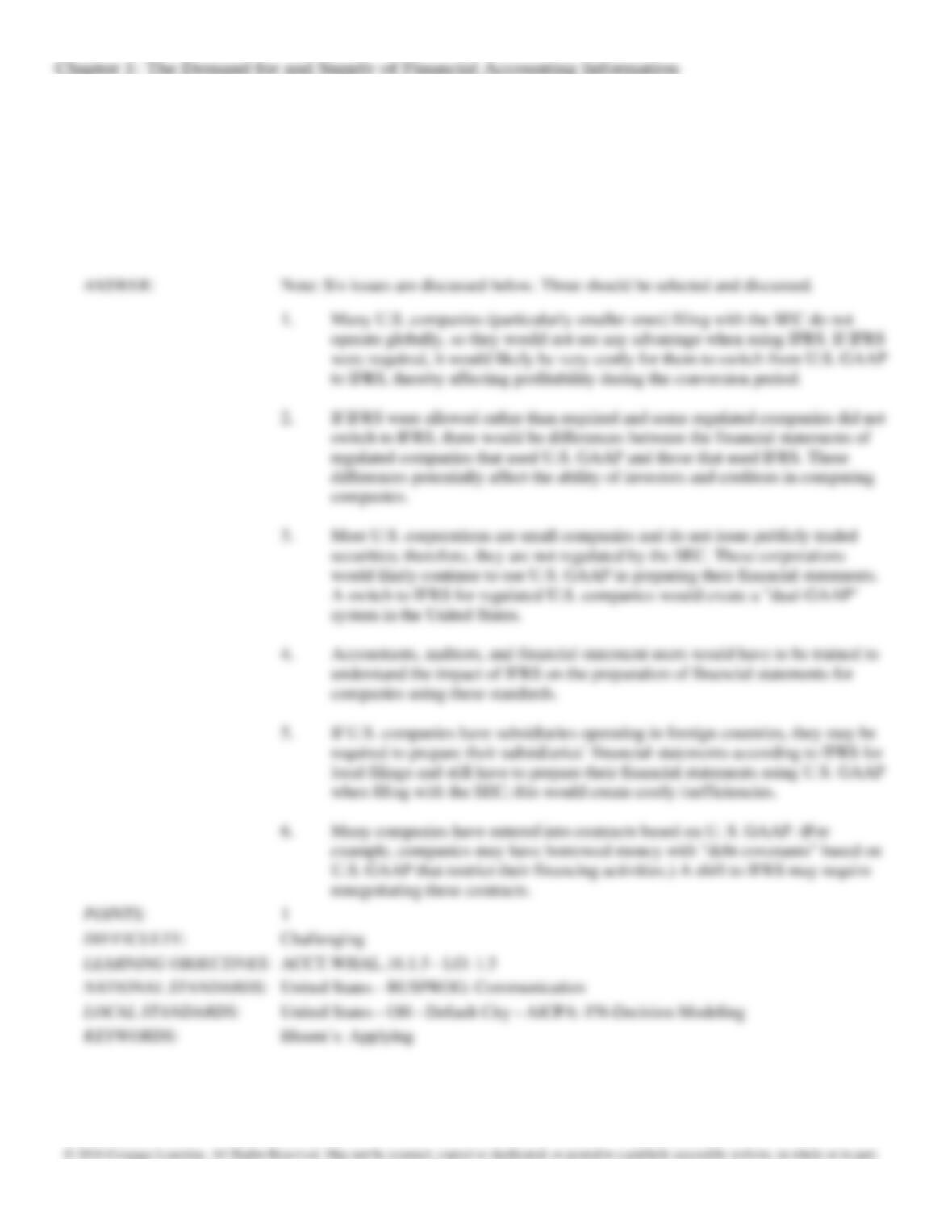
86. The SEC is considering proposals regarding the accounting principles companies may use for their financial statement
filings. The SEC could require that U.S. companies use only U.S. GAAP in their financial statement filings.
Alternatively, the SEC could allow, or even require, U.S. companies to use IFRS in their financial statement filings.
Many issues and complexities surround the use of IFRS. The SEC must consider these and many other issues as it
deliberates whether it should continue to require the use of U.S. GAAP or whether it should require the use of IFRS.
Required:
Identify and discuss three of the potential problems to be considered by the SEC in deliberating these proposals.
87. Your accounting instructor allows you to look at his grade book in order to verify the points you have received to date
in the final course taken by all accounting majors. While looking at your points, you notice that your best friend’s
score on the last exam was recorded incorrectly. He actually received a 68 on the test but the score was recorded as an
86 in the grade book. Your friend needs a passing grade in this class in order to graduate. If the grade book were
updated to show the correct score, your friend might not have enough points to pass the course.
Required:
Discuss the steps you should take to deal with this ethical dilemma using three ethical criteria. You need not indicate
the ethical action you would take.