
Chapter 1: Accounting as a Form of Communication
75. Which of the following organizations is responsible for setting auditing standards followed by public accounting
firms in conducting independent audits of financial statements?
a. Financial Accounting Standards Board (FASB)
b. Securities and Exchange Commission (SEC)
c. Public Company Accounting Oversight Board (PCAOB)
d. International Accounting Standards Board (IASB)
76. Which organization, in addition to the Financial Accounting Standards Board (FASB), occasionally issues
authoritative rules for financial statements?
a. The Accounting Profession
b. International Accounting Standards Board (IASB)
c. Securities and Exchange Commission (SEC)
d. Internal Revenue Service (IRS)
77. The Securities and Exchange Commission (SEC) is concerned with
a. All companies in the United States regardless of size.
b. Companies that issue securities to the general public.
c. Accounting reports issued by government entities.
d. All domestic and international companies that issue accounting reports.
78. To which of the following entities must a company report if it sells its stock on the organized stock market?
a. American Institute of Certified Public Accountants (AICPA)
b. American Accounting Association (AAA)
c. International Accounting Standards Board (IASB)
d. Securities and Exchange Commission (SEC)
79. The reliability of the information in a company’s financial statements is the responsibility of which of the following?
a. The Securities and Exchange Commission (SEC)
b. The Certified Public Accountant in charge of the audit of the company’s financial statements
c. The company’s management
d. The stockholders of the company

Chapter 1: Accounting as a Form of Communication
80. In order for accounting information to be useful in making informed decisions, it must be:
a. relevant.
b. reliable.
c. both relevant and reliable.
d. neither relevant nor reliable.
81. The second step in the ethical decision–making model is to:
a. list alternatives and evaluate the impact of each on those affected.
b. select the best alternative.
c. recognize an ethical dilemma.
d. analyze the key elements in the situation.
82. All of the following are important provisions of the Sarbanes-Oxley Act except:
a. The establishment of a new Public Company Accounting Oversight Board.
b. The requirement to prepare both FASB and IASB financial statements.
c. A requirement that the external auditors report directly to the company’s audit committee.
d. A clause to prohibit public accounting firms that audit a company from providing any other
services that could impair their ability to act independently in the course of their audit.
83. When selecting between the best alternatives regarding an ethical dilemma in accounting all of the
following should be considered except:
a. which alternative provides the most relevant information.
b. which alternative provides the most accurate information.
c. which alternative provides the most neutral information.
d. which alternative provides the most profitable information.
84. Under Armour is an example of a service provider.
a. True
b. False

Chapter 1: Accounting as a Form of Communication
85. A grocery store is an example of a wholesaler.
a. True
b. False
86. The Internal Revenue Service (IRS) recognizes the separate existence of a proprietorship from its owner.
a. True
b. False
87. A partnership is a business owned by two individuals; if three or more individuals organize a business,
it must be established as a corporation.
a. True
b. False
88. Business entities and non-business entities are both organized to earn a profit.
a. True
b. False
89. Someone to whom a company has a debt is known as an investor.
a. True
b. False
90. All assets are tangible in nature.
a. True
b. False
91. A liability is a future economic benefit to a business.
a. True
b. False
92. An expense is an inflow of assets resulting from the sale of goods and services.
a. True
b. False

Chapter 1: Accounting as a Form of Communication
93. Capital stock indicates the owners’ contributions to a partnership.
a. True
b. False
94. Financial accounting is the branch of accounting concerned with communication with internal
management.
a. True
b. False
95. External users of accounting information include present and potential stockholders, bankers and other
creditors, and management.
a. True
b. False
96. Bondholders are internal users of company’s accounting information.
a. True
b. False
97. The income statement is sometimes called the statement of financial position.
a. True
b. False
98. The balance sheet is a statement that summarizes revenues and expenses for a period.
a. True
b. False
99. Assets may be used to satisfy business obligations and to carry on business operations.
a. True
b. False

Chapter 1: Accounting as a Form of Communication
100. The amount of earnings distributed to stockholders can be found in the income statement.
a. True
b. False
101. Profits from operating activities distributed to business owners are called dividends.
a. True
b. False
102. An entity’s assets come from three primary sources: creditors, investors, and profits retained in the
business.
a. True
b. False
103. The balance sheet is linked to the retained earnings statement by the ending retained earnings balance.
a. True
b. False
104. A balance sheet provides information at one specific point in time, while the other basic financial
statements provide information on activities that occur over a period of time.
a. True
b. False
105. When an entity’s revenues exceed its expenses for a period of time, the entity will report a net loss.
a. True
b. False
106. Owners‘ equity is the residual interest that remains after deducting liabilities from stockholders’ equity.
a. True
b. False
107. If a company prepares a statement of retained earnings, net income plus dividends are added to
beginning retained earnings on this statement.
a. True
b. False

Chapter 1: Accounting as a Form of Communication
108. Stockholders’ equity is owners’ equity in a corporation.
a. True
b. False
109. The time period assumption assumes a company prepares financial statements every month.
a. True
b. False
110. GAAP stands for Generally Accepted Auditing Procedures.
a. True
b. False
111. Because market values are subjective, many assets are carried on the balance sheet at their acquisition
cost.
a. True
b. False
112. The term used to refer to an asset’s original cost is “historical cost.”
a. True
b. False
113. The going concern assumption infers that a company will continue to operate indefinitely.
a. True
b. False
114. A company in the process of liquidation meets the requirements under the going concern assumption.
a. True
b. False
115. The International Accounting Standards Board (IASB) was created in order to develop worldwide
accounting standards that must be used for all financial statements prepared regardless of country.
a. True
b. False

Chapter 1: Accounting as a Form of Communication
116. The primary objective of external auditors is to provide assurance to stockholders and other
users that the statements are fairly presented.
a. True
b. False
117. The independent auditor’s report conveys whether or not the business is a good investment.
a. True
b. False
118. The IASB is a branch of the FASB.
a. True
b. False
119. Information must be timely to be relevant.
a. True
b. False
120. According to the accounting profession, the purpose of financial reporting is
to provide information about a company that investors, lenders, and other
creditors can use when deciding whether to provide resources to the entity.
a. True
b. False
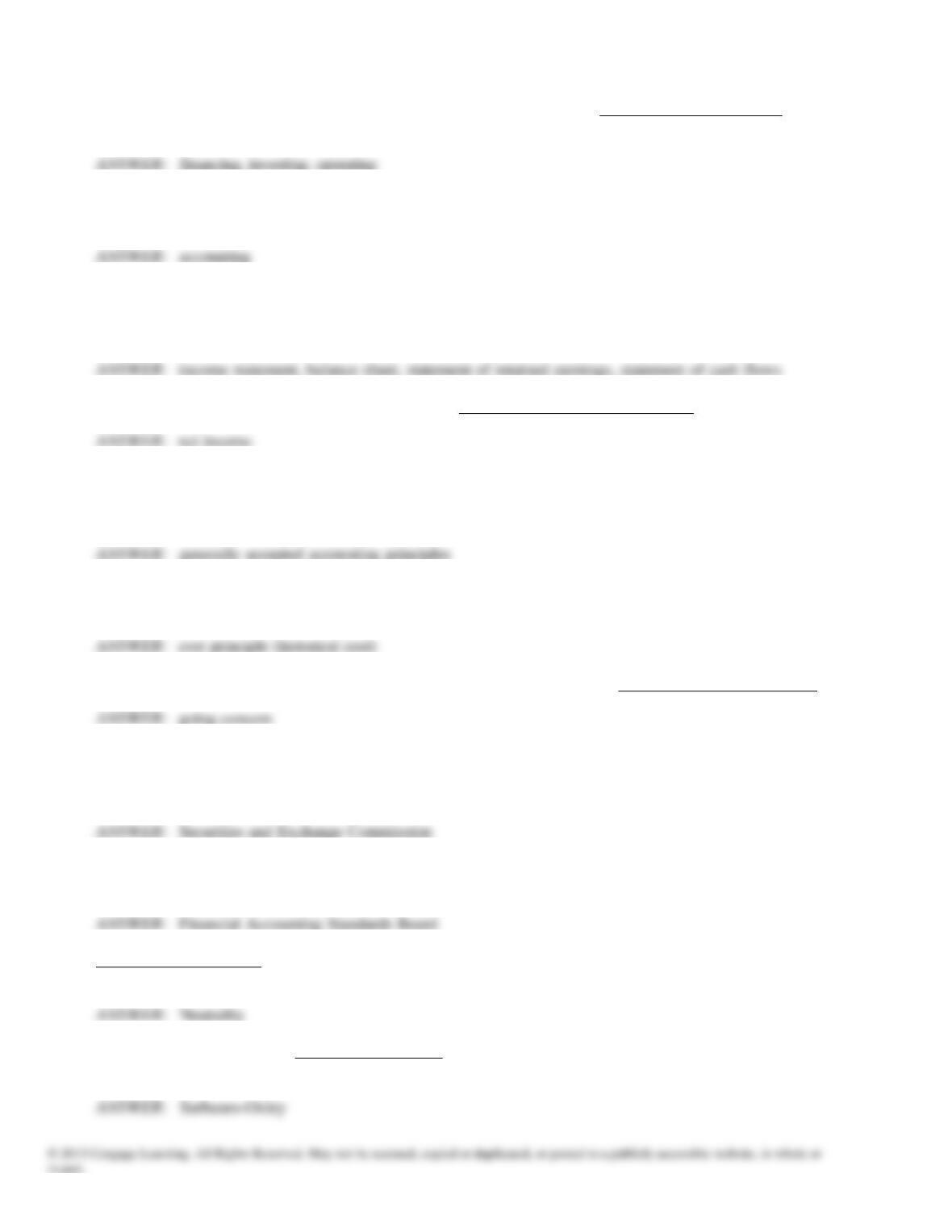
121. consists of all activities necessary to provide the
members of an economic system with goods and services.
122. A is a certificate that represents a corporation’s promise to repay a certain amount of
money and
interest in the future.
123. is the type of accounting used by nonbusiness entities.
124. Owners of corporations are called ____________________.
Chapter 1: Accounting as a Form of Communication
125. The three types of business activities in which all corporations engage are ,
______________________, and _____________________.
126. The process of identifying, measuring, and communicating economic information to various users is called
____________________.
127. The names of the four financial statements are ________________________________,
________________________________, ________________________________, and
________________________________
128. Another name for profits or earnings of a business is .
129. The various methods, rules, practices, and other procedures that have evolved over time in response to
the need to regulate the preparation of financial statements are called
__________________________________________________.
130. The concept that assumes that assets are recorded at the amount to acquire them is called the
_________________________.
131. The concept that assumes that an entity is not in the process of liquidation is .
132. The federal government agency with the ultimate authority to determine the rules in preparing
statements for companies whose stock is sold to the public is the
__________________________________________________.
133. The private sector group with authority to set accounting standards is the
__________________________________________________.
134. means the presentation of information is free from bias toward a particular
result.
135. In 2002, Congress passed the Act to bring reform to corporate
accountability and stewardship in the wake of a number of major corporate scandals.

Chapter 1: Accounting as a Form of Communication
136. Good quality information should be both and present a .
137. Choose the user group that is most likely to have the need listed below. (Select all that apply.)
The ability of the company to pay its debts as they become due.
a. Stockholder
b. Company management
c. Supplier
d. Banker
e. Internal Revenue Service
f. Securities and Exchange Commission
g. Labor union
Chapter 1: Accounting as a Form of Communication
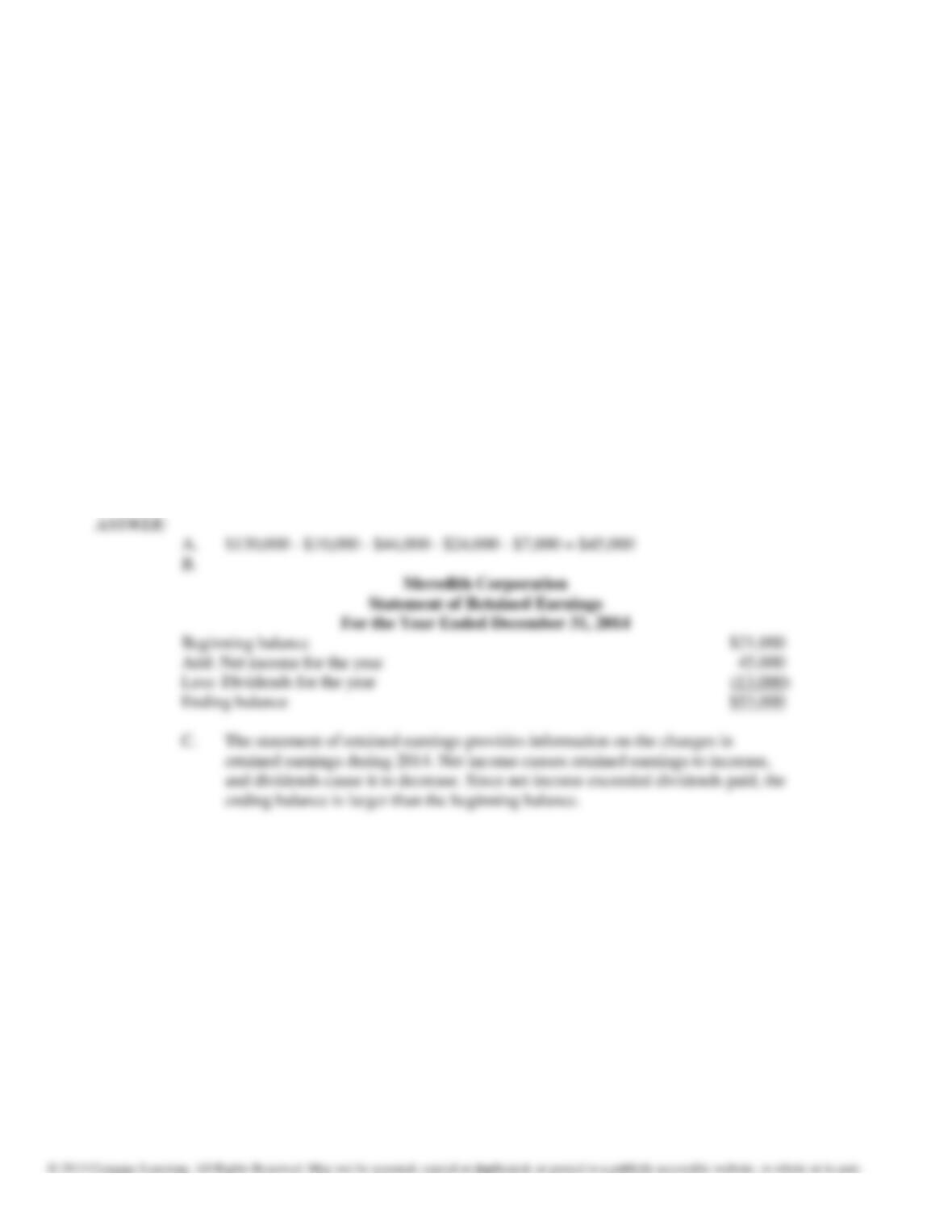
138. Meredith Corporation is in the business of providing dog and cat grooming services to customers within the city of
New York. The following information concerning financial activities during 2014 is available at December 31, 2014:
Grooming revenue
$130,000
Salary and wage expense
$44,000
Dividends declared and paid
13,000
Rent expense
24,000
Equipment
40,000
Furniture
60,000
Accounts payable
30,000
Accounts receivable
23,000
Capital stock
22,000
Retained earnings, Jan. 1, 2014
21,000
Utilities expense
10,000
Notes payable
88,000
Cash
33,000
Income tax expense
7,000
A. Calculate net income for 2014
B. Prepare a statement of retained earnings for the year ended December 31, 2014.
C. What information can you derive from the statement of retained earning concerning this company?
Explain.
Chapter 1: Accounting as a Form of Communication
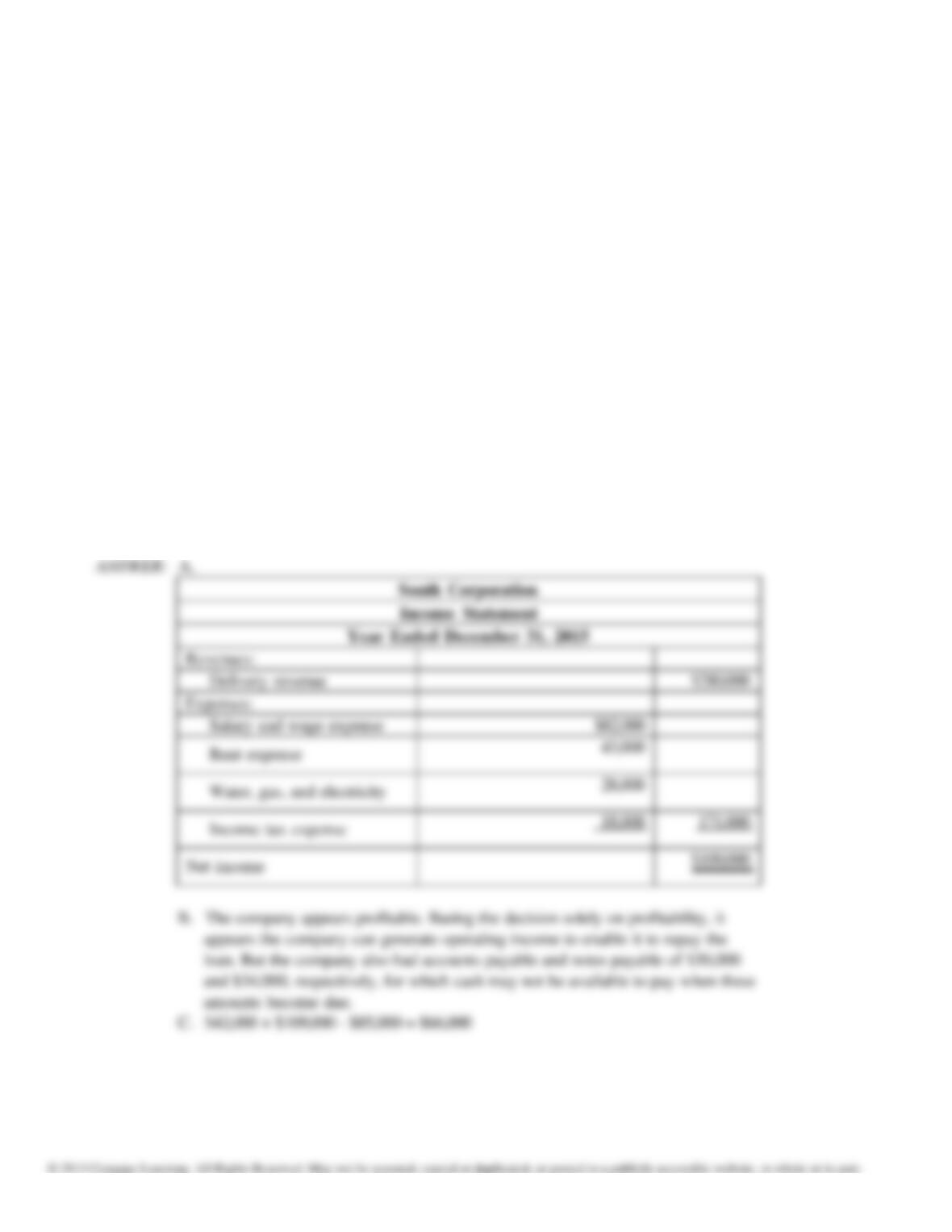
139. South Corporation has been in the business of delivering small packages for local companies within the city of
Atlanta, Georgia, since 1960. The following information concerning financial activities during 2015 is available at
December 31, 2015:
Delivery revenue
$280,000
Salary and wage expense
$82,000
Dividends declared and paid
85,000
Rent expense
43,000
Buildings
140,000
Land
60,000
Accounts payable
30,000
Accounts payable
30,000
Capital stock
105,000
Retained earnings, January 1, 2015
42,000
Water, gas, and electricity
28,000
Notes payable
34,000
Cash
56,000
Income tax expense
18,000
A. Prepare an income statement for the year ended December 31, 2015.
B. If you were a bank loan officer and South Corporation wanted to borrow $100,000 from your bank, would
you lend the money? Explain.
C. Calculate retained earnings at December 31, 2015.
Chapter 1: Accounting as a Form of Communication
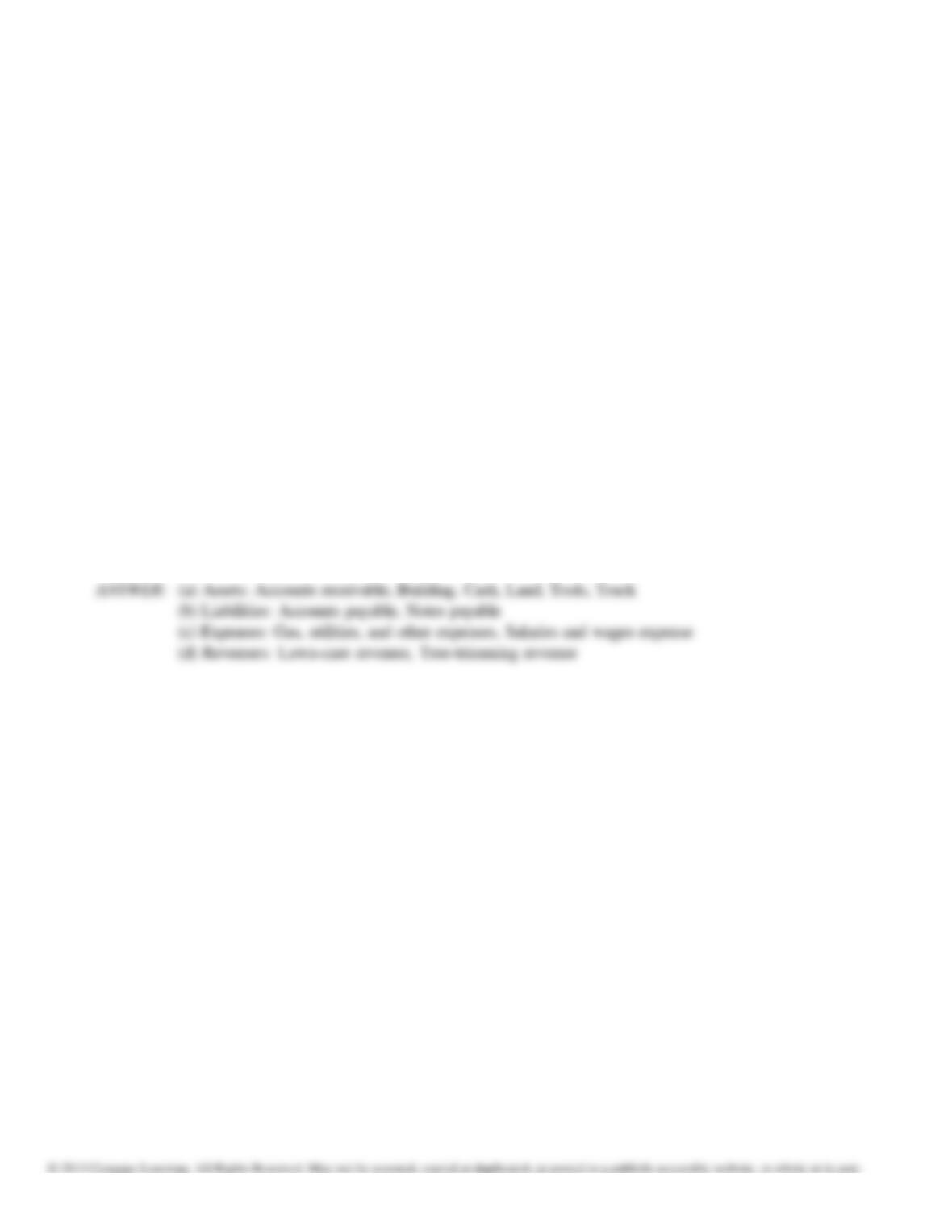
140. Here is a list of accounts and their balances that appear on the Thomas Company’s income statement and balance
sheet.
Accounts payable
$ 800
Accounts receivable
500
Building
2,000
Cash
3,300
Gas, utilities, and other expenses
300
Land
4,000
Lawn-care revenue
1,500
Notes payable
6,000
Salaries and wages expense
900
Tools
800
Tree-trimming revenue
500
Truck
2,000
REQUIRED:
Identify which of these are:
(a) Assets
(b) Liabilities
(c) Expenses
(d) Revenues
Chapter 1: Accounting as a Form of Communication
Taryn Corporation
The accountant for Taryn Corporation prepared the following list of account balances from the company’s records for
the year ended December 31, 2014:
Sales revenue
$165,000
Cash
$30,000
Accounts receivable
14,000
Selling expenses
44,000
Equipment
42,000
Common stock
41,000
Accounts payable
12,000
Interest income
3,000
Salaries and wages expense
40,000
Cost of sales
51,000
Inventories
22,000
Prepaid expenses
2,000
Income taxes payable
5,000
Income taxes expense
18,000
Notes payable
20,000
Retained earnings
?
141. Read the information for Taryn Corporation. Determine the following amounts for Taryn Corp.
A) Total assets at the end of 2014
B) Total liabilities at the end of 2014
C) What parties have a claim on Taryn Corporation’s assets? Explain you answer in the terms of the accounting
equation.
142. Read the information for Taryn Corporation. Determine the following amounts for Taryn Corporation.
A) The balance of retained earnings at the end of 2014.
B) The total stockholders’ equity at the end of 2014.
C) Name the two events that might cause stockholders’ equity to increase.
Chapter 1: Accounting as a Form of Communication
143. Read the information for Taryn Corporation. Prepare an income statement for Taryn Corporation in good form.
144. Read the information for Taryn Corporation. Prepare a balance sheet for Taryn Corporation in good form.
Chapter 1: Accounting as a Form of Communication
145. Read the information for Taryn Corporation. Determine the following amounts for Taryn Corporation:
A) Total revenues for 2014.
B) Total expenses for 2014.
C) What is the purpose of the income statement?
D) Is Taryn Corp. profitable? Explain your answer.
E) Is this the first year of operations for Taryn Corp.? Explain your answer.
Chapter 1: Accounting as a Form of Communication
Canyon Corporation
The accountant for the Canyon Corporation prepared the following list from the company’s accounting records for
the year ended December 31, 2014:
Retained earnings
?
Prepaid expenses
$3,000
Cash
$7,000
Common stock
40,000
Accounts payable
15,000
Accounts receivable
17,000
Sales revenue
125,000
Interest income
500
Cost of sales
70,000
Salary expense
4,000
Land
75,000
Income tax expense
200
Notes payable
15,000
Selling expense
45,000
Inventory
20,000
Salaries payable
5,000
146. Read the information for Canyon Corporation. Determine the following amounts for Canyon Corporation.
A) Total assets at the end of 2014.
B) Total liabilities at the end of 2014.
C) Total equity at the end of 2014.
147. Read the information for Canyon Corporation. Determine the following amounts for Canyon Corporation:
A) Total revenues for 2014.
B) Total expenses for 2014.
C) Net income for 2014.
Chapter 1: Accounting as a Form of Communication
148. Read the information for Canyon Corporation. Determine the following amounts for Canyon Corporation:
A) Stockholders’ equity at the end of 2014.
B) Retained earnings at the end of 2014.
C) Name two events that might cause stockholders’ equity to decrease.
149. Read the information for Canyon Corporation. Using good form, prepare an income statement for Canyon
Corporation.
150. Read the information for Canyon Corporation. Using good form, prepare a Balance Sheet for the Canyon
Corporation.
Chapter 1: Accounting as a Form of Communication
151. Assume that you have received copies of the financial statements for PepsiCo for the years ending December 31,
2014 and 2013. Answer the following questions:
A) If you were a banker, why would you need information from PepsiCo’s financial statements?
B) If you were a potential investor in PepsiCo stock, what information would you want from
their financial statements?
C) If you were a labor negotiator for a union that represents a group of PepsiCo’s
employees, which financial statement would provide you with the most useful
information?
152. Target, Inc., started the year with total assets of $400,000 and total liabilities of $240,000. Net income for the year
is $120,000 and dividends declared and paid during the year are $90,000.
A) What is the amount of Target’s total stockholders’ equity at the end of the year?
B) Could Target have paid additional dividends during the year? Explain your answer.
Chapter 1: Accounting as a Form of Communication
153. Ramos Corp. started business at the beginning of the year, with assets of $600,000 and stockholders‘ equity of
$240,000. By the end of the year, assets increased by $80,000 and liabilities increased by $60,000. Other than net
income or loss, the only change in stockholders‘ equity was dividends declared and paid of $55,000.
A) What was the amount of Ramos Corp. stockholders’ equity at the end of the year?
B) What was the amount of Ramos Corp. net income or net loss for the year?
154. Presented below are selected data from the balance sheet of Farmer Company for 2014. The figures are expressed
in millions.
Total Current assets
$5,572
Property, plant, and equipment
16,325
Other assets
?
Total Current liabilities
3,274
Total Long-term debt
5,632
Total Stockholders’ equity
19,639
A) Determine the amount of “Other assets” for Farmer’s 2014 balance sheet. (HINT: you must use the
accounting equation concept to determine your answer.)
B) How much of Farmer Company is financed by creditors? How much is financed by the owners?