Perform the indicated subtraction.
46)
46)
0.82 – (–0.13)
A)
0.1066
B)
0.69
C)
0.95
D)
1.05
Evaluate the algebraic expression for the given value(s).
47)
10x +20
5x , given 4
47)
A)
40
B)
3
C)
2
D)
1
Perform the indicated operation. Where possible, reduce the answer to its lowest terms.
48)
8
25 –5
25
48)
A)
13
25
B)
2
3
C)
3
25
D)
1
2
Find the sum using a number line.
49)
49)
1+ (–4)
A)
5
B)
3
C)
–3
D)
–5
14
Find the sum without the use of a number line.
50)
50)
–9+2
A)
–7
B)
11
C)
–11
D)
7
Determine whether the given number is a solution of the equation.
51)
51)
6(x +5) –12 =7x; 18
A)
not a solution
B)
solution
Rewrite the division as multiplication involving a multiplicative inverse. Use the multiplication to find the given
quotient.
52)
–72
–8
52)
A)
–72 ·1
8 ; –9
B)
–72 · – 1
8 ; 9
C)
–1
72 ·
(–8) ; 1
9
D)
–72 · – 1
8 ; –9
Write a positive or negative integer that describes the situation.
53)
53)
$486 profit
A)
–486
B)
486
Evaluate the algebraic expression for the given value(s).
54)
54)
6x –2y, given x =5, y =2
A)
24
B)
28
C)
26
D)
34

Identify the natural number as prime or composite. If the number is composite, find its prime factorization.
55)
55)
22
A)
10 ·4
B)
3·13
C)
2·11
D)
prime
Determine if the given value is a solution to the equation.
56)
1
4(x –4) +2=3
5(2x –5); 6
56)
A)
not a solution
B)
solution
Convert the improper fraction to a mixed number.
57)
37
9
57)
A)
37 9
37
B)
41
9
C)
37 37
9
D)
9
37
Evaluate the exponential expression.
58)
102
58)
A)
20
B)
121
C)
1024
D)
100
Determine whether the inequality is true or false.
59)
59)
–27
A)
True
B)
False
Write the English phrase as an algebraic expression. Let the variable x represent the number.
60)
60)
six less than the product of 13 and a number
A)
6–13x
B)
13x +6
C)
13x –6
D)
6x –13
Translate from English to an algebraic expression or equation, whichever is appropriate. Let the variable x represent
the number.
61)
A number decreased by 1
9 is half of that number.
61)
A)
x –1
9=1
2x
B)
x =1
9–1
2x
C)
x –1
9+1
2x
D)
x +1
9=1
2x
Find the sum without the use of a number line.
62)
62)
13 + (–13)
A)
0
B)
26
C)
1
D)
–26
Use the distributive property to rewrite the algebraic expression without parentheses. Simplify.
63)
63)
6(x + y)
A)
6x + 6y
B)
6xy
C)
6x – 6y
D)
6x + y
17

Evaluate the exponential expression.
64)
–92
64)
A)
–81
B)
81
C)
–18
D)
–100
Perform the indicated operation. Where possible, reduce the answer to its lowest terms.
65)
5
8+1
8
65)
A)
4
5
B)
3
4
C)
2
3
D)
2
4
Provide an appropriate response.
66)
66)
Use the distributive property to rewrite without parentheses: 3(3x – 1 + 4y)
A)
9x –3y + 12
B)
9x –3+ 12y
C)
9x +3+ 12y
D)
9x –3+ 4y
Write the sentence as an equation. Let the variable x represent the number.
67)
67)
The product of 4 and a number increased by 5 is 32.
A)
4x +5=32
B)
4x –5=32
C)
20x =32
D)
4(x +5) =32
Simplify the algebraic expression, or state that the expression cannot be simplified.
68)
17x2–17x2
68)
A)
–34x2
B)
x2
C)
cannot be simplified
D)
0
Perform the indicated multiplication.
69)
–3
7· – 7
8
69)
A)
–13
112
B)
21
11
C)
3
8
D)
–13
22
Use the distributive property to rewrite the algebraic expression without parentheses. Simplify.
70)
1
3(9x +6)
70)
A)
3x + 2
B)
27x +18
C)
3x +6
D)
x
Use the commutative property of multiplication to write an equivalent algebraic expression.
71)
71)
6(x +5)
A)
(5 + x)6
B)
(x +6)5
C)
(x +5)6
D)
6(5 + x)

Determine if the given value is a solution to the equation.
72)
72)
60 – y =10; 60
A)
not a solution
B)
solution
Evaluate the exponential expression.
73)
(–7)3
73)
A)
343
B)
–343
C)
–21
D)
21
Simplify the algebraic expression, or state that the expression cannot be simplified.
74)
2x4+
5x4
74)
A)
7x4
B)
cannot be simplified
C)
7x8
D)
28x
Use the commutative property of addition to write an equivalent algebraic expression.
75)
75)
6(x +3)
A)
6(x +3)
B)
3(x +6)
C)
(x +3)6
D)
6(3 + x)
Insert either < or > in the area between the pair of numbers to make a true statement.
76)
–1
6–11
16
76)
A)
<
B)
>
Use the distributive property to rewrite the algebraic expression without parentheses. Simplify.
77)
77)
5(5x +5+ y)
A)
25x +25 + y
B)
25x +25 +5y
C)
25x +5+5y
D)
25x +5+ y
Simplify the algebraic expression.
78)
78)
4b –5b
A)
9b
B)
b
C)
–b
D)
–9b
Write the English phrase as an algebraic expression, then simplify the expression. Let x represent the number.
79)
79)
The difference of 7 times a number and 4 times the number
A)
7x –4x; 11x
B)
7x –4x; 3x
C)
7x +4x; 11x
D)
4x –7x; –3x
Perform the indicated subtraction.
80)
80)
9– (–21)
A)
–12
B)
30
C)
–30
D)
12
Write the fraction in lowest terms.
81)
30
50
81)
A)
30
50
B)
10
5
C)
3
10
D)
3
5
Evaluate the exponential expression.
82)
(–5)3
82)
A)
–15
B)
–125
C)
–64
D)
125
Use the order of operations to simplify the expression.
83)
(–5– 5)(–3+ 8) – 82
83)
A)
–114
B)
5
C)
64
D)
14
Simplify the series of additions and subtractions.
84)
84)
10 + (–10) – 15 – 6
A)
21
B)
–9
C)
–21
D)
9
22

Use the distributive property to rewrite the algebraic expression without parentheses. Simplify.
85)
85)
7(8x + 9)
A)
15x + 16
B)
119x
C)
56x + 9
D)
56x + 63
Translate from English to an algebraic expression or equation, whichever is appropriate. Let the variable x represent
the number.
86)
1
4 of a number, decreased by 4, is 24.
86)
A)
1
4x +4=24
B)
1
4x –4=24
C)
1
4x =4+24
D)
1
4x +28
Perform the indicated multiplication.
87)
87)
(–7)(–9)(–5)(–1)
A)
315
B)
325
C)
–315
D)
215
Use the order of operations to simplify the expression.
88)
88)
36 ÷9(4) – 8
A)
–7
B)
73
C)
9
7
D)
8
23
89)
89)
[32 – (4 + 6) ÷ 2] – [1 +6÷ 3]
A)
19
B)
24
C)
31
D)
21
Find the multiplicative inverse.
90)
1
9
90)
A)
9
B)
1
C)
–9
D)
–1
9
Use an associative property to rewrite the algebraic expression. Once grouping has been changed, simplify the
resulting algebraic expression.
91)
91)
8+ (4+ x)
A)
(8 +4) + x; 12
B)
(8 +4) + x; 12x
C)
8+ (4+ x); 8 +4x
D)
(8 +4) + x; 12 + x
Perform the indicated subtraction.
92)
–3
4– – 5
8
92)
A)
–1
B)
1
8
C)
–1
4
D)
–1
8
Identify the natural number as prime or composite. If the number is composite, find its prime factorization.
93)
93)
30
A)
3·3·2
B)
2·3·5
C)
2·2·5
D)
prime
Use the order of operations to simplify the expression.
94)
94)
7+ (8·4) – 30
A)
–390
B)
–11
C)
30
D)
9
Perform the indicated operation or operations.
95)
95)
–6+18 + (–3) +25
A)
34
B)
–16
C)
–10
D)
52
Simplify the algebraic expression by removing parentheses and brackets.
96)
96)
3–5[5 – (2x – 2)]
A)
10x – 12
B)
–2x – 12
C)
10x – 32
D)
–2x – 32
Identify the terms in the algebraic expression.
97)
97)
–9x + 4xy – y
A)
–9x, 4xy, y
B)
9x, 4xy, y
C)
–9x, 4xy, –y
D)
–9x, 4xy
25
Find the multiplicative inverse.
98)
98)
22
A)
1
22
B)
–1
22
C)
1
D)
–22
Perform the indicated multiplication.
99)
99)
(–30)(–1)
A)
–1
B)
30
C)
1
D)
–30
Simplify the algebraic expression.
100)
100)
10(9x –10y) – (5x –4y)
A)
–85x + 96y
B)
85x – 96y
C)
85x –104y
D)
95x – 96y
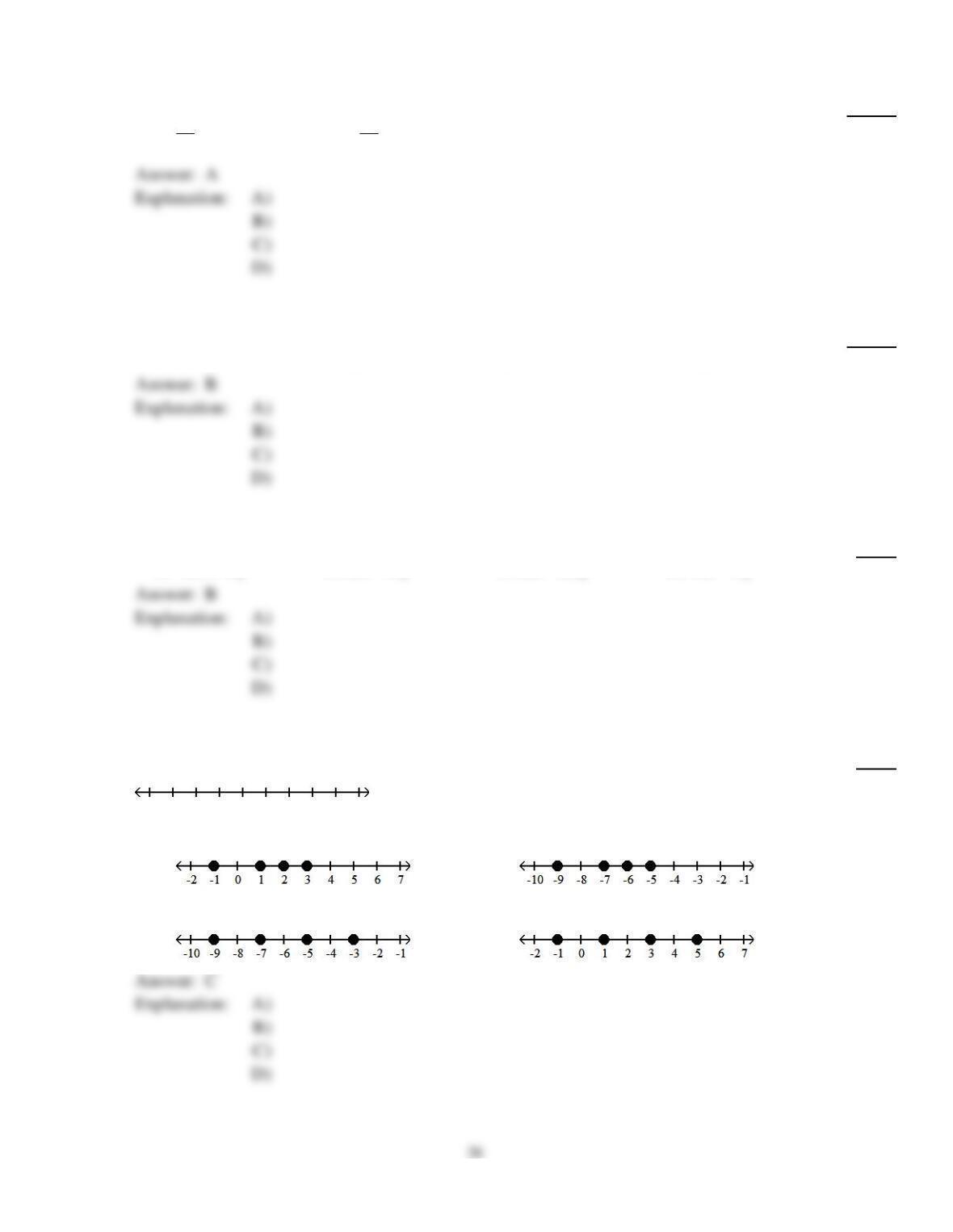
Graph the numbers on a number line.
101)
–9, –7, –5, –3
101)
A)
B)
C)
D)