Exam
Name___________________________________
MULTIPLE CHOICE. Choose the one alternative that best completes the statement or answers the question.
Solve the problem.
1)
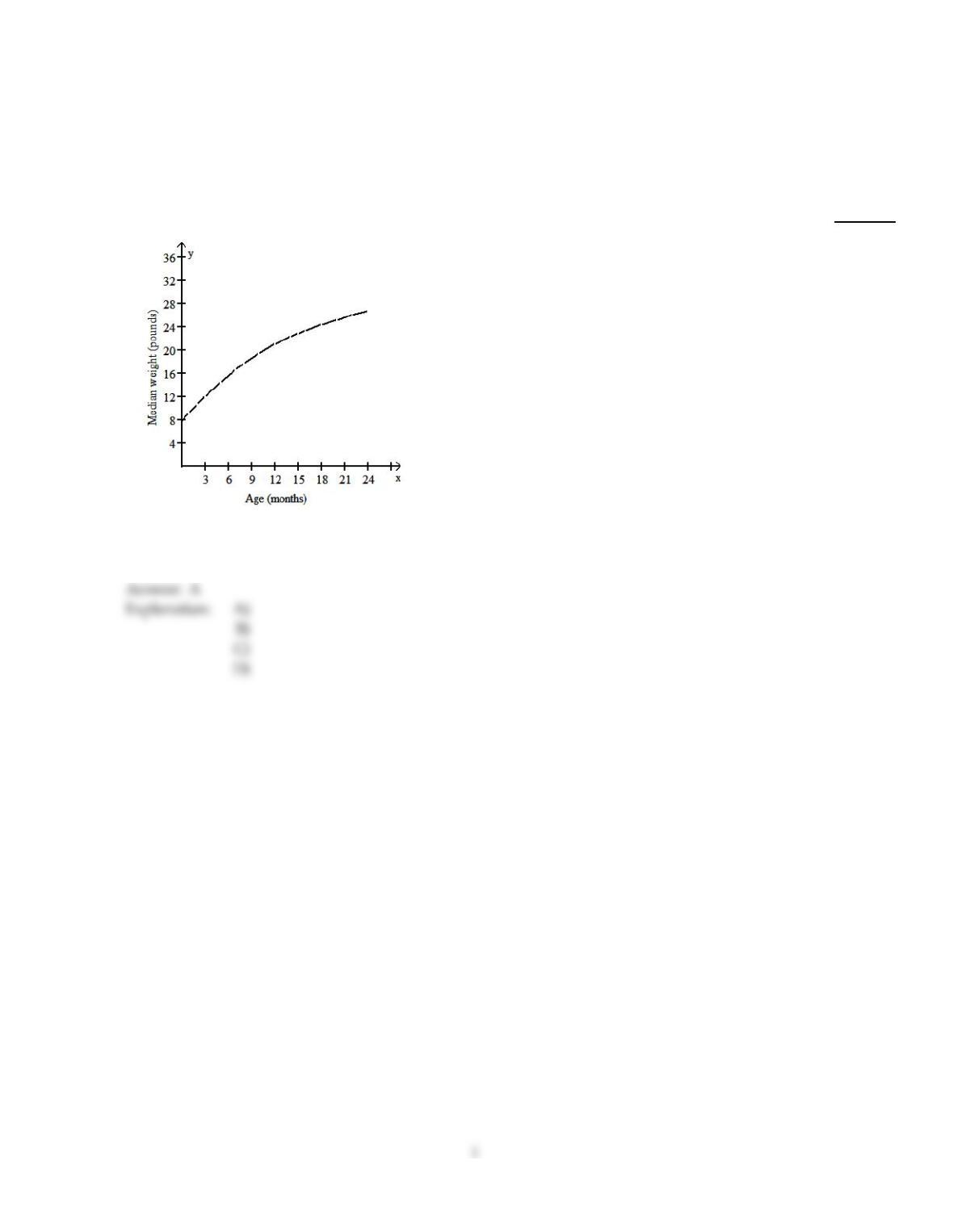
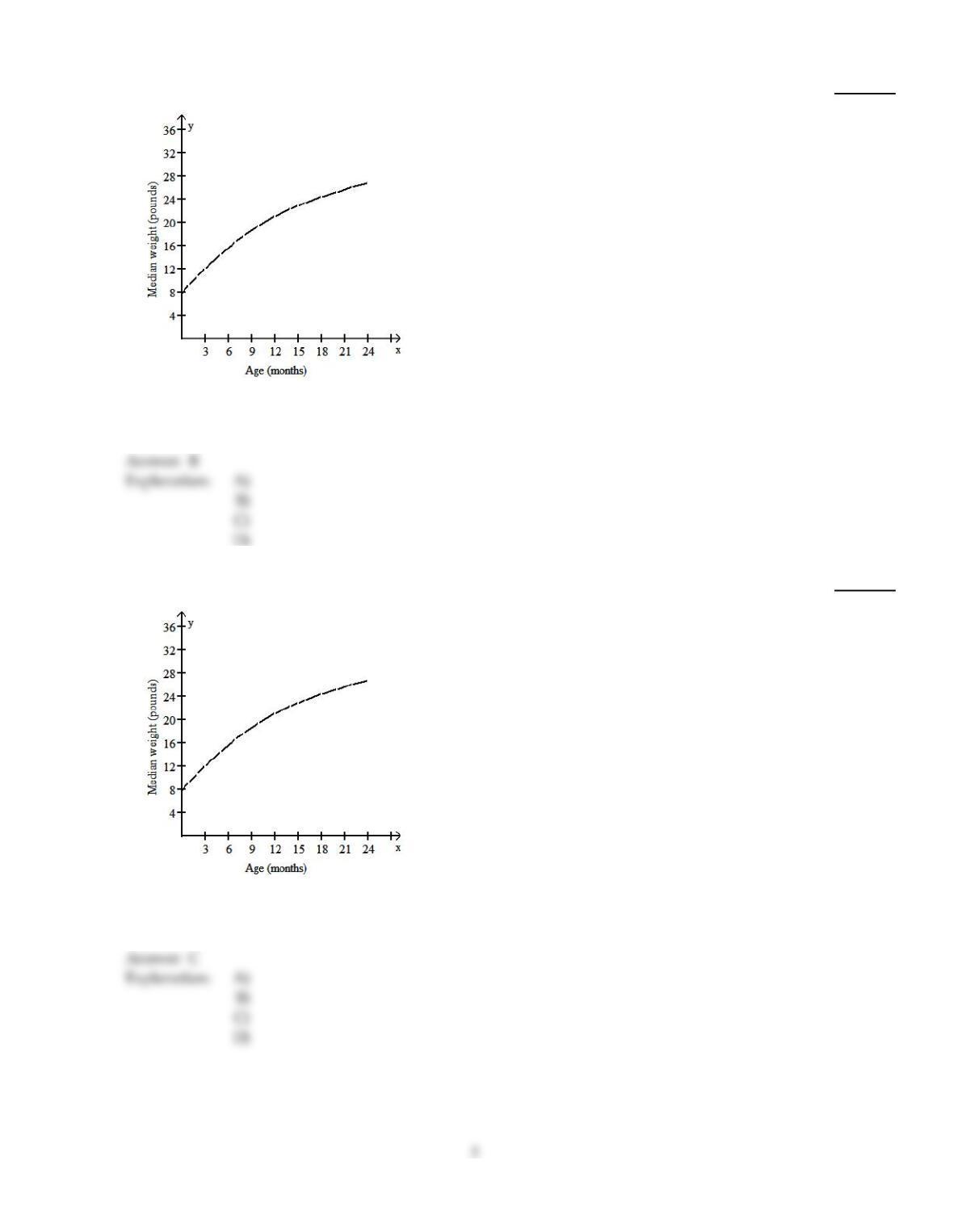
The graph shows the median weight of girls between the ages of 0 and 24 months.
Use the graph to find the average growth rate of a typical girl during the second year of her life.
Give your answer in pounds per month.
1)
A)
0.5 lb/month
B)
1.1 lb/month
C)
0.8 lb/month
D)
0.2 lb/month
2)
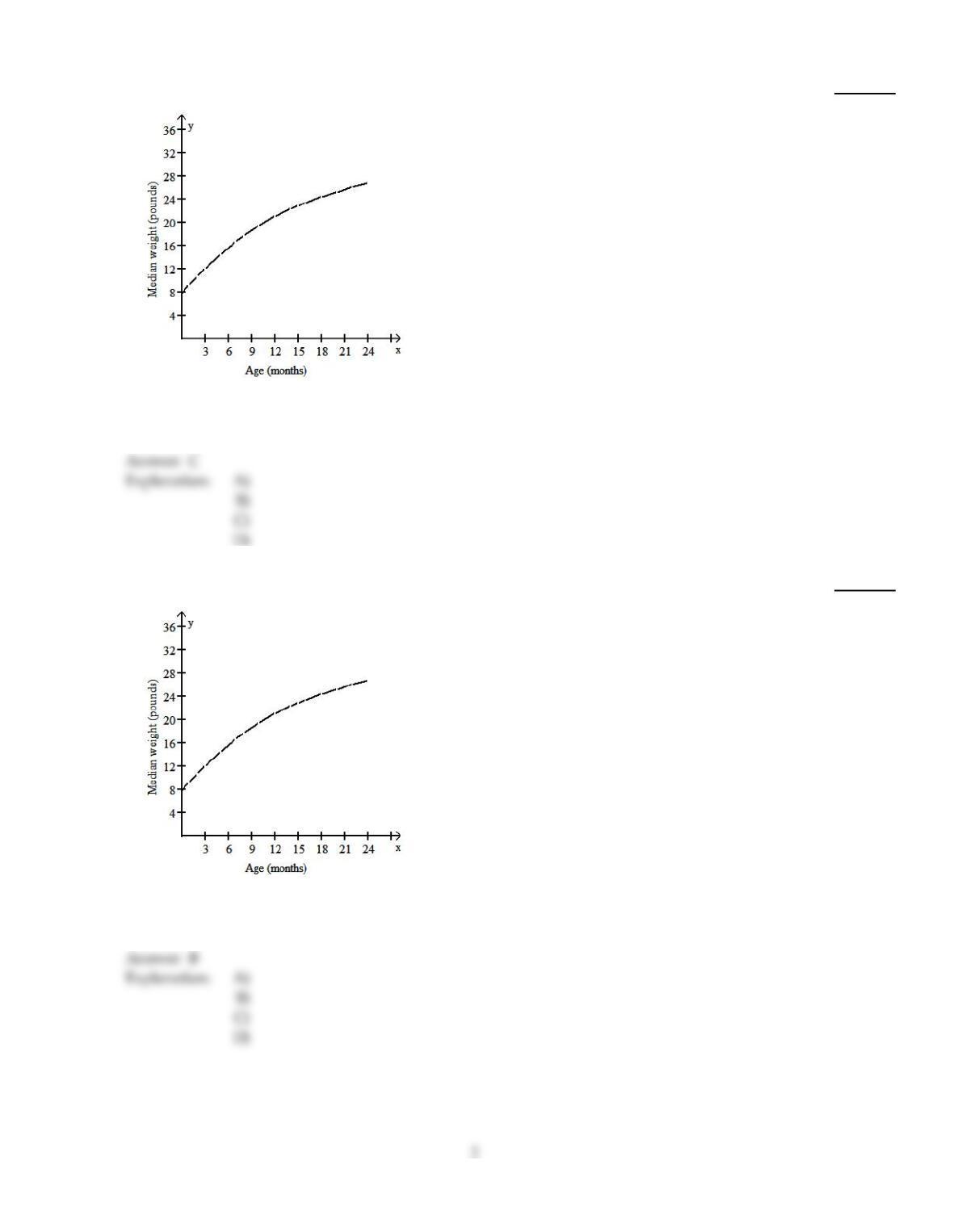
The graph shows the median weight of girls between the ages of 0 and 24 months.
Use the graph to find the average growth rate of a typical girl during the first six months of her life.
Give your answer in pounds per month.
2)
A)
1.0 lb/month
B)
1.6 lb/month
C)
1.3 lb/month
D)
2.6 lb/month
3)
The graph shows the median weight of girls between the ages of 0 and 24 months.
Use the graph to find the average growth rate of a typical girl during the first two years of her life.
Give your answer in pounds per month.
3)
A)
1.6 lb/month
B)
0.8 lb/month
C)
0.6 lb/month
D)
1.1 lb/month
4)
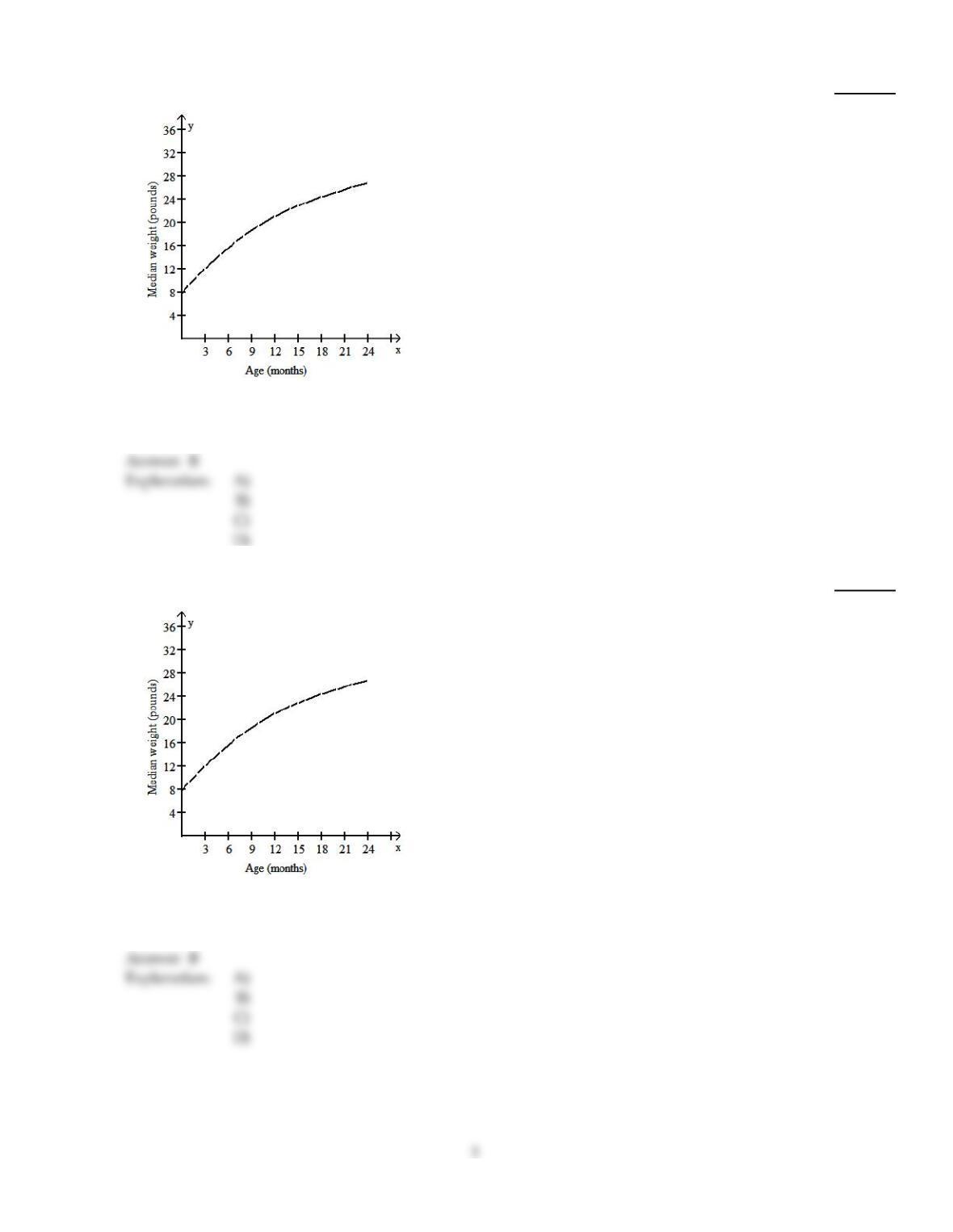
The graph shows the median weight of girls between the ages of 0 and 24 months.
Use the graph to find the average growth rate of a typical girl during the first nine months of her
life. Give your answer in pounds per month.
4)
A)
2.0 lb/month
B)
1.2 lb/month
C)
1.4 lb/month
D)
1.0 lb/month
5)
The graph shows the median weight of girls between the ages of 0 and 24 months.
Use the graph to find the average growth rate of a typical girl between ages 12 and 18 months. Give
your answer in pounds per month.
5)
A)
0.8 lb/month
B)
0.6 lb/month
C)
1.4 lb/month
D)
1.1 lb/month
6)
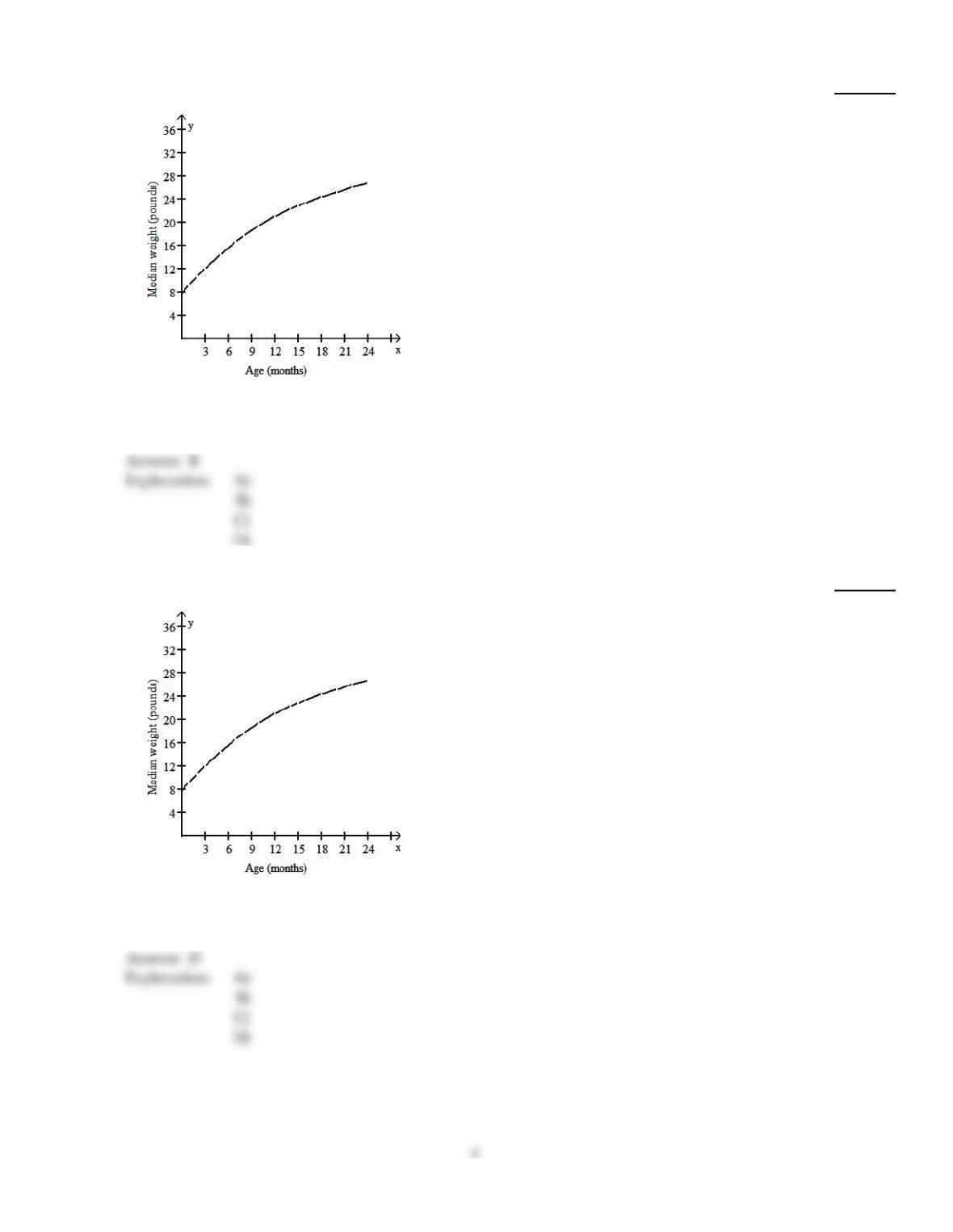
The graph shows the median weight of girls between the ages of 0 and 24 months.
Use the graph to find the average growth rate of a typical girl between ages 12 and 21 months. Give
your answer in pounds per month.
6)
A)
0.7 lb/month
B)
0.5 lb/month
C)
0.9 lb/month
D)
1.2 lb/month
7)
The graph shows the median weight of girls between the ages of 0 and 24 months.
Use the graph to find the average growth rate of a typical girl during the first three months of her
life. Give your answer in pounds per month.
7)
A)
4.0 lb/month
B)
2.2 lb/month
C)
1.2 lb/month
D)
1.3 lb/month
8)
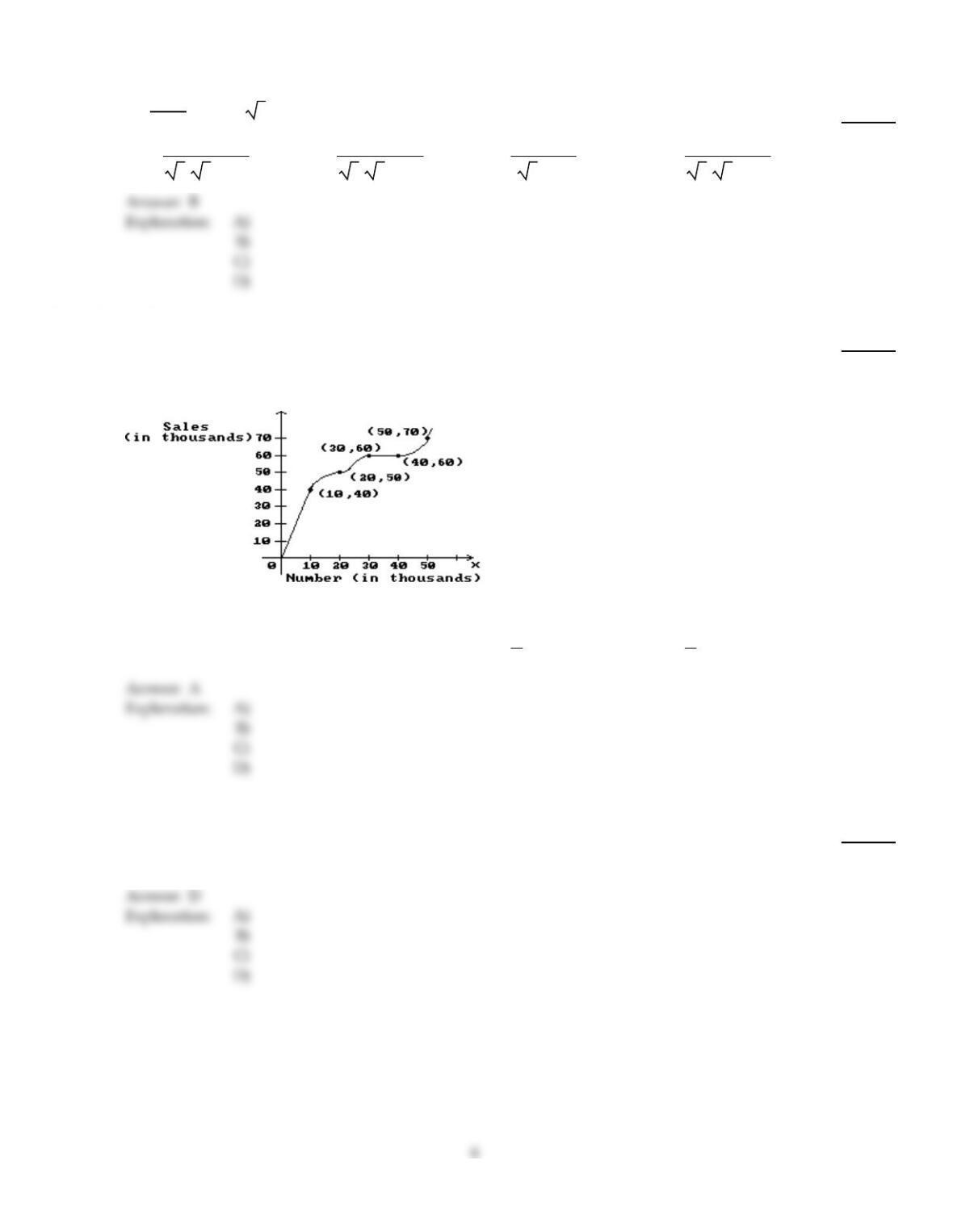
The graph shows the median weight of girls between the ages of 0 and 24 months.
Use the graph to find the average growth rate of a typical girl between ages 12 and 15 months. Give
your answer in pounds per month.
8)
A)
1.0 lb/month
B)
0.6 lb/month
C)
1.5 lb/month
D)
0.5 lb/month
9)
The graph shows the median weight of girls between the ages of 0 and 24 months.
Use the graph to find the average growth rate of a typical girl during the first year of her life. Give
your answer in pounds per month.
9)
A)
1.8 lb/month
B)
0.8 lb/month
C)
1.1 lb/month
D)
1.2 lb/month
Find an expression for dy/dx.
10)
y =u +7
u –7 and u =x+8
10)
A)
–14
x( x + 1)2
B)
–7
x( x + 1)2
C)
7
( x + 1)2
D)
14
x( x + 1)2
Solve the problem.
11)
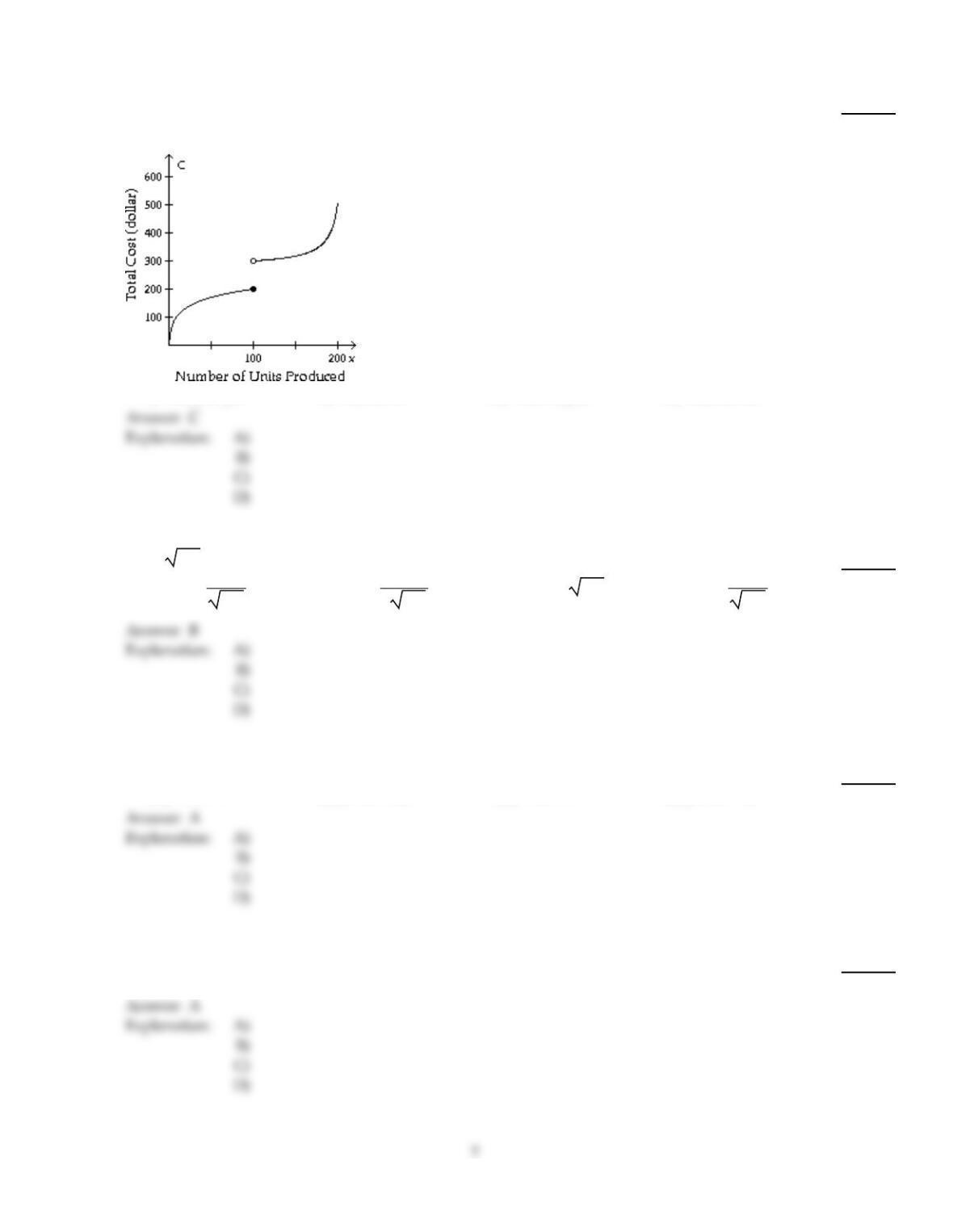
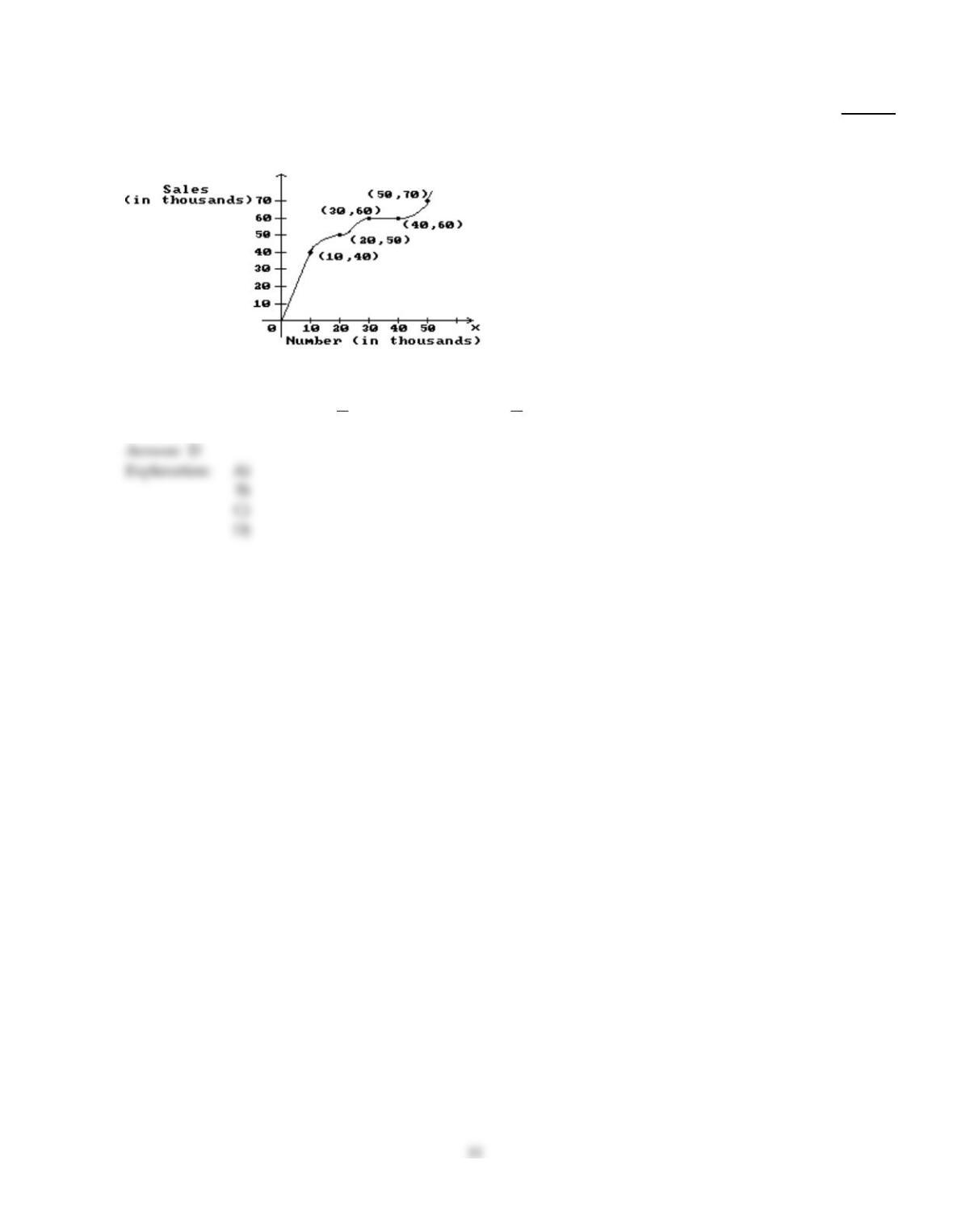
The graph shows the total sales in thousands of dollars from the distribution of x thousand
catalogs. Find the average rate of change of sales with respect to the number of catalogs distributed
for the change in x.
10 to 30
11)
A)
1
B)
3
C)
2
3
D)
1
3
Find the limit, if it exists.
12)
lim
x
0(x2– 5)
12)
A)
5
B)
Does not exist
C)
0
D)
–5
Solve the problem.
13)
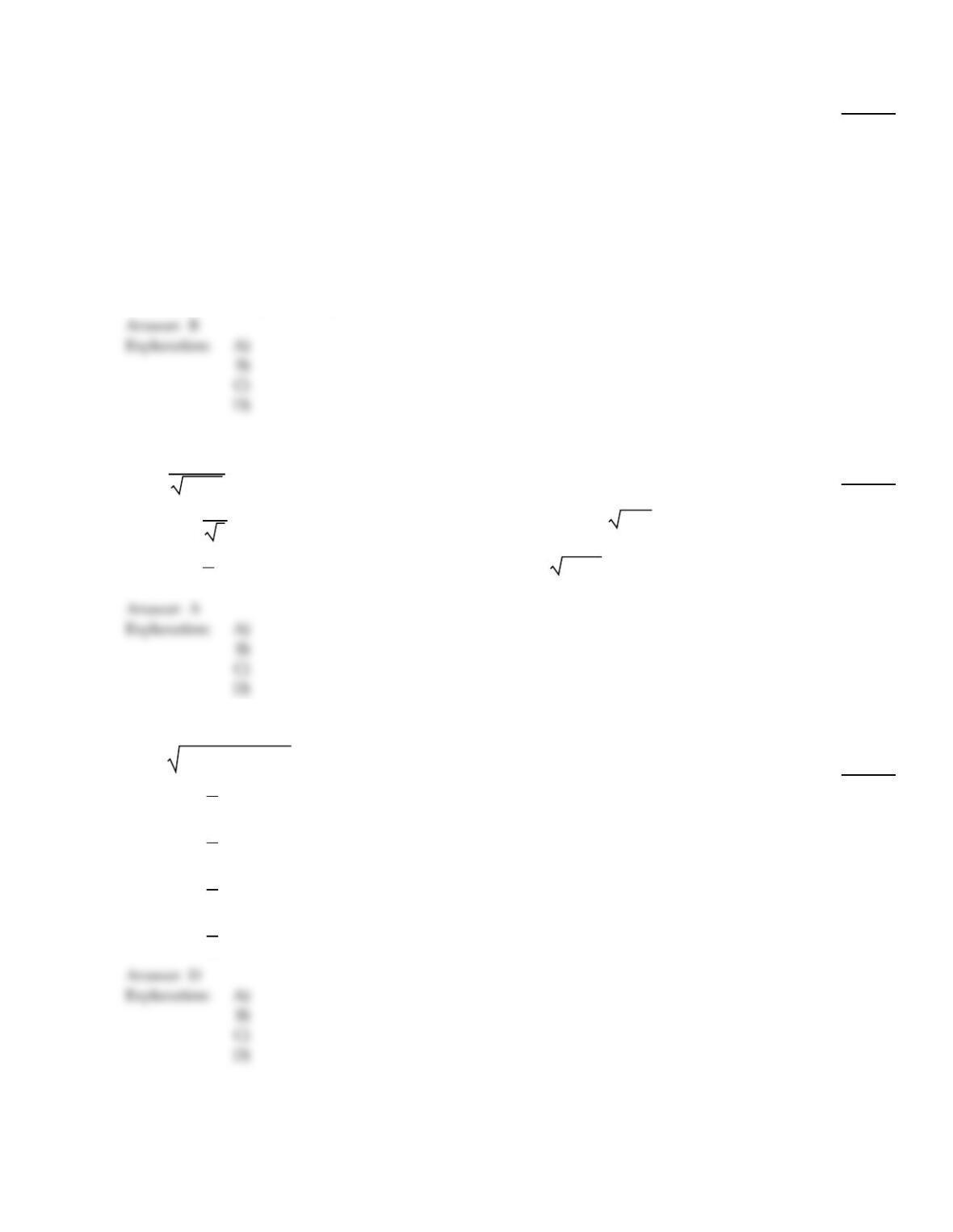
Suppose that the cost, C, of producing x units of a product can be illustrated by the given graph. Is
C(x) continuous at x = 50? x = 100? x = 150?
13)
A)
Yes; yes; yes
B)
No; no; no
C)
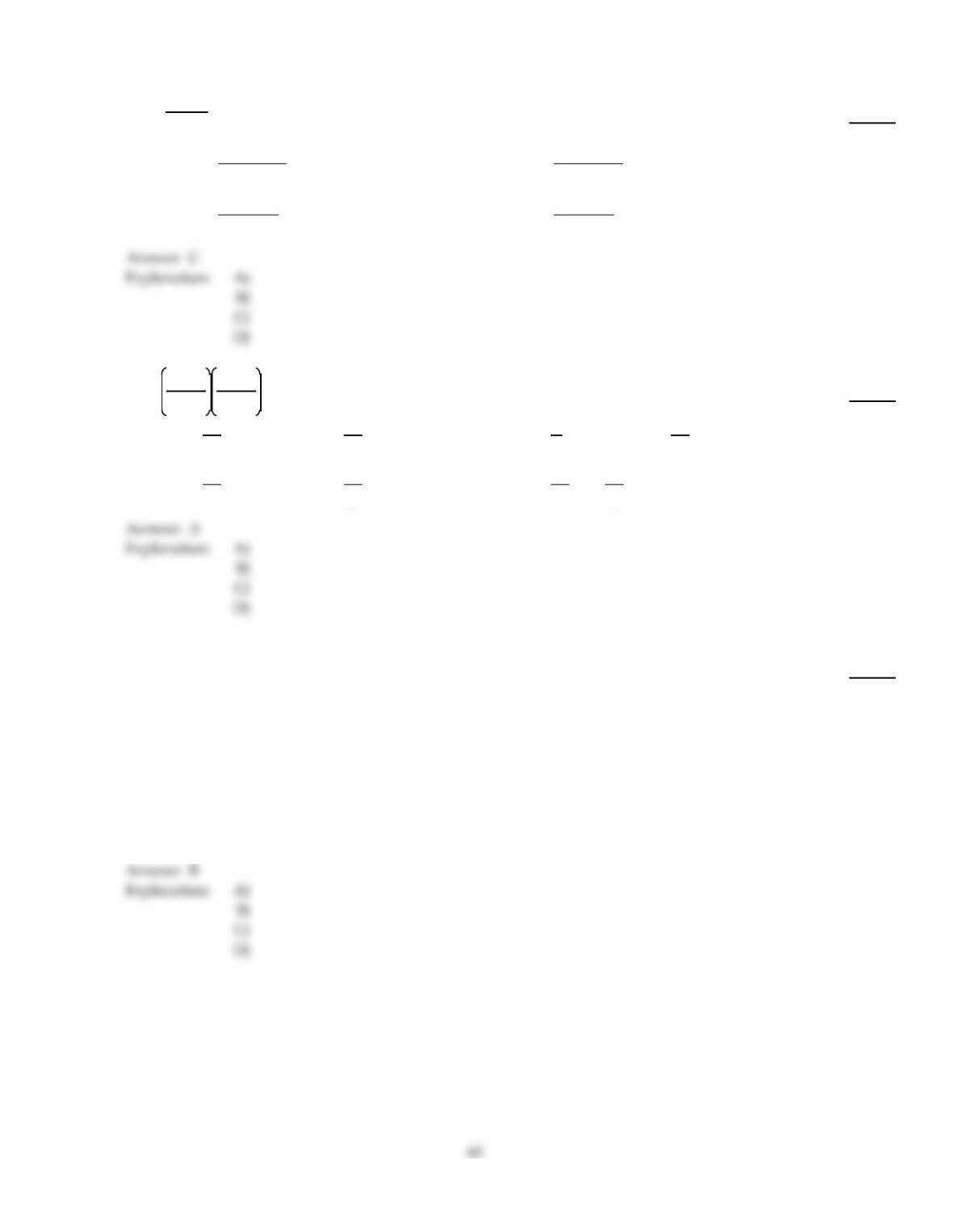
Yes; no; yes
D)
Yes; no; no
Find f'(x).
14)
f(x) =17x
14)
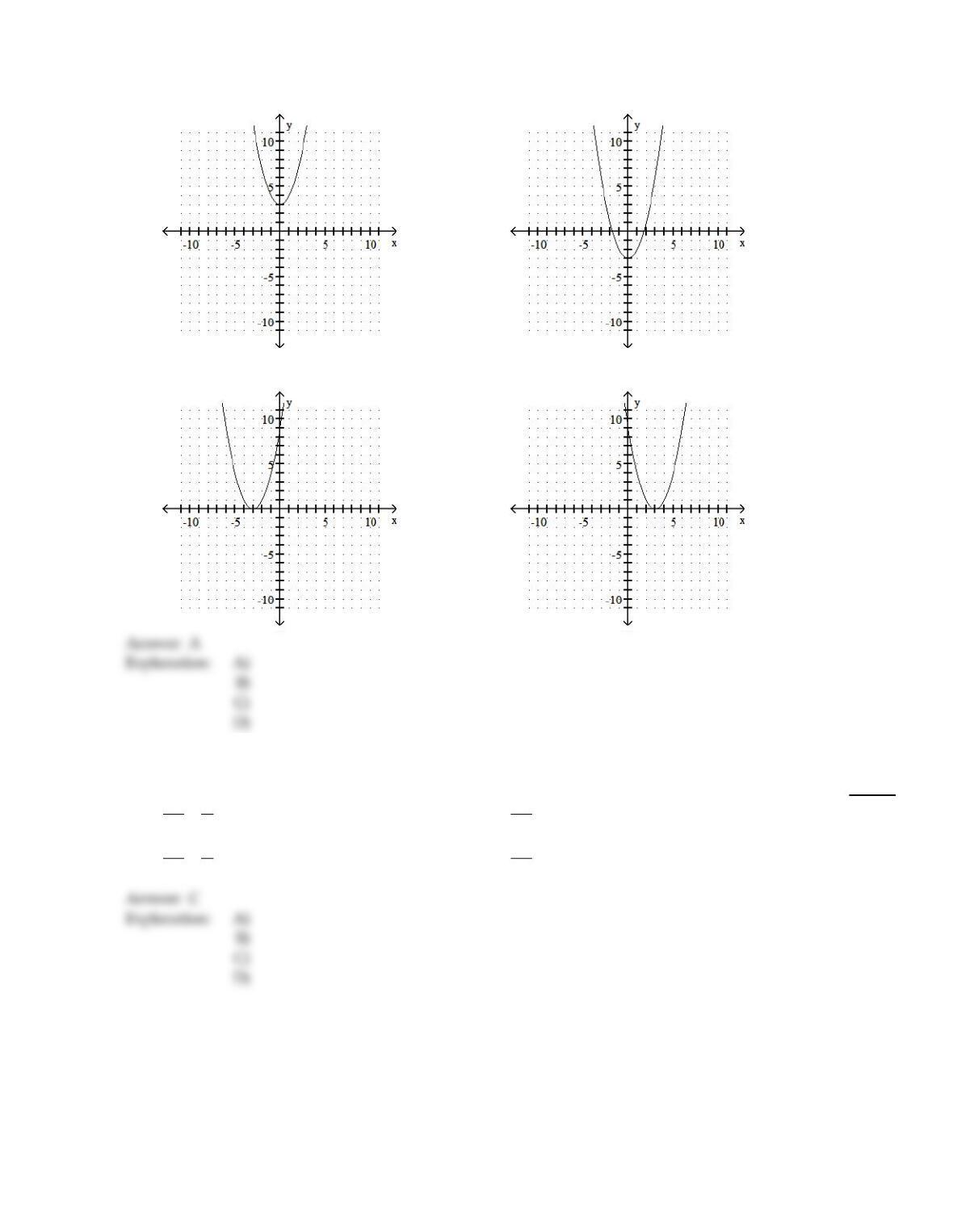
A)
f'(x) =17
17x
B)
f'(x) =17
217x
C)
f'(x) =17 17x
D)
f'(x) =1
17x
Find an equation for the line tangent to the graph of the given function at the indicated point.
15)
f(x) =x2– x at (3, 6)
15)
A)
y =5x –9
B)
y =5x +12
C)
y =5x +9
D)
y =5x –12
Find the equation of the line tangent to the graph of the function at the indicated point.
16)
f(x) =x2–4 at (–3, 5)
16)
A)
y = –6x –13
B)
y = –6x –22
C)
y = –6x –26
D)
y = –3x –13
Provide an appropriate response.
17)
What are four ways that a function may fail to be differentiable at a point?
17)
A)
The function is not defined at the point; the function is discontinuous at the point; the
function has a peak or a valley at the point; the function has a vertical tangent at the point.
B)
The function is not defined at the point; the function is discontinuous at the point; the
function has a corner or similar sharp change in direction at the point; the function has a
vertical tangent at the point.
C)
The function is not defined at the point; the function is discontinuous at the point; the
function has a limit at the point; the function has a vertical tangent at the point.
D)
The function is not defined at the point; the function is discontinuous at the point; the
function has a corner or similar sharp change in direction at the point; the function has a
horizontal tangent at the point.
Find functions f(x) and g(x) such that h(x) = (f g)(x).
18)
h(x) =6
8x + 8
18)
A)
f(x) =6x, g(x) =8x + 8
B)
f(x) =6, g(x) =8+ 8
C)
f(x) =6
x, g(x) =8x + 8
D)
f(x) =8x + 8, g(x) =6
Use the Chain Rule to differentiate the function. You may need to apply the rule more than once.
19)
f(x) =52x –(x2– x +1)6
19)
A)
f'(x) =1
5(2x –(x2– x +1)6)4/5[2 –6(x2– x +1)5]
B)
f'(x) =1
5(2x –(x2– x +1)6)4/5[2 –6(x2– x +1)5(2x – 1)]
C)
f'(x) =1
5(2x –(x2– x +1)6)–4/5[2 –6(x2– x +1)5]
D)
f'(x) =1
5(2x –(x2– x +1)6)–4/5[2 –6(x2– x +1)5(2x – 1)]
8
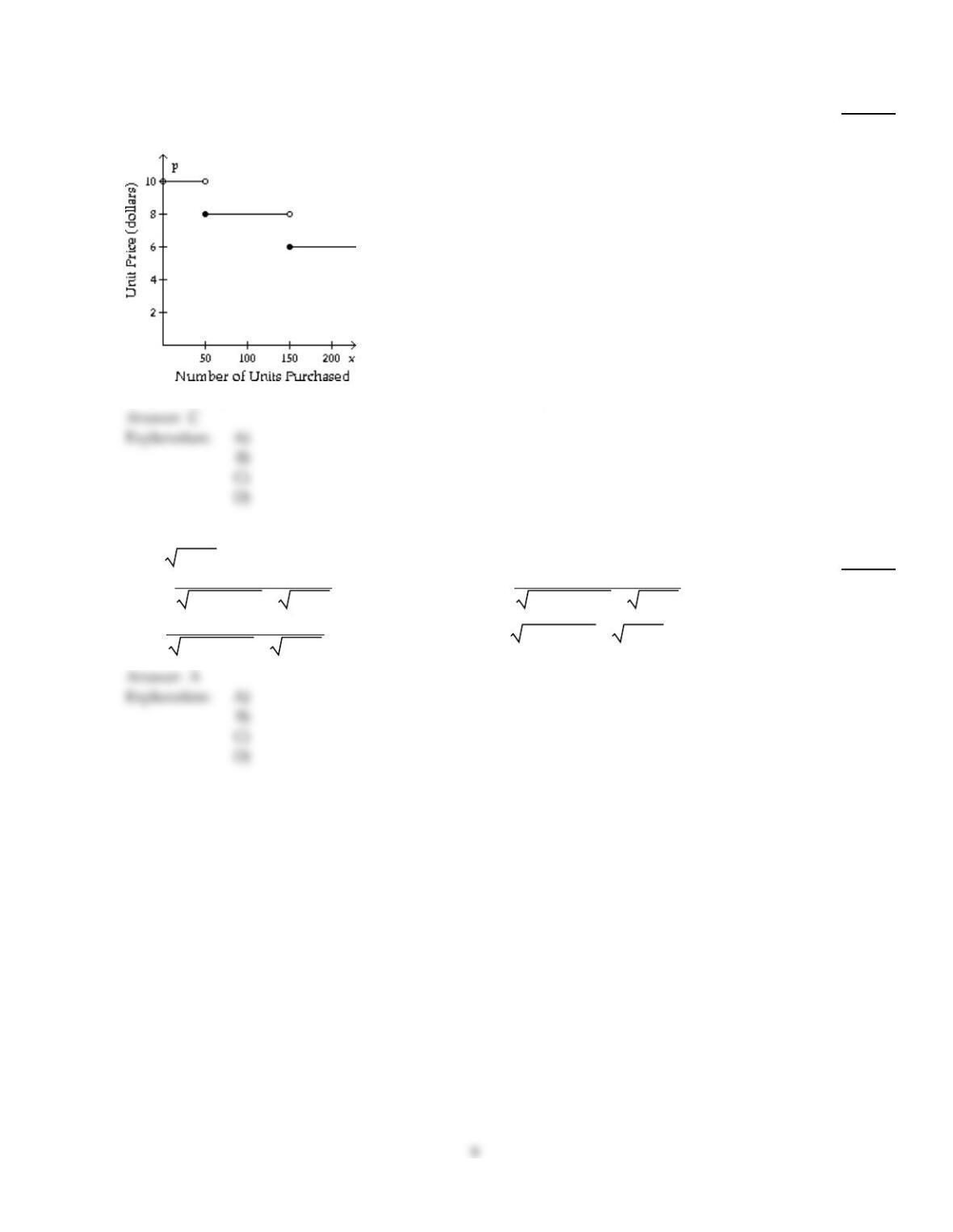
Solve the problem.
20)
Suppose that the unit price, p, for x units of a product can be illustrated by the given graph. Is p
continuous at x = 50? x = 100? x = 150?
20)
A)
No; yes; yes
B)
Yes; no; yes
C)
No; yes; no
D)
No; no; no
Find a simplified form of the difference quotient for the function.
21)
f(x) =8–9x
21)
A)
–9
8–9(x + h) +8–9x
B)
1
8h –9(x + h) +8–9x
C)
9
8–9(x + h) –8–9x
D)
8–9(x + h) +8–9x
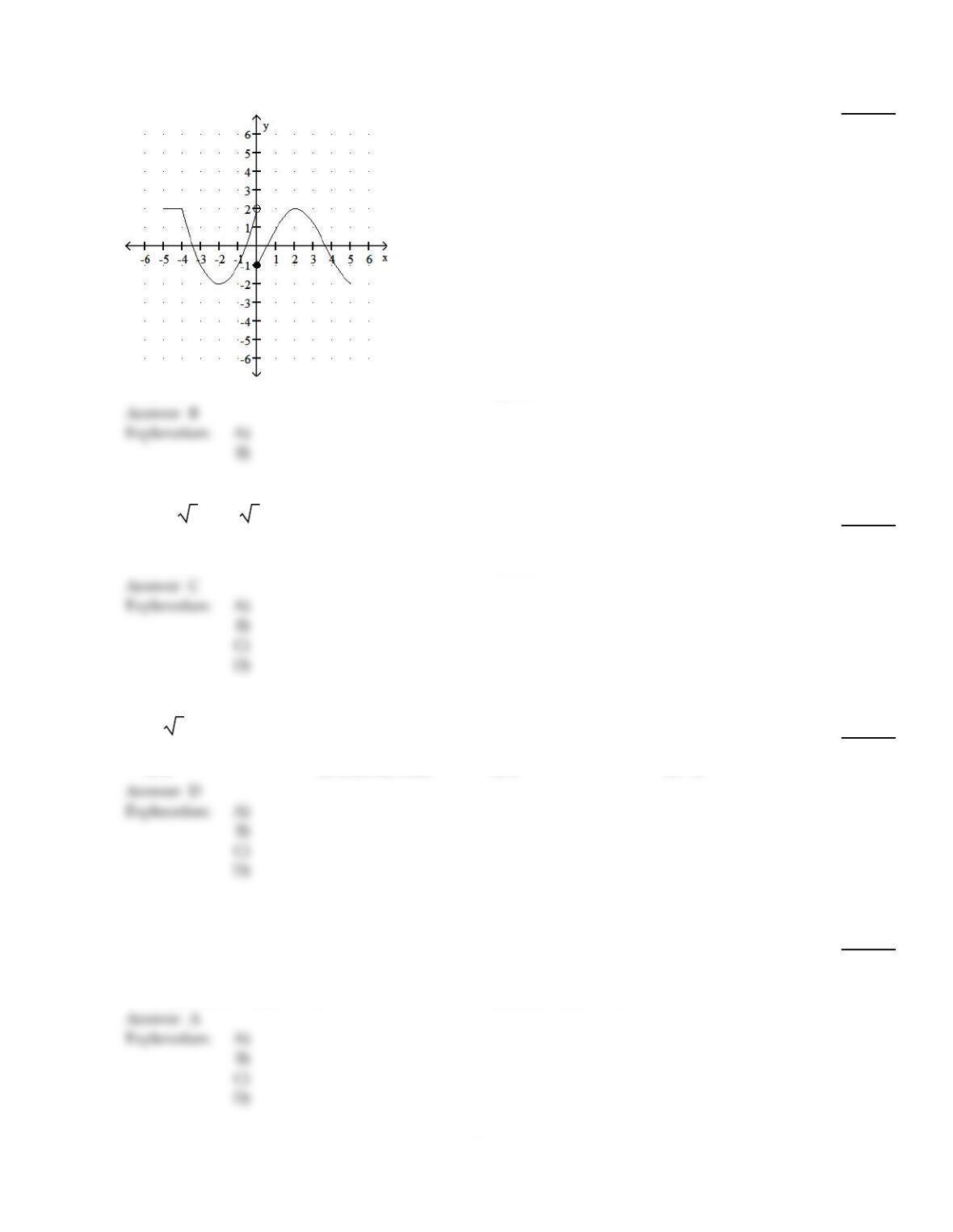
Use the graph to answer the question.
22)
Is f continuous at x =0?
22)
A)
Yes
B)
No
Differentiate.
23)
f(x) = (6 x– 2)(5 x+ 7)
23)
A)
f'(x) = 30 + 32x–1/2
B)
f'(x) = 30x + 32x1/2
C)
f'(x) = 30 + 16x–1/2
D)
f'(x) = 30x + 16x1/2
Find the limit, if it exists.
24)
lim
x
0x– 2
24)
A)
2
B)
Does not exist
C)
0
D)
–2
Differentiate.
25)
f(x) =(4x2+ 9)5
25)
A)
f'(x) =40x(4x2+ 9)4
B)
f'(x) =5(4x2+ 9)4
C)
f'(x) = (40x + 9)(4x2+ 9)4
D)
f'(x) =40(4x2+ 9)4
10
Solve the problem.
26)
The graph shows the total sales in thousands of dollars from the distribution of x thousand
catalogs. Find the average rate of change of sales with respect to the number of catalogs distributed
for the change in x.
10 to 20
26)
A)
2
B)
3
2
C)
1
2
D)
1
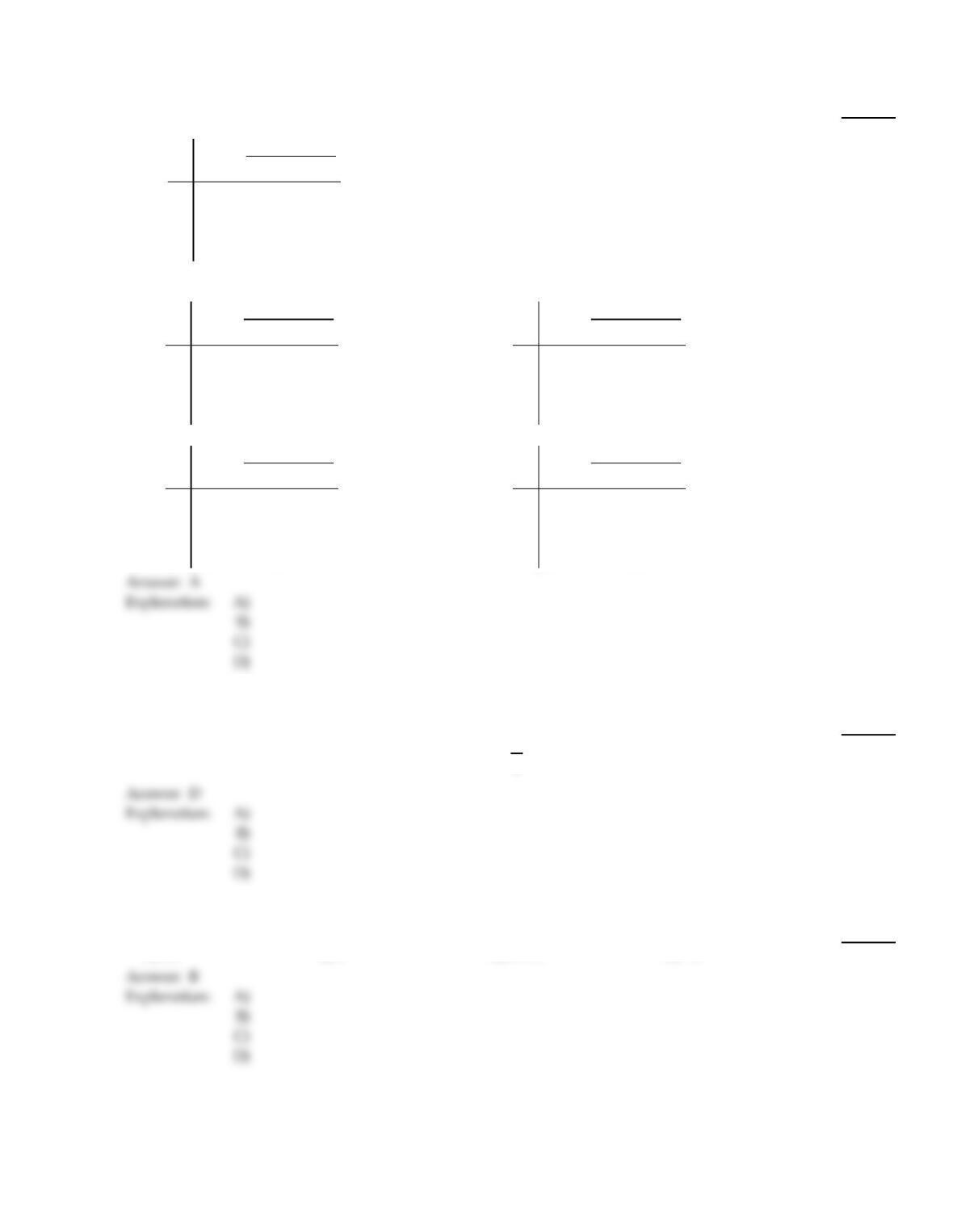
Complete the table after finding a simplified form of the difference quotient.
27)
For the function f(x) =3x3, complete the table below:
x h f(x + h) – f(x)
h
2 2
2 1
2 0.1
2 0.01
27)
A)
x h f(x + h) – f(x)
h
2 2 84
2 1 57
2 0.1 37.83
2 0.01 36.1803
B)
x h f(x + h) – f(x)
h
2 2 52
2 1 43
2 0.1 36.61
2 0.01 36.0601
C)
x h f(x + h) – f(x)
h
2 2 78
2 1 57
2 0.1 38.1
2 0.01 36.21
D)
x h f(x + h) – f(x)
h
2 2 60
2 1 45
2 0.1 36.63
2 0.01 36.0603
Find all values of x (if any) where the tangent line to the graph of the function is horizontal.
28)
y = x2+ 2x – 3
28)
A)
0
B)
1
C)
1
2
D)
–1
Find a simplified difference quotient for the function.
29)
f(x) =3x +6
29)
A)
3h
B)
3
C)
3+ h
D)
–3
12
Differentiate.
30)
f(x) =1 –10x+(1 –5x)2
30)
A)
f'(x) =5
1 –10x+10(1 –5x)
B)
f'(x) = – 10
1 –10x–5(1 –5x)
C)
f'(x) =1
21 –10x+ 2(1 –5x)
D)
f'(x) = – 5
1 –10x–10(1 –5x)
Graph the function and the indicated tangent line.
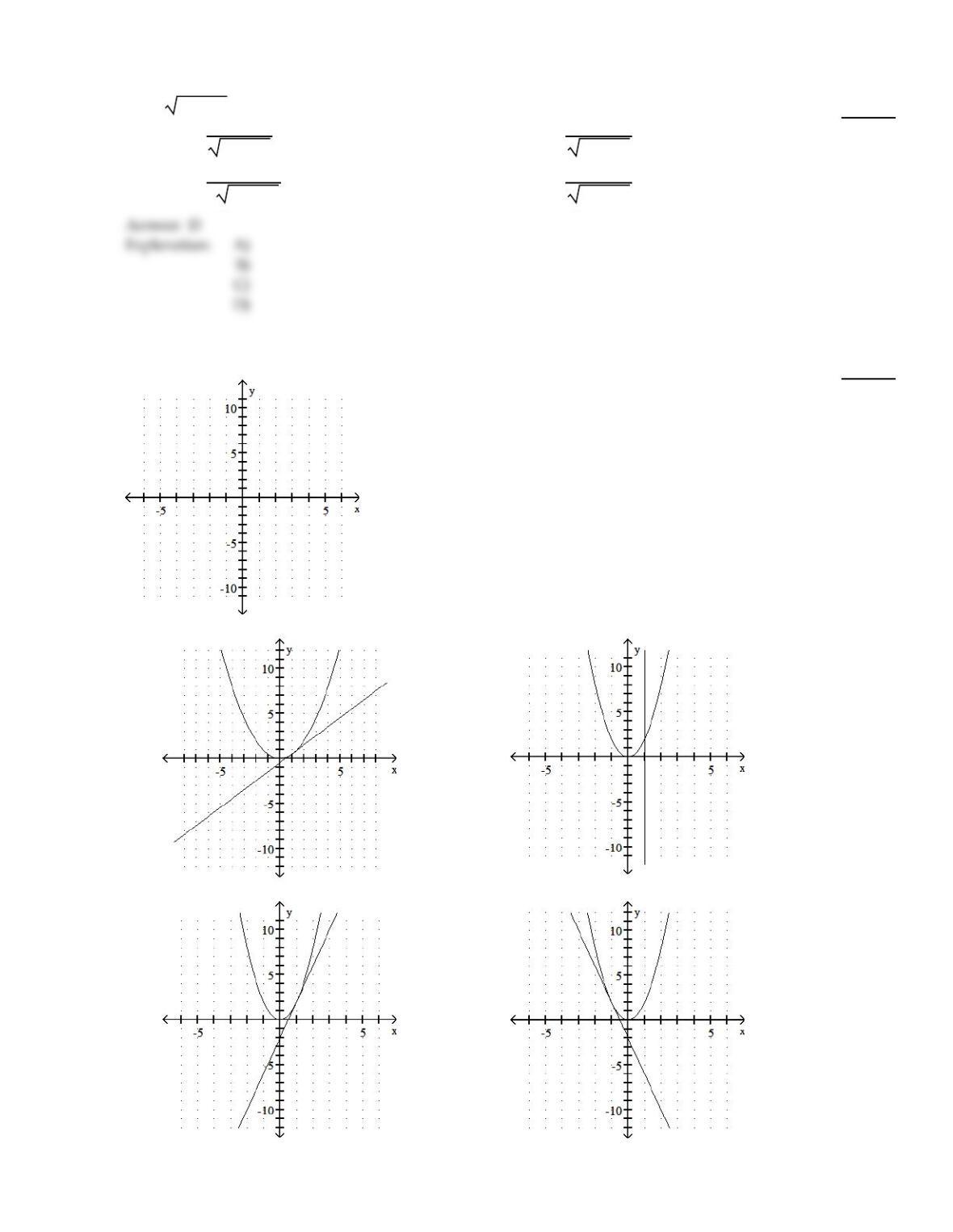
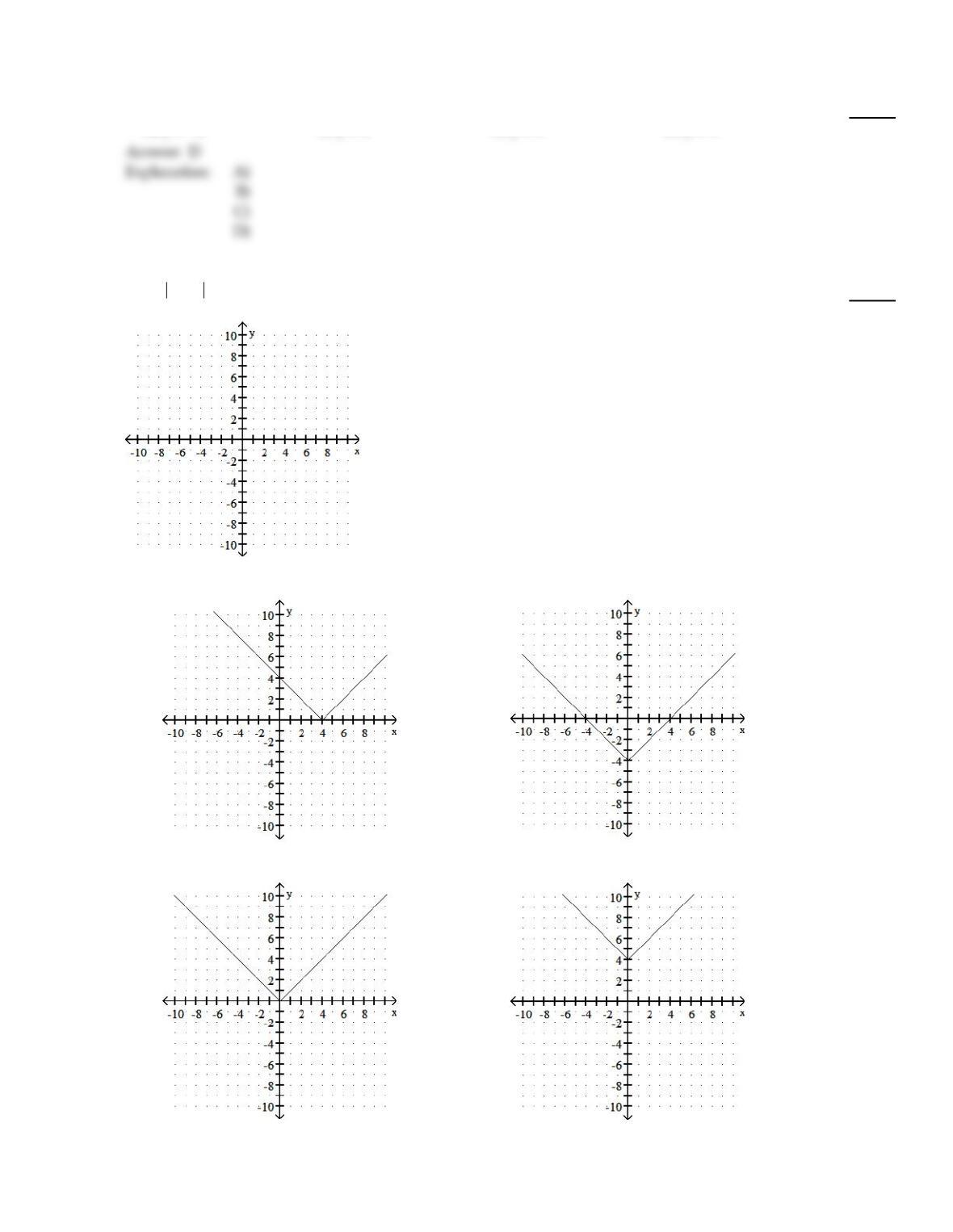
31)
Graph f(x) =2x2and the tangent line to the graph at the point whose x–coordinate is 1.
31)
A)
B)
C)
D)
13
Differentiate.
32)
y = (2x – 1)3(x + 7)–3
32)
A)
dy
dx = 45(2x – 1)2(x + 7)–3
B)
dy
dx = 45(2x – 1)3(x + 7)–4
C)
dy
dx = 45(2x – 1)3(x + 7)–2
D)
dy
dx = 45(2x – 1)2(x + 7)–4
Find the derivative.
33)
y =3
x–x
2
33)
A)
dy
dx =3
x2–1
2
B)
dy
dx = –3x –1
2
C)
dy
dx = – 3
x2–1
2
D)
dy
dx = – 3
x2+x
2
Find an equation for the line tangent to the graph of the given function at the indicated point.
34)
f(x) =27
x at (3, 9)
34)
A)
y = – 6x +27
B)
y = – 3x +18
C)
y = – 3x +9
D)
y = – 3x
Solve the problem.
35)
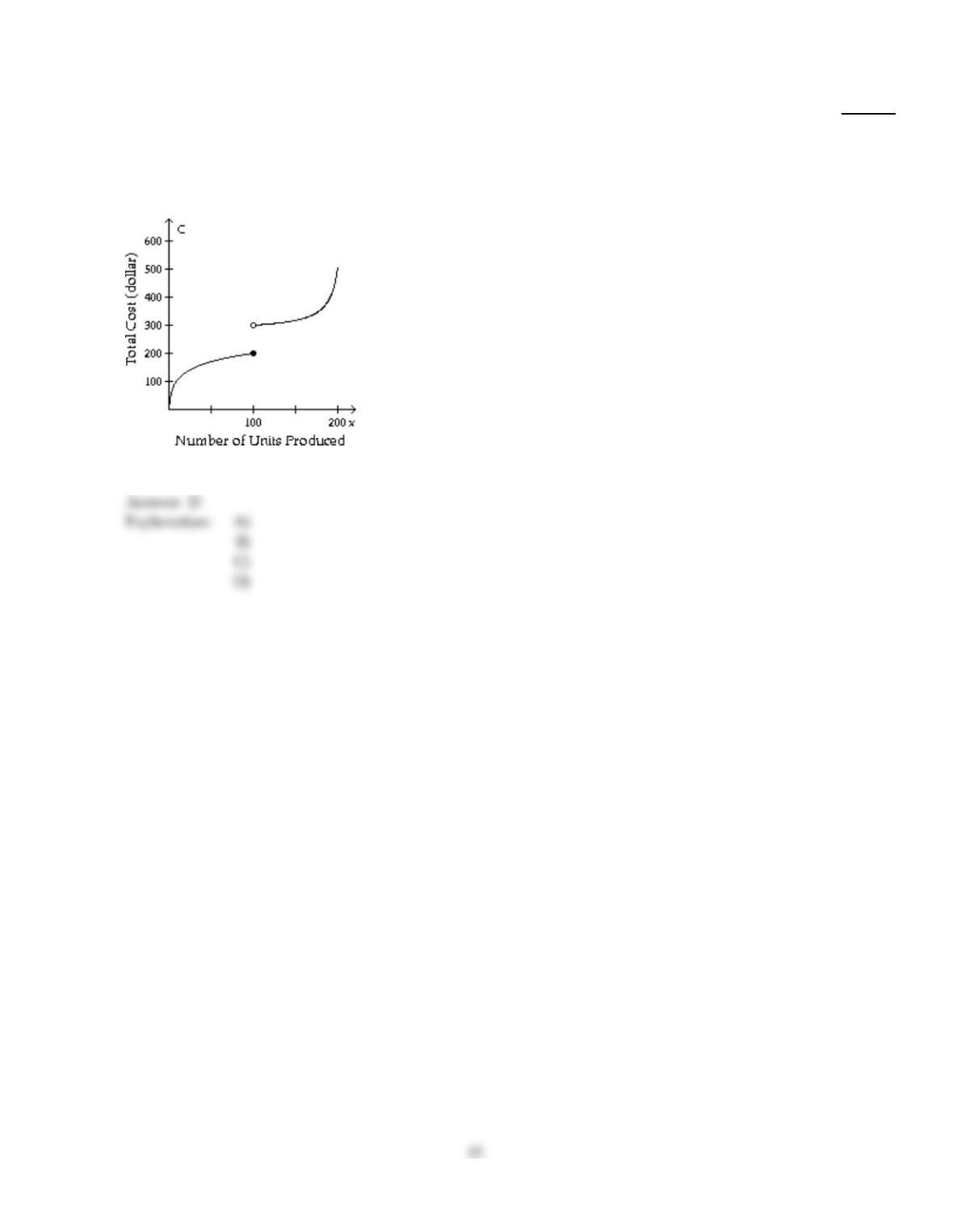
Suppose that the cost, C, of producing x units of a product can be illustrated by the given graph.
Find each limit, if it exists:
lim
x
100–p(x), lim
x
100+p(x), lim
x
100 p(x)
35)
A)
200; 300; 200
B)
200; 200; 200
C)
200; does not exist; does not exist
D)
200; 300; does not exist
Complete the table after finding a simplified form of the difference quotient.
36)
For the function f(x) =6x2, complete the table below:
x h f(x + h) – f(x)
h
2 2
2 1
2 0.1
2 0.01
36)
A)
x h f(x + h) – f(x)
h
2 2 48
2 1 36
2 0.1 25.2
2 0.01 24.12
B)
x h f(x + h) – f(x)
h
2 2 6
2 1 5
2 0.1 4.1
2 0.01 4.01
C)
x h f(x + h) – f(x)
h
2 2 36
2 1 30
2 0.1 24.6
2 0.01 24.06
D)
x h f(x + h) – f(x)
h
2 2 24
2 1 18
2 0.1 12.6
2 0.01 12.06
Find the limit by using the TABLE and TRACE features of your graphing calculator.
37)
lim
x
0
8–64 –x2
x
37)
A)
16
B)
1
16
C)
0
D)
1
8
Find the indicated derivative of the function.
38)
d3y
dx3 of y =x
x + 1
38)
A)
6(x + 1)–4
B)
6(x + 1)–3
C)
–6(x + 1)–3
D)
–6(x + 1)–4
Use the graph to answer the question.
39)
Is f continuous at x =0?
39)
A)
No
B)
Yes
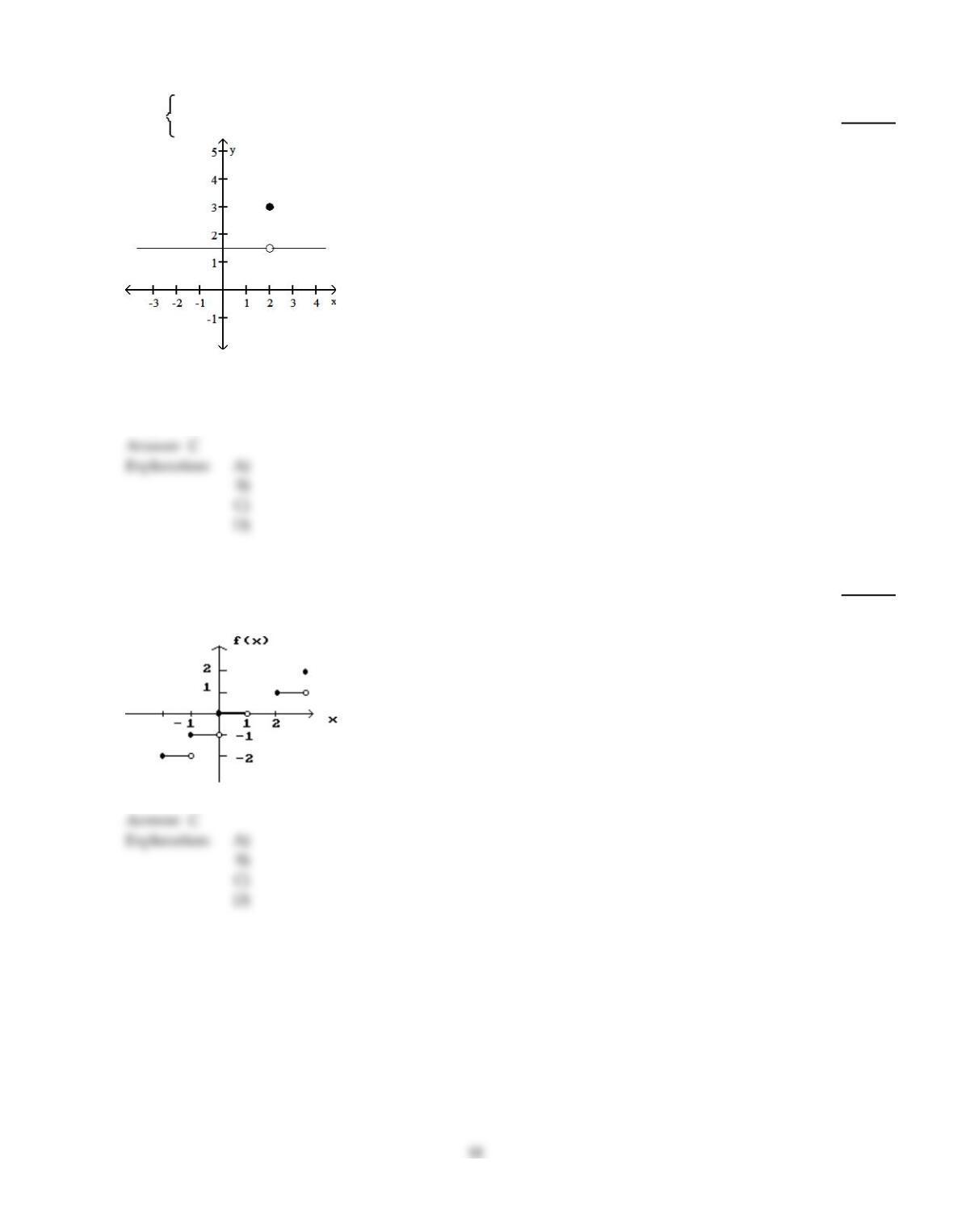
Determine the continuity of the function at the given points.
40)
f(x) =3, for x =2
1.5,for x 2 at x =2 and x =1
40)
A)
The function f is continuous at both x =1 and x =2.
B)
The function f is continuous at neither x =1 nor x =2.
C)
The function f is continuous at x =1 but not at x =2.
D)
The function f is continuous at x =2 but not at x =1.
Decide whether the limit exists. If it exists, find its value.
41)
Find lim
x–1 f(x).
41)
A)
0
B)
–1
C)
Does not exist
D)
–2
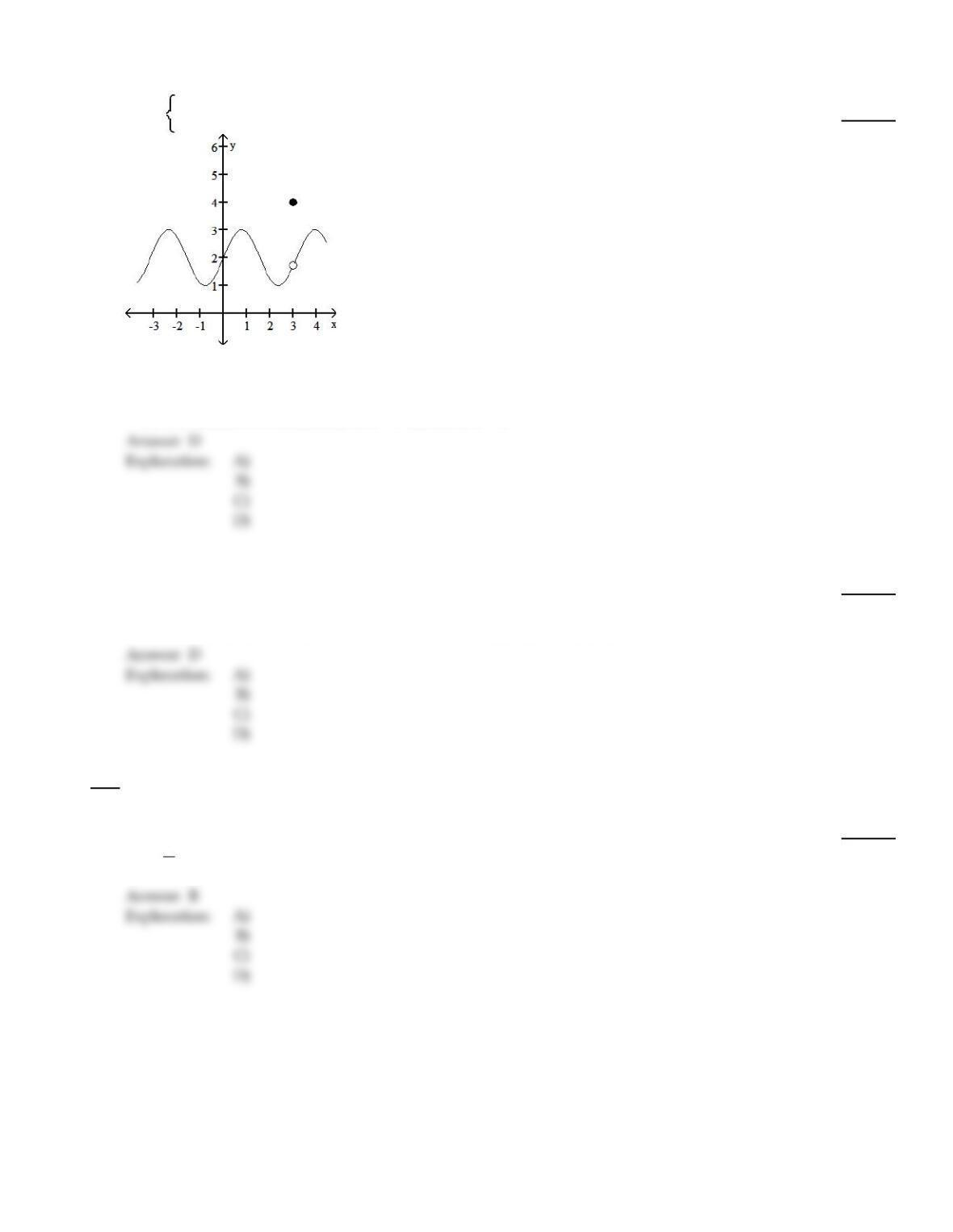
Determine the continuity of the function at the given points.
42)
f(x) =4, for x =3
sin(2x) +2, for x 3 at x =3 and x =1
42)
A)
The function f is continuous at neither x =1 nor x =3.
B)
The function f is continuous at both x =1 and x =3.
C)
The function f is continuous at x =3 but not at x =1.
D)
The function f is continuous at x =1 but not at x =3.
Find the derivative of the function and evaluate the derivative at the given x–value.
43)
f(x) = 1 – x3 at x = 1
43)
A)
f'(x) = 3x2– 1; f'(1) = 2
B)
f'(x) = –3x; f'(1) = –3
C)
f'(x) = 1 – 3x; f'(1) = –2
D)
f'(x) = –3x2; f'(1) = –3
Find d2y
dx2.
44)
y =4x + 6
44)
A)
4
x
B)
0
C)
4x3+ 6x2
D)
4
Graph the function and the indicated tangent line.
19
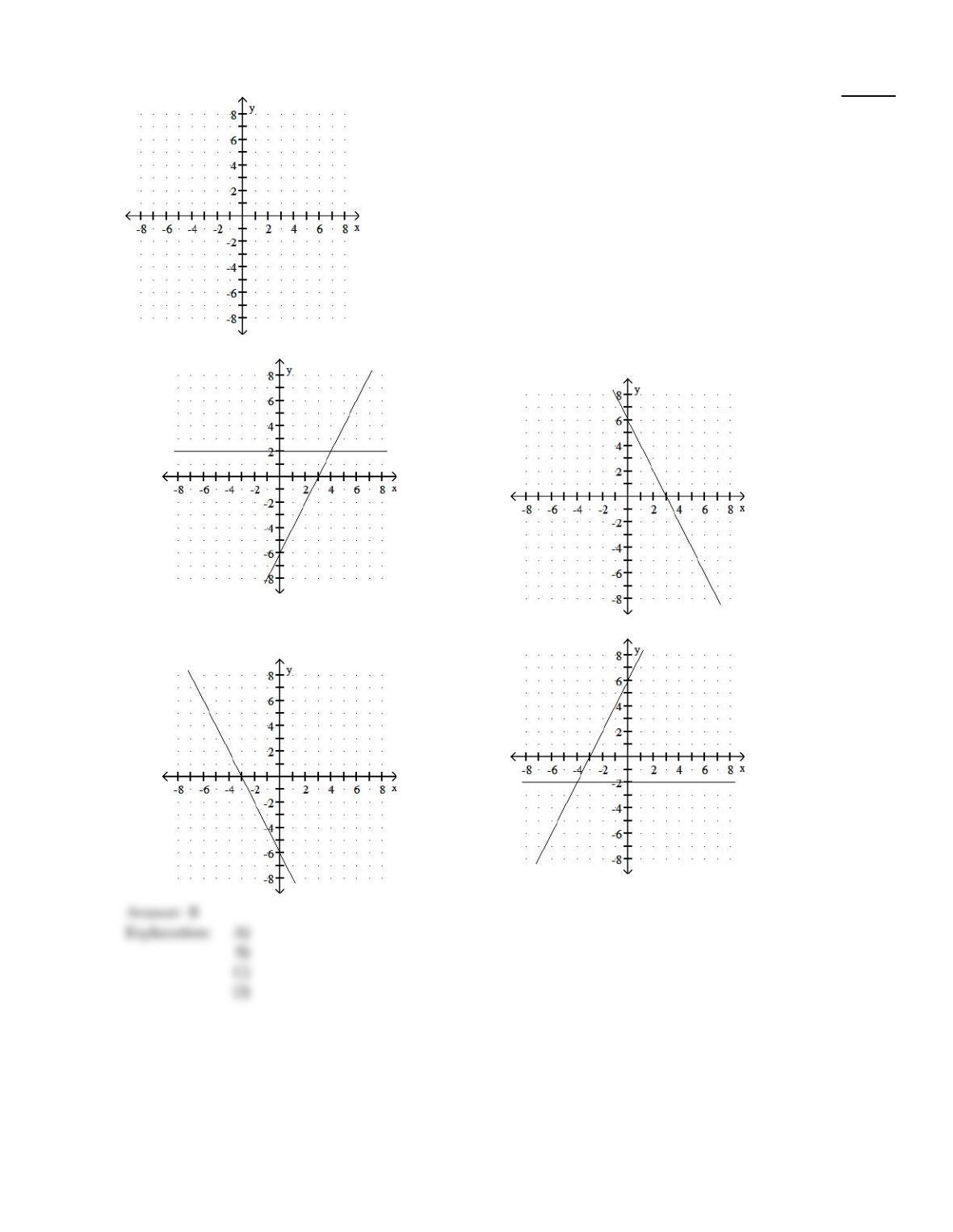
45)
Graph f(x) = –2x + 6 and the tangent line to the graph at the point whose x–coordinate is –2.
45)
A)
B)
The tangent line is identical to the graph
of the original function.
C)
The tangent line is identical to the graph
of the original function.
D)
20
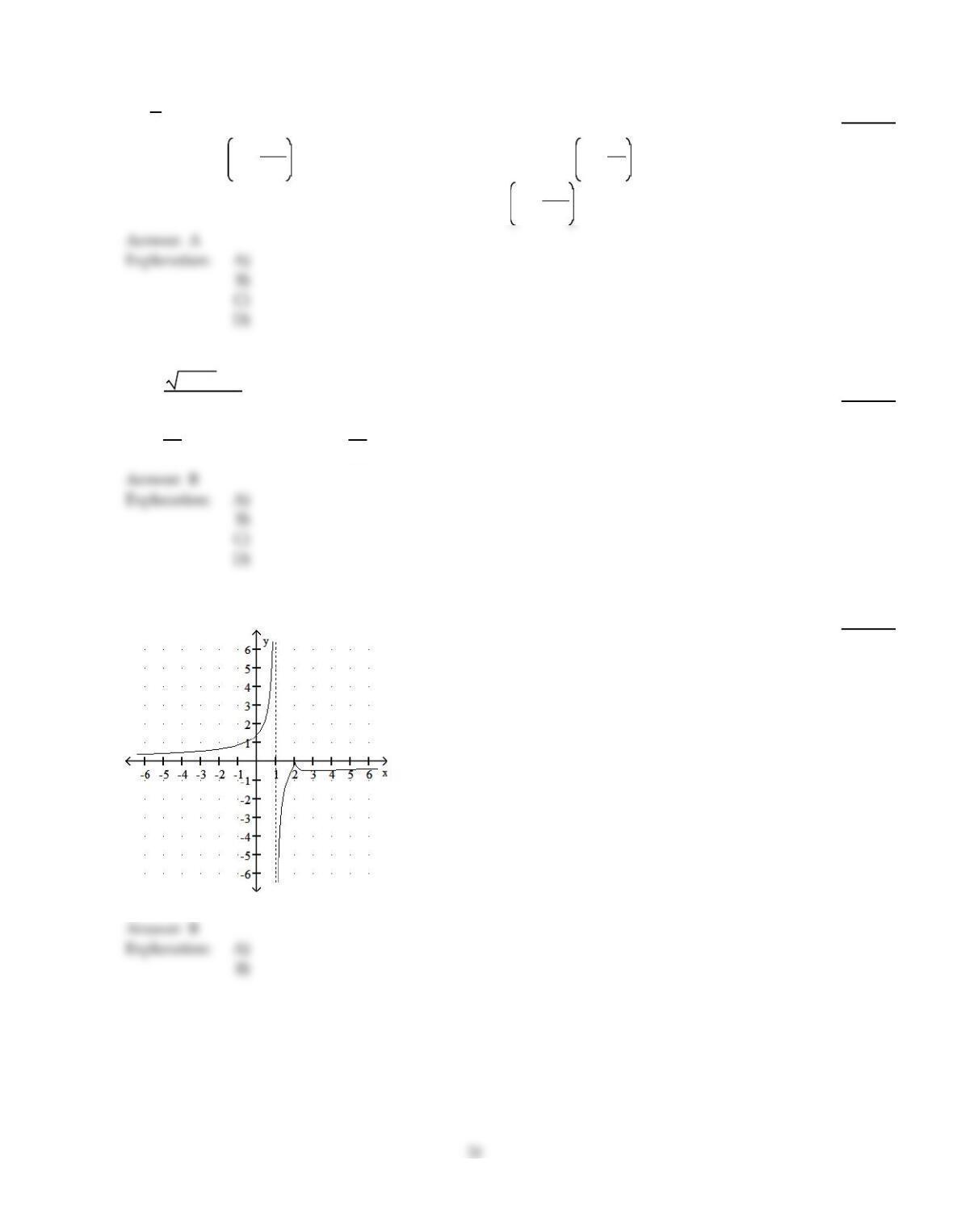
For the given function, find the points on the graph at which the tangent line has slope 1.
46)
y =1
3x3–4x2+ x
46)
A)
(0, 0) and 8, –232
3
B)
(0, 0) and 8, –19
3
C)
(0, 0)
D)
8, –116
3
Find the limit by using the TABLE and TRACE features of your graphing calculator.
47)
lim
x
0
49 – x –7
x
47)
A)
1
14
B)
–1
14
C)
7
D)
14
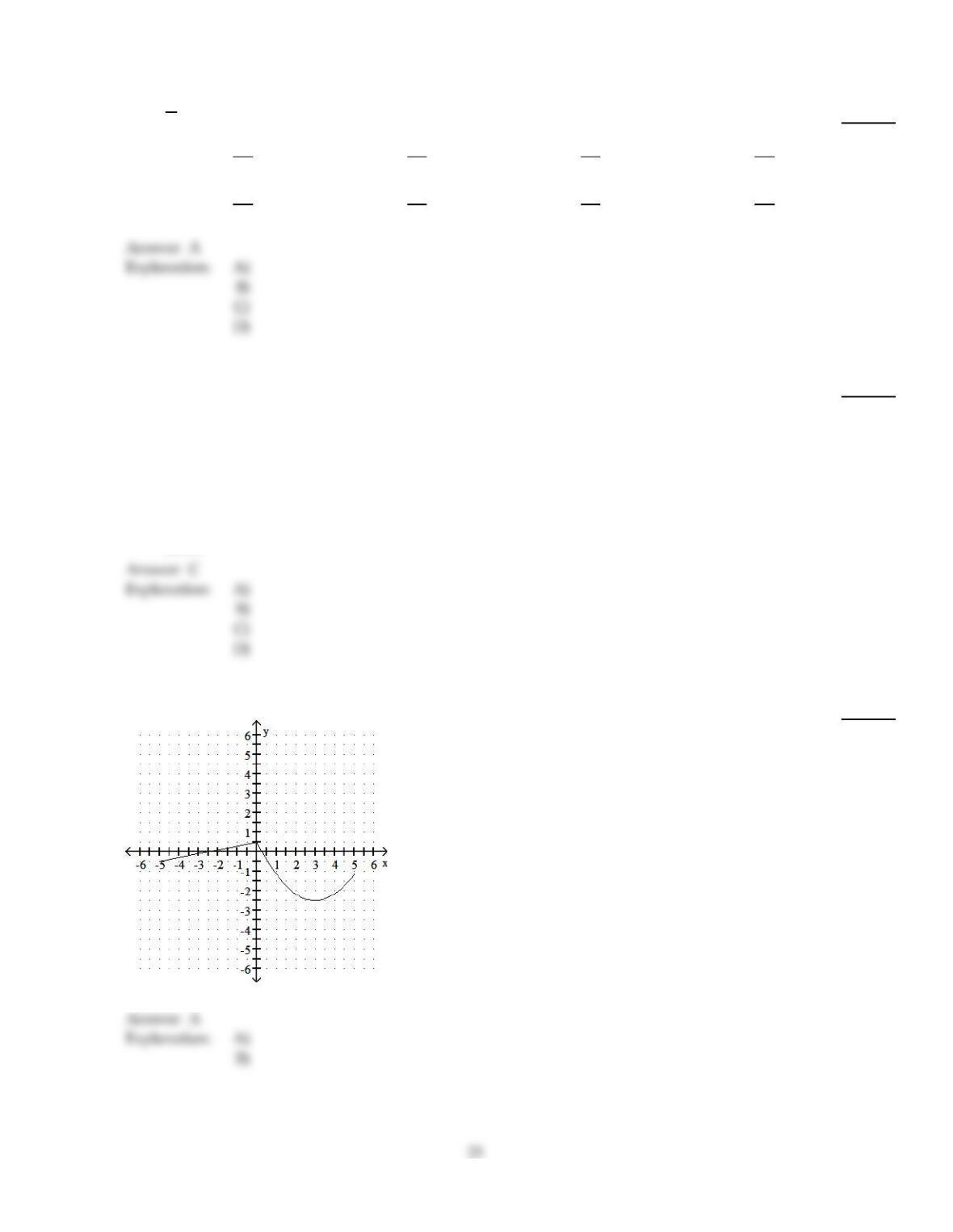
Determine whether the function shown is continuous over the interval (–5, 5).
48)
48)
A)
Yes
B)
No
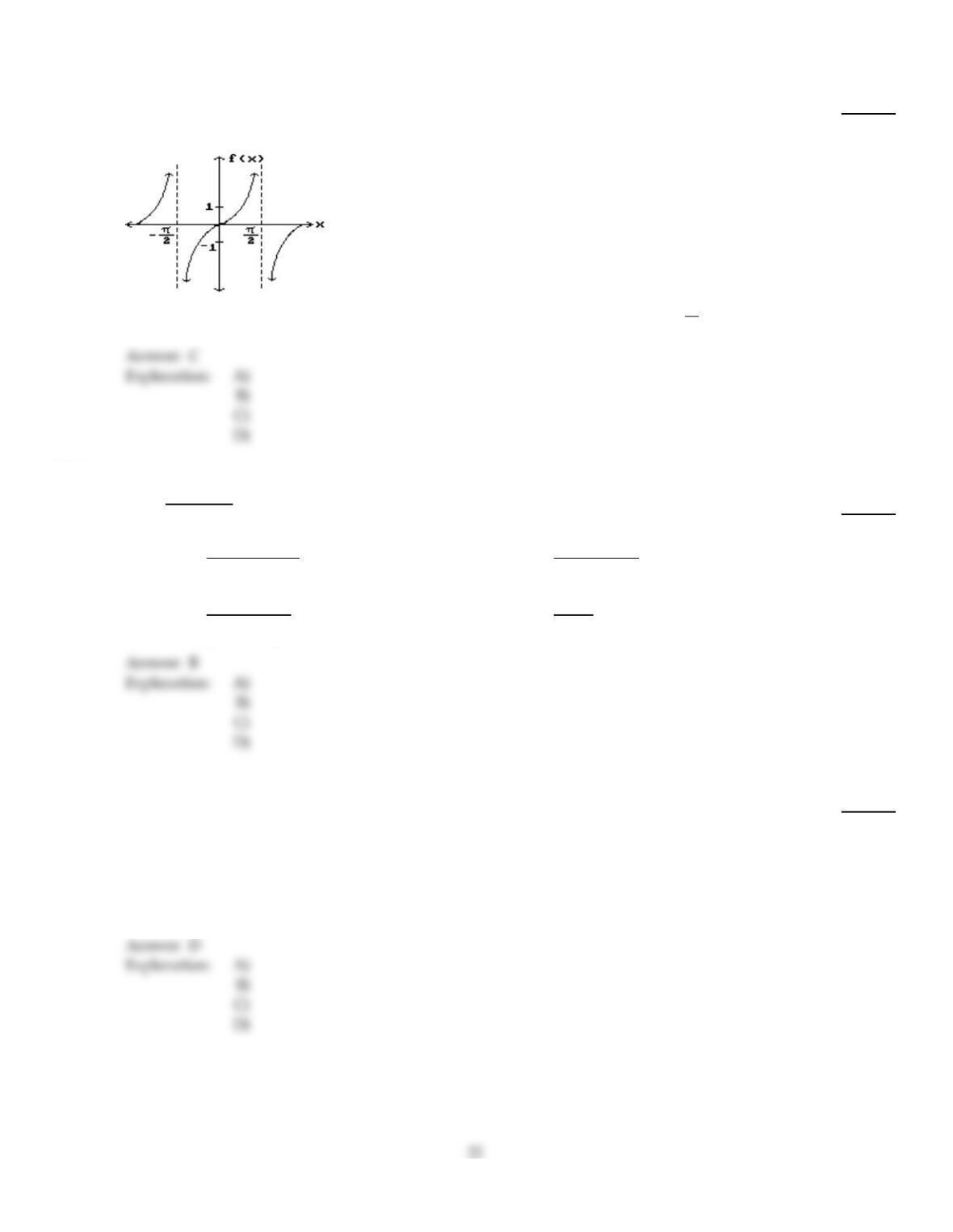
Decide whether the limit exists. If it exists, find its value.
49)
Find lim
x
/2 f(x).
49)
A)
1
B)
0
C)
Does not exist
D)
2
Differentiate.
50)
q(t) =6t
t2–5t – 1
50)
A)
q'(t) =–6(t2–5t + 1)
(t2–5t – 1)2
B)
q'(t) =–6(t2+ 1)
(t2–5t – 1)2
C)
q'(t) =–6t2
(t2–5t – 1)2
D)
q'(t) =6
2t –5
B
Provide an appropriate response.
51)
Provide a short sentence that summarizes the general limit principle given by the formal notation
lim
x
a [f(x) ± g(x)] =lim
x
a f(x) ±lim
x
a g(x) = L ± M, given that lim
x
a f(x) = L and lim
x
a g(x) = M.
51)
A)
The sum or the difference of two functions is the sum of two limits.
B)
The sum or the difference of two functions is continuous.
C)
The limit of a sum or a difference is the sum or the difference of the functions.
D)
The limit of a sum or a difference is the sum or the difference of the limits.
D
C
Find (f
g)(x) and (g f)(x).
52)
f(x) =2
x; g(x) = 2x3
52)
A)
(f
g)(x) =1
x3
(g
f)(x) =16
x3
B)
(f
g)(x) =4
x3
(g
f)(x) =1
x3
C)
(f
g)(x) =1
x3
(g
f)(x) =4
x3
D)
(f
g)(x) =16
x3
(g
f)(x) =1
x3
Provide an appropriate response.
53)
What conditions, when present, are sufficient to conclude that a function f(x) has a limit as x
approaches some value of a?
53)
A)
Either the limit of f(x) as x
a from the left exists or the limit of f(x) as x
a from the right exists
B)
The limit of f(x) as x
a from the left exists, the limit of f(x) as x
a from the right exists, and at
least one of these limits is the same as f(a).
C)
The limit of f(x) as x
a from the left exists, the limit of f(x) as x
a from the right exists, and
these two limits are the same.
D)
f(a) exists, the limit of f(x) as x
a from the left exists, and the limit of f(x) as x
a from the right
exists.
Use the graph to answer the question.
54)
Is f continuous at x =3?
54)
A)
Yes
B)
No
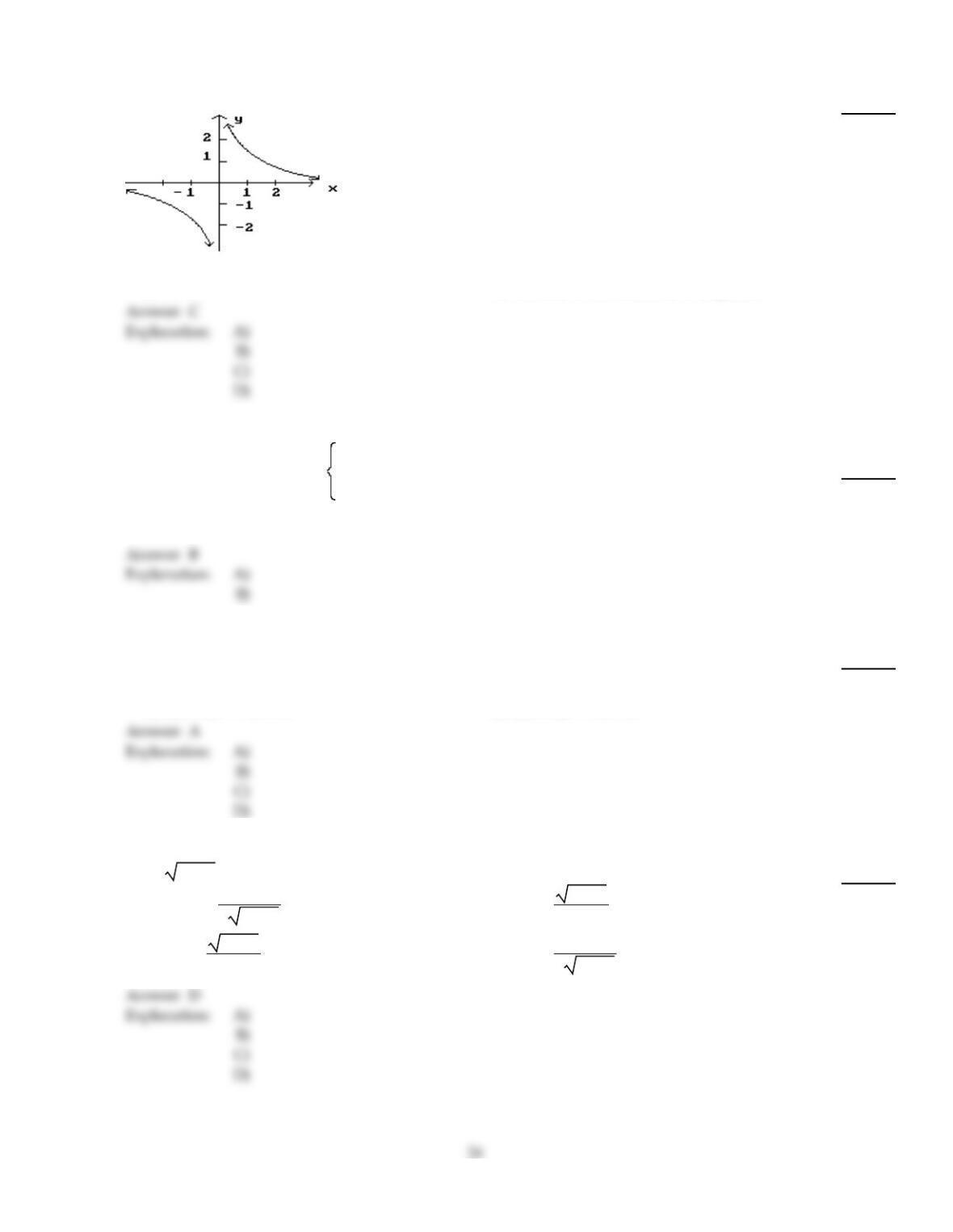
List the x–values in the graph at which the function is not differentiable.
55)
55)
A)
x = –1, x = 0, x = 1
B)
x = –1, x = 1
C)
x = 0
D)
Function is differentiable at all points.
Provide an appropriate response.
56)
Is the function given by f(x) =5x + 2,for x < 1
1, for x = 1
–2x + 7,for x > 1 continuous at x = 1? Why or why not?
56)
A)
Yes, lim
x
1f(x) = f(1)
B)
No, lim
x
1f(x) does not exist
Solve the problem.
57)
If s is a distance given by s(t) =3t4+8t2+ 2t, find the acceleration, a(t).
57)
A)
a(t) =36t2+16
B)
a(t) =36t +16
C)
a(t) =12t3+16t + 2
D)
a(t) =12t2+16t + 2
Find f'(x).
58)
f(x) =x – 10
58)
A)
f'(x) = – 1
2x – 10
B)
f'(x) =x – 10
x – 10
C)
f'(x) =x – 10
2
D)
f'(x) =1
2x – 10
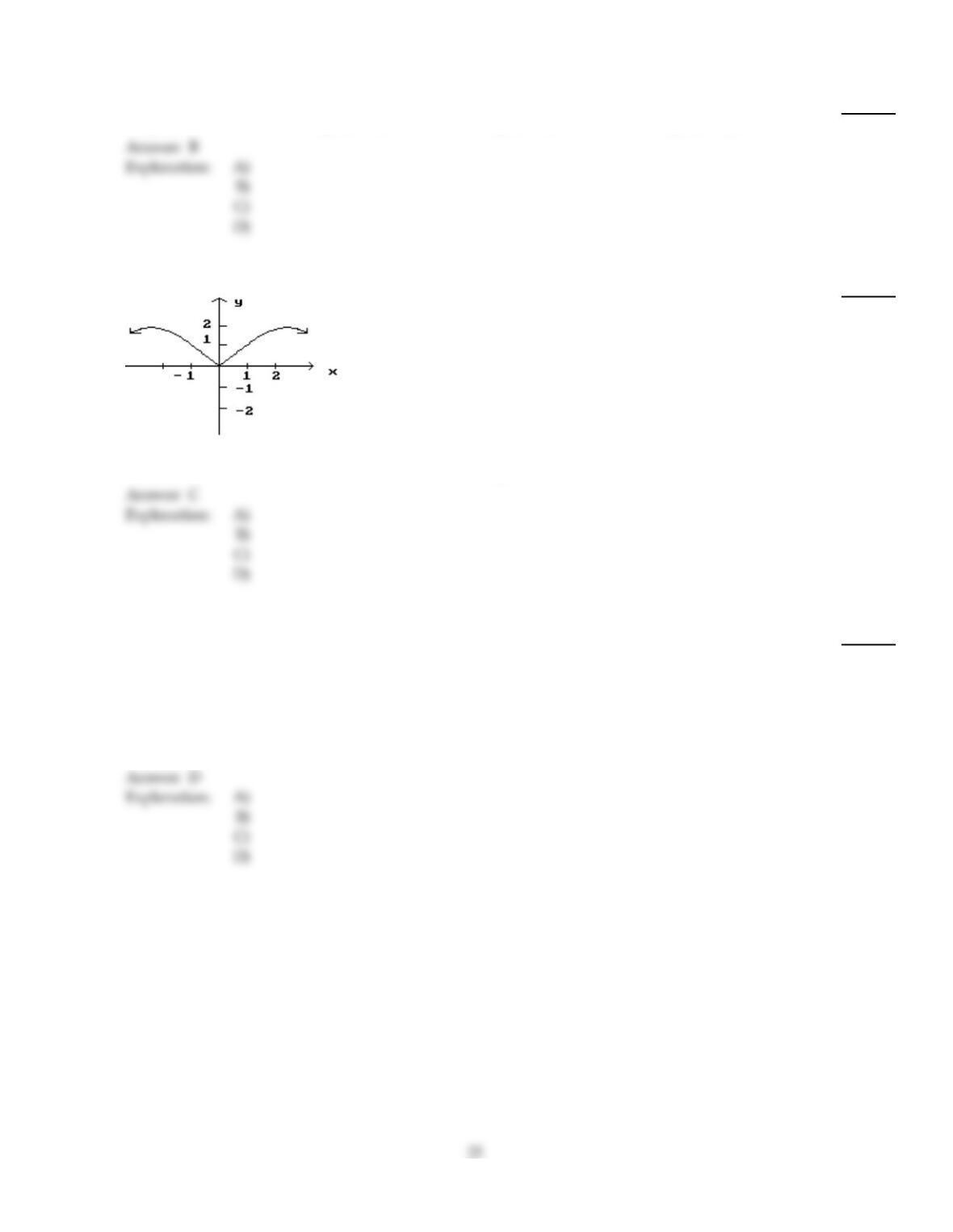
Find the derivative.
59)
y = (2x – 5)(4x + 1)
59)
A)
16x – 9
B)
16x – 18
C)
8x – 18
D)
16x – 22
List the x–values in the graph at which the function is not differentiable.
60)
60)
A)
x = –2, x = 2
B)
x = –2, x = 0, x = 2
C)
x = 0
D)
x = 2
Provide an appropriate response.
61)
What conditions, when present, are sufficient to conclude that a function f(x) is continuous at x = a?
61)
A)
The limit of f(x) as x
a from the left exists, the limit of f(x) as x
a from the right exists, and
these two limits are the same.
B)
f(a) exists, and the limit of f(x) as x
a exists.
C)
f(a) exists, the limit of f(x) as x
a from the left exists, and the limit of f(x) as x
a from the right
exists.
D)
f(a) exists, the limit of f(x) as x
a exists, and the limit of f(x) as x
a is f(a).
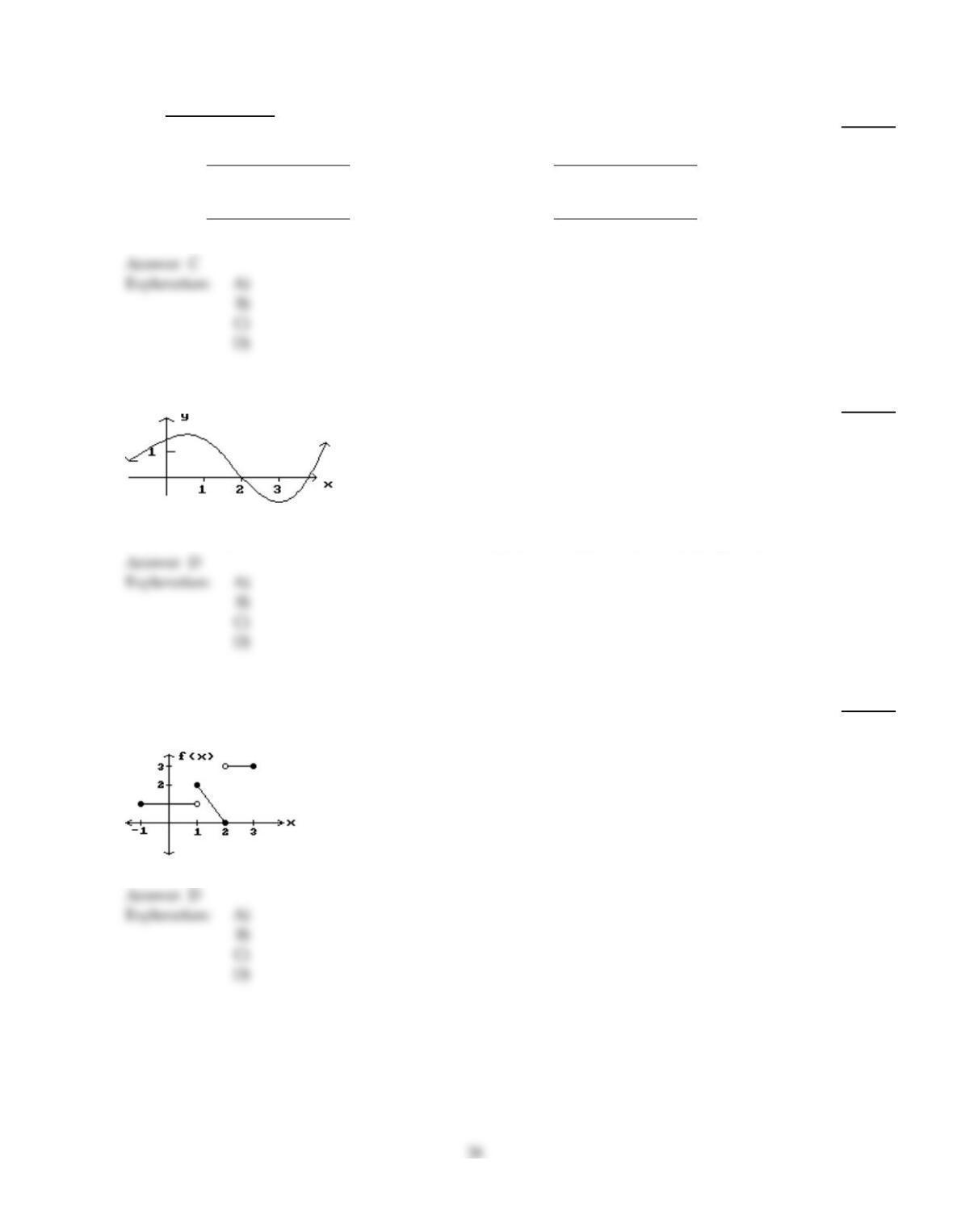
Differentiate.
62)
f(x) =(3x – 1)(3x2+3)
5x +1
62)
A)
f'(x) =90x3+12x2–6x +24
5x +1
B)
f'(x) =90x3+27x2–6x +24
(5x +1)2
C)
f'(x) =90x3+12x2–6x +24
(5x +1)2
D)
f'(x) =45x3+12x2+6x +24
(5x +1)2
List the x–values in the graph at which the function is not differentiable.
63)
63)
A)
x = 1, x = 3
B)
x = 2
C)
x = 1, x = 2, x = 3
D)
Function is differentiable at all points
Decide whether the limit exists. If it exists, find its value.
64)
Find lim
x
1f(x).
64)
A)
1
B)
2
C)
0
D)
Does not exist
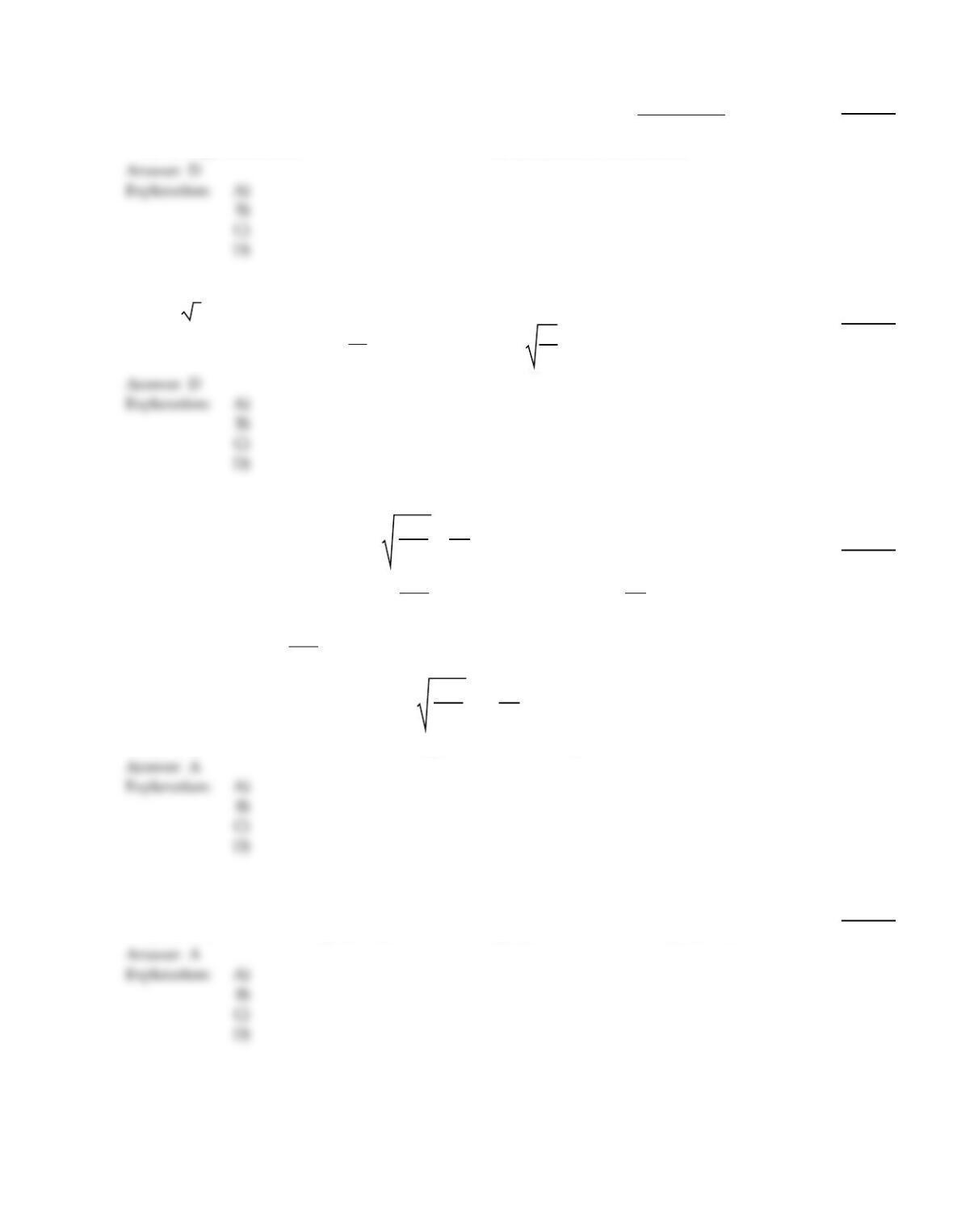
Provide an appropriate response.
65)
The first derivative is to instantaneous velocity as the second derivative is to .
65)
A)
Average velocity
B)
Instantaneous speed
C)
Average momentum
D)
Instantaneous acceleration
Find all values of x (if any) where the tangent line to the graph of the function is horizontal.
66)
y = x9+x
66)
A)
0
B)
–1
20
C)
10 1
20
D)
None
Provide an appropriate response.
67)
Critique the validity of the expression d2y
dx2=dy
dx.
67)
A)
It is not valid, because the notation d2y
dx2 does not mean the square of dy
dx.
B)
It is valid, because d2y
dx2 cannot be negative.
C)
It is not valid, because it should read “ d2y
dx2= ± dy
dx“.
D)
It is valid, because a derivative can be squared the same as any function.
Find the derivative.
68)
y =(6x + 4)2
68)
A)
72x + 48
B)
36x + 24
C)
12x + 8
D)
36x + 16
27
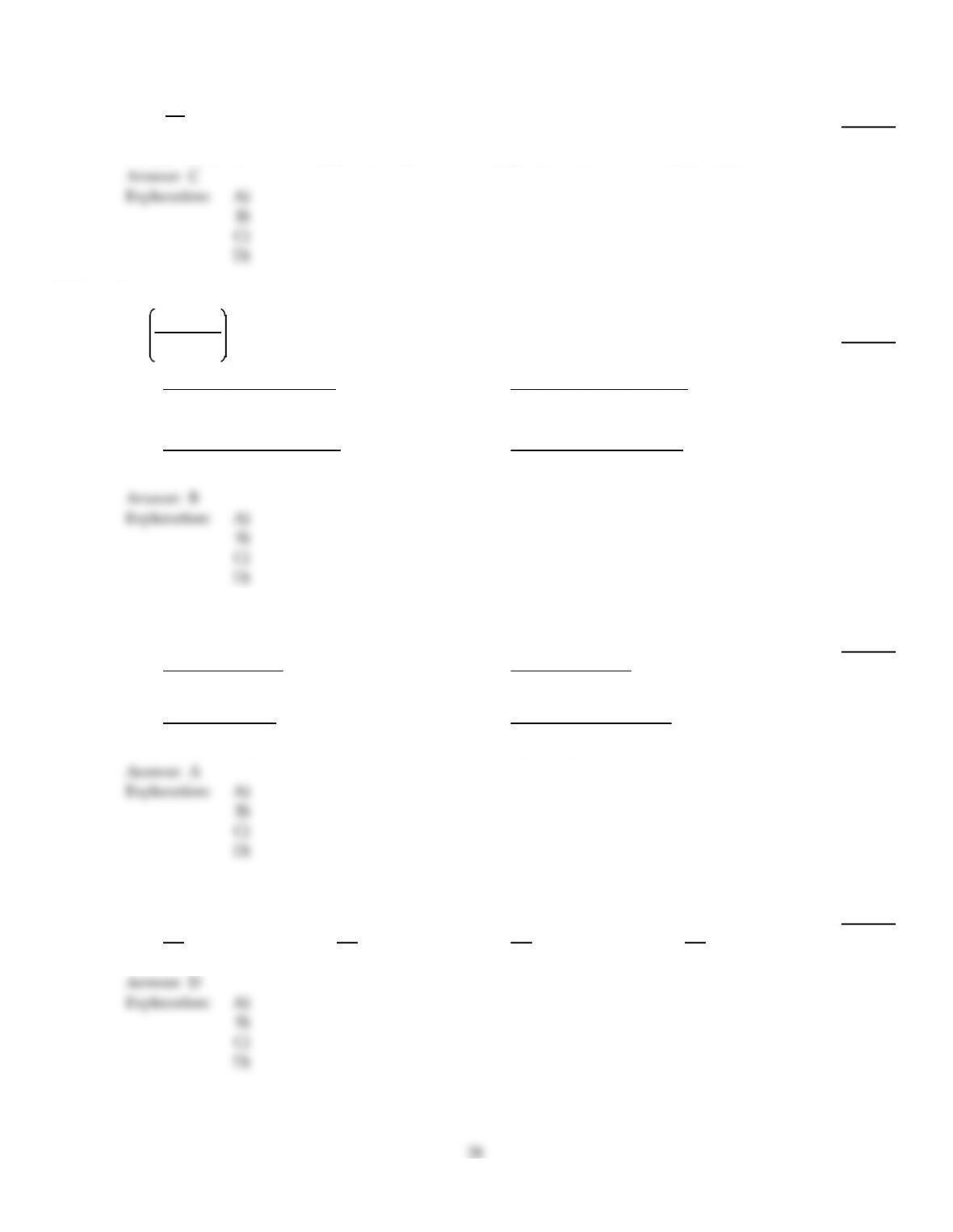
Find an equation for the line tangent to the graph of the given function at the indicated point.
69)
f(x) =x3
4 at (–6, – 54)
69)
A)
y =108x +27
B)
y =9x +108
C)
y =27x +108
D)
y =108x +9
Differentiate.
70)
y =x2+ x + 1
x2– 1
4
70)
A)
4(x2+ x + 1)3(x2+ 4x – 1)
(x2– 1)6
B)
4(x2+ x + 1)3(–x2– 4x –1)
(x2– 1)5
C)
4(x2+ x + 1)3(–x2+ 4x –1)
(x2– 1)6
D)
4(x2+ x + 1)3(x2– 4x + 1)
(x2– 1)5
Find an expression for dy/dx.
71)
y =u–7/4 and u =x2– 9x – 7
71)
A)
–7(2x – 9)
4(x2– 9x – 7)11/4
B)
–7
4(x2– 9x – 7)11/4
C)
–7(2x – 9)
4(x2– 9x – 7)3/4
D)
–7
4(2x – 9)(x2– 9x – 7)7/4
Find the derivative.
72)
y =2– 9x3
72)
A)
dy
dx = –18x2
B)
dy
dx = –27x
C)
dy
dx =2– 27x2
D)
dy
dx = –27x2
Find a simplified form of the difference quotient for the function.
73)
f(x) = b – mx
73)
A)
–mx
B)
–m
C)
–m + h
D)
–mx + h
Differentiate.
74)
g(x) =5x3– 2x +3
x26/5
74)
A)
g'(x) =6
55x3– 2x +3
x21/5 15x2– 2 –6
x3
B)
g'(x) =6
55x3– 2x +3
x21/5
C)
g'(x) =6
55x3– 2x +3
x21/5 15x2– 2 –6
x
D)
g'(x) =6
515x2– 2 –6
x31/5
Find the derivative.
75)
y =x(5x – 3) + 20x – 12
75)
A)
3.33x1/2 – 3x–1/2 + 20
B)
7.5x1/2 – 1.5x–1/2 + 20
C)
7.5x1/2 – 3x–1/2 + 20
D)
3.33x1/2 – 1.5x–1/2 + 20
Find a simplified form of the difference quotient for the function.
76)
f(x) =x – 3
76)
A)
1
x + h +x
B)
1
x – 3 + h +x – 3
C)
h
x – 3 + h –x – 3
D)
x – 3 + h +x – 3
Find the derivative.
77)
f(x) = 9x7/5 – 5x2+ 104
77)
A)
f'(x) =63
5 x2/5 – 10x
B)
f'(x) =63
5 x6/5 – 10x + 4000
C)
f'(x) =63
5 x6/5 – 10x
D)
f'(x) =63
5 x2/5 – 10x + 4000
Find the intervals on which the function is continuous.
78)
Is the function given by f(x) =x +5
x2–12x +32 continuous over the interval [–4, 4]? Why or why not?
78)
A)
No, since f(x) is not continuous at x =4
B)
Yes, f(x) is continuous at each point on [–4, 4]
Find a simplified form of the difference quotient for the function.
79)
f(x) = x
2– x
79)
A)
2
(x –2)(x + h –2)
B)
–2h
(x –2)(x + h –2)
C)
– x
(x –2)(x + h –2)
D)
1
(x –2)(x + h –2)
Provide an appropriate response.
80)
What information does the difference quotient, f(x + h) – f(x)
h, provide about the differentiable
function f(x)?
80)
A)
The average rate of change of f(x) over the interval [x, x + h].
B)
The instantaneous rate of change of f(x) as a function of x.
C)
The slope of the line tangent to f(x) at the point (x, f(x)).
D)
The limit of f(x) as x approaches h.
30
For the given function, find the points on the graph at which the tangent line has slope 1.
81)
y =1
3x3–7
2x2+ x + 1
81)
A)
(0, 1) and 7, –299
6
B)
(0, 0) and 7, –301
6
C)
(0, 1) and 7, –295
6
D)
(0, 0) and 7, –299
6
Find the derivative.
82)
y =x2– 4
x
82)
A)
y’ = 1 +4
x
B)
y’ = 1 +4
x2
C)
y’ = 1 –4
x2
D)
y’ = x +4
x2
83)
y =9
x5–3
x
83)
A)
dy
dx =9
x6+3
x2
B)
dy
dx = – 45
x4–3x
C)
dy
dx = – 45
x6+3
x2
D)
dy
dx = – 45
x6–3
x2
Find d2y
dx2.
84)
y = x2+x
84)
A)
8x3/2 – 1
4x3/2
B)
2x3/2 + 1
x3/2
C)
2x3/2 – 1
x3/2
D)
8x3/2 + 1
4x3/2
31
Find (f
g)(x) and (g f)(x).
85)
f(x) = 5x3+ 8; g(x) = 2x
85)
A)
(f
g)(x) = 40x3+ 8
(g
f)(x) = 10x3+ 16
B)
(f
g)(x) = 10x3+ 8
(g
f)(x) = 40x3+ 16
C)
(f
g)(x) = 10x3+ 16
(g
f)(x) = 40x3+ 8
D)
(f
g)(x) = 40x3+ 16
(g
f)(x) = 10x3+ 8
Find the derivative.
86)
f(x) =7x240
86)
A)
f'(x) =7x239
B)
f'(x) =1680x239
C)
f'(x) =1680x240
D)
f'(x) =1680x241
Use the graph to answer the question.
87)
Is f continuous at x =0?
87)
A)
Yes
B)
No
32
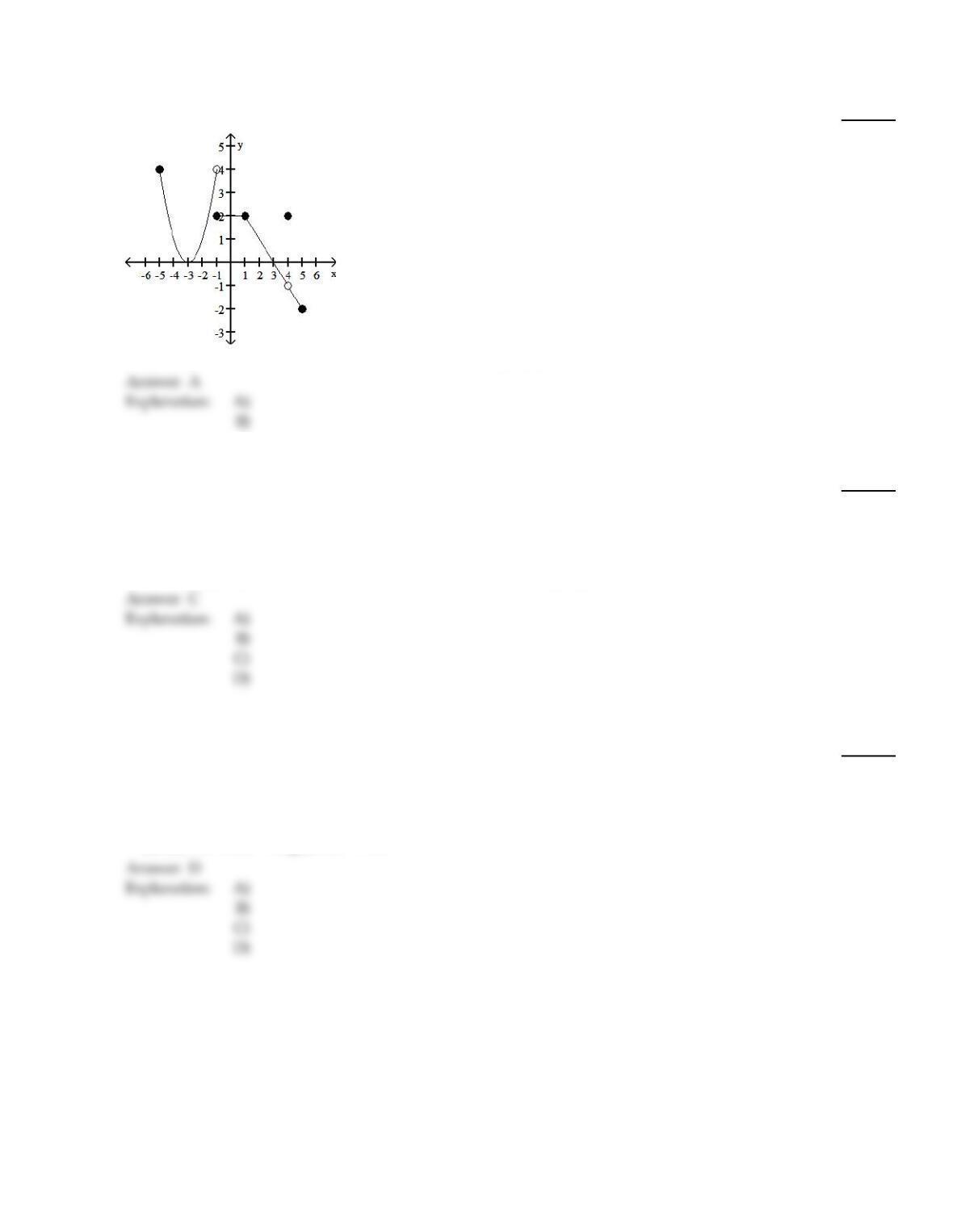
Use the graph to determine whether each statement is true or false.
88)
lim f(x)
x –1exists.
88)
A)
False
B)
True
Solve the problem.
89)
A population grows from an initial size of 10 people to an amount P(t), given by
P(t) = 10(5+ 0.5t +t3), where t is measured in years from 1996. Find the acceleration in the
population t years from 1996.
89)
A)
(5 + 30t2) people per year2
B)
30t people per year2
C)
60t people per year2
D)
60 people per year2
Find functions f(x) and g(x) such that h(x) = (f g)(x).
90)
h(x) =(x1/2 +3)3+3(x1/2 +3) 2–6
90)
A)
f(x) =(x +3)3+3x2–6, g(x) =x1/2
B)
f(x) =x1/2 +3, g(x) =x3+3x2–6
C)
f(x) =(x +3)3+3(x +3) 2–6, g(x) =x1/2 +3
D)
f(x) =x3+3x2–6, g(x) =x1/2 +3
33
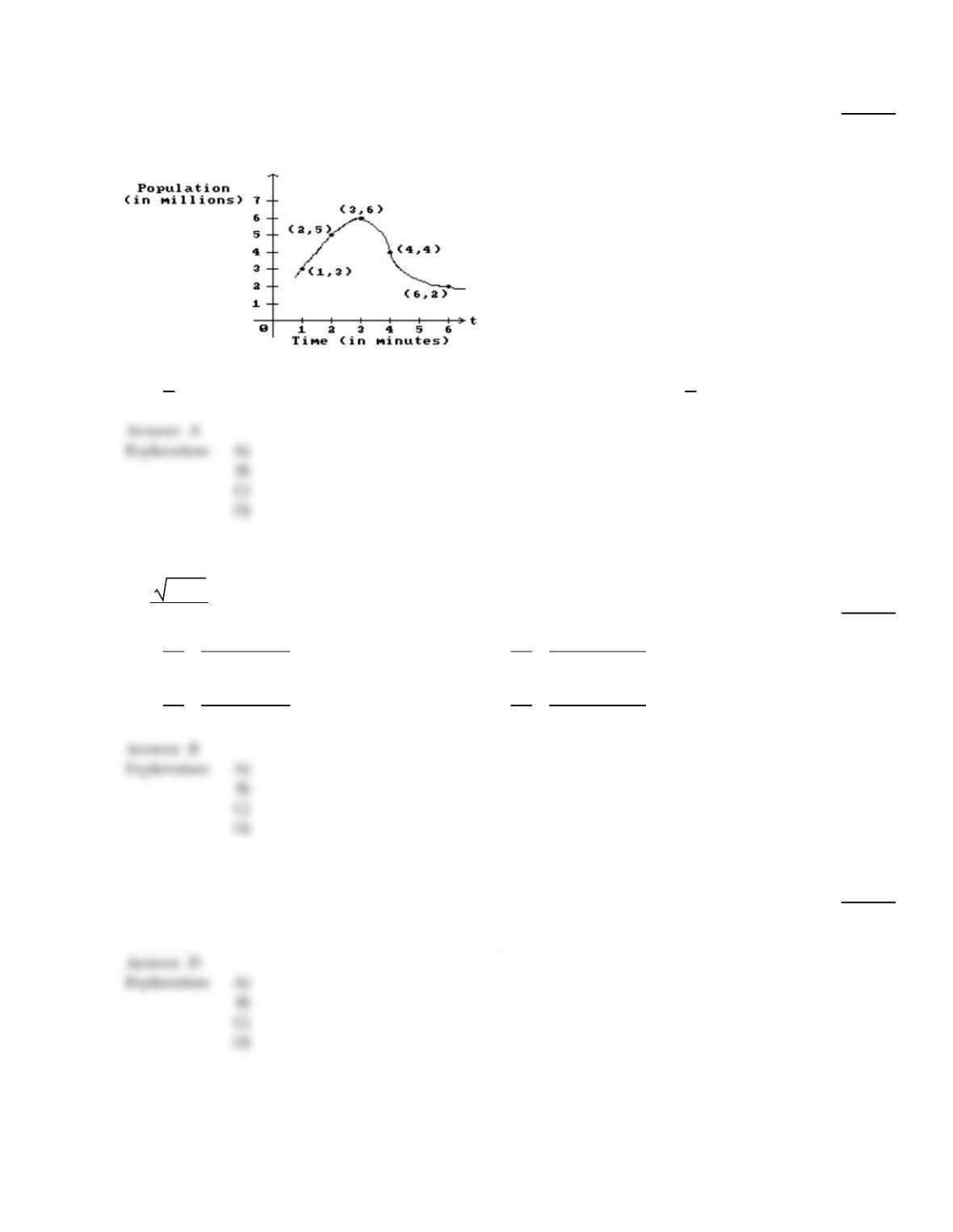
Solve the problem.
91)
The graph shows the population in millions of bacteria t minutes after a bactericide is introduced
into a culture. Find the average rate of change of population with respect to time for the time
interval.
1 to 3
91)
A)
3
2
B)
1
C)
2
D)
2
3
Differentiate.
92)
y =
3x2+ 3
x
92)
A)
dy
dx =–3
x2(x2+3)2/3
B)
dy
dx =–x2– 9
3x2(x2+3)2/3
C)
dy
dx =3
x2(x2+3)2/3
D)
dy
dx =x2+ 9
3x2(x2+3)2/3
Find the derivative.
93)
f(x) =3x4+ 3x3+ 9
93)
A)
f'(x) =12x3+ 9x2– 7
B)
f'(x) = 4x3+ 3x2
C)
f'(x) = 4x3+ 3x2– 7
D)
f'(x) =12x3+ 9x2
34
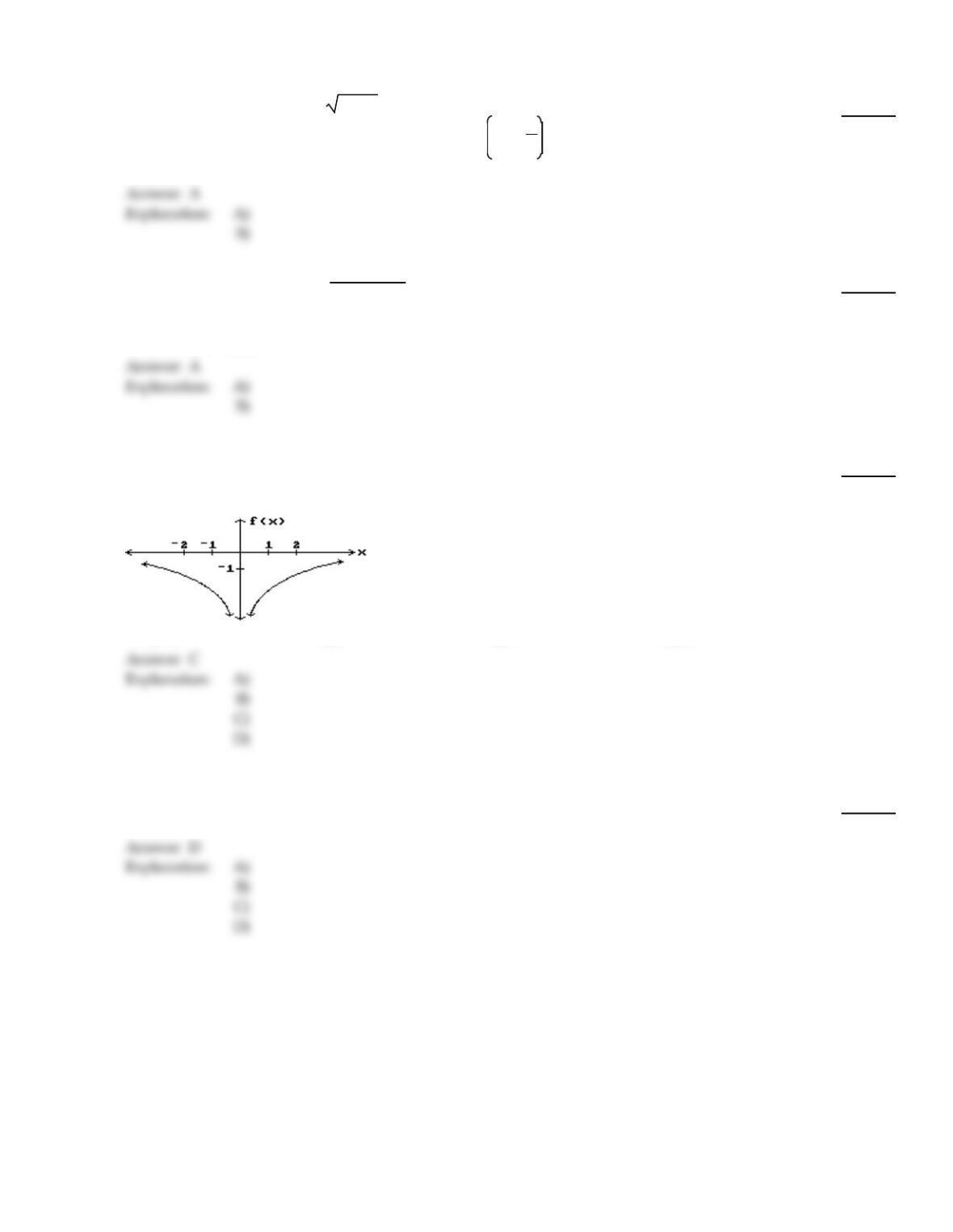
Find the intervals on which the function is continuous.
94)
Is the function given by f(x) =2x +7 continuous continuous on
?
94)
A)
No, since f(x) is not continuous over the interval , –7
2
B)
Yes, f(x) is continuous at each real number
95)
Is the function given by f(x) =2
(x +4)2+8 continuous on
? Why or why not?
95)
A)
Yes, f(x) is continuous at each real number
B)
No, since f(x) is not continuous at x = –4
Decide whether the limit exists. If it exists, find its value.
96)
Find lim
x
0 f(x).
96)
A)
–2
B)
0
C)
D)
2
For the given function, find the points on the graph at which the tangent line has slope 1.
97)
y = –0.25x2+7x
97)
A)
(14, 49)
B)
(0, 0)
C)
(1, 6.75)
D)
(12, 48)
35
Differentiate.
98)
y =x2+ 8x + 3
x
98)
A)
dy
dx =2x + 8
x
B)
dy
dx =2x + 8
2x3/2
C)
dy
dx =3x2+ 8x – 3
x
D)
dy
dx =3x2+ 8x – 3
2x3/2
Find the derivative of the function and evaluate the derivative at the given x–value.
99)
f(x) = 5x2+ x at x = –4
99)
A)
f'(x) = x – 10; f'(–4) = –14
B)
f'(x) = 10x – 1; f'(–4) = –41
C)
f'(x) = x + 10; f'(–4) = 6
D)
f'(x) = 10x + 1; f'(–4) = –39
Calculate the requested derivative from the given information.
100)
Given f(u) =u2 and g(x) = u =x5+ 2, find (f
g)'(1).
100)
A)
–30
B)
15
C)
30
D)
6
Provide an appropriate response.
101)
Is the function given by f(x) =2x +6 continuous at x = – 3? Why or why not?
101)
A)
Yes, lim
x– 3 f(x) = f – 3
B)
No, lim
x– 3 f(x) does not exist
36
Differentiate.
102)
f(x) =(x – 1)(x2+ x + 1)
9
102)
A)
f'(x) =x2
9
B)
f'(x) =x2
27
C)
f'(x) =x2
3
D)
f'(x) =x2
81
For the given function, find the points on the graph at which the tangent line has slope 1.
103)
y =1
3x3– 2x2+ 4x + 1
103)
A)
(0, 3) and (3, 3)
B)
(1, 3) and (3, 4)
C)
1, 10
3 and (3, 4)
D)
0, 10
3 and (3, 4)
Find the indicated derivative of the function.
104)
d5y
dx5 of y =3x6+ 6x4+ 4x2– 5
104)
A)
0
B)
2160
C)
1080x2+ 144
D)
2160x
Differentiate.
105)
y =2x –4
x2–8x +1
105)
A)
dy
dx =2x3–20x2+26x –32
(x2–8x +1)2
B)
dy
dx =6x2–40x +34
(x2–8x +1)2
C)
dy
dx =2x2+8x – 30
x2–8x +1
D)
dy
dx =–2x2+8x + –30
(x2–8x +1)2
106)
f(x) =5
(2x – 3)4
106)
A)
f'(x) =–40
(2x – 3)3
B)
f'(x) =5
4(2x – 3)3
C)
f'(x) =–40
(2x – 3)5
D)
f'(x) =5
8(2x – 3)5
107)
f(x) =1
(5x2– 7x – 3)4
107)
A)
f'(x) = – 4(10x – 7)
(5x2– 7x – 3)5
B)
f'(x) = – 4(10x – 7)
(5x2– 7x – 3)3
C)
f'(x) =(10x – 7)
(5x2– 7x – 3)5
D)
f'(x) = – 4
(5x2– 7x – 3)5
Find the derivative of the function and evaluate the derivative at the given x–value.
108)
f(x) = x2+ 5x at x = 4
108)
A)
f'(x) = 2x + 5; f'(4) = 13
B)
f'(x) = x + 5; f‘(4) = 9
C)
f'(x) = 4x + 5; f'(4) = 21
D)
f'(x) = 2x – 5; f'(4) = 3
Find the indicated derivative of the function.
109)
d4y
dx4 of y =4x6– 4x4+ 5x2
109)
A)
960x2– 48
B)
1440x2– 96
C)
1440x2– 96x
D)
960x2– 48x
Solve the problem.
110)
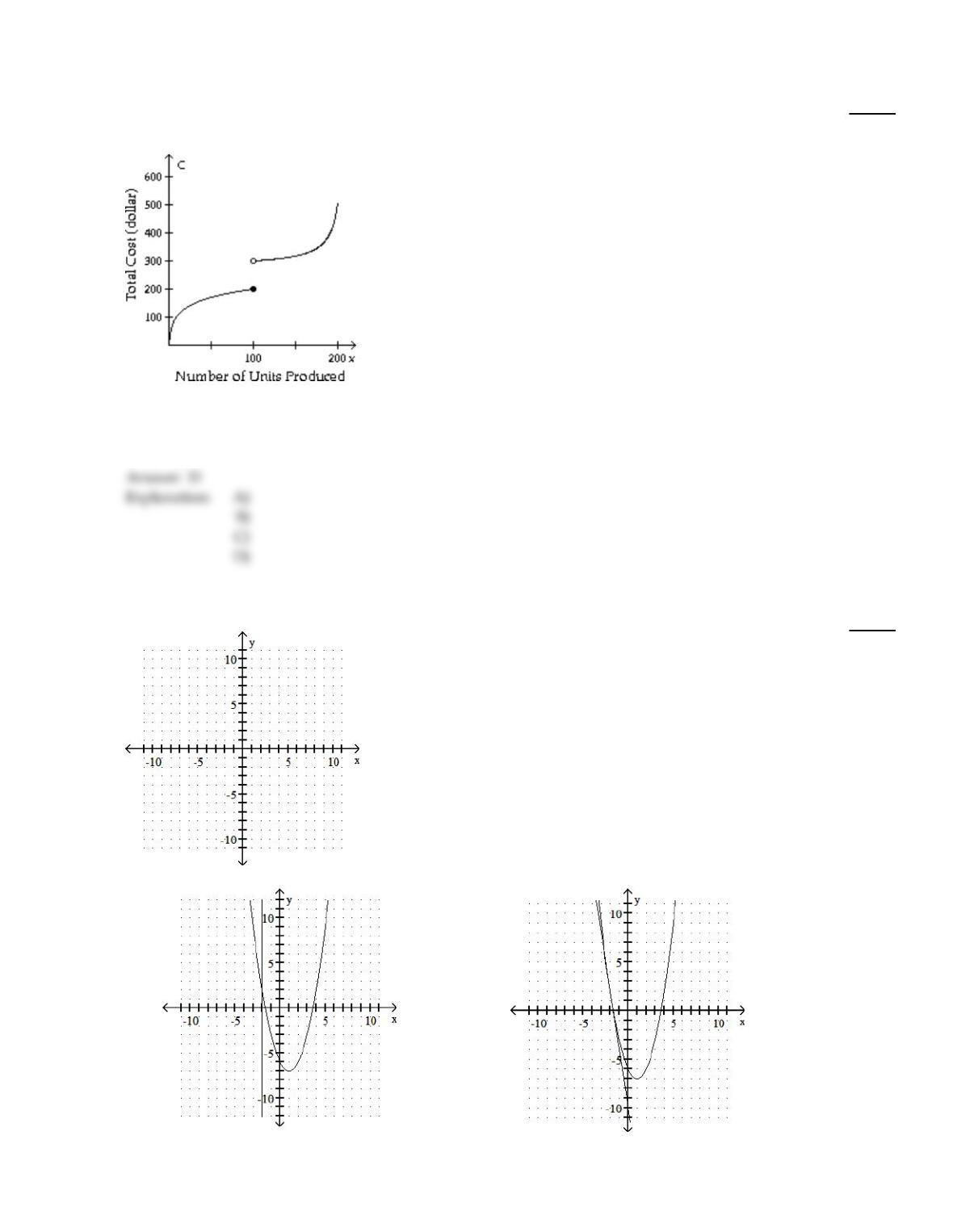
Suppose that the cost, C, of producing x units of a product can be illustrated by the given graph. At
what values is the function C not differentiable?
110)
A)
0, 100, 200
B)
Function is differentiable for all x in the domain
C)
0, 100
D)
100
Graph the function and the indicated tangent line.
111)
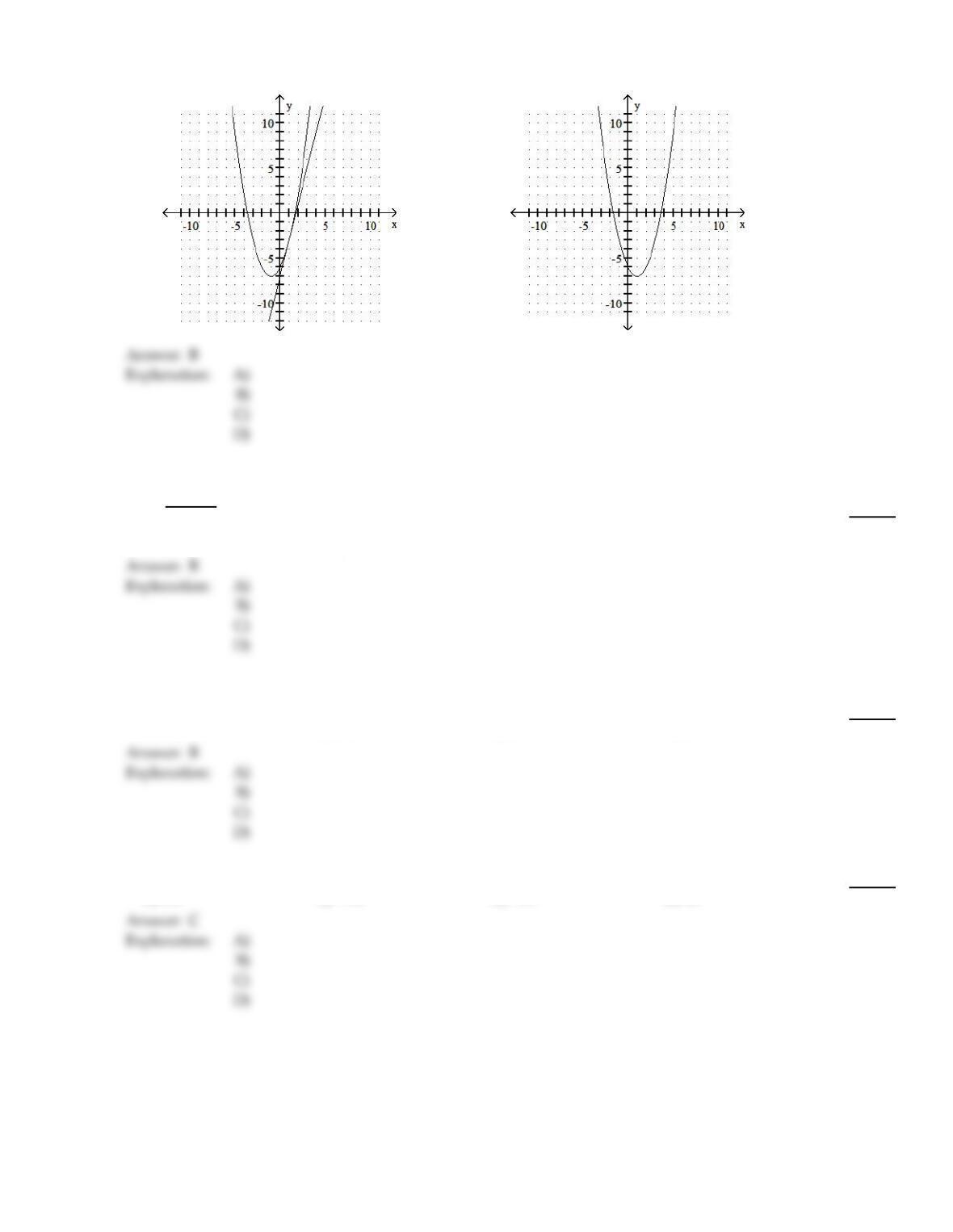
Graph f(x) = x2– 2x – 6 and the tangent line to the graph at the point whose x–coordinate is –2.
111)
A)
B)
39
C)
D)
Write an equation of the tangent line to the graph of y = f(x) at the point on the graph where x has the indicated value.
112)
f(x) =6x2– 1
–3x + 1, x = 0
112)
A)
y = – 3x + 1
B)
y = – 3x – 1
C)
y =3x + 1
D)
y =3x – 1
Find all values of x (if any) where the tangent line to the graph of the function is horizontal.
113)
y = x3– 3x2+ 1
113)
A)
–2, 0, 2
B)
0, 2
C)
0
D)
2
114)
y = –0.01x2–0.3x +60
114)
A)
7.5
B)
–7.5
C)
–15
D)
15
40
Solve the problem.
115)
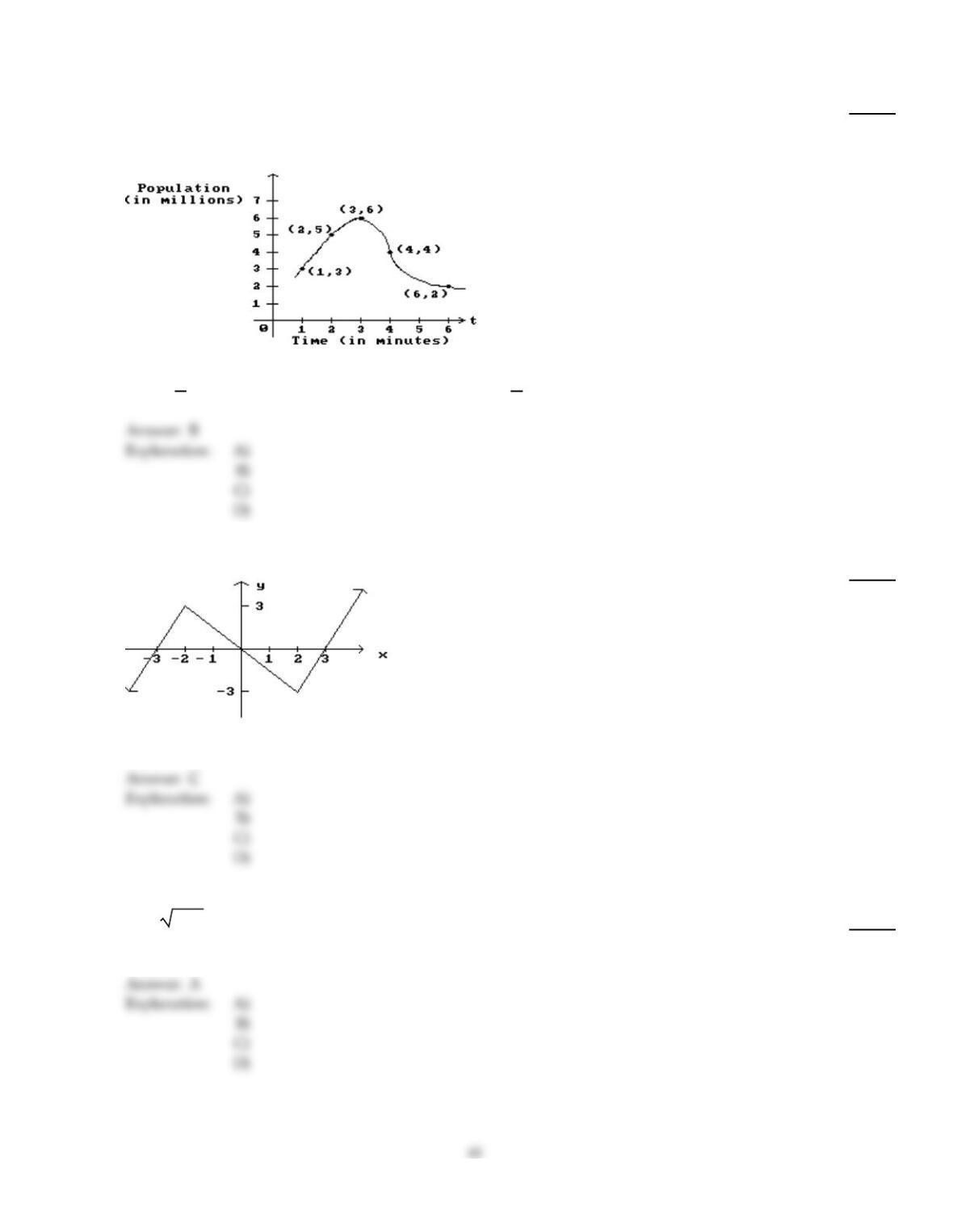
The graph shows the population in millions of bacteria t minutes after a bactericide is introduced
into a culture. Find the average rate of change of population with respect to time for the time
interval.
1 to 2
115)
A)
–1
2
B)
2
C)
1
2
D)
–2
List the x–values in the graph at which the function is not differentiable.
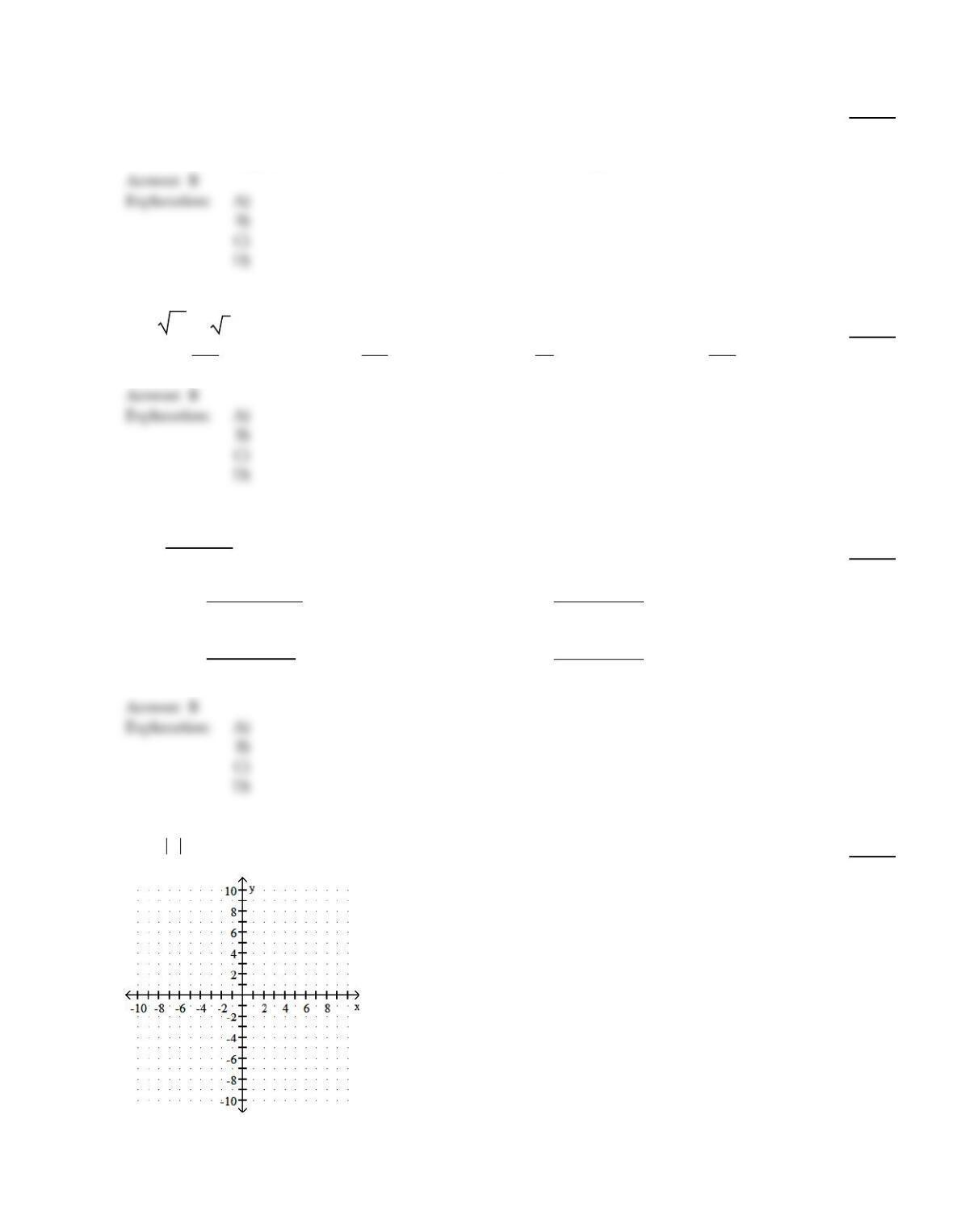
116)
116)
A)
x = –2, x = 0, x = 2
B)
x = –3, x = 3
C)
x = –2, x = 2
D)
x = –3, x = 0, x = 3
Find the limit, if it exists.
117)
lim
x
1x –5
117)
A)
Does not exist
B)
–2
C)
2
D)
0
Find functions f(x) and g(x) such that h(x) = (f g)(x).
118)
h(x) =(6x – 2)9
118)
A)
f(x) =6x9, g(x) = x – 2
B)
f(x) =x9, g(x) =6x – 2
C)
f(x) =6x – 2, g(x) =x9
D)
f(x) = (6x)9, g(x) = –2
Find the equation of the line tangent to the graph of the function at the indicated point.
119)
y = 4 x3– 5 x at (16, 236)
119)
A)
y =101
4x – 168
B)
y =187
8x – 138
C)
y =91
4x – 128
D)
y =197
8x – 158
Differentiate.
120)
q(t) =t2– 5t – 4
t2+ 6t – 5
120)
A)
q'(t) =11t2– 10t + 49
(t2+ 6t – 5)2
B)
q'(t) =11t2– 2t + 49
(t2+ 6t – 5)2
C)
q'(t) =11t2– 2t + 49
t2+ 6t – 5
D)
q'(t) =11t2– 2t + 25
(t2+ 6t – 5)2
Graph the function and then find the specified limit. When necessary, state that the limit does not exist.
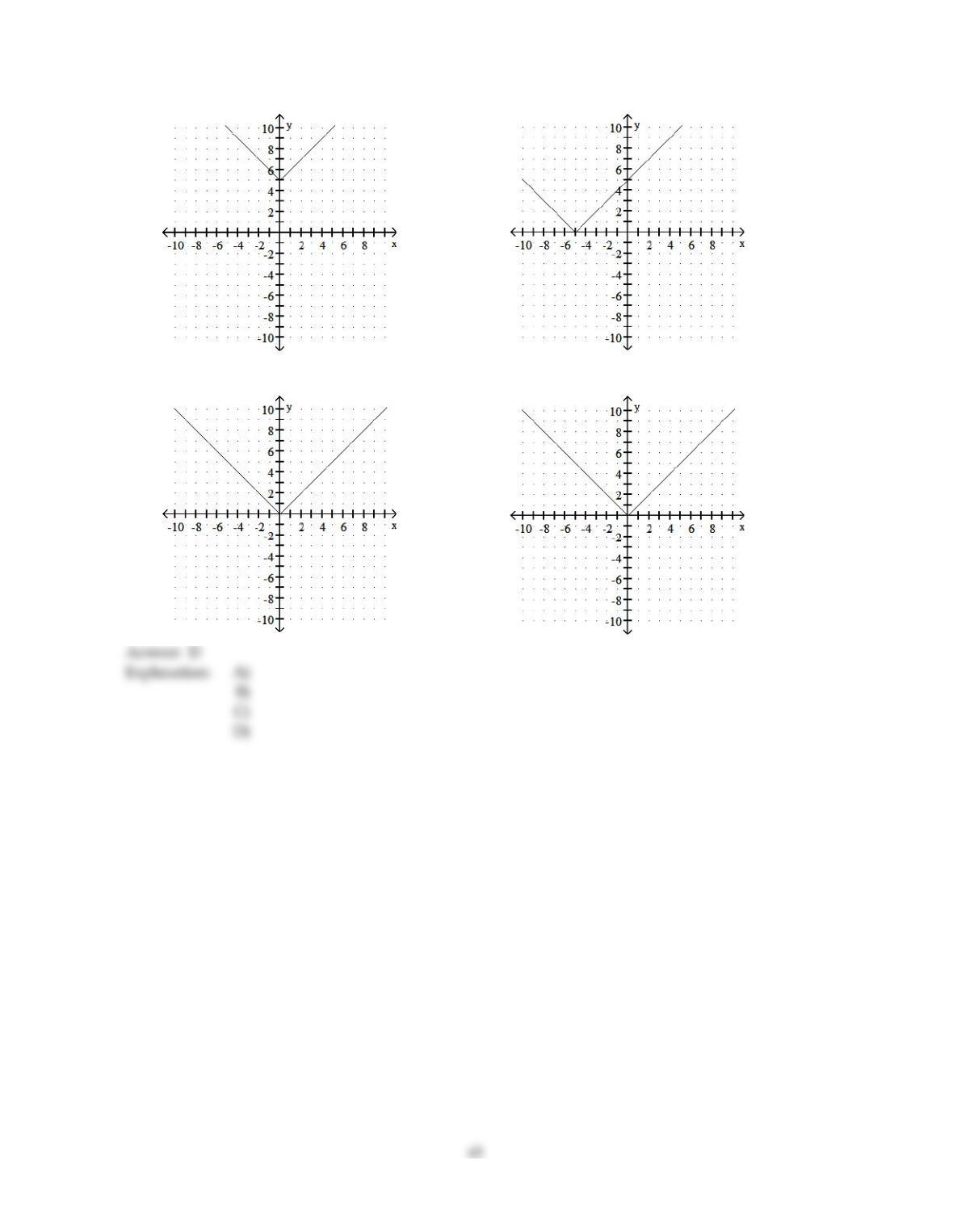
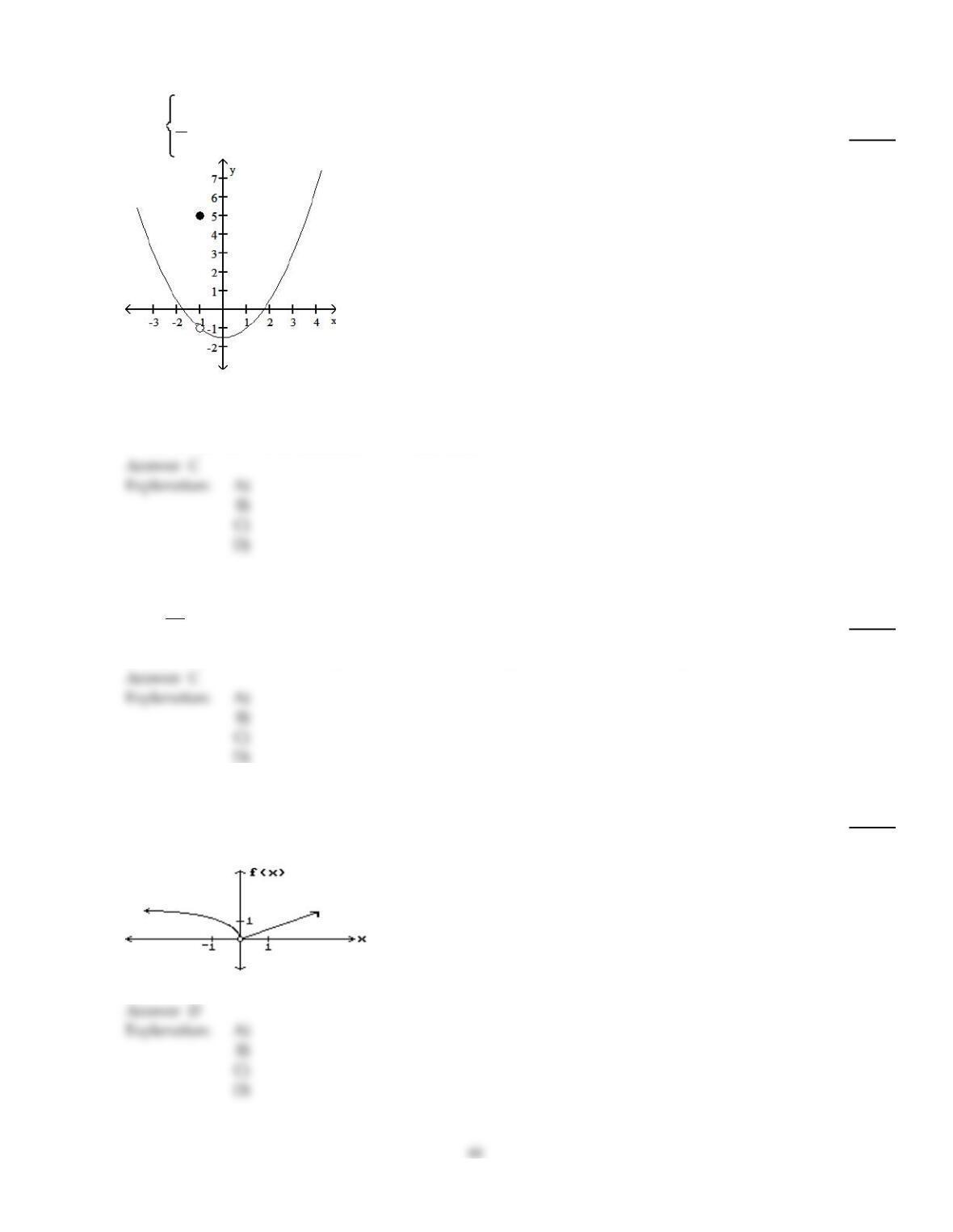
121)
f(x) =x; lim
x–2f(x)
121)
42
A)
lim
x–2f(x) = 7
B)
lim
x–2f(x) = 3
C)
lim
x–2f(x) = 0
D)
lim
x–2f(x) = 2
Determine the continuity of the function at the given points.
122)
f(x) =
5, for x = –1
1
2x2–1.5,for x –1 at x = –1 and x =0
122)
A)
The function f is continuous at neither x =0 nor x = –1.
B)
The function f is continuous at both x =0 and x = –1.
C)
The function f is continuous at x =0 but not at x = –1.
D)
The function f is continuous at x = –1 but not at x =0.
Find an equation for the line tangent to the graph of the given function at the indicated point.
123)
f(x) =x2
2 at (5, 12.5)
123)
A)
y =5x +12.5
B)
y =10 –12.5
C)
y =5x –12.5
D)
y =5x –25
Decide whether the limit exists. If it exists, find its value.
124)
Find lim
x
0f(x).
124)
A)
–1
B)
Does not exist
C)
1
D)
0
Find an expression for dy/dx.
125)
y =u2 and u =2x –3
125)
A)
8x
B)
8x –12
C)
12x –6
D)
4x –6
For the given function, find the points on the graph at which the tangent line has slope 1.
126)
y =x3–3
2x2+ x
126)
A)
(0, 0) and 1, 1
2
B)
3, 33
2 and 0, 1
2
C)
3, 33
2 and 1, 1
2
D)
(1, 0) and 1, 1
2
Find a simplified difference quotient for the function.
127)
f(x) =x3+ x
127)
A)
3x2+ 3xh +h2+ h
B)
2x3+ 3x2+ 3xh +h2
C)
3x2+ 3xh +h2+ 1
D)
2x3+ 3x2+ 3xh +h2+ 1
45
Solve the problem.
128)
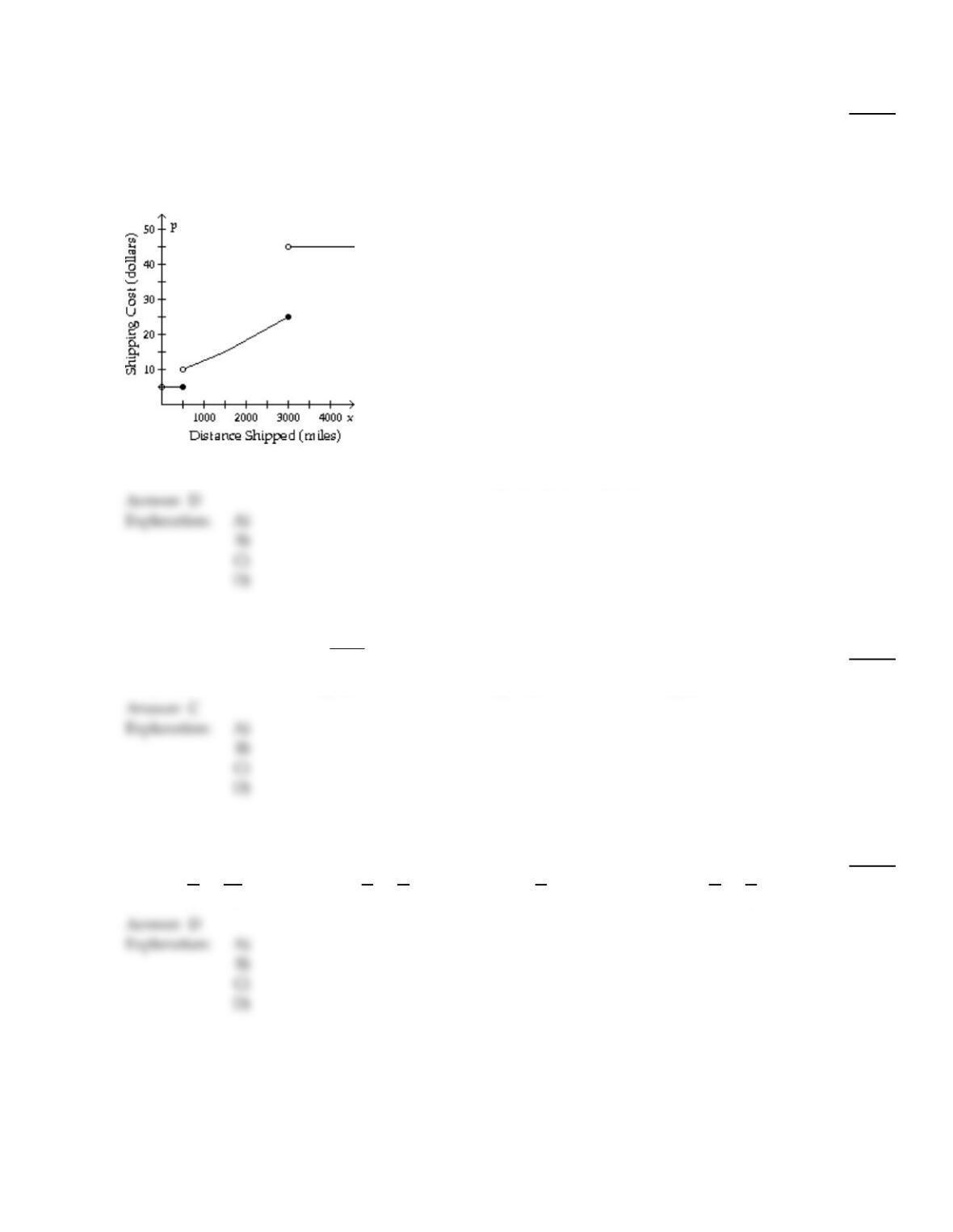
Suppose that the cost, p, of shipping a 3–pound parcel depends on the distance shipped, x,
according to the function p(x) depicted in the graph. Find each limit, if it exists:
lim
x
100 p(x), lim
x
500 p(x), lim
x
1500 p(x)
128)
A)
5; 10; 15
B)
5; does not exist; does not exist
C)
5; 5; 15
D)
5; does not exist; 15
Calculate the requested derivative from the given information.
129)
Given f(u) =u3 and g(x) = u =x + 4
x – 2, find (f
g)'(4).
129)
A)
– 48
B)
72
C)
– 72
D)
48
Find the equation of the line tangent to the graph of the function at the indicated point.
130)
y =(x2+4)2/3 at x =2
130)
A)
y =4
3x +20
3
B)
y =2
3x +4
3
C)
y =4
3x
D)
y =4
3x +4
3
46
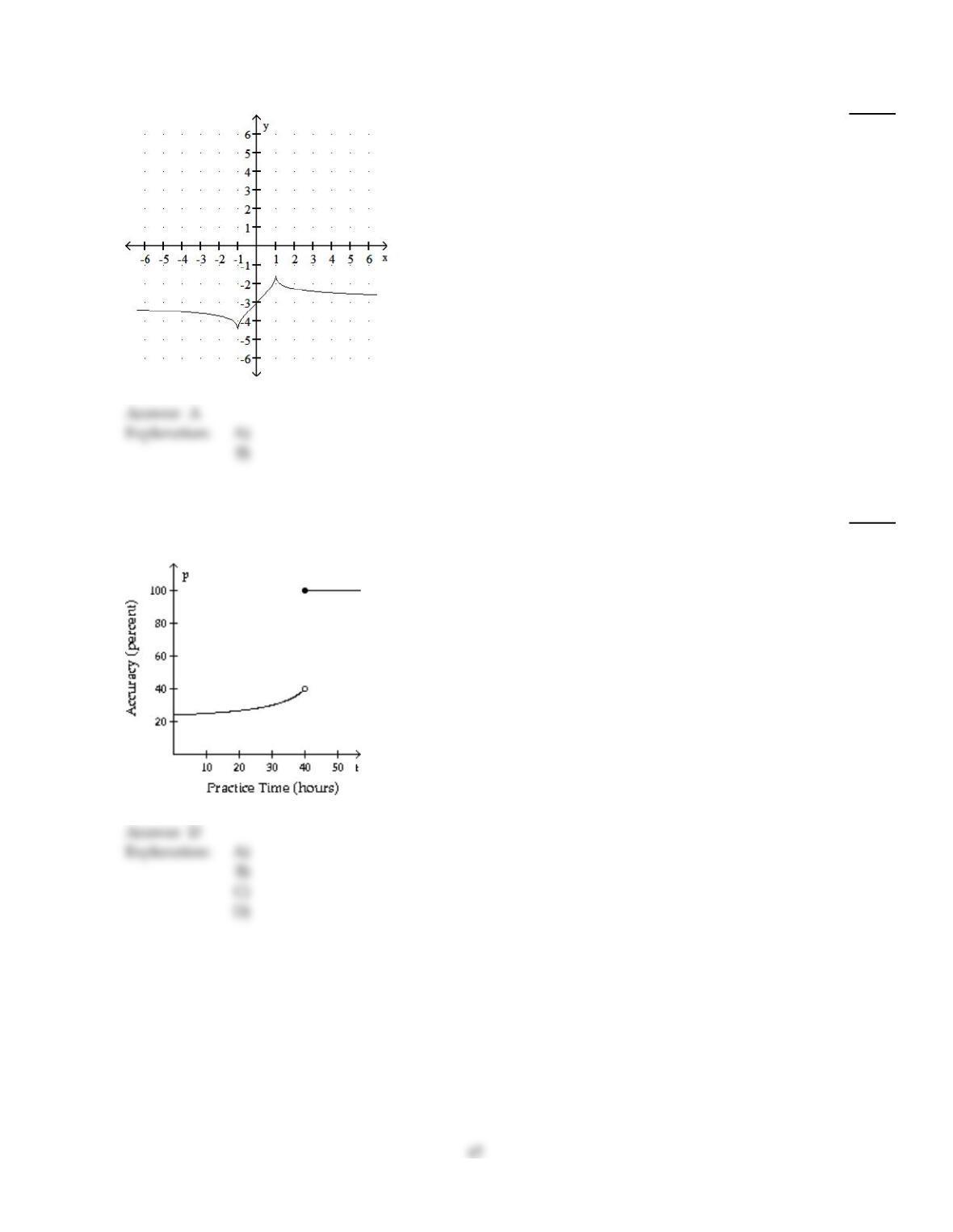
Use the graph to answer the question.
131)
Is f continuous at x = –3?
131)
A)
Yes
B)
No
Solve the problem.
132)
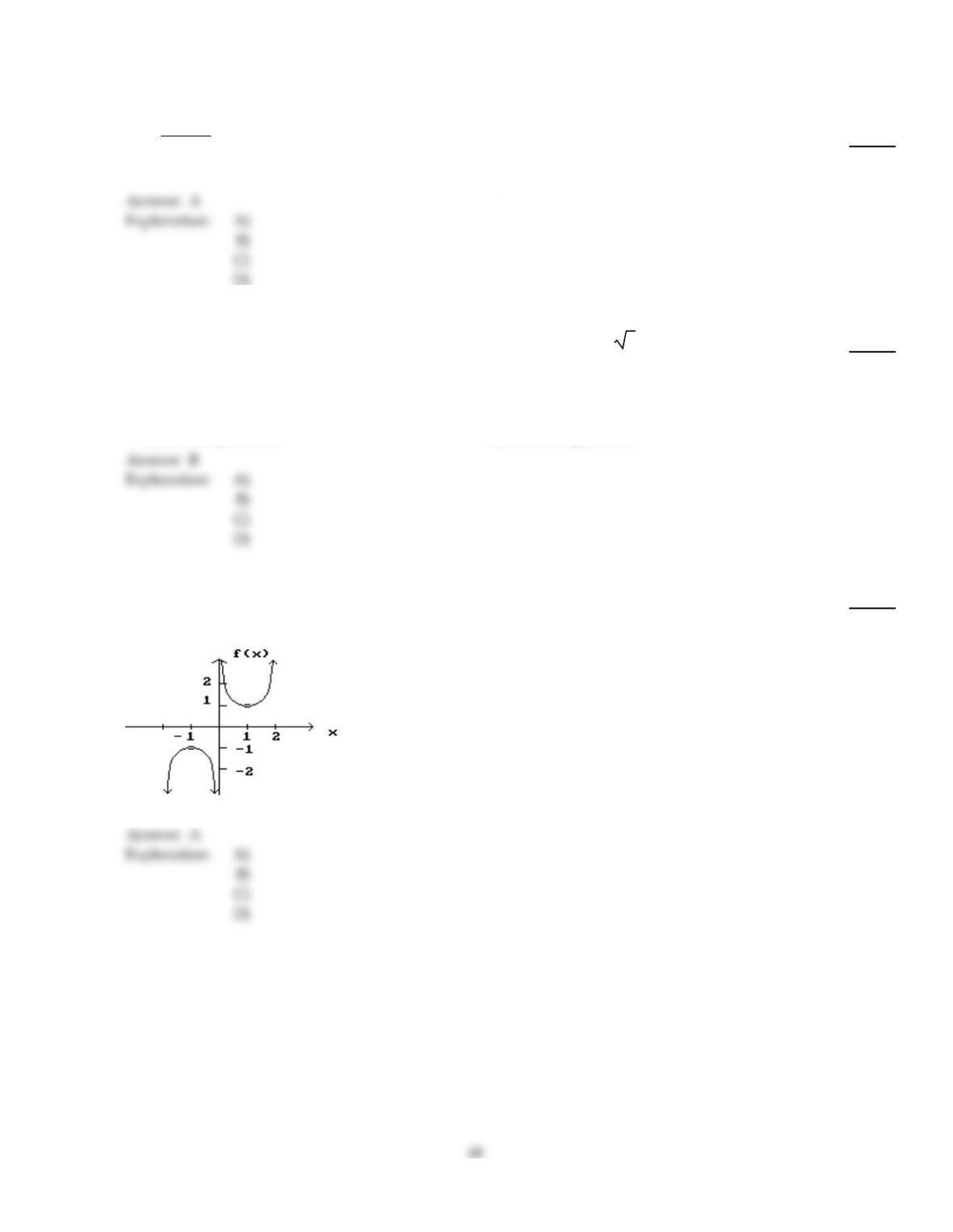
Consider the learning curve defined in the graph. Depicted is the accuracy, p, expressed as a
percentage, in performing a series of short tasks versus the accumulated amount of time spent
practicing the tasks, t. Is p(t) continuous at t = 25? at t = 40? at t = 45?
132)
A)
Yes; yes; yes
B)
No; no; no
C)
Yes; no; no
D)
Yes; no; yes
In the exercise below, the initial substitution of x = a yields the form 0/0. Look for ways to simplify the function
algebraically, or use a table and/or graph to determine the limit. When necessary, state that the limit does not exist.
133)
lim
x
4
64 –x3
x –4
133)
A)
–48
B)
48
C)
24
D)
– 24
Solve the problem.
134)
The velocity of water in ft/s at the point of discharge is given by v =12.88 P, where P is the
pressure in lb/in.2of the water at the point of discharge. Find the rate of change of the velocity with
respect to pressure if the pressure is 10.00 lb/in.2.
134)
A)
0.6440 ft/s per lb/in.2
B)
2.0365 ft/s per lb/in.2
C)
4.07 ft/s per lb/in.2
D)
20.37 ft/s per lb/in.2
Decide whether the limit exists. If it exists, find its value.
135)
Find lim
x
1 f(x).
135)
A)
1
B)
Does not exist
C)
0
D)
–1
Solve the problem.
136)
Suppose that the dollar cost of producing x radios is c(x) =800+40x – 0.2x2. Find the average cost
per radio of producing the first 40 radios.
136)
A)
$2080.00
B)
–$24.00
C)
$32.00
D)
$1280.00
Find the derivative.
137)
y =(x2+4)3
137)
A)
6x5+48x3+96x
B)
6x5+40x3+96x
C)
3x5+48x3+96x
D)
6x5+24x3+48x
Differentiate.
138)
h(z) =3 8z + 1
–7z + 8
138)
A)
h'(z) = – 8(8z + 1)–2/3
21(8 – 7z)–2/3
B)
h'(z) =71(8z + 1)–2/3
3(8 – 7z)2(8 – 7z)–2/3
C)
h'(z) =(8z + 1)–2/3
3(8 – 7z)–2/3
D)
h'(z) =71(8z + 1)–2/3
(8 – 7z)2(8 – 7z)–2/3
49
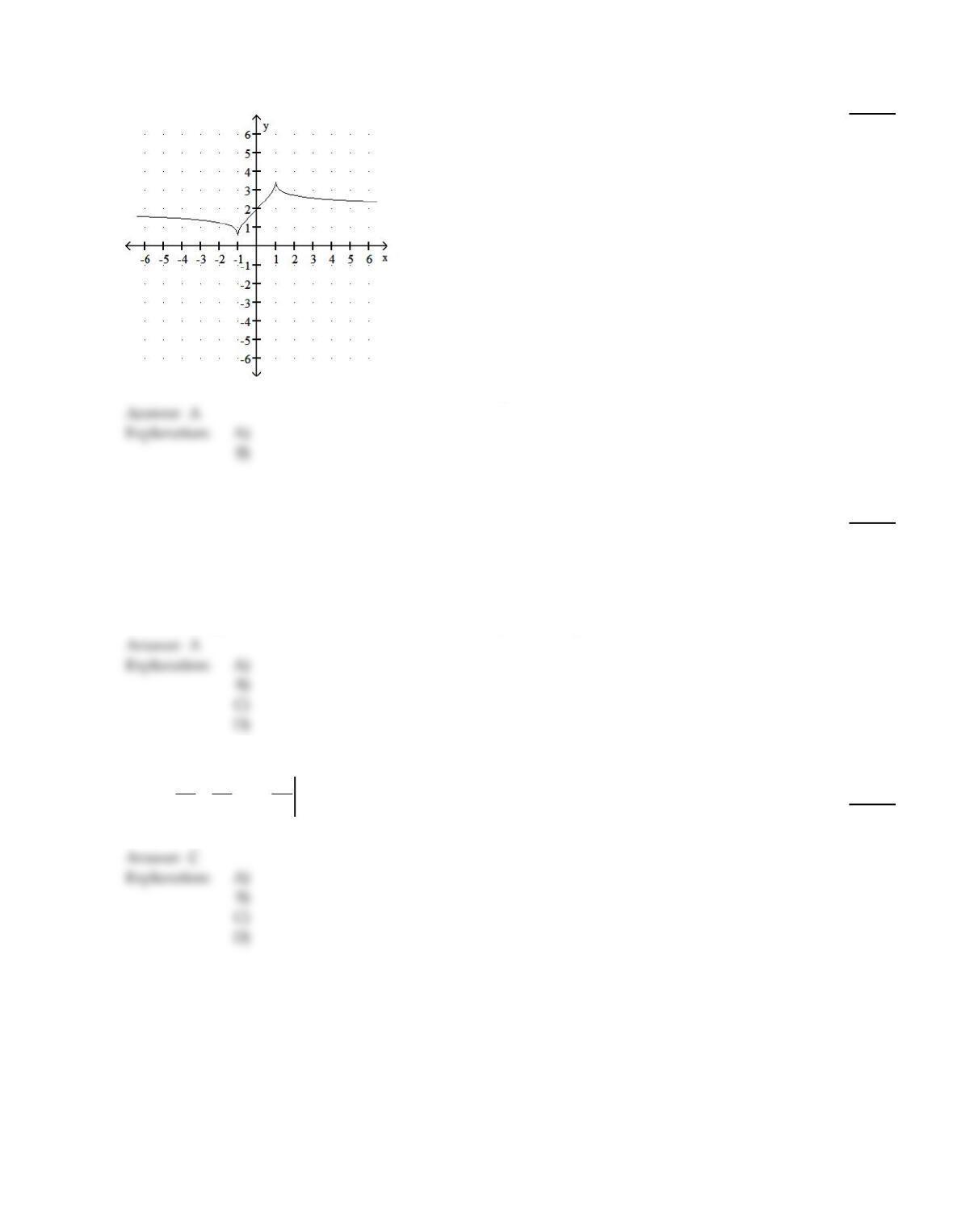
Determine whether the function shown is continuous over the interval (–5, 5).
139)
139)
A)
Yes
B)
No
Solve the problem.
140)
An appliance manufacturer has determined that the cost, in dollars, of producing x espresso
makers is given by C(x) =3800 +1.6x0.5. If the revenue from the sale of x espresso makers is given
by R(x) =78x0.9, find the rate at which the average profit per espresso maker is changing when 40
espresso makers have been made and sold. Round to the nearest cent.
140)
A)
$2.24/espresso maker
B)
–$2.52/espresso maker
C)
$2.52/espresso maker
D)
–$2.24/espresso maker
Evaluate the derivative at the given value of x.
141)
If y = – 1
x5+1
x3, find dy
dx x = 1
141)
A)
8
B)
–2
C)
2
D)
–8
Graph the function and the indicated tangent line.
50
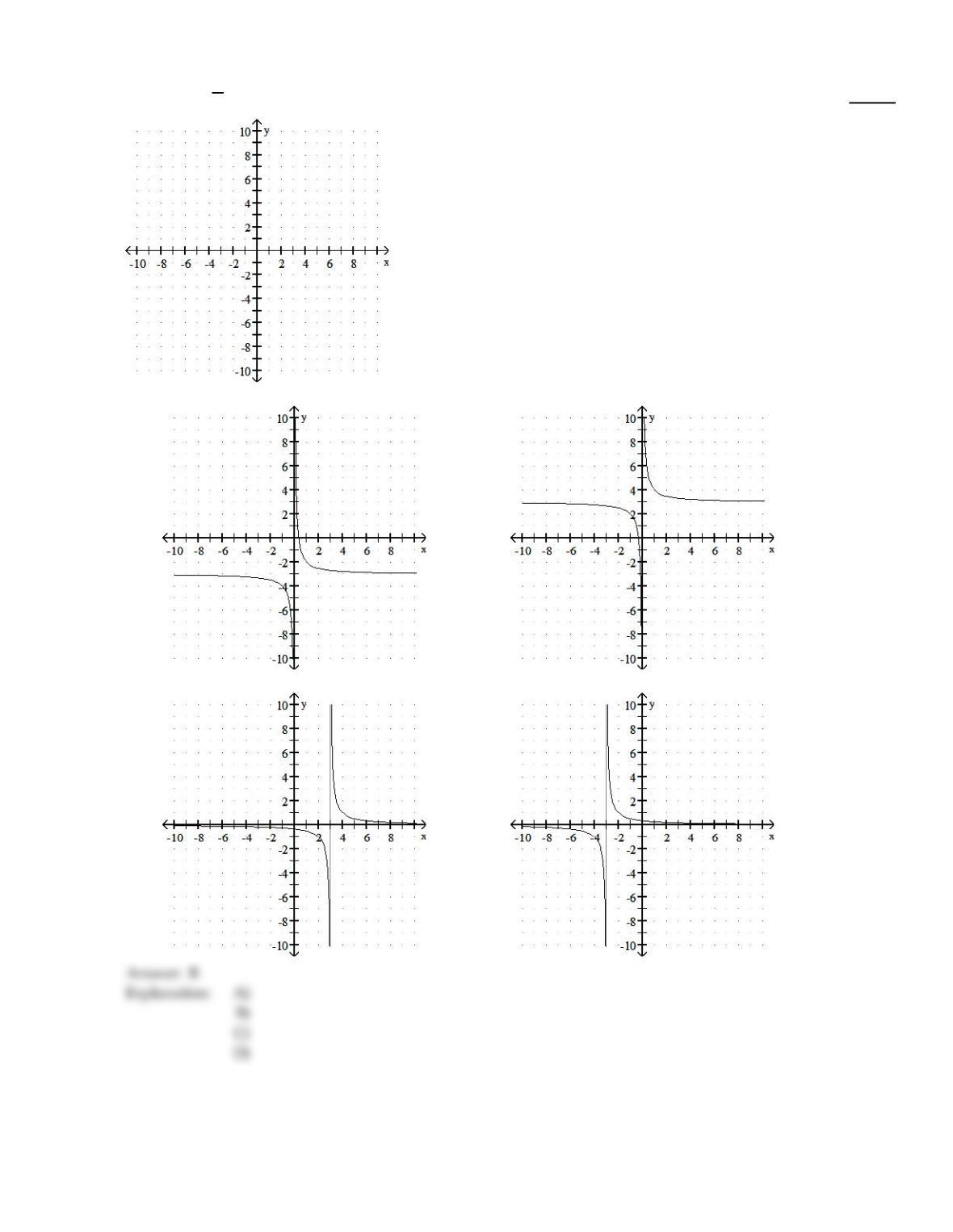
142)
Graph f(x) =1
x+ 3 and the tangent line to the graph at the point whose x–coordinate is 0.
142)
A)
There is no tangent line for x = 0.
B)
There is no tangent line for x = 0.
C)
D)
Graph the function and then find the specified limit. When necessary, state that the limit does not exist.
51
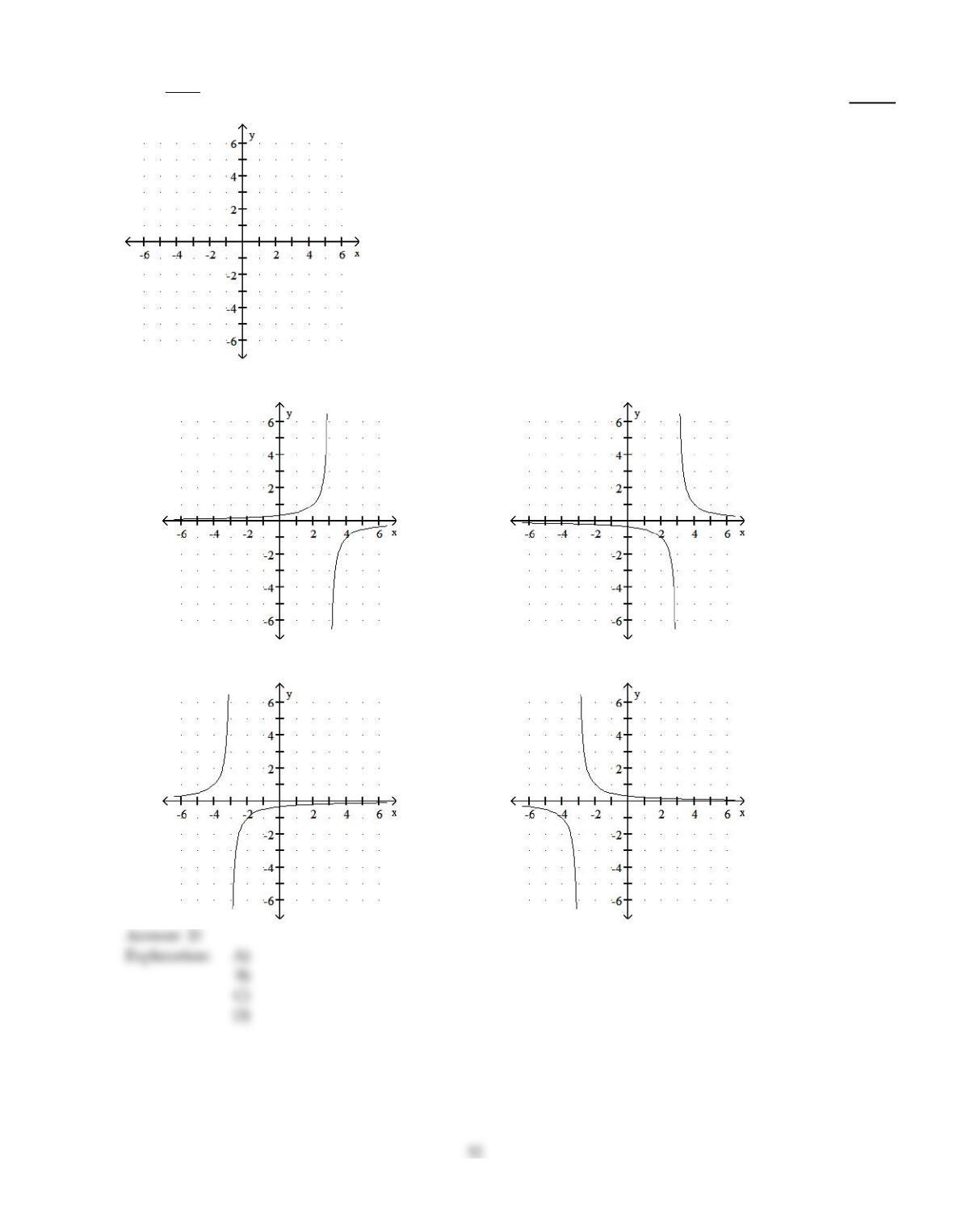
143)
f(x) =1
x + 3; lim
x–3f(x)
143)
A)
lim
x
3f(x) does not exist
B)
lim
x
3f(x) = 0
C)
lim
x–3f(x) = 0
D)
lim
x–3f(x) does not exist
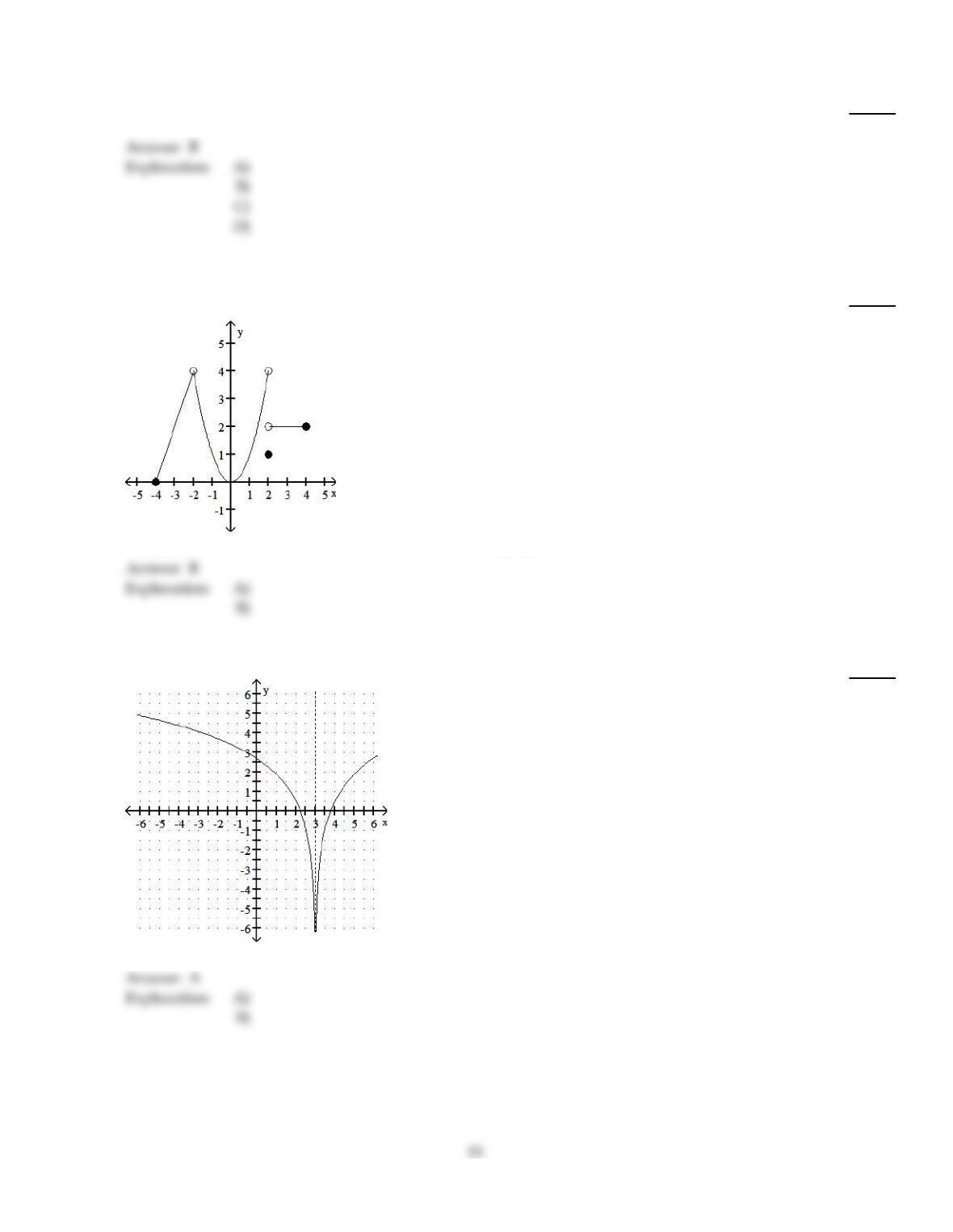
Find the derivative.
144)
y = (x +8)(8x +9)
144)
A)
16x +145
B)
16x +73
C)
8
D)
0
Use the graph to determine whether each statement is true or false.
145)
lim f(x)
x
2–= 4
145)
A)
False
B)
True
Use the graph to answer the question.
146)
Is f continuous at x =3?
146)
A)
No
B)
Yes
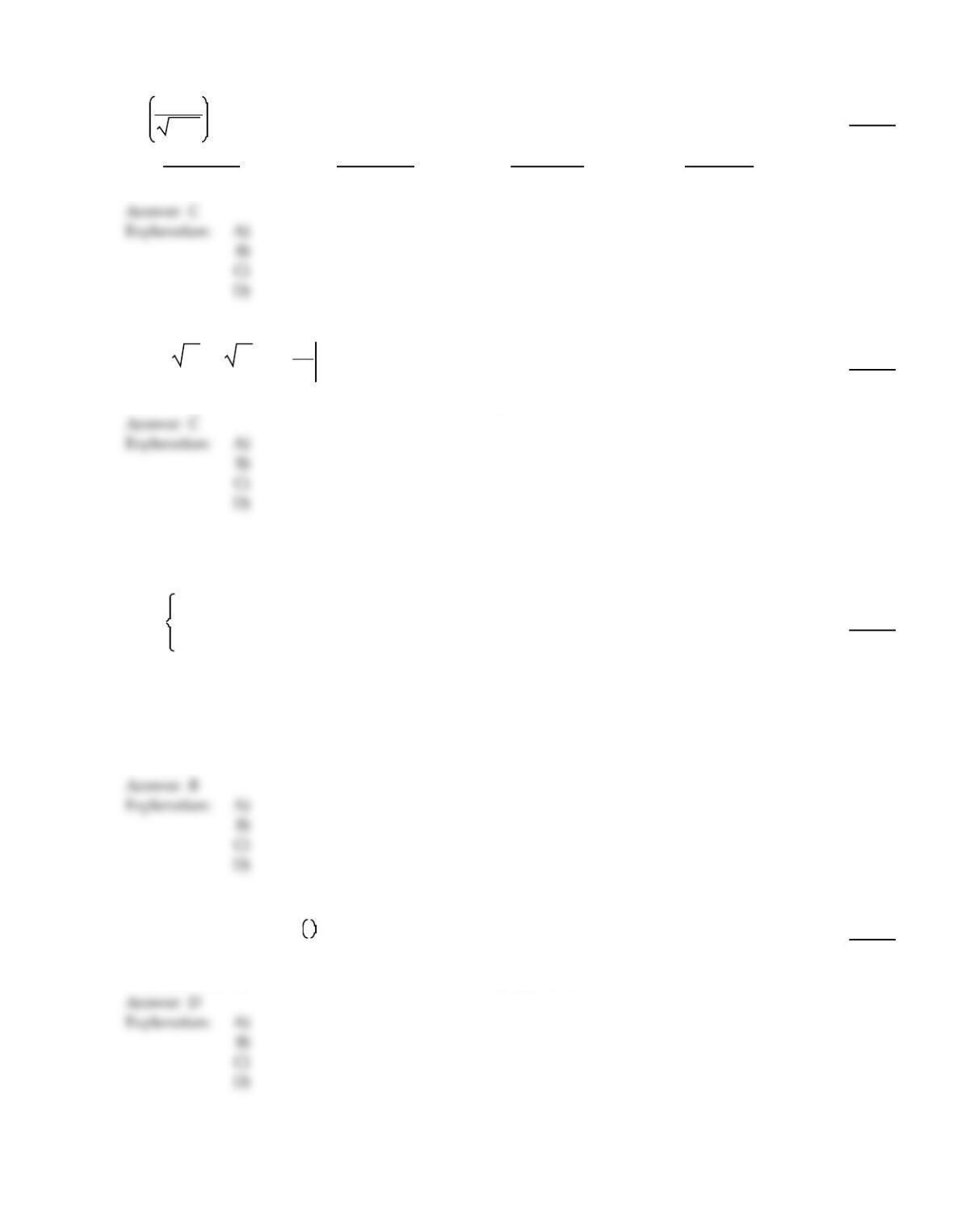
Differentiate.
147)
y =x
4– x
5
147)
A)
–5x4(8 – x)
2(4 – x)7/2
B)
–5x4(8 + x)
2(4 – x)7/2
C)
5x4(8 – x)
2(4 – x)7/2
D)
5x4(8 + x)
(4 – x)7/2
Evaluate the derivative at the given value of x.
148)
If y = 9 x5– 7 x3, find dy
dx x = 4
148)
A)
96
B)
6
C)
159
D)
8
Evaluate or determine that the limit does not exist for each of the limits (a) lim
x
d– f(x), (b) lim
x
d+ f(x), and (c) lim
x
d f(x) for
the given function f and number d.
149)
f(x) =3x – 1,for x < 1
1, for x = 1
–6x + 10,for x > 1; d = 1
149)
A)
(a) 2
(b) 4
(c) 6
B)
(a) 2
(b) 4
(c) Does not exist
C)
(a) 4
(b) 2
(c) 6
D)
(a) 4
(b) 2
(c) Does not exist
Solve the problem.
150)
If s is a distance given by s t=5t4+5t3+ 4t , find the acceleration, a(t).
150)
A)
a(t) =20t2+15t
B)
a(t) =20t3+15t2+ 4
C)
a(t) =60t +30
D)
a(t) =60t2+30t
54
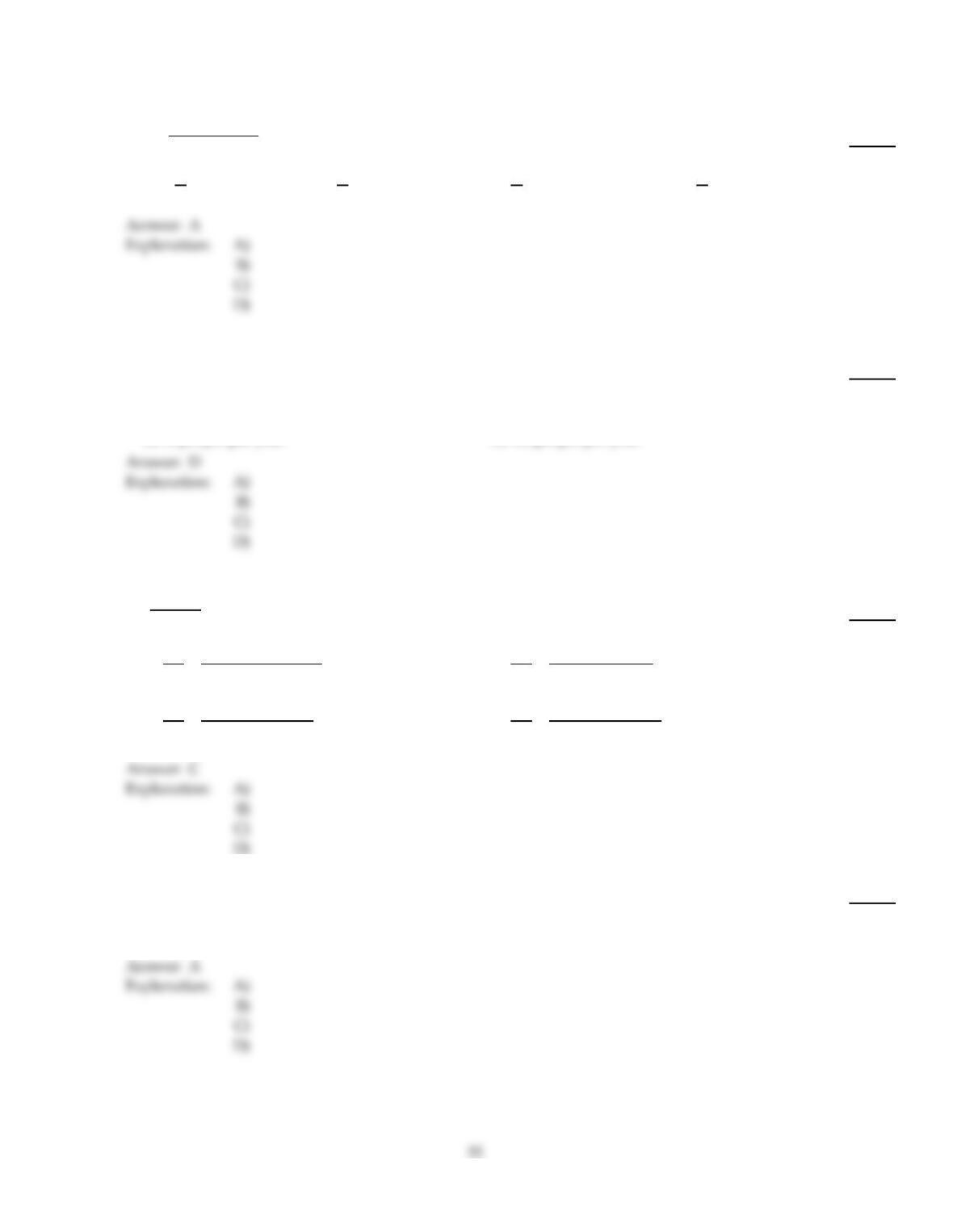
In the exercise below, the initial substitution of x = a yields the form 0/0. Look for ways to simplify the function
algebraically, or use a table and/or graph to determine the limit. When necessary, state that the limit does not exist.
151)
lim
x–4
2x2+ 2x –24
16 –x2
151)
A)
–7
4
B)
1
4
C)
7
4
D)
–1
4
Solve the problem.
152)
A population grows from an initial size of 2 people to an amount P(t), given by P(t) = 2(4+4t +t3),
where t is measured in years from 1993. Find the acceleration in the population t years from 1993.
152)
A)
(8 + 6t2) people per year2
B)
(8 + 3t2) people per year2
C)
3t people per year2
D)
12t people per year2
Differentiate.
153)
y =2x –4
7x2+5
153)
A)
dy
dx =14x3–28x2+66x
(7x2+5)2
B)
dy
dx =42x2–56x +10
(7x2+5)2
C)
dy
dx =–14x2+56x +10
(7x2+5)2
D)
dy
dx =–14x2+ 46x +30
(7x2+5)2
154)
f(x) =(9x – 2)5
154)
A)
f'(x) =45(9x – 2)4
B)
f'(x) =9(9x – 2)4
C)
f'(x) =45(9x – 2)5
D)
f'(x) =5(9x – 2)4
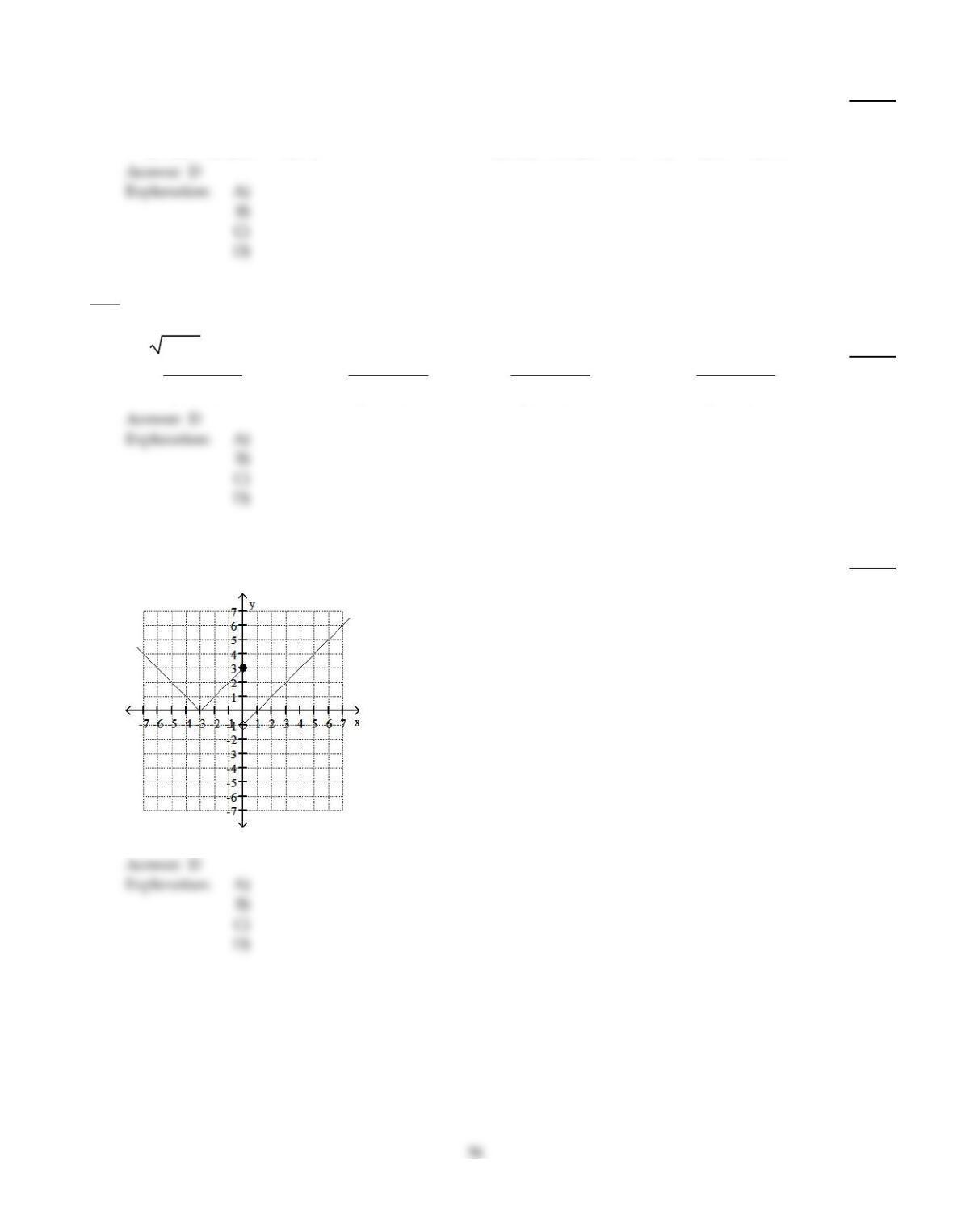
155)
f(x) =(3x5–4x4+5)309
155)
A)
f'(x) =309(3x5–4x4+5)308(5x4– 4x3)
B)
f'(x) =309(3x5–4x4+5)308
C)
f'(x) =309(15x4–16x3)308
D)
f'(x) =309(3x5–4x4+5)308(15x4–16x3)
Find d2y
dx2.
156)
y =3x – 7
156)
A)
9
4(3x – 7)3/2
B)
–10
4(3x – 7)3/2
C)
10
4(3x – 7)3/2
D)
–9
4(3x – 7)3/2
Decide whether the limit exists. If it exists, find its value.
157)
Find lim
x
0–f(x) and lim
x
0+f(x).
157)
A)
–1; 3
B)
–3; –1
C)
3; 1
D)
3; –1
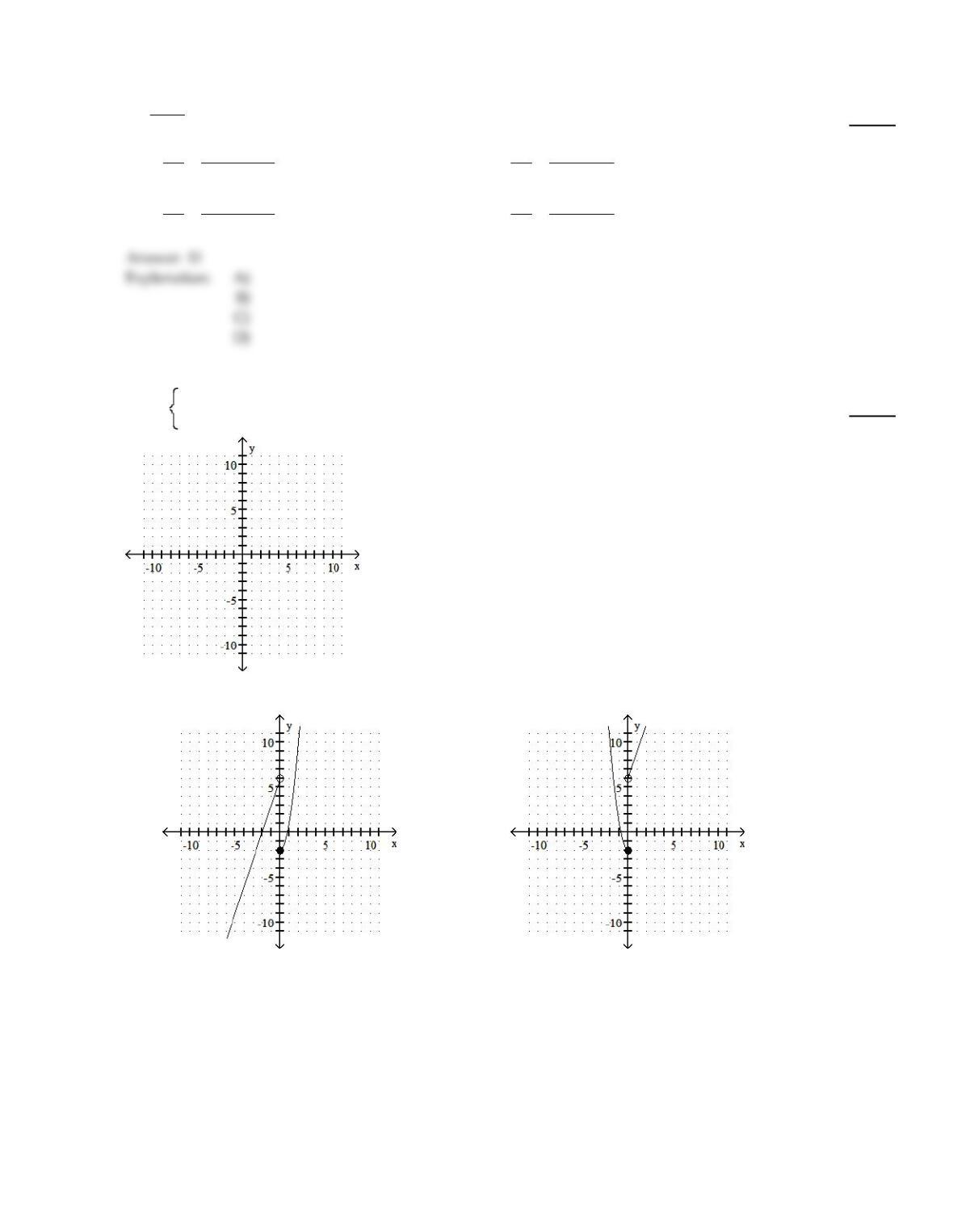
Differentiate.
158)
y =x3
x – 1
158)
A)
dy
dx =–2x3+ 3x2
(x – 1)2
B)
dy
dx =2x3+ 3x2
(x – 1)2
C)
dy
dx =–2x3– 3x2
(x – 1)2
D)
dy
dx =2x3– 3x2
(x – 1)2
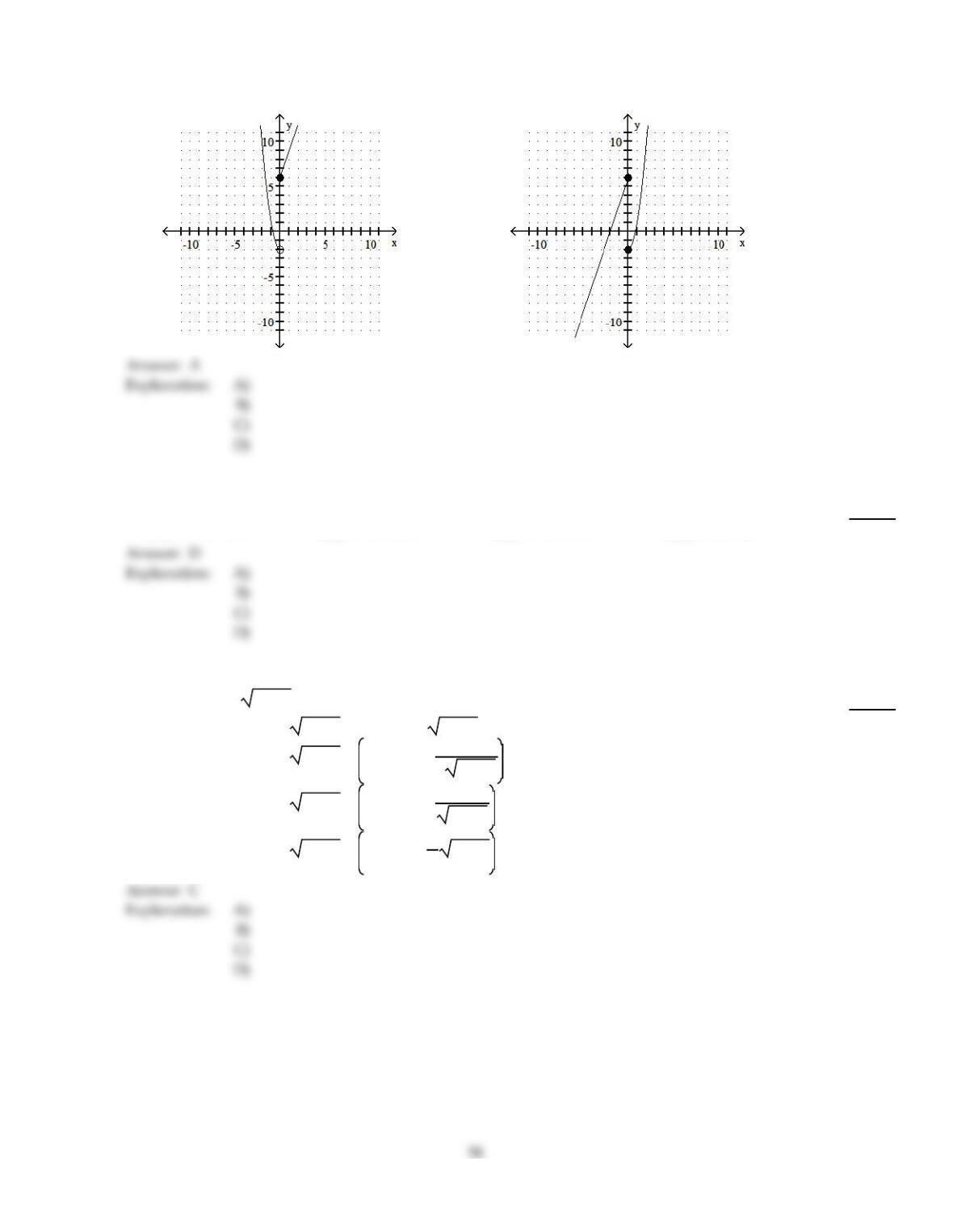
Graph the function and then find the specified limit. When necessary, state that the limit does not exist.
159)
y(x) =3x + 6,for x < 0,
2x2– 2,for x 0. ; lim
x
0f(x)
159)
A)
lim
x
0f(x) does not exist
B)
lim
x
0f(x) = –2
57
C)
lim
x
0f(x) does not exist
D)
lim
x
0f(x) =6
Find the equation of the line tangent to the graph of the function at the indicated point.
160)
f(x) = x –x2 at (–4, –20)
160)
A)
y = –7x –16
B)
y = –9x +16
C)
y = –7x +16
D)
y =9x +16
Use the Chain Rule to differentiate the function. You may need to apply the rule more than once.
161)
f(x) =(–x8–2x –1 – 2x)3
161)
A)
f'(x) = –3(x8–2x –1 – 2x)2)(8x7–2–1 – 2x)
B)
f'(x) =3(–x8–2x –1 – 2x)2)–8x7–2+1
21 – 2x
C)
f'(x) =3(–x8–2x –1 – 2x)2)–8x7–2+1
1 – 2x
D)
f'(x) = –3(x8–2x –1 – 2x)2) 8x7–2–1
21 – 2x
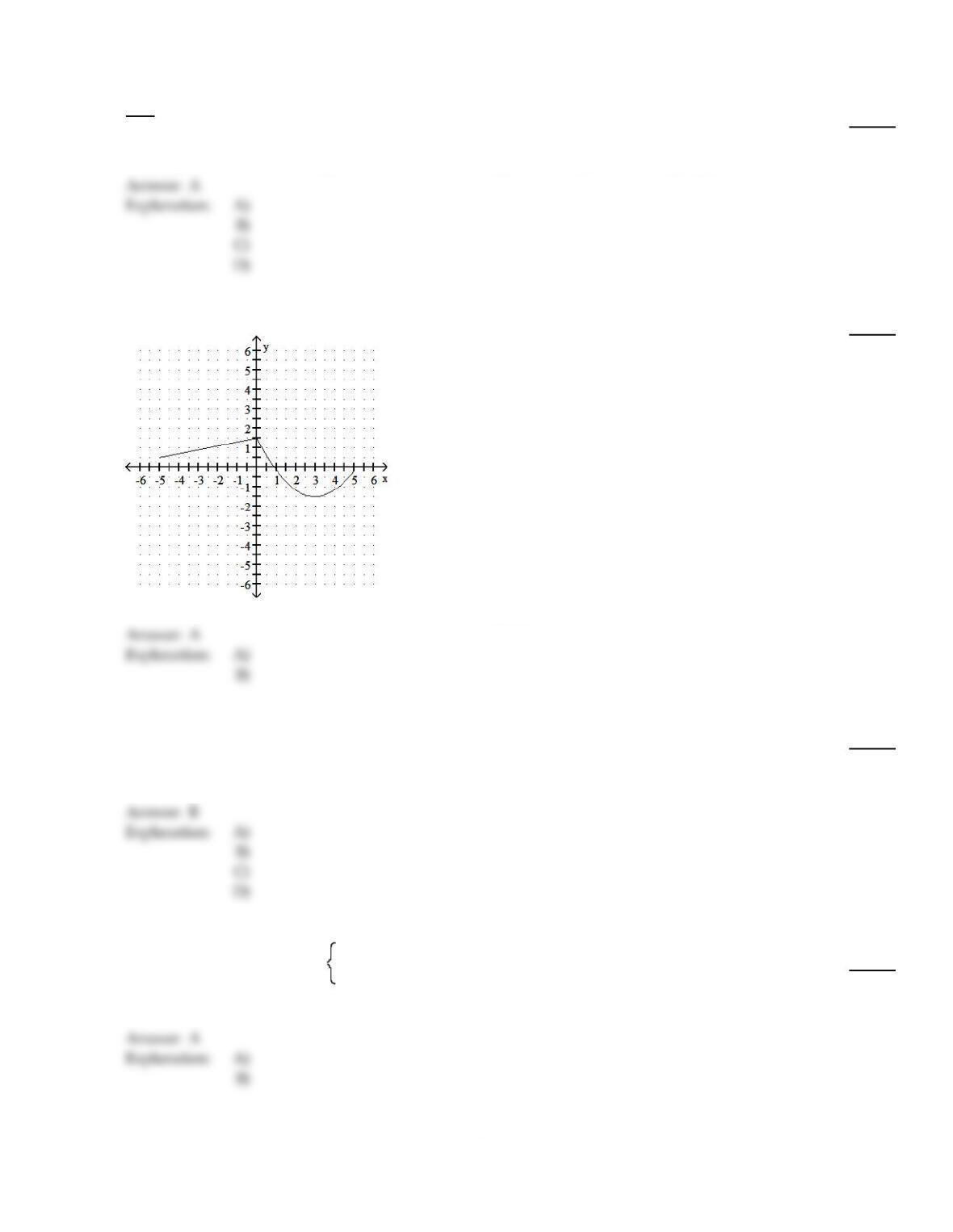
Find the indicated derivative of the function.
162)
d6y
dx6 of y =2x7+ 5x5+ 4x3– 2
162)
A)
10,080x
B)
0
C)
5040x2+ 600
D)
10,080
Determine whether the function shown is continuous over the interval (–5, 5).
163)
163)
A)
Yes
B)
No
Find a simplified difference quotient for the function.
164)
f(x) =6x3
164)
A)
18x2+ h
B)
18x2+18xh +6h2
C)
18x2+18xh +6h
D)
18x2
Provide an appropriate response.
165)
Is the function given by f(x) =x2+ 3,for x < 0
2, for x 0 continuous at x = –1? Why or why not?
165)
A)
Yes, lim
x–1f(x) = f(–1)
B)
No, lim
x–1f(x) = f(–1) does not exist
59
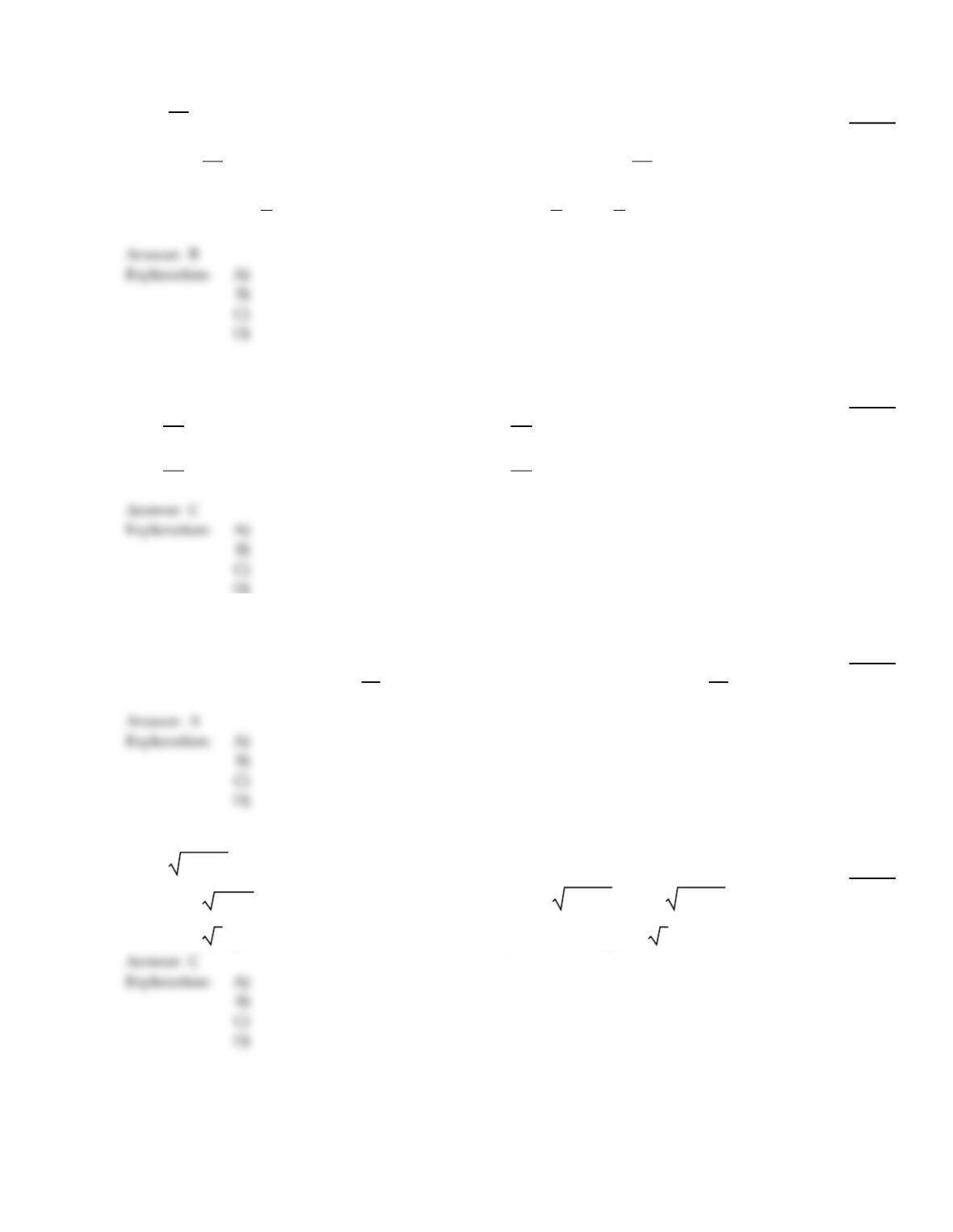
Find functions f(x) and g(x) such that h(x) = (f g)(x).
166)
h(x) =4
x2+ 8
166)
A)
f(x) =4
x2, g(x) =8
B)
f(x) = x + 8, g(x) =4
x2
C)
f(x) = x, g(x) =4
x+ 8
D)
f(x) =1
x, g(x) =4
x+ 8
Differentiate.
167)
y = (x + 1)2(x2+ 1)–3
167)
A)
dy
dx = –2(x + 1)(x2+ 1)–4(2x2– 3x – 1)
B)
dy
dx = 2(x + 1)(x2+ 1)–4(2x2+ 3x – 1)
C)
dy
dx = –2(x + 1)(x2+ 1)–4(2x2+ 3x – 1)
D)
dy
dx = 2(x + 1)(x2+ 1)–4(2x2– 3x – 1)
D)
Write an equation of the tangent line to the graph of y = f(x) at the point on the graph where x has the indicated value.
168)
f(x) = (3x2– 5x – 2)(2x – 5), x = 0
168)
A)
y =21x + 10
B)
y =1
21x – 10
C)
y =21x – 10
D)
y =1
21x + 10
D)
Find functions f(x) and g(x) such that h(x) = (f g)(x).
169)
h(x) =1+3x2
169)
A)
f(x) =1+3x, g(x) = x
B)
f(x) =41+3x2, g(x) =41+3x2
C)
f(x) =x, g(x) =1+3x2
D)
f(x) =1+3x2, g(x) =x
D)
60
D)
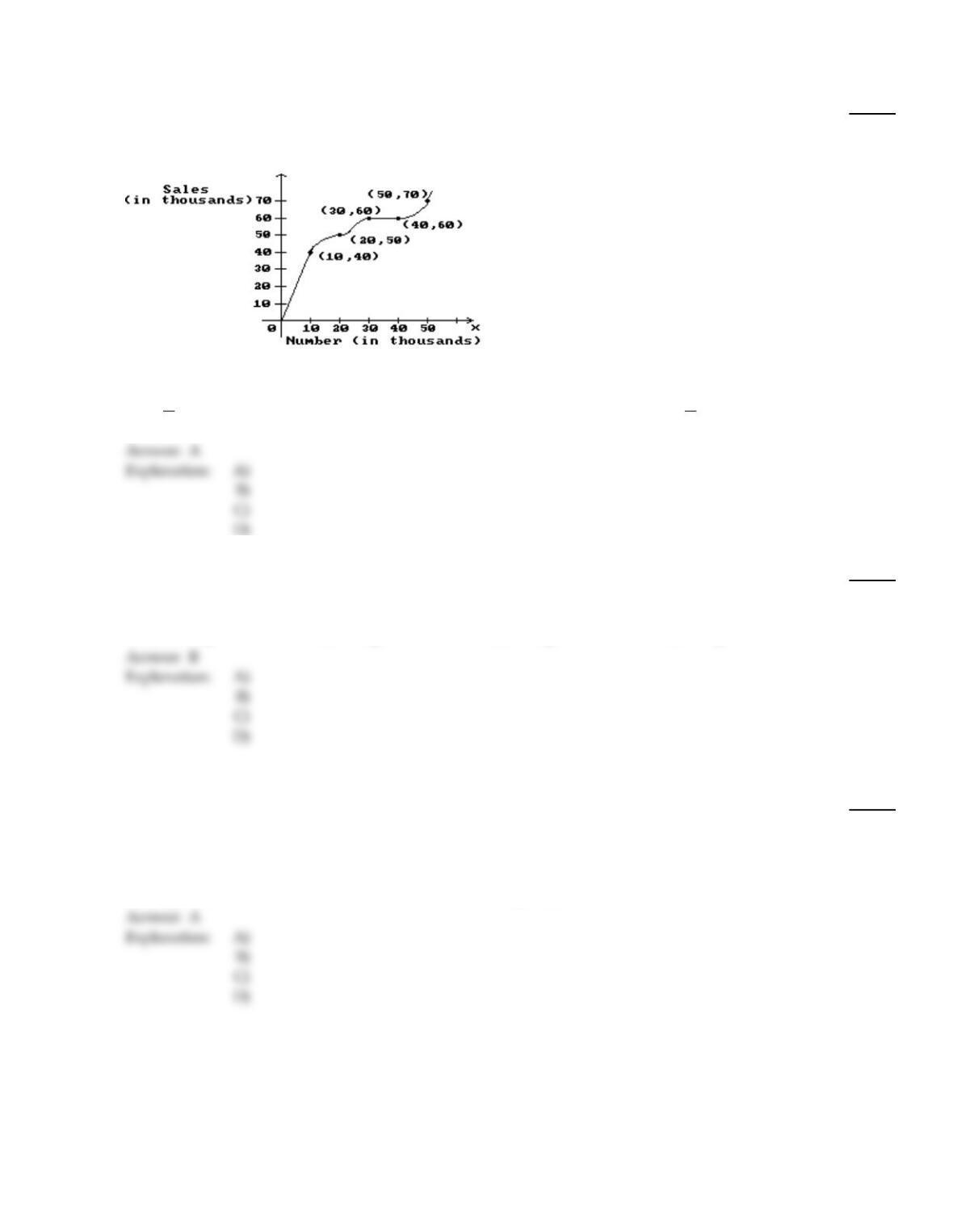
Solve the problem.
170)
The graph shows the total sales in thousands of dollars from the distribution of x thousand
catalogs. Find the average rate of change of sales with respect to the number of catalogs distributed
for the change in x.
10 to 50
170)
A)
3
4
B)
1
C)
2
D)
1
4
171)
For a motorcycle traveling at speed v (in mph) when the brakes are applied, the distance d (in feet)
required to stop the motorcycle may be approximated by the formula d = 0.05 v2+ v. Find the
instantaneous rate of change of distance with respect to velocity when the speed is 47 mph.
171)
A)
11.4 mph
B)
5.7 mph
C)
4.7 mph
D)
48 mph
Find (f
g)(x) and (g f)(x).
172)
f(x) = 5x2; g(x) = x + 3
172)
A)
(f
g)(x) = 5x2+ 30x + 45
(g
f)(x) = 5x2+ 3
B)
(f
g)(x) = 5x2+ 30x + 3
(g
f)(x) = 5x2+ 45
C)
(f
g)(x) = 5x2+ 3
(g
f)(x) = 5x2+ 30x + 49
D)
(f
g)(x) = 5x2+ 45
(g
f)(x) = 5x2+ 30x + 3
61
Provide an appropriate response.
173)
Decide whether the function f(x) =x3+7x –9 is continuous for all x, and provide a short statement
supporting your conclusion.
173)
A)
Yes, polynomial functions are continuous; there are no breaks in the graph of a polynomial
function.
B)
No, there is a break in the graph of this function at x = 0.
C)
No, this polynomial is not defined for all x.
D)
Yes, polynomial functions are defined for all x.
Find the limit by using the TABLE and TRACE features of your graphing calculator.
174)
lim
x
3
x2– 9
x2+ 7 – 4
174)
A)
4
B)
3
C)
1
4
D)
8
Solve the problem.
175)
A coffee house sells coffee by the pound, charging $8.50 per pound for quantities up to and
including 40 pounds. Above 40 pounds, the coffee house charges $7.50 per pound for the entire
quantity, plus a quantity surcharge, k. If x represents the number of pounds, the price function is
p(x) =8.5x, for x 40,
7.5x + k, for x >40.
Find k such that the price function p is continuous at x =40. Then explain why it is preferable to
have continuity at x =40.
175)
A)
k =640; It is preferable so that the coffee house does not lose revenue.
B)
k =415; It is preferable so that the coffee house makes a profit.
C)
k =265; It is preferable so that the coffee house makes a profit.
D)
k =40; It is preferable so that the coffee house does not lose revenue.
Use the Chain Rule to differentiate the function. You may need to apply the rule more than once.
176)
f(x) =(4x3–(6x +9)2)7
176)
A)
f'(x) =7[4x3–(6x +9)2]7[12x1–12(6x +9)]
B)
f'(x) =7[4x3–(6x +9)2]7[12x1– 2(6x +9)]
C)
f'(x) =7[4x3–(6x +9)2]6[12x2– 2(6x +9)]
D)
f'(x) =7[4x3–(6x +9)2]6[12x2–12(6x +9)]
Find the limit, if it exists.
177)
lim
x–8
x2–64
x –8
177)
A)
Does not exist
B)
0
C)
16
D)
1
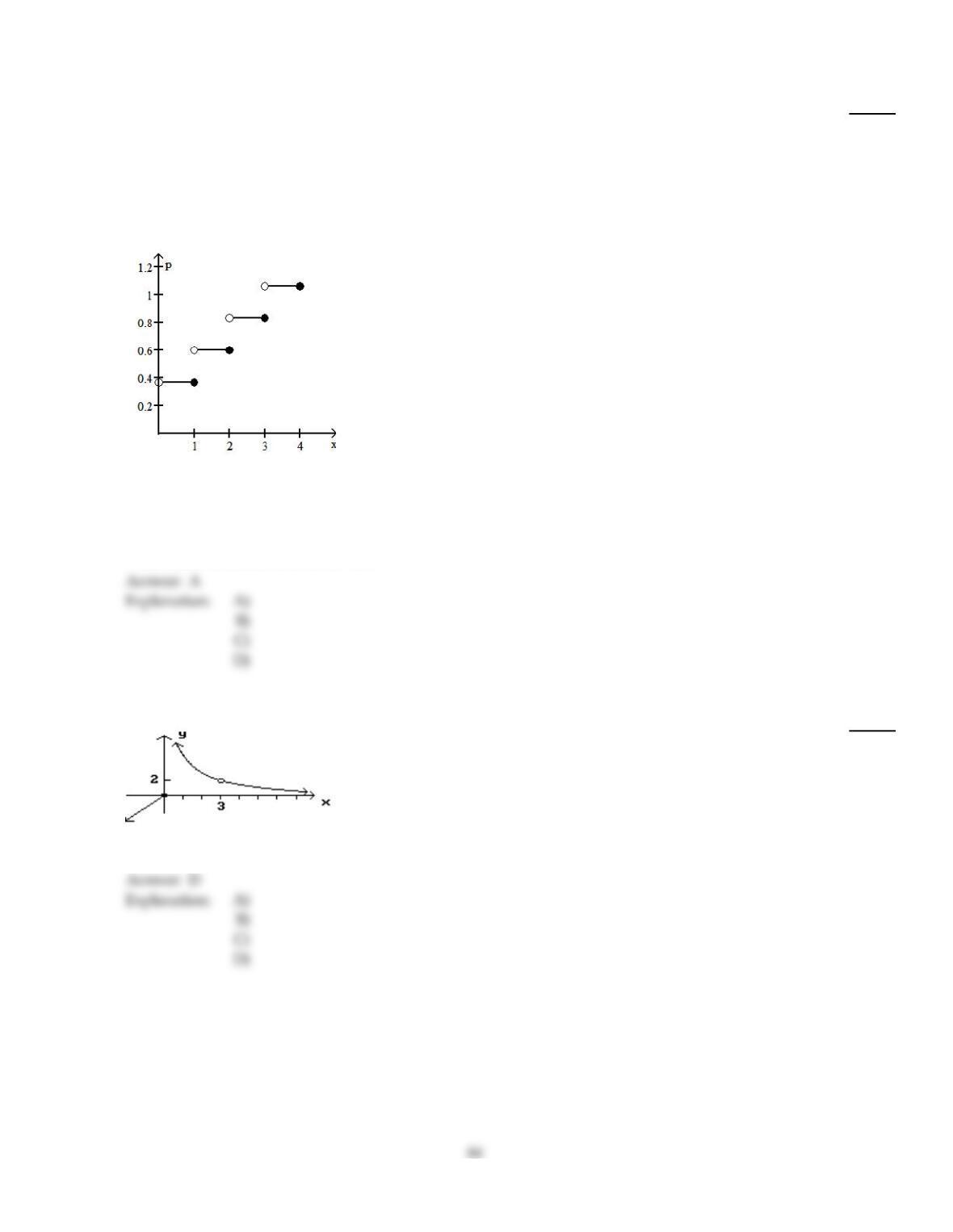
Solve the problem.
178)
Postal rates are $0.37 for the first ounce and $0.23 for each additional ounce (or fraction thereof). If
x is the weight of a letter in ounces, then p(x) is the cost of mailing the letter, where
p(x) = $0.37, if 0 < x 1,
p(x) = $0.60, if 1 < x 2,
p(x) = $0.83, if 2 < x 3,
and so on, up to 13 ounces. The graph of p is shown below.
At what values is the function p not differentiable?
178)
A)
1, 2, 3, 4, 5, 6, 7, 8 , 9, 10, 11, 12
B)
Function is differentiable for all x in the domain
C)
0, 1, 2, 3, 4, 5, 6, 7, 8 , 9, 10, 11, 12, ….…..
D)
0, 1, 2, 3, 4, 5, 6, 7, 8 , 9, 10, 11, 12
List the x–values in the graph at which the function is not differentiable.
179)
179)
A)
x = 3
B)
x = 0
C)
Function is differentiable at all points.
D)
x = 0, x = 3
Differentiate.
180)
f(x) =1
x7+ 2
180)
A)
f'(x) = – 1
(7x7+ 2)2
B)
f'(x) =1
(7x7+ 2)2
C)
f'(x) = – 7x6
(x7+ 2)2
D)
f'(x) =7x6
(x7+ 2)2
181)
f(t) =t8+ 4
2t t7+ 6
t
181)
A)
f'(t) =13
2t12 +10t4+18t5–24
t3
B)
f'(t) =1
2t12 + 2t4+ 3t5+24
t3
C)
f'(t) =17
2t16 +18t8+30t9–24
t3
D)
f'(t) =13
2t12 –24
t3
Provide an appropriate response.
182)
What is the difference between the information provided by a secant line and the information
provided by a tangent line?
182)
A)
A secant line touches the graph of a function just once, but a tangent line generally touches
the curve twice.
B)
The slope of a secant line is the average rate of change of a function over an interval, whereas
the slope of a tangent line is the instantaneous rate of change of a function at a point.
C)
The slope of a secant line drawn for a function f(x) is the average value of f(x) over an
interval, whereas the slope of a tangent line is the instantaneous value of f(x) at a point.
D)
The slope of a secant line is the instantaneous rate of change of a function at a point, whereas
the slope of a tangent line is the average rate of change of a function over an interval.
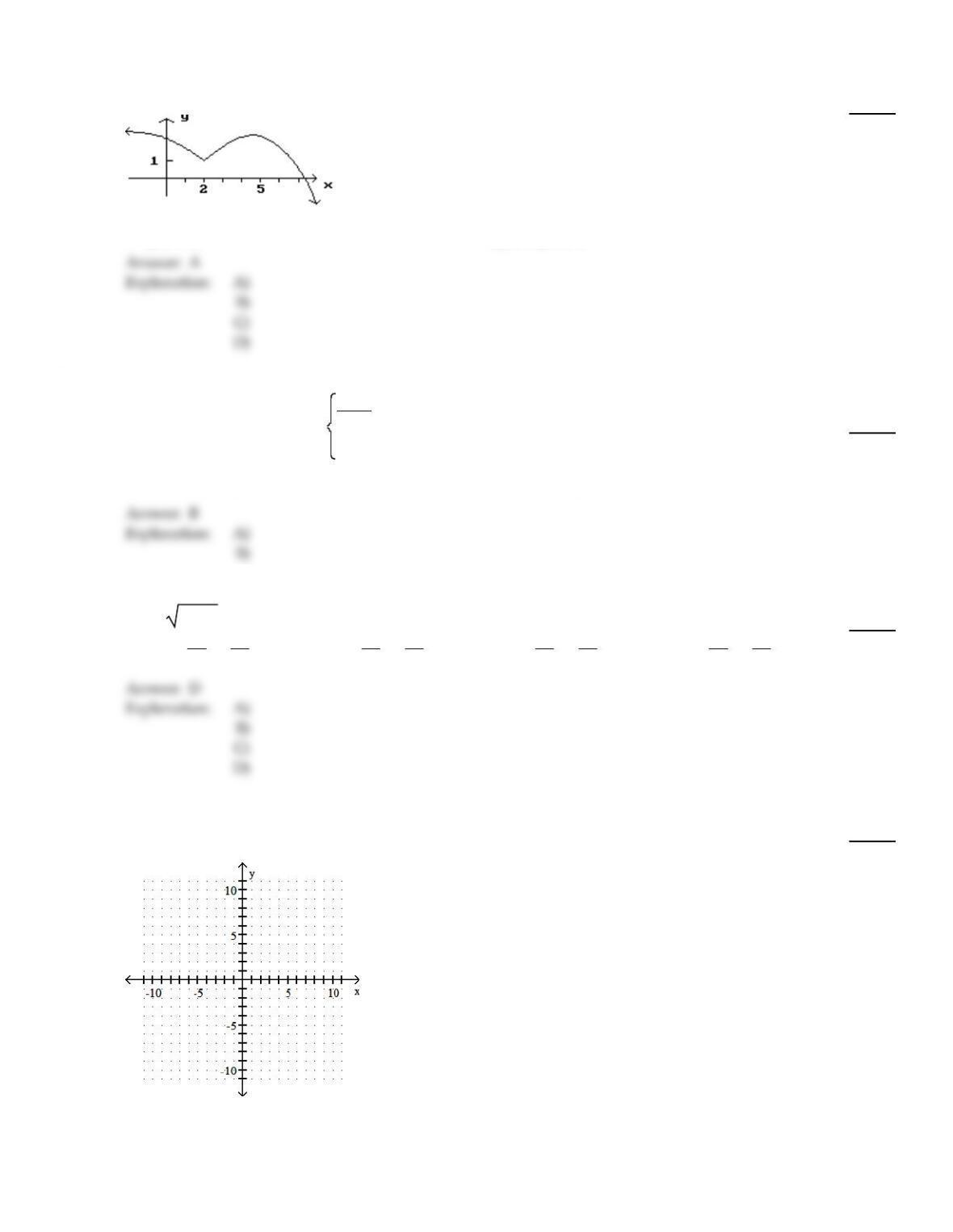
List the x–values in the graph at which the function is not differentiable.
183)
183)
A)
x = 2
B)
Function is differentiable at all points.
C)
x = 5
D)
x = 2, x = 5
Provide an appropriate response.
184)
Is the function given by f(x) =1
x + 4,for x > –4
x2– 3x, for x –4
continuous at x = –4? Why or why not?
184)
A)
Yes, lim
x–4f(x) = f(–4)
B)
No, lim
x–4f(x) does not exist
Find the equation of the line tangent to the graph of the function at the indicated point.
185)
y =x3x3+8 at x = 1
185)
A)
y =19
2x –11
2
B)
y =80
9x +85
9
C)
y =80
9x –85
9
D)
y =19
2x –13
2
Graph the function and then find the specified limit. When necessary, state that the limit does not exist.
186)
y = x2+ 3; lim
x
0f(x)
186)
66
A)
lim
x
0f(x) =3
B)
lim
x
0f(x) = –3
C)
lim
x
0f(x) = –3
D)
lim
x
0f(x) =3
Differentiate.
187)
y = (3x2+ 5x + 1)3/2
187)
A)
dy
dx =3
2(3x2+ 5x + 1)1/2
B)
dy
dx = (3x2+ 5x + 1)1/2
C)
dy
dx =3
2(6x + 5)(3x2+ 5x + 1)1/2
D)
dy
dx = (6x + 5)(3x2+ 5x + 1)1/2
67
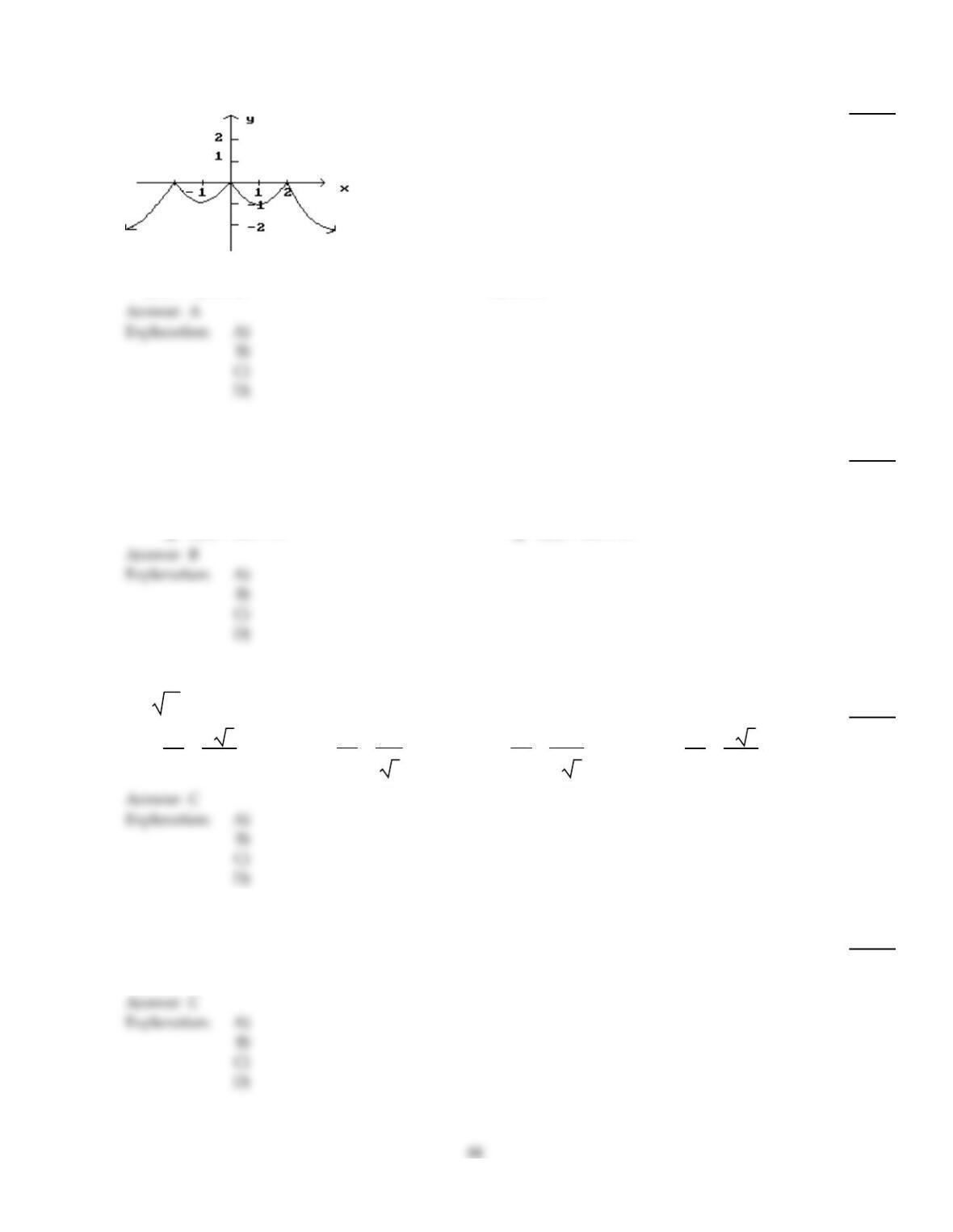
List the x–values in the graph at which the function is not differentiable.
188)
188)
A)
x = –2, x = 0, x = 2
B)
Function is differentiable at all points.
C)
x = –2, x = 2
D)
x = 0
Find (f
g)(x) and (g f)(x).
189)
f(x) = 2x + 11; g(x) = 11x + 2
189)
A)
(f
g)(x) = 22x + 123
(g
f)(x) = 22x + 123
B)
(f
g)(x) = 22x + 15
(g
f)(x) = 22x + 123
C)
(f
g)(x) = 22x + 123
(g
f)(x) = 22x + 15
D)
(f
g)(x) = 22x + 15
(g
f)(x) = 22x + 15
B
Find the derivative.
190)
y =9x8
190)
A)
dy
dx =98x
8
B)
dy
dx =1
9x
C)
dy
dx =8
99x
D)
dy
dx =89x
9
C
Find all values of x (if any) where the tangent line to the graph of the function is horizontal.
191)
y =5x – 5
191)
A)
1
B)
All real numbers
C)
None
D)
0
C
A
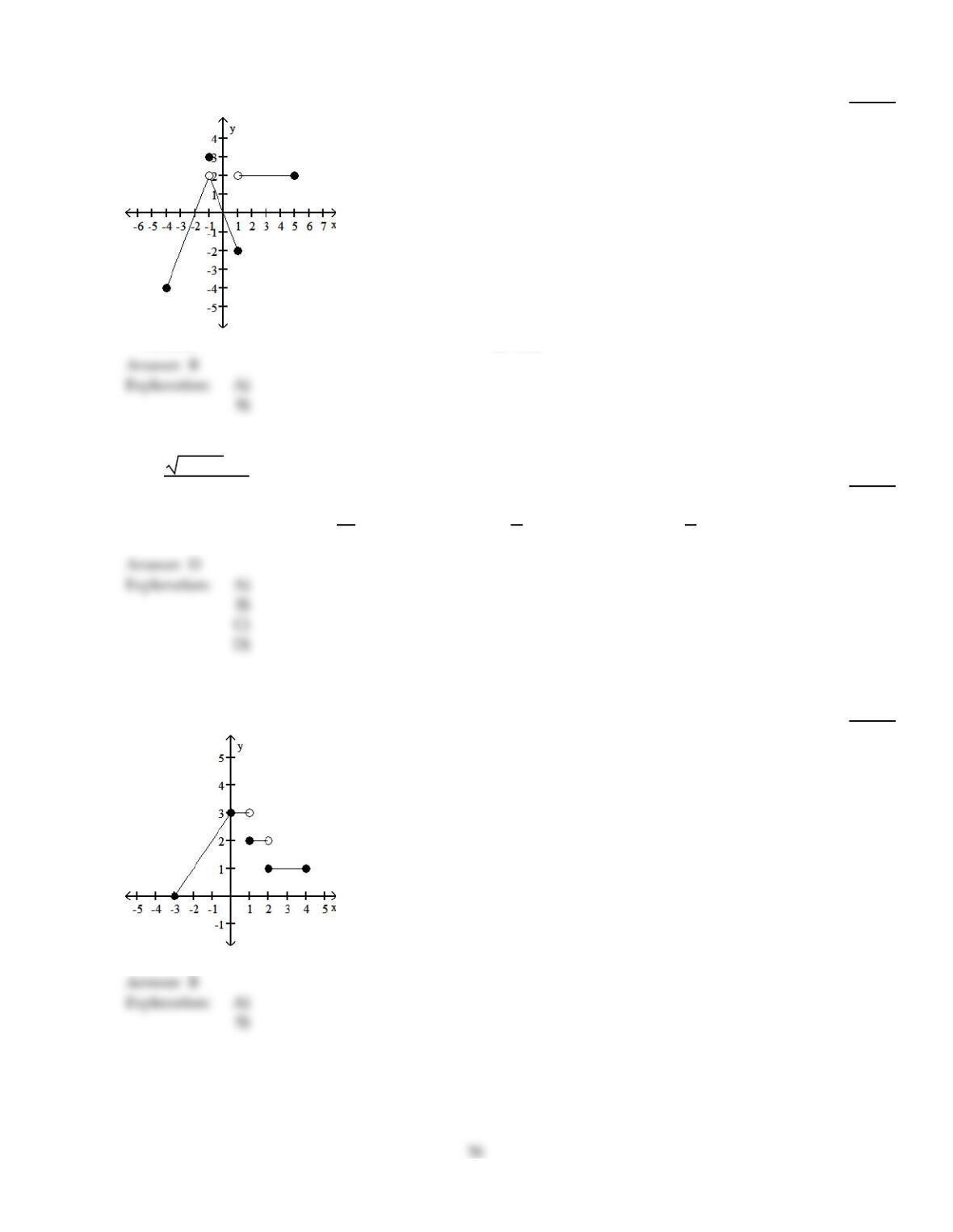
Determine the continuity of the function at the given points.
192)
f(x) =
3, for x =1
2 –1
3x3,for x 1 at x =1 and x =2
192)
A)
The function f is continuous at x =1 but not at x =2.
B)
The function f is continuous at x =2 but not at x =1.
C)
The function f is continuous at neither x =2 nor x =1.
D)
The function f is continuous at both x =2 and x =1.
Use the graph to determine whether each statement is true or false.
193)
lim f(x)
x –1–= 1
193)
A)
False
B)
True
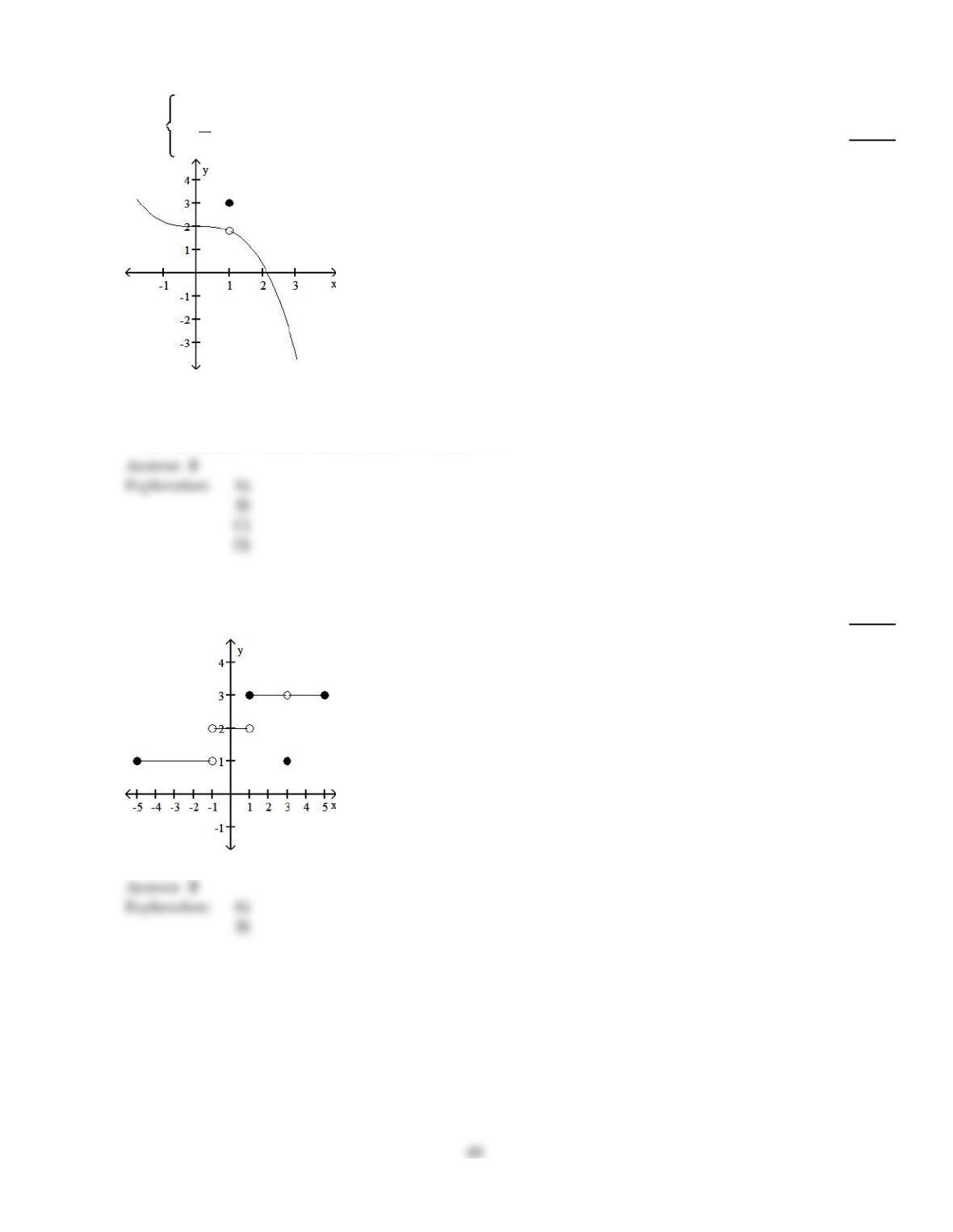
194)
lim f(x)
x –1–= 2
194)
A)
False
B)
True
Find the limit by using the TABLE and TRACE features of your graphing calculator.
195)
lim
x
0
25 + 2x –5
x
195)
A)
25
B)
1
10
C)
2
5
D)
1
5
Use the graph to determine whether each statement is true or false.
196)
lim f(x)
x
1 exists.
196)
A)
True
B)
False
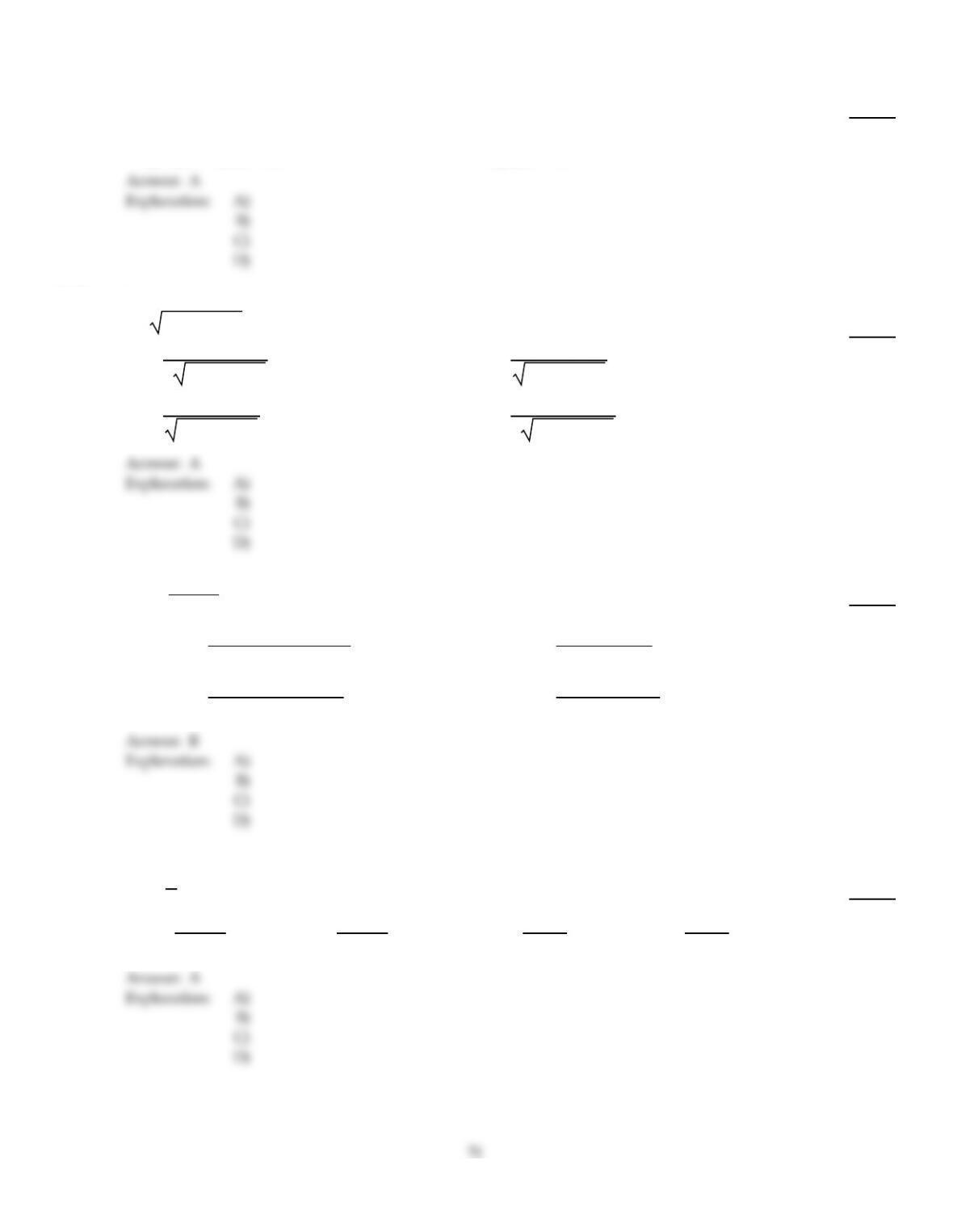
Find a simplified difference quotient for the function.
197)
f(x) = –8x3
197)
A)
–24x2–24xh –8h2
B)
–24x2
C)
–24x2–24xh –8h
D)
24x2– h
Differentiate.
198)
y =(7x +8)9–6
198)
A)
63(7x +8)8
2 (7x +8)9–6
B)
9(7x +8)8
(7x +8)9–6
C)
63(7x +8)8
(7x +8)9–6
D)
9(7x +8)8
2 (7x +8)9–6
199)
g(x) =x2+ 5
x2+ 6x
199)
A)
g'(x) =4x3+ 18x2+ 10x + 30
x2(x + 6)2
B)
g'(x) =6x2– 10x – 30
x2(x + 6)2
C)
g'(x) =x4+ 6x3+ 5x2+ 30x
x2(x + 6)2
D)
g'(x) =2x3– 5x2– 30x
x2(x + 6)2
Find a simplified difference quotient for the function.
200)
f(x) =3
x
200)
A)
–3
x2+ xh
B)
3
x2+ xh
C)
–3
x2+ h
D)
3
x2+ h
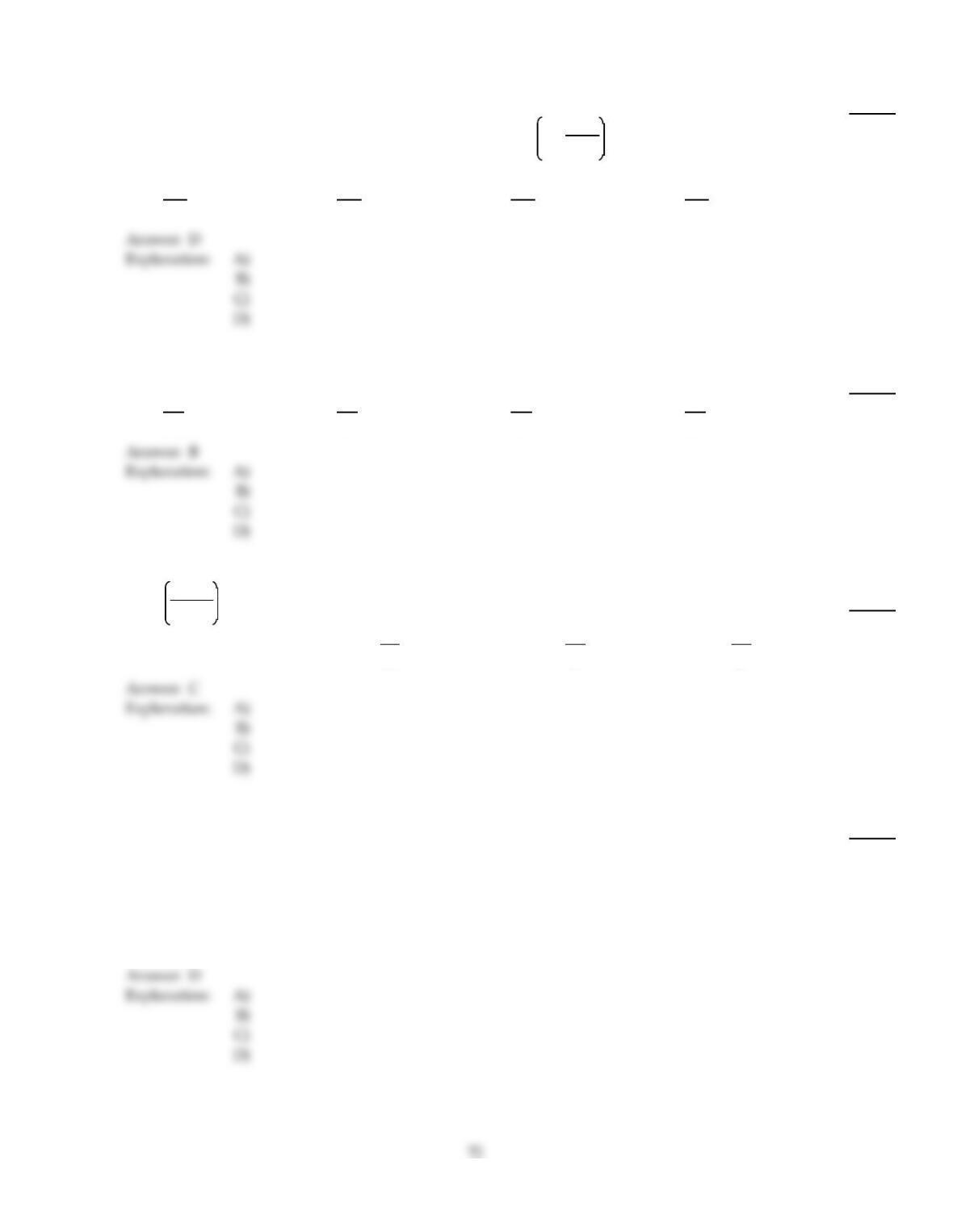
Solve the problem.
201)
$1000 is deposited in an account with an interest rate of r% per year, compounded monthly. At the
end of 8 years, the balance in the account is given by A =1000 1 +r
1200 96. Find the rate of change
of A with respect to r when r =4. Round answer to the nearest hundredth, if necessary.
201)
A)
dA
dr =80.27
B)
dA
dr =110.11
C)
dA
dr =80.53
D)
dA
dr =109.75
Find the derivative.
202)
y =0.35x12.6
202)
A)
dy
dx =0.35x11.6
B)
dy
dx =4.41x11.6
C)
dy
dx =4.41x12.6
D)
dy
dx =4.76x13.6
Differentiate.
203)
f(x) =1 +8x
8x (8 –x)
203)
A)
f'(x) =x2– 1
B)
f'(x) =1
x2+8
C)
f'(x) = – 1
x2– 1
D)
f'(x) =1
x2+ 1
Solve the problem.
204)
Exposure to ionizing radiation is known to increase the incidence of cancer. One thousand
laboratory rats are exposed to identical doses of ionizing radiation, and the incidence of cancer is
recorded during subsequent days. The researchers find that the total number of rats that have
developed cancer t months after the initial exposure is modeled by N(t) =1.18t2.3 for 0 t 10
months. Find the rate of growth of the number of cancer cases at the 7th month.
204)
A)
29.1 cases/month
B)
238.4 cases/month
C)
38.1 cases/month
D)
34.1 cases/month
Find the equation of the line tangent to the graph of the function at the indicated point.
205)
f(x) =x3–x2 at (0, 0)
205)
A)
y = –2
B)
y = 1
C)
y = 3
D)
y = 0
Graph the function and then find the specified limit. When necessary, state that the limit does not exist.
206)
f(x) =x – 4 ; lim
x
0f(x)
206)
A)
lim
x
0f(x) = –4
B)
lim
x
0f(x) = –4
C)
lim
x
0f(x) = 0
D)
lim
x
0f(x) =4
73
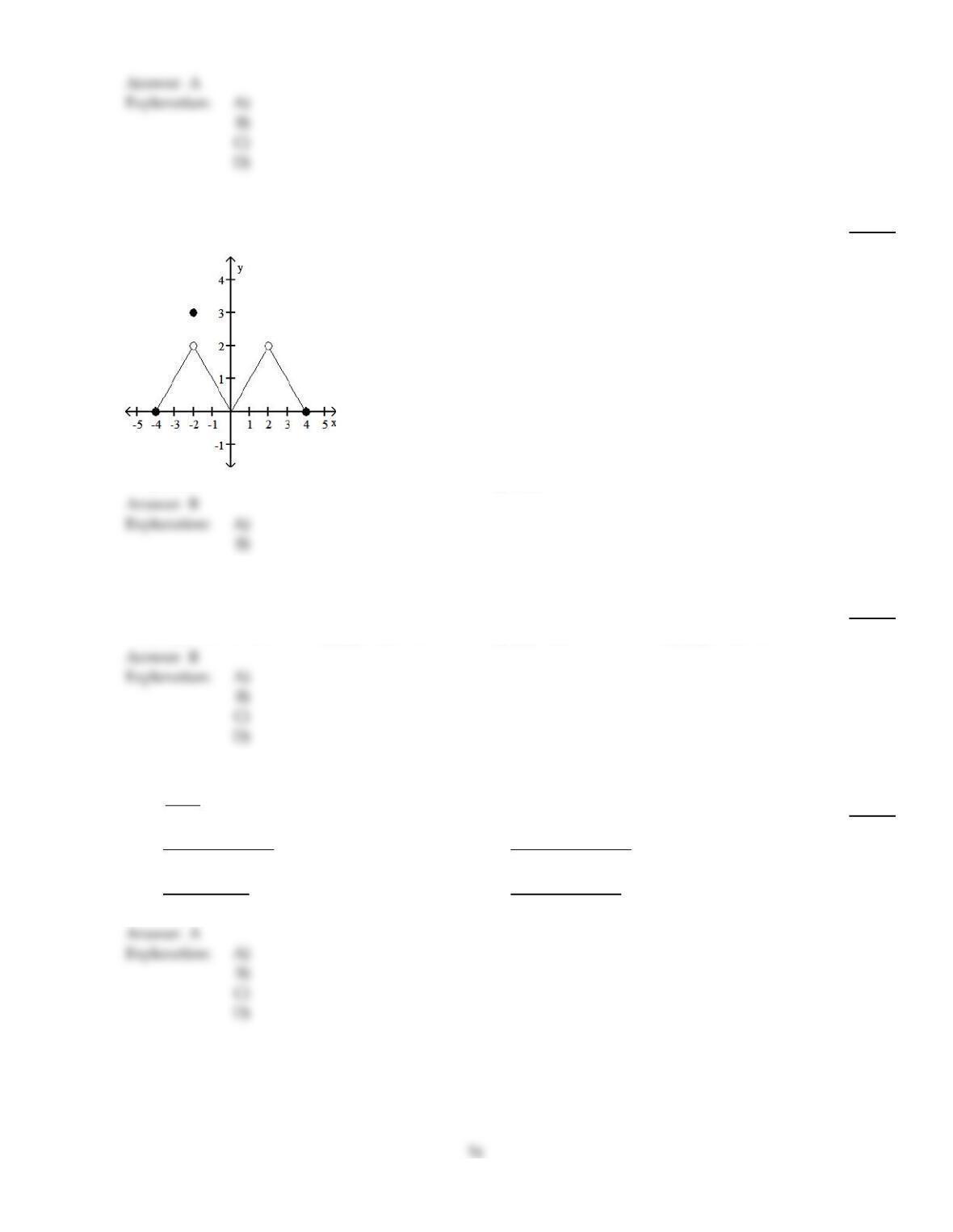
Use the graph to determine whether each statement is true or false.
207)
lim
x –2–f(x) = 2
207)
A)
False
B)
True
Solve the problem.
208)
If s is a distance given by s(t) =5t3+8t2+ 4t , find the acceleration, a(t).
208)
A)
a(t) =15t2+16t
B)
a(t) =30t +16
C)
a(t) =30t
D)
a(t) =46t + 4
Find a simplified form of the difference quotient for the function.
209)
f(x) =5
x +5
209)
A)
–5
(x +5)(x +5+ h)
B)
–5
h(x +5)(x +5+ h)
C)
5
(x +5)(x +5)
D)
5h
(x +5)(x +5+ h)
Answer Key
Testname: C1
Answer Key
Testname: C1
Answer Key
Testname: C1
Answer Key
Testname: C1
Answer Key
Testname: C1