Chapter 1
57.
The following table gives values of three functions. Which one(s) could possibly be
linear? Select all that apply.
x
-2
-1
0
1
2
()fx
12
17
24
27
34
()gx
16
24
36
54
81
()hx
37
32
27
22
17
A)
()fx
B)
()gx
C)
()hx
58.
The following table gives values of three functions. Which one(s) could possibly be
exponential? Select all that apply.
x
-2
-1
0
1
2
()fx
12
18
26
30
38
()gx
16
24
36
54
81
()hx
37
31
25
19
13
A)
()fx
B)
()gx
C)
()hx
Ans: B Learning Objectives: Build linear functions from data, words, or graphs.;
Determine a formula for an exponential function from data, graphs, or words.
difficulty: easy section: 1.2; 1.5
59.
A population of rabbits is growing. In 2005, there were 10,000,000 rabbits, and the
population was increasing at a rate of 20% per decade. What is the predicted rabbit
population in 2016? Round to the nearest rabbit.
Ans:
12,220,793
Chapter 1
60.
A population of rabbits is growing. In 2006, there were 10,000,000 rabbits, and the
rate of increase was 10% per decade. Find
()Pt
, the formula to predict the population
t years after 2006.
A)
10
( ) 10,000,000(1.1)
t
Pt =
B)
( ) 10,000,000(1.1)t
Pt =
C)
10
( ) 10,000,000(0.1)
t
Pt =
D)
( ) 10,000,000(0.1)t
Pt =
Ans: A Learning Objectives: Determine a formula for an exponential function
from data, graphs, or words. difficulty: medium section: 1.5
61.
Identify the function defined in the following table as potentially linear, exponential, or
neither.
x
0
2
4
6
8
()fx
4.25
6.8
10.88
17.408
27.8528
A)
exponential
B)
neither
C)
linear
Ans: A Learning Objectives: Determine a formula for an exponential function
from data, graphs, or words. difficulty: easy section: 1.5
62.
You were the housing minister in the year 1996 for a country with 30 million people.
You were asked to predict the population 15 years from 1996 as part of a 15 year
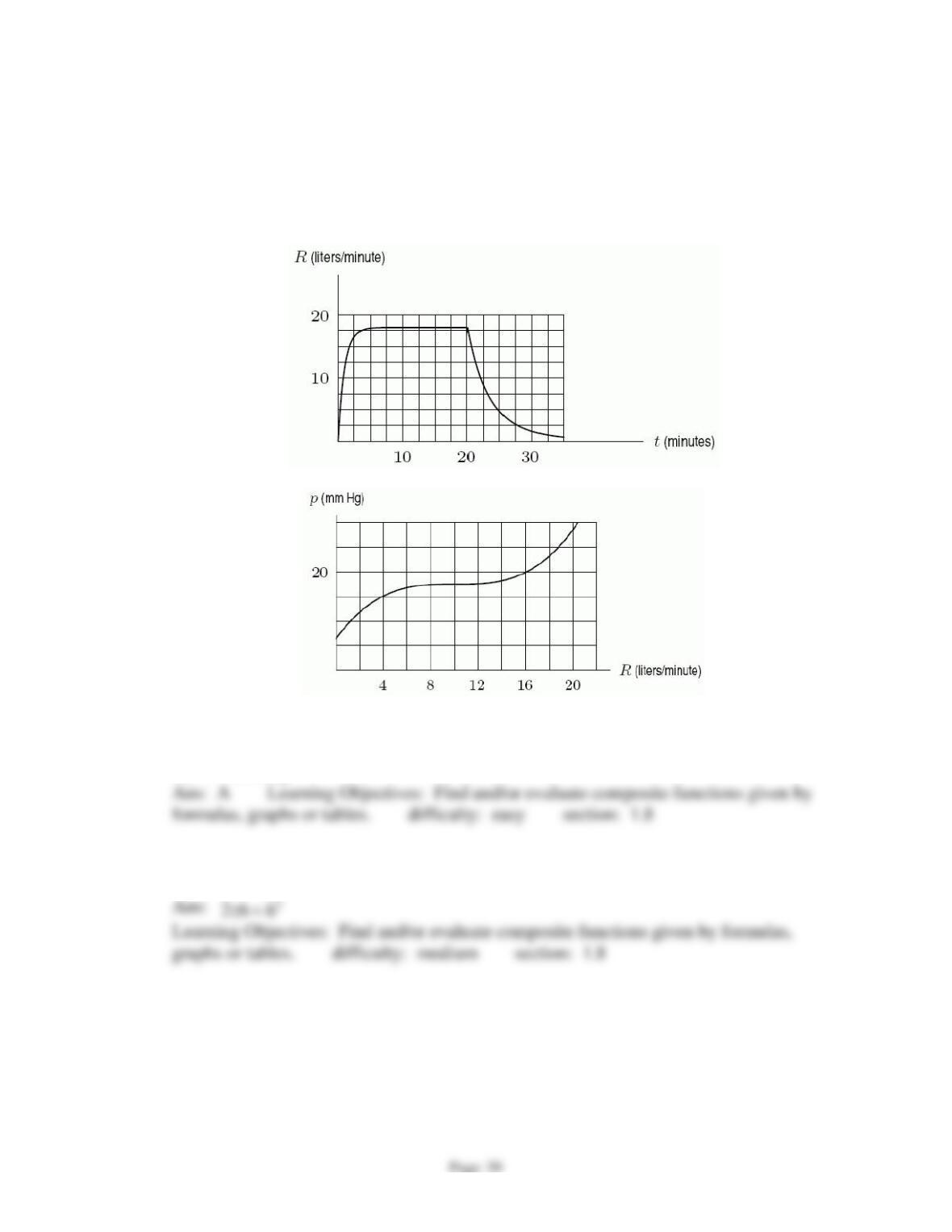
master plan for housing. Census records show that the population was 22.684 million
in 1986 and 26.087 million in 1991. What was your best prediction of the population 15
years from 1996?
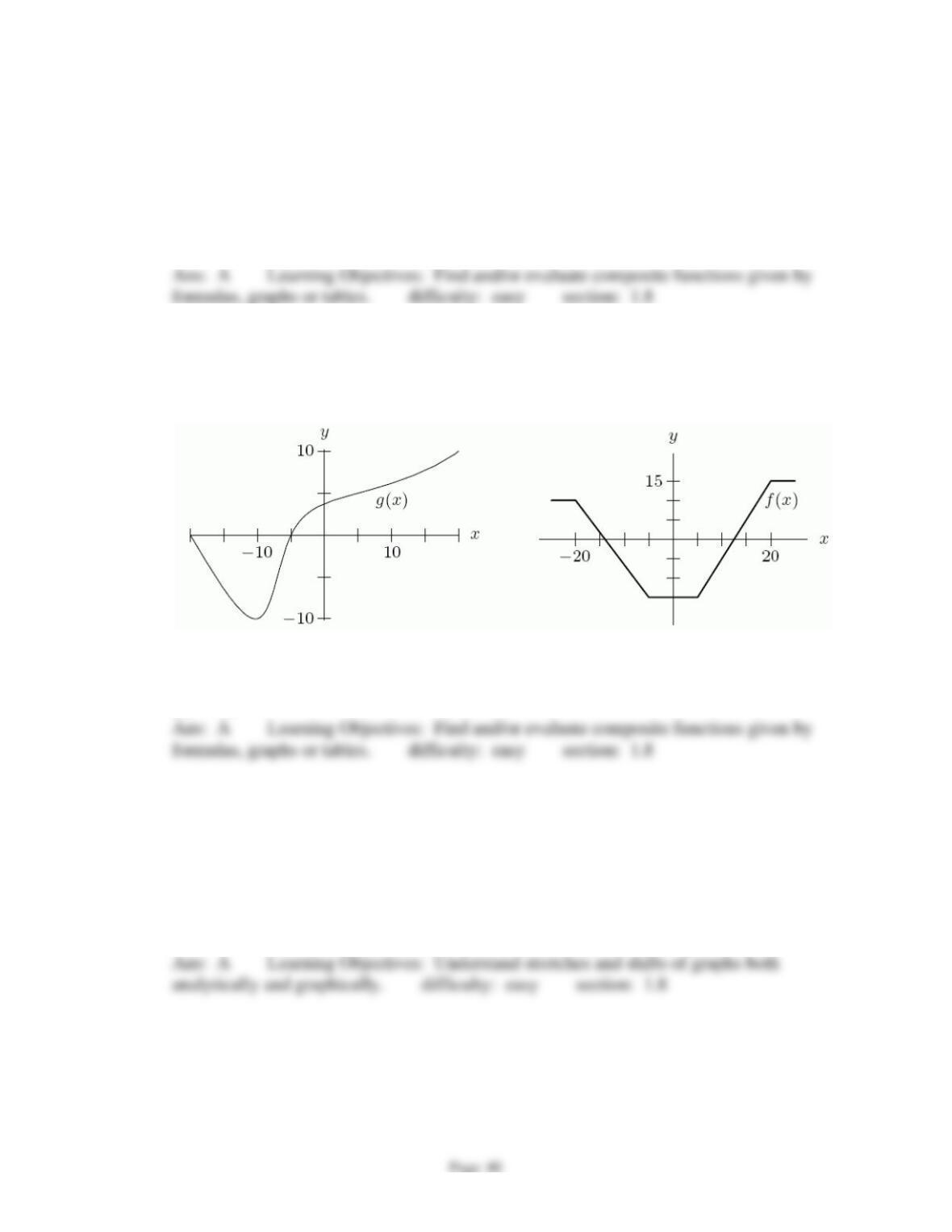
A)
45.626 million
B)
40.974 million
C)
41.739 million
D)
52.470 million
Ans: A Learning Objectives: Determine a formula for an exponential function
from data, graphs, or words. difficulty: medium section: 1.5
Chapter 1
63.
Find a formula for the exponential function partially defined in the following table.
Round any constants to 3 decimal places.
x
0
1
2
3
4
()fx
10
20
?
?
?
64.
Using the table, find the value of a if f is linear.
x
0
10
20
()fx
50
150
a
65.
Using the table, find the value of a if f is exponential.
x
0
10
20
()fx
50
200
a
66.
The following tables shows values for two functions. Which one could be exponential?
t
-2
-1
0
1
()ft
250
300
360
432
t
2
3
4
5
()gt
500
750
1500
4500
A)
()ft
B)
()gt
Chapter 1
67.
The following table shows values for an exponential function,
()ft
. Find a formula for
()ft
. Table entries are rounded to two decimal places.
t
-2
-1
0
1
()ft
151.11
226.67
340.00
510.00
Learning Objectives: Determine a formula for an exponential function from data,
graphs, or words. difficulty: medium section: 1.5
68.
A bar of soap starts out weighing 125 grams. Write a formula for the quantity S grams
of soap remaining after t days if the decrease is 5 grams per day.
Learning Objectives: Build linear functions from data, words, or graphs.
difficulty: medium section: 1.2
69.
A bar of soap starts out at 100 grams. Write a formula for the quantity S grams of soap
remaining after t days if the decrease is 5% per day
Learning Objectives: Determine a formula for an exponential function from data,
graphs, or words. difficulty: medium section: 1.5
70.
A photocopy machine can reduce copies to 90% or 70% of their original size. By
copying an already reduced copy, further reductions can be made. Write a formula for
the size of the image, N, after the original image of size a has been reduced n times with
the copy machine set on 90% reduction.
Learning Objectives: Determine a formula for an exponential function from data,
graphs, or words. difficulty: medium section: 1.5
71.
A photocopy machine can reduce copies to 90% or 70% of their original size. By
copying an already reduced copy, further reductions can be made. Which will be
larger, an image that has been reduced on the 90% setting 10 times, or the same image
after being reduced 3 times on the 70% setting?
A)
The image reduced on the 90% setting
B)
The image reduced on the 70% setting
Ans: A Learning Objectives: Understand and interpret the components of
exponential functions: percent growth/decay rate, base, initial quantity.
difficulty: hard section: 1.5
Chapter 1
72.
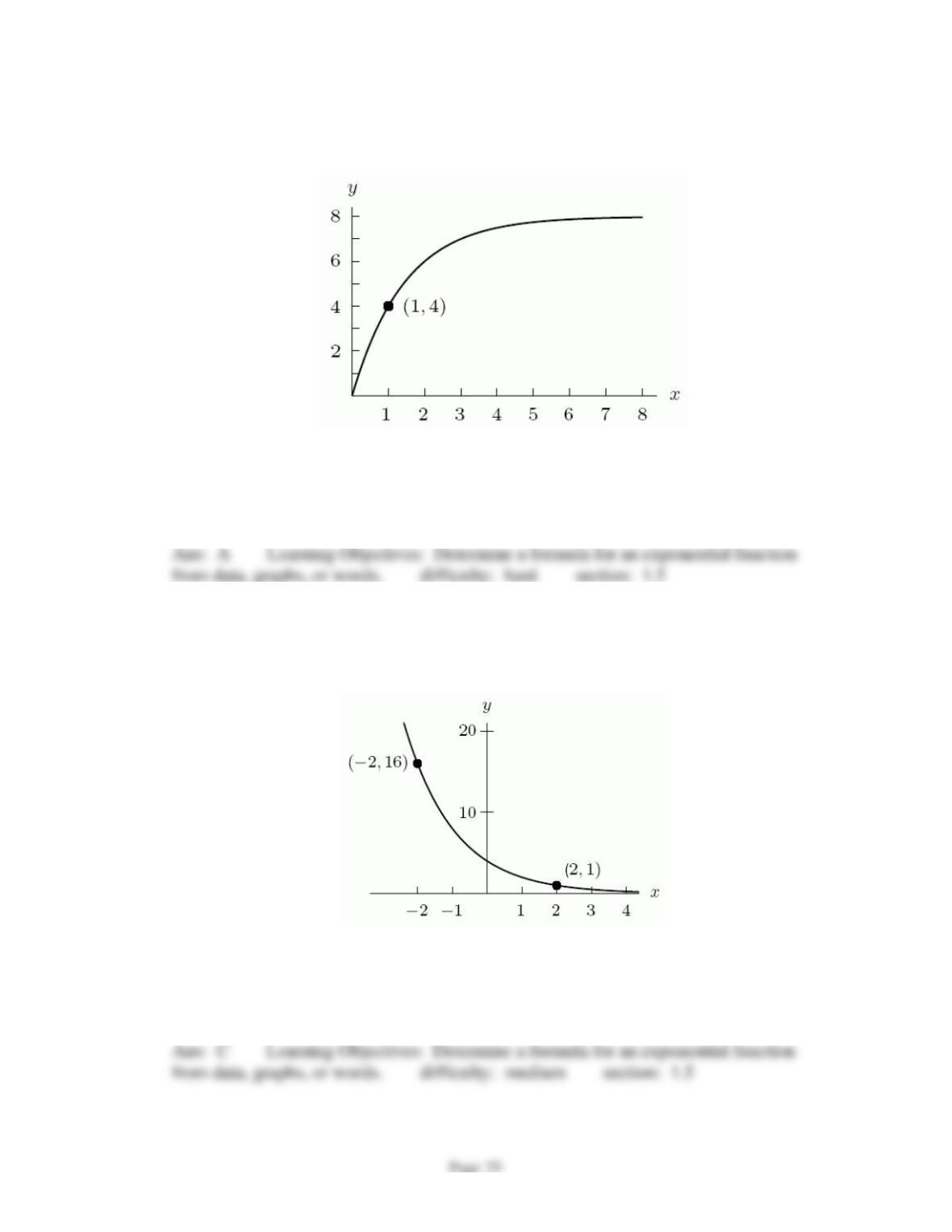
Which could be a possible formula for the following figure? Assume a and b are
positive constants.
A)
(1 )
x
ab
−
−
B)
(1 )
x
ab−
C)
()
x
ab
−
D)
()
x
ab
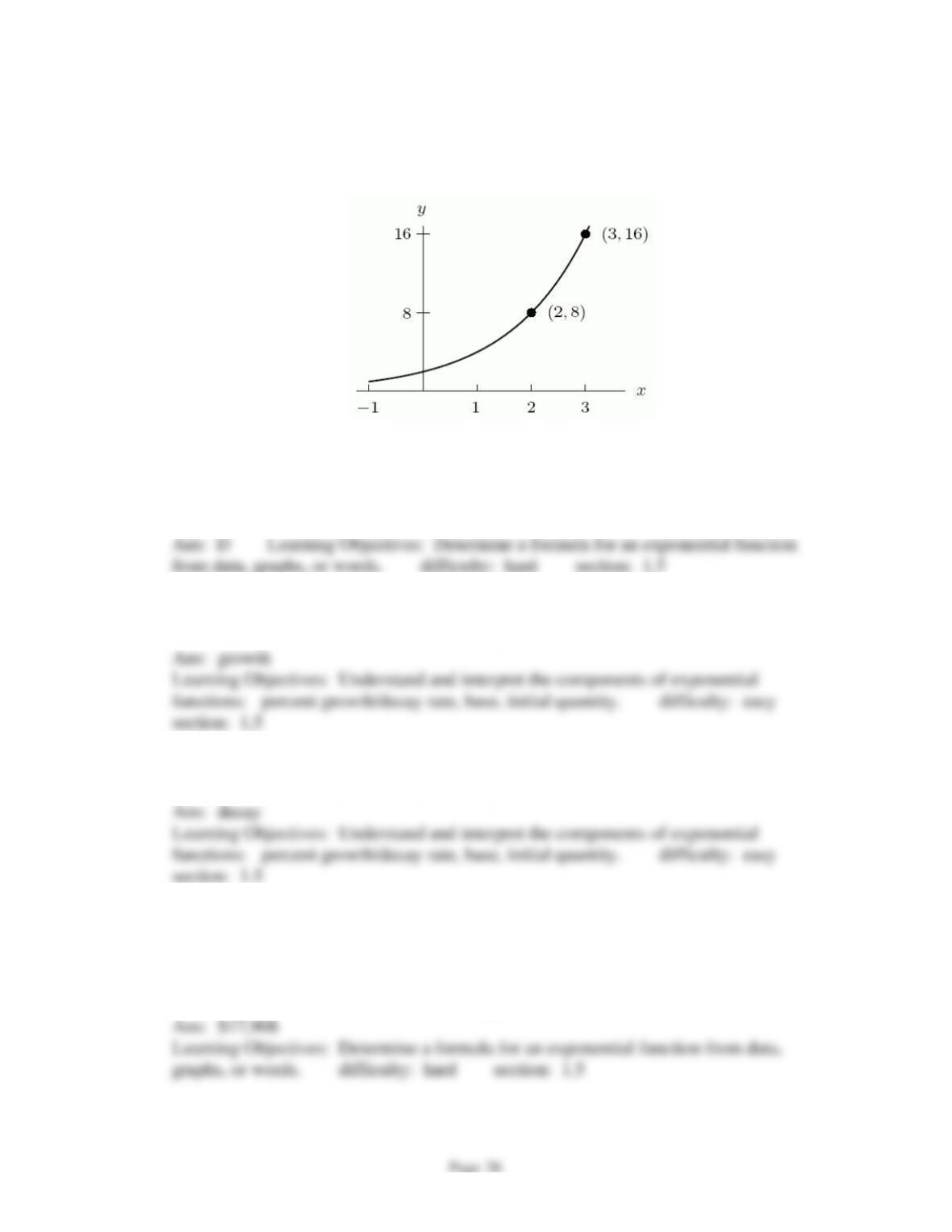
73.
Which could be a possible formula for the following figure? Assume a and b are
positive constants.
A)
(1 )
x
ab
−
−
B)
(1 )
x
ab−
C)
()
x
ab
−
D)
()
x
ab
Chapter 1
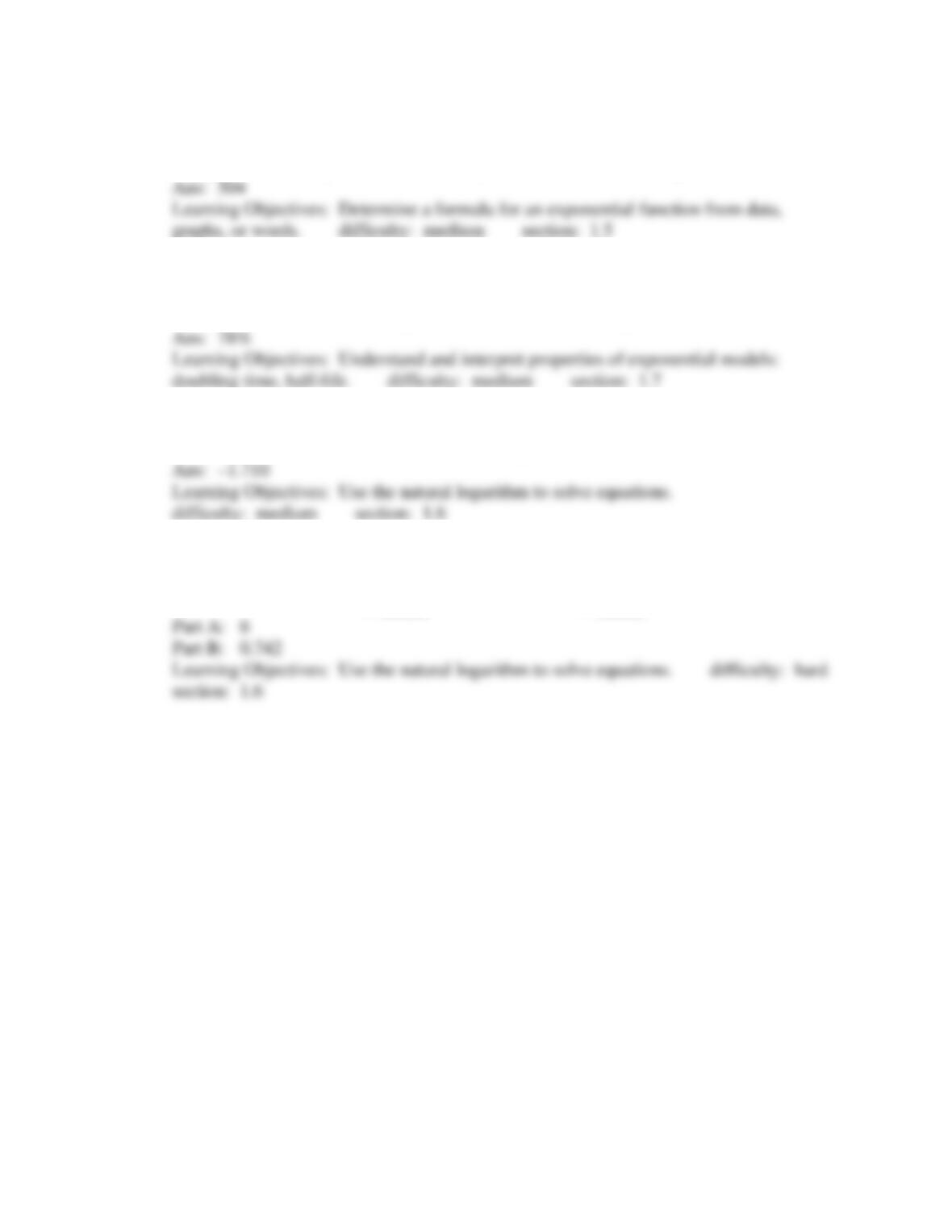
74.
Which could be a possible formula for the following figure? Assume a and b are
positive constants.
A)
(1 )
x
ab
−
−
B)
(1 )
x
ab−
C)
()
x
ab
−
D)
()
x
ab
Ans: D Learning Objectives: Determine a formula for an exponential function
from data, graphs, or words. difficulty: hard section: 1.5
75.
Does
11(1.08)t
P=
represent exponential growth or decay?
Ans:
growth
Learning Objectives: Understand and interpret the components of exponential
functions: percent growth/decay rate, base, initial quantity. difficulty: easy
section: 1.5
76.
Does
–0.07
8.6 t
Pe=
represent exponential growth or decay?
Ans:
decay
Learning Objectives: Understand and interpret the components of exponential
functions: percent growth/decay rate, base, initial quantity. difficulty: easy
section: 1.5
77.
Joe invested $10,000 in the stock market, while Sam invested $20,000. Joe’s
investment increased by 6% per year for 10 years. Sam’s investment decreased in value
by 12% per year for 5 years and then increased by 12% per year for the next 5 years.
What was Joe’s investment worth after 10 years? Round to the nearest dollar.
Ans:
$17,908
Chapter 1
Page 27
78.
A bakery has 800 pounds of flour. If they use 5% of the available flour each day, how
many pounds do they have left after 9 days? Round to the nearest pound.
79.
A substance has a half-life of 56 years. What percent of the original amount of the
substance will remain after 20 years? Round to the nearest percent.
Ans:
78%
Learning Objectives: Understand and interpret properties of exponential models:
doubling time, half-life. difficulty: medium section: 1.7
80.
Solve
6 3 3 2
tt
=
for t. Round to 3 decimal places.
Ans:
Learning Objectives: Use the natural logarithm to solve equations.
difficulty: medium section: 1.6
81.
Solve
6 (2.1)x kx
ae =
for both a and k. Round to 3 decimal places.
a=_____ k=_____
Part A:
6
Part B:
0.742
Learning Objectives: Use the natural logarithm to solve equations. difficulty: hard
section: 1.6
Ans:
504
Learning Objectives: Determine a formula for an exponential function from data,
graphs, or words. difficulty: medium section: 1.5
Chapter 1
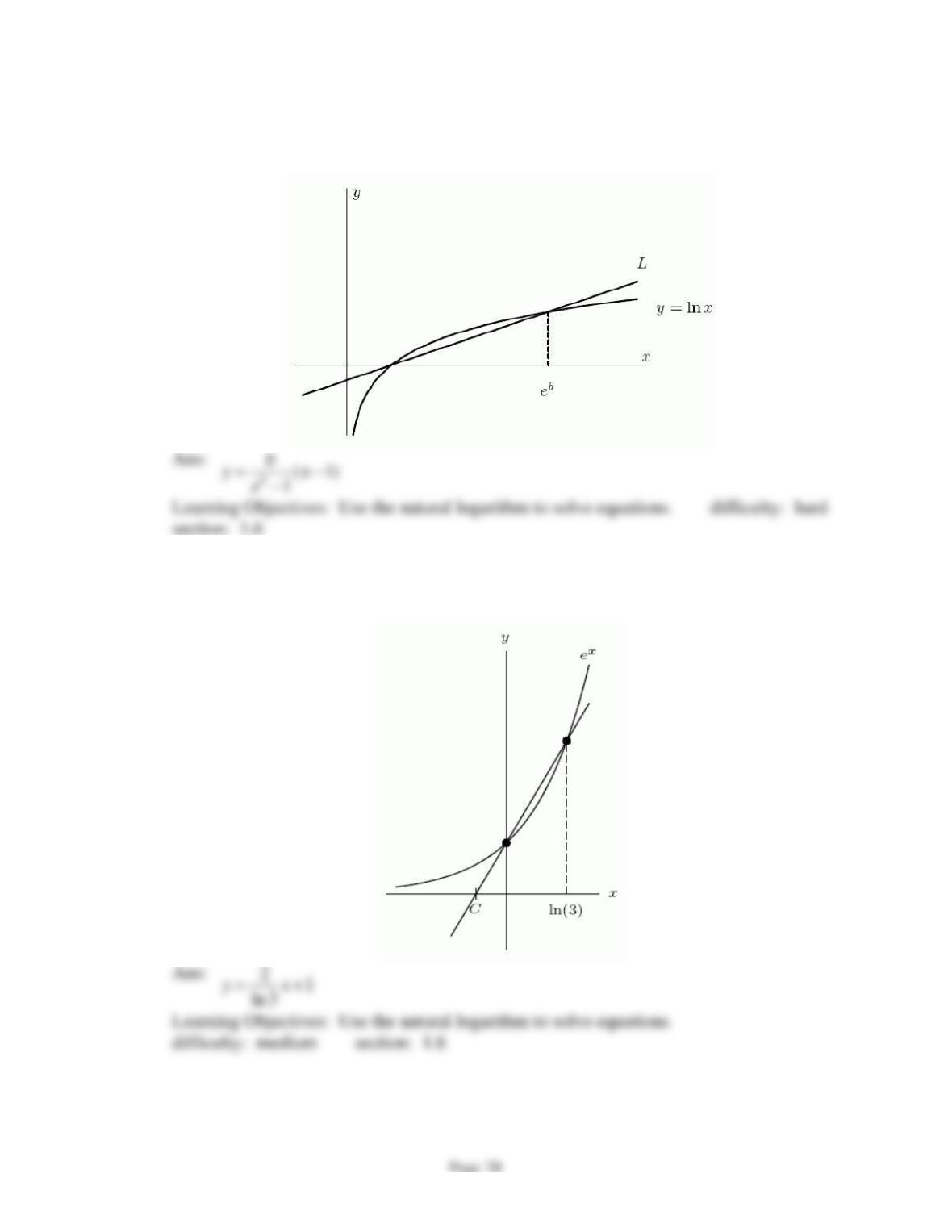
82.
Find an equation for the line L shown. Your answer will contain the positive constant
b.
83.
Find the equation of the line in the following figure.
Chapter 1
Page 29
84.
Solve
90 14 40 12
tt
=
for t. Round to two decimal places.
85.
Use logarithms to solve the equation
20(1.06) 100
x=
. Round to two decimal places.
Ans:
27.62
Learning Objectives: Use the natural logarithm to solve equations.
difficulty: medium section: 1.6
86.
What interest rate, compounded annually, is equivalent to a 9% rate compounded
continuously? Round to two decimal places.
Ans:
9.42%
Learning Objectives: Understand and interpret the forms of exponential functions and
convert from base ‘a’ to base ‘e’ and vice versa. difficulty: hard section: 1.6
87.
The following functions represent exponential growth or decay. Which ones represent
continuous growth or decay? Select all that apply.
A)
3.2(0.97)t
P=
B)
7.1(1.12)t
P=
C)
0.04
26 t
Pe=
D)
0.02
6t
Pe
−
=
functions and convert from base ‘a’ to base ‘e’ and vice versa. difficulty: easy
section: 1.6
88.
The function
–0.02
6e t
P=
represents exponential growth or decay.
A. What is the initial quantity?
B. What is the initial growth or decay rate?
Part B:
B. 2%
Learning Objectives: Build, solve, and interpret exponential functions given data,
graphs or words. difficulty: medium section: 1.7
Ans:
Learning Objectives: Use the natural logarithm to solve equations.
difficulty: medium section: 1.6
Chapter 1
89.
The number of bacteria in milk grows at a rate of 11% per day once the milk has been
bottled. When milk is put in the bottles, it has an average bacteria count of 500 million
per bottle.
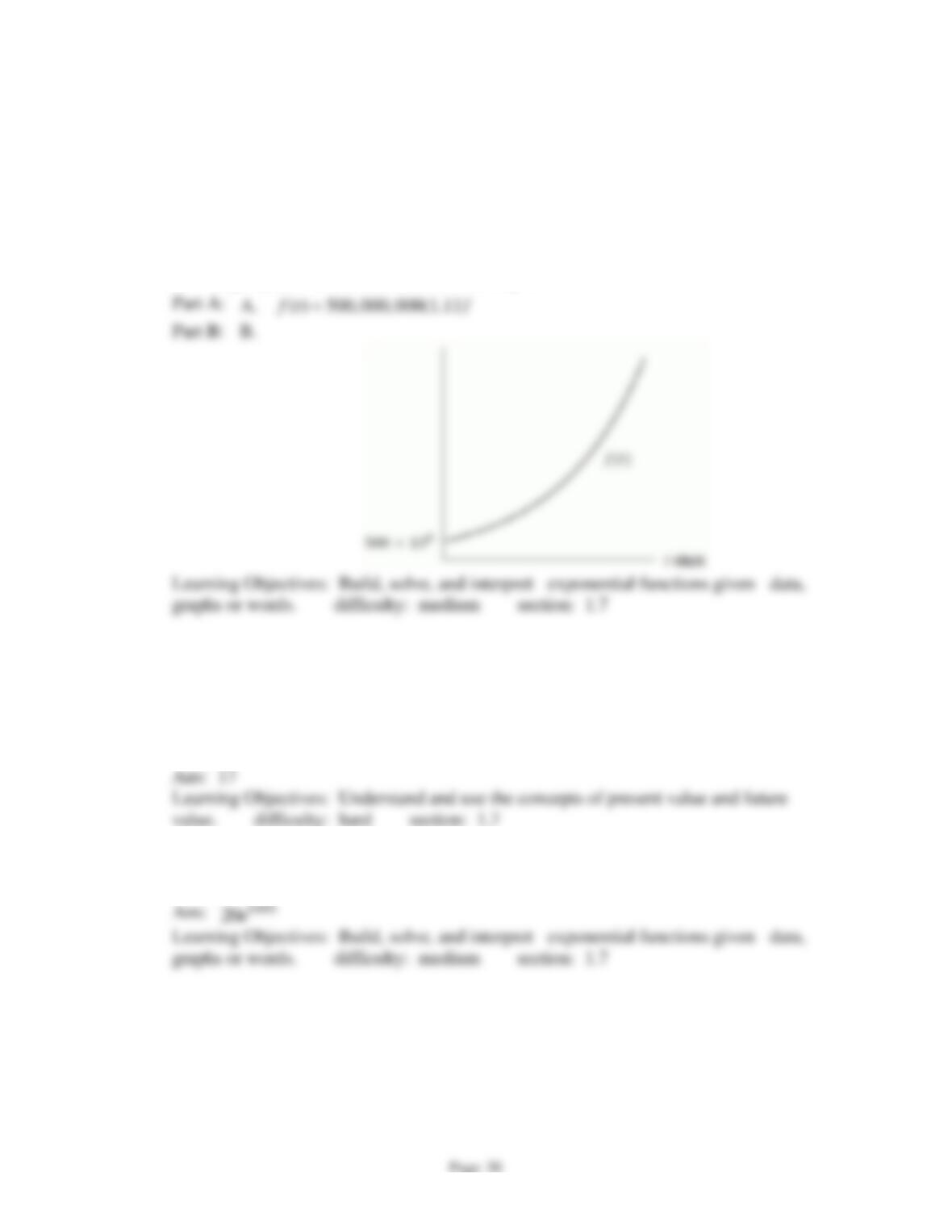
A. Write an equation for
()ft
, the number of bacteria t days after the milk was
bottled.
B. Graph
()ft
. Label the axes and intercepts.
A.
Learning Objectives: Build, solve, and interpret exponential functions given data,
graphs or words. difficulty: medium section: 1.7
90.
The number of bacteria in milk grows at a rate of 11% per day once the milk has been
bottled. When milk is put in the bottles, it has an average bacteria count of 500 million
per bottle. Suppose milk cannot be safely consumed if the bacteria count is greater
than 3 billion per bottle. Under this model, how many days would the milk be safe to
drink once it has been bottled?
Ans:
17
Learning Objectives: Understand and use the concepts of present value and future
value. difficulty: hard section: 1.7
91.
Write the function
( ) 20(1.1)t
at =
in the form
kt
Ae
. Round k to 3 decimal places.
Learning Objectives: Build, solve, and interpret exponential functions given data,
graphs or words. difficulty: medium section: 1.7
Chapter 1
92.
Write the function
1.6
( ) 10 t
b t e=
in the form
0()
t
Pa
. Round a to 3 decimal places.
Learning Objectives: Build, solve, and interpret exponential functions given data,
graphs or words. difficulty: medium section: 1.7
93.
Simplify the expression
2
ln( )
8a
e
as much as possible.
Learning Objectives: Build, solve, and interpret exponential functions given data,
graphs or words. difficulty: medium section: 1.7
94.
Solve
7 12
x=
for x using logs. Round to 3 decimal places.
Ans:
1.277
Learning Objectives: Use the natural logarithm to solve equations. difficulty: easy
section: 1.6
95.
Solve
59
57
xx
ee
+=
using logs. Round your answer to 3 decimal places.
Ans:
0.583
Learning Objectives: Use the natural logarithm to solve equations.
difficulty: medium section: 1.6
96.
What is the doubling time of prices which are increased by 13% per year? Round to
the nearest hundredth of a year.
Ans:
5.67 years
Learning Objectives: Understand and interpret properties of exponential models:
doubling time, half-life. difficulty: medium section: 1.7
97.
If the size of a bacteria colony doubles in 6 hours, how many hours will it take for the
number of bacteria to be 5 times the original amount? Round to 3 decimal places.
Ans:
13.932
Chapter 1
98.
Tornados are classified in several ways. A tornado’s classification on the Fujita Scale
as F1 through F5 is most commonly cited. Another classification of tornados is by path
length, given by the formula
P 2log( ) 1lL=+
where L is the length of the tornado’s
path length, in miles. The Binger, Oklahoma tornado of 1981 was an F4 whose path
was 16 miles in length. What was its Pl classification?
A)
P1
B)
P2
C)
P3
D)
P4
E)
P5
Ans: C Learning Objectives: Use the natural logarithm to solve equations.
difficulty: easy section: 1.6
99.
Use your calculator to find all of the solutions to the equation
2
2xx=
. Round your
answers to 2 decimal places.
Ans:
x = -.77, x = 4
Learning Objectives: Use the natural logarithm to solve equations.
100.
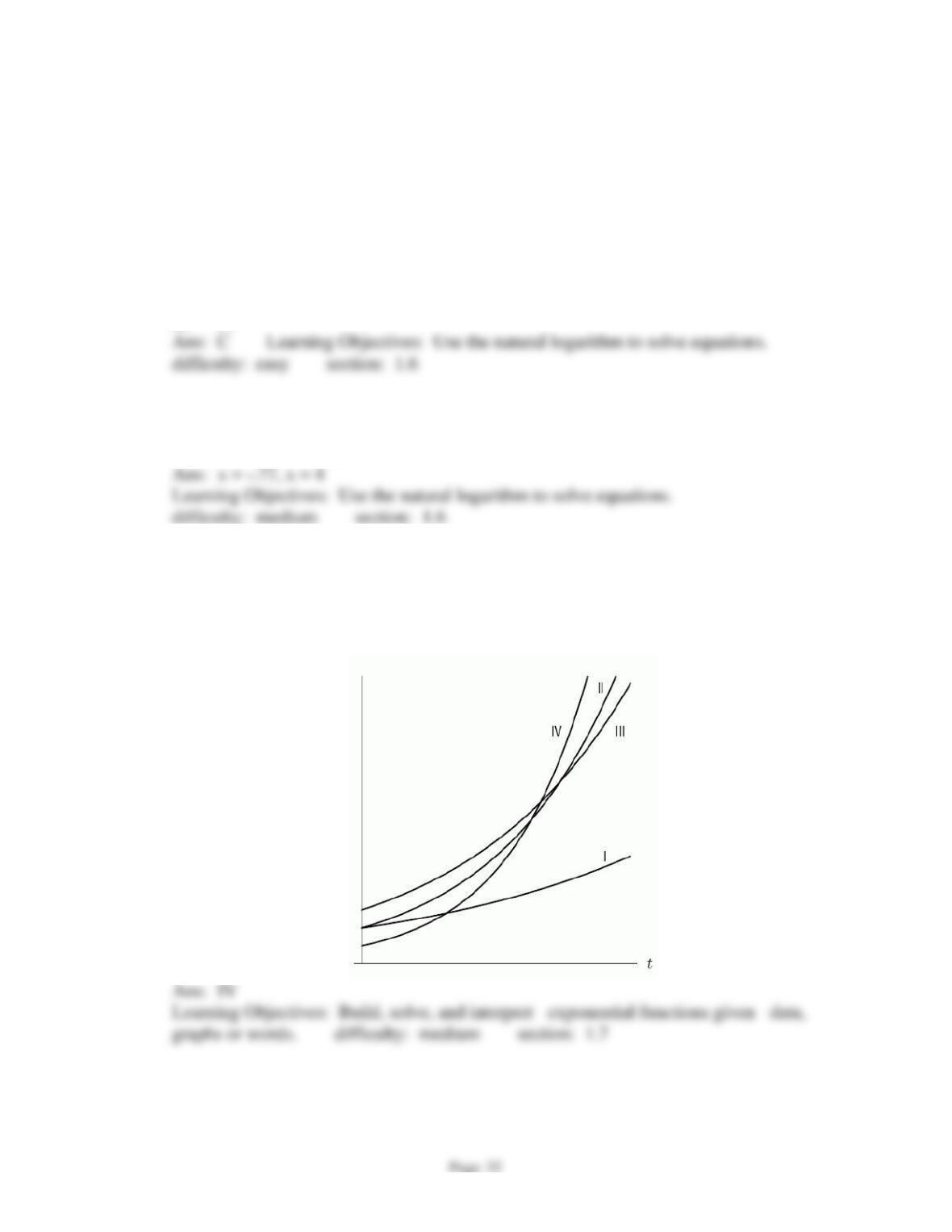
Each of the curves in the following figure represents the balance in a bank account at
time t after a single deposit at time t = 0. Assuming continuously compounded interest,
which curve represents the smallest initial deposit?
Ans:
Learning Objectives: Build, solve, and interpret exponential functions given data,
graphs or words. difficulty: medium section: 1.7
Chapter 1
101.
You win the lottery and are offered a choice of $90,000 now or $20,000 at the end of
each year for five years. Assuming a 5% annual interest rate and ignoring taxes, which
is the better option?
A)
The first
B)
The second
Ans: A Learning Objectives: Build, solve, and interpret exponential functions
given data, graphs or words. difficulty: medium section: 1.7
102.
The population
()P f t=
of the United States in millions t years after 1790 during the
period from 1790 to 1860 was given approximately by the exponential formula
0.0298
( ) 3.9 t
f t e=
. What was the annual percent growth rate of the US during this time
period?
Ans:
3%
Learning Objectives: Build, solve, and interpret exponential functions given data,
graphs or words. difficulty: medium section: 1.7
103.
The population
()P f t=
of the United States in millions t years after 1790 during the
years from 1790 to 1860 was given approximately by the exponential formula
0.0298
( ) 3.9 t
f t e=
. What was the approximate doubling time for the population? Round
to the nearest year.
Ans:
23 years
104.
A standard cup of coffee contains about 100 mg of caffeine, and caffeine leaves the
body at a rate of about 17% an hour. How many mg of caffeine are left in the body
after 6 hours if this rate is hourly? Round to 2 decimal places.
Ans:
32.69
Learning Objectives: Understand and use the concepts of present value and future
value. difficulty: medium section: 1.7
105.
A standard cup of coffee contains about 100 mg of caffeine, and caffeine leaves the
body at a rate of about 17% an hour. How many mg of caffeine are left in the body
after 6 hours if this rate is continuous? Round to 2 decimal places.
Ans:
36.06
Learning Objectives: Understand and use the concepts of present value and future
value. difficulty: easy section: 1.7
Chapter 1
106.
A clean up of a polluted lake will remove 4% of the remaining contaminants every year.
How many years will it take to reduce the quantity of contaminants to 1/10 of its present
level? Round to the nearest tenth.
Ans:
56.4
Learning Objectives: Understand and use the concepts of present value and future
value. difficulty: medium section: 1.7
107.
A new species, introduced into an environment in which it has no natural predators,
grows exponentially with continuous growth rate k=0.095 per year. There are initially
45 individuals introduced. Write the formula for
()Nt
, the number of individuals after
t years and use it to find how many years will it take for the population to reach 300
individuals. Round to 2 decimal places.
Ans:
19.97
Learning Objectives: Build, solve, and interpret exponential functions given data,
graphs or words. difficulty: medium section: 1.7
108.
The population of Nicaragua was 3.6 million in 1990 and growing at 3.4% per year.
Let P be the population in millions, and let t be the time in years since 1990. Express P
as a function of t. Select all that apply.
A)
3.6(1.034)t
P=
B)
0.0334
3.6 t
Pe=
C)
1.034
3.6 t
Pe=
D)
3.6(0.966)t
P=
Ans: A, B Learning Objectives: Build, solve, and interpret exponential functions
given data, graphs or words. difficulty: medium section: 1.7
109.
The population of Nicaragua was 3.6 million in 1990 and growing at 3.4% per year.
How many years does it take for the population of Nicaragua to increase by 60%?
Round to 2 decimal places.
Ans:
14.06
Learning Objectives: Understand and use the concepts of present value and future
value. difficulty: medium section: 1.7
Chapter 1
110.
An exponentially decaying substance was weighed every hour and the results are given
below. If the formula
0
kt
Q Q e−
=
gives the weight of the substance, Q, at time t in
hours since 9 am, then
0
Q
=_____ and k=_____. Round k to 2 decimal points.
Time
Weight (in grams)
9 am
10
10 am
8.958
11 am
8.025
12 noon
7.189
1 pm
6.440
111.
An exponentially decaying substance was weighed every hour and the results are given
below. What is the half-life of the substance? Round to the nearest tenth.
Time
Weight (in grams)
9 am
10.000
10 am
8.958
11 am
8.025
12 noon
7.189
1 pm
6.440
112.
In 1992, the Population Crisis Committee wrote:
“Large cities in developing countries are growing much faster than cities in the
industrialized world ever have. London, which in 1810 became the first industrialized
city to top 1 million, now has a population of 11 million. By contrast, Mexico City’s
population stood at only a million just 50 years ago and now it is 20 million.”
Assume that the percentage growth rates of London and Mexico City were constant over
the last two centuries. How many times greater is Mexico City’s percentage growth
rate than London’s? Round to the nearest tenth.
Chapter 1
113.
Is the function described by the following table of values exponential?
x
5.2
5.3
5.4
5.5
5.6
()fx
27.8
30.58
33.638
37.0018
40.70198
Ans:
yes
Learning Objectives: Build, solve, and interpret exponential functions given data,
graphs or words. difficulty: easy section: 1.7
114.
A quantity growing exponentially according to the formula
0
( ) 9t
Q t Q=
has a doubling
time of
ln 2
ln 9
.
A)
True
B)
False
Ans: A Learning Objectives: Understand and interpret properties of exponential
models: doubling time, half-life. difficulty: medium section: 1.7
115.
Which is worth more after 10 years: $1200 invested at 10% annual interest or $1500
invested at 8% annual interest?
A)
The 8% investment
B)
The 10% investment
Ans: A Learning Objectives: Build, solve, and interpret exponential functions
given data, graphs or words. difficulty: medium section: 1.7
116.
Suppose $1200 is invested at 10% annual interest and $1500 is invested at 8% annual
interest. After how many years will the investments be equal? Round to the nearest
whole number.
Ans:
12
Learning Objectives: Understand and use the concepts of present value and future
value. difficulty: hard section: 1.7
117.
A cigarette contains about 0.4 mg of nicotine. The half-life of nicotine in the body is
about 2 hours. How many hours does it take, after smoking a cigarette, for the level of
nicotine in a smoker’s body to be reduced to 0.1 mg? Round to 2 decimal places.
Ans:
4.00
Learning Objectives: Understand and interpret properties of exponential models:
doubling time, half-life. difficulty: easy section: 1.7
Chapter 1
118.
If
6
() x
f x e +
=
, find and simplify the average rate of change
(3 ) (3)f h f
h
+−
.
A)
1
B)
93
ee−
C)
xh
e
h
+
D)
9( 1)
h
ee
h
−
Ans: D Learning Objectives: Understand and interpret properties of exponential
models: doubling time, half-life. difficulty: medium section: 1.7
119.
In the book One Grain of Rice, a girl receives a reward that starts with one grain of rice
on day one, two grains on day two, four on day three and eight on day four. Each day,
she receives double the number of grains of rice. How many grains of rice does she
receive on the 20th day?
A)
400
B)
1,048,576
C)
2,782,184
D)
40
Ans: B Learning Objectives: Understand and use the concepts of present value and
future value. difficulty: easy section: 1.7
120.
Lisinopril is an ACE inhibitor derived from the venom of a Brazilian pit viper
frequently used in the treatment of hypertension. Because of Lisinopril’s relatively long
half-life of 12 hours, patients need to take a dose just once per day. A patient takes his
first dose, 20 mg, at 6 pm on Saturday.
a) How many hours does it take for the amount of Lisinopril in the patient’s body to
decrease to 17 mg? Round to two decimal places.
b) How many milligrams remain in the patient’s body right before he takes his next 20
mg at 6 pm on Sunday? Round to two decimal places
Ans:
a) 2.81 hours
b) 5.00 milligrams
Learning Objectives: Understand and interpret properties of exponential models:
doubling time, half-life. difficulty: medium section: 1.7
Chapter 1
121.
If the size of a bacteria colony doubles in 8 hours, how many hours will it take for the
number of bacteria to be 11 times the original amount? Round to 2 decimal places.
Ans:
27.68
Learning Objectives: Understand and interpret properties of exponential models:
doubling time, half-life. difficulty: medium section: 1.7
122.
Bank A offers 12% interest, compounded yearly, and Bank B offers 11.1% interest,
compounded continuously. Which bank should you choose if you have $1000 to invest
for 10 years?
Ans:
Bank A
Learning Objectives: Understand and interpret properties of exponential models:
doubling time, half-life. difficulty: medium section: 1.7
123.
You have $500 invested in an account earning 7.2% interest compounded annually.
How many years will it take to triple your money? Round to the nearest tenth of a year.
Ans:
15.8
Learning Objectives: Understand and use the concepts of present value and future
124.
You have $500 invested in an account earning 7.6% interest compounded annually.
Suppose the interest rate were compounded monthly instead, that is you earned
7.6
12
%
interest each month. How much interest would you then earn for a year?
Ans:
$39.35
Learning Objectives: Understand and interpret properties of exponential models:
doubling time, half-life. difficulty: easy section: 1.7
125.
A bank pays 6% annual interest. If $1000 is deposited in this bank account, find the
amount in the account after 5 years if the interest is compounded weekly.
Ans:
$1349.63
Learning Objectives: Understand and use the concepts of present value and future
value. difficulty: easy section: 1.7
126.
Use the following table to find
( (3))fg
.
x
0
1
2
3
4
()fx
2
4
6
3
5
()gx
5
3
2
1
0
Ans:
4
Chapter 1
127.
One of the graphs below shows the rate of flow, R, of blood from the heart in a man
who bicycles for 20 minutes, starting at t = 0 minutes. The other graph shows the
pressure, p, in the artery leading to a man’s lungs as a function of the rate of flow of
blood from the heart. Estimate
( (25))pR
.
A)
15 mm Hg
B)
11 mm Hg
C)
19 mm Hg
D)
7 mm Hg
formulas, graphs or tables. difficulty: easy section: 1.8
128.
Given the function
2
()m z z=
, find and simplify
( ) ( )m z h m z+−
.
graphs or tables. difficulty: medium section: 1.8
Chapter 1
129.
Let
( ) 9 1f x x=+
and
2
( ) 6g x x=+
. What is
( ( ))f g x
?
A)
2
9 55x+
B)
2
81 18 7xx++
C)
297xx++
D)
32
9 54 6x x x+ + +
E)
3
9 54 1xx++
formulas, graphs or tables. difficulty: easy section: 1.8
130.
The graphs of
()y f x=
and
()y g x=
are given in the following figure. Estimate
( (5))gf
.
A)
–7
B)
–15
C)
10−
D)
15
formulas, graphs or tables. difficulty: easy section: 1.8
131.
What is the equation for the graph obtained by shifting the graph of
3
yx=
vertically
upward by 7 units, followed by vertically stretching the graph by a factor of 5?
A)
3
5 35x+
B)
3
57x+
C)
2
35 7x+
D)
32
5 105 735 1715x x x+ + +
analytically and graphically. difficulty: easy section: 1.8