Exam
Name___________________________________
SHORT ANSWER. Write the word or phrase that best completes each statement or answers the question.
Solve the problem.
1)
In the table below, the amount of the U.S. minimum wage is listed for selected years.
U.S. Minimum Wage
Year 1961 1967 1974 1980 1981 1990 1991 1996 1997
Wage $1.15 $1.40 $2.00 $3.10 $3.35 $3.80 $4.25 $4.75 $5.15
Find an exponential regression model of the form y = a ·bx, where y represents the U.S.
minimum wage x years after 1960. Round a and b to four decimal places. According to this
model, what will the minimum wage be in 2005? In 2010?
1)
2)
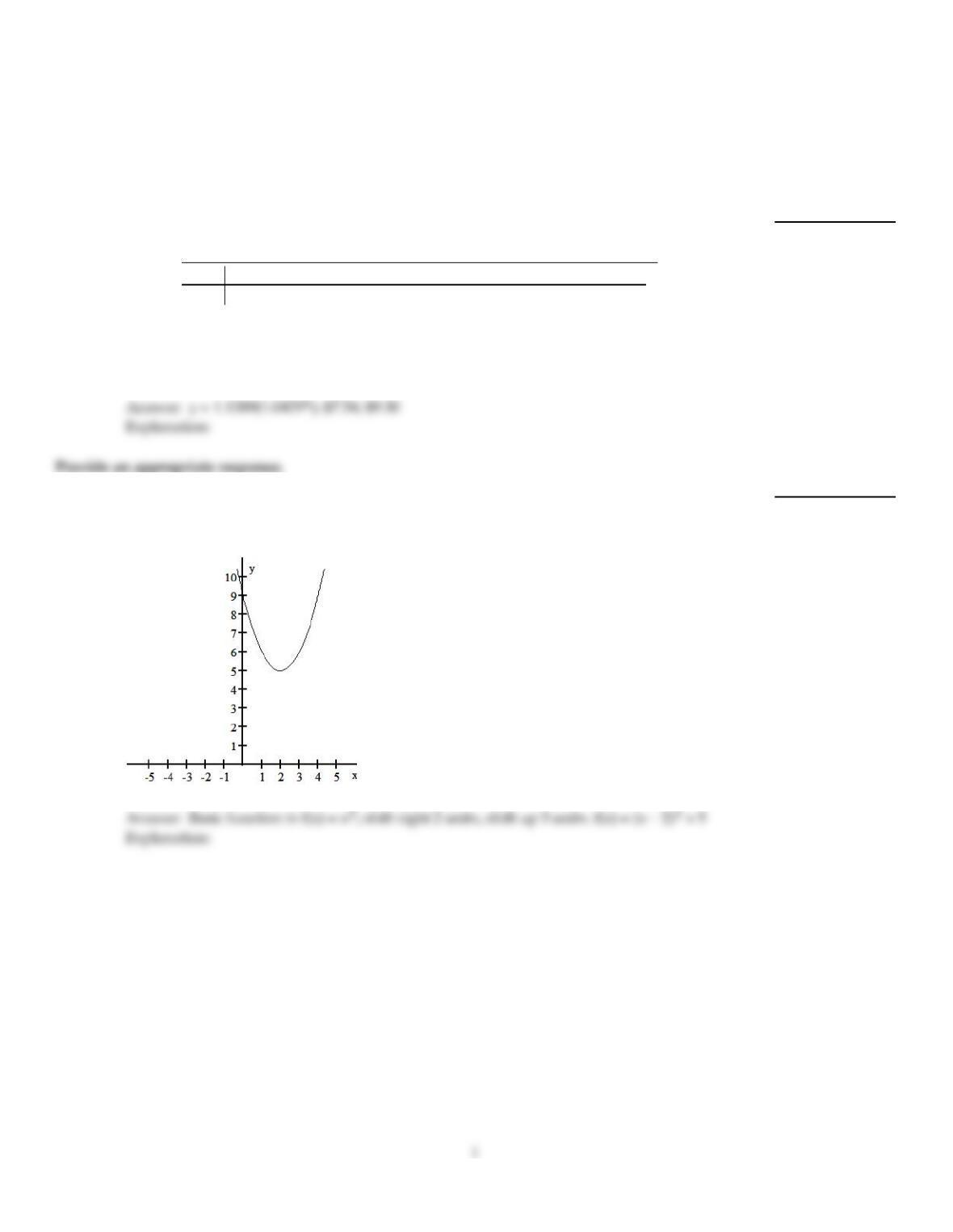
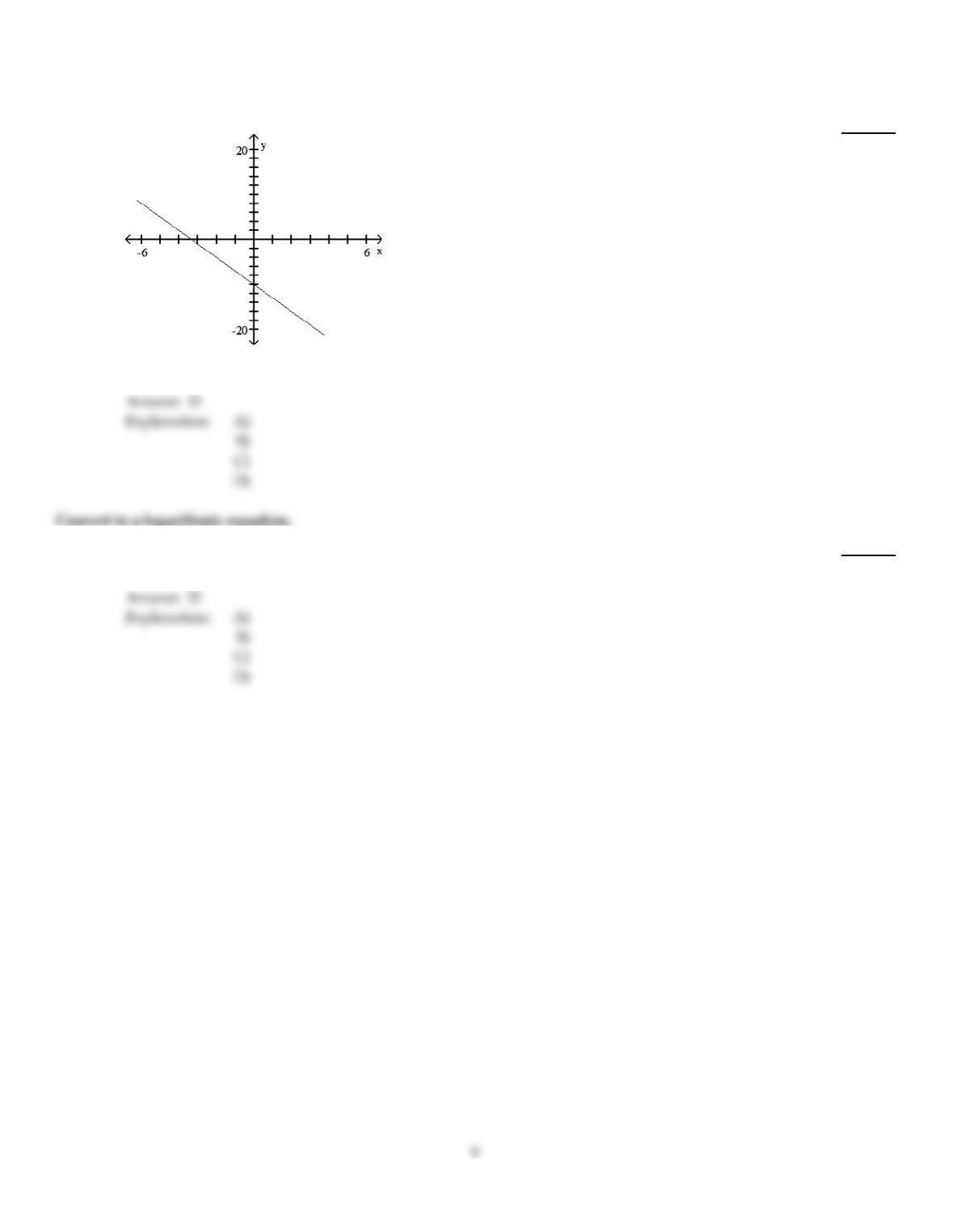
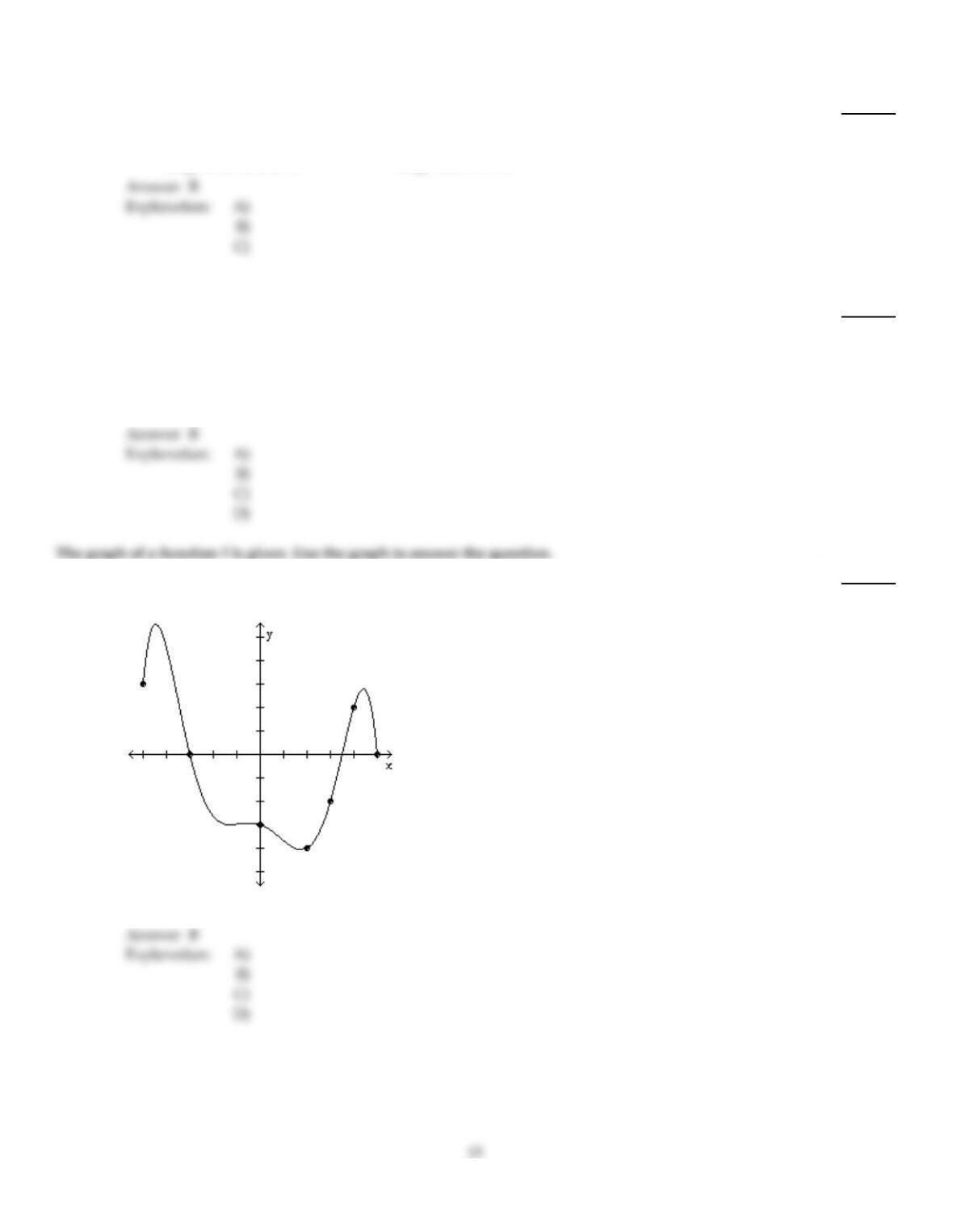
The following graph represents the result of applying a sequence of transformations to the
graph of a basic function. Identify the basic function and describe the transformation(s).
Write the equation for the given graph.
2)
Solve the problem.
3)
The financial department of a company that manufactures portable MP3 players arrived at
the following daily cost equation for manufacturing x MP3 players per day:
C(x) = 1500 + 105x +x2. The average cost per unit at a production level of players per day
is C(x) =C(x)
x.
(A) Find the rational function C.
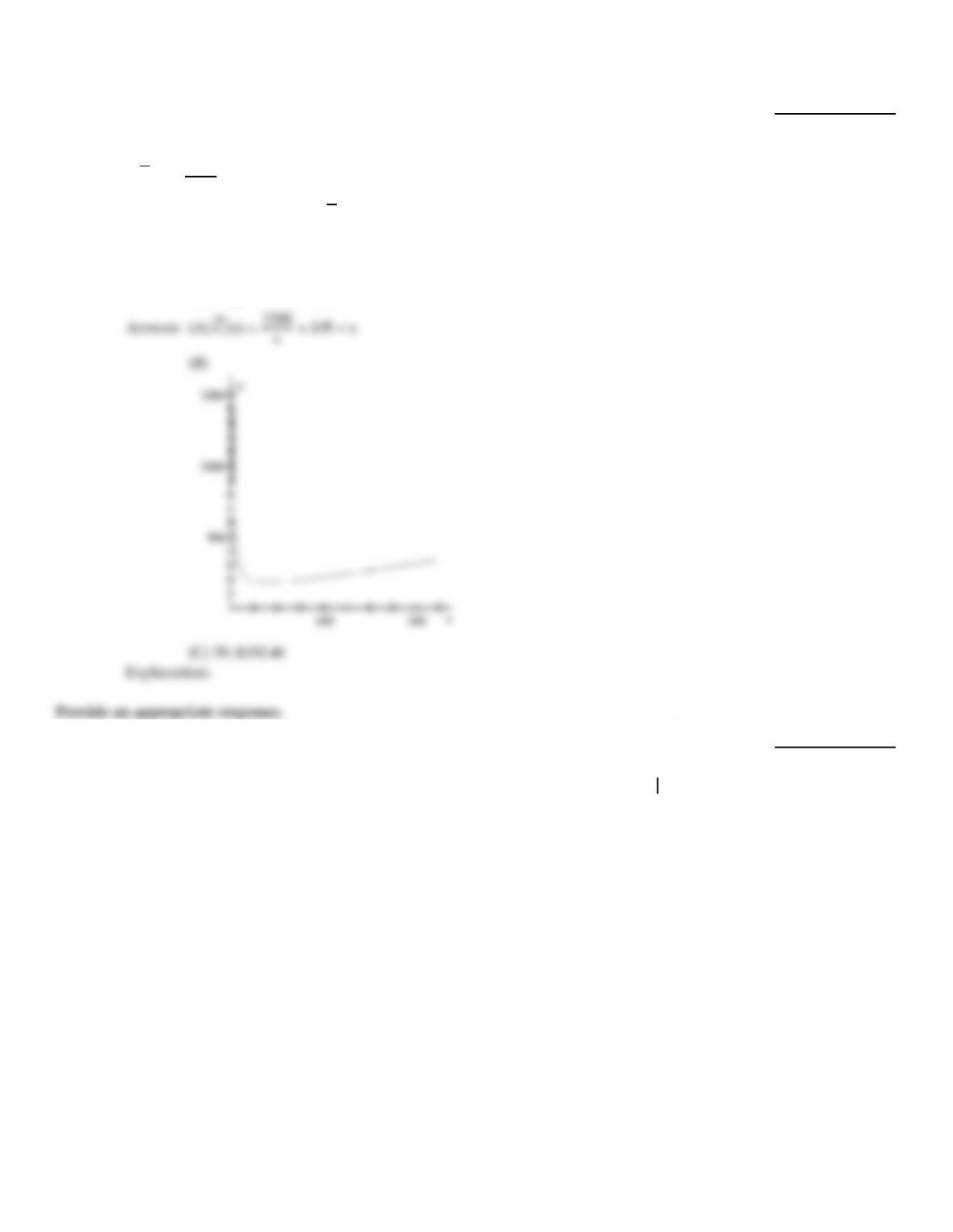
(B) Graph the average cost function on a graphing utility for 10 x 200.
(C) Use the appropriate command on a graphing utility to find the daily production level
(to the nearest integer) at which the average cost per player is a minimum. What is the
minimum average cost (to the nearest cent)?
3)
4)
Find the vertex and the maximum or minimum of the quadratic function f(x) = –x2– 4x + 5
by first writing f in standard form. State the range of f and find the intercepts of f .
4)
Answer:
f(x) = –(x + 2)2+ 9 ; vertex: (–2, 9); maximum: f(–2) = 9; Range of f = {y y 9} ;
y–intercept: (0, 5); x–intercepts: (–5, 0), (1, 0).
Explanation:
2
Answer:
Explanation:
Solve the problem.
5)
The financial department of a company that produces digital cameras arrived at the
following price–demand function and the corresponding revenue function:
p(x) = 95.4 – 6x price–demand
R(x) = x · p(x) = x(95.4 – 6x) revenue function
The function p(x) is the wholesale price per camera at which x million cameras can be sold
and R(x) is the corresponding revenue (in million dollars). Both functions have domain 1
x 15. They also found the cost function to be C(x) = 150 + 15.1x (in million dollars) for
manufacturing and selling x cameras. Find the profit function and determine the
approximate number of cameras, rounded to the nearest hundredths, that should be sold
for maximum profit.
5)
Use the REGRESSION feature on a graphing calculator.
6)
A particular bacterium is found to have a doubling time of 20 minutes. If a laboratory
culture begins with a population of 300 of this bacteria and there is no change in the
growth rate, how many bacteria will be present in 55 minutes? Use six decimal places in
the interim calculation for the growth rate.
6)
Provide an appropriate response.
7)
If g(x) = –4x2+ x – 9, find g(–2), g(1), and g 3
2.
7)
3
8)
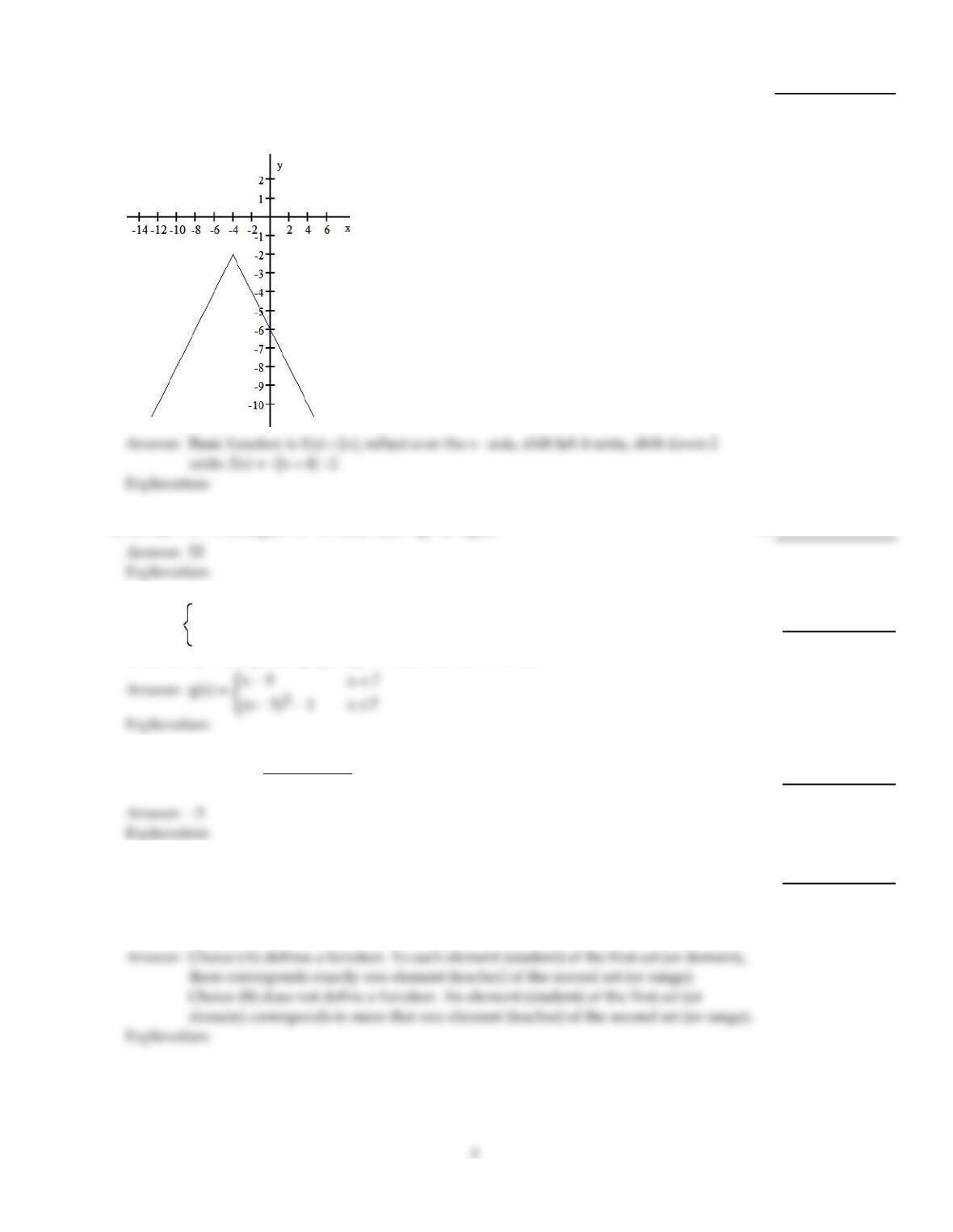
The following graph represents the result of applying a sequence of transformations to the
graph of a basic function. Identify the basic function and describe the transformation(s).
Write the equation for the given graph.
8)
9)
For f(t) = 3t + 2 and g(t) = 2 –t2, find 4f(3) – g(–3) + g(0).
9)
10)
If f(x) =x – 3 if x < 2
x2 if x 2 , what is the definition of g(x), the function whose graph is
obtained by shifting f(x)’s graph right 5 units and down 1 unit?
10)
11)
For f(t) = 3 – 5t, find f(a + h) – f(a)
h.
11)
12)
Let T be the set of teachers at a high school and let S be the set of students enrolled at that
school. Determine which of the following correspondences define a function. Explain.
(A) A student corresponds to the teacher if the student is enrolled in the teacher’s class.
(B) A student corresponds to every teacher of the school.
12)
13)
Only one of the following functions has domain which is not equal to all real numbers.
State which function and state its domain.
(A) h(x) =4x2– 3x – 5 (B) f(x) =2x
48 – x (C) g(x) =x + 7
2
13)
MULTIPLE CHOICE. Choose the one alternative that best completes the statement or answers the question.
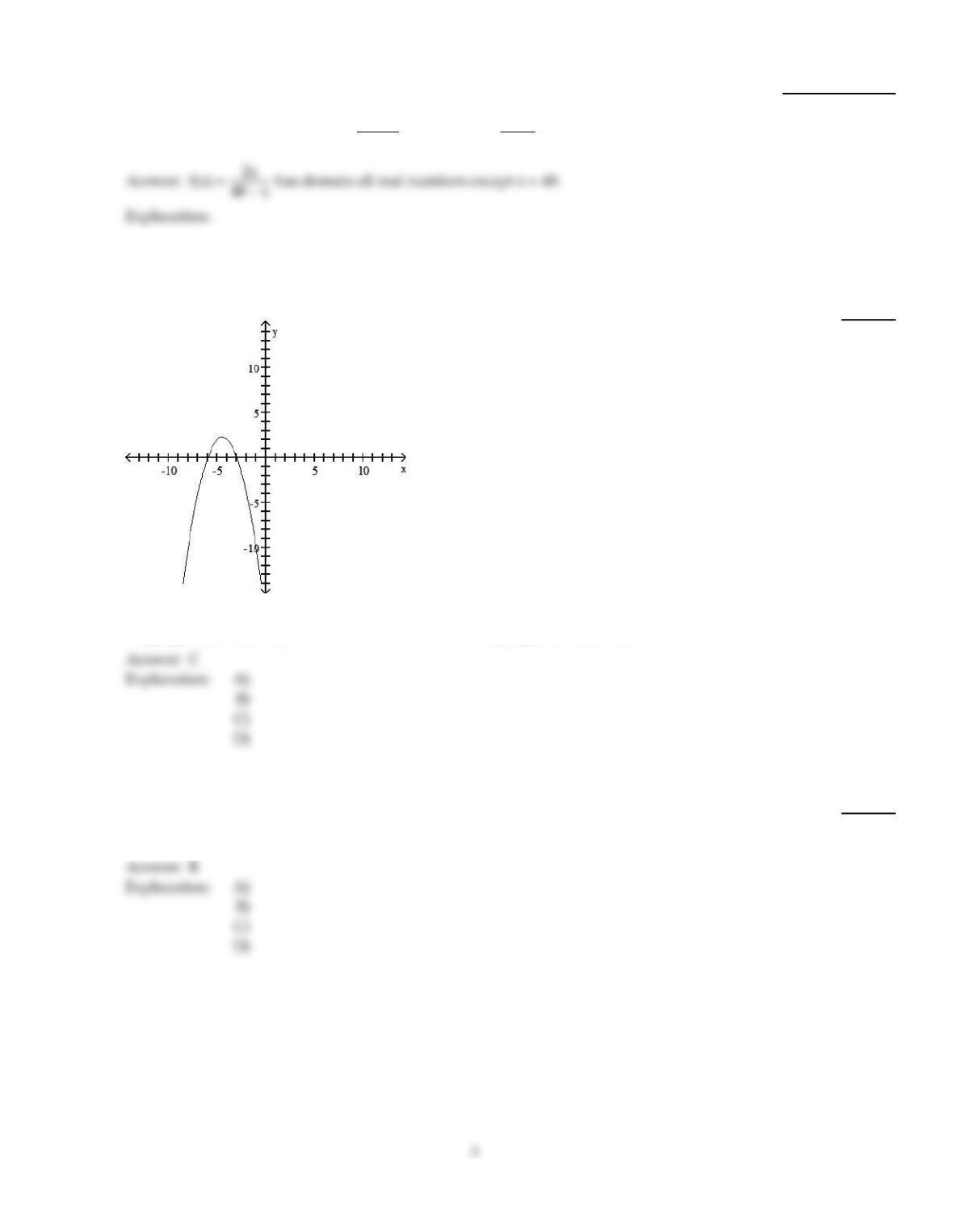
Write an equation for the lowest–degree polynomial function with the graph and intercepts shown in the figure.
14)
14)
A)
f(x) =x2+ 18x – 9
B)
f(x) =x2+ 18x + 9
C)
f(x) = –x2– 9x –18
D)
f(x) =x2+ 9x + 18
Solve graphically to two decimal places using a graphing calculator.
15)
1.7x2–2.6x –3.9 > 0
15)
A)
x < –2.46 or x >0.93
B)
x < –0.93 or x >2.46
C)
–0.93 < x <2.46
D)
–2.46 < x <0.93
Find the slope and y intercept of the graph of the equation.
16)
y =x– 1
16)
A)
Slope =1; y intercept = –1
B)
Slope =0; y intercept =1
C)
Slope = –1; y intercept = 1
D)
Slope = –1; y intercept = –1
17)
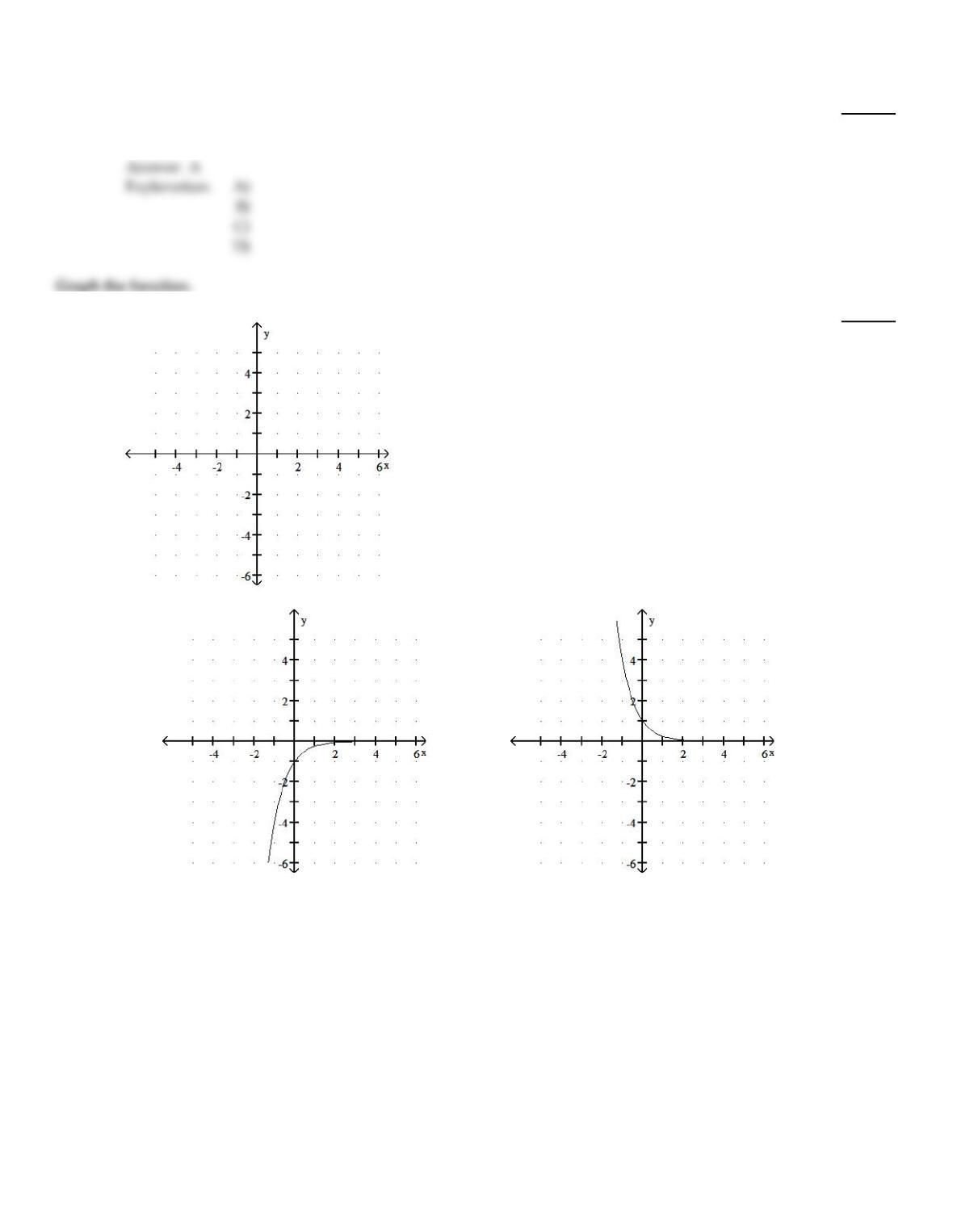
f(x) =4x
17)
A)
B)
6
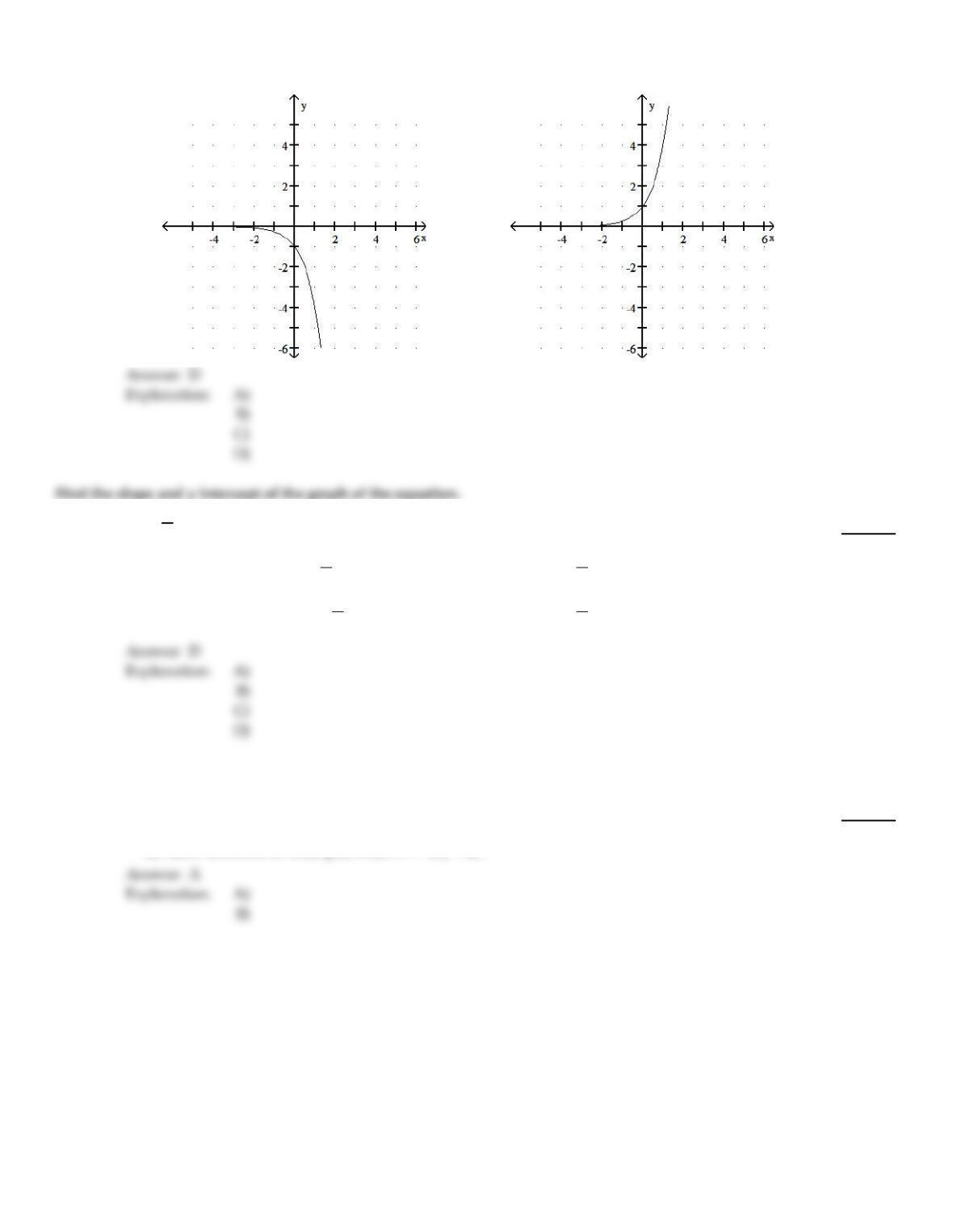
C)
D)
18)
y = – x
2+ 4
18)
A)
Slope =4; y intercept =1
2
B)
Slope = – 1
2; y intercept =-4
C)
Slope =4; y intercept = – 1
2
D)
Slope = – 1
2; y intercept =4
Determine if the equation specifies a function with independent variable x. If so, find the domain. If not, find a value of x
to which there corresponds more than one value of y.
19)
xy + 3y =-4
19)
A)
A function with domain all real numbers except x = –3
B)
Not a function; for example, when x =-4, y = ±3
7
Solve the problem.
20)
To estimate the ideal minimum weight of a woman in pounds multiply her height in inches by 4
and subtract 130. Let W = the ideal minimum weight and h = height. W is a linear function of h.
Find the ideal minimum weight of a woman whose height is 62 inches.
20)
A)
120 lb
B)
118 lb
C)
378 lb
D)
130 lb
Find the equation of any horizontal asymptote.
21)
f(x) =5x2+ 5
5x2– 5
21)
A)
y =5
B)
y =-5
C)
y = 1
D)
None
For the polynomial function find the following: (i) Degree of the polynomial; (ii) All x intercepts; (iii) The y intercept.
22)
y =x2+ 7x – 30
22)
A)
(i) 2
(ii) –10, 1
(iii) -30
B)
(i) 2
(ii) –10, 3
(iii) -30
C)
(i) 2
(ii) 10, -3
(iii) -30
D)
(i) 2
(ii) 10, 3
(iii) -30
Find the equations of any vertical asymptotes.
23)
f(x) =x2– 100
(x – 1)(x + 1)
23)
A)
x = 10, x = –10
B)
x =1, x =-1
C)
y =1, y =-1
D)
x =-1
The graph that follows is the graph of a polynomial function. (i) What is the minimum degree of a polynomial function
that could have the graph? (ii) Is the leading coefficient of the polynomial negative or positive?
24)
24)
A)
(i) 1
(ii) Positive
B)
(i) 2
(ii) Negative
C)
(i) 2
(ii) Positive
D)
(i) 1
(ii) Negative
25)
23= 8
25)
A)
log2 3 = 8
B)
log8 2 = 3
C)
log3 8 = 2
D)
log2 8 = 3
Use the REGRESSION feature on a graphing calculator.
26)
A strain of E–coli Beu–recA441 is placed into a petri dish at 30
Celsius and allowed to grow. The
following data are collected. Theory states that the number of bacteria in the petri dish will initially
grow according to the law of uninhibited growth. The population is measured using an optical
device in which the amount of light that passes through the petri dish is measured.
Time in hours , x Population, y
0 0.09
2.5 0.18
3.5 0.26
4.5 0.35
6 0.50
Find the exponential equation in the form y = a ·bx, where x is the hours of growth. Round to four
decimal places.
26)
A)
y =1.3384x
B)
y = 0.0903 ·1.3384x
C)
y =0.0903x
D)
y = 1.3384 ·0.0903x
Use the properties of logarithms to solve.
27)
log7 x +log7(x – 2) =log7 24
27)
A)
2
B)
7
C)
24
D)
6
28)
logb(x + 3) +logb x =logb 54
28)
A)
3
B)
–6, –3
C)
6
D)
–6
10
Graph the function.
29)
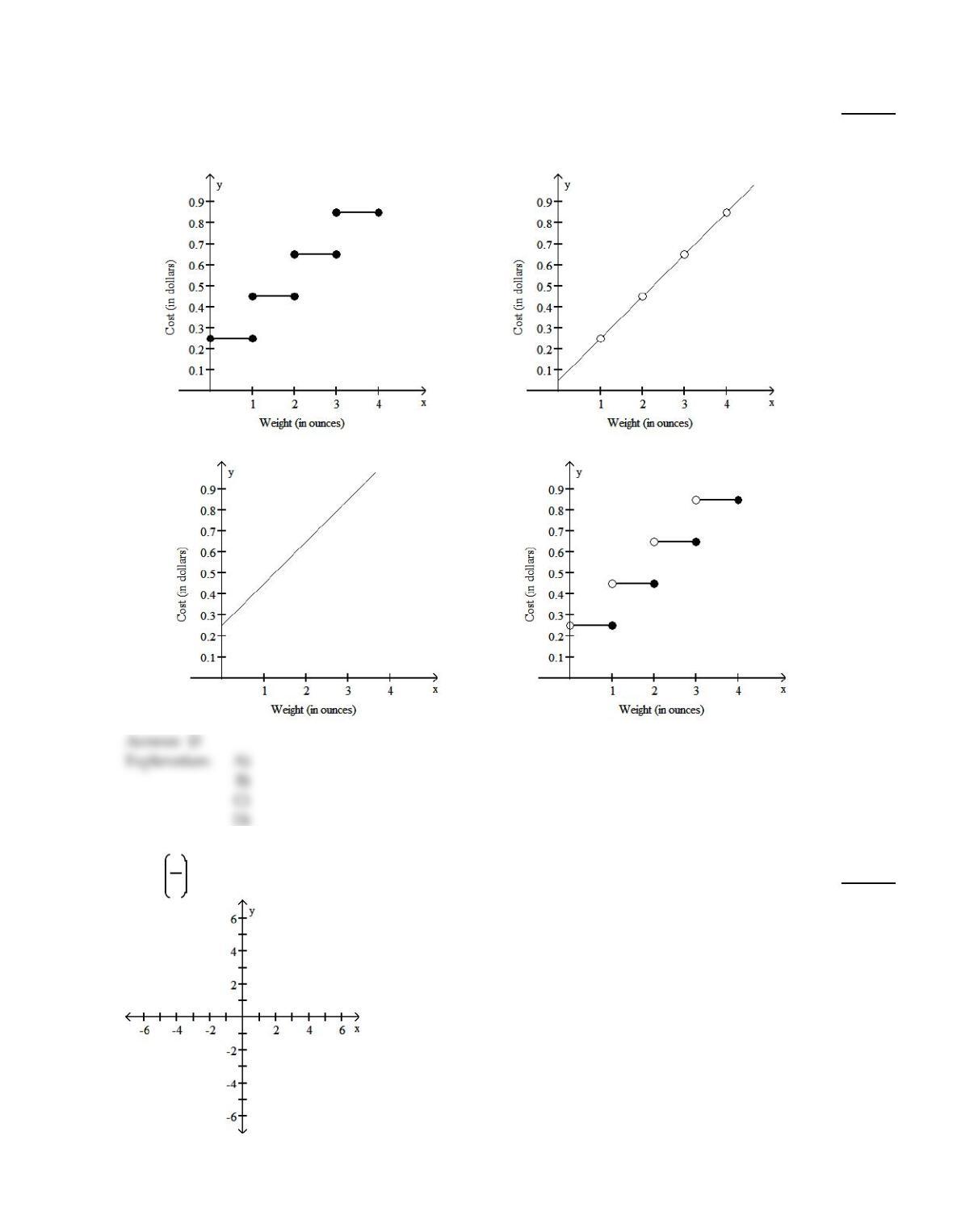
Assume it costs 25 cents to mail a letter weighing one ounce or less, and then 20 cents for each
additional ounce or fraction of an ounce. Let L(x) be the cost of mailing a letter weighing x ounces.
Graph y = L(x). Use the interval (0, 4].
29)
A)
B)
C)
D)
30)
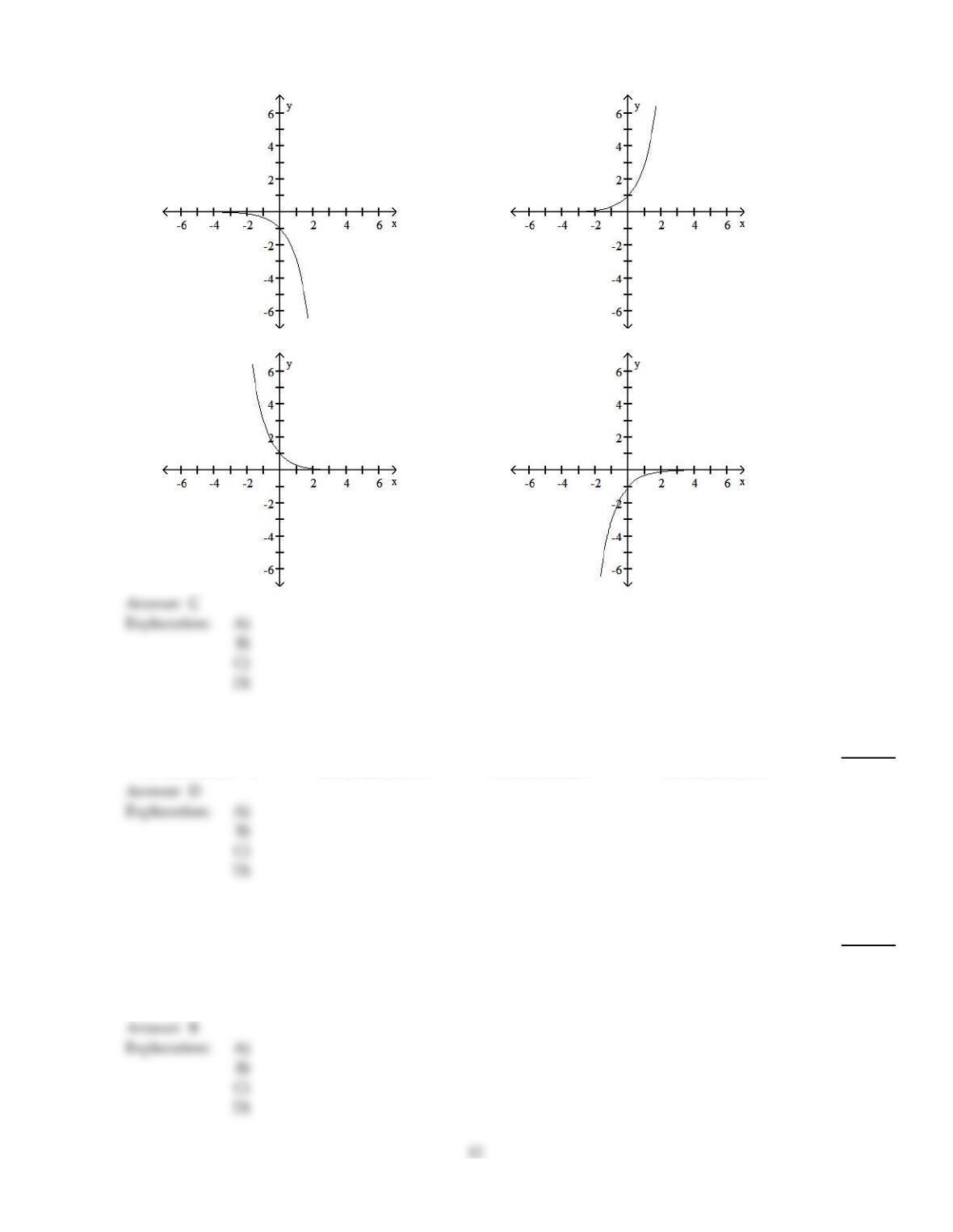
f(x) =1
3x
30)
11
A)
B)
C)
D)
Determine whether there is a maximum or minimum value for the given function, and find that value.
31)
f(x) =x2– 20x +104
31)
A)
Maximum: –4
B)
Maximum: 10
C)
Minimum: 0
D)
Minimum: 4
Write an equation for a function that has a graph with the given transformations.
32)
The shape of y =x2 is vertically stretched by a factor of 10, and the resulting graph is reflected
across the x–axis.
32)
A)
f(x) =(x – 10)2
B)
f(x) = – 10x2
C)
f(x) = 10x2
D)
f(x) = 10(x – 10)2
Determine whether the relation represents a function. If it is a function, state the domain and range.
33)
{(-2, 8), (-1, 5), (0, 4), (1, 5), (3, 13)}
33)
A)
function
domain: {8, 5, 4, 13}
range: {-2, -1, 0, 1, 3}
B)
function
domain: {-2, -1, 0, 1, 3}
range: {8, 5, 4, 13}
C)
not a function
Solve the problem.
34)
Since life expectancy has increased in the last century, the number of Alzheimer’s patients has
increased dramatically. The number of patients in the United States reached 4 million in 2000.
Using data collected since 2000, it has been found that the data can be modeled by the exponential
function y = 4.19549 ·(1.02531)x, where x is the years since 2000. Estimate the Alzheimer’s patients
in 2025. Round to the nearest tenth.
34)
A)
3.9 million
B)
7.8 million
C)
4.8 million
D)
8.0 million
35)
Use the graph of f given below to find f(8).
10
-10 10
-10
35)
A)
10
B)
4
C)
14
D)
8
Write an equation of the line with the indicated slope and y intercept.
36)
Slope = –4, y intercept =5
36)
A)
y = –4x +5
B)
y =4x +5
C)
y =5x –4
D)
y = –4x –5
Use the REGRESSION feature on a graphing calculator.
37)
For some reason the quality of production decreased as the year progressed at a flash drive
manufacturing plant. The following data represent the percentage of defective flash drives
produced at the plant in the corresponding month of the year.
Month, x 2 3 5 7 8 9 12
% defective, y 1.3 1.6 2.0 2.4 2.6 2.8 3.1
Use the regression equation with values rounded to four decimals to predict the percentage of
defective drives in month 6, June.
37)
A)
2.15%
B)
2.0%
C)
2.3%
D)
2.20%
38)
log 8 512 = t
38)
A)
8t= 512
B)
8512= t
C)
t8= 512
D)
5128= t
39)
y =4x –5
39)
A)
Slope =4, y intercept =5
B)
Slope =4, y intercept = –5
C)
Slope =5, y intercept =4
D)
Slope = –5, y intercept =4
Find the vertex form for the quadratic function. Then find each of the following:
(A) Intercepts
(B) Vertex
(C) Maximum or minimum
(D) Range
40)
g(x) =x2– 4x – 5
40)
A)
Standard form: g(x) =(x + 2)2– 9
(A) x–intercepts: – 1, 5; y–intercept: -5
(B) Vertex (2, -9)
(C) Maximum: -9
(D) y -9
B)
Standard form: g(x) =(x – 2)2– 9
(A) x–intercepts: – 1, 5; y–intercept: -5
(B) Vertex (-2, -9)
(C) Minimum: -9
(D) y -9
C)
Standard form: g(x) =(x – 2)2– 9
(A) x–intercepts: – 1, 5; y–intercept: -5
(B) Vertex (2, -9)
(C) Minimum: -9
(D) y -9
D)
Standard form: g(x) =(x + 2)2– 9
(A) x–intercepts: -5, 1; y–intercept: -5
(B) Vertex (2, -9)
(C) Minimum: -9
(D) y -9
Solve the equation graphically to four decimal places.
41)
Let f(x) =-0.5x2+4x +2, find f(x) =11.
41)
A)
4.0000, 10.0000
B)
10.0000
C)
4.0000
D)
No solution
Write an equation of the line with the indicated slope and y intercept.
42)
Slope =5
2; y intercept = – 7
2
42)
A)
y =5
2x +7
2
B)
y =5
2x –7
2
C)
y = – 7
2x +5
2
D)
y =7
2x –5
2
Find the slope of the line containing the given points.
43)
(9, -2); (-2, 2)
43)
A)
– 4
11
B)
4
11
C)
– 11
4
D)
11
4
44)
How can the graph of f(x) = –(x –1 )2 6 be obtained from the graph of y =x2?
44)
A)
Shift it horizontally 1 units to the right. Reflect it across the y–axis. Shift it 6 units up.
B)
Shift it horizontally 1 units to the right. Reflect it across the x–axis. Shift it 6 units up.
C)
Shift it horizontally 1 units to the left. Reflect it across the x–axis. Shift it 6 units up.
D)
Shift it horizontally 1 units to the right. Reflect it across the y–axis. Shift it 6 units down.
B
Solve the equation graphically to four decimal places.
45)
Let f(x) =-0.5x2+4x +2, find f(x) = –5.
45)
A)
9.4772
B)
No solution
C)
-1.4772, 9.4772
D)
-1.4772
C
Find the equations of any vertical asymptotes.
46)
f(x) =x – 1
x2+ 3
46)
A)
x =-3
B)
x =3
C)
x =1, x =-1
D)
None
D
A
Solve the problem.
47)
In economics, functions that involve revenue, cost and profit are used. Suppose R(x) and C(x)
denote the total revenue and the total cost, respectively, of producing a new high–tech widget. The
difference P(x) = R(x) – C(x) represents the total profit for producing x widgets. Given R(x) = 60x –
0.4 x2 and C(x) = 3x + 13, find the equation for P(x).
47)
A)
P(x) = –0.4 x2+ 57x – 13
B)
P(x) = 3x + 13
C)
P(x) = 60x – 0.4 x2
D)
P(x) = –0.4 x2+ 63x + 13
48)
f(x) =8
x3
48)
A)
x < 0
B)
All real numbers except 0
C)
No solution
D)
All real numbers
Find the function value.
49)
f(x) =x2+ 7
x3+ 6x; f(4)
49)
A)
2
11
B)
23
70
C)
23
88
D)
23
64
17
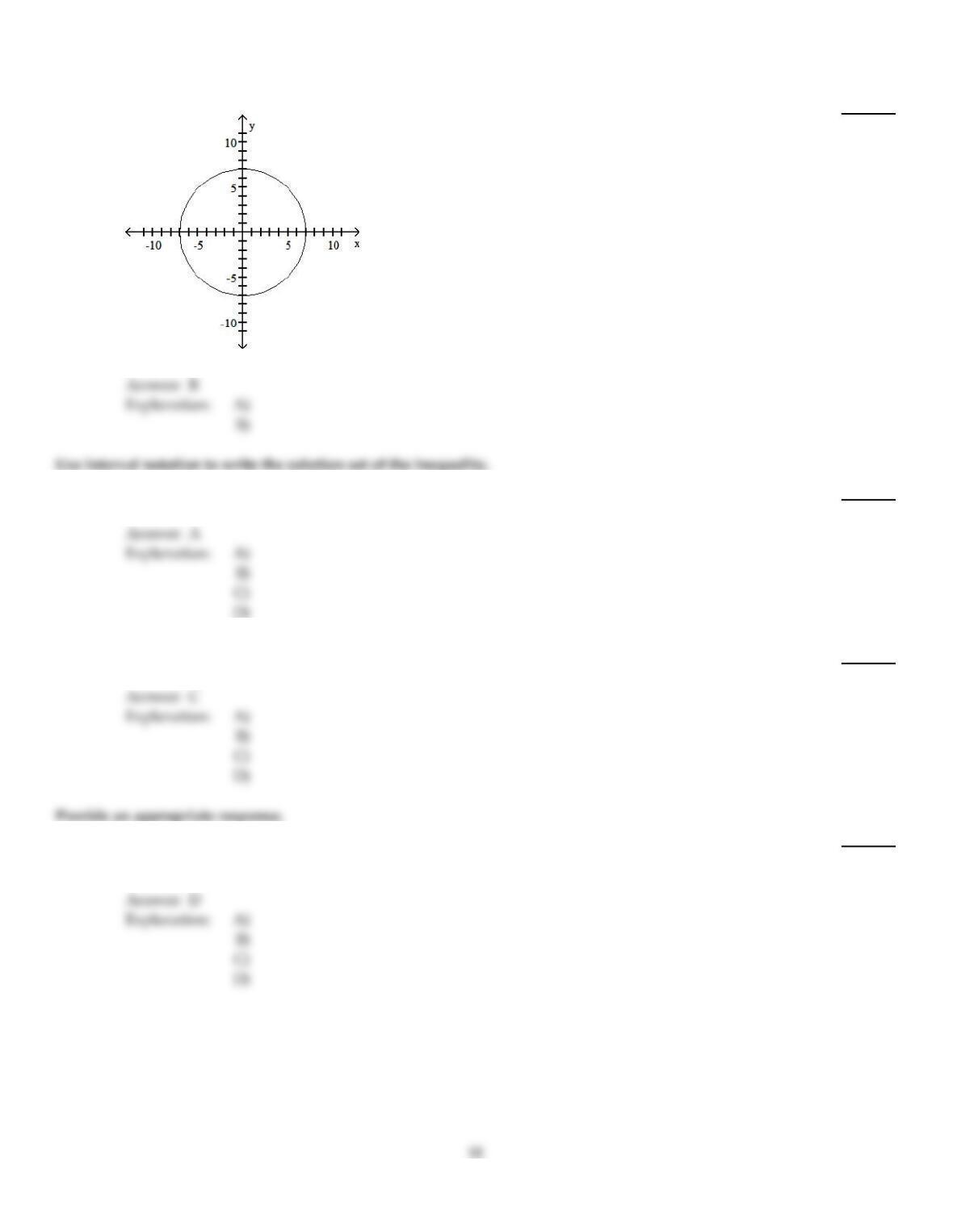
Determine whether the graph is the graph of a function.
50)
50)
A)
function
B)
not a function
51)
x2– 3x – 18 0
51)
A)
[-3, 6]
B)
(–, -3] [6, )
C)
(–, -3]
D)
[6, )
52)
-9x – 45 0
52)
A)
[5, )
B)
[-5, )
C)
(–, -5]
D)
(–, 5]
53)
Write the equation of a line that passes through (3, 9) and (0, –7). Write the final answer in the form
Ax + By = C where A, B, and C are integers with no common divisors (other than ±1) and A > 0.
53)
A)
3x – 16y = 21
B)
–16x + 3y = 21
C)
16x – 3y = –21
D)
16x – 3y = 21
Solve the problem.
54)
In economics, functions that involve revenue, cost and profit are used. Suppose R(x) and C(x)
denote the total revenue and the total cost, respectively, of producing a new high–tech widget. The
difference P(x) = R(x) – C(x) represents the total profit for producing x widgets. Given R(x) = 60x –
0.4 x2 and C(x) = 3x + 13, find P(100).
54)
A)
2000
B)
55687
C)
1687
D)
313
55)
55)
A)
function
B)
not a function
Solve the problem.
56)
The function P, given by P(d) =1
33d + 1, gives the pressure, in atmospheres (atm), at a depth d, in
feet, under the sea. Find the pressure at 200 feet. Round your answer to the nearest whole number.
56)
A)
7 atm
B)
201 atm
C)
8 atm
D)
200 atm
Determine whether the relation represents a function. If it is a function, state the domain and range.
57)
315
420
525
630
57)
A)
function
domain:{15, 20, 25, 30}
range: {3, 4, 5, 6}
B)
function
domain: {3, 4, 5, 6}
range: {15, 20, 25, 30}
C)
not a function
58)
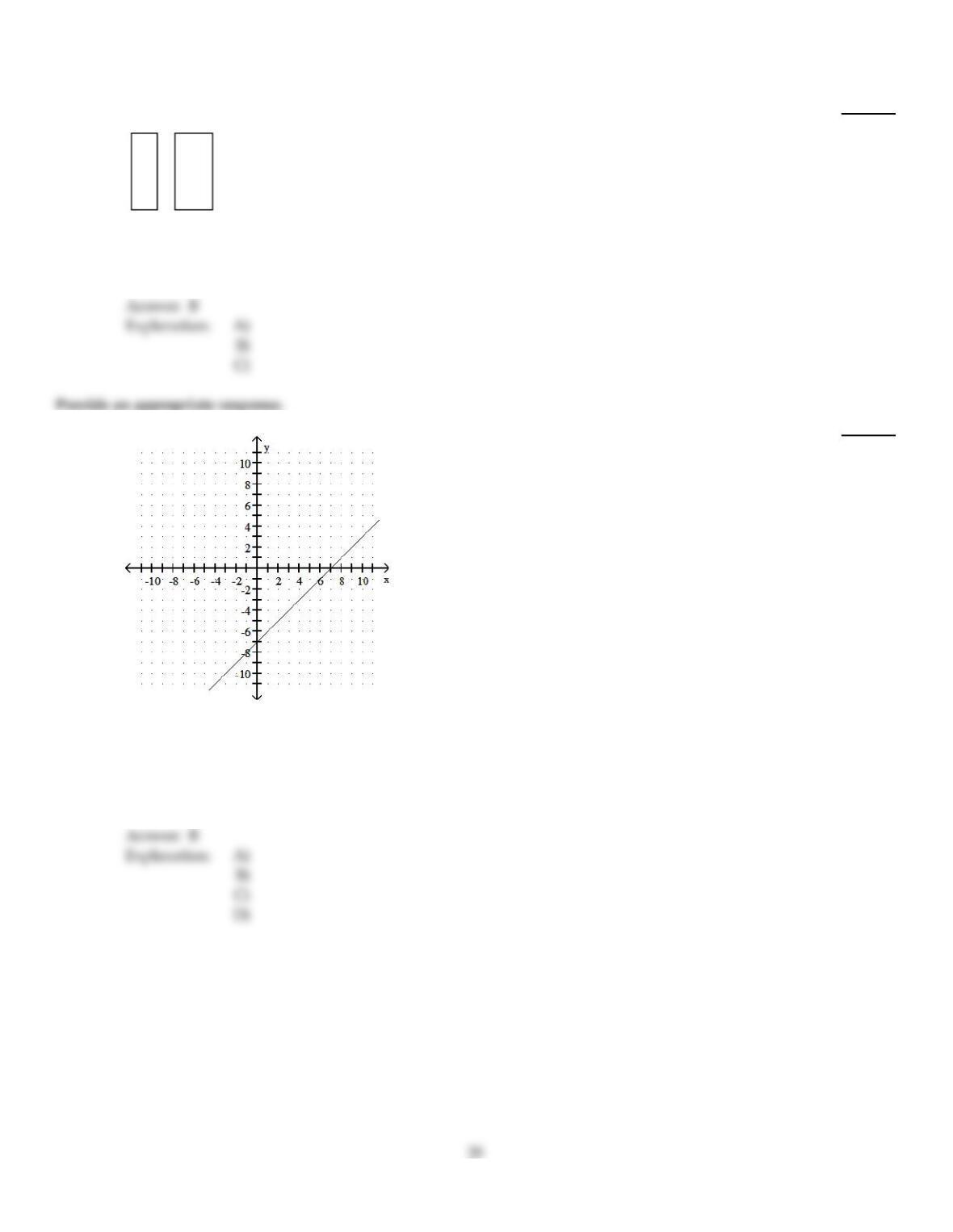
Use the graph to find the slope, x–intercept and y–intercept of the line.
58)
A)
slope = – 1
x–intercept = (–7, 0)
y–intercept = (0, 7)
B)
slope = 1
x–intercept = (7, 0)
y–intercept = (0, –7)
C)
slope = –1
x–intercept = (7, 0)
y–intercept = (0, –7)
D)
slope = 1
x–intercept = (0, 7)
y–intercept = (–7, 0)
Give the domain and range of the function.
59)
f(x) =x2+4
59)
A)
Domain: [4, ); Range: all real numbers
B)
Domain: all real numbers; Range: [-4, )
C)
Domain: [0, ); Range: [0, )
D)
Domain: all real numbers; Range: [4, )
Solve the problem.
60)
Suppose the sales of a particular brand of MP3 player satisfy the relationship S = 200x + 3800,
where S represents the number of sales in year x, with x = 0 corresponding to 2002 . Find the
number of sales in 2005.
60)
A)
4200
B)
12,600
C)
6400
D)
4400
Find the vertex form for the quadratic function. Then find each of the following:
(A) Intercepts
(B) Vertex
(C) Maximum or minimum
(D) Range
61)
f(x) =x2+ 4x – 5
61)
A)
Standard form: f(x) =(x – 2)2– 9
(A) x–intercepts: -1, 5; y–intercept: -5
(B) Vertex (-2, -9)
(C) Minimum: -9
(D) y -9
B)
Standard form: f(x) =(x – 2)2– 9
(A) x–intercepts: – 5, 1; y–intercept: -5
(B) Vertex (-2, -9)
(C) Maximum: -9
(D) y -9
C)
Standard form: f(x) =(x + 2)2– 9
(A) x–intercepts: – 5, 1; y–intercept: -5
(B) Vertex (2, -9)
(C) Minimum: -9
(D) y -9
D)
Standard form: f(x) =(x + 2)2– 9
(A) x–intercepts: – 5, 1; y–intercept: -5
(B) Vertex (-2, -9)
(C) Minimum: -9
(D) y -9
Graph by converting to exponential form first.
21
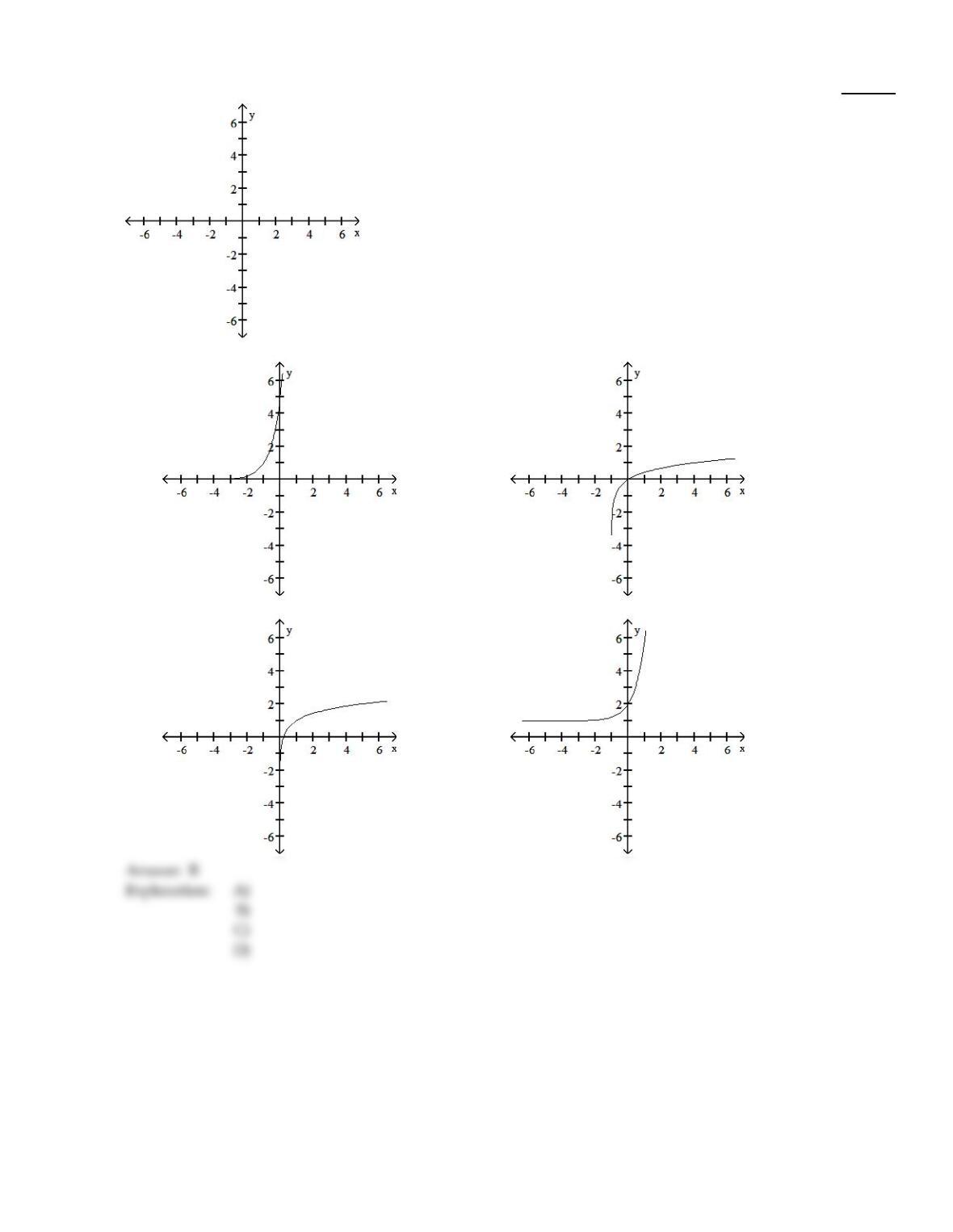
62)
y =log5(x + 1)
62)
A)
B)
C)
D)
22
Solve the problem.
63)
A country has a population growth rate of 2.4% compounded continuously. At this rate, how long
will it take for the population of the country to double? Round your answer to the nearest tenth.
63)
A)
.29 years
B)
2.9 years
C)
28.9 years
D)
30 years
64)
The shape of y =x is shifted 5 units to the left. Then the graph is shifted 7 units upward.
64)
A)
f(x) = 7 x + 5
B)
f(x) =x + 7 + 5
C)
f(x) =x + 5 + 7
D)
f(x) =x – 5 + 7
Solve the problem.
65)
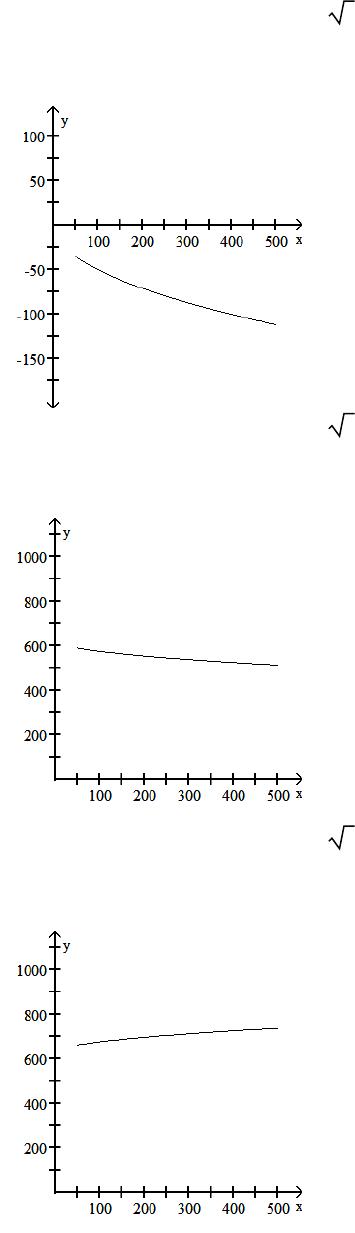
A retail chain sells washing machines. The retail price p(x) (in dollars) and the weekly demand x
for a particular model are related by the function p(x) = 625 – 5 x, where 50 x 500. (i) Describe
how the graph of the function p can be obtained from the graph of one of the six basic functions: y
= x, y =x2,y =x3, y =x, y =3x, or y =x. (ii) Sketch a graph of function p using part (i) as an
aid.
65)
23
A)
(i) The graph of the basic function y =x is
reflected in the x–axis and vertically
expanded by a factor of 5.
(ii)
B)
(i) The graph of the basic function y =x is
reflected in the x–axis, vertically expanded
by a factor of 5, and shifted up 625 units.
(ii)
C)
(i) The graph of the basic function y =x is
vertically expanded by a factor of 5,
and shifted up 625 units.
(ii)
24
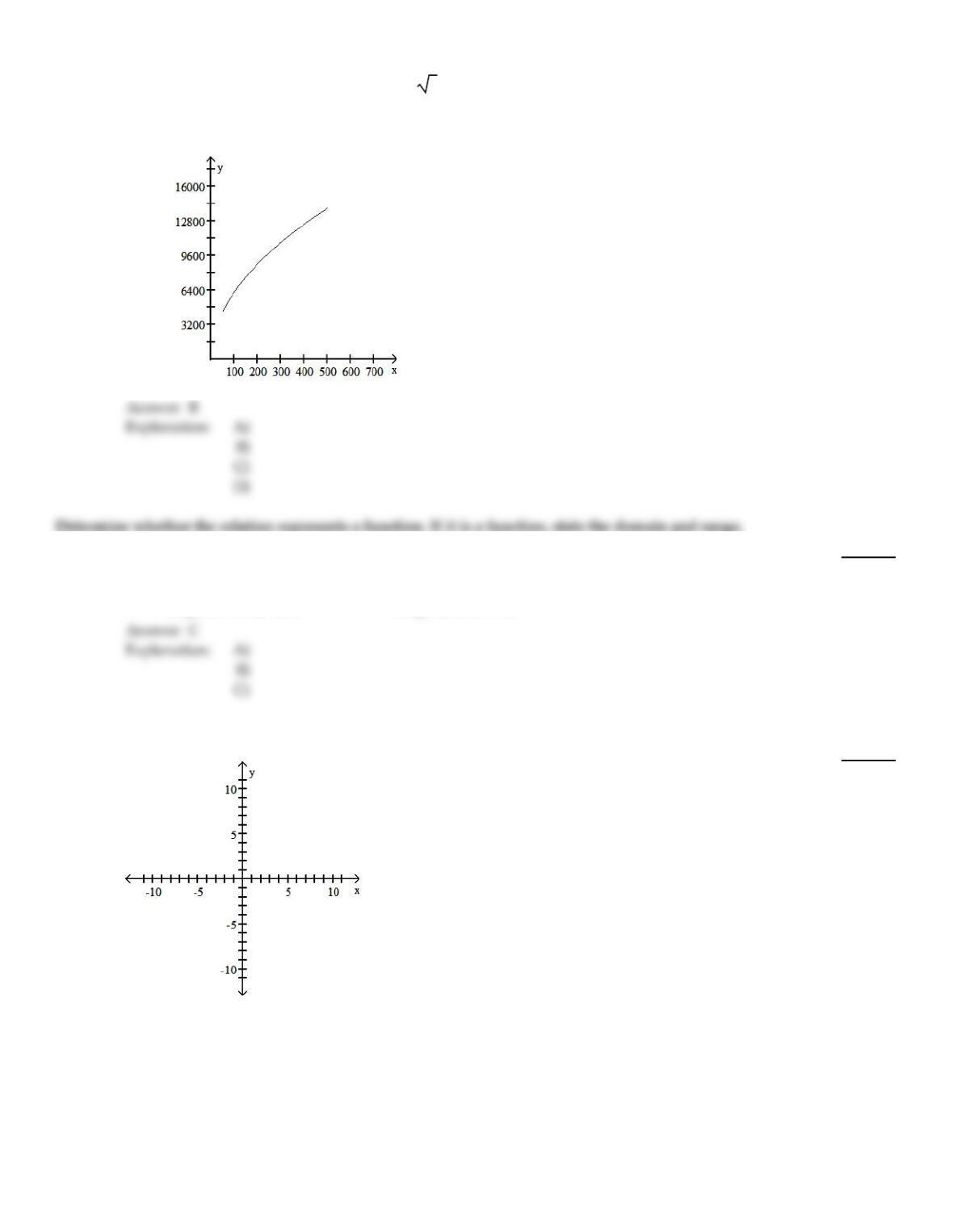
D)
(i) The graph of the basic function y =x is
vertically expanded by a factor of 625,
and shifted up 5 units.
(ii)
66)
{(19, -2), (3, -1), (3, 0), (4, 1), (12, 3)}
66)
A)
function
domain: {19, 4, 3, 12}
range: {-2, -1, 0, 1, 3}
B)
function
domain: {-2, -1, 0, 1, 3}
range: {19, 4, 3, 12}
C)
not a function
Graph the function using a calculator and point–by–point plotting. Indicate increasing and decreasing intervals.
67)
f(x) = 2 – ln(x + 4)
67)
25
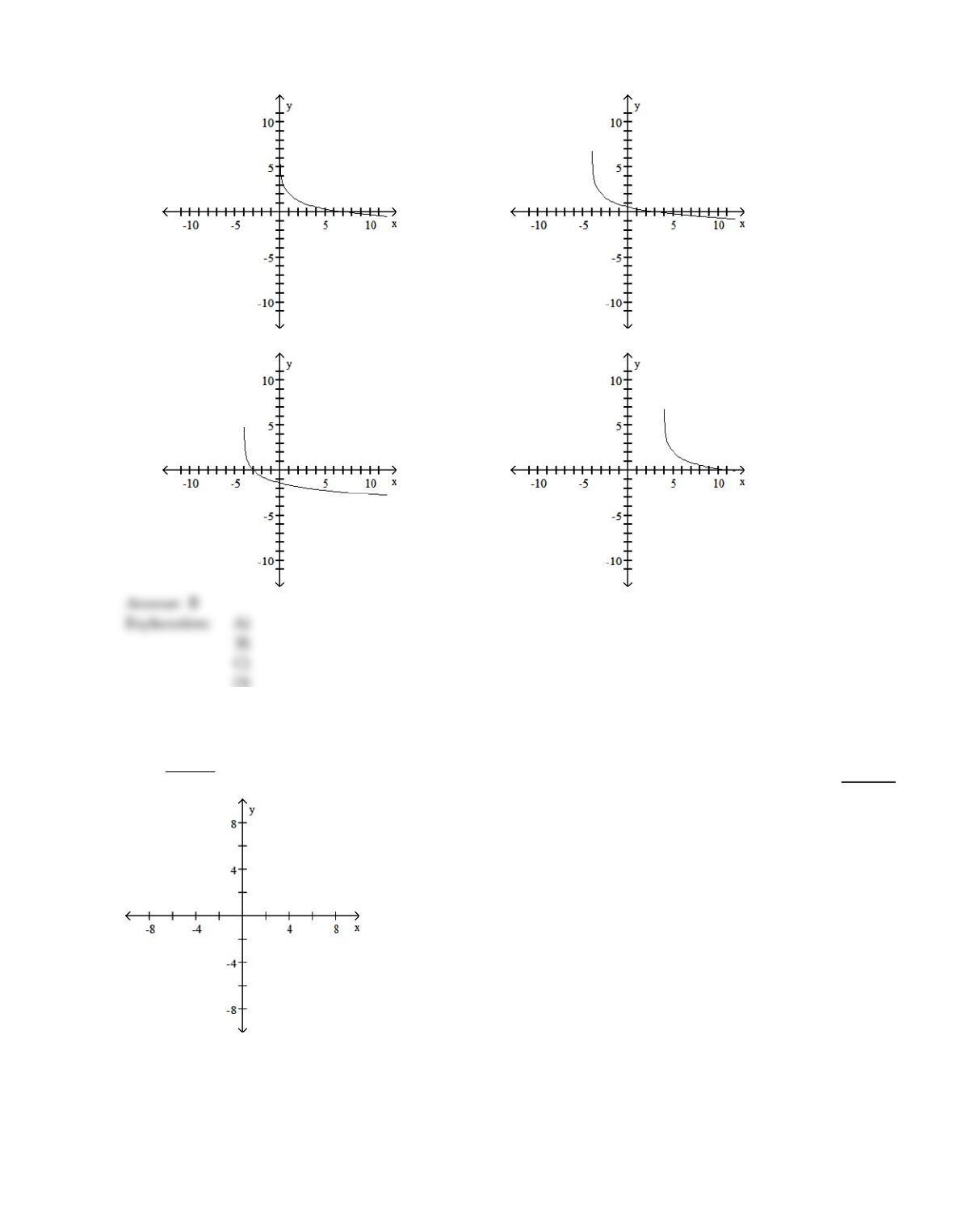
A)
Decreasing: (0, )
B)
Decreasing: (–4, )
C)
Decreasing: (–4, )
D)
Decreasing: (4, )
For the rational function below (i) Find the intercepts for the graph; (ii) Determine the domain; (iii) Find any vertical or
horizontal asymptotes for the graph; (iv) Sketch any asymptotes as dashed lines. Then sketch the graph of y = f(x).
68)
f(x) =–2x – 3
x + 2
68)
26
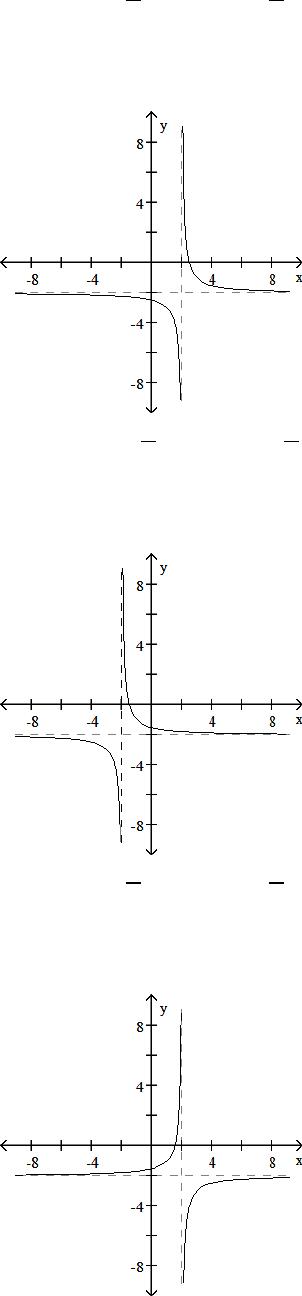
A)
(i) x intercept: 3
2; y intercept: –3
2
(ii) Domain: all real numbers except 2
(iii) Vertical asymptote: x = 2; horizontal asymptote: y = –2
(iv)
B)
(i) x intercept: –3
2; y intercept: –3
2
(ii) Domain: all real numbers except –2
(iii) Vertical asymptote: x = –2; horizontal asymptote: y = –2
(iv)
C)
(i) x intercept: 3
2; y intercept: –3
2
(ii) Domain: all real numbers except 2
(iii) Vertical asymptote: x = 2; horizontal asymptote: y = –2
(iv)
27
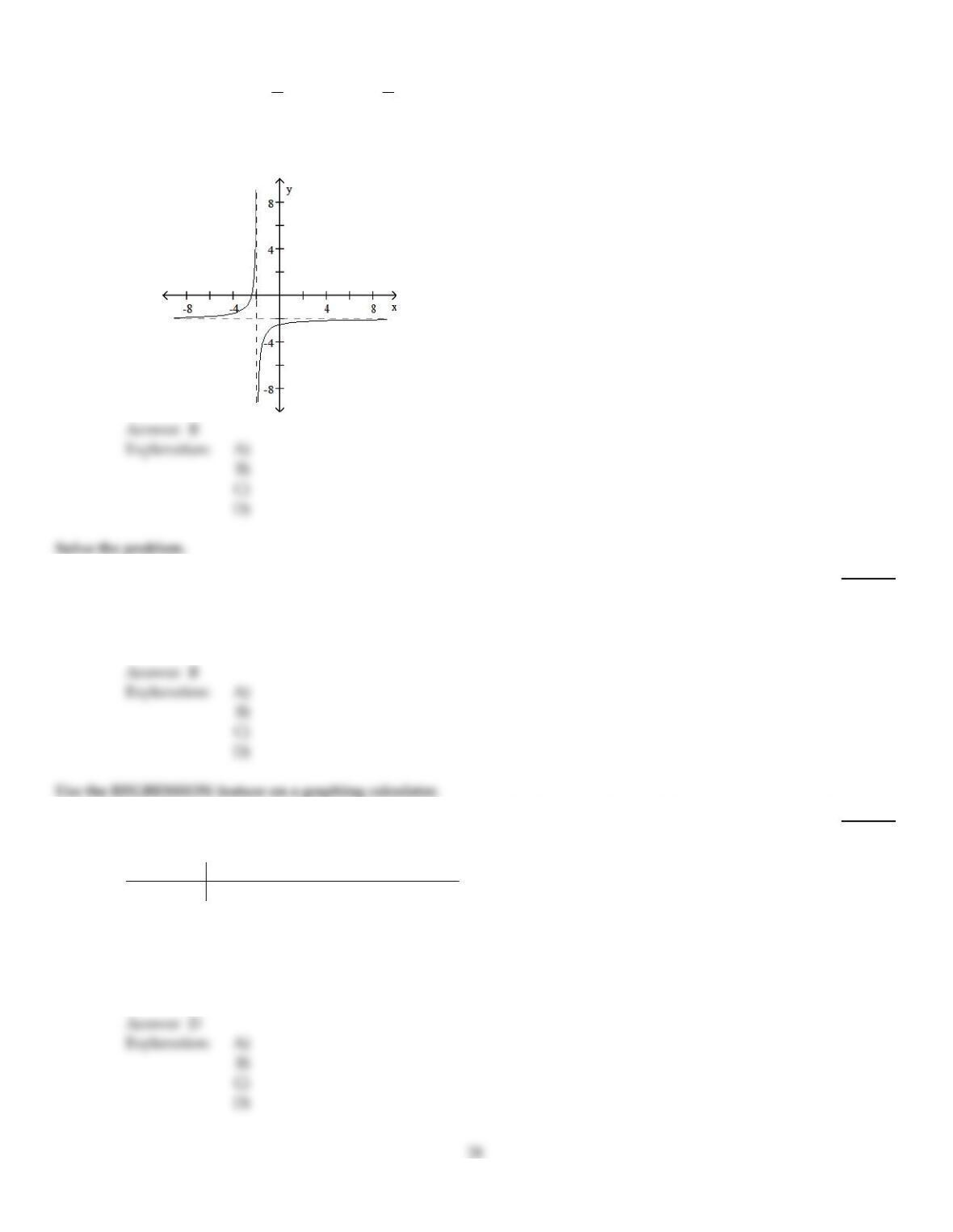
D)
(i) x intercept: –3
2; y intercept: –3
2
(ii) Domain: all real numbers except –2
(iii) Vertical asymptote: x = –2; horizontal asymptote: y = –2
(iv)
69)
A small company that makes hand–sewn leather shoes has fixed costs of $320 a day, and total costs
of $1200 per day at an output of 20 pairs of shoes per day. Assume that total cost C is linearly
related to output x. Find an equation of the line relating output to cost. Write the final answer in the
form C = mx + b.
69)
A)
C = 44x + 1520
B)
C = 44x + 320
C)
C = 60x + 320
D)
C = 60x + 1520
70)
The paired data below consists of the temperature on randomly chosen days and the amount of a
certain kind of plant grew (in millimeters).
Temp, x 62 76 50 51 71 46 51 44 79
Growth, y 36 39 50 13 33 33 17 6 16
Find the linear function that predicts a plant’s growth as a function of the temperature. Round your
answer to two decimal places.
70)
A)
y = – 0.06 x2+ 7.20x – 191.23
B)
y = 14..57x + 0.21
C)
y = – 9.19x3+ 0.11x2– 2.90x + 6.54
D)
y = 0.21x + 14.57
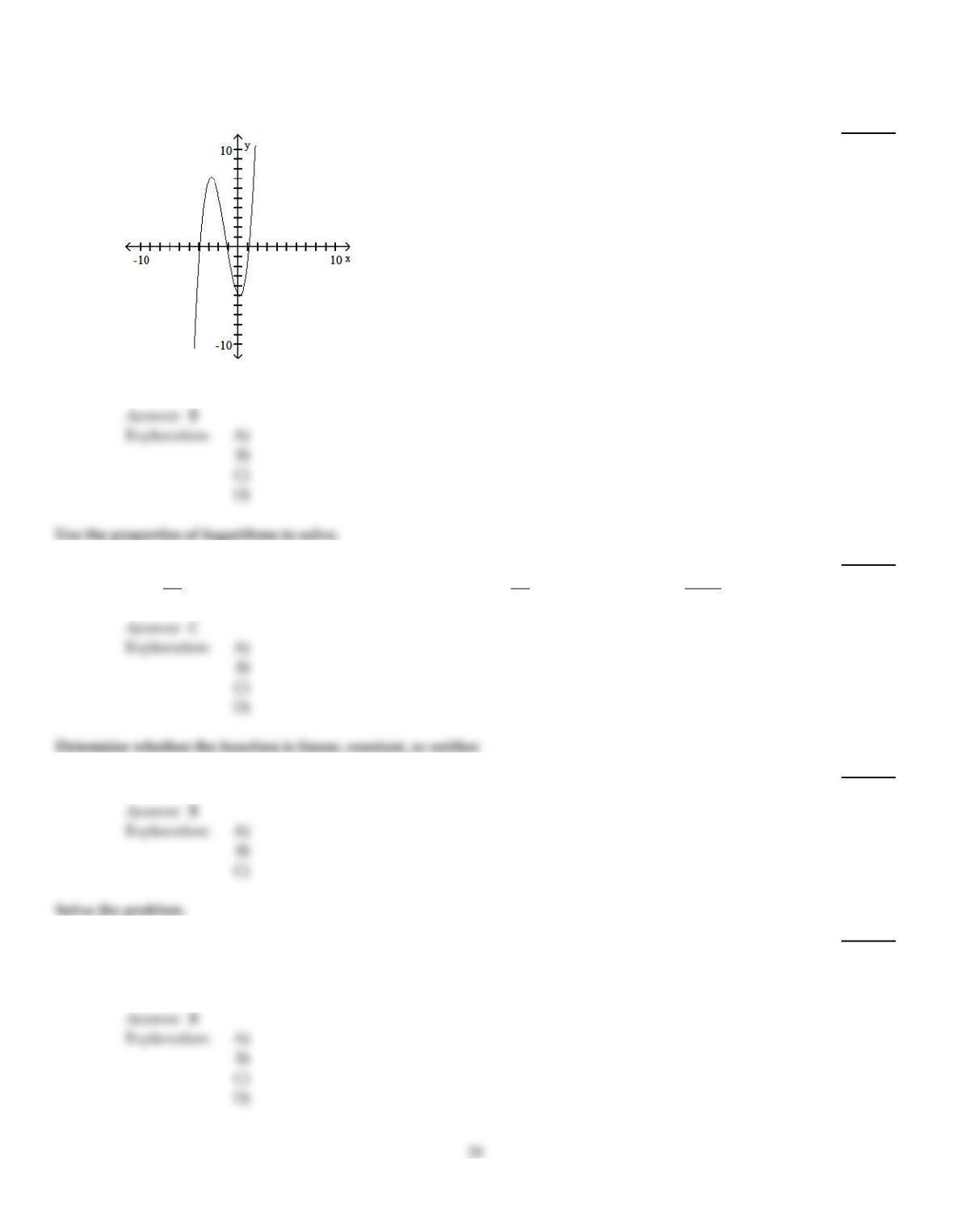
The graph that follows is the graph of a polynomial function. (i) What is the minimum degree of a polynomial function
that could have the graph? (ii) Is the leading coefficient of the polynomial negative or positive?
71)
71)
A)
(i) 2
(ii) Negative
B)
(i) 3
(ii) Positive
C)
(i) 2
(ii) Positive
D)
(i) 3
(ii) Negative
72)
log 6 (4x – 5) = 1
72)
A)
11
6
B)
7
C)
11
4
D)
log 5
4
73)
y – 12 = 0
73)
A)
Linear
B)
Constant
C)
Neither
74)
A sample of 800 grams of radioactive substance decays according to the function
A(t) =800e–0.028t, where t is the time in years. How much of the substance will be left in the
sample after 10 years? Round to the nearest whole gram.
74)
A)
9 grams
B)
605 grams
C)
1 gram
D)
800 grams
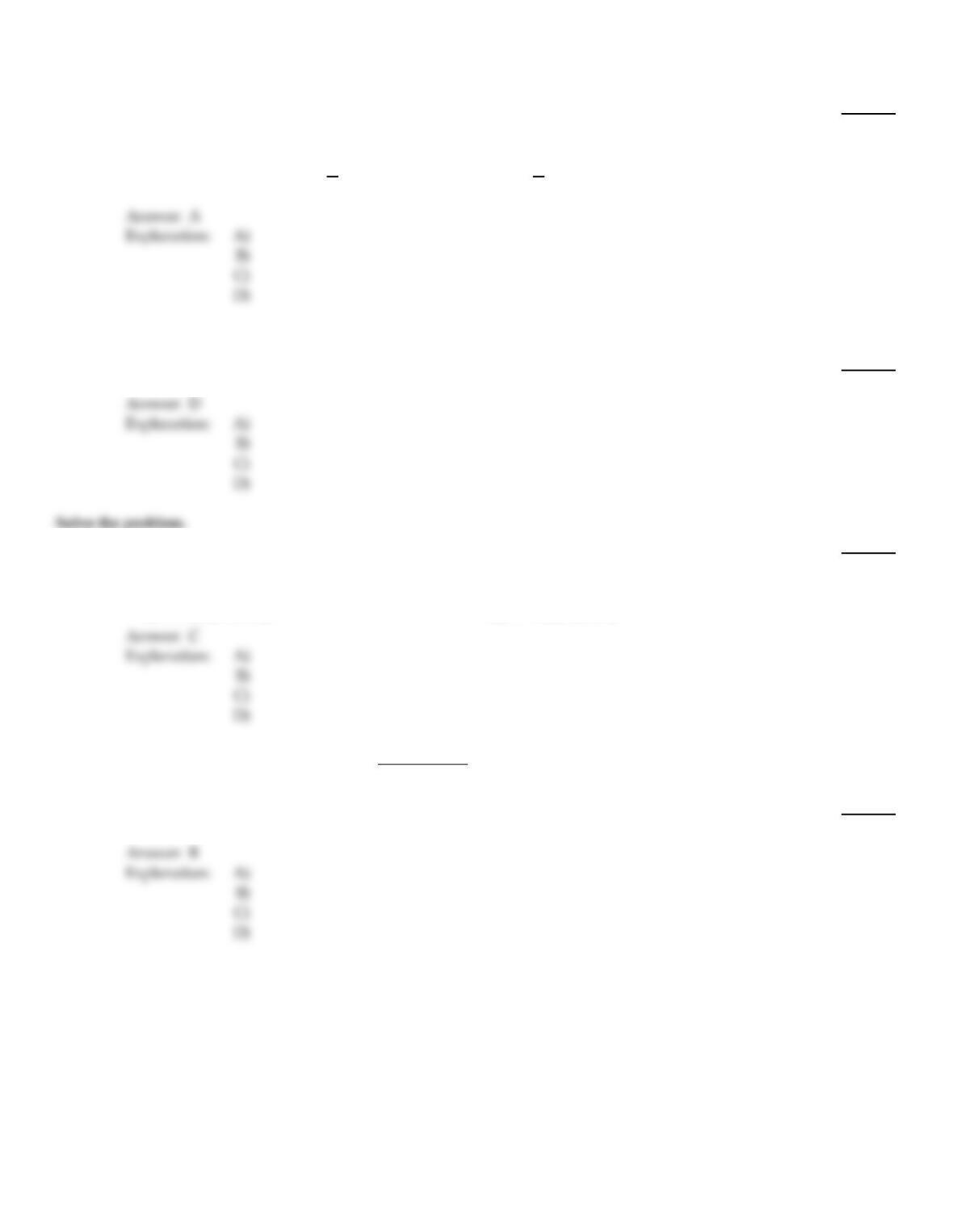
Determine the domain of the function.
75)
f(x) = – 7x + 9
75)
A)
All real numbers
B)
No solution
C)
All real numbers except 9
7
D)
x 9
7
Solve for x to two decimal places (using a calculator).
76)
700 = 500(1.04)x
76)
A)
1.40
B)
1.35
C)
520
D)
8.58
77)
Suppose that $2200 is invested at 3% interest, compounded semiannually. Find the function for the
amount of money after t years.
77)
A)
A = 2200 (1.0125)2t
B)
A = 2200 (1.03)2t
C)
A = 2200 (1.015)2t
D)
A = 2200 (1.015)t
Compute and simplify the difference quotient f(x + h) – f(x)
h, h 0.
78)
f(x) = 5x2+ 7x
78)
A)
15x – 7h + 14
B)
10x + 5h + 7
C)
10x + 7
D)
10x2+ 5h+ 7x
30
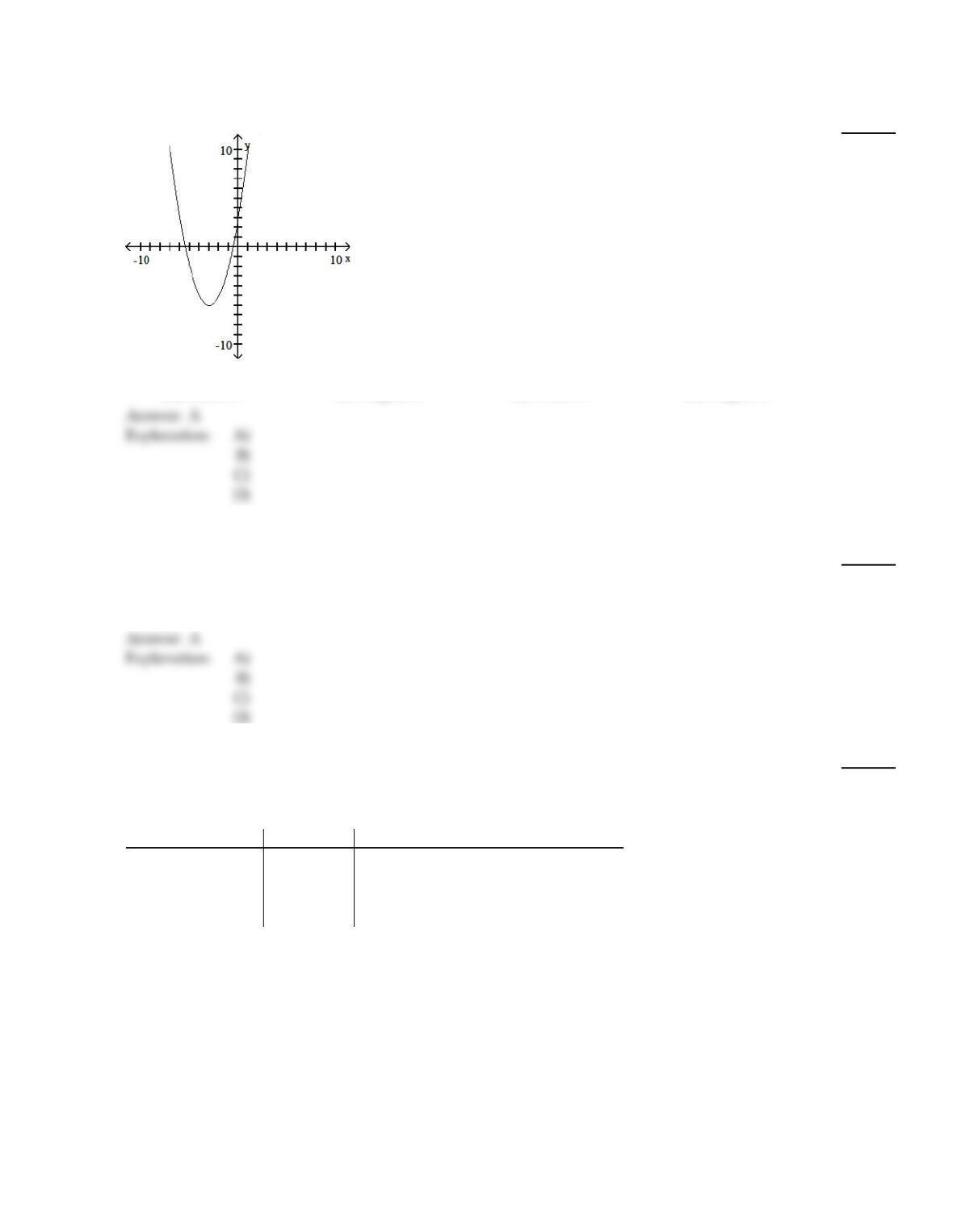
The graph that follows is the graph of a polynomial function. (i) What is the minimum degree of a polynomial function
that could have the graph? (ii) Is the leading coefficient of the polynomial negative or positive?
79)
79)
A)
(i) 2
(ii) Positive
B)
(i) 2
(ii) Negative
C)
(i) 3
(ii) Positive
D)
(i) 3
(ii) Negative
Solve the problem.
80)
Assume that a savings account earns interest at the rate of 2% compounded monthly. If this
account contains $1000 now, how many months will it take for this amount to double if no
withdrawals are made?
80)
A)
417 months
B)
12 months
C)
450 months
D)
408 months
81)
The following table shows a recent state income tax schedule for married couples filing a joint
return in State X. State X Income Tax
SCHEDULE I – MARRIED FILING JOINTLY
If taxable income is
Over But not over Tax due is
$0 $40,000 4.25% of taxable incomes
$40,000 $70,000 $3700 plus 6.75% of excess over $40,000
$70,000 $3875 plus 7.05% of excess over $70,000
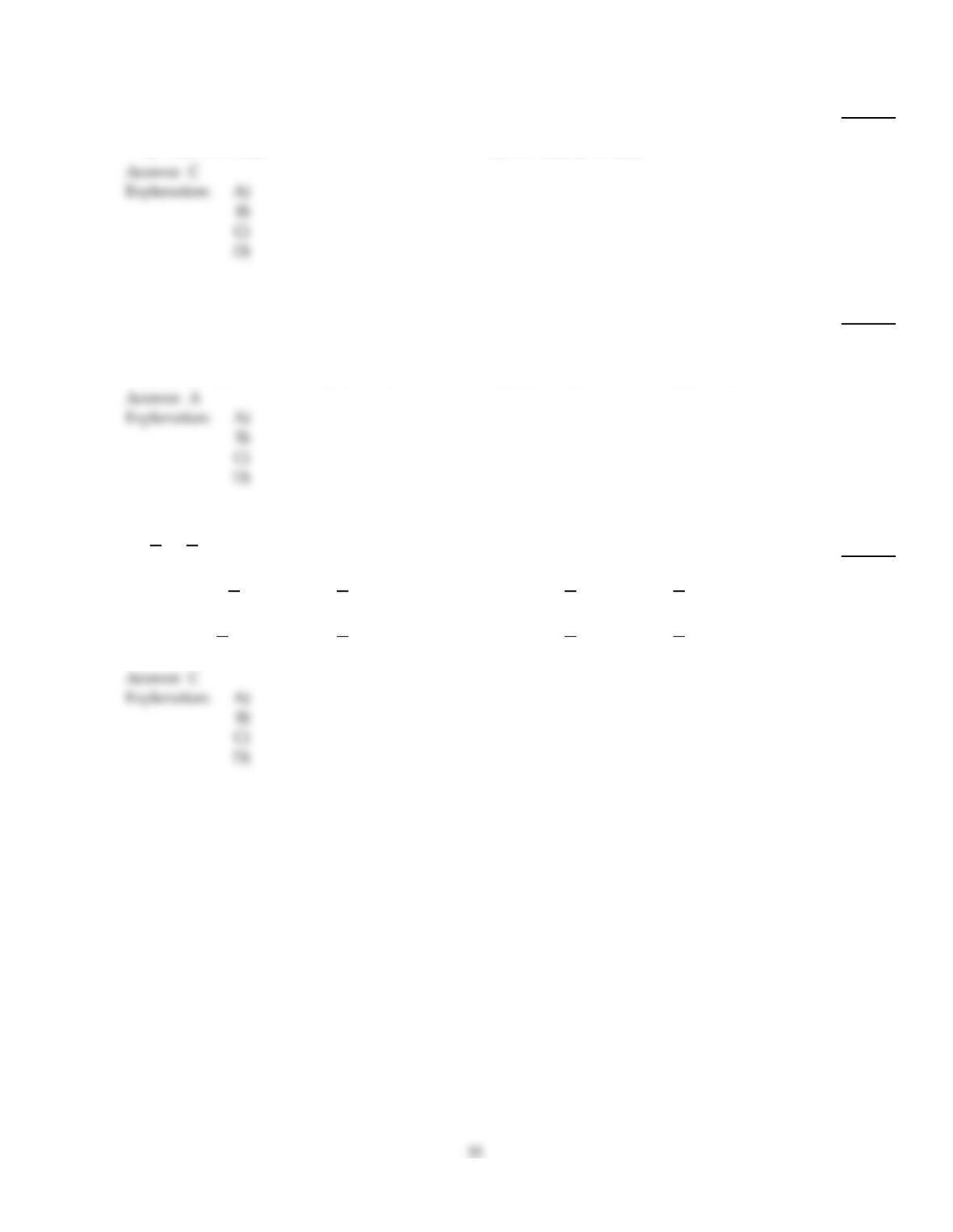
(i) Write a piecewise definition for the tax due T(x) on an income of x dollars. (ii) Graph T(x). (iii)
Find the tax due on a taxable income of $50,000. Of $95,000.
81)
31
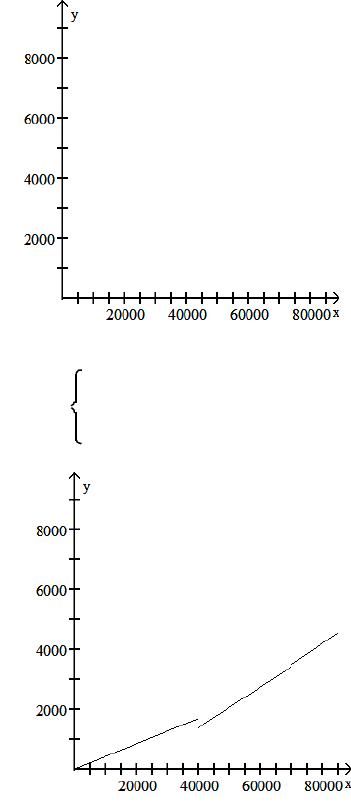
A)
(i)
T(x) =0.0425x if 0 x 40,000
0.0675x – 1300 if 40,000 < x 70,000
0.0705x – 1427 if x > 70,000
(ii)
(iii) $2075; $5270.50
32
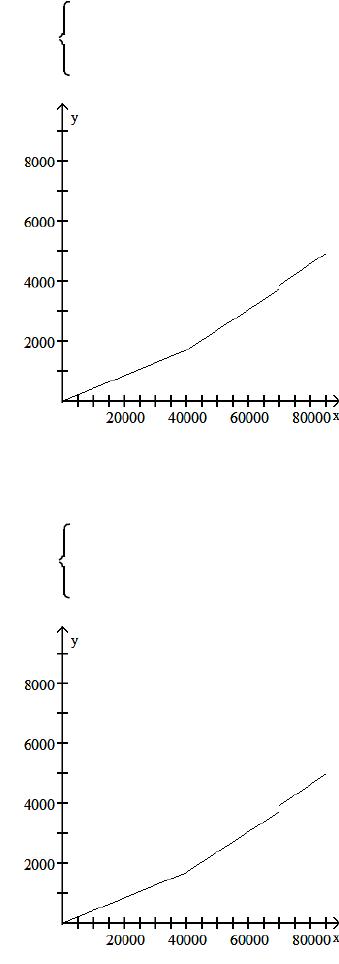
B)
(i)
T(x) =0.0425x if 0 x 40,000
0.0675x – 1000 if 40,000 < x 70,000
0.0705x – 1060 if x > 70,000
(ii)
(iii) $2375; $5637.50
C)
(i)
T(x) =0.0425x if 0 x 40,000
0.0675x – 990 if 40,000 < x 70,000
0.0705x – 1000 if x > 70,000
(ii)
(iii) $2385; $5697.50
33
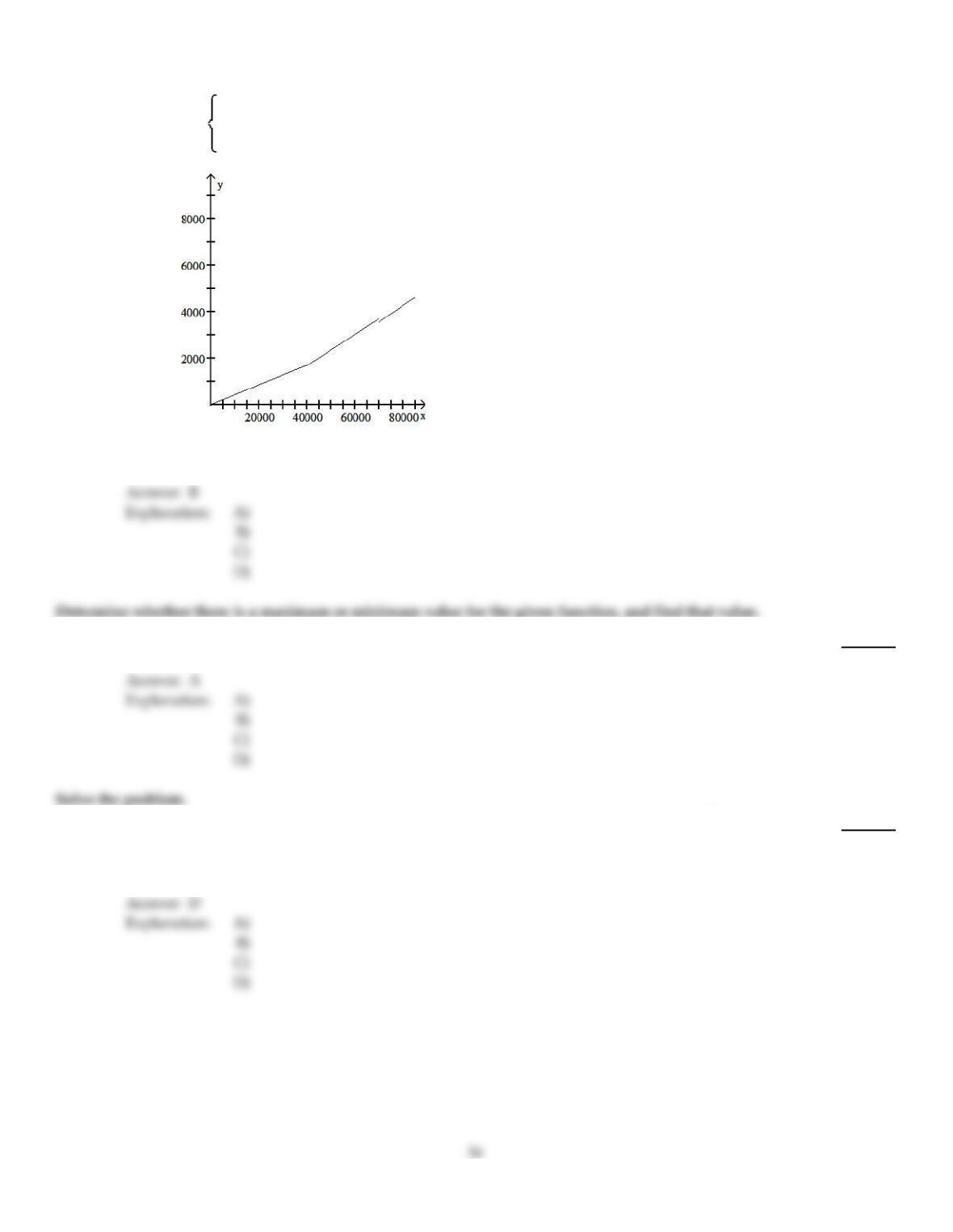
D)
(i)
T(x) =0.0425x if 0 x 40,000
0.0675x – 1025 if 40,000 < x 70,000
0.0705x – 1375 if x > 70,000
(ii)
(iii) $2350; $5322.50
82)
f(x) = – x2– 18x – 90
82)
A)
Maximum: – 9
B)
Minimum: –9
C)
Minimum: 0
D)
Minimum: 9
83)
U. S. Census Bureau data shows that the number of families in the United States (in millions) in
year x is given by h(x) = 51.42 + 15.473 · log x , where x = 0 is 1980. How many families were there
in 2002?
83)
A)
48 million
B)
90 million
C)
21 million
D)
72 million
Solve graphically to two decimal places using a graphing calculator.
84)
1.9x2–3.1x –2.7 0
84)
A)
–2.26 < x <0.63
B)
x < –2.26 or x >0.63
C)
–0.63 < x <2.26
D)
x < –0.63 or x >2.26
Solve the problem.
85)
The polynomial 0.0053x3+ 0.003x2+ 0.108x + 1.54 gives the approximate total earnings of a
company, in millions of dollars, where x represents the number of years since 1996. This model is
valid for the years from 1996 to 2000. Determine the earnings for 2000. Round to 2 decimal places.
85)
A)
$2.36 million
B)
$2.82 million
C)
$2.26 million
D)
$2.03 million
Find the slope and y intercept of the graph of the equation.
86)
y =5
2x –9
2
86)
A)
Slope = – 9
2; y intercept =5
2
B)
Slope =9
2; y intercept =5
2
C)
Slope =5
2; y intercept = – 9
2
D)
Slope =5
2; y intercept =9
2
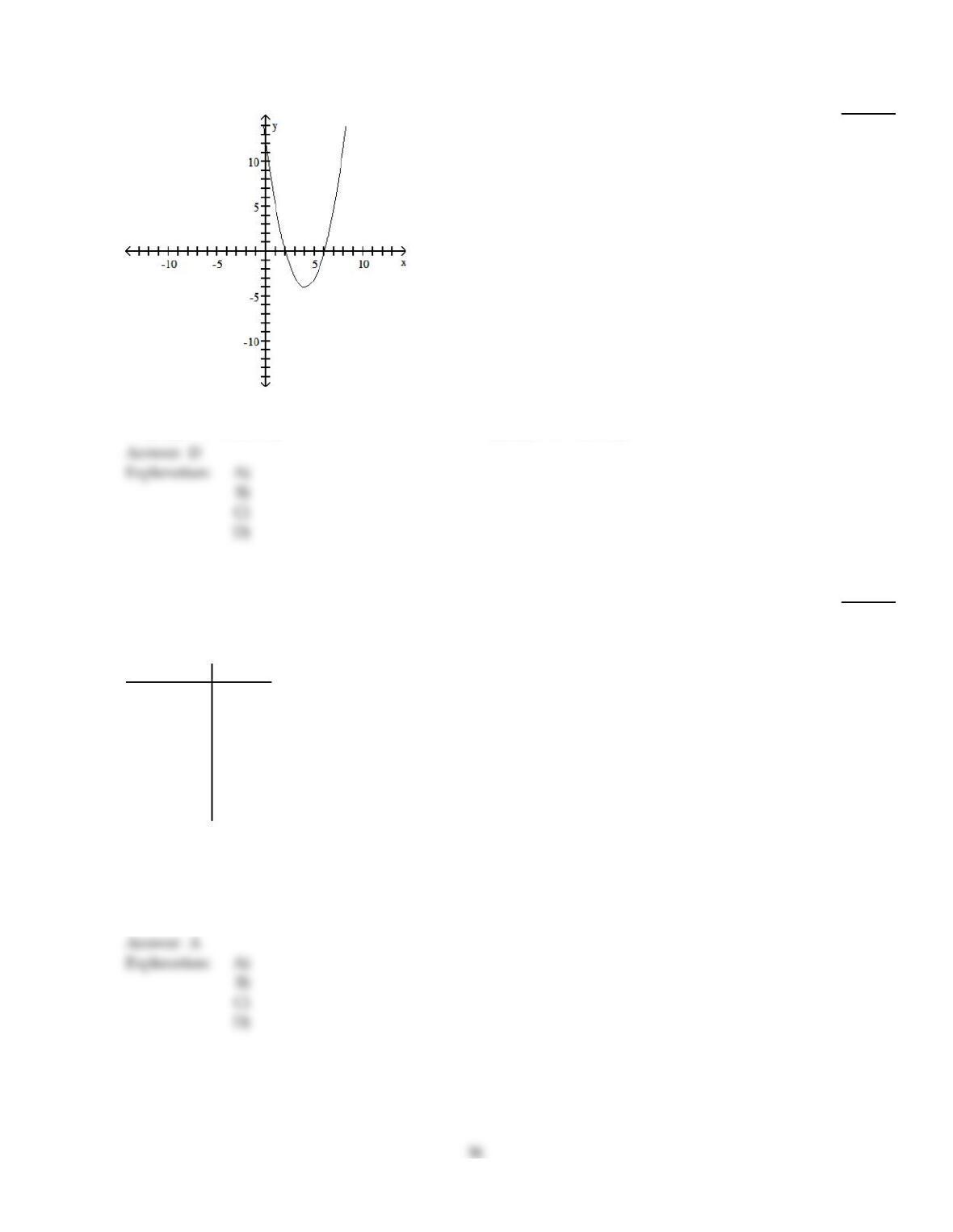
Write an equation for the lowest–degree polynomial function with the graph and intercepts shown in the figure.
87)
87)
A)
f(x) =x2+ 12x – 8
B)
f(x) =x2+ 12x + 8
C)
f(x) =x2+ 8x + 12
D)
f(x) =x2– 8x + 12
Use the REGRESSION feature on a graphing calculator.
88)
The total cost of the Democratic and the Republican national conventions has increased 596% over
the 20–year period between 1980 and 2004. The following table lists the total cost, in millions of
dollars, for selected years.
Year, x Cost, y
1980, x = 0 $ 23.1
1984, x = 4 31.8
1988, x = 8 44.4
1992, x = 12 58.8
1996, x = 16 90.6
2000, x = 20 160.8
2004, x = 24 170.5
Find the exponential functions that best estimates this data. Round your answer to four decimal
places
88)
A)
y = 22.2887 · (1.0929)x
B)
y = 6.6643x + 2.8857
C)
y = 22.2887x· (1.0929)x
D)
y = 1.0929 · (22.2887)x
Find the slope and y intercept of the graph of the equation.
89)
y = –3x +4
89)
A)
Slope =4, y intercept = –3
B)
Slope = –4, y intercept = –3
C)
Slope =3, y intercept = –4
D)
Slope = –3, y intercept =4
Provide an appropriate response.
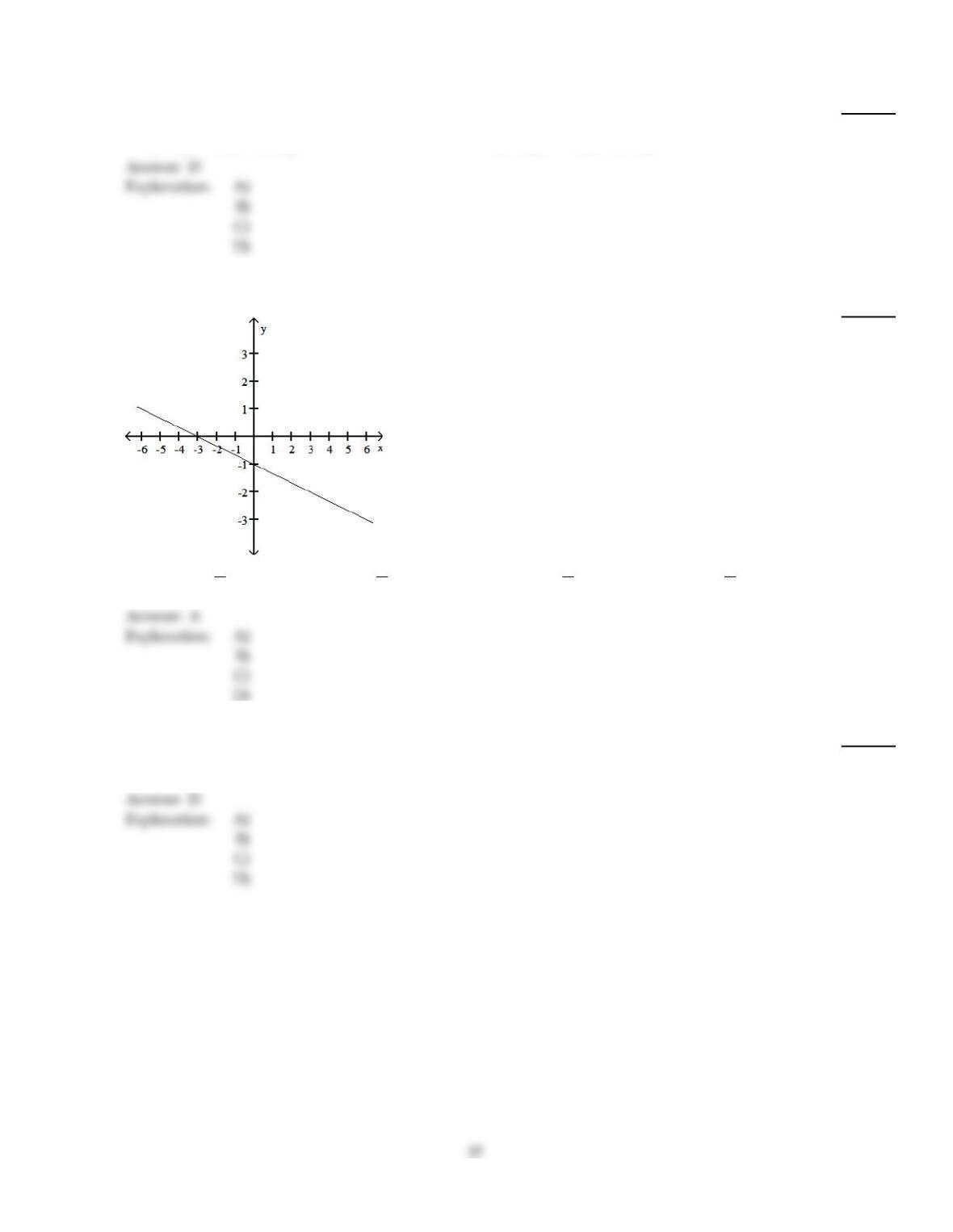
90)
Write the equation of the line in the following graph.
90)
A)
f(x) = – 1
3x – 1
B)
f(x) =1
3x + 1
C)
f(x) = – 1
3x + 1
D)
f(x) =1
3x – 1
91)
In a profit–loss analysis, point where revenue equals cost.
91)
A)
turning point
B)
profit–loss point
C)
inflection point
D)
break–even point
For the given function, find each of the following:
(A) Intercepts
(B) Vertex
(C) Maximum or minimum
(D) Range
92)
m(x) = –(x + 1)2+ 4
92)
A)
(A) x–intercepts: – 3, 1; y–intercept: 3
(B) Vertex (-1, 4)
(C) Minimum: 4
(D) y 4
B)
(A) x–intercepts: – 3, 1; y–intercept: 3
(B) Vertex (-1, 4)
(C) Maximum: 4
(D) y 4
C)
(A) x–intercepts: -1, 3; y–intercept: 3
(B) Vertex (-1, 4)
(C) Maximum: 4
(D) y 4
D)
(A) x–intercepts: – 3, 1; y–intercept: 3
(B) Vertex (1, -4)
(C) Maximum: 4
(D) y 4
Write in terms of simpler forms.
93)
logbM9
93)
A)
M +logb 9
B)
M logb 9
C)
9 +logb M
D)
9 logb M
94)
y =2
3
94)
A)
Linear
B)
Constant
C)
Neither
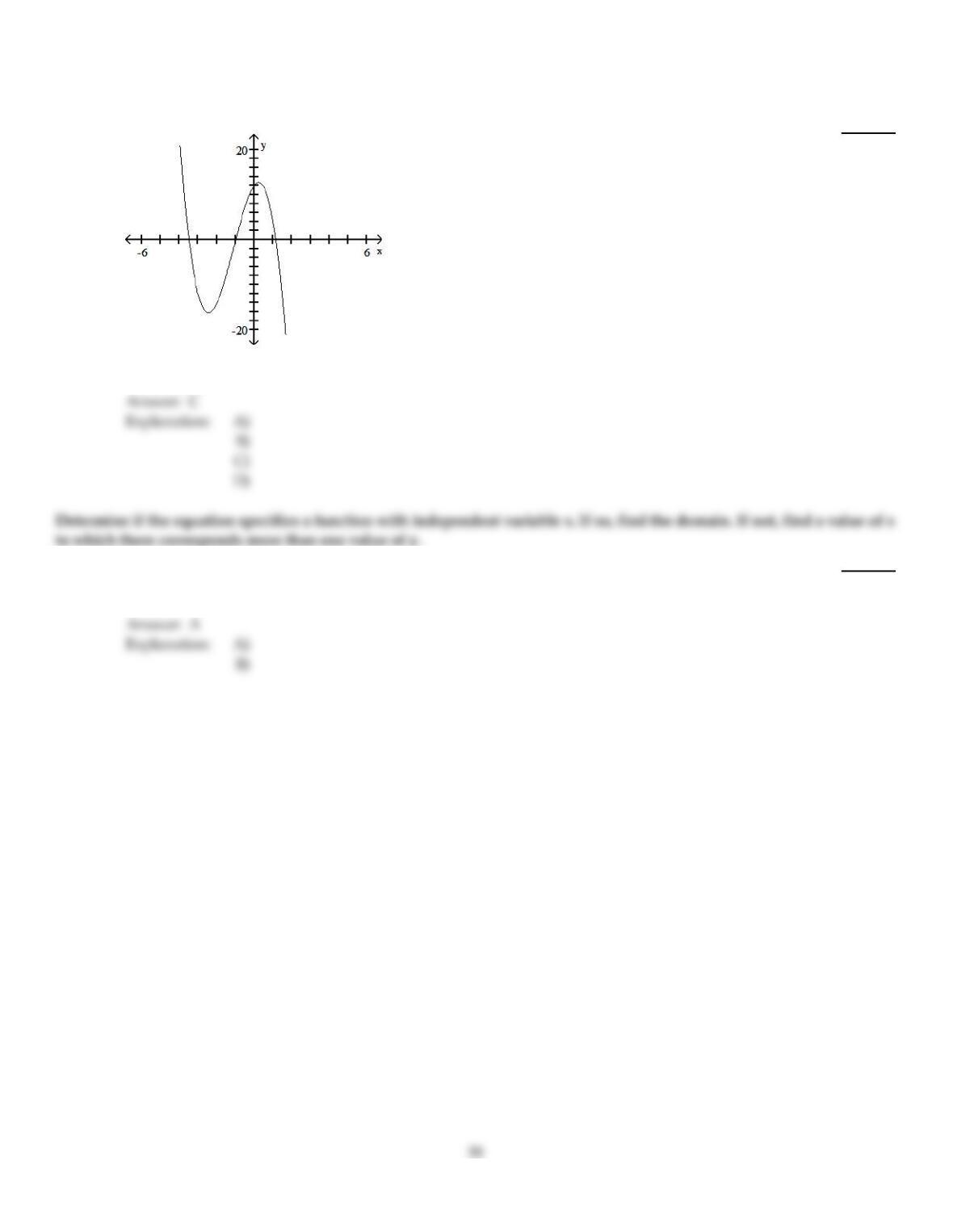
The graph that follows is the graph of a polynomial function. (i) What is the minimum degree of a polynomial function
that could have the graph? (ii) Is the leading coefficient of the polynomial negative or positive?
95)
95)
A)
(i) 3
(ii) Positive
B)
(i) 4
(ii) Negative
C)
(i) 3
(ii) Negative
D)
(i) 4
(ii) Positive
96)
xy =7
96)
A)
A function with domain all real numbers except x = 0
B)
Not a function; for example, when x =7, y = ±1
Find the vertex form for the quadratic function. Then find each of the following:
(A) Intercepts
(B) Vertex
(C) Maximum or minimum
(D) Range
97)
m(x) = –x2– 6x – 5
97)
A)
Standard form: m(x) = –(x – 3)2+ 4
(A) x–intercepts: 1, 5; y–intercept: -5
(B) Vertex (-3, 4)
(C) Maximum: 4
(D) y 4
B)
Standard form: m(x) = –(x + 3)2+ 4
(A) x–intercepts: – 5, -1; y–intercept: -5
(B) Vertex (3, -4)
(C) Maximum: 4
(D) y 4
C)
Standard form: m(x) = –(x – 3)2+ 4
(A) x–intercepts: – 5, -1; y–intercept: -5
(B) Vertex (-3, 4)
(C) Minimum: 4
(D) y 4
D)
Standard form: m(x) = –(x + 3)2+ 4
(A) x–intercepts: – 5, -1; y–intercept: -5
(B) Vertex (-3, 4)
(C) Maximum: 4
(D) y 4
Solve the problem.
98)
The function F described by F(x) = 2.75x + 71.48 can be used to estimate the height, in centimeters,
of a woman whose humerus (the bone from the elbow to the shoulder) is x cm long. Estimate the
height of a woman whose humerus is 30.93 cm long. Round your answer to the nearest four
decimal places.
98)
A)
13.5775 cm
B)
105.1600 cm
C)
156.5375 cm
D)
43.3000 cm
For the polynomial function find the following: (i) Degree of the polynomial; (ii) All x intercepts; (iii) The y intercept.
99)
f(x) = (x6+ 7)(x10 + 9)
99)
A)
(i) 16
(ii) 7, 9
(iii) 63
B)
(i) 16
(ii) none
(iii) 63
C)
(i) 60
(ii) none
(iii) –63
D)
(i) 60
(ii) 7, 9
(iii) –63
Graph the function.
40
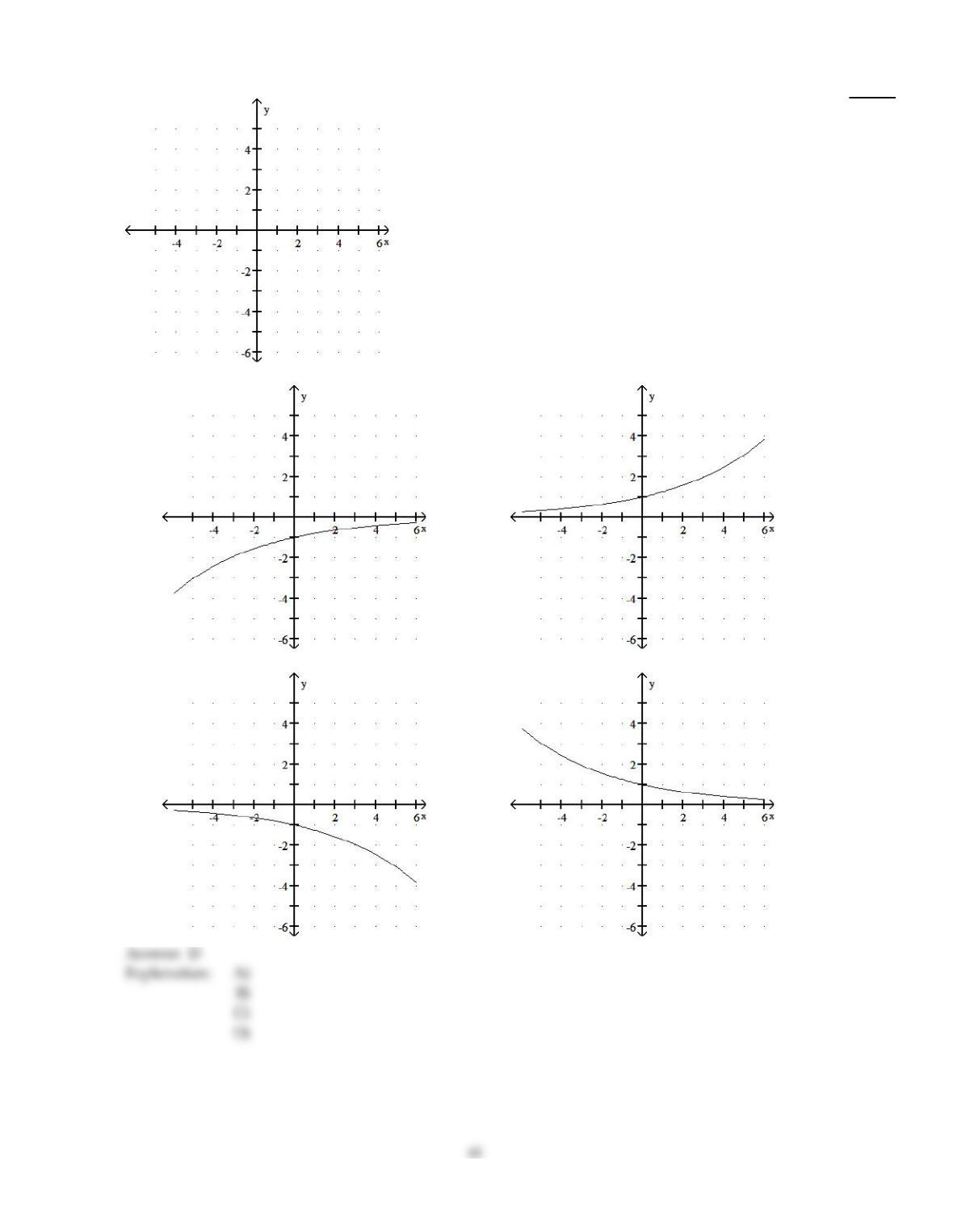
100)
f(x) =0.8x
100)
A)
B)
C)
D)
Solve the equation.
101)
Solve for x: 24x =8x + 5
101)
A)
5
B)
–5
C)
15
D)
–15
Determine whether the graph is the graph of a function.
102)
102)
A)
function
B)
not a function
Solve the equation.
103)
Solve for x: 3(1 + 2x) = 27
103)
A)
–1
B)
3
C)
1
D)
9
Write in terms of simpler forms.
104)
logbx
b
104)
A)
logbx–logbb
B)
log2b x
b
C)
logbx+logbb
D)
logbx– b
Solve the problem.
105)
Assume that a person’s critical weight W, defined as the weight above which the risk of death rises
dramatically, is given by W(h) =h
11.9 3, where W is in pounds and h is the person’s height in
inches.
Find the tcritical weight for a person who is 6 ft 11 in. tall. Round to the nearest tenth.
105)
A)
212.4 lb
B)
377.4 lb
C)
339.3 lb
D)
221.5 lb
Write an equation of the line with the indicated slope and y intercept.
106)
Slope =2, y intercept = –5
106)
A)
y =5x –2
B)
y = –2x –5
C)
y =2x –5
D)
y =5x +2
107)
log9 27 =3
2
107)
A)
27 =3
29
B)
3
2=927
C)
9 =273/2
D)
27 =93/2
108)
ln 44 = 3.7842
108)
A)
e3.7842 = 1
B)
e44 = 3.7842
C)
e3.7842 = ln 44
D)
e3.7842 = 44
Determine if the equation specifies a function with independent variable x. If so, find the domain. If not, find a value of x
to which there corresponds more than one value of y.
109)
x2+ y2=16
109)
A)
A function with domain
B)
Not a function; for example, when x = 0, y = ±4
43
Solve the problem.
110)
Suppose the cost per ton, y, to build an oil platform of x thousand tons is approximated by
C(x) =212,500
x + 425 . What is the cost per ton for x = 30?
110)
A)
$425.00
B)
$467.03
C)
$7083.33
D)
$16.67
111)
Find the standard form of the equation of the line passing through the two points.
(2, – 6) and (– 9, 6)
111)
A)
– 8x + 15y = – 18
B)
12x + 11y = – 42
C)
– 12x + 11y = – 42
D)
8x – 15y = – 18
B
Solve the problem.
112)
The function M described by M(x) = 2.89x + 70.64 can be used to estimate the height, in centimeters,
of a male whose humerus (the bone from the elbow to the shoulder) is x cm long. Estimate the
height of a male whose humerus is 30.93 cm long. Round your answer to the nearest four decimal
places.
112)
A)
160.0277 cm
B)
156.5375 cm
C)
30.9300 cm
D)
157.3400 m
A
113)
Hi–Tech UnWater begins a cable TV advertising campaign in Miami to market a new water. The
percentage of the target market that buys water is estimated by the function w(t) = 100(1 –e–0.02t),
t represents the number of days of the campaign. After how long will 90% of the target market have
bought the water?
113)
A)
3 days
B)
115 days
C)
120 days
D)
90 days
B
B
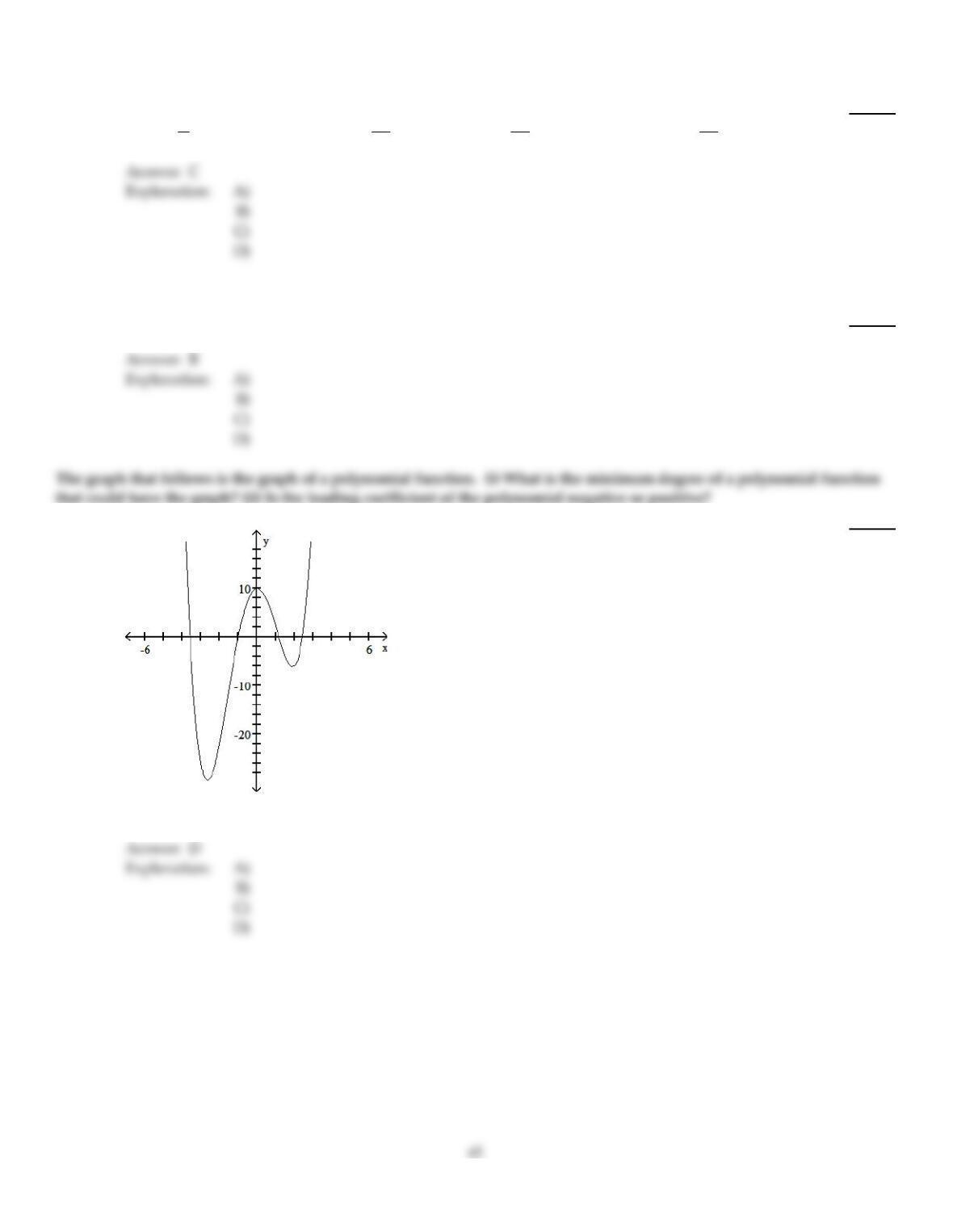
Use the properties of logarithms to solve.
114)
ln (3x – 4) = ln 20 – ln (x – 5)
114)
A)
5, 5
3
B)
–5, –19
3
C)
19
3
D)
0, 19
3
Solve the equation.
115)
Solve for t: e–0.07t = 0.05 Round your answer to four decimal places.
115)
A)
–66.4815
B)
42.7962
C)
44.321
D)
–70.1312
116)
116)
A)
(i) 3
(ii) Negative
B)
(i) 3
(ii) Positive
C)
(i) 4
(ii) Negative
D)
(i) 4
(ii) Positive
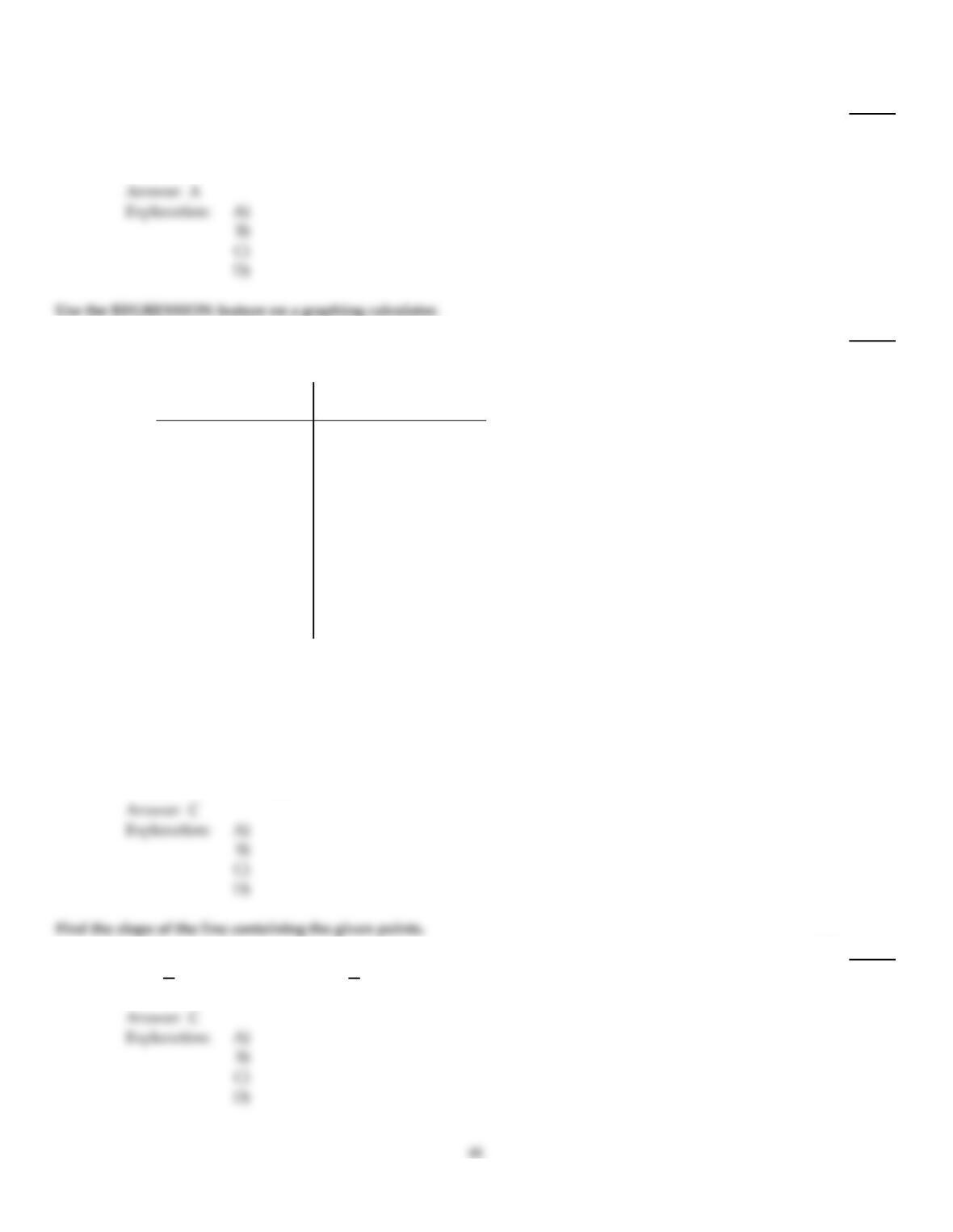
Solve the problem.
117)
A professional basketball player has a vertical leap of 37 inches. A formula relating an athlete’s
vertical leap V, in inches, to hang time T, in seconds, is V=48T2. What is his hang time? Round to
the nearest tenth.
117)
A)
0.9 sec
B)
0.6 sec
C)
1 sec
D)
0.8 sec
118)
As the number of farms has decreased in South Carolina, the average size of the remaining farms
has grown larger, as shown below.
YEAR AVERAGE ACREAGE
PER FARM
1900 (x = 0)
1910 (x = 10) 127
119
1920
1930 135
137
1940 155
1950 196
1960 283
1970 353
1980 406
1990 440
2000 (x = 100) 420
Let x represent the number of years since 1900. Use a graphing calculator to fit a quadratic function
to the data. Round your answer to five decimal places.
118)
A)
y = –.00114x3+ 0.19605x2– 5.29775 + 143.55245
B)
y = 0.02536x3+ 1.21114 x + 102.58741
C)
y = 0.02536x2+ 1.21114 x + 102.58741
D)
y = 0.02536x3+ 1.21114 + 102.58741
C
119)
(–5, 2) and (0, 2)
119)
A)
5
2
B)
–5
2
C)
0
D)
Undefined
C
A
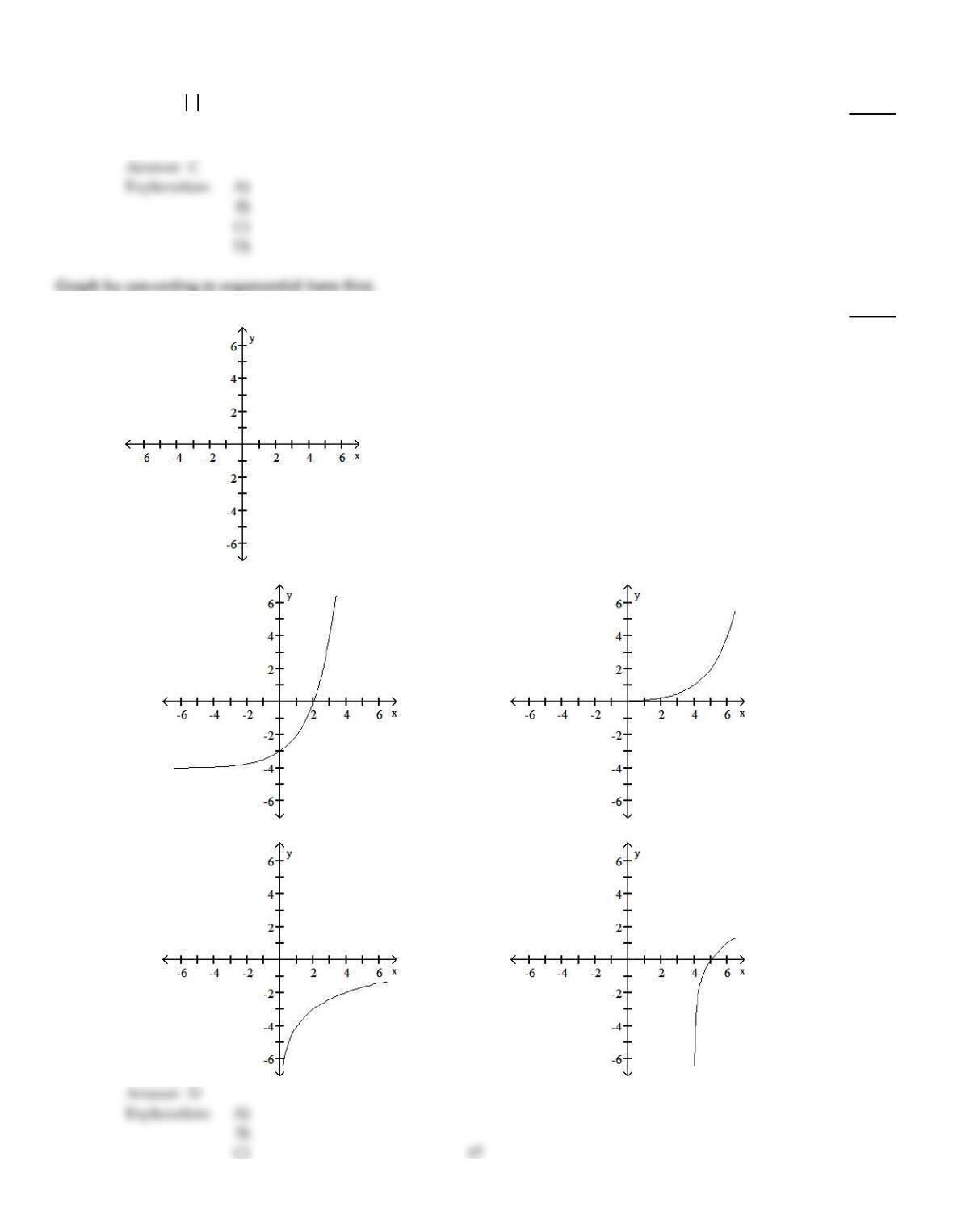
Give the domain and range of the function.
120)
h(x) = –4 x
120)
A)
Domain: [0, ); Range: [0, )
B)
Domain: all real numbers; Range: (–, 3]
C)
Domain: all real numbers; Range: (–, 0]
D)
Domain: (–, 0]; Range: all real numbers
121)
y =log2(x – 4)
121)
A)
B)
C)
D)
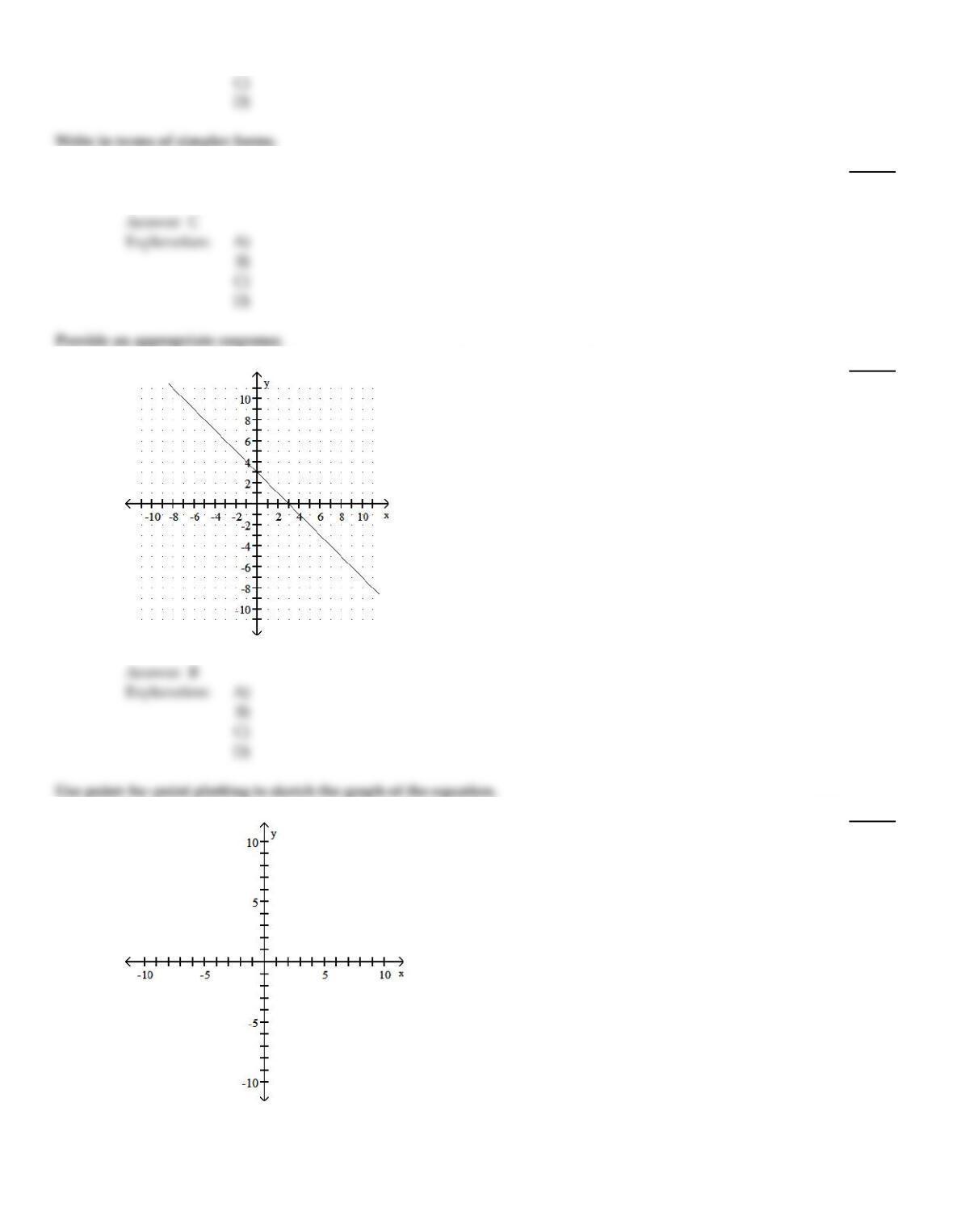
122)
log8 XY
122)
A)
log4 X –log4 Y
B)
log8 X –log8 Y
C)
log8 X +log8 Y
D)
log4 X +log4 Y
123)
Use the graph to find the slope–intercept form of the equation of the line.
123)
A)
y = x – 3
B)
y = –x + 3
C)
y = x + 3
D)
y = 3x
124)
y = x – 6
124)
48
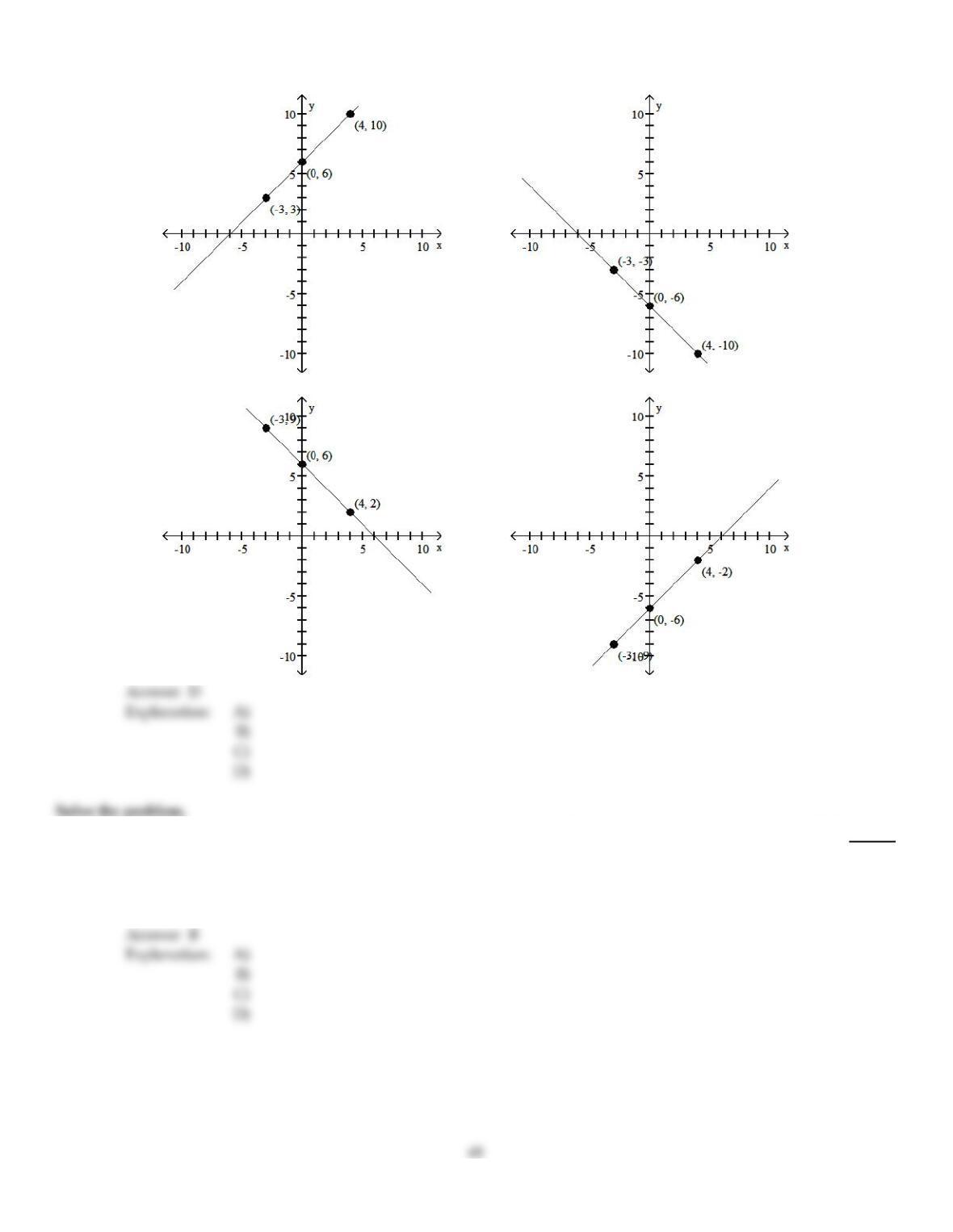
A)
B)
C)
D)
125)
To estimate the ideal minimum weight of a woman in pounds multiply her height in inches by 4
and subtract 130. Let W = the ideal minimum weight and h = height. Express W as a linear function
of h.
125)
A)
W(h) = 130h + 4
B)
W(h) = 4h – 130
C)
W(h) = 130
D)
W(h) = 4 (h + 130)
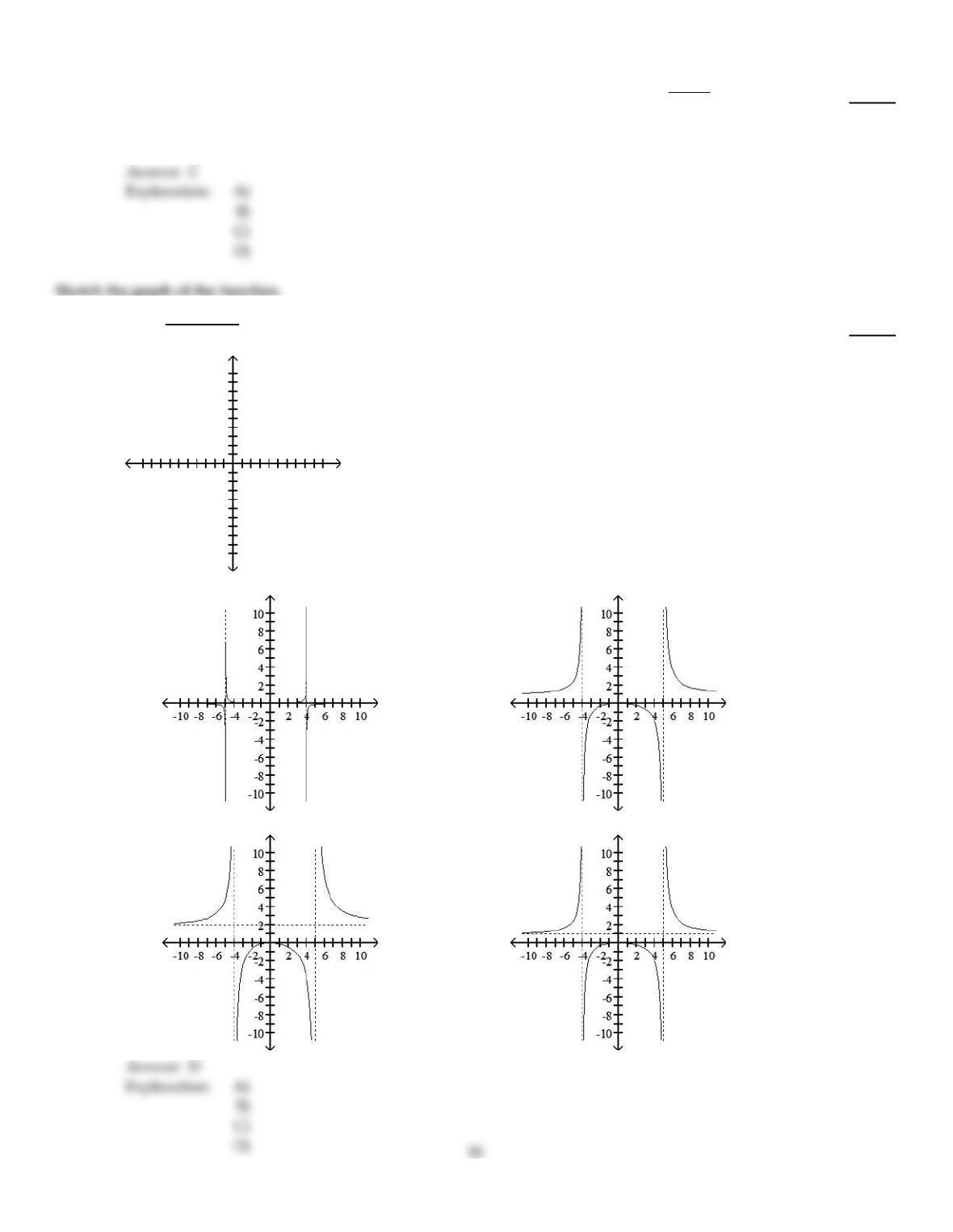
126)
If the average cost per unit C(x) to produce x units of plywood is given by C(x) =1200
x + 40, what is the
unit cost for 10 units?
126)
A)
$120.00
B)
$80.00
C)
$24.00
D)
$3.00
127)
f(x) =x2
x2– x –20
127)
A)
B)
C)
D)
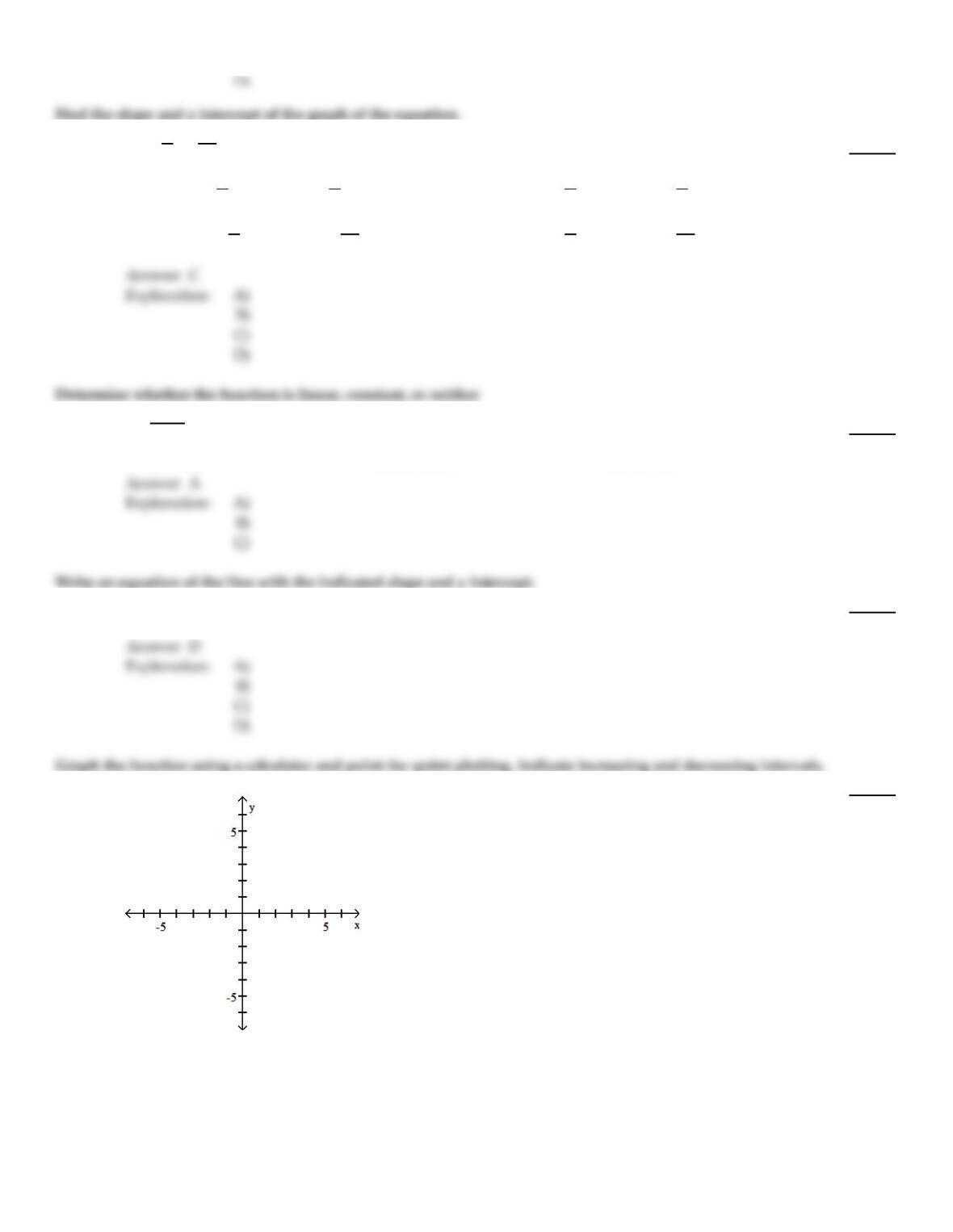
128)
y = – 2
5x +19
5
128)
A)
Slope =2
5; y intercept =9
5
B)
Slope =5
2; y intercept =9
5
C)
Slope = – 2
5; y intercept =19
5
D)
Slope =2
5; y intercept =19
5
129)
y =x + 3
7
129)
A)
Linear
B)
Constant
C)
Neither
130)
Slope =1; y intercept =3
130)
A)
y =3x + 1
B)
y = –x + 3
C)
y =3x – 1
D)
y =x+ 3
131)
f(x) =2– ln x
131)
51
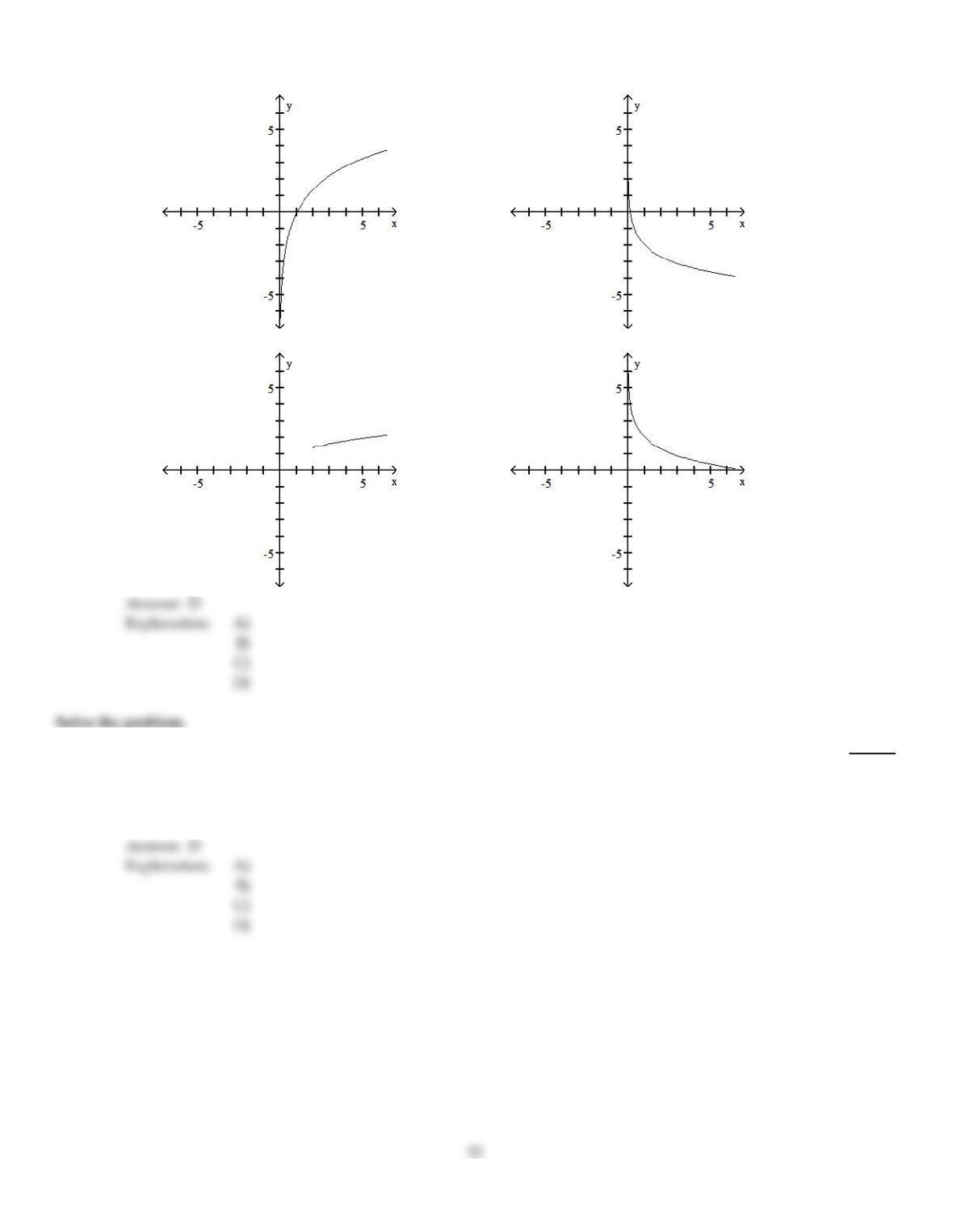
A)
Increasing (0, )
B)
Decreasing: (0, )
C)
Increasing (2, )
D)
Decreasing: (0, )
132)
In North America, coyotes are one of the few species with an expanding range. The future
population of coyotes in a region of Mississippi valley can be modeled by the equation
P = 59 + 12 · ln(18t + 1), where t is time in years. Use the equation to determine when the population
will reach 170. (Round your answer to the nearest tenth year.)
132)
A)
586.2 years
B)
583.1 years
C)
581.3 years
D)
578.0 years
133)
Efficiency experts rate employees according to job performance and attitude. The results for several
randomly selected employees are given below.
Attitude, x 59 63 65 69 58 77 76 69 70 64
Performance, y 72 67 78 82 75 87 92 83 87 78
Find the regression line which can be used to predict performance rating if attitude rating is
known.
133)
A)
y = 2.81 + 1.35x
B)
y = –47.3 + 2.02x
C)
y = 92.3 – 0.669x
D)
y = 11.7 + 1.02x
134)
Bob
Ann
Dave
carrots
peas
squash
134)
A)
function
domain: {Bob, Ann, Dave}
range: {carrots, peas, squash}
B)
function
domain: {carrots, peas, squash}
range: {Bob, Ann, Dave}
C)
not a function
135)
log 51.237
135)
A)
3.93646
B)
1.70958
C)
51.237
D)
Undefined
136)
f(x) =-3 ln x
136)
A)
Decreasing: (0, 1]
Increasing: [1, )
B)
Decreasing: (0, -3]
Increasing: [-3, )
C)
Decreasing: 0, 1
2
Increasing: 1
2,
D)
Decreasing: (0, )
Solve the problem.
137)
An initial investment of $12,000 is invested for 2 years in an account that earns 4% interest,
compounded quarterly. Find the amount of money in the account at the end of the period.
137)
A)
$12,979.20
B)
$994.28
C)
$12,994.28
D)
$12,865.62
138)
f(x) =3x
x – 2
138)
A)
(i) x intercept: 0; y intercept: 0
(ii) Domain: all real numbers except –2
(iii) Vertical asymptote: x = –2; horizontal asymptote: y = –3
(iv)
55
B)
(i) x intercept: 0; y intercept: 0
(ii) Domain: all real numbers except 2
(iii) Vertical asymptote: x = 2; horizontal asymptote: y = 3
(iv)
C)
(i) x intercept: 0; y intercept: 0
(ii) Domain: all real numbers except –2
(iii) Vertical asymptote: x = –2; horizontal asymptote: y = 3
(iv)
D)
(i) x intercept: 0; y intercept: 0
(ii) Domain: all real numbers except 2
(iii) Vertical asymptote: x = 2; horizontal asymptote: y = –3
(iv)
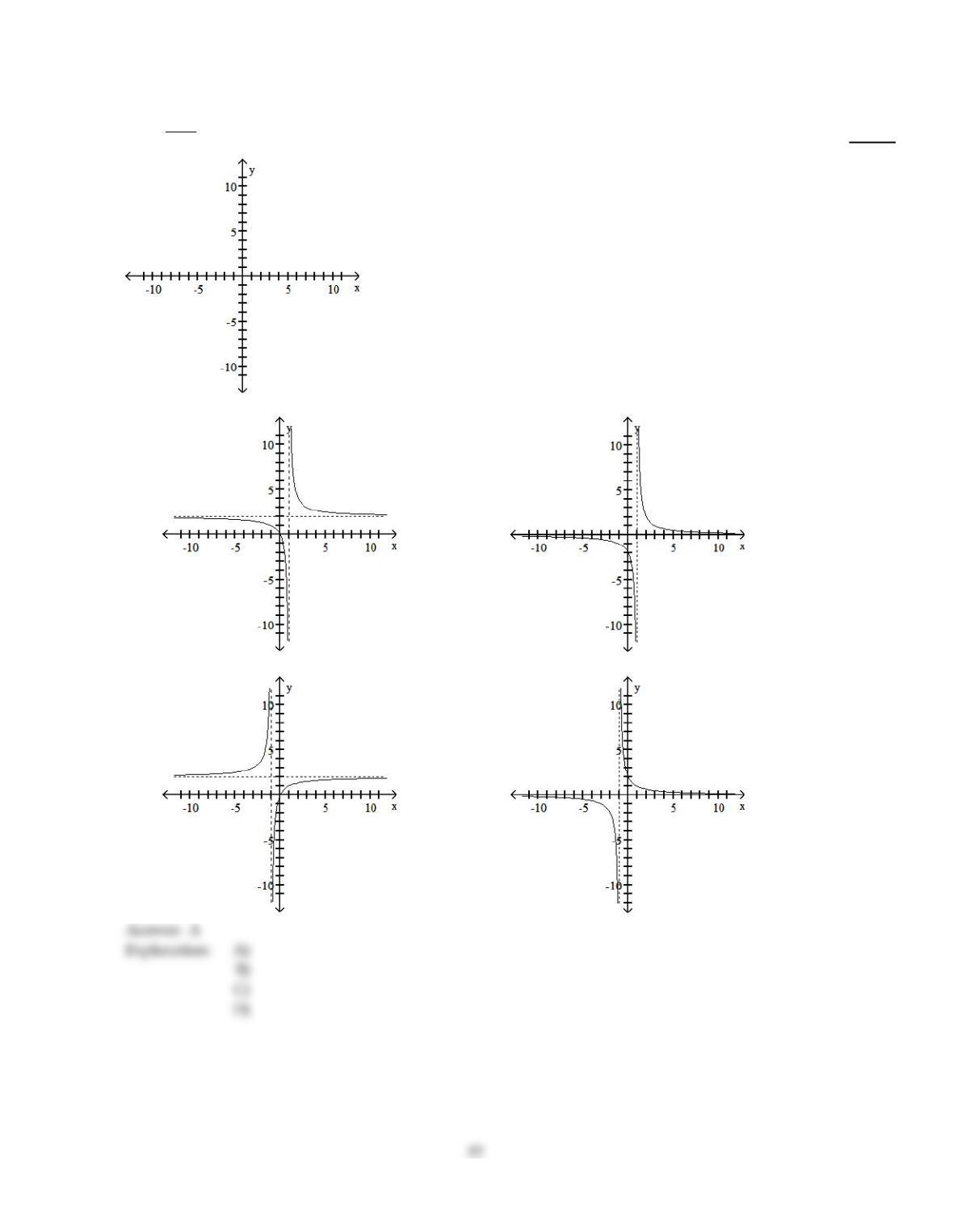
Use point–by–point plotting to sketch the graph of the equation.
139)
f(x) =2x
x – 1
139)
A)
B)
C)
D)
Find the function value.
140)
Find f(-7) when f(x) =4–6x2.
140)
A)
88
B)
46
C)
298
D)
-290
141)
log (x – 9) = 1 – log x
141)
A)
–10
B)
10
C)
–1, 10
D)
–10, 1
B
142)
The cost of manufacturing a computer part is related to the quantity produced, x, during a
production run. When 100 parts are produced, the cost is $300. When 600 parts are produced, the
cost is $4800. Find an equation of the line relating quantity produced to cost. Write the final answer
in the form C = mx + b.
142)
A)
C = 9x – 600
B)
C = 9x + 600
C)
C = 600x + 9
D)
C = 9x
A
143)
52= 25
143)
A)
5 =log2 25
B)
2 =log 5 25
C)
2 =log25 5
D)
25 =log5 2
B
Find the function value.
144)
Given that f(x) = 5x2– 2x, find f(t + 2).
144)
A)
t2+ 2t – 6
B)
5t2+ 18t + 16
C)
5t2– 18t + 16
D)
3t + 6
B
58
D
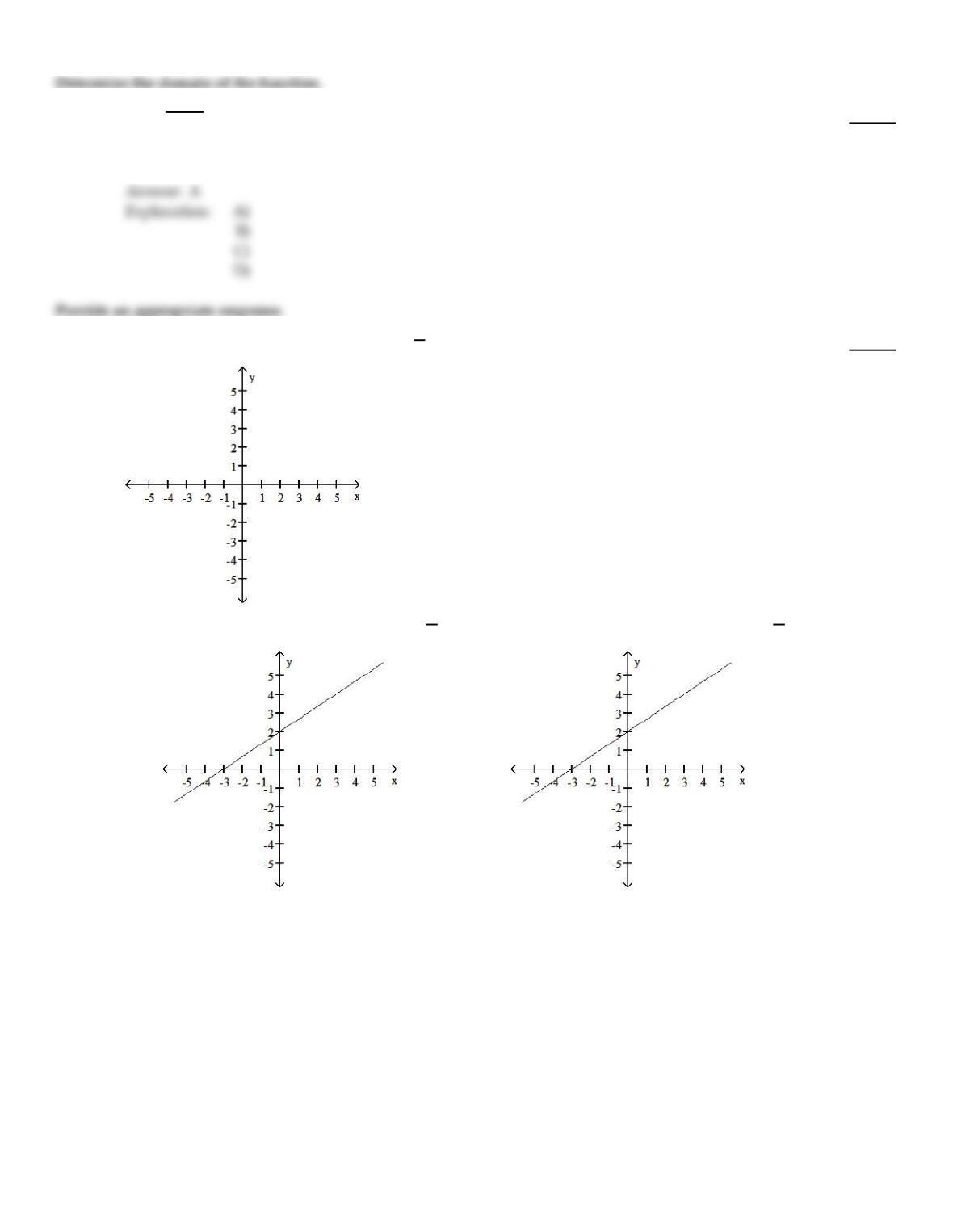
145)
f(x) =x
x – 2
145)
A)
All real numbers except 2
B)
x < 2
C)
No solution
D)
All real numbers
146)
Graph the linear function defined by f(x) =2
3x + 2 and indicate the slope and intercepts.
146)
A)
x–intercept = 2; y–intercept = –3; slope 2
3
B)
x–intercept = –3; y–intercept = 2; slope 2
3
59
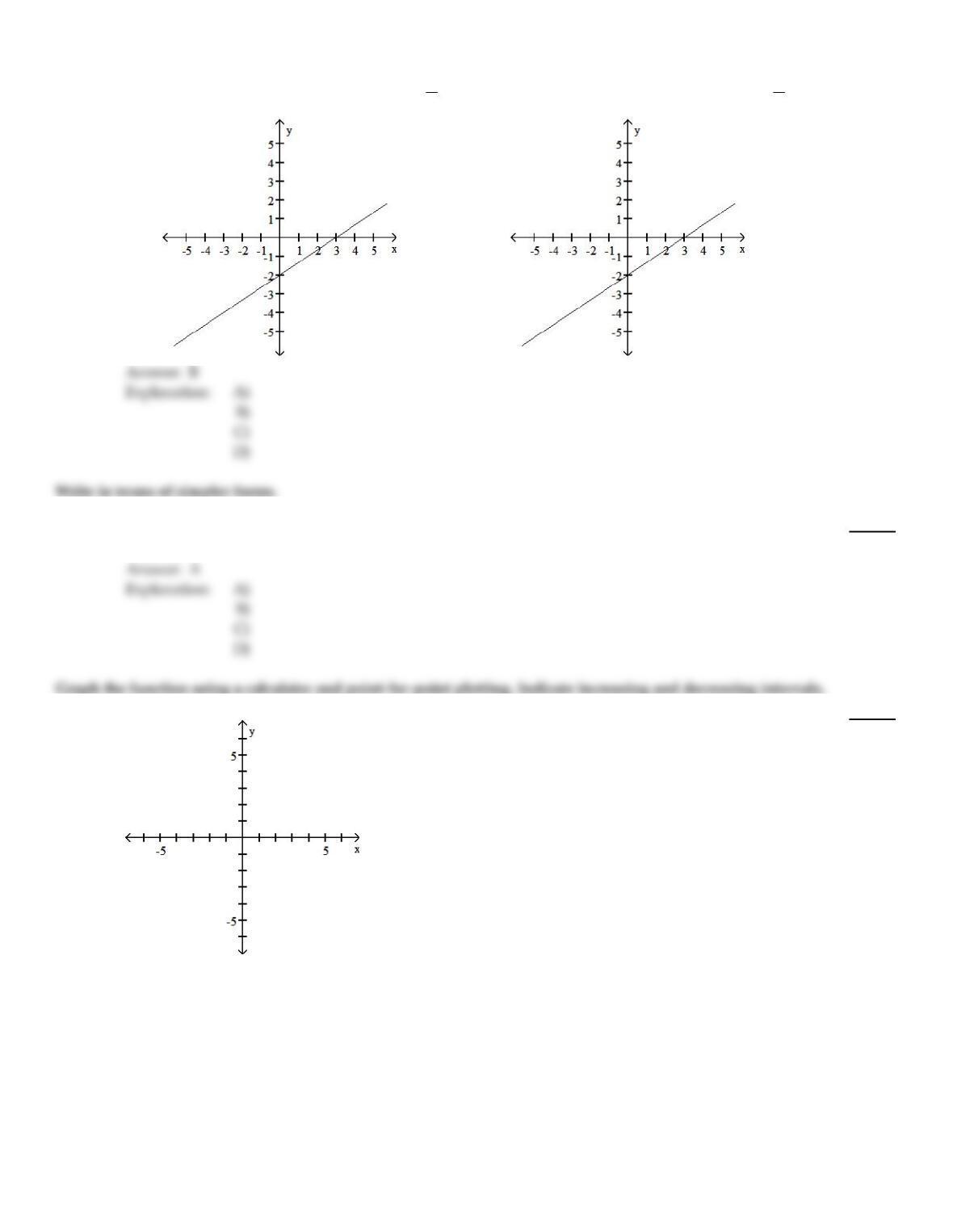
C)
x–intercept = –2; y–intercept = 3; slope 2
3
D)
x–intercept = 3; y–intercept = –2; slope 2
3
147)
4a log4 b
147)
A)
ba
B)
a4b
C)
ab
D)
b4a
148)
f(x) = 3 ln x
148)
60
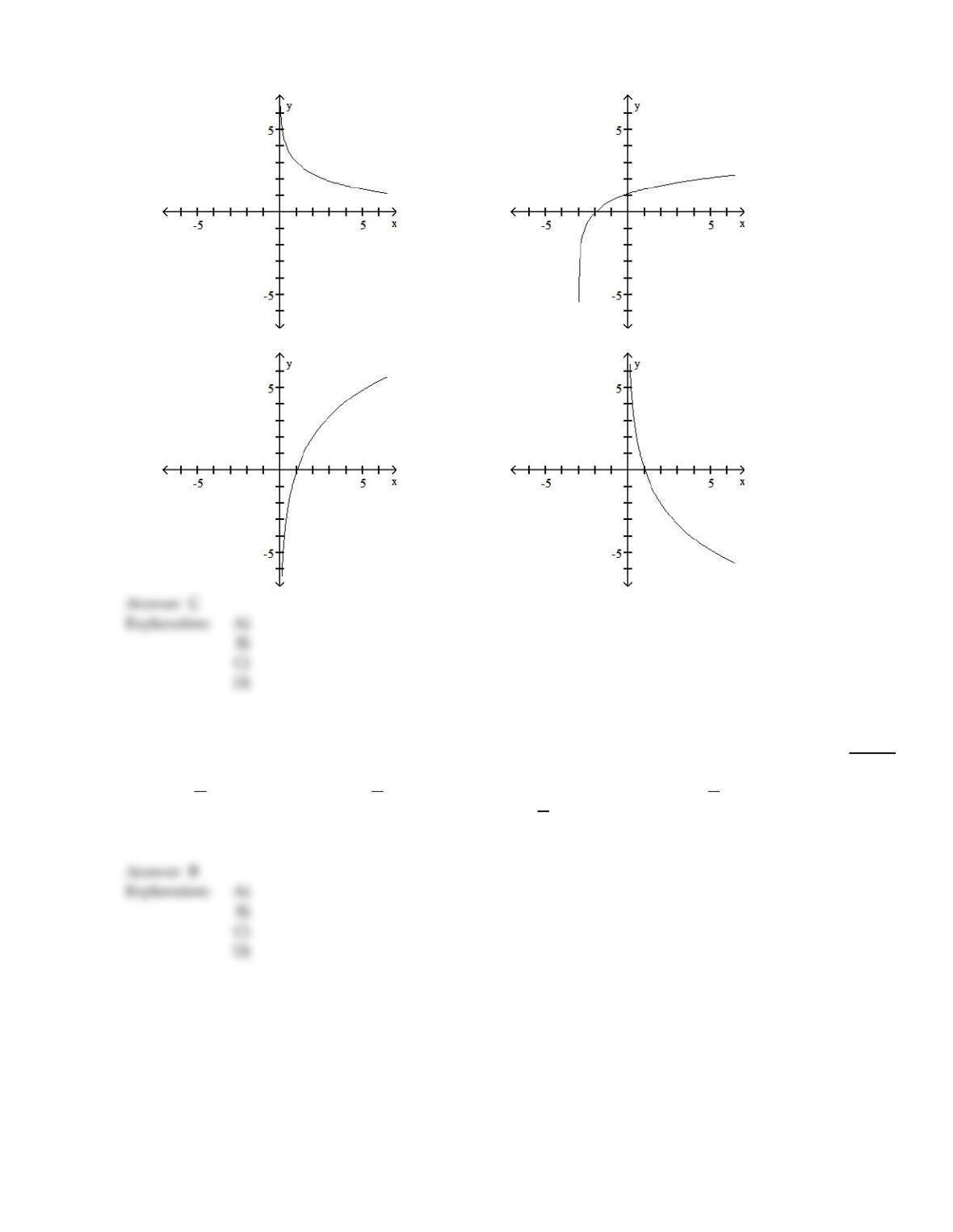
A)
Decreasing: (0, )
B)
Increasing: (–3, )
C)
Increasing: (0, )
D)
Decreasing: (0, )
For the polynomial function find the following: (i) Degree of the polynomial; (ii) All x intercepts; (iii) The y intercept.
149)
y =7x +5
149)
A)
(i) 1
(ii) – 7
5
(iii) 7
B)
(i) 1
(ii) –5
7
(iii) 5
C)
(i) 1
(ii) 5
(iii) 5
7
D)
(i) 1
(ii) 5
7
(iii) 5
61
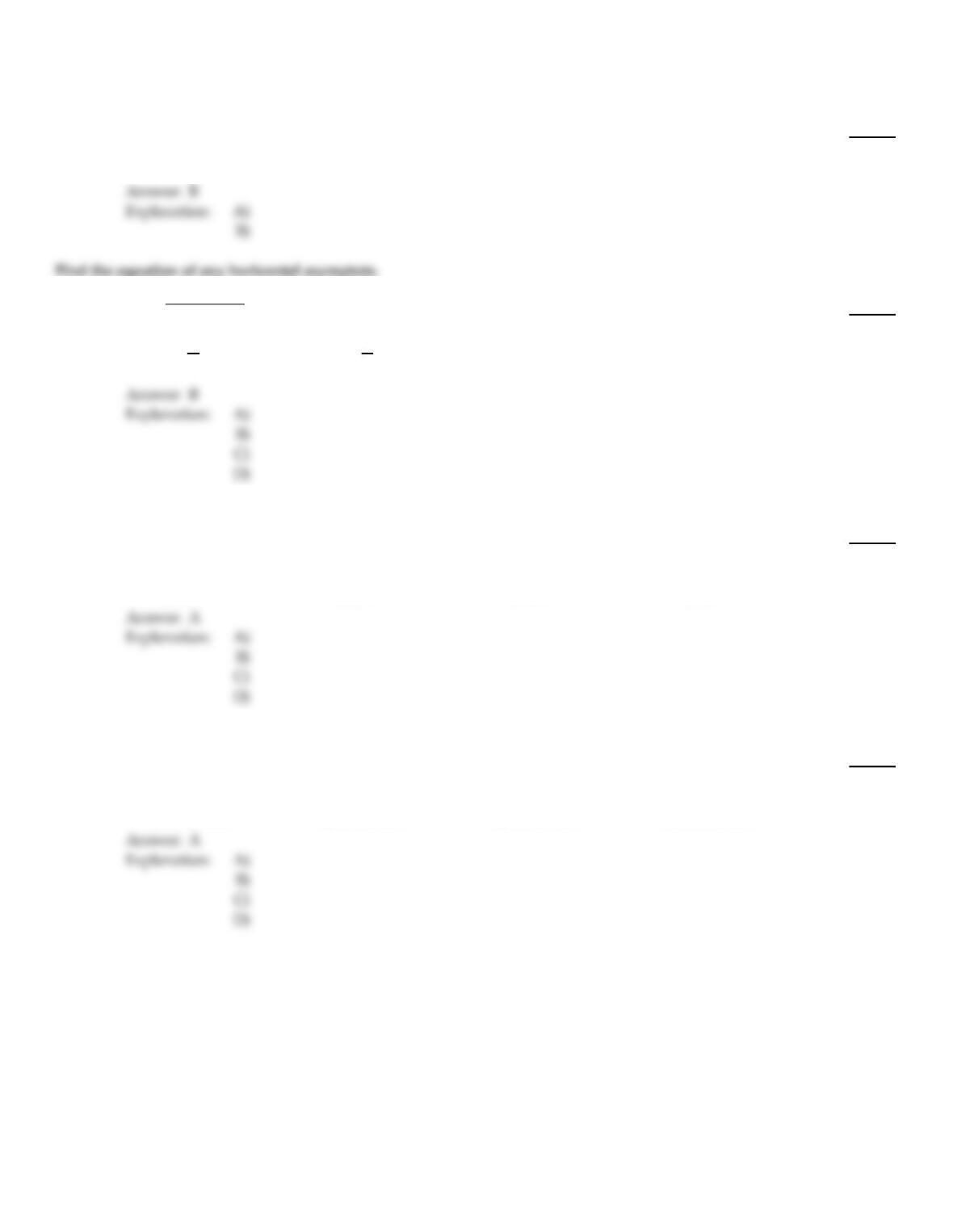
Determine if the equation specifies a function with independent variable x. If so, find the domain. If not, find a value of x
to which there corresponds more than one value of y.
150)
x2–y2= 9
150)
A)
A function with domain all real numbers except x = 5
B)
Not a function; for example, when x = 5, y = ±4
151)
f(x) =9x2– 5x – 7
5x2– 2x + 8
151)
A)
y =5
2
B)
y =9
5
C)
y = 0
D)
None
For the polynomial function find the following: (i) Degree of the polynomial; (ii) All x intercepts; (iii) The y intercept.
152)
y = (x + 3)(x + 1)(x + 3)
152)
A)
(i) 3
(ii) –3, –1, –3
(iii) 9
B)
(i) 3
(ii) –3, –1, –3
(iii) –3
C)
(i) 3
(ii) 3, 1, 3
(iii) 3
D)
(i) 3
(ii) 3, 1, 3
(iii) 9
Solve the problem.
153)
Book sales on the Internet (in billions of dollars) in year x are approximated by f(x) = 1.84 + 2.1 · ln
x, where x = 0 corresponds to 2000. How much will be spent on Internet book sales in 2008? Round
to the nearest tenth.
153)
A)
6.2 billion
B)
3.9 billion
C)
6.0 billion
D)
8.0 billion
For the rational function below (i) Find the intercepts for the graph; (ii) Determine the domain; (iii) Find any vertical or
horizontal asymptotes for the graph; (iv) Sketch any asymptotes as dashed lines. Then sketch the graph of y = f(x).
62
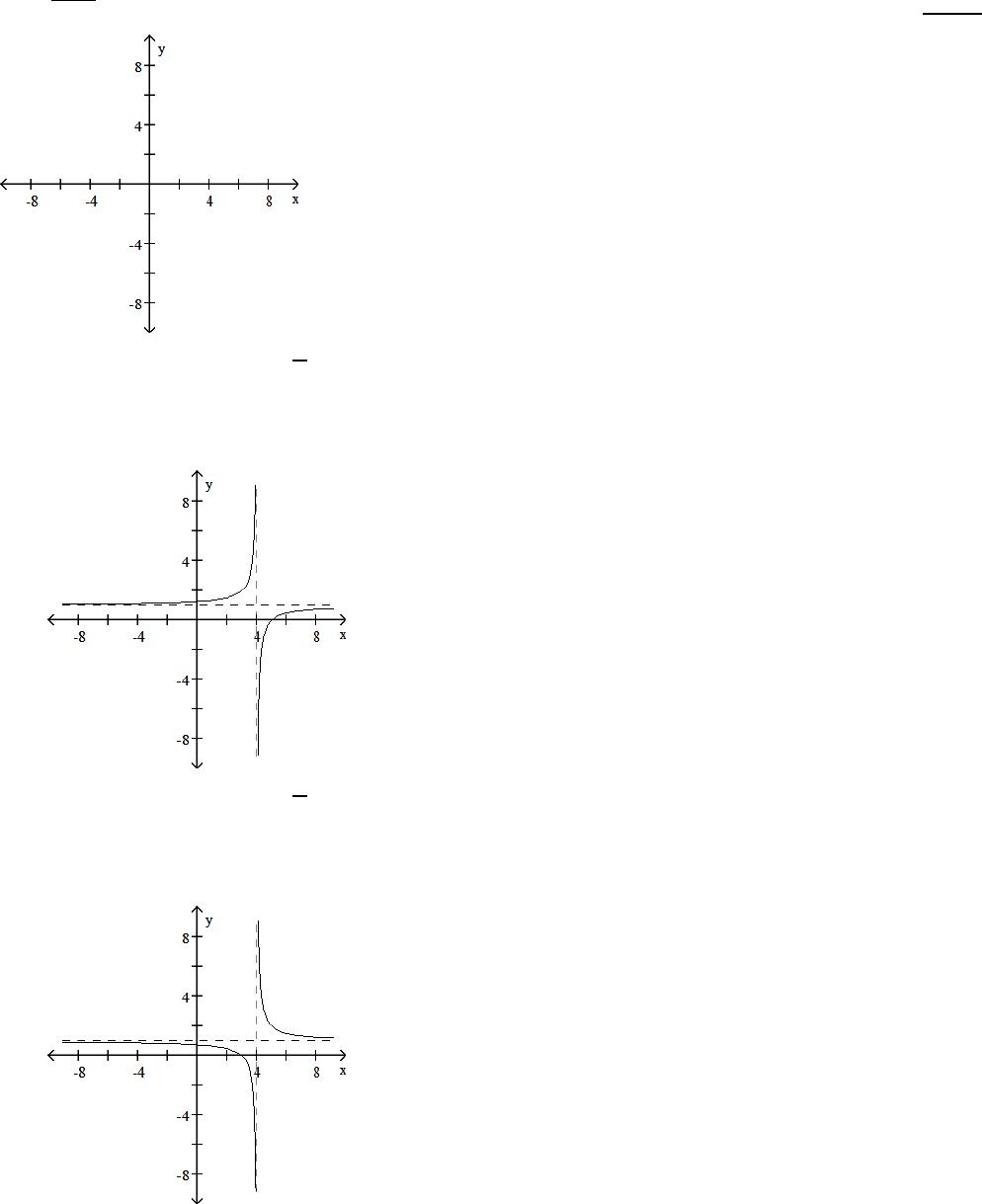
154)
f(x) =x – 3
x – 4
154)
A)
(i) x intercept: 5; y intercept: 3
4
(ii) Domain: all real numbers except 4
(iii) Vertical asymptote: x = 4; horizontal asymptote: y = 1
(iv)
B)
(i) x intercept: 3; y intercept: 3
4
(ii) Domain: all real numbers except 4
(iii) Vertical asymptote: x = 4; horizontal asymptote: y = 1
(iv)
63
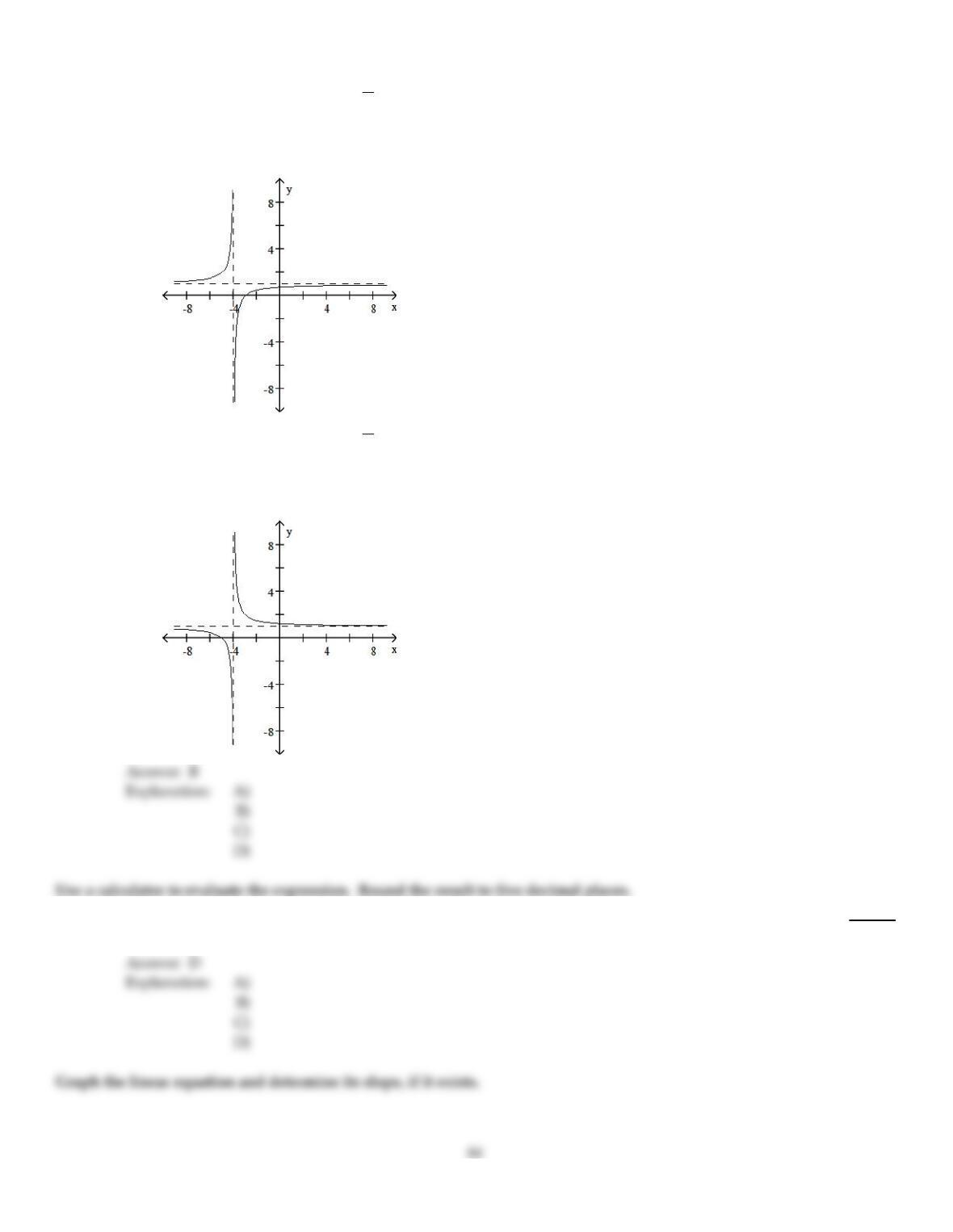
C)
(i) x intercept: –3; y intercept: 3
4
(ii) Domain: all real numbers except –4
(iii) Vertical asymptote: x = –4; horizontal asymptote: y = 1
(iv)
D)
(i) x intercept: –5; y intercept: 3
4
(ii) Domain: all real numbers except –4
(iii) Vertical asymptote: x = –4; horizontal asymptote: y = 1
(iv)
155)
log8 36.8
155)
A)
0.57674
B)
1.56585
C)
3.60550
D)
1.73388
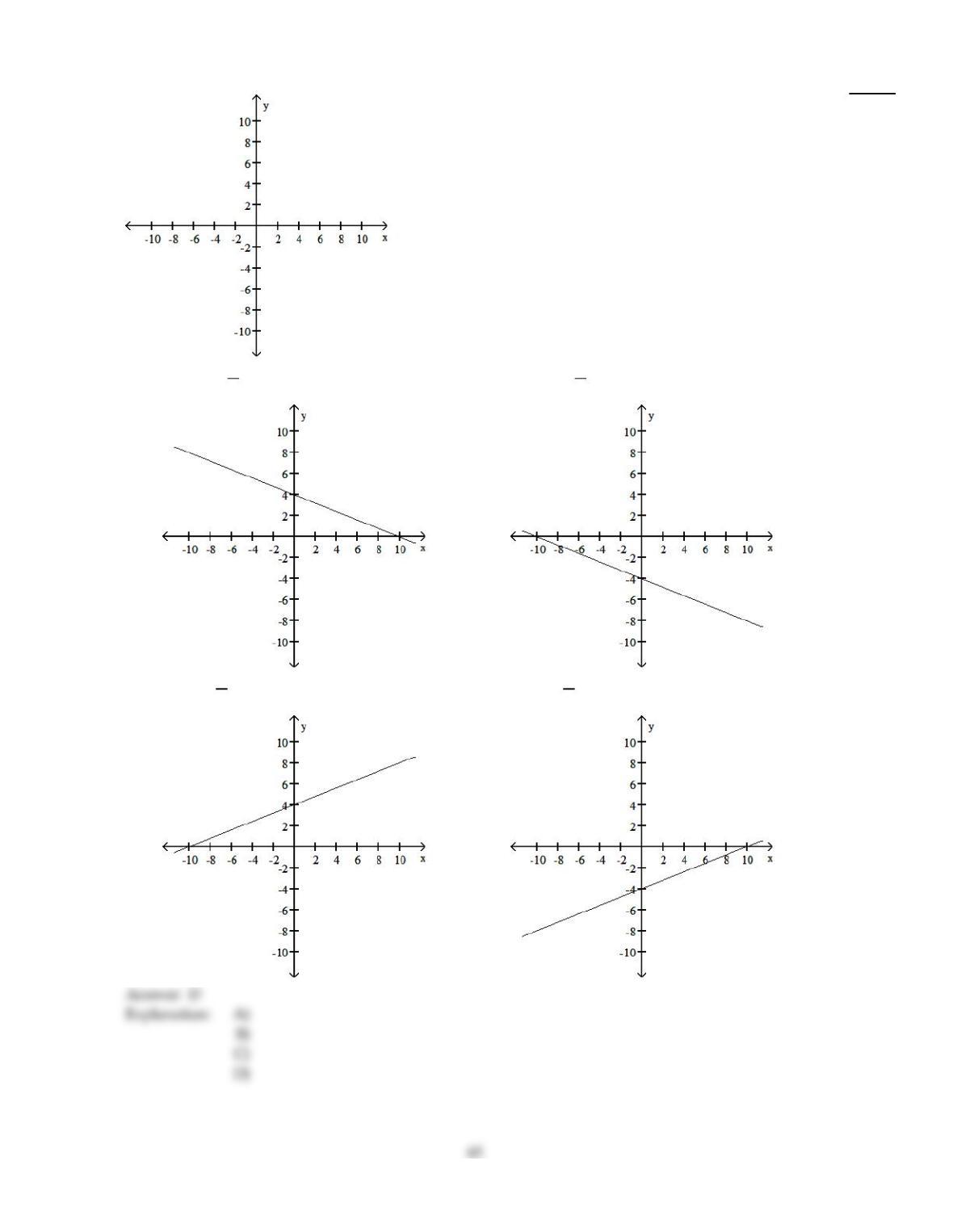
156)
2x – 5y = 20
156)
A)
slope = – 2
5
B)
slope = – 2
5
C)
slope =2
5
D)
slope =2
5
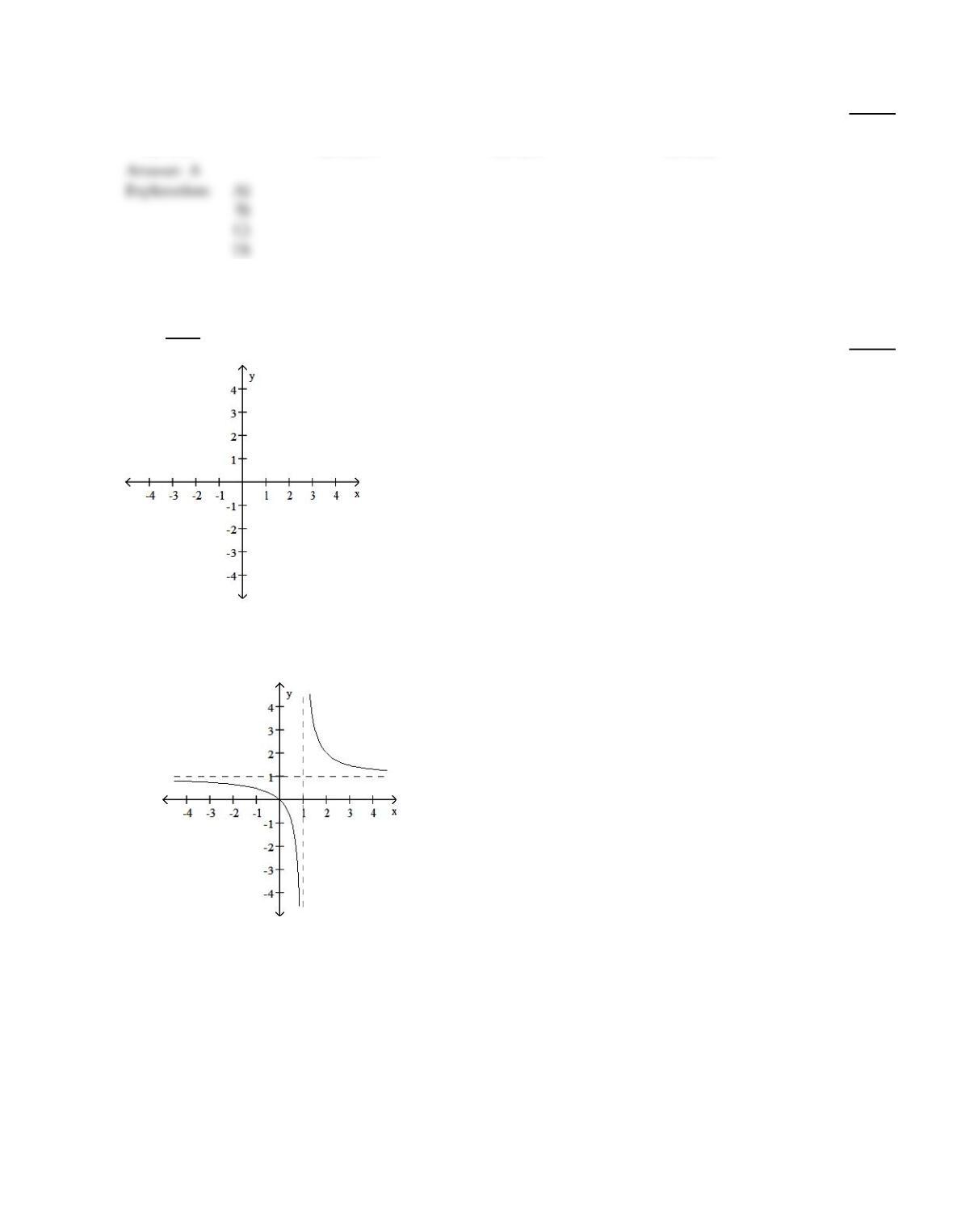
Solve the problem.
157)
The number of books in a community college library increases according to the function
B = 7200e0.03t, where t is measured in years. How many books will the library have after 8 year(s)?
157)
A)
9153
B)
10,275
C)
7200
D)
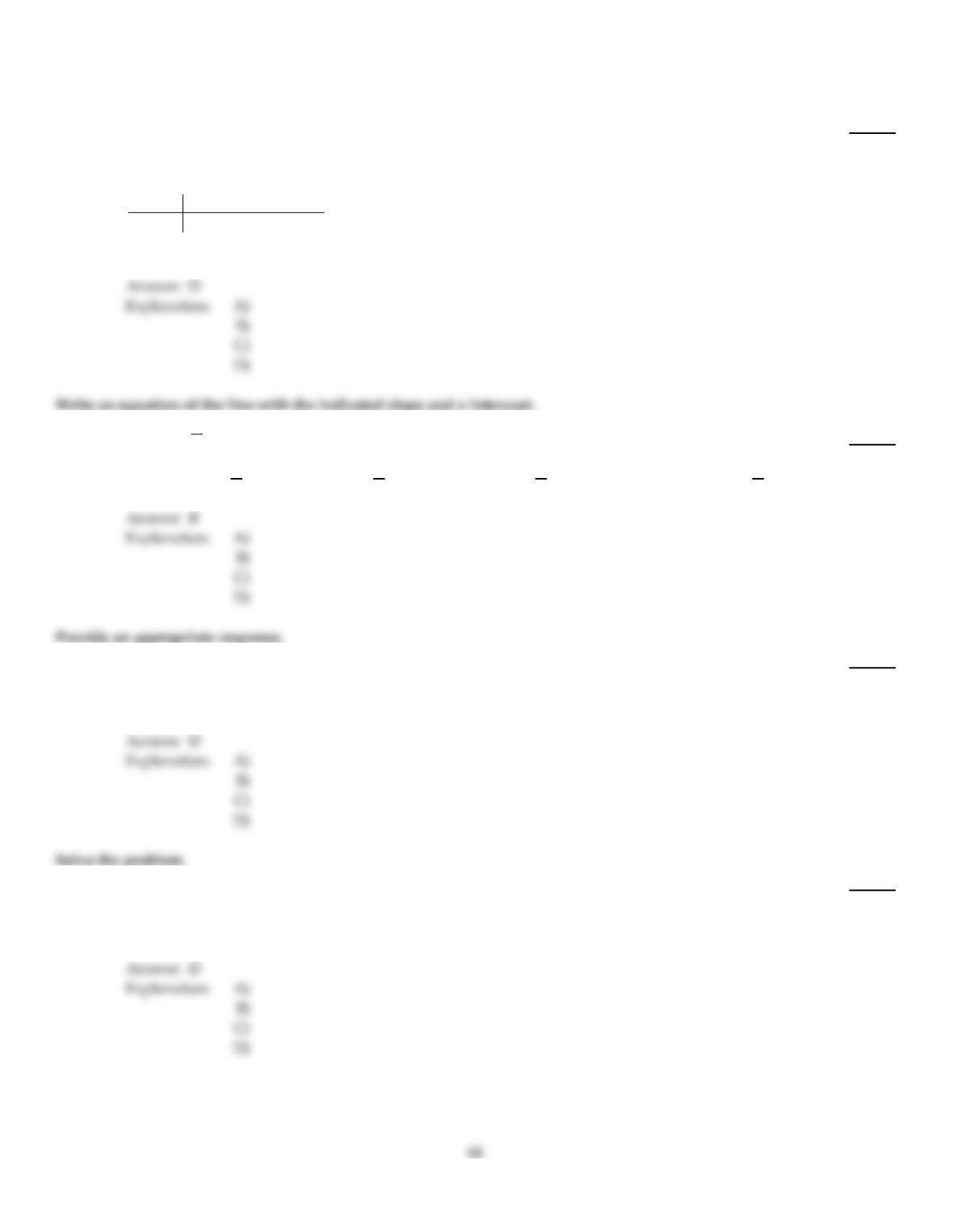
4462
For the rational function below (i) Find the intercepts for the graph; (ii) Determine the domain; (iii) Find any vertical or
horizontal asymptotes for the graph; (iv) Sketch any asymptotes as dashed lines. Then sketch the graph of y = f(x).
158)
f(x) =x + 2
x + 1
158)
A)
(i) x intercept: 0; y intercept: 0
(ii) Domain: all real numbers except 1
(iii) Vertical asymptote: x = 1; horizontal asymptote: y = 1
(iv)
66
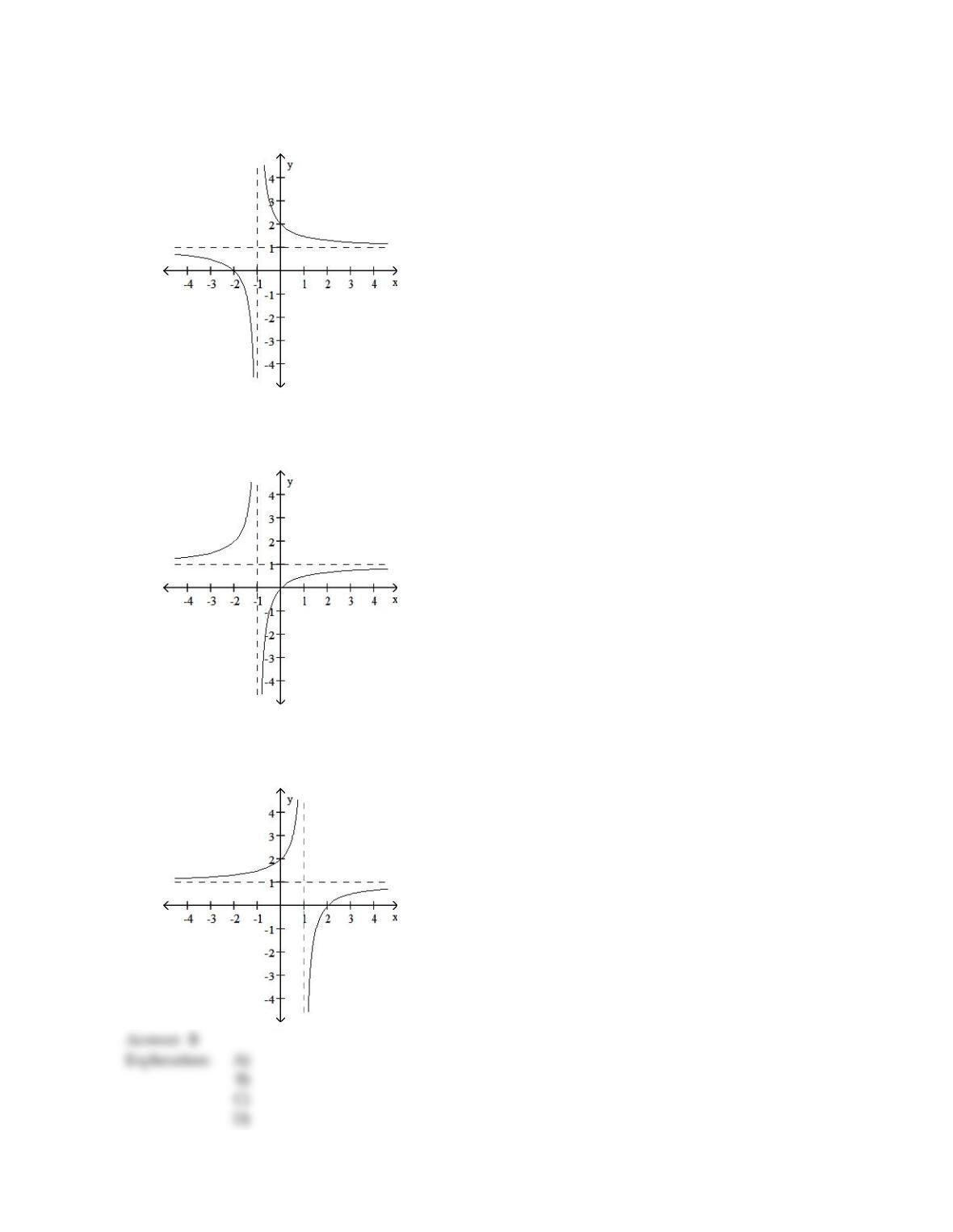
B)
(i) x intercept: –2; y intercept: 2
(ii) Domain: all real numbers except –1
(iii) Vertical asymptote: x = –1; horizontal asymptote: y = 1
(iv)
C)
(i) x intercept: 0; y intercept: 0
(ii) Domain: all real numbers except –1
(iii) Vertical asymptote: x = –1; horizontal asymptote: y = 1
(iv)
D)
(i) x intercept: 2; y intercept: 2
(ii) Domain: all real numbers except 1
(iii) Vertical asymptote: x = 1; horizontal asymptote: y = 1
(iv)
67
Use the REGRESSION feature on a graphing calculator.
159)
In the table below, x represents the number of years since 2000 and y represents sales (in thousands
of dollars) of a clothing company. Use the regression equation to estimate sales in the year 2006.
Round to the nearest thousand dollars.
Year x 1 2 3 4 5
Sales y 84 76 39 30 26
159)
A)
$14,000
B)
$20,000
C)
$8,000
D)
$2,000
160)
Slope = – 1
2; y intercept = –6
160)
A)
y = –6x +1
2
B)
y = – x
2– 6
C)
y =x
2– 6
D)
y = –6x –1
2
161)
Write the equation of a line that passes through (–1, 4) and (5, –1). Write the final answer in the
form Ax + By = C where A, B, and C are integers with no common divisors (other than ±1) and
A > 0.
161)
A)
5x – 6y = 19
B)
–5x + 6y = 19
C)
5x + 6y = –19
D)
5x + 6y = 19
162)
Under certain conditions, the power P, in watts per hour, generated by a windmill with winds
blowing v miles per hour is given by P(v) = 0.015v3. Find the power generated by 18–mph winds.
162)
A)
58.32 watts per hour
B)
4.86 watts per hour
C)
0.00006075 watts per hour
D)
87.48 watts per hour
Use the REGRESSION feature on a graphing calculator.
163)
The average retail price in the Spring of 2000 for a used Camaro Z28 coupe depends on the age of
the car as shown in the following table.
Age, x 1 2 3 4 5 6 7 8 9
Price, y 18,325 15,925 13,685 11,805 10,490 8885 8015 6480 5710
Find the quadratic model that best estimates this data. Round your answer to whole numbers.
163)
A)
y = 102x2– 2576x
B)
y = –1551x + 18,790x
C)
y = –9x3+ 235x2– 3134x + 21,252
D)
y = 102x2– 2576x + 20,669
Use the properties of logarithms to solve.
164)
log (x + 10) – log (x + 4) = log x
164)
A)
6
B)
–5
C)
2
D)
2, – 5
C
Solve the problem.
165)
If $1250 is invested at a rate of 8 1
4% compounded monthly, what is the balance after 10 years?
[A =P(1 + i)n]
165)
A)
$1594.31
B)
$1031.25
C)
$2281.25
D)
$2844.31
D
166)
A carbon–14 dating test is performed on a fossil bone, and analysis finds that 15.5% of the original
amount of carbon–14 is still present in the bone. Estimate the age of the fossil bone. (Recall that
carbon–14 decays according to the equation A =A0e–0.000124t).
166)
A)
1,500 years
B)
150 years
C)
15,000 years
D)
15,035 years
D
D
Give the domain and range of the function.
167)
r(x) =x –7–2
167)
A)
Domain: all real numbers; Range: [0, )
B)
Domain: all real numbers; Range: all real numbers
C)
Domain: all real numbers; Range: [– 2, )
D)
Domain: [– 2, ); Range: all real numbers
168)
The U. S. Census Bureau compiles data on population. The population (in thousands) of a southern
city can be approximated by P(x) = 0.08x2– 13.08x + 927, where x corresponds to the years after
1950. In what calendar year was the population about 804,200?
168)
A)
1965
B)
1955
C)
2000
D)
1960
Find the equations of any vertical asymptotes.
169)
f(x) =x2+6x
x2–2x –48
169)
A)
x =8, x =-6
B)
x =-8, x =6
C)
x =8
D)
None
Graph the function.
170)
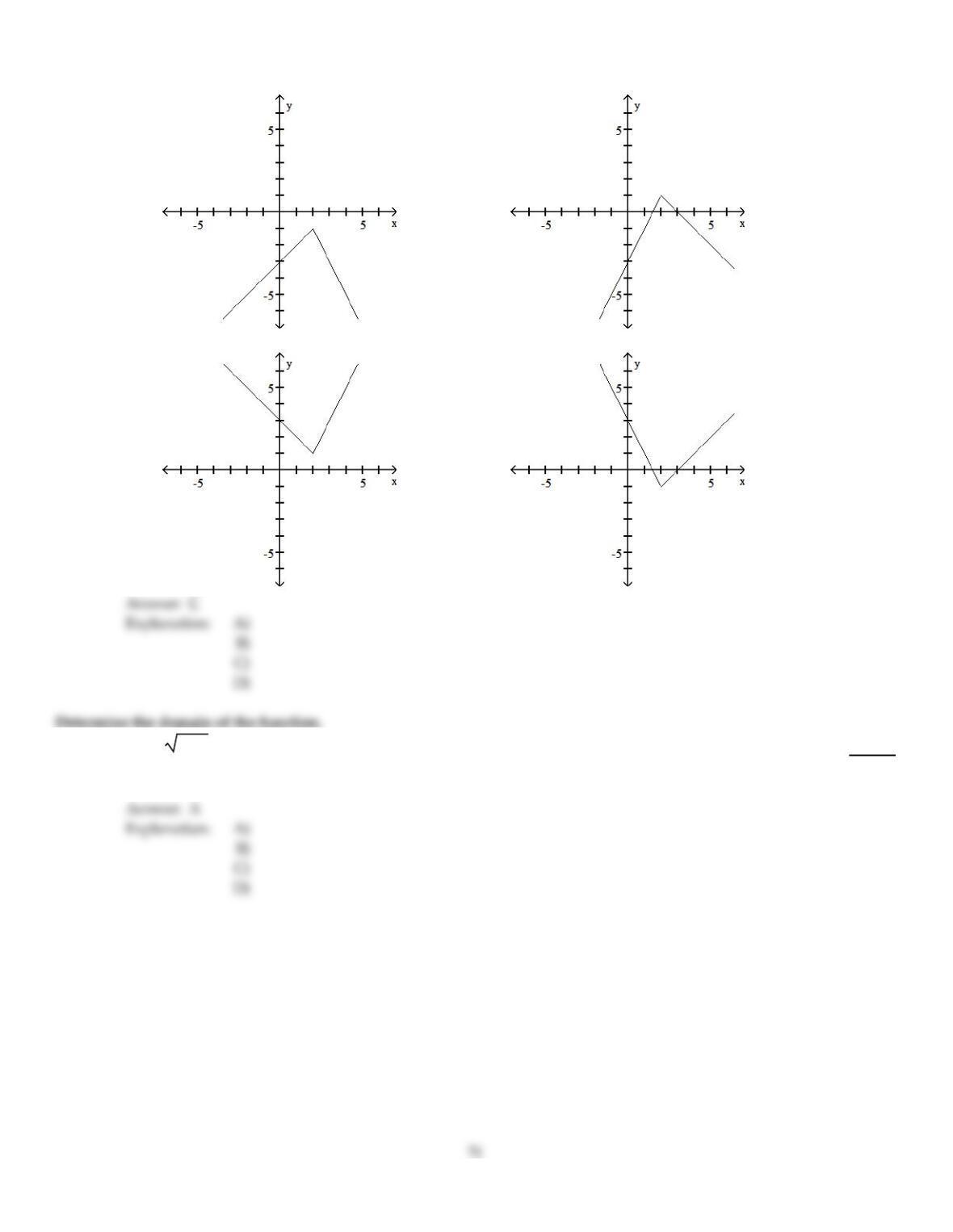
f(x) =–x + 3 if x < 2
2x – 3 if x 2
170)
70
A)
B)
C)
D)
171)
f(x) =3 – x
171)
A)
x 3
B)
x < 3
C)
All real numbers except 3
D)
No solution
For the given function, find each of the following:
(A) Intercepts
(B) Vertex
(C) Maximum or minimum
(D) Range
172)
f(x) =(x + 4)2– 9
172)
A)
(A) x–intercepts: – 7, -1; y–intercept: 7
(B) Vertex (-4, -9)
(C) Minimum: -9
(D) y -9
B)
(A) x–intercepts: – 7, -1; y–intercept: 7
(B) Vertex (4, -9)
(C) Minimum: -9
(D) y -9
C)
(A) x–intercepts: – 7, -1; y–intercept: 7
(B) Vertex (-4, -9)
(C) Maximum: -9
(D) y -9
D)
(A) x–intercepts: 1, 7; y–intercept: 7
(B) Vertex (-4, -9)
(C) Minimum: -9
(D) y -9
Find the slope of the line containing the given points.
173)
(6, 1) and (6, – 4)
173)
A)
– 4
B)
0
C)
–1
4
D)
Undefined
174)
100.4771 = 3
174)
A)
3 = log 0.4771
B)
0.4771 = log 3
C)
0.4771 = log 10
D)
0.4771 =log 9 10
Provide an appropriate response.
175)
How can the graph of f(x) = – x + 1 be obtained from the graph of y =x?
175)
A)
Shift it horizontally –1 units to the left. Reflect it across the x–axis.
B)
Shift it horizontally 1 units to the left. Reflect it across the y–axis.
C)
Shift it horizontally 1 units to the right. Reflect it across the x–axis.
D)
Shift it horizontally 1 units to the left. Reflect it across the x–axis.
Use the REGRESSION feature on a graphing calculator.
176)
Since 1984 funeral directors have been regulated by the Federal Trade Commission. The average
cost of a funeral for an adult in a Midwest city has increased, as shown in the following table.
YEAR AVERAGE COST
OF FUNERAL
1980 $ 1926
1985 $ 2841
1991 $ 3842
1995 $ 4713
1996 $ 4830
1998 $ 5120
2001 $ 5340
Let x represent the number of years since 1980. Use a graphing calculator to fit a quartic function to
the data. Round your answer to five decimal places.
176)
A)
y = –2.047489x2+ 212.82699x + 1879.85469
B)
y = –0.04268x4+ 1.53645x3– 16.76289x2+ 231.82723x + 1927.58518
C)
y = 170.5971x + 1991.5213
D)
y = –0.04268x4
177)
The cost for labor associated with fixing a washing machine is computed as follows: There is a fixed
charge of $25 for the repairman to come to the house, to which a charge of $20 per hour is added.
Find an equation that can be used to determine the labor cost, C, of a repair that takes x hours.
Write the final answer in the form C = mx + b.
177)
A)
C = 45x
B)
C = 20x + 25
C)
C = –20x + 25
D)
C = 25x + 20
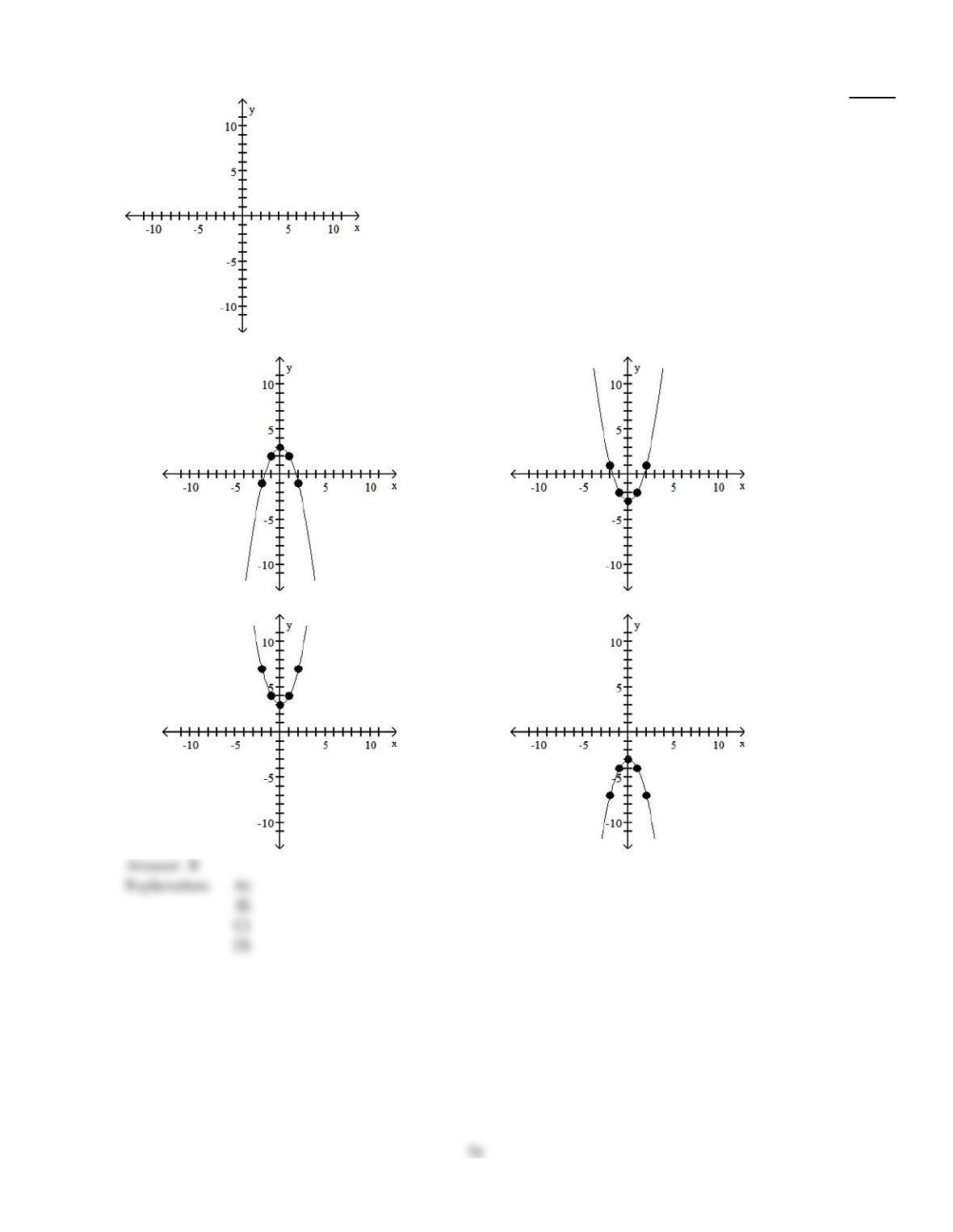
178)
y =x2– 3
178)
A)
B)
C)
D)
Use a calculator to evaluate the expression. Round the result to five decimal places.
179)
ln 0.027
179)
A)
–1.56864
B)
–3.61192
C)
0.56864
D)
Undefined
180)
What is the minimum number of x intercepts that a polynomial of degree 8 can have? Explain.
180)
A)
0 because a polynomial of even degree may not cross the x axis at all.
B)
8 because this is the degree of the polynomial.
C)
1 because a polynomial of even degree crosses the x axis at least once.
D)
Not enough information is given.
Find the equation of any horizontal asymptote.
181)
f(x) =x2+ 6x – 6
x – 6
181)
A)
y =-6
B)
y =6
C)
None
D)
y =7
Use the REGRESSION feature on a graphing calculator.
182)
A study was conducted to compare the average time spent in the lab each week versus course
grade for computer students. The results are recorded in the table below.
Hours in lab 10 11 16 9 7 15 16 10
Grade (percent) 96 51 62 58 89 81 46 51
Use linear regression to find a linear function that predicts a student’s course grade as a function of
the number of hours spent in lab.
182)
A)
y = 88.6 – 1.86x
B)
y = 0.930 + 44.3x
C)
y = 44.3 + 0.930x
D)
y = 1.86 + 88.6x
183)
The use of bottled water in the United States has shown a steady increase in recent years. The table
shows the annual per capita consumption for the years 1995 – 2001.
Year 1995 1996 1997 1998 1999 2000 2001
Gallons/person 4.4 5.1 5.7 6.4 7.3 8.0 10.2
With x being the years since 1995, find the linear function that represents this data. Round your
answer to two decimal places.
183)
A)
y = 0.04x3– 0.23x2+ 1.01x + 4.35
B)
y = 0.89x + 4.07
C)
y = 4.07x + 0.89
D)
y = 0.1x2+ 0.29x + 4.57
184)
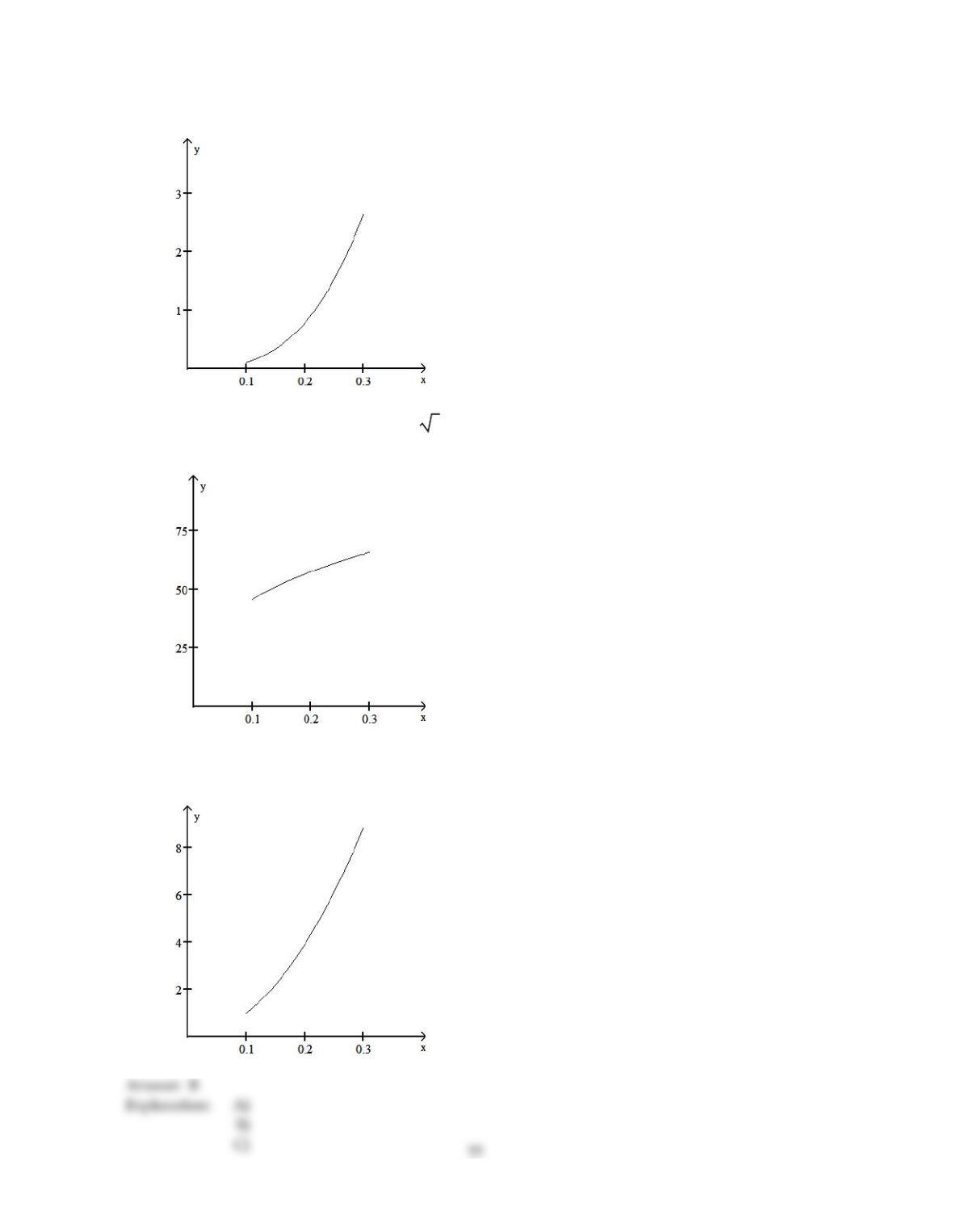
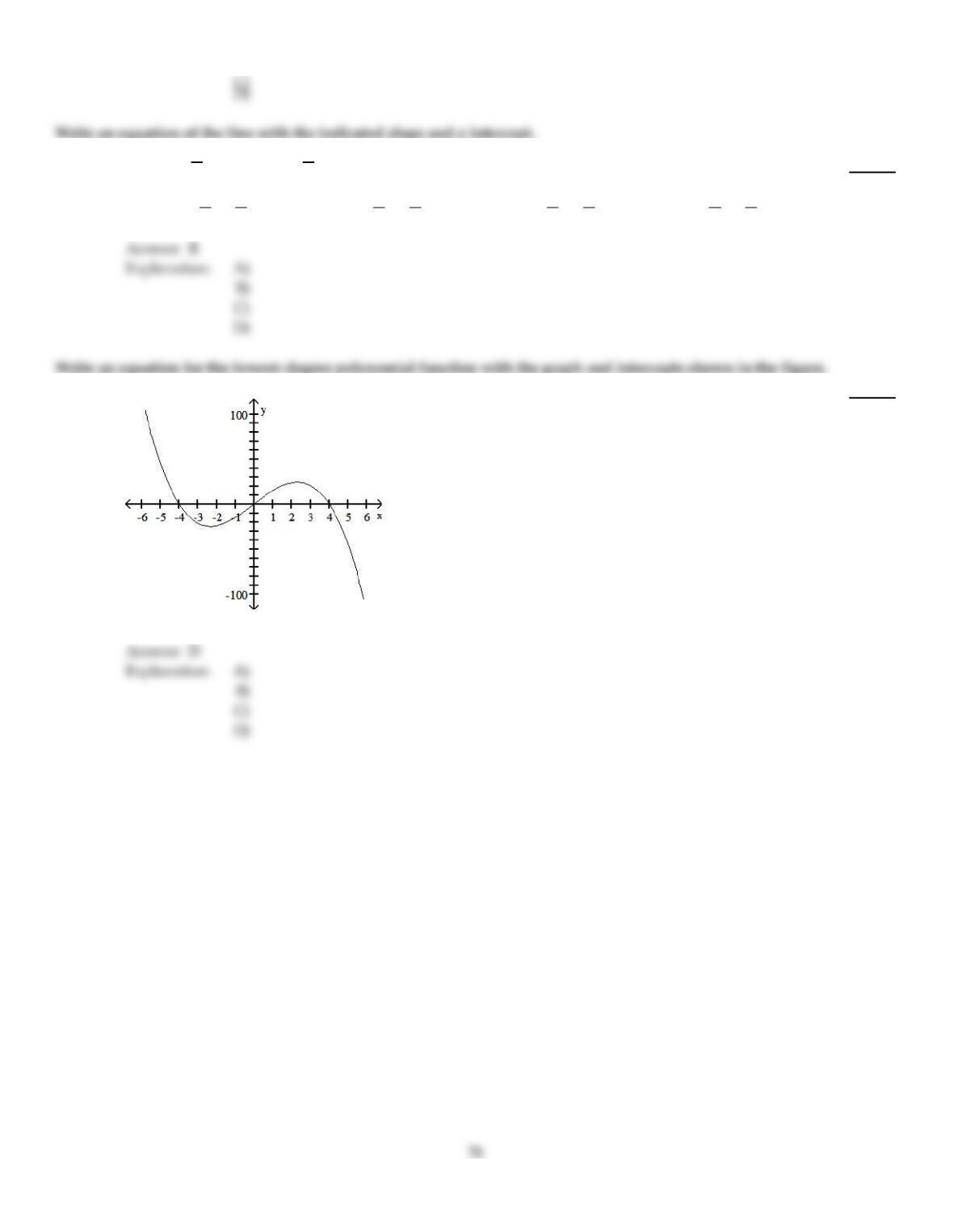
The average weight of a particular species of frog is given by w(x) = 98x3, 0.1 x 0.3, where x is
length (with legs stretched out) in meters and w(x) is weight in grams. (i) Describe how the graph
of function w can be obtained from one of the six basic functions: y = x, y =x2, y =x3, y =x, y =
3x, or y =x. (ii) Sketch a graph of function w using part (i) as an aid.
184)
A)
(i) The graph of the basic function y =x3 is
reflected on the x–axis and is vertically
expanded by a factor of 98.
(ii)
76
B)
(i) The graph of the basic function y =x3 is
vertically expanded by a factor of 98.
(ii)
C)
(i) The graph of the basic function y =3x is
vertically expanded by a factor of 98.
(ii)
D)
(i) The graph of the basic function y =x2 is
vertically expanded by a factor of 98.
(ii)
185)
Slope = – 3
4; y intercept =9
2
185)
A)
y = – 4
3x +9
2
B)
y = – 3
4x +9
2
C)
y = – 3
4x –9
2
D)
y =3
4x +5
2
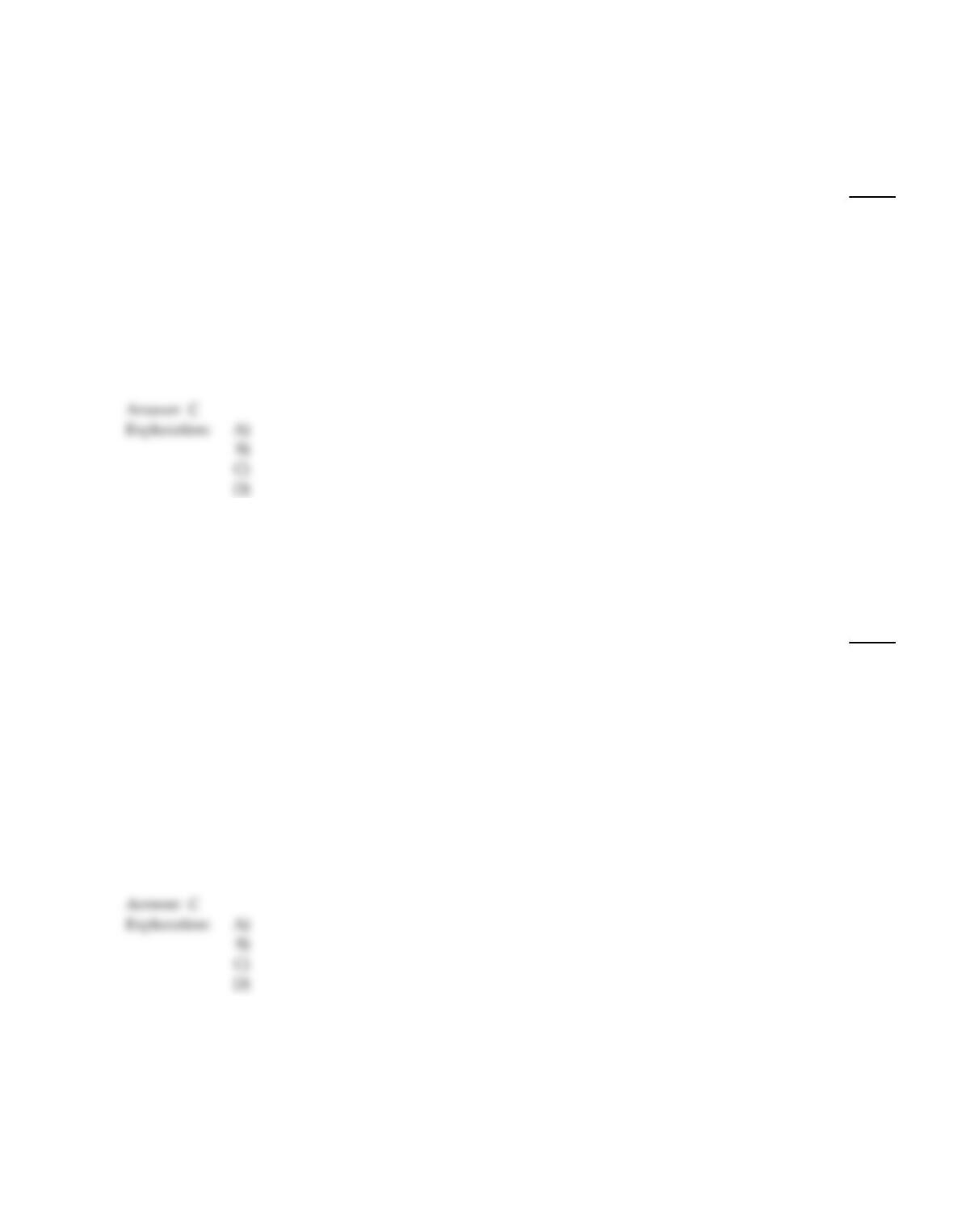
186)
186)
A)
f(x) =x3+ 16x
B)
f(x) = –x3– 16x
C)
f(x) = –x3– 16x
D)
f(x) = –x3+ 16x
For the given function, find each of the following:
(A) Intercepts
(B) Vertex
(C) Maximum or minimum
(D) Range
187)
n(x) = –(x – 2)2+ 9
187)
A)
(A) x–intercepts: – 1, 5; y–intercept: 5
(B) Vertex (2, 9)
(C) Minimum: 9
(D) y 9
B)
(A) x–intercepts: -5, 1; y–intercept: 5
(B) Vertex (2, 9)
(C) Maximum: 9
(D) y 9
C)
(A) x–intercepts: – 1, 5; y–intercept: 5
(B) Vertex (2, 9)
(C) Maximum: 9
(D) y 9
D)
(A) x–intercepts: – 1, 5; y–intercept: 5
(B) Vertex (-2, -9)
(C) Maximum: 9
(D) y 9
Find the vertex form for the quadratic function. Then find each of the following:
(A) Intercepts
(B) Vertex
(C) Maximum or minimum
(D) Range
188)
n(x) = –x2+ 8x – 7
188)
A)
Standard form: n(x) = –(x – 4)2+ 9
(A) x–intercepts: 1, 7; y–intercept: –7
(B) Vertex (-4, -9)
(C) Maximum: 9
(D) y 9
B)
Standard form: n(x) = –(x + 4)2+ 9
(A) x–intercepts: 1, 7; y–intercept: –7
(B) Vertex (4, 9)
(C) Minimum: 9
(D) y 9
C)
Standard form: n(x) = –(x – 4)2+ 9
(A) x–intercepts: 1, 7; y–intercept: –7
(B) Vertex (4, 9)
(C) Maximum: 9
(D) y 9
D)
Standard form: n(x) = –(x + 4)2+ 9
(A) x–intercepts: -7, – 1; y–intercept: –7
(B) Vertex (4, 9)
(C) Maximum: 9
(D) y 9
79
Solve the problem.
189)
The number of reports of a certain virus has increased exponentially since 1960. The current
number of cases can be approximated using the function r(t) = 207 e0.005t, where t is the number of
years since 1960. Estimate the of cases in the year 2010.
189)
A)
190
B)
207
C)
240
D)
266
190)
log884
190)
A)
84
B)
4
C)
32
D)
8
191)
y =x2–36
191)
A)
(i) 2
(ii) –6, 6
(iii) –36
B)
(i) 1
(ii) 18
(iii) –36
C)
(i) 2
(ii) –7, 7
(iii) –36
D)
(i) 1
(ii) 6
(iii) –36
Find the range of the given function. Express your answer in interval notation.
192)
f(x) = 4x2+ 16x + 19
192)
A)
[ – 2, )
B)
(–, –3]
C)
[3, )
D)
(–, 2]
Solve the problem.
193)
If $4,000 is invested at 7% compounded annually, how long will it take for it to grow to $6,000,
assuming no withdrawals are made? Compute answer to the next higher year if not exact.
[A =P(1 + r)t]
193)
A)
2 years
B)
8 years
C)
5 years
D)
6 years
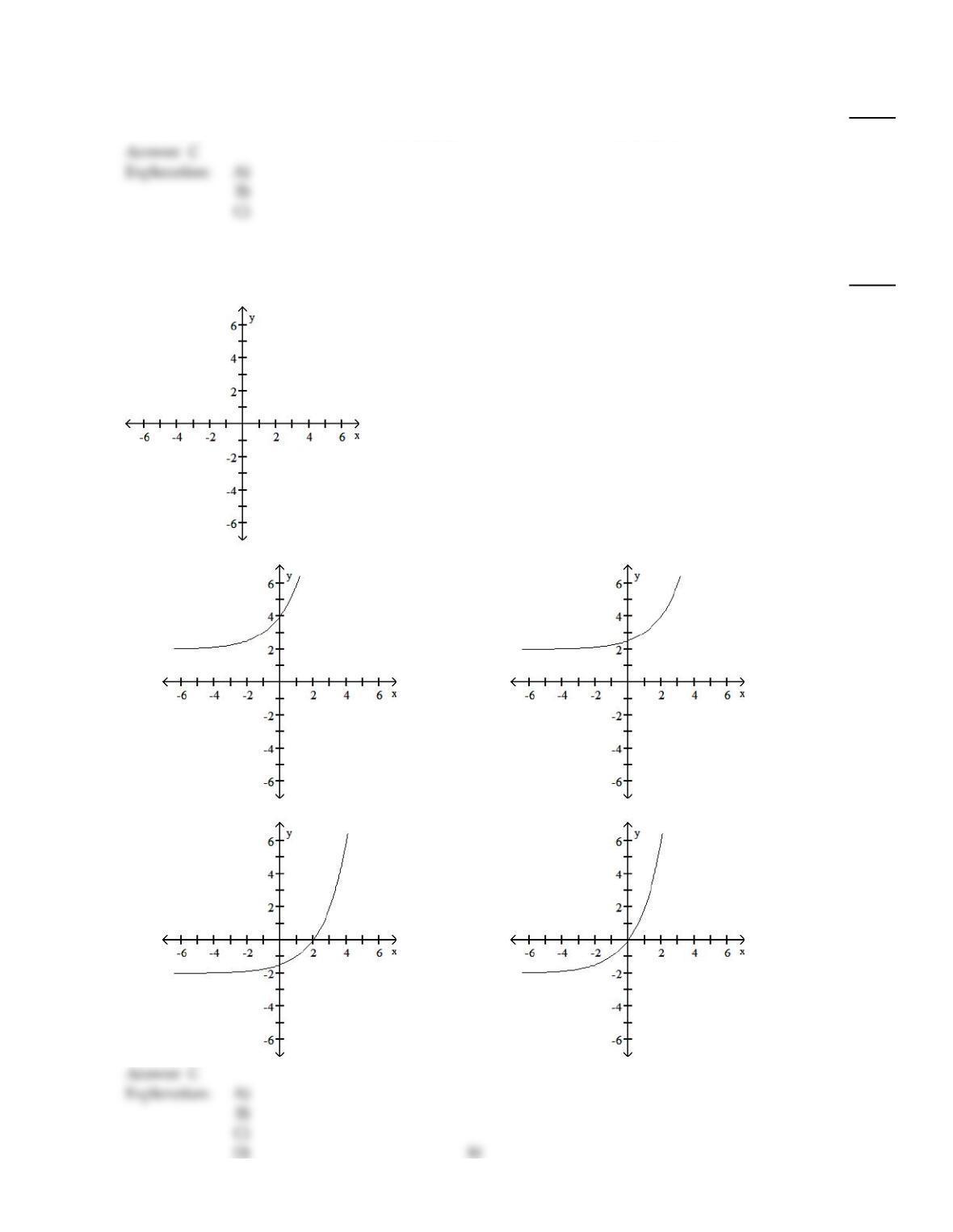
Determine whether the function is linear, constant, or neither
194)
y =x3–x2+ 8
194)
A)
Linear
B)
Constant
C)
Neither
Graph the function.
195)
f(x) =2(x – 1)– 2
195)
A)
B)
C)
D)
D)
Solve the problem.
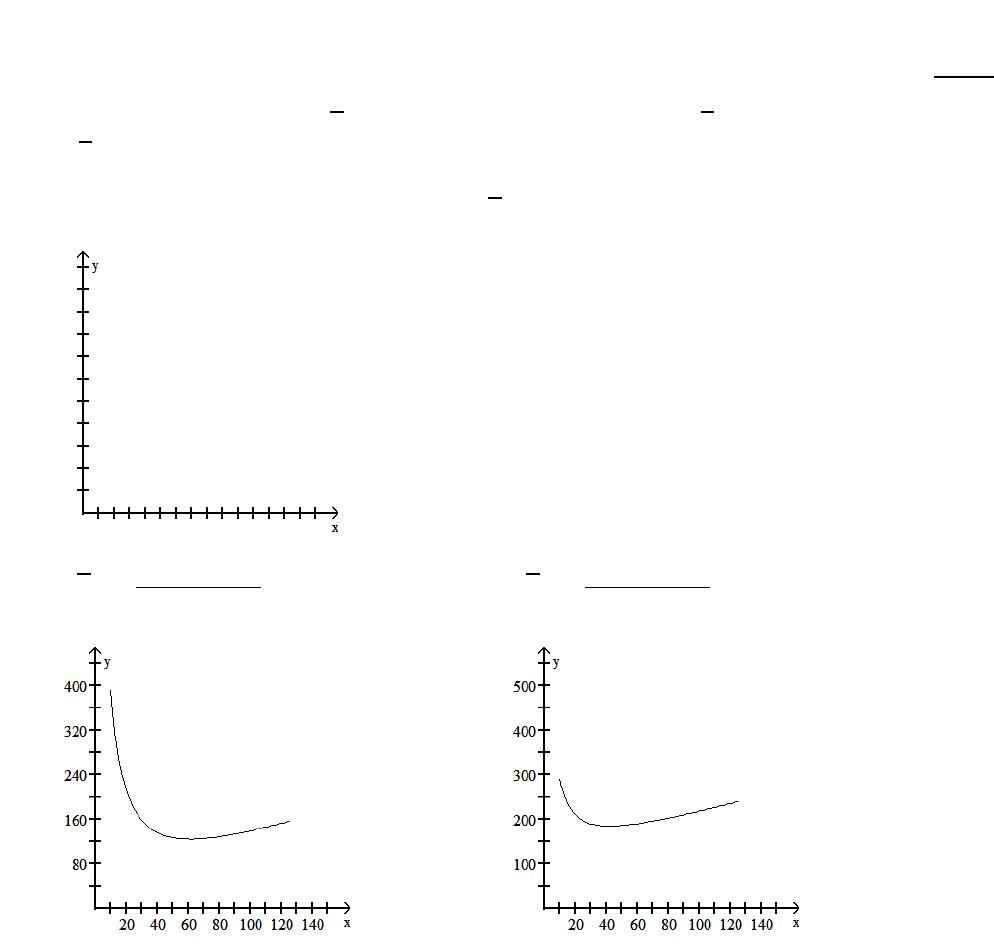
196)
Financial analysts in a company that manufactures ovens arrived at the following daily cost
equation for manufacturing x ovens per day: C(x) =x2+ 4x + 1800. The average cost per unit at a
production level of x ovens per day is C(x) = C(x)/x. (i) Find the rational function C. (ii) Sketch a
graph of C(x) for 10 x 125. (iii) For what daily production level (to the nearest integer) is the
average cost per unit at a minimum, and what is the minimum average cost per oven (to the nearest
cent)? HINT: Refer to the sketch in part (ii) and evaluate C(x) at appropriate integer values until a
minimum value is found.
196)
A)
(i) C(x) =x2+ 4x + 1800
x
(ii)
(iii) 61 units; $133.29 per oven
B)
(i) C(x) =x2+ 4x + 1800
x
(ii)
(iii) 44 units; $185.61 per oven
82
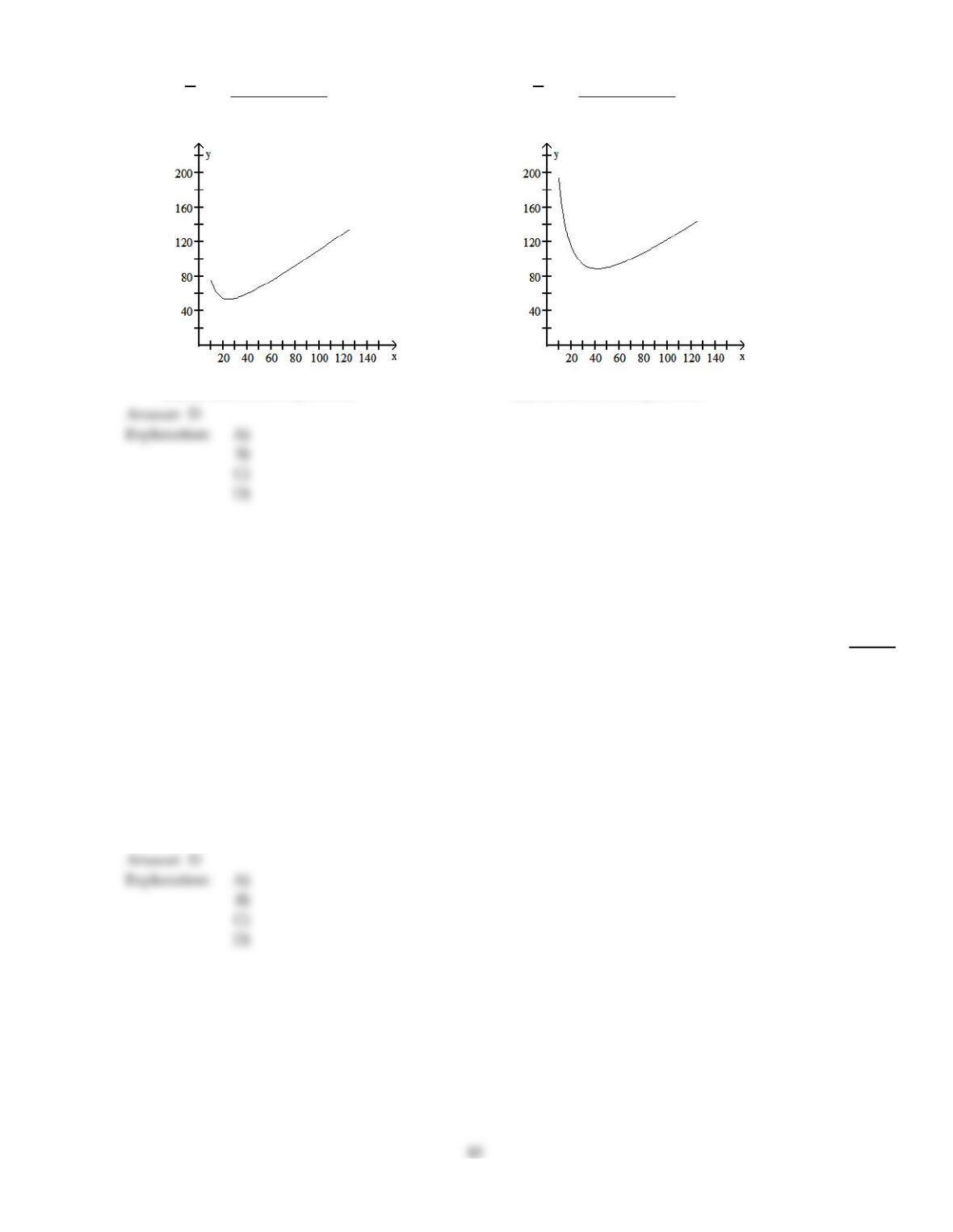
C)
(i) C(x) =x2+ 4x + 1800
x
(ii)
(iii) 22 units; $48.93 per oven
D)
(i) C(x) =x2+ 4x + 1800
x
(ii)
(iii) 42 units; $88.86 per oven
For the given function, find each of the following:
(A) Intercepts
(B) Vertex
(C) Maximum or minimum
(D) Range
197)
g(x) =(x – 4)2– 9
197)
A)
(A) x–intercepts: 1, 7; y–intercept: 7
(B) Vertex (-4, -9)
(C) Minimum: -9
(D) y -9
B)
(A) x–intercepts: 1, 7; y–intercept: 7
(B) Vertex (4, -9)
(C) Maximum: -9
(D) y -9
C)
(A) x–intercepts: -7, – 1; y–intercept: 7
(B) Vertex (4, -9)
(C) Minimum: -9
(D) y -9
D)
(A) x–intercepts: 1, 7; y–intercept: 7
(B) Vertex (4, -9)
(C) Minimum: -9
(D) y -9
Use a calculator to evaluate the expression. Round the result to five decimal places.
198)
log (–10.25)
198)
A)
–1.01072
B)
1.01072
C)
2.32728
D)
Undefined
Give the domain and range of the function.
199)
g(x) =x2–2
199)
A)
Domain: all real numbers; Range: [–2, )
B)
Domain: [2, ); Range: all real numbers
C)
Domain: all real numbers; Range: [–3, )
D)
Domain: [0, ); Range: [0, )
Solve the problem.
200)
The mathematical model C = 600 x + 30,000 represents the cost in dollars a company has in
manufacturing x items during a month. Using this model, how much does it cost to produce 600
items?
200)
A)
$50.00
B)
$360,000
C)
$390,000
D)
$0.08
Solve the equation.
201)
Solve for x: (ex)x·e72 =e17x
201)
A)
{8, 9}
B)
{8}
C)
{-8, -9}
D)
{9}
Solve the problem.
202)
The population P, in thousands, of Fayetteville is given by P(t) =300t
2t2+ 7, where t is the time, in
months. Find the population at 9 months.
202)
A)
7988
B)
15, 976
C)
30, 769
D)
40,000
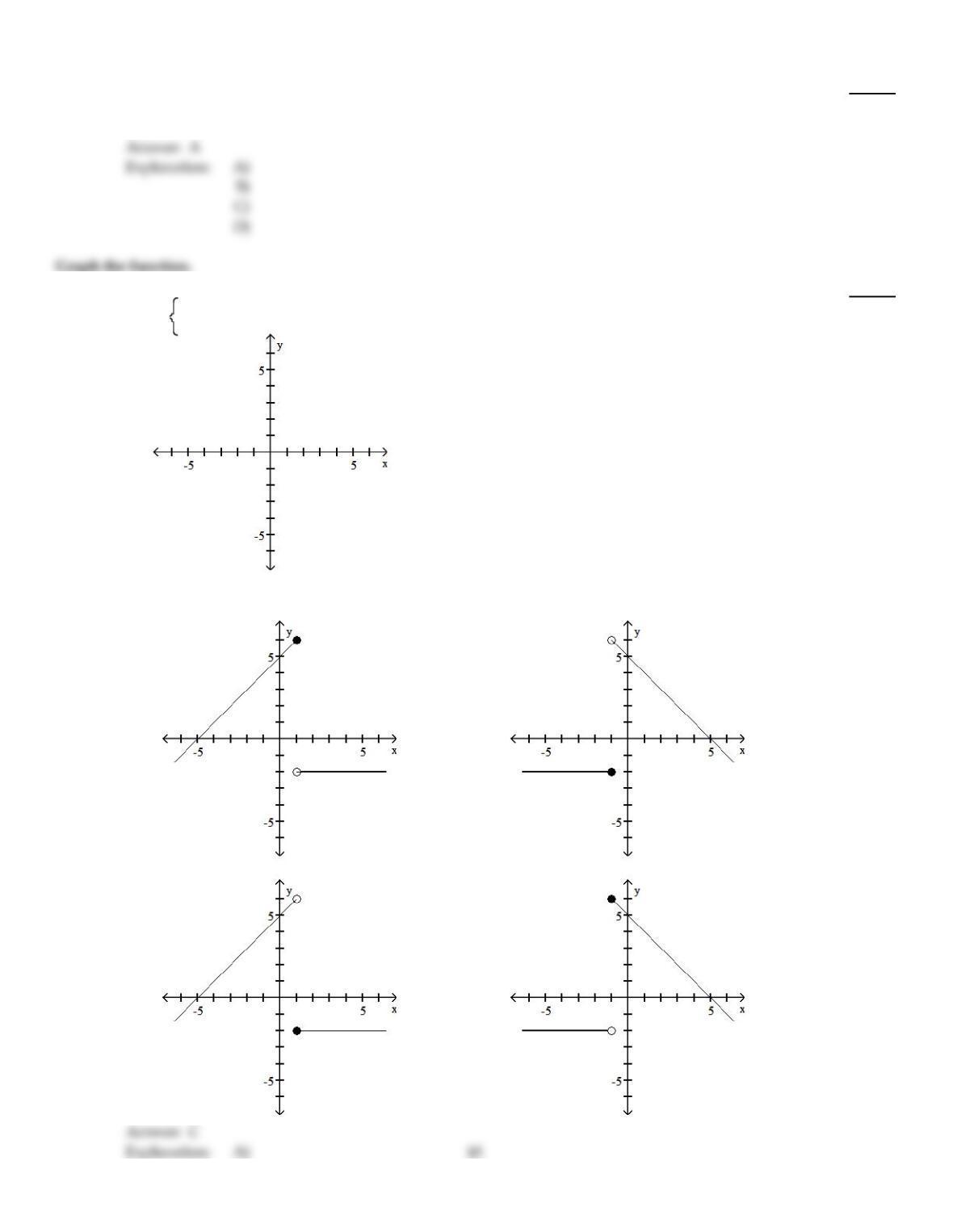
203)
Using a phone card to make a long distance call costs a flat fee of $0.85 plus per $0.19 minute
starting with the first minute. Find the total cost of a phone call which lasts 8 minutes.
203)
A)
$2.37
B)
$8.16
C)
$1.52
D)
$6.00
204)
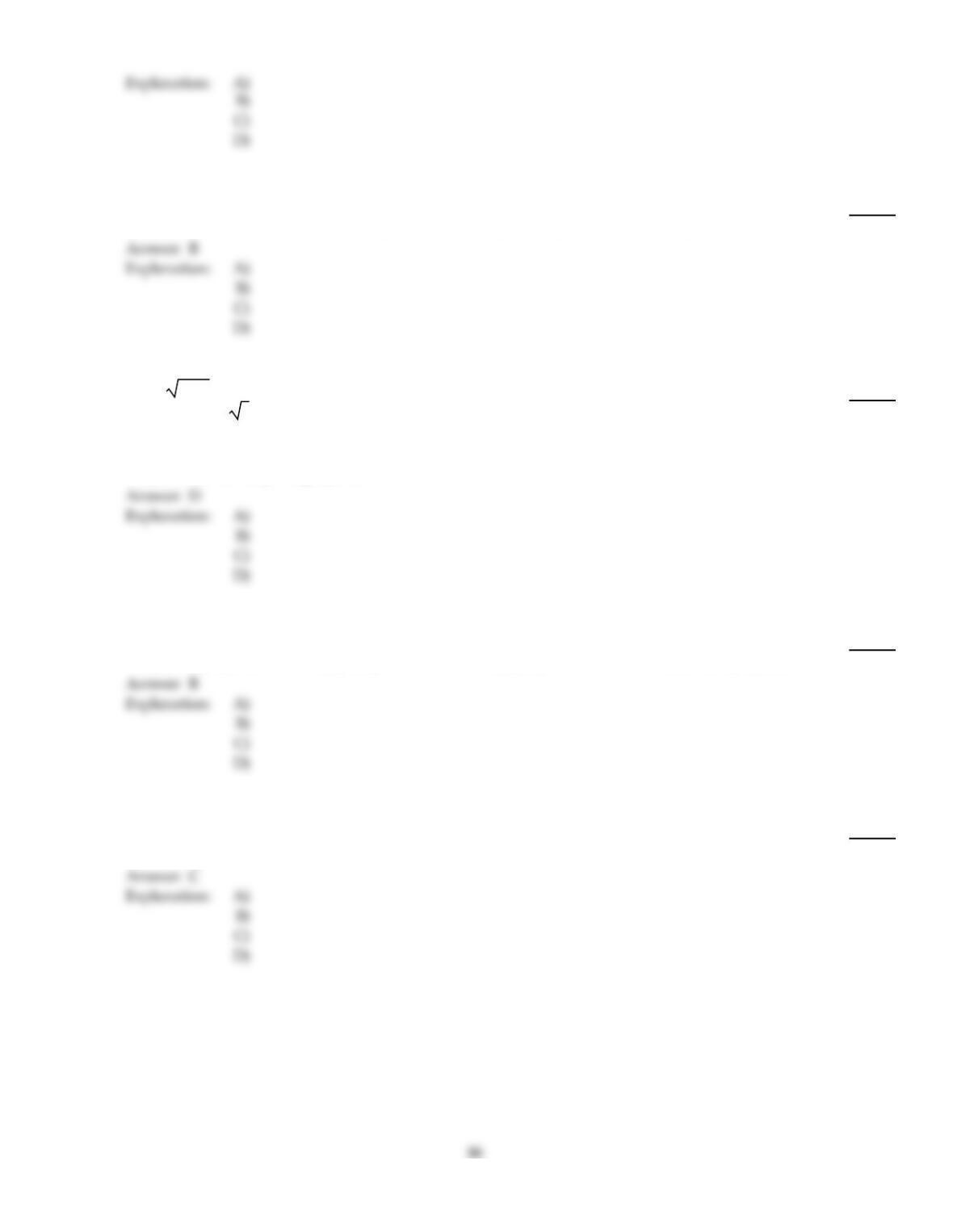
f(x) =x + 5 if x < 1
-2 if x 1
204)
A)
B)
C)
D)
Find the range of the given function. Express your answer in interval notation.
205)
f(x) = –2x2+ 12x – 23
205)
A)
[5, )
B)
(–, –5]
C)
(–, –3]
D)
[–3, )
Give the domain and range of the function.
206)
s(x) =3– x
206)
A)
Domain: ( 3, ); Range: (–, 0]
B)
Domain: all real numbers; Range: [0, )
C)
Domain: (–, 3) (3, ); Range: (–, 0) (0, )
D)
Domain: (–, 3]; Range: [0, )
Use interval notation to write the solution set of the inequality.
207)
x2+8x 0
207)
A)
(–, 0] [8, )
B)
[–8, 0]
C)
[0, 8]
D)
(–, –8] [0, )
Convert to a logarithmic equation.
208)
et= 7
208)
A)
log 7 t = e
B)
ln 7 = t
C)
ln t = 7
D)
log 7 e = t
Use the properties of logarithms to solve.
209)
logb x –logb 5 =logb 2 –logb(x – 3)
209)
A)
2, 5
B)
3
C)
5
D)
2
Graph the function.
210)
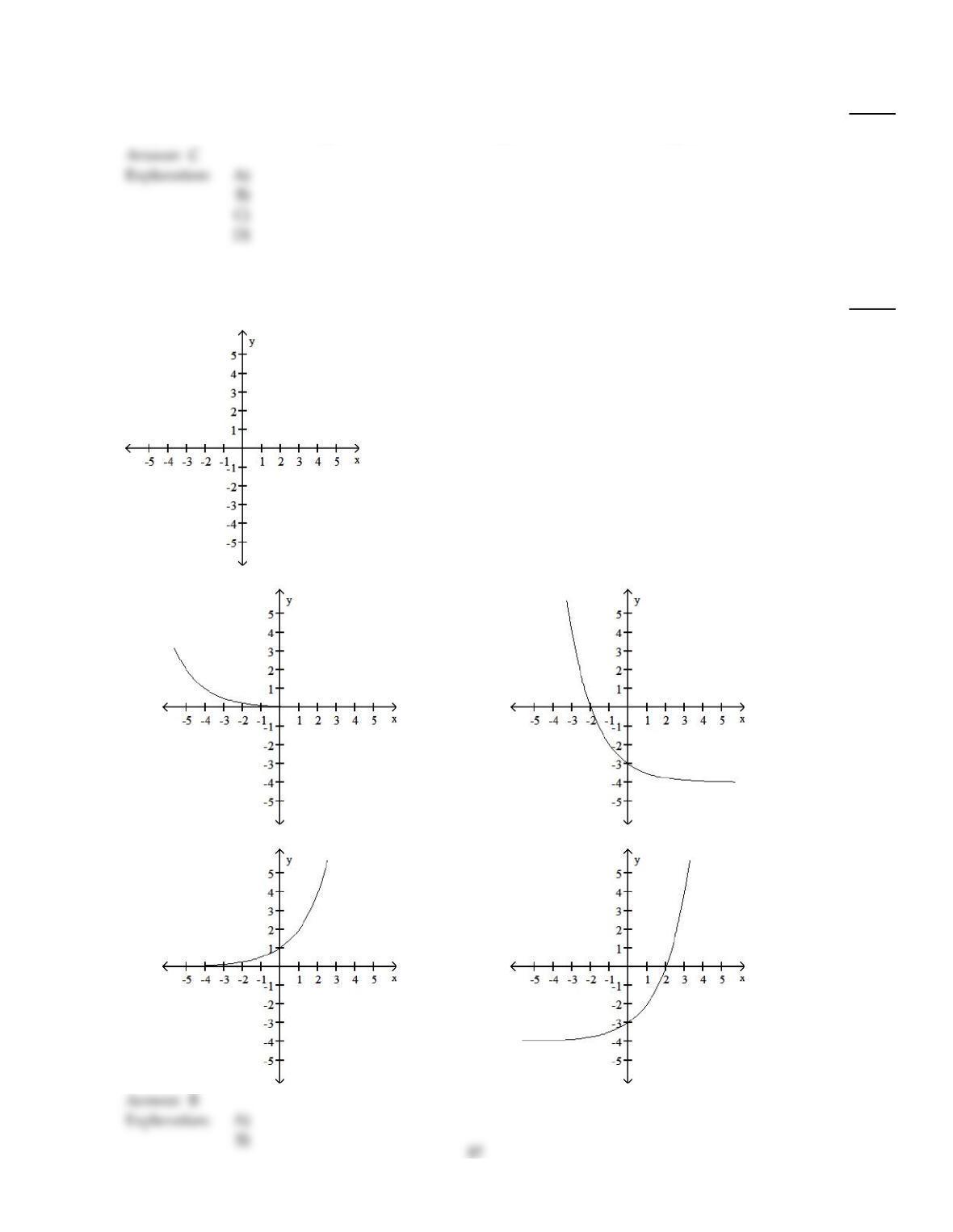
f(x) =2– x –4
210)
A)
B)
C)
D)
Sketch the graph of the function.
211)
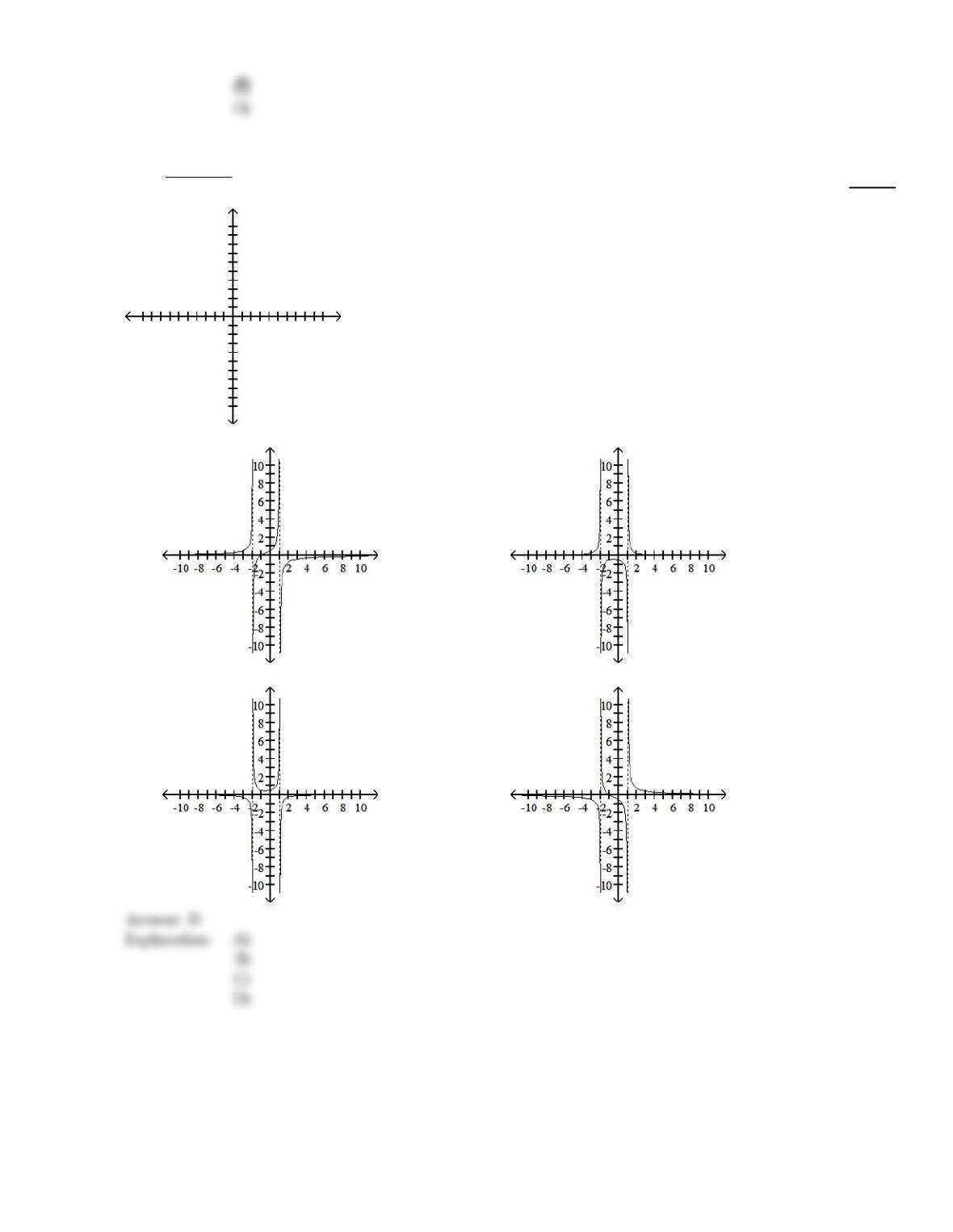
f(x) =x + 1
x2+ x –2
211)
A)
B)
C)
D)
Graph the linear equation and determine its slope, if it exists.
88
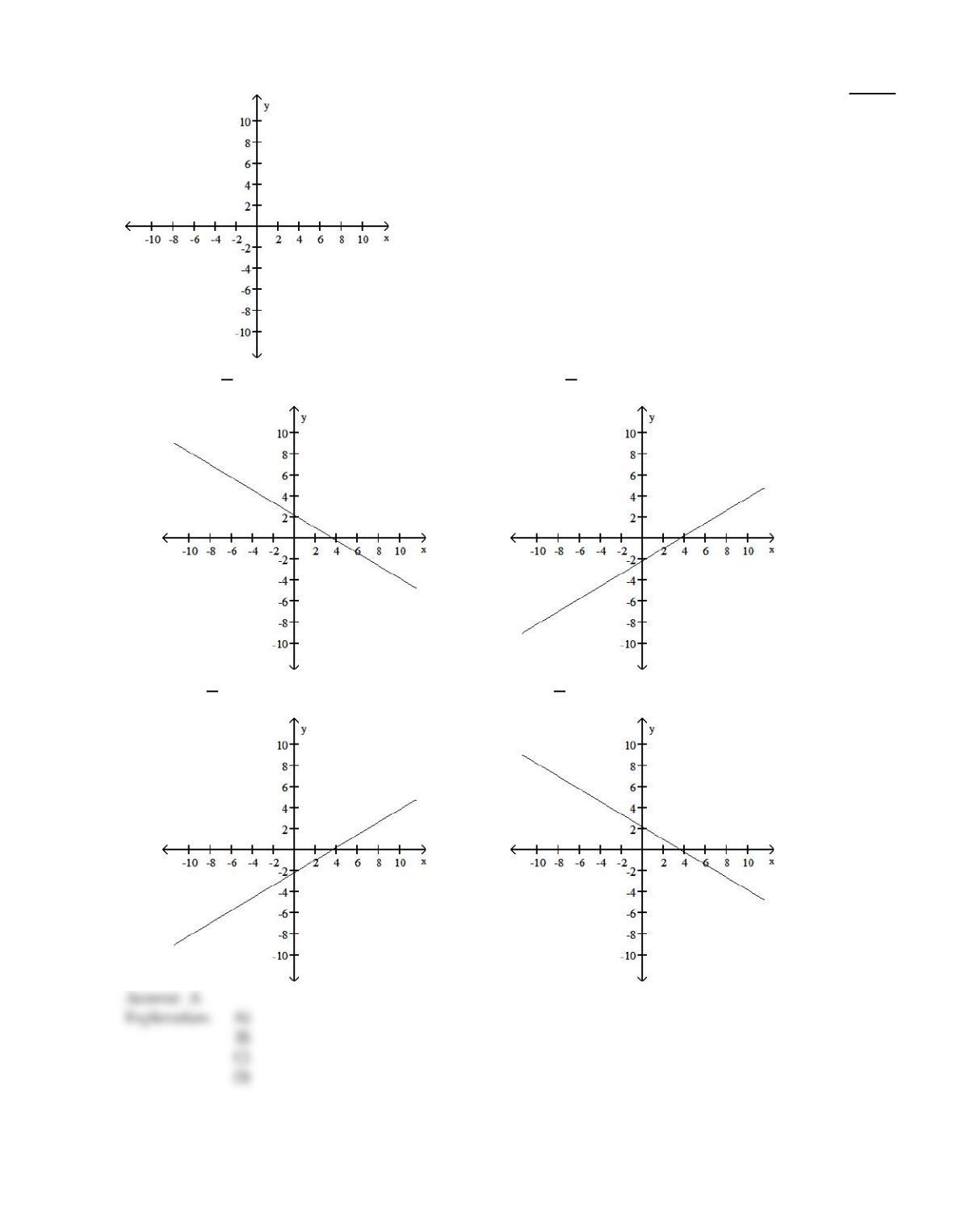
212)
3x + 5y = 11
212)
A)
slope: –3
4
B)
slope: –3
4
C)
slope: 3
4
D)
slope: 3
4
89
Solve the problem.
213)
The level of a sound in decibels (db) is determined by the formula N = 10 · log(I ×1012) db, where I
is the intensity of the sound in watts per square meter. A certain noise has an intensity of
8.49 ×10⁻⁴ watts per square meter. What is the sound level of this noise? (Round your answer to
the nearest decibel.)
213)
A)
206 db
B)
9 db
C)
79 db
D)
89 db
214)
x –y2= 9
214)
A)
A function with domain
B)
Not a function; for example, when x = 10, y = ±1
215)
log 0.234
215)
A)
–1.45243
B)
1.26364
C)
–0.63074
D)
0.234
216)
f(x) =4x – 11
x2+2x –3
216)
A)
x =1, x = –3
B)
y =4
C)
y =1, y = –3
D)
x = –1, x =3
Solve the problem.
217)
The point at which a company’s costs equals its revenue is the break–even. C represents cost, in
dollars, of x units of a product. R represents the revenue, in dollars, for the sale of x units. Find the
number of units that must be produced and sold in order to break even.
C = 15x + 12,000
R = 18x – 6000
217)
A)
800
B)
12,000
C)
545
D)
6000
For the polynomial function find the following: (i) Degree of the polynomial; (ii) All x intercepts; (iii) The y intercept.
218)
y =18 –x2+ 3x
218)
A)
(i) 2
(ii) -3, -6
(iii) –18
B)
(i) 2
(ii) 6, 3
(iii) 18
C)
(i) 2
(ii) 3, -6
(iii) –18
D)
(i) 2
(ii) 6, -3
(iii) 18
D
Use a calculator to evaluate the expression. Round the result to five decimal places.
219)
ln 1097
219)
A)
4.69775
B)
3.04021
C)
9.30292
D)
7.00033
D
220)
What is the maximum number of x intercepts that a polynomial of degree 10 can have?
220)
A)
11
B)
9
C)
10
D)
Not enough information is given.
C
221)
5.2 =1.00612x
221)
A)
22.97
B)
5.17
C)
2.32
D)
1.07
A
D
Use interval notation to write the solution set of the inequality.
222)
4x +1<13
222)
A)
(–, 3]
B)
(3, )
C)
[3, )
D)
(–, 3)
Provide an appropriate response.
223)
What is the minimum number of x intercepts that a polynomial of degree 11 can have? Explain.
223)
A)
11 because this is the degree of the polynomial.
B)
1 because a polynomial of odd degree crosses the x axis at least once.
C)
0 because a polynomial of odd degree may not cross the x axis at all.
D)
Not enough information is given.
224)
log 0.17
224)
A)
–0.76955
B)
–4.07454
C)
–1.76955
D)
–1.77196
Solve the equation graphically to four decimal places.
225)
Let f(x) =-0.4x2+2x +3, find f(x) =2.
225)
A)
No solution
B)
-0.4580, 5.4580
C)
-0.4580
D)
5.4580
Use interval notation to write the solution set of the inequality.
226)
x2+ 4x + 3 > 0
226)
A)
(–, -3) (-1, )
B)
(-3, -1)
C)
(-1, )
D)
(–, -3)
92
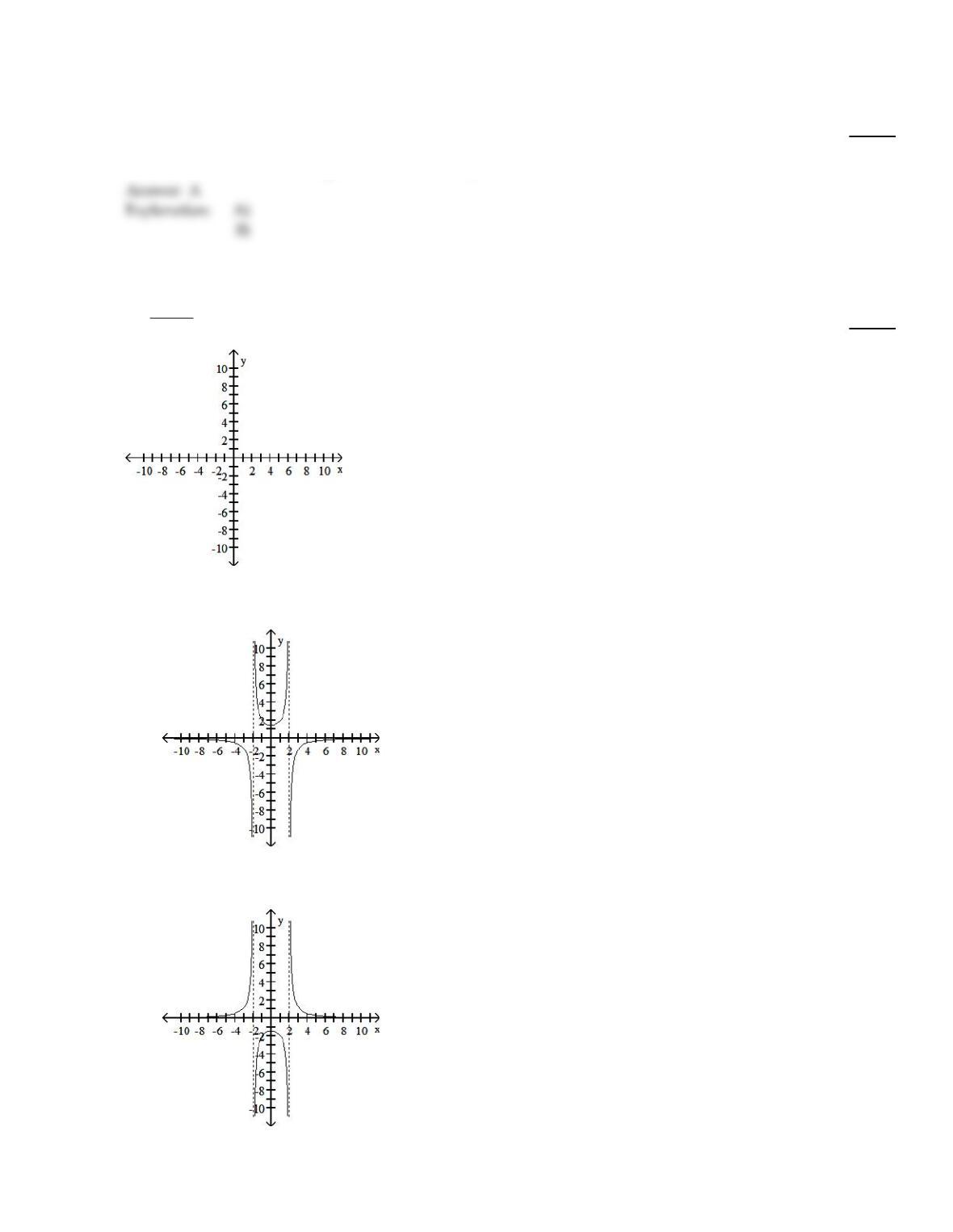
Determine if the equation specifies a function with independent variable x. If so, find the domain. If not, find a value of x
to which there corresponds more than one value of y.
227)
y = x2+ 5
227)
A)
A function with domain
B)
Not a function; for example, when x =5, then y = ±1
For the rational function below (i) Find any intercepts for the graph; (ii) Find any vertical and horizontal asymptotes for
the graph; (iii) Sketch any asymptotes as dashed lines. Then sketch a graph of f.
228)
y =6
x2–1
228)
A)
(i) y intercept: 2
(ii) horizontal asymptote: y = 0; vertical asymptotes: x =2 and x = –2
(iii)
B)
(i) y intercept: –2
(ii) horizontal asymptote: y = 0; vertical asymptotes: x =2 and x = –2
(iii)
93
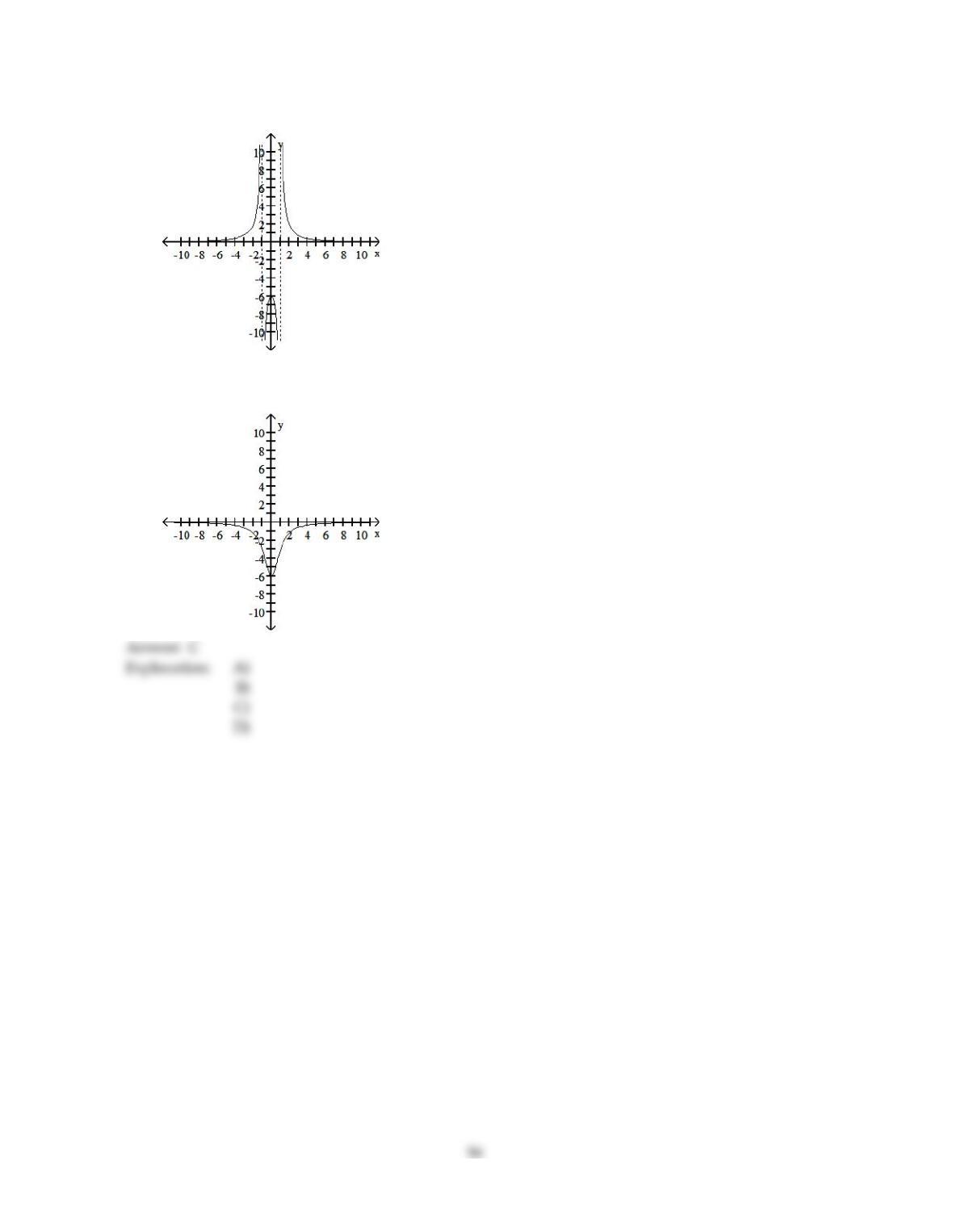
C)
(i) y intercept: – 6
(ii) horizontal asymptote: y = 0; vertical asymptotes: x =1 and x = –1
(iii)
D)
(i) y intercept: – 6
(ii) horizontal asymptote: y = 0
(iii)
Answer Key
Testname: C1
Answer Key
Testname: C1
Answer Key
Testname: C1
Answer Key
Testname: C1
Answer Key
Testname: C1

Answer Key
Testname: C1