Managerial Decision Modeling w/ Spreadsheets, 3e (Balakrishnan/Render/Stair)
Chapter 1 Introduction to Managerial Decision Making
1.1 Chapter Questions
1) Which of the following variables is considered random or probabilistic?
A) future interest rates
B) last year’s advertising budget
C) last week’s sales data
D) historical stock prices
E) historical interest rates
2) Which of the following variables is considered non-random or deterministic?
A) next year’s cash flow projections
B) future interest rates
C) last year’s income
D) projected value of the euro next week
E) projected NASDAQ index
3) Determining how much the solution will change if there are changes in the input data is part of:
A) model formulation
B) model solution
C) model interpretation
D) model development
E) model assessment
4) If all the variables in a model are under the control of the decision maker, then the model is
considered to be:
A) probabilistic
B) random
C) mathematical
D) schematic
E) deterministic
5) Which of the following models is a picture or drawing of reality?
A) physical model
B) schematic model
C) scale model
D) mathematical model
E) analytical model
6) Acquiring input data is part of:
A) model solution
B) model formulation
C) model interpretation
D) model testing
E) model identification
7) Which of the following variables is considered to be qualitative?
A) annual sales
B) earnings per share
C) age
D) method of payment (e.g., cash or credit card)
E) price
8) Which of the following variables is considered to be quantitative?
A) soft drink size
B) make of automobile
C) army rank
D) gender
E) none of the above
9) The ABC Corporation is considering introducing a new product, which will require buying new
equipment for a monthly payment of $5,000. Each unit produced can be sold for $20.00. ABC incurs a
variable cost of $10.00 per unit. How many units must ABC sell each month to break even?
A) 500 units
B) 5000 units
C) 250 units
D) 2500 units
E) 25 units
10) The ABC Corporation is considering introducing a new product, which will require buying new
equipment for a monthly payment of $5,000. Each unit produced can be sold for $20.00. ABC incurs a
variable cost of $10.00 per unit. What is ABC’s monthly break-even amount in dollars?
A) $100,000
B) $10,000
C) $5,000
D) $50,000
E) $1,000
11) The ABC Corporation is considering introducing a new product, which will require buying new
equipment for a monthly payment of $5,000. Each unit produced can be sold for $20.00. ABC incurs a
variable cost of $10.00 per unit. Suppose that ABC would like to realize a monthly profit of $50,000.
How many units must they sell each month to realize this profit?
A) 500 units
B) 450 units
C) 4500 units
D) 5000 units
E) 5500 units
12) The ABC Corporation is considering introducing a new product, which will require buying new
equipment for a monthly payment of $5,000. Each unit produced can be sold for $20.00. ABC incurs a
variable cost of $10.00 per unit. Suppose that ABC anticipates selling 100 units of the new product next
month. Moreover, they would like to realize a monthly profit of $5000. What should the selling price
per unit be to realize this profit?
A) $100
B) $120
C) $130
D) $115
E) $110
13) Which of the following is an equation to determine the break-even point (BEP) in units?
A) BEP = fixed cost / selling price per unit – variable cost per unit)
B) BEP = fixed cost / (selling price per unit – variable cost per unit)
C) BEP = variable cost / (selling price per unit – fixed cost)
D) BEP = variable cost / (fixed cost – selling price per unit)
E) BEP = fixed cost / (selling price per unit + variable cost per unit)
14) The break-even volume (BEP) occurs at the point where:
A) total profit = total cost
B) fixed cost = total variable cost
C) total revenue = total cost
D) selling price per unit = variable cost per unit
E) total revenue = total variable cost
15) Which of the following is an equation to determine the break-even point in dollars?
A) (BEP) * (total variable cost) + fixed cost
B) (BEP) * (variable cost per unit)
C) (BEP) / (selling price)
D) (BEP) * (selling price) / (variable cost per unit)
E) (BEP) * (selling price)
16) All of the following are considered typical roadblocks in defining a problem for Decision Analysts
EXCEPT:
A) Impact on other departments
B) Solution outdated
C) Lack of leadership
D) Beginning assumptions
E) Conflicting viewpoints
17) Which of the following statements is FALSE regarding possible problems in developing decision
models?
A) It is difficult to develop a model that is not understandable.
B) Assumptions are made when developing solutions.
C) Accounting data is not always conducive as input data.
D) The limitation of only one answer when developing a solution
E) The validity of the data being used as input data
18) A measurable quantity that is inherent in a problem is known as a(n):
A) problem parameter
B) variable
C) model
D) assumption
E) factor
19) If all the values of the input variables in a decision model are known with certainty, then the model
is considered to be deterministic.
20) If all the values of the input variables in a decision model are random in nature, then the model is
considered to be probabilistic.
21) A decision model has the following input variables: projected sales data and historical advertising
budget. This model is considered to be deterministic.
22) A decision model has the following input variables: Historical sales data and historical advertising
budget. The model is considered to be probabilistic.
23) If a decision model has one variable with a certain/deterministic input value and another variable
with a random/probabilistic input, then the outcome of this model which is based on both variables will
be probabilistic.
24) The order of the three sequential steps involved in decision modeling is: formulation, solution, and
interpretation.
25) Identifying the key decision variables in a decision model is considered to be part of “model
solution.”
26) Determining how much the solution will change if there are changes in the input data of the model is
referred to as sensitivity analysis.
27) Suppose you have a decision model that contains the input variable “number of labor hours.” You
would like to test how the solution changes if a labor strike takes effect. This type of analysis is called
sensitivity analysis.
28) At the break-even point (BEP), total profit is typically greater than zero.
29) Suppose that the break-even point (BEP) for a given product is 200 units. This means that if 198
units are produced, then this product is not profitable.
30) Suppose that the break-even point (BEP) for a product is 300 units. This means if 310 units are
produced, then this product is profitable.
31) Models that have random variables as input data are considered to be deterministic.
32) In dealing with business models, managers need to consider only quantitative data while making
decisions in practice.
33) A quantitative model can still yield acceptable results even if the input data is unreliable.
34) The validity of input data is not a typical concern for analysts in decision modeling.
8
1.2 Excel Problems
1) Set up the following cell entries in Excel:
Variable cost/unit
$1.5
Fixed cost
$90
Selling price/unit
$3
Breakeven (units)
60
Breakeven in dollars ($)
$180
Using Goal Seek, what should the selling price per unit be in order to realize a breakeven amount of
$200?
Answer:
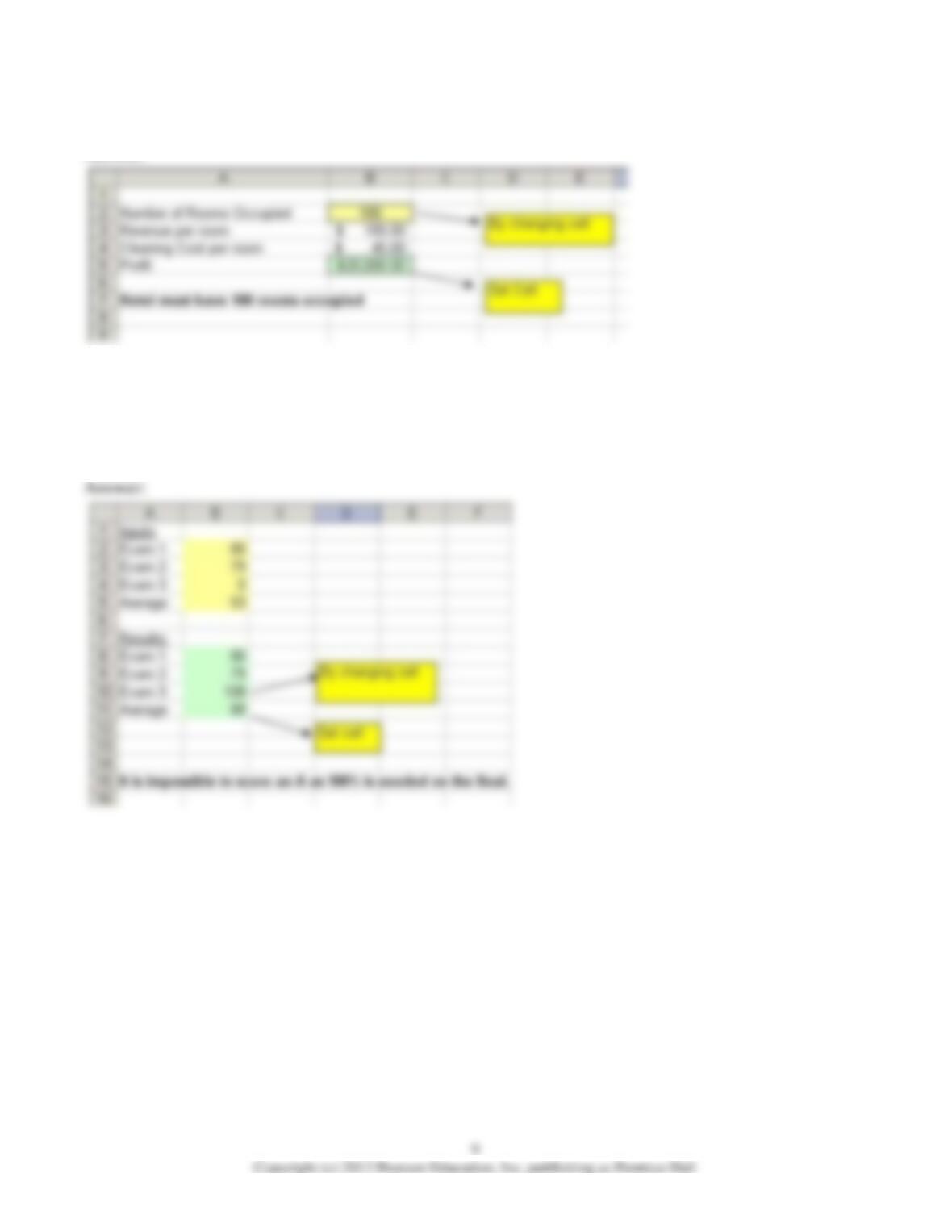
2) A hotel typically incurs a cost of $45 to clean each room before guest arrival. Each room generates
revenue of $155.00 per night. Using Goal Seek, how many rooms must be occupied nightly in order to
realize a daily profit of $20,000?
Answer:
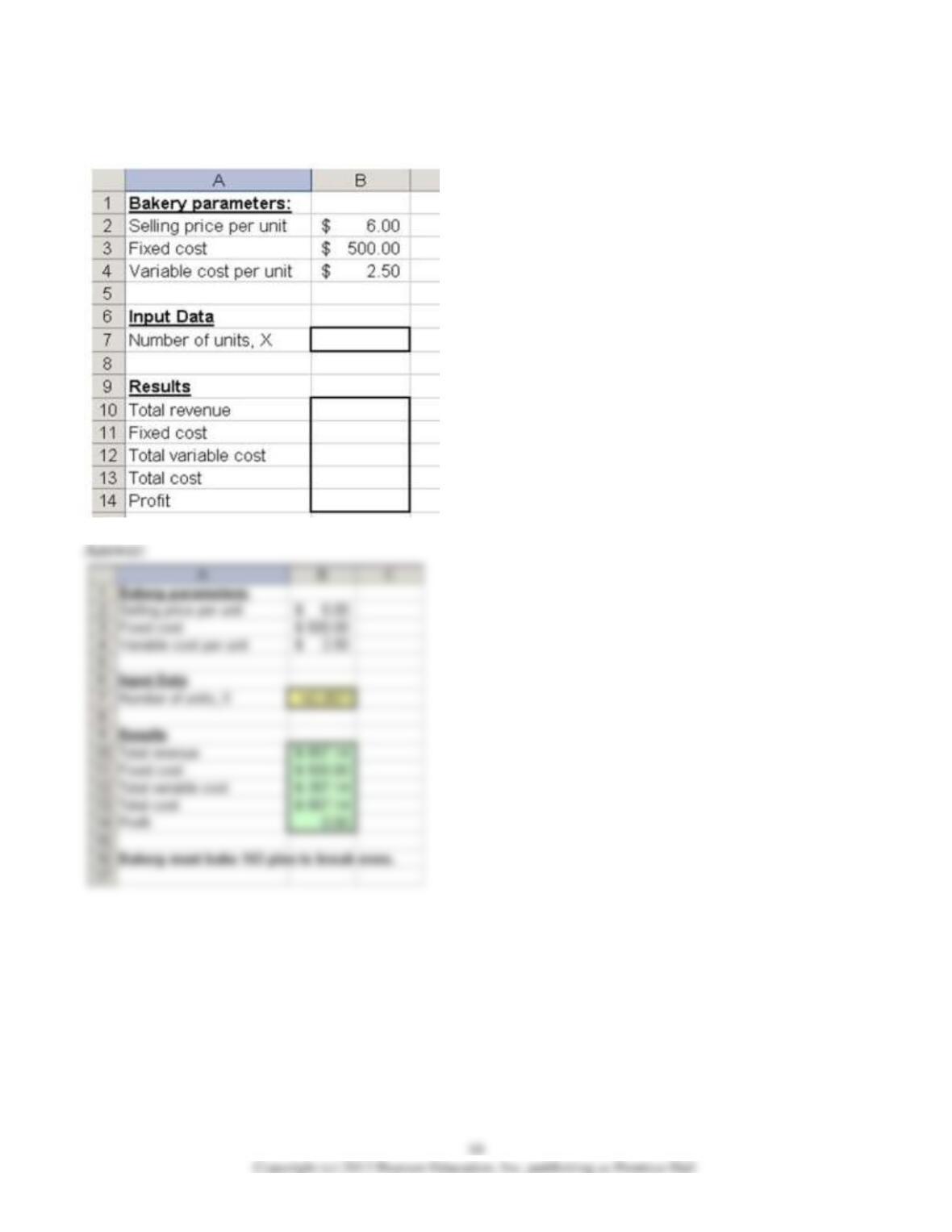
3) A professor that teaches Management Science assigns the final grade based on three examinations.
To earn an A, the overall average on the three exams must be at least 89%. Suppose that you score 80%
and 79% on exams 1 and 2, respectively. Using Goal Seek, what is the minimum score that you need to
earn on exam 3 to get an A?
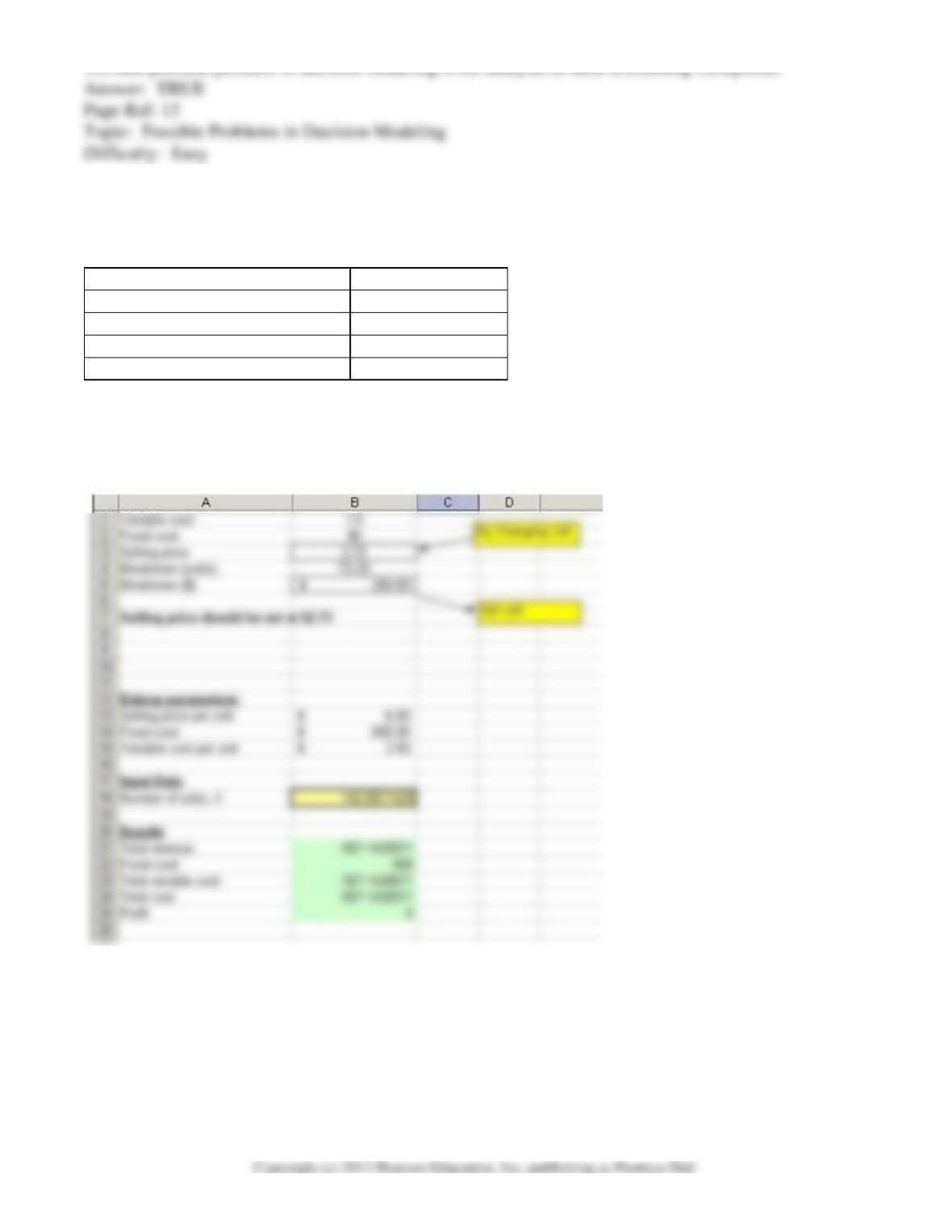
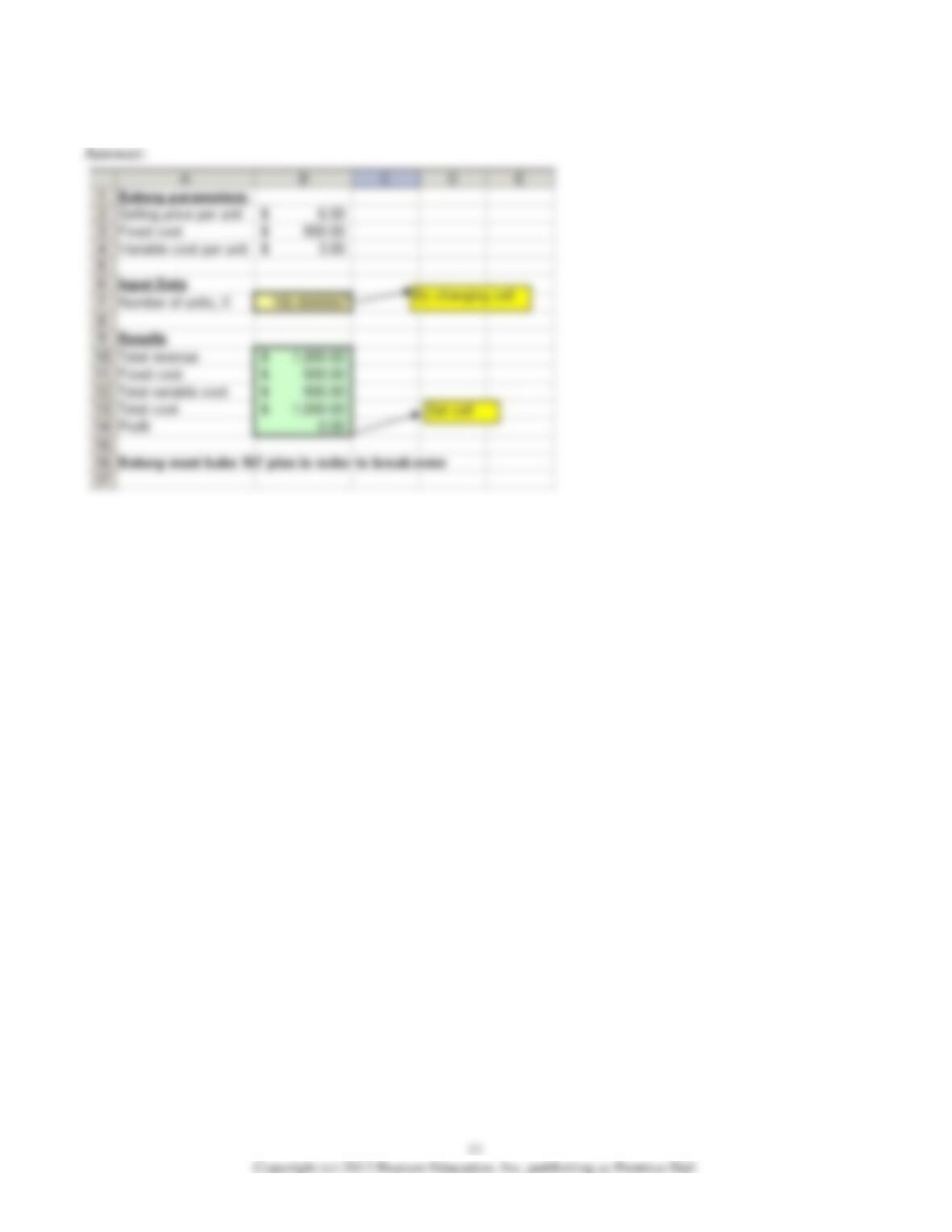
4) A bakery sells its pies for $6.00 each. The bakery incurs a daily fixed cost of $500 which includes
salaries and rental. The variable cost per pie is $2.50. Set up this problem in Excel as shown below to
compute the number of pies (X) that must be baked daily in order to break even. Model the problem
mathematically without using Goal Seek.
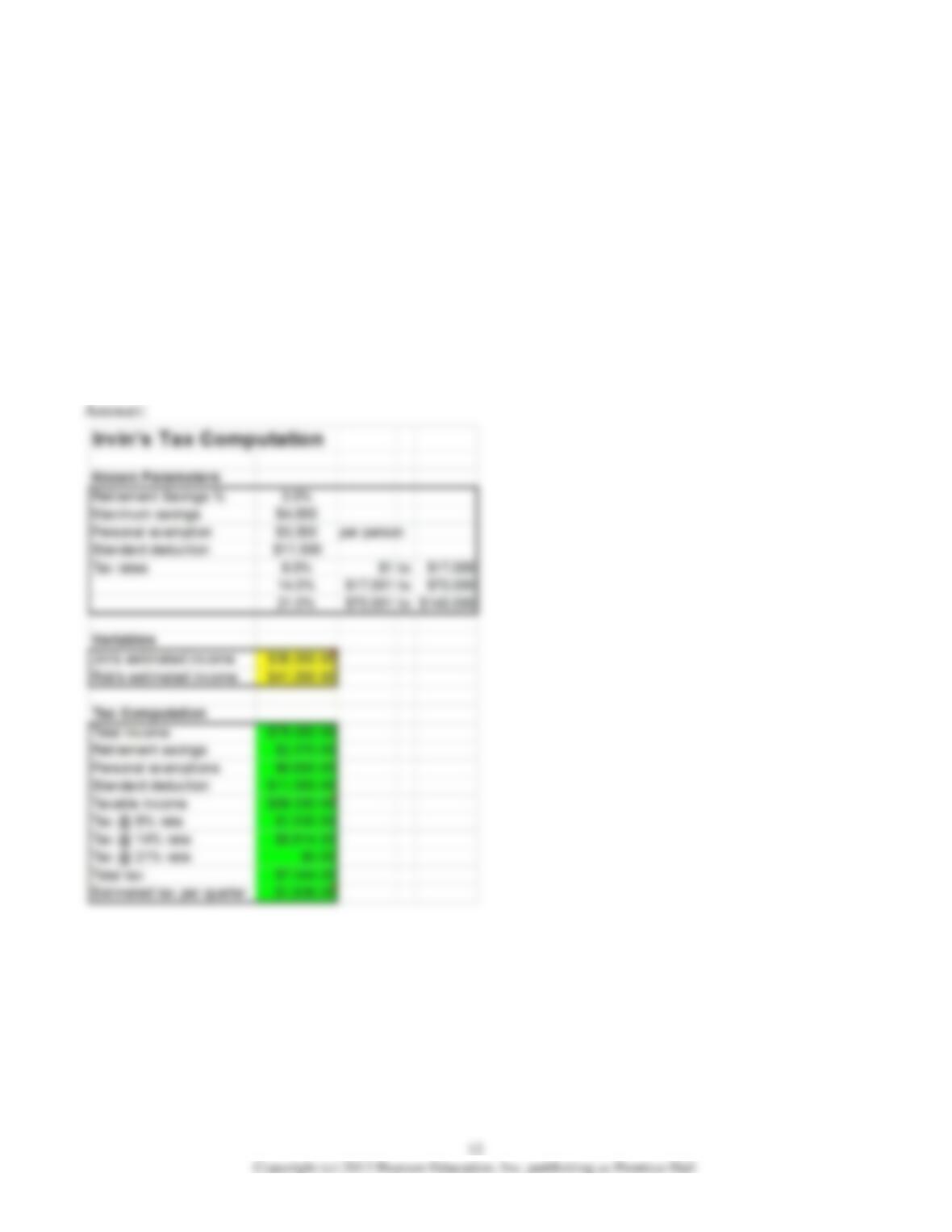
5) A bakery sells its pies for $6.00 each. The bakery incurs a daily fixed cost of $500 which includes
salaries and rental. The variable cost per pie is $2.50. Use Goal Seek to compute the number of pies (X)
that must be baked daily in order to break even if the variable cost per pie increases to $3.00.
6) Jim and Shirley Irvin, a newly married couple, will be filing a joint tax return for the first year.
Because both work as independent contractors (both are soccer coaches), their income is subject to some
variability. However, because their earnings are not taxed at the source, they know that they have to pay
estimated income taxes on a quarterly basis, based on their estimated taxable income for the year. To
help calculate this tax, the Irvins would like to set up a spreadsheet-based decision model. Assume that
they have the following information available:
Their only source of income is from their jobs as soccer coaches. The would like to put away 3% of their
total income in a retirement account, up to a maximum of $4,000. Any amount the put in that account
can be deducted from their total income for tax purposes. They are entitled to a personal exemption of
$3,300 each. There is a standard deduction for married couples of $11,500, meaning this amount is free
from any taxes and can be deducted from total joint income. Jim makes an estimated $41,000 and
Shirley makes an estimated $36,000. The tax brackets are 9% for up to $17,000, 14% for $17,001 to
$70,000, and 21% for $70,001 to $140,000. What are the estimated taxes per quarter that Jim and
Shirley will have to pay?