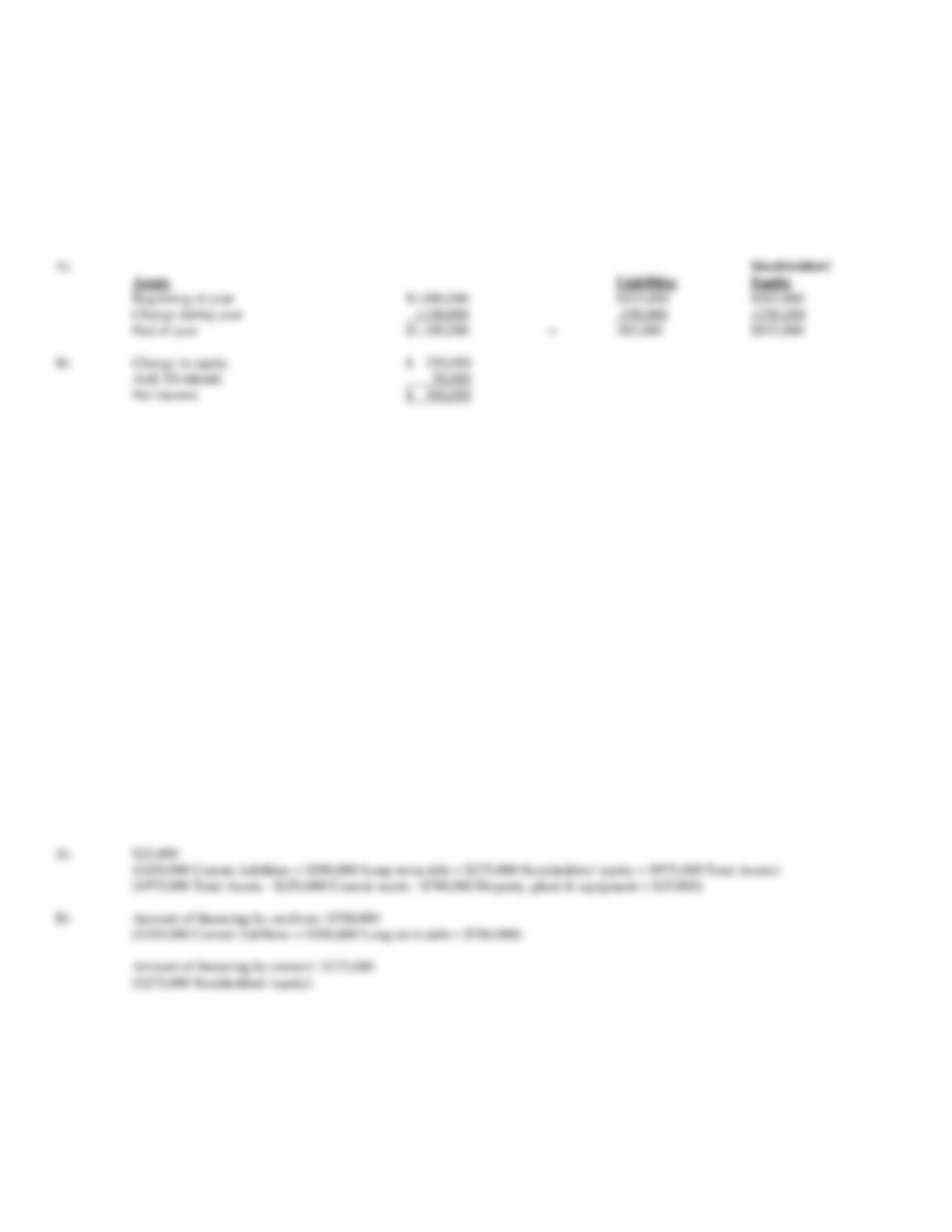
175. A certain company started business on January 1, 2012 with assets of $1,000,000 and stockholders’ equity
of $565,000. By the end of the year, assets increased by $100,000 and liabilities decreased by $150,000. Other
than net income or loss, the only change in stockholders’ equity was dividends of $50,000.
A)
What was the amount total stockholders’ equity at the end of the year?
B)
What was the amount net income or net loss for the year?
176. Presented below are selected data from the balance sheet:
Current assets
$250,000
Property, plant & equipment
700,000
Other assets
? ? ?
Current liabilities
200,000
Total Long-term debt
500,000
Total Stockholders’ equity
275,000
A)
Determine the amount of “Other assets.”
(Hint: you must use the accounting equation concept to determine your answer.)
B)
How much of the company is financed by creditors? How much is financed by the owners?
$25,000
($200,000 Current liabilities + $500,000 Long-term debt + $275,000 Stockholders’ equity = $975,000 Total Assets)
($975,000 Total Assets – $250,000 Current assets – $700,000 Property, plant & equipment = $25,000)
B)
Amount of financing by creditors: $700,000
($200,000 Current liabilities + $500,000 Long-term debt = $700,000)
Amount of financing by owners’: $275,000
($275,000 Stockholders’ equity)
A)
Beginning of year
$1,000,000
$435,000
$565,000
Change during year
+100,000
-150,000
+250,000
End of year
$1,100,000
=
285,000
$815,000
B)
Change in equity
$ 250,000
Add: Dividends
50,000
Net Income
$ 300,000
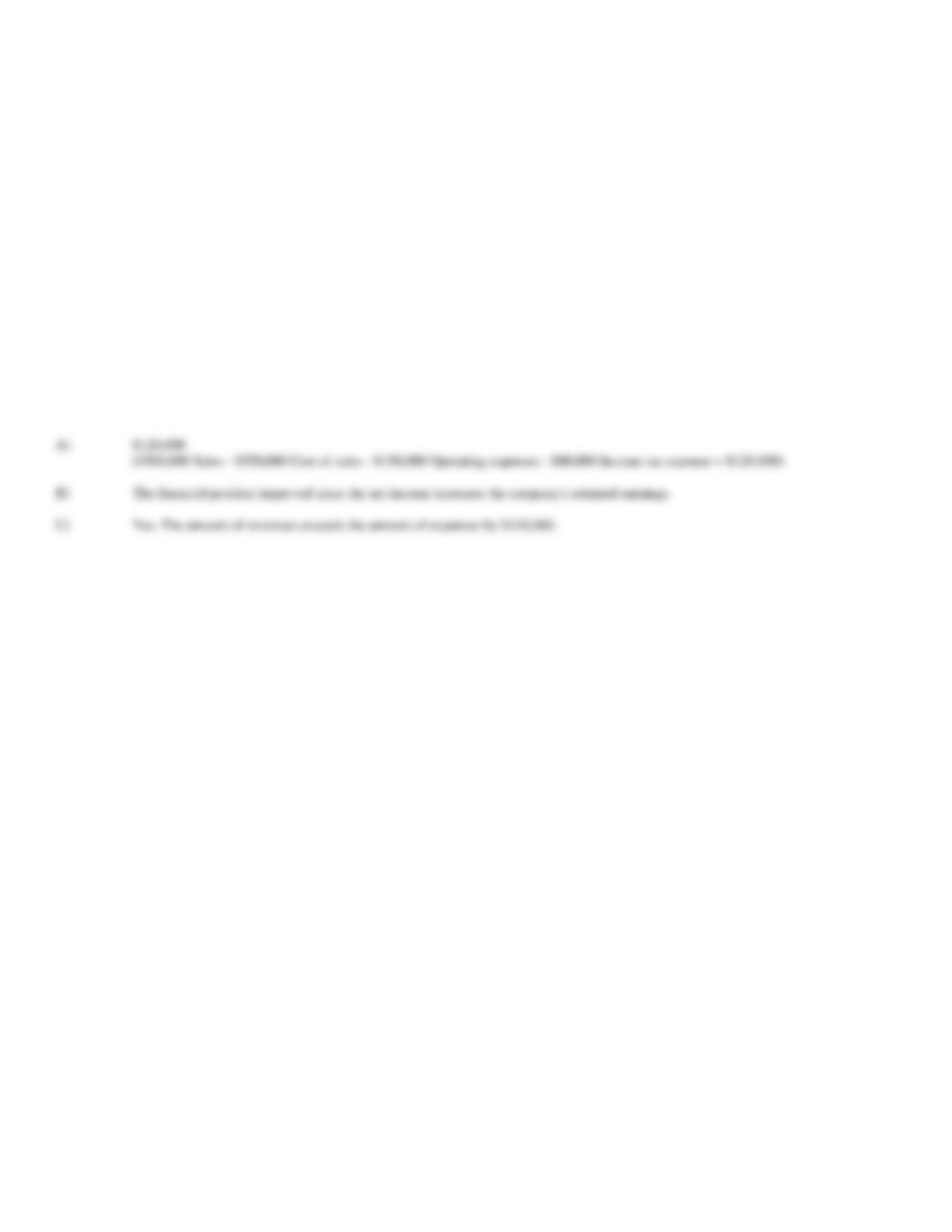
177. Presented below are selected data from the accounting records for 2013:
Sales
$900,000
Income tax expense
80,000
Cost of Sales
550,000
Operating expenses
150,000
Dividends
75,000
A)
Calculate the net income or loss for the year.
B)
Did the company’s financial position improve or deteriorate during the year? Explain.
C)
Is the company profitable? Explain.
A)
$120,000
($900,000 Sales – $550,000 Cost of sales – $150,000 Operating expenses – $80,000 Income tax expense = $120,000)
B)
The financial position improved since the net income increases the company’s retained earnings.
C)
Yes. The amount of revenues exceeds the amount of expenses by $120,000.
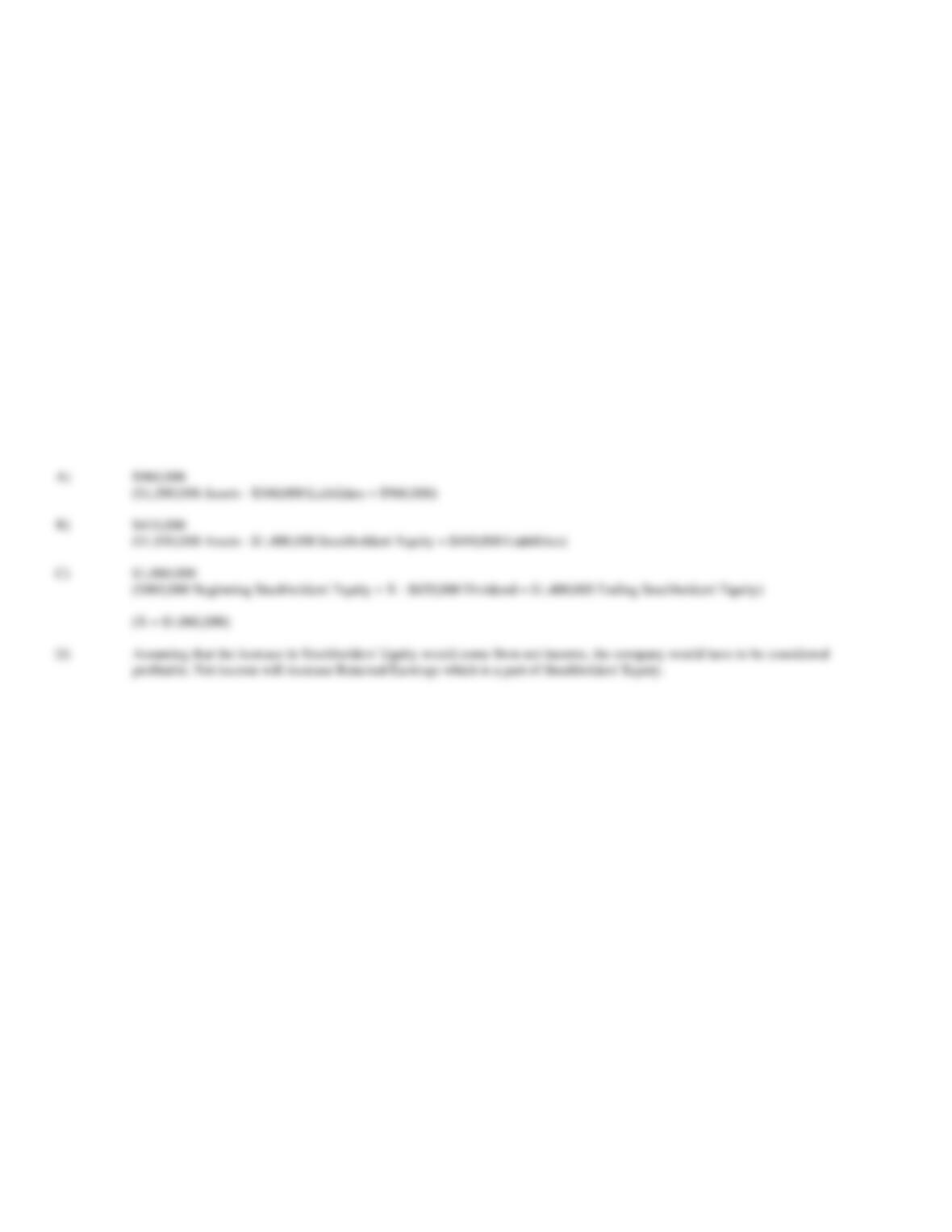
178. The following balance sheet information is provided:
Stockholder’s
Assets
Liabilities
Equity
January 1, 2013
$1,500,000
$540,000
$________
December 31, 2013
1,810,000
_______
1,400,000
A)
What is the amount of Stockholders’ Equity at January 1, 2013?
B)
What is the amount of Liabilities at December 31, 2013?
C)
Assume that the company paid dividends of $620,000 during the year. How much net income did it earn during the year?
D)
Assume that the company paid no dividends during the year. Without looking at the income statement, how can you tell if the
company is profitable or not?
A)
$960,000
($1,500,000 Assets – $540,000 Liabilities = $960,000)
B)
$410,000
($1,810,000 Assets – $1,400,000 Stockholders’ Equity = $410,000 Liabilities)
$1,060,000
($960,000 Beginning Stockholders’ Equity + X – $620,000 Dividend = $1,400,000 Ending Stockholders’ Equity)
(X = $1,060,000)
D)
Assuming that the increase in Stockholders’ Equity would come from net income, the company would have to be considered
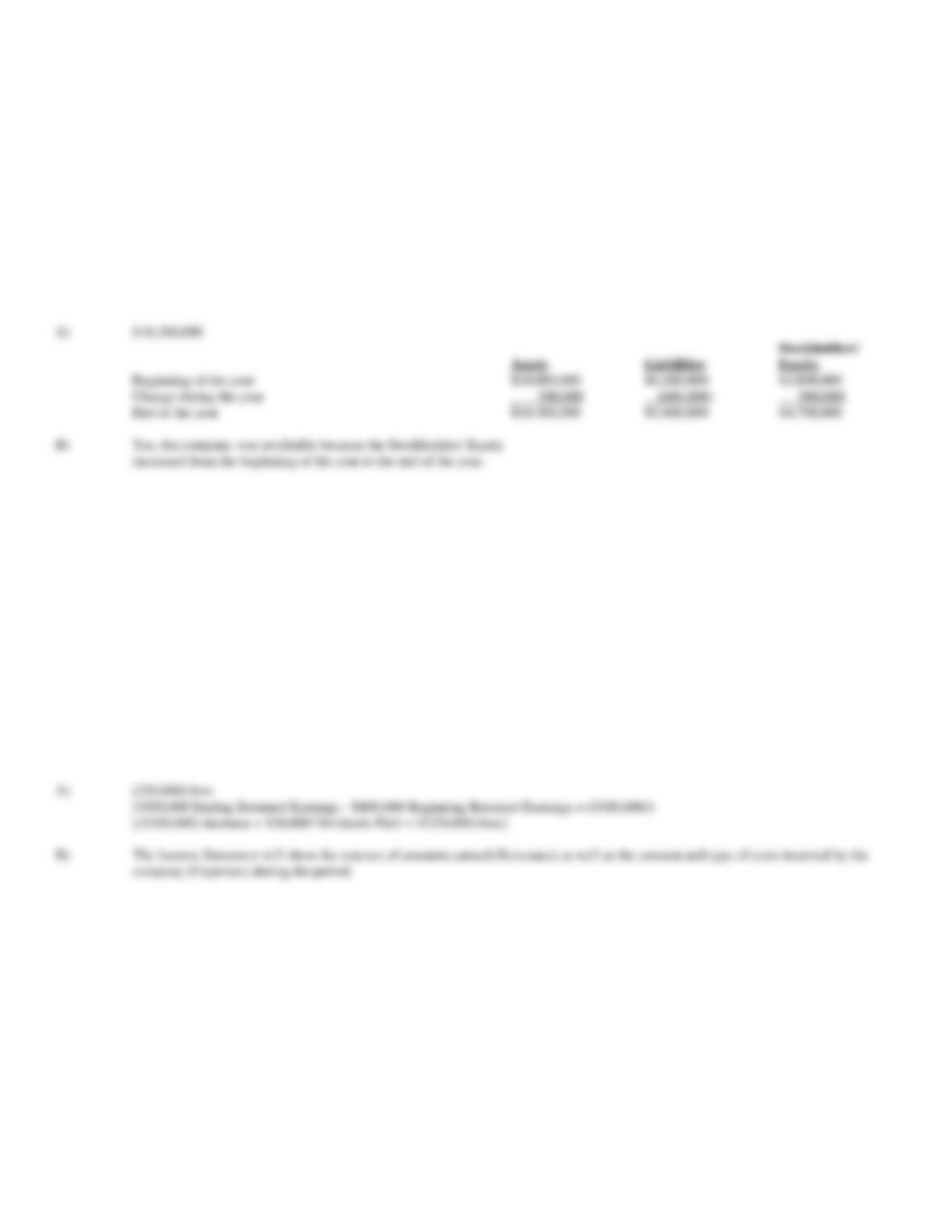
179. A certain company began the year with total assets of $10,000,000 and total liabilities of $6,200,000. No
additional stock was issued during the year. Use the accounting equation to answer the following questions.
A)
What was the amount of Total Assets at the end of the year if Liabilities decreased by $600,000 and Stockholders’ Equity increased
by $900,000?
B)
Was the company profitable? Explain your answer.
180. The beginning balance of retained earnings was $800,000, and the ending balance was $500,000. The
company paid dividends of $50,000.
A)
Determine the amount of net income (loss) for the year.
B)
What information would one find on the income statement in addition to net income?
(250,000) loss
[$500,000 Ending Retained Earnings – $800,000 Beginning Retained Earnings = ($300,000)]
[($300,000) decrease + $50,000 Dividends Paid = ($250,000) loss]
A)
$10,300,000
Beginning of the year
$10,000,000
$6,200,000
$3,800,000
Change during the year
300,000
(600,000)
900,000
End of the year
$10,300,000
$5,600,000
$4,700,000
181. Best Deal Auto Parts began 2013 with $400,000 in assets, $140,000 in liabilities, and $160,000 of retained
earnings. Net income for the year was $100,000, and dividends of $80,000 were paid.
A)
Prepare a Statement of Retained Earnings for 2013.
B)
What is the nature or purpose of the statement of retained earnings?
C)
What was the amount of Capital Stock at the beginning of 2013?
D)
What events would cause the two stockholders’ equity items to increase?
E)
How do you identify whether the company was profitable during 2013 by examining the statement of retained earnings?
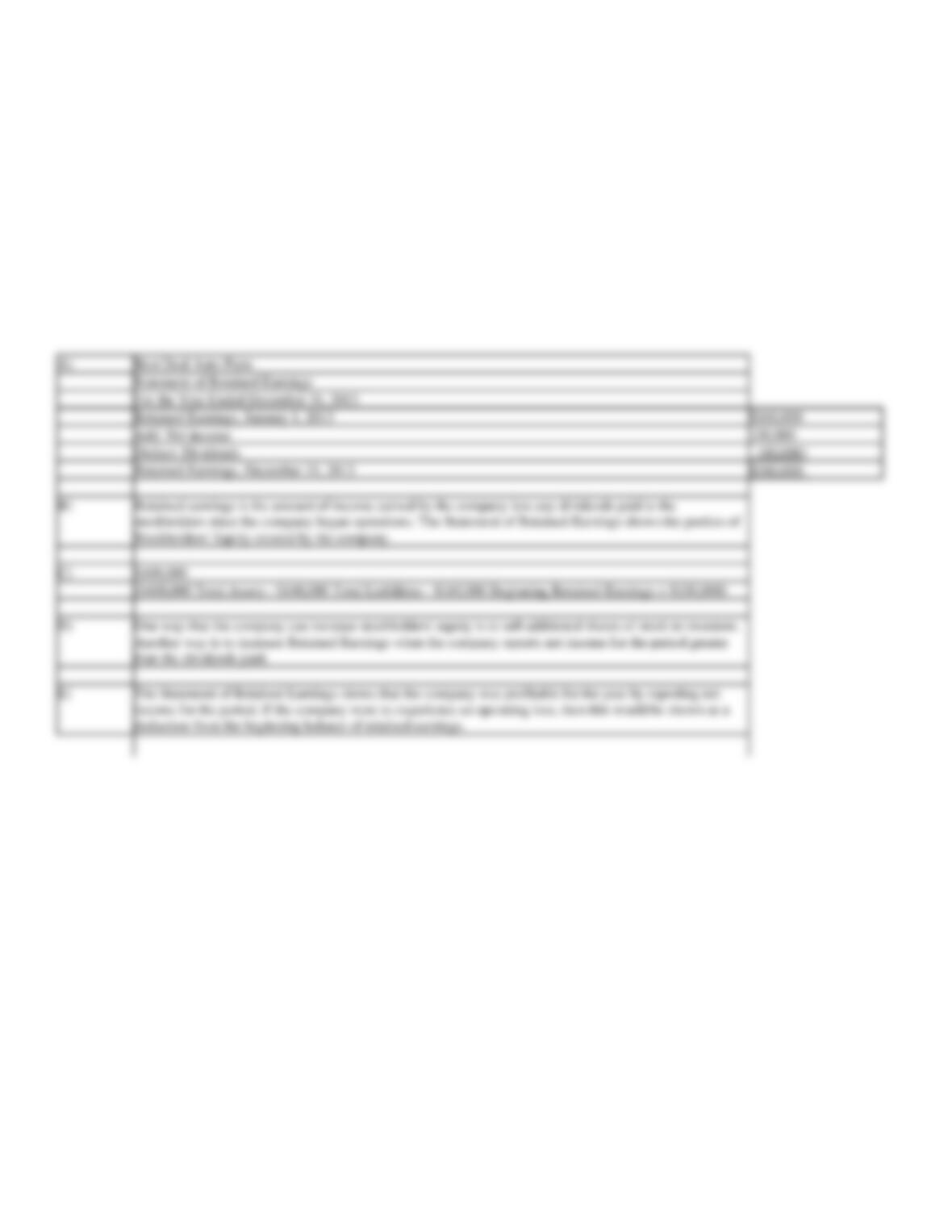
A)
Best Deal Auto Parts
Statement of Retained Earnings
For the Year Ended December 31, 2013
Retained Earnings, January 1, 2013
$160,000
Add: Net income
100,000
Deduct: Dividends
(80,000)
Retained Earnings, December 31, 2013
$180,000
C)
$100,000
($400,000 Total Assets – $140,000 Total Liabilities – $160,000 Beginning Retained Earnings = $100,000)
than the dividends paid.
182. The following accounts were taken from a company’s accounting records. Answer the questions that
follow.
Total liabilities, end of the yr.
$920,000
Total assets, end of the yr.
$1,430,000
Capital stock, end of the yr.
160,000
Retained earnings, beginning of yr.
150,000
Dividends for the period
200,000
Net income for the yr.
400,000
A)
How much is the balance of Retained Earnings at the end of the year?
B)
Show the company’s accounting equation at the end of the year with the respective dollar amounts.
C)
If stockholders’ equity increases during the year, does that mean that the company is profitable? Explain your answer.
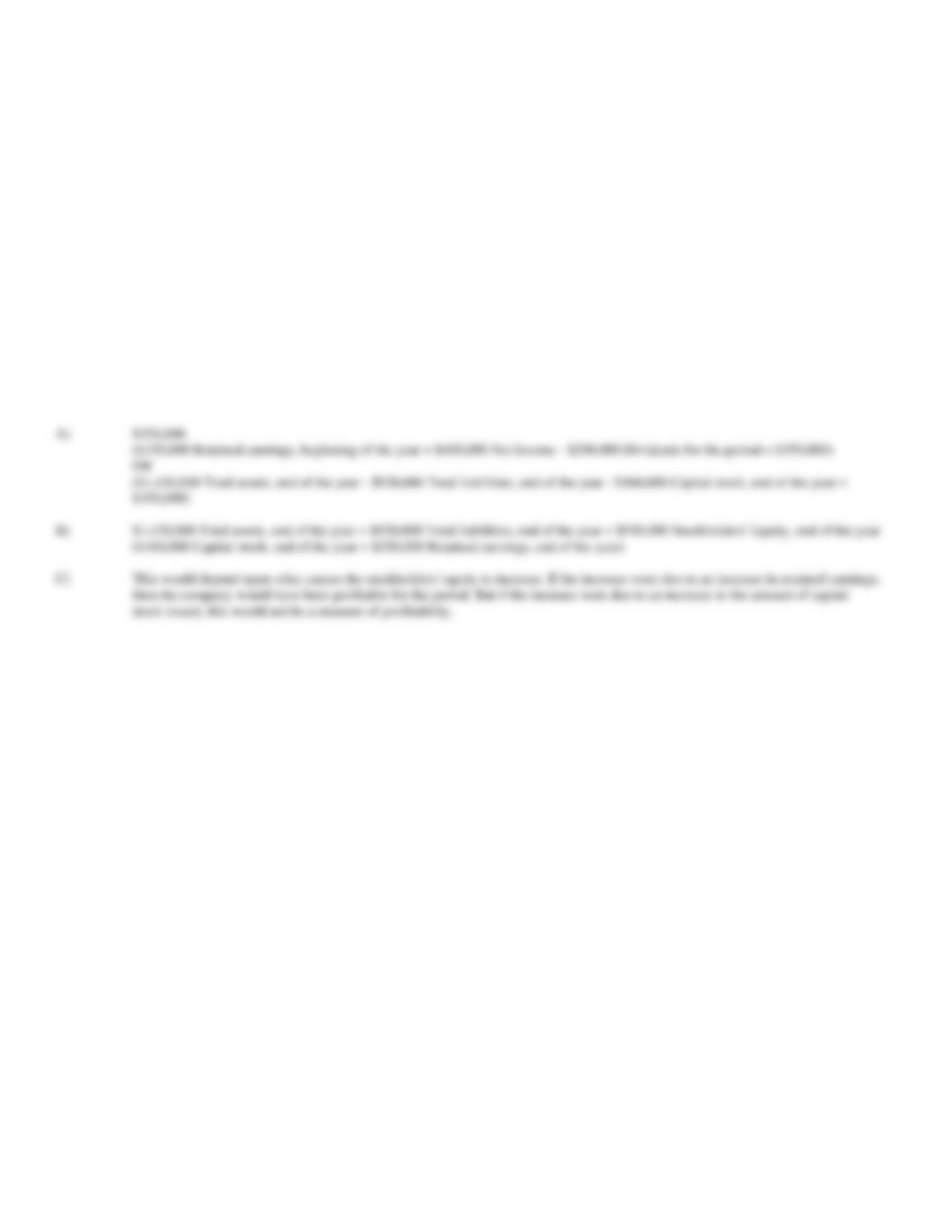
A)
$350,000
($150,000 Retained earnings, beginning of the year + $400,000 Net income – $200,000 Dividends for the period = $350,000)
B)
$1,430,000 Total assets, end of the year = $920,000 Total liabilities, end of the year + $510,000 Stockholders’ Equity, end of the year
($160,000 Capital stock, end of the year + $350,000 Retained earnings, end of the year)
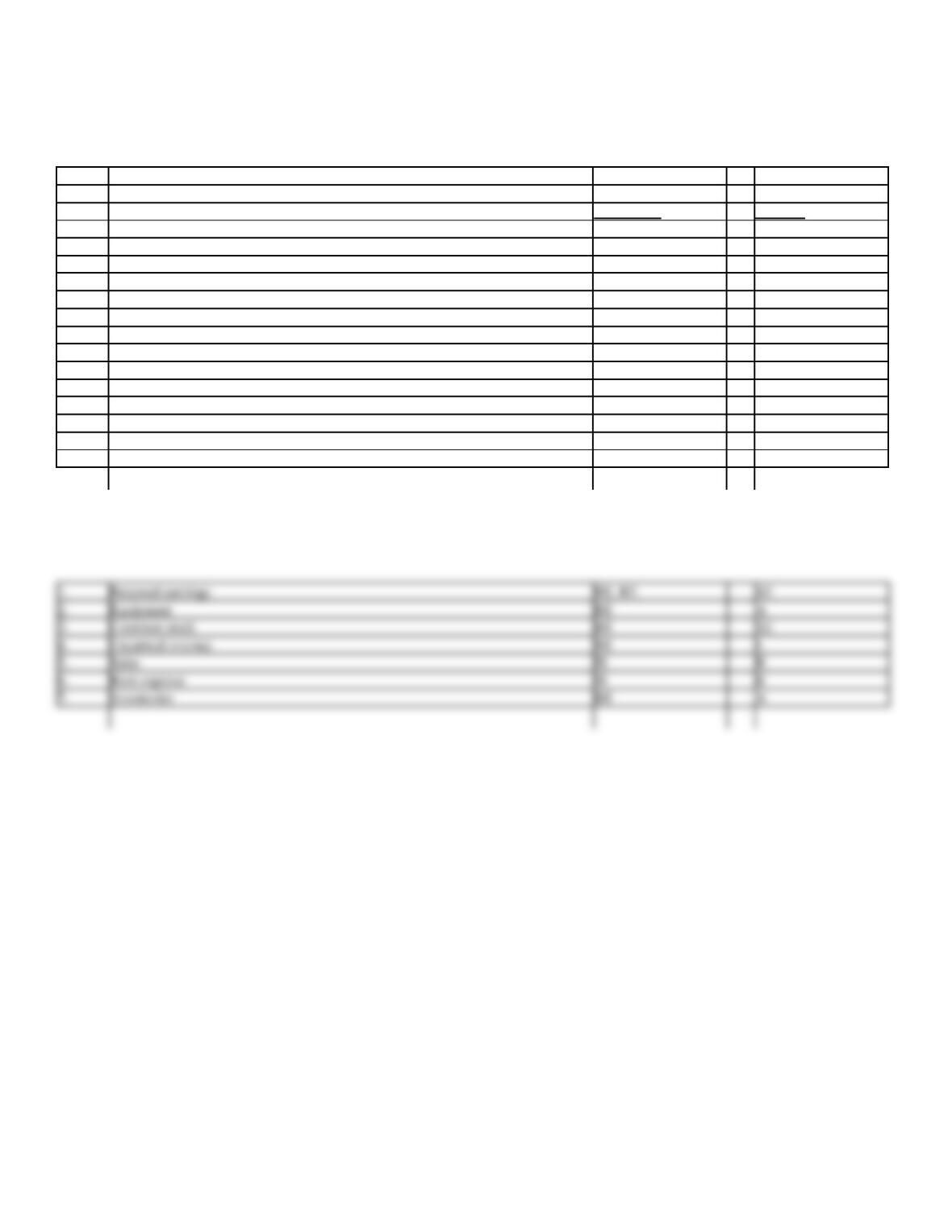
183. Classify the following items according to the financial statement on which each belongs, either the income
statement (IS), statement of retained earnings (RE), or the balance sheet (BS). Also indicate whether each is a
revenue (R), expense (E), asset (A), liability (L), or stockholders’ equity (SE) item.
Appears on
Which
Type of
Statement?
Account
1.
Retained earnings
2.
Equipment
3.
Common stock
4.
Unearned revenue
5.
Sales
6.
Rent expense
7.
Inventories
1.
Retained earnings
BS, RE
2.
Equipment
A
3.
Common stock
4.
Unearned revenue
L
5.
Sales
R
6.
Rent expense
E
7.
Inventories
A
184. The following amounts were taken from the accounting records at December 31, 2013:
Service Revenue
$600,000
Salaries Expense
$200,000
Dividends Paid
50,000
Rent Expense
86,000
Buildings
110,000
Land
100,000
Accounts Payable
40,000
Accounts Receivable
28,000
Capital Stock
60,000
Retained Earnings, Jan. 1, 2013
400,000
Utilities Expense
19,000
Notes Payable
30,000
Income Tax Payable
4,000
Income Tax Expense
110,000
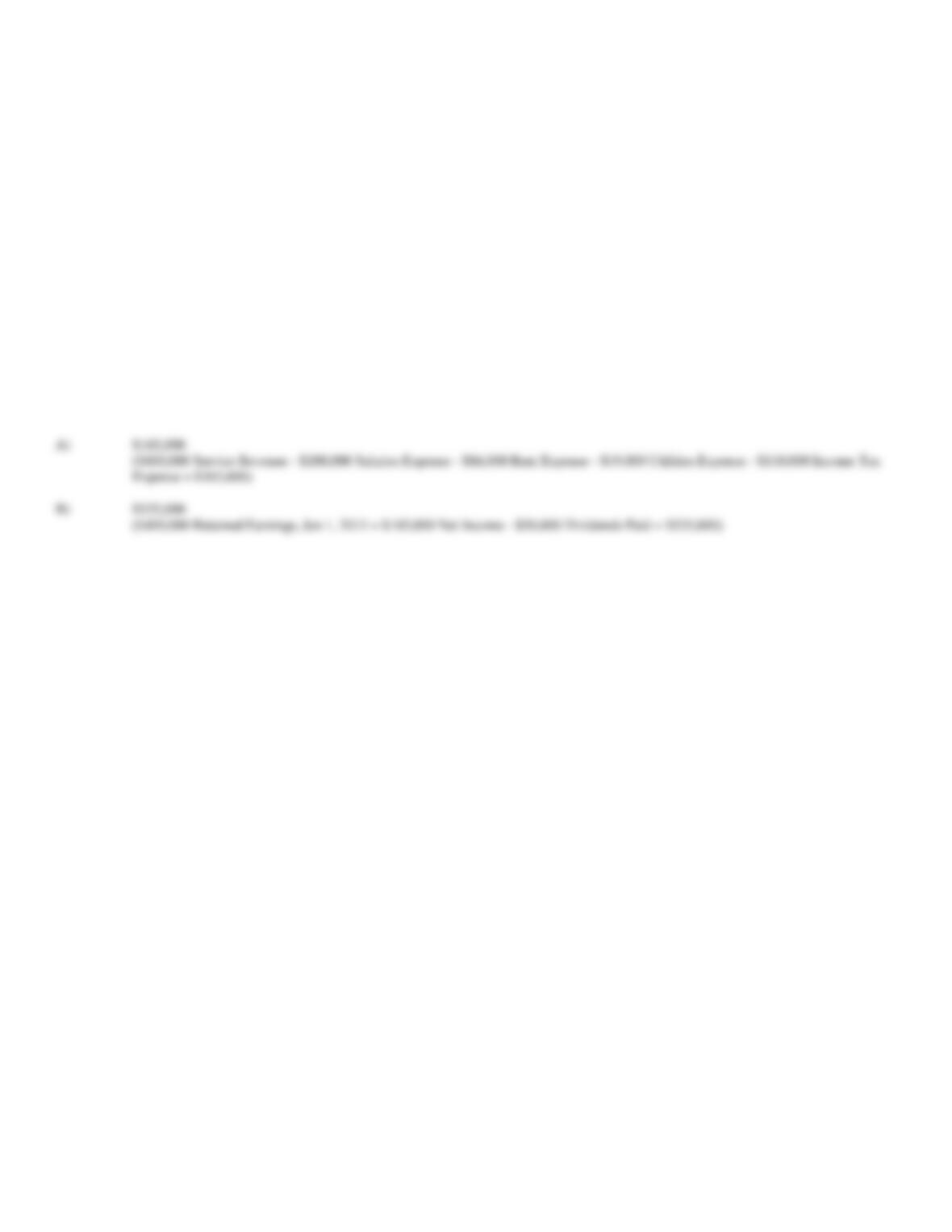
A)
Calculate net income for 2013.
B)
Calculate retained earnings at the end of 2013.
$185,000
B)
$535,000
($400,000 Retained Earnings, Jan 1, 2013 + $185,000 Net Income – $50,000 Dividends Paid = $535,000)
185. The following amounts were taken from the accounting records at December 31, 2013:
Accounts Payable
$400,000
Dividends Paid
$100,000
Cash
$100,000
Expenses
$600,000
Inventories
$700,000
Revenue
$750,000
A)
Calculate Total Assets.
B)
Calculate Net Income for 2013.
C)
Calculate Total Stockholders’ Equity at the end of 2013.
D)
Calculate Total Stockholders’ Equity at the beginning of 2013 assuming there were no stock transactions during the year.
186. The following information is taken from the Balance Sheet at December 31, 2013:
Cash
$288,000
Retained Earnings
$168,000
Inventory
96,000
Accounts Payable
84,000
Equipment
456,000
Bonds Payable
276,000
Common Stock
312,000
A)
How much did creditors provide to this company?
B)
On which financial statement would an investor look to see if any stock was issued during the year?
A)
$360,000
($84,000 Accounts Payable + $276,000 Bond Payable)
A)
$800,000
($100,000 Cash + $700,000 Inventories = $800,000)
B)
$150,000
($750,000 Revenue – $600,000 Expenses = $150,000)
C)
$400,000
($800,000 Total Assets – $400,000 Accounts Payable = $400,000)
D)
$350,000
($400,000 End-of-year – $150,000 (NI = $750,000 – $600,000) + $100,000 (Dividends)
187. Baloon-E-Tunes
Retained Earnings
$370,000
Notes Payable (due in 6 years)
$120,000
Accumulated Depreciation
130,000
Salaries Payable
10,000
Income Taxes Payable
240,000
Supplies
20,000
Plant
480,000
Accounts Payable
360,000
Cash
110,000
Inventory
330,000
Accounts Receivable
350,000
Land
500,000
Common Stock
600,000
Prepaid Insurance
40,000
Refer to Baloon-E-Tunes. Prepare the current assets section of the Balance Sheet at December 31, 2013. You may omit the heading. How does the
concept of liquidity apply?
188. Baloon-E-Tunes
Retained Earnings
$370,000
Notes Payable (due in 6 years)
$120,000
Accumulated Depreciation
130,000
Salaries Payable
10,000
Income Taxes Payable
240,000
Supplies
20,000
Plant
480,000
Accounts Payable
360,000
Cash
110,000
Inventory
330,000
Accounts Receivable
350,000
Land
500,000
Common Stock
600,000
Prepaid Insurance
40,000
Refer to Baloon-E-Tunes. Prepare the current liabilities section of the balance sheet at December 31, 2013. You may omit the heading. If the amount
of current liabilities were larger, what effect would this have on the current ratio?
Accounts Payable
$360,000
Salaries Payable
10,000
Income Taxes Payable
240,000
Total
$610,000
Cash
$110,000
Accounts Receivable
350,000
Inventory
330,000
Prepaid Insurance
40,000
Supplies
20,000
Total Current Assets
$850,000
189. Baloon-E-Tunes
Retained Earnings
$370,000
Notes Payable (due in 6 years)
$120,000
Accumulated Depreciation
130,000
Salaries Payable
10,000
Income Taxes Payable
240,000
Supplies
20,000
Plant
480,000
Accounts Payable
360,000
Cash
110,000
Inventory
330,000
Accounts Receivable
350,000
Land
500,000
Common Stock
600,000
Prepaid Insurance
40,000
Refer to Baloon-E-Tunes. Prepare the long-term asset section of the balance sheet at December 31, 2013. You may omit the heading. Why are these
amounts classified as “long-term”?
190. Baloon-E-Tunes
Retained Earnings
$370,000
Notes Payable (due in 6 years)
$120,000
Accumulated Depreciation
130,000
Salaries Payable
10,000
Income Taxes Payable
240,000
Supplies
20,000
Plant
480,000
Accounts Payable
360,000
Cash
110,000
Inventory
330,000
Accounts Receivable
350,000
Land
500,000
Common Stock
600,000
Prepaid Insurance
40,000
Refer to Baloon-E-Tunes. Calculate the current ratio at December 31, 2013. What does this ratio tell you about the “composition” of the current
assets?
Land
$500,000
Plant
$480,000
Less: Accumulated Depreciation
(130,000)
350,000
Total
$850,000
191. Baloon-E-Tunes
Retained Earnings
$370,000
Notes Payable (due in 6 years)
$120,000
Accumulated Depreciation
130,000
Salaries Payable
10,000
Income Taxes Payable
240,000
Supplies
20,000
Plant
480,000
Accounts Payable
360,000
Cash
110,000
Inventory
330,000
Accounts Receivable
350,000
Land
500,000
Common Stock
600,000
Prepaid Insurance
40,000
Refer to Baloon-E-Tunes. Calculate the amount of working capital at December 31, 2013. What can you learn from the current ratio that you cannot
learn from the amount of working capital?
192. B-There Transportation
B-There Transportation calculated the following amounts concerning its financial information for the years
ending December 31, 2013 and 2012.
2013
2012
Current Ratio
4.0 to 1
2.0 to 1
Refer to B-There Transportation. Is the change in the current ratio favorable or not? Explain.
193. B-There Transportation
B-There Transportation calculated the following amounts concerning its financial information for the years
ending December 31, 2013 and 2012.
2013
2012
Current Ratio
4.0 to 1
2.0 to 1
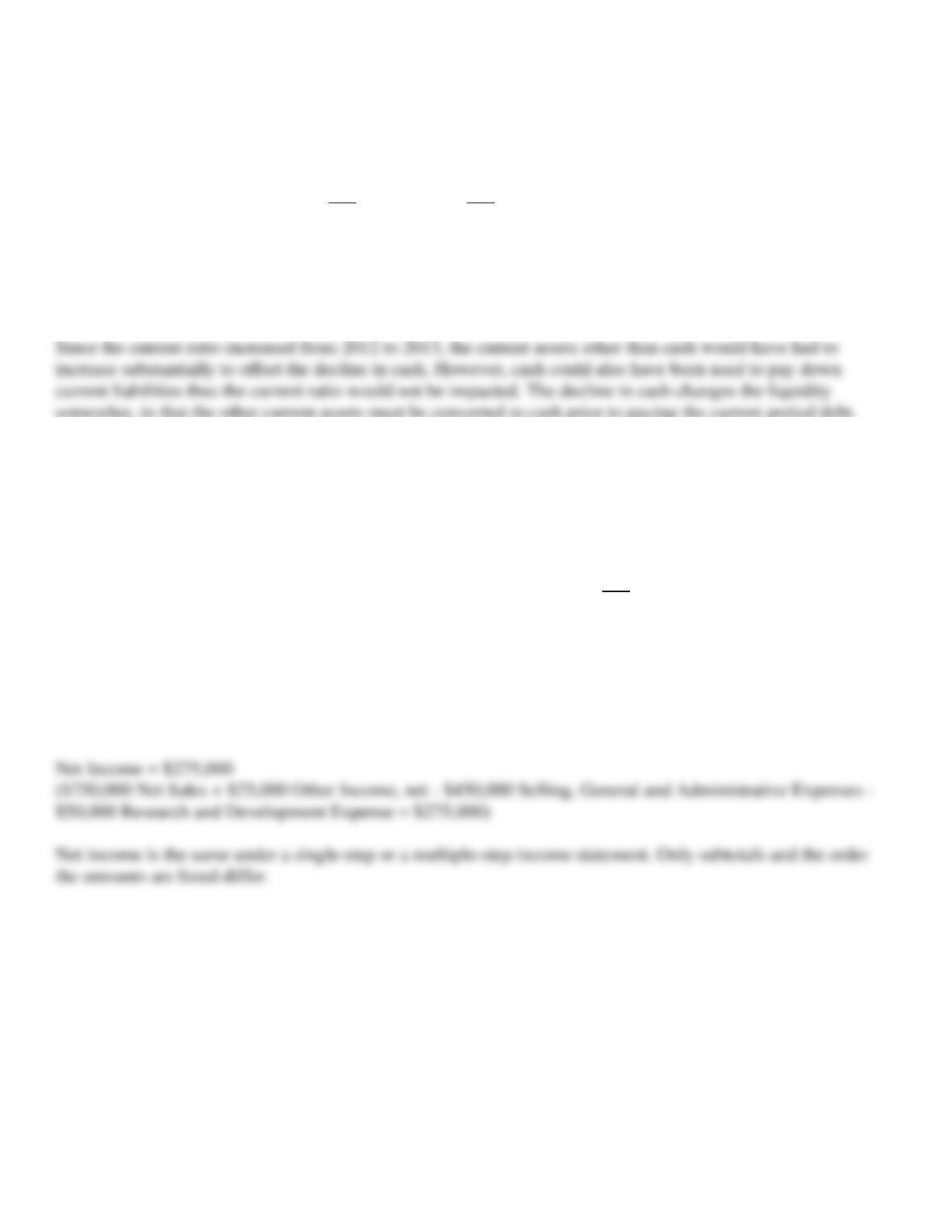
Refer to B-There Transportation. Suppose the company had a decrease in its cash account from 2012 to 2013. Would the other current asset amounts
have increased or decreased? Explain.
194. The following amounts were taken from the income statement of Beauty World for the year ending
December 31, 2013:
2013
Net Sales
$750,000
Selling, General and Administrative Expense
450,000
Research and Development Expense
50,000
Other Income (net)
25,000
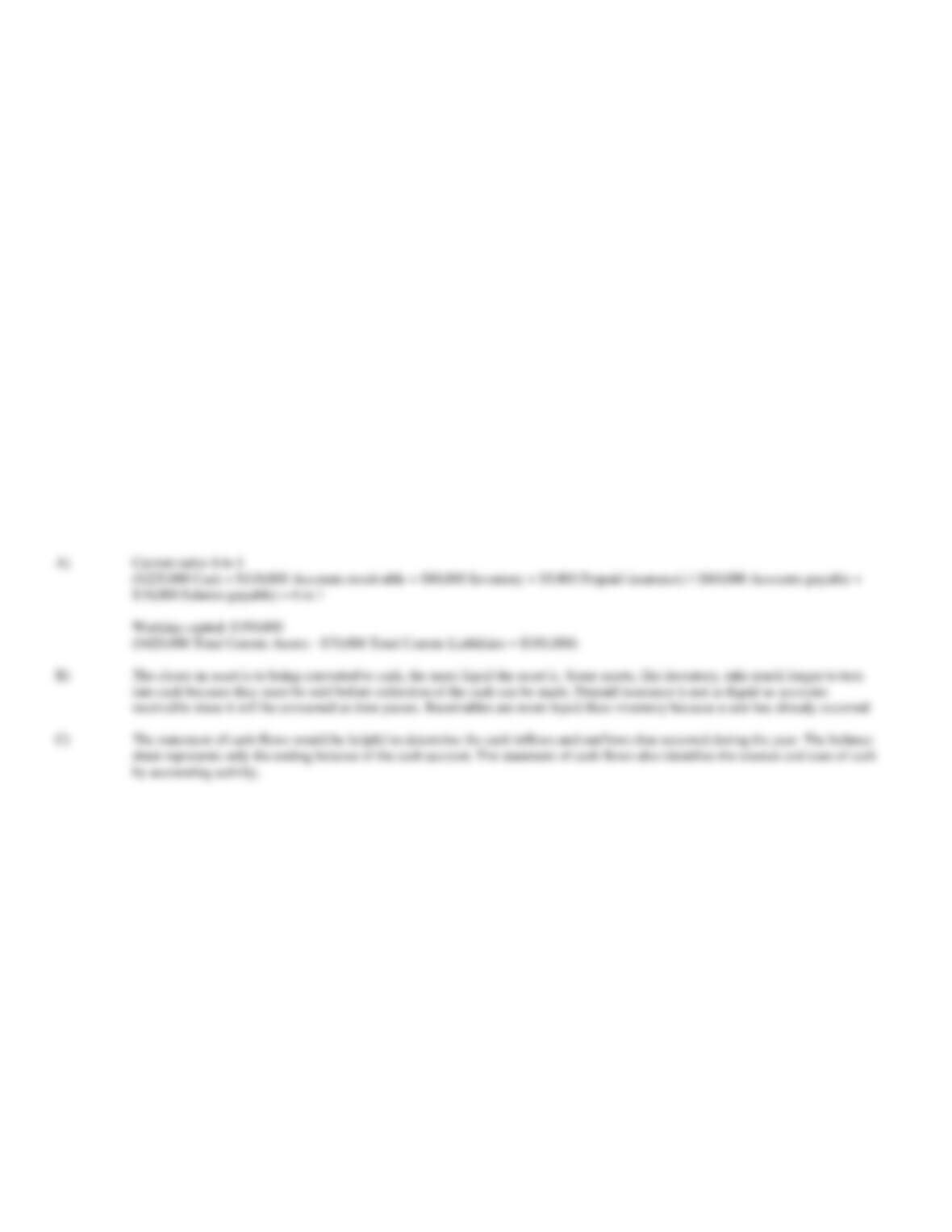
How much is net income for the year ended December 31, 2013? Would the net income amount have been different if the company had used a
single-step income statement rather than the multiple-step statement? Explain.
195. After reporting a profit of $20,000 for the year, a certain company reported the following items on its
balance sheet at December 31, 2013:
Cash
$225,000
Accounts receivable
110,000
Inventory
80,000
Prepaid insurance
5,000
Land
100,000
Building
280,000
Accounts payable
60,000
Salaries payable
10,000
Capital stock
500,000
Retained earnings
230,000
A)
Calculate the current ratio and determine the amount of working capital.
B)
Beyond the information provided in your answers to “A,” what does the composition of the current assets tell you about the
company’s liquidity?
C)
What other information would one need to fully access liquidity?
A)
Current ratio: 6 to 1
Working capital: $350,000
($420,000 Total Current Assets – $70,000 Total Current Liabilities = $350,000)