
Chapter 1: Introduction to Accounting and Business
Harris Designers
Balance Sheet
April 30
Assets
Liabilities
Cash
$ (g)
Accounts payable $(i)
Supplies
8,100
Owner’s Equity
Land
(h)
Lori Harris, capital
(j)
Total liabilities and
Total assets
$55,900
owner’s equity
$(k)
Harris Designers
Statement of Cash Flows
For the Month Ended April 30
Cash flows from operating activities:
Cash flows from financing activities:
Cash received as owner’s investment $ (l)
Deduct cash withdrawal by owner (m)
Net cash flow from financing activities (n)
Net cash flow and April 30 cash balance $ (o)
Cash received from customers
Deduct cash payments for expenses and payments to
$23,000
creditors
4,200
Net cash flow from operating activities
$18,800
Cash flows from investing activities:
Cash payments for acquisition of land
(17,000)
Chapter 1: Introduction to Accounting and Business
Place your answers in the space provided below. Hint: Use the interrelationships among the financial statements
to
solve this problem.
(a)
___________
(b)
___________
(c)
___________
(d)
___________
(e)
___________
(f)
___________
(g)
___________
(h)
___________
(i)
___________
(j)
___________
(k)
___________
(l)
___________
(m)
___________
(n)
___________
(o)
___________
Chapter 1: Introduction to Accounting and Business
187.
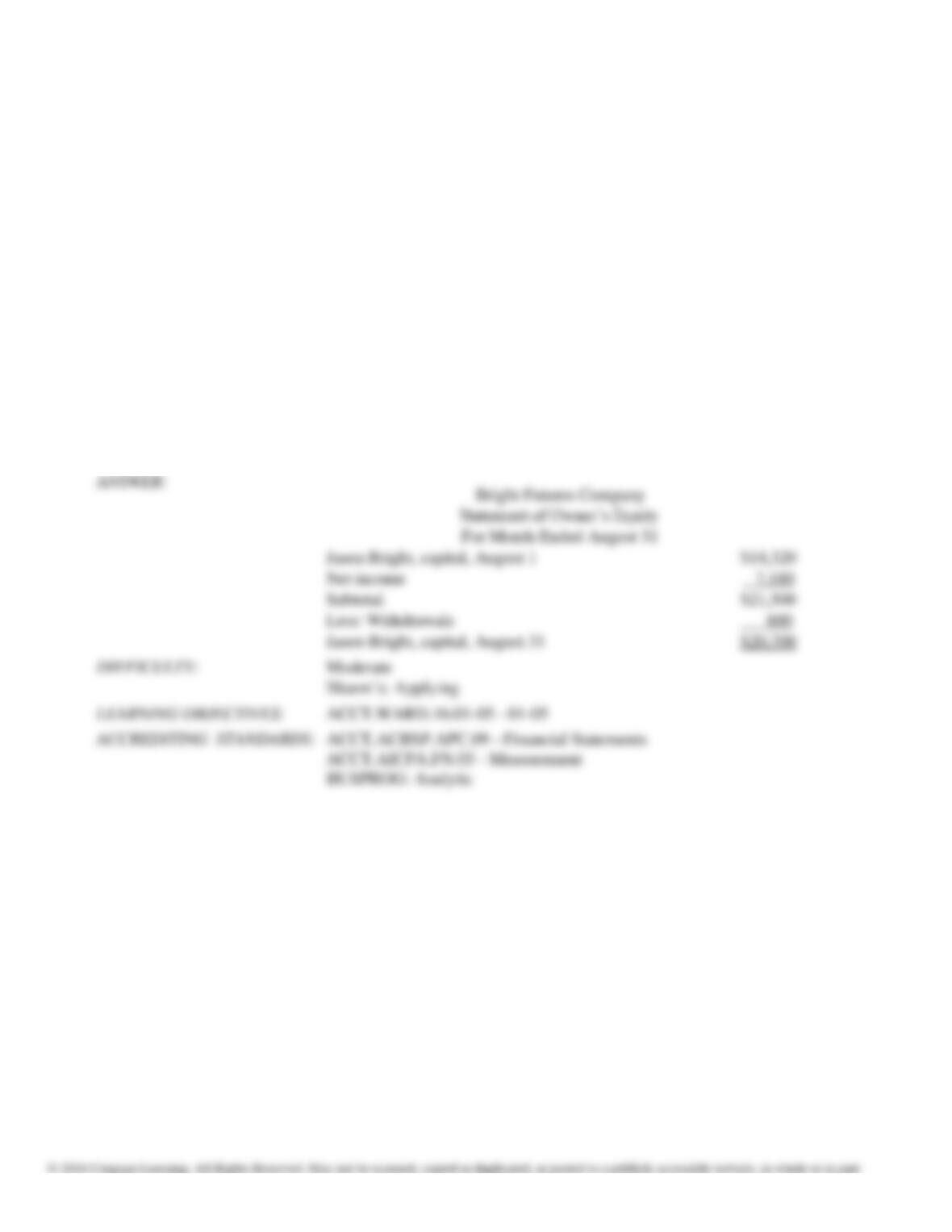
Using the following accounts and their amounts, prepare in good format an income statement for Heavenly
Futures
Company for the month ended August 31.
Telephone Expense
$ 1,150
Cash
3,000
Accounts Payable
1,540
Jason Heaven, Drawing
800
Fees Earned
15,700
Rent Expense
1,400
Supplies
140
Accounts Receivable
1,500
Computer Equipment
20,000
Jason Heaven, Capital (August 1)
14,320
Wages Expense
4,800
Utilities Expense
750
Notes Payable
2,400
Office Expense
420
Net income
Chapter 1: Introduction to Accounting and Business
188.
Using the following accounts and their amounts, prepare in good format a statement of owner’s equity for Bright
Futures Company for the month ended August 31.
Telephone Expense
$ 1,150
Cash
3,000
Accounts Payable
1,540
Jason Bright, Drawing
800
Fees Earned
15,700
Rent Expense
1,400
Supplies
140
Accounts Receivable
1,500
Computer Equipment
20,000
Jason Bright, Capital (August 1)
14,320
Wages Expense
4,800
Utilities Expense
750
Notes Payable
2,400
Office Expense
420

Chapter 1: Introduction to Accounting and Business
189.
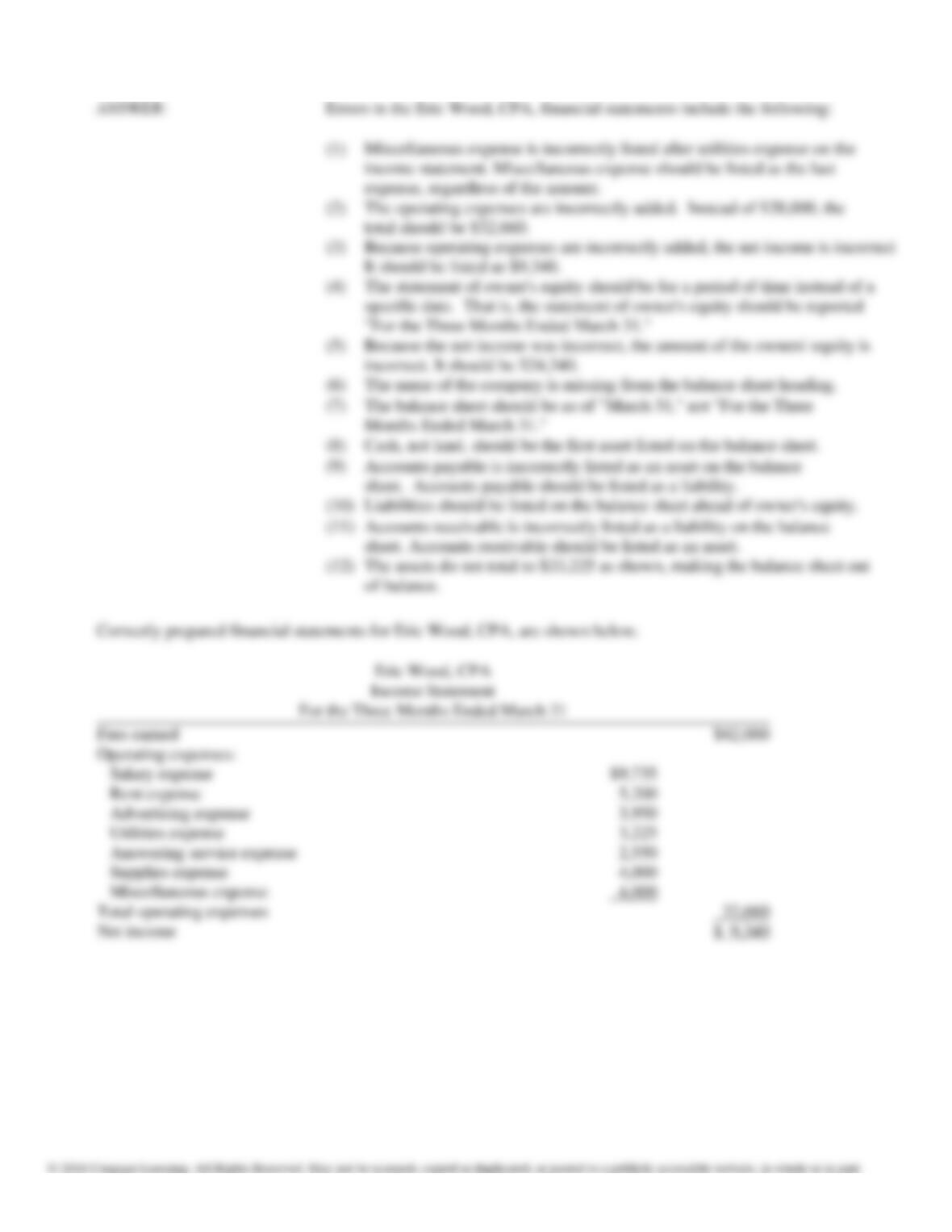
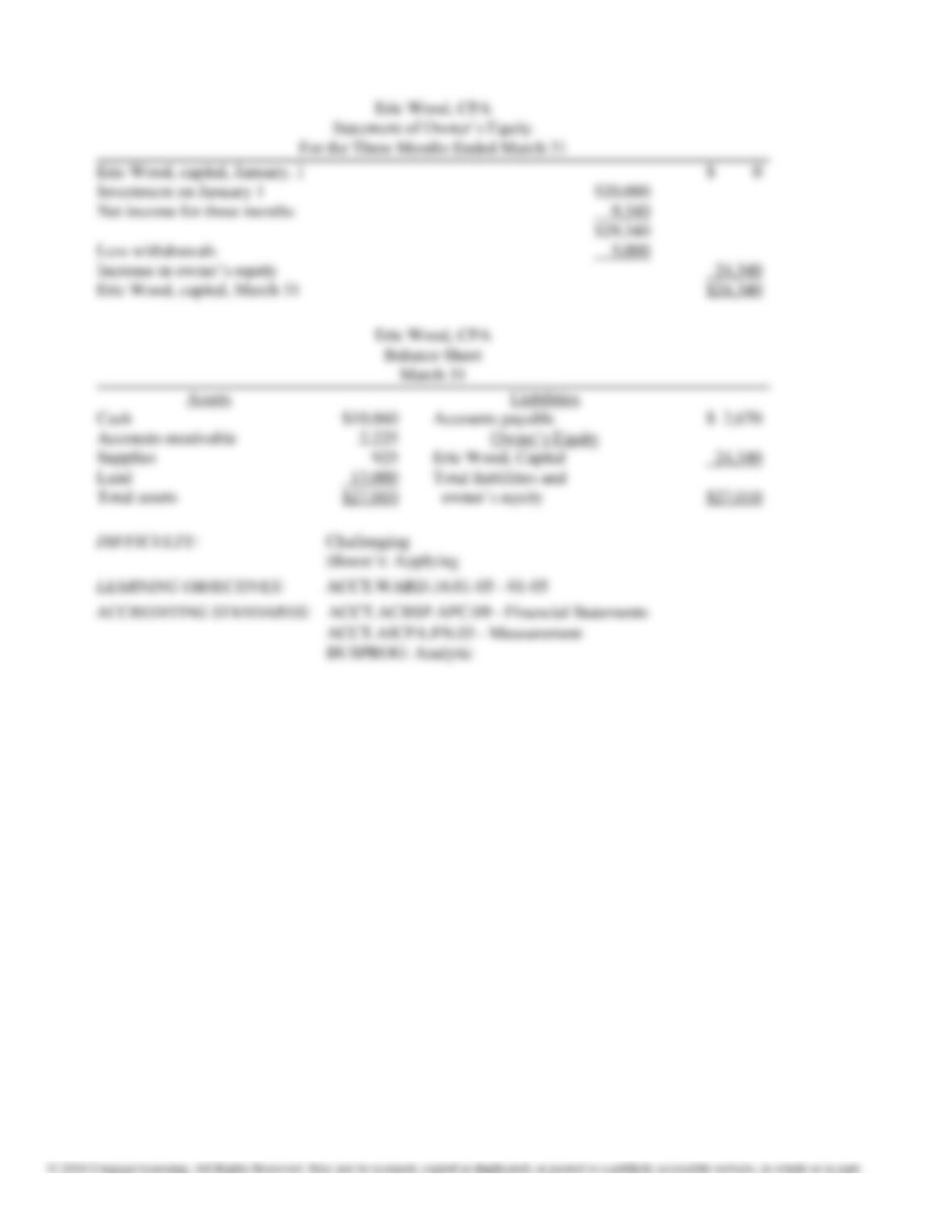
Eric Wood, CPA, was organized on January 1 as a proprietorship. List the errors that you find in the
following
financial statements and prepare the corrected statements for the three months ended March 31.
Eric Wood, CPA
Income Statement
For the Three Months Ended March 31
Fees earned
$42,000
Operating expenses:
Salary expense
$9,735
Rent expense
5,200
Advertising expense
3,950
Utilities expense
3,225
Miscellaneous expense
4,000
Answering service expense
2,550
Supplies expense
4,000
Total operating expenses
28,000
Net income
$14,000
Eric Wood, CPA
Statement of Owner’s Equity
March 31
Eric Wood, capital, January, 1, 2011
$ 0
Investment on January 1, 2011
$20,000
Net income for the 3 months
14,000
36,000
Less withdrawals
5,000
Increase in owner’s equity
31,000
Eric Wood, capital, March 31
$31,000
Balance Sheet
For the Three Months Ended March 31
Assets
Owner’s Equity
Land
$13,000
Eric Wood, Capital
$31,000
Cash
10,860
Liabilities
Accounts payable
2,670
Accounts receivable
2,225
Supplies
925
Total liabilities and
Total assets
$33,225
owner’s equity
$33,225
Chapter 1: Introduction to Accounting and Business
Chapter 1: Introduction to Accounting and Business
Chapter 1: Introduction to Accounting and Business
190.
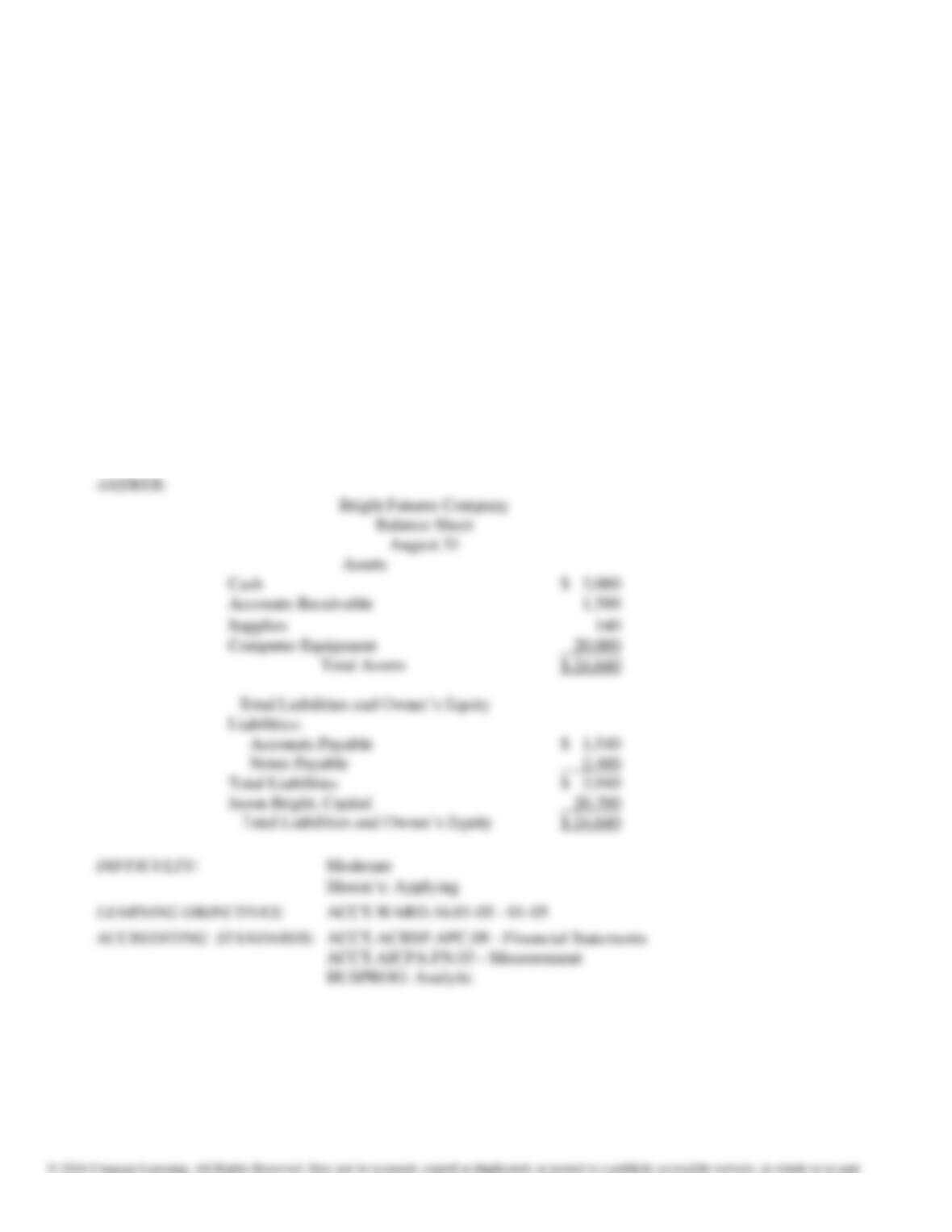
Using the following accounts and their amounts, prepare in good format a balance sheet for Bright
Futures
Company for the month ended August 31.
Telephone Expense $ 1,150
Cash 3,000
Accounts Payable 1,540
Jason Bright, Drawing 800
Fees Earned 15,700
Rent Expense 1,400
Supplies 140
Accounts Receivable 1,500
Computer Equipment 20,000
Jason Bright, Capital (August 1) 14,320
Wages Expense 4,800
Utilities Expense 750
Notes Payable 2,400
Office Expense 420
Chapter 1: Introduction to Accounting and Business
191.
The account balances of Awesome Travel Services at December 31 are listed below. There were no
additional
investments or withdrawals by J. Trendsetter during the year.
Accounts Payable
$12,000
J. Trendsetter, Capital (Jan. 1)
$10,000
Accounts Receivable
14,000
Supplies
1,000
Cash
18,000
Taxes Expense
1,300
Computer Equipment
21,000
Utilities Expense
8,000
Fees Earned
78,000
Wages Expense
25,000
Rent Expense
10,000
Supplies Expense
1,700
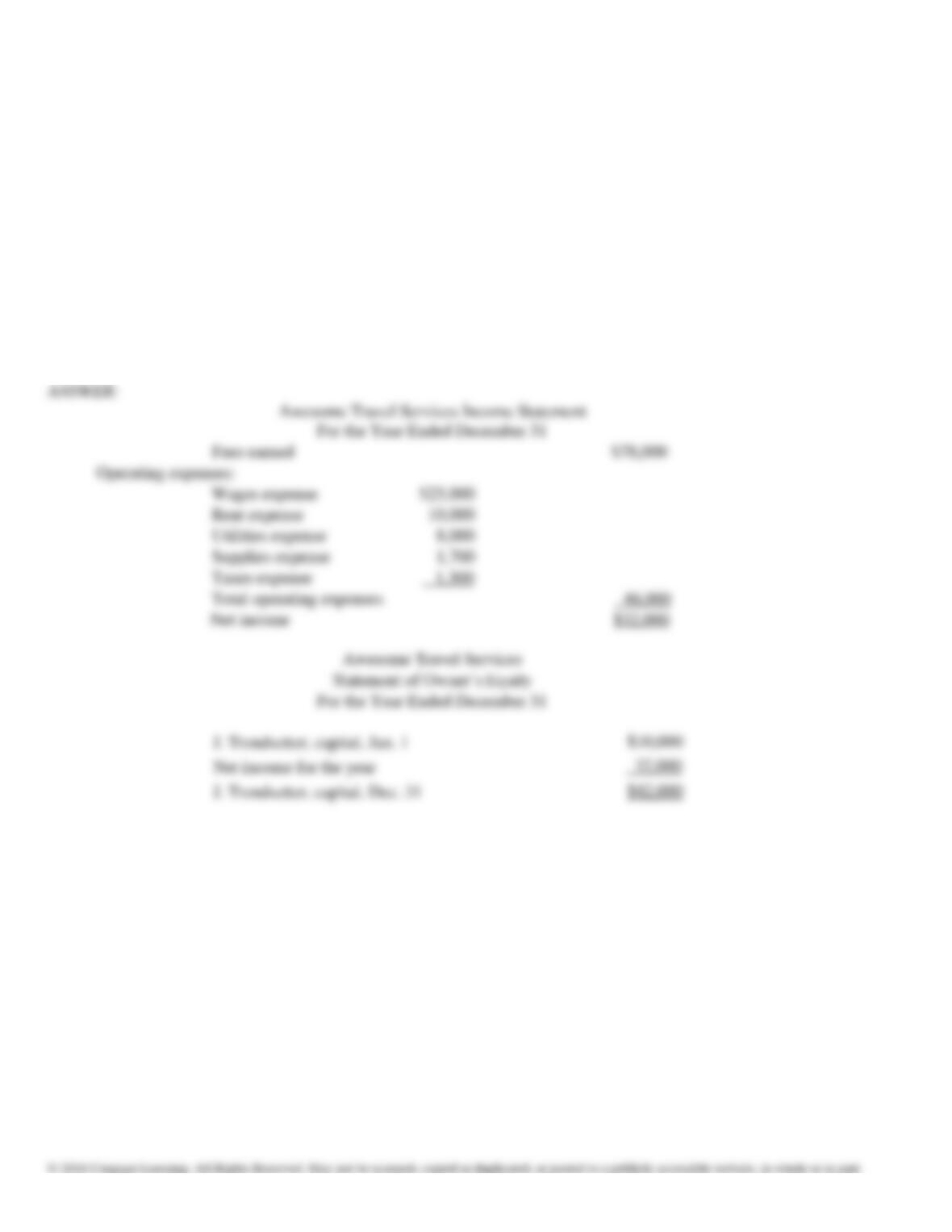
Prepare an income statement, statement of owner’s equity, and a balance sheet as of December 31.
J. Trendsetter, capital, Jan. 1
Net income for the year
J. Trendsetter, capital, Dec. 31
Chapter 1: Introduction to Accounting and Business
192.
Schultz Tax Services, a tax preparation business, had the following transactions during the month of June:
1.
Received cash for providing accounting services, $3,000.
2.
Billed customers on account for providing services, $7,000.
3.
Paid advertising expense, $800.
4.
Received cash from customers on account, $3,800.
5.
Owner made a withdrawal, $1,500.
6.
Received telephone bill, $220.
7.
Paid telephone bill, $220.
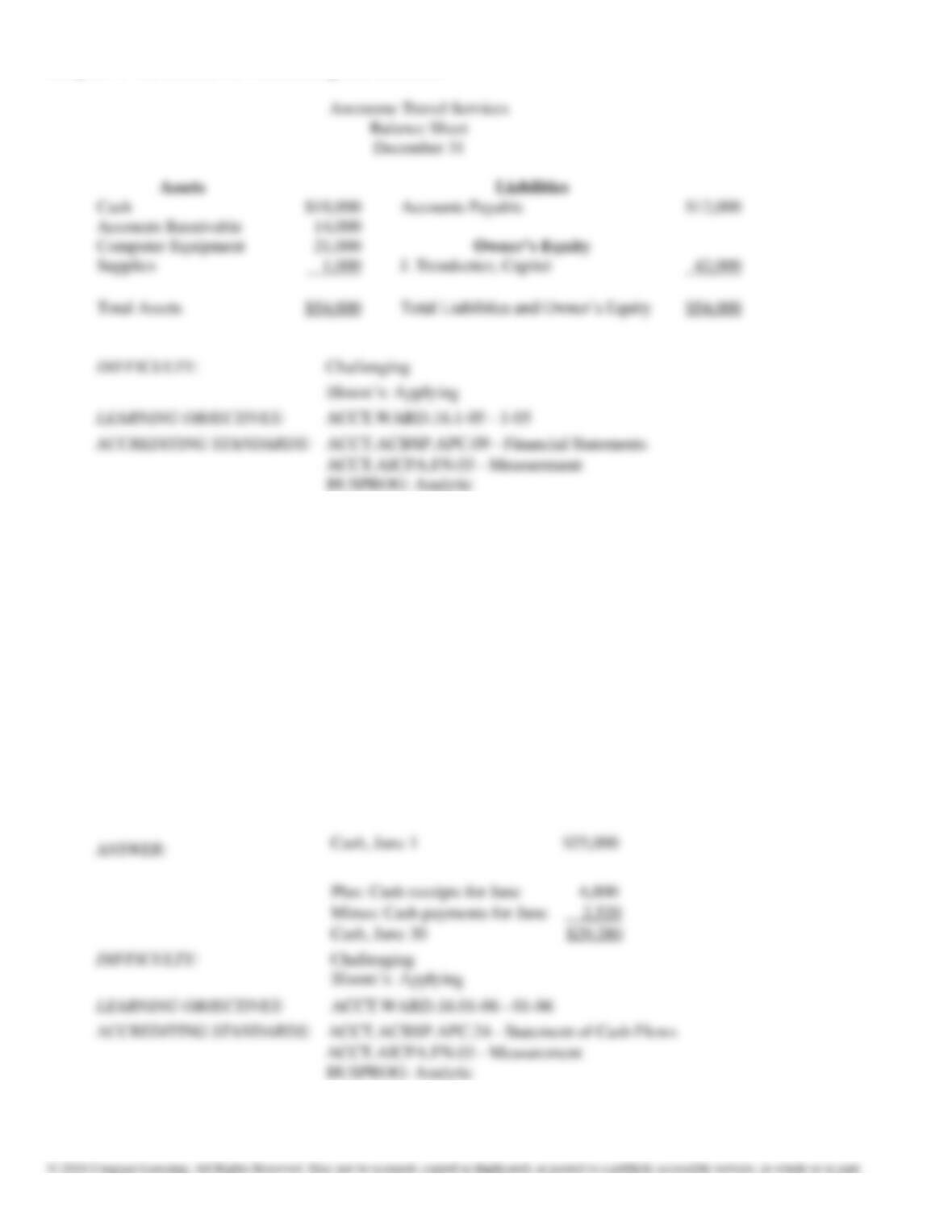
Based on the information given above, calculate the balance of Cash at June 30. (Hint: Use the following
reconciliation.)
Cash, June $25,000
Plus: cash receipts for June ____________
Minus: cash payments for June ____________
Cash, June 30 ____________
Chapter 1: Introduction to Accounting and Business
193.
Given the following data:
Dec. 31, Year 2 Dec. 31, Year 1
Total liabilities $128,250 $120,000
Total owner’s equity 95,000 80,000
a.
Compute the ratio of liabilities to owner’s equity for each year.
b.
Has the creditors’ risk increased or decreased from December 31, Year 1, to December 31, Year 2?
194.
Company G has a ratio of liabilities to stockholders’ equity of 0.12 and 0.28 for Year 1 and Year 2, respectively.
In
contrast, Company M has a ratio of liabilities to stockholders’ equity of 1.13 and 1.29 for the same period.
REQUIRED:
Based on this information, which company‘s creditors are more at risk and why? Should the creditors of either
company fear the risk of nonpayment?
Chapter 1: Introduction to Accounting and Business
195.
The following data were taken from Miller Company’s balance sheet:
Dec. 31, Year 2
Dec. 31, Year 1
Total liabilities
$150,000
$105,000
Total owner’s equity
75,000
60,000
a.
Compute the ratio of liabilities to owner’s equity.
b.
Has the creditors’ risk increased or decreased from December 31, Year 1, to December 31, Year 2?
Match the following business types with each business listed below. Each may be used more than once.
a.
Service firm
b.
Manufacturing firm
c.
Merchandising firm
DIFFICULTY: Easy
Bloom’s: Remembering
LEARNING OBJECTIVES: ACCT.WARD.16.01-01 – 01–01
ACCREDITING STANDARDS: ACCT.ACBSP.APC.03 – Business Forms
ACCT.AICPA.BB.01 – Industry
ACCT.AICPA.FN.03 – Measurement
BUSPROG: Analytic
196.
A tax preparation firm
197.
A law firm
198.
A health club and spa

Chapter 1: Introduction to Accounting and Business
199.
An automobile dealer
200.
A book publisher
201.
A hospital
202.
A supermarket
203.
A modular homebuilder
204.
A men’s clothing store
205.
A dressmaking company

Chapter 1: Introduction to Accounting and Business
Match the following characteristics with the form of business entity that best describes it. Each may be used
more
than once.
a.
Proprietorship
b.
Partnership
c.
Corporation
d.
Limited liability company (LLC)
DIFFICULTY: Easy
Bloom’s: Remembering
LEARNING OBJECTIVES: ACCT.WARD.16.01-02 – 01–02
ACCREDITING STANDARDS: ACCT.ACBSP.APC.03 – Business Forms
ACCT.AICPA.BB.01 – Industry
ACCT.AICPA.FN.03 – Measurement
BUSPROG: Analytic
206.
Comprises 70% of business entities in the United States
207.
Generates 90% of business revenues
208.
Owned by two or more individuals
209.
Organized as a separate legal taxable entity
210.
Easy and cheap to organize
211.
Often used as an alternative to a partnership
212.
Used by large business
Chapter 1: Introduction to Accounting and Business
213.
Has the ability to obtain large amounts of resources
214.
Offers tax and legal liability advantages for owners
Match each transactions with its effect on the accounting equation. Each letter may be used more than
once.
a.
Increase assets, increase liabilities
b.
Increase liabilities, decrease owner’s equity
c.
Increase assets, increase owner’s equity
d.
No effect
e.
Decrease assets, decrease liabilities
f.
Decrease assets, decrease owner’s equity
DIFFICULTY: Moderate
Bloom’s: Remembering
LEARNING OBJECTIVES: ACCT.WARD.16.01-04 – 01–04
ACCREDITING STANDARDS: ACCT.ACBSP.APC.06 – Recording Transactions
ACCT.AICPA.FN.03 – Measurement
BUSPROG: Analytic
215.
Received cash for services provided
216.
Received utility bill to be paid next month
217.
Investment of land by owner
218.
Paid part of an amount owed to a creditor
219.
Paid cash for the purchase of a one year insurance policy

Chapter 1: Introduction to Accounting and Business
220.
Received payment from a customer on account
221.
Cash withdrawal by owner
222.
Provided a service to a customer on account
223.
Purchased supplies on credit
224.
Paid wages
225.
Cash investment by owner
226.
Borrowed money from a bank
227.
Purchased equipment for cash
228.
Received cash for providing services to customers
229.
Used up supplies that were already on hand

Chapter 1: Introduction to Accounting and Business
Match the following characteristics with the financial statement it describes it. Each may be used more than
once.
a.
Income Statement
b.
Balance Sheet
c.
Statement of Owner’s Equity
d.
Statement of Cash Flows
DIFFICULTY: Bloom’s:
Remembering
Easy
LEARNING OBJECTIVES: ACCT.WARD.16.01-05 – 01–05
ACCREDITING STANDARDS: ACCT.ACBSP.APC.06 – Recording Transactions
ACCT.ACBSP.APC.09 – Financial Statements
ACCT.ACBSP.APC.24 – Statement of Cash Flows
ACCT.AICPA.FN.03 – Measurement
BUSPROG: Analytic
230.
Reports as of a specific date
231.
The first statement prepared
232.
Has three sections: operating, investing and financing
233.
Reports only revenues and expenses
234.
The second statement prepared
235.
A formal presentation of the accounting equation
236.
The connecting link between the income statement and balance sheet