CHAPTER 1
ACCOUNTING IN ACTION
SUMMARY OF QUESTIONS BY LEARNING OBJECTIVES AND BLOOM’S TAXONOMY
Item
LO
BT
Item
LO
BT
Item
LO
BT
Item
LO
BT
Item
LO
BT
True-False Statements
1.
1
K
10.
2
K
19.
4
K
28.
7
C
sg37.
2
K
2.
1
K
11.
2
K
20.
5
C
29.
7
C
sg38.
3
K
3.
1
C
12.
2
K
21.
5
K
30.
7
C
sg39.
4
C
4.
2
K
13.
2
K
22.
5
K
31.
8
K
sg40.
5
K
5.
2
K
14.
2
K
23.
5
K
32.
8
K
sg41.
6
K
6.
2
C
15.
3
K
24.
6
K
33.
8
K
sg42.
7
K
7.
2
K
16.
4
K
25.
6
K
34.
8
K
sg43.
8
K
8.
2
C
17.
4
K
26.
6
K
35.
8
K
9.
2
K
18.
4
K
27.
7
K
sg36.
1
K
Multiple Choice Questions
44.
1
K
74.
4
C
104.
6
K
134.
8
K
a164.
9
C
45.
1
K
75.
4
K
105.
6
C
135.
8
K
sg165.
1
K
46.
1
K
76.
4
K
106.
6
K
136.
8
AP
st166.
1
K
47.
1
C
77.
4
C
107.
6
C
137.
8
AP
st167.
1
K
48.
1
K
78.
4
K
108.
6
AP
138.
8
AP
sg168.
2
K
49.
1
K
79.
5
K
109.
6
AP
139.
8
K
st169.
2
K
50.
1
K
80.
5
K
110.
6
AP
140.
8
C
sg170.
4
K
51.
1
K
81.
5
K
111.
6
AP
141.
8
K
st171.
5
K
52.
1
K
82.
5
K
112.
6
AP
142.
8
K
sg172.
5
K
53.
2
K
83.
5
K
113.
6
K
143.
8
AP
sg173.
6
K
54.
2
C
84.
5
C
114.
6
K
144.
8
AP
sg174.
7
C
55.
2
C
85.
5
C
115.
6
K
145.
8
AP
sg175.
7
C
56.
2
C
86.
5
K
116.
6
K
146.
8
AP
8
K
57.
2
C
87.
5
K
117.
7
C
147.
8
AP
sg177.
8
K
58.
2
C
88.
5
C
118.
7
AP
148.
8
AP
178.
10
K
59.
2
C
89.
5
K
119.
7
C
149.
8
AP
179.
10
K
60.
2
K
90.
5
K
120.
7
C
150.
8
AP
180.
10
K
61.
2
K
91.
5
K
121.
7
C
151.
8
AP
181.
10
K
62.
2
C
92.
5
K
122.
7
C
152.
8
AP
182.
10
K
63.
3
K
93.
6
K
123.
7
C
153.
8
AP
183.
10
K
64.
3
C
94.
6
K
124.
7
C
154.
8
AP
184.
10
K
65.
3
K
95.
6
K
125.
7
K
155.
8
AP
185.
10
K
66.
4
K
96.
6
C
126.
7
C
156.
8
AN
186.
10
K
67.
4
K
97.
6
K
127.
7
C
157.
8
AN
187.
10
K
68.
4
K
98.
6
K
128.
7
C
158.
8
AN
188.
10
K
69.
4
K
99.
6
C
129.
7
AN
159.
8
AN
189.
10
K
70.
4
K
100.
6
K
130.
7
C
160.
8
AN
190.
10
K
71.
4
C
101.
6
K
131.
8
C
a161.
9
K
191.
10
K
72.
4
K
102.
6
K
132.
8
C
a162.
9
K
73.
4
K
103.
6
K
133.
8
K
a163.
9
K
sg This question also appears in the Study Guide.
st This question also appears in a self-test at the student companion website.
a This question covers a topic in an appendix to the chapter.
sg176.
Test Bank for Financial Accounting, Ninth Edition
FOR INSTRUCTOR USE ONLY
1 – 2
SUMMARY OF QUESTIONS BY LEARNING OBJECTIVES AND BLOOM’S TAXONOMY
Brief Exercises
192.
2
C
195.
6
AP
198.
7
C
201.
8
AP
193.
6
K
196.
6
AP
199.
8
AP
202.
8
AP
194.
6
K
197.
6
C
200.
6.
8
C
Exercises
203.
2,4
K
211.
6
C
219.
7
C
227.
8
AP
235.
8
AN
204.
6
C
212.
6,7
C
220.
7
C
228.
8
AP
236.
8
C
205.
6
C
213.
6,7
C
221.
7
AP
229.
8
AP
237.
8
AP
206.
6
AP
214.
6,7
AP
222.
7
C
23.
8
AN
238.
8
AP
207.
6
C
215.
7
AP
223.
7
C
231.
8
AP
239.
8
AP
208.
6
AP
216.
7
AP
224.
7
C
232.
8
AP
209.
6
AN
217.
7
C
225.
7
C
233.
8
C
210.
6
AN
218.
7
AN
226.
7
C
234.
8
AP
Completion Statements
240.
1
K
242.
2
K
244.
4
K
246.
5
K
248.
6
K
241.
2
K
243.
2
K
245.
4
K
247.
6
K
249.
8
K
Matching: Q250, Short Answer: Q251-256
SUMMARY OF LEARNING OBJECTIVES BY QUESTION TYPE
Item
Type
Item
Type
Item
Type
Item
Type
Item
Type
Item
Type
Item
Type
Learning Objective 1
1.
TF
36.
TF
46.
MC
49.
MC
52.
MC
167.
MC
2.
TF
44.
MC
47.
MC
50.
MC
165.
MC
240.
C
3.
TF
45.
MC
48.
MC
51.
MC
166.
MC
Learning Objective 2
4.
TF
9.
TF
14.
TF
56.
MC
61.
MC
203.
Ex
5.
TF
10.
TF
37.
TF
57.
MC
62.
MC
241.
C
6.
TF
11.
TF
53.
MC
58.
MC
168.
MC
242.
C
7.
TF
12.
TF
54.
MC
59.
MC
169.
MC
243.
C
8.
TF
13.
TF
55.
MC
60.
MC
192.
BE
Learning Objective 3
15.
TF
38.
TF
63.
MC
64.
MC
65.
MC
Learning Objective 4
16.
TF
39.
TF
69.
MC
73.
MC
77.
MC
244.
C
17.
TF
66.
MC
70.
MC
74.
MC
78.
MC
245.
C
18.
TF
67.
MC
71.
MC
75.
MC
170.
MC
19.
TF
68.
MC
72.
MC
76.
MC
203.
Ex
Learning Objective 5
20.
TF
40.
TF
82.
MC
86.
MC
90.
MC
172.
MC
21.
TF
79.
MC
83.
MC
87.
MC
91.
MC
246.
C
22.
TF
80.
MC
84.
MC
88.
MC
92.
MC
23.
TF
81.
MC
85.
MC
89.
MC
171.
MC
Accounting in Action
FOR INSTRUCTOR USE ONLY
1 – 3
SUMMARY OF LEARNING OBJECTIVES BY QUESTION TYPE
Learning Objective 6
24.
TF
96.
MC
103.
MC
110.
MC
173.
MC
205.
Ex
212.
Ex
25.
TF
97.
MC
104.
MC
111.
MC
193.
BE
206.
Ex
213.
Ex
26.
TF
98.
MC
105.
MC
112.
MC
194.
BE
207.
Ex
214.
Ex
41.
TF
99.
MC
106.
MC
113.
MC
195.
BE
208.
Ex
247.
C
93.
MC
100.
MC
107.
MC
114.
MC
196.
BE
209.
Ex
248.
C
94.
MC
101.
MC
108.
MC
115.
MC
197.
BE
210.
Ex
95.
MC
102.
MC
109.
MC
116.
MC
204.
Ex
211.
Ex
Learning Objective 7
27.
TF
118.
MC
124.
MC
130.
MC
214.
Ex
220.
Ex
226.
Ex
28.
TF
119.
MC
125.
MC
174.
MC
215.
Ex
221.
Ex
29.
TF
120.
MC
126.
MC
175.
MC
216.
Ex
222.
Ex
30.
TF
121.
MC
127.
MC
198.
BE
217.
Ex
223.
Ex
42.
TF
122.
MC
128.
MC
212.
Ex
218.
Ex
224.
Ex
117.
MC
123.
MC
129.
MC
213.
Ex
219.
Ex
225.
Ex
Learning Objective 8
31.
TF
133.
MC
141.
MC
149.
MC
157.
MC
201.
BE
233.
Ex
32.
TF
134.
MC
142.
MC
150.
MC
158.
MC
202.
BE
234.
Ex
33.
TF
135.
MC
143.
MC
151.
MC
159.
MC
227.
Ex
235.
Ex
34.
TF
136.
MC
144.
MC
152.
MC
160.
MC
228.
Ex
236.
Ex
35.
TF
137.
MC
145.
MC
153.
MC
176.
MC
229.
Ex
237.
Ex
43.
TF
138.
MC
146.
MC
154.
MC
177.
MC
230.
Ex
238.
Ex
131.
MC
139.
MC
147.
MC
155.
MC
199.
BE
231.
Ex
239.
Ex
132.
MC
140.
MC
148.
MC
156.
MC
200.
BE
232.
Ex
249.
C
Learning Objective 9
a161.
MC
a162.
MC
a163.
MC
a164.
MC
Learning Objective 10
178.
MC
180.
MC
182.
MC
184.
MC
186.
MC
188.
MC
190.
MC
179.
MC
181.
MC
183.
MC
185.
MC
187.
MC
189.
MC
191.
MC
Note: TF = True-False BE = Brief Exercise C = Completion
MC = Multiple Choice Ex = Exercise

Test Bank for Financial Accounting, Ninth Edition
FOR INSTRUCTOR USE ONLY
1 – 4
CHAPTER LEARNING OBJECTIVES
1. Explain what accounting is. Accounting is an information system that identifies, records,
and communicates the economic events of an organization to interested users.
2. Identify the users and uses of accounting. The major users and uses of accounting are as
follows: (a) Management uses accounting information to plan, organize, and run the business.
(b) Investors (owners) decide whether to buy, hold, or sell their financial interests on the basis
of accounting data. (c) Creditors (suppliers and bankers) evaluate the risks of granting credit
or lending money on the basis of accounting information. Other groups that use accounting
information are taxing authorities, regulatory agencies, customers, and labor unions.
3. Understand why ethics is a fundamental business concept. Ethics are the standards of
conduct by which actions are judged as right or wrong. Effective financial reporting depends
on sound ethical behavior.
4. Explain generally accepted accounting principles. Generally accepted accounting
principles are a common set of standards used by accountants.
5. Explain the monetary unit assumption and the economic entity assumption. The
monetary unit assumption requires that companies include in the accounting records only
transaction data that can be expressed in terms of money. The economic entity assumption
requires that the activities of each economic entity be kept separate from the activities of its
owners and other economic entities.
6. State the accounting equation, and define its components. The basic accounting
equation is:
Assets = Liabilities + Stockholders’ Equity
Assets are resources owned by a business. Liabilities are creditorship claims on total assets.
Stockholders’ equity is the ownership claim on total assets.
The expanded accounting equation is:
Assets = Liabilities + Common Stock + Revenues − Expenses − Dividends
Common stock is affected when the company issues new shares of stock in exchange for
cash. Revenues are increases in assets resulting from income-earning activities. Expenses
are the costs of assets consumed or services used in the process of earning revenue.
Dividends are payments the company makes to its stockholders.
7. Analyze the effects of business transactions on the accounting equation. Each business
transaction must have a dual effect on the accounting equation. For example, if an individual
asset increases, there must be a corresponding (1) decrease in another asset, or (2) increase
in a specific liability, or (3) increase in stockholders’ equity.
8. Understand the four financial statements and how they are prepared. An income
statement presents the revenues and expenses, and resulting net income or net loss, for a
specific period of time. A retained earnings statement summarizes the changes in retained
earnings for a specific period of time. A balance sheet reports the assets, liabilities, and
stockholders’ equity at a specific date. A statement of cash flows summarizes information
about the cash inflows (receipts) and outflows (payments) for a specific period of time.
a9. Explain the career opportunities in accounting. Accounting offers many different jobs in
fields such as public and private accounting, governmental, and forensic accounting.
Accounting is a popular major because there are many different types of jobs, with unlimited
potential for career advancement.
Accounting in Action
1 – 5
TRUE-FALSE STATEMENTS
1. Owners of business firms are the only people who need accounting information.
2. Transactions that can be measured in dollars and cents are recorded in the financial
information system.
3. The hiring of a new company president is an economic event recorded by the financial
information system.
4. Management of a business enterprise is the major external user of information.
5. Accounting communicates financial information about a business enterprise to both
internal and external users.
6. Accounting information is used only by external users with a financial interest in a
business enterprise.
7. Financial statements are the major means of communicating accounting information to
interested parties.
8. Bookkeeping and accounting are one and the same because the bookkeeping function
includes the accounting process.
9. The origins of accounting are attributed to Luca Pacioli, a famous mathematician.
10. The study of accounting will be useful only if a student is interested in working for a profit-
oriented business firm.
11. Private accountants are accountants who are not employees of business enterprises.
12. The study of accounting is not useful for a business career unless your career objective is
to become an accountant.
13. A working knowledge of accounting is not relevant to a lawyer or an architect.
14. Expressing an opinion as to the fairness of the information presented in financial
statements is a service performed by CPAs.
Test Bank for Financial Accounting, Ninth Edition
1 – 6
15. Accountants rely on a fundamental business concept—ethical behavior—in reporting
financial information.
16. The primary accounting standard-setting body in the United States is the International
Accounting Standards Board.
17. The Financial Accounting Standards Board is a part of the Securities and Exchange
Commission.
18. The Securities and Exchange Commission oversees U.S. financial markets and
accounting standard-setting bodies.
19. The cost and fair value of an asset are the same at the time of acquisition and in all
subsequent periods.
20. Even though a partnership is not a separate legal entity, for accounting purposes the
partnership affairs should be kept separate from the personal activities of the owners.
21. A partnership must have more than one owner.
22. The economic entity assumption requires that the activities of an entity be kept separate
and distinct from the activities of its owner and all other economic entities.
23. The monetary unit assumption states that transactions that can be measured in terms of
money should be recorded in the accounting records.
24. In order to possess future service potential, an asset must have physical substance.
25. Owners’ claims to total business assets take precedence over the claims of creditors
because owners invest assets in the business and are liable for losses.
26. The basic accounting equation states that Assets = Liabilities.
27. Accountants record both internal and external transactions.
28. Internal transactions do not affect the basic accounting equation because they are
economic events that occur entirely within one company.
Accounting in Action
1 – 7
29. The purchase of store equipment for cash reduces stockholders’ equity by an equal
amount.
30. The purchase of office equipment on credit increases total assets and total liabilities.
31. The primary purpose of the statement of cash flows is to provide information about the
cash receipts and cash payments of a company during a period.
32. Net income for the period is determined by subtracting total expenses and drawings from
total revenues.
33. The income statement is sometimes referred to as the statement of operations.
34. A balance sheet reports the assets and liabilities of a company for a specific period of
time.
35. The ending retained earnings balance is reported on both the retained earnings statement
and the balance sheet.
36. Identifying is the process of keeping a chronological diary of events measured in dollars
and cents.
37. Management consulting includes examining the financial statements of companies and
expressing an opinion as to the fairness of their presentation.
38. Accountants do not have to worry about issues of ethics.
39. At the time an asset is acquired, cost and fair value should be the same.
40. The monetary unit assumption requires that all dollar amounts be rounded to the nearest
dollar.
41. The basic accounting equation is in balance when the creditor and ownership claims
against the business equal the assets.
42. External transactions involve economic events between the company and some other
enterprise or party.
43. In the retained earnings statement, revenues are listed first, followed by expenses, and
net income (or net loss).
Test Bank for Financial Accounting, Ninth Edition
FOR INSTRUCTOR USE ONLY
1 – 8
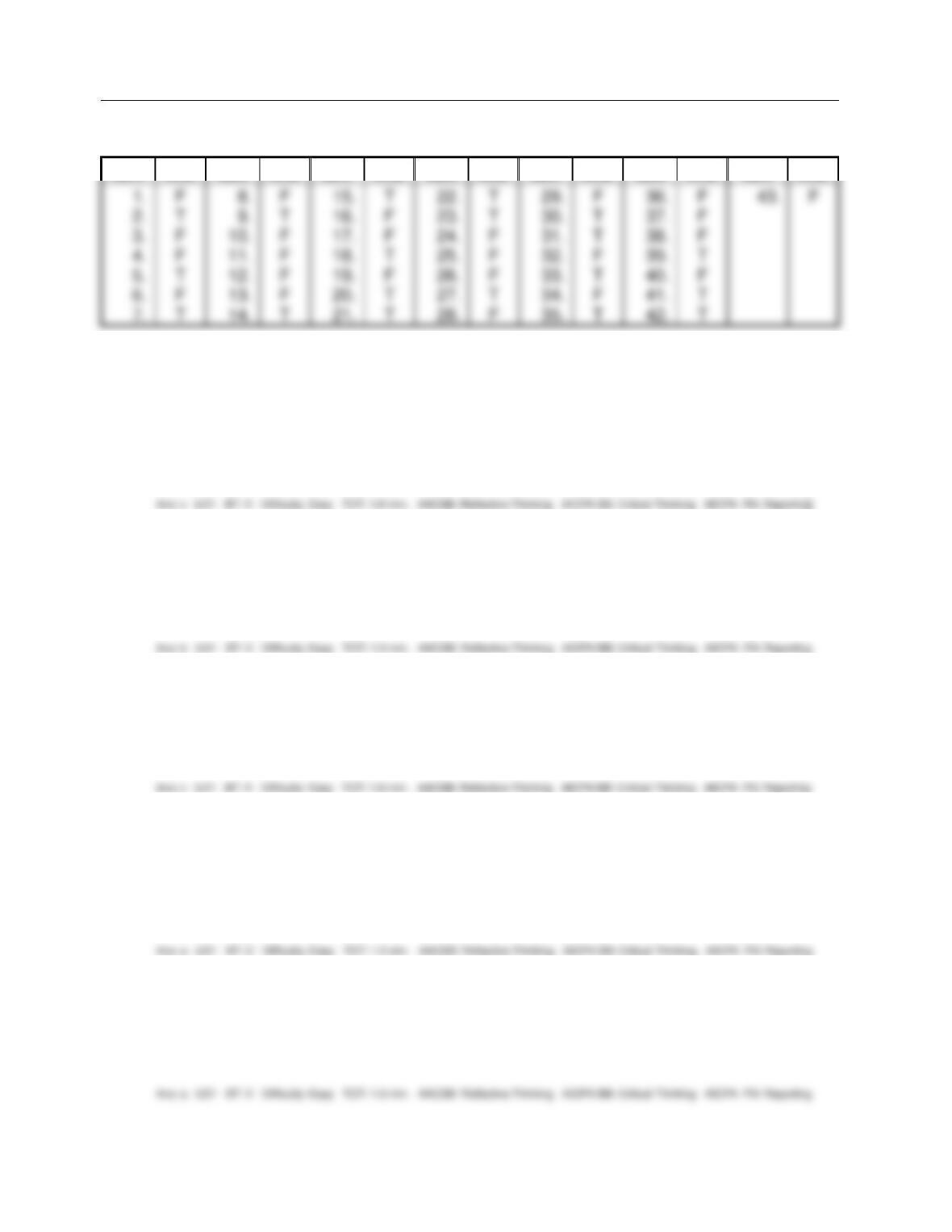
Answers to True-False Statements
Item
Ans.
Item
Ans.
Item
Ans.
Item
Ans.
Item
Ans.
Item
Ans.
Item
Ans.
MULTIPLE CHOICE QUESTIONS
44. Accountants refer to an economic event as a
a. purchase.
b. sale.
c. transaction.
d. change in ownership.
45. The process of recording transactions has become more efficient because
a. fewer events can be quantified in financial terms.
b. computers are used in processing business events.
c. more people have been hired to record business transactions.
d. business events are recorded only at the end of the year.
46. Communication of economic events is the part of the accounting process that involves
a. identifying economic events.
b. quantifying transactions into dollars and cents.
c. preparing accounting reports.
d. recording and classifying information.
47. Which of the following events cannot be quantified into dollars and cents and recorded as
an accounting transaction?
a. The appointment of a new CPA firm to perform an audit.
b. The purchase of a new computer.
c. The sale of store equipment.
d. Payment of income taxes.
48. The use of computers in recording business events
a. has made the recording process more efficient.
b. does not use the same principles as manual accounting systems.
c. has greatly impacted the identification stage of the accounting process.
d. is economical only for large businesses.
Accounting in Action
1 – 9
49. The accounting process involves all of the following except
a. identifying economic transactions that are relevant to the business.
b. communicating financial information to users by preparing financial reports.
c. recording nonquantifiable economic events.
d. analyzing and interpreting financial reports.
50. The accounting process is correctly sequenced as
a. identification, communication, recording.
b. recording, communication, identification.
c. identification, recording, communication.
d. communication, recording, identification.
51. Which of the following techniques are not used by accountants to interpret and report
financial information?
a. Graphs.
b. Special memos for each class of external users.
c. Charts.
d. Ratios.
52. Accounting consists of three basic activities which are related to economic events of an
organization. These include
a. identifying, recording, and communicating
b. identifying, calculating, and responding
c. classifying, numbering, and reporting
d. issuing, reporting, and classifying
53. All of the following statements are correct except
a. Good decision-making depends on good information.
b. A vital element in communicating economic events is the accountant’s ability to
analyze and interpret reported information.
c. The origins of accounting are generally attributed to Socrates, a classical Greek
philosopher, who promoted accounting as a social contract.
d. The information that a user of financial information needs depends upon the kinds of
decisions the user makes.
54. Which of the following would not be considered an internal user of accounting data for the
GHI Company?
a. President of the company.
b. Production manager.
c. Merchandise inventory clerk.
d. President of the employees’ labor union.
Test Bank for Financial Accounting, Ninth Edition
1 – 10
55. Which of the following would not be considered an external user of accounting data for
the GHI Company?
a. Internal Revenue Service Agent.
b. Management.
c. Creditors.
d. Customers.
56. Which of the following would not be considered internal users of accounting data for a
company?
a. The president of a company.
b. The controller of a company.
c. Creditors of a company.
d. Salesmen of the company.
57. Which of the following is an external user of accounting information?
a. Labor unions.
b. Finance directors.
c. Company officers.
d. Managers.
58. Which one of the following is not an external user of accounting information?
a. Regulatory agencies.
b. Customers.
c. Investors.
d. All of these are external users.
59. Bookkeeping differs from accounting in that bookkeeping primarily involves which part of
the accounting process?
a. Identification.
b. Communication.
c. Recording.
d. Analysis.
60. The origins of accounting are generally attributed to the work of
a. Christopher Columbus.
b. Abner Doubleday.
c. Luca Pacioli.
d. Leonardo da Vinci.
Accounting in Action
1 – 11
61. Financial accounting provides economic and financial information for all of the following
except
a. creditors.
b. investors.
c. managers.
d. other external users.
62. The final step in solving an ethical dilemma is to
a. identify and analyze the principal elements in the situation.
b. recognize an ethical situation.
c. identify the alternatives and weigh the impact of each alternative on stakeholders.
d. recognize the ethical issues involved.
63. The first step in solving an ethical dilemma is to
a. identify and analyze the principal elements in the situation.
b. identify the alternatives.
c. recognize an ethical situation and the ethical issues involved.
d. weigh the impact of each alternative on various stakeholders.
64. Ethics are the standards of conduct by which one‘s actions are judged as
a. right or wrong.
b. honest or dishonest.
c. fair or unfair.
d. All of these answers are correct.
65. All of the following are steps in analyzing ethics cases in financial reporting except
a. identify and analyze the principle elements in the situation.
b. contact law enforcement regarding any violations of corporate ethics codes
c. identify the alternatives and weigh the impact of each alternative on various
stakeholders.
d. recognize an ethical situation and the ethical issues involved.
66. In order to increase comparability, in recent years, the FASB and IASB have made efforts
to reduce the differences between U.S.GAAP and IFRS through a process known as
a. convergence
b. monetary unit assumption
c. the cost principle
d. the fair value principle
Test Bank for Financial Accounting, Ninth Edition
1 – 12
67. Martin Corporation purchased land in 2007 for $290,000. In 2015, it purchased a nearly
identical parcel of land for $460,000. In its 2015 balance sheet, Martin valued these two
parcels of land at a combined value of $920,000. By reporting the land in this manner,
Martin Corp. has violated the
a. historical cost principle
b. convergence
c. economic entity assumption
d. monetary unit assumption
68. Andre Dickinson, owner of Andre’s Fine Wines, also owns a personal residence that costs
$475,000. The market value of his residence is $625,000. During preparation of the
financial statements for Andre’s Fine Wines, the accounting concept most relevant to the
presentation of Andre’s home is
a. the economic entity assumption.
b. the fair value principle.
c. the monetary unit assumption.
d. convergence.
69. Generally accepted accounting principles are
a. income tax regulations of the Internal Revenue Service.
b. standards that indicate how to report economic events.
c. theories that are based on physical laws of the universe.
d. principles that have been proven correct by academic researchers.
70. The historical cost principle requires that when assets are acquired, they be recorded at
a. appraisal value.
b. cost.
c. market price.
d. book value.
71. The cost of an asset and its fair value are
a. never the same.
b. the same when the asset is sold.
c. irrelevant when the asset is used by the business in its operations.
d. the same on the date of acquisition.
72. The body of theory underlying accounting is not based on
a. physical laws of nature.
b. concepts.
c. principles.
d. definitions.
Accounting in Action
1 – 13
73. The private sector organization involved in developing accounting principles is the
a. Feasible Accounting Standards Body.
b. Financial Accounting Studies Board.
c. Financial Accounting Standards Board.
d. Financial Auditors’ Standards Body.
74. The SEC and FASB are two organizations that are primarily responsible for establishing
generally accepted accounting principles. It is true that
a. they are both governmental agencies.
b. the SEC is a private organization of accountants.
c. the SEC often mandates guidelines when no accounting principles exist.
d. the SEC and FASB rarely cooperate in developing accounting standards.
75. GAAP stands for
a. Generally Accepted Auditing Procedures.
b. Generally Accepted Accounting Principles.
c. Generally Accepted Auditing Principles.
d. Generally Accepted Accounting Procedures.
76. Financial information that is capable of making a difference in a decision is
a. faithfully representative.
b. relevant.
c. convergent.
d. generally accepted.
77. The Duce Company has five plants nationwide that cost a total of $100 million. The
current fair value of the plants is $500 million. The plants will be recorded and reported as
assets at
a. $100 million.
b. $600 million.
c. $400 million.
d. $500 million.
78. The fair value principle is applied for
a. all assets.
b. current assets.
c. buildings.
d. investment securities.
Test Bank for Financial Accounting, Ninth Edition
1 – 14
79. The proprietorship form of business organization
a. must have at least three owners in most states.
b. represents the largest number of businesses in the United States.
c. combines the records of the business with the personal records of the owner.
d. is characterized by a legal distinction between the business as an economic unit and
the owner.
80. The economic entity assumption requires that the activities
a. of different entities can be combined if all the entities are corporations.
b. must be reported to the Securities and Exchange Commission.
c. of a sole proprietorship cannot be distinguished from the personal economic events of
its owners.
d. of an entity be kept separate from the activities of its owner.
81. A business organized as a corporation
a. is not a separate legal entity in most states.
b. requires that stockholders be personally liable for the debts of the business.
c. is owned by its stockholders.
d. terminates when one of its original stockholders dies.
82. The partnership form of business organization
a. is a separate legal entity.
b. is a common form of organization for service-type businesses.
c. enjoys an unlimited life.
d. has limited liability.
83. Which of the following is not an advantage of the corporate form of business
organization?
a. Limited liability of stockholders
b. Transferability of ownership
c. Unlimited personal liability for stockholders
d. Unlimited life
84. A small neighborhood barber shop that is operated by its owner would likely be organized
as a
a. joint venture.
b. partnership.
c. corporation.
d. proprietorship.
Accounting in Action
1 – 15
85. John and Sam met at law school and decide to start a small law practice after graduation.
They agree to split revenues and expenses evenly. The most common form of business
organization for a business such as this would be a
a. joint venture.
b. partnership.
c. corporation.
d. proprietorship.
86. Which of the following is true regarding the corporate form of business organization?
a. Corporations are the most prevalent form of business organization.
b. Corporate businesses are generally smaller in size than partnerships and proprietor-
ships.
c. The revenues of corporations are greater than the combined revenues of partnerships
and proprietorships.
d. Corporations are separate legal entities organized exclusively under federal law.
87. A basic assumption of accounting that requires activities of an entity be kept separate
from the activities of its owner is referred to as the
a. stand alone concept.
b. monetary unit assumption.
c. corporate form of ownership.
d. economic entity assumption.
88. Ted Leo is the proprietor (owner) of Ted’s, a retailer of golf apparel. When recording the
financial transactions of Ted‘s, Ted does not record an entry for a car he purchased for
personal use. Ted took out a personal loan to pay for the car. What accounting concept
guides Ted‘s behavior in this situation?
a. Pay back concept
b. Economic entity assumption
c. Cash basis concept
d. Monetary unit assumption
89. A basic assumption of accounting assumes that the dollar is
a. unrelated to business transactions.
b. a poor measure of economic activities.
c. the common unit of measure for all business transactions.
d. useless in measuring an economic event.
90. The assumption that the unit of measure remains sufficiently constant over time is part of
the
a. economic entity assumption.
b. cost principle.
c. historical cost principle.
d. monetary unit assumption.
Test Bank for Financial Accounting, Ninth Edition
1 – 16
91. Owners enjoy limited liability in a
a. proprietorship.
b. partnership.
c. corporation.
d. sole proprietorship.
92. A problem with the monetary unit assumption is that
a. the dollar has not been stable over time.
b. the dollar has been stable over time.
c. the dollar is a common medium of exchange.
d. it is impossible to account for international transactions.
93. The common characteristic possessed by all assets is
a. long life.
b. great monetary value.
c. tangible nature.
d. future economic benefit.
94. Owner’s equity is best depicted by the following:
a. Assets = Liabilities.
b. Liabilities + Assets.
c. Residual equity + Assets.
d. Assets – Liabilities.
95. The basic accounting equation may be expressed as
a. Assets = Equities.
b. Assets – Liabilities = Stockholders’ Equity.
c. Assets = Liabilities + Stockholders’ Equity.
d. All of these answers are correct.
96. Liabilities
a. are future economic benefits.
b. are existing debts and obligations.
c. possess service potential.
d. are things of value used by the business in its operation.
97. Liabilities of a company would not include
a. notes payable.
b. accounts payable.
c. salaries and wages payable.
d. cash.
Accounting in Action
1 – 17
98. Liabilities of a company are owed to
a. debtors.
b. benefactors.
c. creditors.
d. underwriters.
99. Stockholders’ equity can be described as
a. creditorship claim on total assets.
b. ownership claim on total assets.
c. benefactor’s claim on total assets.
d. debtor claim on total assets.
100. Stockholders’ equity is often referred to as
a. residual equity.
b. leftovers.
c. spoils.
d. second equity.
101. When assets are distributed to the owners of a corporation, these distributions are termed
a. depletions.
b. consumptions.
c. dividends.
d. a credit line.
102. A dividend is
a. a distribution of the company’s earnings to its stockholders.
b. equal to liabilities minus stockholders’ equity.
c. equal to assets minus stockholders’ equity.
d. equal to revenues less expenses
103. Revenues would not result from
a. sale of merchandise.
b. issuance of common stock.
c. performance of services.
d. rental of property.
104. Sources of increases to stockholder’s equity are
a. additional investments by owners.
b. purchases of merchandise.
c. dividends.
d. expenses.
Test Bank for Financial Accounting, Ninth Edition
1 – 18
105. The basic accounting equation cannot be restated as
a. Assets – Liabilities = Stockholders’ Equity.
b. Assets – Stockholders‘ Equity = Liabilities.
c. Stockholders’ Equity + Liabilities = Assets.
d. Assets + Liabilities = Stockholders’ Equity.
106. Stockholders’ equity is decreased by all of the following except
a. sales of stock.
b. net losses.
c. expenses.
d. dividends.
107. A net loss will result during a time period when
a. liabilities exceed assets.
b. dividends exceed investments.
c. expenses exceed revenues.
d. revenues exceed expenses.
108. If total liabilities increased by $30,000 and stockholders’ equity increased by $20,000
during a period of time, then total assets must change by what amount and direction
during that same period?
a. $50,000 decrease
b. $10,000 decrease
c. $10,000 increase
d. $50,000 increase
109. If total liabilities decreased by $30,000 and stockholders’ equity increased by $20,000
during a period of time, then total assets must change by what amount and direction
during that same period?
a. $50,000 decrease
b. $10,000 decrease
c. $10,000 increase
d. $50,000 increase
110. If total liabilities decreased by $50,000 and stockholders’ equity increased by $30,000
during a period of time, then total assets must change by what amount and direction
during that same period?
a. $80,000 decrease
b. $20,000 decrease
c. $20,000 increase
d. $80,000 increase
Accounting in Action
1 – 19
111. If total liabilities decreased by $30,000 and stockholders’ equity decreased by $20,000
during a period of time, then total assets must change by what amount and direction
during that same period?
a. $50,000 decrease
b. $10,000 decrease
c. $10,000 increase
d. $50,000 increase
112. If total liabilities increased by $25,000 during a period of time and stockholders’ equity
decreased by $9,000 during the same period, then the amount and direction (increase or
decrease) of the period’s change in total assets is a(n)
a. $34,000 decrease.
b. $16,000 decrease.
c. $16,000 increase.
d. $34,000 increase.
113. If total assets equal $345,000 and total stockholders’ equity equal $140,000, then total
liabilities must equal
a. $485,000.
b. $205,000.
c. $140,000.
d. There is not enough information given to determine this.
114. Which of the following will not cause a change in the stockholders’ equity of a business?
a. An increase in prepaid expenses.
b. An increase in retained earnings.
c. The sale of common stock.
d. The declaration and payment of dividends.
115. The amount of stockholders’ equity in a business is not affected by
a. The percentage of total assets held in cash.
b. Assets consumed in the process of earning revenues.
c. The profitability of the business.
d. The amount of dividends declared and paid to stockholders.
116. If the transaction causes an asset account to decrease, which of the following related
effects may occur?
a. An increase of equal amount in the common stock account.
b. An increase in a liability account.
c. An increase of equal amount in another asset account.
d. An increase in the combined total of liabilities and stockholders’ equity.
Test Bank for Financial Accounting, Ninth Edition
1 – 20
117. The accounting equation for Quattro Enterprises is as follows:
Assets Liabilities Stockholders’ Equity
$120,000 = $60,000 + $60,000
If Quattro purchases office equipment on account for $25,000, the accounting equation
will change to
Assets Liabilties Stockholders’ Equity
a. $120,000 = $60,000 + $60,000
b. $145,000 = $60,000 + $85,000
c. $145,000 = $72,500 + $72,500
d. $145,000 = $85,000 + $60,000
118. As of June 30, 2015, Actual Tigers Company has assets of $100,000 and stockholders’
equity of $40,000. What are the liabilities for Actual Tigers Company as of June 30, 2015?
a. $40,000
b. $60,000
c. $100,000
d. $140,000
119. Stockholders’ equity is increased by
a. dividends.
b. revenues.
c. expenses.
d. liabilities.
120. Stockholders’ equity is decreased by
a. assets.
b. revenues.
c. expenses.
d. liabilities.
121. If total liabilities increased by $8,000, then
a. assets must have decreased by $8,000.
b. stockholders’ equity must have increased by $8,000.
c. assets must have increased by $8,000, or stockholders’ equity must have decreased
by $8,000.
d. assets and stockholders’ equity each increased by $4,000.
122. Collection of a $1,000 Accounts Receivable
a. increases an asset $1,000; decreases an asset $1,000.
b. increases an asset $1,000; decreases a liability $1,000.
c. decreases a liability $1,000; increases stockholders’ equity $1,000.
d. decreases an asset $1,000; decreases a liability $1,000.
Accounting in Action
1 – 21
123. Revenues are
a. the cost of assets consumed during the period.
b. gross increases in stockholders’ equity resulting from business activities.
c. the cost of services used during the period.
d. actual or expected cash outflows.
124. If an individual asset is increased, then
a. there must be an equal decrease in a specific liability.
b. there must be an equal decrease in stockholders’ equity.
c. there must be an equal decrease in another asset.
d. All of these answers are possible.
125. If services are rendered for credit, then
a. assets will decrease.
b. liabilities will increase.
c. stockholders’ equity will increase.
d. liabilities will decrease.
126. If expenses are paid in cash, then
a. assets will increase.
b. liabilities will decrease.
c. stockholders’ equity will increase.
d. assets will decrease.
127. If a corporation distributes cash to its stockholders, then
a. there has been a violation of accounting principles.
b. stockholders’ equity will increase.
c. stockholders’ equity will decrease.
d. there will be a new liability showing the stockholders owes money to the business.
128. If supplies that have been purchased are used in the course of business, then
a. a liability will increase.
b. an asset will increase.
c. stockholders’ equity will decrease.
d. stockholders’ equity will increase.
129. As of December 31, 2015, Calexico Company has assets of $42,000 and stockholders‘
equity of $20,000. What are the liabilities for Calexico Company as of December 31,
2015?
a. $22,000.
b. $20,000.
c. $42,000.
d. $62,000.
Test Bank for Financial Accounting, Ninth Edition
1 – 22
130. Which of the following events is not a business transaction?
a. Issuance of stock in exchange for cash.
b. Hired employees.
c. Incurred utility expenses for the month.
d. Earned revenue for services provided.
131. Net income results when
a. Assets > Liabilities.
b. Revenues = Expenses.
c. Revenues > Expenses.
d. Revenues < Expenses.
132. Retained earnings at the end of the period is equal to
a. retained earnings at the beginning of the period plus net income minus liabilities.
b. retained earnings at the beginning of the period plus net income minus dividends.
c. net income.
d. assets plus liabilities.
133. A balance sheet shows
a. revenues, liabilities, and stockholders’ equity.
b. expenses, dividends, and stockholders’ equity.
c. revenues, expenses, and dividends.
d. assets, liabilities, and stockholders’ equity.
134. An income statement
a. summarizes the changes in retained earnings for a specific period of time.
b. reports the changes in assets, liabilities, and stockholders’ equity over a period of time.
c. reports the assets, liabilities, and stockholders’ equity at a specific date.
d. presents the revenues and expenses for a specific period of time.
135. If the retained earnings account increases from the beginning of the year to the end of the
year, then
a. net income is less than dividends.
b. a net loss is less than dividends.
c. the company must have sold stock.
d. net income is greater than dividends.
136. Mofro’s Computer Repair Shop started the year with total assets of $300,000 and total
liabilities of $200,000. During the year, the business recorded $500,000 in computer repair
revenues, $300,000 in expenses, and Mofro paid dividends of $50,000. Stockholders’
equity at the end of the year was
a. $200,000.
b. $100,000.
c. $250,000.
d. $300,000.
Accounting in Action
1 – 23
137. Mofro’s Computer Repair Shop started the year with total assets of $300,000 and total
liabilities of $200,000. During the year, the business recorded $500,000 in computer repair
revenues, $300,000 in expenses, and Mofro paid dividends of $50,000. The net income
reported by Mofro’s Computer Repair Shop for the year was
a. $100,000.
b. $150,000.
c. $200,000.
d. $250,000.
138. Mofro’s Computer Repair Shop started the year with total assets of $300,000 and total
liabilities of $200,000. During the year, the business recorded $500,000 in computer repair
revenues, $300,000 in expenses, and Mofro paid dividends of $50,000. Mofro’s
stockholders’ equity changed by what amount from the beginning of the year to the end of
the year?
a. $100,000.
b. $150,000.
c. $200,000.
d. $250,000.
139. The balance sheet is frequently referred to as
a. an operating statement.
b. the statement of financial position.
c. the statement of cash flows.
d. the statement of retained earnings.
140. The primary purpose of the statement of cash flows is to report
a. a company’s investing transactions.
b. a company’s financing transactions.
c. information about cash receipts and cash payments of a company.
d. the net increase or decrease in cash.
141. All of the financial statements are for a period of time except the
a. income statement.
b. retained earnings statement.
c. balance sheet.
d. statement of cash flows.
142. The ending retained earnings amount is shown on
a. the balance sheet only.
b. the retained earnings statement only.
c. both the income statement and the retained earnings statement.
d. both the balance sheet and the retained earnings statement.
Test Bank for Financial Accounting, Ninth Edition
1 – 24
143. Black Keys Company began the year with stockholders’ equity of $280,000. During the
year, the company recorded revenues of $375,000, expenses of $285,000, and paid
dividends of $30,000. What was Black Keys’ stockholders’ equity at the end of the year?
a. $280,000.
b. $340,000.
c. $370,000.
d. $400,000.
144. Kennedy Company issued stock to Ed Kennedy in exchange for his investment of $75,000
cash in the business. The company recorded revenues of $555,000, expenses of
$420,000, and had paid dividends of $30,000. What was Kennedy’s net income for the
year?
a. $105,000.
b. $135,000.
c. $165,000.
d. $180,000.
145. Centro-matic Company began the year with stockholders’ equity of $30,000. During the
year, Centro-matic issued additional shares of stock in exchange for cash of $42,000,
recorded expenses of $120,000, and paid dividends of $8,000. If Centro-matic’s ending
stockholders’ equity was $112,000, what was the company’s revenue for the year?
a. $160,000.
b. $168,000.
c. $202,000.
d. $210,000.
146. Barsuk Company began the year with stockholders’ equity of $108,000. During the year,
Barsuk issued stock for $147,000, recorded expenses of $420,000, and paid dividends of
$28,000. If Barsuk’s ending stockholders’ equity was $290,000, what was the company’s
revenue for the year?
a. $455,000.
b. $483,000.
c. $602,000.
d. $630,000.
Accounting in Action
1 – 25
147. Fat Possum’s Service Shop started the year with total assets of $330,000 and total
liabilities of $240,000. During the year, the business recorded $630,000 in revenues,
$420,000 in expenses, and paid dividends of $60,000.
Stockholders‘ equity at the end of the year was
a. $90,000.
b. $240,000.
c. $300,000.
d. $360,000.
148. Fat Possum’s Service Shop started the year with total assets of $330,000 and total
liabilities of $2400,000. During the year, the business recorded $630,000 in revenues,
$420,000 in expenses, and paid dividends of $60,000.
The net income reported by Fat Possum’s Service Shop for the year was
a. $150,000.
b. $210,000.
c. $240,000.
d. $270,000.
149. Misra Company compiled the following financial information as of December 31, 2015:
Revenues $340,000
Retained earnings (1/1/15) 60,000
Equipment 80,000
Expenses 250,000
Cash 90,000
Dividends 20,000
Supplies 10,000
Accounts payable 40,000
Accounts receivable 70,000
Common stock 80,000
Misra’s assets on December 31, 2015 are
a. $180,000.
b. $250,000.
c. $360,000.
d $490,000.
Test Bank for Financial Accounting, Ninth Edition
1 – 26
150. Misra Company compiled the following financial information as of December 31, 2015:
Revenues $340,000
Retained earnings (1/1/15) 60,000
Equipment 80,000
Expenses 250,000
Cash 90,000
Dividends 20,000
Supplies 10,000
Accounts payable 40,000
Accounts receivable 70,000
Common stock 80,000
Misra’s stockholders’ equity on December 31, 2015 is
a. $90,000.
b. $140,000.
c. $210,000.
d. $250,000.
151. Teamboo Company’s stockholders’ equity at the beginning of August 2015 was $750,000.
During the month, the company earned net income of $175,000 and paid dividends of
$75,000. At the end of August 2015, what is the amount of stockholders‘ equity?
a. $675,000
b. $750,000
c. $825,000
d. $850,000
152. On January 1, 2015, Cat Power Company reported stockholders’ equity of $705,000.
During the year, the company paid dividends of $30,000. At December 31, 2015, the
amount of stockholders’ equity was $825,000. What amount of net income or net loss
would the company report for 2015?
a. Net loss of $30,000
b. Net income of $90,000
c. Net income of $120,000
d. Net income of $150,000
153. Stahl Consulting started the year with total assets of $60,000 and total liabilities of
$15,000. During the year, the business recorded $48,000 in catering revenues and
$30,000 in expenses. Stahl issued stock of $9,000 and paid dividends of $15,000 during
the year. The stockholders’ equity at the end of the year was
a. $33,000.
b. $54,000.
c. $57,000.
d. $63,000.
Accounting in Action
1 – 27
154. Stahl Consulting started the year with total assets of $60,000 and total liabilities of
$15,000. During the year, the business recorded $48,000 in catering revenues and
$30,000 in expenses. Stahl issued stock of $9,000 and paid dividends of $15,000 during
the year. The net income reported by Stahl Consulting for the year was:
a. $3,000.
b. $12,000.
c. $18,000.
d. $27,000.
155. Stahl Consulting started the year with total assets of $60,000 and total liabilities of
$15,000. During the year, the business recorded $48,000 in catering revenues and
$30,000 in expenses. Stahl issued stock of $9,000 and paid dividends of $15,000 during
the year. Stockholders’ equity changed by what amount from the beginning of the year to
the end of the year?
a. $3,000.
b. $9,000.
c. $12,000.
d. $45,000.
156. During the year 2015, Dilego Company earned revenues of $90,000, had expenses of
$56,000, purchased assets with a cost of $10,000 and paid dividends of $6,000. Net
income for the year is
a. $18,000.
b. $24,000.
c. $28,000.
d. $34,000.
157. At October 1, Arcade Fire Enterprises reported stockholders’ equity of $70,000. During
October, no stock was issued and the company earned net income of $18,000. If
stockholders’ equity at October 31 totals $78,000, what amount of dividends were paid
during the month?
a. $0
b. $8,000
c. $10,000
d. $26,000
Test Bank for Financial Accounting, Ninth Edition
FOR INSTRUCTOR USE ONLY
1 – 28
158. At October 1, Arcade Fire Enterprises reported stockholders’ equity of $72,000. During
October, no stock was issued and the company posted a net loss of $8,000. If
stockholders’ equity at October 31 totals $64,000, what amount of dividends were paid
during the month?
a. $0
b. $4,000
c. $8,000
d. $16,000
159. At October 1, Arcade Fire Enterprises reported stockholders’ equity of $70,000. During
October, common stock of $4,000 was issued and the company earned net income of
$14,000. If stockholders’ equity at October 31 totals $80,000, what amount of dividends
were paid during the month?
a. $0
b. $4,000
c. $8,000
d. $10,000
160. At October 1, Arcade Fire Enterprises reported stockholders’ equity of $70,000. During
October, common stock of $10,000 was issued and the company posted a net loss of
$4,000. If stockholders’ equity at October 31 totals $70,000, what amount of dividends
were paid during the month?
a. $0
b. $4,000
c. $6,000
d. $10,000
a161. All of the following are services offered by public accountants except
a. budgeting.
b. auditing.
c. tax planning.
d. consulting.
a162. Which list below best describes the major services performed by public accountants?
a. Bookkeeping, mergers, budgets.
b. Employee training, auditing, bookkeeping.
c. Auditing, taxation, management consulting.
d. Cost accounting, production scheduling, recruiting.
Accounting in Action
1 – 29
a163. Preparing tax returns and engaging in tax planning is performed by
a. public accountants only.
b. private accountants only.
c. both public and private accountants.
d. IRS accountants only.
a164. A private accountant can perform many activities in a business organization but would not
work in
a. budgeting.
b. accounting information systems.
c. external auditing.
d. tax accounting.
165. Which of the following is not part of the accounting process?
a. Recording
b. Identifying
c. Financial decision making
d. Communicating
166. The first part of the accounting process is
a. communicating.
b. identifying.
c. processing.
d. recording.
167. Keeping a systematic, chronological diary of events that are measured in dollars and
cents is called
a. communicating.
b. identifying.
c. processing.
d. recording.
168. Auditing is
a. the examination of financial statements by a CPA in order to express an opinion on
their fairness.
b. a part of accounting that involves only recording of economic events.
c. an area of accounting that involves such activities as cost accounting, budgeting, and
accounting information systems.
d. conducted by the Securities and Exchange Commission to ensure that registered
financial statements are presented fairly.

Test Bank for Financial Accounting, Ninth Edition
1 – 30
169. Internal users of accounting information include all of the following except
a. company officers.
b. investors.
c. marketing managers.
d. production supervisors.
170. The organization(s) primarily responsible for establishing generally accepted accounting
principles is(are) the
FASB SEC
a. no no
b. yes no
c. no yes
d. yes yes
171. The primary accounting standard-setting body in the United States is the
a. Financial Accounting Standards Board.
b. International Accounting Standards Board.
c. Internal Revenue Service.
d. Securities and Exchange Commission.
172. A proprietorship is a business
a. owned by one person.
b. owned by two or more persons.
c. organized as a separate legal entity under state corporation law.
d. owned by a governmental agency.
173. A net loss will result during a time period when
a. assets exceed liabilities.
b. assets exceed stockholders’ equity.
c. expenses exceed revenues.
d. revenues exceed expenses.
174. Bright Eyes Downtown Diner received a bill of $600 from the Jronand Wine Advertising
Agency. The owner, A. A. Bondy, is postponing payment of the bill until a later date. The
effect on specific items in the basic accounting equation is
a. a decrease in Cash and an increase in Accounts Payable.
b. a decrease in Cash and an increase in Retained Earnings.
c. an increase in Accounts Payable and a decrease in Retained Earnings.
d. a decrease in Accounts Payable and an increase in Retained Earnings.
Accounting in Action
1 – 31
175. Matador Company purchases $1,300 of equipment from Danger Mouse Inc. for cash. The
effect on the components of the basic accounting equation of Matador Company is
a. an increase in assets and liabilities.
b. a decrease in assets and liabilities.
c. no change in total assets.
d. an increase in assets and a decrease in liabilities.
176. Druganaut Company buys a $21,000 van on credit. The transaction will affect the
a. income statement only.
b. balance sheet only.
c. income statement and retained earnings statement only.
d. income statement, retained earnings statement, and balance sheet.
177. The financial statement that summarizes the financial position of a company is the
a. income statement.
b. balance sheet.
c. operating statement.
d. retained earnings statement.
178. Which of the following is not a reason one set of international accounting standards are
needed?
a. multinational corporations.
b. mergers and acquisitions.
c. information technology.
d. all of these answer choices are correct.
179. Which of the following is not a reason one set of international accounting standards are
needed?
a. multinational corporations.
b. financial markets.
c. information technology.
d. all of the above are reasons one set of international accounting standards are needed.
180. International standards are referred to as
a. IFRS.
b. GAAP.
c. IASB.
d. FASB.
Test Bank for Financial Accounting, Ninth Edition
1 – 32
181. U.S. standards are referred to as
a. IFRS.
b. GAAP.
c. IASB.
d. FASB.
182. International standards are developed by the
a. IFRS.
b. GAAP.
c. IASB.
d. FASB.
183. U.S. standards are developed by the
a. IFRS.
b. GAAP.
c. IASB.
d. FASB.
184. The United States and the international standard-setting environment are primarily driven
by meeting the needs of
a. investors and creditors.
b. tax authorities.
c. central government planners.
d. academic researchers.
185. The internal control standards applicable to Sarbanes-Oxley apply to
a. all U.S. and international companies.
b. U.S. and international companies listed on U.S. exchanges.
c. International companies listed on U.S. exchanges.
d. U.S. companies listed on U.S. exchanges.
186. The concern about international companies adopting SOX-type standards centers on
a. cost-benefit analysis.
b. ethics issues.
c. the governing authorities.
d. comparability.
Accounting in Action
1 – 33
187. Financial accounting ethics violations are
a. not a problem in the U.S. or internationally.
b. much more common in the U.S. than internationally.
c. much more common internationally than in the U.S.
d. a major problem both in the U.S. and internationally.
188. IFRS, compared to GAAP, tends to be more
a. detailed.
b. rules-based.
c. principles-based.
d. full of disclosure requirements.
189. GAAP, compared to IFRS, tends to be more
a. simple in accounting requirements.
b. rules-based.
c. principles-based.
d. simple in disclosure requirements.
190. Proprietorships, partnerships, and corporations
a. are the three most common forms of business organizations in the U.S.
b. are the three most common forms of business organizations internationally.
c. are used in different proportions in different countries.
d. all of these answers are correct.
191. The conceptual framework that underlies IFRS
a. is very similar to that used to develop GAAP.
b. does not define assets or liabilities.
c. does not define equity.
d. does not define income or expenses.
Test Bank for Financial Accounting, Ninth Edition
FOR INSTRUCTOR USE ONLY
1 – 34
Answers to Multiple Choice Questions
Item
Ans.
Item
Ans.
Item
Ans.
Item
Ans.
Item
Ans.
Item
Ans.
Item
Ans.
Accounting in Action
1 – 35
BRIEF EXERCISES
BE 192
Match the following external users of financial accounting information with the type of decision
that user will make with the information.
a. Creditor
b. Investor
c. Regulatory Agency
d Internal Revenue Service
_______ (1) Is the company operating within prescribed guidelines?
_______ (2) Is the company complying with tax laws?
_______ (3) Is the company able to pay its debts?
_______ (4) Is the company a good investment?
BE 193
Match the following terms and definitions.
a. Accounts receivable c. Accounts payable
b. Creditor d. Note payable
_______ (1) Amounts due from customers
_______ (2) Amounts owed to suppliers for goods and services purchased
_______ (3) Amounts owed to bank
_______ (4) Party to whom money is owed
Test Bank for Financial Accounting, Ninth Edition
FOR INSTRUCTOR USE ONLY
1 – 36
BE 194
Indicate which of these items is an asset (A), liability (L) or stockholders’ equity (SE) account.
_______ (1) Supplies
_______ (2) Dividends
_______ (3) Buildings
_______ (4) Notes Payable
_______ (5) Salaries and Wages Payable
BE 195
Use the accounting equation to answer the following questions.
1. Picaresque Sails Co. has total assets of $140,000 and total liabilities of $45,000. What is
stockholders’ equity?
2. The Natenal Fun Center has total assets of $225,000 and stockholders’ equity of $100,000.
What are total liabilities?
3. Okkervil River Restaurant has total liabilities of $50,000 and stockholders‘ equity of $100,000.
What are total assets?
BE 196
Determine the missing items.
Assets = Liabilities + Stockholders’ Equity
$85,000 $52,000 (a)
(b) $28,000 $34,000
$84,000 (c) $50,000
Accounting in Action
FOR INSTRUCTOR USE ONLY
1 – 37
BE 197
Classify each of these items as an asset (A), liability (L), or stockholders’ equity (SE).
_____ 1. Accounts receivable
_____ 2. Accounts payable
_____ 3. Common stock
_____ 4. Supplies
_____ 5. Utilities expense
_____ 6. Cash
_____ 7. Notes payable
_____ 8. Equipment
BE 198
Identify the impact on the accounting equation of each of the following transactions.
1. Purchase office supplies on account.
2. Paid secretary weekly salary.
3. Purchased office furniture for cash.
4. Received monthly utility bill to be paid at later time.
Test Bank for Financial Accounting, Ninth Edition
FOR INSTRUCTOR USE ONLY
1 – 38
BE 199
Balance sheet amounts as of December 31, 2015 for Matt Pond’s Tutoring Service are listed
below. Prepare a balance sheet in good form.
Accounts Payable $ 400
Accounts Receivable 1,000
Cash 300
Common Stock ?
BE 200
Identify whether the following items would be reported on the income statement (IS) or balance
sheet (BS).
1. Cash
2. Service Revenue
3. Notes Payable
4. Interest Expense
5. Accounts Receivable
Accounting in Action
FOR INSTRUCTOR USE ONLY
1 – 39
BE 201
Use the following information to calculate for the year ended December 31, 2015 (a) net income,
(b) ending retained earnings, and (c) total assets.
Supplies $ 3,000 Revenues $25,000
Operating expenses 12,000 Cash 15,000
Accounts payable 9,000 Dividends 1,000
Accounts receivable 3,000 Notes payable 1,000
Beginning retained earnings 5,000 Equipment 6,000
BE 202
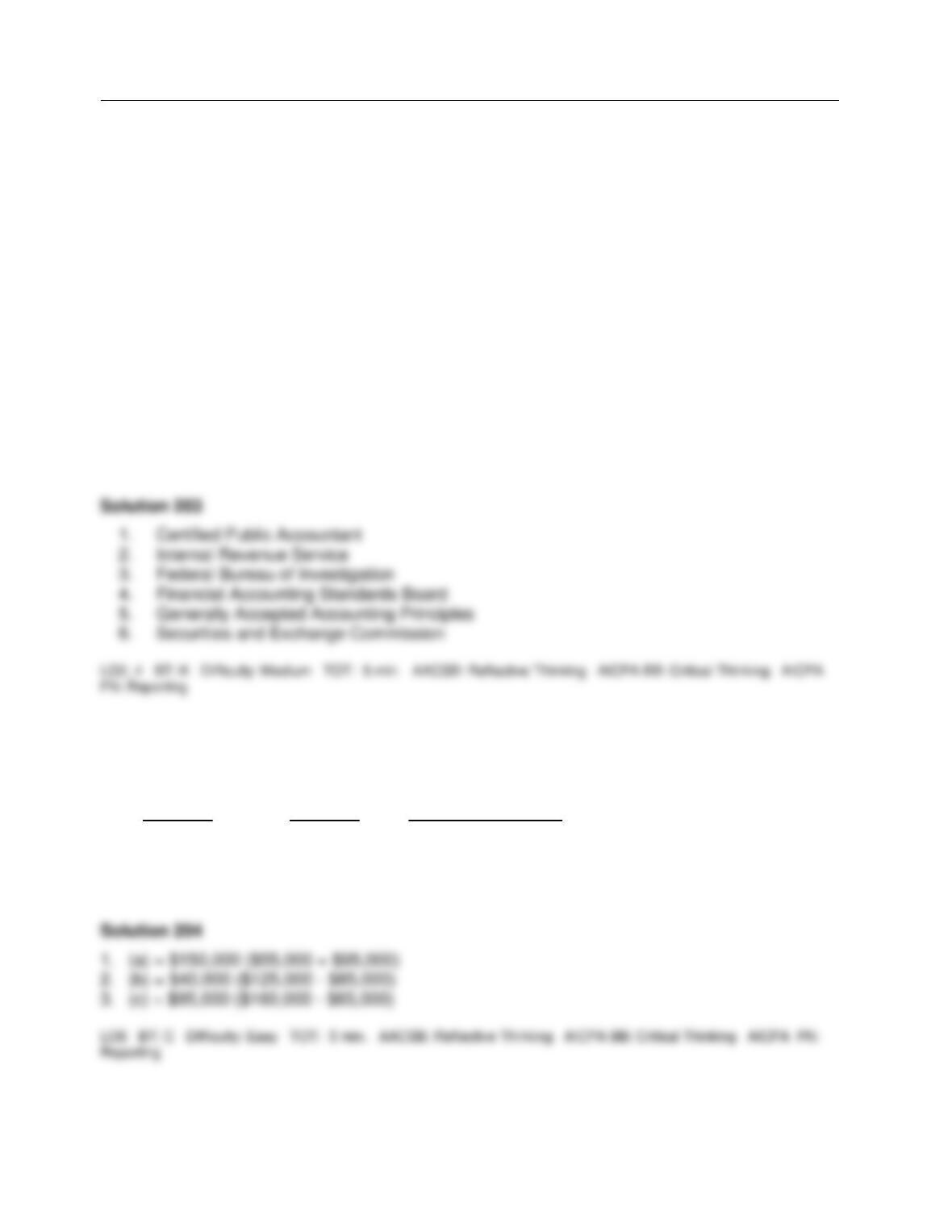
Listed below in alphabetical order are the balance sheet items of Madjack Company at December
31, 2015. Prepare a balance sheet and include a complete heading.
Accounts payable $ 21,000
Accounts receivable 15,000
Buildings 91,000
Cash 6,000
Common stock 108,000
Equipment 17,000
Test Bank for Financial Accounting, Ninth Edition
FOR INSTRUCTOR USE ONLY
1 – 40
EXERCISES
Ex. 203
Below is a list of important abbreviations widely used in business. For each abbreviation give the
full designation.
1. CPA _____________________________________________
2. IRS _____________________________________________
3. FBI _____________________________________________
4. FASB _____________________________________________
5. GAAP _____________________________________________
6. SEC _____________________________________________
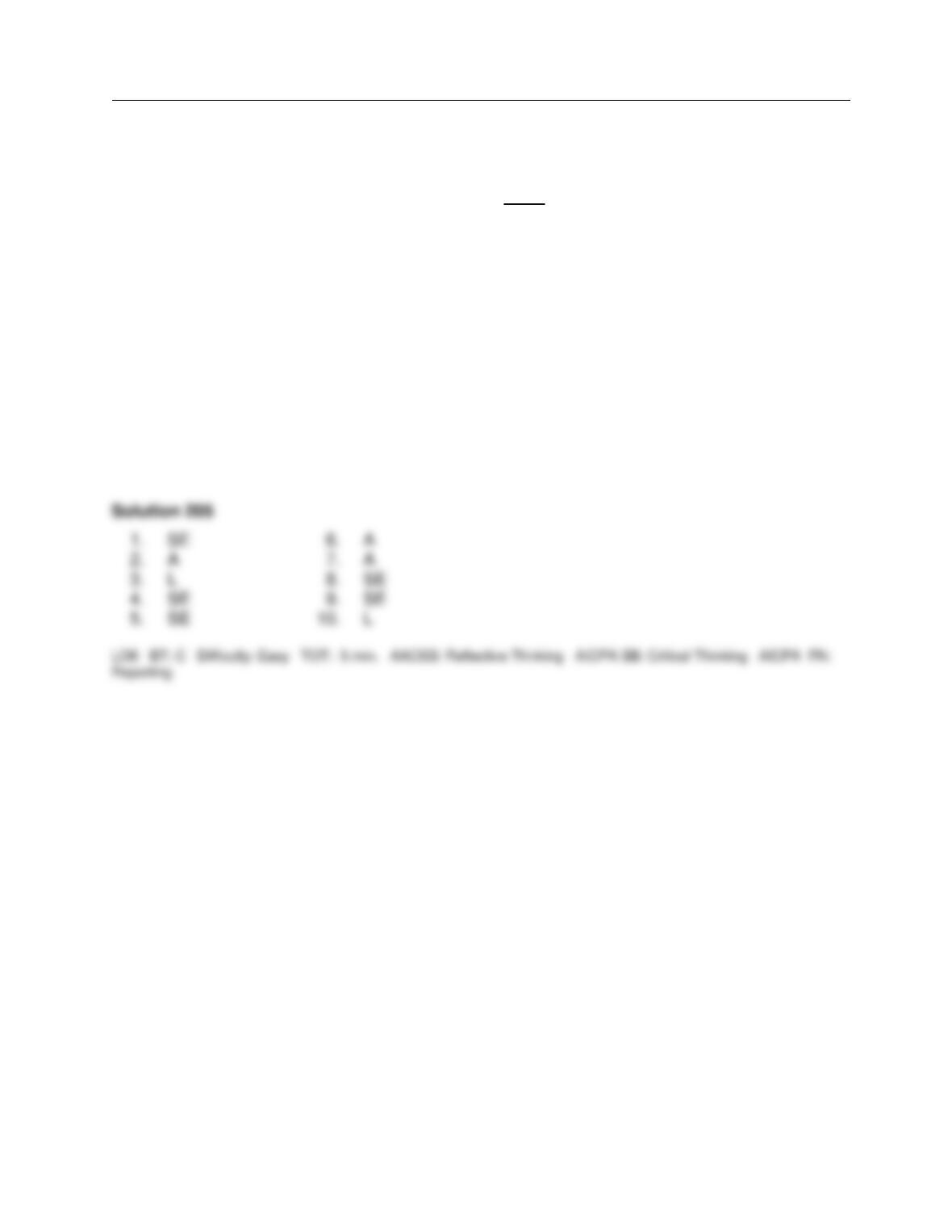
Ex. 204
Determine the missing amount for each of the following.
Assets = Liabilities + Stockholders’ Equity
1. (a) $55,000 $95,000
2. $125,000 (b) $85,000
3. $160,000 $65,000 (c)
Accounting in Action
FOR INSTRUCTOR USE ONLY
1 – 41
Ex. 205
For the items listed below, fill in the appropriate code letter to indicate whether the item is an
asset, liability, or stockholders’ equity item.
Code
Asset A
Liability L
Stockholders’ Equity SE
_____ 1. Rent Expense ____ 6. Cash
_____ 2. Equipment ____ 7. Accounts Receivable
_____ 3. Accounts Payable ____ 8. Dividends
_____ 4. Common Stock ____ 9. Service Revenue
_____ 5. Insurance Expense ____ 10. Notes Payable
Ex. 206
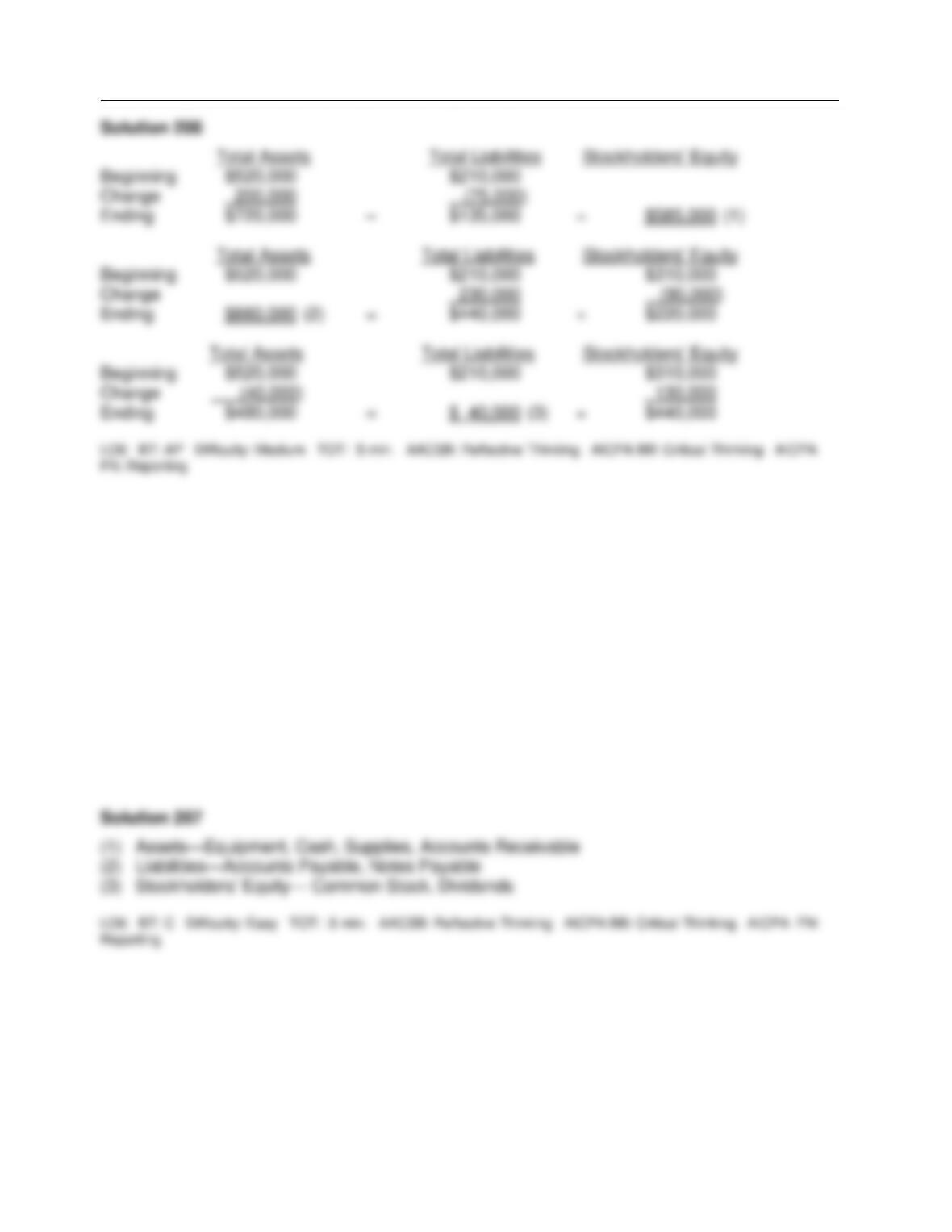
At the beginning of the year, Shaolin Company had total assets of $520,000 and total liabilities of
$210,000. Answer the following questions viewing each situation as being independent of the
others.
(1) If total assets increased $200,000 during the year, and total liabilities decreased $75,000,
what is the amount of stockholders’ equity at the end of the year?
(2) During the year, total liabilities increased $230,000 and stockholders’ equity decreased
$90,000. What is the amount of total assets at the end of the year?
(3) If total assets decreased $40,000 and stockholders’ equity increased $130,000 during the
year, what is the amount of total liabilities at the end of the year?
Test Bank for Financial Accounting, Ninth Edition
FOR INSTRUCTOR USE ONLY
1 – 42
Ex. 207
Magnolia Electric Car Cleaning has the following accounts:
Equipment Notes Payable
Accounts Payable Common Stock
Cash Dividends
Supplies
Accounts Receivable
Identify which items are (1) Assets
(2) Liabilities
(3) Stockholders Equity
Ex. 208
On June 1, 2015, Secretly Canadian Company prepared a balance sheet that shows the
following:
Assets (no cash) …………………………………………………….. $100,000
Liabilities ……………………………………………………………….. 45,000
Stockholders’ Equity ……………………………………………….. 55,000
Accounting in Action
FOR INSTRUCTOR USE ONLY
1 – 43
Ex. 208 (cont.)
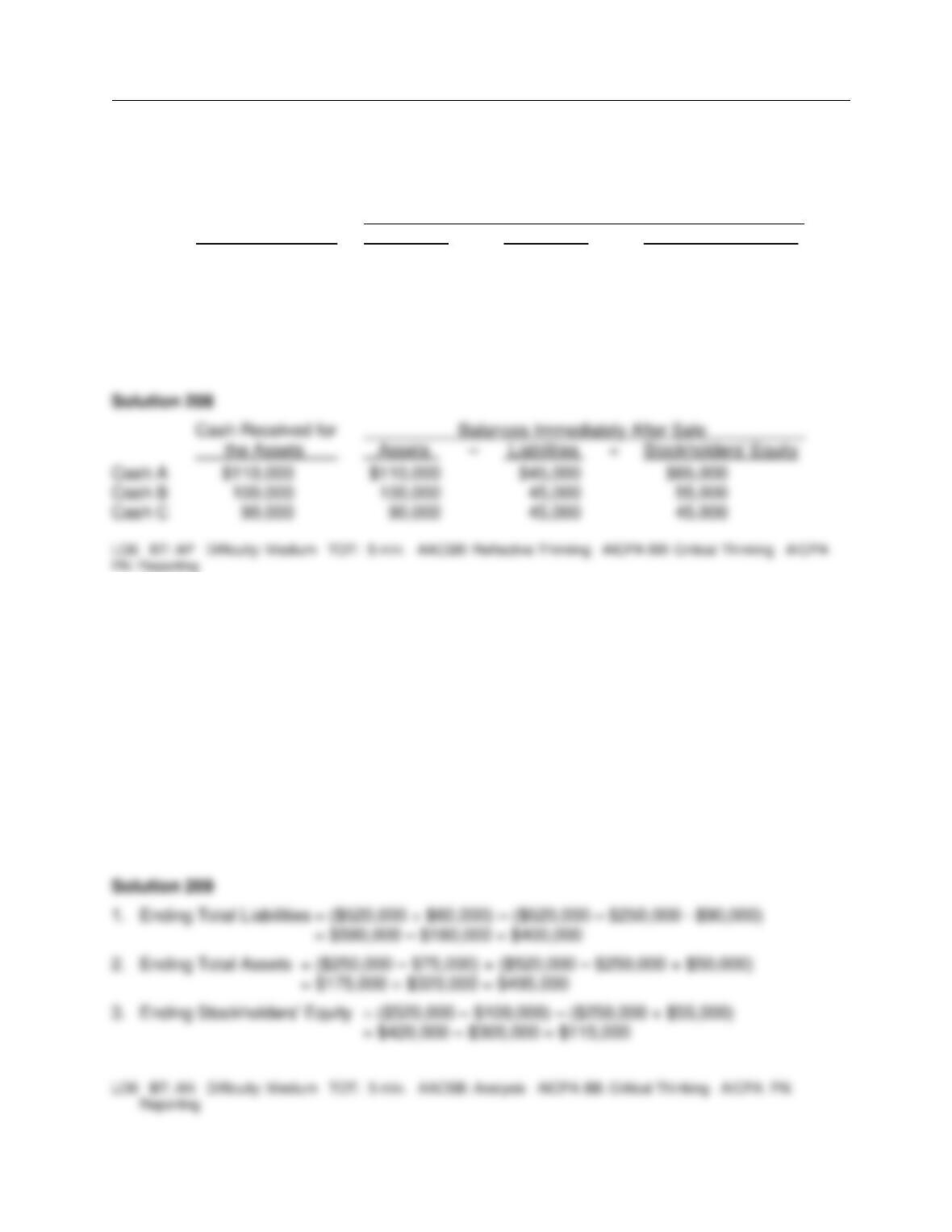
Shortly thereafter, all of the assets were sold for cash. How would the balance sheet appear
immediately after the sale of the assets for cash for each of the following cases?
Cash Received for Balances Immediately After Sale
the Assets Assets – Liabilities = Stockholders’ Equity
Cash A $110,000 $________ $________ $________
Cash B 100,000 ________ ________ ________
Cash C 90,000 ________ ________ ________
Ex. 209
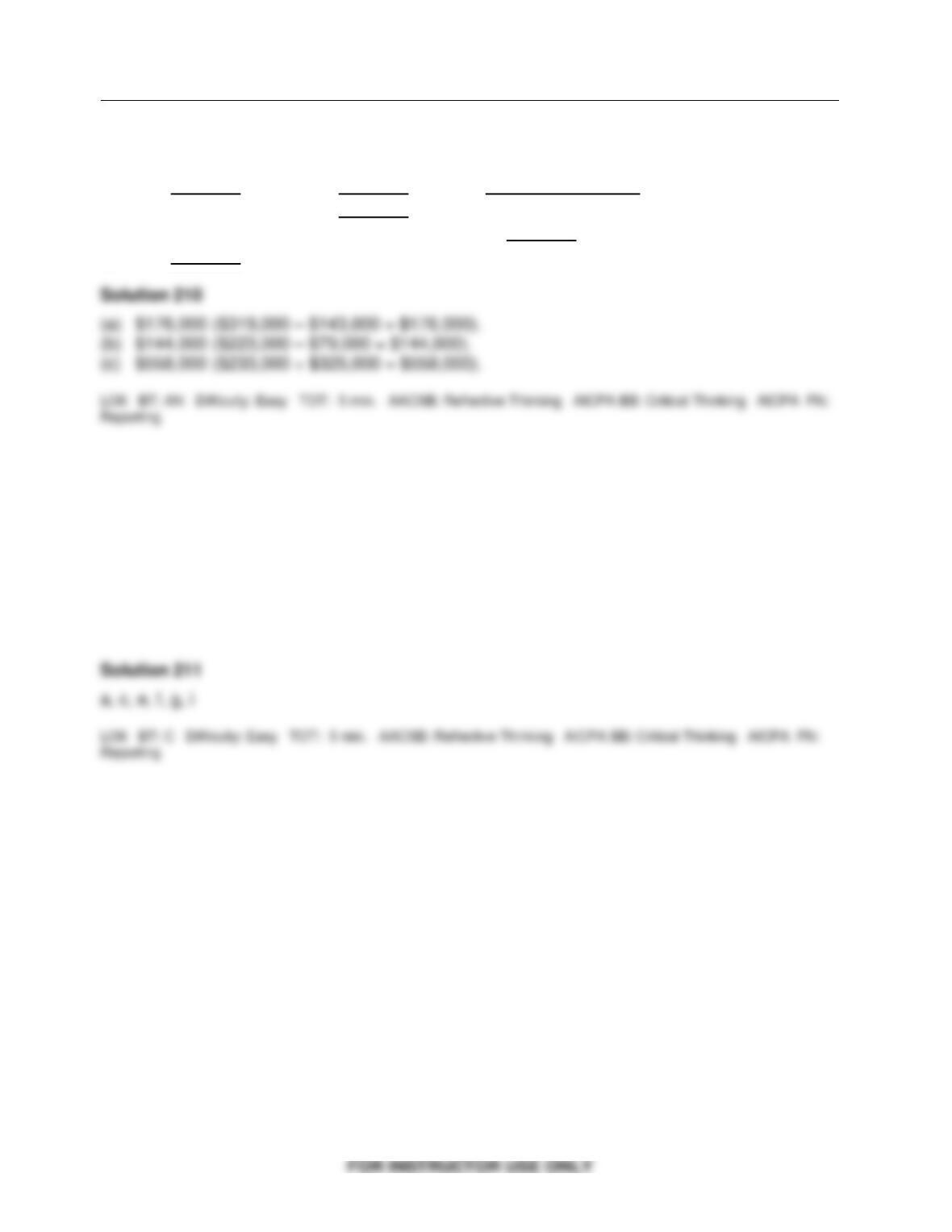
At the beginning of 2015, Hold Steady Company had total assets of $520,000 and total liabilities
of $250,000. Answer each of the following questions.
1. If total assets increased $60,000 and stockholders’ equity decreased $90,000 during the year,
determine the amount of total liabilities at the end of the year.
2. During the year, total liabilities decreased $75,000 and stockholders’ equity increased
$50,000. Compute the amount of total assets at the end of the year.
3. If total assets decreased $100,000 and total liabilities increased $55,000 during the year,
determine the amount of stockholders’ equity at the end of the year.
Test Bank for Financial Accounting, Ninth Edition
1 – 44
Ex. 210
Compute the missing amount in each category of the accounting equation.
Assets Liabilities Stockholders’ Equity
(a) $319,000 $ ? $143,000
(b) $223,000 $ 79,000 $ ?
(c) $ ? $233,000 $325,000
Ex. 211
From the following list of selected accounts taken from the records of Ward Homeopathic Center,
identify those that would appear on the balance sheet.
a. Common Stock f. Accounts Payable
b. Service Revenue g. Cash
c. Land h. Rent Expense
d. Salaries and Wages Expense i. Supplies
e. Notes Payable j. Utilities Expense
Ex. 212
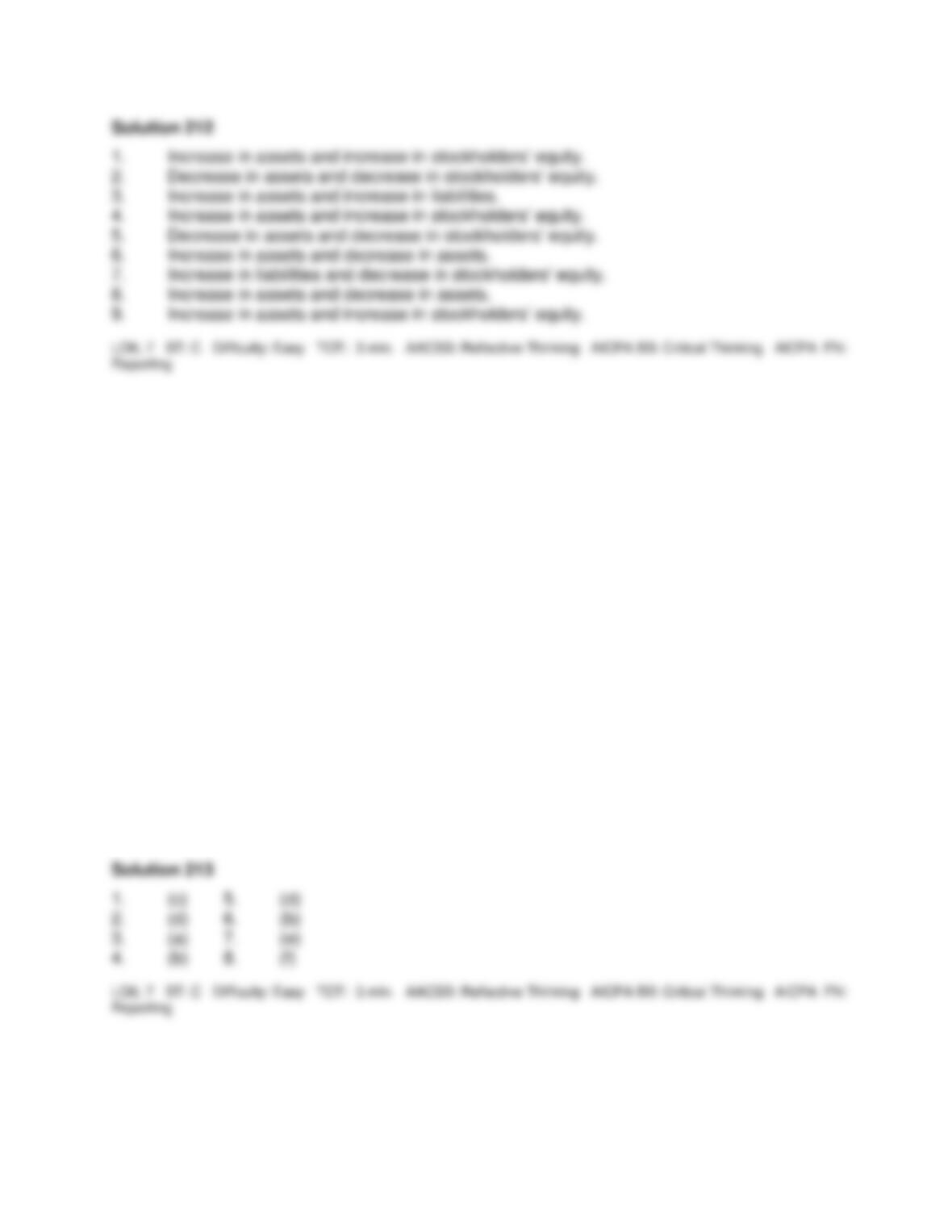
Selected transactions for Mountain Goats Tree Service are listed below.
1. Sold common stock for cash to start business.
2. Paid for monthly advertising.
3. Purchased supplies on account.
4. Billed customers for services performed.
5. Paid cash dividends.
6. Received cash from customers billed in (4).
7. Incurred utilities expense on account.
8. Purchased additional supplies for cash.
9. Received cash from customers when service was performed.
Instructions
List the numbers of the above transactions and describe the effect of each transaction on assets,
liabilities, and stockholders’ equity. For example, the first answer is: (1) Increase in assets and
increase in stockholders’ equity.
Accounting in Action
FOR INSTRUCTOR USE ONLY
1 – 45
Ex. 213
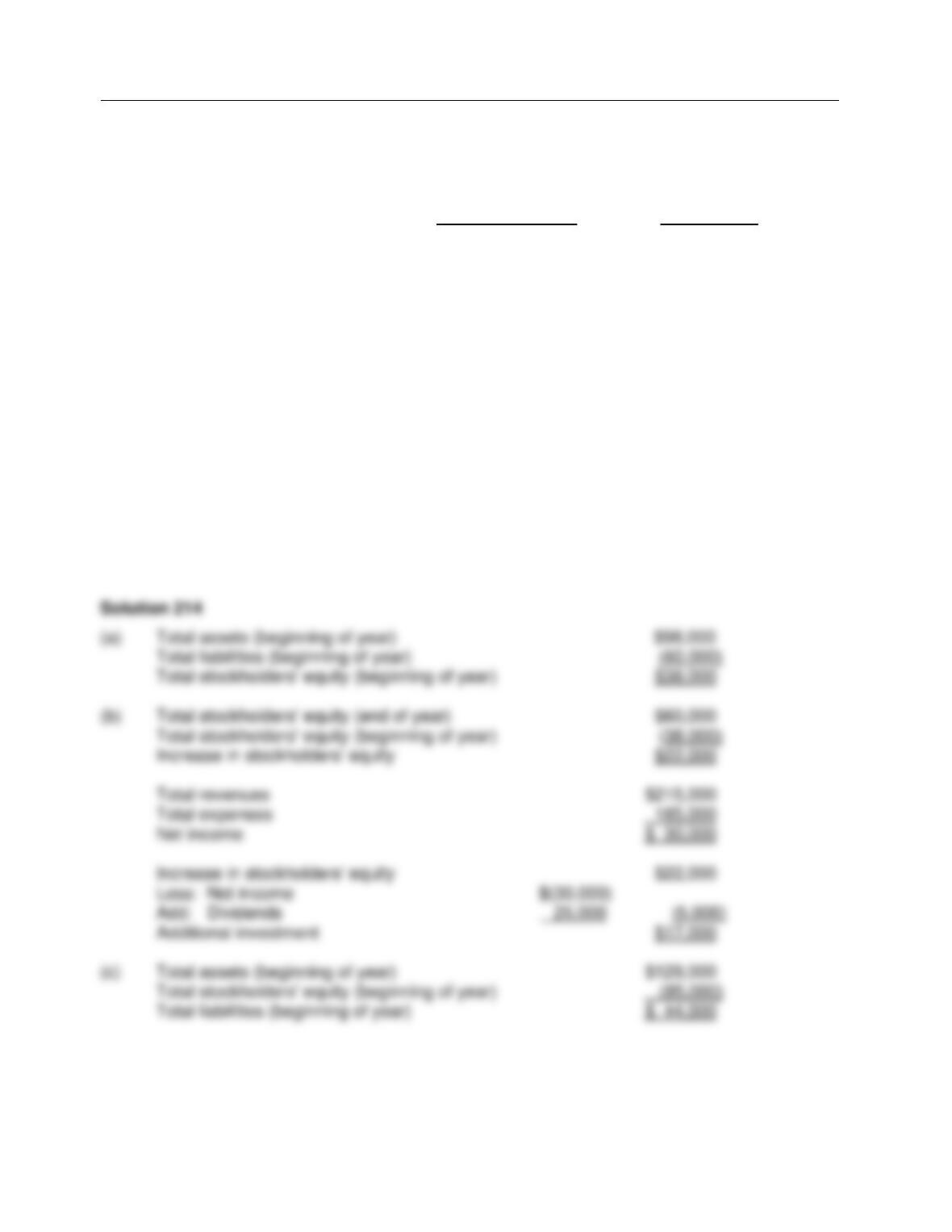
Wilco Legal Eagles Company entered into the following transactions during
March 2015.
1. Purchased office equipment for $23,000 from Business Equipment, Inc. on account.
2. Paid $3,000 cash for March rent on office furniture.
3. Received $15,000 cash from customers for legal work billed in February.
4. Provided legal services to Amy Construction Company for $3,500 cash.
5. Paid Northern States Power Co. $2,700 cash for electric usage in March.
6. Stockholders‘ invested an additional $32,000 in the business.
7. Paid Business Equipment, Inc. for the office equipment purchased in (1) above.
8. Incurred advertising expense for March of $1,900 on account.
Instructions
Indicate with the appropriate letter whether each of the transactions above results in:
(a) an increase in assets and a decrease in assets.
(b) an increase in assets and an increase in stockholders’ equity.
(c) an increase in assets and an increase in liabilities.
(d) a decrease in assets and a decrease in stockholders’ equity.
(e) a decrease in assets and a decrease in liabilities.
(f) an increase in liabilities and a decrease in stockholders’ equity.
(g) an increase in stockholders’ equity and a decrease in liabilities.
Test Bank for Financial Accounting, Ninth Edition
FOR INSTRUCTOR USE ONLY
1 – 46
Ex. 214
Two items are omitted from each of the following summaries of balance sheet and income
statement data for two proprietorships for the year 2015, Holly Enterprises and Cat Stevens.
Holly Enterprises Cat Stevens
Beginning of year:
Total assets $ 98,000 $129,000
Total liabilities 60,000 (c)
Total stockholders‘ equity (a) 85,000
End of year:
Total assets 160,000 180,000
Total liabilities 100,000 50,000
Total stockholders‘ equity 60,000 130,000
Changes during year in stockholders’ equity:
Additional investment (b) 25,000
Dividends 25,000 (d)
Total revenues 215,000 100,000
Total expenses 185,000 65,000
Instructions
Determine the missing amounts.
Accounting in Action
FOR INSTRUCTOR USE ONLY
1 – 47
Ex. 215
An analysis of the transactions made by White Stripes & Co., a law firm, for the month of July is
shown below. Each increase and decrease in stockholders’ equity is explained.
Assets
=
Liab
+
Stockholders’ Equity
Retained Earnings
Cash
+
Accounts
Receivable
+
Supplies
+
Equipment
=
Accounts
Payable
+
Com Stock
+
Rev.
-Exp
-Div.
1.
+$15,000
+$15,000
2.
– 2,000
+$5,000
+$3,000
3.
– 750
+$750
4.
+ 2,500
+$6,600
+$9,100
Rev.
5.
– 1,500
– 1,500
6.
– 2,500
-$2,500
Div.
7.
– 750
–$750
Rent.
8.
+ 550
–550
9.
– 3,500
-$4,500
Sal.
10.
+ 500
+ 500
–500
Util.
Instructions
(a) Determine how much stockholders’ equity increased for the month.
(b) Compute the amount of net income for the month.
Test Bank for Financial Accounting, Ninth Edition
FOR INSTRUCTOR USE ONLY
1 – 48
Ex. 216
The Constantine Company had the following assets and liabilities on the dates indicated.
December 31 Total Assets Total Liabilities
2014 $480,000 $250,000
2015 $460,000 $220,000
2016 $590,000 $300,000
Constantine began business on January 1, 2014, with an investment of $100,000.
Instructions
From an analysis of the change in stockholders’ equity during the year, compute the net income
(or loss) for:
(a) 2014, assuming Constantine’s dividends were $45,000 for the year.
(b) 2015, assuming Constantine made an additional investment of $50,000 and paid no dividends
in 2015.
(c) 2016, assuming Constantine made an additional investment of $15,000 and paid dividends of
$40,000 in 2016.
Accounting in Action
FOR INSTRUCTOR USE ONLY
1 – 49
Ex. 217
For each of the following, indicate whether the transaction affects revenue (R), expense (E),
dividends (D), common stock (CS), or no effect on stockholders’ equity (NOE).
1. Made an investment to start the business.
2. Billed customers for services performed.
3. Purchased equipment on account.
4. Paid monthly rent.
5. Paid dividends.
Ex. 218
Presented below is a balance sheet for Jim Henson Yard Service at December 31, 2015.
JIM HENSON YARD SERVICE
Balance Sheet
December 31, 2015
Assets Liabilities and Stockholders’ Equity
Cash $13,000 Liabilities
Accounts receivable 6,000 Accounts payable $ 8,000
Supplies 9,000 Notes payable 15,000
Equipment 11,000 Stockholders’ equity
Common stock 16,000
Total assets $39,000 Total liabilities & stockholders’ equity $39,000
The following additional data are available for the year which began on January 1: All expenses
(excluding supplies expense) total $6,000. Supplies on January 1, were $11,000 and $7,000 of
supplies were purchased during the year. Net income for the year was $8,000 and dividends paid
were $9,000.
Instructions
Determine the following: (Show all computations.)
1. Supplies used during the year.
2. Total expenses for the year.
3. Service revenues for the year.
4. Stockholders’ equity on January 1.
Test Bank for Financial Accounting, Ninth Edition
FOR INSTRUCTOR USE ONLY
1 – 50
Ex. 219
Analyze the transactions of a business organized as a corporation described below and indicate
their effect on the basic accounting equation. Use a plus sign (+) to indicate an increase and a
minus sign (–) to indicate a decrease.
Assets = Liabilities + Stockholders’ Equity
1. Received cash for services provided. ______ ______ _______
2. Purchased office equipment on credit. ______ ______ _______
3. Paid employees’ salaries. ______ ______ _______
4. Received cash from customer in payment
on account. ______ ______ _______
5. Paid telephone bill for the month. ______ ______ _______
6. Paid for office equipment purchased in
transaction 2. ______ ______ _______
7. Purchased office supplies on credit. ______ ______ _______
8. Paid dividends. ______ ______ _______
9. Obtained a loan from the bank. ______ ______ _______
10. Billed customers for services rendered. ______ ______ _______
Accounting in Action
FOR INSTRUCTOR USE ONLY
1 – 51
Ex. 220
For each of the following, indicate whether the transaction increased (+), decreased (-), or had no
effect (NE) on assets, liabilities, and stockholders’ equity using the following format.
Assets = Liabilities + Stockholders’ Equity
1. Issued stock in exchange for cash.
2. Billed customers for services performed.
3. Purchased equipment on account.
4. Paid dividends.
5. Paid for equipment purchased in 3. above.

Test Bank for Financial Accounting, Ninth Edition
FOR INSTRUCTOR USE ONLY
1 – 52
Ex. 221
Neko Case decides to open a cleaning and laundry service near the local college campus that will
operate as a corporation. Analyze the following transactions for the month of June in terms of
their effect on the basic accounting equation. Record each transaction by increasing (+) or
decreasing (–) the dollar amount of each item affected. Indicate the new balance of each item
after a transaction is recorded. It is not necessary to identify the cause of changes in
stockholders’ equity.
Transactions
(1) Issued stock in exchange for $20,000 cash on June 1.
(2) Purchased equipment for $5,000 paying $3,000 in cash and the remainder due in 30
days.
(3) Purchased supplies for $1,200 cash.
(4) Received a bill from College News for $300 for advertising in the campus newspaper.
(5) Cash receipts from customers for cleaning and laundry amounted to $2,400.
(6) Paid salaries of $600 to student workers.
(7) Billed the Lion Soccer Team $450 for cleaning and laundry services.
(8) Paid $300 to College News for advertising that was previously billed in Transaction 4.
(9) Paid dividends of $1,200.
(10) Incurred utility expenses for month on account, $500.
Trans- Accounts Accounts Common Retained
action Cash + Receivable + Supplies + Equipment = Payable + Stock + Earnings
(1)
——————————————————————————————————————————
Balance
(2)
——————————————————————————————————————————
Balance
(3)
——————————————————————————————————————————
Balance
(4)
——————————————————————————————————————————
Balance
(5)
——————————————————————————————————————————
Balance
(6)
——————————————————————————————————————————
Balance
(7)
——————————————————————————————————————————
Balance
(8)
——————————————————————————————————————————
Accounting in Action
FOR INSTRUCTOR USE ONLY
1 – 53
Ex. 221 (cont.)
Balance
(9)
——————————————————————————————————————————
Balance
(10)
——————————————————————————————————————————
Totals
Test Bank for Financial Accounting, Ninth Edition
FOR INSTRUCTOR USE ONLY
1 – 54
Ex. 222
For each of the following, describe a transaction that will have the stated effect on the elements of
the accounting equation.
(a) Increase one asset and decrease another asset.
(b) Increase an asset and increase a liability.
(c) Decrease an asset and decrease a liability.
(d) Increase an asset and increase stockholders’ equity.
(e) Increase one asset, decrease one asset, and increase a liability.
Ex. 223
The following transactions represent part of the activities of Bloc Party Company for the first
month of its existence. Indicate the effect of each transaction upon the total assets of the
business by one of the following phrases: increased total assets, decreased total assets, or no
change in total assets.
(a) Issued stock in exchange for cash.
(b) Purchased a computer for cash.
(c) Purchased office equipment with money borrowed from the bank.
(d) Paid the first month‘s utility bill.
(e) Collected an accounts receivable.
(f) Paid dividends.
Accounting in Action
FOR INSTRUCTOR USE ONLY
1 – 55
Ex. 224
Selected transactions for Parton Company are listed below. List the number of the transaction
and then describe the effect of each transaction on assets, liabilities, and stockholders’ equity.
Sample: Issued common stock in exchange for cash investment.
The answer would be—Increase in assets and increase in stockholders’ equity.
1. Paid monthly utility bill.
2. Purchased new display case for cash.
3. Paid cash for repair work on security system.
4. Billed customers for services performed.
5. Received cash from customers billed in 4.
6. Paid dividends.
7. Incurred advertising expenses on account.
8. Paid monthly rent.
9. Received cash from customers when service was rendered.
Ex. 225
A service company shows five transactions summarized below. The effect of each transaction on
the accounting equation is shown, and also the new balance of each item in the equation. For
each transaction (a) to (e) write an explanation of the nature of the transaction.
Accounts Equip- Accounts Stockholders’
Cash + Rec. + ment + Land + Building = Payable + Equity
——————————————————————————————————————————
$5,000 $6,500 $10,000 $7,500 $50,000 $3,000 $76,000
a) –2,000 –2,000
3,000 6,500 10,000 7,500 50,000 1,000 76,000
b) +1,000 – 1,000
4,000 5,500 10,000 7,500 50,000 1,000 76,000
Test Bank for Financial Accounting, Ninth Edition
FOR INSTRUCTOR USE ONLY
1 – 56
Ex. 225 (cont.)
c) + 5,000 +5,000
4,000 5,500 15,000 7,500 50,000 6,000 76,000
d) +2,500 + 2,500
6,500 5,500 15,000 7,500 50,000 6,000 78,500
e) +3,000 + 3,000
$6,500 $8,500 $15,000 $7,500 $50,000 $6,000 $81,500
Ex. 226
There are ten transactions listed below. Match the transactions that have the identical effect on
the accounting equation. You should end up with 5 matches.
a. Receive cash from customers on account.
b. Issued stock in exchange for cash.
c. Pay cash to reduce an accounts payable.
d. Purchase supplies for cash.
e. Pay cash to reduce a notes payable.
f. Purchase supplies on account.
g. Additional investment by a stockholder.
h. Purchase equipment with a note payable.
i. Pay utilities with cash.
j. Pay dividends.
Accounting in Action
FOR INSTRUCTOR USE ONLY
1 – 57
Ex. 227
An analysis of the transactions made by Cookie Mountain Legal, a law firm, for the month of July
is shown below. Each increase and decrease in stockholders‘ equity is explained.
Assets
=
Liab
+
Stockholders’ Equity
Retained Earnings
Cash
+
Accounts
Receivable
+
Supplies
+
Equipment
=
Accounts
Payable
+
Com Stock
+
Rev.
-Exp
-Div.
1.
+$15,000
+$15,000
2.
– 2,000
+$5,000
+$3,000
3.
– 750
+$750
4.
+ 2,500
+$6,600
+$9,100
Rev.
5.
– 1,500
– 1,500
6.
– 2,500
-$2,500
Div.
7.
– 750
–$750
Rent.
8.
+ 550
–550
9.
– 4,500
-$4,500
Sal.
10.
+ 500
–500
Util.
Instructions
(a) Prepare an income statement for the month ending July 31, 2015.
(b) Prepare a retained earnings statement for the month ending July 31, 2015.
Test Bank for Financial Accounting, Ninth Edition
FOR INSTRUCTOR USE ONLY
1 – 58
Ex. 228
An analysis of the transactions made by Cookie Mountain Legal, a law firm, for the month of July
is shown below. Each increase and decrease in retained earnings is explained.
Assets
=
Liab
+
Stockholders’ Equity
Retained Earnings
Cash
+
Accounts
Receivable
+
Supplies
+
Equipment
=
Accounts
Payable
+
Com Stock
+
Rev.
-Exp
-Div.
1.
+$15,000
+$15,000
2.
– 2,000
+$5,000
+$3,000
3.
– 750
+$750
4.
+ 2,500
+$6,600
+$9,100
Rev.
5.
– 1,500
– 1,500
6.
– 2,500
-$2,500
Div.
7.
– 750
–$750
Rent.
8.
+ 550
–550
9.
– 4,500
-$4,500
Sal.
10.
+ 500
–500
Util.
Instructions
Prepare a balance sheet at July 31, 2015.
Accounting in Action
FOR INSTRUCTOR USE ONLY
1 – 59
Ex. 229
The following information relates to Bonnie Billy Co. for the year 2015.
Retained earnings, January 1, 2015 $ 67,000 Advertising expense $6,500
Dividends 6,000 Rent expense 9,500
Service revenue 65,500 Utilities expense 1,400
Salaries and wages expense 29,000
Instructions
After analyzing the data, prepare an income statement and a retained earnings statement for the
year ending December 31, 2015
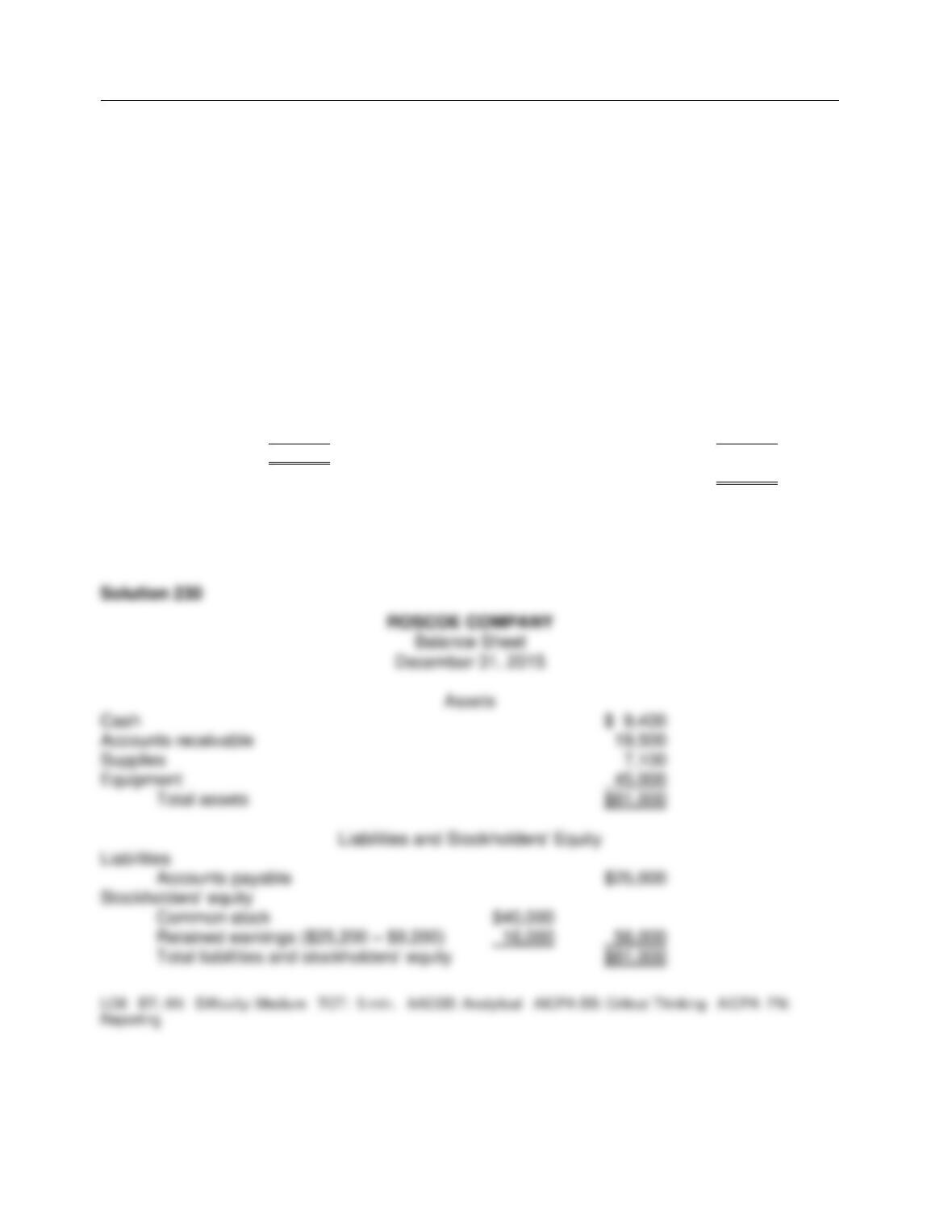
Test Bank for Financial Accounting, Ninth Edition
FOR INSTRUCTOR USE ONLY
1 – 60
Ex. 230
Van Occupanther is the bookkeeper for Roscoe Company. Van has been trying to get the
balance sheet of Roscoe Company to balance. Roscoe’s balance sheet is as follows.
ROSCOE COMPANY
Balance Sheet
December 31, 2015
Assets Liabilities
Cash $9,400 Accounts payable $25,000
Supplies 7,100 Accounts receivable (19,500)
Equipment 45,000 Common stock 40,000
Dividends 9,200 Retained earnings 25,200
Total assets $70,700 Total liabilities and
stockholders’ equity $70,700
Instructions
Prepare a correct balance sheet.
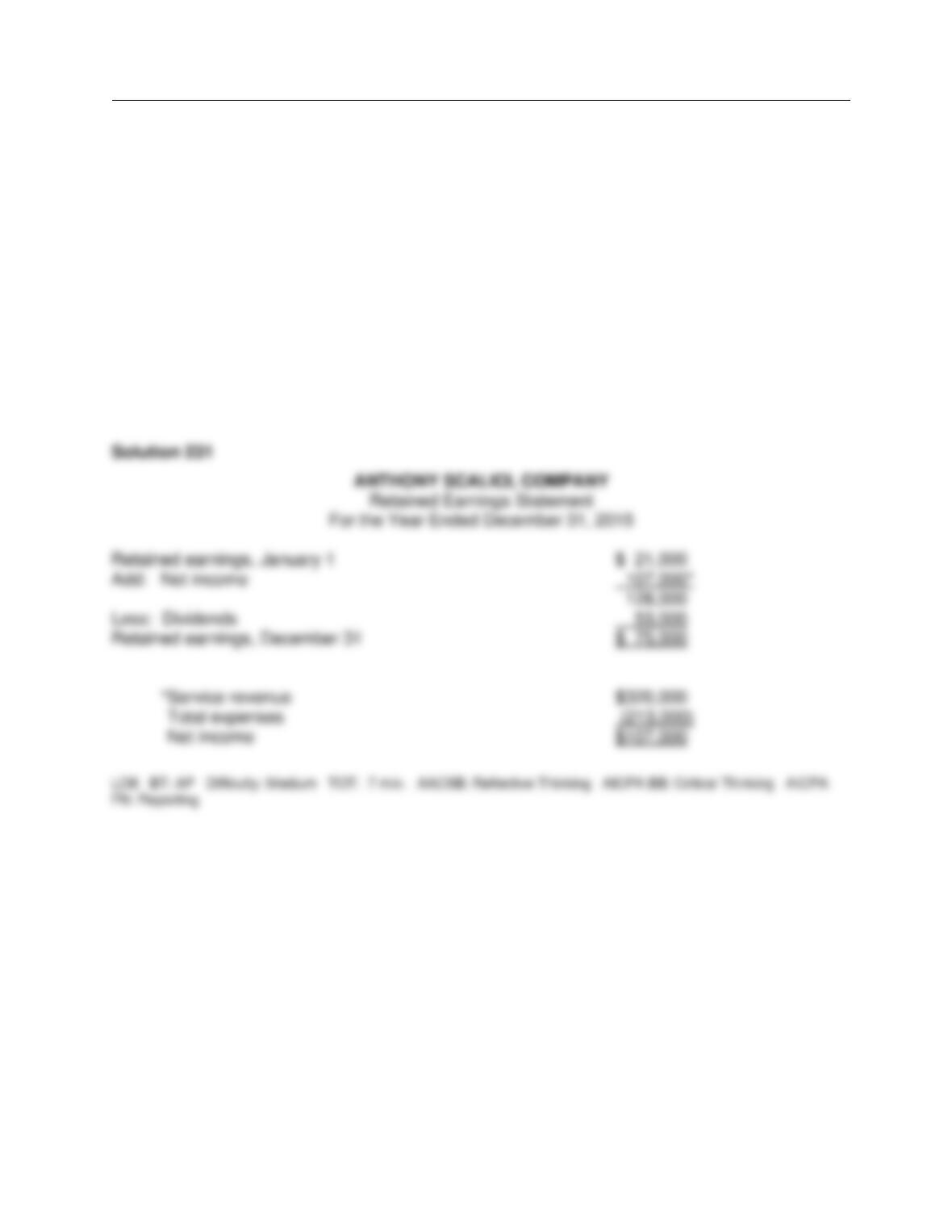
Accounting in Action
FOR INSTRUCTOR USE ONLY
1 – 61
Ex. 231
Presented below is information related to Anthony Scalici Company.
Retained earnings, January 1, 2015 $ 21,000
Service revenue—2015 320,000
Total expenses—2015 213,000
Assets, January 1, 2015 85,000
Liabilities, January 1, 2015 64,000
Assets, December 31, 2015 165,000
Liabilities, December 31, 2015 90,000
Dividends—2015 ?
Instructions
Prepare the 2015 retained earnings statement for Anthony Scalici Company.

Test Bank for Financial Accounting, Ninth Edition
FOR INSTRUCTOR USE ONLY
1 – 62
Ex. 232
Prepare an income statement, a retained earnings statement, and a balance sheet for the
accupuncture practice of Golda Bear, from the items listed below for the month of September,
2015.
Retained earnings, September 1 $17,000
Common stock 30,000
Accounts payable 7,000
Equipment 35,000
Service revenue 28,000
Dividends 6,000
Supplies expense 4,500
Cash 3,000
Utilities expense 700
Supplies 4,800
Salaries and wages expense 9,000
Accounts receivable 14,000
Rent expense 5,000
GOLDA BEAR, ACCUPUNCTURIST
Income Statement
For the Month Ended September 30, 2015
——————————————————————————————————————————
Revenues $
Expenses $ $
Total expenses $
Net income $
GOLDA BEAR, ACCUPUNCTURIST
Retained Earnings Statement
For the Month Ended September 30, 2015
——————————————————————————————————————————
Retained Earnings, September 1 $
Add:
$
Less:
$
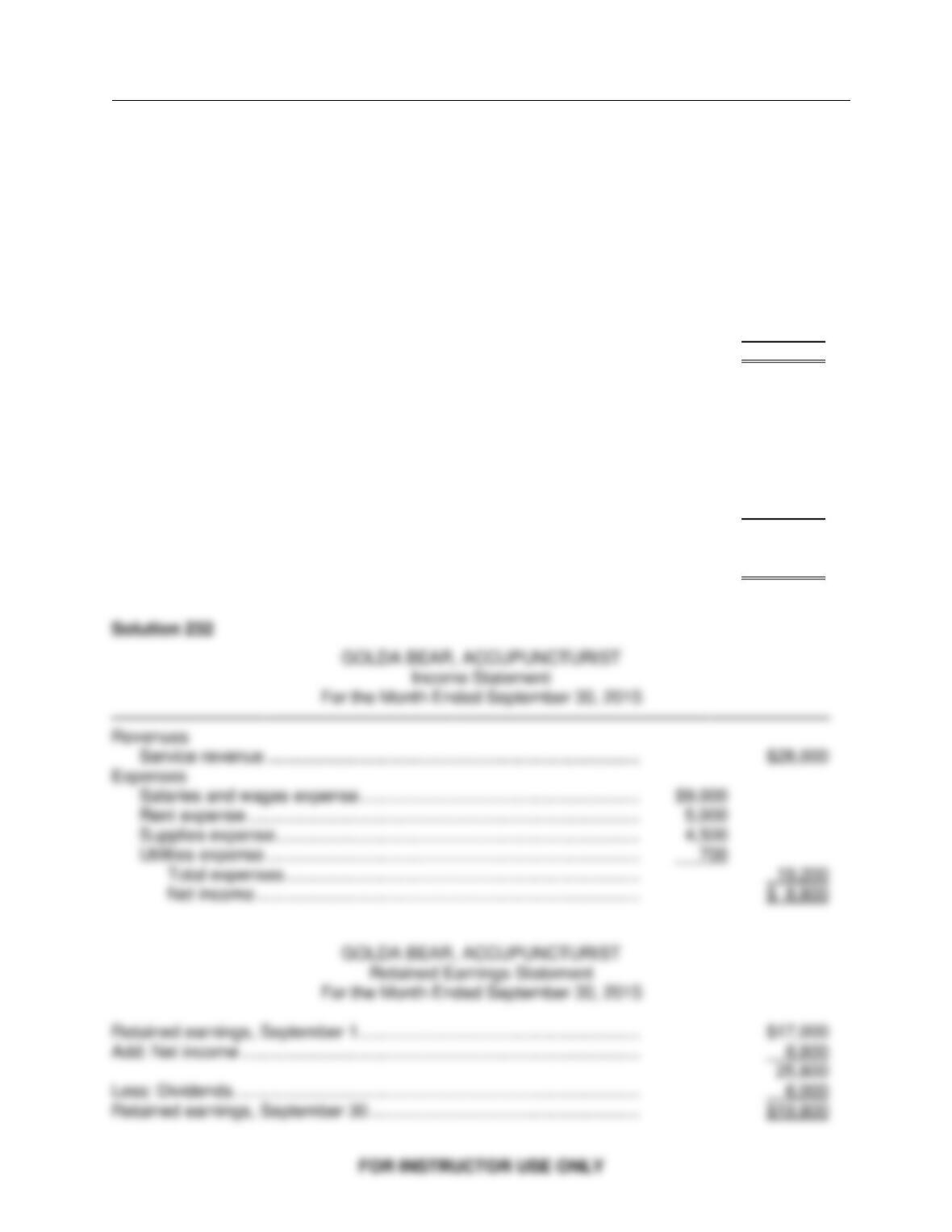
Accounting in Action
1 – 63
Ex. 232 (cont.)
GOLDA BEAR, ACCUPUNCTURIST
Balance Sheet
September 30, 2015
——————————————————————————————————————————
Assets
$
Total assets
$
Liabilities and Stockholder’ Equity
Liabilities
$
Stockholders’ Equity $
Total liabilities and stockholders’ equity $
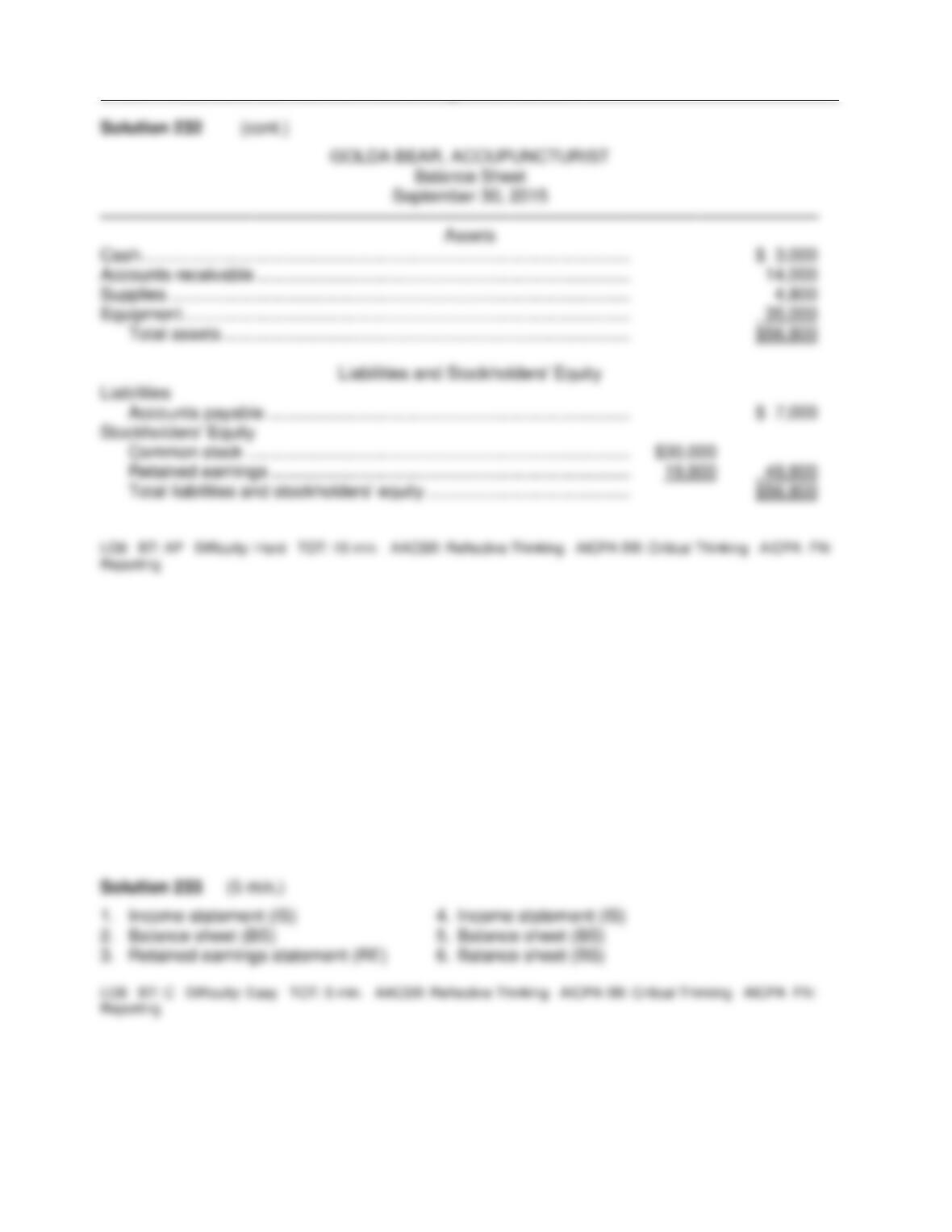
Test Bank for Financial Accounting, Ninth Edition
FOR INSTRUCTOR USE ONLY
1 – 64
Ex. 233
Indicate whether the following items would appear on the balance sheet (BS), income statement
(IS), or retained earnings statement (RE).
1. Advertising expense
2. Accounts receivable
3. Dividends
4. Rent revenue
5. Salaries and wages payable
6. Supplies
Accounting in Action
FOR INSTRUCTOR USE ONLY
1 – 65
Ex. 234
Listed below in alphabetical order are the balance sheet items of Rock Plaza Company at
December 31, 2015. Prepare a balance sheet and include a complete heading.
Accounts Payable $ 24,000
Accounts Receivable 15,000
Buildings 51,000
Cash 7,000
Common Stock 102,000
Land 42,000
Equipment 11,000
Test Bank for Financial Accounting, Ninth Edition
FOR INSTRUCTOR USE ONLY
1 – 66
Ex. 235
One item is omitted in each of the following summaries of balance sheet and income statement
data for three different sole corporations, X, Y, and Z. Determine the amounts of the missing
items, identifying each corporation by letter.
Corporation
X Y Z
Beginning of the Year:
Assets $390,000 $150,000 $219,000
Liabilities 250,000 105,000 168,000
End of the Year:
Assets 450,000 175,000 195,000
Liabilities 280,000 95,000 169,000
During the Year:
Issued additional shares of stock ? 79,000 80,000
Dividends 90,000 83,000 ?
Revenue 195,000 ? 187,000
Expenses 170,000 113,000 175,000
Accounting in Action
FOR INSTRUCTOR USE ONLY
1 – 67
Ex. 236
Indicate in the space provided by each item whether it would appear on the Income Statement
(IS), Balance Sheet (BS), or Retained Earnings Statement (RE):
a. ____ Service Revenue g. ____ Accounts Receivable
b. ____ Utilities Expense h. ____ Retained Earnings (ending)
c. ____ Cash i. ____ Equipment
d. ____ Accounts Payable j. ____ Advertising Expense
e. ____ Office Supplies k. ____ Dividends
f. ____ Salaries Expense l. ____ Notes Payable
Ex. 237
Maria Queen was reviewing her business activities at the end of the year (2015) and decided to
prepare a Retained Earnings Statement. At the beginning of the year her assets were $700,000
and her liabilities were $210,000. At the end of the year the assets had grown to $930,000 but
liabilities had also increased to $340,000. Common Stock was $200,000 in both years. The net
income for the year was $220,000. The company paid dividends of $120,000 during the year.
Prepare a Retained Earnings statement in good form.
Test Bank for Financial Accounting, Ninth Edition
FOR INSTRUCTOR USE ONLY
1 – 68
Ex. 238
At September 1, the balance sheet accounts for Stanley’s Restaurant were as follows:
Accounts Payable $ 3,800 Land $33,000
Accounts Receivable 9,600 Common Stock ?
Buildings 68,000 Notes Payable 48,000
Cash 10,000 Supplies 6,600
Equipment 18,700
The following transactions occurred during the next two days:
The company issued additional shares of stock for $22,000 cash in the business. The accounts
payable were paid in full. (No payment was made on the notes payable.)
Instructions
Prepare a balance sheet at September 1, 2015.
Accounting in Action
FOR INSTRUCTOR USE ONLY
1 – 69
Ex. 239
Presented below are balance sheet items for Black Angel Company at December 31, 2015.
Accounts payable $35,000
Accounts receivable 36,000
Cash 17,000
Equipment 77,000
Common stock 45,000
Notes payable 50,000
Compute each of the following:
1. Total assets.
2. Total liabilities.
Test Bank for Financial Accounting, Ninth Edition
FOR INSTRUCTOR USE ONLY
1 – 70
COMPLETION STATEMENTS
240. Accounting is an information system that identifies, _____________, and _____________
the economic events of an organization.
241. The mere recording of economic events is called ______________, and is just one part of
the _______________ process.
242. The three major services rendered by a certified public accountant are ______________,
________________, and management ________________.
243. Accountants who are employees of business enterprises are referred to as
________________ accountants.
244. A common set of standards that provides guidelines to accountants and indicates how to
report economic events is called _________________.
245. The ________________ principle states that assets should be recorded at the value
exchanged at the time the asset is acquired.
246. The _________________ assumption requires that the activities of an entity be kept
separate from the activities of its owner.
247. The residual claim on total assets of a business is known as ________________ and is
equal to total assets minus total liabilities.
248. Dividends ________________ stockholders’ equity but are not expenses.
249. The ________________ reports the assets, liabilities, and stockholders’ equity of a
business enterprise at a specific date.
Accounting in Action
FOR INSTRUCTOR USE ONLY
1 – 71
MATCHING
250. Match the items below by entering the appropriate code letter in the space provided.
A. CPA F. Corporation
B. Budgeting G. Assets
C. SEC H. Equities
D. Proprietorship I. Expenses
E. Economic Entity Assumption J. Transaction
____ 1. Activities of an entity must be kept separate from its owner’s activities.
____ 2. Consumed assets or services.
____ 3. Ownership is limited to one person.
____ 4. Offers expert accounting service to the general public.
____ 5. Creditor and ownership claims against the assets of the business.
____ 6. A separate legal entity under state laws.
____ 7. Government agency that can mandate accounting rules.
____ 8. Quantifying goals and objectives.
____ 9. Future economic benefits.
____ 10. Economic events recorded by accountants.
Answers to Matching
Test Bank for Financial Accounting, Ninth Edition
FOR INSTRUCTOR USE ONLY
1 – 72
SHORT-ANSWER ESSAY QUESTIONS
*S-A E 251
The accounting profession provides many career opportunities for individuals. Identify the major
fields that exist in accounting and comment on the major functions performed by individuals in
each of these areas.
S-A E 252
The framework used to record and summarize the economic activities of a business enterprise is
referred to as the accounting equation. State the basic accounting equation and define its major
components. How are business transactions and financial statements related to the accounting
equation?
Accounting in Action
FOR INSTRUCTOR USE ONLY
1 – 73
S-A E 253
Your friend, Angela, made this comment:
My major is biology and I plan to research for cures for major illnesses. Thus, I have
no need to study accounting.
What is your response to Angela?
S-A E 254
The information needs of a specific user of financial accounting information depends upon the
kinds of decisions that user makes. Identify the major users of accounting information and
discuss what questions financial accounting information answers for each group of users.
Test Bank for Financial Accounting, Ninth Edition
FOR INSTRUCTOR USE ONLY
1 – 74
S-A E 255 (Ethics)
Joanna Newsom owns and operates Joanna’s Burgers, a small fast food store, located at the
edge of City College campus in Newton, Ohio. After several very profitable years, Joanna’s
Burgers began to have problems. Most of the problems were related to Joanna’s expansion of the
eating area in the restaurant without corresponding increases in the food preparation area.
Joanna does not have the cash or financial backing to expand further. She has therefore decided
to sell her business.
Vivian Girls is interested in purchasing the business. However, she is located in another city and
is unfamiliar with Newton. She has asked Joanna why she is selling Joanna’s Burgers. Joanna
replies that her elderly mother requires extra care, and that her brother needs help in his
manufacturing business. Both are true, but neither is her primary reason for selling. Joanna
reasons that Vivian should not have asked her anyway, since profitable businesses don’t come
up for sale.
Required:
1. Identify the stakeholders in this situation.
2. Did Joanna act ethically in not revealing fully her reasons for selling the business? Why or
why not?
S-A E 256 (Communication)
Rachel Bells Havens is a friend of yours from high school. She decided to become a beautician
after leaving high school, rather than to attend college. She recently opened her own shop, and
has contracted her services to a local hospital. She is paid a monthly fee for her services, and
receives a small gratuity from each of the patients.
Accounting in Action
FOR INSTRUCTOR USE ONLY
1 – 75
She has just received her first set of financial statements from her accountant. She is quite upset.
The statements show a cash balance of $3,600 at the end of the month, but a net income of only
$500. She has written you a letter, asking you whether such a situation is possible, or whether
she should find another accountant.
Required:
Write a short letter to your friend. Use proper form. Answer her question completely, but briefly.
Test Bank for Financial Accounting, Ninth Edition
FOR INSTRUCTOR USE ONLY
1 – 76
CHALLENGE EXERCISES
CE 1
The total assets and liabilities of Company at January 1 and December 31, 2015 are presented
below.
January 1 December 31
Assets $95,000 $140,000
Liabilities 30,000 36,000
Instructions:
1. Assume dividends of $10,800 were paid and no additional stock was issued during the year.
Revenues were $110,000. Compute (a) net income, and (b) expenses.
2. Assume additional stock was issued for $4,800 and no dividends were paid during the year.
Expenses were $42,000. Compute (a) net income, and (b) revenues.
3. Assume additional stock was issued for $62,000 and dividends of $15,600 were paid during
the year. Compute net income.
4. Assume additional stock was issued for $6,000 and net income was $51,000. Compute
dividends paid.
Accounting in Action
FOR INSTRUCTOR USE ONLY
1 – 77
CE 2
Windsor Service had the following financial information at the end of 2015.
1/1/15
2015
12/31/15
Accounts payable
$19,000
Accounts Receivable
25,000
Advertising Expense
$1,000
Cash
16,000
Common Stock
15,000
Dividends
9,000
Equipment
38,000
Notes Payable
20,000
Rent Expense
3,500
Retained Earnings
$6,000
Salaries and Wages Expense
20,000
Service Revenue
55,000
Utilities Expense
2,500
Instructions:
Prepare a 2015 income statement, 2015 retained earnings statement, and a 12/31/15 balance
sheet for Windsor Service.
Test Bank for Financial Accounting, Ninth Edition
FOR INSTRUCTOR USE ONLY
1 – 78
CE 3
This information is for Downing Company for the year ended December 31, 2015.
Cash received from revenues from customers $930,000
Cash received for issuance of common stock 420,000
Cash paid for new equipment 150,000
Cash dividends paid 30,000
Cash paid for expenses 640,000
Cash balance 1/1/15 50,000
Instructions
Prepare the 2015 statement of cash flows for Downing Company.
Accounting in Action
FOR INSTRUCTOR USE ONLY
1 – 79