
The Essential Cosmic Perspective, 8e (Bennett et al.)
Chapter 1 A Modern View of the Universe
1.1 Multiple Choice Questions
1) The farthest galaxies that modern telescopes are capable of seeing are up to
A) 10 million light-years away.
B) 1 billion light-years away.
C) 5 billion light-years away.
D) 10 billion light-years away.
E) 1 trillion light-years away.
2) Suppose we imagine the Sun to be about the size of a grapefruit. How big an area would the
orbits of the eight planets of the solar system cover?
A) the size of a small room
B) the size of a building
C) the size of a typical college campus
D) the size of a small city
E) the size of a western state (e.g., Colorado)
3) Earth is made mostly of metals and rocks. Where did the elements (carbon, silicon, iron, etc.)
that make up these materials form?
A) They were produced by the Big Bang.
B) They are a product of chemical reactions in interstellar gas clouds.
C) They were produced by nuclear fusion in stars.
D) They were produced by nuclear fusion in our Sun.
E) They were produced by nuclear fission of uranium and other radioactive materials in space.
4) What is nuclear fusion?
A) an explosion caused by putting together two volatile chemicals
B) the process of splitting nuclei to produce energy
C) the combination of exotic nuclei of very different types of heavy elements
D) the process of combining lighter weight nuclei to make heavier nuclei
E) a process that only occurs in nuclear bombs
5) On the cosmic calendar, where every month is about 1.2 billion years long, and where the Big
Bang happened on January 1, when did the Sun and Earth form?
A) January
B) December
C) September
D) February

6) Light takes approximately one second to travel from Earth to the Moon. This means that the
Moon is approximately
A) 1 astronomical unit from Earth.
B) 1 light-year from Earth.
C) 3,000 kilometers from Earth.
D) 300,000 kilometers from Earth.
E) near the top of Earth’s atmosphere.
7) Recall the raisin cake model of the universe. Our universe is expanding between the galaxies.
You measure the recession velocity of Galaxy A to be 2,000 km/sec and the recession velocity of
Galaxy B to be 6,000 km/sec. What can you say about the distances to these galaxies?
A) The relative distances cannot be determined from the information in this problem.
B) Galaxy B is 9 times closer than Galaxy A.
C) Galaxy B is 9 times farther than Galaxy A.
D) Galaxy B is 6 times farther than Galaxy A.
8) Suppose we look at a photograph of many galaxies. Assuming that all of these galaxies
formed at the same time after the Big Bang, which galaxies, as seen in the photo, would appear
to be the youngest?
A) those galaxies that are the furthest away
B) those galaxies that are closest to us
C) those galaxies whose actual size is small
D) those galaxies that appear to be the bluest
E) All of the galaxies would appear to be at the same age.
9) Sunlight takes 8.4 minutes to get from the Sun to Earth. When NASA’s New Horizons
Spacecraft passed Pluto in 2016, it was 33 AU from Earth. How long did it take for its
transmitted images of Pluto to arrive at Earth?
A) One Plutonian year
B) 277.3 hours
C) 4.6 hours
D) They arrived almost instantaneously. The transmitted signals were radio signals and therefore
traveled at the speed of light.

10) How are galaxies able to recycle the material of stars?
A) As the stars burn, they grow smaller. The gravity of the galaxy joins them together.
B) As a galaxy rotates, the stars cycle around the galaxy center again and again, returning to
where they started.
C) New stars are continuously being formed in galaxies out of the gas that has been ejected
during the evolution of a previous generation of stars.
D) New galaxies are continuously being formed from gas that remains after the explosion of
previous galaxies.
E) In the formation of a star, no matter is wasted. All excess material ends up recycled into
orbiting planets.
11) What is the Sun mainly made of?
A) hydrogen and oxygen
B) hydrogen and helium
C) carbon and nitrogen
D) oxygen and carbon
E) nearly equal portions of all the elements
12) What is the evidence for the existence of the mysterious “Dark Matter”?
A) We are unable to see the stars that are located at large distances from us across the Milky
Way Galaxy suggesting unknown “Dark Matter” is absorbing their light.
B) The outer parts of galaxies rotate about their centers at unexpected velocities. These velocities
indicate that there are massive halos around each galaxy made of matter invisible to astronomers.
C) The expansion of the universe is observed to be accelerating, implying a repulsive force due
to the unknown presence of “Dark Matter”.
D) Anti-matter (expected to be formed in the Big Bang) has never been seen. Hence, it is
referred to as the “Dark Matter”.
13) The universe is defined as
A) all the stars and galaxies that we can see with telescopes.
B) all the objects we can see and the space between them.
C) all material, space, and energy that exist: everything.
D) the entire Milky Way Galaxy.
14) When both are viewed from a distance away from Earth, would a person standing on the
South Pole appear to be oriented upside down compared with a person standing on the North
Pole?
A) No, they would both be standing in the same orientation because “up” is always in the same
direction on Earth.
B) No, that would imply the South Pole person would fall off the globe.
C) Yes, but they each would believe they were standing upright.
D) Yes, but they would each have the North Star, Polaris, above their head.

15) The fact that the expansion of the universe is seen to be accelerating suggests
A) the Big Bang explosion caused the constant expansion of space.
B) the gravity of distant galaxies is pulling the universe apart ever faster.
C) the universe is destined to contract in the distant future.
D) an unknown repulsive force, called “Dark Energy”, is present in the universe.
E) “Dark Matter” is present between galaxies.
16) Where was the Hydrogen in the universe formed?
A) in the Big Bang
B) in chemical reactions in interstellar space
C) from the dissociation of water (H2O)
D) in the cores of stars
17) Which of the following best describes the Milky Way Galaxy?
A) a disk-shaped galaxy about 50,000 light–years in radius and containing between 100 billion
and 1 trillion stars
B) a disk-shaped galaxy about 50,000 light-years in diameter and containing between 100
million and 1 billion stars
C) a disk-shaped galaxy about 100,000 light–years in diameter and containing between 100
million and 1 billion stars
D) a spherically shaped collection of stars, including our solar system and about a dozen other
solar systems, stretching about 4 light-years in diameter
E) a spherically shaped collection of about 1 million stars that is about 100 light–years in
diameter
18) How many galaxies are there in the observable universe?
A) roughly (within a factor of 10) the same as the number of stars in our galaxy
B) roughly a thousand times more than the number of stars in our galaxy
C) about as many as the number of stars we see in the sky with our naked eyes
D) about as many as the number of grains of sand on all the beaches on Earth
E) infinity
19) On the scale of the cosmic calendar, in which the history of the universe is compressed to
one year, how long has human civilization (i.e., since ancient Egypt) existed?
A) about half the year
B) about a month
C) a few hours
D) about 10 seconds
E) less than a thousandth of a second

20) On a cosmic calendar, in which the history of the universe is compressed into one year, when
did the dinosaurs become extinct, given that they became extinct 64 million years ago?
A) in the last 2 days of the year
B) in the last 3 weeks of the year
C) in the last 3 months of the year
D) in late September
E) in late August
21) On a cosmic calendar, in which the history of the universe is compressed into one year, when
did Kepler and Galileo first discover that we live on a planet in a solar system?
A) 1 second ago
B) 1 day ago
C) 1 week ago
D) December 25
E) December 30
22) Approximately how fast is a person located at the Earth’s equator traveling due to the
rotation of the Earth?
A) 17,000 km/hr
B) 1,700 km/hr
C) 170 km/hr
D) 17 km/hr
E) not moving at all
23) How long does it take our solar system to complete one orbit around the Milky Way Galaxy?
A) 10 thousand years
B) 230 thousand years
C) 1 million years
D) 100 million years
E) 230 million years
24) How much of the hydrogen and helium of the universe had been converted into heavier
elements when the universe was 1/3 its current age (when Earth formed)?
A) 20%
B) 10%
C) 5%
D) 2%

25) Which of the following correctly lists speeds from slowest to fastest?
A) Earth’s speed of revolution about the Sun, typical speeds of stars in the local solar
neighborhood relative to us, Earth’s speed of rotation on its axis, the speed of our solar system
orbiting the center of the Milky Way Galaxy, the speeds of very distant galaxies relative to us
B) Earth’s speed of rotation on its axis, typical speeds of stars in the local solar neighborhood
relative to us, Earth’s speed of revolution about the Sun, the speed of our solar system orbiting
the center of the Milky Way Galaxy, the speeds of very distant galaxies relative to us
C) the speeds of very distant galaxies relative to us, typical speeds of stars in the local solar
neighborhood relative to us, Earth’s speed of rotation on its axis, Earth’s speed of revolution
about the Sun, the speed of our solar system orbiting the center of the Milky Way Galaxy
D) the speed of our solar system orbiting the center of the Milky Way Galaxy, Earth’s speed of
revolution about the Sun, Earth’s speed of rotation on its axis, the speeds of very distant galaxies
relative to us, typical speeds of stars in the local solar neighborhood relative to us
E) Earth’s speed of revolution about the Sun, Earth’s speed of rotation on its axis, the speed of
our solar system orbiting the center of the Milky Way Galaxy, typical speeds of stars in the local
solar neighborhood relative to us, the speeds of very distant galaxies relative to us
26) Most of the mass in the Milky Way Galaxy is located
A) in the halo (above/below the disk).
B) within the disk.
C) in the stars in the disk and bulge.
D) in the gas and dust.
E) in the combination of the stars and the gas in the disk and the central bulge of the galaxy.
27) The distribution of the mass of the Milky Way Galaxy is determined by
A) counting the number of stars.
B) determining the amount of gas and dust.
C) studying how stars are distributed in the Milky Way.
D) studying the rotation of the galaxy.
E) weighing various parts of the Milky Way.
28) The reason galaxies that are distant from our galaxy move away from our galaxy more
rapidly than those that are near is
A) the more distant galaxies formed first with higher speeds.
B) the more distant galaxies are smaller and less massive, so they can move faster.
C) the nearby galaxies are slowed by our galaxy’s gravitational pull.
D) more space expands between us and the distant galaxies.

29) By studying distant galaxies in the 1920s, Hubble made the following important discovery
that led us to conclude that the universe is expanding
A) all galaxies contain billions of stars, and all galaxies have spiral shapes.
B) all galaxies were born at the same time, and all will die at the same time.
C) all galaxies outside the Local Group are moving away from us, and the farther away they are,
the faster they’re going.
D) all galaxies outside the Local Group are orbiting the Local Group.
E) all galaxies outside the Local Group are moving away from us, and all are moving away at
nearly the same speed.
30) Imagine that we put a raisin cake into the oven, with each raisin separated from the others by
1 cm. An hour later, we take it out and the distances between raisins are 3 cm. If you lived in one
of the raisins and watched the other raisins as the cake expanded, which of the following would
you conclude?
A) All raisins would be moving away from you at the same speed.
B) More distant raisins would be moving away from you faster.
C) More distant raisins would be moving away from you more slowly.
D) It depends: If you lived in a raisin near the left side of the cake, you’d see other raisins
moving away from you, but they’d be coming toward you if you lived in a raisin near the right
side of the cake.
31) How many seconds are in one year? (Calculate this, do not look it up.)
A) about 380 million (380,000,000, or 3.8 × 10⁸)
B) about 30 million (30,000,000, or 3 × 10⁷)
C) about 86 thousand (86,000, or 8.6 × 10⁵)
D) about 3,600 (3.6 × 10³)
32) Astronomer Alan says the universe is expanding at one rate and Astronomer Wendy says it is
expanding at a faster rate. All other things being equal, which astronomer would say that the
universe is OLDER?
A) Wendy
B) Alan
C) Neither
33) When did the Sun form?
A) The Sun formed before our galaxy formed, and gravity between the stars formed our galaxy.
B) The Sun and our galaxy formed together.
C) The Sun formed long after our galaxy formed.
D) Astronomers think that the Sun and the galaxy formed at nearly the same time by the same
process, but are unsure about this.

34) The total energy of the universe is now thought to be dominated by
A) the gas between the stars.
B) Dark Energy.
C) the stars within galaxy clusters and superclusters.
D) Dark Matter.
35) One light-hour is the distance light travels in one hour. The speed of light is about 300,000
km/s (3 × 10⁵ km/s). If Jupiter is 0.72 light hours from the Sun, how far is this?
A) 216 thousand km (2.15 × 10⁵ km)
B) 13 million km (1.3 × 10⁷ km)
C) 778 million km (7.78 × 10⁸ km)
D) 1.5 billion km (1.5 × 10⁹ km)
36) The planet Mars is, on average, about 228 million km from the Sun. How long does it take
light from the Sun to reach Mars? (Recall that the speed of light is about 300,000 km/s.)
A) about 8.4 minutes
B) about 12.7 minutes
C) about 1.52 light seconds
D) about 1.52 hours
37) One light-year is the distance light travels in one year. The speed of light is about 300,000
km/s (3 × 10⁵ km/s). How far is 1 light-year?
A) 3 × 10⁵ km
B) 1.8 × 10⁷ km
C) 1.08 × 10⁹ km
D) 9.46 × 10¹² km
38) Where did the elements hydrogen and most helium form?
A) Stars
B) Planets
C) Comets
D) Big Bang

39) If the entire galaxy (with a diameter of 100,000 light-years) were represented by a circle with
a diameter of 4,400 km (similar to the width of the continental United States), then how far apart
would be the Sun and its nearest stellar neighbor, Proxima Centauri (which is 4.2 light-years
away)?
A) about 0.2 meters (about the length of an adult’s forearm)
B) about 2 meters (about 2 long footsteps)
C) about 20 meters (about the size of a large classroom)
D) about 200 meters (about 2 football fields)
40) The Earth has a radius of about 6,000 km. How long would it take for an object traveling at
the speed of light to circle the earth? (Recall that the speed of light is 300,000 km/s.)
A) 1/300,000 of a second (0.0000033 s)
B) 1/6000 of a second (0.000017s)
C) 1/8 of a second (0.0125 s)
D) 1/2 of a second (0.5 s)
41) Our solar system is located about 27,000 light-years from the galactic center. How far does
our solar system travel in one orbit?
A) 54,000 light-years
B) 85,000 light-years
C) 100,000 light-years
D) 170,000 light-years
42) A person located on the equator is orbiting the center of the Earth to the East at 1670 km/s.
Relative to the center of the Earth, a person on the North Pole is
A) moving at the same velocity to the East, since they are both on the same planet in space.
B) moving toward the South at the same velocity.
C) not moving at all.
D) stationary, except spinning in-place once per day.
43) Light travels 300,000 km/sec. About how far is a light-year?
A) 10 million meters
B) 10 billion km
C) 300,000 km
D) 10 trillion km
1) Earth rotates on it axis each day, the Moon orbits Earth in a little less than one month, and
Earth orbits the Sun each year.

2) While, night after night, the stars seem not to move relative to each other, they are actually
moving in random directions with relative to each other with typical velocities of about 70,000
km/hr.
3) A typical supercluster contains no more than about 10 billion stars.
4) One light-year is about 9.5 trillion kilometers.
5) In a model of the solar system, where the Sun is the size of a grapefruit, it would take a few
minutes to walk from the Sun to Pluto.
6) The observable universe is the same size today as it was a few billion years ago.
7) The Milky Way is moving further away from most other galaxies in the universe.
8) NASA’s New Horizons Spacecraft passed Pluto going 60,000 km/hr. Therefore, it was 1
million km past Pluto in less than a day.
9) NASA’s New Horizons Spacecraft, which passed Pluto in 2016, should reach the nearest star
system (beyond our solar system) in about 500 years.
10) As Earth orbits the Sun, its axis is tilted from the vertical by 23-1/2 degrees, with the North
Pole always tipped toward the Sun.
11) The solar system is a member of a galaxy containing approximately 100 billion stars.
12) In the expanding universe, the Andromeda Galaxy is moving away from the Milky Way
Galaxy.
13) Compared to the length of its diameter, the Milky Way is more than tens of thousands of
these lengths away from all other galaxies.

1.3 Process of Science Questions
1) Light Travel Time: Because of the finite speed of light, we see more distant objects as they
were in the past. For example, we see the star Alpha Centauri as it was 4.4 years ago, and the
Andromeda Galaxy as it was 2.5 million years ago. Astronomers are often asked how we know
that these objects still exist when we look at them in the night sky. How would you try to answer
this question?
2) The Observable Universe: How does the age of the universe (estimated at 14 billion years)
relate to the concept of the “observable universe?” Suppose you feel, as do many astronomers,
that the universe is much larger than the observable universe. Do you think there is any way to
obtain direct evidence for this larger universe? If the universe is much larger than the Observable
Universe, moreover, if the universe is infinite, as many astronomers believe, how can we be
justified in drawing conclusions about the general nature of the universe by examining only our
local infinitesimal part of it?
3) Light travel time: Our solar system is a little more than halfway from the center of our galactic
disk, about 27,000 light-years. When we view stars and gas located at the far edge of the galaxy
disk, located on the opposite side of the galactic center, we are looking out across 77,000 light-
years of space. While our Sun orbits the center once in about 200 million years, we know that
this distant material takes about 400 million years to go around once. Since we are looking at
light from a part of our galaxy that has moved on since the light left it, are we getting a distorted
view of our galaxy’s disk?
4) Stellar and galactic crowding: The comparison of objects’ sizes to the distance between them
gives a sense of their relative density, i.e., how “crowded” they are. A typical human is about 1
meter across the shoulders. Compare the relative density of people in the case where they are
standing on average 1 meter apart compared to a situation where they are on average 10 meters
apart (hint: describe the separation in units of person-size). Now, compare the “crowding” of
stars to that of galaxies. A typical star has a diameter of about 1 million km, while the average
space between stars is about 5 light-years. A typical spiral galaxy in a cluster (such as the Milky
Way) is 100,000 light-years across, and has another spiral galaxy within about 10 million light-
years.
1.4 Short Answer Questions
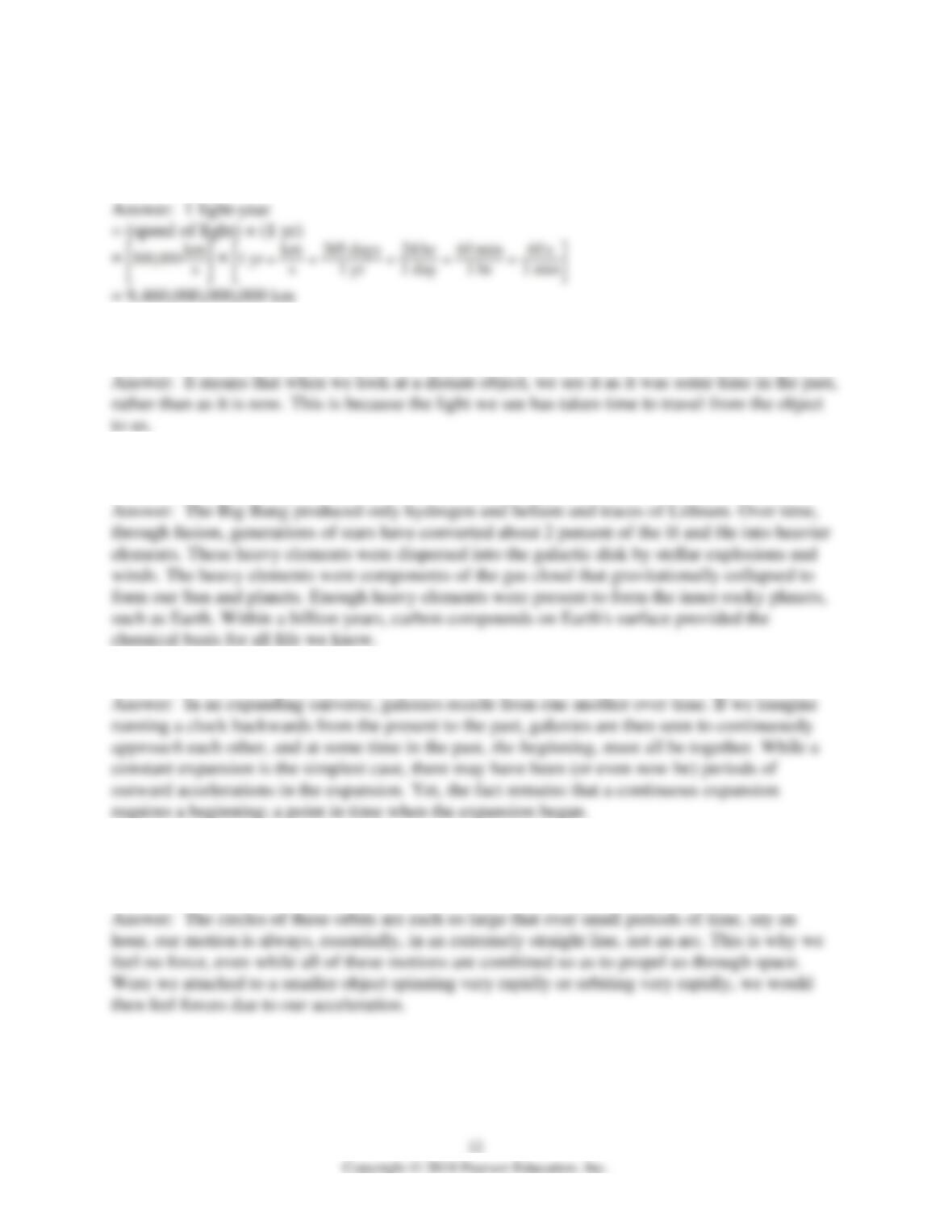
1) The speed of light is 300,000 km/s. How far is a light-year? Be sure to show all work clearly
on your calculation.
2) Briefly explain what we mean by the statement “The farther away we look in distance, the
further back we look in time.”
3) Starting from the Big Bang, briefly explain how our solar system came to contain the
chemical elements necessary to make Earth and living organisms.
4) Briefly explain why an expanding universe implies a beginning (called the Big Bang).
5) Standing on Earth, we are experiencing many different motions at once: the rotating Earth; the
Sun-orbiting Earth; the solar system’s orbit of the galactic orbit, etc., all with enormous
velocities. Why do we not feel these motions, like one does, say, on a roller coaster?
6) Consider the following statement, and explain whether or not it is sensible: NASA hopes to
build a new telescope that will allow us to see some galaxies as they appeared 8 billion years
ago.
7) As we watch the sky in daytime and nighttime, we see the Sun, Moon, and stars on the
horizon rise in the East and track through the sky to set in the West. What causes this illusion of
motion?
8) Name the rotation and orbit motions associated with time intervals of days, months, and years.
9) Consider the following statement, and explain whether or not it is sensible: Someday we may
build spaceships capable of traveling at a speed of 1 light-second per hour.
10) Briefly explain how the Sun generates energy.
11) Imagine that you could drive your car in space. Assume that you can drive at a constant
speed of 100 kilometers per hour. Suppose you started driving from the Sun. How long would it
take, in years, to reach Earth?
12) Explain why it is so difficult to see planets around other stars.
13) Given the idea that we are on “spaceship Earth,” list our motions through space that show
why it is not the case that we are “just sitting here.”
14) What is the difference between the distance and the “look back time” for a distant receding
galaxy?
1.5 Mastering Astronomy Reading Quiz
1) From your location on Earth right now, your trajectory through space is the combination of
many different motions. Which motion adds the most velocity to total?
A) the rotation of Earth on its axis
B) the orbit of Earth around the Sun
C) the solar system’s motion relative to the local stars
D) the orbit of the solar system around the center of the galaxy
2) As the Sun and stars in the Sun’s local neighborhood orbit the center of the galaxy, they
A) often collide with each other due to the gravitational force that pulls all stars together.
B) gradually fall inward to the inner galaxy, where they accumulate in the massive central bulge.
C) usually maintain an even spacing with each other, much like the planets of the solar system.
D) each also have their own independent motions (which we cannot easily see in the night sky)
as fast as 70,000 km/hour.
3) A galaxy is ________.
A) a collection of a few hundred million to a trillion or more stars, bound together by gravity
B) a large, glowing ball of gas powered by nuclear energy
C) a name for the great variety of stars.
D) another name for the universe
E) a system consisting of one or a few stars orbited by planets, moons, and smaller objects
4) The elements crucial for making life on Earth: Carbon, Nitrogen, Oxygen
A) were made in fusion reactions in the core of the Sun.
B) were processed through earlier generations of stars and drifted across space.
C) were generated in hydrogen and helium interactions in the Big Bang.
D) were made from hydrogen and helium interactions in galactic gas clouds.

5) What do astronomers mean by the Big Bang?
A) the event that marked the beginning of the expansion of the universe
B) a gigantic explosion that blew all the galaxies in the universe to smithereens
C) the explosion of a massive star at the end of its life
D) the event that marked the birth of our solar system
6) What do we mean when we say that the universe is expanding?
A) Everything in the universe is gradually growing in size.
B) Within galaxies, average distances between star systems are increasing with time and the
galaxies and galaxy clusters are, in general, receding from each other.
C) The statement is not meant to be literal; rather, it means that our knowledge of the universe is
growing.
D) The average distance between galaxies is increasing with time.
7) Based on observations of the universal expansion, the age of the universe is about ________.
A) 14,000 years
B) 14 million years
C) 14 billion years
D) 14 trillion years
8) According to astronomers, how old is Earth?
A) 4.5 billion years
B) 4.5 trillion years
C) 1.5 million years old
D) 14 billion years old
9) The term observable universe refers to ________.
A) that portion of the universe that we have so far photographed through telescopes
B) the portion of the universe that can be seen by the naked eye
C) the portion of the universe that is not hidden from view by, for example, being below the
horizon
D) that portion of the universe that we can see in principle, given the current age of the universe
10) We observe that most galaxies are moving away from us. If we could (somehow)
communicate with an observer in a distant galaxy, what would it tell us?
A) Most galaxies are moving away from me, except for yours.
B) Most galaxies are moving away from me, including yours.
C) Most galaxies are moving away from you, and about half are moving towards me.

11) On the Cosmic Calendar, in which the entire history of the universe is represented in a single
year starting on January 1, and ending now on December 31, the lives of your grandparents, your
parents, and yourself have all taken place on the day 31 December
A) in less than a half second before midnight.
B) in less than 10 seconds before midnight.
C) in less than a half minute before midnight.
D) in less than 10 minutes before midnight.
12) The number of stars in the Milky Way Galaxy is approximately ________.
A) a few million
B) a few hundred million
C) a few billion
D) a few hundred billion
13) The Dark Matter Halo of our galaxy is
A) the extension or the central bulge into space where dust makes the stellar material too dark to
see.
B) a massive non-luminous cloud of material that surrounds the galaxy, providing the dominant
source of gravity in our galaxy.
C) a halo component curiously absent in most others galaxies which astronomers have examined.
D) a disproven super-gravity concept once thought to be possible, but contradicted by evidence.
14) What is the ecliptic plane?
A) the plane of Earth’s orbit around the Sun
B) the plane of Earth’s equator
C) the plane of the Sun’s equator
D) the plane of the Milky Way Galaxy
15) How long does it take the Earth to complete one orbit around the Sun?
A) one year
B) one day
C) one month
D) one week
E) The time it takes Earth to orbit the Sun changes significantly from one orbit to the next.
1) Which of the following has your “cosmic address” in the correct order?
A) you, Earth, solar system, Local Group, Local Supercluster, Milky Way Galaxy
B) you, Earth, solar system, Milky Way Galaxy, Local Group, Local Supercluster
C) you, Earth, solar system, Local Group, Milky Way Galaxy, Local Supercluster

2) Using the ideas discussed in your textbook, in what sense are we “star stuff”?
A) The overall chemical composition of our bodies is about the same as that of stars.
B) Nearly every atom from which we are made was once inside of a star.
C) We could not survive without light from our star, the Sun.
3) How are galaxies important to our existence?
A) Without galaxies, there could not have been a Big Bang.
B) Without galaxies, the universe could not be expanding.
C) Deep in their centers, galaxies created the elements from which we are made.
D) Galaxies facilitate recycling material from one generation of stars to the next, and, without
this recycling, we would not exist.
4) The distance of Mars from the Sun is about 1.5 AU. How far is this in kilometers?
A) 1.5 × 150,000,000 km
B) 150,000,000,000 / 1.5 km
C) 150,000,000 / 1.5 km
D) 1.5 × 150,000,000,000 km
5) Suppose we look at two distant galaxies: Galaxy 1 is twice as far away as Galaxy 2. In that
case, ________.
A) Galaxy 1 must be twice as big as Galaxy 2
B) we are seeing Galaxy 1 as it looked at an earlier time in the history of the universe than
Galaxy 2
C) we are seeing Galaxy 1 as it looked at a later time in the history of the universe than Galaxy 2
D) Galaxy 2 must be twice as old as Galaxy 1
6) The Moon orbits the Sun
A) once a month.
B) once a year.
C) once a day.
7) The mysterious Dark Energy
A) was suggested by the unexpected rotation speeds of galaxies.
B) is believed to be the dominant form of energy in the universe.
C) is attributed to the gravitational force of black holes.
D) is slowing the expansion of the universe.

8) Why don’t star systems, galaxies and galaxy clusters themselves expand as the universe
around them expands?
A) Actually, they do.
B) Expansion pertains to the space between objects, and not the objects themselves.
C) Their inter-gravitational attraction is strong enough to keep them bound together against the
expansion of space.
D) They were formed before the period of expansion began and are thus unaffected.
9) Where is our solar system located within the Milky Way Galaxy?
A) very near the center of the galaxy
B) at the far edge of the galaxy’s visible disk
C) roughly halfway between the center and the edge of the visible disk of the galaxy
D) in the halo of the galaxy
10) If we imagine the history of the universe compressed into one year ending today, dinosaurs
became extinct ________.
A) about 6 months ago
B) about 3 weeks ago
C) yesterday morning
D) about an hour ago
11) Relative to the age of the universe, how old is our solar system?
A) It is about 1% as old as the universe.
B) It is between about 5% and 10% as old as the universe.
C) It is about one-third the age of the universe.
D) It is nearly the same age as the universe.
12) How do the speeds at which we are moving with Earth’s rotation and orbit compare to the
speeds of more familiar objects?
A) Earth’s rotation carries most people around the axis faster than a commercial jet travels, and
Earth’s orbit carries us around the Sun faster than the Space Shuttle orbits Earth.
B) Earth’s rotation carries most people around the axis at about the speed of a commercial jet,
and Earth’s orbit carries us around the Sun at about the speed of a military jet.
C) Earth’s rotation carries most people around the axis at about the speed of a car on the freeway,
and Earth’s orbit carries us around the Sun at about the speed of a commercial jet.
D) Earth’s rotation carries most people around the axis at about the speed at which the Space
Shuttle orbits Earth, and Earth’s orbit carries us around the Sun at nearly the speed of light.

13) Why do the patterns of the stars in our sky look the same from year to year?
A) because the stars in the constellations are so far away
B) because the stars in the constellations are not moving
C) because the stars in the constellations all move at the same speeds and in the same directions,
so they don’t change their relative positions
D) because the stars in the constellations move so slowly—typically about the speed of a snail—
that their motions are not noticeable
14) What made most of the oxygen nuclei in the solar system?
A) stars
B) high energy collisions of dust and cosmic rays
C) the Big Bang
D) our Sun
15) Which statement about motion in the universe is not true?
A) The mysterious dark matter is the fastest-moving material in the universe.
B) Some stars in the Milky Way Galaxy are moving toward us and others are moving away from
us.
C) Except for a few nearby galaxies, all other galaxies are moving away from us.
D) Your speed of rotation around Earth’s axis is faster if you live near the equator than if you live
near the North Pole.