
Chapter 1—Sex and Development
MULTIPLE CHOICE
1. What is the normal number of chromosomes for a human?
a.
44
b.
42
c.
40
d.
46
e.
45
2. Which of the following properties does a zygote possess?
a.
Carries XX, XY, or YY chromosomes.
b.
Cell division occurs before fertilization.
c.
Carries 1 pair of sex chromosomes and 22 pairs of autosomal chromosomes.
d.
Carries an X or Y chromosome and a single set of 22 autosomal chromosomes.
e.
Undergoes multiple meiotic cell divisions to produce an embryo.
3. Which of the following statements is true about sex ratios?
a.
Based on production of sperm, we would expect the sex ratio to be 2 males for every 1
female.
b.
More females than males are conceived.
c.
By 20 years of age, the ratio of males to females is 1:1.
d.
About the same number of males and females are born.
e.
By 60 years of age, there are more males than females.
4. Whether a fetus develops as a male or female depends on
a.
a complex interaction of genes and environment.
b.
hormones produced by the mother during pregnancy.
c.
how many sperm enter the egg.
d.
the number of autosomes present.
e.
only on which sex chromosomes are present.
5. What is the normal number of pairs of chromosomes for humans?
a.
21
b.
22
c.
23
d.
24
e.
42

6. What is the sex chromosome make-up of a normal male?
a.
XXY
b.
XY
c.
XX
d.
XXX
e.
XO
7. Autosomes are
a.
non-sex chromosomes.
b.
another term for the sex chromosomes.
c.
a pair of chromosomes.
d.
chromosomes with mutated genes.
e.
capable of forming Barr bodies.
8. Sperm sorting relies on _________________ between sperm carrying the X chromosome and sperm
carrying the Y chromosome.
a.
differences in electrical charges
b.
direct microscopic examination and recognition of visual differences
c.
differences in the swimming speed
d.
magnetic differences
e.
differences in the amounts of fluorescent dye binding.
9. The process of sex selection
a.
is only possible after the egg has been fertilized.
b.
is only used to avoid having children with genetic disorders.
c.
carries a small risk of miscarriage for the mother.
d.
allows a couple to choose the sex of their child.
e.
allows a couple to alter the sex of their unborn child.
10. What is involved in in vitro fertilization?
a.
The woman receives hormone treatments.
b.
Eggs are surgically removed from the woman’s ovaries.
c.
Both sperm and eggs are placed in a dish to allow fertilization.
d.
A sperm sample must be provided.
e.
All of these are steps in in vitro fertilization.
11. In humans, fertilization usually occurs
a.
in the ovary.
b.
in the fallopian tube.
c.
in the vagina.
d.
in the uterus.
e.
right at the cervix.

12. How many sperm usually enter an egg?
a.
1
b.
2
c.
3
d.
4
e.
5
13. What are the different parts of a blastocyst?
a.
Inner cell mass
b.
Inner cavity
c.
Middle layer of cells
d.
Inner cell mass and inner cavity
e.
All of these .
14. The chorion
a.
contains human embryonic stem cells (hESC).
b.
is a membrane inside the embryo.
c.
protects the embryo.
d.
forms in the last trimester of pregnancy.
e.
is an extension of the embryo.
15. Human chorionic gonadotropin (hCG)
a.
nourishes the embryo.
b.
stimulates the formation of the placenta.
c.
is present in undetectable amounts throughout the pregnancy.
d.
prevents the expulsion of the embryo.
e.
is transported to the embryo through the umbilical cord.
16. The villi
a.
extend into the spaces in the uterine wall.
b.
are fingerlike projections.
c.
will eventually form part of the placenta.
d.
come in contact with the maternal blood.
e.
All of these are true.
17. At what point in gestation does the fetus have a well-formed face with eyes that can open?
a.
1-2 weeks after fertilization
b.
2-3 weeks
c.
5 weeks
d.
8 weeks
e.
16 weeks

18. During which trimester(s) does the most rapid fetal growth take place?
a.
first trimester
b.
second trimester
c.
third trimester
d.
There is equal fetal growth in all trimesters.
e.
It varies depending on each individual pregnancy.
19. At what point in development is the embryo considered a fetus?
a.
After the first month.
b.
After eight weeks.
c.
After the fourth month.
d.
After the sixth month.
e.
Just before birth.
20. When can the mother usually feel movements of the fetus’ arms and legs?
a.
within days after fertilization
b.
during the second month
c.
around the fourth month
d.
not until the third trimester
e.
only in the last two months of pregnancy
21. When can ultrasound be used to determine the sex of a fetus?
a.
within days after implantation
b.
1-2 weeks after fertilization
c.
at the end of the first trimester
d.
at the beginning of the second trimester
e.
not until the third trimester
22. Which of the following is FALSE?
a.
Testes secrete the hormone testosterone.
b.
Testosterone promotes the development of male reproductive organs.
c.
Testosterone promotes the development of the ovary.
d.
Testosterone promotes the development of secondary male sex characteristics.
e.
The Y chromosome must be present for the secretion of testosterone.
23. Which of the following is FALSE about androgen insensitivity?
a.
Complete androgen insensitivity is caused by a mutation in a gene on the X chromosome.
b.
Individuals have a mutation in the androgen receptor gene.
c.
Development of individuals continues as if testosterone were absent.
d.
Individuals with this condition have an XX sex chromosome combination.
e.
Individuals with complete androgen insensitivity have the chromosome combination of a
female but appear male.

9
24. Individuals with complete androgen insensitivity
a.
menstruate after reaching puberty.
b.
are phenotypically males.
c.
often have testes present in their abdomens.
d.
usually have no problems reproducing.
e.
have a set of XX sex chromosomes.
25. Gonadal sex is determined
a.
at fertilization.
b.
at birth.
c.
upon the formation of external genitalia.
d.
when the presence or absence of the SRY gene determines the formation of testes or
ovaries.
e.
when either testosterone or estrogen is produced.
26. The _____ will eventually form the fetus.
a.
inner cell mass of the blastocyst
b.
outer layer of cells of the blastocyst
c.
internal cavity of the blastocyst
d.
outer layer of chorion
e.
inner layer of placenta
27. The _____ is the source for embryonic stem cells.
a.
inner cell mass of the blastocyst
b.
outer layer of cells of the blastocyst
c.
internal cavity of the blastocyst
d.
outer layer of chorion
e.
inner layer of placenta
28. Sex testing in the Olympics prior to 2000 was based on
a.
testosterone levels.
b.
the presence or absence of the Y chromosome.
c.
ultrasound scanning.
d.
the presence or absence of Barr bodies.
e.
estrogen levels.
29. Intersexuality
a.
is determined only by the number of sex chromosomes an individual possesses.
b.
is a condition in which the chromosomal and phenotypic sex of an individual match.
c.
describes a condition in which an individual’s phenotype cannot be classified as either
male or female.
d.
is determined only by the autosomes an individual possesses.
e.
is determined at fertilization.

Chapter 1 – Sex and Development
30. How many Barr bodies would be found in cells from an individual with Turner syndrome?
a.
0
b.
1
c.
2
d.
3
e.
The number would vary depending on the age of the individual.
TRUE/FALSE
1. In an ultrasound scan, the sex organs can be seen as early as 7 weeks after implantation.
2. Development of the sex organs is influenced by the presence or absence of the hormone testosterone.
3. Chromosomal sex is determined at fertilization.
4. Complete androgen insensitivity is genetically controlled.
5. Sperm containing the X chromosome have more DNA than sperm containing the Y chromosome and
therefore glow brighter in the sperm sorting procedure.
6. Sex selection can use sperm sorting or preimplantation genetic diagnosis.
7. In males, the development of internal and external sex organs depends on the actions of the SRY gene
located on the Y chromosome.
8. In females, one X chromosome out of the two becomes a Barr body.
9. An individual who is (45, X) would be phenotypically female.

11
10. An individual who is (47, XXY) would be phenotypically female.
MATCHING
Match the appropriate chromosomal composition to the sex of the individual.
a.
Female
b.
Male
1. XX
2. XY
3. XO
4. XXY
Match the appropriate term with the description.
a.
finger-like projections
b.
large hollow ball of cells
c.
attachment of embryo to uterus
d.
source of embryonic stem cells
e.
hCG is produced by this membrane
5. Blastocyst
6. Implantation
7. Villi
8. Inner cell mass
9. Chorion
Match the description to the number of chromosomes.
a.
normal number of chromosomes in humans
b.
number of autosomal chromosomal pairs
c.
number of chromosomes present in an individual with Kleinfelter syndrome
d.
number of chromosomes present in an individual with Turner syndrome
10. 22
11. 46
12. 47
13. 45
13
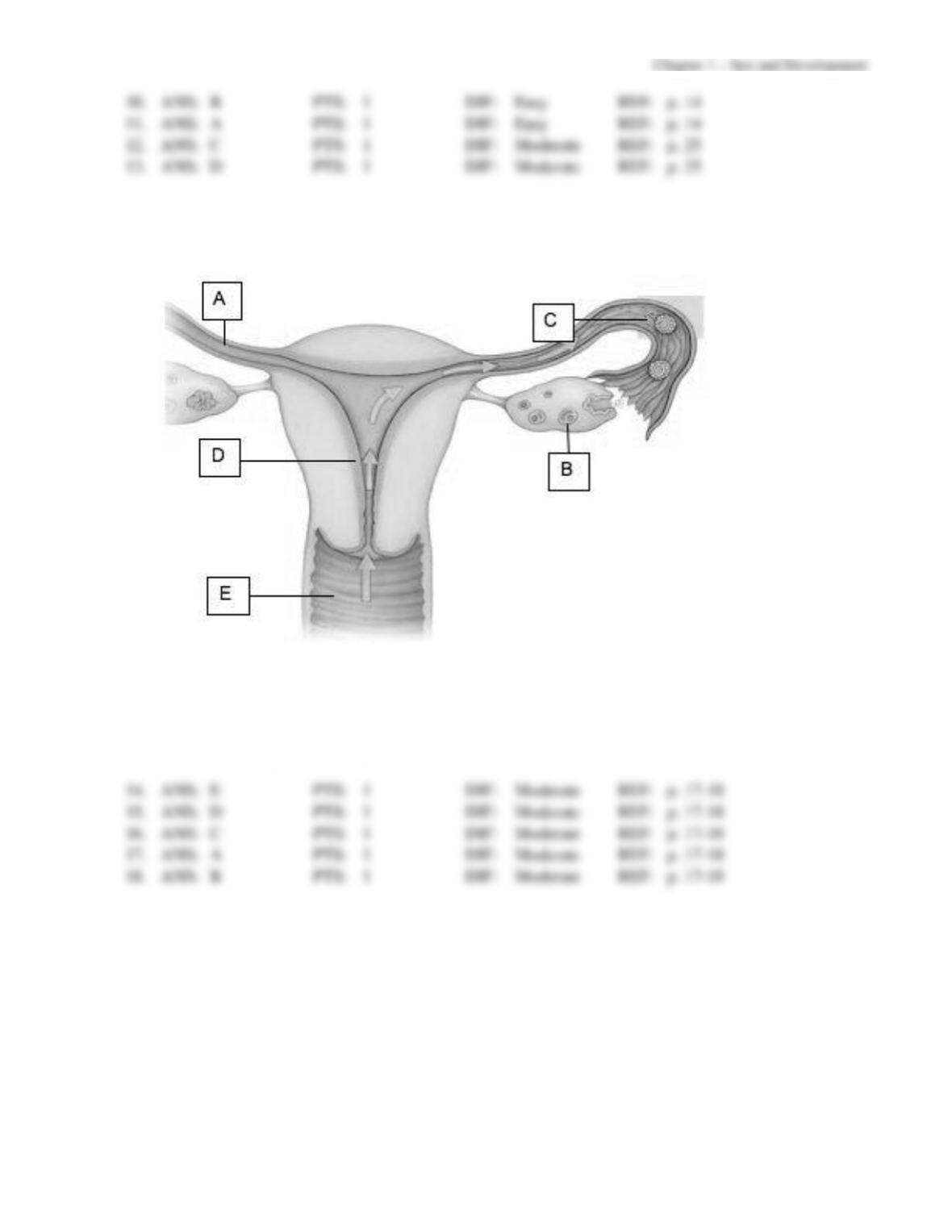
Match the following descriptions with the appropriate letter.
14. sperm enter the female reproductive tract here
15. implantation will occur here
16. fertilization occurring
17. fallopian tube
18. the nonspecific gonad develops into this structure in human females
ESSAY
1. In countries like China and India, sex selection using ultrasound, amniocentesis, preimplantation
genetic diagnosis, and sperm sorting has resulted in an imbalance of male and female offspring in the
population. The trend has led to a gradual increase in the number of males born. How would you
anticipate this sex selection could influence society in these countries? Do you think the same
possibility exists in this country?
Chapter 1 – Sex and Development
2. One technology that has been valuable for couples who have a known increased risk of passing on a
genetic disease (biochemical or chromosomal) is preimplantation genetic diagnosis (PGD). Ethically,
some individuals feel this is “playing God” and should not be done; others consider the method a
“scientific miracle” and are grateful for the opportunity to virtually insure that they will not have a
disease-stricken child. Where would you fall on this spectrum of varying opinions? What factors have
you considered in forming your opinion? Now suppose that you and your spouse are interested in
starting a family but find out that the female (you or your spouse) is a carrier for Hunter syndrome, a
genetic disorder in which the affected infants become blind, deaf, mentally retarded, and seldom live
past age 5. Does this change your opinion of using PGD to select for a healthy child? Explain.
SHORT ANSWER
1. The X and Y chromosomes of the human genome are termed the sex chromosomes. Explain how the
sex chromosome complement for a normal female and a normal male is determined at fertilization.
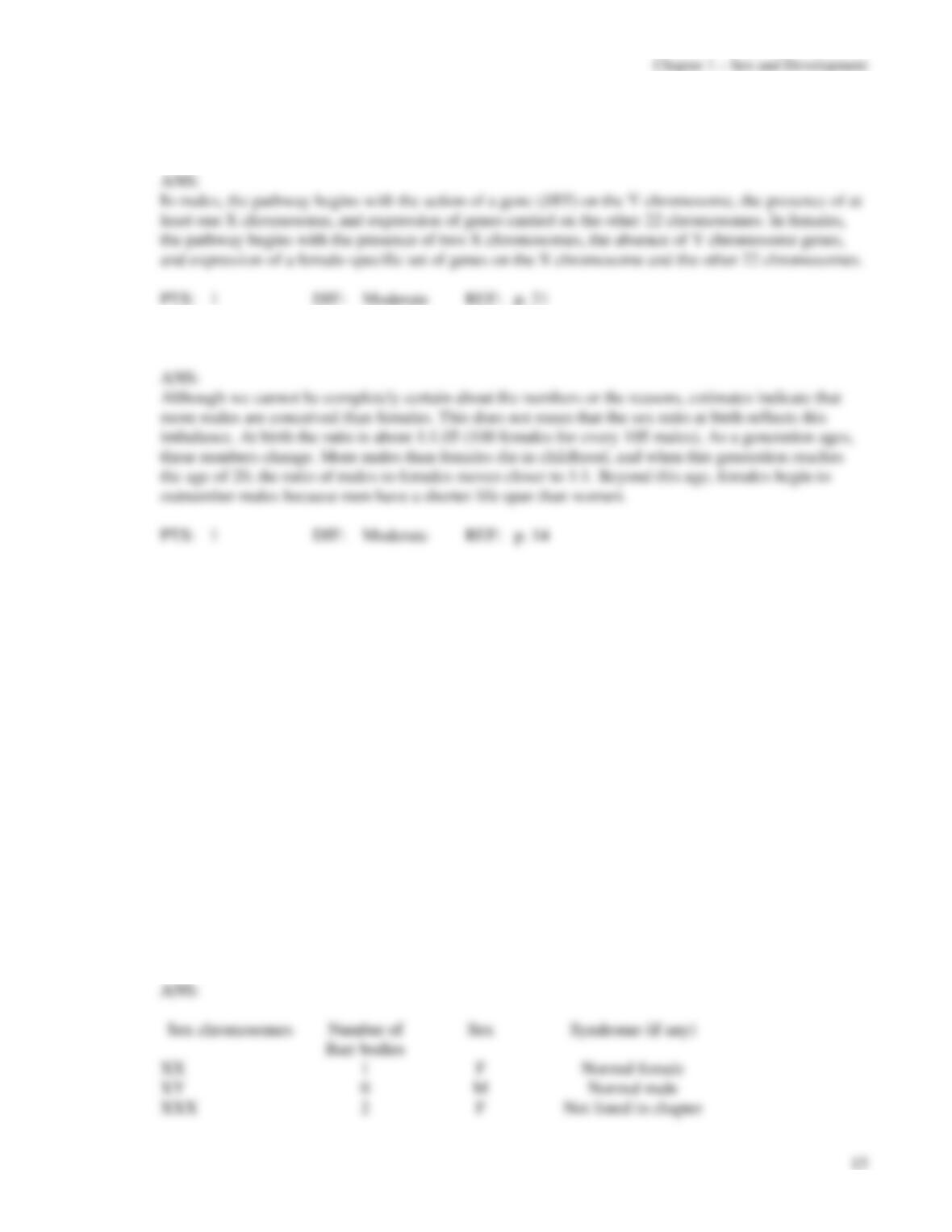
2. Distinguish between chromosomal, gonadal, and phenotypic stages of sex development for a male.
When does each occur and what is the key feature of each?
Sex chromosomes
Number of
Sex
Syndrome (if any)
Barr bodies
XY
XXX
3. Describe the genetic factors required for the development of the male internal and external sex organs.
Describe the genetic factors required for the development of the female internal and external sex
organs.
4. Explain why the sex ratio for humans changes over time.
PROBLEM
1. During early embryonic development, one of the X chromosomes is randomly inactivated in each cell
to form a Barr body, a condensed structure near the nuclear envelope that can be used to identify the
sex of the individual and/or the presence of a sex chromosome abnormality. In individuals with
abnormal numbers of X chromosomes, all but one of the X chromosomes will be inactivated. What
would the number of Barr bodies, sex, and syndrome (if any) be for each of the following situations?
Sex chromosomes
Number of
Sex
Syndrome (if any)
Barr bodies
XX
________
________
__________________
XY
________
________
__________________
XXX
________
________
__________________
XO
________
________
__________________
XYY
________
________
__________________
XXY
________
________
__________________
XXXY
________
________
__________________