Chapter 1: The Study of Motion
TRUE/FALSE
1. A vector quantity has only a magnitude and no direction associated with it.
2. Speed can sometimes be negative.
3. Motion in a circle at constant speed is motion with constant acceleration.
4. Motion in a circle at constant speed is motion with constant velocity.
5. Uniform motion is any motion at constant speed.
6. The terms velocity and speed have identical meanings in physics.
7. If an object’s speed is constant, its velocity must also be constant.
8. If an object’s velocity is constant, its speed must also be constant.
9. The proper abbreviation for ‘seconds’ is ‘sec.’
10. The proper abbreviation for ‘grams’ is ‘g.’
11. The proper abbreviation for ‘kilohertz’ is ‘kHz.’
12. The metric prefix that means one thousand is milli-.
13. Twenty milliseconds is 0.020 s.
14. There are one thousand megabytes in a gigabyte.
15. The second is a metric unit of measure.
16. The number of cycles of a periodic process that occur per unit time is called the period.
17. The time for one complete cycle of a periodic process to take place is called the period.
18. The period of oscillation for a signal having a frequency of 60 Hz is 60 seconds.
19. The maximum possible speed in nature is the speed of light.
20. Experimenting is part of the scientific method.
21. A body at the end of a spring oscillates up and down ten times in five seconds. The period of
oscillation is 2 s.
22. The slope of a distance vs. time graph is the acceleration.
23. The slope of a velocity vs. time graph is the acceleration.
24. An object moving in a circle undergoes centripetal acceleration.
25. If an object’s acceleration is positive, its speed must be increasing.
26. A fast-moving body must have a larger acceleration than a slow-moving body.
27. An aircraft approaches a runway that runs directly east as a strong wind blows out of the
south. The direction that the aircraft should aim in order to land is east of north.
28. The velocity of the moving object is a non-zero constant.
29. The acceleration of the moving object is a non-zero constant.
30. The velocity of the moving object is a non-zero constant.
31. The acceleration of the moving object is a non-zero constant.
32. The object’s velocity is zero in region II.
33. The object’s velocity is positive in region II.
34. The object’s velocity is never negative.
35. The object’s acceleration is zero only in region II.
36. The object’s acceleration is negative in region III.
37. The object is never at rest.
38. The object’s speed is greatest in region I.
39. As the ball is going upwards the velocity and acceleration both point up.
40. At the peak of the motion the velocity and acceleration are both zero.
41. As the ball is going downwards the velocity and acceleration both point down.
42. When a body moves in circular motion at constant speed the velocity and acceleration point
in opposite directions.
43. The distance from the starting point is 16 m.
44. The velocity acquired after starting from rest is 8 m/s.
45. The acceleration after starting from rest is 8 m/s2.
46. A racecar goes around a 200 m radius curve at a constant speed of 40 m/s. Its acceleration is
8 m/s2.

47. A racecar driver steps on the gas, changing his speed from 10 m/s to 30 m/s in 4 seconds.
The acceleration of the racecar is 10 m/s2.
48. A racecar driver steps on the gas, and his racecar travels 20 meters in 2 seconds starting
from rest. The acceleration of the racecar is 5 m/s2.
MULTIPLE CHOICE
1. Which of these are fundamental physical quantities?
a.
space, time, and matter
c.
length, time, and mass
b.
kilograms, seconds, and meters
d.
momentum, energy, and mass
2. What is the proper abbreviation for ‘seconds?’
a.
sec
b.
There is none. It should always be spelled out.
c.
secs
d.
s
e.
none of the above
3. What is the proper abbreviation for ‘kilohertz?’
a.
kh
b.
khz
c.
Khz
d.
KHz
e.
kHz
4. What is the proper abbreviation for ‘grams?’
a.
g
b.
gms
c.
gm
d.
gr
e.
kg
5. The metric prefix that means one thousand is
a.
milli–
b.
centi-
c.
one-

d.
kilo-
e.
mega-
6. Twenty milliseconds is
a.
0.00002 s
b.
0.0002 s
c.
0.002 s
d.
0.02 s
e.
20000 s
7. Fifteen microseconds is
a.
0.0000015 s
b.
0.000015 s
c.
0.00015 s
d.
0.015 s
e.
15000000 s
8. Twenty kilometers is
a.
200,000 m
b.
20,000 m
c.
2,000 m
d.
200 m
e.
0.02 m
9. Two microcuries is
a.
200,000 Ci
b.
0.0002 Ci
c.
0.00002 Ci
d.
0.000002 Ci
e.
0.00000002 Ci
10. How many megabytes are there in a gigabyte?
a.
10
c.
1000000
b.
1000
d.
none of the above
11. In expressions like Dv and Dt, D stands for
a.
“change in”
c.
a constant of proportionality
b.
“triangle”
d.
a variable

12. The number of cycles of a periodic process that occur per unit time is called
a.
amplitude
b.
frequency
c.
period
d.
wavelength
e.
speed
13. The time for one complete cycle of a periodic process to take place is called
a.
amplitude
b.
frequency
c.
period
d.
wavelength
e.
speed
14. A body at the end of a spring oscillates up and down ten times in five seconds. The period of
oscillation is
a.
0.5 s
b.
2 s
c.
5 s
d.
10 s
e.
not determinable
15. What is the period of a signal that has a frequency of 60 Hz?
a.
60 s
c.
1/60 s
b.
60 s-1
d.
not determinable
16. The slope of a distance vs. time graph is the
a.
distance
c.
acceleration
b.
velocity
d.
none of the above
17. The slope of a velocity vs. time graph is the
a.
distance
c.
acceleration
b.
velocity
d.
none of the above
18. An object moving in a circle undergoes
a.
constant acceleration
b.
free fall
c.
centripetal acceleration
d.
linear acceleration
e.
frequency
19. Motion in a circle at constant speed is motion with
a.
constant acceleration
c.
both of the above
b.
constant velocity
d.
none of the above
20. An aircraft approaches a runway that runs directly east as a strong wind blows out of the
south. The direction that the aircraft should point in order to land on the runway is
a.
north
b.
east of north
c.
east
d.
south of east
e.
south
21. GPS stands for
a.
the metric system of measurement
b.
grams per second
c.
Global Positioning System
d.
a space shuttle
e.
none of the above
22. Instantaneous speed and average speed are equal
a.
always
c.
for accelerated motion
b.
for motion at constant speed
d.
never
23. If the velocity of an object is negative,
a.
its speed is decreasing
b.
its velocity does not exist
c.
it is reversing direction
d.
it is moving in the direction labeled negative
24.
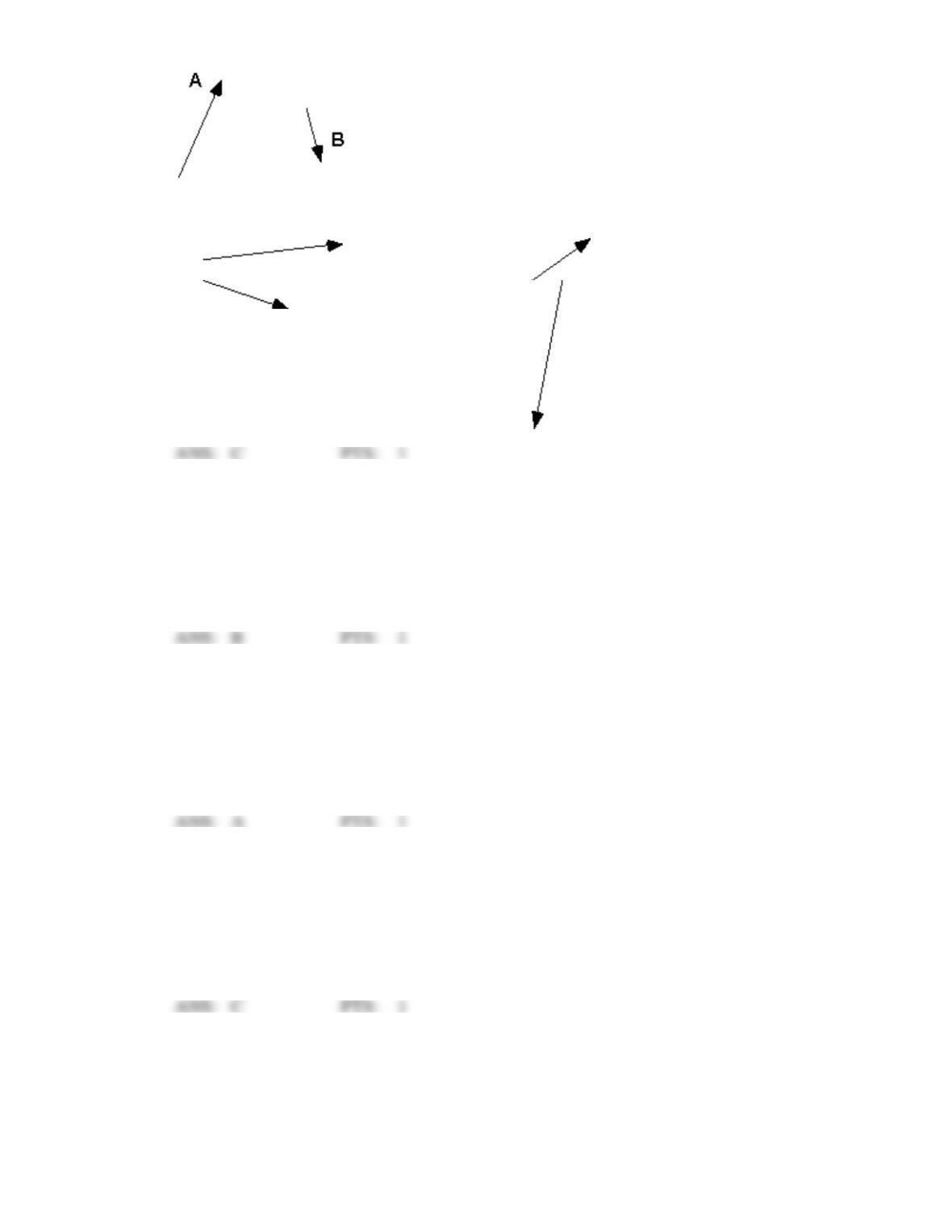
The sum of vectors A and B is
a.
c.
b.
d.
25. The velocity of the moving object is
a.
zero
b.
constant
c.
increasing
d.
decreasing
e.
not determinable
26. The acceleration of the moving object is
a.
zero
b.
constant
c.
increasing
d.
decreasing
e.
not determinable
27. The velocity of the moving object is
a.
zero
b.
constant
c.
increasing
d.
decreasing
e.
not determinable
28. The acceleration of the moving object is
a.
zero
b.
constant

c.
increasing
d.
decreasing
e.
not determinable
29. The object’s velocity is zero in region(s)
a.
I
c.
III
b.
II
d.
no regions
30. The object’s velocity is positive in region(s)
a.
I
c.
III
b.
II
d.
no regions
31. The object’s velocity is negative in region(s)
a.
I
c.
III
b.
II
d.
no regions
32. The object’s acceleration is negative in region(s)
a.
I
c.
III
b.
II
d.
no regions
33. The object is at rest in region(s)
a.
I
c.
III
b.
II
d.
no regions
34. The object’s speed is greatest in region(s)
a.
I
c.
III
b.
II
d.
no regions
35. As the ball is going upwards
a.
the velocity and acceleration both point up
b.
the velocity points up and the acceleration down
c.
the velocity points down and the acceleration up
d.
the velocity and acceleration both point down
e.
the acceleration is zero
36. At the maximum height

a.
the velocity and acceleration both point up
b.
the velocity points up and the acceleration down
c.
the velocity points down and the acceleration up
d.
the velocity and acceleration both point down
e.
the velocity is zero
f.
the acceleration is zero
37. As the ball is going downwards
a.
the velocity and acceleration both point up
b.
the velocity points up and the acceleration down
c.
the velocity points down and the acceleration up
d.
the velocity and acceleration both point down
e.
the acceleration is zero
38. When a body moves in circular motion at constant speed
a.
the velocity and acceleration point in the same direction
b.
the velocity and acceleration point in opposite directions
c.
the velocity and acceleration point perpendicular to each other
d.
the acceleration is zero
e.
none of the above
39. The distance the ball is below the rooftop in meters is
a.
0
b.
4.9
c.
9.8
d.
6
e.
none of these
40. The velocity of the ball in m/s is
a.
0
b.
4.9
c.
9.8
d.
6
e.
none of these
41. The acceleration of the ball in m/s2 is
a.
0
b.
4.9
c.
9.8
d.
6
e.
none of these