Chapter 1 – Introduction to Accounting and Business
129. Donner Company is selling a piece of land adjacent to its business. An appraisal reported the market value of the
land to be $120,000. The Focus Company initially offered to buy the land for $107,000. The companies settled on a
purchase price of $115,000. On the same day, another piece of land on the same block sold for $122,000. Under the cost
principle, what is the amount that will be used to record this transaction in the accounting records?
130. Explain the meaning of the business entity assumption.
131. Darnell Company purchased $88,000 of computer equipment from Joseph Company. Darnell Company paid for the
equipment using cash that had been obtained from the initial investment by Donnie Darnell.
Which entity or entities (Darnell Company, Joseph Company, and Donnie Darnell) should record the transaction
involving the computer equipment on their accounting records?
Chapter 1 – Introduction to Accounting and Business
132. Discuss the characteristics of a limited liability company (LLC).
133. Explain the meaning of:
(a) the measurement principle
(b) the monetary unit assumption
134. Bob Johnson is the sole owner of Johnson’s Carpet Cleaning Service. Bob purchased a personal automobile for
$10,000 cash plus he took out a loan for $20,000 in his name. Describe how this transaction is related to the business
entity assumption.
Chapter 1 – Introduction to Accounting and Business
135. Dave Ryan is the CEO of Ryan’s Arcade. At the end of its accounting period, December 31, Ryan’s Arcade has
assets of $450,000 and liabilities of $125,000. Using the accounting equation, determine the following amounts:
(a)
stockholders’ equity as of December 31 of the current year
(b)
stockholders’ equity as of December 31 at the end of the next year, assuming that assets
increased by $65,000 and liabilities increased by $35,000 during the year
(a)
(b)
136. Krammer Company has liabilities equal to one fourth of the total assets. Krammer’s stockholders’ equity is
$45,000. Using the accounting equation, what is the amount of liabilities for Krammer?
x = $15,000 in liabilities
137. Determine the missing amount for each of the following:
Assets
Liabilities
Stockholders’ Equity
(a)
$38,000
$45,000
$30,000
(b)
$22,000
$53,000
$32,000
(c)
(a)
$83,000 ($38,000 + $45,000)
(b)
$8,000 ($30,000 – $22,000)
(c)
$21,000 ($53,000 – $32,000)
Chapter 1 – Introduction to Accounting and Business
138. Determine the missing amount “X” for each of the following:
Assets
Liabilities
Stockholders’ Equity
(a) $78,500
$37,600
X
(b) X
$53,280
$145,000
(c) $49,500
X
$34,000
139. Use the accounting equation to answer each of the independent questions below.
(a) At the beginning of the year, Norton Company’s assets were $75,000 and its stockholders’ equity was $38,000.
During the year, assets increased by $18,000 and liabilities increased by $4,000. What was the stockholders’ equity at
the end of the year?
(b) At the beginning of the year, Turpin Industries had liabilities of $44,000 and stockholders’ equity of $66,000. If
assets increased by $10,000 and liabilities decreased by $5,000, what was the stockholders’ equity at the end of the year?
140. On July 1 of the current year, the assets and liabilities of John Wong, DVM, are as follows: Cash, $27,000; Accounts
Receivable, $12,300; Supplies, $3,100; Land, $35,000; Accounts Payable, $13,900. What is the amount of stockholders’
equity as of July 1 of the current year?
$13,900 Accounts Payable = $63,500)
Chapter 1 – Introduction to Accounting and Business
141. At the end of its accounting period, December 31, of Year 1, Hsu’s Financial Services has assets of $575,000 and
stockholders’ equity of $335,000. Using the accounting equation and considering each case independently, determine the
following amounts.
(a) Hsu’s liabilities as of December 31, of Year 1.
(b) Hsu’s liabilities as of December 31, of Year 2, assuming that assets increased by $56,000 and
shareholders’ equity decreased by $32,000.
(c) Net income or net loss during Year 2, assuming that as of December 31, Year 2, assets were $592,000,
liabilities were $450,000, and there were no additional investments or dividends.
142. Indicate whether each of the following accounts represents an asset, liability, or stockholders’ equity:
(a)
Accounts Payable
(b)
Wages Expense
(c)
Common Stock
(d)
Accounts Receivable
(e)
Dividends
(f)
Land
(a)
liability
(b)
stockholders’ equity
(c)
stockholders’ equity
(d)
(e)
stockholders’ equity
(f)
Chapter 1 – Introduction to Accounting and Business
143. At December 31 of the current year, Martin Consultants has assets of $430,000 and liabilities of $205,000. Using the
accounting equation and considering each case independently, determine the following:
(a) stockholders’ equity, as of December 31.
(b) stockholders’ equity, as of December 31 of the next year, assuming that assets increased by $12,000
and liabilities increased by $15,000.
(c) stockholders’ equity, as of December 31 of the next year, assuming that assets decreased by $8,000
and liabilities increased by $14,000.
The accountant for Scott Industries prepared the following list of account balances from the company’s records for the
year ended December 31. Use this information to answer the question that follows.
Fees earned
$165,000
Cash
$30,000
Accounts receivable
16,000
Selling expenses
44,000
Equipment
64,000
Common stock
47,000
Accounts payable
12,000
Interest revenue
3,000
Salaries & wages expense
40,000
Income taxes expense
18,000
Income taxes payable
5,000
Rent expense
20,000
144. Determine the total assets at the end of the current year for Scott Industries.
$110,000
145. Determine the total liabilities at the end of the current year for Scott Industries.
($12,000 Accounts payable + $5,000 Income taxes payable = $17,000)
Chapter 1 – Introduction to Accounting and Business
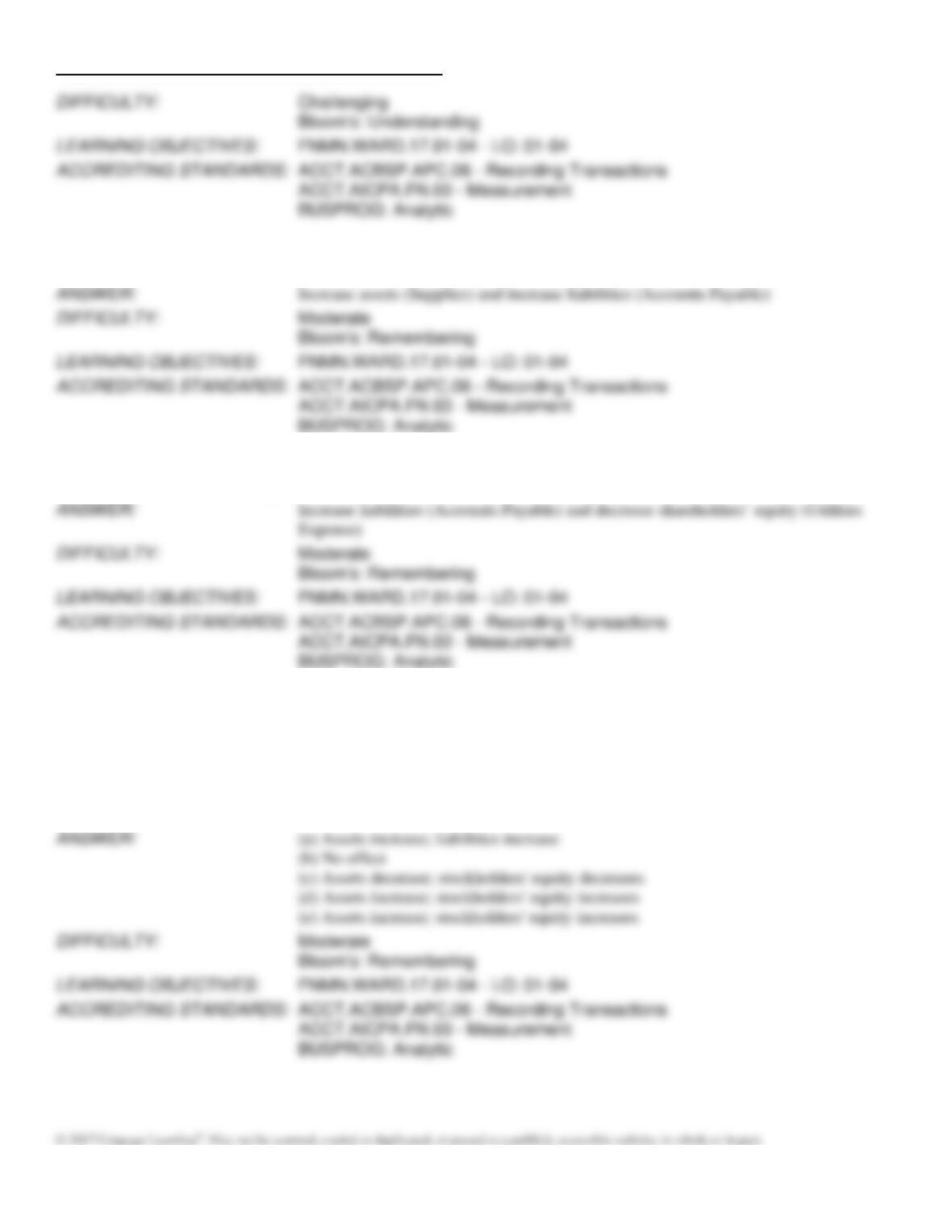
146. Daniels Company made the following selected transactions during May:
1.
Received cash from sale of stock, $55,000
2.
Paid creditors on account, $7,000
3.
Billed customers for services on account, $2,565
4.
Received cash from customers on account, $8,450
5.
Paid dividends to stockholders, $2,500
6.
Received the utility bill, $160, to be paid next month
Indicate the effect of each transaction on the accounting equation by:
(a)
Account type – (A)assets, (L)liabilities, (SE)stockholders’ equity, (R)revenue, and
(E)expense
b)
Name of account
c)
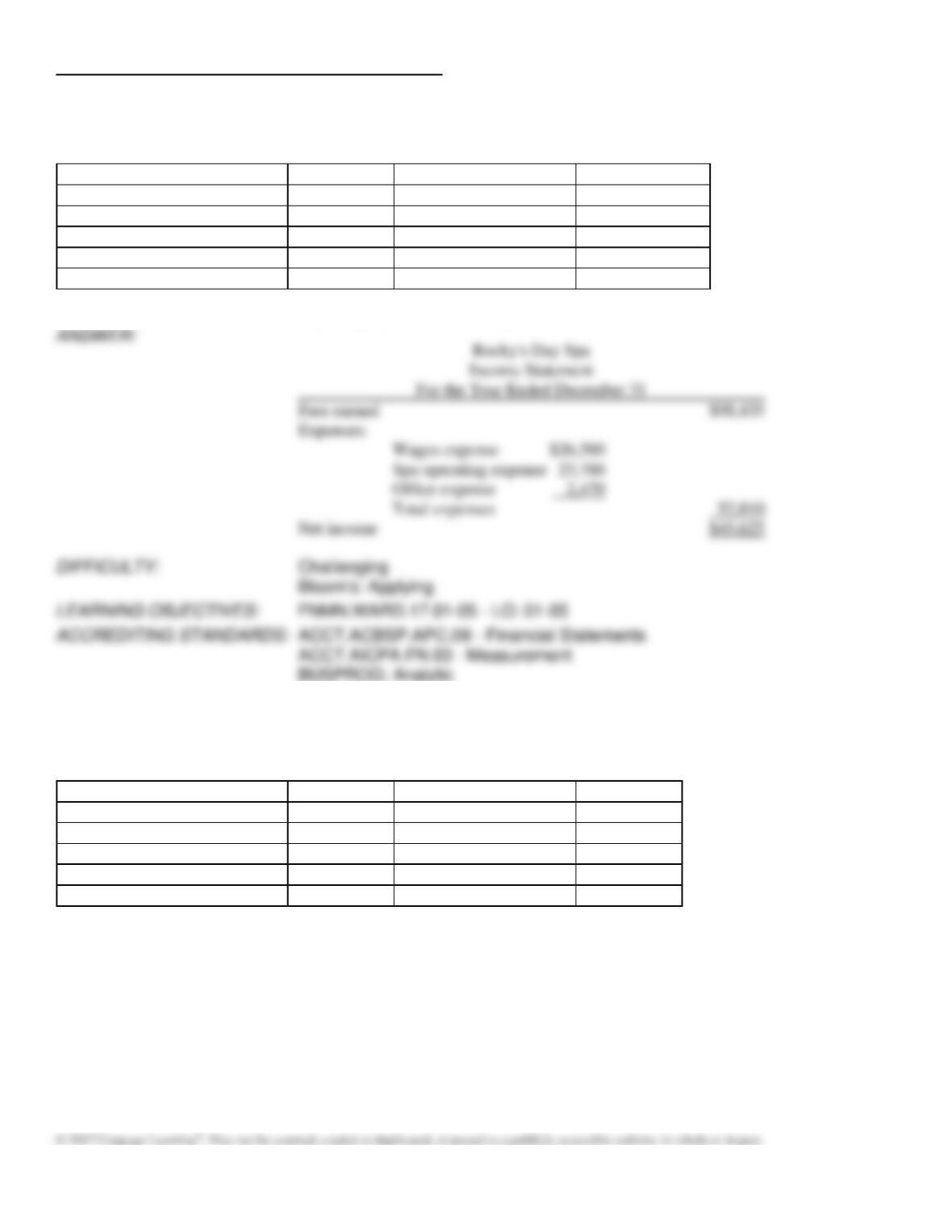
The amount by of the transaction
d)
The direction of change (increase or decrease) in the account affected
Note: Each transaction has two entries.
Entry
Entry
Account
Type
(a)
Name of
Account
(b)
Amount
(c)
Increase or
Decrease
(d)
Account
Type
(a)
Name of
Account
(b)
Amount
(c)
Increase or
Decrease
(d)
1
2
3
4
5
6
Decrease
$55,000
$55,000
Decrease
receivable
Chapter 1 – Introduction to Accounting and Business
147. Collins Landscape Company purchased various landscaping supplies on account to be used for landscape designs for
its customers. How will this business transaction affect the accounting equation?
148. Ramierez Company received its first electric bill in the amount of $60 which will be paid next month. How will this
transaction affect the accounting equation?
149. Indicate how the following transactions affect the accounting equation.
(a) The purchase of supplies on account
(b) The purchase of supplies for cash
(c) Payment of cash dividends to stockholders
(d) Revenues received in cash
(e) Sale made on account
Chapter 1 – Introduction to Accounting and Business
150. (a) A vacant lot acquired for $83,000 cash is sold for $127,000 in cash. What is the effect of the sale on the
total amount of the seller’s (1) assets, (2) liabilities, and (3) stockholders’ equity?
(b) Assume that the seller owes $52,000 on a loan for the land. After receiving the $127,000 cash in (a), the
seller pays the $52,000 owed. What is the effect of the payment on the total amount of the seller’s (1) assets,
(2) liabilities, and (3) stockholders’ equity?
151. The Austin Land Company sold land for $85,000 in cash. The land was originally purchased for $65,000. At the
time of the sale, $40,000 was still owed to Regions Bank. After the sale, The Austin Land Company paid off the loan.
Explain the effect of the sale and the payoff of the loan on the accounting equation.
152. There are four transactions that affect stockholders’ equity.
(a) What are the two types of transactions that increase stockholders’ equity?
(b) What are the two types of transactions that decrease stockholders’ equity?
Chapter 1 – Introduction to Accounting and Business
153. Identify each of the following as an (1) increase to stockholders’ equity, or a (2) decrease to stockholders’ equity.
(a)
Fees earned
(b)
Wages expense
(c)
Dividends
(d)
Lawn care revenue
(e)
Investment
(f)
Supplies expense
(a)
(b)
(c)
(d)
(e)
(f)
154. Given the following:
Beginning stockholders’ equity $58,000
Ending stockholders’ equity $30,000
Stockholder dividends $25,000
Calculate net income or net loss.
Ending stockholders’ equity
Beginning stockholders’ equity
Decrease in stockholders’ equity
Less dividends
Chapter 1 – Introduction to Accounting and Business
155. Based on this information, is Scott Industries profitable? Explain your answer.
The assets and liabilities of Thompson Computer Services at March 31, the end of the current year, and its revenue and
expenses for the year are listed below. The common stock was $120,000 and the retained earnings was $60,000 at April 1,
the beginning of the current year. During the year, shareholders purchased an additional $25,000 in stock. Use this
information the answer the questions that follow.
Accounts payable
$ 2,000
Miscellaneous expense
$ 1,030
Accounts receivable
10,340
Office expense
1,240
Cash
21,420
Supplies
1,670
Fees earned
73,450
Wages expense
23,550
Land
47,000
Dividends
16,570
Building
157,630
156. Prepare an income statement for the current year ended March 31.
Fees earned
Expenses:
Wages expense
Office expense
Miscellaneous expense
Total expenses
Fees earned
Cash
Accounts receivable
Selling expenses
Equipment
Common stock
Accounts payable
Interest revenue
Salaries & wages expense
Income taxes expense
Income taxes payable
Rent expense
Chapter 1 – Introduction to Accounting and Business
157. Prepare a statement of retained earnings for the current year ended March 31.
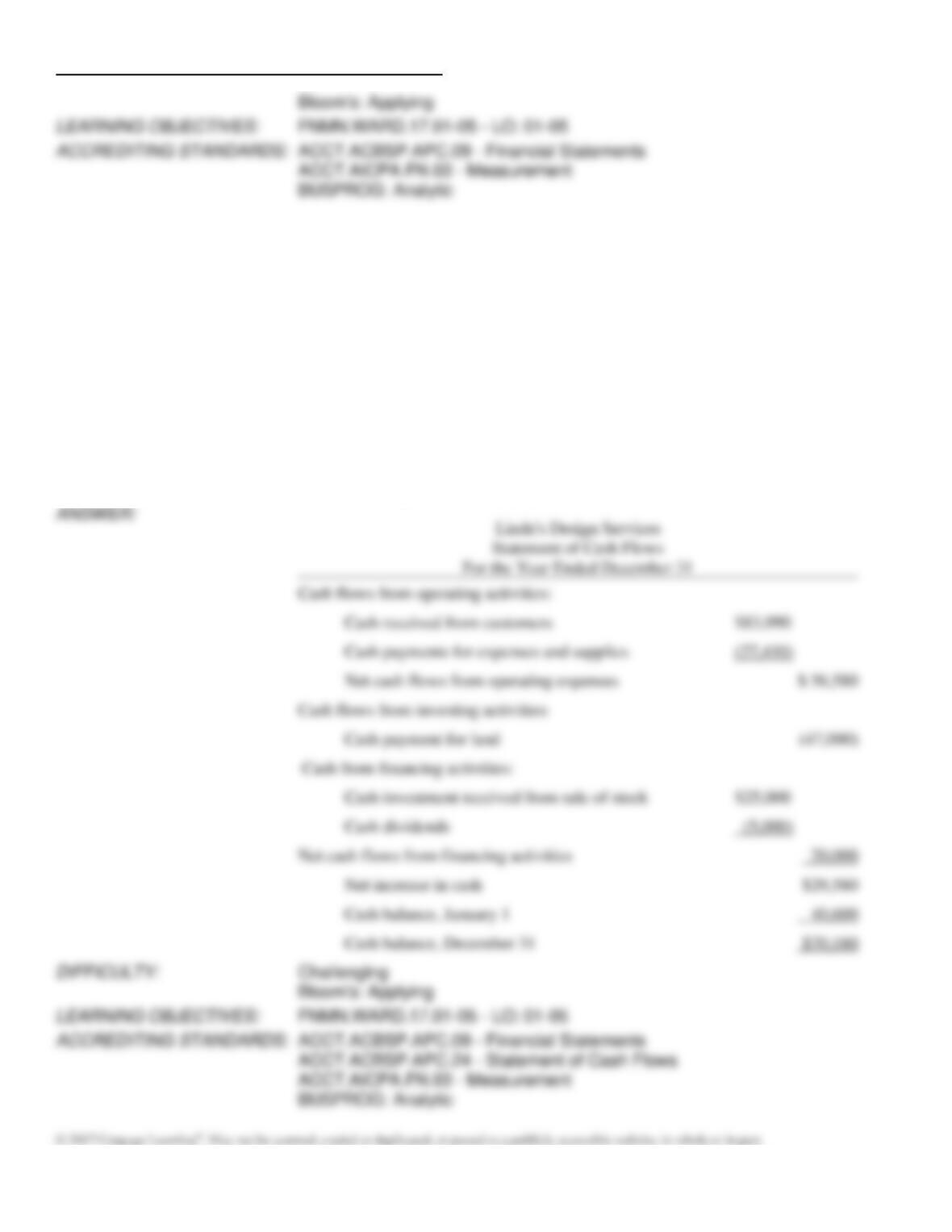
158. Prepare a balance sheet for the current year ended March 31.
Chapter 1 – Introduction to Accounting and Business
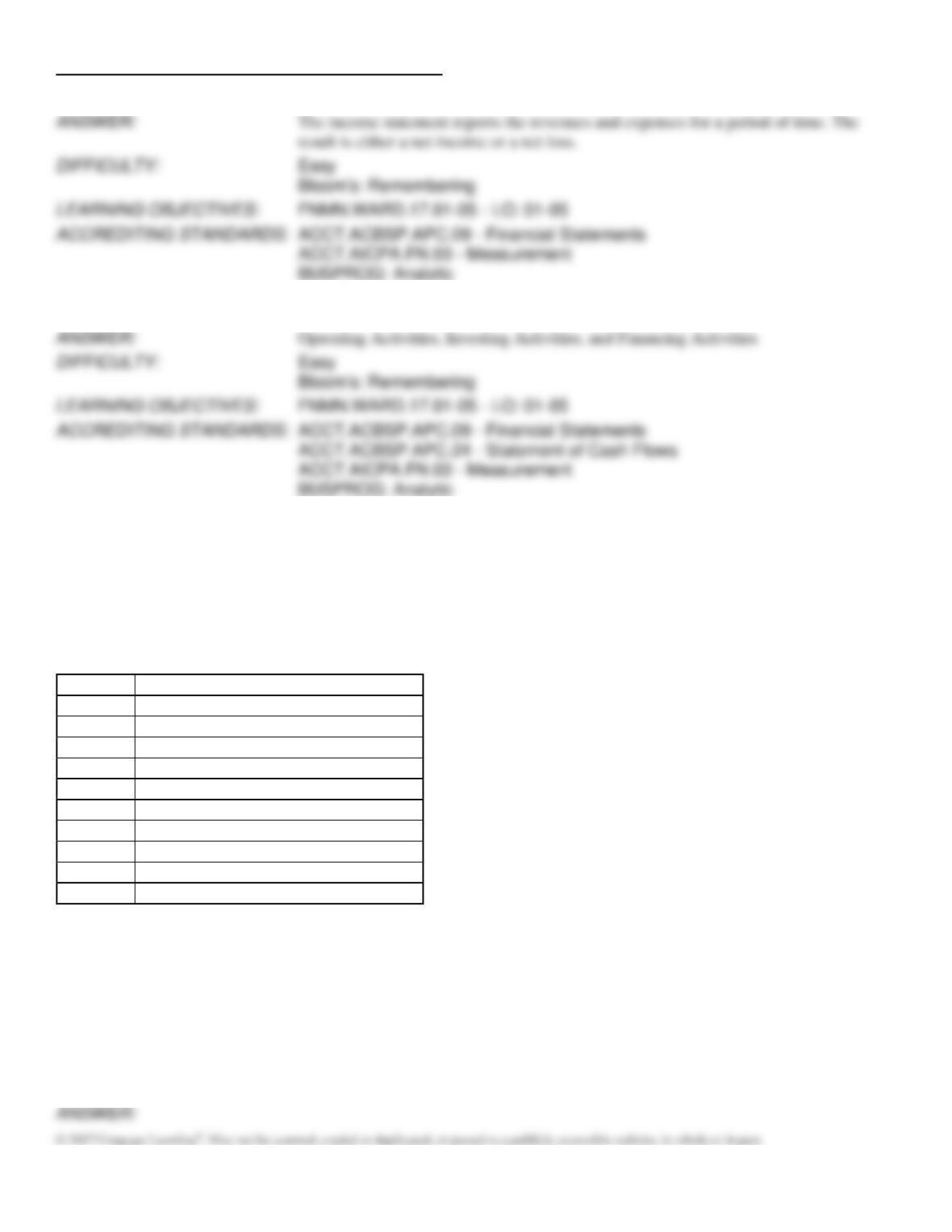
159. A summary of cash flows for Linda’s Design Services for the year ended December 31 is shown below.
Cash receipts:
Cash received from customers
$83,990
Cash received from sale of stock
25,000
Cash payments:
Cash paid for expenses
$27,000
Cash paid for land
47,000
Cash paid for supplies
410
Dividends
5,000
The cash balance as of January 1
$40,600
Prepare a statement of cash flows for Linda’s Design Services for the year ended December 31.
Chapter 1 – Introduction to Accounting and Business
160. What information does the income statement give to business users?
161. What are the three sections of the statement of cash flows?
Operating Activities, Investing Activities, and Financing Activities
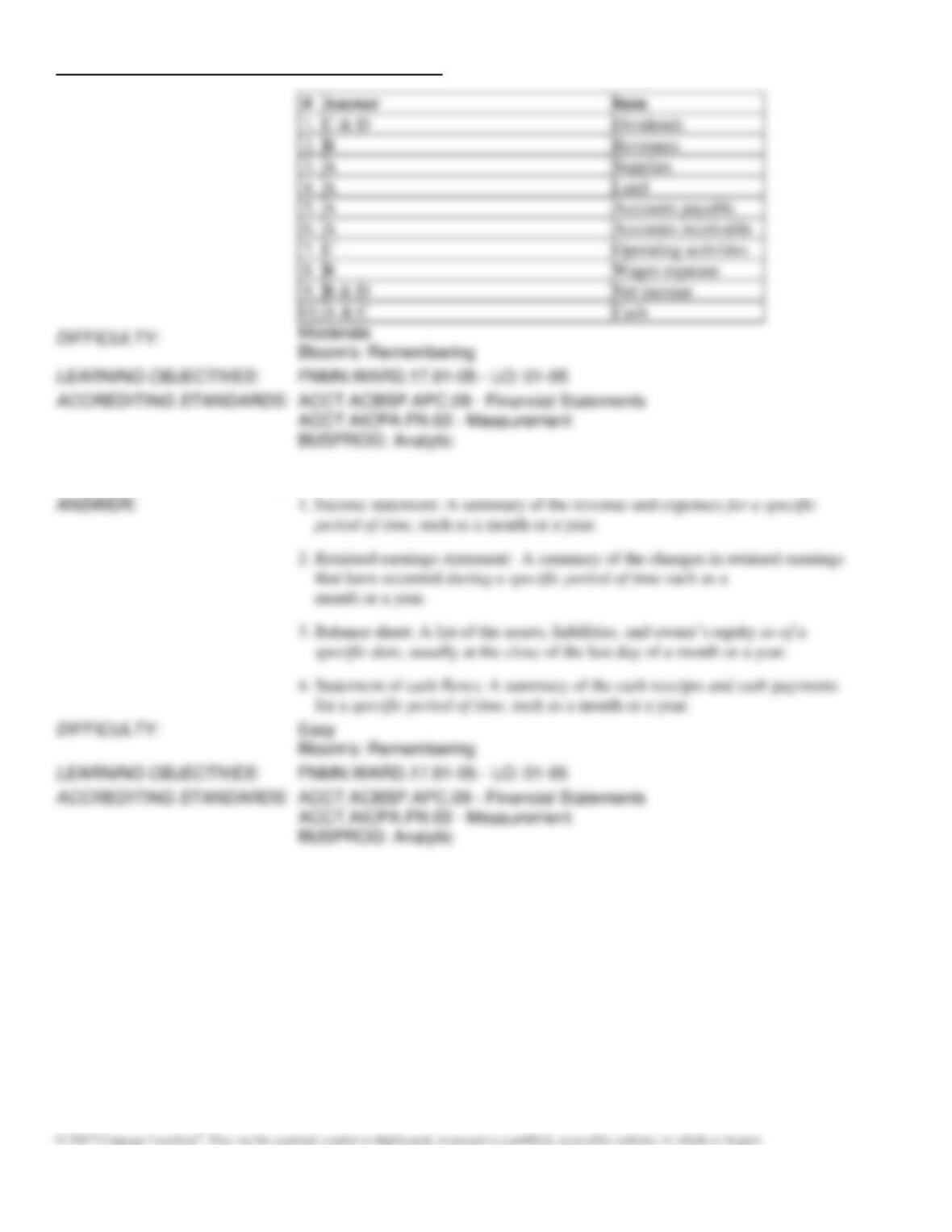
162. Match the following items to the financial statement where they can be found. (Hint: Some of the items can be found
on more than one financial statement.)
A. Balance sheet
B. Income statement
C. Statement of cash flows
D. Retained earnings statement
#
Item
1.
Dividends
2.
Revenues
3.
Supplies
4.
Land
5.
Accounts payable
6.
Accounts receivable
7.
Operating activities
8.
Wages expense
9.
Net income
10.
Cash
Chapter 1 – Introduction to Accounting and Business
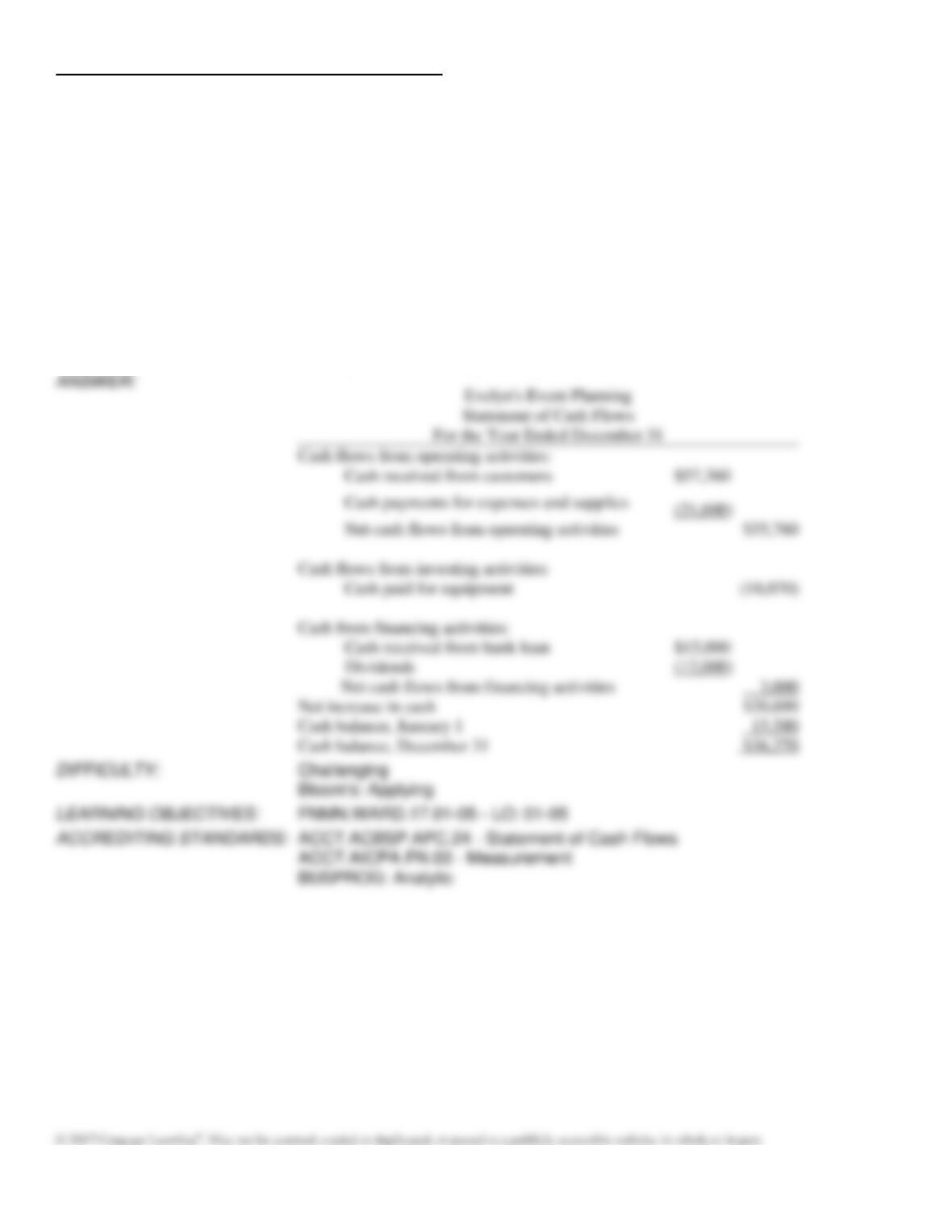
163. Name and describe the four primary financial statements for a corporation.
Chapter 1 – Introduction to Accounting and Business
164. A summary of cash flows for Evelyn’s Event Planning for the year ended December 31 is shown below.
Cash receipts:
Cash received from customers
$57,360
Cash received from bank loan
15,000
Cash payments:
Cash paid for operating expenses
$12,120
Cash paid for equipment
18,070
Cash paid for party supplies
9,480
Dividends
12,000
The cash balance as of January 1
$15,580
Prepare a statement of cash flows for Evelyn’s Event Planning for the year ended December 31.
Cash flows from operating activities:
Cash flows from investing activities:
Cash from financing activities:
Net cash flows from financing activities
Cash balance, January 1
Cash balance, December 31
Chapter 1 – Introduction to Accounting and Business
165. The assets and liabilities of Rocky’s Day Spa at December 31 and expenses for the year are listed below. The
stockholders’ equity was $68,000 ($48,000 in Common Stock and $20,000 in Retained Earnings) at January 1. The
shareholders invested in an additional $10,000 of common stock during the year. Net income for the year is $45,625.
Accounts payable
$ 4,375
Spa operating expense
$23,760
Accounts receivable
8,490
Office expense
2,470
Cash
13,980
Spa supplies
9,230
Fees earned
???
Wages expense
26,580
Spa furniture & equipment
56,000
Dividends
38,170
Computers
2,130
Prepare an income statement for Rocky’s Day Spa for the current year ended December 31.
Fees earned
Expenses:
Wages expense
Spa operating expense
Office expense
Total expenses
Bloom’s: Applying
166. The assets and liabilities of Rocky’s Day Spa at December 31 and expenses for the year are listed below. The
stockholders’ equity was $68,000 ($48,000 in Common Stock and $20,000 in Retained Earnings) at January 1. The
shareholders invested in an additional $10,000 of common stock during the year. Net income for the year is $45,625.
Accounts payable
$ 4,375
Spa operating expense
$23,760
Accounts receivable
8,490
Office expense
2,470
Cash
???
Spa supplies
9,230
Fees earned
98,435
Wages expense
26,580
Spa furniture & equipment
56,000
Dividends
38,170
Computers
2,130
Prepare a balance sheet for Rocky’s Day Spa for the year ended December 31.