
1
Chapter 1
OVERVIEW OF EMPLOYMENT LAW
Test Bank Questions, 5e
MULTIPLE CHOICE QUESTIONS
1. Sarah aged 59, has been employed by your firm for more than 26 years, and has continually
received above-average evaluations. Just before her 27th anniversary with the firm, you are
ordered by your superior, the HR Manager, to tell her that her employment with the firm is
terminated immediately. Given the facts, as presented, the issues most likely to be raised are:
a. legal
b. ethical
c. medical
d. contract
e. none of these
2. Under U.S. employment laws, employees have the right to:
a. not be fired, as long as they do a good job and the employer’s financial condition
does not require that employment levels be cut
b. be treated fairly in all aspects of the workplace, including receiving fair
compensation
c. have health insurance and other basic benefits, provided that they are full-time
employees
d. all of the above
e. none of the above
3. In order to determine which employment laws apply to a certain employer, the employer
should consider which of the following factors?
a. the number of employees that work for the company
b. whether the employer sells goods or services to the federal government
c. the state(s) in which the employer operates
d. all of the above
e. none of the above
4. Regarding the historical development of employment law in the U.S., which of the following
statements is true?
a. Most federal employment laws were passed in the first half of the 19th century in
response to growing industrialization
b. The earliest employment laws focused on wages and hours
c. Most employment laws were passed with little conflict, since the need for these
laws was evident to employers, employees and legislators.

d. The importance of employment at will has increased over time.
e. None of the above.
5. Which of the following is generally true regarding the process of enforcing employment
laws?
a. courts and government agencies hear cases only after employees come forward with
complaints about violations of the law
b. employees are very likely to seize the opportunity to sue their employers, because
all of the cost of employment litigation is borne by the employer
c. once a claim is brought, a company’s attorneys deal with it, and managers have
little involvement in the case
d. all of the above
e. none of the above
6. In Nino v The Jewelry Exchange, plaintiff bank employee sued alleging discrimination, and
his employer sought to dismiss the suit, stating that the employee had signed a mandatory
arbitration agreement, so that the suit should go to arbitration. The employee responded that
the mandatory arbitration agreement he had signed was unconscionable, and therefore,
unenforceable. Among other things, the employee alleged that the arbitration agreement was
unconscionable because gave him only 5 days to make a demand for arbitration. The court
ruled:
a. for the Plaintiff employee, because the agreement was both procedurally and
substantively unconscionable.
b. for the Plaintiff employee, because the arbitration agreement was procedurally
unconscionable.
c. for the Defendant employer, because none of the provisions of the arbitration
agreement was unconscionable.
d. for the Defendant employer because the unconscionable parts of the arbitration
agreement could be stricken, and the arbitration could proceed.
7. Under the “payroll method” approved by the U.S. Supreme Court:
a. employers whose payrolls exceed $500,000 annually are covered by Title VII
b. employers are covered by Title VII if they had at least 20 employees on the payroll
at the time of the alleged discrimination
c. employers are covered by Title VII if they had at least 15 employees working and
being paid for each working day during at least 20 weeks in the same or the
preceding year
d. employees are counted for each full week between when they are hired and when
they leave employment, regardless of the number of days or hours worked.
e. none of the above

3
8. Regarding arbitration, which of the following statements is true?
a. historically, arbitration has been used to resolve disputes over contractual rights
b. arbitrators’ decisions are usually advisory and not considered final
c. arbitrators have less control over the outcomes of disputes than do mediators.
d. arbitration is always more costly and time-consuming than litigation
e. none of these
9. Regarding the interrelationship of federal and state employment laws:
a. state laws must be identical to federal law or the state law is void
b. states may pass laws which reduce employee rights, but may not enact laws that
expand employee protections granted in federal laws
c. states may pass laws which expand employee rights, but may not enact laws that
reduce employee protections granted in federal laws
d. employment law is exclusively a federal domain, so states may not enact laws when
federal law already exists
10. In Casias v. Wal-Mart Stores, plaintiff Casias, a cancer patient and Wal-Mart employee, was
prescribed medical marijuana for his symptoms by his physician, pursuant to the state’s new
medical marijuana law. Upon being injured at work, he was given a blood test which showed
marijuana in his system. He was fired, and sued for wrongful termination. The court ruled:
a. for the Plaintiff because he had a valid state medical marijuana registry card to
show that he was authorized to use medical marijuana
b. for the Plaintiff because he did not cause his own injury at work
c. for Wal-Mart, because the state law did not change employment-at-will
d. for Wal-Mart, because plaintiff’s marijuana use led to his injury
11. In EEOC v AutoZone, the EEOC sued AutoZone on behalf of an employee who suffered
injury and disability because his employer would not provide a reasonable accommodation
for his disability. Fed Ex argued that the damages awarded by the jury were too high, and
also offered evidence of its ADA compliance policy set forth in the employee manual. The
court ruled:
a. for the defendant AutoZone, since the establishment of an ADA compliance policy
was sufficient to establish a good faith effort to comply with the ADA
b. for the defendant AutoZone, because plaintiff had not established that he suffered
from a disability
c. for the plaintiff because the damages awarded were consistent with the damages
awarded in other cases
d. for the plaintiff because he established that he suffered from a disability
12. Which of the following is true regarding enforcement of employee rights and enforcement of
employment laws?

4
a. finding a lawyer willing to take an employment law case is difficult because
lawyers accept only about 50% of employment discrimination cases brought to
them
b. if an employer has a complaint or grievance procedure, the employee is required to
exhaust the remedies afforded under the internal procedure before taking the case to
an enforcement agency or court
c. the EEOC encourages the parties to discrimination cases to use mediation
d. the EEOC encourages the parties to discrimination cases to use arbitration
13. An employer considering whether to use mandatory arbitration agreements should recognize
which of the following limitations of their use?
a. the agreements probably won’t apply to any of its unionized employees
b. the agreements will not deter the EEOC from investigating and possibly litigating to
recover remedies for individuals
c. the agreements may not be enforceable if they do not provide employees with the
same remedies as those available through the courts
d. all of the above
e. none of the above
14. Which of the following is true of the enforcement process for discrimination charges brought
under Title VII?
a. the plaintiff may choose to begin in the state civil rights agency, or may file directly
with the EEOC as they wish
b. charges must be brought within 60 days of the alleged discriminatory act
c. a right to sue letter must be obtained from the EEOC before a plaintiff can file suit
in court
d. all of the above
e. none of the above
15. A mandatory arbitration agreement which provides that all claims be brought within 90 days
of the date of the alleged violation would likely be:
a. enforceable
b. unenforceable
c. subject to amendment by the court
16. Dean got a job as a copyrighter for a publishing firm, and after working for the firm for two
years, was told he was required to sign a mandatory arbitration agreement and agree to
submit any employment disputes to binding arbitration. Dean was also told that if he would
not sign it as is, he would be fired. Dean:
a. will have to sign the agreement if he wants to keep his job
b. does not have to sign the agreement, and can still keep his job

17. The contract referred to in Question #16 above is:
a. procedurally unconscionable
b. substantively unconscionable
c. neither of these
d. both of these
18. Which of the following provisions, if included in a mandatory arbitration agreement, would
be likely to render it unenforceable?
a. a provision that the employee pay the costs of the arbitrator’s services
b. a provision that gives the employer the right to choose any arbitrator
c. a provision that bars all discovery
d. a provision that requires the employee to prove his case
e. all of these
f. all of these except d
19. As the Human Resources manager of your firm, the task of putting into effect the firm’s new
mandatory arbitration agreement has fallen to you. At a minimum, legally, which of the
following actions are required to make the policy enforceable?
a. send email notice to all employees that a mandatory arbitration policy has been
adopted
b. post the mandatory arbitration policy on the firm’s website, and ask employees to
visit the site and review the policy
c. provide employees with a copy of the agreement, and ask them to sign it
d. make certain that the agreement provides, and the employees understand, that they
are waiving their rights to sue
e. all of these are legally required
f. none of these are legally required
g. only c and d are legally required
20. Your firm has just gotten a contract with the U.S. government to build security gates for the
fence along the U.S.-Mexican border. In addition to the employment laws which already
apply to your business, the following will now also apply:
a. Title IX
b. the Federal Security Fence Funding Act of 2008
c. EO # 11246
d. all of these
e. none of these
ESSAY QUESTIONS
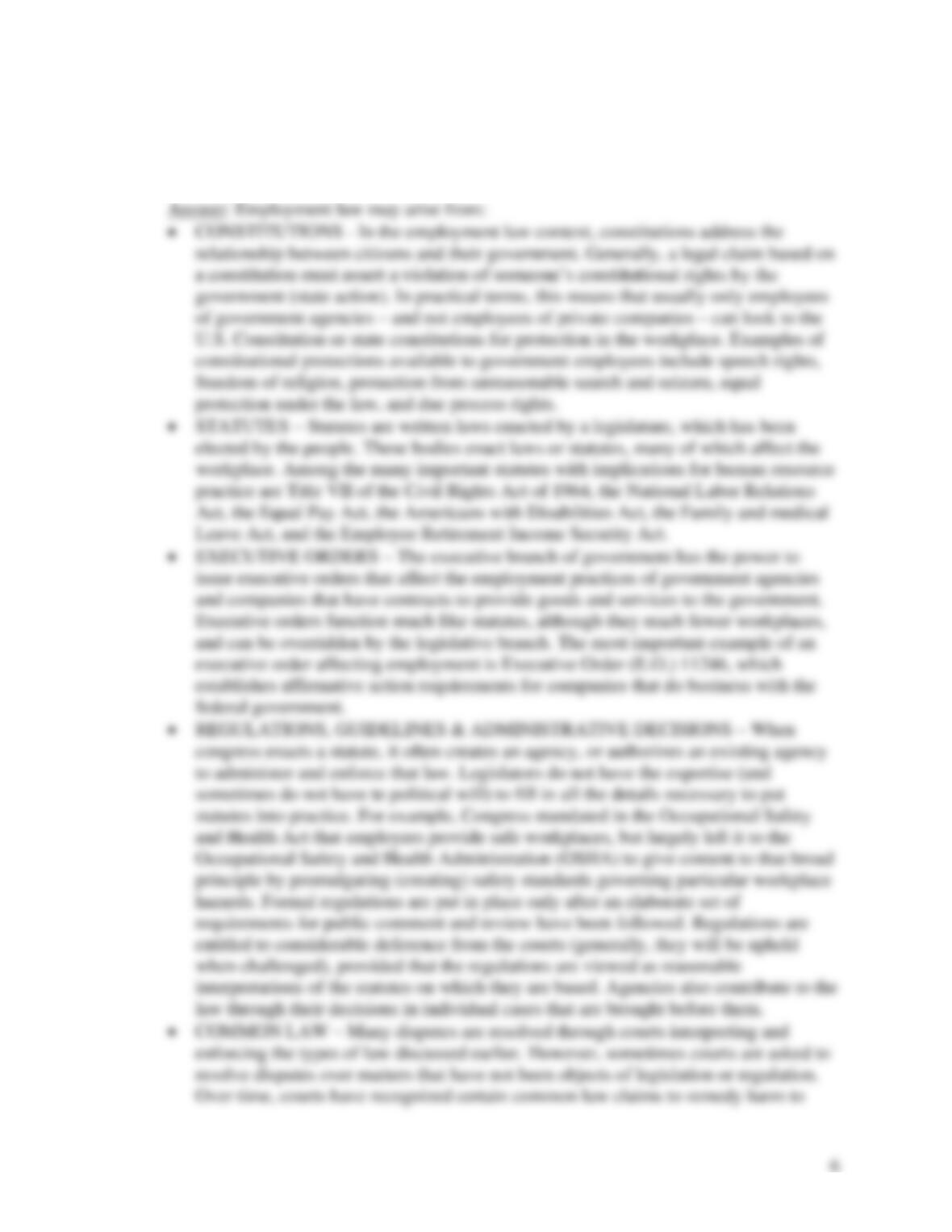
1. Employment law arises from a variety of sources. Name and briefly discuss each of them.
2. Describe what the role of a good human resources manager should be in managing
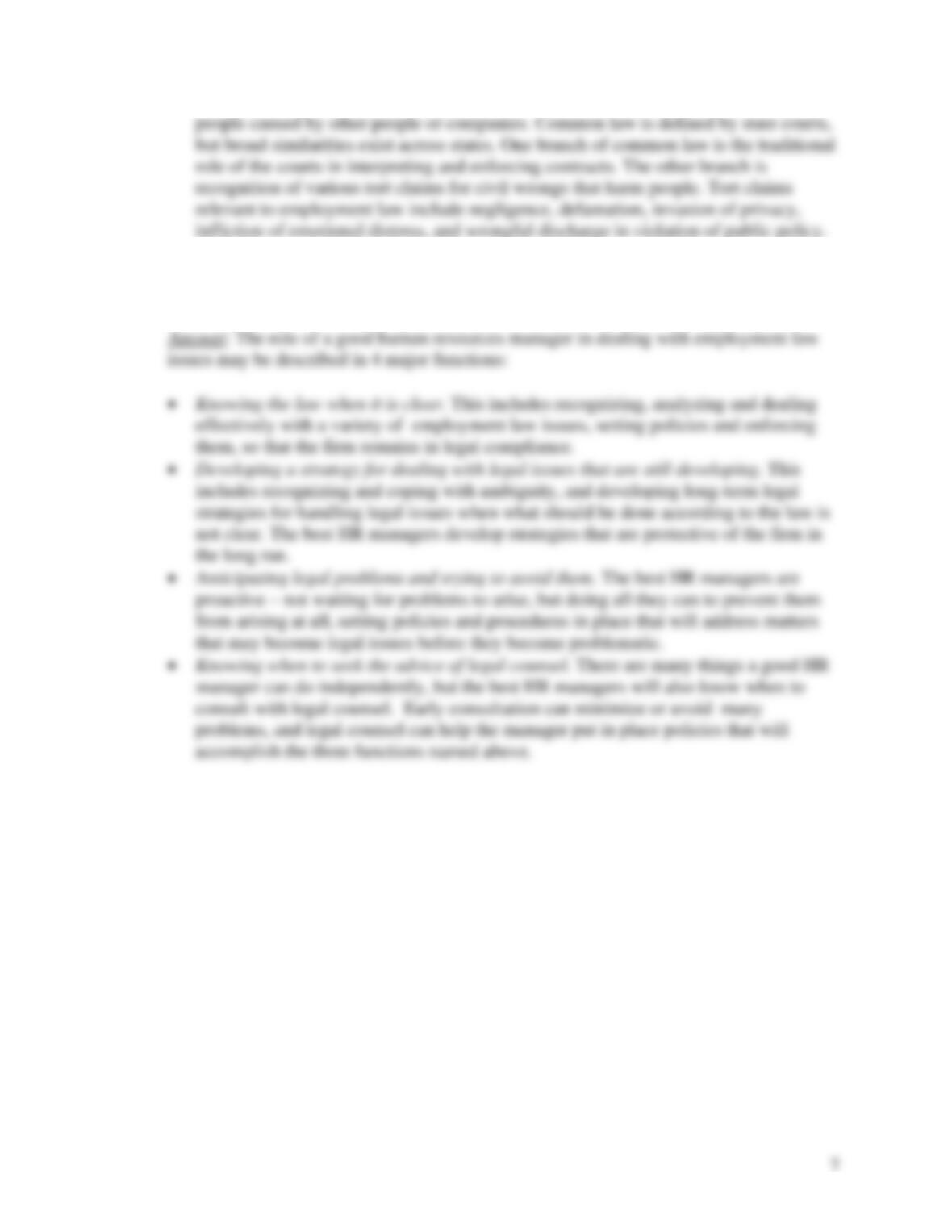
employment law issues.