Chapter 1: Data and Decisions– Quiz A Name_________________________
1.1.1 Identify various aspects of studies and experiments and/or classify variables.
1. Viamedia, the cable industry’s leading independent cable rep firm and provider of
online advertising services, sponsored an online survey in June, 2013 to understand
television viewing habits. The survey was given to 2,029 American adults age 18 and
older, of whom 1,958 watch television programming. Of interest was how Americans
watched television –72% watch cable TV while 33% watch on a device (tablet,
smartphone, computer). Describe the W’s for the information given.
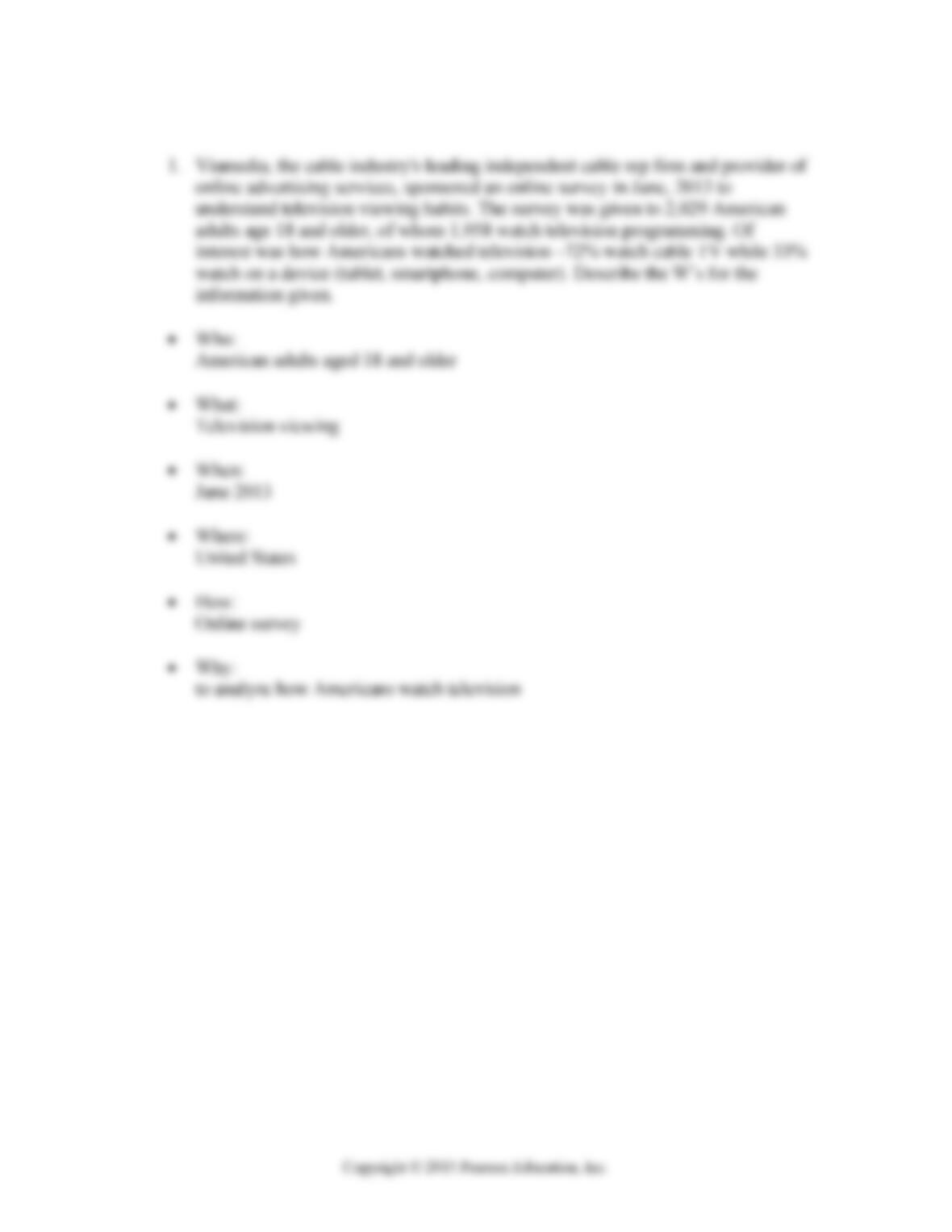
• Who:
• What:
• When:
• Where:
• How:
• Why:
1.2.2 Identify various aspects of studies and experiments and/or classify variables.
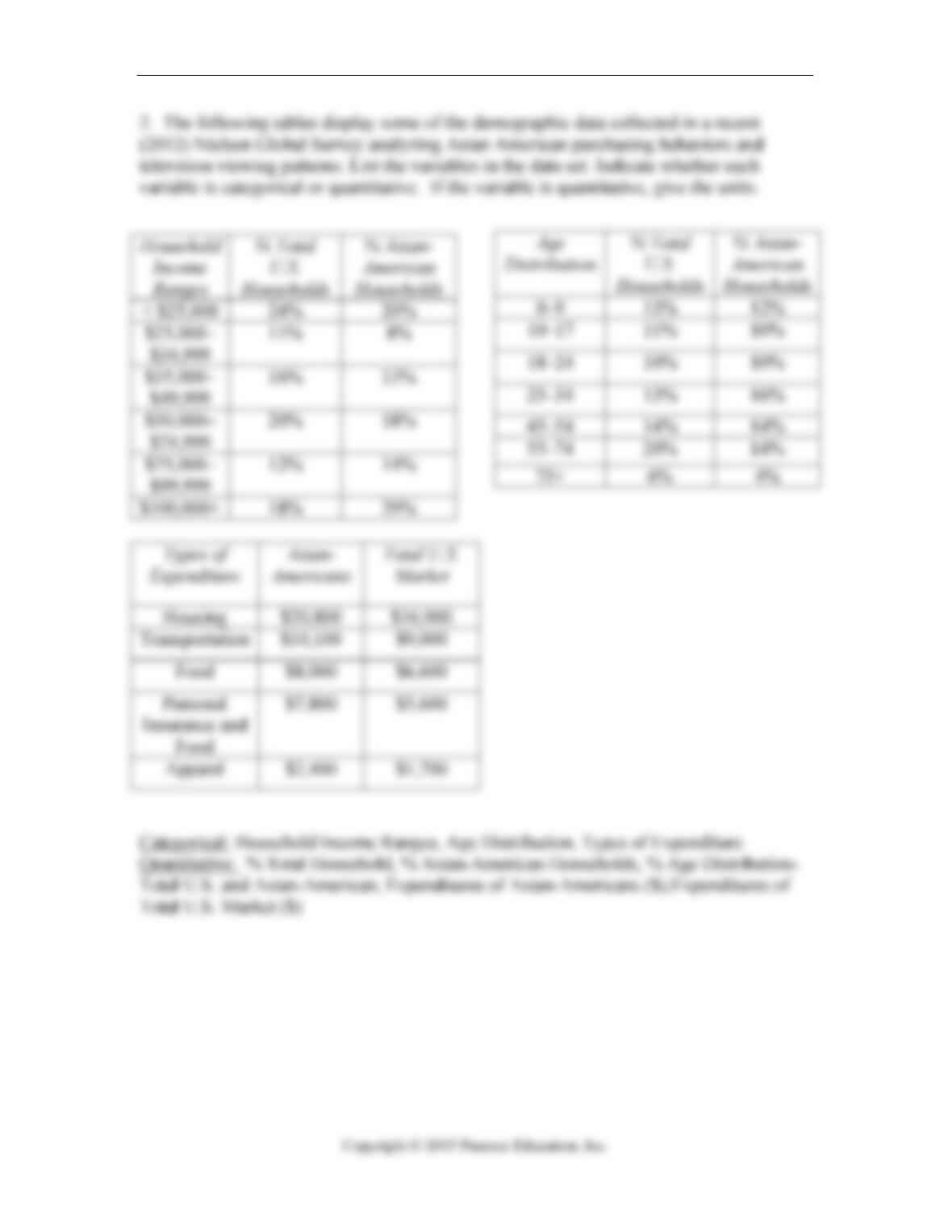
2. The following tables display some of the demographic data collected in a recent
(2012) Nielsen Global Survey analyzing Asian American purchasing behaviors and
television viewing patterns. List the variables in the data set. Indicate whether each
variable is categorical or quantitative. If the variable is quantitative, give the units.
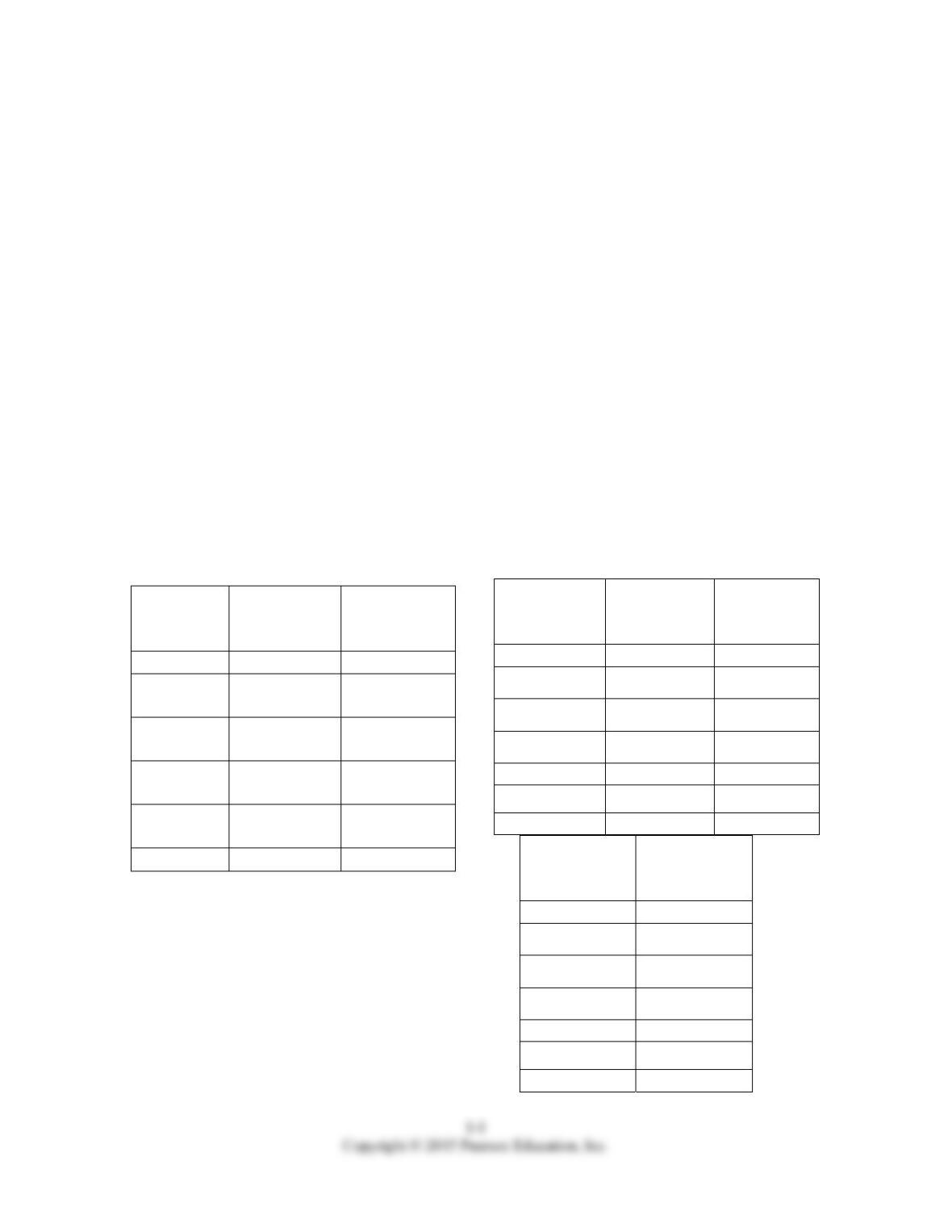
Age
Distribution
% Total
U.S.
Households
% Asian-
American
Households
0–9 13% 12%
10–17 11% 10%
18–24 10% 10%
25–34 13% 16%
45–54 14% 14%
55–74 20% 14%
75+ 6% 4%
Income
Ranges
% Total
U.S.
Households
% Asian-
American
Households
< $25,000 24% 20%
$25,000–
$34,999
11% 8%
$35,000–
$49,999
16%
13%
$50,000–
$74,999
20% 18%
$75,000–
$99,999
12% 14%
$100,000+ 18% 29% Composition
of Asian-
Americans
%
Composition
Asian-Indian 19%
Vietnamese 11%
Chinese 23%
Korean 10%
Filipino 17%
Japanese 5%
Other Asian 15%

1-2 Chapter 1 Data and Decisions
1.2.1 Identify various aspects of studies and experiments and/or classify variables.
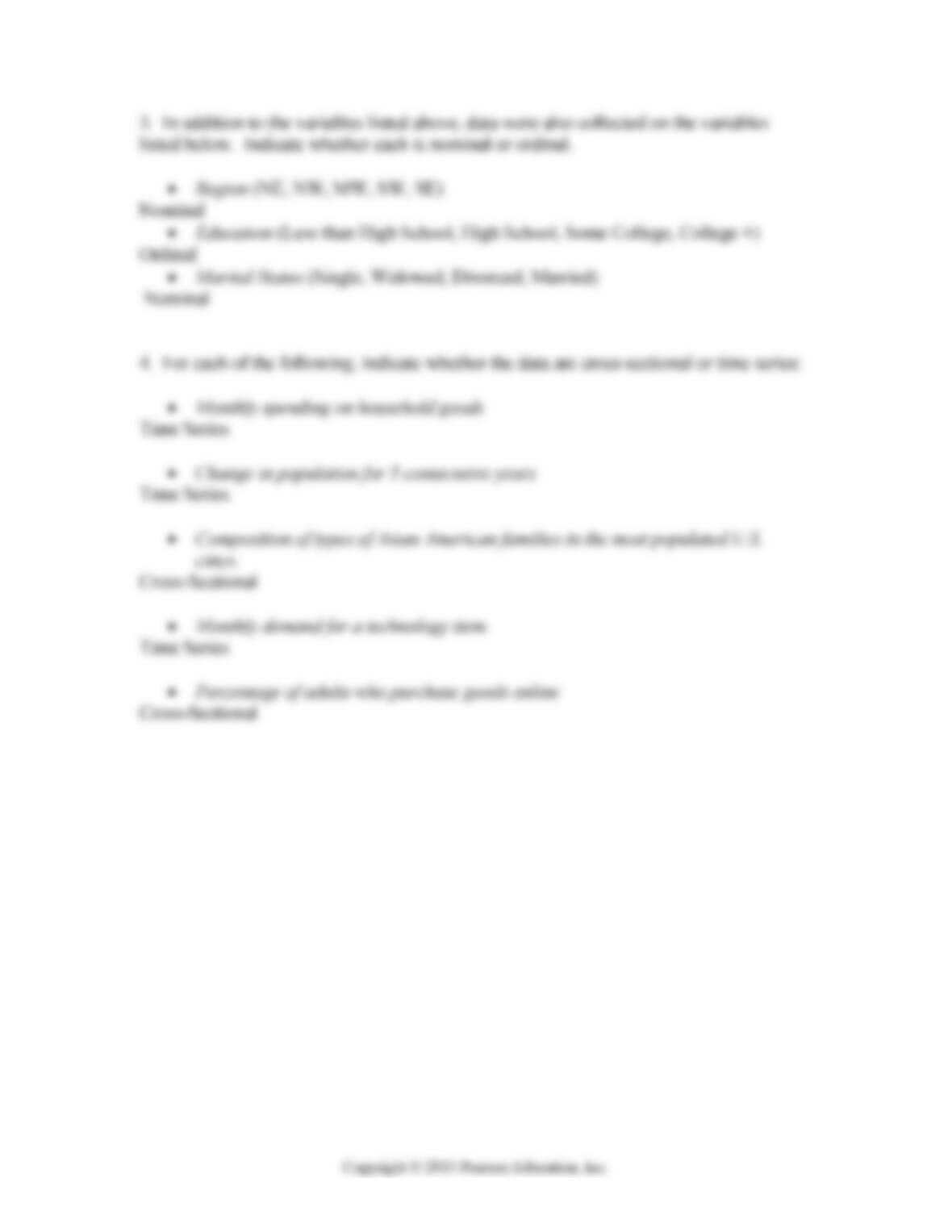
3. In addition to the variables listed above, data were also collected on the variables
listed below. Indicate whether each is nominal or ordinal.
• Region of U.S. (NE, NW, MW, SW, SE)
• Education (Less than High School, High School, Some College, College +)
• Marital Status (Single, Widowed, Divorced, Married)
1.2.3 Identify various aspects of studies and experiments and/or classify variables.
4. For each of the following, indicate whether the data are cross-sectional or time series:
• Monthly spending on household goods
• Change in population for 5 consecutive years
• Percentage of adults who bank online
• Composition of types of Asian American families in the most populated U.S.
cities.
• Monthly demand for a technology item
• Percentage of adults who purchase goods online
Quiz A 1-3
Chapter 1: Data and Decisions – Quiz A – Key
1-4 Chapter 1 Data and Decisions
Quiz A 1-5

1-6 Chapter 1 Data and Decisions
Chapter 1: Data and Decisions – Quiz B Name_________________________
1.1.1 Identify various aspects of studies and experiments and/or classify variables.
1. Consumer Reports Health routinely compares drugs in terms of effectiveness and
safety. In summer 2008 they reviewed drugs used to treat arthritis. Information was
reported on convenience of use (how many pills required each day), possible side effects
(e.g., dizziness, stomach upset), cost, and ratings of effectiveness in relieving symptoms
(very effective, somewhat effective, not effective). Describe the W’s for the information
given.
• Who:
• What:
• When:
• Where:
• How:
• Why:
1.2.1 Identify various aspects of studies and experiments and/or classify variables.
2. List the variables reported in the Consumer Reports Health article on drugs used to
treat arthritis. If the variable is quantitative, give the units. If the variable is categorical,
indicate whether it is nominal or ordinal.
1.2.2 Identify various aspects of studies and experiments and/or classify variables.
3. The Human Resources Department of a large corporation maintains records on its
employees. The table displays some of these data. List the variables in the data set.
Indicate whether each variable is categorical or quantitative. If the variable is
quantitative, give the units. If the variable is categorical, indicate whether it is nominal or
ordinal.
Age Employment
Category
Education Participates in
Wellness Program?
Paycheck Benefit
Deductions
32 Clerical High School Yes $250
52 Professional College No $120
60 Professional Junior College Yes $0
28 Clerical High School No $120
1.2.3 Identify various aspects of studies and experiments and/or classify variables.
4. For each of the following, indicate whether the data are cross-sectional or time series:
• Company quarterly profits
• Percentage of American adults who work full time
• Historical closing stock prices
Quiz B 1-7
Chapter 1: Data and Decisions – Quiz B – Key
1-8 Chapter 1 Data and Decisions

Quiz C 1-9
Chapter 1: Data and Decisions – Quiz C Name_________________________
1.1.1 Identify various aspects of studies and experiments and/or classify variables.
1. Consumer Reports National Research Center routinely compares products and
services. A poll of more than 1,800 U.S. residents was conducted shortly after the 2008
holiday season. What they found was that fewer people than in the previous year tipped
their service providers (newspaper carrier, barber, mail carrier, hairdresser, garbage
collector) or the amount that consumers tip for specific services was reduced..
Information was reported on the type of service, whether a tip or gift was given, and the
median total value of the tip. Describe the W’s for the information given.
• Who:
• What:
• When:
• Where:
• How:
• Why:
1.2.1 Identify various aspects of studies and experiments and/or classify variables.
2. List the variables reported in the Consumer Reports Magazine article on tipping. If
the variable is quantitative, give the units. If the variable is categorical, indicate whether
it is nominal or ordinal.
1.2.2 Identify various aspects of studies and experiments and/or classify variables.
3. Businesses in a U.S. city were surveyed about information to provide to prospective
employees after graduating from business school. The table displays some of these data.
List the variables in the data set. Indicate whether each variable is categorical or
quantitative. If the variable is quantitative, give the units. If the variable is categorical,
indicate whether it is nominal or ordinal.
Employment
Category
Require an MBA
Degree?
Prefer Graduates
with Work
Experience?
Median Salary of
New Graduates
Sales No No $35,000
Management Yes Yes $47,000
Accounting No Yes $52,000
Advertising No No $45,000
1.2.3 Identify various aspects of studies and experiments and/or classify variables.
4. For each of the following, indicate whether the data are cross-sectional or time series:
• Dow Jones Index
• Eating habits by age group
• Attitudes toward abortion over past 10 years
• Voting behavior data for a particular neighborhood
1-10 Chapter 1 Data and Decisions
Chapter 1: Data and Decisions – Quiz C – Key
Quiz C 1-11

1-12 Chapter 1 Data and Decisions
Chapter 1: Data and Decisions – Quiz D – Multiple Choice
Name________________________
1.1.1 Identify various aspects of studies and experiments and/or classify variables.
1. In the fall of 2007, the Pew Internet & Life Project conducted telephone interviews
with a sample of American adults aged 18 and older about online shopping. American
adults aged 18 and older constitute the ______ of the study.
A. Who
B. What
C. When
D. Where
E. How
1.2.1 Identify various aspects of studies and experiments and/or classify variables.
2. A few of the variables for which data were collected in the Pew Internet & Life
Project study about online shopping include age, gender, income, and number of hours
spent shopping online per month. Which of the variables is categorical?
A. Age
B. Gender
C. Income
D. Number of hours spent shopping online
E. None
1.2.1 Identify various aspects of studies and experiments and/or classify variables.
3. The Pew Internet & Life Project study about online shopping asked respondents to
indicate their education level on the following scale: Less than High School, High
School, Some College, College +. Which of the following statements is (are) true?
A. Education level is a categorical variable.
B. Education level is nominal scaled.
C. Education level is ordinal scaled.
D. Both A and B
E. Both A and C

Quiz D 1-13
1.1.1 Identify various aspects of studies and experiments and/or classify variables.
4. Consumer Reports Health routinely compares drugs in terms of effectiveness and
safety. In summer 2008 they reviewed drugs used to treat arthritis. Among the
information reported was convenience of use (how many pills required each day) and
possible side effects (e.g., dizziness, stomach upset). Convenience of use and possible
side effects constitute the ________ of the study.
A. Who
B. What
C. When
D. Where
E. How
1.1.1 Identify various aspects of studies and experiments and/or classify variables.
5. What is the “Who” in a Consumer Reports Health study on the effectiveness and
safety of drugs used to treat arthritis?
A. drugs to treat arthritis currently on the market
B. convenience of use and possible side effects
C. summer 2008
D. the United States
E. testing on drugs
1.2.1 Identify various aspects of studies and experiments and/or classify variables.
6. A Consumer Reports Health study on the effectiveness and safety of arthritis drugs
collected data on possible side effects. This is what kind of variable?
A. Quantitative
B. Categorical
C. Nominal
D. Both A and C
E. Both B and C
1.2.1 Identify various aspects of studies and experiments and/or classify variables.
7. A Consumer Reports Health study on arthritis drugs takes into consideration cost.
Cost is
A. is a nominal variable.
B. is a categorical variable.
C. is a quantitative variable.
D. is an ordinal variable.
E. is an irrelevant variable.

1-14 Chapter 1 Data and Decisions
1.2.1 Identify various aspects of studies and experiments and/or classify variables.
8. The Human Resources Department of a large corporation maintains records on its
employees. Data are maintained of the following variables: Age, Employment Category,
Education, Whether or not the employee participates in a wellness program, and
Paycheck benefit deductions. Which of these variables are categorical?
A. Age, Employment Category, and Education
B. Employment Category, Education, and Whether or not the employee participates in
a wellness program
C. Education, Whether or not the employee participates in a wellness program, and
Paycheck benefit deductions
D. All of the variables
E. None of the variables
1.2.3 Identify various aspects of studies and experiments and/or classify variables.
9. Which of the following is (are) based on cross sectional data?
A. Company quarterly profits
B. Percentage of American adults who work full time
C. Historical closing stock prices
D. All of the above
E. None of the above.
1.2.3 Identify various aspects of studies and experiments and/or classify variables.
10. Which of the following is (are) time series data?
A. Weekly receipts at a clothing boutique
B. Monthly demand for an automotive part
C. Quarterly sales of automobiles
D. All of the above
E. None of the above

Quiz D 1-15
Chapter 1: Data and Decisions – Quiz D – Key

1-16 Chapter 1 Data and Decisions
Chapter 1: Data and Decisions – Quiz E – Multiple Choice
Name___________________
1.1.1 Identify various aspects of studies and experiments and/or classify variables.
1. A university is interested in gauging student satisfaction in its online MBA program.
A survey is designed and administered via the Internet to a sample of students currently
active in the program. Which of the following would best describe the cases?
A. Participants
B. Respondents
C. Experimental Units
D. Subjects
E. Variables
1.2.1 Identify various aspects of studies and experiments and/or classify variables.
2. In a survey undertaken by a university to gauge student satisfaction in its online MBA
program, one question asked students to indicate their employment status (unemployed,
employed part-time, employed full-time). Which of the following is true?
A. This variable is categorical.
B. This variable is quantitative.
C. This is an identifier variable.
D. Both A and C.
E. Both B and C.
1.2.1 Identify various aspects of studies and experiments and/or classify variables.
3. In a survey undertaken by a university to gauge student satisfaction in its online MBA
program, one question asked students to indicate the number of credits they had
transferred into the program. Which of the following is true?
A. This variable is categorical.
B. This variable is transactional.
C. This variable is quantitative.
D. This is an identifier variable.
E. This variable is nominal.

Quiz E 1-17
1.1.1 Identify various aspects of studies and experiments and/or classify variables.
4. Researchers in e-commerce design an experiment to determine what factors are most
important to online consumers when completing a transaction via the Internet.
Individuals perform tasks on a set of Web sites and record their impressions about
various attributes. Which of the following would best describe the cases?
A. Participants
B. Respondents
C. Experimental Units
D. Transactions
E. Variables
1.2.1 Identify various aspects of studies and experiments and/or classify variables.
5. A popular travel magazine regularly reviews hotels worldwide. In a recent issue, it
focused on hotels in Hawaii. Among the variables for which it provided data was
whether or not the hotel included a spa. This is a
A. quantitative variable.
B. identifier variable.
C. ordinal variable.
D. categorical variable.
E. transactional variable.
1.2.1 Identify various aspects of studies and experiments and/or classify variables.
6. A popular travel magazine regularly reviews hotels worldwide. In a recent issue, it
focused on hotels in Hawaii. Among the variables for which it provided data was the
price range for rooms with an ocean view. Which of the following statements is true?
A. These data are transactional.
B. This variable is quantitative and the units are $.
C. This variable is quantitative and the units are number of rooms.
D. This variable is qualitative and ordinal.
E. These data are time series.
1.2.1 Identify various aspects of studies and experiments and/or classify variables.
7. A mid-priced chain of hotels, Hometown Suites, strives to make its guests “feel at
home” by providing amenities such as microwaves in every room. Comment cards are
used to get feedback on the importance of such amenities by asking guests to rate them
using the scale: ___ Essential ___ Important ___ Not Important. These data are
A. qualitative.
B. nominal.
C. ordinal.
D. both A and B.
E. both A and C.

1-18 Chapter 1 Data and Decisions
1.3.1 Identify various aspects of studies and experiments and/or classify variables.
8. A locally owned spa, Alexander’s, is interested in adding a tea room that not only
offers specialty teas but an organic lunch menu. In order to determine how many of its
regular customers would be interested in such an addition, Alexander’s sent out a short e-
mail questionnaire. The source of these data is
A. the Internet.
B. transactional.
C. a designed survey.
D. a designed experiment.
E. secondary.
1.2.3 Identify various aspects of studies and experiments and/or classify variables.
9. A locally owned spa, Alexander’s, is interested in adding a tea room that not only
offers specialty teas but an organic lunch menu. In order to determine how many of its
regular customers would be interested in such an addition, Alexander’s sent out a short e-
mail questionnaire. One question asked its customers to indicate how much they spend
monthly on all natural, organic products. These data are
A. cross-sectional.
B. time series.
C. categorical.
D. transactional.
E. experimental.
1.2.3 Identify various aspects of studies and experiments and/or classify variables.
10. A mid-priced chain of hotels, Hometown Suites, collects data on monthly occupancy
rates for forecasting and planning purposes. These data are
A. cross-sectional.
B. time series.
C. categorical.
D. transactional.
E. experimental.
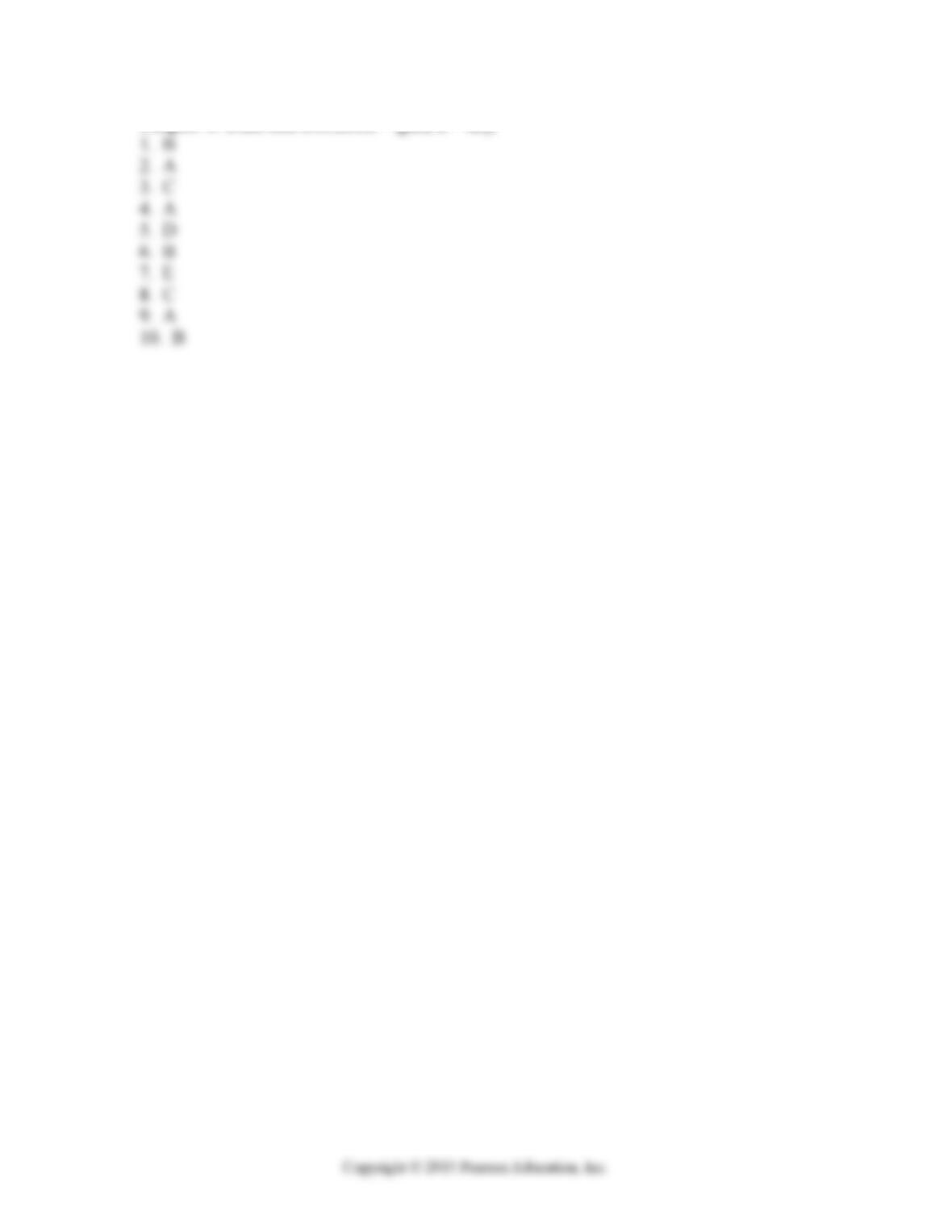
Quiz E 1-19
Chapter 1: Data and Decisions – Quiz E – Key

1-20 Chapter 1 Data and Decisions
Chapter 1: Data and Decisions – Quiz F– Multiple Choice
Name___________________
1.1.1 Identify various aspects of studies and experiments and/or classify variables.
1. In June, 2013, Viamedia sponsored an online survey to sample a group of American
adults aged 18 and older about watching television. American adults aged 18 and older
constitute the ______ of the study.
A. Who
B. What
C. When
D. Where
E. How
1.2.1 Identify various aspects of studies and experiments and/or classify variables.
2. A few of the variables for which data were collected in the Viamedia survey about
television viewing include age, gender, income, and type of device used to watch
television. Which of the variables is categorical?
A. Age
B. Type of device used to watch television
C. Income
D. All
E. None
1.2.1 Identify various aspects of studies and experiments and/or classify variables.
3. The data collected in a recent (2012) Nielsen Global Survey analyzed Asian American
demographics. Which of the following statements is (are) true?
A. Education level is a categorical variable.
B. Education level is nominal scaled.
C. Education level is ordinal scaled.
D. Both A and B
E. Both A and C
1.1.1 Identify various aspects of studies and experiments and/or classify variables.
4. Businesses are interested in the work experience of recent graduates from a local
business school. Whether or not the graduates have work experience constitutes the
________ of the study.
A. Who
B. What
C. When
D. Where
E. How

Quiz F 1-21
1.1.1 Identify various aspects of studies and experiments and/or classify variables.
5. What is the “What” in a Consumer Reports Tipping study on the level of tipping
during the current holiday season compared to the last holiday season?
A. whether or not tipped
B. amount of tip compared to last year
C. the type of tip
D. the United States
1.2.1 Identify various aspects of studies and experiments and/or classify variables.
6. A Consumer Reports survey on the level of tipping for service providers. This is what
kind of variable?
A. Quantitative
B. Ordinal
C. Nominal
D. Both A and C
E. Both B and C
1.2.1 Identify various aspects of studies and experiments and/or classify variables.
7. A Consumer Reports study on tipping takes into consideration median amount of
tipping for service providers. Tipping is
A. is a nominal variable.
B. is a categorical variable.
C. is a quantitative variable.
D. is an ordinal variable.
E. is an irrelevant variable.
1.2.1 Identify various aspects of studies and experiments and/or classify variables.
8. The Human Resources Department of a large corporation maintains records on its
employees. Data are maintained of the following variables: Age, Employment Category,
Education, and Whether or not the employee has an advanced degree. Which of these
variables are categorical?
A. Age, Employment Category, and Education
B. Employment Category and Education
C. Education and Whether or not the employee has an advanced degree
D. All of the variables
E. None of the variables

1-22 Chapter 1 Data and Decisions
1.2.3 Identify various aspects of studies and experiments and/or classify variables.
9. Which of the following is (are) based on cross sectional data?
A. Company quarterly profits
B. Percentage of American adults who work full time
C. Dow Jones Index
D. All of the above
E. None of the above.
1.2.3 Identify various aspects of studies and experiments and/or classify variables.
10. Which of the following is (are) time series data?
A. Monthly receipts at an apparel shop
B. Monthly demand for a technology item
C. Dow Jones Index
D. All of the above
E. None of the above

Quiz F 1-23
Chapter 1: Data and Decisions – Quiz F – Key