Chapter 1: The Role of Accounting Information in Management
Decision Making
Learning Objective
True /
False
Multiple Choice
Matching
Exercises
Short
Answer
Problems
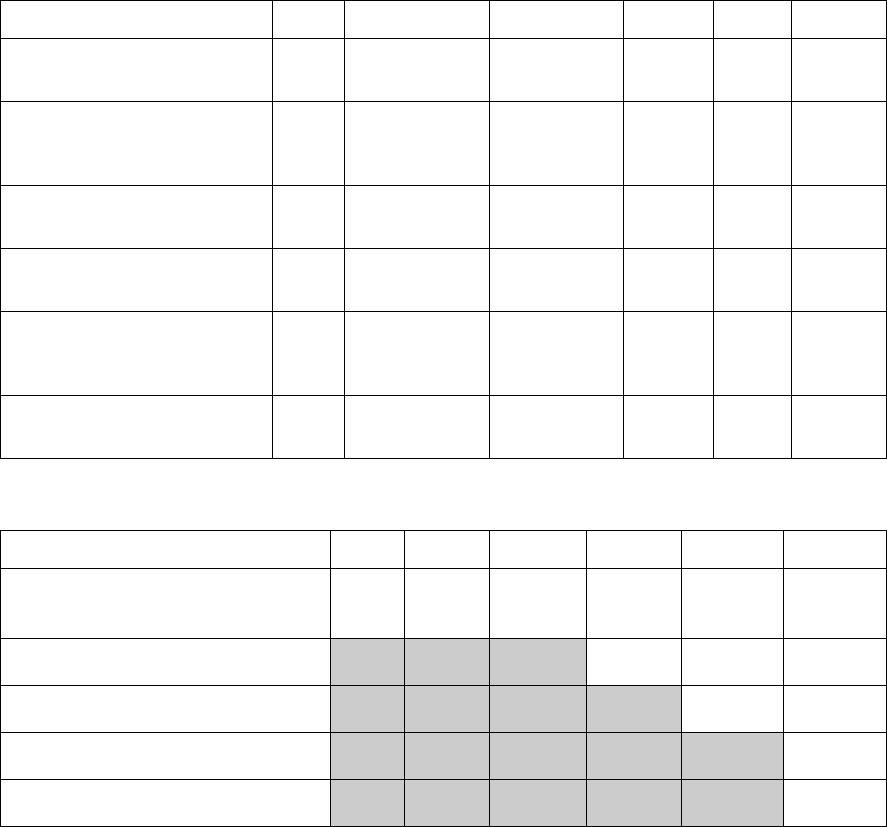
Q1: What types of decisions do
managers make for an
organization?
1-4
1-12
S: 59, 67
W: 78, 83, 84
1
6
Q2: What is the role of
accounting information in
management decision
making?
5-9
13-20, 32
S: 60-62
W: 68-70, 80
3
3, 4
Q3: How do uncertainties and
biases affect the quality of
decisions?
10–13
21–30
W: 72, 73
2
1, 5, 7
1
Q4: How can managers make
higher-quality decisions?
14–18
31, 34-44
S: 58
W: 71
2
4
Q5: What information is relevant
for decision making?
19–22
45–51
S: 63-65
W: 74, 75, 77,
79, 81, 82
4
1
2
1, 2
Q6: What is ethical decision
making, and why is it
important?
23–25
52–57
S: 66
W: 76
5
S: Questions from the study guide
W: Questions from web quizzes on the student web site
Level of Complexity*
True /
False
Multiple
Choice
Matching
Exercises
Short
Answer
Problems
Foundation: Repeat or paraphrase
information; Reason to single correct
solution; Perform computations; etc.
All
All
All
All
6
2
Step 1: Identify the problem, relevant
information, and uncertainties
1, 2, 5, 6,
7
1, 2
Step 2: Explore interpretations and
connections
3, 4
1
Step 3: Prioritize alternatives and
implement conclusions
Step 4: Envision and direct strategic
innovation
*Based on level in Steps for Better Thinking (Exhibit 1.10, textbook p. 16):
Note: Step 1, 2, 3, and 4 questions in this test bank are intentionally open-ended and subjective, giving students the
opportunity to demonstrate skills such as judgment, reasoning, identification of uncertainties, identification or analysis of
pros and cons, and so on. Therefore, student answers may not exactly match those shown in the solutions.

1-2 Cost Management
True / False
1. A vision statement is one way to clarify an organization’s basic purpose and ideology.
2. Most managers follow a standard template and format when writing a vision statement.
3. A vision statement helps employees understand how to deal with various stakeholder groups.
4. Organizational core competencies are the tactics that managers use to take advantage of the vision.
5. Accounting information is the only thing managers need to make financial decisions.
6. Accounting information is used to monitor operations by comparing actual results to planned results.
7. Accounting information cannot be used to motivate employee behavior.
8. Cost accounting information is used for both external reporting and internal decision making.
9. Cost accounting information, such as the valuation of ending inventory, is shown on external
financial statements.
10. Because accounting information is highly objective and quantitative in nature, it is not subject to
uncertainties or management bias.
11. Uncertainty and bias reduce decision quality.
12. Uncertainties cause decision makers to ignore weaknesses in a preferred course of action.
13. Uncertainties and biases do not affect external financial reports, because they are based on objective
standards.
14. Because we can never completely remove biases and uncertainty from decision making, higher
quality decision processes are often imprecise.
15. Higher quality decisions result from higher quality information, reports, and decision making
processes.
16. Few management decisions can be made with absolute certainty.
17. Open-ended problems are not often seen in business.
18. When learning cost accounting, it is sufficient to learn the mechanics of applying cost accounting
methods.
19. Incremental cash flows are relevant for decision making.
20. Incremental cash flows are the same as unavoidable cash flows.
21. Relevant information for decisions can focus both on learning from the past and anticipating the
future.
22. The cost of your old automobile is relevant in the decision to purchase a new automobile.
23. Ethical behavior is an individual obligation, but not an organizational obligation.
24. Employees will always make ethical decisions if they act in the best interests of shareholders.
25. Ethical behavior is required of every employee within an organization.

Chapter 1: The Role of Accounting Information in Management Decision Making 1-3
Multiple Choice
1. Which of the following influences organizational strategies?
a. Organizational vision
b. Financial statement results
c. Computer software
d. Number of employees
2. Which of the following statements regarding organizational vision is false?
a. Organizational vision means the same as core competencies
b. Organizational vision is one tool for expressing an organization’s main purpose
c. Organizational vision should be communicated to all employees
d. Managers sometimes divide the organizational vision into one or more written statements
3. An organizational vision is sometimes broken down into
I. Mission statement
II. Core values statement
III. Code of conduct
a. I only
b. I and II only
c. I, II, and III
d. II and III only
4. Organizational core competencies can include
a. A mission statement
b. Patents, copyrights and special legal protections
c. A code of conduct
d. An operating plan
5. How are organizational strategies related to core competencies?
a. Competencies are the tactics managers use to take advantage of strategies
b. Competencies and strategies are an integral part of organizational vision
c. Strategies help managers exploit competencies
d. Strategies and competencies are actually two ways of expressing the same idea
6. Organizational strategies
a. Are reconsidered on a daily basis
b. Should never be reconsidered once they are determined
c. Are reconsidered quarterly
d. Are reconsidered periodically in response to changes in the organization or environment
7. Which of the following is an element of an operating plan?
a. Developing an organizational mission
b. Preparing financial statements
c. Defining core values
d. Budgeting employee costs
Use the following information for the next 5 questions:
Maude is considering opening her own business, now that she has retired from her regular job. Her business
idea is a reminder and shopping service, in which clients submit lists of birthdays, anniversaries and other
important dates. Maude sends her clients reminders for those dates, and shops for special gifts at the client’s
request. She plans to do all of the work herself rather than hiring and managing additional employees.
1-4 Cost Management
8. “Providing excellent, reliable customer service at reasonable prices” best describes which of the
following for Maude’s business?
a. Core competency
b. Vision
c. Operating plan
d. Actual operations
9. Maude’s core competencies are most likely to include
a. An annual budget
b. The ability to deduct business expenses on her tax return
c. The first year’s actual results
d. Her knowledge of potential gifts and the local shops
10. Maude’s organizational strategy is most likely to include
a. Her knowledge of local stores
b. Operating her business from her home to keep costs low
c. Leasing equipment
d. Mailing flyers to potential clients
11. Maude’s actual operations would probably include
a. Establishing a sales strategy
b. Purchasing advertisements in local media
c. Identifying her core competencies
d. Developing a budget
12. Which of the following statements is true for Maude’s business regarding measuring and monitoring
performance?
a. Maude does not need a system to measure and monitor performance because her company is a
sole proprietorship
b. Maude needs audited financial statements every year
c. Maude can track cash flows on a monthly basis
d. Maude only needs to reconcile her accounts every few years
13. Accounting information
I. Can be used to guide organizational vision
II. Is a core competency for most companies
III. Can be used to motivate performance
a. I only
b. I and II only
c. I, II, and III
d. I and III only
14. Cost accounting information is used for
a. Financial reporting only
b. Management reporting only
c. Both financial and management reporting
d. Neither financial nor management reporting
15. Which of the following is a type of external report produced by an organization’s information
system?
a. Cash flow plan
b. Analysis of potential acquisition
c. News release
d. Bonus computations
Chapter 1: The Role of Accounting Information in Management Decision Making 1-5
16. Which of the following is least likely to be an external report?
a. Credit report
b. Supplier’s inventory report
c. Tax return
d. Analysis of supplier quality
17. Which of the following is the best example of an internal report that might come from an
organization’s information system?
a. Environmental Protection Agency regulatory report
b. Operating budget
c. Income tax returns
d. Medicare cost report
18. Financial statements are
a. External reports produced from an organization’s information system
b. Never used for internal decision making
c. Only true when they are audited
d. Unimportant reports for most organizations
19. Information gathered outside the organization includes
a. Customer preferences
b. Product design specifications
c. Taxable income
d. Number of employees hired
20. Which of the following is not true about information in an organization’s databases?
a. Information may be collected formally or informally
b. Access to database information is often restricted to specific individuals
c. Intellectual capital is usually captured in database information
d. The benefits of generating information should exceed the costs
21. Uncertainties
a. Are issues about which managers have doubts
b. Do not impact accounting information, which is highly objective and reliable
c. Are preconceived notions developed without careful thought
d. Are rarely a problem in business decision making
22. Biases
a. Are issues about which managers have doubts.
b. Do not impact accounting information, which is highly objective and reliable
c. Are preconceived notions developed without careful thought
d. Are rarely a problem in business decision making
23. Alaska Airlines flies several non-stop flights daily between Los Angeles and Vancouver. Which of
the following is an uncertainty associated with this operation?
a. The exact number of flights flown the previous day
b. The average number of passengers on each flight the previous week
c. The average number of empty seats for flights next month
d. The number of ticket agents scheduled for each shift for the next day
1-6 Cost Management
24. Marriott Corporation operates hotels all over the world. Which of the following is the best example
of a potential bias associated with its operations?
a. Managers assume that most travelers are interested in conducting business, rather than
vacationing
b. Managers learn that guests rarely stay longer than a week
c. Managers find that last year’s profits were below the industry average
d. Managers are concerned because employee turnover increased during the last year
25. Uncertainties and biases can affect
I. Organizational vision
II. Core competencies
III. Operating plans
a. I only
b. II only
c. I and III only
d. I, II, and III
26. Which of the following statement about biases is true?
a. Biases can affect management accounting information, but not financial accounting information
b. Managers cannot work toward eliminating their biases
c. Biases reduce the quality of decisions
d. Biased managers are more likely to explore alternatives before making a decision
27. Uncertainty may hinder a manager’s ability to:
I. Adequately define a problem
II. Identify all potential solution options
III. Predict the outcome of various solution options
a. I and III only
b. II and III only
c. I, II, and III
d. II only
28. Biases may be
a. Intentional
b. Unintentional
c. Both intentional and unintentional
d. Beneficial to decision making
29. Biases
a. Inhibit anticipating all future conditions
b. Assist in the identification of relevant information
c. Do not affect the ability to identify irrelevant information
d. Are not a problem in ethical decision making
30. Pet Snacks Company has 500 pounds of liver-flavored dog biscuits that are not selling well. The
selling price of the biscuits could be reduced from $3.00 to $2.50 per pound. Or, they could be
cheese-coated and sold for $4.00 per pound; the additional processing cost would be $0.50 per pound.
Cheese-coated biscuits sell very well. Which alternative probably has less uncertainty concerning
volume of sales?
a. Reduce the price of liver-flavored biscuits
b. Proceed with the cheese coating
c. Both alternatives are equally uncertain
d. Uncertainty does not affect this decision
Chapter 1: The Role of Accounting Information in Management Decision Making 1-7
31. Managers can make higher-quality decisions by relying on all of the following except
a. More complete information
b. Better decision-making processes
c. Irrelevant information
d. Information having less uncertainty
32. How does the use of sophisticated information systems affect managerial decision making?
a. Sophisticated information systems always improve managerial decision making
b. Sophisticated information systems always provide better information
c. Managers may overlook potential uncertainties and bias in their information
d. The cost of sophisticated information systems may exceed their benefit
33. Which of the following adjectives describes higher quality information?
I. Complete
II. Costly to develop
III. Relevant
a. I and II only
b. II and III only
c. I and III only
d. I, II, and III
34. Higher quality reports are more
I. Relevant
II. Understandable
III. Available
a. I and II only
b. I and III only
c. II and III only
d. I, II, and III
35. Higher quality decision making processes are less
a. Biased
b. Certain
c. Creative
d. Focused
36. The process of making higher quality business decisions requires each of the following except
a. Distinguishing between relevant and irrelevant information
b. Recognizing and evaluating assumptions
c. Considering organizational values and core competencies
d. Relying on preconceived notions to make decisions more quickly
37. Which of the following statements about open-ended problems is true?
a. Open-ended problems cannot be solved with absolute certainty
b. It is not possible to find the best solution to an open-ended problem
c. Only one possible solution is possible for an open-ended problem
d. The best solution to an open-ended problem ensures the most favorable outcome
38. Why is it necessary to identify whether a problem is open-ended?
a. Open-ended problems require less decision making effort than other types of problems
b. Decision maker biases are not important when addressing open-ended problems
c. More than one potential solution must be explored for open-ended problems
d. Few management decisions are open-ended
1-8 Cost Management
39. Which of the following is least likely to be an open-ended problem?
a. How to contribute as a team member
b. Choice of career
c. How to study for a course
d. Identification of required courses for a college degree
40. John is creating next year’s budget for PDC Corporation. He estimates that next year’s sales volume
will be 5% higher than this year and that the selling price per unit will remain at $75 per unit. He
estimates that cost of goods sold will be $40 per unit, based on a purchase agreement the company
has signed with its supplier. The company has done business with the supplier for many years. In
creating the budget, which of the following tasks is most likely to be open-ended?
a. Calculating budgeted sales volume
b. Determining that sales volume will grow by 5%
c. Calculating budgeted cost of goods sold
d. Determining that cost of goods sold per unit will be $75 per unit
41. Analyzing the strengths and weaknesses of different alternatives includes all of the following except
a. Recognizing and evaluating assumptions
b. Drawing a conclusion about which alternative is best overall
c. Gauging the quality of information
d. Considering different viewpoints
42. Choosing and implementing a solution to a business problem includes
I. Making trade-offs among alternatives
II. Considering the organization’s strategies
III. Motivating performance within the organization
a. I only
b. I and II only
c. II and III only
d. I, II, and III
43. Management decisions require monitoring over time for all of the following reasons except
a. The economic environment may change
b. New opportunities may become available
c. To motivate employees to follow plans exactly, even if the plan results in poor performance
d. Unforeseen threats may arise
44. Which of the following often prevents managers from adequately exploring information before
making a decision?
a. The existence of many uncertainties
b. The need to distinguish between relevant and irrelevant information
c. The managers’ biases
d. The organization’s values
45. Irrelevant information may be
I. Useful in decision making
II. Internally-generated
III. Accurate
a. I only
b. I and II only
c. II and III only
d. I, II, and III
Chapter 1: The Role of Accounting Information in Management Decision Making 1-9
46. Whether a given type of information is relevant or irrelevant depends on
a. Its accuracy
b. Its objectivity
c. Its relation to the decision to be made
d. Whether it is cash-basis or accrual-basis
47. Relevant cash flows are
a. Past cash flows
b. Future cash flows
c. Incremental cash flows
d. Unavoidable cash flows
48. In a decision to lease or borrow money and build office space, which of the following is relevant?
a. The current cost of office space
b. The architect’s fee for drawing the building
c. The number of employees currently working for the company
d. The personal preferences of the decision maker
49. Irrelevant cash flows are
a. Avoidable
b. Unavoidable
c. Objective
d. Subjective
50. Relevant cash flows are
a. Avoidable
b. Incremental
c. Both of the above
d. None of the above
51. Frank is considering transportation modes to a client’s office. He can drive his own car, at an
incremental cost of $0.55 per mile, or take a company car. If he takes his own car, he can be
reimbursed $0.45 per mile. If Frank makes his decision strictly from his personal economic point of
view, what is the relevant net cost associated with driving his own car?
a. $0.10
b. $0.45
c. $0.55
d. Some other amount
52. As an accountant, you are responsible for
I. Your own behavior
II. The behavior of any organizations you manage
III. The behavior of outside vendors with whom you interact
a. I only
b. I and II only
c. I and III only
d. I, II, and III
53. When is the most appropriate time to identify ethical problems in organizations?
a. When they are discovered by legal authorities
b. As they arise
c. After they arise
d. When they are discovered by shareholders

1-10 Cost Management
54. Conflicts of interest often compromise managers’ ability to make ethical decisions. Which of the
following situations most likely includes a conflict of interest?
a. Selling goods and services at discounted prices to some clients based on historical volumes
b. Offering sales on credit only to creditworthy clients
c. Paying dividends to shareholders rather than investing in an environmental project
d. Using LIFO to report the cost of ending inventory on the balance sheet
55. Rewards for ethical behavior can include
I. Integrity
II. Reputation
III. Higher profits
a. I, II, and III
b. I and III only
c. I and II only
d. II only
56. Which of the following can influence ethical behavior in organizations?
I. Employee personal values
II. Systems for measuring, monitoring and motivating
III. Organizational culture
a. I only
b. I and II only
c. I and III only
d. I, II, and III
57. Fraudulent financial reporting
I. Is an example of unethical behavior
II. Eventually is likely to decrease organizational market value
III. Decreases the value of the accounting profession
a. I only
b. II only
c. I and III only
d. I, II, and III
Multiple Choice from Study Guide
s58. Decision quality
a. Refers to a decision that had a positive outcome
b. Refers to the characteristics of a decision that affects the likelihood of achieving a positive
outcome
c. Is reduced by uncertainty and bias
d. Both (b) and (c) are correct
s59. Which of the following statements is false?
a. Managers must determine the organizational vision before further planning can occur
b. Organizational strategies should take advantage of the organization’s core competencies
c. Operating plans are long-term in nature
d. Organizational core competencies are an organization’s strengths relative to competitors
Chapter 1: The Role of Accounting Information in Management Decision Making 1-11
s60. Which of the following statements is true?
a. Managerial accounting and cost accounting are the same thing
b. Managerial accounting prepares reports used most frequently by external decision makers
c. Cost accounting information is used for both management and financial accounting
d. Preparation of the entity’s income tax return is an example of a cost accounting activity
s61. All of the following are examples of external reports except:
a. Tax returns
b. Credit reports
c. Financial statements
d. Budgets
s62. All of the following are examples of internal reports except:
a. Cash flow analyses
b. News releases
c. Analyses of supplier quality
d. Product mix analyses
s63. If a manager is deciding whether to repair equipment or replace it, which of the following is irrelevant
to the decision?
a. Cost of the repair
b. Original cost of the equipment
c. Warranty period for the repair
d. Expected life of the equipment if it is not repaired
s64. Lori is deciding whether to go to school full-time at the local community college or get a full time
job. Which of the following is not relevant to her decision?
a. Tuition costs
b. Potential salary she could earn in a full-time job
c. Cost of books
d. Monthly rent on her apartment
s65. Relevant cash flows are
a. Unavoidable
b. Incremental cash flows
c. Constant across alternatives
d. Those that occurred in the past
s66. Which of the following is not one of the steps in ethical decision making?
a. Identify the ways you might get caught doing something unethical
b. Identify the stakeholders to the decision
c. Identify the ethical dilemma
d. Identify the effects of the decision on the stakeholders
s67. Which of the following statements is false?
a. Strategic cost management focuses on reducing costs as well as strengthening an organization’s
strategic position
b. The balanced scorecard is a formalized approach to strategic cost management
c. The balanced scorecard may include both financial and nonfinancial measures
d. Cost accounting information used for strategic cost management includes only measures of costs

1-12 Cost Management
Multiple Choice from Web Quizzes (Available on Student Web Site)
w68. An internal report is
a. Used for decision making primarily inside the organization
b. Used for decision making primarily outside the organization
c. Used to explain new personnel policies
d. Used by financial analysts
w69. Cost accounting is all of the following except
a. A process of gathering and summarizing information
b. Preparing employee evaluation reports
c. Preparing information for internal reporting and decision making
d. Preparing information used in financial statements
w70. Financial accounting is all of the following except
a. A process of gathering and summarizing information primarily for external reports
b. Preparing financial statements according to Generally Accepted Accounting Principles
c. Information used by shareholders, creditors, and regulators for decision making
d. Preparing information for internal reporting and decision making
w71. Decision quality can best be increased by
a. Thinking harder
b. Controlling for bias and uncertainties
c. Asking an expert for help
d. Using the most current technology
w72. Biases are
a. Necessary for decision making
b. Expert opinions
c. Ideas that are adopted without careful thought
d. Always part of decision making
w73. Uncertainties are
a. Issues about which we have doubt
b. Foreseeable factors
c. Not usually part of decision making
d. Biased information
w74. Relevant information
a. Plays no part in decision making
b. Varies with the action taken
c. Must be based on the opinion of experts
d. Is the same as unavoidable cash flows
w75. Avoidable cash flows are
a. Usually relevant to a decision
b. Cash flows that are incurred no matter which action is taken
c. Ignored in decision making
d. Are the same as irrelevant cash flows
w76. Ethical decision making
a. Does not include ongoing improvement
b. Considers the well-being of those affected by the decision
c. Has little to do with professional reputation
d. Is not important for accountants
Chapter 1: The Role of Accounting Information in Management Decision Making 1-13
w77. The incremental cash flow approach
a. Analyzes the additional cash inflows and outflows for a specific decision
b. Is not useful for decision making
c. Is a search for as many cash flows as possible so they can all be used in decision-making.
d. Includes unavoidable cash flows
w78. Strategic cost management focuses on all of the following except
a. Strengthening an organization’s strategic position.
b. Reducing costs
c. Both financial and non-financial measures
d. Producing financial statements
w79. Information for decision making
a. Is only produced inside an organization.
b. Includes estimates and predictions
c. Ensures certainty in the decision making process
d. Is easy to identify
w80. Cost accounting differs from financial accounting in that cost accounting is
a. Primarily concerned with income determination
b. Relied on for analyzing and implementing internal decisions
c. Focused only on qualitative information
d. Primarily concerned with external reporting
w81. Tom is gathering information about buying a new car to replace his existing car. The following items
are irrelevant
a. The purchase price of the new car
b. The gasoline mileage of the new car
c. The cost of parking at the university
d. The money Tom will receive for selling the old car
w82. Lisa would like to start a new business selling pet toys to local pet shops. To reduce her uncertainty
about the volume of toys she can sell in a month, she should do all of the following except
a. Ask pet store managers how many pet toys they sell every month
b. Determine the average price of the pet toys sold each month at local pet stores
c. Take a sample of toys to local stores and ask how many of each item the managers would be
willing to buy
d. Produce as many toys as possible the first month to be certain she has enough
w83. (CMA) When comparing strategic planning with operational planning, which one of the following
statements is most appropriate?
a. Strategic planning is performed at all levels of management
b. Operational planning results in budget data
c. Strategic planning focuses on authority and responsibility
d. Operational planning is long-range in focus
w84. (CMA) Wong Company utilizes both strategic planning and operational budgeting. Which one of the
following items would normally be considered in a strategic plan?
a. Setting a target of 12 percent return on sales
b. Maintaining the image of the company as the industry leader
c. Setting a market price per share of stock outstanding
d. Distributing monthly reports for departmental variance analysis

1-14 Cost Management
Matching
1. Consider the following activities, which could be undertaken by managers at Southwest Airlines.
Indicate whether each item is most likely part of: (S) organizational strategies, (P) operating plans,
(A) actual operations or (M) measuring, monitoring and motivating. Each numbered item has only
one correct response.
____ 1. comparing actual revenues with budgeted revenues
____ 2. developing processes for handling customer complaints
____ 3. handling customer complaints
____ 4. hosting an annual employee picnic
____ 5. maintaining high quality customer service
_____ 6. negotiating contracts with the flight attendant union over the next six months
____ 7. opening a new route to Philadelphia
____ 8. providing employees opportunities to buy stock at discounted prices
____ 9. valuing training for employees to increase organizational competence
____ 10. reporting periodic financial results
2. The owner of a local restaurant is deciding whether to lease a company van. If the van is leased, the
company would avoid paying its vendors to deliver the supplies and food purchases. The owner has
negotiated a potential lease contract that would require a down payment plus a flat monthly rental
payment. At the end of each year, an additional “contingency” rental payment would be required if
the total number of miles driven exceeds 8,000. The owner has estimated that the van will be driven
600 miles per month for picking up supplies and food purchases, so she does not expect to incur a
contingency annual payment. Based on these miles, the owner has calculated the expected amount of
cost for fuel, repairs, and maintenance. She has received a quote from her insurance company for the
next six months’ insurance. She plans to hire a part-time employee at $10 per hour to drive the van.
The employee will work a flexible schedule based on the deliveries required. Items 1 through 7 are
relevant costs for this decision. Indicate whether the dollar amount of each relevant cost is most
likely (C) certain or (U) uncertain. Each numbered item has only one correct response.
____ 1. Lease down payment
____ 2. Monthly lease rental payments
____ 3. Contingency annual payment
____ 4. Fuel, repairs, and maintenance
____ 5. Van insurance for the next six months
____ 6. Part-time employee wages
____ 7. Reduction in vendor delivery charges
3. Indicate whether each of the following items is primarily: (I) an internal report or (E) an external
report. Each numbered item has only one correct response.
____ 1. analysis of potential acquisitions
____ 2. analysis of product mix
____ 3. capital budgets
Chapter 1: The Role of Accounting Information in Management Decision Making 1-15
____ 4. cash flow plan
____ 5. credit reports
____ 6. financial statements
____ 7. inventory reports for suppliers
____ 8. news release
____ 9. analysis of supplier quality
____ 10. tax returns
4. Rick is an accountant for MRT Corporation. His boss has asked him to make a recommendation
about buying or leasing new computer equipment for the accounting department. A decision has
already been made to acquire a particular type of equipment. The only remaining decision is whether
the equipment will be purchased or leased. Several pieces of information Rick might consider in his
decision are listed below. Indicate whether each of the following items is: (R) relevant or (I)
irrelevant to the decision.
____ 1. cost of current computer equipment
____ 2. interest rate for lease
____ 3. employee feelings about the type of new computer equipment
____ 4. cost of purchasing new equipment
____ 5. depreciation on old equipment
____ 6. future reliability of new equipment
____ 7. independent quality ratings on new equipment
____ 8. trade-in value of old equipment
____ 9. tax incentives to lease
____ 10. personal relationship with equipment vendor
5. The Institute of Management Accountants (IMA) Standards of Ethical Conduct for Members includes
four standards: (A) competence, (B) confidentiality, (C) integrity and (D) objectivity. Several
elements of these standards are listed below. Indicate, with the appropriate letter, the applicable
standard for each. Each numbered item has only one correct response.
____ 1. Avoid actual or apparent conflicts of interest.
____ 2. Communicate information fairly.
____ 3. Communicate unfavorable as well as favorable information and professional judgments
or opinions.
____ 4. Disclose fully all relevant information that could reasonably be expected to influence an
intended user’s understanding of the reports, comments, and recommendations presented.
____ 5. Inform subordinates as appropriate regarding the privacy of information acquired in the
course of their work.
____ 6. Monitor subordinates’ activities to assure the maintenance of privacy.
____ 7. Perform their professional duties in accordance with relevant laws and regulations.

1-16 Cost Management
____ 8. Prepare clear and complete reports after appropriate analysis of relevant and reliable
information.
____ 9. Refrain from disclosing restricted information acquired in the course of their work except
when authorized, unless legally obligated to do so
____ 10. Refrain from engaging in any activity that would prejudice their ability to carry out their
duties ethically
Exercises
1. Bill, the controller of CRV Corporation, is considering two new phone systems for his staff. System
1 costs $0.80 per minute, while System 2 charges $10 per month plus $0.50 per minute.
a. If Bill’s staff collectively plan to use the new phone system 20 hours per month, which alternative
is preferable from a financial perspective?
b. What is the cost of the alternative you identified in Part A?
c. How many minutes would the staff have to use the phones for Bill to be indifferent between the
two alternatives?
Short Answer
1. Roger is the controller of TPD Corporation. He is currently working with a group of managers to
decide whether to expand TPD’s operations to Mexico. Describe three uncertainties related to the
decision.
2. FCS Corporation’s accounting manager, Gail, is in the process of hiring new staff accountants. List
four types of information relevant to the hiring decision.
3. Financial accounting information is often used as an input for management decisions. Describe two
pros and two cons of using financial accounting information in decision making.
4. Explain why the use of management accounting information cannot completely eliminate the risk of
poor decisions in organizations.
5. One type of uncertainty managers face in decision making is an inability to describe a problem
accurately. For example, PKT Corporation has experienced a drop in its stock price over the last six
months, and the managers have attributed the problem to a decrease in profits. Identify and describe
two uncertainties about the managers’ interpretation of the problem.
6. Each of the following is a decision made by the manager of concessions at the local sports arena.
Classify each decision as an organizational strategy (long-term) or an operating decision (short-term).
Explain your reasoning for each classification.
a. Determining whether to replace old cash registers that have been in use for eight years with new
models that also track inventories.
b. Setting a schedule for staffing the concession booths for the next month.
c. Deciding whether to close several concession stands during a week of low attendance.
d. Deciding whether to remodel the concession stands to improve wait times at each booth.
7. The textbook defined open-ended problems as problems for which there is no single correct solution,
often due to significant uncertainties. Discuss reasons why each of the following problems is open-
ended:
a. Pacific Northwest Mountain Bikes has developed a new braking system that will enable riders to
apply brakes to both the front and back wheels simultaneously and also to apply brakes in a
consistent pumping pattern to slow the bike, but not stop it. The company’s managers are

Chapter 1: The Role of Accounting Information in Management Decision Making 1-17
considering whether to manufacture and sell the brakes as part of their current product mix or
whether to sell the patent to a large bicycle manufacturer.
b. Mike Penny is trying to decide whether to major in accounting or to graduate with a double major
in accounting and information systems. He has been discussing his options with several people in
firms that would be likely to hire him. He has been told that he will make more money at the
beginning of his career if he completes both the accounting and information system degrees.
However, a double degree will add a year and a half to his time at the university.
Problems
1. Flora is deciding whether to go on a spring break cruise or drive to Florida and spend a week at
Daytona Beach. Her best friend is going on the cruise, but Flora has never been on a cruise before
and is concerned that she cannot leave if she does not like it. If she drives to Florida, she can either
drive back to campus or go home if the beach trip is not what she expects. She also needs to consider
the costs associated with both trips because her finances are somewhat limited. If she spends too
much on the trip, she will not have enough money to finish the semester and will have to increase the
hours that she works, which will likely lower her grades for the semester. Following is information
about both alternatives.
Cost for the cruise is $600 if she shares a room with her friend. It is a four-day cruise. This cost
includes all meals and incidentals while she is on the boat. In addition, there will be three off shore
excursions and no costs are covered once passengers leave the boat. After discussing these costs with
her friend, Flora estimates these costs for the trip. She believes she will spend about $150 for
excursions. She will have to drive to Daytona beach because that is the cruise ship’s home port. She
estimates that cost to be $250 and to take more than one day with an overnight stay each way. The
cruise ship charges for parking at $10 per day.
Alternatively Flora can drive to Daytona Beach at a cost of $250, stay in a hotel and enjoy the beach.
If she does this, it will cost $180 and another friend will share this cost. They will stay at the hotel for
four days. Flora has estimated the cost of food, beverages, and entertainment to be about $75 per day.
However other students have told her that this amount is too little. The hotel charges $5 a day for
parking. While she is gone, Flora needs to pay a house sitter to feed her kitten and water her plants.
This costs $12 per day.
a. What are the relevant costs for deciding whether to take the cruise or stay in Daytona Beach?
b. What factors other than costs might influence Flora’s decision? List at least two.
c. Consider your own preferences for this problem. Do you expect Flora’s preferences to be the
same as yours? How can you control for your biases and consider this problem from Flora’s
point of view?
2. Suppose the current average cost per mile for operating a car is $0.70 but the cost of gas and
maintenance is $0.40. Beth is required to drive to a client’s office that is 50 miles away (100 miles
round-trip). The client is an artist, and Beth will be expected to take the client to lunch as part of their
meeting. Beth can use her own car (a brand-new luxury sedan) and be reimbursed $0.50 per mile, use
a company-owned vehicle (a 3-year-old economy sedan), or rent a 4-year-old sports car from Gamma
Car Rental for $25 per day plus $0.25 per mile. Identify relevant information from the preceding
paragraph for Beth’s transportation decision. For each piece of relevant information, discuss why you
believe it is relevant.
a. Identify the least costly alternative from the company’s perspective.
b. Identify two qualitative factors that might influence Beth’s decision.

1-18 Cost Management
Answers
True / False
Multiple Choice
Matching
Chapter 1: The Role of Accounting Information in Management Decision Making 1-19
Exercises
Problems
1-20 Cost Management
Short Answer
Chapter 1: The Role of Accounting Information in Management Decision Making 1-21