66)
Which of the following is an example of an activity undertaken by an entrepreneur?
66)
A)
landscape design for your new home
B)
running for the president of the United States
C)
starting your own pet sitting business
D)
holding a position as the president of a liberal arts college
67)
The relationship between sales and revenue is
67)
A)
independent.
B)
an inverse relationship.
C)
a negative relationship.
D)
a direct relationship.
D
68)
You explain to your friend Haslina, who runs a catering service called “Meals in a Zip,” about
an economic theory that asserts that consumers will purchase less of a product at higher prices
than they will at lower prices. She contends that the theory is incorrect because over the
past two years she has raised the price of her catered meals and yet has seen a brisk increase
in sales. How would you respond to Haslina?
68)
A)
I will explain to her that there are some omitted variables that have contributed to an increase
in her sales such as changes in income.
B)
Haslina is making the mistake of assuming that correlation implies causation.
C)
I will explain to her that she confusing positive economic analysis with normative economic
analysis.
D)
Haslina is right; she has evidence to back her claim. The theory must be false.
A
69)
Which of the following is not an example of an economic tradeoff that a firm has to make?
69)
A)
whether to outsource the production of a good or service
B)
whether it is cheaper to produce with more machines or with more workers.
C)
whether or not consumers will buy its products .
D)
whether it should produce more of its product.
C
C
70)
At a recent company meeting, Geraldine Erwin, sales manager of Dastoria, a flavored beverage
producer announced, “We have increased our sales by 8 percent in just six months.” Suppose six
months ago, its sales amounted to $452,000, what is the value of its sales today?
70)
A)
$488,160
B)
$415,840
C)
$565,000
D)
$36,160
71)
If the marginal cost of producing a television is constant at $200, then a firm should produce this
item
71)
A)
until the marginal revenue it receives reaches zero.
B)
as long as the marginal revenue it receives is just equal to or greater than $200.
C)
as long as its marginal cost does not rise.
D)
only if the marginal revenue it receives is greater than $200 plus an acceptable profit margin.
72)
Which of the following best describes an assumption economists make about human behavior?
72)
A)
They assume that individuals act randomly.
B)
They assume that rational behavior is useful in explaining choices people make even though
people may not behave rationally all the time.
C)
They assume that people take into account the question of fairness in all decisions they make.
D)
They assume that individuals act rationally all the time in all circumstances.
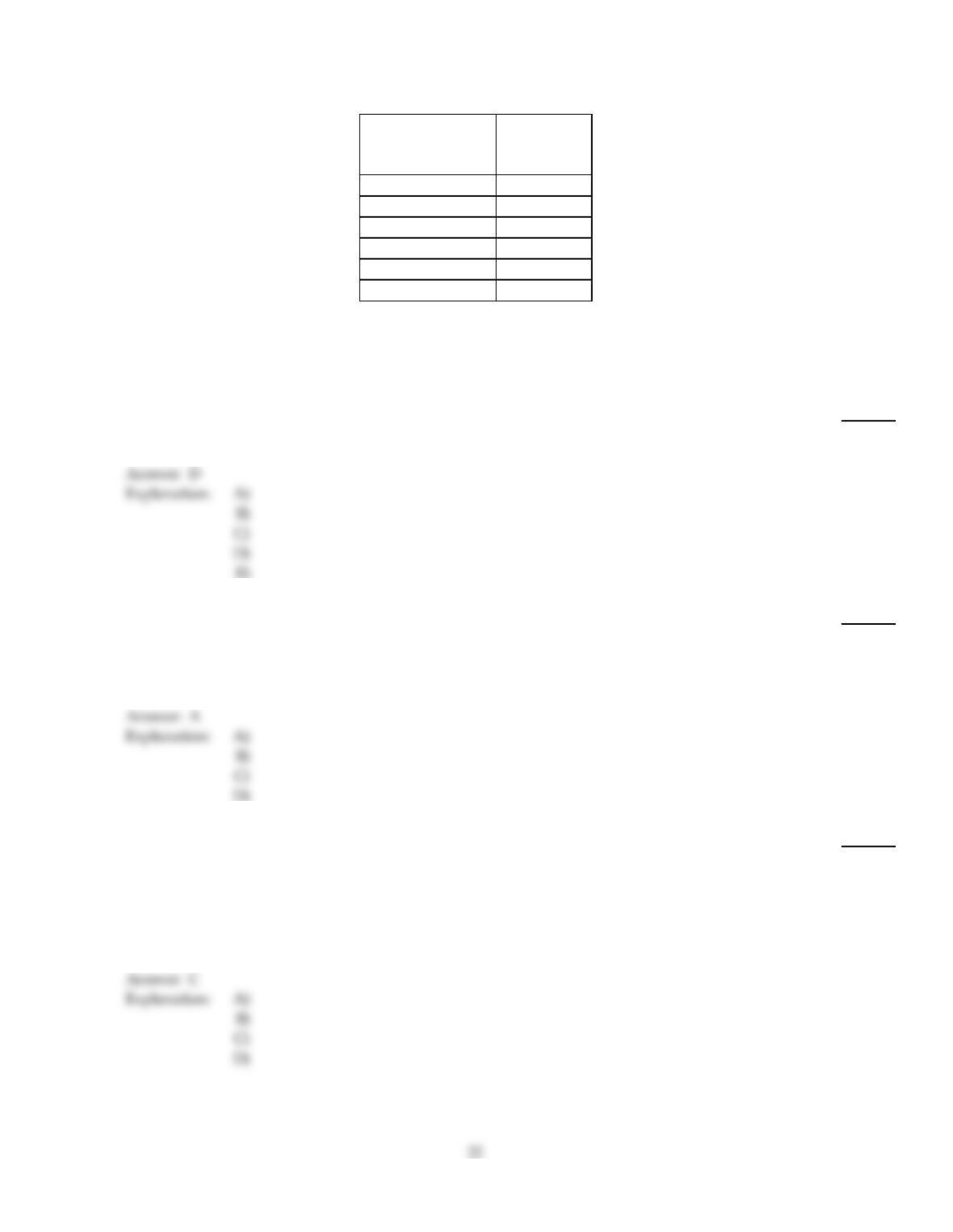
Table 1–1
Hours
Open
Total
Revenue
(Dollars)
1$35
260
380
492
5100
6105
Eva runs a small bakery in the village of Roggerli. She is debating whether she should extend her hours of operation. Eva
figures that her sales revenue will depend on the number of hours the bakery is open as shown in the table above. She would
have to hire a worker for those hours at a wage rate of $12 per hour.
73)
Refer to Table 1–1. Using marginal analysis, how many hours should Eva extend her bakery’s
hours of operations?
73)
A)
5 hours
B)
6 hours
C)
2 hours
D)
4 hours
E)
3 hours
74)
Economists assume that rational people do all of the following except
74)
A)
undertake activities that benefit others and hurt themselves.
B)
weigh the benefits and costs of all possible alternative actions.
C)
use all available information as they act to achieve their goals.
D)
respond to economic incentives.
75)
Cassie’s Quilts alters, reconstructs and restores heirloom quilts. Cassie has just spent $800
purchasing, cleaning and reconstructing an antique quilt which she expects to sell for $1,500 once
she is finished. After spending $800, Cassie discovers that she would need some special period
fabric that would cost her $200 in material and time in order to complete the task. Alternatively,
she can sell the quilt “as is” now for $900. What is the marginal cost of completing the task?
75)
A)
$1,000
B)
$500
C)
$200
D)
$1,000 plus the value of her time
76)
Making “marginal” decisions involves
76)
A)
comparing the additional benefits and the additional costs of an activity.
B)
calculating the average benefit and the average cost of an activity to determine if it is
worthwhile to undertake that activity.
C)
calculating the total costs of an activity and determining if you can afford to incur that
expenditure.
D)
calculating the total benefits of an activity and determining if you are satisfied with that
amount.
77)
A grocery store sells a bag of potatoes at a fixed price of $2.30. Which of the following is a term
used by economists to describe the money received from the sale of an additional bag of potatoes?
77)
A)
gross earnings
B)
marginal costs
C)
net benefit
D)
pure profit
E)
marginal revenue
78)
How does a market economy prevent people from getting as many goods and services as they
wish?
78)
A)
A market economy allocates goods and services to those who are able to pay for those
products; therefore, income is a limiting factor.
B)
Governments interfere with market economies to influence the allocation of goods and
services.
C)
The government imposes taxes on those who earn beyond a certain amount of income.
D)
In a market economy, firms can charge any price they want, thus preventing poor people
from getting as many goods and services as they wish.
79)
Economists promote which of the following as the way to make the best decisions?
79)
A)
Continue an enjoyable activity up to the point where its marginal benefit equals its marginal
cost.
B)
Continue an enjoyable activity until it is no longer enjoyable.
C)
Continue an enjoyable activity as long as you do not have to pay for it.
D)
Continue an enjoyable activity until you cannot afford to pursue it.
80)
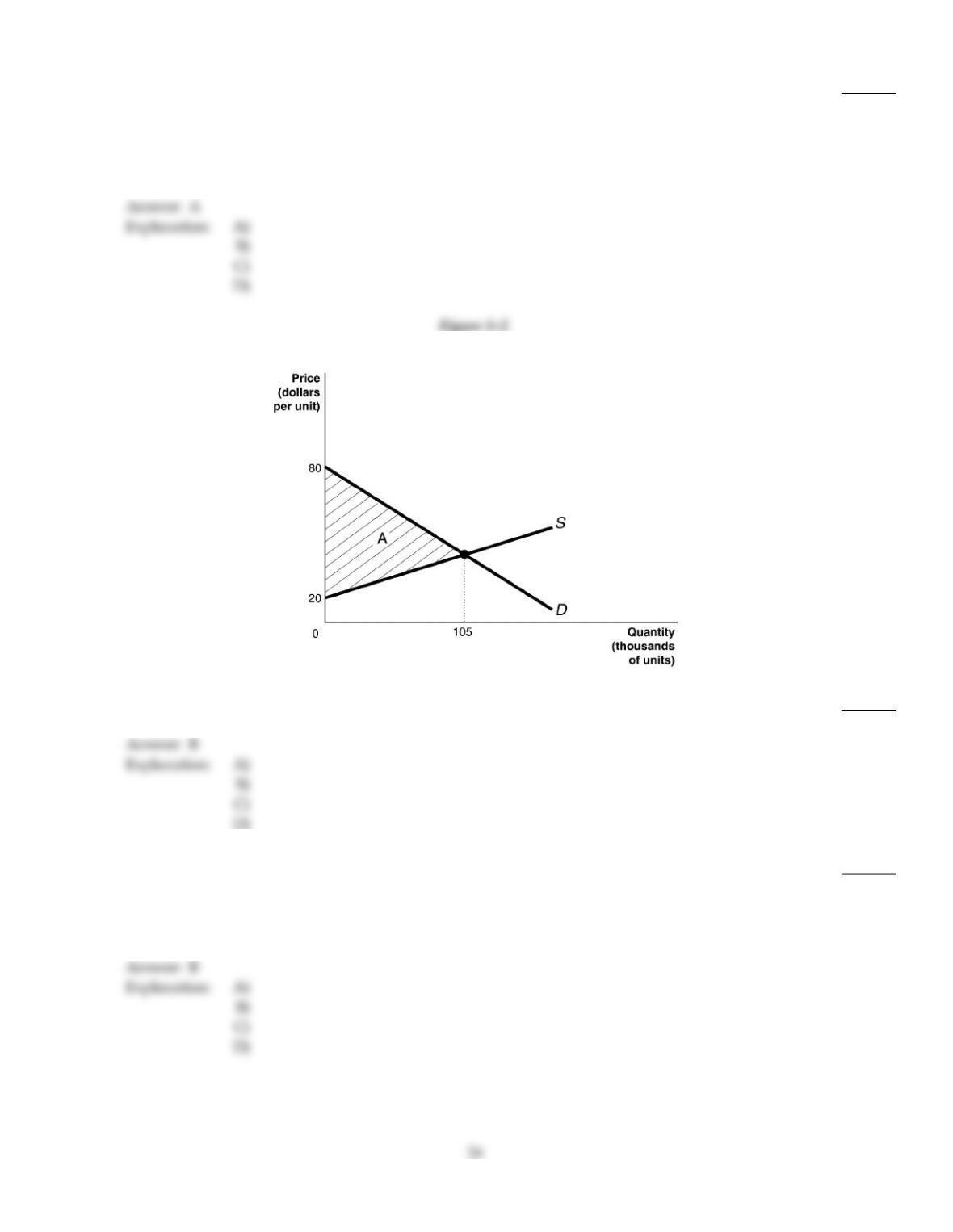
Refer to Figure 1–2. Calculate the area of the triangle A.
80)
A)
$8.4 million
B)
$3.15 million
C)
$2.1 million
D)
$6.3 million
B
81)
Which of the following is a macroeconomics question?
81)
A)
What determines the production of DVDs?
B)
What determines the inflation rate?
C)
What factors determine the price of carrots?
D)
What determines the wage of auto workers?
B
A
82)
What is the “reverse causality” problem in determining cause and effect?
82)
A)
It is a problem that occurs when one concludes that a change in variable X caused a change in
variable Y when in fact, it is a change in variable Y that caused a change in variable X.
B)
It is a problem that arises when two variables are inter–connected so that a change in variable
X causes a change in variable Y, and a change in variable Y causes a change in variable X.
C)
It is a problem that occurs when one observes that a change in variable X caused a change in
variable Y which caused a change in variable Z and concludes that a change in variable X
caused a change in variable Z.
D)
It is a problem that occurs when one concludes that a change in variable X caused a change in
variable Y when in fact, it is a change in variable Z that caused a change in variable Y.
83)
Where do economic agents such as individuals, firms and nations, interact with each other?
83)
A)
in any arena that brings together buyers and sellers
B)
in public locations monitored by the government
C)
in any physical location where people can get together for selling goods, such as shopping
malls
D)
in any location where transactions can be monitored by consumer groups and taxed by the
government
84)
Ted quits his $60,000–a–year job to be a stay–at–home dad. What is the opportunity cost of his
decision?
84)
A)
at least $60,000
B)
zero, since he will no longer be earning a salary
C)
the value he attributes to the joy of parenting
D)
It depends on the “going rate” for stay–at–home dads
85)
Which of the following statements about profit is true?
85)
A)
Profit is the difference between a firm’s revenue and its costs.
B)
Profit refers to the revenue received from the sale of a quantity of goods.
C)
Profit is calculated by multiplying price per unit by the number of units sold.
D)
The terms “accounting profit” and “economic profit” can be used interchangeably.
86)
What is the “omitted variable” problem in determining cause and effect?
86)
A)
It is a problem that arises when an economic variable that affects other variables is omitted
from an analysis and its omission leads to false conclusions about cause and effect.
B)
It is a problem that arises when a significant variable is not given enough weight in an
economic experiment leading to skewed conclusions about cause and effect.
C)
It is a problem that arises when an insignificant variable is given too much weight in an
economic analysis leading to skewed conclusions about cause and effect.
D)
It is a problem that arises when an insignificant economic variable that should have been
omitted is included in an economic experiment leading to false conclusions about cause and
effect.
87)
Economists assume that individuals
87)
A)
are rational and respond to incentives.
B)
behave in unpredictable ways.
C)
prefer to live in a society that values fairness above all else.
D)
will never take actions to help others.
A
88)
The three fundamental questions that any economy must address are
88)
A)
how much will be saved; what will be produced; and how can goods and services be fairly
distributed?
B)
what goods and services will be produced; how will the goods and services be produced; who
will receive the goods and services produced?
C)
what will be the prices of goods and services; how will these goods and services be produced;
and who will receive them?
D)
who gets jobs; what wages do workers earn; and who owns what property?
B
A
Scenario 1–1
Suppose a cell–phone manufacturer currently sells 20,000 cell–phones per week and makes a profit of $5,000 per week. A
manager at the plant observes, “Although the last 3,000 cell phones we produced and sold increased our revenue by $6,000
and our costs by $6,700, we are still making an overall profit of $5,000 per week so I think we’re on the right track. We are
producing the optimal number of cell phones.“
89)
Refer to Scenario 1–1. Using marginal analysis terminology, what is another economic term for the
incremental revenue received from the sale of the last 3,000 cell phones?
89)
A)
gross earnings
B)
sales revenue
C)
marginal revenue
D)
gross profit
90)
The economic analysis of the minimum wage involves both normative and positive analysis.
Consider the following consequences of a minimum wage:
a. The minimum wage law causes unemployment.
b. The minimum wage law benefits some groups and hurts others.
c. In some cities such as San Francisco and New York, it would be impossible for low–skilled
workers to live in the city without a minimum wage law.
d. The gains to winners of a minimum wage law should be valued more highly than the losses to
losers because most of the losers are businesses.
Which of the consequences above are positive statements and which are normative statements?
90)
A)
a and c are positive statements; b and d are normative statements
B)
a, b, and c are positive statements and d is a normative statement.
C)
a and b are positive statements; c and d are normative statements.
D)
Only a is a positive statement; b, c and d are normative statements.
C
91)
Which of the following is a normative economic statement?
91)
A)
When the price of gasoline rises, the quantity of gasoline purchased falls.
B)
The price of gasoline is too high.
C)
When the price of gasoline rises, transportation costs rise.
D)
The current high price of gasoline is the result of strong worldwide demand.
B
C
92)
Over the past decade, health plans have sought to contain rising health care costs by raising
premiums and encouraging the use of lower–cost generic drugs. Recently, some health insurers
have implemented plans that involve lowering or eliminating co–payments on medications for
chronic illnesses.
Source: Vanessa Fuhrmans, “New Tack on Copays: Cutting Them”, Wall Street Journal, Tuesday, May 8 2007, Page
D1.
Which of the following best explains why employers and health insurers might choose to adopt this
radical approach?
92)
A)
Health insurers are finally recognizing that many, especially the elderly, are not getting the
care they need.
B)
These health plans are trying to persuade employers and consumers to bear a greater share of
rising health care costs.
C)
They believe that this will give consumers incentives to take better care of their health, which
in turn will enable health plans to save even more money by preventing costly health crises
down the road.
D)
Health insurers have an incentive to institute plans that promote equity.
93)
The distribution of income primarily determines which of the fundamental economic questions?
93)
A)
how to plan the economy?
B)
how will the goods and services be produced?
C)
who will receive the goods and services produced?
D)
what goods and services will be produced?
C
C
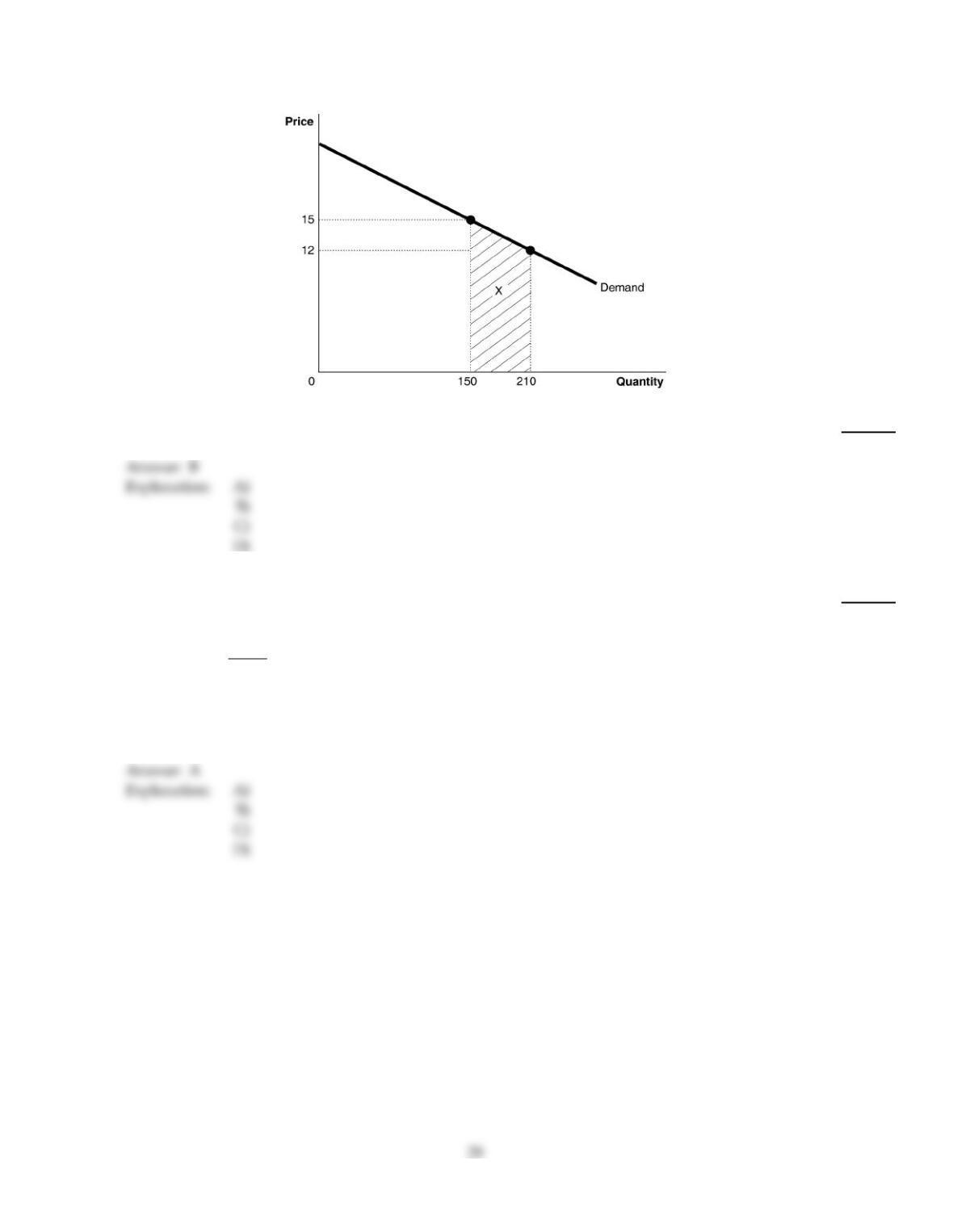
Figure 1–3
94)
Refer to Figure 1–3. Calculate the area of the trapezoid X.
94)
A)
$2,520
B)
$810
C)
$270
D)
$720
95)
In the United States and in most European countries, aging populations and declining birthrates
threaten public finances. As the population ages, there are fewer workers paying taxes relative to
the number of retired people receiving government benefits. Which of the following government
policies would NOT help reduce the pressure on public finances?
95)
A)
reducing taxes paid by current workers so that they can save for the future
B)
increasing the retirement age
C)
offering financial incentives to increase the birthrate
D)
reducing retiree benefit payments
96)
Which of the following is an example of a “marginal” decision?
96)
A)
You’re planning to hold a graduation party and must decide between having your party
catered or having a pot–luck meal.
B)
Chelsea has withdrawn from the swim team to take up a full–time job.
C)
The Zhous have demolished their old home and are debating whether to build a ranch–style
house or a Craftsman home.
D)
The Pleasantville movie theatre is open only in the evenings. The theatre’s manager is
debating whether to add daily matinee shows.
97)
Refer to Table 1–1. What is Eva’s marginal cost if she decides to stay open for two hours instead of
one hour?
97)
A)
$71
B)
$12
C)
$36
D)
$24
98)
Voluntary exchange increases economic efficiency
98)
A)
because neither the buyer nor the seller would agree to a trade unless they both benefit.
B)
because it allows wealthy individuals to act altruistically and give to the poor.
C)
because it is free and consequently does not cost anything.
D)
because voluntary exchange only takes place with government permission.
99)
The prevalence of Alzheimer’s dementia is very high among residents living in nursing homes. A
student concludes that it is likely that living in nursing home causes Alzheimer’s dementia. What is
the flaw in the student’s reasoning?
99)
A)
The student is drawing a false conclusion; he is confusing cause and effect.
B)
The student is drawing a false conclusion by making the mistake of omitting critical variables
such as the age and gender of the residents.
C)
The student has failed to take into account other causes of Alzheimer’s disease.
D)
The student is using an inadequate sample size.
100)
If a straight line passes through the point x= 14 and y= 3 and also through the point x= 4 and y=
10, the slope of this line is
100)
A)
6 divided by 11.
B)
negative seven tenths.
C)
seven tenths.
D)
negative 11 divided by 6.
101)
Suppose when the price of laptops falls, college students buy more laptops. This implies that
101)
A)
there is a one–to–one relationship between laptop prices and quantities purchased by college
students.
B)
there is a negative relationship between laptop prices and quantities purchased by college
students.
C)
there is a positive relationship between laptop prices and quantities purchased by college
students.
D)
there is a direct relationship between laptop prices and quantities purchased by college
students.
102)
The branch of economics which studies the behavior of entire economies and policies that affect the
economy as a whole is called
102)
A)
macroeconomics.
B)
normative economics.
C)
microeconomics.
D)
public economics.
103)
Which of the following correctly describes the relationship between economic efficiency and
economic equity?
103)
A)
They always call for opposite outcomes.
B)
There is often a trade–off between the two.
C)
There is no conflict between the two goals.
D)
They are both automatically achieved in a free market economy.
104)
Which of the following generates allocative efficiency in a market economy?
104)
A)
national government intervention
B)
voluntary exchange between buyers and sellers
C)
equity
D)
United Nations rules for competition
B
105)
In the first six months of 2003, branches of Commerce Bank in New York City were robbed 14
times. The New York City Police recommended steps the bank could take to deter robberies,
including the installation of plastic barriers called “bandit barriers.” The police were surprised the
bank did not take their advice. According to a deputy commissioner of police, “Commerce does
very little of what we recommend. They’ve told our detectives they have no interest in ever putting
in the barriers.”
Which of the following is the best explanation why Commerce Bank did not install the barriers?
105)
A)
The banks must have weighed the cost of installing bandit barriers against the benefit and
decided that they have “no interest in ever putting in the barriers”.
B)
The banks would rather delay installation of any theft deterring equipment in anticipation of
new lower cost innovations in the security devices market.
C)
The banks probably resent any interference from the police department.
D)
The banks are concerned that “bandit barriers” would send the wrong message to customers
– – that the bank is unsafe.
A
106)
The extra cost associated with undertaking an activity is called
106)
A)
net loss.
B)
foregone cost.
C)
marginal cost.
D)
opportunity cost.
C
B
107)
The branch of economics which studies how households and firms make choices, interact in
markets and how government attempts to influence their choices is called
107)
A)
positive economics.
B)
microeconomics.
C)
macroeconomics.
D)
normative economics.
108)
Which of the following is correct about the economic decisions consumers, firms and the
government have to make?
108)
A)
Governments may face the problem of shortages but not scarcity in making economic
decisions.
B)
Firms and the government face scarcity, individuals only face shortages.
C)
Only individuals face scarcity; firms and the government do not.
D)
Each faces the problem of scarcity which necessitates tradeoffs in making economic decisions.
109)
The revenue received from the sale of an additional unit of a product
109)
A)
is called a net gain.
B)
is a marginal benefit to the firm.
C)
is called profit.
D)
is called gross sales.
110)
The basic economic problem of scarcity
110)
A)
has always existed and will continue to exist.
B)
is a problem only in developing economies.
C)
does not apply to the wealthy in society.
D)
will eventually disappear as technology continues to advance.
SHORT ANSWER. Write the word or phrase that best completes each statement or answers the question.
111)
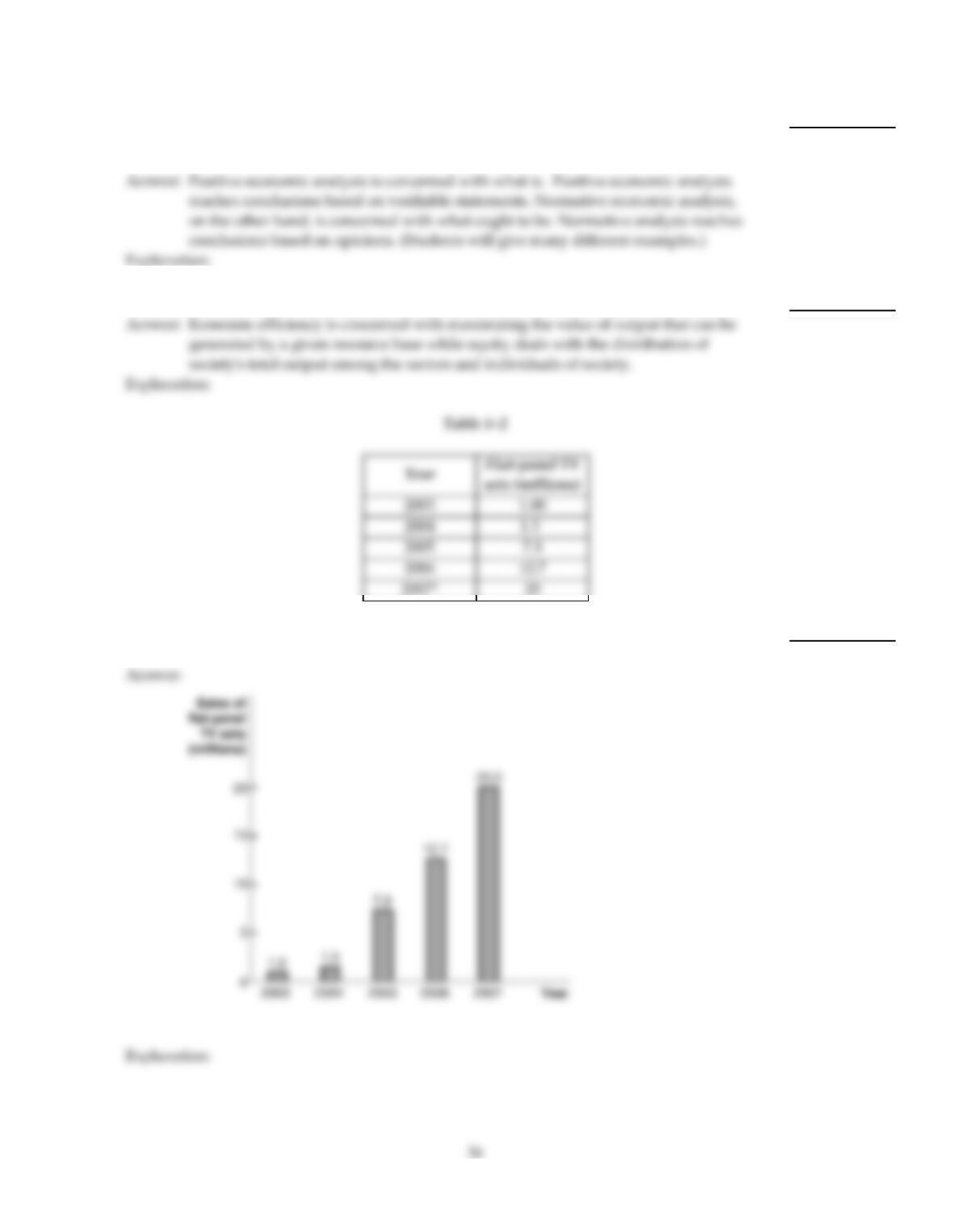
What is the difference between positive economic analysis and normative economic
analysis? Give one example each of a positive and normative economic issue or question or
statement.
111)
112)
What is the difference between economic efficiency and equity?
112)
113)
Refer to Table 1–2. The table above shows the sales and projected sales (*) of flat–panel
television sets in North America. Present the information using a bar graph.
113)
114)
What is the difference between an invention and an innovation?
114)
115)
Identify three factorsthat limit the number of jobs that can move from developed countries
to countries such as India and China.
115)
116)
How does the study of microeconomics differ from that of macroeconomics? Give one
example each of an issue studied in microeconomics and in macroeconomics.
116)
117)
Define productive efficiency. Does productive efficiency imply allocative efficiency?
Explain.
117)
118)
Define allocative efficiency. Explain the significance of this concept in economics?
118)
TRUE/FALSE. Write ‘T’ if the statement is true and ‘F’ if the statement is false.
119)
“A decrease in the price of digital cameras will decrease the demand for camera film.” This
statement is an example of a positive economic statement.
119)
120)
The term “market” refers only to trading arrangements that have been approved by the
government.
120)
121)
A college must decide if it wants to offer more evening and weekend classes. This decision involves
answering the economic question of “who will receive the goods and services produced?”
121)
122)
The government makes all economic decisions in a centrally planned economy.
122)
123)
If it costs Sinclair $300 to produce 3 suede jackets and $420 to produce 4 suede jackets, then the
difference of $120 is the marginal cost of producing the 4th suede jacket.
123)
124)
One desirable outcome of a market economy is that it leads to a more equitable distribution of
income.
124)
125)
The sales revenue a seller receives from the sale of an additional unit of goods is called marginal
revenue.
125)
126)
Scarcity is a problem that will eventually disappear as technology advances.
126)
127)
Suppose the extra cost to Apple Computer of producing another iPod is $270. Then, Apple should
not produce this unit if it can only sell it for $270.
127)
128)
One example of human capital is the amount of savings that you have.
128)
129)
According to a Wall Street Journal article, there are nearly 75,000 patients in the U.S. awaiting
kidney transplants. To move more people off the wait list, economists along with computer experts
and surgeons are developing a market for kidney swapping. This is an example of a
macroeconomics topic.
Source: Laura Meckler, “Kidney Swaps Seen as a Way to Ease Donor Shortage”, Wall Street Journal, page A1, Oct
15, 2007.
129)
130)
In the market for factors of production, firms earn income by selling goods and services to
households.
130)
131)
Policies based on normative economic ideas tend to increase economic efficiency and improve
equity.
131)
132)
When voluntary exchange takes place, both parties gain from the exchange.
132)
133)
“The distribution of income should be left to the market” is an example of a positive economic
statement.
133)
134)
All economic questions arise from the fact that resources are scarce.
134)
135)
Marginal benefit is the benefit that your activity provides to someone else.
135)
136)
Examining the conditions that could lead to a recession in an economy is an example of a
macroeconomics topic.
136)
SHORT ANSWER. Write the word or phrase that best completes each statement or answers the question.
137)
Assume that Apple computer can earn an additional $81 million of revenue from making
300,000 more iPods. What must the additional cost of producing these 300,000 be to make
the additional output economically rational?
137)