Chapter 01 – Introduction to Physiology and Homeostasis
a.
True
b.
False
False
47. Enzymes are specialized proteins that speed up particular chemical reactions in the body.
a.
True
b.
False
True
48. The three types of muscle tissue include skeletal, smooth, and connective.
a.
True
b.
False
False
49. Epithelial sheets are layers of tightly joined cells that cover and line various parts of the body.
a.
True
b.
False
True
50. Glands are epithelial tissue derivatives specialized for secreting.
a.
True
b.
False
True
51. Blood is classified as connective tissue.
a.
True
b.
False
52. Tendons and ligaments are classified as epithelial tissue.
a.
True
b.
False
False
53. All endocrine glands contain ducts.
a.
True
b.
False
False
54. The internal environment of a multicellular organism is the fluid surrounding cells, through which life-sustaining
exchanges are made.
a.
True
b.
False
True
55. Homeostasis is a static-state control system within the body.
a.
True
b.
False
False
56. Long-term adaptations make the body more efficient in responding to an ongoing or repetitive challenge in
homeostasis.
a.
True
b.
False
True
57. Exercise initially disrupts homeostasis.
a.
True
b.
False
True
58. The respiratory system removes excess water, salt, acid, and other electrolytes from the plasma.
a.
True
b.
False
False
59. Muscle tissue is the ultimate source of all red blood cells.
a.
True
b.
False
False
60. In contrast to the nervous system, the endocrine system regulates activities that require duration rather than speed,
such as growth.
a.
True
b.
False
True
homeostasis
61. The reproductive system is not essential for homeostasis, nor is it essential for survival of the individual.
a.
True
b.
False
True
homeostasis
62. Intrinsic, or local, controls are learned by an organ.
a.
True
b.
False
False
63. A common example of positive feedback is the control of room temperature via a thermostat.
a.
True
b.
False
False
64. Because the body’s goal is to maintain stable, homeostatic conditions, positive feedback occurs more often than
negative feedback.
a.
True
b.
False
False
65. The body uses feedforward mechanisms less frequently than feedback mechanisms.
a.
True
b.
False
True
66. Physiology is closely related to ____________________, the study of the structure of the body.
anatomy
67. Common atoms combine to form the ____________________ of life, such as proteins, carbohydrates and fats.
molecules
68. The basic units of life are ____________________.
69. The simplest forms of independent life are called ____________________ organisms.
70. Each living organism must perform the following equation: food + O2 ➞ CO2 + H2O + ____________________.
71. Tissues are groups of ____________________ with similar specialization.
72. Muscle tissue is able to contract and, therefore, allows ____________________ of the body.
73. A(n) ____________________ is the cavity within a hollow organ or tube.
74. Glands are formed during ____________________ development by pockets of epithelial tissue.
75. ___________________ glands lack ducts and release their secretory products (hormones) into the blood.
76. Milk-secreting glands are examples of ____________________ glands.
exocrine
77. ____________________ tissue is distinguished by relatively fewer cells within an abundance of extracellular
material.
Connective
78. Except for ____________________, cells within connective tissue produce specific structural molecules that they
release into extracellular spaces.
blood
79. The ____________________ environment is the surrounding environment in which an organism lives.
external
80. The fluid outside the cells is called ____________________ fluid.
extracellular
81. Body systems maintain ____________________, a dynamic steady state in the internal environment.
homeostasis
82. Two natural categories of stem cells are ____________________ cells and tissue-specific cells from
____________________.
Chapter 01 – Introduction to Physiology and Homeostasis
83. ____________________ medicine is a field that involves repairing, replacing, or regenerating cells, tissues, or organs
to establish normal function.
84. Homeostasis involves both ____________________ compensatory responses and ____________________
adaptations among the different body systems.
85. Body cells function best within a(n) ____________________ temperature range.
86. ____________________ is one of the easiest factors to monitor that shows both an immediate response to exercise
and long-term adaptation to exercise program.
87. ____________________ or systemic controls are regulatory mechanisms initiated outside an organ.
88. In a(n) ____________________ feedback control system, output is regulated to resist change so that the controlled
variable is kept at a relatively steady set point.
89. The hormone oxytocin is controlled by a(n) ____________________ feedback loop during the birthing process.
90. The term ____________________ refers to the abnormal functioning of the body associated with disease.
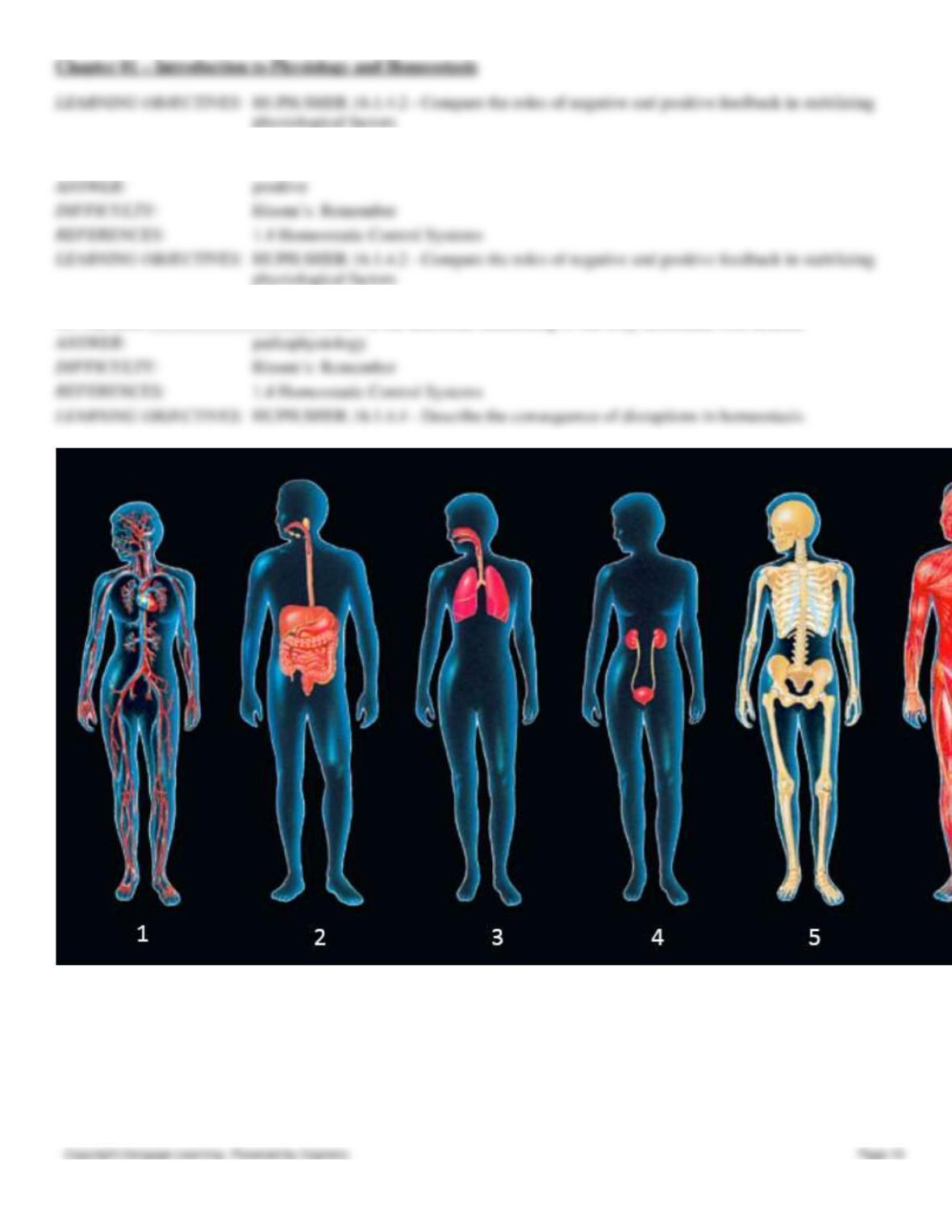
Figure 1-5
Answer the following questions using the accompanying figure.
91. Which numbered diagram shows the source of all blood cells?
a.
1
b.
2
c.
3
Chapter 01 – Introduction to Physiology and Homeostasis
d.
4
e.
5
f.
6
92. Which numbered diagram shows the site of nutrient/waste exchange via alveoli?
a.
1
b.
2
c.
3
d.
4
e.
5
f.
6
93. Which numbered diagram depicts a system vulnerable to atherosclerosis disease?
a.
1
b.
2
c.
3
d.
4
e.
5
f.
6
94. Which numbered diagram depicts a system most negatively affected by a lack of dietary protein?
a.
1
b.
2
c.
3
d.
4
e.
5
f.
6
95. Which numbered diagram depicts the site of nutrient/waste exchange between cells and the interstitial fluid?
a.
1
b.
2
c.
3
d.
4
e.
5
f.
6
96. Describe a typical physiologist’s explanation of shivering.
97. How does the interface between the air and blood in the lungs work?
98. Distinguish between exocrine and endocrine glands.
99. Discuss the ethical concerns and political issues of the use of embryonic stem cells (ESC).
100. What must a body control system do to maintain homeostasis?