Granof Test Bank Chapter 1 Page 1
Chapter 1
The Government and Not-For-Profit Environment
TRUE/FALSE (CHAPTER 1)
1. The main objective of a typical government or not-for-profit entity is to earn a profit.
2. A government’s budget may be backed by the force of law.
3. Governments have no need for an accounting system.
4. A government’s internal managers rely on general purpose financial statements for a
considerable amount of information about their government.
5. Governments and not-for-profit entities may never engage in business-type activities.
6. Lenders use the financial statements of governments and not-for-profit entities just as they
would those of businesses, that is, to help assess the borrower’s credit-worthiness.
7. Financial statements, no matter how prepared, do not directly affect the economic worth of
an entity.
8. The Federal Accounting Standards Advisory Board’s standards do not apply to the federal
Department of the Treasury.
9. Governments may be subject to the same pressures that led to accounting scandals like
Enron.
10. The Governmental Accounting Standards Board establishes generally accepted accounting
principles for all state and local governments and all not-for-profit entities.
Granof Test Bank Chapter 1 Page 2
MULTIPLE CHOICE (CHAPTER 1)
1. A primary characteristic that distinguishes governments from businesses is
a) The need to generate revenues equal to or in excess of expenditures/expenses.
b) The importance of the budget in the governing process.
c) The need to provide goods or services.
d) The correlation between revenues generated and demand for goods or services.
2. A primary characteristic that distinguishes not-for-profit entities from businesses is
a) The need to generate revenues equal to or in excess of expenditures/expenses.
b) The importance of the budget in the governing process.
c) The need to provide goods or services.
d) The correlation between revenues generated and demand for goods or services.
3. Which of the following characteristics distinguishes a government or not-for-profit entity
from a business?
a) There is always a direct link between revenues generated and expenditures/expenses
incurred.
b) Capital assets are used to produce revenues and save costs.
c) Revenues are always indicative of demand for goods and services.
d) The mission of the entity will determine the goods or services provided.
4. The most significant financial document provided by a government is the
a) Balance sheet.
b) Operating statement.
c) Operating budget.
d) Cash flow statement.
5. Which of the following statements is true?
a) Governments may engage in activities similar to activities engaged in by for-profit
entities.
b) There are a limited number of different types of governments.
c) All governments engage in the same activities.
d) Managers may have a long-term focus and thereby sacrifice the short-term liquidity of
the entity.
6. Which of the following activities is NOT an activity in which a government might engage?
a) Selling electric power.
b) Operating a golf course.
c) Operating a bookstore.
d) All of the above are activities that might be carried out by a government.
7. In which of the following activities is a not-for-profit entity least likely to engage?
a) Providing educational services.
b) Providing health-care services.
c) Providing for terrorism defense.
d) Retail sales of cookies.
Granof Test Bank Chapter 1 Page 3
8. Which of the following can be affected by GAAP?
a) Legal ability to issue bonds.
b) Ability to balance the budget.
c) Amount reported as employee pension plan contributions.
d) Claims and judgments settled.
9. Which of the following characteristics is unique to governments?
a) The ability to have activities financed with tax-exempt debt.
b) The power to impose fees.
c) The ability to issue tax-exempt debt.
d) The ability to have activities financed by Federal grants.
10. To obtain a comprehensive understanding of a government’s fiscal health, a financial analyst
should obtain an understanding of which of the following?
a) All the resources owned by the government.
b) All the resources that may be summoned by the government.
c) Demographic data about the residents served by the government.
d) All of the above.
11. Which of the following is common to both governments and not-for-profit entities but
distinguishes these entities from for-profit entities?
a) The budget is a legal, financial document.
b) Revenues are usually indicative of demand for goods or services.
c) There is direct matching of revenues and expenses.
d) There are no defined ownership interests.
12. Which of the following is NOT a purpose of external financial reporting by governments?
External financial reports should allow users to
a) Assess financial condition.
b) Compare actual results with the budget.
c) Assess the ability of elected officials to effectively manage people.
d) Evaluate efficiency and effectiveness.
13. Which of the following is NOT a reason why users need government and not-for-profit
external financial statements?
a) To determine the ability of the entity to meet its obligations.
b) To determine the ability of the entity to continue to provide services.
c) To predict future fiscal solvency.
d) To evaluate the overall profitability of the entity.
14. Users of government financial statements should be interested in information about
compliance with laws and regulations for which of the following reasons?
a) To determine if the government has complied with bond covenants.
b) To determine if the government has complied with taxing limitations.
c) To determine if the government has complied with donor restrictions on the use of funds.
d) To determine all of the above.
Granof Test Bank Chapter 1 Page 4
15. Which of the following is NOT generally considered a main user of government and not-for-
profit entity external financial statements?
a) Investors and creditors.
b) Taxpayers.
c) Donors.
d) Internal managers.
16. Which of the following is a probable use a donor would make of the external financial
statements of a not-for-profit entity?
a) To determine the proportion of entity resources directed to programs as opposed to fund-
raising.
b) To determine the creditworthiness of the entity for investment purposes.
c) To determine the salaries paid to all employees of the entity.
d) To determine the budget of the entity.
17. A regulatory agency would use the external financial statements of a local government for
which of the following purposes?
a) To ensure that the entity is spending and receiving resources in accordance with laws,
regulations or policies.
b) To determine how resources should be allocated.
c) To exercise general oversight responsibility.
d) To do all of the above.
18. Which of the following constituency groups would be most likely to evaluate government
financial statements to determine likely areas in which to achieve cost-savings?
a) Creditors.
b) Union officials representing the government’s employees.
c) Federal agencies that provide purpose-restricted grants.
d) Students of government accounting.
19. Which of the following objectives is considered the cornerstone of financial reporting by a
state or local government?
a) Accountability.
b) Budgetary compliance.
c) Interperiod equity.
d) Service efforts and accomplishments.
20. Which of the following is an objective of financial reporting by state and local governments
as established by the GASB? Financial reporting should assist users in
a) Assessing the management skills of top management.
b) Determining if current-period revenues were sufficient to pay for current-period services.
c) Evaluating the cash management operations of the government for the year.
d) Assessing whether the government provided appropriate services to its constituents in the
current year.
Granof Test Bank Chapter 1 Page 5
21. Which of the following is an objective of financial reporting by nongovernmental not-for-
profit entities as established by the FASB? Financial reporting should provide information
that is useful to present and potential resource providers and other users in:
a) Assessing the types of services provided and the need for those services.
b) Assessing the services provided and the entity’s ability to earn a profit.
c) Making rational decisions about the allocation of resources to those organizations.
d) Assessing how managers have managed personnel.
22. As used by the GASB, interperiod equity refers to which of the following? Financial
reporting should:
a) Demonstrate compliance with finance-related contractual requirements.
b) Provide information to determine whether current-year revenues were sufficient to pay
for current-year services.
c) Demonstrate whether resources were obtained and used in accordance with the
government’s legally adopted budget.
d) Provide information to assist users in assessing the government’s economy, efficiency,
and effectiveness.
23. Given a specific set of data, the basis of accounting selected by or imposed on a government
will least affect which of the following?
a) Determining whether or not the government has a balanced budget.
b) Determining whether or not the government has the ability to issue debt.
c) Determining whether or not certain economic events occurred.
d) Determining the annual payments to a government-sponsored pension plan.
24. The basis of accounting selected by or imposed on a government can influence which of the
following?
a) A decision to contract-out a specific service rather than provide that service itself.
b) The amount of salary increases proposed by union negotiators.
c) The amount that is available to spend on a donor-specified project or service.
d) All of the above.
25. The Governmental Accounting Standards Board is the primary standard-setting body for:
a) All governments.
b) All state and local governments.
c) All governments and all not-for-profit entities.
d) All state and local governments and all not-for-profit entities.
26. Under certain circumstances a government might use standards established by which of the
following standard-setting bodies?
a) GASB.
b) FASB.
c) AICPA.
d) All of the above.
Granof Test Bank Chapter 1 Page 6
27. The primary standard-setting body for accounting and financial reporting by a state-
supported college or university is:
a) GASB.
b) FASB.
c) AICPA.
d) All of the above.
28. In descending order, the hierarchy of GAAP applicable to a church-owned college may be:
a) FASB Statements and Interpretations, FASB Technical Bulletins, AICPA Industry Audit
Guides, FASB Implementation Guides, other accounting literature—including GASB
standards.
b) FASB Statements and Interpretations, FASB Technical Bulletins, FASB Implementation
Guides, AICPA Practice Bulletins (if cleared by FASB).
c) GASB Statements and Interpretations, AICPA Industry Audit Guides, GASB
Implementation Guides, other accounting literature—including FASB standards.
d) GASB Statements and Interpretations, GASB Technical Bulletins, AICPA Industry Audit
Guides, AICPA Practice Bulletins (if cleared by GASB), GASB Implementation Guides,
other accounting literature—including FASB standards.
29. Which of the following entities was a principal in creating the FASAB?
a) U.S. Congress.
b) Office of Management and Budget.
c) Governmental Accounting Standards Board.
d) Securities and Exchange Commission.
30. The purpose of the FASAB is to establish accounting standards for
a) Not-for-profit entities.
b) Federal government.
c) All governments.
d) Non-federal governments.

Granof Test Bank Chapter 1 Page 7
PROBLEMS (CHAPTER 1)
1. Thorn County adopted a cash budget for FY2010 as follows. The City budget laws prohibit
budgeting or operating at a deficit. During the year the County collected or spent the
following amounts. Was the County in compliance with budget laws? Did the County
accomplish the goal of interperiod equity? Explain your answers in detail.
Budgeted Collected/Spent
Receipts from property tax collections
From the 2009 levy $ 100,000 $ -0-
From the 2010 levy $1,000,000 $ 900,000
In advance for 2011 $ 50,000 $ -0-
Receipts from bonds issued $ 500,000 $ 500,000
Borrowed from bank (due in 5 years) $ -0- $ 75,000
Disbursements
Salaries and wages $ 500,000 $ 500,000
Operating expenses $ 200,000 $ 275,000
City Hall annex purchased $ 500,000 $ 500,000
Payments on debt principal $ 150,000 $ 150,000
Payments on interest $ 50,000 $ 50,000
Pension contribution $ 80,000 $ -0-
Explanations provided by the City for the differences between budget and actual are as
follows. Property tax collections are down because the major industry in the community
closed and many citizens are currently unemployed. Operating expenses are up because the
only bridge over a river bisecting the City sustained damages by an uninsured motorist and
had to be repaired immediately. The repair was not budgeted.
Granof Test Bank Chapter 1 Page 8
2. Save-the-Birds (STB), a not-for-profit entity dedicated to acquiring and preserving habitat for
upland birds, prepares financial statements in accordance with generally accepted accounting
principles. Currently, standards require that a not-for-profit entity report virtually all
contributions as revenue in the year received. During the current year STB received a
donation of several hundred acres of prime habitat for upland birds. STB will require several
hundred thousand dollars in additional donations in order to make the land completely
suitable for the birds. Before embarking on its fund-raising campaign STB prepares financial
statements which are summarized as follows.
Statement of Financial Position (Balance Sheet)
Cash $ 8,000
Supplies $ 2,000
Equipment (net of depreciation) $ 5,000
Land $1,000,000
Total Assets $1,015,000
Liabilities $ 1,000
Net Assets—Unrestricted $ 14,000
Net Assets—Restricted $1,000,000
Total Liabilities and Net Assets $1,015,000
Statement of Activities (Income Statement)
Revenues $1,030,000
Expenses:
Salaries $ 30,000
Change in Net Assets $1,000,000
What difficulties, if any, will STB encounter in its new fund-raising drive? Knowing that the
donation of the land accounted for $1,000,000 of the revenue reported by STB, do you think
the financial statements present fairly the financial position and results of operations of this
not-for-profit entity?
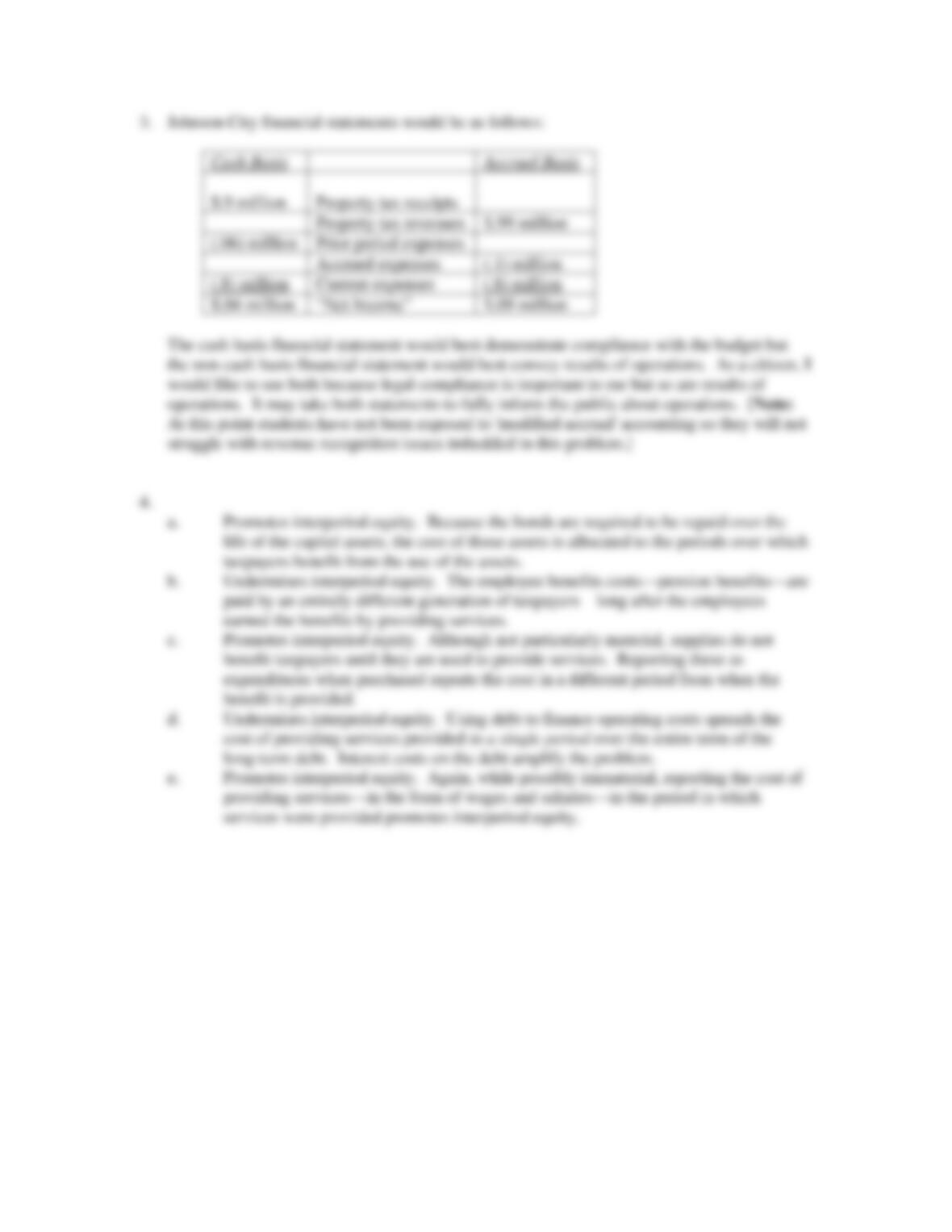
3. Johnson City prepares its budget on the cash basis and prepares its external financial
statements on the accrual basis. From the following data prepare statements of activity
(income statements) on both the cash basis and the accrual basis. Which statement best
represents the results of operations of the City? Which statement best demonstrates
compliance with laws and regulations? Which statement would you rather see? Which
conveys the best information to the citizens of Johnson City?
The City levies taxes in the current year of $1 million. Of this amount $.9 million is collected
during the current year, $.05 will be collected next year, and $.04 will be collected in the
future. $.01 will never be collected. During the current year the City pays bills from prior
periods $.06 million, bills of the current period $.8 million, and defers payment until future
periods on bills that were received for services consumed during the current period $.1
million.
Granof Test Bank Chapter 1 Page 9
4. Certain fiscal practices of governments promote interperiod equity while others do not. For
the situations listed below, indicate whether interperiod equity is promoted or undermined.
Why?
a. Issuing 30-year serial bonds to finance the construction of capital assets with estimated
30-year lives.
b. Paying for the pensions of retired employees out of resources provided by current-period
taxpayers.
c. Charging the cost of supplies as expenditures in the year in which they were used rather
than when they were purchased.
d. Issuing 30-year bonds to finance a portion of the current-period operating costs of a city’s
school system
e. Charging payments of wages and salaries made in the first week of a new year to the
previous fiscal year, the year in which the wages and salaries were earned.
Granof Test Bank Chapter 1 Page 10
ESSAY (CHAPTER 1)
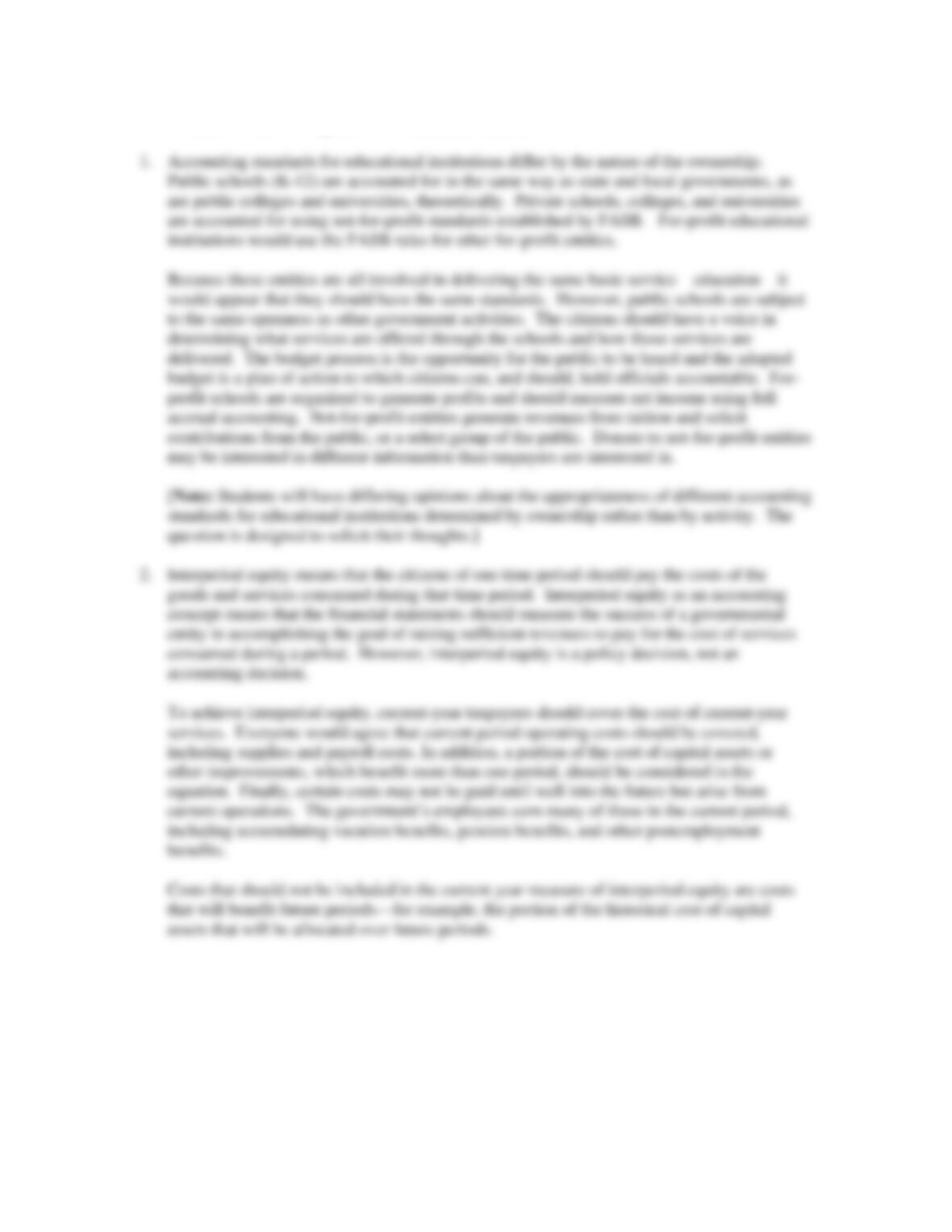
1. In the United States, educational services can be provided by federal government entities, by
non-federal government entities, by not-for-profit entities, and by for-profit entities. Are the
accounting and financial reporting standards the same for each of these entities? Should they
be the same?
2. The Governmental Accounting Standards Board (GASB) stated that an objective of financial
reporting is to measure interperiod equity, that is—“Financial reporting should provide
information to determine whether current-year revenues were sufficient to pay for current-
year services.” What is your understanding of interperiod equity? What costs incurred in the
current year should be paid for by the taxpayers of the current period? What costs incurred in
the current year should be paid for by future taxpayers?
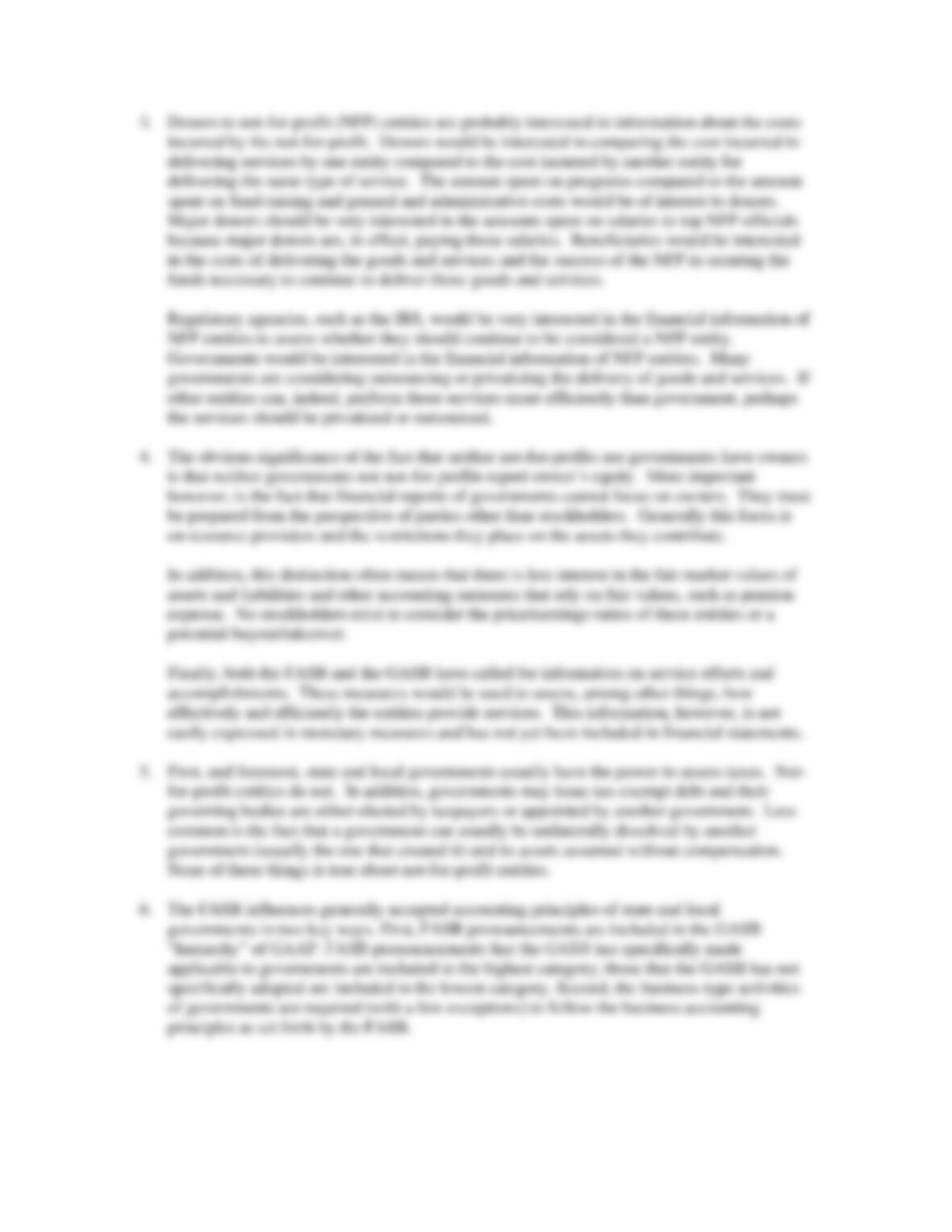
3. A not-for-profit entity raises funds to support specific programs, services, and activities. The
recipients of the programs, services, and activities are frequently not the providers of the
resources needed to deliver the programs, services, and activities. What information would
donors to these not-for-profit entities be interested in seeing? What information would
program beneficiaries be interested in seeing? Identify other users of the financial statements
of a not-for-profit and the types of information in which they would be interested.
4. What is the significance—for financial reporting purposes—of the fact that neither not-for-
profits nor governments have owners (stockholders)?
5. What are some of the definitional criteria that distinguish a state or local government from a
not-for-profit entity?
6. How does the FASB influence generally accepted accounting principles for state and local
governments?
Granof Test Bank Chapter 1 Page 11
ANSWERS TO TRUE/FALSE QUESTIONS (CHAPTER 1)
ANSWERS TO MULTIPLE CHOICE (CHAPTER 1)
Granof Test Bank Chapter 1 Page 12
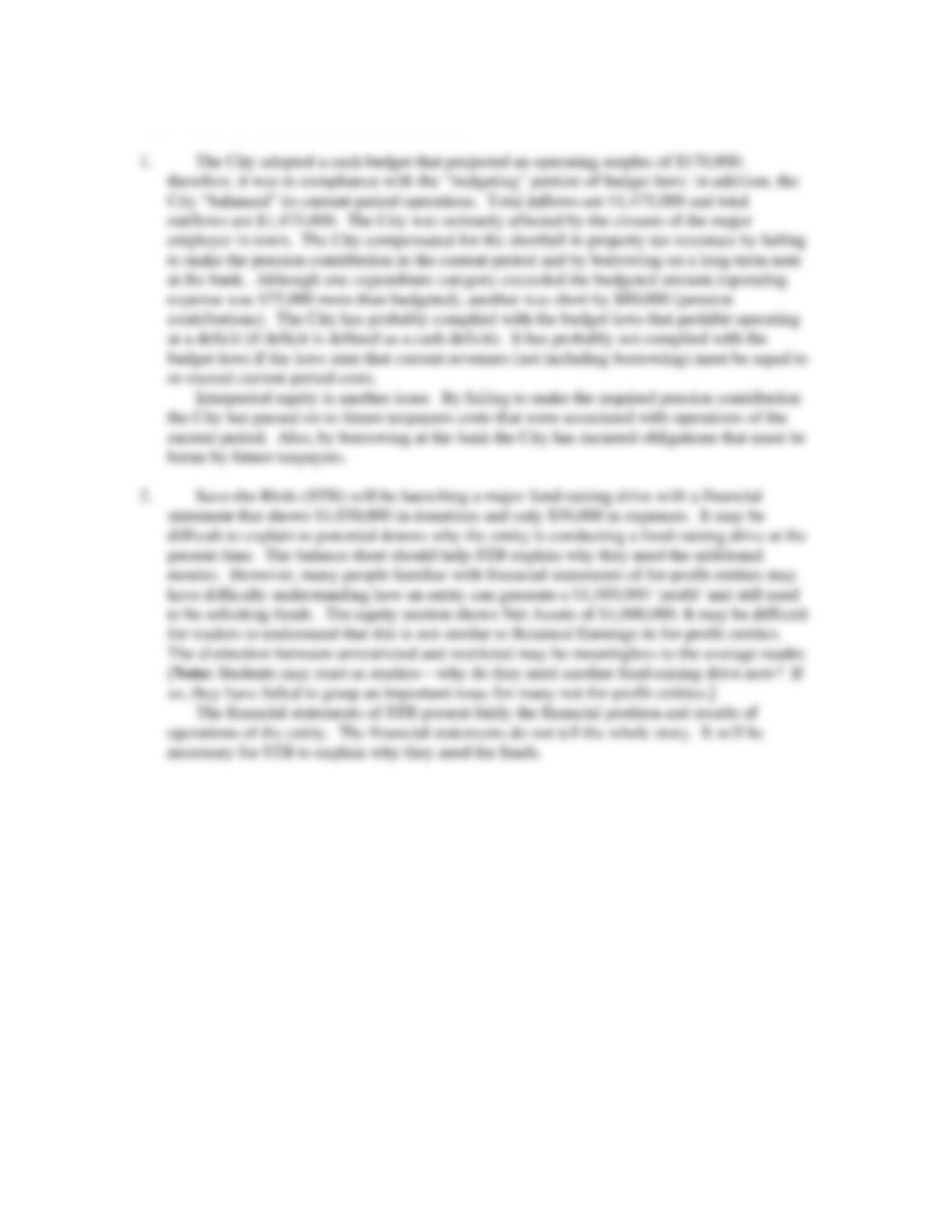
ANSWERS TO PROBLEMS (CHAPTER 1)
Granof Test Bank Chapter 1 Page 13
Granof Test Bank Chapter 1 Page 14
ANSWERS TO ESSAY QUESTIONS (CHAPTER 1)
Granof Test Bank Chapter 1 Page 15