Larson_Calculus_10e ch01sec01
MULTIPLE CHOICE
1. Decide whether the following problem can be solved using precalculus, or whether calculus is
required. If the problem can be solved using precalculus, solve it. If the problem seems to require
calculus, use a graphical or numerical approach to estimate the solution.
Find the distance traveled in 16 seconds by an object traveling at a constant velocity of 20 feet per
second.
a.
calculus, 320 ft
b.
calculus, 340 ft
c.
precalculus, 320 ft
d.
calculus, 640 ft
e.
precalculus, 640 ft
2. Decide whether the following problem can be solved using precalculus, or whether calculus is
required. If the problem can be solved using precalculus, solve it. If the problem seems to require
calculus, use a graphical or numerical approach to estimate the solution.
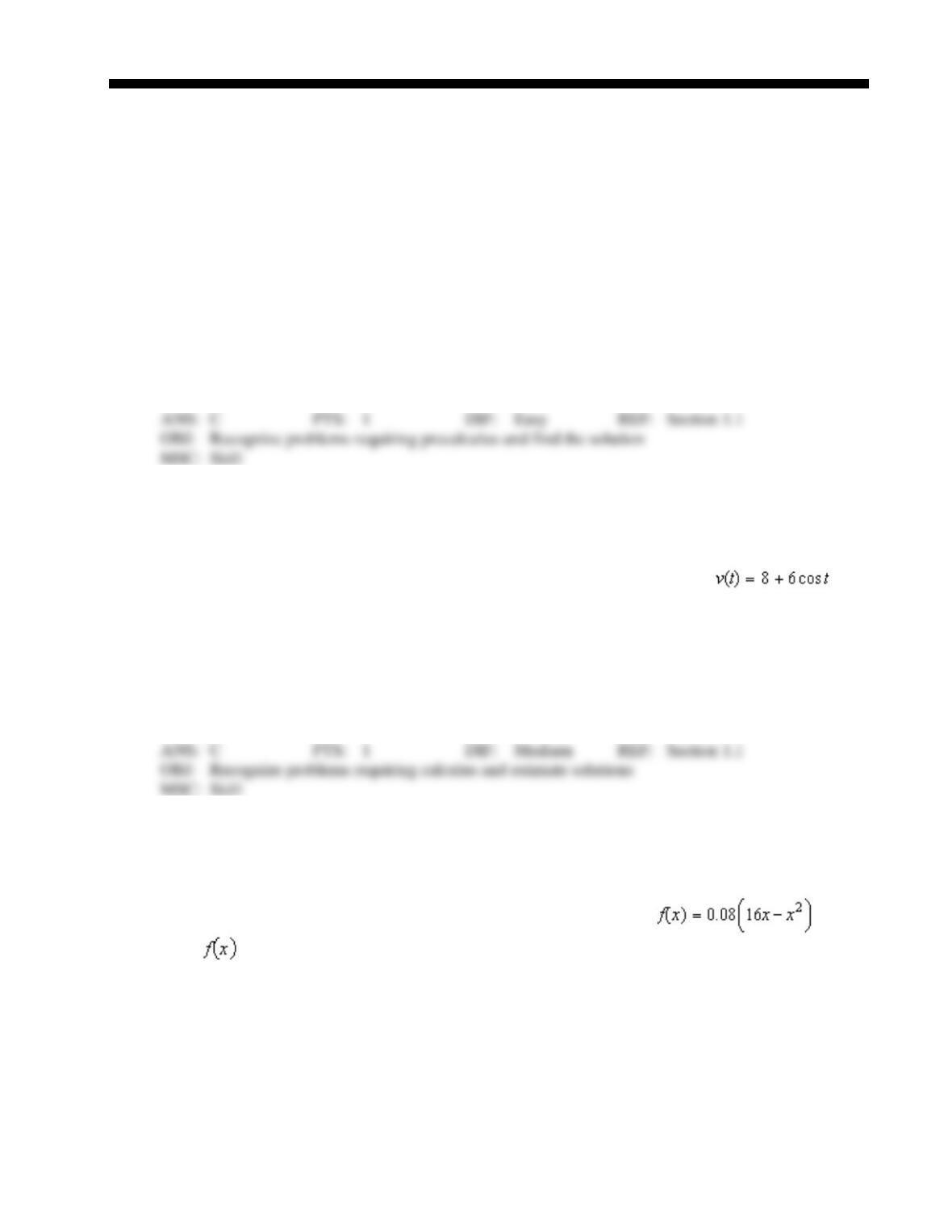
Find the distance traveled in 20 seconds by an object moving with a velocity of feet
per second.
a.
calculus, 162.4485 ft
b.
precalculus, 163.7985 ft
c.
calculus, 165.4777 ft
d.
precalculus, 165.4777 ft
e.
precalculus, 162.4485 ft
3. Decide whether the following problem can be solved using precalculus, or whether calculus is
required. If the problem can be solved using precalculus, solve it. If the problem seems to require
calculus, use a graphical or numerical approach to estimate the solution.
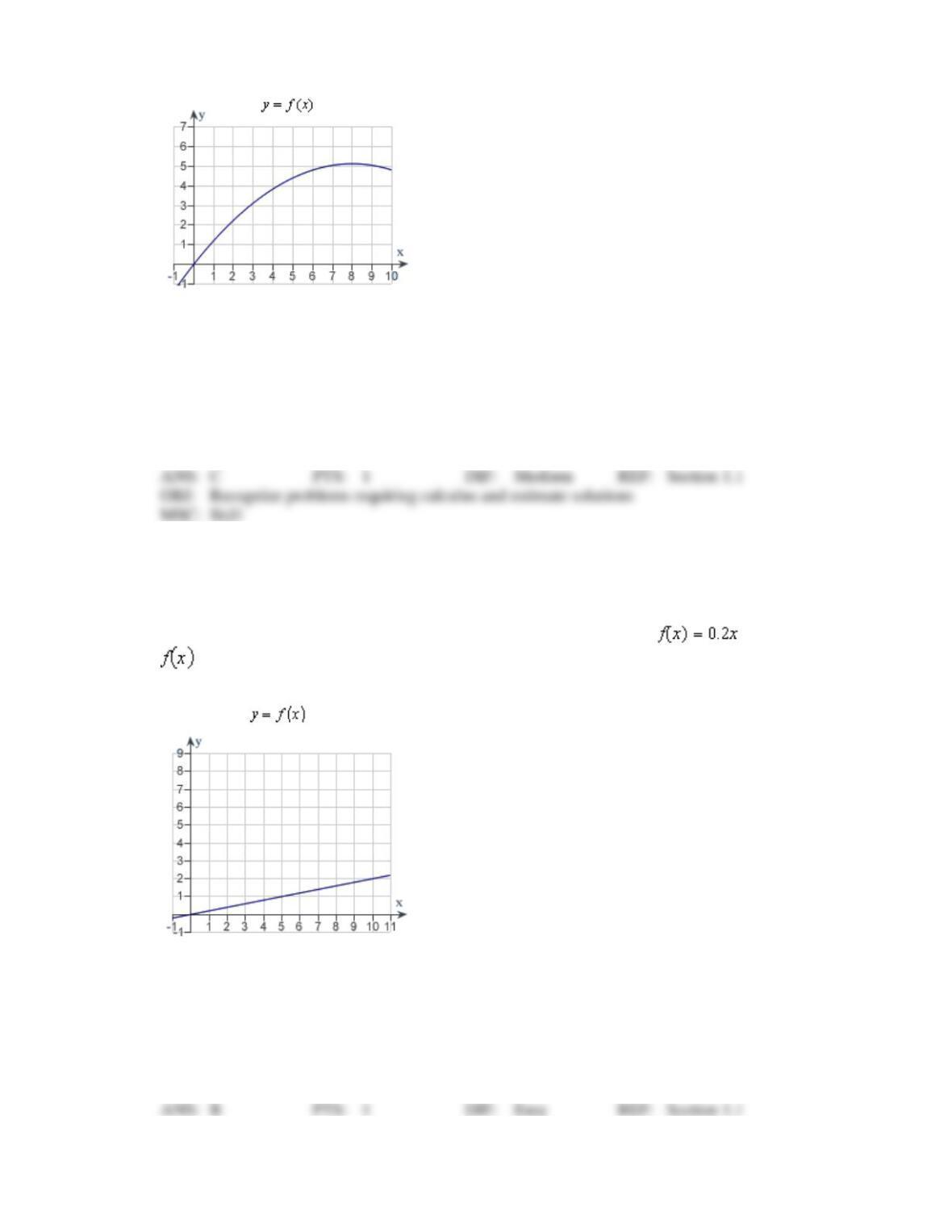
A cyclist is riding on a path whose elevation is modeled by the function where
x and are measured in miles. Find the rate of change of elevation when x = 4.
a.
precalculus, 0.08
b.
calculus, 0.2
c.
calculus, 0.64
d.
calculus, 0.08
e.
precalculus, 0.2
4. Decide whether the following problem can be solved using precalculus, or whether calculus is
required. If the problem can be solved using precalculus, solve it. If the problem seems to require
calculus, use a graphical or numerical approach to estimate the solution.
A cyclist is riding on a path whose elevation is modeled by the function where x and
are measured in miles. Find the rate of change of elevation when x = 5.
a.
calculus, 2
b.
precalculus, 0.2
c.
calculus, 0.2
d.
precalculus, 2
e.
precalculus, 0.45
5. Decide whether the following problem can be solved using precalculus, or whether calculus is
required. If the problem can be solved using precalculus, solve it. If the problem seems to require
calculus, use a graphical or numerical approach to estimate the solution.
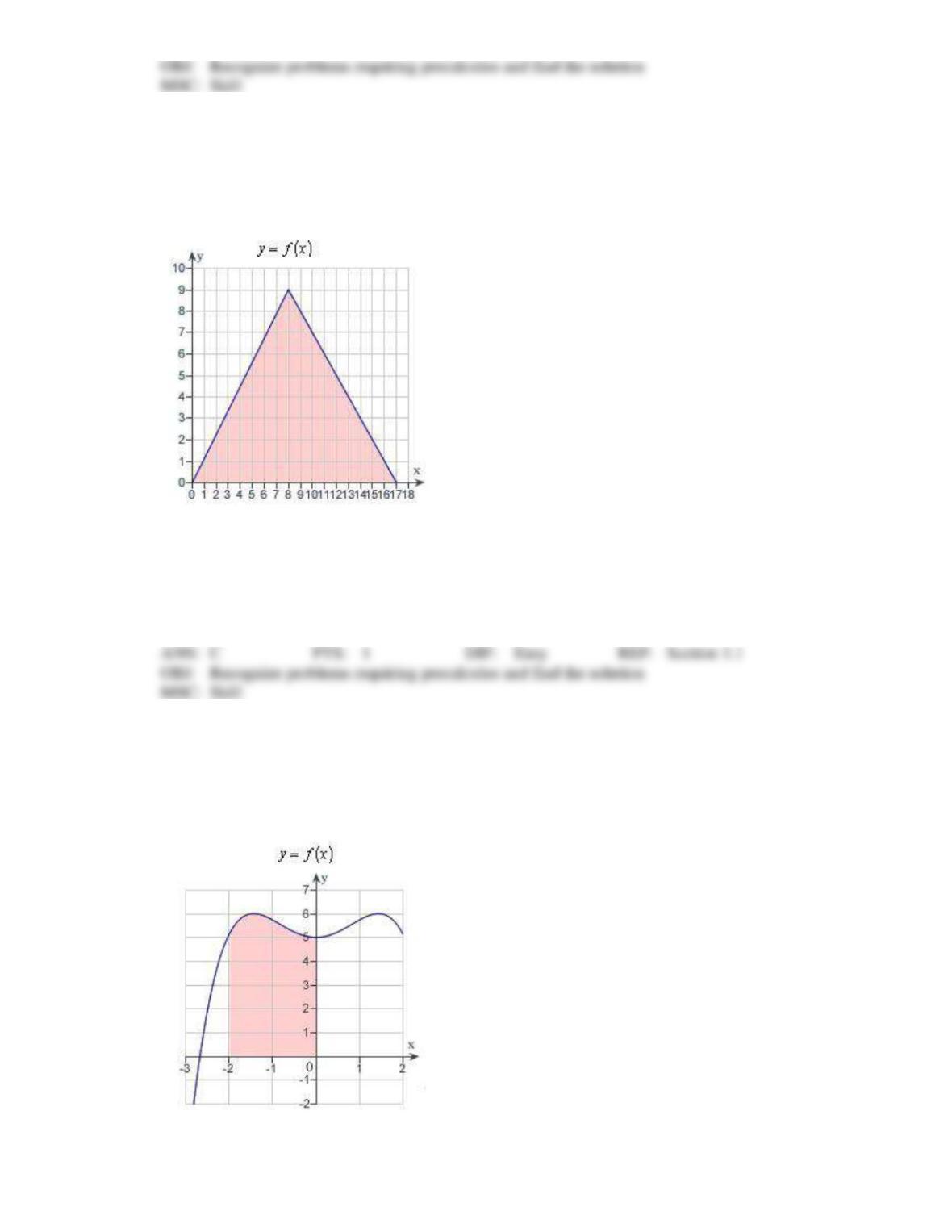
Find the area of the shaded region bounded by the triangle with vertices (0,0), (8,9), (17,0).
a.
precalculus , 153
b.
calculus , 229.5
c.
precalculus , 76.5
d.
precalculus , 229.5
e.
calculus , 153
6. Decide whether the following problem can be solved using precalculus, or whether calculus is
required. If the problem can be solved using precalculus, solve it. If the problem seems to require
calculus, use a graphical or numerical approach to estimate the solution.
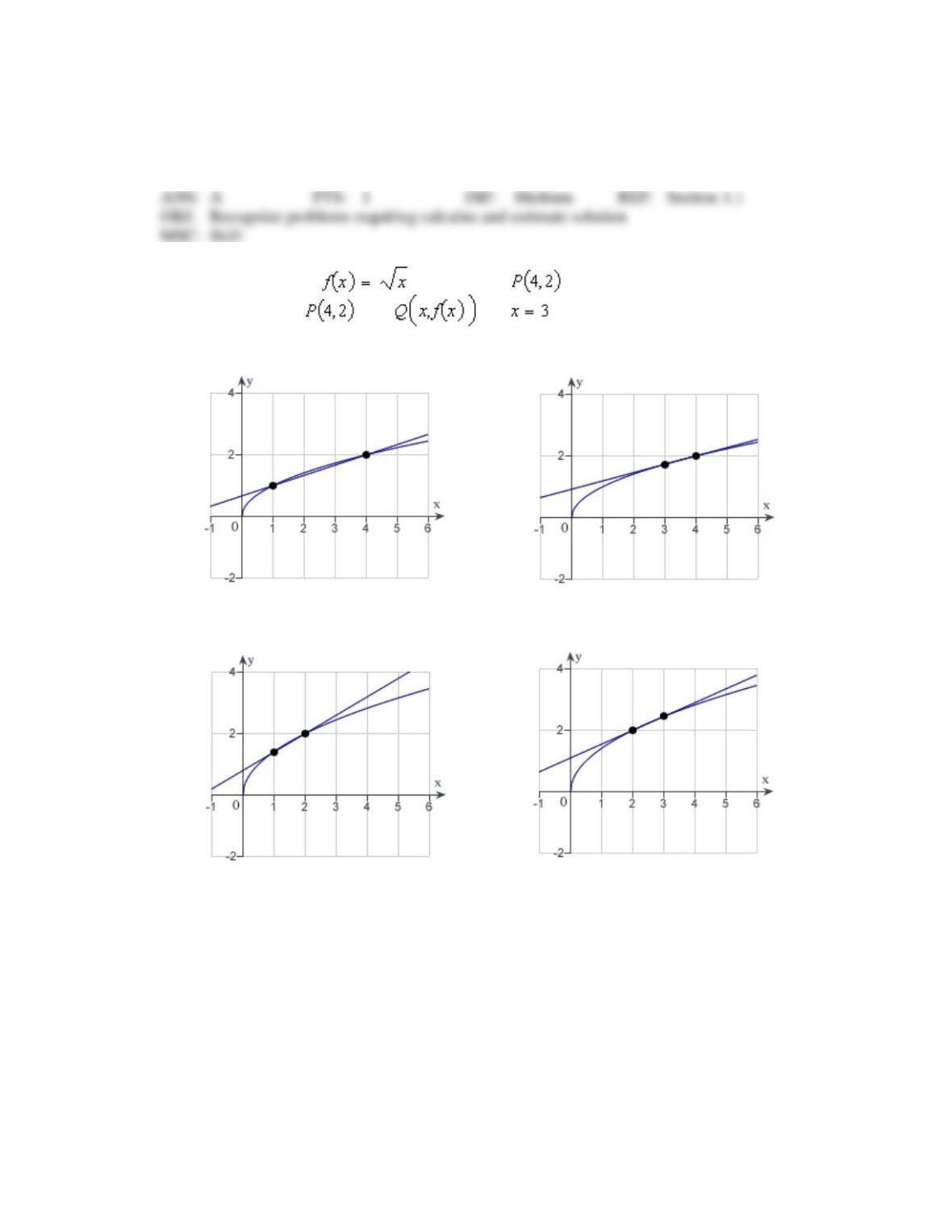
Find the area of the shaded region.
a.
calculus , 11
b.
precalculus , 11
c.
precalculus , 13
d.
calculus , 16
e.
precalculus , 16
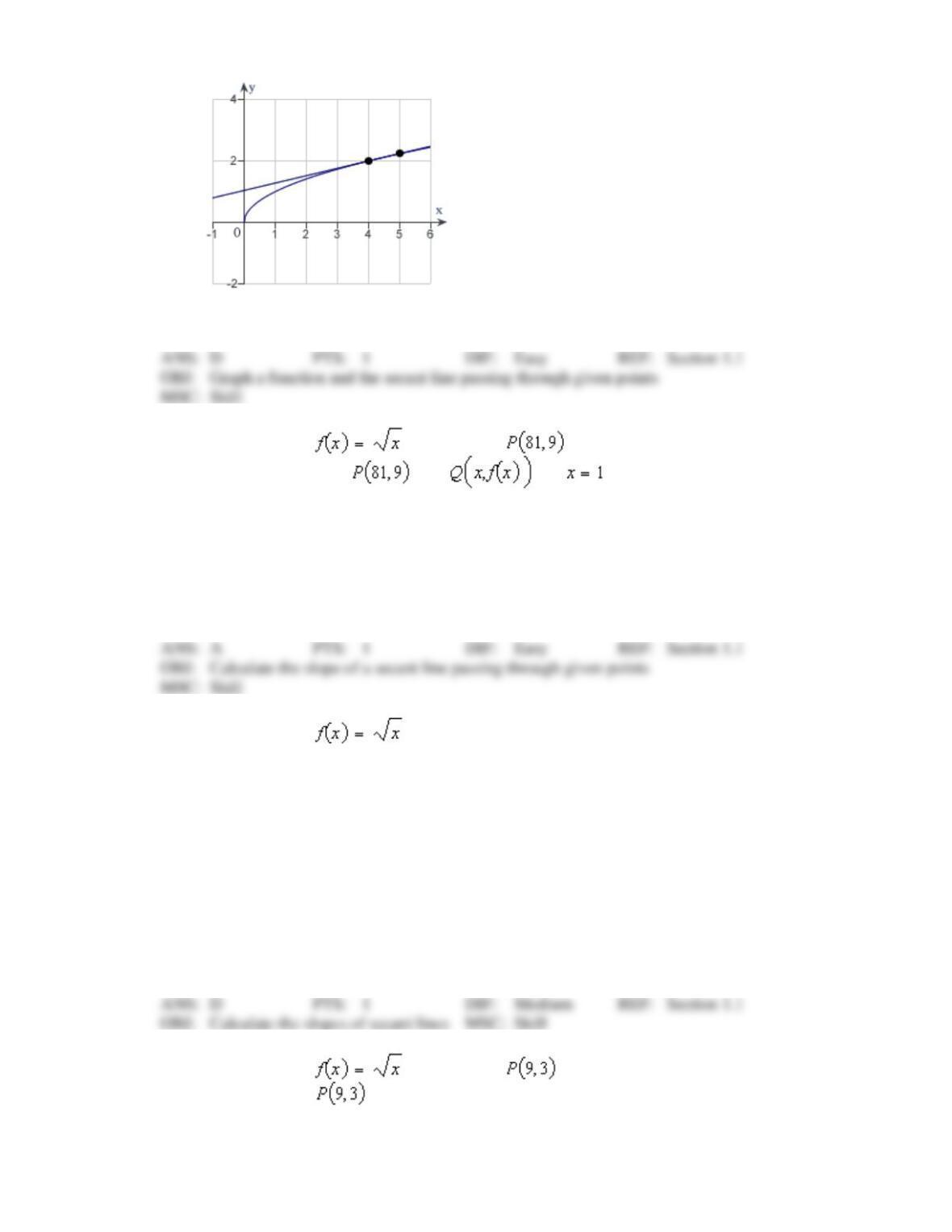
7. Consider the function and the point on the graph of f. Graph f and the secant
line passing through and for .
a.
d.
b.
e.
c.
8. Consider the function and the point on the graph of f. Find the slope of the
secant line passing through and for . Round your answer to four decimal
places.
a.
m=0.1000
b.
m=0.0122
c.
m=0.0122
d.
m=0.3133
e.
m=0.1000
9. Consider the function and the point P(64,8) on the graph of f.
Consider the secant lines passing through P(64,8) and Q(x, f(x)) for x values of 61, 63, and 65. Find the
slope of each secant line to four decimal places.
(Think about how you could use your results to estimate the slope of the tangent line of f at P(64,8),
and how to improve your approximation of the slope.)
a.
0.0633 , –0.0627 , 0.0623
b.
0.0633 , 0.0627 , 0.0623
c.
0.0317 , 0.0314 , 0.0312
d.
0.0633 , –0.0627 , –0.0623
e.
–0.0317 , –0.0314 , –0.0312
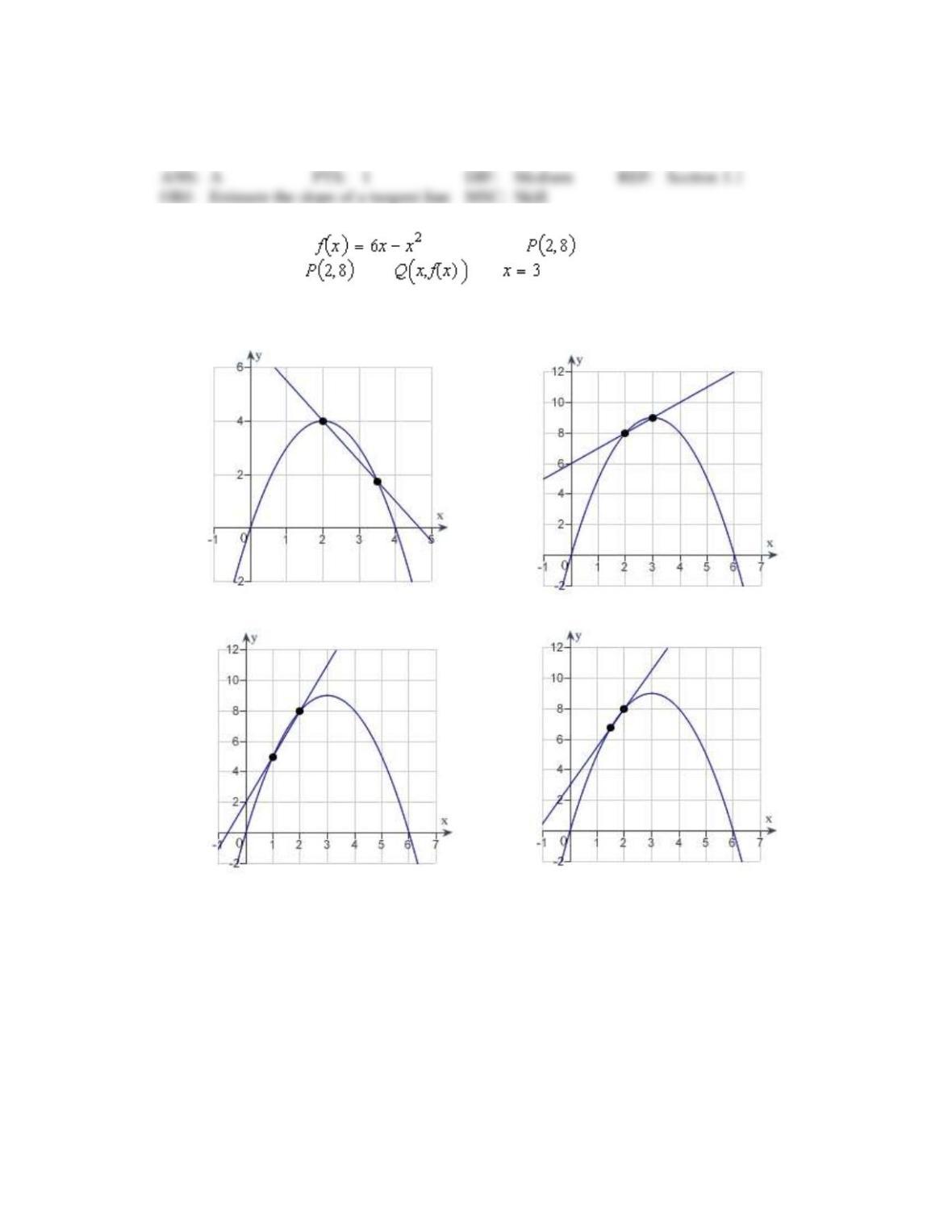
10. Consider the function and the point on the graph of f. Estimate the slope m of
the tangent line of f at . Round your answer to four decimal places.
a.
m=0.1667
b.
m=0.0832
c.
m=0.3800
d.
m=0.0556
e.
m=0.0833
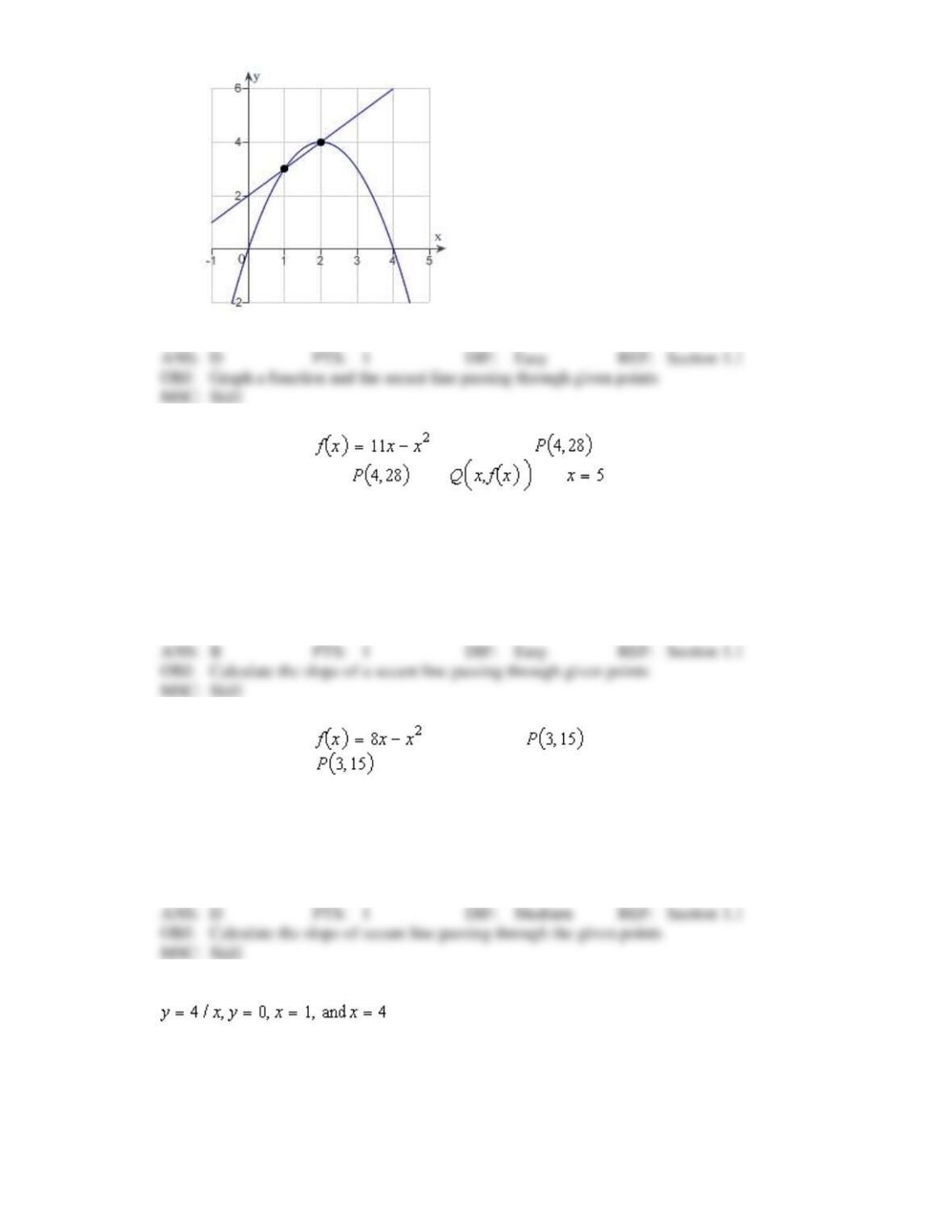
11. Consider the function and the point on the graph of f. Graph f and the secant
line passing through and for .
a.
d.
b.
e.
c.
12. Consider the function and the point on the graph of f. Find the slope of the
secant line passing through and for . Round your answer to one decimal
place.
a.
3.5
b.
2.0
c.
3.0
d.
4.5
e.
9.0
13. Consider the function and the point on the graph of f. Estimate the slope of
the tangent line of f at .
a.
10
b.
3
c.
8
d.
2
e.
9
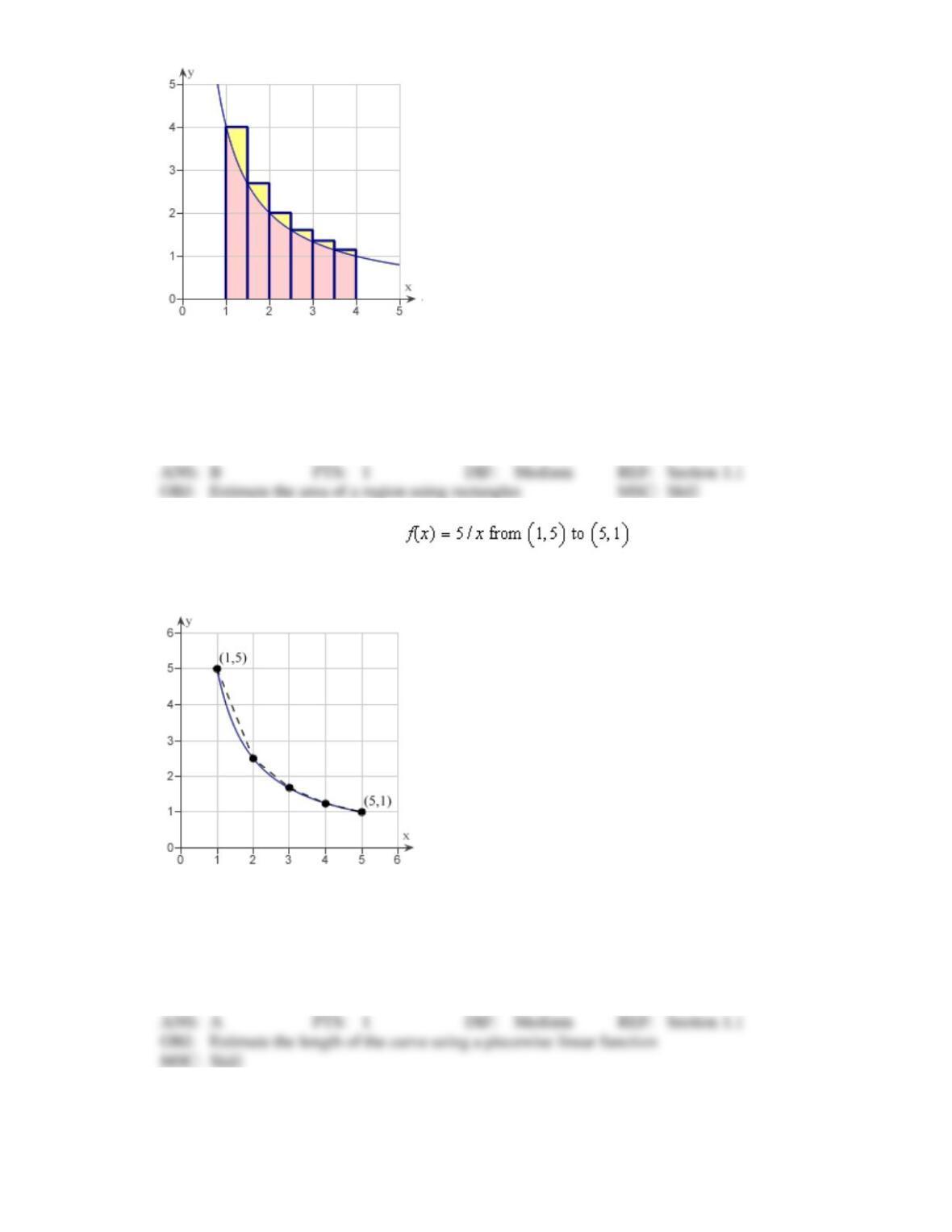
14. Use the rectangles in the graph given below to approximate the area of the region bounded by
Round your answer to three decimal places.
a.
2.481 units2
b.
6.371 units2
c.
3.585 units2
d.
6.872 units2
e.
6.903 units2
15. Consider the length of the graph of Approximate the length of the
curve by finding the sum of the lengths of four line segments, as shown in following figure. Round
your answer to two decimal places.
a.
6.11
b.
8.12
c.
5.66
d.
8.49
e.
7.11