
CHAPTER 1—INCOME TAXATION OF CORPORATIONS Key
1. The proprietorship uses gross ordinary income as the basis for calculating any self-employment tax due.
2. In contrast to a regular corporation, an S corporation’s pass-through of income and deductions to its
shareholders allows it to avoid double taxation of the same source of income.
3. In transactions between the partners and the partnership, the parties are generally treated like unrelated
parties.
4. Section 11 of the Code imposes a tax on all corporations, including nonprofit organizations.
5. A corporation is an artificial ‘‘person’’ created by Federal law.
6. If an individual taxpayer creates a legal corporation under state law, the government (i.e., the IRS) cannot
disregard the entity and tax the individual taxpayer on the income.
7. Although recognized as partnerships under state law, certain partnerships are treated and taxed as
corporations for Federal income tax purposes.
8. All bad debts of a corporation are treated as business rather than nonbusiness bad debts.

9. A corporation is allowed a dividends-received deduction only if the corporation is a member of an affiliated
group and the dividends are received from another member of the same group.
10. In computing a corporation’s limitation on the dividends-received deduction, its taxable income is
determined without the deductions for dividends received, net operating loss carryovers, and capital loss
carrybacks.
11. Where a dividends-received deduction adds to or creates a net operating loss, the taxable income limitation
decreases from 70 percent to 34 percent.
12. At its election, a corporation can either deduct all organizational costs paid during the current year or
amortize the expenditures over a period not less than 180 months.
13. Because organizational costs are assets with indefinite lives (i.e., they have value for the life of the
corporation), they may not be expensed or amortized.
14. Organizational expenses incurred by an accrual basis corporation in its first year of existence but paid in a
later year will not qualify for amortization.
15. If an accrual basis corporation incurs an additional expense in setting up its accounting system after the
close of its first tax year but before the due date of its initial return, the expense qualifies as an organizational
expense and may be amortized.
16. A corporation is not allowed a dividends-received deduction in computing its net operating loss for any
given year.

17. A corporation’s annual charitable contribution deduction is limited to 10 percent of its taxable income
without reduction for charitable contributions, the dividends-received deduction, net operating loss carrybacks,
and capital loss carrybacks.
18. In planning for its annual charitable contributions, a corporation should take into account any net operating
loss or capital loss carryforwards since such items reduce the corporation’s taxable income base for purposes of
the annual deduction limitation.
19. Unlike individuals, corporations with excess capital losses in the current year are allowed to carry these
losses back five years and forward three years to offset capital gains in the carryback or carryforward years.
20. A corporation may be required to recapture (as ordinary income) a greater portion of its gain on the sale of
depreciable real property than would an individual taxpayer.
21. An accrual basis corporation must use the cash method in claiming deductions for amounts paid to its cash
basis sole shareholder.
22. The 2012 Federal income tax rate for a calendar year corporation with taxable income of $335,000 up to
$10 million is 34 percent.
23. Corporation A is equally owned by 10 unrelated individual shareholders. Corporation B is 100 percent
owned by one of the shareholders that owns stock of Corporation A. As a result of this common stock
ownership, Corporations A and B are members of a brother-sister controlled group.
24. A personal service corporation with taxable income of $10,000 for its 2012 calendar year will have a regular
Federal income tax liability of $3,500 before credits or prepayments.
25. A corporation with alternative minimum taxable income of $20,000 will be subject to an alternative
minimum tax of $4,000.
26. Which of the following is not true?
27. Which of the following is not a corporate characteristic?
28. Which of the following is treated the same for individuals and corporations?
29. R Corporation had 2012 gross income of $200,000, including $100,000 of dividends received from a less
than 20 percent owned taxable domestic corporation. R had deductible business expenses of $110,000 before
considering its dividends-received deduction. What is R Corporation’s dividends-received deduction for 2012,
assuming no restrictions other than the taxable income limitation may apply?

30. For its taxable year ending December 31, 2012, T Corporation has the following taxable income and
deductible expenses:
Gross income from operations
$205,000
Deductible expenses of operations
218,000
Dividends received
35,000
The dividends were received from a taxable domestic corporation in which T owns 15 percent of the stock (not debt-financed). What is T
Corporation’s dividends-received deduction for 2012?
31. Corporations A, B, and C are taxable domestic corporations. All are members of an affiliated group.
Corporation A pays a $50,000 dividend to B and a $50,000 dividend to C. Corporations B and C are each
entitled to a dividends-received deduction of
32. New Corporation was organized and began active business on January 7, 2012. New incurred the following
expenses in connection with opening the business:
Legal fees for drafting the charter and bylaws
$ 750
Legal fees for the transfer of the ownership
titles of assets from shareholders to the
corporation
100
State incorporation fees
250
Printing cost for stock certificates
175
Fees paid to temporary directors for
first two organization meetings
300
Accounting fees to set up initial recordkeeping system
400
Total
$1,975
Assuming New Corporation adopts a calendar year for tax purposes, what is the maximum amount of organizational expenses that may be deducted
on the corporation’s initial tax return?
33. A newly formed corporation elected to use a fiscal year ending June 30. On July 17, 2012, the corporation
began business and incurred $8,000 of qualified organizational expenses. Assuming that the corporation
properly elected to deduct/amortize these costs, what is the amount of organization expenses that it should
deduct on its tax return for the fiscal year ending June 30, 2013.
34. X Corporation, which files its tax return on a cash basis, incurred organizational costs (not to a related party)
of $5,000 during its first year. $1,875 of these expenses were paid in the fourth month after the close of its
taxable year. What is the maximum deduction the corporation is entitled to claim on its first tax return if that tax
return is for a period of 111=2 months and a proper election is made?
35. The charitable deduction for a corporation is limited both by type of property contributed and an annual
maximum amount. Which of the following is a false statement?
36. Which one of the following statements is true for a regular corporation?

37. T Corporation’s taxable income for 2012 was $100,000, computed by erroneously deducting the
corporation’s total charitable contributions of $12,000. The correct contribution deduction for T Corporation is
38. During its first year of operation, K Corporation had a gross profit from operations of $180,000 and
deductions of $250,000 before considering its dividend income or dividends-received deduction. K received
dividends of $50,000 from a taxable domestic corporation in which K owned 4.5 percent of the stock. Assuming
its ownership of the dividend-paying corporation’s stock is not debt financed, what is K Corporation’s net
operating loss for the year?
39. Z Corporation had 2012 taxable income of $600,000 before considering the following:
Gain on the sale of equipment
$15,000
Loss on the sale of equipment
(29,000)
Gain on the sale of land used in the business
70,000
Loss on the sale of investment held five months
(5,000)
Loss on the sale of investment held two years
(18,000)
The equipment sold at a gain originally cost $150,000, and $90,000 of depreciation had been claimed. What is Z Corporation’s taxable income for
2012?
40. Which of the following is different for corporations than it is for individuals?
41. T Corporation sold a commercial building for $200,000 on January 2, 2012 (purchased for $150,000 on
December 16, 2007). The building was depreciated using the straight-line method, and depreciation in the
amount of $20,000 has been taken. The amount and nature of the gain upon sale is
42. J is a 60 percent shareholder in the JS Corporation. In 2009, he sold property to the corporation for $60,000
(basis in his hands of $70,000). In 2012, the corporation sold the property for $65,000 to an unrelated party. The
amount of gain or loss the JS Corporation must recognize in 2012 is
43. Which of the following is a false statement regarding transactions between corporations and their
shareholders?
44. Z Corporation’s 2012 calendar year taxable income is $2,000,000. The corporation’s 2012 Federal income
tax liability before credits and prepayments is
45. A regular corporation and a personal service corporation each have taxable income of $20,000 for the 2012
calendar year. Ignoring the alternative minimum tax provisions, which one of the following statements is true
regarding the Federal income tax liabilities of these two corporations?
46. The principal activity of several corporations is shown below. Which of the following could not be
classified as a personal service corporation?
47. Two personal service corporations (PSCs) are properly determined to be a brother-sister controlled group.
Corporation A has taxable income of $75,000, and Corporation B has a loss of $50,000. Which of the following
is a true statement?
48. A brother-sister controlled group consists of two or more corporations connected through the stock
ownership of certain types of shareholders, including
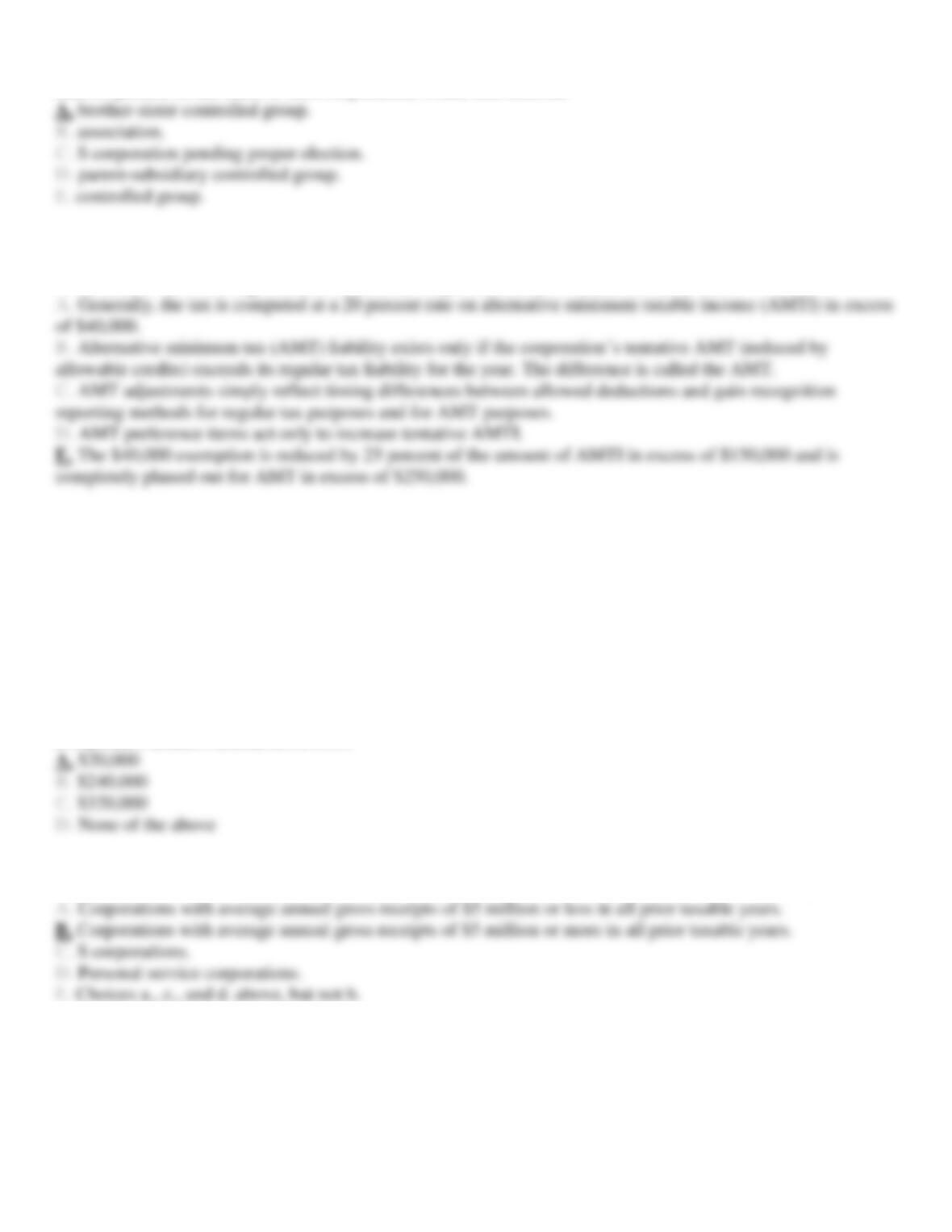
49. Two or more corporations owned by five or fewer noncorporate shareholders, who collectively own more
than 50 percent of the stock of each corporation, would best describe
50. Which of the following statements about the corporate alternative minimum tax is false?
51. B Corporation reported taxable income in 2012 of $1 million. Additional information concerning B’s 2012
tax return is as follows:
Alternative minimum taxable income
(without regard to the ACE adjustment item)
$1.2 million
Adjusted current earnings (ACE)
2.0 million
B Corporation’s alternative minimum tax for 2012 is
52. Which of the corporations below are required to use the accrual method of accounting for tax purposes?
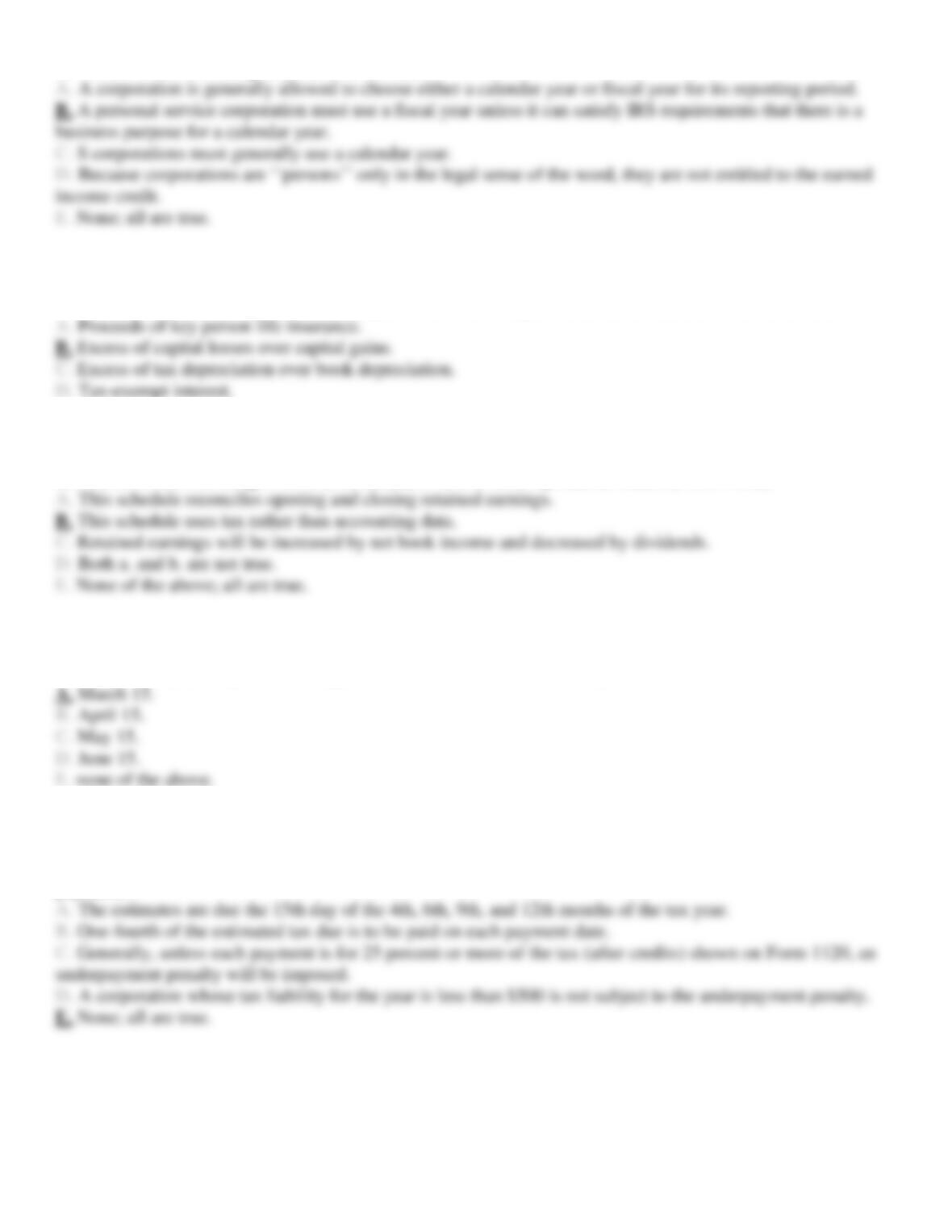
53. Which of the following statements is not true?
54. Which of the following is a positive adjustment to income per books on Schedule M-1 of Form 1120?
55. Which of the following is not true of Schedule M-2 of the corporate tax return (Form 1120)?
56. A calendar year corporation is required to file its Federal tax return by
57. Which of the following is not true concerning the obligation of a corporation to make estimated tax
payments?
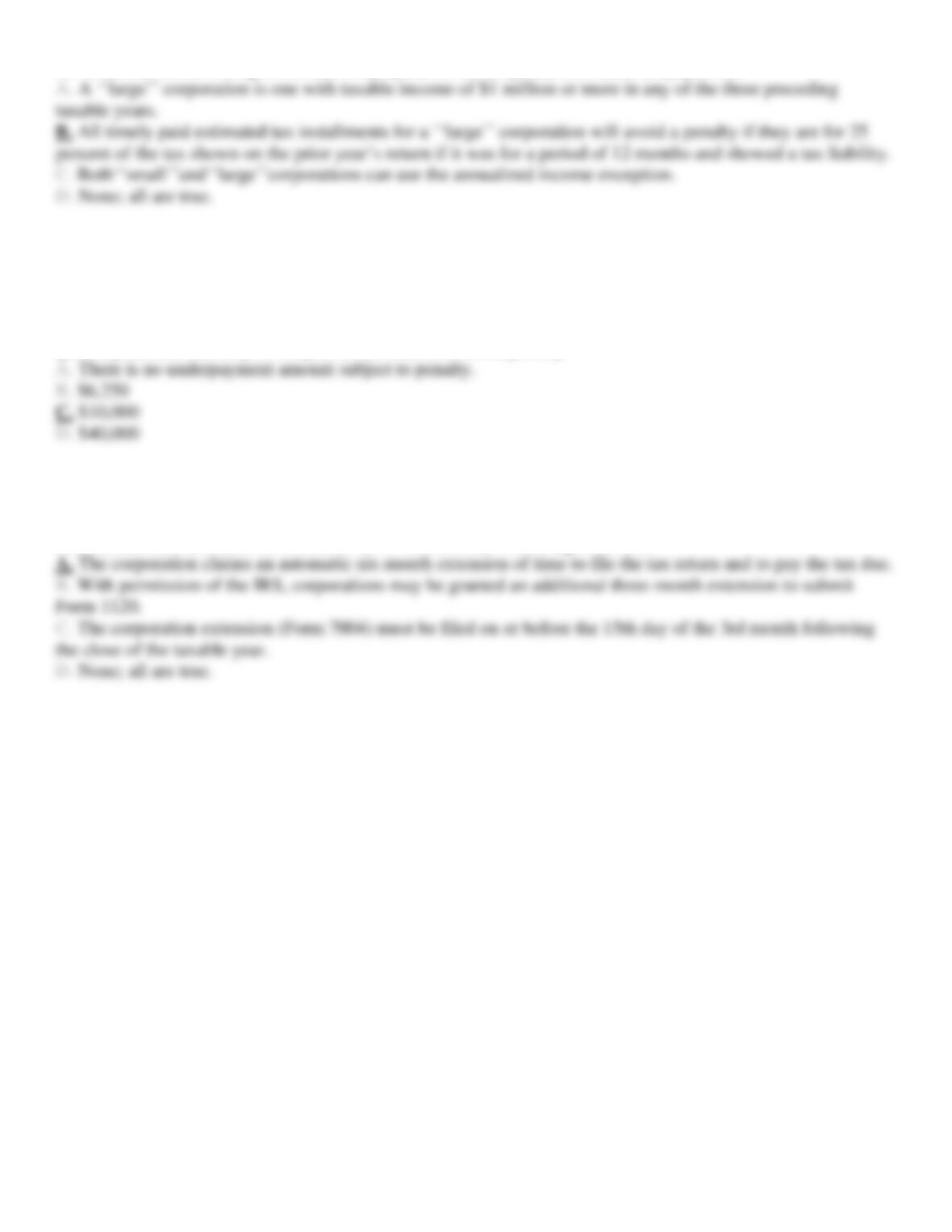
58. Which of the following is not true for purposes of the corporate estimated tax payments?
59. Large Corporation, with over $1 million in taxable income for each of the last several years, paid estimated
tax payments of $30,000 each quarter for the current year. The actual tax liability for the current year is
$160,000; last year’s tax liability was $145,000. Income is earned evenly throughout the year. What is the
quarterly amount that may be subject to the underestimation penalty?
60. X Corporation determines it cannot meet the filing deadline for Form 1120 (U.S. Corporation Income Tax
Return) and files an extension on Form 7004. Which of the following is not true?