
Chapter 1
Standards Informing School Leadership
Chapter Overview
This chapter examines the case that is being made for using standards to inform policy decisions
and school leader behaviors. It summarizes the rationale for using standards, identifies
organizations proposing them, and presents the set of standards informing school leadership
Learner Objectives
After reading the chapter, completing the prescribed activities, and addressing the discussion
questions, students should be able to:
❖ Identify standards that inform the behavior of school leaders and describe what they
should know and be able to do to enhance the academic achievement of every
student.

❖ Identify standards that inform the requirements of school leadership preparation
programs.
❖ Understand the importance of using clear and consistent evaluation criteria to
evaluate the effectiveness of leadership preparation programs.
Chapter Outline
Introduction
The Emergence of Standards for School Leaders
Measuring School Leadership Effectiveness
Understanding Existing School Conditions
Organizations that create standards and how they inform practice
The National Policy Board for Educational Administration
Unpacking the ISLLC Standards
Transforming Standards into Practice
Leadership Behavior in Schools
Chapter Summary
Moving into Practice
Acquiring an Understanding of Self
Deepening Your Understanding
Practice for the School Leaders Licensure Assessment
Suggested Readings
• Professor’s Presentation
• Open Dialogue/Introductions
• Review Course Syllabus
• Present and Discuss Course Assignments

• Conduct One or More In Class Assignments
• Discuss Assignments for the Next Class Session
o “The Four Dimensions of Principal Leadership: A Foundation for Leading
21st Century Schools”
o Leadership Definitions
• Critique Writing
❖ It is critical that students develop an approach to use in determining the extent to which
they can effectively meet the ISLLC Standards.
Discussion Questions
1. What are some processes a school leader might use to place the ISLLC Standards into
practice?
2. Why is it important to have a set of national standards to inform leadership behavior?
3. Why is it necessary to have a set of standards to use in establishing criteria for
leadership preparation programs?

Key Terms and Concepts
➢ A vision of learning
➢ School and community
➢ Teaching and learning in schools
Key Standards/Theories
There are a number of standards that inform the behavior of leaders. In this chapter some of the
standards and competencies that are essential to leading 21st century schools are analyzed. The
standards and competencies analyzed are:
✓ ISLLC Standards
✓ ELCC Standards
✓ The Thirteen Core Competencies
In-Class Activities
1. The ISLLC Standards inform a contemporary approach to practicing the art of leadership.
List the functions of the standards and describe the meaning of each function in terms of
how it informs leadership behavior in a school situation.

2. The standards’ movement has emerged to ensure that 21st century school leaders have the
3. Select one (1) of the thirteen (13) core competencies and discuss it in the context of
school leadership.
4. Have each student conduct a series of self -assessment activities for the purpose of
acquiring an assessment in the following areas:
1. Interest 5. Oral Skills
5. List each of the standards and identify an artifact from your school experience that will
serve as evidence that you have engaged each standard in a practical school situation.
6. Require students to develop and submit a self-assessment paper containing the results of
an analysis of their leadership style. Then, have each student use the results to prepare an
1. Which of the following is an example of a school leader’s ability to formulate goals with
individuals and groups?
a. A written news letter
b. The monitoring of students’ individual instructional plans
c. A set of goals for fourth grade students designed by members of the third, fourth,
and fifth grade teams
d. A memo to the third, fourth, and fifth grade team members thanking them for
participating in several goal development sessions
2. The principles of ISLLC Standard 1 advocate that school leaders should:
a. Develop a vision of learning that is shared by all stakeholders.
b. Develop a school culture and instructional program conductive to student learning
and staff professional growth.
c. Manage the school organization in a manner that ensures that students can learn in
a safe environment.
d. Respond to diverse community interest.
3. The principles of ISLLC Standard 2 advocate that school leaders should:
a. Develop a vision of learning that is shared by all stakeholders.
b. Develop a school culture and instructional program conductive to student learning
and staff professional growth.
c. Manage the school organization in a manner that ensures that students can learn in
a safe environment.
d. Respond to diverse community interest.
4. The principles of ISLLC Standard 3 advocate that school leaders should:
a. Develop a vision of learning that is shared by all stakeholders.
b. Develop a school culture and instructional program conductive to student learning
and staff professional growth.
c. Manage the school organization in a manner that ensures that students can learn in
a safe environment.
d. Respond to diverse community interest.
5. The principles of ISLLC Standard 4 advocate that school leaders should:
a. Develop a vision of learning that is shared by all stakeholders.
b. Develop a school culture and instructional program conductive to student learning
and staff professional growth.
c. Manage the school organization in a manner that ensures that students can learn in
a safe environment.
d. Respond to diverse community interest.
6. If a school leader is analyzing data from multiple sources about the progress of students
in the schoolhouse, he/she is most likely concerned with:
a. Providing a safe learning environment for each student.
b. Identifying an approach to use in communicating with members of the diverse
community.
c. Enhancing the teaching and learning process.
d. Maximizing the use of community resources.
7. If a school leader is concerned with developing a communication plan to use in sharing
with key external stakeholder the resource challenges the school face, he/she would most
likely be concerned with:
a. Providing a safe learning environment for each student.
b. Identifying an approach to use in communicating with members of the diverse
community.
c. Enhancing the teaching and learning process.
d. Maximizing the use of community resources.
8. If a school leader held a series of meeting with teachers, students, and parents for the
purpose of developing guidelines and norms to govern behavior in the school, he/she
would most likely be concerned with:
a. Providing a safe learning environment for each student.
b. Identifying an approach to use in communicating with members of the diverse
community.
c. Enhancing the teaching and learning process.
d. Maximizing the use of community resources.
9. If a school leader organized a group of stakeholders and met with them each month to
discuss the extent to which members of the community were knowledgeable of the
school’s practices and procedures, he/she would most likely be concerned with:
a. Providing a safe learning environment for each student.
b. Identifying an approach to use in communicating with members of the diverse
community.
c. Enhancing the teaching and learning process.
d. Maximizing the use of community resources.
10. If a school leader was seriously interested in implementing ISLLC Standard 1, he/she
would facilitate processes and engage in activities to ensure that:
a. The vision and mission of the school are effectively communicated to staff,
parents, students, and community members.
b. The school culture and climate are assessed on a regular basis.
c. Operational plans and procedures to achieve the vision and goals of the school are
in place.
d. Diversity is recognized and valued.
11. If a school leader is seriously interested in implementing ISLLC Standard 2, he/she
would facilitate processes and engage in activities to ensure that:
a. The vision and mission of the school are effectively communicated to staff,
parents, students, and community members.
b. The school culture and climate are assessed on a regular basis.
c. Operational plans and procedures to achieve the vision and goals of the school are
in place.
d. Diversity is recognized and valued.
12. If a school leader is seriously interested in implementing ISLLC Standard 3, he/she
would facilitate processes and engage in activities to ensure that:
a. The vision and mission of the school are effectively communicated to staff,
parents, students, and community members.
b. The school culture and climate are assessed on a regular basis.
c. Operational plans and procedures to achieve the vision and goals of the school are
in place.
d. Diversity is recognized and valued.
13. If a school leader is seriously interested in implementing ISLLC Standard 4, he/she
would facilitate processes and engage in activities to ensure that:
a. The vision and mission of the school are effectively communicated to staff,
parents, students, and community members.
b. The school culture and climate are assessed on a regular basis.
c. Operational plans and procedures to achieve the vision and goals of the school are
in place.
d. Diversity is recognized and valued.
14. If a school leader is seriously interested in implementing ISLLC Standard 5, he/she
would facilitate processes and engage in activities to ensure that:
a. The vision and mission of the school are effectively communicated to staff,
parents, students, and community members.
b. The school culture and climate are assessed on a regular basis.
c. All stakeholders demonstrated a personal and professional code of ethics.
d. Diversity is recognized and valued.
15. If a school leader is seriously interested in implementing ISLLC Standard 6, he/she
would facilitate processes and engage in activities to ensure that:
a. All stakeholders demonstrated a personal and professional code of ethics.
b. There is ongoing dialogue with representatives of diverse community groups.
c. The school culture and climate are assessed on a regular basis.
d. None of the above
16. Which of the following standards inform leadership preparation programs:
a. ISLLC Standards
b. ELCC Standards
c. A. and B.
d. None of the above.
17. According to the National Policy Board for Educational Administration, today’s school
leaders should be:
a. The School’s Chief Learning Officer.
b. The Instructional Leader of the School.
c. Knowledgeable of Instructional Practices.
d. All of the above
18. A number of states require prospective school leader to _____________
_________________ on a standards-based assessment for licensure.
a. demonstrate a level of proficiency
b. demonstrate mastery of the ISLLC Standards
c. demonstrate mastery of the ELCC Standards
d. None of the above
1. Discuss in some detail three approaches a school leader might use to implement the
ISLLC Standards.
2. Describe five practices that a school leader might use to ensure mastery of the thirteen
core competences.
3. In your opinion, is standards-based instruction effective? Provide evidence to support
your opinion.
Power Points
▪ Unpacking the ISLLC Standards
Professor’s Scenario
Creating a Professional Learning Community

An urban elementary school principal was assigned to lead a new school constructed in a middle
to high socioeconomic status community. The school was built to relieve two neighborhood
schools that were exceeding their capacity and to keep students in their feeder pattern.
Stephanie Williams was named principal and placed in the Regional Office for one year
to plan for the opening of the new school that would be a professional learning community.
Principal Williams was given the option to transfer staff from her former school to the new
Having identified the staff, Principal William began the process of developing a
leadership team. Once developed, the leadership team consisted of a committee of teachers and
staff members that represented each phase of the school (i.e. special areas and each individual
The Intensive Training
Day 1 of the leadership training focused on team building. The principal explained her
vision and mission for the school and invited the team to share in that vision. Having presented

her vision, Principal Williams asked the team to look at both the vision and mission statements
and write out how each would be exhibited: 1) in classrooms; 2) through instructional strategies;
3) in school-wide activities, and 4) on grade levels. Team members worked individually to
develop measureable behaviors that responded to each of the requested areas. The exercise was
concluded with individuals sharing their interpretation of the vision and mission in a
This extensive training exercise is an example of the development of school culture. In,
The Four Dimension of Principal Leadership: A Framework for Leading 21st Century Schools,
Green, 2010 speaks about the elements of school culture that enhance academic achievement.
Those elements are:
(1) Internal Organization – structure, culture, and climate
(2) The Social System – individuals, formal groups, and informal groups
(3) Purpose – mission, goals, objectives

began the process of using generative thinking rather than adaptive thinking. Generative
thinking, “emphasizes continuous experimentation and feedback in an ongoing examination of
the way organizations go about defining and solving problems
Day 2 of the leadership team training focused on how the mission would be received by
parents and the larger community. Strategies and procedures for effectively communicating with
parents and community leaders were shared and practiced. Attendance incentives and discipline
Day 3 the team participated in curriculum planning and scheduling. Each grade level
chair worked to create curriculum maps to chart the path for instruction. Textbooks were
selected, and instructional materials were identified, and reviewed. The team collaboratively
selected the materials that they believed would best meet the academic needs of the students that
Day 4 the meeting focused primarily on the internal organization of the school. The
topics discussed included: 1) professionalism when communicating with colleagues, students,
and parents; 2) maintaining trust within those conversations by being confidential, and 3) attire.
The team developed a uniform dress code. It was agreed that teachers and students would wear
uniforms Monday – Thursday and on Fridays all students and staff would wear, “Friday T–

Day 5 of the leadership team training was a physical day. The entire team went to the
“under–construction” school site dressed in hard hats, goggles, and jeans. The team walked
through the entire building to see where each grade level would be placed and the rooms each
individual would occupy. Day 5 ended with the entire team sweeping and picking up scraps in
After the extensive leadership training, it was time to bring the remainder of the staff on
board for two weeks of transferring of knowledge. The leadership team understood, appreciated,
Directions: Hold a classroom discussion on the activities in the scenario and have students
identify:
1. Passages that are informed by each standard.
2. Functions from the standards that are represented in the scenario.
3. Leadership behavior, if any, that is not consistant with any of the standards
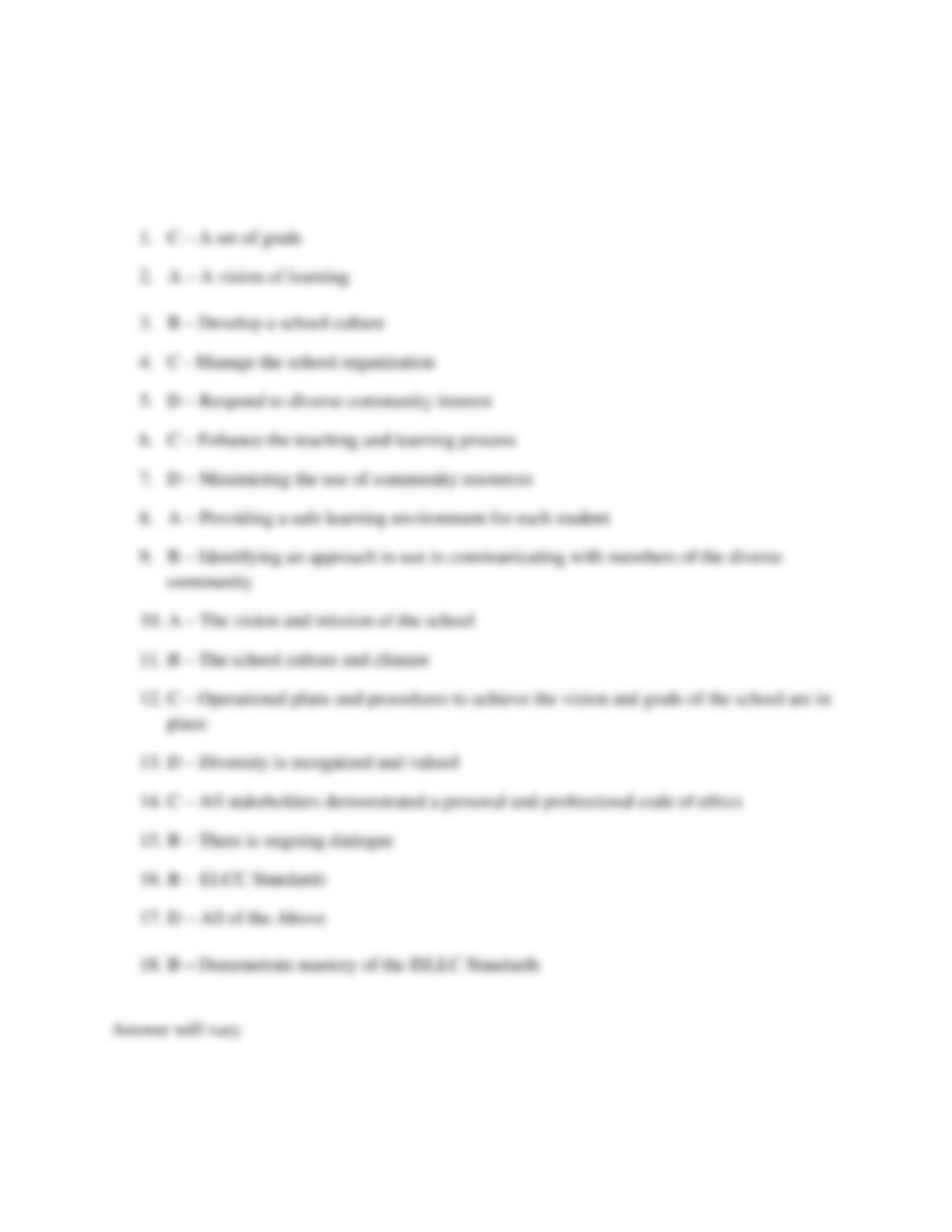
Answer Key
Chapter 1