
0
Chapter 1 Exceptionality and Special Education
1.1 Multiple-Choice Questions
1) In comparison to typical students, students who are exceptional
A) have both similarities and differences.
B) are similar in almost every way.
C) are different in almost every way.
D) have the same instructional needs, but differ in ability level.
Praxis: I.B.
CEC: ICC2K5
2) Advances in drug treatments appear to hold the potential for a cure for
A) cerebral palsy.
B) cystic fibrosis.
C) Down syndrome.
D) muscular dystrophy.
Praxis: I.B.
CEC: ICC2K7
3) “Mental retardation” is now called
A) intellectual disorder
B) disordered reasoning
C) intellectual and functional disability
D) intellectual disability
Praxis: I.B.
CEC: ICC1K5
4) The most important characteristic of exceptional learners is
A) their physical limitations.
B) their disabilities.
C) their abilities.
D) their health concerns.
Praxis: I.B.
CEC: ICC2K6
5) Which one of the following descriptions distinguishes best between a disability
and a handicap?
A) Disabilities are functional impairments, while handicaps are disadvantages
imposed on an individual.
B) Disabilities are more severe than handicaps.
C) Handicaps are caused by disabilities.
D) There is no real difference between the two; the terms are interchangeable.
Praxis: I.C.
1
CEC: ICC1K5
6) Doug Landis, an artist who is paralyzed from the neck down, uses a pencil
attached to a mouth stick to draw. This illustrates how the focus on persons with
disabilities should be
A) on what they can do.
B) on how they are limited.
C) on their miraculous achievements.
D) on what others can do to help them.
Praxis: I.C.
CEC: ICC1K5
7) Annette is a high school student who reads at the level of a typical third grader. She
wants to get her driver’s license, but is unable to read the driver’s manual or the
questions on the driving test. For purposes of driver training, Annette would be
considered to have
A) a disability.
B) a handicap.
C) a disability and a handicap.
D) neither a disability nor a handicap.
Praxis: I.C.
CEC: ICC1K5
8) A six-month-old child who cannot walk or talk would best be described as having a(n)
A) disability.
B) age-appropriate disability.
C) age-appropriate inability.
D) instructional inability.
Praxis: I.C.
CEC: ICC1K5
9) Although no two students are alike, to be considered “exceptional” for purposes of
their school program, students must
A) have a disability related to their academic progress.
B) be handicapped.
C) require special educational services to achieve.
D) have a history of school failure.
Praxis: I.C.
CEC: CC2K2
10) When special education works as it should, the outcome for students is
A) the ability to hide their disabilities.
B) the eradication of their disabilities.
C) instruction in a special class.
D) improved achievement and behavior.
2
Praxis: III.E.
CEC: ICC2K2
11) Which one of the following students most resembles the “typical” student who
receives special education services?
A) Joe is a high school student with a physical disability.
B) Lisa is an elementary school student with mental retardation.
C) Edna is a middle school student with a learning disability.
D) Sam is an elementary school student with a learning disability.
Praxis: I.B.
CEC: ICC2K1
12) By federal law, an exceptional student is eligible for special education when
A) a teacher recommends it.
B) careful assessment indicates he or she is unable to make satisfactory progress
in the regular school program.
C) a parent requests it.
D) a teacher has recorded observations of behavior and assessment of academic
performance for at least two months.
Praxis: III.C.
CEC: ICC1K6
13) Prevalence refers to
A) the number of individuals having a particular exceptionality.
B) the probability of having a child with a particular exceptionality.
C) the percentage of a population having a particular exceptionality.
D) the distribution of exceptionalities across different segments of the population.
Praxis: I.C.
CEC: ICC1K5
14) According to national prevalence estimates, how many exceptional students would
we expect to find in a school of 100 students?
A) 1
B) 5
C) 10
D) 20
Praxis: I.C.
CEC: ICC1K5
15) At present, about how many students in the United States receive special education?
A) about 1 million
B) about 3 million
C) about 4 million
D) over 6 million
3
Praxis: I.C.
CEC: ICC1K5
16) The number of students identified as having a learning disability
A) has more than doubled since the mid-1970s.
B) now makes up about one-third of the number of students receiving special
education.
C) has remained fairly stable during the past 30 years.
D) has more than tripled since the mid-1980s.
Praxis: I.C.
CEC: ICC1K5
17) The majority of students who receive special education services fall within which age
range?
A) 3–12
B) 6–17
C) 9–18
D) 12–21
Praxis: I.C.
CEC: ICC1K5
18) Dramatic increases in prevalence figures since 1995 have been recorded for children
identified as having
A) learning disabilities.
B) mental retardation.
C) physical disabilities.
D) autism or traumatic brain injury.
Praxis: I.C.
CEC: ICC1K5
19) Which one of the following provides the best definition of special education?
A) Special education uses special equipment and materials.
B) Special education meets individual needs of exceptional students.
C) Special education is delivered by a certified special education teacher.
D) Special education provides greater structure and smaller classes.
Praxis: I.C.
CEC: ICC1K1
20) The single most important goal of special education is
A) identifying the types of disabilities.
B) placing all students in the regular classroom for the entire day.
C) finding and capitalizing on exceptional students abilities.
D) preventing disabilities.
Praxis: I.C.
CEC: ICC1K1
4
21) The historical roots of special education are found primarily in the
A) 1700s.
B) early 1800s.
C) late 1800s.
D) 1900s.
Praxis: I.A.
CEC: ICC1K1
22) In the prerevolutionary era in Europe and America, what goal predominated in the
actions of society towards people with disabilities?
A) protection
B) inclusion
C) prevention
D) adaptation
Praxis: III.A.
CEC: ICC1K1
23) Most historians trace the beginning of special education as we know it today to
A) Philippe Pinel.
B) Édouard Séguin.
C) Jean-Marc-Gaspard Itard.
D) Thomas Gallaudet.
Praxis: I.A.
CEC: ICC1K1
24) Most of the earliest special educators were trained as
A) ministers or priests.
B) physicians.
C) regular classroom teachers.
D) social workers.
Praxis: III.A.
CEC: ICC1K1
25) Itard is best known for his work with
A) Victor, the “wild boy of Aveyron.”
B) students who were deaf.
C) Laura Bridgman, a girl who was both deaf and blind.
D) students with physical disabilities.
Praxis: III.A.
CEC: ICC1K1
5
26) The first special educators provided many of the ideas that form the foundation for
special education practice today. They include all of the following EXCEPT
A) individualized instruction.
B) structured arrangement of the learning environment.
C) placement in the least restrictive environment.
D) emphasis on functional, life skills.
Praxis: III.A.
CEC: ICC1K1
27) The U.S. physician, educator, and political and social reformer who taught Laura
Bridgman (who was deaf and blind) and helped found the Perkins School for the
Blind was
A) Thomas Hopkins Gallaudet.
B) Édouard Séguin.
C) Philippe Pinel.
D) Samuel Gridley Howe.
Praxis: III.A.
CEC: ICC1K1
28) All of the following practices promote integration EXCEPT
A) normalization.
B) institutionalization.
C) full inclusion.
D) mainstreaming.
Praxis: II.B.
CEC: ICC1K6
29) Which one of the following provides the best description of normalization?
A) the theory that disabilities are a matter of social perceptions and values
B) the belief that people with disabilities should have experiences as similar as
possible to those of people without disabilities
C) the principle that schools should educate all students in the regular classroom,
regardless of the nature of their disabilities
D) the philosophy that students with disabilities should be educated in the
environment that will allow them to achieve their maximum potential as adults
Praxis: II.B.
CEC: ICC1K1
30) In the story about Kathy Koons, the 19-year-old with spina bifida, the principle of
normalization is
A) fully realized by her family and school.
B) frightening to Kathy, who desires to be taken care of by others for the rest of
her life.
C) impossible to apply to Kathy because her measured intelligence is too low.
D) supported by Kathy’s school, but seems less supported at home.
Praxis: II.B.
CEC: ICC1K1
6
31) When did deinstitutionalization begin?
A) 1900s
B) 1950s
C) 1960s
D) 1980s
Praxis: II.B.
CEC: ICC1K6
32) Deinstitutionalization refers to the movement away from
A) placement in large residential facilities.
B) government responsibility for providing services for people with disabilities.
C) placement in small, community facilities.
D) parental responsibility for the care of children with disabilities.
Praxis: II.B.
CEC: ICC1K6
33) The relationship between heredity, environmental factors, and disability is known as:
A) nature vs. environment
B) genetics vs. education
C) genetics vs. nutrition
D) nature vs. nurture
Praxis: II.B.
CEC: ICC1K6
34) What was one of Elizabeth Farrell’s contributions to special education?
A) founded the Special Olympics
B) organized a parent lobby for children with disabilities
C) founded the Council for Exceptional Children
D) developed a technique for teaching children who were both blind and deaf
Praxis: II.B.
CEC: ICC1K4
35) The founder of the Special Olympics was
A) Elizabeth Farrell
B) Eunice Kennedy Shriver
C) John F. Kennedy
D) Thomas Gallaudet
Praxis: II.B.
CEC: ICC10S3
36) Parent organizations have served three primary functions. One of these has been
A) supporting teachers of children with disabilities.
B) evaluating special education programs.
C) donating funds for innovative programs.
D) providing information about services and resources.
Praxis: II.B.
7
CEC: ICC10S3
37) Effective national parent organizations have existed in the United States since
A) 1800.
B) 1920.
C) 1950.
D) 1975.
Praxis: II.B.
CEC: ICC1K4
38) Which of the following is NOT a reason parents of children with severe disabilities
cite for supporting inclusion?
A) to enable siblings with and without disabilities to go to the same school
B) to help their kids acquire social skills
C) because even though nondisabled students do not become more sensitive to
students with disabilities, they should still have to see them
D) because their children can acquire more functional and academic skills due to
higher expectations and good examples
39) Which federal provision requires that children with disabilities be provided with a
free, appropriate public education?
A) Fourteenth Amendment
B) Individuals with Disabilities Education Act (IDEA)
C) Americans with Disabilities Act
D) Civil Rights Act
Praxis: II.A.
CEC: ICC1K1
40) Which one of the following accomplishments is associated with the Americans with
Disabilities Act?
A) mandate for early childhood special education
B) requirement that public transportation be made accessible to people with
disabilities
C) provision of transition services to facilitate movement from school to work for
people with disabilities
D) funding to provide technological assistance (e.g., computers, wheel chairs) to
people with disabilities
Praxis: II.A.
CEC: ICC1K1
8
41) Which of the following accomplishments is associated with IDEA?
A) requirement that schools provide individualized programs in the least
restrictive environment for all students with disabilities
B) provision of free educational services to children with disabilities from birth to
age 21
C) prohibition of discrimination against people with disabilities in schools,
businesses, or recreational facilities
D) requirement that schools provide a free, appropriate public education for all
exceptional students, including those with gifts and talents
Praxis: II.A.
CEC: ICC1K1
42) P.L. 99-457 and IDEA mandate a free, appropriate public education for people ages
three to twenty-one. In addition, P.L. 99-457
A) requires employers to provide special programs for people with disabilities.
B) requires schools to provide transitional programs for people with disabilities
who are between the ages of 18 and 25.
C) provides incentives for states to develop early intervention programs.
D) requires schools to develop programs for students who are gifted.
Praxis: II.A.
CEC: ICC10S2
43) Under IDEA, each state and locality must have a plan to ensure all of the following
EXCEPT
A) screening all students for possible disabilities.
B) protecting parents’ rights to informed consent.
C) providing services to equal numbers of males and females.
D) providing training for personnel in meeting the needs of students with
disabilities.
Praxis: II.A.
CEC: ICC1K2
44) Which federal act requires most students with disabilities to take standard tests of
academic achievement and to achieve at a level equal to that of students without
disabilities?
A) Individuals with Disabilities Education Act
B) No Child Left Behind Act
C) Americans with Disabilities Act
D) Education for all Handicapped Children Act
Praxis: II.A.
CEC: ICC8K2
9
45) What is the distinction between litigation and legislation?
A) Legislation provides guidelines, whereas litigation specifies penalties for
violating the guidelines.
B) Legislation involves passing a law, whereas litigation interprets the meaning of
the law.
C) Legislation is mandatory and litigation is permissive.
D) Legislation can be changed, but litigation is permanent.
Praxis: II.A.
CEC: CC1K1
46) In the case of Hudson v. Rowley, the U.S. Supreme Court ruled that the school did not
have to provide a sign interpreter for Amy Rowley, a child who was deaf, because she
had an individualized program that allowed her to achieve at or above an average
level for her age. The decision interpreted which component of P.L. 94-142?
A) due process
B) least restrictive environment
C) free, appropriate education
D) nondiscriminatory evaluation
Praxis: II.A.
CEC: CC1K1
1.2 True/False Questions
1) We know considerably more today about how to educate exceptional learners than we
did ten years ago.
Praxis: I.C.
CEC: CC2K2
2) Because of the widely accepted theory of normal development, quite a few definite
statements can be made about exceptional learners.
Praxis: I.A.
CEC: CC2K1
3) In the vast majority of cases, we are unable to identify the exact reason why a child is
exceptional.
Praxis: I.C.
CEC: CC1K5
4) A disability is always a handicap.
Praxis: I.C.
CEC: CC1K5
5) By definition, exceptional children require special education or related services to
realize their full human potential.
Praxis: I.C.
CEC: CC2K2
10
6) The law does not require provision of special education services simply because a
student has been shown to have a disability.
Praxis: I.C.
CEC: CC2K2
7) Effective national parents’ organizations have existed in the United States only since
about 1950.
Praxis: II.B.
CEC: CC1K4
8) Special education legislation has become increasingly permissive rather than
mandatory.
Praxis: II.A.
CEC: CC1K2
9) Public schools may choose not to provide education for some children with
disabilities.
Praxis: II.A.
CEC: CC1K1
10) Litigation is now focused on ensuring that every child receives an education
appropriate for his or her individual needs.
Praxis: II.A.
CEC: CC7K1
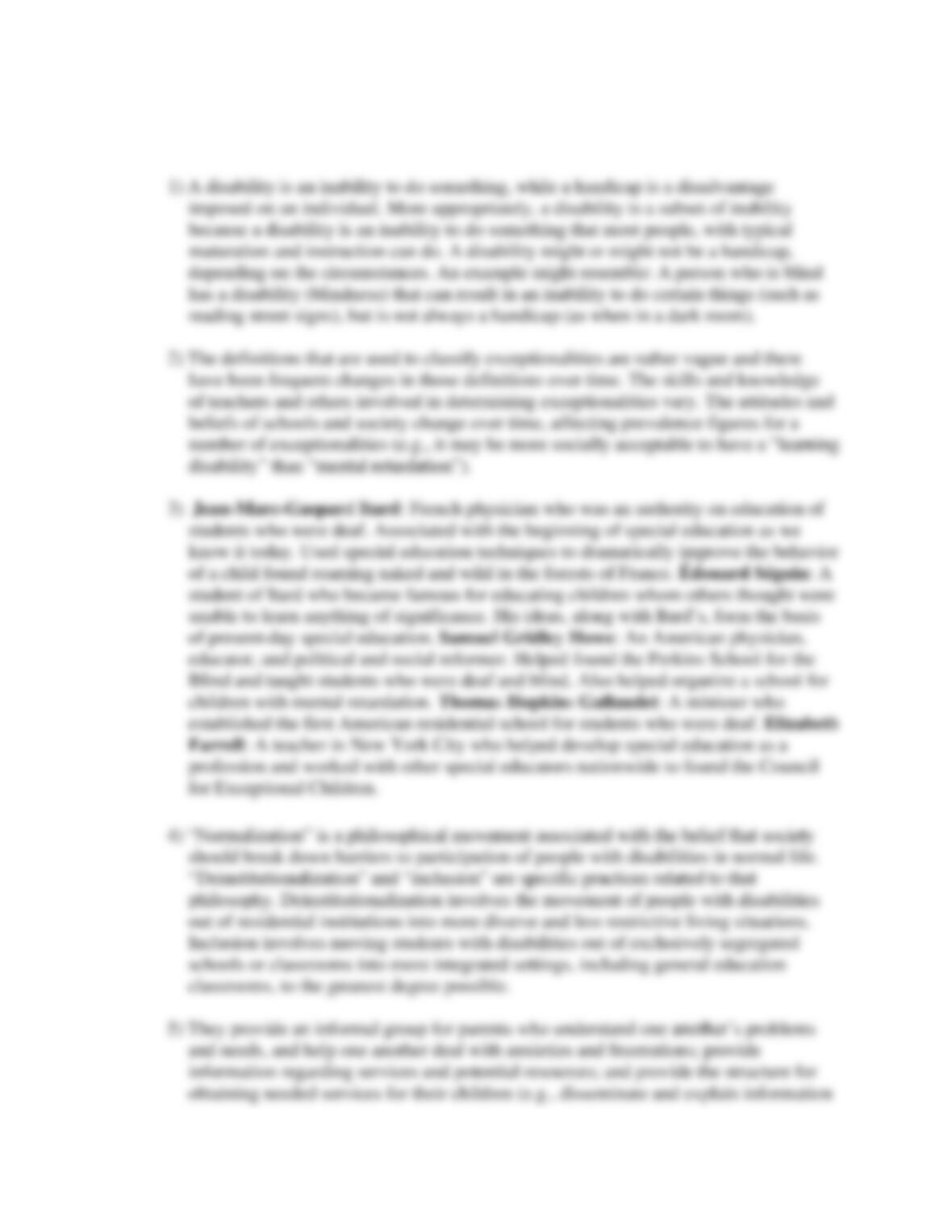
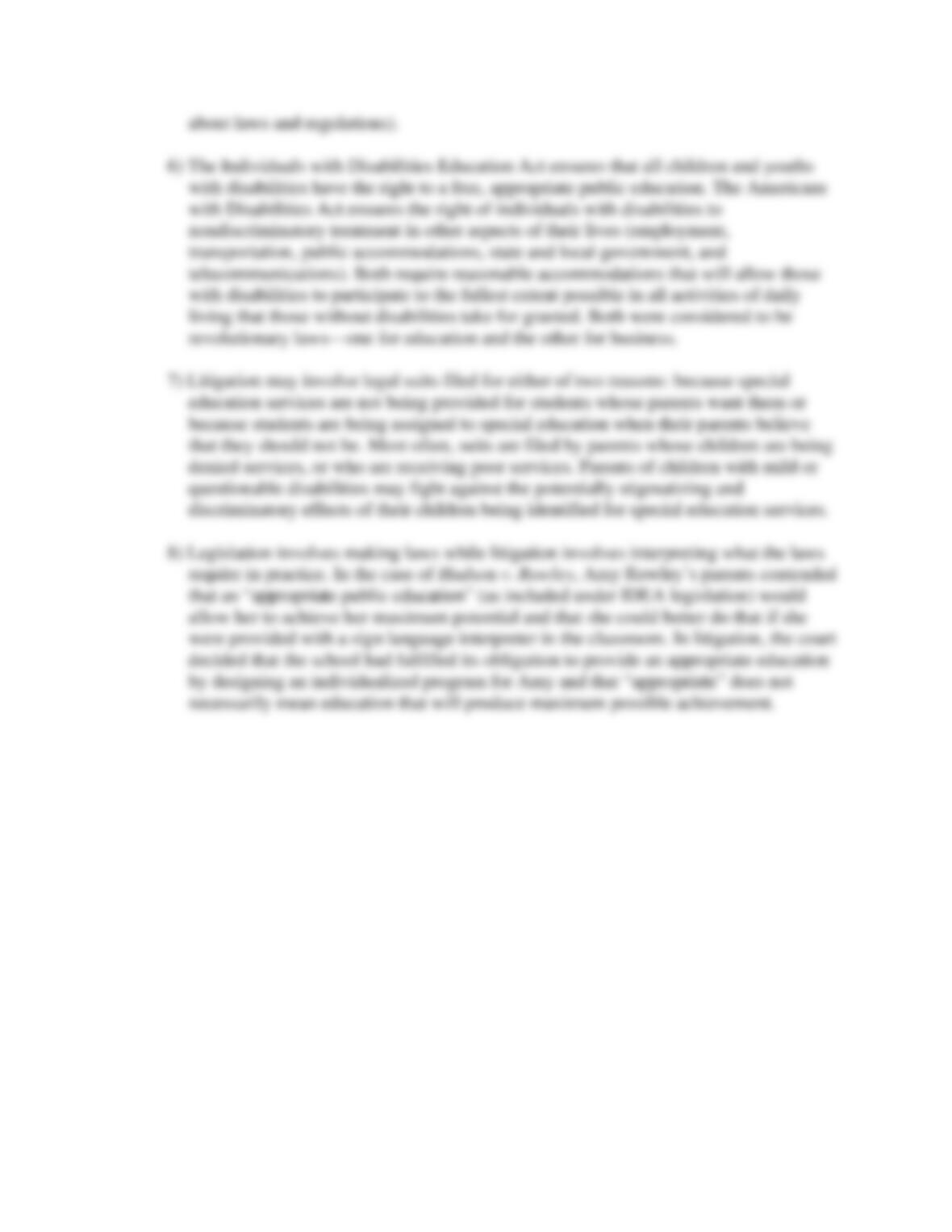
1.3 Short Answer Questions
1) Describe the differences between “disability,” “handicap,” and “inability.” Use one
example to illustrate each term.
Praxis: I.C.
CEC: ICC1K5
2) Describe two reasons for why it is so difficult to determine an exact figure for the
prevalence of exceptional children.
Praxis: I.C.
CEC: ICC1K5
3) Identify and briefly describe the contributions of two individuals pertinent to the
growth of special education.
Praxis: I.A.
CEC: ICC1K1
4) What is the relationship between normalization, deinstitutionalization, and
inclusion? Define each term.
Praxis: I.A.
CEC: ICC1K1
11
5) Describe the role that parent organizations have played in meeting the needs of
exceptional children and their families.
Praxis: II.B.
CEC: ICC1K4
6) Compare and contrast two major laws that affect individuals with disabilities: IDEA
and ADA. In doing so, describe the unique contribution of each and briefly discuss
the ways in which the two laws are similar.
Praxis: II.A.
CEC: ICC1K1
7) Discuss the two reasons for which legal suits (for or against special education) might
be filed.
Praxis: II.A.
CEC: CC3K3
8) Discuss the relationship between litigation and legislation using the case of Hudson
v. Rowley to illustrate the relationship.
Praxis: II.A.
CEC: CC1K1
12
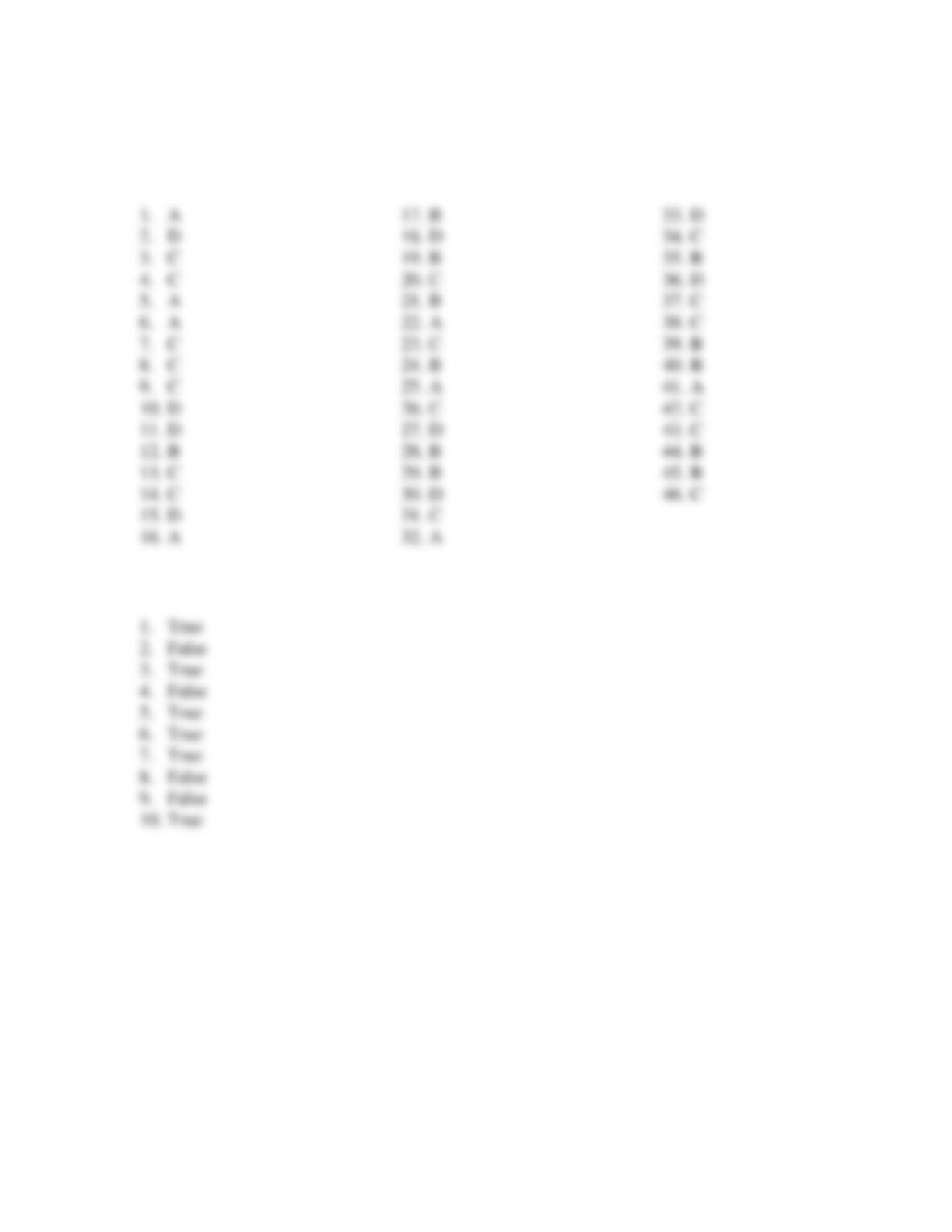
Chapter 1 Exceptionality and Special Education
1.1 Multiple Choice Questions
1.2 True/False Questions
13
1.3 Short Answer Questions
14