
Chapter 1 — Business Combinations: America’s Most Popular
Business Activity, Bringing an End to the Controversy
MULTIPLE CHOICE
1. An economic advantage of a business combination includes
a.
Utilizing duplicative assets.
b.
Creating separate management teams.
c.
Coordinated marketing campaigns.
d.
Horizontally combining levels within the marketing chain.
2. A tax advantage of business combination can occur when the existing
owner of a company sells out and receives:
a.
cash to defer the taxable gain as a “tax-free reorganization.”
b.
stock to defer the taxable gain as a “tax-free reorganization.”
c.
cash to create a taxable gain.
d.
stock to create a taxable gain.
3. A controlling interest in a company implies that the parent company
a.
owns all of the subsidiary’s stock.
b.
has influence over a majority of the subsidiary’s assets.
c.
has paid cash for a majority of the subsidiary’s stock.
d.
has transferred common stock for a majority of the subsidiary’s
outstanding bonds and debentures.
4. Which of the following is a potential abuse that may arise when a
business combination is accounted for as a pooling of interests?
a.
Assets of the buyer may be overvalued when the price paid by the
investor is allocated among specific assets.
b.
Earnings of the pooled entity may be increased because of the
combination only and not as a result of efficient operations.
c.
Liabilities may be undervalued when the price paid by the investor
is allocated to specific liabilities.
d.
An undue amount of cost may be assigned to goodwill, thus
potentially allowing an understatement of pooled earnings.

5. Company B acquired the assets (net of liabilities) of Company S in
exchange for cash. The acquisition price exceeds the fair value of the
net assets acquired. How should Company B determine the amounts to be
reported for the plant and equipment, and for long-term debt of the
acquired Company S?
Plant and Equipment Long-Term Debt
a.
Fair value S’s carrying amount
b.
Fair value Fair value
c.
S’s carrying amount Fair value
d.
S’s carrying amount S’s carrying amount
6. Publics Company acquired the net assets of Citizen Company during 20X5.
The purchase price was $800,000. On the date of the transaction,
Citizen had no long-term investments in marketable equity securities
and $400,000 in liabilities. The fair value of Citizen assets on the
acquisition date was as follows:
Current assets…………………………… $ 800,000
Noncurrent assets………………………… 600,000
$1,400,000
==========
How should Publics account for the $200,000 difference between the fair
value of the net assets acquired, $1,000,000, and the cost, $800,000?
a.
Retained earnings should be reduced by $200,000.
b.
Current assets should be recorded at $685,000 and noncurrent
assets recorded at $515,000.
c.
The noncurrent assets should be recorded at $400,000.
d.
A deferred credit of $200,000 should be set up and subsequently
amortized to future net income over a period not to exceed 40
years.
7. ABC Co. is acquiring XYZ Inc. XYZ has the following Intangible assets:
Patent on a product that is deemed to have no useful life $10,000.
Customer List with an observable fair value of $50,000.
A 5-year operating lease with favorable terms with a discounted
present value of $8,000.
Identifiable R & D of $100,000.
ABC will record how much for acquired Intangible Assets from the
Purchase of XYZ Inc?
a.
$168,000
b.
$58,000
c.
$158,000
d.
$150,000

8. Vibe Company purchased the net assets of Atlantic Company in a business
combination accounted for as a purchase. As a result, goodwill was
recorded. For tax purposes, this combination was considered to be a
tax-free merger. Included in the assets is a building with an appraised
value of $210,000 on the date of the business combination. This asset
had a net book value of $70,000, based on the use of accelerated
depreciation for accounting purposes. The building had an adjusted tax
basis to Atlantic (and to Vibe as a result of the merger) of $120,000.
Assuming a 36% income tax rate, at what amount should Vibe record this
building on its books after the purchase?
a.
$120,000
b.
$134,400
c.
$140,000
d.
$210,000
9. Goodwill represents the excess cost of an acquisition over the
a.
sum of the fair values assigned to intangible assets less
liabilities assumed.
b.
sum of the fair values assigned to tangible and intangible assets
acquired less liabilities assumed.
c.
sum of the fair values assigned to intangibles acquired less
liabilities assumed.
d.
book value of an acquired company.
10. When purchasing a company occurs, FASB recommends disclosing all of the
following EXCEPT:
a.
goodwill related to each reporting segment.
b.
contingent payment agreements, options, or commitments included in
the purchase agreement, including accounting methods to be
followed.
c.
results of operations for the current period if both companies had
remained separate.
d.
amount of in-process R&D purchased and written-off during the
period.

11. Cozzi Company is being purchased and has the following balance sheet as
of the purchase date:
Current assets………. $200,000 Liabilities…. $ 90,000
Fixed assets………… 180,000 Equity……… 290,000
Total…………….. $380,000 Total…….. $380,000
======== ========
The price paid for Cozzi’s net assets (the purchaser assumes the
liabilities) is $500,000. The fixed assets have a fair value of
$220,000, and the liabilities have a fair value of $110,000. The amount
of goodwill to be recorded in the purchase is __________.
a.
$0
b.
$50,000
c.
$70,000
d.
$90,000
12. Separately identified intangible assets are accounted for by
amortizing:
a.
exclusively by using impairment testing.
b.
based upon a pattern that reflects the benefits conveyed by the
asset.
c.
over the useful economic life less residual value using only the
straight-line method.
d.
amortizing over a period not to exceed a maximum of 40 years.
13. Acme Co. is preparing a pro-forma set of financial statements after an
acquisition of Coyote Co. The purchase price is less than the fair
value of the assets acquired. However, the purchase price is greater
than net book value of the acquired company.
a.
Acme’s goodwill will decrease over time.
b.
Acme’s amortization of intangible assets will increase over time.
c.
Depreciation expense will be greater than Coyote Company’s
expense.
d.
Coyote’s loss on the sale of the assets will create a net loss
carryforward.

14. While performing a goodwill impairment test, the company had the
following information:
Estimated implied fair value of reporting unit
(without goodwill) $420,000
Existing net book value of reporting unit
(without goodwill) $380,000
Book value of goodwill $60,000
Based upon this information the proper conclusion is:
a.
The existing net book value plus goodwill is in excess of the
implied fair value, therefore, no adjustment is required.
b.
The existing net book value plus goodwill is less than the implied
fair value plus goodwill, therefore, no adjustment is required.
c.
The existing net book value plus goodwill is in excess of the
implied fair value, therefore, goodwill needs to be decreased.
d.
The existing net book value is less than the estimated implied
fair value; therefore, goodwill needs to be decreased.
15. Balter Inc. acquired Jersey Company on January 1, 20X5. When the
purchase occurred Jersey Company had the following information related
to fixed assets:
Land $ 80,000
Building 200,000
Accumulated Depreciation (100,000)
Equipment 100,000
Accumulated Depreciation (50,000)
The building has a 10-year remaining useful life and the equipment has
a 5-year remaining useful life. The fair value of the assets on that
date were:
Land $100,000
Building 130,000
Equipment 75,000
What is the 20X5 depreciation expense Balter will record related to
purchasing Jersey Company?
a.
$8,000
b.
$15,000
c.
$28,000
d.
$30,000

1-6
16. In performing the 20X7 impairment test for goodwill, the company had
the following 20X6 and 20X7 information is available.
20X6 20X7
Implied fair value of reporting unit $350,000 $400,000
Net book value of reporting unit (including goodwill) $380,000 $360,000
Based upon this information what are the 20X6 and 20X7 adjustment to
goodwill, if any?
a.
20X6 $0
20X7 $40,000 decrease
b.
20X6 $30,000 increase
20X7 $40,000 decrease
c.
20X6 $30,000 decrease
20X7 $40,000 decrease
d.
20X6 $30,000 decrease
20X7 $0
17. Couples Corporation purchases Players Corporation. The fair value of
the net assets of Players is $750,000 and the fair value of priority
accounts (including a deduction for depreciation) is $600,000. Which of
the following purchase prices would require using allocation
procedures?
a.
$500,000
b.
$600,000
c.
$700,000
d.
$800,000
18. ACME Co. paid $110,000 for the net assets of Comb Corp. At the time of
the acquisition the following information was available related to
Comb’s balance sheet:
Book Value Fair Value
Current Assets $50,000 $ 50,000
Building 80,000 100,000
Equipment 40,000 50,000
Liabilities 30,000 30,000
What is the amount recorded by ACME for the Building?
a.
$40,000
b.
$60,000
c.
$80,000
d.
$100,000
19. Which of the following business combination expenses would NOT qualify
as a direct acquisition expense for a purchase?
a.
Fees for purchase audit
b.
Outside legal fees
c.
Stock issuance fees

Chapter 1
d.
All are direct acquisition expenses.
20. Polk issues common stock to acquire all the assets of the Sam Company
on January 1, 20X5. There is a contingent share agreement, which states
that if the income of the Sam Division exceeds a certain level during
20X5 and 20X6, additional shares will be issued on January 1, 20X7. The
impact of issuing the additional shares is to
a.
increase the price assigned to fixed assets.
b.
have no effect on asset values, but to reassign the amounts
assigned to equity accounts.
c.
reduce retained earnings.
d.
record additional goodwill.
21. In a purchase, the direct acquisition, indirect acquisition and
security issuance costs are accounted for as follows:
Direct Acquisition Indirect Acquisition Security Issuance
a.
Added to price paid Added to price paid Added to price paid
b.
Added to price paid Expensed Deducted from value
of security issued
c.
Expensed Expensed Deducted from value
of security issued
d.
Expensed Expensed Expensed
22. Orbit Inc. purchased Planet Co. in 20X3. At that time an existing
patent was not recorded as a separately identified intangible asset. At
the end of fiscal year 20X5, the patent is valued at $15,000, and
goodwill has a book value of $100,000. How should intangible assets be
reported at the beginning of fiscal year 20X6?
a.
Goodwill $100,000 Patent $0
b.
Goodwill $115,000 Patent $0
c.
Goodwill $100,000 Patent $15,000
d.
Goodwill $85,000 Patent $15,000
23. Which of the following income factors should not be factored into a
calculation of goodwill?
a.
sales for the period
b.
income tax expense
c.
extraordinary items
d.
cost of goods sold

1-8
1. Internet Corporation is considering the acquisition of Homepage
Corporation and has obtained the following audited condensed balance
sheet:
Homepage Corporation
Balance Sheet
December 31, 20X5
Assets Liabilities and Equity
Current assets…. $ 40,000 Current Liabilities………. $ 60,000
Land………….. 20,000 Capital Stock (50,000 shares,
Buildings (net)… 80,000 $1 par value)……………. 50,000
Equipment (net)… 60,000 Other Paid-in Capital…….. 20,000
Retained Earnings…………. 70,000
$200,000 $200,000
======== ========
Internet also acquired the following fair values for Homepage’s assets
and liabilities:
Current assets………………………………….. $ 55,000
Land…………………………………………… 60,000
Buildings (net)…………………………………. 90,000
Equipment (net)…………………………………. 75,000
Current Liabilities……………………………… (60,000)
$220,000
========
Internet and Homepage agree on a price of $280,000 for Homepage’s net
assets. Prepare the necessary journal entry to record the purchase
given the following scenarios:
a.
Internet pays cash for Homepage Corporation and incurs $5,000
of direct acquisition costs.
b.
Internet issues its $5 par value stock as consideration. The
fair value of the stock at the acquisition date is $50 per
share. Additionally, Internet incurs $5,000 of security
issuance costs.
Chapter 1
1-9
2. On January 1, 20X5, Brown Inc. acquired Larson Company’s net assets in
exchange for Brown’s common stock with a par value of $100,000 and a
fair value of $800,000. Brown also paid $10,000 in direct acquisition
costs and $15,000 in stock issuance costs.
On this date, Larson’s condensed account balances showed the following:
Book Value
Fair Value
Current Assets
$ 280,000
$ 370,000
Plant and Equipment
440,000
480,000
Accumulated Depreciation
(100,000)
Intangibles – Patents
80,000
120,000
Current Liabilities
(140,000)
(140,000)
Long-Term Debt
(100,000)
(110,000)
Common Stock
(200,000)
Other Paid-in Capital
(120,000)
Retained Earnings
(140,000)
Required:
Record Brown’s purchase of Larson Company’s net assets on the books of
Brown Inc.
Chapter 1
1-10
3. The Chan Corporation purchased the net assets (existing liabilities
were assumed) of the Don Company for $900,000 cash. The balance sheet
for the Don Company on the date of acquisition showed the following:
Assets
Current assets…………………………………. $ 100,000
Equipment……………………………………… 300,000
Accumulated depreciation………………………… (100,000)
Plant…………………………………………. 600,000
Accumulated depreciation………………………… (250,000)
Total…………………………………………. $ 650,000
=========
Liabilities and Equity
Bonds payable, 8%………………………………. $ 200,000
Common stock, $1 par……………………………. 100,000
Paid-in capital in excess of par…………………. 200,000
Retained earnings………………………………. 150,000
Total…………………………………………. $ 650,000
=========
Chapter 1
Required:
The equipment has a fair value of $300,000, and the plant assets have a
fair value of $500,000. Assume that the Chan Corporation has an
effective tax rate of 40%. Prepare the entry to record the purchase of
the Don Company for each of the following separate cases with specific
added information:
a.
The sale is a nontaxable exchange to the seller that limits
the buyer to depreciation and amortization on only book value
for tax purposes.
b.
The bonds have a current fair value of $190,000. The
transaction is a nontaxable exchange.
c.
There are $100,000 of prior-year losses that can be used to
claim a tax refund. The transaction is a nontaxable exchange.
d.
There are $150,000 of past losses that can be carried forward
to future years to offset taxes that will be due. The
transaction is a nontaxable exchange.
4. On January 1, 20X5, Zebb and Nottle Companies had condensed balance
sheets as shown below:
Zebb Nottle
Company Company
Current Assets……………………… $1,000,000 $ 600,000
Plant and Equipment…………………. 1,500,000 800,000
$2,500,000 $1,400,000
========== ==========
Current Liabilities…………………. $ 200,000 $ 100,000
Long-Term Debt……………………… 300,000 300,000
Common Stock, $10 par………………… 1,400,000 400,000
Paid-in Capital in Excess of Par………. 0 100,000
Retained Earnings……………………. 600,000 500,000
$2,500,000 $1,400,000
========== ==========
Required:
Record the acquisition of Nottle’s net assets, the issuance of the
stock and/or payment of cash, and payment of the related costs. Assume
that Zebb issued 30,000 shares of new common stock with a fair value of
$25 per share and paid $500,000 cash for all of the net assets of
Nottle. Direct acquisition costs of $50,000 and stock issuance costs of
$20,000 were paid-in cash. The combination is accounted for as a
purchase. Current assets had a fair value of $650,000, plant and
equipment had a fair value of $900,000, and long-term debt had a fair
value of $330,000.
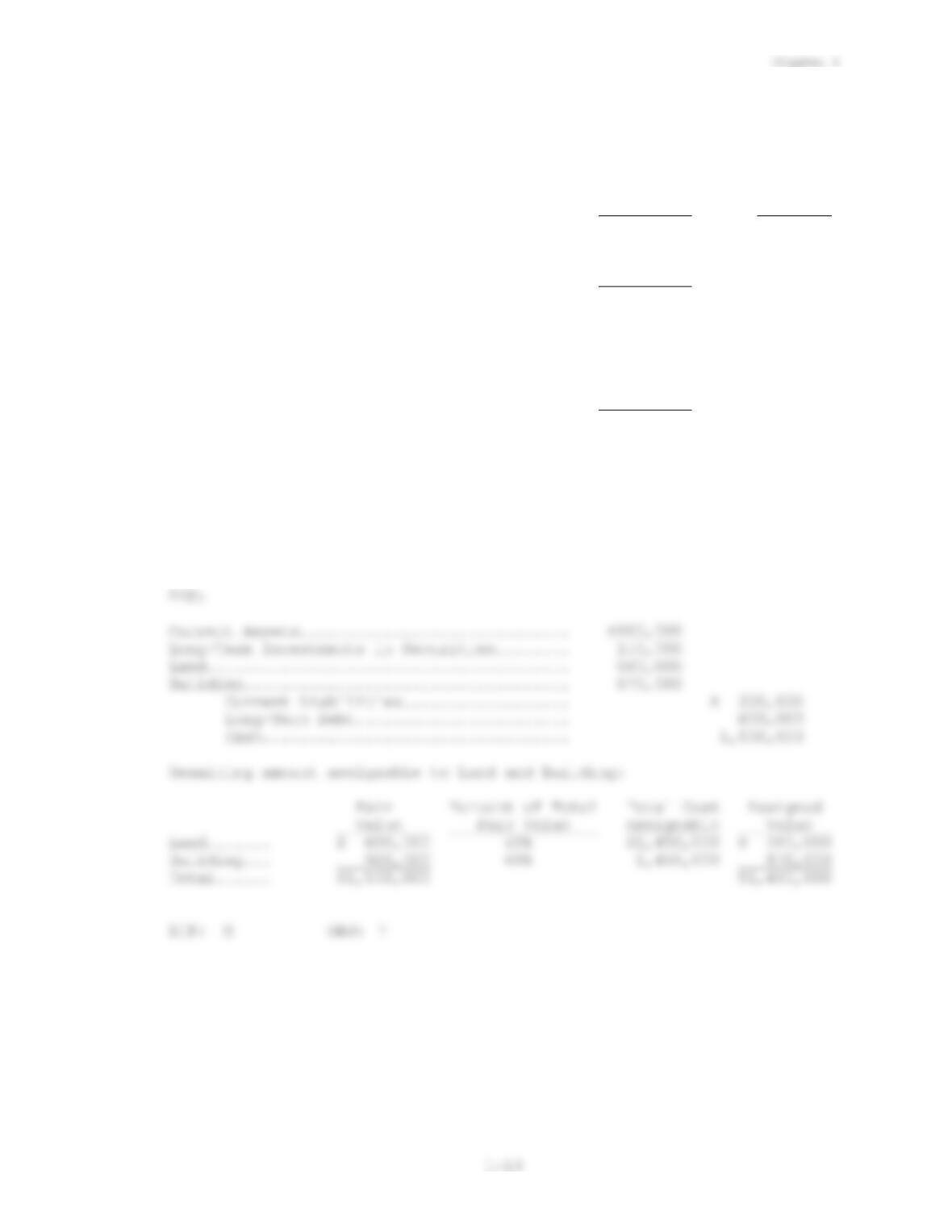
5. On January 1, 20X1, Honey Bee Corporation purchased the net assets of
Green Hornet Company for $1,500,000. On this date, a condensed balance
sheet for Green Hornet showed:
Book Fair
Value Value
Current Assets……………………….. $ 500,000 $800,000
Long-Term Investments in Securities. 200,000 150,000
Land………………………………… 100,000 600,000
Buildings (net)………………………. 700,000 900,000
$1,500,000
==========
Current Liabilities…………………… $ 300,000 $300,000
Long-Term Debt……………………….. 550,000 600,000
Common Stock (no-par)…………………. 300,000
Retained Earnings…………………….. 350,000
$1,500,000
==========
Required:
Record the entry on Honey Bee’s books for the acquisition of Green
Hornet’s net assets. Prepare supporting schedules as necessary.
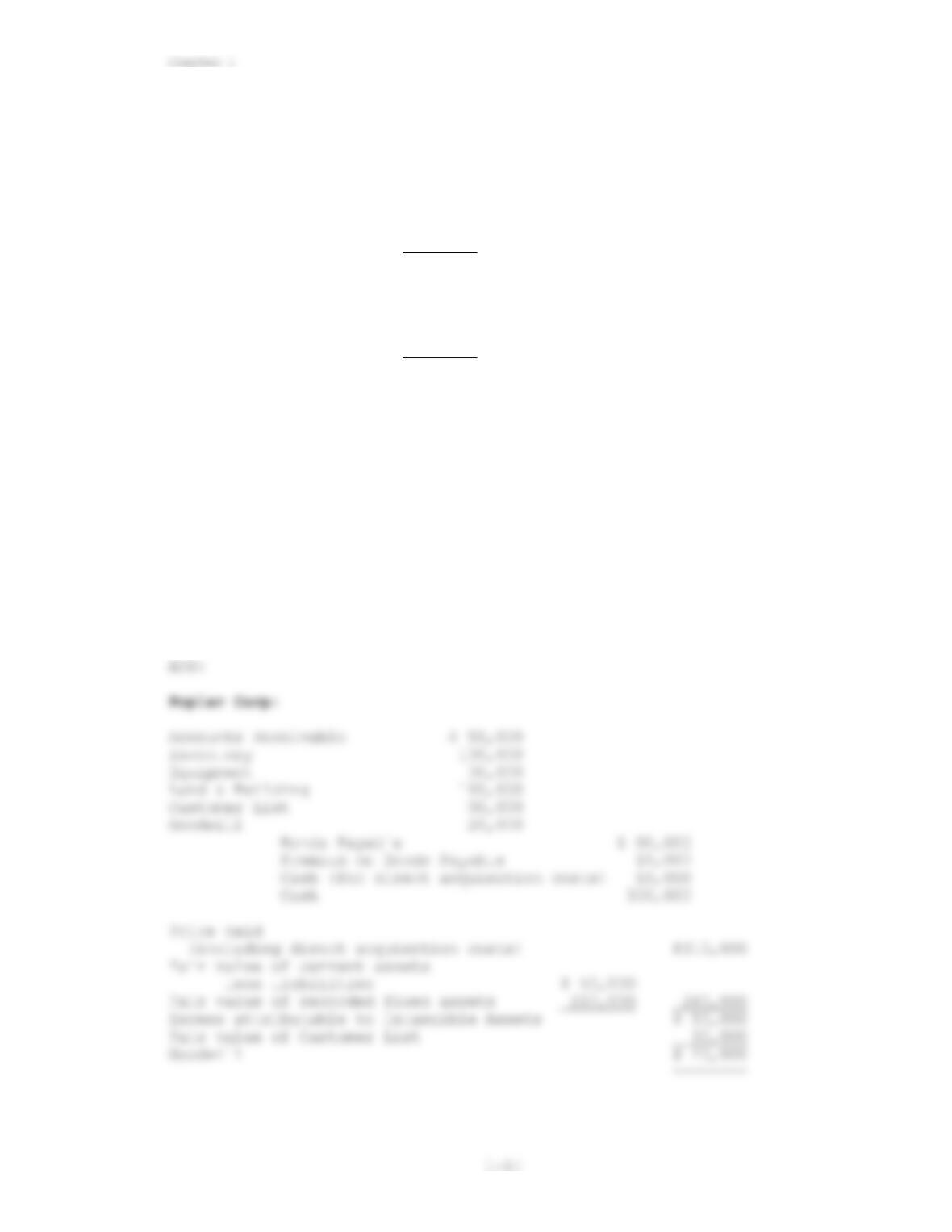
6. Poplar Corp. acquires the net assets of Sapling Company, which has the
following balance sheet:
Accounts Receivable $ 50,000
Inventory 80,000
Equipment, Net 50,000
Land & Building, Net 120,000
Total Assets $300,000
========
Bonds Payable $ 90,000
Common Stock 100,000
Retained Earnings 110,000
Total Liabilities and
Stockholders’ Equity $300,000
========
Fair values on the date of acquisition:
Inventory $100,000
Equipment 30,000
Land & Building 180,000
Customer List 30,000
Bonds Payable 100,000
Direct acquisition costs: $10,000
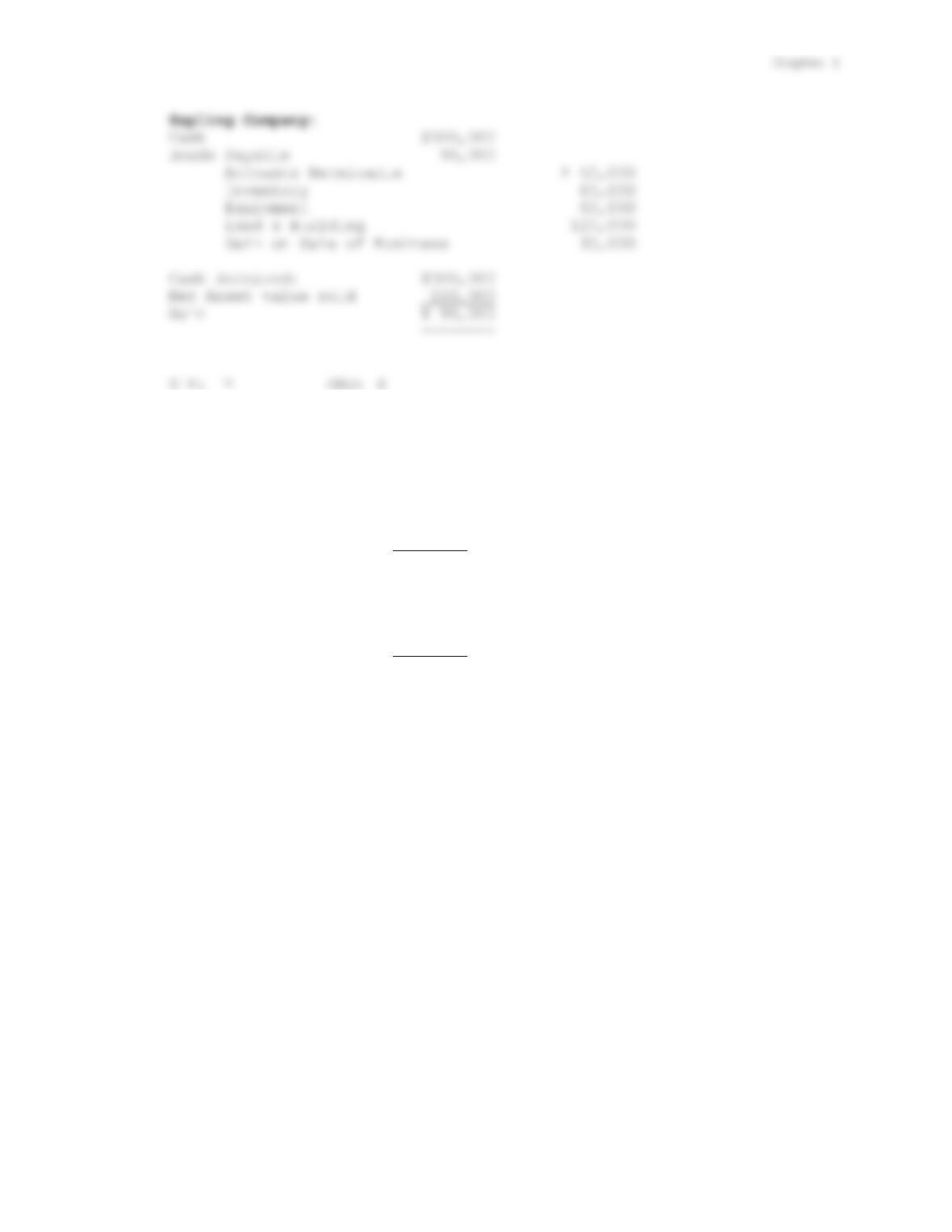
If Poplar paid $300,000 what journal entries would be recorded by both
Poplar Corp. and Sapling Company?
1-15
7. Diamond acquired Heart’s net assets. At the time of the acquisition
Heart’s Balance sheet was as follows:
Accounts Receivable $130,000
Inventory 70,000
Equipment, Net 50,000
Building, Net 250,000
Land & Building, Net 100,000
Total Assets $600,000
========
Bonds Payable $100,000
Common Stock 50,000
Retained Earnings 450,000
Total Liabilities and
Stockholders’ Equity $600,000
========
Fair values on the date of acquisition:
Inventory $100,000
Equipment 30,000
Building 350,000
Land 120,000
Brand name copyright 50,000
Bonds payable 120,000
Direct acquisition costs: $5,000
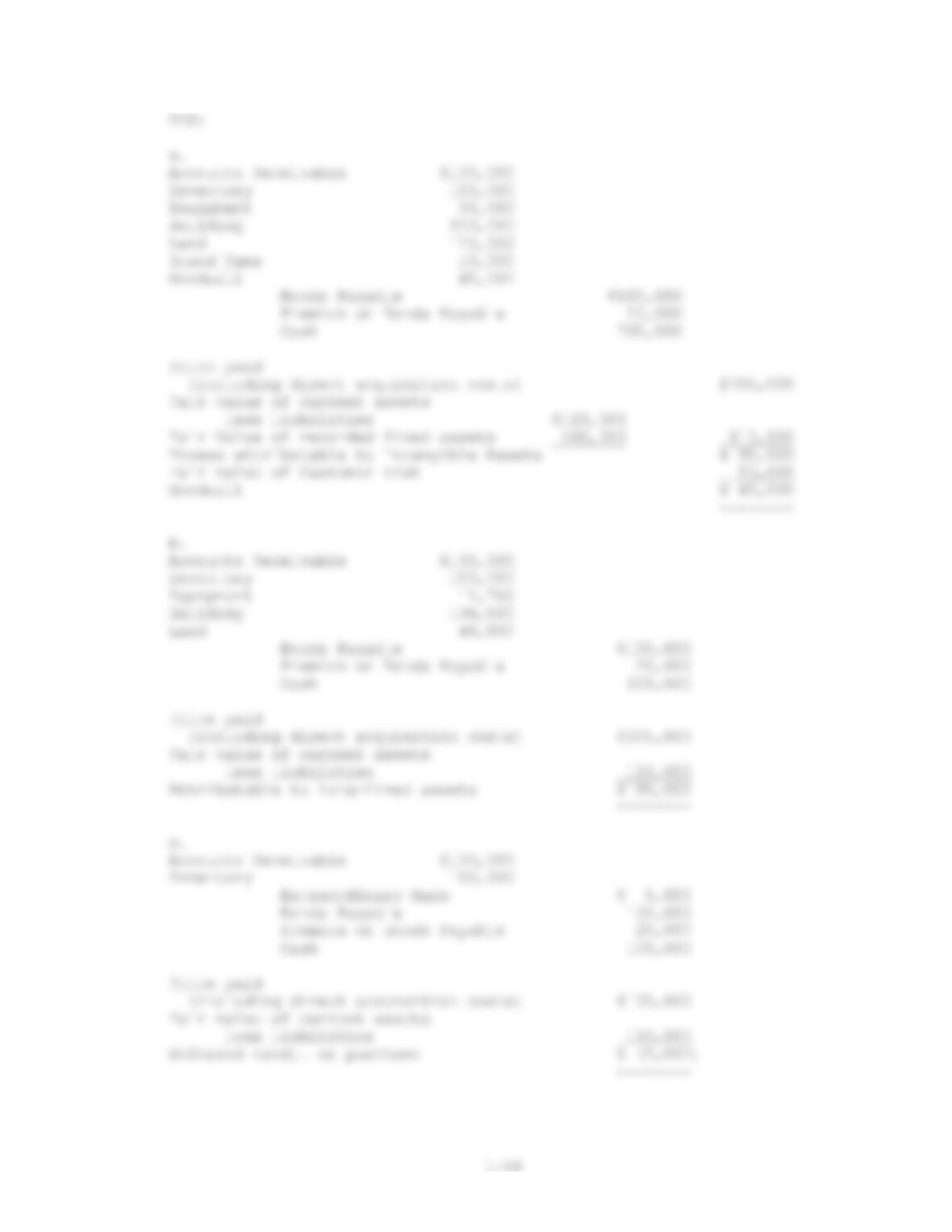
Required:
Record the entry for the purchase of the net assets of Heart by Diamond
at the following Cash prices:
a. $700,000
b. $300,000
c. $100,000
Chapter 1

1-17
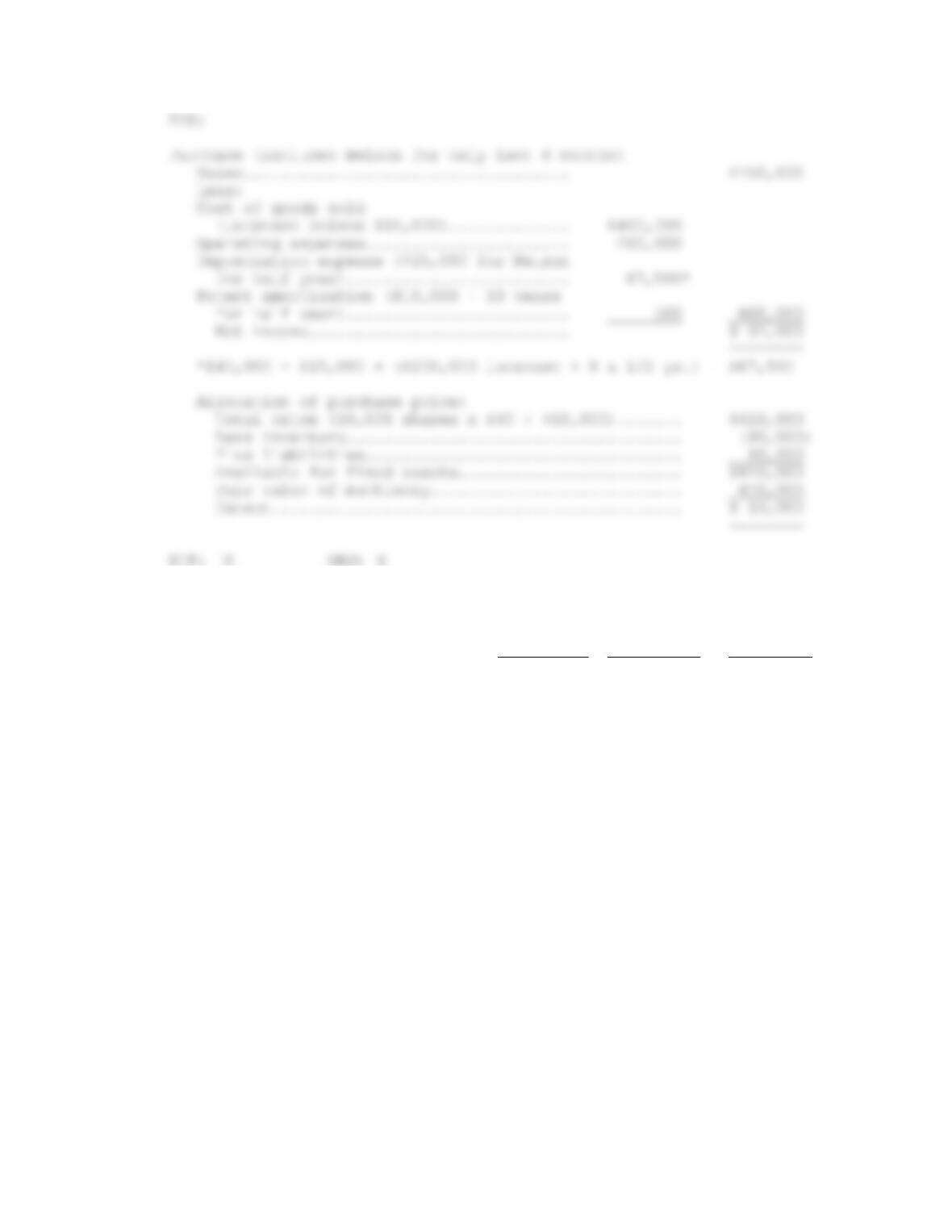
8. Marquette Instruments Company acquired all the assets and assumed all
the liabilities of the Nelson Company on July 1, 20X1. The fiscal year
for both Marquette and Nelson ends on December 31. On the date of
acquisition, Nelson Company had the following trial balance:
Accounts receivable…………………… $ 60,000
Inventory……………………………. 70,000
Machinery……………………………. 300,000
Accumulated depreciation, machinery…….. $100,000
Notes payable………………………… 80,000
Sales……………………………….. 210,000
Cost of goods sold……………………. 120,000
Operating expenses……………………. 70,000
Depreciation expense …………………. 15,000
Common stock, $1 par………………….. 10,000
Paid-in capital in excess of par……….. 70,000
Retained earnings…………………….. 165,000
Totals…………………………….. $635,000 $635,000
======== ========
Marquette issued 10,000 of its $5 par value shares for the outstanding
shares of the Nelson Company and paid $10,000 in direct acquisition
costs. The fair value of its shares was $40 per share. On the
acquisition date, the inventory had a fair value of $80,000 (sold by
December 31), and the machinery had a fair value of $400,000 with an
estimated 8-year remaining life. Any value associated with intangible
assets arising from the business combination are associated with a
patent that will be amortized over 10 years.
The following operating results were reported by the two resulting
divisions:
Marquette Nelson
January 1-December 31 July 1-December 31
Sales…………………. $450,000 $300,000
Cost of goods sold……… 230,000 160,000
Operating expenses……… 120,000 80,000
Depreciation expense……. 40,000 15,000
The results for Nelson are based on book values and do not consider
adjustments resulting from the business combination.
Required:
Prepare an income statement for the Marquette Instruments Company.
Chapter 1
1-18
9. On January 1, July 1, and December 31, 20X5, a condensed trial balance
for Nelson Company showed the following debits and (credits):
01/01/X5 06/30/X5 12/31/X5
Current Assets………………. $ 200,000 $ 260,000 $ 340,000
Plant and Equipment (net)…….. 500,000 510,000 510,000
Current Liabilities………….. (50,000) (70,000) (60,000)
Long-Term Debt………………. (100,000) (100,000) (100,000)
Common Stock………………… (150,000) (150,000) (150,000)
Other Paid-in Capital………… (100,000) (100,000) (100,000)
Retained Earnings, January 1….. (300,000) (300,000) (300,000)
Dividends Declared ………….. 10,000
Revenues……………………. (400,000) (900,000)
Expenses……………………. 350,000 750,000
Nelson Company’s books were NOT closed on June 30, 20X5.
For all of 20X5, Systems’ revenues and expenses were $1,500,000 and
$1,200,000, respectively.
Chapter 1
1-19
Required:
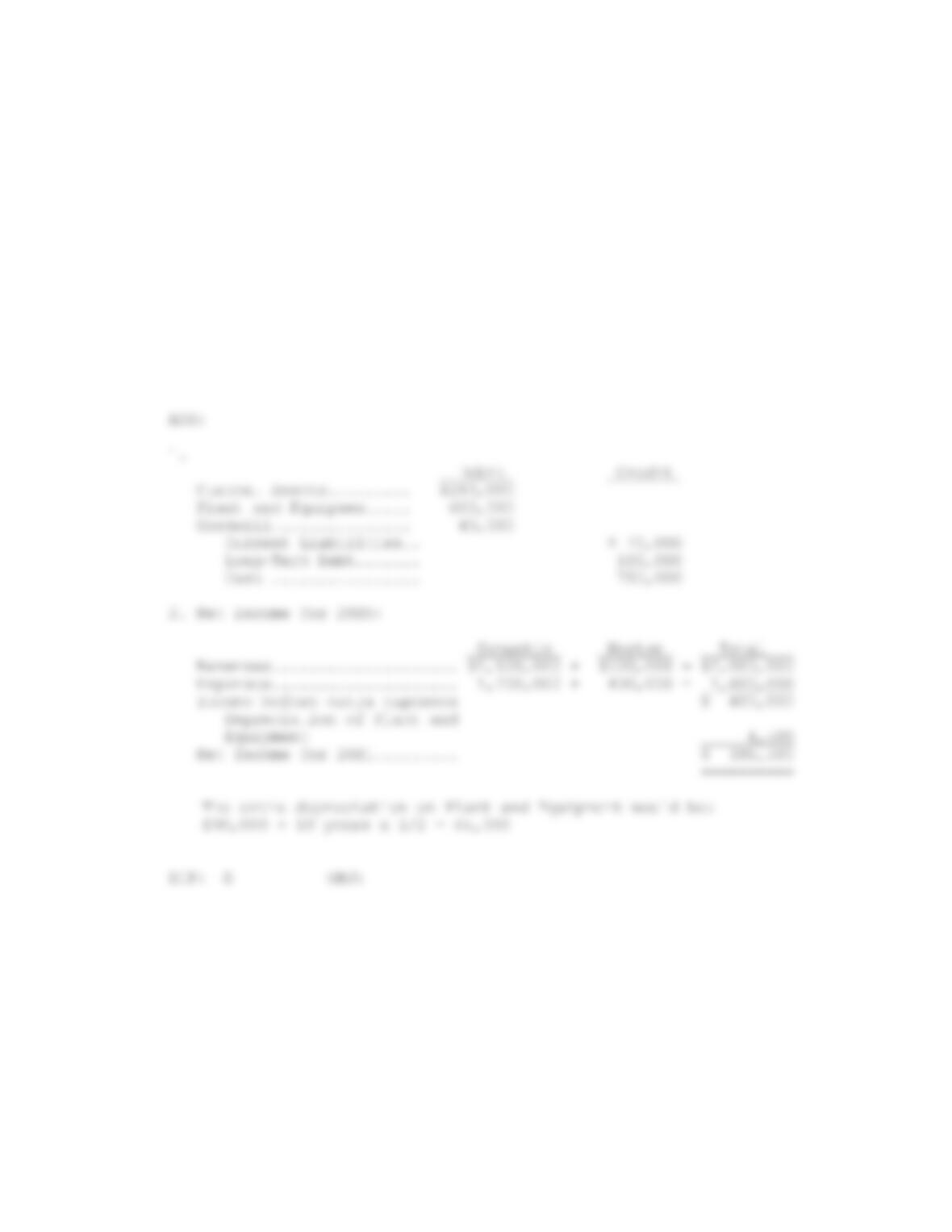
Assume that, on July 1, 20X5, Systems Corporation purchased
the net assets of Nelson Company for $750,000 in cash. On this
date, the fair values for certain net assets were:
Current Assets………………………………. $280,000
Plant and Equipment………………………….. 600,000
On July 1, 20X1, the Plant and Equipment had a remaining life of
10 years.
(1)
Record the entry on Systems’ books for the July 1, 20X5
purchase of Nelson.
(2)
Compute the amount of net income which will be reported
for 20X5.
$90,000 ÷ 10 years x 1/2 = $4,500

Chapter 1
1-20
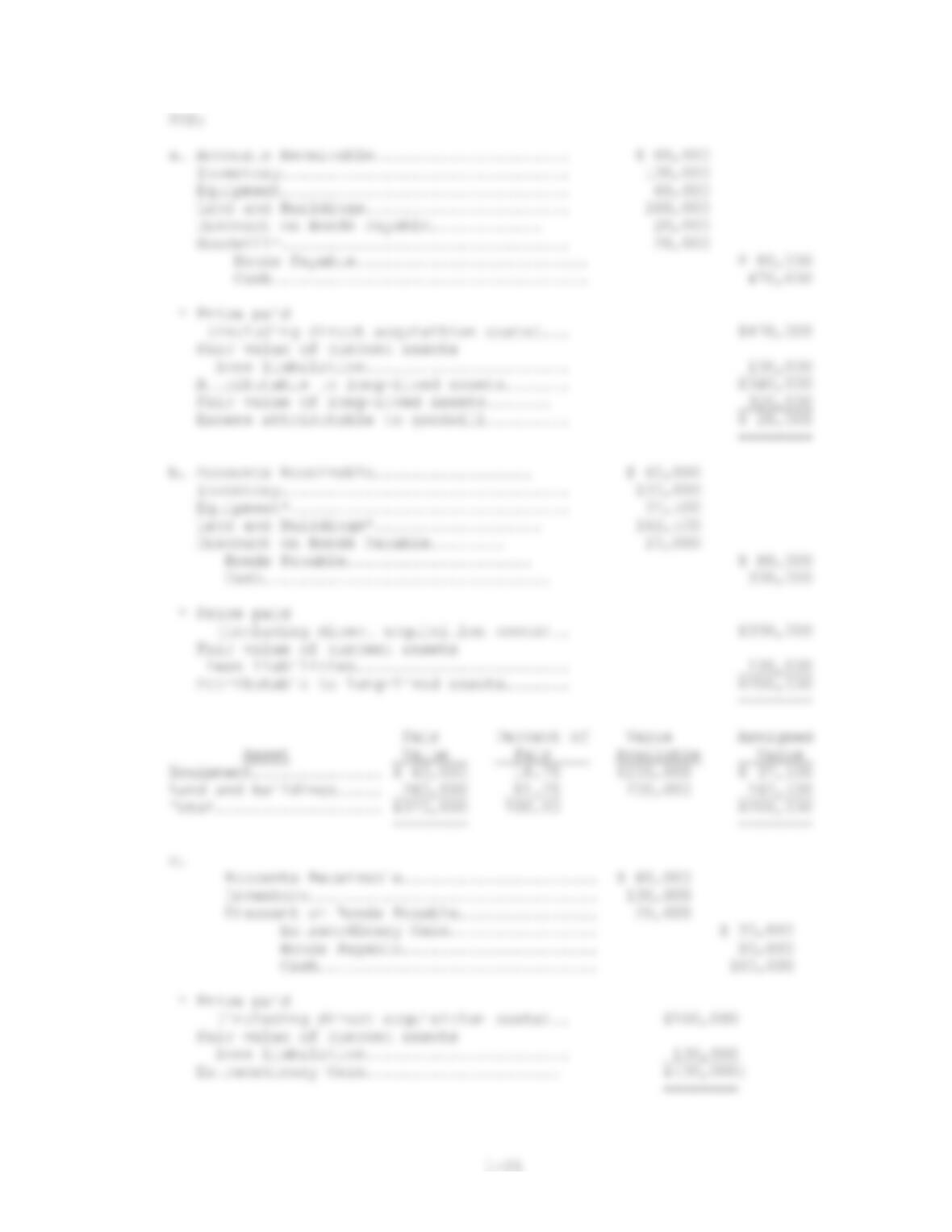
10. Mans Company is about to purchase the net assets of Eagle Incorporated,
which has the following balance sheet:
Assets
Accounts receivable…………………… $ 60,000
Inventory……………………………. 100,000
Equipment …………………………… $ 90,000
Accumulated depreciation ……………… (50,000) 40,000
Land and buildings……………………. $ 300,000
Accumulated depreciation………………. (100,000) 200,000
Goodwill…………………………….. 60,000
Total assets……………………….. $460,000
========
Liabilities and Stockholders’ Equity
Bonds payable………………………… $ 80,000
Common stock, $10 par…………………. 200,000
Paid-in capital in excess of par……….. 100,000
Retained earnings…………………….. 80,000
Total liabilities and equity…………. $460,000
========
Mans has secured the following fair values of Eagle’s accounts:
Inventory……………………………. $130,000
Equipment……………………………. 60,000
Land and buildings……………………. 260,000
Bonds payable………………………… 60,000
Direct acquisition costs were $20,000.
Required:
Record the entry for the purchase of the net assets of Eagle by Mans at
the following cash prices:
a.
$450,000
b.
$310,000
c.
$80,000
Chapter 1
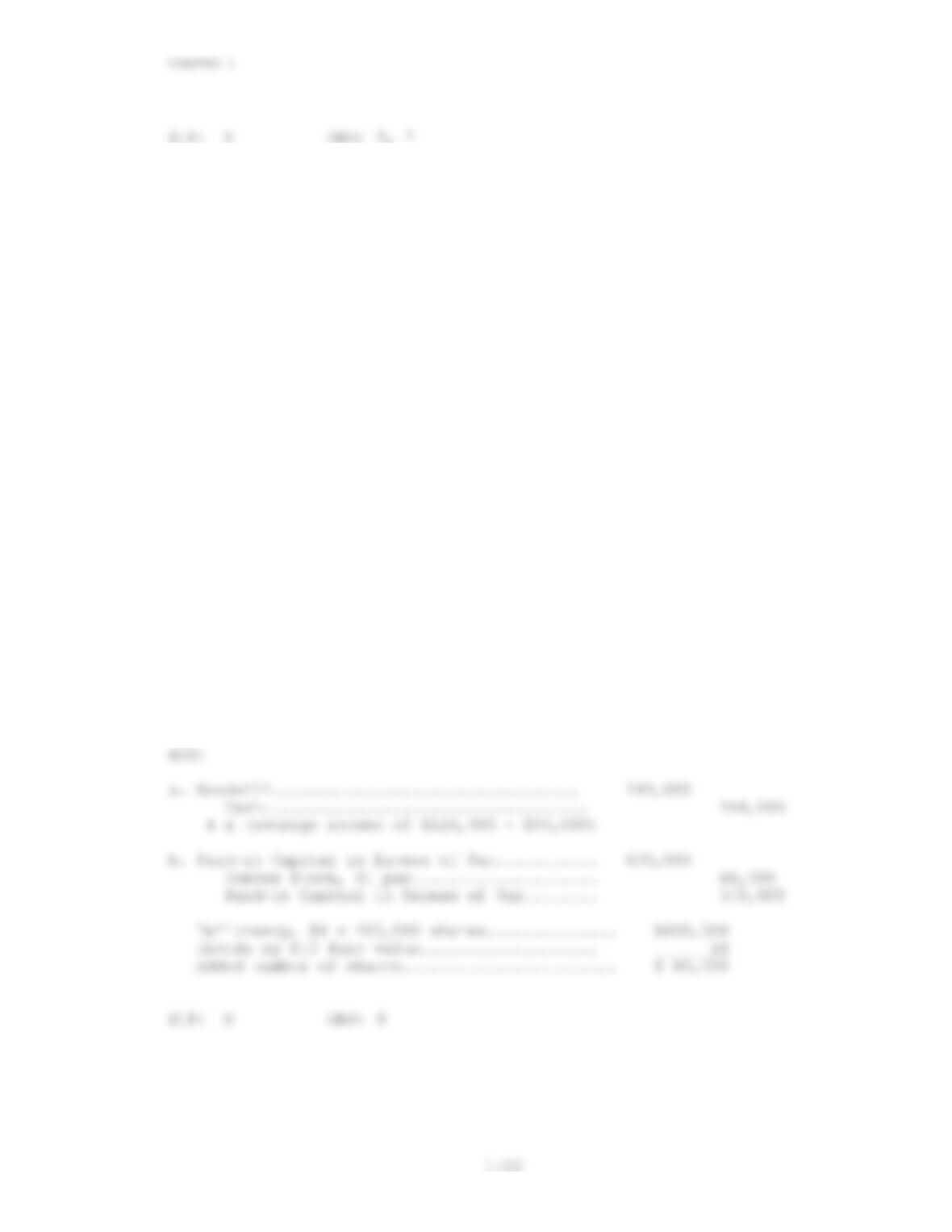
11. The Blue Reef Company purchased the net assets of the Pink Coral
Company on January 1, 20X1, and made the following entry to record the
purchase:
Current Assets……………………….. 100,000
Equipment……………………………. 150,000
Land ……………………………….. 50,000
Buildings……………………………. 300,000
Goodwill ……………………………. 100,000
Liabilities………………………… 80,000
Common Stock, $1 Par………………… 100,000
Paid-in Capital in Excess of Par……… 520,000
Required:
Make the required entry on January 1, 20X3, for each of the two
following independent contingency agreements:
a.
An additional cash payment would be made on January 1, 20X3
equal to four times the amount by which average annual
earnings of the Pink Coral Division exceed $80,000 per year
20X1 and 20X2. Net income was $112,000 in 20X1 and $140,000 in
20X2.
b.
Additional shares would be issued on January 1, 20X3 to
compensate for any fall in the value of Blue Reef common stock
below $16 per share. The settlement would be to cure the
deficiency by issuing added shares based on their fair value
on January 1, 20X3. The fair price of the shares on January 1,
20X3 was $10.

Chapter 1
1-23
12. The balance sheet information for Nickel Company is to be used in both
parts (a) and (b), each of which is an independent case. On January 1,
20X1, a business combination occurred between Dime Co. and Nickel Co.
On this date, a condensed balance sheet for Nickel showed:
Book Value
Current Assets…………………….. $ 500,000
Plant and Equipment (net)…………… 900,000
Intangibles – Patent……………….. 150,000
$1,550,000
==========
Current Liabilities………………… $ 75,000
Long-Term Debt…………………….. 225,000
Common Stock………………………. 400,000
Paid-in Capital in Excess of Par…….. 300,000
Retained Earning…………………… 550,000
$1,550,000
==========
Required:
a.
Assume the combination was an asset acquisition in which Dime
purchased all of the net assets of Nickel for $1,725,000 cash.
Nickel’s current assets were undervalued $70,000; plant and
equipment were undervalued $150,000; the patent was
undervalued $80,000; and long-term debt was overvalued
$45,000.
Record the entry or entries on Dime’s books to carry out the
acquisition of the net assets of Nickel.
b.
Assume that, in the combination, Dime acquired Nickel’s net
assets by issuance of new Dime common stock with a par value
of $200,000 and a fair value of $1,750,000. In addition, Dime
incurred stock issuance costs of $30,000. For financial
accounting purposes, the combination is to be accounted for as
a purchase. For tax purposes, the combination is tax-free to
the shareholders of Nickel Company. Assume a tax rate of 32%.
Current assets of Nickel are undervalued by $70,000. The fair
value of Nickel’s plant and equipment was $1,050,000. The
intangible is a patent with a fair value equal to book value.
Record the entry or entries on Dime’s books to carry out the
acquisition of the net assets of Nickel. Provide supporting
calculations.
Chapter 1
Chapter 1
1-25
ESSAY
1. Goodwill is an intangible asset. There are a variety of recommendations
about how intangible assets should be included in the financial
statements. Discuss the recommendations for proper disclosure of
goodwill. Include a comparison with disclosure of other intangible
assets.
Chapter 1
2. While acquisitions are often friendly, there are numerous occasions
when a party does not want to be acquired. Discuss possible defensive
strategies that firms can implement to fend off a hostile takeover
attempt.