
FOR INSTRUCTOR USE ONLY
CHAPTER 1
INTRODUCTION TO FINANCIAL STATEMENTS
SUMMARY OF QUESTIONS BY LEARNING OBJECTIVE AND BLOOM’S TAXONOMY
Item
LO
BT
Item
LO
BT
Item
LO
BT
Item
LO
BT
Item
LO
BT
True-False Statements
1.
1
K
9.
2
K
17.
3
K
25.
4
K
33.
5
K
2.
1
K
10.
2
K
18.
3
C
26.
4
K
34.
5
K
3.
1
K
11.
2
K
19.
3
K
27.
5
K
35.
6
K
4.
1
K
12.
3
K
20.
4
K
28.
5
C
36.
6
K
5.
1
K
13.
3
K
21.
4
K
29.
5
C
37.
6
K
6.
2
K
14.
3
K
22.
4
K
30.
5
C
38.
6
K
7.
2
K
15.
3
K
23.
4
K
31.
5
C
39.
6
K
8.
2
K
16.
3
K
24.
4
K
32.
5
C
40.
6
C
Multiple Choice Questions
41.
1
K
68.
2
K
95.
4
AP
122.
4
AP
149.
5
K
42.
1
K
69.
2
K
96.
4
K
123.
4
AN
150.
5
C
43.
1
K
70.
2
K
97.
3
C
124.
4
AN
151.
5
C
44.
1
K
71.
2
K
98.
3
C
125.
5
K
152.
5
C
45.
1
K
72.
2
C
99.
4
K
126.
5
K
153.
5
AP
46.
1
K
73.
2
K
100.
4
K
127.
5
K
154.
5
AP
47.
1
K
74.
2
K
101.
4
K
128.
5
AP
155.
5
AP
48.
1
K
75.
2
C
102.
4
C
129.
5
AP
156.
5
AP
49.
1
K
76.
3
C
103.
4
K
130.
5
AP
157.
5
AP
50.
1
K
77.
3
C
104.
4
C
131.
5
AP
158.
5
AP
51.
1
C
78.
3
K
105.
4
K
132.
5
AN
159.
4
K
52.
1
C
79.
3
K
106.
4
K
133.
5
AN
160.
5
K
53.
1
K
80.
3
K
107.
4
K
134.
5
AN
161.
5
AN
54.
1
K
81.
3
K
108.
4
K
135.
5
AN
162.
5
AN
55.
2
C
82.
3
K
109.
4
C
136
5
AN
163.
5
AN
56.
2
K
83.
3
K
110.
5
K
137.
5
K
164.
5
AN
57.
2
K
84.
3
K
111.
4
K
138.
4
K
165.
5
AN
58.
2
K
85.
3
K
112.
4
K
139.
5
K
166.
6
K
59.
2
K
86.
3
K
113.
4
C
140.
5
K
167.
6
K
60.
2
K
87.
3
K
114.
4
K
141.
5
K
168.
6
K
61.
2
K
88.
3
K
115.
4
C
142.
3
K
169.
6
K
62.
2
K
89.
3
K
116.
4
K
143.
5
K
170.
6
K
63.
2
K
90.
3
K
117.
4
K
144.
5
K
171.
6
K
64.
2
K
91.
3
K
118.
4
C
145.
5
K
172.
6
K
65.
2
K
92.
3
K
119.
4
AP
146.
4
K
173.
6
C
66.
2
K
93.
3
K
120.
4
AP
147.
4
C
174.
6
K
67.
2
K
94.
4
AP
121.
4
AP
148.
4
K
Brief Exercises
175.
1
C
179.
5
AP
183.
5
AP
187.
5
C
191.
5
AN
176.
3
C
180.
4,5
C
184.
5
AP
188.
5
AN
177.
4,5
AP
181.
4
AP
185.
5
K
189.
5
C
178.
154.
4,5
AP
182.
5
K
186.
5
C
190.
5
AN
Exercises
192.
4,5
AP
194.
5
AP
196.
4,5
AN
198.
5
AP
200.
5
AP
193.
4,5
AP
195.
4
AP
197.
4,5
AP
199.
5
AN
201.
5
AN
Test Bank for Financial Accounting: Tools for Business Decision Making, Seventh Edition
FOR INSTRUCTOR USE ONLY
1-2
Completion Statements
202.
1
K
204.
3
K
206.
5
K
208.
5
K
203.
2
K
205.
5
K
207.
5
K
209.
6
K
Matching
210.
1-6
K
Short Answer Essay
211.
1
K
214.
2
K
217.
5
AN
220.
6
C
212.
1
C
215.
5
C
218.
5
K
221.
6
E
213.
2
C
216.
5
C
219.
5
C
222.
4
C
*This topic is dealt with in an Appendix to the chapter.
SUMMARY OF LEARNING OBJECTIVES BY QUESTION TYPE
Learning Objective 1
Item
Type
Item
Type
Item
Type
Item
Type
Item
Type
Item
Type
1.
TF
5.
TF
44.
MC
48.
MC
52.
MC
202.
CS
2.
TF
41.
MC
45.
MC
49.
MC
53.
MC
210.
Ma
3.
TF
42.
MC
46.
MC
50.
MC
54.
MC
211.
SA
4.
TF
43.
MC
47.
MC
51.
MC
175.
BE
212.
SA
Learning Objective 2
Item
Type
Item
Type
Item
Type
Item
Type
Item
Type
Item
Type
6.
TF
55.
MC
61.
MC
67.
MC
73.
MC
214.
SA
7.
TF
56.
MC
62.
MC
68.
MC
74.
MC
8.
TF
57.
MC
63.
MC
69.
MC
75.
MC
9.
TF
58.
MC
64.
MC
70.
MC
203.
CS
10.
TF
59.
MC
65.
MC
71.
MC
210.
Ma
11.
TF
60.
MC
66.
MC
72.
MC
213.
SA
Learning Objective 3
Item
Type
Item
Type
Item
Type
Item
Type
Item
Type
Item
Type
12.
TF
18.
TF
80.
MC
86.
MC
92.
MC
204.
CS
13.
TF
19.
TF
81.
MC
87.
MC
93.
MC
210.
Ma
14.
TF
76.
MC
82.
MC
88.
MC
97.
MC
15.
TF
77.
MC
83.
MC
89.
MC
98.
MC
16.
TF
78.
MC
84.
MC
90.
MC
142.
MC
17.
TF
79.
MC
85.
MC
91.
MC
176.
BE

Introduction to Financial Statements
FOR INSTRUCTOR USE ONLY
1-3
Learning Objective 4
Item
Type
Item
Type
Item
Type
Item
Type
Item
Type
Item
Type
20.
TF
96.
MC
107.
MC
117.
MC
146.
MC
193.
Ex
21.
TF
99.
MC
108.
MC
118.
MC
147.
MC
194.
Ex
22.
TF
100.
MC
109.
MC
119.
MC
148.
MC
195.
Ex
23.
TF
101.
MC
111.
MC
120.
MC
159.
MC
196.
Ex
24.
TF
102.
MC
112.
MC
121.
MC
177.
BE
197.
Ex
25.
TF
103.
MC
113.
MC
122.
MC
178.
BE
210.
Ma
26.
TF
104.
MC
114.
MC
123.
MC
180.
BE
222.
SA
94.
MC
105.
MC
115.
MC
124.
MC
181.
BE
95.
MC
106.
MC
116.
MC
138.
MC
192.
Ex
Learning Objective 5
Item
Type
Item
Type
Item
Type
Item
Type
Item
Type
Item
Type
27.
TF
130.
MC
144.
MC
161.
MC
187.
BE
215.
SA
28.
TF
131.
MC
145.
MC
162.
MC
188.
BE
216.
SA
29.
TF
132.
MC
146.
MC
163.
MC
189.
BE
217.
SA
30.
TF
133.
MC
149.
MC
164.
MC
190.
BE
218.
SA
31.
TF
134.
MC
150.
MC
165.
MC
191.
BE
219.
SA
32.
TF
135.
MC
151.
MC
177.
BE
196.
Ex
210.
Ma
33.
TF
136.
MC
152.
MC
178.
BE
198.
Ex
34.
TF
137.
MC
153.
MC
179.
BE
199.
Ex
110.
MC
138.
MC
154.
MC
180.
BE
200.
Ex
125.
MC
139
MC
155.
MC
182.
BE
201.
Ex
126.
MC
140
MC
156.
MC
183.
BE
205.
CS
127.
MC
141.
MC
157.
MC
184.
BE
206.
CS
128.
MC
142.
MC
158.
MC
185.
BE
207.
CS
129.
MC
143.
MC
160.
MC
186.
BE
208.
CS
Learning Objective 6
Item
Type
Item
Type
Item
Type
Item
Type
Item
Type
Item
Type
35.
TF
39.
TF
168.
MC
172.
MC
210.
Ma
36.
TF
40.
TF
169.
MC
173.
MC
220.
SA
37.
TF
166.
MC
170.
MC
174.
MC
221.
SA
38.
TF
167.
MC
171.
MC
209.
CS
Note: TF = True-False C = Completion
MC = Multiple Choice Ex = Exercise
Ma = Matching SA = Short Answer Essay

Test Bank for Financial Accounting: Tools for Business Decision Making, Seventh Edition
FOR INSTRUCTOR USE ONLY
1-4
CHAPTER LEARNING OBJECTIVES
1. Describe the primary forms of business organization. A sole proprietorship is a business
owned by one person. A partnership is a business owned by two or more people associated
as partners. A corporation is a separate legal entity for which evidence of ownership is
provided by shares of stock.
2. Identify the users and uses of accounting information. Internal users are managers who
need accounting information to plan, organize, and run business operations. The primary
external users are investors and creditors. Investors (stockholders) use accounting
information to help them decide whether to buy, hold, or sell shares of a company’s stock.
Creditors (suppliers and bankers) use accounting information to assess the risk of granting
credit or loaning money to a business. Other groups who have an indirect interest in a
business are taxing authorities, customers, labor unions, and regulatory agencies.
3. Explain the three principal types of business activity. Financing activities involve
collecting the necessary funds to support the business. Investing activities involve acquiring
the resources necessary to run the business. Operating activities involve putting the
resources of the business into action to generate a profit.
4. Describe the content and purpose of each of the financial statements. An income
statement presents the revenues and expenses of a company for a specific period of time. A
retained earnings statement summarizes the changes in retained earnings that have occurred
for a specific period of time. A balance sheet reports the assets, liabilities, and stockholders’
equity of a business at a specific date. A statement of cash flows summarizes information
concerning the cash inflows (receipts) and outflows (payments) for a specific period of time.
5. Explain the meaning of assets, liabilities, and stockholders’ equity, and state the basic
accounting equation. Assets are resources owned by a business. Liabilities are the debts
and obligations of the business. Liabilities represent claims of creditors on the assets of the
business. Stockholders’ equity represents the claims of owners on the assets of the business.
Stockholders’ equity is subdivided into two parts: common stock and retained earnings. The
basic accounting equation is:
Assets = Liabilities + Stockholders’ Equity
6. Describe the components that supplement the financial statements in an annual report.
The management discussion and analysis provides management’s interpretation of the
company’s results and financial position as well as a discussion of plans for the future. Notes
to the financial statements provide additional explanation or detail to make the financial
statements more informative. The auditor’s report expresses an opinion as to whether the
financial statements present fairly the company’s results of operations and financial position.
Introduction to Financial Statements
1-5
TRUE-FALSE STATEMENTS
1. A business organized as a separate legal entity owned by stockholders is a partnership.
2. Corporate stockholders generally pay higher taxes but have no personal liability.
3. The liability of corporate stockholders is limited to the amount of their investment.
4. The majority of U.S. business is transacted by proprietorships.
5. Proprietorships in the United States generate more revenue than the other two forms of
business enterprise.
6. Owners of business firms are the only people who need accounting information.
7. Management of a business enterprise is the major external user of information.
8. External users of accounting information are managers who plan, organize, and run a
business.
9. The information needs and questions of external users vary considerably.
10. Accounting communicates financial information about a business to both internal and
external users.
11. Two primary external users of accounting information are investors and creditors.
12. Financing activities for corporations include borrowing money and selling shares of their
own stock.
13. Investing activities involve collecting the necessary funds to support the business.
Test Bank for Financial Accounting: Tools for Business Decision Making, Seventh Edition
1-6
14. The purchase of equipment is an example of a financing activity.
15. Assets are resources owned by a business and provide future services or benefits to the
business.
16. Payments to owners are operating activities.
17. The economic resources that are owned by a business are called stockholders’ equity.
18. Operating activities involve putting the resources of the business into action to generate a
profit.
19. A business is usually involved in two types of activity—financing and investing.
20. Net income for the period is determined by subtracting total expenses and dividends from
revenues.
21. A different set of financial statements usually is prepared for each user.
22. The heading for the income statement might include the line “As of December 31, 20xx.”
23. Net income is another term for revenue.
24. Cash is another term for stockholders’ equity.
25. The primary purpose of the statement of cash flows is to provide information about the
cash receipts and cash payments of a company for a specific period of time.
26. The balance sheet reports assets and claims to those assets at a specific point in time.
Introduction to Financial Statements
1-7
27. The basic accounting equation states that Assets = Liabilities.
28. One way of stating the accounting equation is: Assets + Liabilities = Stockholders’ Equity.
29. The accounting equation can be expressed as Assets – Stockholders’ Equity = Liabilities.
30. The accounting equation can be expressed as Assets – Liabilities = Stockholders’ Equity.
31. If the assets owned by a business total $150,000 and liabilities total $105,000,
stockholders’ equity totals $45,000.
32. If the assets owned by a business total $100,000 and liabilities total $65,000,
stockholders’ equity totals $25,000.
33. Claims of creditors and owners on the assets of a business are called liabilities.
34. Creditors’ rights to assets supersede owners’ rights to the assets.
35. All publicly traded U.S. companies must provide their stockholders with an annual report
each year.
36. Information in the notes to the financial statements has to be quantifiable (numeric).
37. An auditor is an accounting professional who conducts an independent examination of the
accounting data presented by a company.
38. The management discussion and analysis (MD & A) section of an annual report covers
various financial aspects of a company.
39. Explanatory notes and supporting schedules are an optional part of an annual report.
Test Bank for Financial Accounting: Tools for Business Decision Making, Seventh Edition
1-8
40. Examples of notes are descriptions of the significant accounting policies and methods
used in preparing the statements, explanations of contingencies, and various statistics.
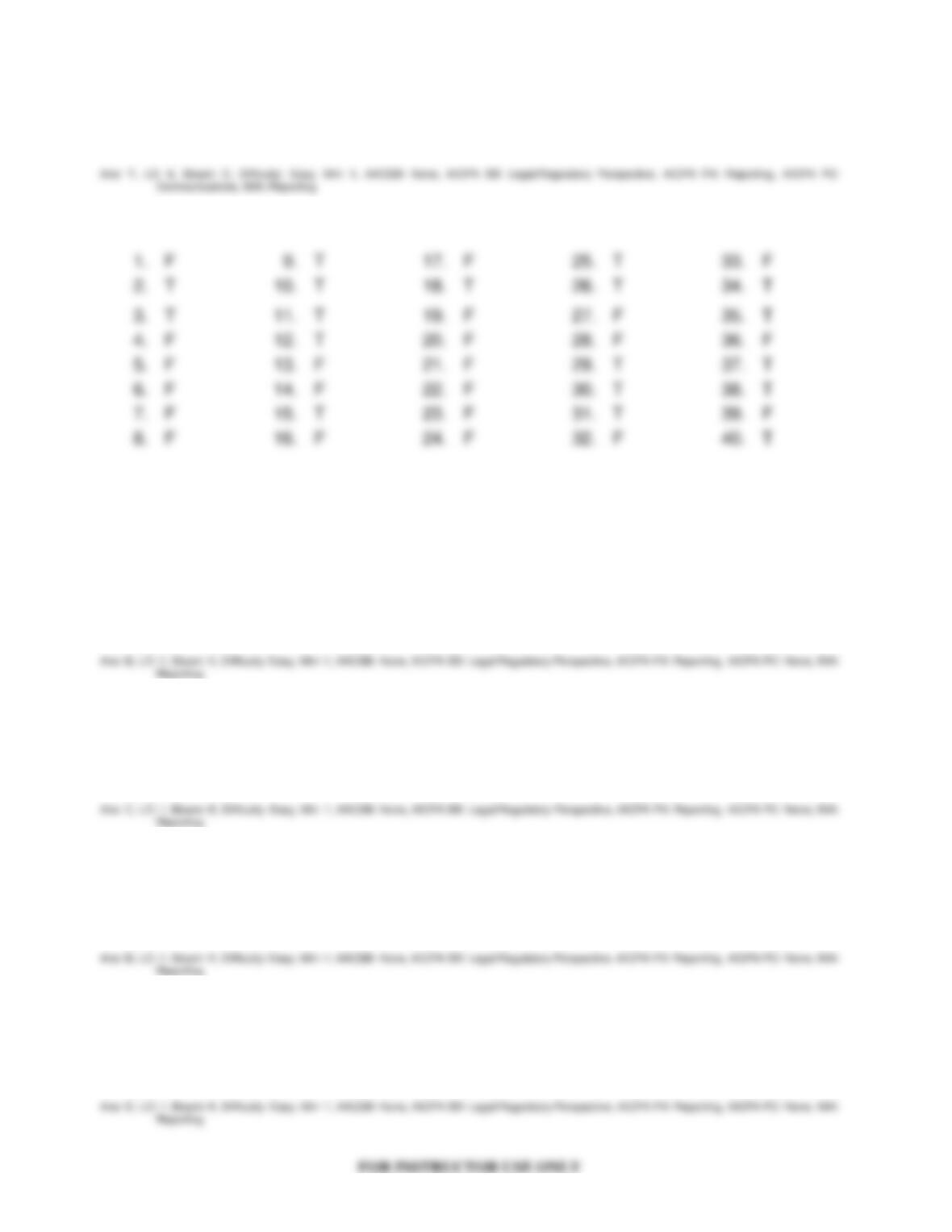
Answers to True-False Statements
MULTIPLE CHOICE QUESTIONS
41. The proprietorship form of business organization
a. must have at least two owners in most states.
b. generally receives favorable tax treatment relative to a corporation.
c. combines the records of the business with the personal records of the owner.
d. is classified as a separate legal entity.
42. A business organized as a corporation
a. is not a separate legal entity in most states.
b. requires that stockholders be personally liable for the debts of the business.
c. is owned by its stockholders.
d. has tax advantages over a proprietorship or partnership.
43. The partnership form of business organization
a. is a separate legal entity.
b. is a common form of organization for service-type businesses.
c. enjoys an unlimited life.
d. has limited liability.
44. Which of the following is not one of the three forms of business organization?
a. Corporations
b. Partnerships
c. Proprietorships
d. Investors
Introduction to Financial Statements
1-9
45. Most business enterprises in the United States are
a. proprietorships and partnerships.
b. partnerships.
c. corporations.
d. government units.
46. A business organized as a separate legal entity is a
a. corporation.
b. proprietor.
c. government unit.
d. partnership.
47. Which of the following is not an advantage of the corporate form of business
organization?
a. No personal liability
b. Easy to transfer ownership
c. Favorable tax treatment
d. Easy to raise funds
48. An advantage of the corporate form of business is that
a. it has limited life.
b. its owner’s personal resources are at stake.
c. its ownership is easily transferable via the sale of shares of stock.
d. it is simple to establish.
49. Which of the following is an advantage of corporations relative to partnerships and sole
proprietorships?
a. Reduced legal liability for investors
b. Harder to transfer ownership
c. Lower taxes
d. Most common form of organization
50. A corporation has which of the following set of characteristics?
a. Shared control, tax advantages, increased skills and resources
b. Simple to set up and maintains control with founder
c. Easier to transfer ownership and raise funds, no personal liability
d. Harder to raise funds and gives owner control
Test Bank for Financial Accounting: Tools for Business Decision Making, Seventh Edition
1-10
51. A small neighborhood barber shop that is operated by its owner would likely be organized
as a
a. joint venture.
b. partnership.
c. corporation.
d. proprietorship.
52. A local retail shop has been operating as a sole proprietorship. The business is growing
and now the owner wants to incorporate. Which of the following is not a reason for this
owner to incorporate?
a. Ability to raise capital for expansion
b. Desire to limit the owner’s personal liability
c. The prestige of operating as a corporation
d. The ease in transferring shares of the corporation’s stock
53. All of the following are advantages for choosing a proprietorship for a business except
a. a proprietorship is a simple form of business to set up.
b. a proprietorship gives the owner control of the business.
c. proprietorship receive more favorable tax treatment.
d. transfer of ownership is easily achieved through stock sales.
54. Jack and Jill form a partnership. Jack runs the business in New York, while Jill vacations
in Hawaii. During the time Jill is away from the business, Jack increases the debts of the
business by $20,000. Which of the following statements is true regarding this debt?
a. Only Jack is personally liable for the debt, since he has been the managing partner
during that time.
b. Only Jill is personally liable for the debt of the business, since Jack has been working
and she has not.
c. Both Jack and Jill are personally liable for the business debt.
d. Neither Jack nor Jill is personally liable for the business debt, since the partnership is
a separate legal entity.
55. Which one of the following questions is most likely asked by an internal human resources
director for the company?
a. Which product line is most profitable?
b. What price for our product will maximize the company income?
c. What average pay raise is affordable for employees this year?
d. Should any product lines be eliminated?
Introduction to Financial Statements
1-11
56. Which of the following are internal reports that accounting provides to internal users?
a. Forecasts of cash needs for next year.
b. Financial comparisons of operating activity alternatives.
c. Both forecasts of cash needs and financial comparisons are internal reports.
d. Neither forecasts of cash needs or financial comparisons is an internal report.
57. Which of the following is the best definition of an internal user of accounting information?
a. Investors who use accounting information to decide whether to buy or sell stock.
b. Creditors like banks that use accounting information to evaluate the risk of lending
money.
c. Labor unions who use accounting information to examine the ability of the company to
pay increased wages and benefits.
d. Managers who use accounting information to plan, organize, and run a business.
58. External users of accounting information, like the Internal Revenue Service, are most
commonly known as
a. taxing authorities.
b. labor unions.
c. customers.
d. regulatory agencies.
59. Which of the following statements is not true regarding the Sarbanes-Oxley Act (SOX)?
a. The Act calls for increased oversight responsibilities for boards of directors.
b. The Act has resulted in increased penalties for financial fraud by top management.
c. The Act calls for decreased independence of outside auditors reviewing corporate
financial statements.
d. The Act is meant to decrease the likelihood of unethical corporate behavior.
60. Which of the following is not a step for solving an ethical dilemma?
a. Identifying the alternatives and weighing the impact of each alternative on various
stakeholders.
b. Certifying the ethical accuracy of the financial information.
c. Identifying and analyzing the principal elements in the situation.
d. Recognizing the ethical situation and issues involved.
61. Which of the following is the most appropriate and modern definition of accounting?
a. The information system that identifies, records, and communicates the economic
events of an organization to interested users.
b. A means of collecting information.
c. The interconnected network of subsystems necessary to operate a business.
d. Electronic collection, organization, and communication of vast amounts of information.
Test Bank for Financial Accounting: Tools for Business Decision Making, Seventh Edition
1-12
62. Which of the following would not be considered an internal user of accounting data for the
Xanadu Company?
a. President of the company
b. Production manager
c. Merchandise inventory clerk
d. President of the employees’ labor union
63. Which of the following groups uses accounting information primarily to insure the entity is
operating within prescribed rules?
a. Taxing authorities
b. Regulatory agencies
c. Labor Unions
d. Management
64. The group of users of accounting information charged with achieving the goals of the
business is its
a. auditors.
b. investors.
c. managers.
d. creditors.
65. Which of the following groups uses accounting information to determine whether the
company can pay its obligations?
a. Investors in common stock
b. Marketing managers
c. Creditors
d. Chief Financial Officer
66. Which of the following groups uses accounting information to determine whether the
company’s net income will result in a stock price increase?
a. Investors in common stock
b. Marketing managers
c. Creditors
d. Chief Financial Officer
67. Which of the following groups uses accounting information to determine whether a
marketing proposal will be cost effective?
a. Investors in common stock
b. Marketing managers
c. Creditors
d. Chief Financial Officer
Introduction to Financial Statements
1-13
68. Which of the following would not be considered an external user of accounting data for
the Julian Company?
a. Internal Revenue Service agent
b. Management
c. Creditors
d. Customers
69. Which of the following would not be considered an internal user of accounting data for a
company?
a. The president of a company
b. The controller of a company
c. Creditor of a company
d. Salesperson of a company
70. Which of the following is a primary user of accounting information with a direct financial
interest in the business?
a. Taxing authority
b. Creditor
c. Regulatory agency
d. Labor union
71. Which of the following is a user of accounting information with an indirect financial interest
in a business?
a. A financial adviser
b. Management
c. Investor
d. Creditor
72. Which type of corporate information is readily available to investors?
a. Financial comparison of operating alternatives
b. Marketing strategies for a product that will be introduced in eighteen months
c. Forecasts of cash needs for the upcoming year
d. Amount of net income retained in the business
73. Which of the following statements concerning users of accounting information is incorrect?
a. Management is considered an internal user.
b. Present creditors are considered external users.
c. Regulatory authorities are considered internal users.
d. Taxing authorities are considered external users.
Test Bank for Financial Accounting: Tools for Business Decision Making, Seventh Edition
1-14
74. External users want answers to all of the following questions except
a. Is the company earning satisfactory income?
b. Will the company be able to pay its debts as they come due?
c. Will the company be able to afford employee pay raises this year?
d. How does the company compare in profitability with competitors?
75. Which type of corporate information is not available to investors?
a. Dividend history
b. Forecast of cash needs for the upcoming year
c. Cash provided by investing activities
d. Beginning cash balance
76. The liability created by a business when it purchases coffee beans and coffee cups on
credit from suppliers is termed a(n)
a. account payable.
b. account receivable.
c. revenue.
d. expense.
77. The right to receive money in the future is called a(n)
a. account payable.
b. account receivable.
c. liability.
d. revenue.
78. Which of the following is not a principal type of business activity?
a. Operating
b. Investing
c. Financing
d. Delivering
79. Borrowing money is an example of a(n)
a. delivering activity.
b. financing activity.
c. investing activity.
d. operating activity.
Introduction to Financial Statements
1-15
80. Issuing shares of stock in exchange for cash is an example of a(n)
a. delivering activity.
b. investing activity.
c. financing activity.
d. operating activity.
81. Debt securities sold to investors that must be repaid at a particular date some years in the
future are called
a. accounts payable.
b. notes receivable.
c. taxes payable.
d. bonds payable.
82. Which of the following activities involves collecting the necessary funds to support the
business?
a. Operating
b. Investing
c. Financing
d. Delivering
83. Buying assets needed to operate a business is an example of a(n)
a. delivering activity.
b. financing activity.
c. investing activity.
d. operating activity.
84. Which activities involve acquiring the resources to run the business?
a. Delivering
b. Financing
c. Investing
d. Operating
85. Which activities involve putting the resources of the business into action to generate a
profit?
a. Delivering
b. Financing
c. Investing
d. Operating
Test Bank for Financial Accounting: Tools for Business Decision Making, Seventh Edition
1-16
86. The statement of cash flows would disclose the payment of a dividend
a. nowhere on the statement.
b. in the operating activities section.
c. in the investing activities section.
d. in the financing activities section.
87 Buying and selling products are examples of
a. operating activities.
b. investing activities.
c. financing activities.
d. delivering activities.
88. The common characteristic possessed by all assets is
a. long life.
b. great monetary value.
c. tangible nature.
d. future economic benefit.
89. Expenses are incurred
a. only on rare occasions.
b. to produce assets.
c. to produce liabilities.
d. to generate revenues.
90. The cost of assets consumed or services used is also known as
a. a revenue.
b. an expense.
c. a liability.
d. an asset.
91. Resources owned by a business are referred to as
a. stockholders’ equity.
b. liabilities.
c. assets.
d. revenues.
92. The best definition of assets is the
a. cash owned by the company.
b. collections of resources belonging to the company and the claims on these resources.
c. owners’ investment in the business.
d. resources belonging to a company that have future benefit to the company.
Introduction to Financial Statements
1-17
93. Debts and obligations of a business are referred to as
a. assets.
b. equities.
c. liabilities.
d. expenses.
94. Jackson Company recorded the following cash transactions for the year:
Paid $135,000 for salaries.
Paid $60,000 to purchase office equipment.
Paid $15,000 for utilities.
Paid $6,000 in dividends.
Collected $245,000 from customers.
What was Jackson’s net cash provided by operating activities?
a. $95,000
b. $35,000
c. $110,000
d. $89,000
95. Gibson Company recorded the following cash transactions for the year:
Paid $180,000 for salaries.
Paid $80,000 to purchase office equipment.
Paid $20,000 for utilities.
Paid $8,000 in dividends.
Collected $310,000 from customers.
What was Gibson’s net cash provided by operating activities?
a. $110,000
b. $30,000
c. $130,000
d. $102,000
96. When expenses exceed revenues, which of the following is true?
a. a net loss results
b. a net income results
c. assets equal liabilities
d. assets are increased
97. Which of the following is an asset?
a. Mortgage payable
b. Investments
c. Common stock
d. Retained earnings
Test Bank for Financial Accounting: Tools for Business Decision Making, Seventh Edition
1-18
98. Which of the following is not a liability?
a. Unearned Service Revenue
b. Accounts Payable
c. Accounts Receivable
d. Interest Payable
99. Which of the following financial statements is divided into major categories of operating,
investing, and financing activities?
a. The income statement.
b. The balance sheet.
c. The retained earnings statement.
d. The statement of cash flows.
100. The retained earnings statement shows all of the following except
a. the amounts of changes in retained earnings during the period.
b. the causes of changes in retained earnings during the period.
c. the time period following the one shown for the income statement.
d. beginning retained earnings on the first line of the statement.
101. Ending retained earnings for a period is equal to beginning
a. Retained earnings + Net income + Dividends
b. Retained earnings – Net income – Dividends
c. Retained earnings + Net income – Dividends
d. Retained earnings – Net income + Dividends
102. Which of the following statements is true?
a. Amounts received from issuing stock are revenues.
b. Amounts paid out as dividends are not expenses.
c. Amounts paid out as dividends are reported on the income statement.
d. Amounts received from issued stock are reported on the income statement.
103. Dividends are reported on the
a. income statement.
b. retained earnings statement.
c. balance sheet.
d. income statement and balance sheet.
Introduction to Financial Statements
1-19
104. Dividends paid
a. increase assets.
b. increase expenses.
c. decrease revenues.
d. decrease retained earnings.
105. The financial statement that summarizes the changes in retained earnings for a specific
period of time is the
a. balance sheet.
b. income statement.
c. statement of cash flows.
d. retained earnings statement.
106. To show how successfully your business performed during a period of time, you would
report its revenues and expenses in the
a. balance sheet.
b. income statement.
c. statement of cash flows.
d. retained earnings statement.
107. Net income results when
a. Assets > Liabilities.
b. Revenues = Expenses.
c. Revenues > Expenses.
d. Revenues < Expenses.
108. Net income will result during a time period when
a. assets exceed liabilities.
b. assets exceed revenues.
c. expenses exceed revenues.
d. revenues exceed expenses.
109. Retained earnings at the end of the period is equal to
a. retained earnings at the beginning of the period plus net income minus liabilities.
b. retained earnings at the beginning of the period plus net income minus dividends.
c. net income.
d. assets plus liabilities.
Test Bank for Financial Accounting: Tools for Business Decision Making, Seventh Edition
1-20
110. Which of the following financial statements is concerned with the company at a point in
time?
a. Balance sheet
b. Income statement
c. Retained earnings statement
d. Statement of cash flows
111. The company’s policy toward dividends and growth could best be determined by
examining the
a. balance sheet.
b. income statement.
c. retained earnings statement.
d. statement of cash flows.
112. An income statement
a. summarizes the changes in retained earnings for a specific period of time.
b. reports the changes in assets, liabilities, and stockholders’ equity over a period of
time.
c. reports the assets, liabilities, and stockholders’ equity at a specific date.
d. presents the revenues and expenses for a specific period of time.
113. If the retained earnings account increases from the beginning of the year to the end of the
year, then
a. net income is less than dividends.
b. a net loss is less than dividends.
c. additional investments are less than net losses.
d. net income is greater than dividends.
114. The retained earnings statement would not show
a. the retained earnings beginning balance.
b. revenues and expenses.
c. dividends.
d. the ending retained earning balance.
115. If the retained earnings account decreases from the beginning of the year to the end of
the year, then
a. net income is less than dividends.
b. there was a net income and no dividends.
c. additional investments are less than net losses.
d. net income is greater than dividends.
Introduction to Financial Statements
1-21
116. Which financial statement is prepared first?
a. Balance sheet
b. Income statement
c. Retained earnings statement
d. Statement of cash flows
117. An income statement shows
a. revenues, liabilities, and stockholders’ equity.
b. expenses, dividends, and stockholders’ equity.
c. revenues, expenses, and net income.
d. assets, liabilities, and stockholders’ equity.
118. In a study session, a classmate makes this statement “Dividends are listed as expenses
on the income statement.” What is your best response to this statement?
a. I’ve been struggling with that concept and I feel that dividends should be shown on the
balance sheet as assets.
b. You are right. Revenues and expenses are shown on the income statement.
Dividends are a cost of generating revenues and that makes them an expense. Why
else would a corporation pay dividends?
c. Dividends represent a portion of corporate profits that are paid to the shareholders.
They belong on the retained earnings statement.
d. Dividends are deducted from retained earnings on the balance sheet.
119. Henson Company began the year with retained earnings of $330,000. During the year, the
company recorded revenues of $500,000, expenses of $380,000, and paid dividends of
$40,000. What was Henson’s retained earnings at the end of the year?
a. $490,000
b. $410,000
c. $790,000
d. $450,000
120. Pinson Company began the year with retained earnings of $570,000. During the year, the
company recorded revenues of $600,000, expenses of $380,000, and paid dividends of
$140,000. What was Pinson’s retained earnings at the end of the year?
a. $930,000
b. $650,000
c. $1,030,000
d. $500,000
Test Bank for Financial Accounting: Tools for Business Decision Making, Seventh Edition
1-22
121. Finney Company began the year by issuing $40,000 of common stock for cash. The
company recorded revenues of $370,000, expenses of $320,000, and paid dividends of
$20,000. What was Finney’s net income for the year?
a. $30,000
b. $70,000
c. $50,000
d. $90,000
122. Lankston Company began the year by issuing $90,000 of common stock for cash. The
company recorded revenues of $825,000, expenses of $720,000, and paid dividends of
$45,000. What was Lankston’s net income for the year?
a. $60,000
b. $150,000
c. $105,000
d. $195,000
123. Gilkey Corporation began the year with retained earnings of $465,000. During the year,
the company issued $630,000 of common stock, recorded expenses of $1,800,000, and
paid dividends of $120,000. If Gilkey’s ending retained earnings was $495,000, what was
the company’s revenue for the year?
a. $1,830,000
b. $1,950,000
c. $2,460,000
d. $2,580,000
124. Kilmer Corporation began the year with retained earnings of $620,000. During the year,
the company issued $840,000 of common stock, recorded expenses of $2,400,000, and
paid dividends of $160,000. If Kilmer’s ending retained earnings was $660,000, what was
the company’s revenue for the year?
a. $2,440,000
b. $2,600,000
c. $3,280,000
d. $33,440,000
125. A balance sheet shows
a. revenues, liabilities, and stockholders’ equity.
b. expenses, dividends, and stockholders’ equity.
c. revenues, expenses, and dividends.
d. assets, liabilities, and stockholders’ equity.
Introduction to Financial Statements
1-23
126. The accounting equation may be expressed as
a. Assets = Stockholders’ Equity – Liabilities.
b. Assets = Liabilities + Stockholders’ Equity.
c. Assets + Liabilities = Stockholders’ Equity.
d. Assets + Stockholders’ Equity = Liabilities.
127. Which of the following is not a satisfactory statement of the accounting equation?
a. Assets = Stockholders’ Equity – Liabilities
b. Assets = Liabilities + Stockholders’ Equity
c. Assets – Liabilities = Stockholders’ Equity
d. Assets – Stockholders’ Equity = Liabilities
128. Jimmy’s Repair Shop started the year with total assets of $200,000 and total liabilities of
$160,000. During the year the business recorded $420,000 in revenues, $220,000 in
expenses, and dividends of $40,000. Stockholders’ equity at the end of the year was
a. $240,000.
b. $200,000.
c. $160,000.
d. $180,000.
129. Jimmy’s Repair Shop started the year with total assets of $200,000 and total liabilities of
$160,000. During the year the business recorded $420,000 in revenues, $220,000 in
expenses, and dividends of $40,000. The net income reported by Jimmy’s Repair Shop
for the year was
a. $160,000.
b. $200,000.
c. $120,000.
d. $380,000.
130. Ashley’s Accessory Shop started the year with total assets of $140,000 and total liabilities
of $80,000. During the year the business recorded $220,000 in revenues, $110,000 in
expenses, and dividends of $40,000. Stockholders’ equity at the end of the year was
a. $120,000.
b. $110,000.
c. $130,000.
d. $70,000.
Test Bank for Financial Accounting: Tools for Business Decision Making, Seventh Edition
1-24
131. Ashley’s Accessory Shop started the year with total assets of $140,000 and total liabilities
of $80,000. During the year the business recorded $220,000 in revenues, $110,000 in
expenses, and dividends of $40,000. The net income reported by Ashley’s Accessory
Shop for the year was
a. $80,000.
b. $100,000.
c. $130,000.
d. $110,000.
132. If total liabilities increased by $75,000 and stockholders’ equity increased by $25,000
during a period of time, then total assets must change by what amount and direction
during that same period?
a. $100,000 decrease
b. $100,000 increase
c. $125,000 increase
d. $150,000 increase
133. If total liabilities decreased by $75,000 and stockholders’ equity increased by $25,000
during a period of time, then total assets must change by what amount and direction
during that same period?
a. $100,000 increase
b. $50,000 decrease
c. $50,000 increase
d. $75,000 decrease
134. If total liabilities decreased by $50,000 and stockholders’ equity increased by $10,000
during a period of time, then total assets must change by what amount and direction
during that same period?
a. $40,000 decrease
b. $40,000 increase
c. $50,000 increase
d. $60,000 increase
Introduction to Financial Statements
1-25
135. If total liabilities decreased by $75,000 and stockholders’ equity decreased by $25,000
during a period of time, then total assets must change by what amount and direction
during that same period?
a. $100,000 increase
b. $50,000 decrease
c. $100,000 decrease
d. $50,000 decrease
136. If total liabilities increased by $46,000 during a period of time and stockholders’ equity
decreased by $18,000 during the same period, then the amount and direction (increase or
decrease) of the period’s change in total assets is a(n)
a. $46,000 increase.
b. $64,000 increase.
c. $28,000 decrease.
d. $28,000 increase.
137. The balance sheet
a. summarizes the changes in retained earnings for a specific period of time.
b. reports the changes in assets, liabilities, and stockholders’ equity over a period of
time.
c. reports the assets, liabilities, and stockholders’ equity at a specific date.
d. presents the revenues and expenses for a specific period of time.
138. The retained earnings statement
a. summarizes the changes in retained earnings for a specific period of time.
b. reports the changes in assets, liabilities, and stockholders’ equity over a period of
time.
c. reports the assets, liabilities, and stockholders’ equity at a specific date.
d. presents the revenues and expenses for a specific period of time.
139. Liabilities
a. are future economic benefits.
b. are debts and obligations.
c. possess service potential.
d. are things of value owned by a business.
Test Bank for Financial Accounting: Tools for Business Decision Making, Seventh Edition
1-26
140. Liabilities of a company are owed to
a. debtors.
b. owners.
c. creditors.
d. stockholders.
141. Stockholders’ equity can be described as claims of
a. creditors on total assets.
b. owners on total assets.
c. customers on total assets.
d. debtors on total assets.
142. Payments to stockholders are called
a. expenses.
b. liabilities.
c. dividends.
d. distributions.
143. Common stock is reported on the
a. statement of cash flows.
b. retained earnings statement.
c. income statement.
d. balance sheet.
144. Stockholders’ equity is comprised of
a. common stock and dividends.
b. common stock and retained earnings.
c. dividends and retained earnings.
d. net income and retained earnings.
145. Stockholders’ equity
a. is usually equal to cash on hand.
b. is equal to liabilities and retained earnings.
c. includes retained earnings and common stock.
d. is shown on the income statement.
146. Retained earnings is
a. the stockholders’ claim on total assets.
b. equal to cash.
c. equal to revenues.
d. the amount of net income kept in the corporation for future use.
Introduction to Financial Statements
1-27
147. Which financial statement would best indicate whether the company relies on debt or
stockholders’ equity to finance its assets?
a. Statement of cash flows
b. Retained earnings statement
c. Income statement
d. Balance sheet
148. The primary purpose of the statement of cash flows is to report
a. a company’s investing transactions.
b. a company’s financing transactions.
c. information about cash receipts and cash payments of a company.
d. the net increase or decrease in cash.
149. Claims of owners are called
a. dividends.
b. stockholders’ equity.
c. liabilities.
d. income payable.
150. Which of the following is not a common way that managers use the balance sheet?
a. To analyze the balances of assets, liabilities, and stockholders’ equity throughout the
accounting period
b. To determine if the cash balance is sufficient for future needs
c. To analyze the balance between debt and common stock financing
d. To analyze the balance of accounts receivable on the last day of the accounting
period
151. Why are financial statement users interested in the statement of cash flows?
a. It is the easiest financial statement to evaluate.
b. It provides information about an important company resource.
c. It is the first statement that is presented to users.
d. It helps users decide whether assets such as office equipment should be replaced.
152. Why should the income statement be prepared first?
a. The statement of cash flows should be prepared first because it determines the
sources of cash. That information is then used in preparing the income statement.
b. Net income from the income statement flows into the retained earnings statement. The
ending retained earnings balance then flows into the balance sheet.
c. The income statement does not have to be prepared first. Financial statements can be
prepared in any order.
d. None of these answer choices are correct.
Test Bank for Financial Accounting: Tools for Business Decision Making, Seventh Edition
1-28
153. Elston Company compiled the following financial information as of December 31, 2014:
Service revenue $700,000
Common stock 150,000
Equipment 200,000
Operating expenses 625,000
Cash 175,000
Dividends 50,000
Supplies 25,000
Accounts payable 100,000
Accounts receivable 75,000
Retained earnings, 1/1/14 375,000
Elston’s assets on December 31, 2014 are
a. $1,175,000.
b. $850,000.
c. $400,000.
d. $475,000.
154. Elston Company compiled the following financial information as of December 31, 2014:
Service revenue $700,000
Common stock 150,000
Equipment 200,000
Operating expenses 625,000
Cash 175,000
Dividends 50,000
Supplies 25,000
Accounts payable 100,000
Accounts receivable 75,000
Retained earnings, 1/1/14 375,000
Elston’s retained earnings on December 31, 2014 are
a. $375,000.
b. $450,000.
c. $400,000.
d. $ 25,000.
Introduction to Financial Statements
1-29
155. Elston Company compiled the following financial information as of December 31, 2014:
Service revenue $700,000
Common stock 150,000
Equipment 200,000
Operating expenses 625,000
Cash 175,000
Dividends 50,000
Supplies 25,000
Accounts payable 100,000
Accounts receivable 75,000
Retained earnings, 1/1/14 375,000
Elston’s stockholders’ equity on December 31, 2014 is
a. $525,000.
b. $550,000.
c. $400,000.
d. $600,000.
156. Benedict Company compiled the following financial information as of December 31, 2014:
Service revenue $560,000
Common stock 120,000
Equipment 160,000
Operating expenses 500,000
Cash 140,000
Dividends 40,000
Supplies 20,000
Accounts payable 80,000
Accounts receivable 60,000
Retained earnings, 1/1/14 300,000
Benedict’s assets on December 31, 2014 are
a. $940,000.
b. $680,000.
c. $320,000.
d. $380,000.
Test Bank for Financial Accounting: Tools for Business Decision Making, Seventh Edition
1-30
157. Benedict Company compiled the following financial information as of December 31, 2014:
Service revenue $560,000
Common stock 120,000
Equipment 160,000
Operating expenses 500,000
Cash 140,000
Dividends 40,000
Supplies 20,000
Accounts payable 80,000
Accounts receivable 60,000
Retained earnings, 1/1/14 300,000
Benedict’s retained earnings on December 31, 2014 are
a. $300,000.
b. $360,000.
c. $320,000.
d. $ 20,000.
158. Benedict Company compiled the following financial information as of December 31, 2014:
Service revenue $560,000
Common stock 120,000
Equipment 160,000
Operating expenses 500,000
Cash 140,000
Dividends 40,000
Supplies 20,000
Accounts payable 80,000
Accounts receivable 60,000
Retained earnings, 1/1/14 300,000
Benedict’s stockholders’ equity on December 31, 2014 is
a. $420,000.
b. $440,000.
c. $320,000.
d. $480,000.
159. The heading on the statement of cash flows identifies all of the following except
a. the preparer of the statement.
b. the company
c. the time period covered by the statement.
d. the type of statement.
Introduction to Financial Statements
1-31
160. All of the following are interrelationships that are important to understand when preparing
financial statements except
a. the net income from the income statement is used in the retained earnings statement.
b. the ending retained earnings from the retained earnings statement is used in the
stockholder’s equity section of the balance sheet.
c. the cash on the balance sheet should be equal to the cash at the end of the period on
the statement of cash flows.
d. all of the payments on the balance sheet should be equal to the cash payments for
operating activities on the statement of cash flows.
161. Marvin Services Corporation had the following accounts and balances:
Accounts payable
$18,000
Equipment
$21,000
Accounts receivable
3,000
Land
21,000
Buildings
?
Unearned service revenue
6,000
Cash
9,000
Total stockholders‘ equity
?
If the balance of the Buildings account was $42,000 and $3,000 of Accounts Payable
were paid in cash, what would be the balance of the total stockholders’ equity?
a. $81,000
b. $72,000
c. $102,000
d. $78,000
162. Marvin Services Corporation had the following accounts and balances:
Accounts payable
$18,000
Equipment
$21,000
Accounts receivable
3,000
Land
21,000
Buildings
?
Unearned service revenue
6,000
Cash
9,000
Total stockholders‘ equity
?
If the balance of the Buildings account was $24,000 and $6,000 of Accounts Payable
were paid in cash, what would be the total liabilities and stockholders’ equity?
a. $54,000
b. $78,000
c. $48,000
d. $72,000
Test Bank for Financial Accounting: Tools for Business Decision Making, Seventh Edition
1-32
163. Marvin Services Corporation had the following accounts and balances:
Accounts payable
$18,000
Equipment
$21,000
Accounts receivable
3,000
Land
21,000
Buildings
?
Unearned service revenue
6,000
Cash
9,000
Total stockholders‘ equity
?
If total stockholder’s equity was $57,000, what would be the balance of the Buildings
Account?
a. $21,000
b. $81,000
c. $87,000
d. $27,000
164. Marvin Services Corporation had the following accounts and balances:
Accounts payable
$18,000
Equipment
$21,000
Accounts receivable
3,000
Land
21,000
Buildings
?
Unearned service revenue
6,000
Cash
9,000
Total stockholders‘ equity
?
If the balance of the Buildings account was $45,000 and the equipment was sold for
$21,000, what would be the total of stockholders’ equity?
a. $39,000
b. $54,000
c. $69,000
d. $75,000
165. Marvin Services Corporation had the following accounts and balances:
Accounts payable
$18,000
Equipment
$21,000
Accounts receivable
3,000
Land
21,000
Buildings
?
Unearned service revenue
6,000
Cash
9,000
Total stockholders‘ equity
?
If the balance of the Buildings account was $51,000, what would be the total of liabilities
and stockholders’ equity?
a. $102,000
b. $105,000
c. $81,000
d. $75,000
Introduction to Financial Statements
1-33
166. Notes to the financial statements include all of the following except
a. descriptions of significant accounting policies used.
b. explanations of uncertainties.
c. quantifiable accounting information.
d. statistics needed to understand the statements.
167. The management discussion and analysis (MD&A) section of the annual report covers all
of the following aspects except the
a. ability of the company to pay near-term obligations.
b. certification criteria of the company’s auditors.
c. company’s ability to fund operations and expansion.
d. results of the company operations.
168. An annual report includes all of the following except
a. management discussion and analysis section.
b. notes to the financial statements.
c. an auditor’s report.
d. salary information for all the executives.
169. Which of the following clarifies information presented in the financial statements, as well
as expanding upon it where additional detail is needed?
a. Auditor’s report
b. Management discussion and analysis section
c. Notes to the financial statements
d. President’s state of the company report
170. The information needed to determine whether a company is using accounting methods
similar to those of its competitors would be found in the
a. auditor’s report.
b. balance sheet.
c. management discussion and analysis section.
d. notes to the financial statements.
171. In the annual report, where would a financial statement reader find out if the company’s
financial statements give a fair depiction of its financial position and operating results?
a. Notes to the financial statements
b. Management discussion and analysis section
c. Balance sheet
d. Auditor’s report
Test Bank for Financial Accounting: Tools for Business Decision Making, Seventh Edition
FOR INSTRUCTOR USE ONLY
1-34
172. Management’s views on the company’s short-term debt paying ability, expansion
financing, and results of operations are found in the
a. auditor’s report.
b. management discussion and analysis section.
c. notes to the financial statements.
d. president’s state of the company report.
173. Which of the following statements is true?
a. Publicly traded U.S. companies must provide an annual report to their shareholders
when operating conditions change significantly.
b. An unqualified independent auditor’s report must be included in the annual report.
c. Notes to the financial statements do not need to be included in the annual report
because that information is only for internal users.
d. None of these answer choices are correct.
174. Notes to the financial statements
a. are optional.
b. help clarify information presented in the financial statements.
c. are generally brief and few in number.
d. need not be read in detail if an unqualified opinion accompanies the financial
statements.
Answers to Multiple Choice Questions
Introduction to Financial Statements
FOR INSTRUCTOR USE ONLY
1-35
BRIEF EXERCISES
Be. 175
Indicate in the space by letter whether each statement below applies to a sole proprietorship (S),
partnership (P), or corporation (C). More than one answer may be appropriate.
____ a. Simple to establish.
____ b. Shared control.
____ c. Easy to transfer ownership.
____ d. No personal liability.
____ e. Tax advantage.
____ f. Easier to raise funds.
Be. 176
Indicate in the space provided by each item whether it would appear on the statement of cash
flows as a(n): (O) operating activity, (I) investing activity, or (F) financing activity.
____ a. Cash receipts from customers.
____ b. Issuance of common stock for cash.
____ c. Payment of cash dividends.
____ d. Cash purchase of equipment.
____ e. Cash payments to suppliers.
____ f. Sale of old machine for cash.
Test Bank for Financial Accounting: Tools for Business Decision Making, Seventh Edition
FOR INSTRUCTOR USE ONLY
1-36
Be. 177
Use the following information to calculate for the year ended December 31, 2014 (a) net income
(net loss), (b) ending retained earnings, and (c) total assets.
Supplies $ 1,500 Service revenue $19,000
Other operating expenses 10,000 Cash 15,000
Accounts payable 11,000 Dividends 6,000
Accounts receivable 4,000 Notes payable 1,000
Common stock 10,000 Equipment 9,500
Retained earnings (beginning) 5,000
Be. 178
Use the following information to calculate for the year ended December 31, 2014 (a) net income
(net loss), (b) ending retained earnings, and (c) total assets.
Supplies $ 1,000 Service revenue $18,000
Other operating expenses 12,000 Cash 15,000
Accounts payable 9,000 Dividends 1,000
Accounts receivable 3,000 Notes payable 1,000
Common stock 9,000 Equipment 13,000
Retained earnings (beginning) 5,000
Introduction to Financial Statements
FOR INSTRUCTOR USE ONLY
1-37
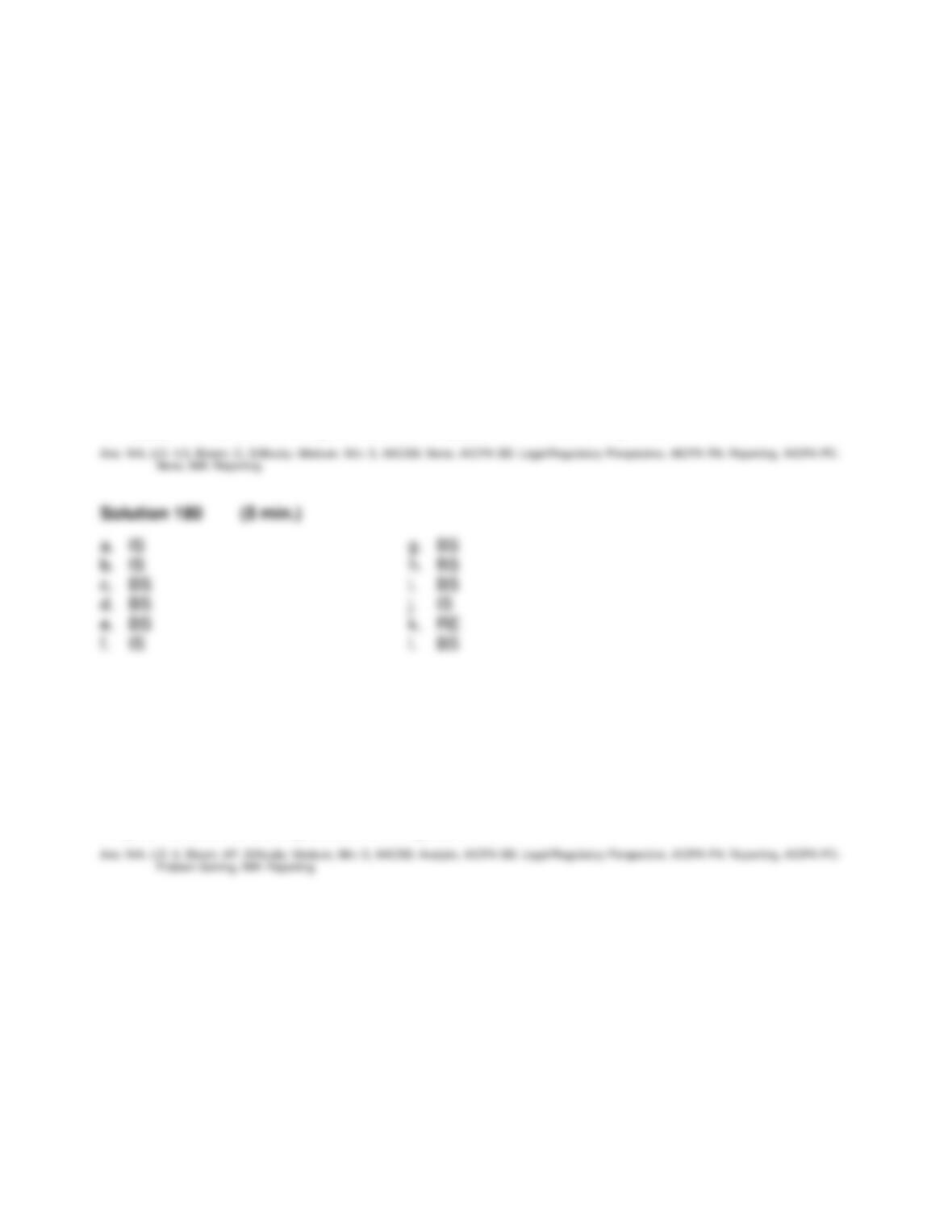
Be. 179
Listed below in alphabetical order are the balance sheet items of Nolan Company at December
31, 2014. Prepare a balance sheet and include a complete heading.
Accounts payable $ 11,000
Accounts receivable 15,000
Buildings 65,000
Cash 11,000
Common stock 80,000
Land 31,000
Equipment 10,000
Retained earnings 41,000
Test Bank for Financial Accounting: Tools for Business Decision Making, Seventh Edition
FOR INSTRUCTOR USE ONLY
1-38
Be. 180
Indicate in the space provided by each item whether it would appear on the income statement
(IS), balance sheet (BS), or retained earnings statement (RE):
a. ____ Service Revenue g. ___ Accounts Receivable
b. ____ Utilities Expense h. ___ Common Stock
c. ____ Cash i. ____ Equipment
d. ____ Accounts Payable j. ____ Advertising Expense
e. ____ Supplies k. ___ Dividends
f. ____ Salaries and Wages Expense l. ____ Notes Payable
Be. 181
Cesar Ruiz was reviewing his company’s activities at the end of the year (2014) and decided to
prepare a retained earnings statement. At the beginning of the year his assets were $530,000,
liabilities were $140,000, and common stock was $120,000. The net income for the year was
$250,000. Dividends of $220,000 were paid during the year.
Prepare a retained earnings statement in good form.
Introduction to Financial Statements
FOR INSTRUCTOR USE ONLY
1-39
Be. 182
From the following list of selected accounts taken from the records of Schmidt Clinic, identify
those that would appear on the balance sheet.
a. Common Stock f. Accounts Payable
b. Service Revenue g. Cash
c. Land h. Advertising Expense
d. Salaries and Wages Expense i. Supplies
e. Notes Payable j. Utilities Expense
Be. 183
Determine the missing items.
Assets = Liabilities + Stockholders’ Equity
$80,000 $56,000 (a)
(b) $28,000 $34,000
$84,000 (c) $55,000
Test Bank for Financial Accounting: Tools for Business Decision Making, Seventh Edition
FOR INSTRUCTOR USE ONLY
1-40
Be. 184
Determine the missing items.
Assets = Liabilities + Stockholders’ Equity
$66,000 $50,000 (a)
(b) $18,000 $30,000
$54,000 (c) $40,000
Be. 185
Identify which of the following accounts appear on a balance sheet.
(a) Service revenue
(b) Cash
(c) Common stock
(d) Accounts payable
(e) Rent expense
(f) Supplies
(g) Land
Introduction to Financial Statements
FOR INSTRUCTOR USE ONLY
1-41
Be. 186
For the items listed below, fill in the appropriate code letter to indicate whether the item is an
asset, liability, or stockholders’ equity item.
Code
Asset A
Liability L
Stockholders’ Equity SE
_____ 1. Rent Expense ____ 6. Cash
_____ 2. Equipment ____ 7. Accounts Receivable
_____ 3. Accounts Payable ____ 8. Retained Earnings
_____ 4. Common Stock ____ 9. Service Revenue
_____ 5. Insurance Expense ____ 10. Notes Payable
Be. 187
Classify each of these items as an asset (A), liability (L), or stockholders’ equity (SE).
_____ 1. Accounts receivable
_____ 2. Accounts payable
_____ 3. Common stock
_____ 4. Supplies
_____ 5. Retained earnings
_____ 6. Cash
_____ 7. Notes payable
_____ 8. Equipment
Test Bank for Financial Accounting: Tools for Business Decision Making, Seventh Edition
FOR INSTRUCTOR USE ONLY
1-42
Be. 188
At the beginning of the year, Gant Company had total assets of $660,000 and total liabilities of
$300,000. Answer the following questions viewing each situation as being independent of the
others.
(1) If total assets increased $225,000 during the year, and total liabilities decreased $100,000,
what is the amount of stockholders’ equity at the end of the year?
(2) During the year, total liabilities increased $215,000 and stockholders’ equity decreased
$130,000. What is the amount of total assets at the end of the year?
(3) If total assets decreased $60,000 and stockholders’ equity increased $150,000 during the
year, what is the amount of total liabilities at the end of the year?
Be. 189
Reinhardt’s Carpet Cleaning has the following balance sheet items:
Buildings Notes Payable
Accounts Payable Common Stock
Cash Retained Earnings
Supplies Equipment
Accounts Receivable
Identify which items are (1) Assets
(2) Liabilities
(3) Stockholders’ Equity
Introduction to Financial Statements
FOR INSTRUCTOR USE ONLY
1-43
Be. 190
On June 1, 2014, Shaw Company prepared a balance sheet that shows the following:
Assets (no cash) ……………………………………………………………. $125,000
Liabilities ……………………………………………………………………… 75,000
Stockholders’ Equity ……………………………………………………….. 50,000
Shortly thereafter, all of the assets were sold for cash.
How would the balance sheet appear immediately after the sale of the assets for cash for each of
the following cases?
Cash Received for Balances Immediately After Sale
the Assets Assets – Liabilities = Stockholders’ Equity
Cash A $135,000 $________ $________ $________
Cash B 120,000 ________ ________ ________
Cash C 105,000 ________ ________ ________
Be. 191
Compute the missing amount in each category of the accounting equation.
Assets Liabilities Stockholders’ Equity
(a) $243,000 $ ? $ 91,000
(b) $183,000 $ 75,000 $ ?
(c) $ ? $212,000 $310,000

Test Bank for Financial Accounting: Tools for Business Decision Making, Seventh Edition
1-44
EXERCISES
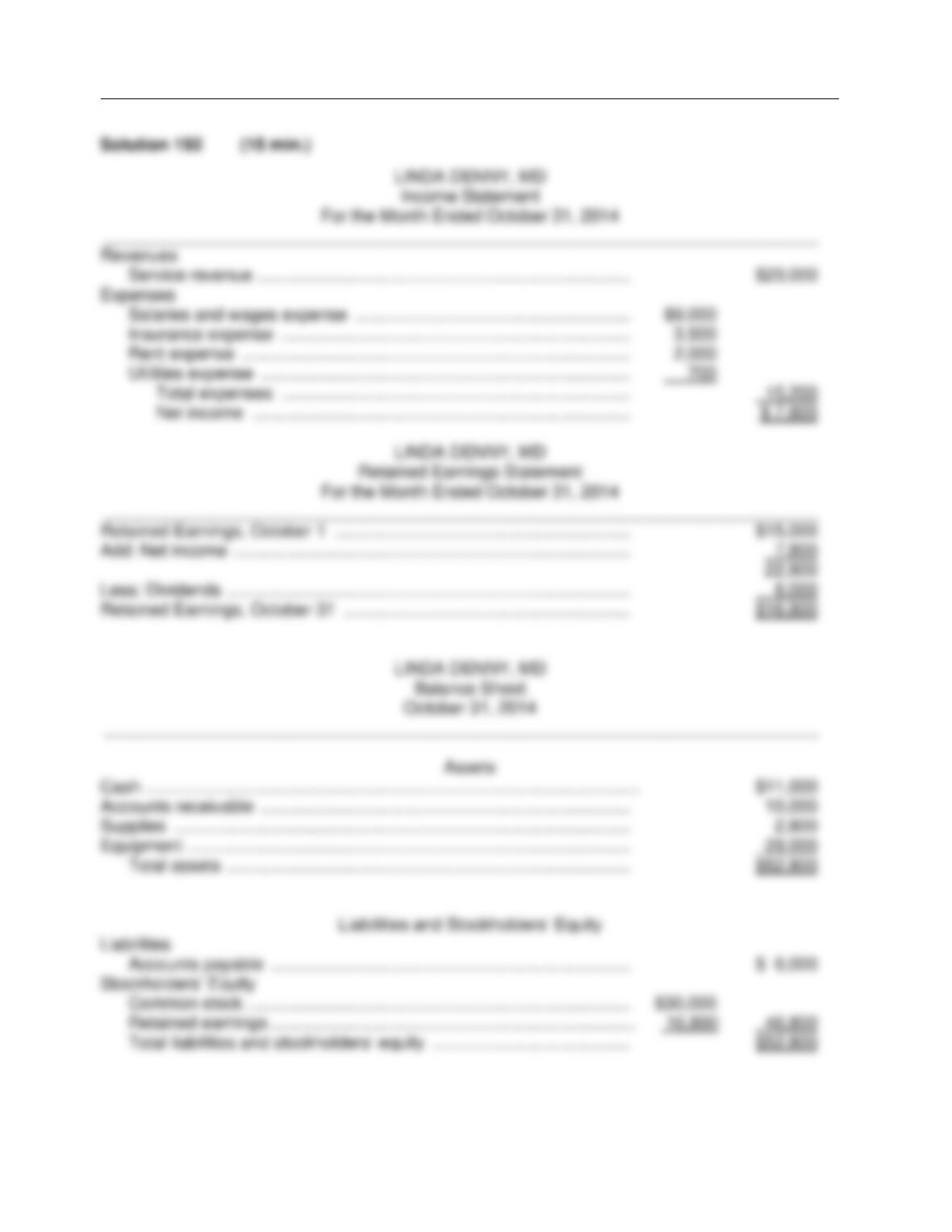
Ex. 192
Prepare an income statement and a retained earnings statement, for the month of October, 2014
and a balance sheet at October 31, 2014 for the medical practice of Linda Denny, MD, from the
items listed below.
Retained earnings (October 1) $15,000
Common stock 30,000
Accounts payable 6,000
Equipment 29,000
Service revenue 23,000
Dividends 6,000
Insurance expense 3,500
Cash 11,000
Utilities expense 700
Supplies 2,800
Salaries and wages expense 9,000
Accounts receivable 10,000
Rent expense 2,000
LINDA DENNY, MD
Income Statement
For the Month Ended October 31, 2014
___________________________________________________________________________
Revenues $
Expenses $
Total expenses
Net income $ t
Introduction to Financial Statements
FOR INSTRUCTOR USE ONLY
1-45
Ex. 192 (Cont.)
LINDA DENNY, MD
Retained Earnings Statement
For the Month Ended October 31, 2014
___________________________________________________________________________
Retained Earnings, October 1 $
Add:
Less:
$ t
LINDA DENNY, MD
Balance Sheet
October 31, 2014
___________________________________________________________________________
Assets
$
Total assets
$ t
Liabilities and Stockholders’ Equity
Liabilities
$
Stockholders’ Equity
$
Total liabilities and stockholders’ equity $ t
Test Bank for Financial Accounting: Tools for Business Decision Making, Seventh Edition
FOR INSTRUCTOR USE ONLY
1-46

Introduction to Financial Statements
FOR INSTRUCTOR USE ONLY
1-47
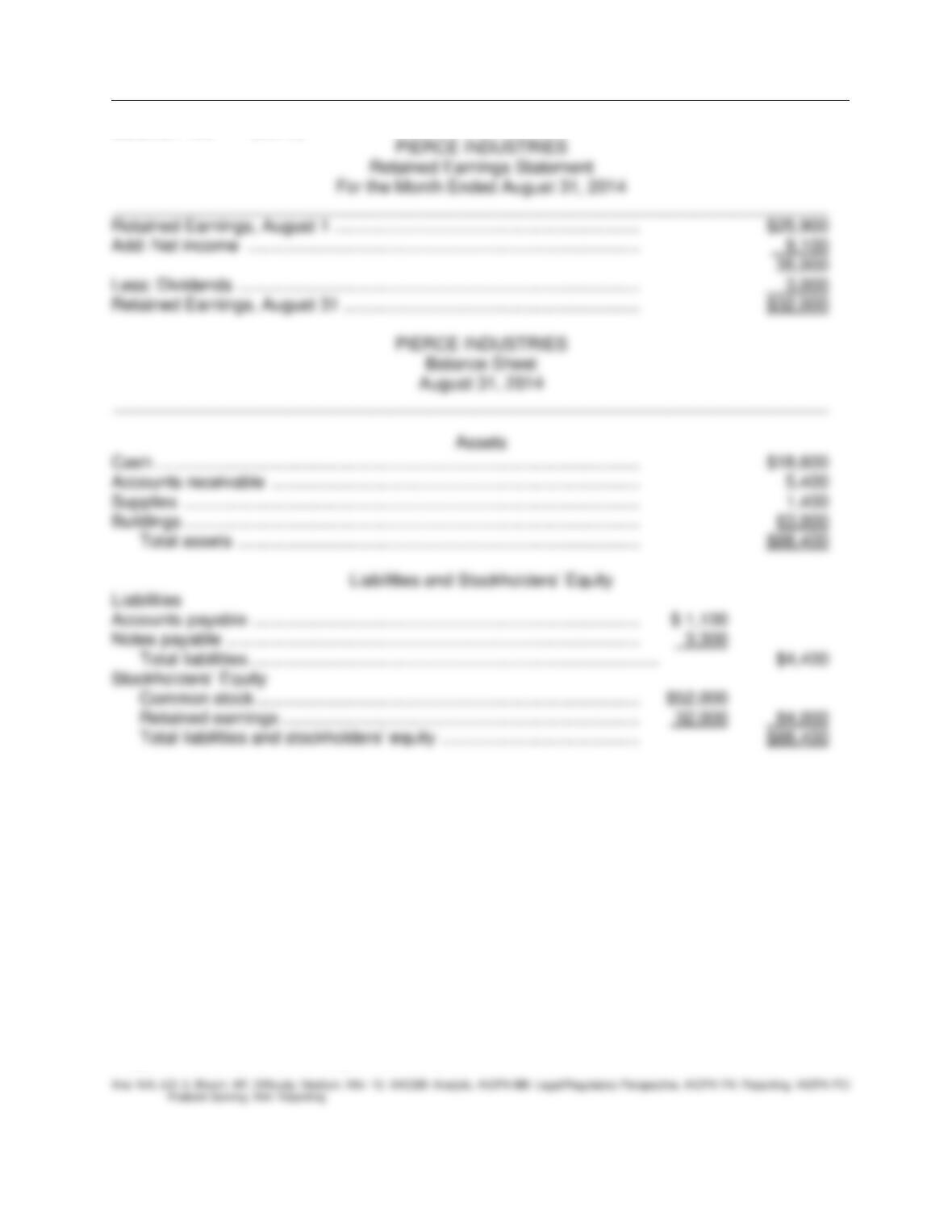
Ex. 193
Use the following accounts and information to prepare, in good form, an income statement and a
retained earnings statement, for the month of August and a balance sheet at August 31, 2014 for
Pierce Industries.
Accounts payable $ 1,100 Dividends $ 3,000
Accounts receivable 5,400 Insurance expense 1,200
Buildings 63,000 Supplies 1,400
Cash 18,600 Notes payable 3,300
Service revenue 25,700 Rent expense 3,400
Common stock 52,000 Salaries and wages expense 12,000
Retained earnings (beginning) 25,900
PIERCE INDUSTRIES
Income Statement
For the Month Ended August 31, 2014
___________________________________________________________________________
Revenues
$
Expenses
$
Total expenses
Net income $ t
PIERCE INDUSTRIES
Retained Earnings Statement
For the Month Ended August 31, 2014
___________________________________________________________________________
Retained Earnings, August 1 $
Add:
Less:
Retained Earnings, August 31 $ t
Test Bank for Financial Accounting: Tools for Business Decision Making, Seventh Edition
FOR INSTRUCTOR USE ONLY
1-48
Ex. 193 (Cont.) PIERCE INDUSTRIES
Balance Sheet
August 31, 2014
___________________________________________________________________________
Assets
$
Total assets
$ t
Liabilities and Stockholders’ Equity
Liabilities
$
$
Stockholders’ Equity
$
Total liabilities and stockholders’ equity $ t
Introduction to Financial Statements
FOR INSTRUCTOR USE ONLY
1-49
Solution 193 (Cont.) PIERCE INDUSTRIES
Ex. 194
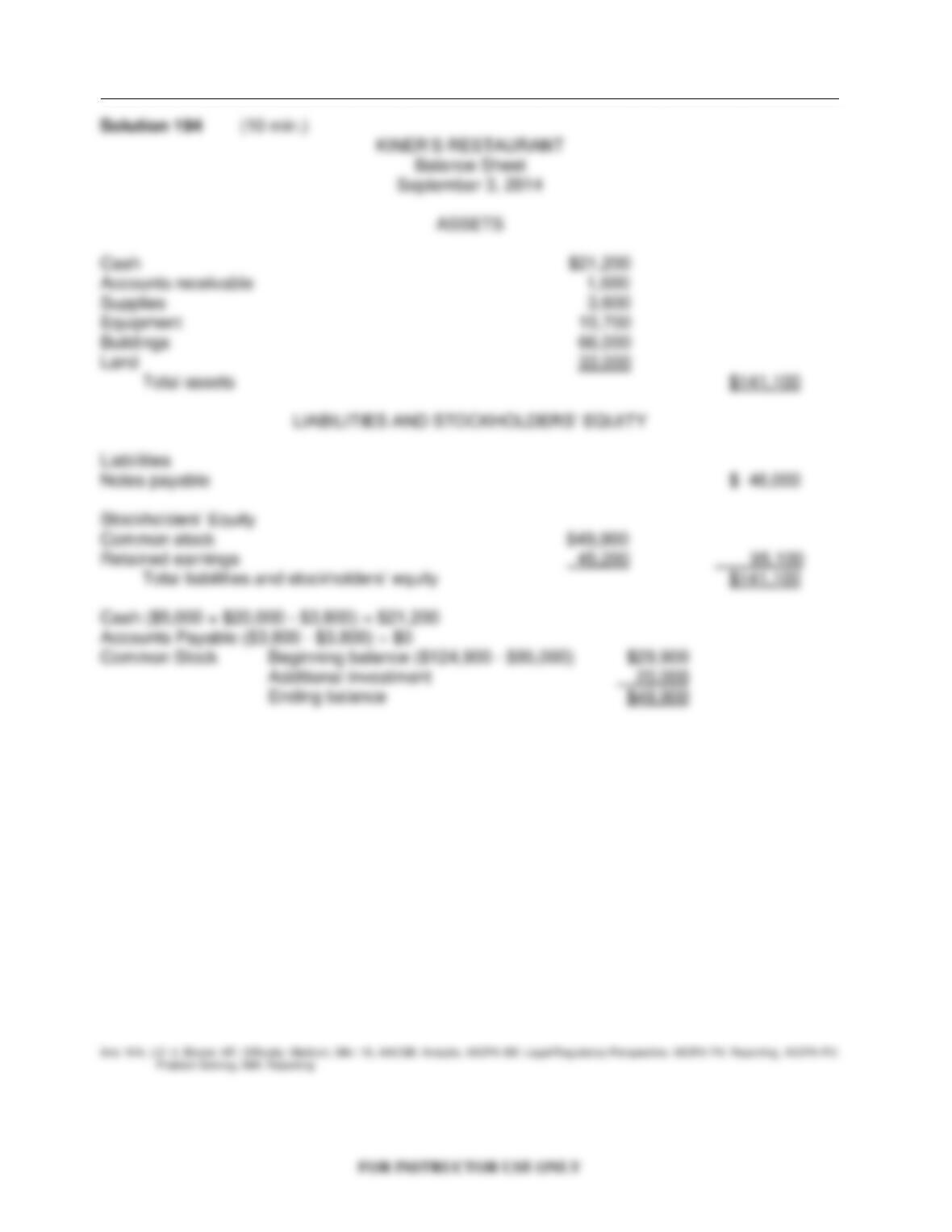
At September 1, the balance sheet accounts for Kiner’s Restaurant were as follows:
Accounts Payable $ 3,800 Land $33,000
Accounts Receivable 1,600 Common Stock ?
Buildings 66,000 Notes Payable 46,000
Cash 5,000 Supplies 3,600
Equipment 15,700 Retained Earnings 45,200
The following transactions occurred during the next two days:
Stockholders invested an additional $20,000 cash in the business. The accounts payable were
paid in full. (No payment was made on the notes payable.)
Instructions
Prepare a balance sheet at September 3, 2014.
Test Bank for Financial Accounting: Tools for Business Decision Making, Seventh Edition
1-50
Ex. 195
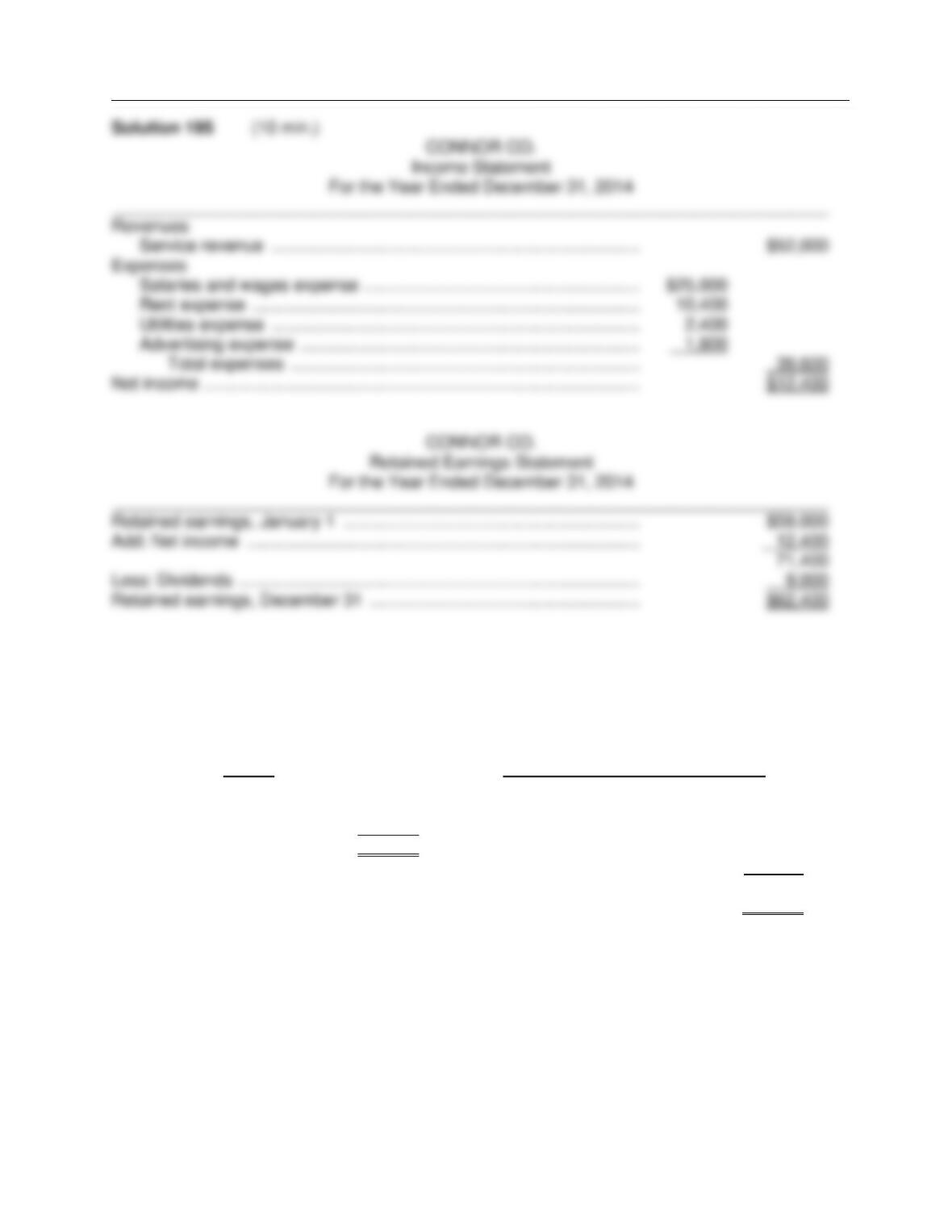
This information relates to Connor Co. for the year 2014.
Retained earnings, January 1, 2014 $59,000
Advertising expense 1,800
Dividends paid during 2014 9,000
Rent expense 10,400
Service revenue 52,000
Utilities expense 2,400
Salaries and wages expense 25,000
Instructions
After analyzing the data, prepare an income statement and a retained earnings statement for the
year ending December 31, 2014.
Introduction to Financial Statements
FOR INSTRUCTOR USE ONLY
1-51
Ex. 196
Here are incomplete financial statements for Brandon, Inc.
BRANDON, INC.
Balance Sheet
Assets Liabilities and Stockholders’ Equity
Cash $ 5,000 Liabilities
Inventory 10,000 Accounts payable $ 5,000
Buildings 40,000 Stockholders’ equity
Total assets $55,000 Common stock (a)
Retained earnings (b)
Total liabilities and
stockholders’ equity $55,000
Test Bank for Financial Accounting: Tools for Business Decision Making, Seventh Edition
FOR INSTRUCTOR USE ONLY
1-52
Ex. 196 (Cont.)
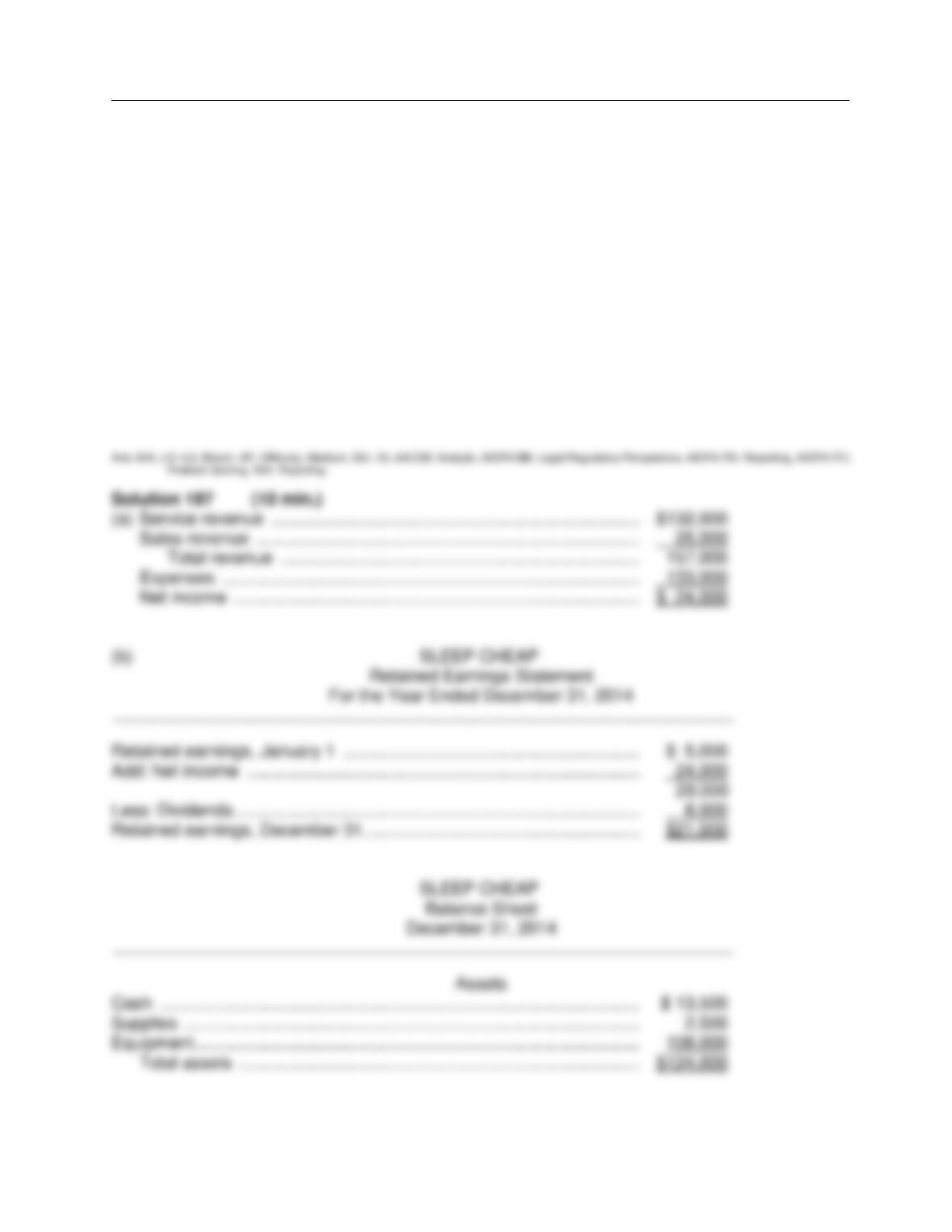
Income Statement
Revenues $80,000
Cost of goods sold (c)
Administrative expenses 10,000
Net income $ (d)
Retained Earnings Statement
Beginning retained earnings $10,000
Net income (e)
Dividends 5,000
Ending retained earnings $24,000
Instructions
Calculate the missing amounts.
Introduction to Financial Statements
FOR INSTRUCTOR USE ONLY
1-53
Ex. 197
Sleep Cheap is a private camping ground near the Boulder Peak Recreation Area. It has
compiled the following financial information as of December 31, 2014.
Services revenues (from camping fees) $132,000 Dividends $ 8,000
Sales revenues (from general store) 25,000 Notes payable 50,000
Accounts payable 13,000 Administrative expenses 133,000
Cash 13,500 Supplies 2,500
Equipment 108,000 Common stock 40,000
Retained earnings (1/1/2014) 5,000
Instructions
(a) Determine net income from Sleep Cheap for 2014.
(b) Prepare a retained earnings statement and a balance sheet for Sleep Cheap as of
December 31, 2014.
Test Bank for Financial Accounting: Tools for Business Decision Making, Seventh Edition
FOR INSTRUCTOR USE ONLY
1-54
Ex. 198
John Tate is the bookkeeper for Gabelli Company. John has been trying to get the balance sheet
of Gabelli Company to balance. It finally balanced, but now he’s not sure it is correct.
GABELLI COMPANY
Balance Sheet
December 31, 2014
Assets Liabilities and Stockholders’ Equity
Cash $12,500 Accounts payable $18,000
Supplies 9,500 Accounts receivable (12,000)
Equipment 50,000 Common stock 40,000
Dividends 13,000 Retained earnings 39,000
Total assets $85,000 Total liabilities and
stockholders’ equity $85,000
Instructions
Prepare a correct balance sheet.
Introduction to Financial Statements
FOR INSTRUCTOR USE ONLY
1-55
Ex. 199
The summaries of data from the balance sheet, income statement, and retained earnings
statement for two corporations, Bates Corporation and Wilson Enterprises, are presented below
for 2014.
Bates Corporation Wilson Enterprises
Beginning of year
Total assets $110,000 $130,000
Total liabilities 80,000 (d)
Total stockholders‘ equity (a) 70,000
End of year
Total assets (b) 190,000
Total liabilities 120,000 65,000
Total stockholders‘ equity 70,000 (e)
Changes during year in retained
earnings
Dividends (c) 5,000
Total revenues 225,000 (f)
Total expenses 165,000 80,000
Instructions
Determine the missing amounts. Assume all changes in stockholders’ equity are due to changes
in retained earnings.
Test Bank for Financial Accounting: Tools for Business Decision Making, Seventh Edition
FOR INSTRUCTOR USE ONLY
1-56
Ex. 200
This information is for Campo Corporation for the year ended December 31, 2014.
Cash received from lenders $20,000
Cash received from customers 65,000
Cash paid for new equipment 30,000
Cash dividends paid 9,000
Cash paid to suppliers 28,000
Cash balance 1/1/14 12,000
Instructions
Prepare the 2014 statement of cash flows for Campo Corporation.
Introduction to Financial Statements
FOR INSTRUCTOR USE ONLY
1-57
Ex. 201
One item is omitted in each of the following summaries of balance sheet and income statement
data for three different corporations, A, B, and C.
Determine the amounts of the missing items, identifying each corporation by letter.
Corporation
A B C
Beginning of the Year:
Assets $410,000 $150,000 $199,000
Liabilities 250,000 115,000 166,000
End of the Year:
Assets 460,000 195,000 205,000
Liabilities 280,000 95,000 169,000
During the Year:
Additional Investment by stockholders ? 79,000 78,000
Dividends 70,000 83,000 ?
Revenue 195,000 ? 187,000
Expenses 155,000 113,000 183,000
Test Bank for Financial Accounting: Tools for Business Decision Making, Seventh Edition
1-58
COMPLETION STATEMENTS
202. A business organized as a separate legal entity owned by stockholders is a ___________.
203. _______________ of accounting information are managers who plan, organize, and run a
business.
204. _________________ activities involve collecting the necessary funds to start the business.
205. The ________________ reports the assets, liabilities, and stockholders’ equity of a
business at a specific date.
206. The claims of owners on the assets of a corporation are known as ________________.
Introduction to Financial Statements
1-59
207. The basic accounting equation is Assets = ____________ + _______________.
208. The primary purpose of a ________________ is to provide financial information about the
cash receipts and cash payments of a business.
209. The _________________ is prepared by an independent auditor stating the auditor’s
opinion as to the fairness of the presentation of the financial statements.
Answers to Completion Statements
MATCHING
210. Match the items below by entering the appropriate code letter in the space provided.
A. Internal users F. Corporation
B. Management discussion and analysis G. Assets
C. Annual report H. Liabilities
D. Sole proprietorship I. Expenses
E. Dividends J. Investing activities
____ 1. Distributions of cash from a corporation to its stock holders.
____ 2. Consumed assets or services.
____ 3. Ownership is limited to one person.
____ 4. Officers and others who manage the business.
____ 5. Creditor claims against the assets of the business.
____ 6. A separate legal entity under state laws.
____ 7. A report prepared by management that presents financial information.
____ 8. A section of the annual report that presents management’s views.
____ 9. Future economic benefits.
____ 10. Involves acquiring the resources necessary to run the business.
Test Bank for Financial Accounting: Tools for Business Decision Making, Seventh Edition
FOR INSTRUCTOR USE ONLY
1-60
Answers to Matching
SHORT-ANSWER ESSAY QUESTIONS
S-A E 211
What are the advantages to a business of being formed as a corporation? What are the
disadvantages?
S-A E 212
Why would it be safer for a wealthy individual to set up his or her business as a corporation rather
than as a proprietorship or partnership?
S-A E 213
Your friend, James, made this comment: “My major is biology and I plan to research for cures for
major illnesses. Therefore, I have no need to study accounting.” What is your response to
James?
Introduction to Financial Statements
FOR INSTRUCTOR USE ONLY
1-61
S-A E 214
The information needs of a specific user of financial accounting information depends upon the
kinds of decisions that user makes. Identify the major users of accounting information and
discuss what questions financial accounting information answers for each group of users.
Financial accounting information may answer the following questions for internal users:
1. Is cash sufficient to pay our debts?
2. Can we afford to give employee pay raises this year?
3. What is the cost of manufacturing each unit of product?
4. Which product line is the most profitable?
Questions answered by financial accounting information for external users include:
1. Is the company earning satisfactory income?
2. How does the company compare in size and profitability with competitors?
3. Will the company be able to pay its debts as they come due?
Test Bank for Financial Accounting: Tools for Business Decision Making, Seventh Edition
FOR INSTRUCTOR USE ONLY
1-62
S-A E 215
The statement of cash flows for Nyland Corporation reveals the following information:
Net cash used by operating activities ($150,000)
Net cash used by investing activities ($200,000)
Net cash provided by financing activities
Issuance of common stock $100,000
Issued note payable 250,000 $350,000
Net change in cash 0
Provide three comments about this information. Make your comments concise yet thorough.
S-A E 216
How are each of the following financial statements interrelated? (a) Retained earnings statement
and income statement. (b) Retained earnings statement and balance sheet. (c) Balance sheet
and statement of cash flows.
Introduction to Financial Statements
FOR INSTRUCTOR USE ONLY
1-63
S-A E 217
Broadway Corporation’s stockholders’ equity equals one–fourth of the company’s total assets.
The company’s liabilities are $270,000. What is the amount of the company’s stockholders’
equity?
S-A E 218
Which three items affect retained earnings, and how do they affect it?
S-A E 219
The framework used to record and summarize the economic activities of a business enterprise is
referred to as the accounting equation. State the basic accounting equation and define its major
components. How are financial statements related to the accounting equation?
S-A E 220
What types of information are presented in the notes to the financial statements?
Test Bank for Financial Accounting: Tools for Business Decision Making, Seventh Edition
1-64
S-A E 221 (Ethics)
Joe Laramie owns and operates Joe’s Burgers, a small fast food store, located at the edge of City
College campus in Newton, Ohio. After several very profitable years, Joe’s Burgers began to
have problems. Most of the problems were related to Joe’s expansion of the eating area in the
restaurant without corresponding increases in the food preparation area. Joe does not have the
cash or financial backing to expand further. He has therefore decided to sell his business.
William Sheets is interested in purchasing the business. However, he is located in another city
and is unfamiliar with Newton. He has asked Joe why he is selling Joe’s Burgers. Joe replies that
his elderly mother requires extra care, and that his brother needs help in his manufacturing
business. Both are true, but neither is his primary reason for selling. Joe reasons that William
should not have asked him anyway, since profitable businesses don‘t come up for sale.
Required:
1. Identify the stakeholders in this situation.
2. Did Joe act ethically in not revealing fully his reasons for selling the business? Why or why
not?
S-A E 222 (Communication)
Mary Baroni is a friend of yours from high school. She decided to become a beautician after
leaving high school, rather than to attend college. She recently opened her own shop, and has
contracted her services to a local hospital. She is paid a monthly fee for her services, and
receives a small gratuity from each of the patients.
She has just received her first set of financial statements from her accountant. She is quite upset.
The statements show a cash balance of $3,600 at the end of the month, but a net income of only
$500. She has written you a letter, asking you whether such a situation is possible, or whether
she should find another accountant.
Required:
Write a short letter to your friend. Use proper form. Answer her question completely, but briefly.
Introduction to Financial Statements
FOR INSTRUCTOR USE ONLY
1-65
Solution 222
Test Bank for Financial Accounting: Tools for Business Decision Making, Seventh Edition
1-66
IFRS Questions
1. Which of the following is not a reason one set of international accounting standards are
needed?
a. Multinational corporation.
b. Financial markets.
c. Information technology.
d. All of these answer choices are reasons one set of international accounting standards
are needed.
2. International standards are referred to as
a. IFRS.
b. GAAP.
c. IASB.
d. FASB.
3. U.S. standards are referred to as
a. IFRS.
b. GAAP.
c. IASB.
d. FASB.
4. International standards are developed by the
a. IFRS.
b. GAAP.
c. IASB.
d. FASB.
5. U.S. standards are developed by the
a. IFRS.
b. GAAP.
c. IASB.
d. FASB.
6. The United States and the international standard-setting environment are primarily driven
by meeting the needs of
a. investors and creditors.
b. tax authorities.
c. central government planners.
d. academic researchers.
Introduction to Financial Statements
1-67
7. The internal control standards applicable to Sarbanes-Oxley apply to?
a. all U.S.and international companies.
b. U.S. and international companies listed on U.S. exchange.
c. International companies listed on U.S. exchange.
d. U.S. companies listed on U.S. exchange.
8. The concern about international companies adopting SOX-type standards centers on
a. cost-benefit analysis.
b. ethics issues.
c. the governing authorities.
d. comparability.
9. Financial accounting ethics violations are
a. not a problem in the U.S or internationally.
b. much more common in the U.S than internationally.
c. much more common internationally than in the U.S.
d. a major problem both in the U.S and internationally.
10. IFRS, compared to GAAP, tends to be more
a. detailed.
b. rules-based.
c. principles-based.
d. full of disclosure requirements.
11. GAAP, compared to IFRS, tends to be more
a. simple in accounting requirements.
b. rules-based.
c. principles-based.
d. simple in disclosure requirements.
12. The conceptual framework that underlines IFRS
a. is very similar to that used to develop GAAP.
b. does not define assets or liabilities.
c. does not define equity.
d. does not define income or expenses.