Chapter 1: Introduction to Accounting and Business
119.
Liabilities are reported on the
a.
income statement
b.
statement of owner’s equity
c.
statement of cash flows
d.
balance sheet
120.
Cash investments made by the owner to the business are reported on the statement of cash flows in the
a.
financing activities section
b.
investing activities section
c.
operating activities section
d.
supplemental statement
121.
The year-end balance of the owner’s capital account appears in
a.
both the statement of owner’s equity and the income statement
b.
only the statement of owner’s equity
c.
both the statement of owner’s equity and the balance sheet
d.
both the statement of owner’s equity and the statement of cash flows
Chapter 1: Introduction to Accounting and Business
122.
A financial statement user would determine if a company was profitable or not during a specific period of time
by
reviewing the
a.
income statement
b.
balance sheet
c.
statement of cash flows
d.
statement of retained earnings
123.
If an owner wanted to know how money flowed into and out of the company, which financial statement would
the
owner use?
a.
income statement
b.
statement of cash flows
c.
balance sheet
d.
statement of retained earnings
124.
The assets section of the balance sheet normally presents assets in
a.
alphabetical order
b.
the order of largest to smallest dollar amounts
c.
the order in which they will be converted into cash or used in operations
d.
the order of smallest to largest dollar amounts
Chapter 1: Introduction to Accounting and Business
125.
All of the following statements regarding the ratio of liabilities to owner’s equity are true except
a.
A ratio of 1 indicates that liabilities equal owner’s equity.
b.
Corporations can use this ratio but substitute total stockholders’ equity for total owner’s equity.
c.
The higher this ratio, the better able a business is to withstand poor business conditions and pay creditors.
d.
The lower this ratio, the better able a business is to withstand poor business conditions and pay creditors.
126.
Given the following data:
Dec. 31, Year 2 Dec. 31, Year 1
Total liabilities $128,250 $120,000
Total owner’s equity 95,000 80,000
Compute the ratio of liabilities to owner’s equity for each year. Round to two decimal places.
a.
1.50 and 1.07, respectively b. 1.35 and 1.50, respectively
c. 1.07 and 1.19, respectively d. 1.19 and 1.35, respectively
Chapter 1: Introduction to Accounting and Business
127.
Discuss internal and external users of accounting information. What areas of accounting provide them
with
information? Give an example of the type of report each type of user might use.
128.
Companies like Enron, WorldCom, and Tyco International, Ltd. have been caught in the midst of ethical lapses
that
led to fines, firings, and criminal and/or civil prosecution. List and briefly describe three factors that are
responsible
for what went wrong in these companies.
Chapter 1: Introduction to Accounting and Business
129.
List the five steps in the process by which accounting provides information to users.
130.
For each of the following companies, identify whether they are a service, merchandising, or
manufacturing
business.
A.
Dillard’s
B.
Time Warner Cable
C.
General Motors
D.
Blockbuster
E.
Applebee’s
F.
Sony
G.
Best Buy
H.
Banana Republic
I.
H&R Block
Merchandising
Service
Manufacturing
Service
Service / Manufacturing
Manufacturing
Merchandising
Merchandising
Service
Chapter 1: Introduction to Accounting and Business
131.
Identify each of the following as either internal or external users of accounting information.
A.
Payroll Manager
B.
Bank
C.
President’s Secretary
D.
Internal Revenue Service
E.
Raw Material Vendors
F.
Social Security Administration
G.
Health Insurance Provider
H.
Managerial Accountant
A.
Internal
External
Internal
External
External
External
External
Internal
132.
What is the major difference between the objective of financial accounting and the objective of
managerial
accounting?
Chapter 1: Introduction to Accounting and Business
133.
Give the major disadvantage of disregarding the cost concept and constantly revaluing assets based on
appraisals
and opinions.
134.
On May 7, Carpet Barn Company offered to pay $83,000 for land that had a selling price of $105,000. On May
15,
Carpet Barn accepted a counteroffer of $95,000. On June 5, the land was assessed at a value of $115,000 for
property tax purposes. On December 10, Carpet Barn Company was offered $135,000 for the land by another
company. At what value should the land be recorded in Carpet Barn Company’s records?
135.
Donner Company is selling a piece of land adjacent to its business. An appraisal reported the market value of the
land to be $120,000. The Focus Company initially offered to buy the land for $107,000. The companies settled on
a
purchase price of $115,000. On the same day, another piece of land on the same block sold for $122,000. Under
the cost concept, what is the amount that will be used to record this transaction in the accounting records?
136.
Explain the meaning of the business entity concept.
Chapter 1: Introduction to Accounting and Business
137.
Darnell Company purchased $88,000 of computer equipment from Joseph Company. Darnell Company paid for
the
equipment using cash that had been obtained from the initial investment by Donnie Darnell.
Which entity or entities (Darnell Company, Joseph Company, Donnie Darnell) should record the transaction
involving the computer equipment on their accounting records?
138.
Bob Johnson is the sole owner of Johnson’s Carpet Cleaning Service. Bob purchased a personal automobile
for $10,000 cash plus he took out a loan for $20,000 in his name. Describe how this transaction is related to the
business entity concept.
139.
Discuss the characteristics of a limited liability company (LLC).
Chapter 1: Introduction to Accounting and Business
140.
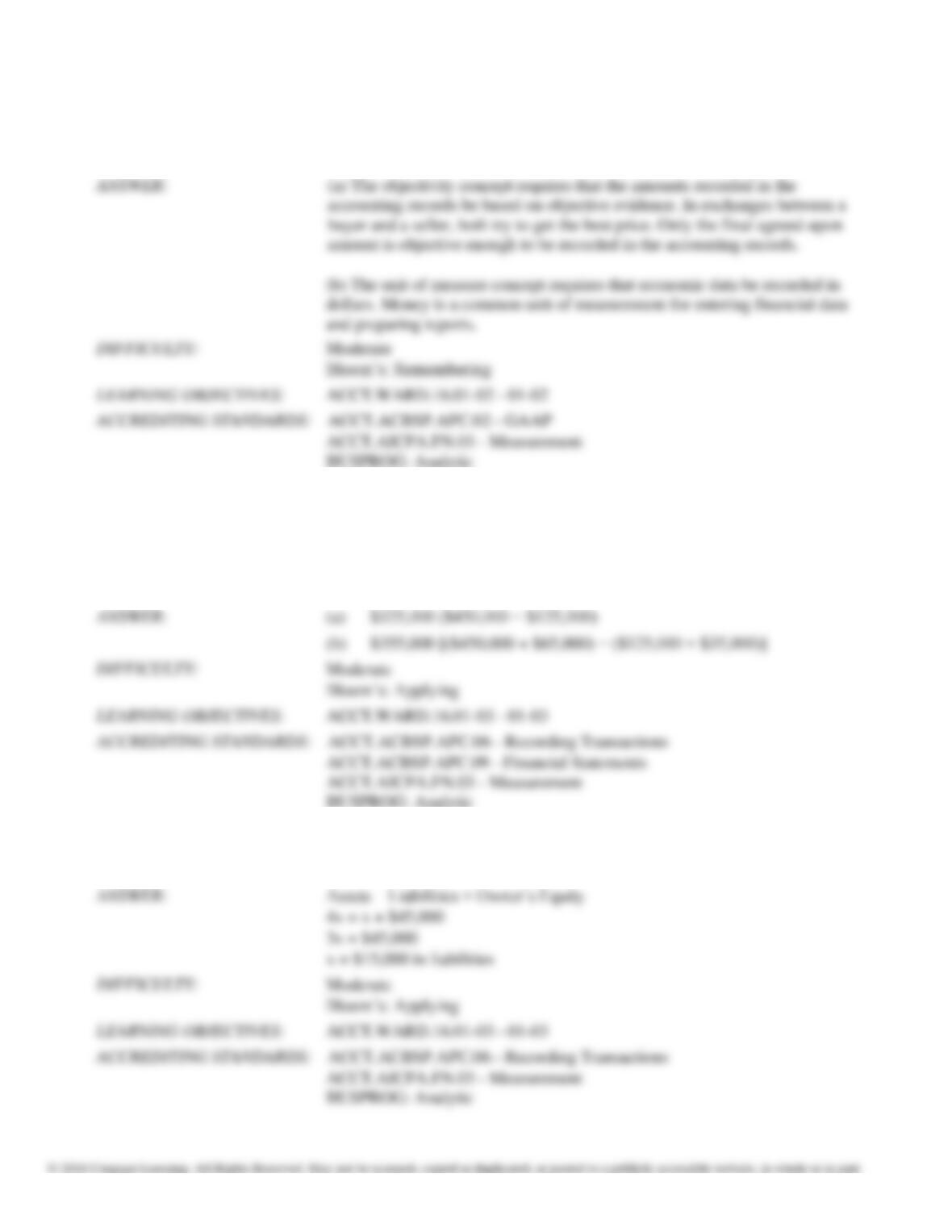
Explain the meaning of:
(a)
the objectivity concept
(b)
the unit of measure concept
141.
Dave Ryan is the owner and operator of Ryan’s Arcade. At the end of its accounting period, December 31, Ryan’s
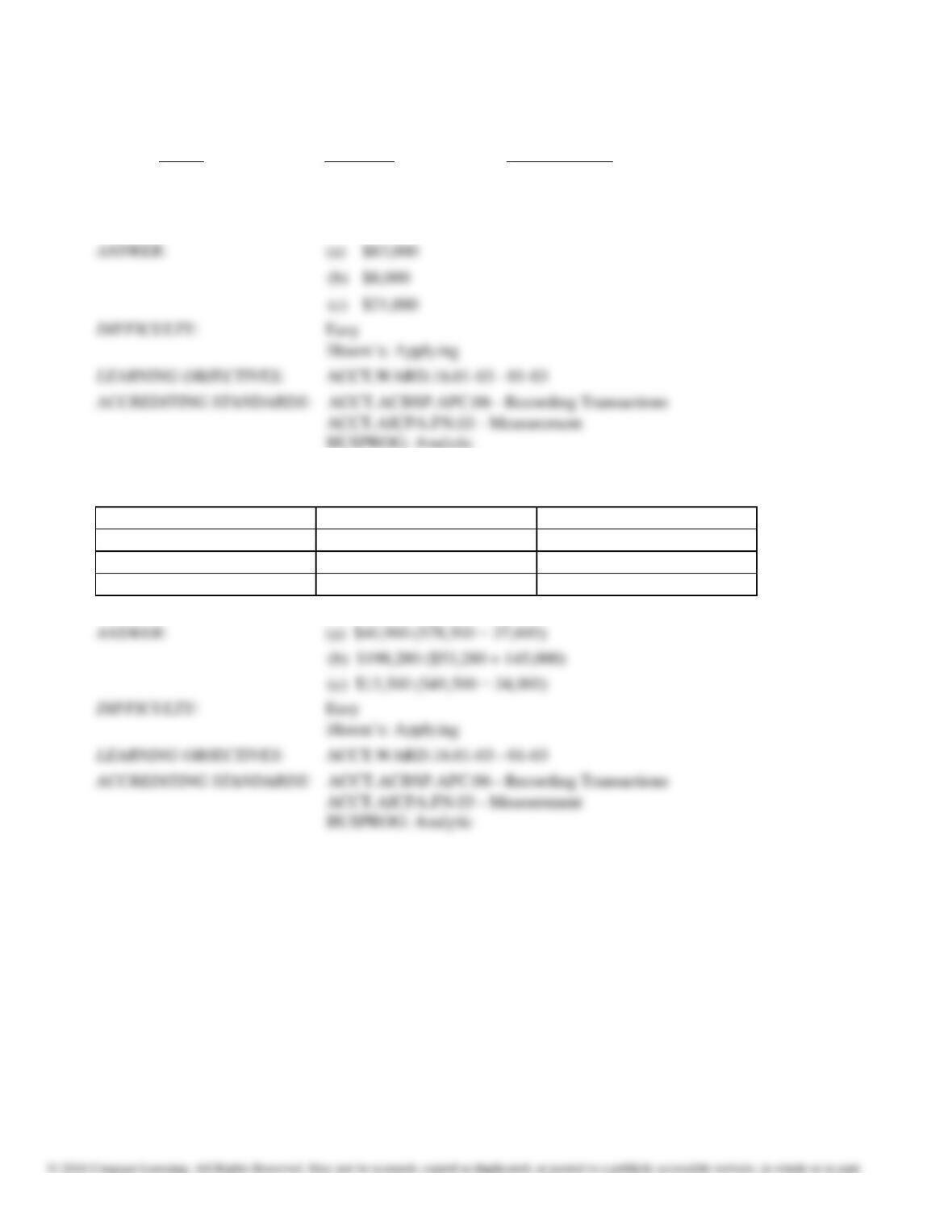
$450,000 and liabilities of $125,000. Using the accounting equation, determine the following amounts:
(a)
owner’s equity as of December 31 of the current year
(b)
owner’s equity as of December 31 at the end of the next year, assuming that assets increased by $65,000
and liabilities increased by $35,000 during the year
142.
Krammer Company has liabilities equal to one fourth of the total assets. Krammer’s owner’s equity is $45,000.
Using the accounting equation, what is the amount of liabilities for Krammer?
Chapter 1: Introduction to Accounting and Business
143.
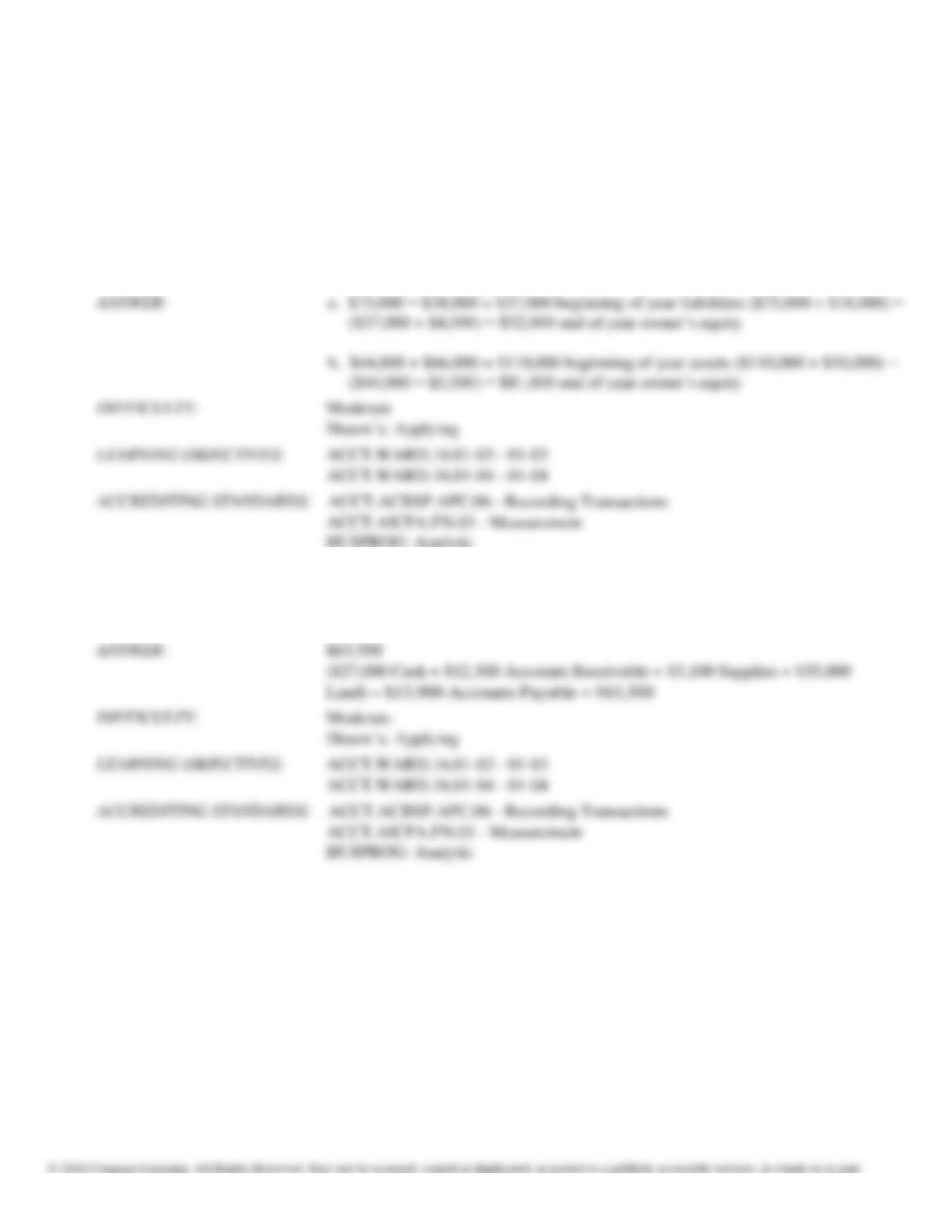
Determine the missing amount for each of the following:
Assets
Liabilities
Owner’s Equity
(a)
$38,000
$45,000
$30,000
(b)
$22,000
$53,000
$32,000
(c)
144.
Determine the missing amount “X” for each of the following:
Assets
Liabilities
Owner’s Equity
(a) $78,500
$37,600
X
(b) X
$53,280
$145,000
(c) $49,500
X
$34,000
Chapter 1: Introduction to Accounting and Business
145.
Use the accounting equation to answer each of the independent questions below.
a.
At the beginning of the year, Norton Company’s assets were $75,000 and its owner’s equity was $38,000. During
the year, assets increased by $18,000 and liabilities increased by $4,000. What was the owner’s equity at the end
of the year?
b.
At the beginning of the year, Turpin Industries had liabilities of $44,000 and owner’s equity of $66,000. If
assets
increased by $10,000 and liabilities decreased by $5,000, what was the owner’s equity at the end of the
year?
146.
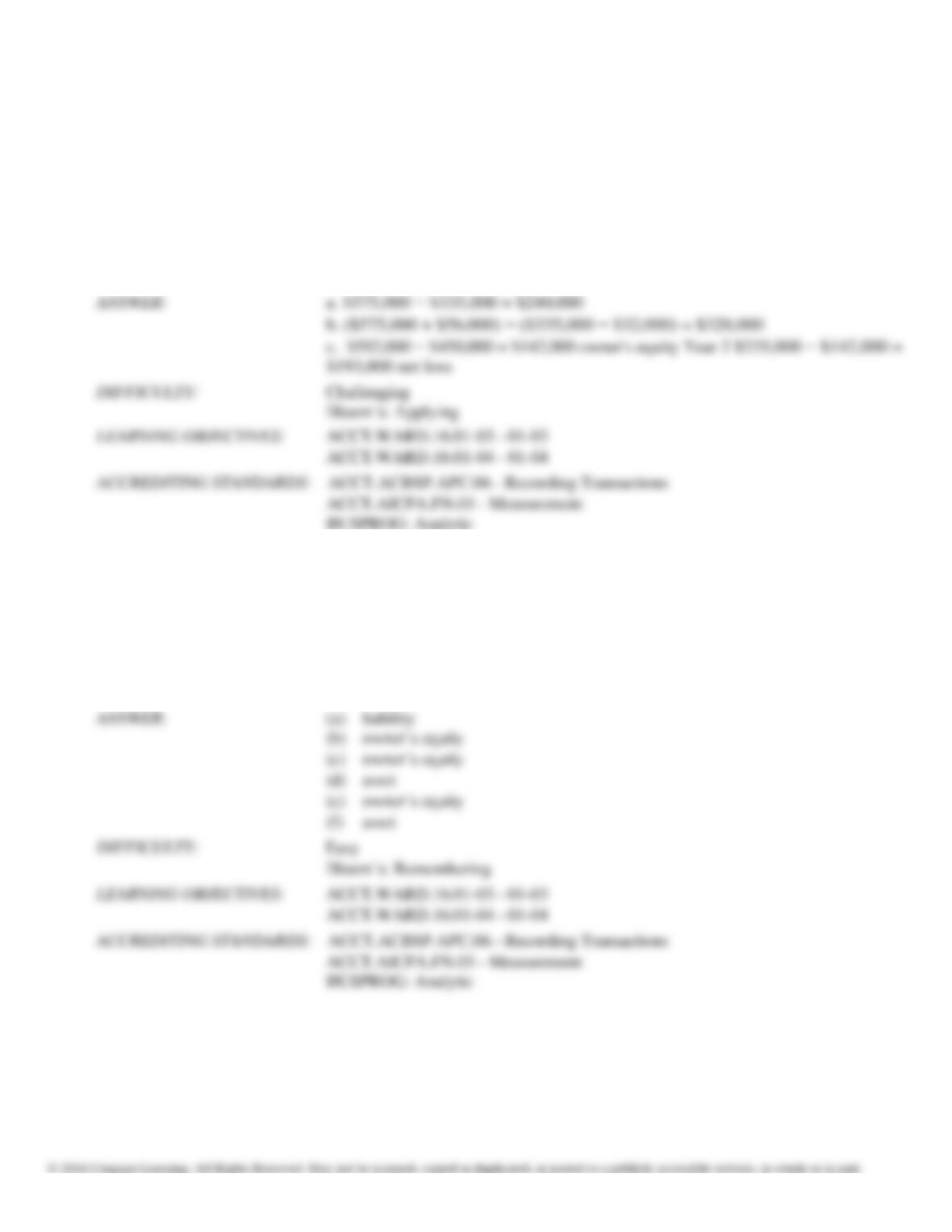
On July 1 of the current year, the assets and liabilities of John Wong, DVM, are as follows: Cash, $27,000;
Accounts Receivable, $12,300; Supplies, $3,100; Land, $35,000; Accounts Payable, $13,900. What is the amount
of
owner’s equity (John Wong’s capital) as of July 1 of the current year?
Chapter 1: Introduction to Accounting and Business
147.
Ting Hsu is the owner of Hsu’s Financial Services. At the end of its accounting period, December 31, of Year 1,
Hsu’s has assets of $575,000 and owner’s equity of $335,000. Using the accounting equation and considering
each
case independently, determine the following amounts.
a.
Hsu’s liabilities as of December 31 of Year 1.
b.
Hsu’s liabilities as of December 31 of Year 2, assuming that assets increased by $56,000 and
owner’s equity decreased by $32,000.
c. Net income or net loss during Year 2, assuming that as of December 31, Year 2, assets were $592,000,
liabilities were $450,000, and there were no additional investments or withdrawals.
148.
Indicate whether each of the following represents an asset, liability, or owner’s equity:
(a)
accounts payable
(b)
wages expense
(c)
capital
(d)
accounts receivable
(e)
withdrawal
(f)
land
Chapter 1: Introduction to Accounting and Business
149.
Martin Blair is the owner and operator of Martin Consultants. At December 31 of the current year, Martin
Consultants has assets of $430,000 and liabilities of $205,000. Using the accounting equation and considering
each
case independently, determine the following:
a.
Martin Blair, capital, as of December 31.
b.
Martin Blair, capital, as of December 31 of the next year, assuming that assets increased by
$12,000
and liabilities increased by $15,000.
c.
Martin Blair, capital, as of December 31 of the next year, assuming that assets decreased by $8,000
and liabilities increased by $14,000.
The accountant for Scott Industries prepared the following list of account balances from the company’s records for
the year ended December 31:
Fees Earned
$165,000
Cash
$30,000
Accounts Receivable
14,000
Selling Expenses
44,000
Equipment
64,000
Franklin, Capital
27,000
Accounts Payable
12,000
Interest Income
3,000
Salaries & Wages Expense
40,000
Prepaid Rent
2,000
Income Taxes Payable
5,000
Income Taxes Expense
18,000
Notes Payable
20,000
Rent Expense
20,000
150.
Determine the total assets at the end of the current year for Scott Industries.
Chapter 1: Introduction to Accounting and Business
151.
Determine the total liabilities at the end of the current year for Scott Industries.
152.
Based on this information, is Scott Industries profitable? Explain your answer.
Chapter 1: Introduction to Accounting and Business
153.
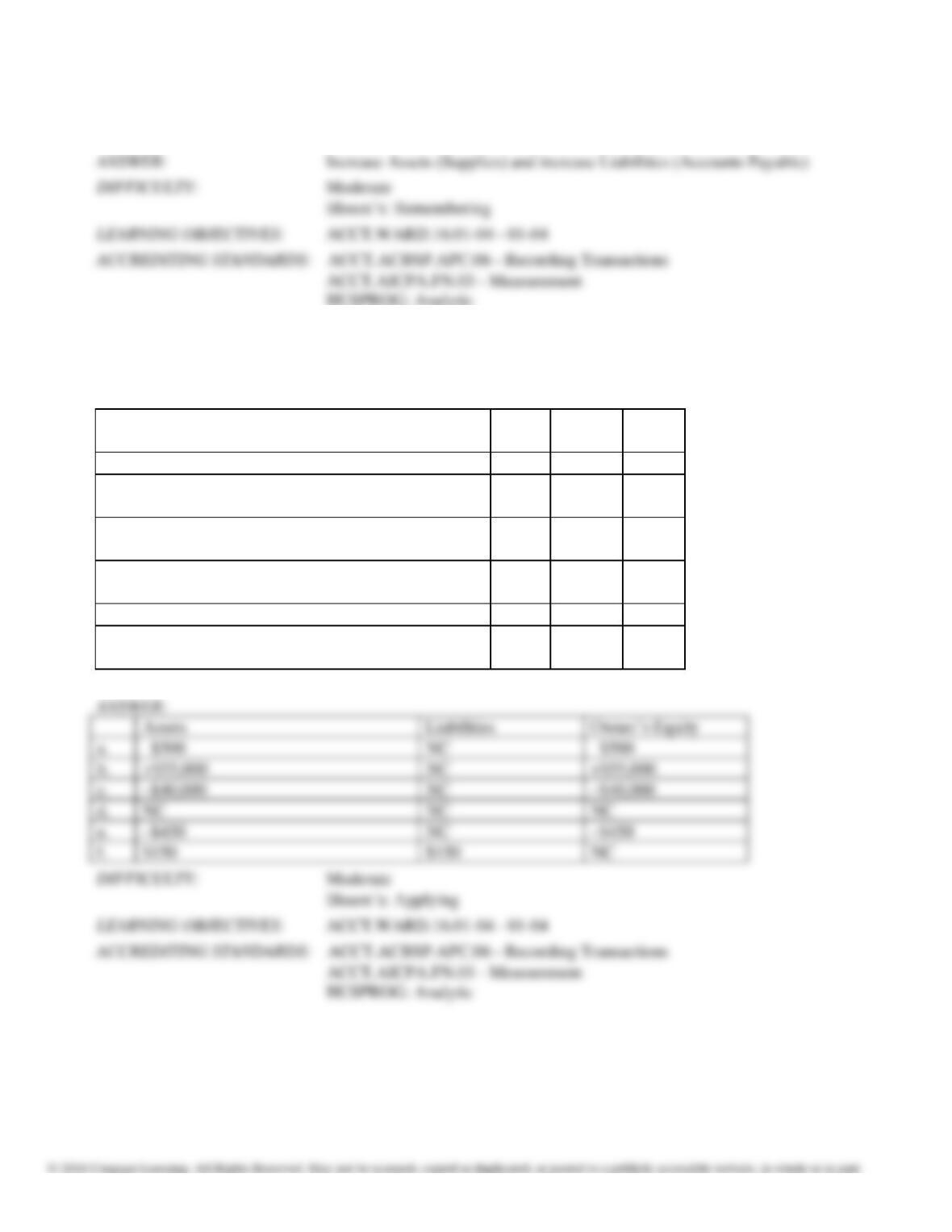
Daniels Company is owned and operated by Thomas Daniels. The following selected transactions were
completed
by Daniels Company during May:
1.
Received cash from owner as additional investment, $55,000.
2.
Paid creditors on account, $7,000.
3.
Billed customers for services on account, $2,565.
4.
Received cash from customers on account, $8,450.
5.
Paid cash to owner for personal use, $2,500.
6.
Received the utility bill, $160, to be paid next month.
Indicate the effect of each transaction on the accounting equation by:
1)
Account type (A)assets, (L)liabilities, (OE)owner’s equity, (R)revenue, and (E)expense
2)
Name of account
3)
The amount by of the transaction
4)
The direction of change (increase or decrease) in the account affected
Note: Each transaction has two entries.
Entry
Entry
Account
Type
Name of
Account
Amount
Increase or
Decrease
Account
Type
Name of
Account
Amount
Increase or
Decrease
(1)
(2)
(3)
(4)
(1)
(2)
(3)
(4)
1
2
3
4
5
6
Chapter 1: Introduction to Accounting and Business
154.
Collins Landscape Company purchased various landscaping supplies on account to be used for landscape
designs
for its customers. How will this business transaction affect the accounting equation?
155.
Shiny Kar Company had the following transactions. For each transaction, show the effect on the accounting
equation by putting the amount and direction (plus, minus, or NC for no change) in each box of the table
below.
Assets
Liabilities
Owner’s
Equity
a. Shiny Kar withdrew $500 cash for food.
b. Shiny Kar Company sold 2 cars for a total of
$55,000
on account.
c. The cost of the cars sold in (b) above was
$40,000.
d. Shiny Kar received $35,000 payment for a car
previously sold on account.
e. Shiny Kar paid $450 for advertising.
f. Shiny Kar purchased $150 of cleaning supplies
on
account.
Chapter 1: Introduction to Accounting and Business
156.
Ramierez Company received its first electric bill in the amount of $60 which will be paid next month. How will
this
transaction affect the accounting equation?
157.
Simpson Auto Body Repair purchased $20,000 of machinery. The company paid $8,000 in cash at the time of
the
purchase and signed a promissory note for the remainder to be paid in four monthly installments.
(a)
How will the purchase affect the accounting equation?
(b)
How will the payment of the first monthly installment affect the accounting equation (ignore interest)?
158.
Indicate how the following transactions affect the accounting equation.
(a)
The purchase of supplies on account.
(b)
The purchase of supplies for cash.
(c)
A withdrawal by the owner to pay personal expenses.
(d)
Revenues received in cash.
(e)
Sale made on account.
Chapter 1: Introduction to Accounting and Business
159.
a. A vacant lot acquired for $83,000 cash is sold for $127,000 in cash. What is the effect of the sale on the total
amount of the seller’s (1) assets, (2) liabilities, and (3) owner’s equity?
b.
Assume that the seller owes $52,000 on a loan for the land. After receiving the $127,000 cash in (a), the
seller pays the $52,000 owed. What is the effect of the payment on the total amount of the seller’s (1) assets,
liabilities, and (3) owner’s equity?
160.
The Austin Land Company sold land for $85,000 in cash. The land was originally purchased for $65,000. At
the
time of the sale, $40,000 was still owed to Regions Bank. After the sale, The Austin Land Company paid
off the
loan. Explain the effect of the sale and the payoff of the loan on the accounting equation.
Chapter 1: Introduction to Accounting and Business
161.
There are four transactions that affect owner’s equity.
(a)
What are the two types of transactions that increase owner’s equity?
(b)
What are the two types of transactions that decrease owner’s equity?
162.
Identify each of the following as an (1) increase to owner’s equity, or a (2) decrease to owner’s equity.
(a)
Fees Earned
(b)
Wages Expense
(c)
Withdrawal
(d)
Lawn Care Revenue
(e)
Investment
(f)
Supplies Expense
Chapter 1: Introduction to Accounting and Business
163.
Given the following:
Beginning capital
$58,000
Ending capital
$30,000
Owner’s withdrawals
$25,000
Calculate net income or net loss.