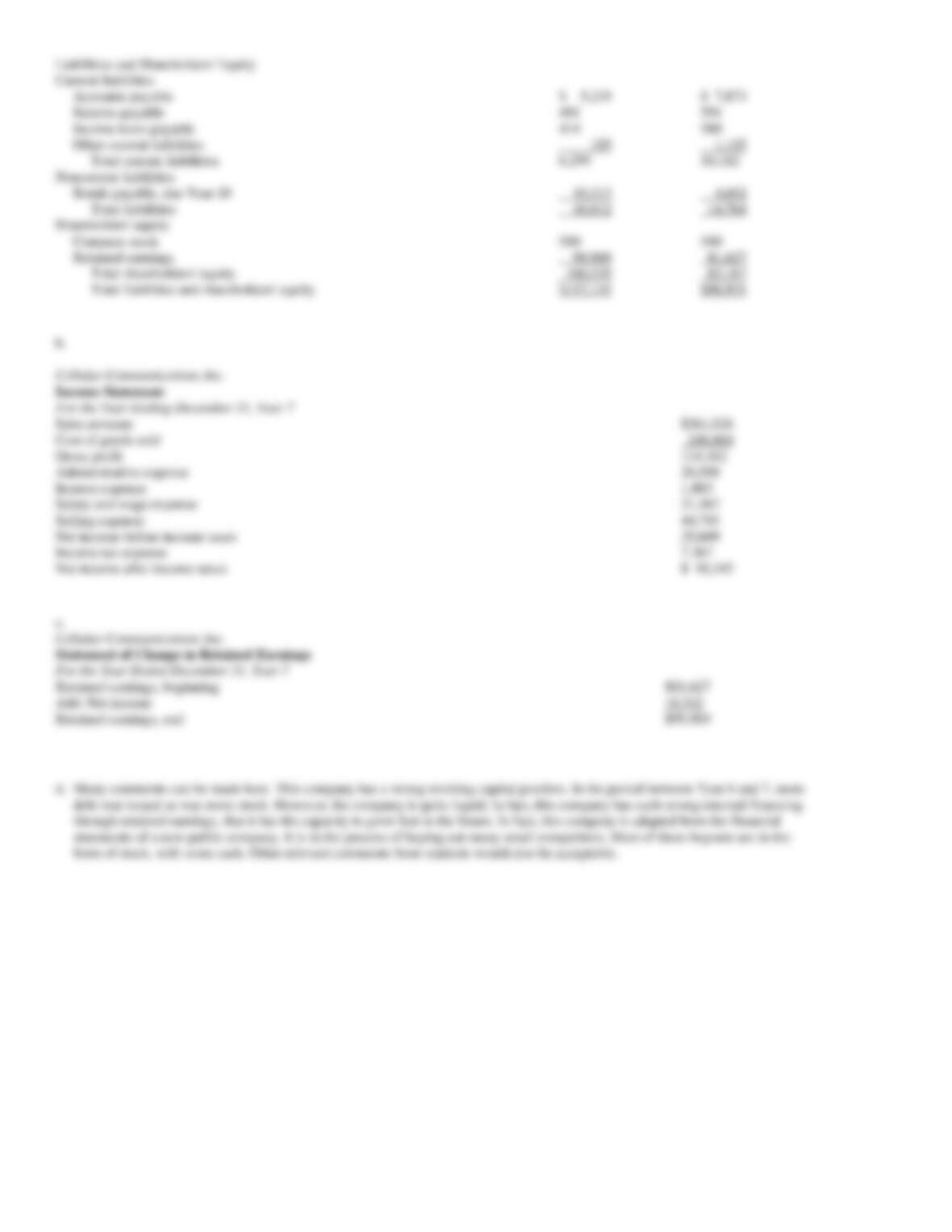
120. Presented below are several statement regarding the roles of participants in the financial reporting process.
Identify these as either true or false. If false, explain why the statement is false.
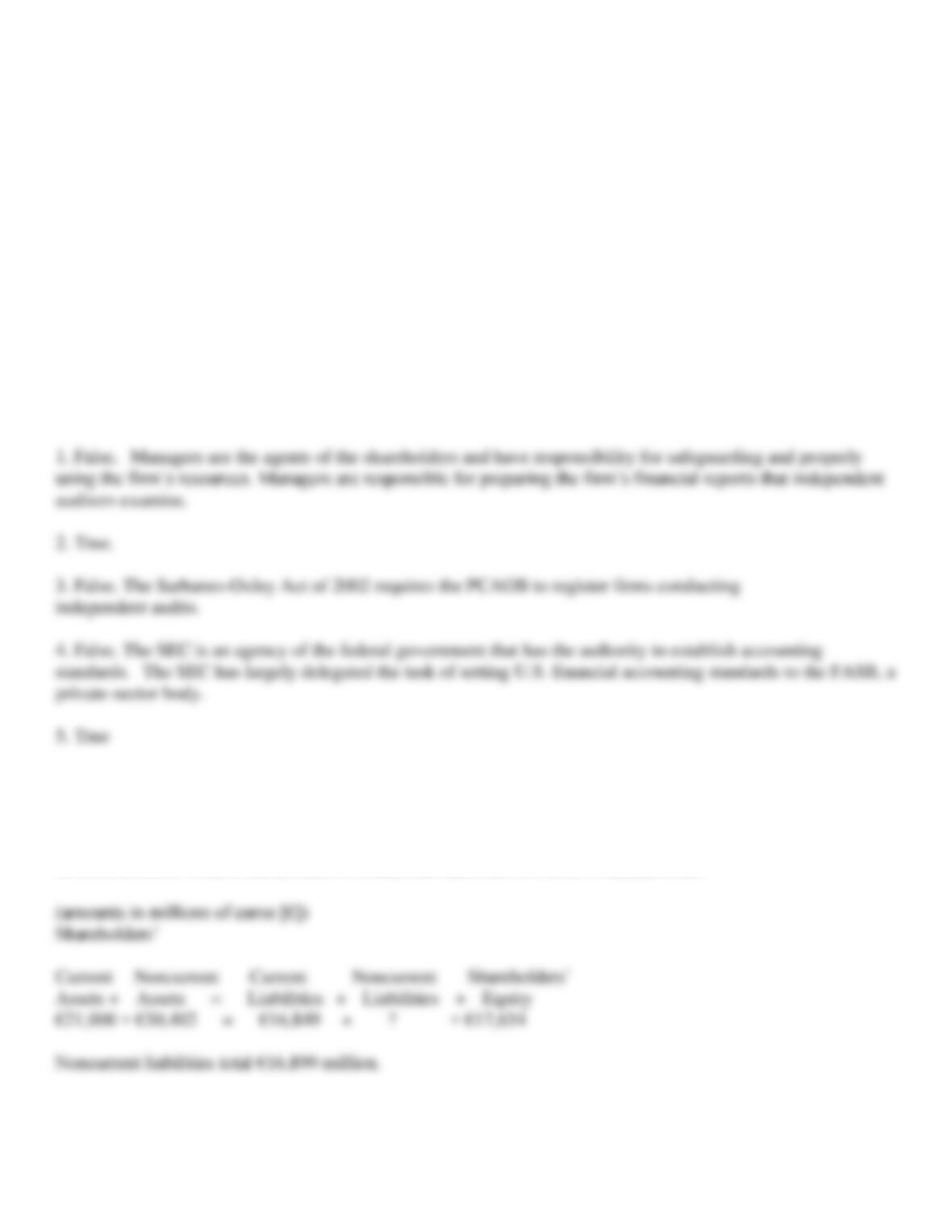
1. Auditors are the agents of the shareholders and have responsibility for safeguarding and properly using the
firm’s resources.
2. The Sarbanes-Oxley Act of 2002 established the Public Company Accounting Oversight Board (PCAOB),
which is responsible for monitoring the quality of audits of SEC registrants.
3. The Sarbanes-Oxley Act of 2002 requires the AICPA to register firms conducting
independent audits.
4. The FASB is an agency of the federal government that has the authority to establish accounting standards.
5. The governing board, or board of directors, is responsible for selecting, compensating, and overseeing
managers; for establishing dividend policy; and for making decisions on major issues such as acquisitions of
other firms and divestitures of lines of business.
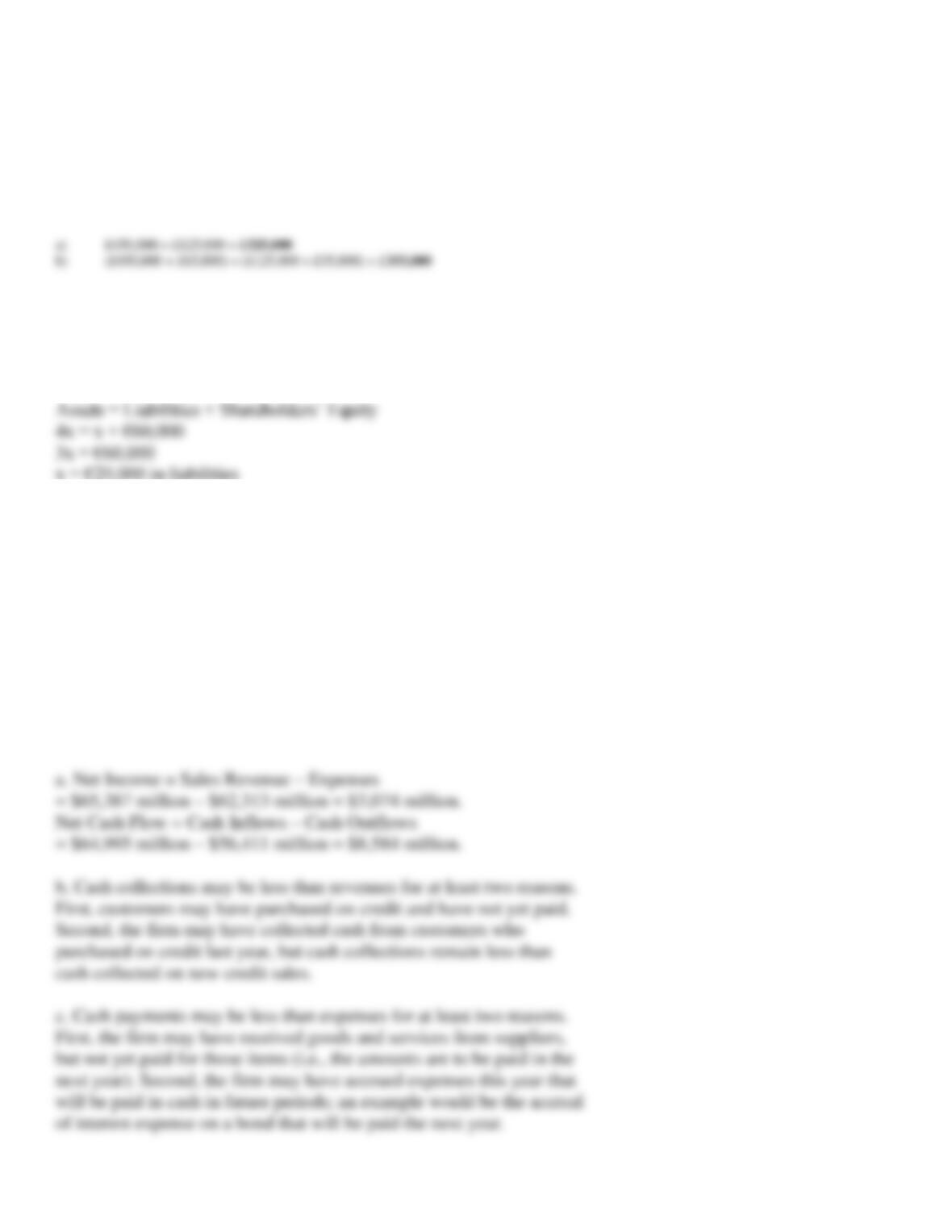
121. The balance sheet of Parler, a European Union communications firm, shows current assets of €21,000
million, current liabilities of €16,849 million, shareholders’ equity of €17,654 million, and noncurrent assets of
€30,402 million. What is the amount of noncurrent liabilities on Parler’s balance sheet?
122. Maeve Irwin is the CEO of Maeve’s Spa. At the end of its accounting period, December 31, 2013,
Maeve’s Spa has assets of £450,000 and liabilities of £125,000. Using the equation that holds for equality of
assets to liabilties and shareholders’ equity, determine the following amounts:
a)
Shareholders’ Equity as of December 31, 2013.
b)
Shareholders’ Equity as of December 31, 2014, assuming that assets increased by £65,000 and liabilities increased by £35,000
during 2014£.
123. Hemd Company has liabilities equal to one fourth of the total assets. Hemd’s shareholders’equity
is €60,000. Using the accounting equation, what is the amount of liabilities for Hemd?
124. The following information is based on the financial statements of Hadley Company, a large manufacturer.
Annual revenues are $65,387 million and net expenses (including income taxes) are $62,313 million. During the
year, the firm collected $64,995 million in cash from customers and had cash outflows associated with
payments to suppliers and vendors of $56,411 million.
REQUIRED:
a. Calculate net income and net cash flow for the year.
b. How can cash collected from customers be less than revenues?
c. How can cash payments to suppliers and vendors be less than expenses?
a)
125. The following information is reported by ComCo, a Singapore company; all figures are in millions of
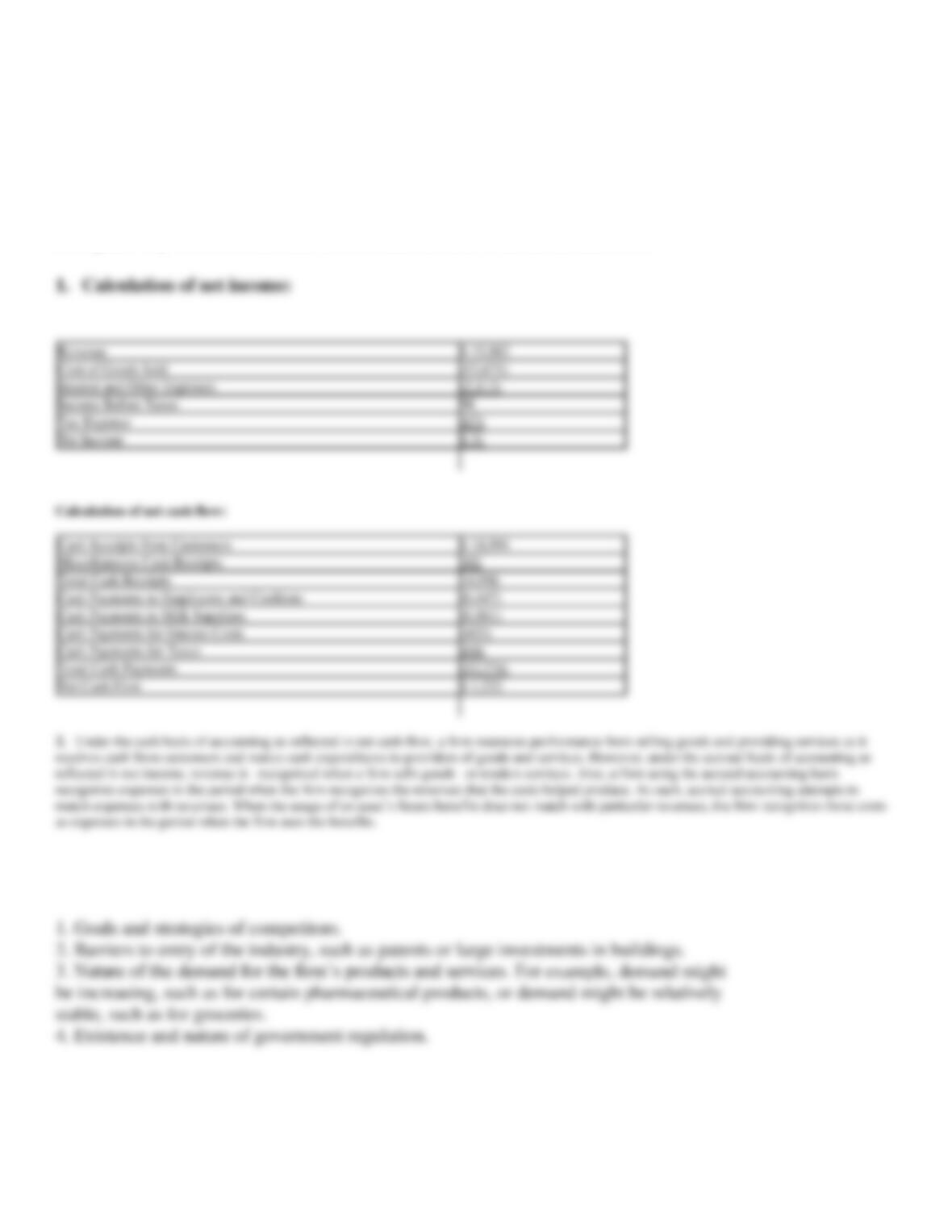
Singapore dollars ($). The firm reported revenues of $15,882, cost of goods sold of $13,671, interest and other
expenses of $2,113, and tax expense of $67. It also reported $14,894 in cash receipts from customers, $102 in
miscellaneous cash receipts, $6,447 in cash payments to employees and creditors, $6,861 in cash payments for
milk, $402 in cash payments for interest, and $64 in cash payments for taxes.
Required:
1. Calculate net income and its net cash flow.
2. Explain why ComCo’s net income is so much different than its net cash flow.
126. Describe some of the factors that would affect a firm’s goals and strategies.
127. Understanding financial reports requires an understanding of the activities of the business. Describe at least
four investing activities that firms use to obtain the productive capacity to carry out its business activities.
128. Understanding financial reports requires an understanding of the activities of the business. Describe at least
three operating activities that firms use to generate earnings.
129. Briefly list and describe the principal financial statements.
130. Explain the roles, duties, and responsibilities of managers and governing boards of reporting entities.
131. FASB board members make standard-setting decisions guided by a conceptual framework
that addresses the objectives of financial reporting and qualitative characteristics of accounting
information.. Briefly describe the objectives of financial reporting and qualitative characteristics of accounting
information
132. Discuss internal and external users of accounting information. What areas of accounting provide them
with information? Give an example of the type of report each type of user might use.
133. What are the roles, duties, and responsibilities of the independent auditor?
134. Who are the users of financial statements and what do they need?
135. What is US GAAP?
136. Concerns over the quality of financial reporting have led, and continue to lead, to government
initiatives in the United States including, the Sarbanes-Oxley Act of 2002. Briefly describe the Sarbanes-Oxley
Act of 2002.
137. Briefly describe the International Accounting Standards Board (IASB) and who can use IFRS in the United
States?
138. As a basis for measuring performance for a particular accounting period, the cash basis of accounting has
three weaknesses. Briefly describe the three weaknesses.
139. Describe the accrual basis of accounting.