1.4 Microeconomics and Macroeconomics
1) Which of the following is a microeconomics question?
A) How much will be saved and how much will be produced in the entire economy?
B) What will the level of economic growth be in the entire economy?
C) What factors determine the price of carrots?
D) What determines the average price level and inflation?
2) Microeconomics is the study of
A) how households and firms make choices.
B) the economy as a whole.
C) the global economy.
D) topics such as unemployment, inflation, and economic growth.
3) Which of the following is a macroeconomics question?
A) What determines the inflation rate?
B) What determines the production of DVDs?
C) What factors determine the price of carrots?
D) What determines the wage of auto workers?
4) Macroeconomics is the study of
A) how households make choices.
B) how firms make choices.
C) how households and firms make choices.
D) the economy as a whole.
5) Examining the conditions that could lead to a recession in an economy is an example of
macroeconomics topic.
6) The decisions Apple makes in determining production levels for its iPhone is an example of a
microeconomics topic.
7) Which of the following are primarily macroeconomic topics and which are primarily
microeconomic topics?
a. gasoline prices
b.unemployment
c. inflation
d. health care costs
e. air pollution
f. economic growth
1.5 A Preview of Important Economic Terms
1) Which of the following statements is true about profit?
A) Profit refers to the revenue received from the sale of a quantity of goods.
B) Profit is calculated by multiplying price and quantity sold.
C) The terms “accounting profit” and “economic profit” can be used interchangeably.
D) Profit is the difference between revenue and cost.
2) In economics, the accumulated skills and training that workers have is known as
A) human capital.
B) entrepreneurship.
C) physical capital.
D) innovation.
3) Which of the following is an example of an activity undertaken by an entrepreneur?
A) designing your landscaping for your new home
B) holding a position as the president of a liberal arts college
C) running for the president of the United States
D) starting your own pet sitting business
4) The machines workers have to work with are considered
A) human capital.
B) physical capital.
C) entrepreneurship.
D) financial capital.
5) Technology is defined as
A) the process of developing and revising models.
B) new innovations and creations.
C) the processes used to produce goods and services.
D) the process of recycling products.
6) Which of the following statements about economic resources is true?
A) Economic resources include financial capital and money.
B) Economic resources are also called factors of production.
C) Economic resources are used only by businesses.
D) All economic resources are man-made.
7) The U.S. Health Resources and Services Administration (HRSA) forecasts that in 2020
A) there will be a shortage of doctors in the United States.
B) the number of doctors in the United States will decrease and the number of doctors needed
will increase.
C) the number of doctors in the United States will increase and the number of doctors needed
will decrease.
D) there will be a surplus of doctors in the United States.
8) According to census figures, between 1970 and 2007 the number of doctors who described
themselves as self-employed
A) fell by more than 50 percent.
B) more than doubled.
C) has remained fairly constant.
D) fell to almost zero before rising back to its original level.
9) In the market for factors of production, firms earn income by selling goods and services to
households.
10) One example of human capital is the amount of skills that you have.
11) List the five main factors of production.
12) What is the difference between an invention and an innovation?
13) Explain the difference between a firm’s revenue and its profit.
14) What are some of the reasons given for the the decline in the number of physicians choosing
to enter private practices?
1.6 Appendix: Using Graphs and Formulas
1) If a graph has a line that shows the amount of outsourcing in the last ten years, it is known as
A) a pie chart.
B) a time-series graph.
C) a demand curve for outsourcing.
D) a supply curve of outsourcing.
2) ________ have a horizontal and a vertical axis and are used in economics to illustrate
relationships between two economic variables.
A) Two-dimensional graphs
B) One-dimensional graphs
C) Pie Charts
D) Bar graphs
3) If a straight line passes through the point x = 14 and y = 3 and also through the point x = 4 and
y = 10, the slope of this line is
A) negative 11 divided by 6.
B) seven tenths.
C) negative seven tenths.
D) 6 divided by 11.
4) On a two-dimensional graph, ________ allows for the effects of additional variables.
A) moving along a curve
B) shifting curves
C) eliminating a curve
D) adding an additional curve
5) Which of the following statements is false?
A) An inverse relationship has a negative slope value.
B) A direct relationship has a positive slope value.
C) A curved line has slope values that change at every point.
D) A straight line has a slope of zero.
6) The relationship between consumer spending and disposable personal income is
A) an inverse relationship.
B) a direct relationship.
C) a negative relationship.
D) independent.
7) Suppose when the price of laptops fall, college students buy more laptops. This implies that
A) there is a positive relationship between laptop prices and quantities purchased by college
students.
B) there is a negative relationship between laptop prices and quantities purchased by college
students.
C) there is a direct relationship between laptop prices and quantities purchased by college
students.
D) there is a one-to-one relationship between laptop prices and quantities purchased by college
students.
8) If the price of milk was $2.50 a gallon and it is now $3.25 a gallon, what is the percentage
change in price?
A) 13 percent
B) 30 percent
C) 75 percent
D) 77 percent
9) In 2010, Hooverville consumed 205,000 tons of sugar. In 2011, sugar consumption rose to
245,000 tons. Calculate the percentage change in sugar consumption.
A) 8.37%
B) 11.95%
C) 19.51%
D) 26.33%
10) At a recent faculty meeting, Lorraine Waverly, president of Skywalker College, announced
that enrollment is up by 12 percent over the previous semester. If enrollment the previous
semester was 3,250 students, what is the student enrollment this semester?
A) 390
B) 2,860
C) 3,640
D) 4,030
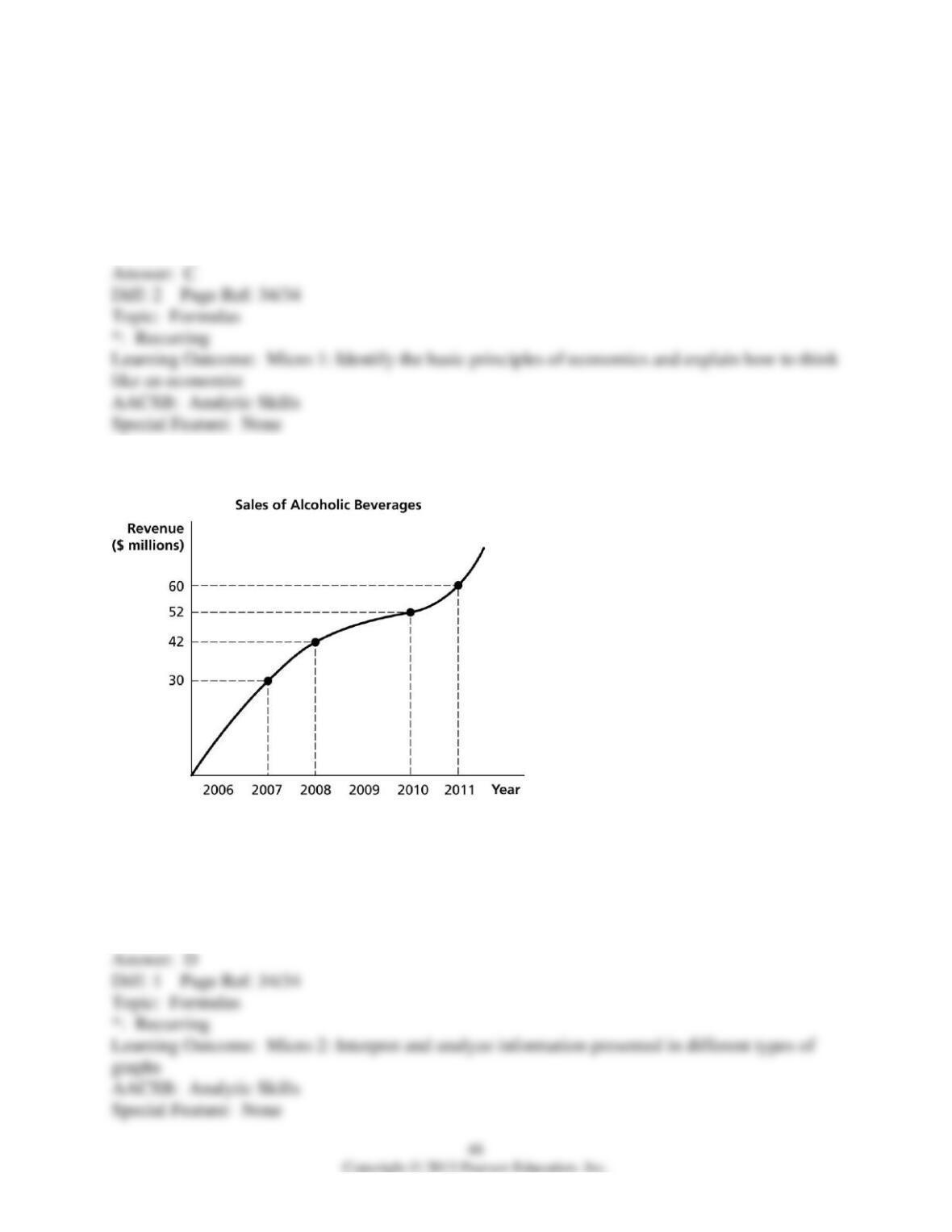
Figure 1-1
11) Refer to Figure 1-1. Using the information in the figure above, calculate the percentage
change in sales of alcoholic beverages between 2008 and 2011.
A) 23.1%
B) 23.8%
C) 30%
D) 42.9%
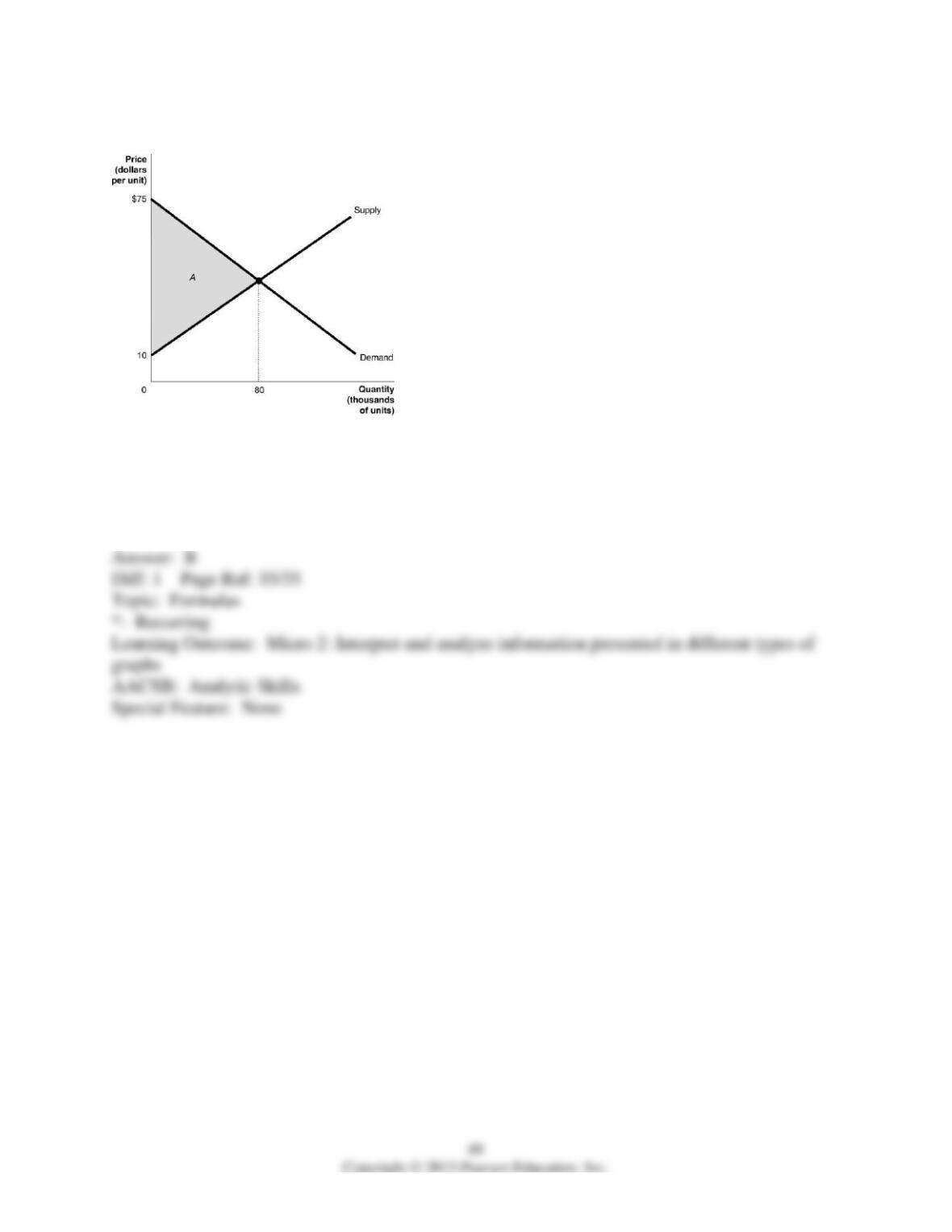
Figure 1-2
12) Refer to Figure 1-2. Calculate the area of the triangle A.
A) $1.3 million
B) $2.6 million
C) $3.4 million
D) $5.2 million
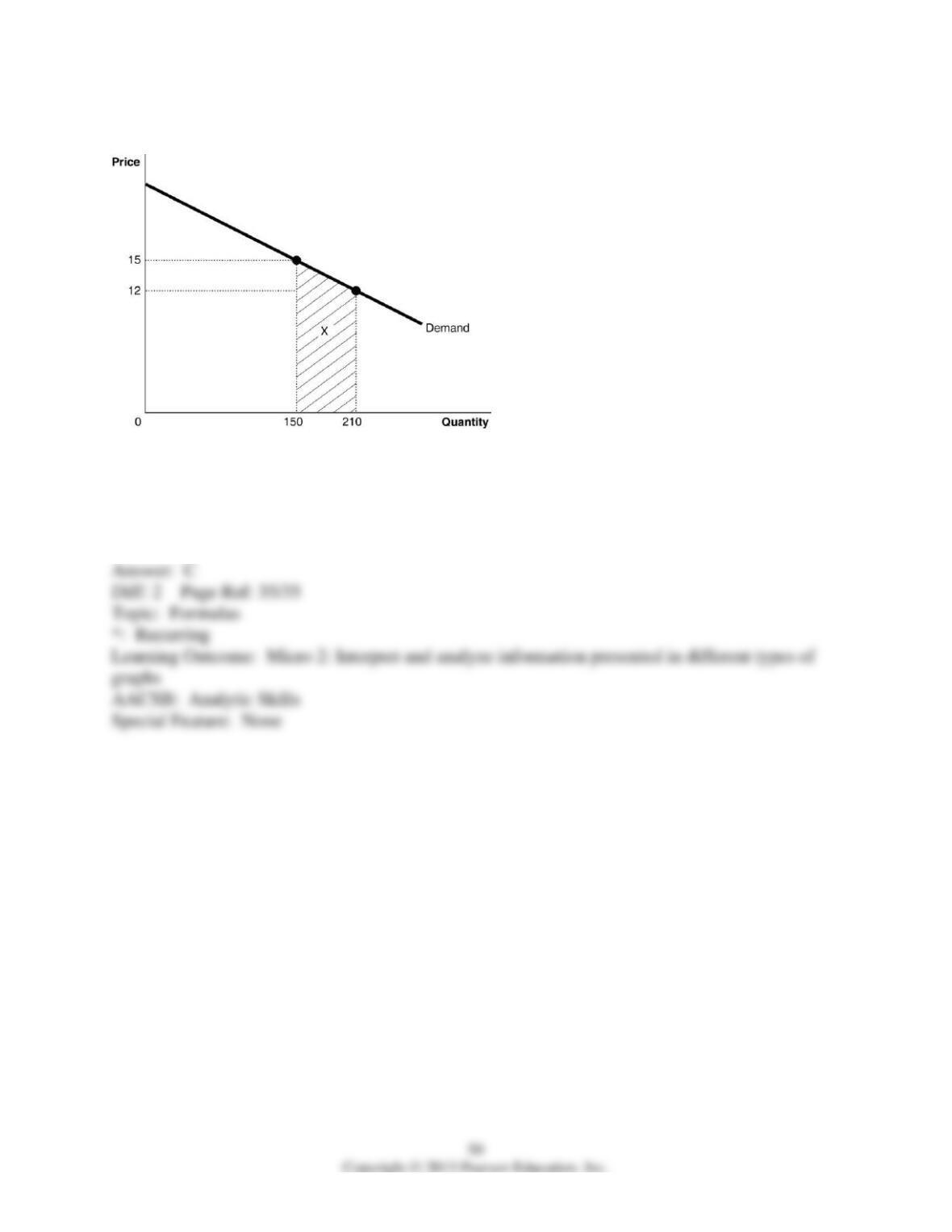
Figure 1-3
13) Refer to Figure 1-3. Calculate the area of the trapezoid X.
A) $270
B) $720
C) $810
D) $2,520
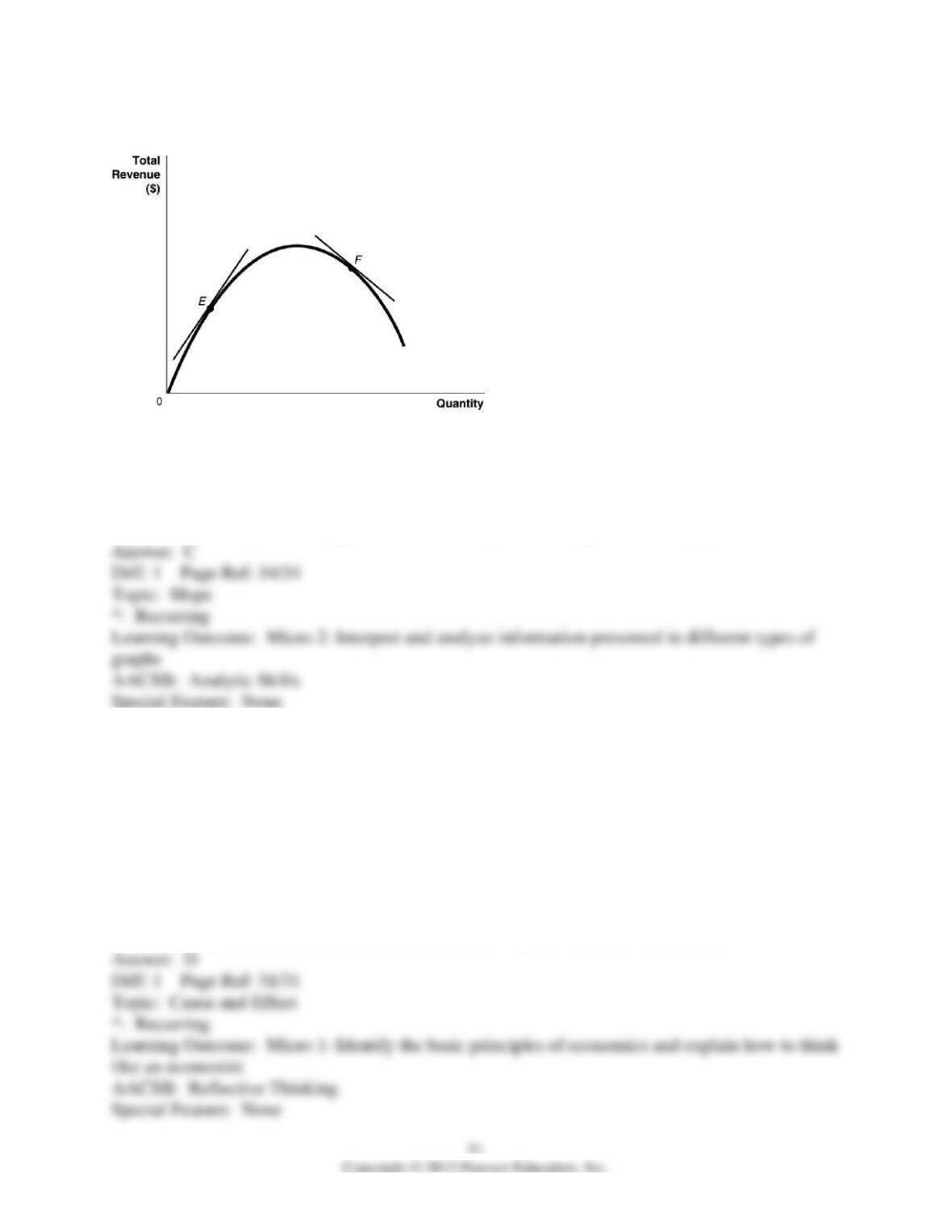
Figure 1-4
14) Refer to Figure 1-4. Which of the following statements is false?
A) The slope of the tangent at E is positive.
B) The slope of the tangent at F is negative.
C) The slope of the tangent at E and the slope of the tangent at F are equal.
D) Neither the slope of the tangent at E nor the slope of the tangent at F are equal to zero.
15) What is the “omitted variable” problem in determining cause and effect?
A) It is a problem that arises when an insignificant variable is given too much weight in an
economic analysis leading to skewed conclusions about cause and effect.
B) It is a problem that arises when a significant variable is not given enough weight in an
economic experiment leading to skewed conclusions about cause and effect.
C) It is a problem that arises when an insignificant economic variable that should have been
omitted is included in an economic experiment leading to false conclusions about cause and
effect.
D) It is a problem that arises when an economic variable that affects other variables is omitted
from an analysis and its omission leads to false conclusions about cause and effect.
16) ________ is a problem that occurs when one concludes that a change in variable X caused a
change in variable Y when in actual fact, it is a change in variable Y that caused a change in
variable X.
A) The omitted variable
B) The positive-to-negative relationship
C) Reverse causality
D) Nonlinear slope
17) The prevalence of Alzheimer’s dementia is very high among residents living in nursing
homes. A student concludes that it is likely that living in nursing home causes Alzheimer’s
dementia. What is the flaw in the student’s reasoning?
A) The student has failed to take into account other causes of Alzheimer’s disease.
B) The student is drawing a false conclusion; he is confusing cause and effect.
C) The student is using an inadequate sample size.
D) The student is drawing a false conclusion by making the mistake of omitting critical variables
such as the age and gender of the residents.
18) You explain to your roommate Surya, who makes beaded headbands, about an economic
theory which asserts that consumers will purchase more of a product at lower prices than they
will at higher prices. She contends that the theory is incorrect because over the past two years
she has lowered the price of her headbands and yet has seen a decrease in sales. How would you
respond to Surya?
A) Surya is right; she has evidence to back her claim. The theory must be erroneous.
B) Surya is making the mistake of assuming that correlation implies causation.
C) I will explain to her that she is making the error of reverse causality: it is the decrease in
demand that has caused her to lower her prices.
D) I will explain to her that there are some omitted variables that have contributed to a decrease
in her sales such as changes in income.
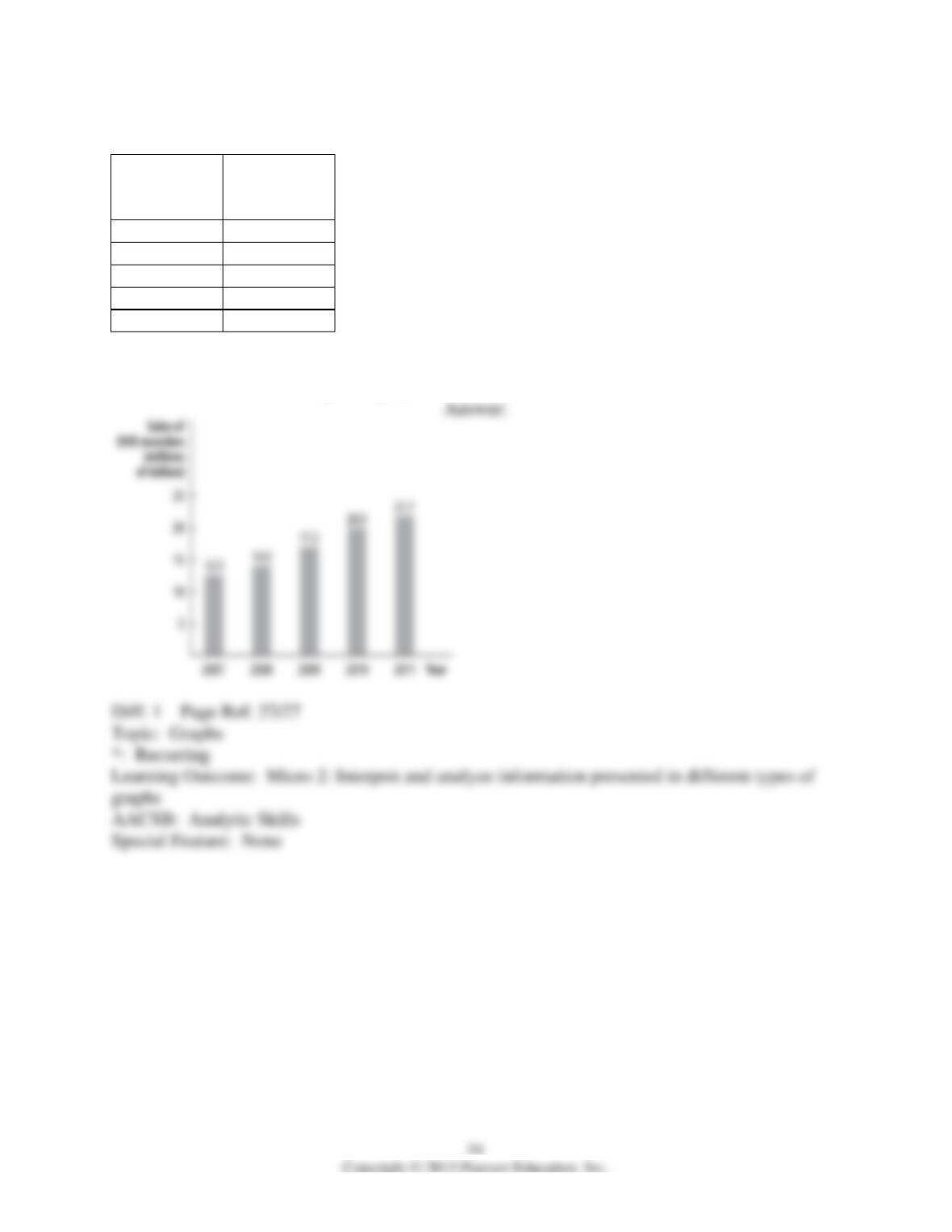
Table 1-2
Year
DVD
Recorders
(millions)
2007
12.5
2008
14.0
2009
17.2
2010
20.0
2011
21.7
19) Refer to Table 1-2. The table above shows the sales of DVD recorders in North America.
Present the information using a bar graph.