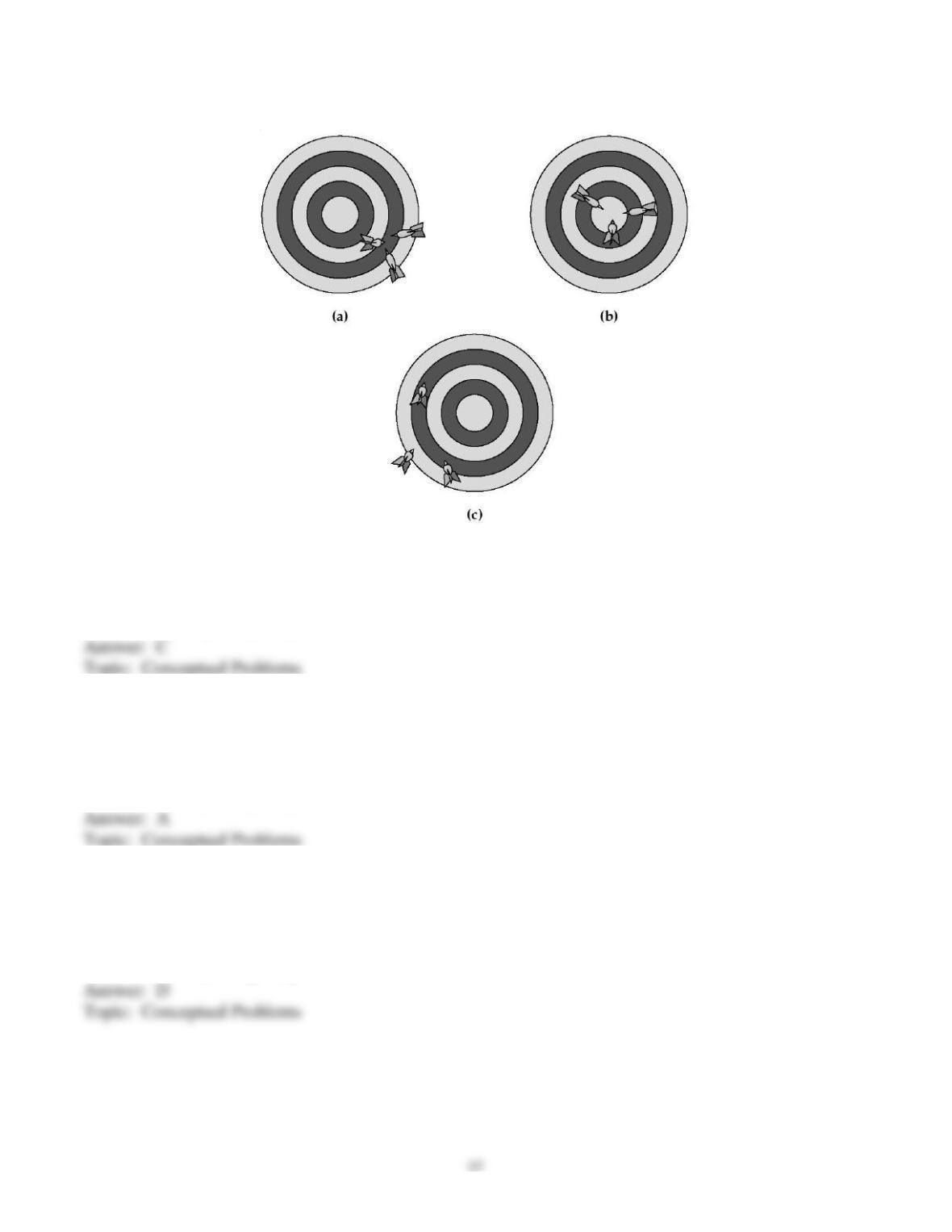
Use the drawings below to answer the following questions.
139) If hitting the bull’s-eye is the desired result, Figure (a) represents
A) good accuracy and good precision.
B) good accuracy and poor precision.
C) poor accuracy and good precision.
D) poor accuracy and poor precision.
140) If hitting the bull’s-eye is the desired result, Figure (b) represents
A) good accuracy and good precision.
B) good accuracy and poor precision.
C) poor accuracy and good precision.
D) poor accuracy and poor precision.
141) If hitting the bull’s-eye is the desired result, Figure (c) represents
A) good accuracy and good precision.
B) good accuracy and poor precision.
C) poor accuracy and good precision.
D) poor accuracy and poor precision.
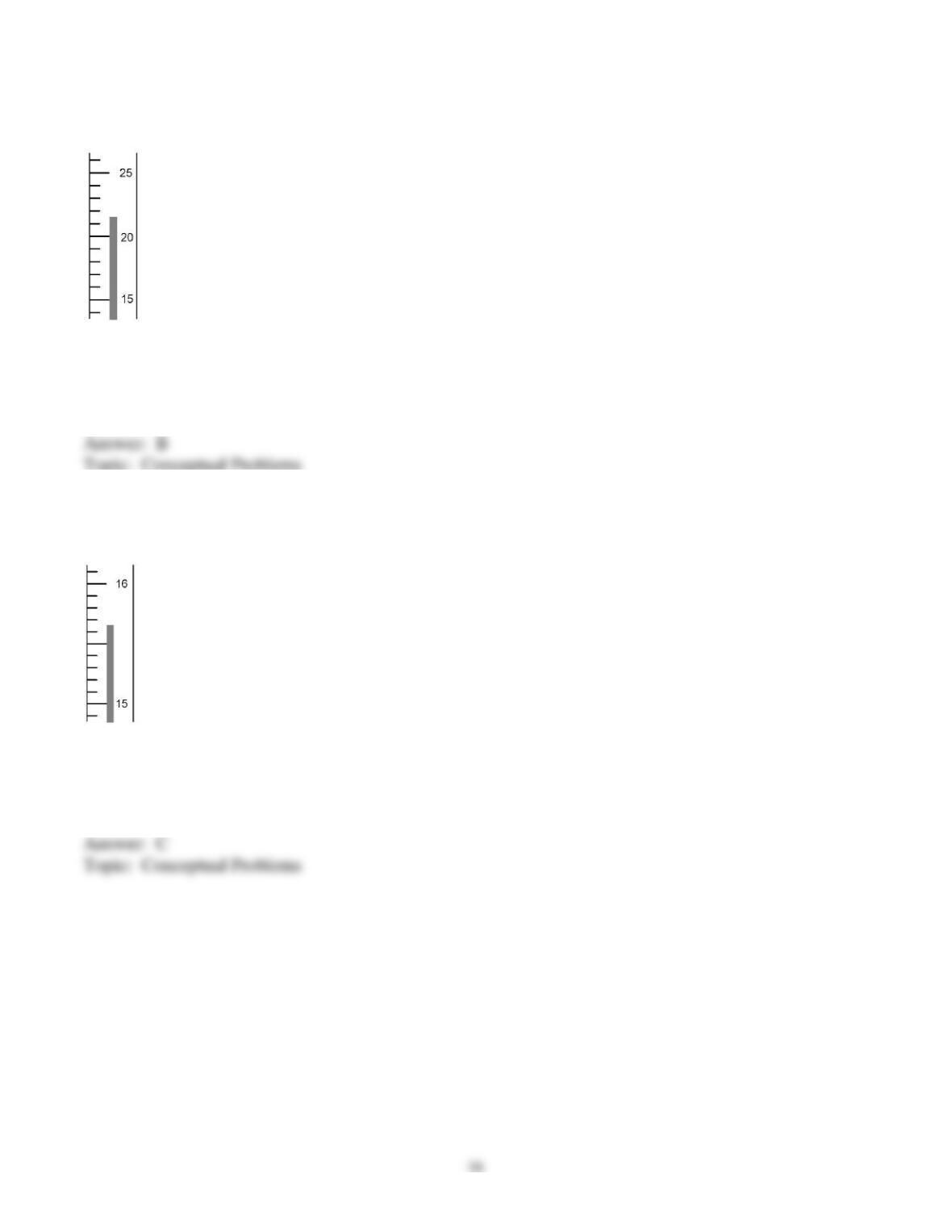
142) To the correct number of significant figures, what is the temperature reading on the following
Celsius thermometer?
A) 21°C
B) 21.7°C
C) 21.70°C
D) 22°C
143) To the correct number of significant figures, what is the temperature reading on the following
Celsius thermometer?
A) 15°C
B) 15.6°C
C) 15.67°C
D) 16°C
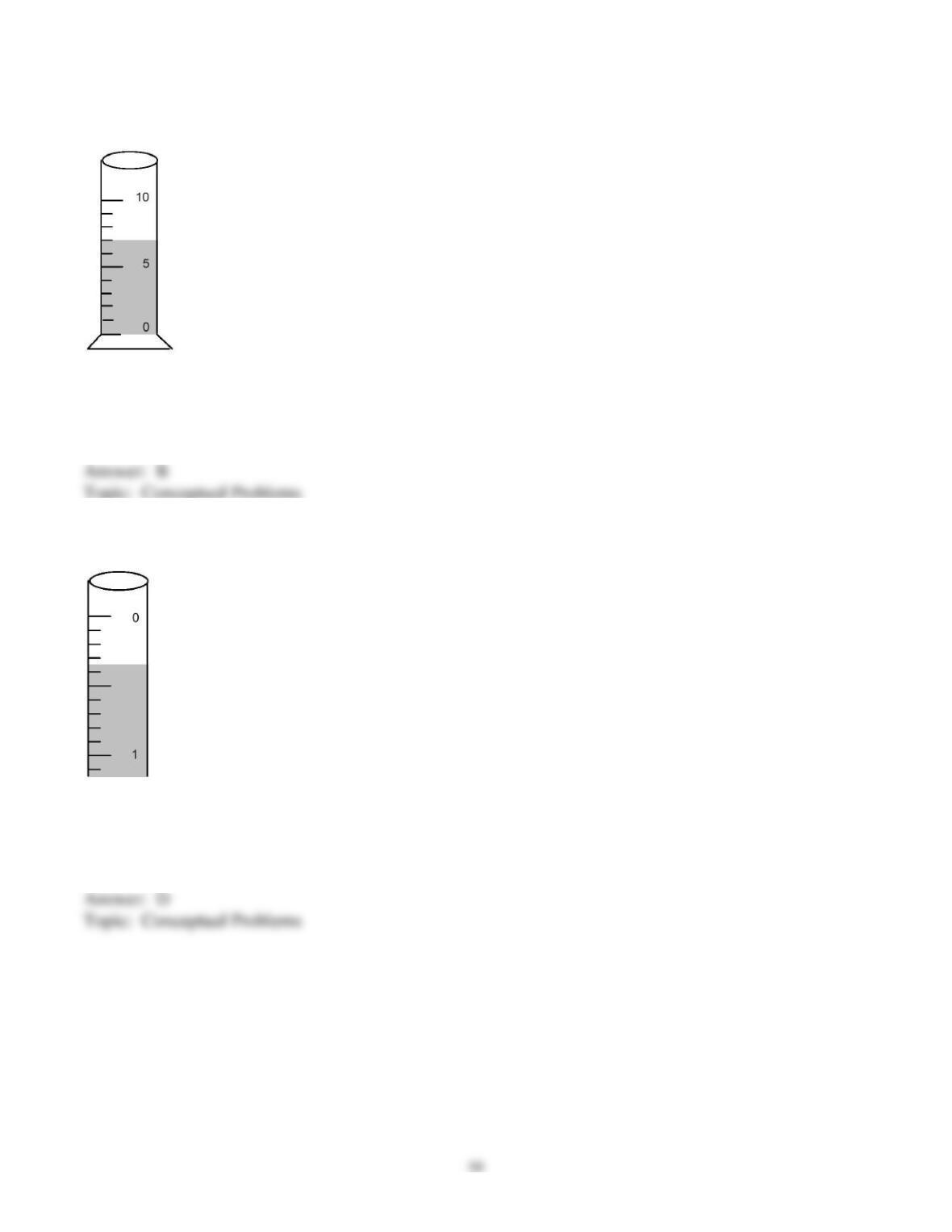
144) To the correct number of significant figures, what is the volume of the liquid in the graduated
cylinder?
A) 7 mL
B) 7.0 mL
C) 7.7 mL
D) 8 mL
145) To the correct number of significant figures, what is the level of the liquid in the buret?
A) 0.2 mL
B) 0.29 mL
C) 0.3 mL
D) 0.35 mL
1.2 Algorithmic Questions
1) What is the chemical symbol for titanium?
A) Th
B) Ti
C) Tl
D) Tm
2) What is the chemical symbol for mercury?
A) Ag
B) Au
C) Hg
D) Pb
3) What is the chemical symbol for copper?
A) Co
B) Cr
C) Cu
D) C
4) Which element has the chemical symbol, Ru?
A) rubidium
B) ruthenium
C) rutherfordium
D) rhodium
5) Which element has the chemical symbol, S?
A) selenium
B) silicon
C) sulfur
D) scandium
6) Cesium belongs to the ________ group of the periodic table.
A) alkali metal
B) alkaline earth metal
C) halogen
D) noble gas
41
7) Iodine belongs to the ________ group of the periodic table.
A) alkali metal
B) alkaline earth metal
C) halogen
D) noble gas
8) Argon belongs to the ________ group of the periodic table.
A) alkali metal
B) alkaline earth metal
C) halogen
D) noble gas
9) Barium belongs to the ________ group of the periodic table.
A) alkali metal
B) alkaline earth metal
C) halogen
D) noble gas
10) Which of the following elements has chemical properties similar to tellurium?
A) fluorine
B) hydrogen
C) nitrogen
D) sulfur
11) Which of the following elements is a gas at room temperature?
A) bromine
B) carbon
C) helium
D) sodium
12) Which of the following elements is not a solid at room temperature?
A) Ag
B) Al
C) Xe
D) Fe
13) Which of the following elements is classified as a semimetal?
A) calcium
B) boron
C) fluorine
D) uranium
14) Which of the following elements is a good conductor of heat and electricity?
A) carbon
B) chlorine
C) neon
D) aluminum
15) Which one of the following elements is a poor conductor of heat and electricity?
A) copper
B) fluorine
C) iron
D) lead
16) All of the following elements are nonmetals except
A) barium.
B) carbon.
C) hydrogen.
D) oxygen.
17) What symbol is used to represent the factor 101?
A) M
B) da
C) μ
D) n
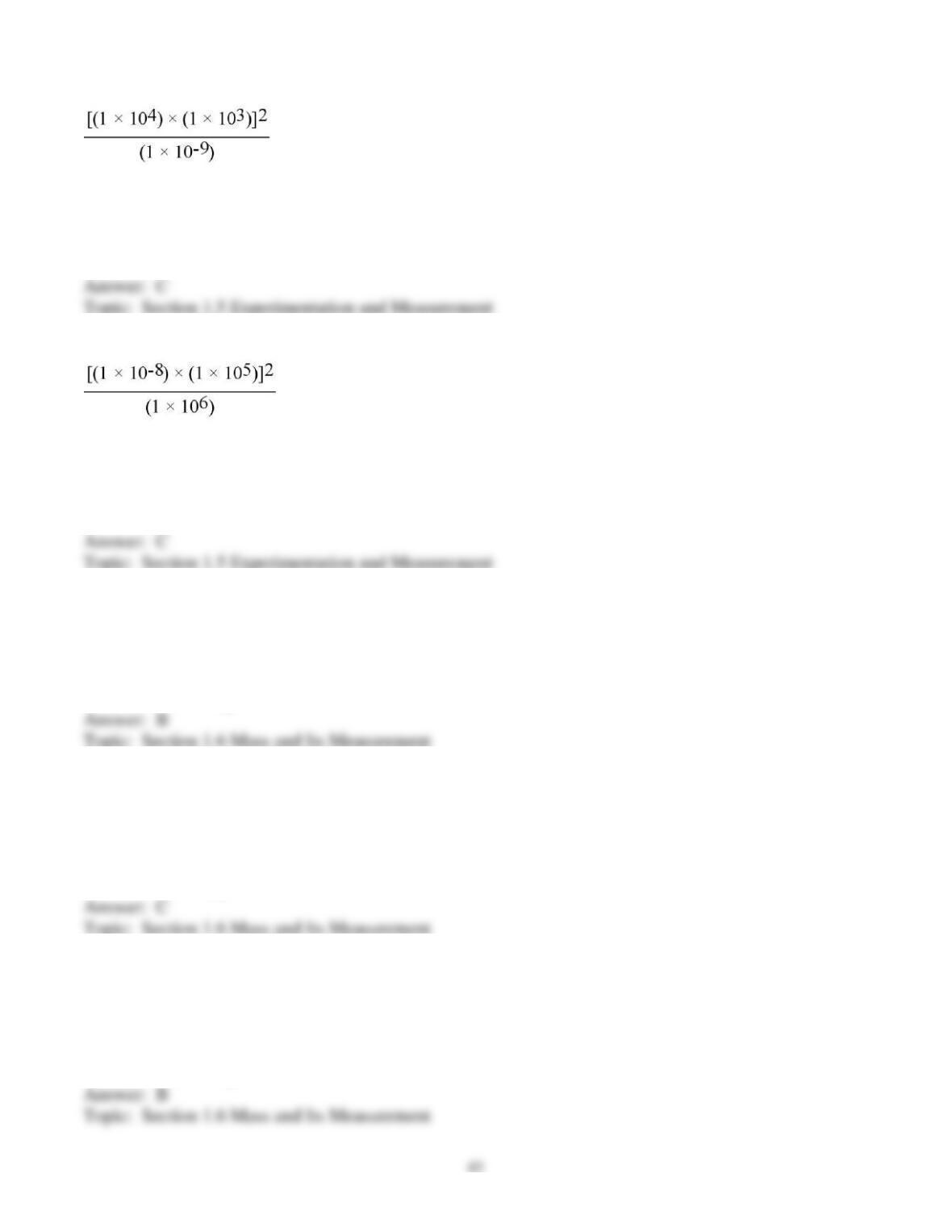
18) Without using a calculator, solve the following problem:
A) 1 × 10⁻⁴
B) 1 × 10⁵
C) 1 × 10²³
D) 1 × 1032
19) Without using a calculator, solve the following problem:
A) 1 × 10⁶
B) 1 × 100
C) 1 × 10-12
D) 1 × 10-18
20) Which of the following is the greatest mass?
A) 1000 μg
B) 1.000 × 10⁻⁴ kg
C) 1.000 × 10⁻⁴ cg
D) 1.000 × 10⁻⁸ Mg
21) The mass of a proton is 1.67 × 10⁻²⁷ kg. What is the mass of a proton in picograms?
A) 1.67 × 10– 18 pg
B) 1.67 × 10– 15 pg
C) 1.67 × 10– 12 pg
D) 1.67 × 10– 9 pg
22) The mass of a single zinc atom is 1. 086 × 10-22 g. This is the same mass as
A) 1.086 × 10⁻¹⁶ mg.
B) 1.086 × 10⁻²⁵ kg.
C) 1.086 × 10⁻²⁸ μg.
D) 1.086 × 10⁻³¹ ng.
23) A student weighed 30.00 μg of sulfur in the lab. This is the same mass as
A) 3.000 × 10– 8 g.
B) 3.000 × 10– 5 kg.
C) 3.000 × 10⁻⁵ mg.
D) 3.000 × 10⁴ ng.
24) Convert 4 μm to meters.
A) 4 × 10⁻⁹ m
B) 4 × 10⁻⁶ m
C) 4 × 10⁻³ m
D) 4 × 10⁶ m
25) The average distance between nitrogen and oxygen atoms is 115 pm in a compound called nitric
oxide. What is this distance in millimeters?
A) 1.15 × 10– 8 mm
B) 1.15 × 10– 7 mm
C) 1.15 × 1013 mm
D) 1.15 × 1017 mm
26) The diameter of an atom is approximately 1 × 10⁻¹⁰ m. What is the diameter in millimeters?
A) 1 × 10– 16 mm
B) 1 × 10– 13 mm
C) 1 × 10⁻⁷ mm
D) 1 × 10⁻⁴ mm
27) The diameter of the nucleus of an atom is approximately 1 × 10– 3 pm. If 1 nm is equal to 10
Ångstroms, what is the diameter of the nucleus in Ångstroms?
A) 1 × 10-23 Å
B) 1 × 10⁻⁸ Å
C) 1 × 10⁻⁷ Å
D) 1 × 10⁻⁵ Å
28) If the melting point of vanadium metal is 1910°C, what is its melting point in Kelvin temperature?
A) 1029 K
B) 1637 K
C) 2183 K
D) 3470 K
29) Which of the following is the lowest temperature?
A) 42°C
B) 57°F
C) 318 K
D) All of these temperatures are all equal.
30) Which of the following volumes is equal to 40 mL?
A) 40 cm3
B) 40 dm3
C) 0. 40 L
D) 0.000 40 kL
31) Convert 10 cm3 to m3.
A) 1 × 10– 5 m3
B) 1 × 10⁻¹ m3
C) 1 × 10³ m3
D) 1 × 10⁷ m3
32) Convert 35 m3 to liters.
A) 3.5 × 10⁻² L
B) 3.5 L
C) 3.5 × 10² L
D) 3.5 × 10⁴ L
33) Which of the following is the smallest volume?
A) 44 cm3
B) 1.0 dL
C) 5.5 × 10³ mL
D) 1.0 × 10⁸ nL
34) What symbol is used to represent the factor 10-1?
A) M
B) m
C) μ
D) d
35) The factor 1,000,000 corresponds to which prefix?
A) deka
B) deci
C) mega
D) milli
36) The factor 10-3 corresponds to which prefix?
A) deka
B) deci
C) milli
D) centi
37) A piece of metal ore weighs 8.25 g. When a student places it into a graduated cylinder containing
water, the liquid level rises from 21.25 mL to 26.47 mL. What is the density of the ore?
A) 0.3 12 g/mL
B) 0. 633 g/mL
C) 1. 58 g/mL
D) 3.21 g/mL
38) A mass of mercury occupies 0. 950 L. What volume would an equal mass of ethanol occupy? The
density of mercury is 13.546 g/mL and the density of ethanol is 0.789 g/mL.
A) 0.0 553 L
B) 0. 0613 L
C) 16.3 L
D) 18.1 L
39) Calculate the kinetic energy of a 150-g baseball moving at a speed of 36. m/s ( 81 mph).
A) 5.4 J
B) 9.7 × 101 J
C) 5.4 × 10³ J
D) 9.7 × 10⁴ J
40) Which of the following numbers has the greatest number of significant figures?
A) 0. 5070
B) 0 .201
C) 418000
D) 6.02 × 1024
41) How many of the following numbers contain 3 significant figures?
0. 408 9.040 0.0 400 9.05 × 1024
A) one
B) two
C) three
D) four
42) How many significant figures are there in the answer to the following problem?
( 9.992 × 3.200) + 0. 610 = ?
A) one
B) two
C) three
D) four
43) How many significant figures are there in the answer for the following problem?
56.4 + 0. 8822 + 21 = ?
A) one
B) two
C) three
D) four
44) How many significant figures are there in the answer for the following problem?
[(143.7 121) 2.06]
0.600
−
= ?
A) one
B) two
C) three
D) four
45) An acetylene molecule contains 2 atoms of carbon. The number 2 represents how many significant
figures?
A) one
B) two
C) three
D) infinite
46) Round off 00 907506 to four significant figures.
A) 00 91
B) 9076
C) 9100
D) 9.075 × 10⁵
47) If 1.4% of the mass of a human body is calcium, how many kilograms of calcium are there in a 185-
pound man?
A) 1.2 kg Ca
B) 5.7 kg Ca
C) 1.2 × 10² kg Ca
D) 5.7 × 10² kg
48) A fishing boat accidentally spills 3.0 barrels of diesel oil into the ocean. Each barrel contains 42
gallons. If the oil film on the ocean is 2.5 × 10² nm thick, how many square meters will the oil slick
cover?
A) 1.9 × 10⁻³ m2
B) 1.9 × 10⁶ m2
C) 1.9 × 10⁷ m2
D) none of these
49) Because of the high heat and low humidity in the summer in Death Valley, California, a visitor
requires about one quart of water for every two miles traveled on foot. Calculate the approximate
number of liters required for a person to walk 10. kilometers in Death Valley.
A) 2.9 L
B) 12 L
C) 30 L
D) 47 L
1.3 Short Answer Questions
1) Chemistry is the study of the composition, properties, and transformations of ________.
2) A preliminary explanation of the results of many experiments that can be used to make predictions
and suggest further experimentations is a ________.
3) The symbol for mercury is ________.
4) Pb is the symbol for the element ________.
5) In a periodic table rows are called ________ and columns are called ________.
6) The element Se can be found in period ________ and group ________ of the periodic table.
7) The element that is in period 6 and group 7A has the symbol ________.
8) A property that depends on the amount of a substance is an ________ property, whereas a property
that is independent on the amount of substance is an ________ property.
9) Elements are classified as metals, nonmetals, or semimetals. At room temperature a certain element
exists as a dull yellow solid that is a poor conductor of electricity and is brittle. This element is most
likely a ________.
10) Sodium is an example of an ________ metal that reacts with water to form hydrogen gas and an
________ solution.
11) Using exponential notation, there are ________ bytes of memory are contained in a 2 TB external
hard drive.
12) Using exponential notation, there are ________ g in 1.0 kg.
13) The fundamental SI unit of mass is the ________.
14) The meter is closest in length to the English system unit the ________.
15) The difference between the boiling point and freezing point of water is 100°C, which is ________
kelvins.
16) Volume is a derived unit having the unit lengthx, where x = ________.
17) The quantity 3.00 cm3 is the same as ________ mL.
18) The density of lead is 11.3 g/cm3. The volume occupied by 227 g of lead is ________ cm3.
19) The density of mercury is 13.6 g/cm3. The mass of 38.0 cm3 of mercury is ________ g.
20) Stored energy is ________ energy, and energy of motion is ________ energy.
21) The nutritionist unit Calorie is equal to ________ calories.
22) ________ refers to how well a number of independent measurements agree with one another,
whereas ________ refers to how close to the true value a given measurement is.
23) The number of significant digits in 0.07090 g is ________.
24) The quantity 1.0567 qt rounded to two significant figures is ________ qt.
25) Given that 2.54 cm = 1 in, 350 in3 = ________ L.