178. Identify each of the following as either internal or external users of accounting information.
179. Determine the missing amount for each of the following:
Assets
Liabilities
Owner’s Equity
(a)
$38,000
$45,000
$30,000
(b)
$22,000
$53,000
$ 32,000
(c)
(a)
$83,000
(b)
$8,000
(c)
$21,000

180. Identify each of the following as an (1) increase in owner’s equity, or a (2) decrease in owner’s equity.
(a)
Fees Earned
(b)
Wages Expense
(c)
Withdrawal
(d)
Lawn Care Revenue
(e)
Investment
(f)
Supplies Expense
(a)
1
(b)
2
(c)
2
(d)
1
(e)
1
2

181. Selected transactions completed by a proprietorship are described below. Indicate the effects of each
transaction on assets, liabilities, and owner’s equity by inserting “+” for increase and “-” for decrease in the
appropriate columns at the right. If appropriate, you may insert more than one symbol in a column.
A
L
OE
(a)
Received cash from owner as an additional investment
_____
_____
_____
(b)
Purchased supplies on account
_____
_____
_____
(c)
Paid rent for the current month
_____
_____
_____
(d)
Received cash for services sold to customers
_____
_____
_____
(e)
Returned some defective supplies purchased in (b)
_____
_____
_____
(f)
Paid insurance premiums in advance
_____
_____
_____
(g)
Paid cash to creditor for purchases in (b)
_____
_____
_____
(h)
Charged customers for services sold on account
_____
_____
_____
(i)
Paid cash to a customer as a refund for an overcharge
_____
_____
_____
(j)
Received cash on account from customers
_____
_____
_____
(k)
Owner withdrew cash for personal use
_____
_____
_____
(l)
Recorded the cost of supplies used during the year
_____
_____
_____
(m)
Received invoice for electricity used
_____
_____
_____
(n)
Paid wages
_____
_____
_____
(o)
Purchased a truck for cash
_____
_____
_____
A
L
OE
(a)
+
+
(b)
+
+
(c)
–
–
(d)
+
+
(e)
–
–
(g)
–
–
(h)
+
+
(i)
–
–
(j)
(k)
–
–
(l)
–
–
(m)
+
–
(n)
–
–
(o)

182. From the following list of accounts taken from Lamar’s accounting records, identify those that would
appear on the Income Statement.
(a)
Rent Expense
(b)
Land
(c)
Capital
(d)
Fees Earned
(e)
Withdrawal
(f)
Wages Expense
(g)
Investment
183. Identify which of the following accounts appear on a balance sheet.
(a)
Cash
(b)
Fees Earned
(c)
Joe Brown, Capital
(d)
Wages Payable
(e)
Rent Expense
(f)
Prepaid Advertising
(g)
Land
184. Indicate whether each of the following activities would be reported on the Statement of Cash Flows as an
Operating Activity, an Investing Activity, a Financing Activity, or does not appear on the Cash Flow Statement.
(a)
Cash paid for building
(b)
Cash paid to suppliers
(c)
Cash paid for owner’s withdrawal
(d)
Cash received from customers
(e)
Cash received from the owner’s investment
(f)
Cash received from the sale of a building
(g)
Borrowed cash from a bank
185. For each of the following, determine the amount of net income or net loss for the year.
(a)
Revenues for the year totaled $71,300 and expenses totaled $35,500. The owner made an additional investment of $15,000 during
the year.
(b)
Revenues for the year totaled $220,500 and expenses totaled $175,000. The owner withdrew $40,000 during the year.
(c)
Revenues for the year totaled $149,000 and expenses totaled $172,000. The owner invested an additional $12,000 and withdrew
$16,000 during the year.
(d)
Revenues for Konner Co. totaled $198,150 and expenses totaled $174,200. Cash withdrawals of $35,000 were paid during the year.
(a)
$35,800 net income ($71,300 – $35,500)
(b)
$45,500 net income ($220,500 – $175,000)
(c)
$23,000 net loss ($149,000 – $172,000)
(d)
$23,950 net income ($198,150 – $174,200)
(a)
Investing
(b)
Operating
(c)
Financing
(d)
Operating
(e)
Financing
(f)
Investing
(g)
Financing
186. The total assets and total liabilities of Paul’s Pools, a proprietorship, at the beginning and at the end of the
current fiscal year are as follows:
Jan. 1
Dec. 31
Total assets
$280,000
$475,000
Total liabilities
205,000
130,000
(a)
Determine the amount of net income earned during the year. The owner did not invest any additional assets in the business
during the year and made no withdrawals.
(b)
Determine the amount of net income during the year. The assets and liabilities at the beginning and at the end of the year are
unchanged from the amounts presented above. However, the owner withdrew $53,000 in cash during the year (no additional
investments).
(c)
Determine the amount of net income earned during the year. The assets and liabilities at the beginning and at the end of the
year are unchanged from the amounts presented above. However, the owner invested an additional $35,000 in cash in the
business in June of the current fiscal year (no withdrawals).
(d)
Determine the amount of net income earned during the year. The assets and liabilities at the beginning and at the end of the
year are unchanged from the amounts presented above. However, the owner invested an additional $12,000 in cash in August
of the current fiscal year and made twelve monthly cash withdrawals of $1,500 each during the year.
(a)
Owner’s equity at end of year ($475,000 – $130,000)
$345,000
Owner’s equity at beginning of year ($280,000 – $205,000)
75,000
Net income
$270,000
(b)
Increase in owner’s equity as in (a)
$270,000
Add withdrawals
53,000
(c)
Increase in owner’s equity as in (a)
$270,000
Deduct additional investment
35,000
Net income
$235,000
(d)
Increase in owner’s equity as in (a)
$270,000
Add withdrawals ($1,500 x 12)
18,000
$288,000
Deduct additional investment
12,000
Net income
$276,000
187. Selected transaction data of a business for September are summarized below. Determine the following
amounts for September: (a) total revenue, (b) total expenses, (c) net income.
Service sales charged to customers on account during September
$33,000
Cash received from cash customers for services performed in September
28,000
Cash received from customers on account during September:
Services performed and charged to customers prior to September
13,000
Services performed and charged to customers during September
18,000
Expenses incurred prior to September and paid during September
6,500
Expenses incurred and paid in September
36,250
Expenses incurred in September but not paid in September
5,000
Expenses for supplies used and insurance (not included above) applicable to September
2,000
(a)
$61,000 ($33,000 + $28,000)
(b)
$43,250 ($36,250 + $5,000 + $2,000)
(c)
$17,750 ($61,000 – $43,250)
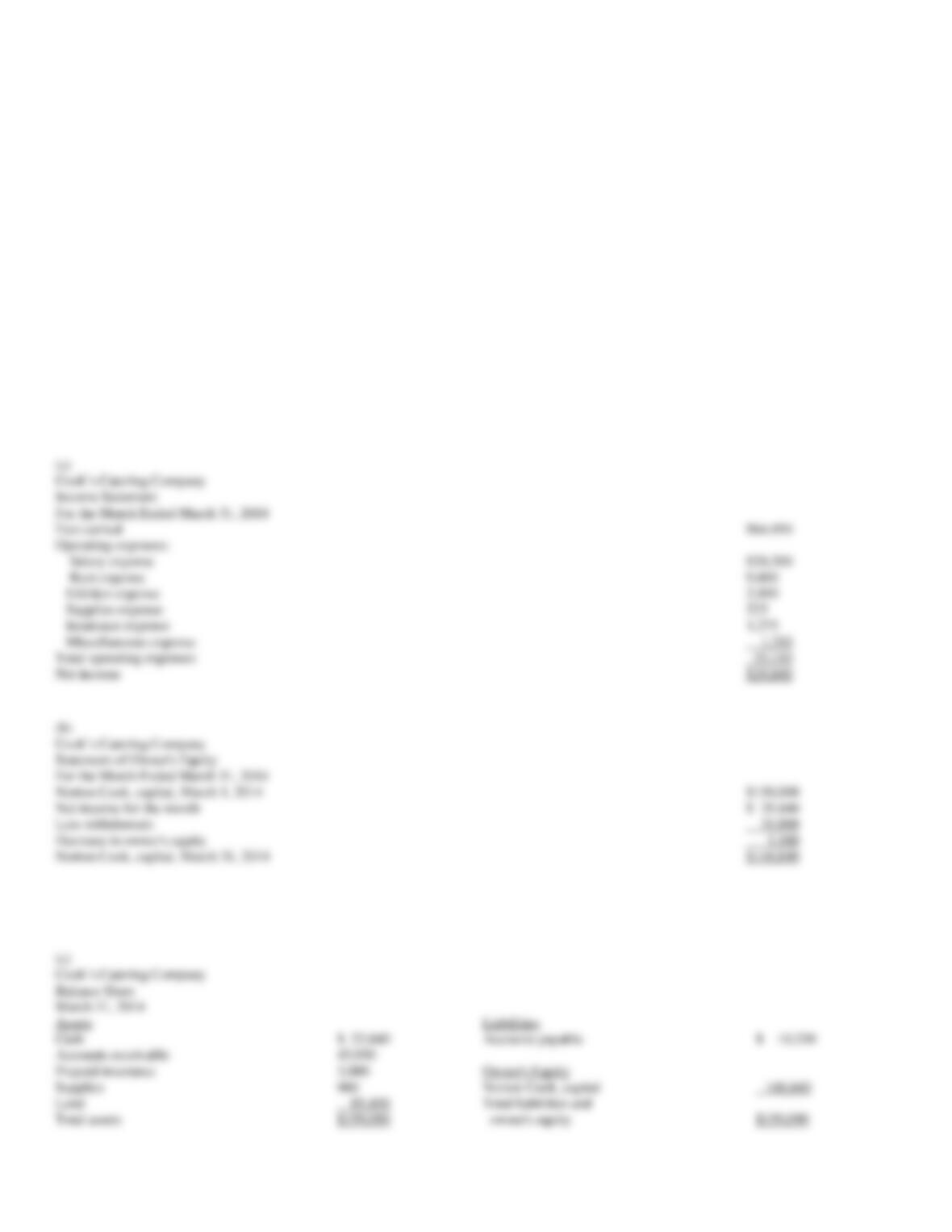
188. On March 1, 2014, the amount of Norton Cook’s capital in Cook’s Catering Company was
$150,000. During March, he withdrew $31,000 from the business. The amounts of the various assets,
liabilities, revenues, and expenses are as follows:
Accounts payable
$ 10,250
Accounts receivable
45,950
Cash
23,840
Fees earned
64,950
Insurance expense
1,275
Land
85,400
Miscellaneous expense
1,210
Prepaid insurance
3,000
Rent expense
9,000
Salary expense
20,300
Supplies
900
Supplies expense
525
Utilities expense
2,800
Present, in good form, (a) an income statement for March, (b) a statement of owner’s equity for March, and (c) a balance sheet as of March 31.
(a)
Fees earned
$64,950
Operating expenses:
Salary expense
$20,300
Rent expense
9,000
Utilities expense
2,800
Supplies expense
525
Insurance expense
1,275
Miscellaneous expense
1,210
Total operating expenses
35,110
Net income
$29,840
(b)
Norton Cook, capital, March 1, 2014
$150,000
Net income for the month
$ 29,840
Less withdrawals
31,000
Decrease in owner’s equity
1,160
Norton Cook, capital, March 31, 2014
$148,840
(c)
Assets
Liabilities
Cash
$ 23,840
Accounts payable
$ 10,250
Accounts receivable
45,950

189. Simpson Designers began operations on April 1, 2011. The financial statements for Simpson Designers
are shown below for the month ended April 30, 2011 (the first month of operations). Determine the missing
amounts for letters (a) through (o).
Simpson Designers
Income Statement
For the Month Ended April 30, 2011
Fees earned
$27,000
Operating expenses:
Wages expense
$5,250
Rent expense
(a)
Supplies expense
4,600
Utilities expense
400
Miscellaneous expense
1,250
Total operating expenses
(b)
Net income
$ (c)
Simpson Designers
Statement of Owner’s Equity
For the Month Ended April 30, 2011
Lori Simpson, capital, April 1, 2011
0
Investment on April 1, 2011
$35,000
Net income for April
(d)
$ (e)
Less withdrawals
6,000
Increase in owner’s equity
(f)
Lori Simpson, capital, April 30, 2011
$38,100
Simpson Designers
Balance Sheet
April 30, 2011
Assets
Liabilities
Cash
$ (g)
Accounts payable
$ (i)
Supplies
8,100
Owner’s Equity
Land
(h)
Lori Simpson, capital
(j)
Total assets
$55,900
Total liabilities and
owner’s equity
$(k)
Simpson Designers
Statement of Cash Flows
For the Month Ended April 30, 2011
Cash flows from operating activities:
Cash received from customers
$23,000
Deduct cash payments for expenses and payments to
creditors
4,200
Net cash flow from operating activities
$ 18,800
Cash flows from investing activities:
Cash payments for acquisition of land
(17,000)
Cash flows from financing activities:
Cash received as owner’s investment
$ (l)
Deduct cash withdrawal by owner
(m)
Net cash flow from financing activities
(n)
Net cash flow and April 30, 2011 cash balance
$ (o)
Place your answers in the space provided below. Hint: Use the interrelationships among the financial statements to solve this problem.
(a)
___________
(b)
___________
(c)
___________

(d)
___________
(e)
___________
(f)
___________
(g)
___________
(h)
___________
(i)
___________
(j)
___________
(k)
___________
(l)
___________
(m)
___________
(n)
___________
(o)
___________
(a)
$ 6,400
(b)
$17,900
(c)
$ 9,100
(d)
$ 9,100
(e)
$44,100
$38,100
(g)
$30,800
(h)
$17,000
(i)
$17,800
(j)
$38,100
(k)
$55,900
(l)
$35,000 given
(m)
$ 6,000
(n)
$29,000
(o)
$30,800

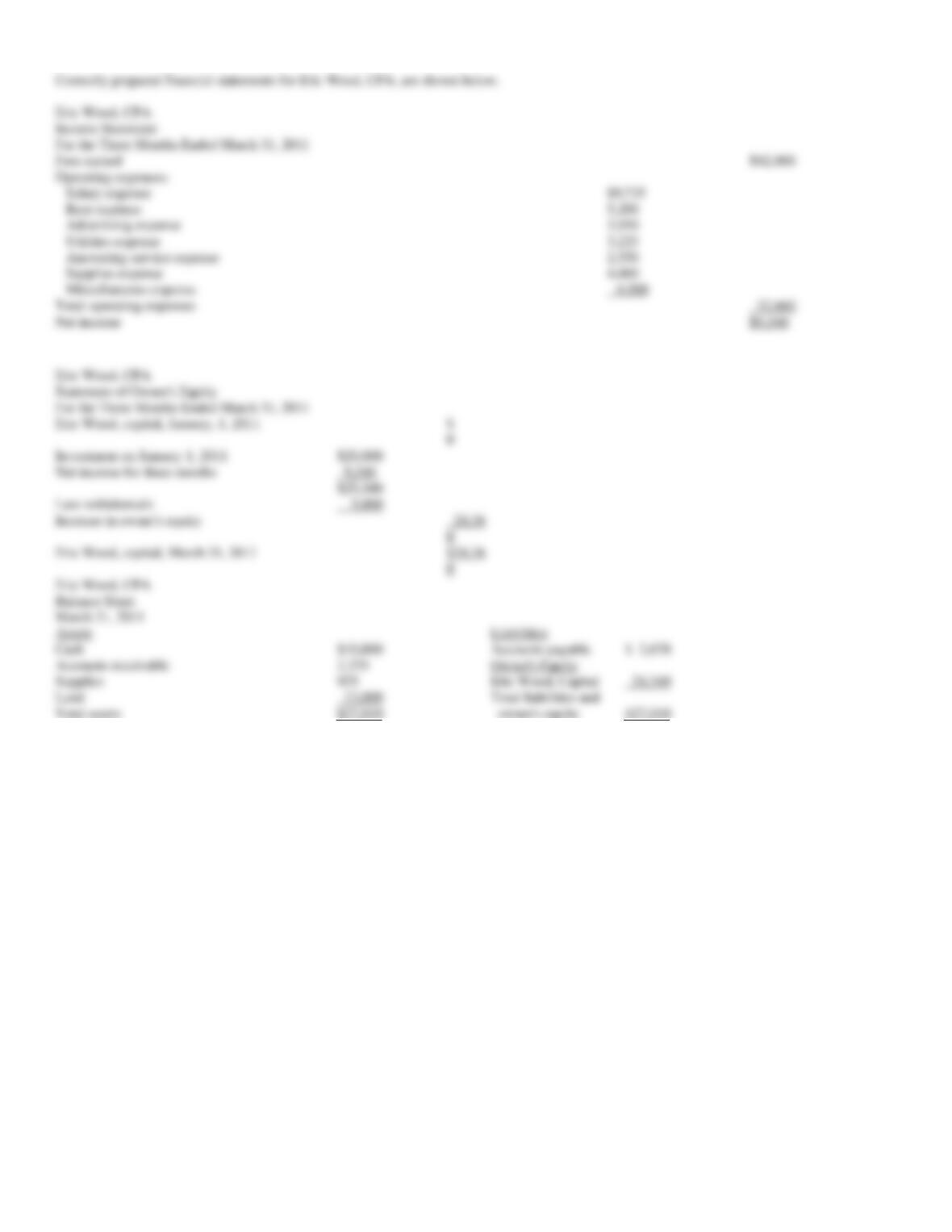
190. Eric Wood, CPA, was organized on January 1, 2011, as a proprietorship. List the errors that you find in
the following financial statements and prepare the corrected statements for the three months ended March 31,
2011.
Eric Wood, CPA
Income Statement
For the Three Months Ended March 31, 2011
Fees earned
$42,000
Operating expenses:
Salary expense
$9,735
Rent expense
5,200
Advertising expense
3,950
Utilities expense
3,225
Miscellaneous expense
4,000
Answering service expense
2,550
Supplies expense
4,000
Total operating expenses
28,000
Net income
$14,000
Eric Wood, CPA
Statement of Owner’s Equity
March 31, 2011
Eric Wood, capital, January, 1, 2011
$ 0
Investment on January 1, 2011
$20,000
Net income for the 3 months
14,000
36,000
Less withdrawals
5,000
Increase in owner’s equity
31,000
Eric Wood, capital, March 31, 2011
$31,000
Balance Sheet
For the Three Months Ended March 31, 2011
Assets
Owner’s Equity
Land
$13,000
Eric Wood, Capital
$31,000
Cash
10,860
Liabilities
Accounts payable
2,670
Accounts receivable
2,225
Supplies
925
Total liabilities and
Total assets
$33,225
owner’s equity
$33,225
Errors in the Eric Wood, CPA, financial statements include the following:
(1)
Miscellaneous expense is incorrectly listed after utilities expense in the income statement. Miscellaneous expense should be listed as the
last expense, regardless of the amount.
(2)
The operating expenses are incorrectly added. Instead of $28,000, the total should be $32,660.
(3)
Because operating expenses are incorrectly added, the net income is incorrect. It should be listed as $9,340.
(4)
The statement of owner’s equity should be for a period of time instead of a specific date. That is, the statement of owner’s equity should
be reported “For the Three Months Ended March 31, 2011.”
(5)
The amount of the owners’ equity is incorrect. It should be $24,340.
(6)
The name of the company is missing from the balance sheet heading.
(7)
The balance sheet should be as of “March 31, 2011,” not “For the Three Months Ended March 31, 2011.”
(8)
Cash, not Land, should be the first asset listed in the balance sheet.
(9)
Accounts Payable is incorrectly listed as an asset in the balance sheet. Accounts Payable should be listed as a liability.
(10)
Liabilities should be listed in the balance sheet ahead of owner’s equity.
(11)
Accounts Receivable is incorrectly listed as a liability in the balance sheet. Accounts Receivable should be listed as an asset.
(12)
The total assets and the total liabilities and owner’s equity do not foot.
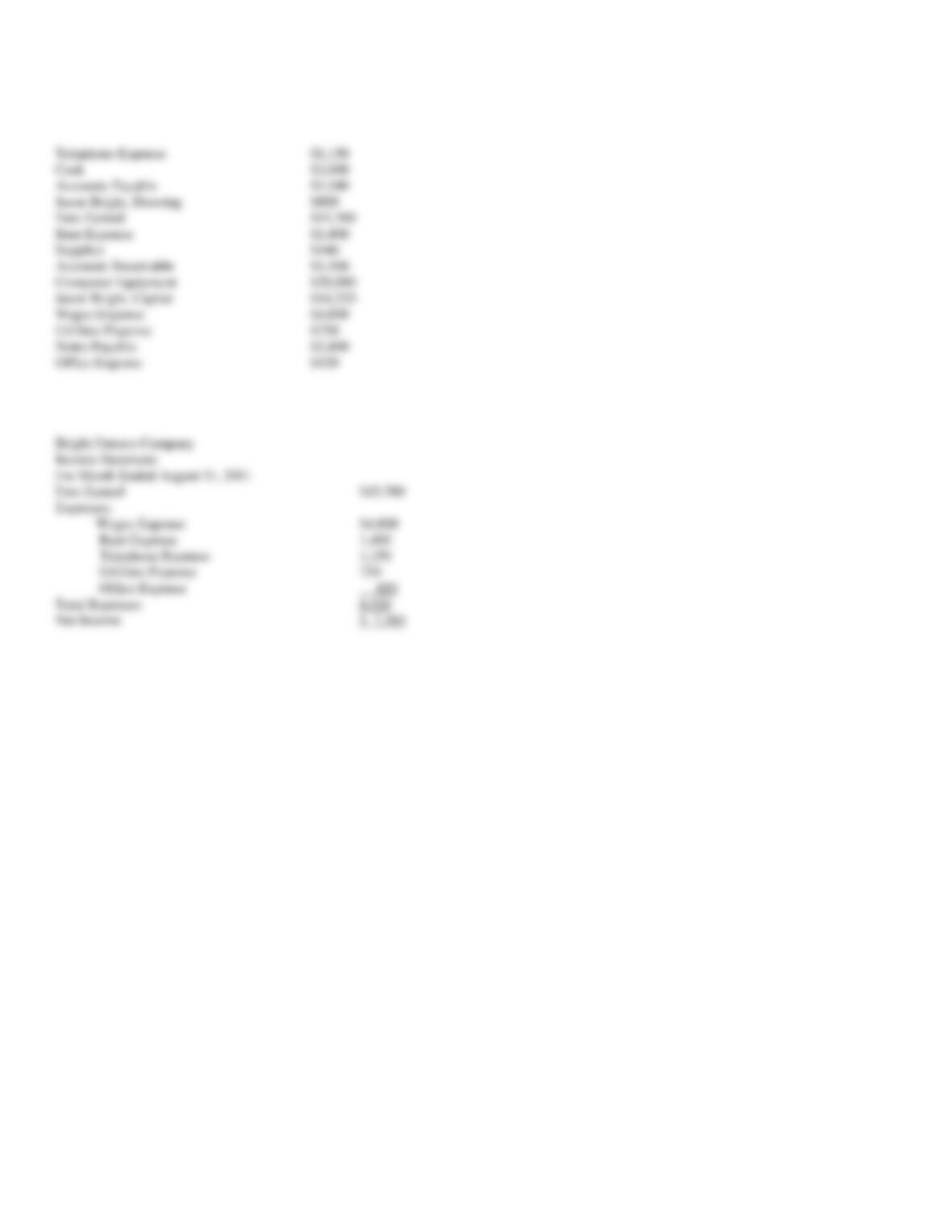
191. Using the following accounts and their amounts, prepare in good format an Income Statement for Bright
Futures Company, month ended August 31, 2011:
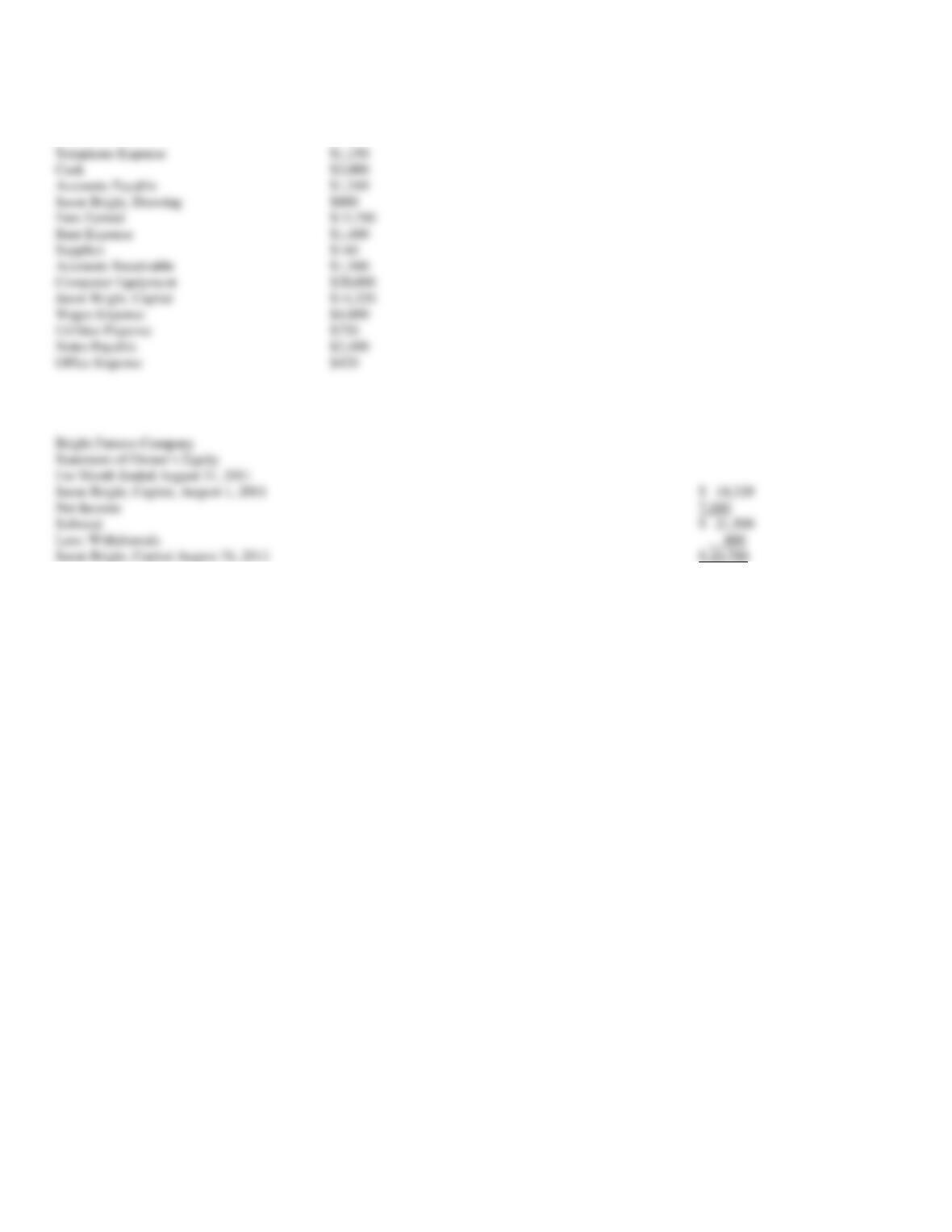
192. Using the following accounts and their amounts, prepare in good format a Statement of Owner’s Equity for
Bright Futures Company, month ended August 31, 2011:
193. Using the following accounts and their amounts, prepare in good format a Balance Sheet for Bright Futures
Company, month ended August 31, 2011:
194. The account balances of Trendsetter Travel Services at December 31, 2014 are listed below:
Accounts Payable
$12,000
J. Trendsetter, Capital 1/1/14
$10,000
Accounts Receivable
14,000
Supplies
1,000
Cash
18,000
Taxes Expense
1,300
Computer Equipment
21,000
Utilities Expense
8,000
Fees Earned
78,000
Wages Expense
25,000
Rent Expense
10,000
Supplies Expense
1,700
Prepare an income statement, statement of owner’s equity, and a balance sheet as of December 31, 2014.
December 31, 2014
Fees Earned
$ 78,000
Operating Expenses:
Wages Expense
$ 25,000
Rent Expense
10,000
Utilities Expense
8,000
Supplies Expense
1,700
Taxes Expense
1,300
Total Operating Expenses
$46,000
Net Income
$32,000
J. Trendsetter, Capital 1/1/14
$10,000
Net Income for the year
32,000
J. Trendsetter, Capital, 12/31/14
$42,000
Cash
$18,000
Accounts Payable
$12,000
Accounts Receivable
14,000
Computer Equipment
21,000
Supplies
1,000
J. Trendsetter, Capital
42,000
Total Assets
$ 54,000
Total Liabilities and Owner’s Equity
$54,000
195. The accountant for Flagger Company prepared the following list of account balances from the company’s
records for the year ended December 31, 2011:
Fees Earned
$165,000
Cash
$ 30,000
Accounts Receivable
14,000
Selling Expenses
44,000
Equipment
42,000
Flagger, Capital
36,000
Accounts Payable
12,000
Interest Income
3,000
Salaries & Wages Expense
40,000
Rent Expense
51,000
Income Taxes Payable
5,000
Prepaid Rent
2,000
Notes Payable
20,000
Income Taxes Expense
18,000
Prepare an Income Statement for Flagger Company in good form.
Flagger Company
Income Statement
For the Year Ended December 31, 2011
Revenues:
Fees earned
$ 165,000
Interest income
3,000
$ 168,000
Expenses:
Rent expense
$ 51,000
Selling expenses
44,000
Income taxes expense
18,000
153,000
Net income
$ 15,000
=======
196. Schultz Tax Services, a tax preparation business had the following transactions during the month of June:
1. Received cash for providing accounting services, $3,000.
2. Billed customers on account for providing services, $7,000.
3. Paid advertising expense, $800.
4. Received cash from customers on account, $3,800.
5. Owner made a withdrawal, $1,500.
6. Received telephone bill, $220.
7. Paid telephone bill, $220
Based on the information given above, calculate the balance of Cash at June 30. (Hint: Use the following
reconcilitation.)
Cash, June 1 $25,000
Plus: cash receipts for June ____________
Minus: cash payments for June ____________
Cash, June 30 ____________