Chapter 1: Accounting as a Form of Communication
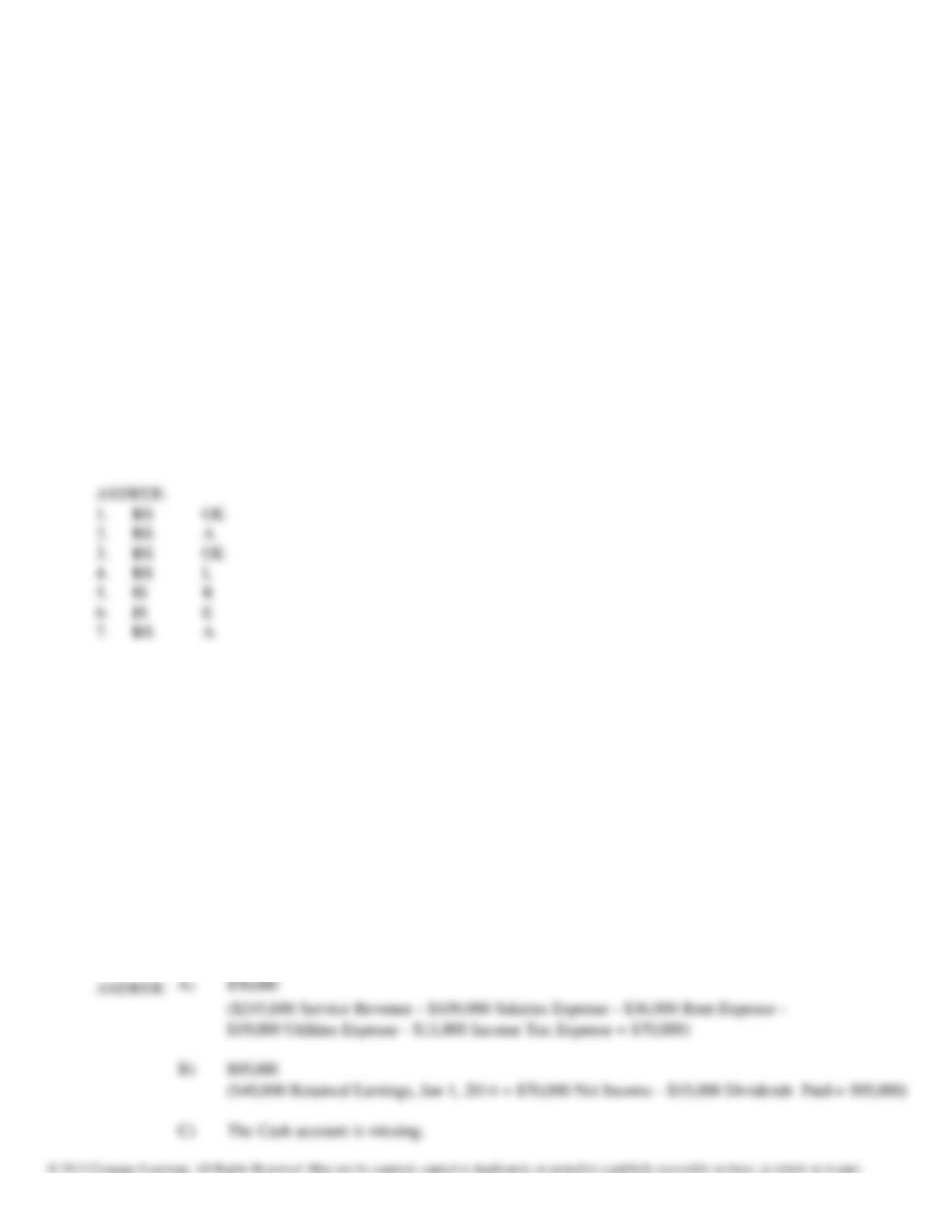
162. Classify the following items according to the financial statement on which each belongs, either the income
statement (IS) or the balance sheet (BS). Also indicate whether each is a revenue (R), expense (E), asset (A),
liability (L), or owners’ equity (OE) item.
Appears on Which Statement?
Type of Account
1.
Retained earnings
_________________
_________________
2.
Buildings
_________________
_________________
3.
Common stock
_________________
_________________
4.
Accounts payable
_________________
_________________
5.
Football ticket sales
_________________
_________________
6.
Salaries expense
_________________
_________________
7.
Accounts receivable
_________________
_________________
163. Several amounts from Duggard Company at December 31, 2014 are listed below. Answer the questions.
Service revenue
$245,000
Salaries expense
$109,000
Dividends declared and paid
15,000
Rent expense
36,000
Buildings
110,000
Land
100,000
Accounts payable
40,000
Accounts receivable
28,000
Capital stock
60,000
Retained earnings, Jan. 1, 2014
40,000
Utilities expense
19,000
Notes payable
30,000
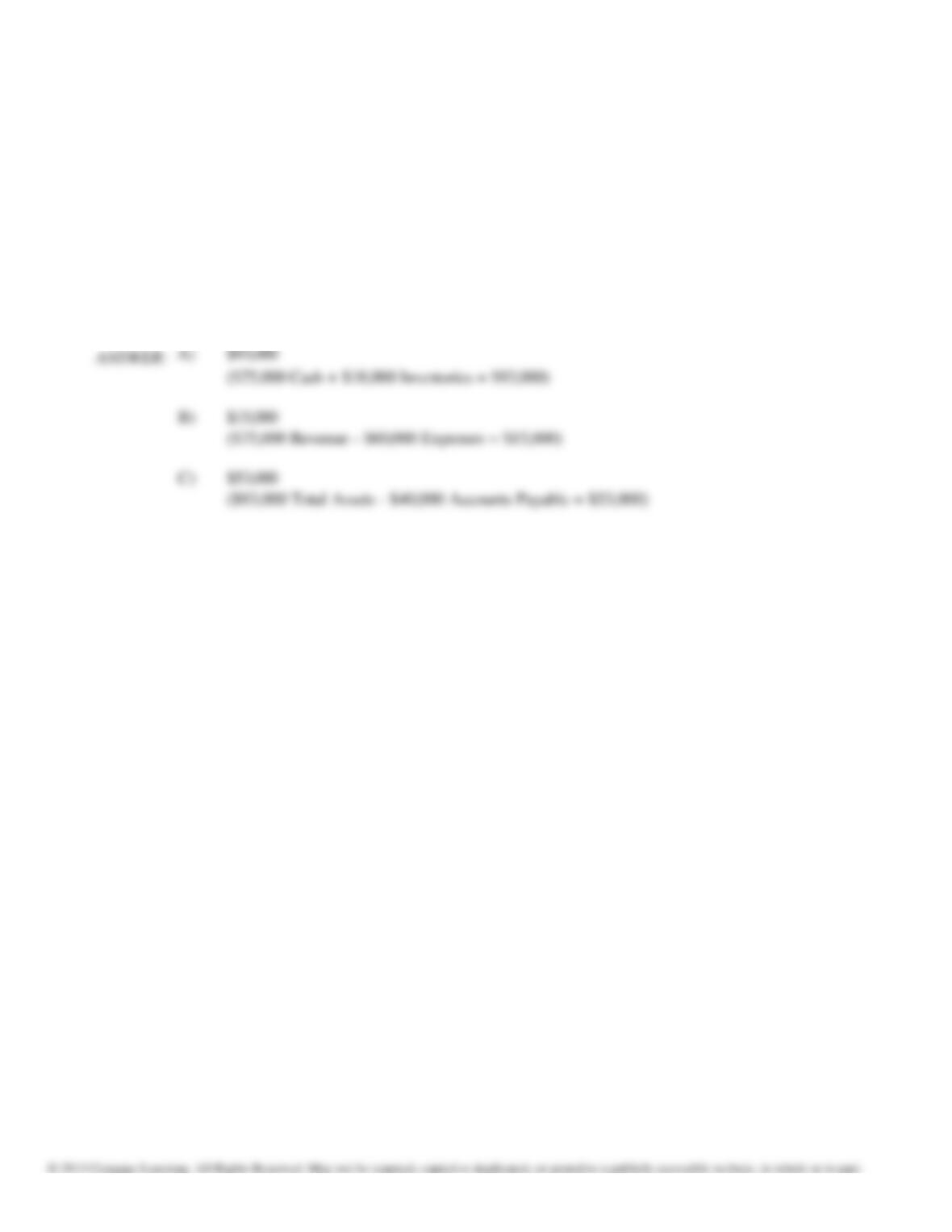
A) Calculate net income for 2014.
B) How much is Duggard Company’s retained earnings at the end of 2014?
C) What primary asset account is missing?
Chapter 1: Accounting as a Form of Communication
164. Gym Corporation reported the following information at December 31, 2014:
Accounts payable
$40,000
Dividends declared and paid
$10,000
Cash
75,000
Expenses
60,000
Inventories
18,000
Revenue
75,000
A) Calculate Gym Corporation’s total assets.
B) Calculate Gym Corporations’ net income for 2014.
C) Calculate Gym Corporation’s total stockholders’ equity at the end of 2014.
Chapter 1: Accounting as a Form of Communication
165. Joseph is the president of Sunshine Enterprises. Sunshine Enterprises began business on January 1, 2014. The
company’s controller is out of the country on business. Joseph needs a copy of the company’s balance sheet for a
meeting tomorrow and asks his assistant to obtain the required information from the company’s records. She
presents Joseph with the following balance sheet. He asks you to review it for accuracy.
Sunshine Enterprises
Balance Sheet
December 31, 2014
ASSETS
LIABILITIES & STOCKHOLDERS’
EQUITY
Accounts payable
$ 30,600
Accounts receivable
$ 24,200
Building and equipment
177,300
Supplies
12,200
Cash
14,700
Capital stock
100,000
Cash dividends declared and paid
16,000
Net income for 2014
113,800
Required
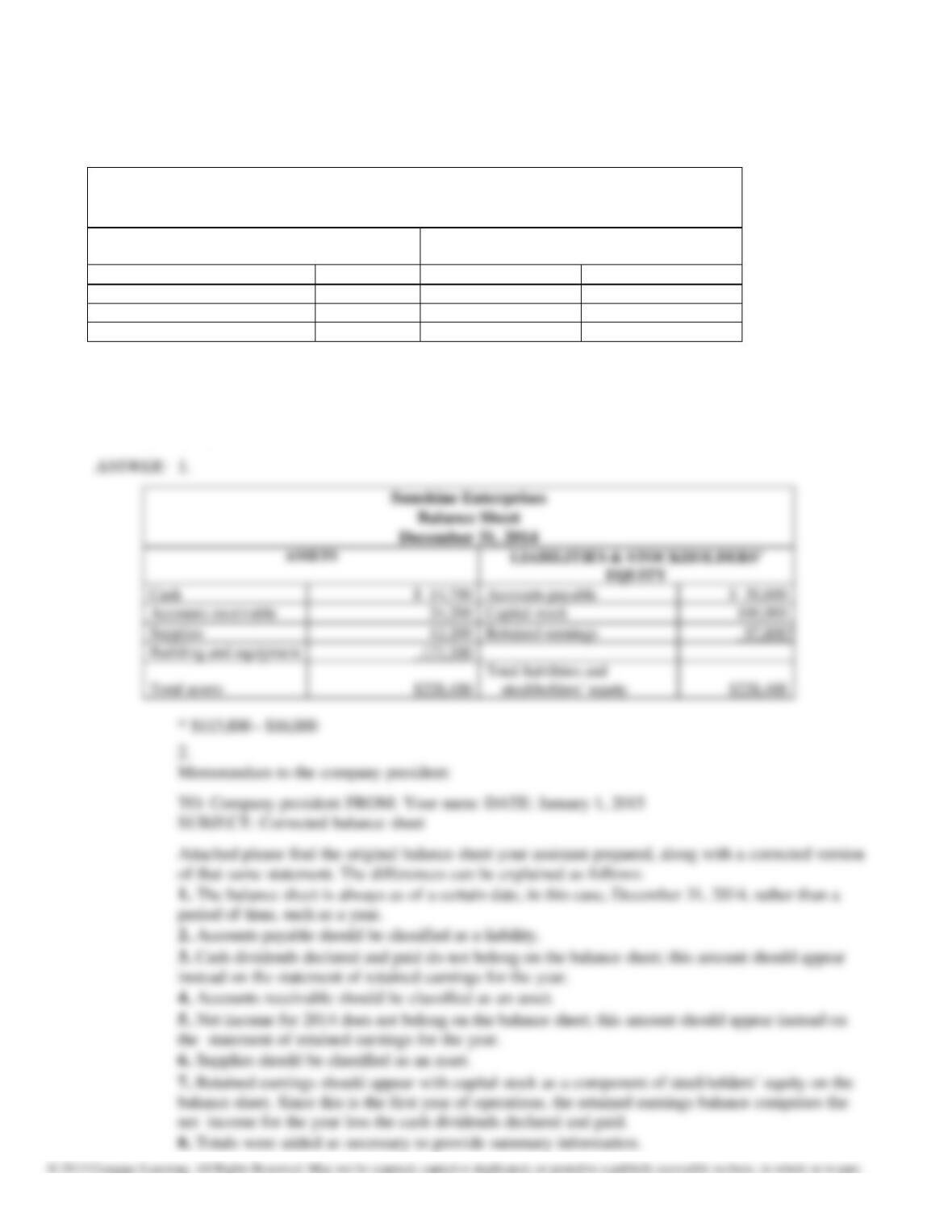
1. Prepare a corrected balance sheet.
2. Draft a memo explaining the major differences between the balance sheet Joseph’s assistant prepared and the
one you prepared.
Cash
Accounts payable
Supplies
Retained earnings
Building and equipment
Chapter 1: Accounting as a Form of Communication
166. The following items are available from the records of Ramos Corporation at the end of its fiscal year, June 30, 2014:
Accounts payable
$17,000
Advertising expense
4,600
Accounts receivable
5,700
Notes payable
50,000
Buildings
35,000
Office equipment
12,000
Inventory
12,100
Retained earnings (end of year)
26,300
Capital stock
25,000
Salary and wage expense
8,230
Cash
21,900
Sales revenue
14,220
Computerized grinders
25,800
Hand Tools
5,800
Required
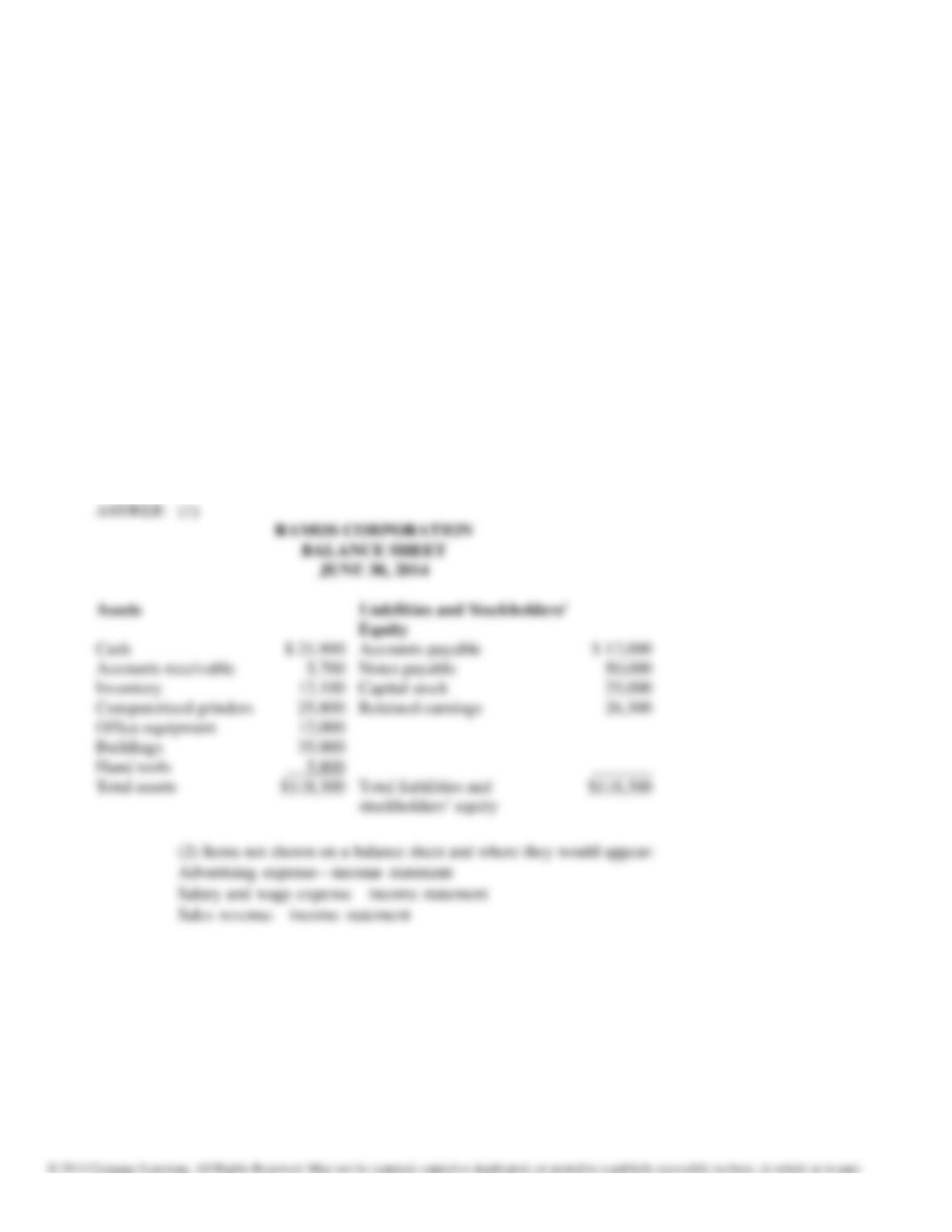
(1) Prepare a balance sheet.
(2) For each non-balance-sheet item, indicate where it should appear.
Cash
Accounts payable
Accounts receivable
Notes payable
Inventory
Capital stock
Computerized grinders
Retained earnings
Office equipment
Buildings
Hand tools
Chapter 1: Accounting as a Form of Communication
167. Tentco reported the following amounts in various statements included in its 2014 annual report. (All amounts are
stated in millions of dollars.)
Net income for 2014
$142
Cash dividends declared in 2014
15
Retained earnings, December 31, 2013
95
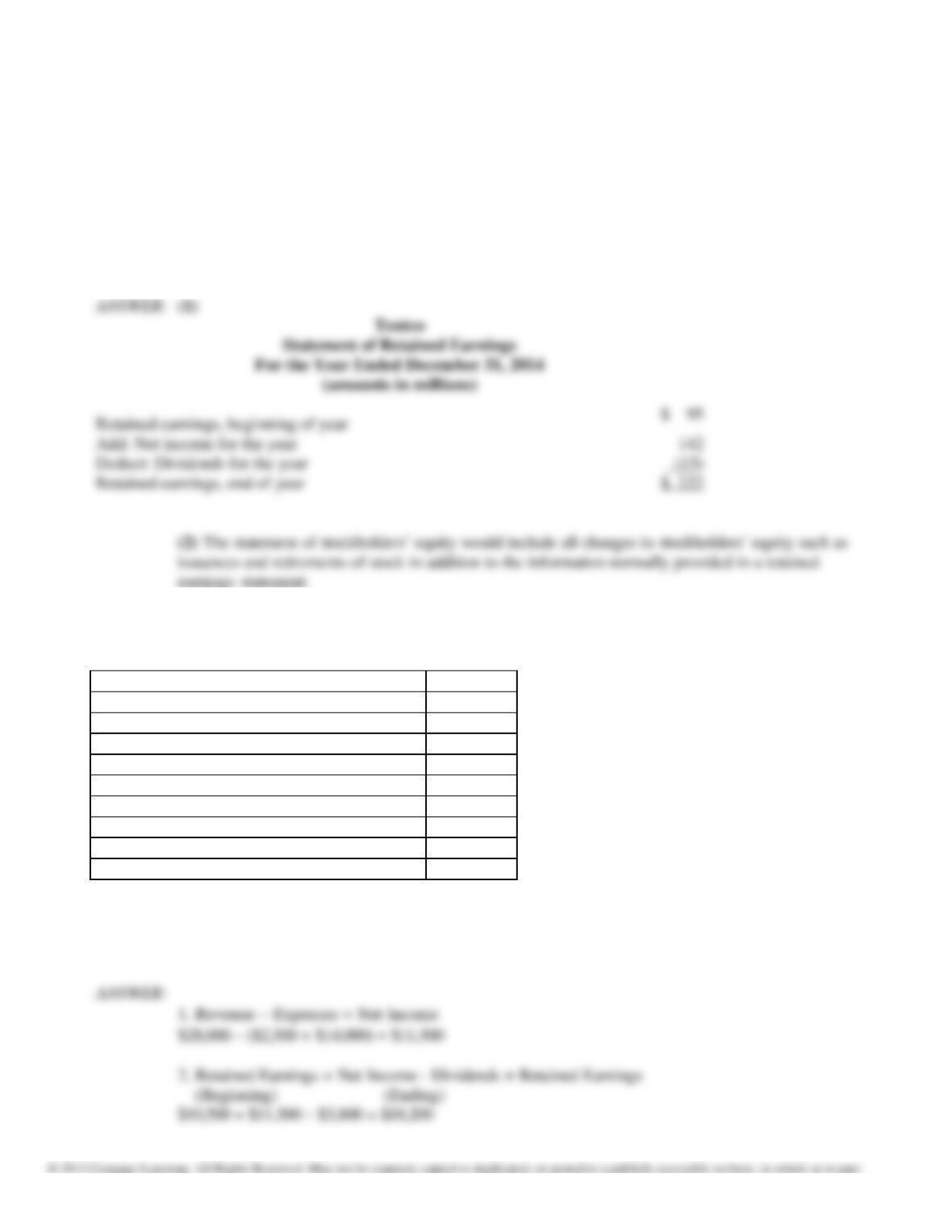
(1) Prepare a Statement of retained earnings for the year ended December 31, 2014.
(2) Assume that Tentco presents a statement of stockholders’ equity rather than a statement of retained earnings
in its annual report. Explain how the information differs between the two statements.
Retained earnings, beginning of year
Add: Net income for the year
Deduct: Dividends for the year
Retained earnings, end of year
168. The following information is available from the records of Focus Seascapes, Inc. at the end of the 2014 calendar
year:
Accounts payable
$ 4,700
Service revenues
28,000
Accounts receivable
3,600
Office equipment
9,200
Capital stock
?
Rent expense
2,500
Cash
13,200
Retained earnings, beginning of year
10,500
Dividends declared and paid during the year
3,800
Salary and wage expense
14,000
Required:
(1) What is Focus’ net income for the year ended December 31, 2014?
(2) What is Focus’ retained earnings balance for the year ended December 31, 2014?
Chapter 1: Accounting as a Form of Communication
169. The following information is available from the records of Focus Seascapes, Inc. at the end of the 2014 calendar
year:
Accounts payable
$ 4,700
Service revenues
28,000
Accounts receivable
3,600
Office equipment
9,200
Capital stock
?
Rent expense
2,500
Cash
13,200
Retained earnings, beginning of year
10,500
Dividends declared and paid during the year
3,800
Salary and wage expense
14,000
Required:
1. What is the total amount of Focus’ assets at December 31, 2014?
2. What is the total amount of Owners’ Equity at December 31, 2014?
3. What is the capital stock balance at December 31, 2014?
170. Rogers Corporation starts the year with a Retained Earnings balance of $55,000. Net income for the year is
$27,000. The ending balance in Retained Earnings is $70,000. What was the amount of dividends declared and paid
for the year?
171. List the names of three companies with which you are familiar that are manufacturers or producers. Also list the
names of three companies that are retailers. Finally, provide the names of three service providers.

Chapter 1: Accounting as a Form of Communication
172. Presented below are condensed data from the financial statements of Unique Factory for 2015 and 2014. The
figures are expressed in thousands. Use this information to answer the questions that follow.
Statement A
2015
2014
Total current assets
$ 82,309
$ 80,080
Property, plant & equipment
(net of accumulated depreciation)
63,451
62,724
Investments
303
1,061
Other assets
3,438
2,606
Total assets
$149,501
$146,471
Total current liabilities
$ 33,928
$ 28,668
Long-term debt
20,491
25,676
Deferred income taxes and contingencies
4,174
5,208
Total liabilities
$ 58,593
$ 59,552
Total stockholders’ equity
90,908
86,919
Total liabilities & stockholders’ equity
$149,501
$146,471
Statement B
2015
2014
Net sales
$209,203
$174,206
Cost of sales
136,225
114,284
Gross profit
72,978
59,922
Selling, general and administrative expenses
63,895
53,520
Other income (expense)
693
(118)
Income (loss) before income taxes
9,776
6,284
Income tax expense
3,534
2,388
Net income (loss)
$ 6,242
$ 3,896
Required: Based on the information provided, is Unique Factory considered a business or non–business entity?
How do you know by examining the financial statements?
Chapter 1: Accounting as a Form of Communication
173. In 2014, you invested $12,000 along with 5 other investors in a new theatre, Rock-On, that offers Broadway play
productions. Because you live out of state, you have not been actively involved in the daily affairs of the theatre.
On January 10, 2015, you are excited because you received $12,000 as a dividend after the end of the 1st year of
the theatre’s existence. Included with your $12,000 check are financial statements and some supplemental
information regarding the accounting. The supplemental information explains:
(1) During the last three months of 2014, an aggressive advertising campaign resulted in the sale of 600 season
tickets for the 2015 productions. Each season ticket cost $120 and the resulting $72,000 was included in 2014
income.
(2) Along with the advertising campaign, the general manager was able to secure pledges of $7,500 for advertising
by local merchants in the playbills for the first two productions for 2015. This amount is included as advertising
revenue in the 2014 financial statements.
REQUIRED:
Are there any problems related to the supplementary disclosures? If so, explain and indicate what effects (over-
or understatements) these items will have on the financial statements.
174. List three different groups of users of accounting information. Indicate the type of decisions each group typically
makes from accounting information.
175. What is the purpose of an income statement?
Chapter 1: Accounting as a Form of Communication
176. List the four financial statements. Explain the connection between these four statements.
177. Presented below are condensed data from the financial statements of Faux Factory for 2015 and 2014. The
figures are expressed in thousands. Use this information to answer the questions that follow.
Statement A
2015
2014
Total current assets
$ 82,309
$ 80,080
Property, plant & equipment
(net of accumulated depreciation)
63,451
62,724
Investments
303
1,061
Other assets
3,438
2,606
Total assets
$149,501
$146,471
Total current liabilities
$ 33,928
$ 28,668
Long-term debt
20,491
25,676
Deferred income taxes and contingencies
4,174
5,208
Total liabilities
$ 58,593
$ 59,552
Total stockholders’ equity
90,908
86,919
Total liabilities & stockholders’ equity
$149,501
$146,471
Statement B
2015
2014
Net sales
$209,203
$174,206
Cost of sales
136,225
114,284
Gross profit
72,978
59,922
Selling, general and administrative expenses
63,895
53,520
Other income (expense)
693
(118)
Income (loss) before income taxes
9,776
6,284
Income tax expense
3,534
2,388
Net income (loss)
$ 6,242
$ 3,896
1. What is the name of Statement A?
2. What is the name of Statement B?

Chapter 1: Accounting as a Form of Communication
178. Presented below are condensed data from the financial statements of Toro Factory for 2015 and 2014. The
figures are expressed in thousands. Use this information to answer the questions that follow.
Statement A
2015
2014
Total current assets
$ 82,309
$ 80,080
Property, plant & equipment
(net of accumulated depreciation)
63,451
62,724
Investments
303
1,061
Other assets
3,438
2,606
Total assets
$149,501
$146,471
Total current liabilities
$ 33,928
$ 28,668
Long-term debt
20,491
25,676
Deferred income taxes and contingencies
4,174
5,208
Total liabilities
$ 58,593
$ 59,552
Total stockholders’ equity
90,908
86,919
Total liabilities & stockholders’ equity
$149,501
$146,471
Statement B
2015
2014
Net sales
$209,203
$174,206
Cost of sales
136,225
114,284
Gross profit
72,978
59,922
Selling, general and administrative expenses
63,895
53,520
Other income (expense)
693
(118)
Income (loss) before income taxes
9,776
6,284
Income tax expense
3,534
2,388
Net income (loss)
$ 6,242
$ 3,896
Required: Which statement indicates the financial position of the company? What information is provided on that
statement that indicates the “financial position” of the company? Explain.

Chapter 1: Accounting as a Form of Communication
179. Presented below are condensed data from the financial statements of Laugh Factory for 2015 and 2014. The
figures are expressed in thousands. Use this information to answer the questions that follow.
Statement A
2015
2014
Total current assets
$ 82,309
$ 80,080
Property, plant & equipment
(net of accumulated depreciation)
63,451
62,724
Investments
303
1,061
Other assets
3,438
2,606
Total assets
$149,501
$146,471
Total current liabilities
$ 33,928
$ 28,668
Long-term debt
20,491
25,676
Deferred income taxes and contingencies
4,174
5,208
Total liabilities
$ 58,593
$ 59,552
Total stockholders’ equity
90,908
86,919
Total liabilities & stockholders’ equity
$149,501
$146,471
Statement B
2015
2014
Net sales
$209,203
$174,206
Cost of sales
136,225
114,284
Gross profit
72,978
59,922
Selling, general and administrative expenses
63,895
53,520
Other income (expense)
693
(118)
Income (loss) before income taxes
9,776
6,284
Income tax expense
3,534
2,388
Net income (loss)
$ 6,242
$ 3,896
Required: Was Laugh Factory profitable both years? What are the amounts of the total revenues and total
expenses, respectively, for 2015? Which financial statement provides this information to you?