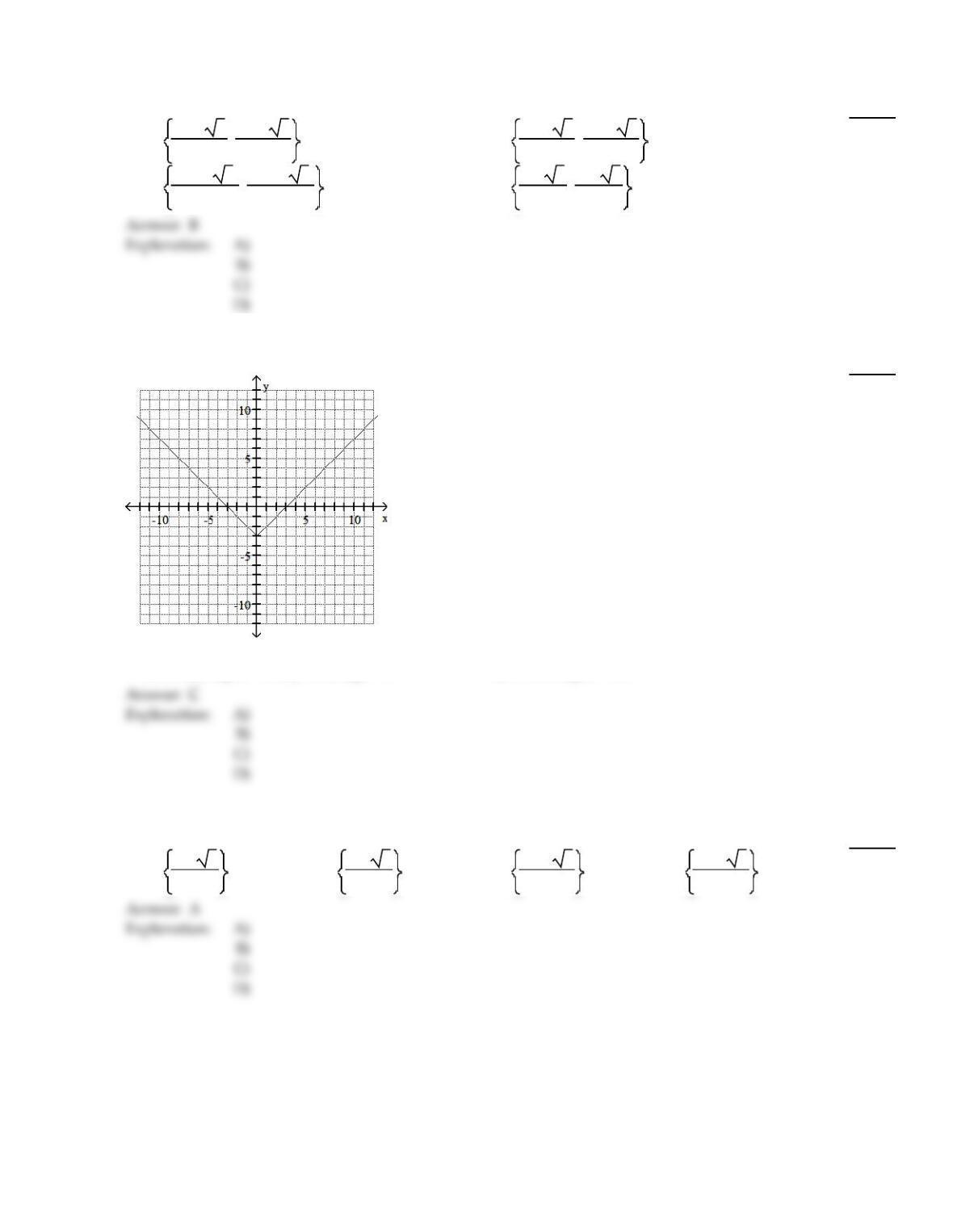
Solve the equation using the quadratic formula.
119)
x2+5x +5= 0
119)
A)
–5–5
10 , –5+5
10
B)
–5–5
2, –5+5
2
C)
–5–3 5
2, –5+3 5
2
D)
5–5
2, 5+5
2
Use the graph to determine the x– and y–intercepts.
120)
120)
A)
x–intercepts: –3, 3; y–intercept: 0
B)
y–intercept: –3
C)
x–intercepts: –3, 3; y–intercept: –3
D)
x–intercepts: –3, 3
C
Solve the equation by making an appropriate substitution.
121)
x–2– 12x–1+ 34 = 0
121)
A)
6±2
34
B)
6±2
38
C)
–6±2
34
D)
6± 2 2
34
A
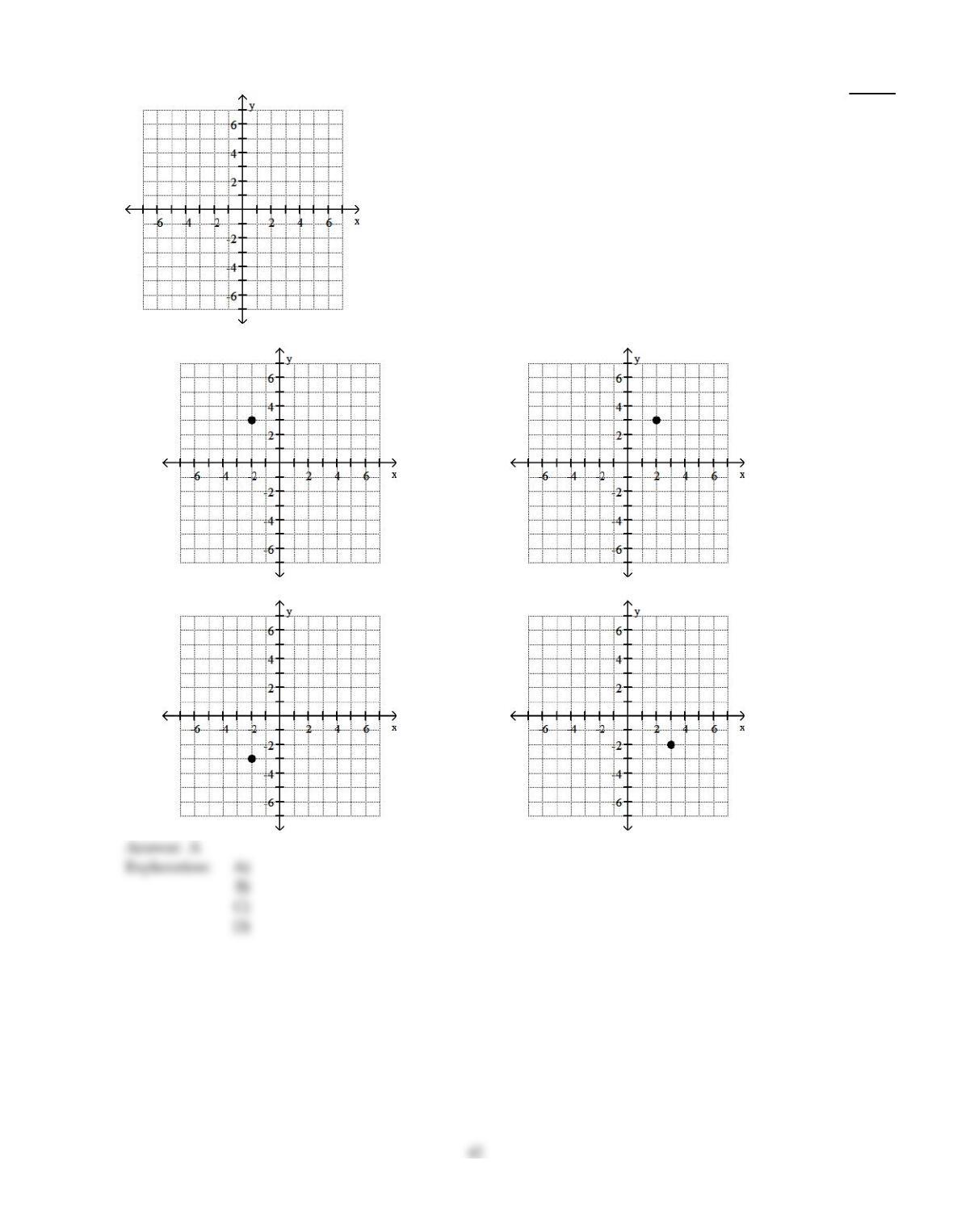
Plot the given point in a rectangular coordinate system.
41
B
122)
(–2, 3)
122)
A)
B)
C)
D)
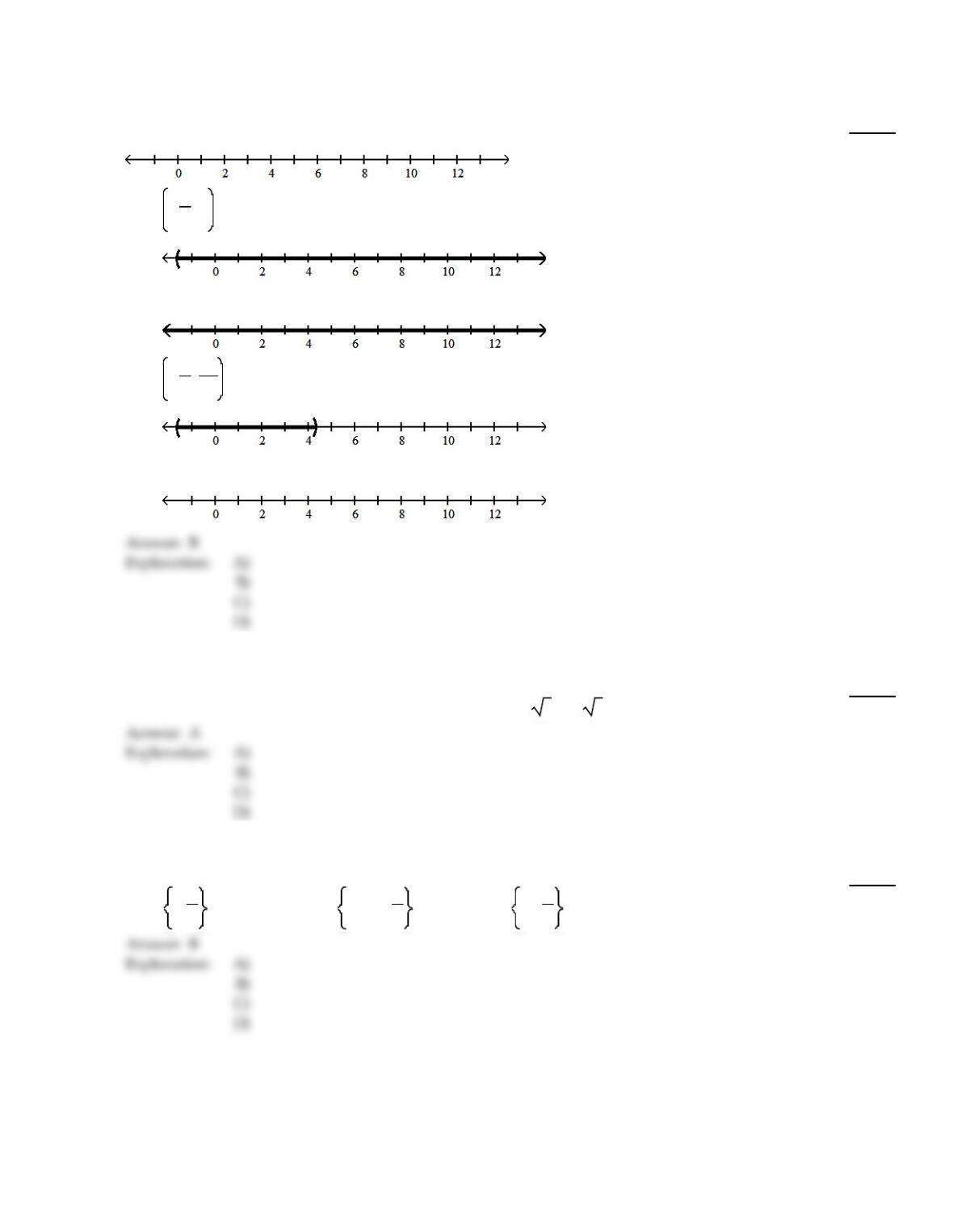
Solve the absolute value inequality. Other than , use interval notation to express the solution set and graph the solution
set on a number line.
123)
|3x – 4| + 1 > – 8
123)
A)
–5
3,
B)
(–, )
C)
–5
3, 13
3
D)
Solve the polynomial equation by factoring and then using the zero product principle.
124)
2x4–50x2= 0
124)
A)
{–5, 0, 5}
B)
{0}
C)
{–5 2, 0, 5 2}
D)
{–5, 5}
Solve the equation by making an appropriate substitution.
125)
(8x + 8)2+ 12(8x + 8) + 32 = 0
125)
A)
0, 1
2
B)
– 2, – 1 1
2
C)
2, 11
2
D)
{–8, –4}
43
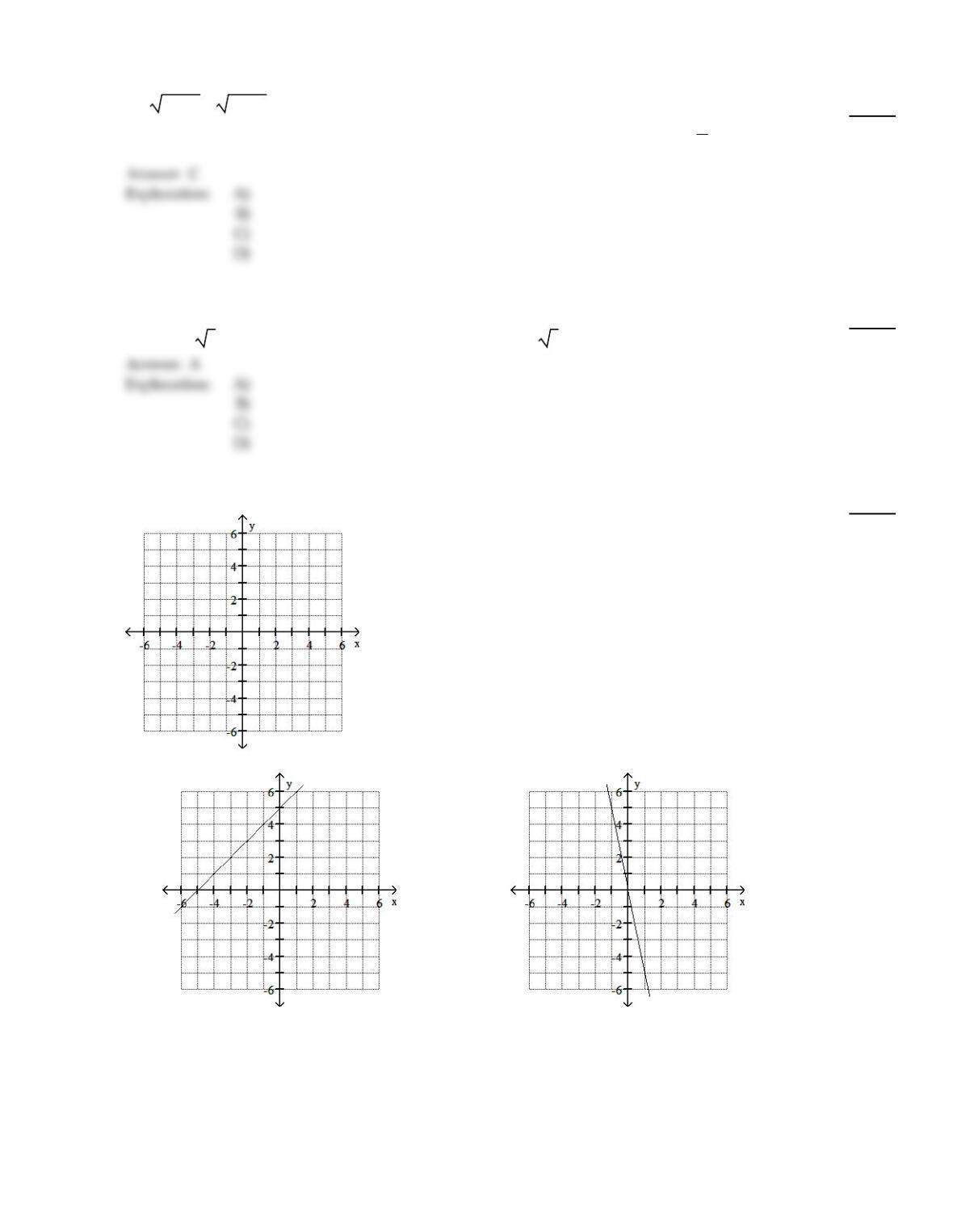
Find the x–intercepts of the graph of the equation.
126)
y =3x – 2 +11 + x + 1
126)
A)
0
B)
5
C)
No x–intercepts
D)
–5
2
Solve the equation by the square root property.
127)
(x –3)2= – 6
127)
A)
{3 ± i 6}
B)
{–3, 9}
C)
{3 ±6}
D)
{–3±6i}
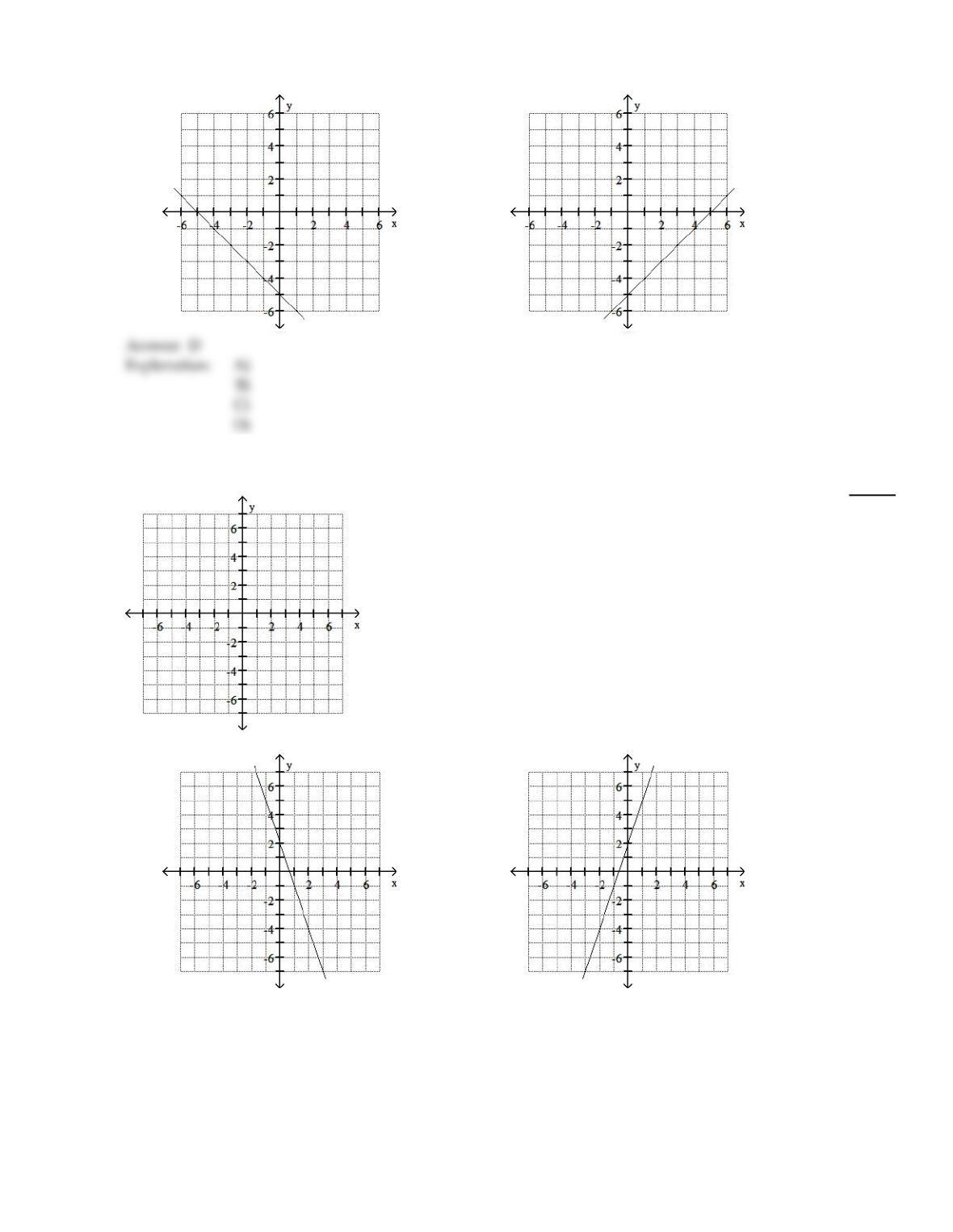
Graph the equation.
128)
y = x – 5
128)
A)
B)
44
C)
D)
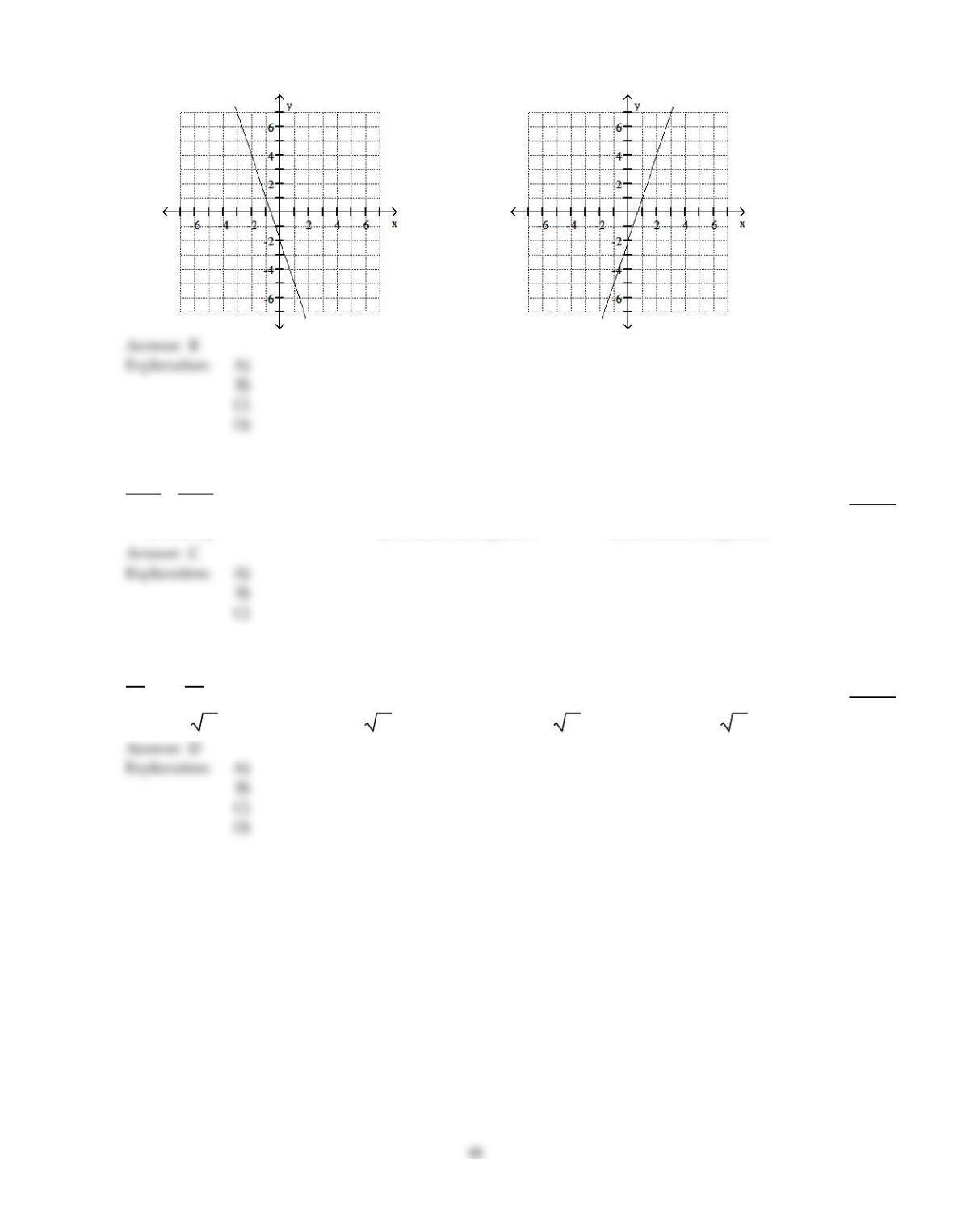
Write the English sentence as an equation in two variables. Then graph the equation.
129)
The y–value is two more than three times the x–value.
129)
A)
y = – 3x +2
B)
y =3x +2
45
C)
y = – 3x –2
D)
y =3x –2
Determine whether the equation is an identity, a conditional equation, or an inconsistent equation.
130)
3x
x –6=18
x –6+2
130)
A)
Identity
B)
Conditional equation
C)
Inconsistent equation
Solve the equation by the method of your choice.
131)
x2
12 + x +13
12 = 0
131)
A)
{6 +23}
B)
{6 ±13}
C)
{–12 +13}
D)
{–6±23}
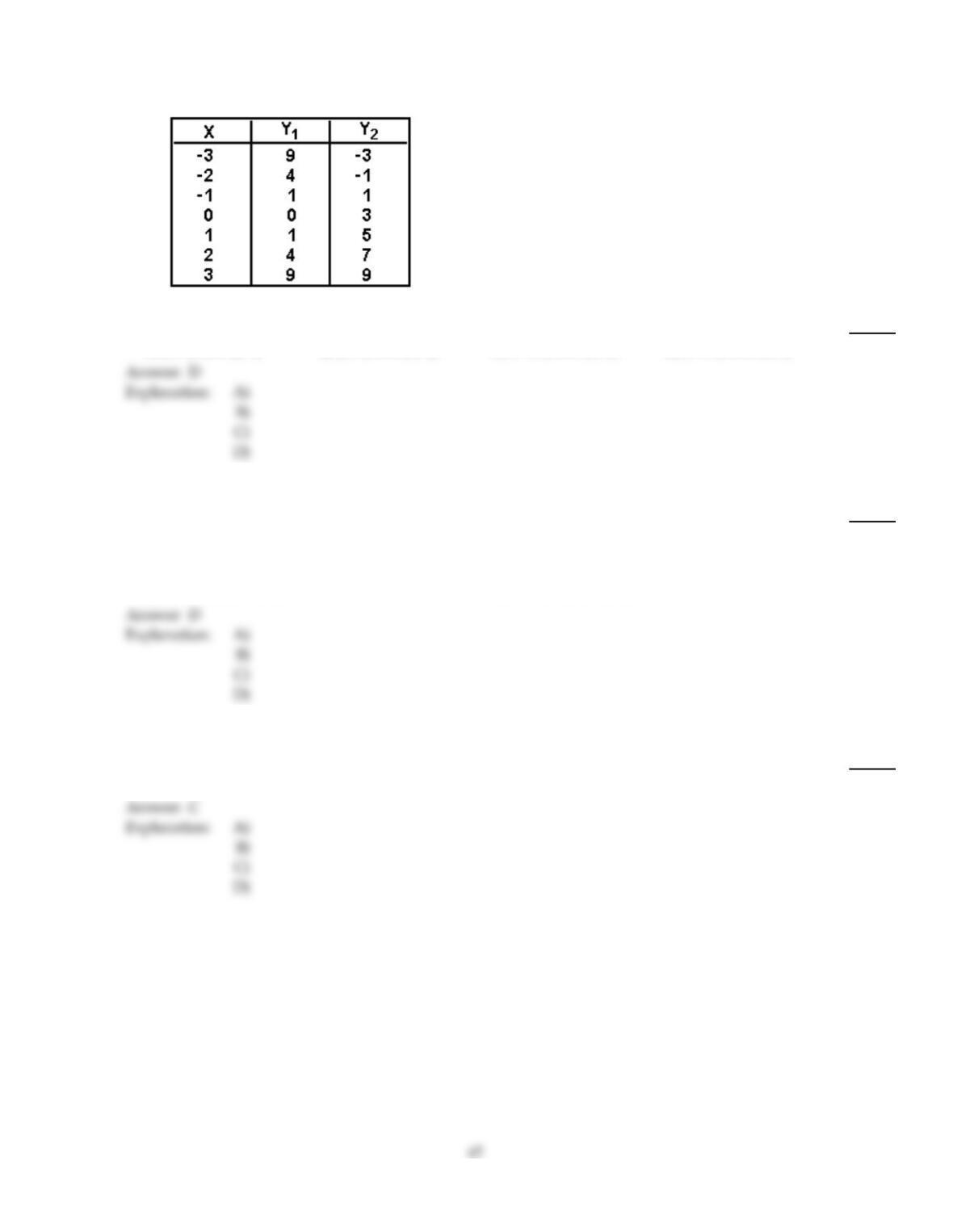
The table of values was generated by a graphing utility with a TABLE feature. Use the following table to solve.
132)
At which points do the graph of Y1 and Y2 intersect?
132)
A)
(0, 1) and (3, 9)
B)
(0, 3) and (0, 1)
C)
(–1, 1) and (0, 3)
D)
(–1, 1) and (3, 9)
Solve the problem.
133)
When making a long distance call from a certain pay phone, the first three minutes of a call cost
$2.40. After that, each additional minute or portion of a minute of that call costs $0.30. Use an
inequality to find the number of minutes one can call long distance for $4.20.
133)
A)
14 minutes or fewer
B)
6 minutes or fewer
C)
2 minutes or fewer
D)
9 minutes or fewer
Find the product and write the result in standard form.
134)
(6 – 2i)2
134)
A)
32
B)
36 – 24i +4i2
C)
32 – 24i
D)
40 – 24i
Solve the problem.
135)
A landscaping company sells 40–pound bags of top soil. The actual weight x of a bag, however,
may differ from the advertised weight by as much as 0.75 pound. Write an inequality involving
absolute value that expresses the relationship between the actual weight x of a bag and 40 pounds.
Solve the inequality, and express the answer in interval form.
135)
A)
|x|– 40 0.75 ; ( , 40.75]
B)
|40 + x| 0.75; [39.25, 40.75]
C)
|x + 0.75| 40; [39.25, )
D)
|40 – x| 0.75; [39.25, 40.75]
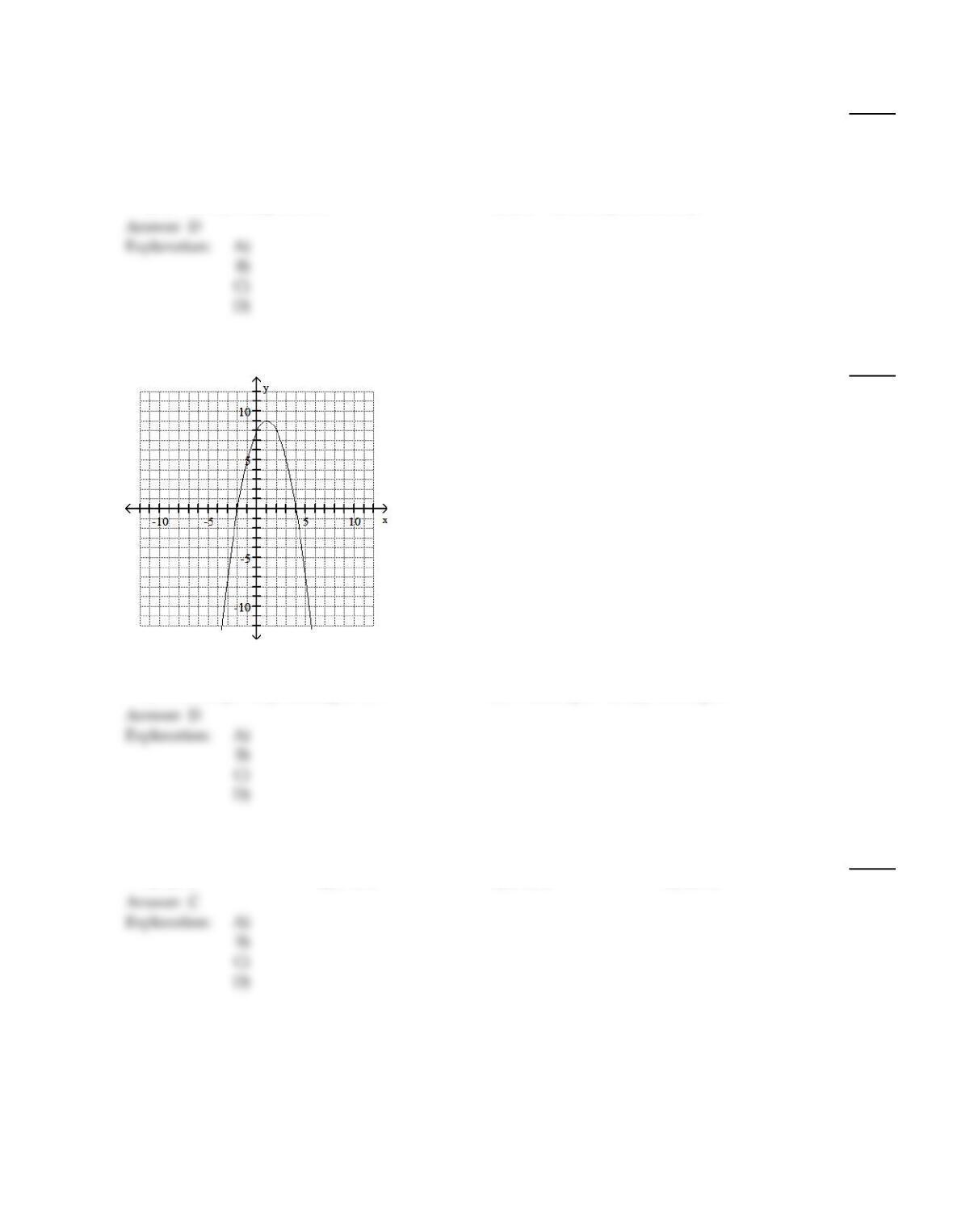
Use the graph to determine the x– and y–intercepts.
136)
136)
A)
x–intercept: 4; y–intercept: 8
B)
x–intercept: 8; y–intercepts: –2, 4
C)
x–intercept: –2; y–intercepts: 4, 8
D)
x–intercepts: –2, 4; y–intercept: 8
Solve the equation by the square root property.
137)
(2x + 2)2=16
137)
A)
{1, 3}
B)
{–9, 9}
C)
{–3, 1}
D)
{0, 1}
48
Solve the problem.
138)
A local race for charity has taken place since 1993. Using the actual speeds of the winners from 1993
through 1998, mathematicians obtained the formula y =0.19x +5, in which x represents the number
of years after 1993 and y represents the winning speed in miles per hour. In what year is the
winning speed predicted to be 7.28 mph?
138)
A)
2007
B)
2006
C)
2004
D)
2005
Find the product and write the result in standard form.
139)
6i(–3i + 3)
139)
A)
–18 + 18i
B)
18i – 18i2
C)
18i + 18i2
D)
18 + 18i
Solve the problem.
140)
A rain gutter is made from sheets of aluminum that are 24 inches wide. The edges are turned up to
form right angles. Determine the depth of the gutter that will allow a cross–sectional area of 58
square inches. There are two solutions to this problem. Round to the nearest tenth of an inch.
140)
A)
2.2 in. and 17.0 in.
B)
2.7 in. and 21.3 in.
C)
3.4 in. and 8.6 in.
D)
4.0 in. and 10.4 in.
Perform the indicated operations and write the result in standard form.
141)
–64(6 – – 64)
141)
A)
64 + 48i
B)
48i + 64i2
C)
48i – 64
D)
48i – 64i2
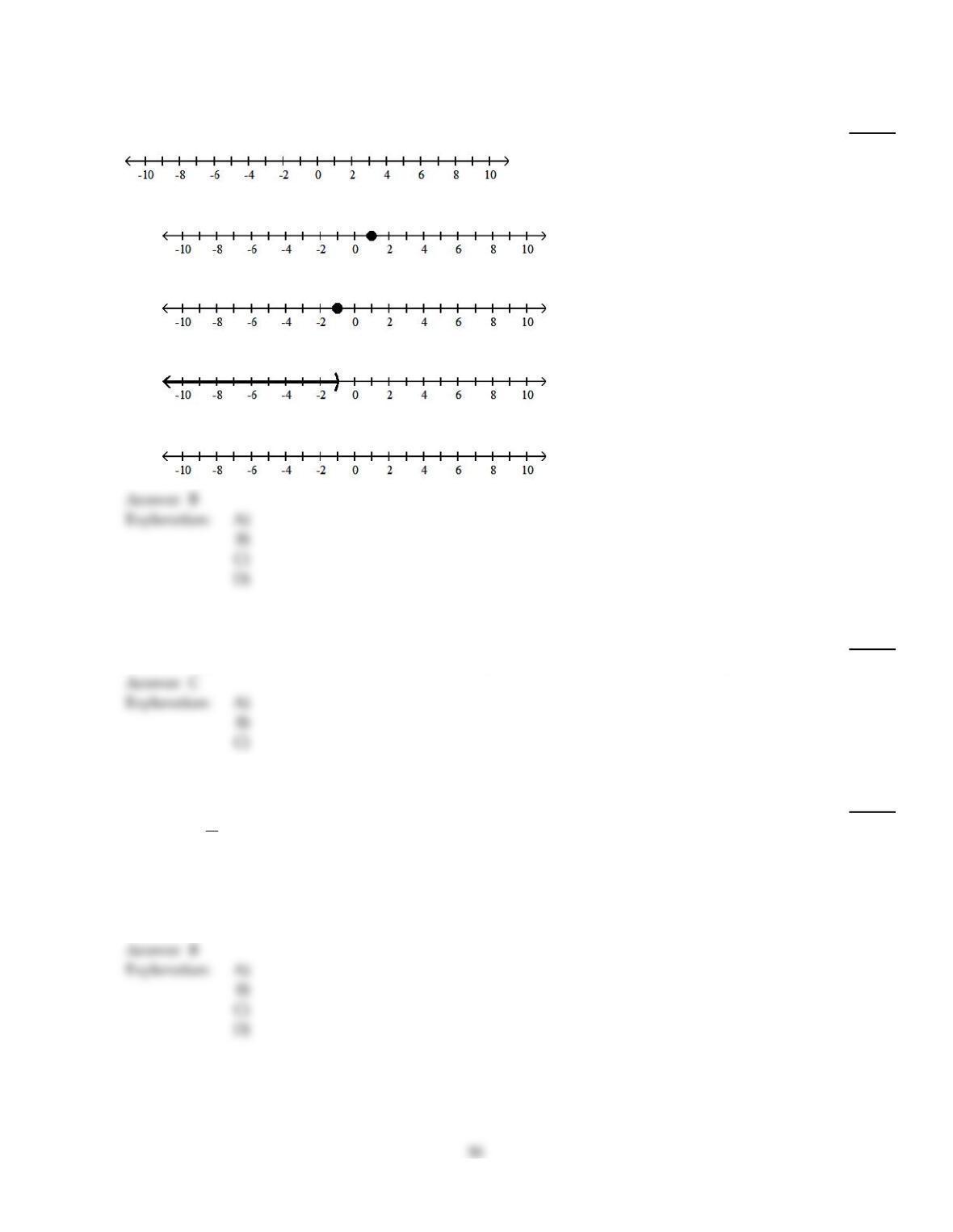
Solve the absolute value inequality. Other than , use interval notation to express the solution set and graph the solution
set on a number line.
142)
|x + 1| 0
142)
A)
{1}
B)
{–1}
C)
(–, –1)
D)
Determine whether the equation is an identity, a conditional equation, or an inconsistent equation.
143)
–4(x + 6) + 165 =5x –9(x – 9)
143)
A)
Identity
B)
Conditional equation
C)
Inconsistent equation
C
Solve the problem.
144)
The formula for converting Celsius temperature, C, to Fahrenheit temperature, F, is
F =9
5C + 32.
If Fahrenheit temperature ranges from 113° to 248°, inclusive, what is the range for the Celsius
temperature?
144)
A)
(235°C, 478°C)
B)
[45°C, 120°C]
C)
(45°C, 120°C)
D)
[235°C, 478°C]
B
B
145)
After a 9% price reduction, a boat sold for $29,120. What was the boat’s price before the reduction?
(Round to the nearest cent, if necessary.)
145)
A)
$31,740.80
B)
$323,555.56
C)
$2620.80
D)
$32,000
Add or subtract as indicated and write the result in standard form.
146)
(–5+ 3i) – 9
146)
A)
14 – 3i
B)
–14 + 3i
C)
4+ 3i
D)
4– 3i
B
First, write the value(s) that make the denominator(s) zero. Then solve the equation.
147)
x –8
2x +5=x +4
x
147)
A)
x 0, 2; 16
9
B)
x 0; 16
9
C)
No restrictions; 6
5
D)
x 0; – 11
B
Solve the problem.
148)
Using data from 1996–1998, the annual number of cars sold at a certain dealership can be modeled
by the formula
y =3x +4,
where y is the number of cars, in thousands, sold x years after 1996. According to this formula, in
which years will the number of cars sold exceed 25 thousand?
148)
A)
Years after 2007
B)
Years after 2003
C)
Years after 2001
D)
Years after 2005
B
D
Solve the absolute value equation or indicate that the equation has no solution.
149)
x + 3 =8
149)
A)
{11, 5}
B)
{–11, 5}
C)
{–5}
D)
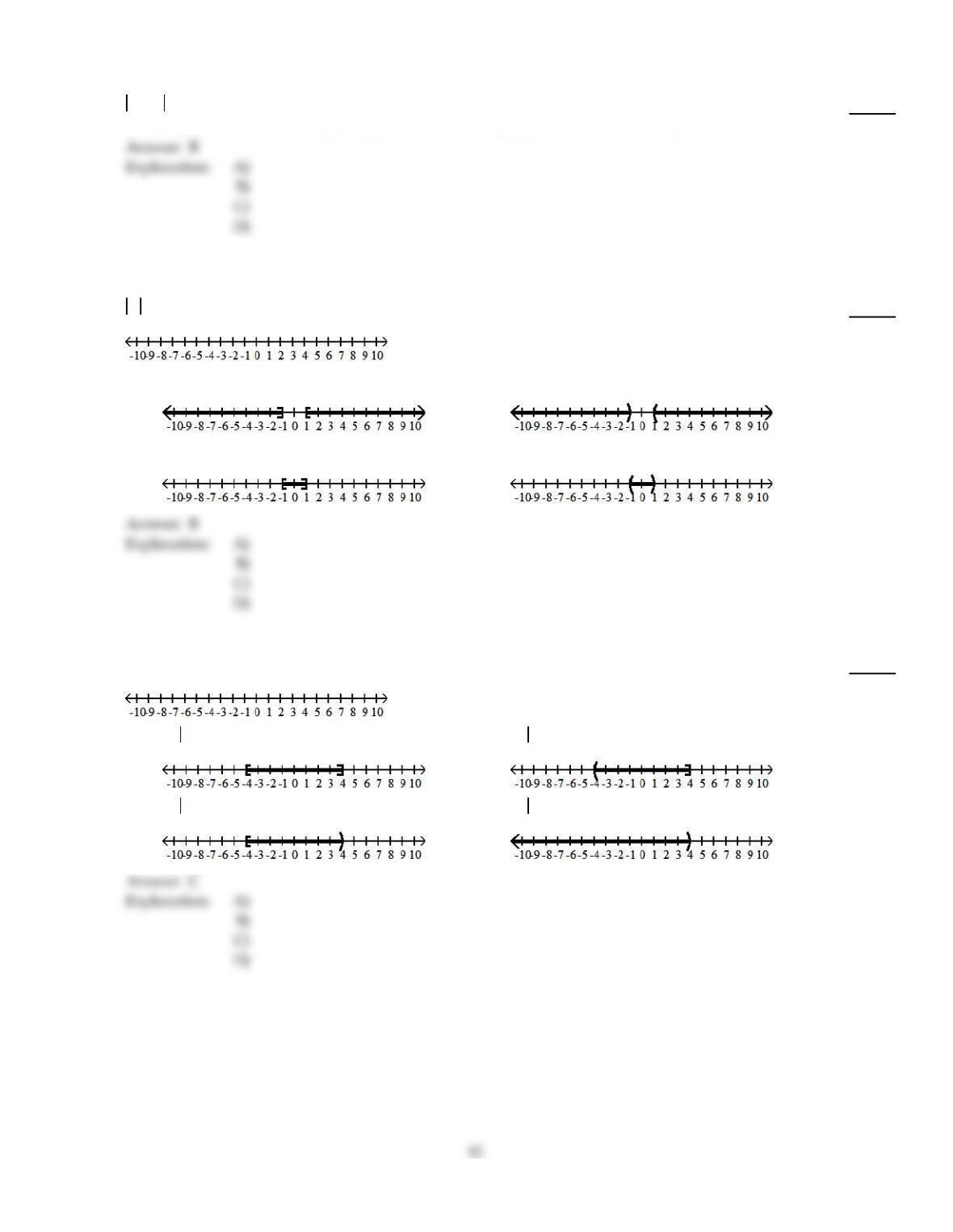
Solve the absolute value inequality. Other than , use interval notation to express the solution set and graph the solution
set on a number line.
150)
x>1
150)
A)
(–, –1] [1, )
B)
(–, –1) (1, )
C)
[–1, 1]
D)
(–1, 1)
Express the interval in set–builder notation and graph the interval on a number line.
151)
[–4, 4)
151)
A)
{x –4 x 4}
B)
{x –4< x 4}
C)
{x –4 x <4}
D)
{x x <4}
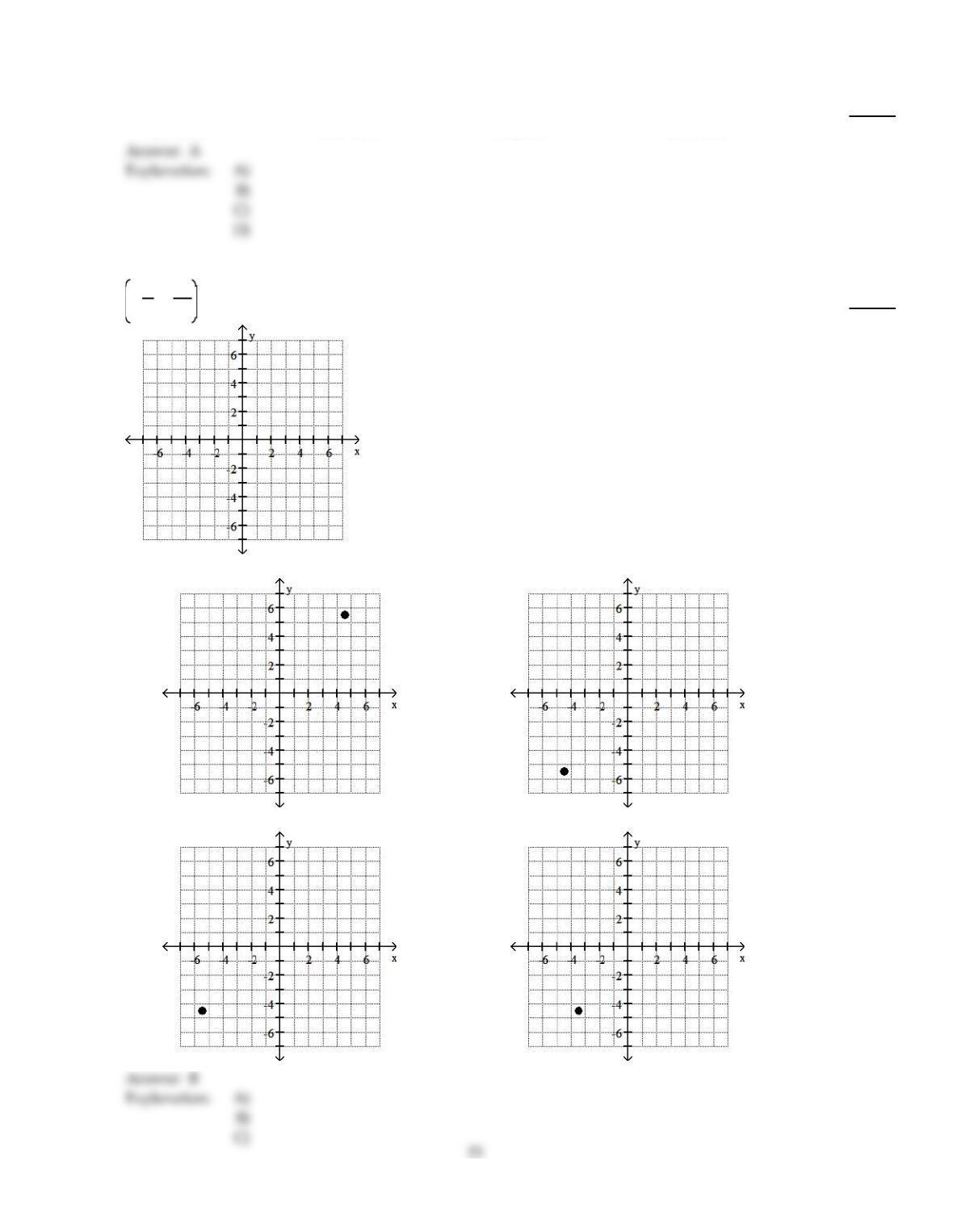
Solve the equation using the quadratic formula.
152)
x2+ 6x – 16 = 0
152)
A)
{–8, 2}
B)
{–8, 1}
C)
{8, 2}
D)
{–2, 8}
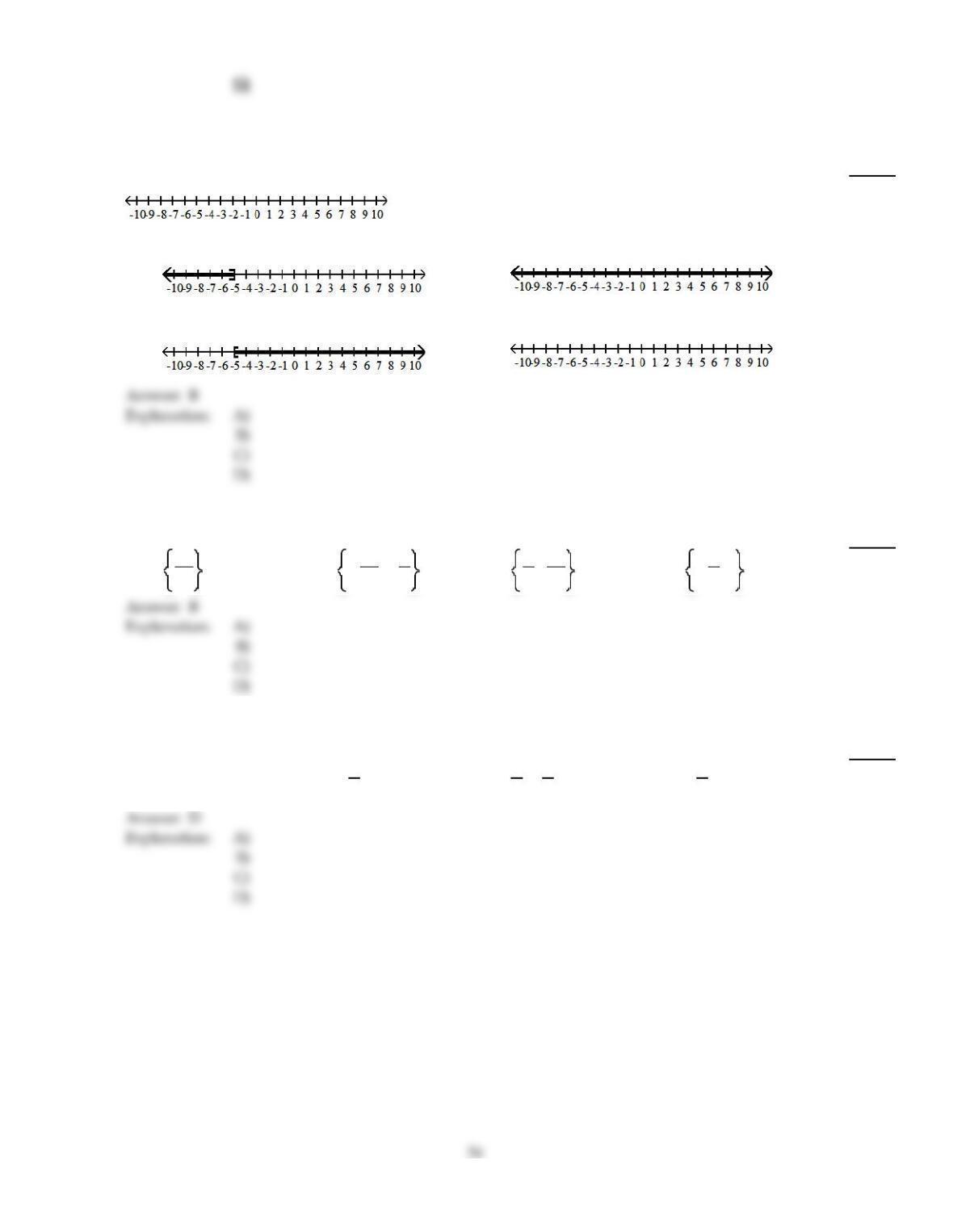
Plot the given point in a rectangular coordinate system.
153)
–9
2, –11
2
153)
A)
B)
C)
D)
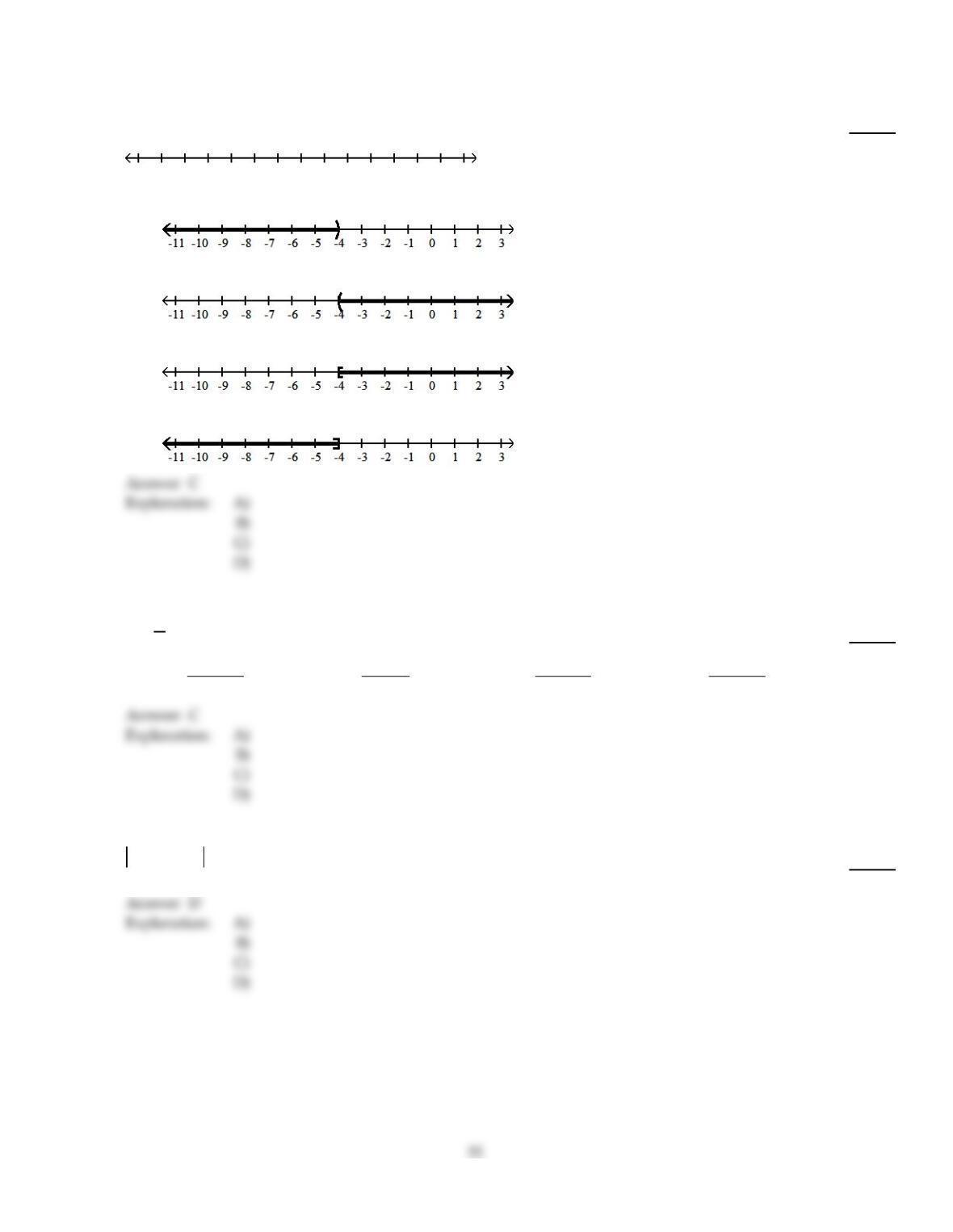
Solve the linear inequality. Other than , use interval notation to express the solution set and graph the solution set on a
number line.
154)
–3x –3(x – 5)
154)
A)
( , –5]
B)
( , )
C)
[–5, )
D)
Solve the equation by the method of your choice.
155)
(2x + 9)2=64
155)
A)
55
2
B)
–17
2, –1
2
C)
1
2, 17
2
D)
–1
2, 0
Find all values of x satisfying the given conditions.
156)
y =4x2– 7x – 2 and y = 0
156)
A)
–4, 2
B)
–1
4, 4
C)
1
7, –1
4
D)
–1
4, 2
Solve the linear inequality. Other than , use interval notation to express the solution set and graph the solution set on a
number line.
157)
–8x + 6 –2(3x – 7)
157)
A)
(–, –4)
B)
(–4, )
C)
[–4, )
D)
(–, –4]
Solve the formula for the specified variable.
158)
A =1
2h(a + b) for a
158)
A)
a=hb – 2A
h
B)
a=A – hb
2h
C)
a=2A – hb
h
D)
a=2Ab– h
h
Solve the absolute value equation or indicate that the equation has no solution.
159)
x2– 4x – 4 = 8
159)
A)
{–2, 2}
B)
{–2, 2, –6}
C)
{2, 6}
D)
{–2, 2, 6}
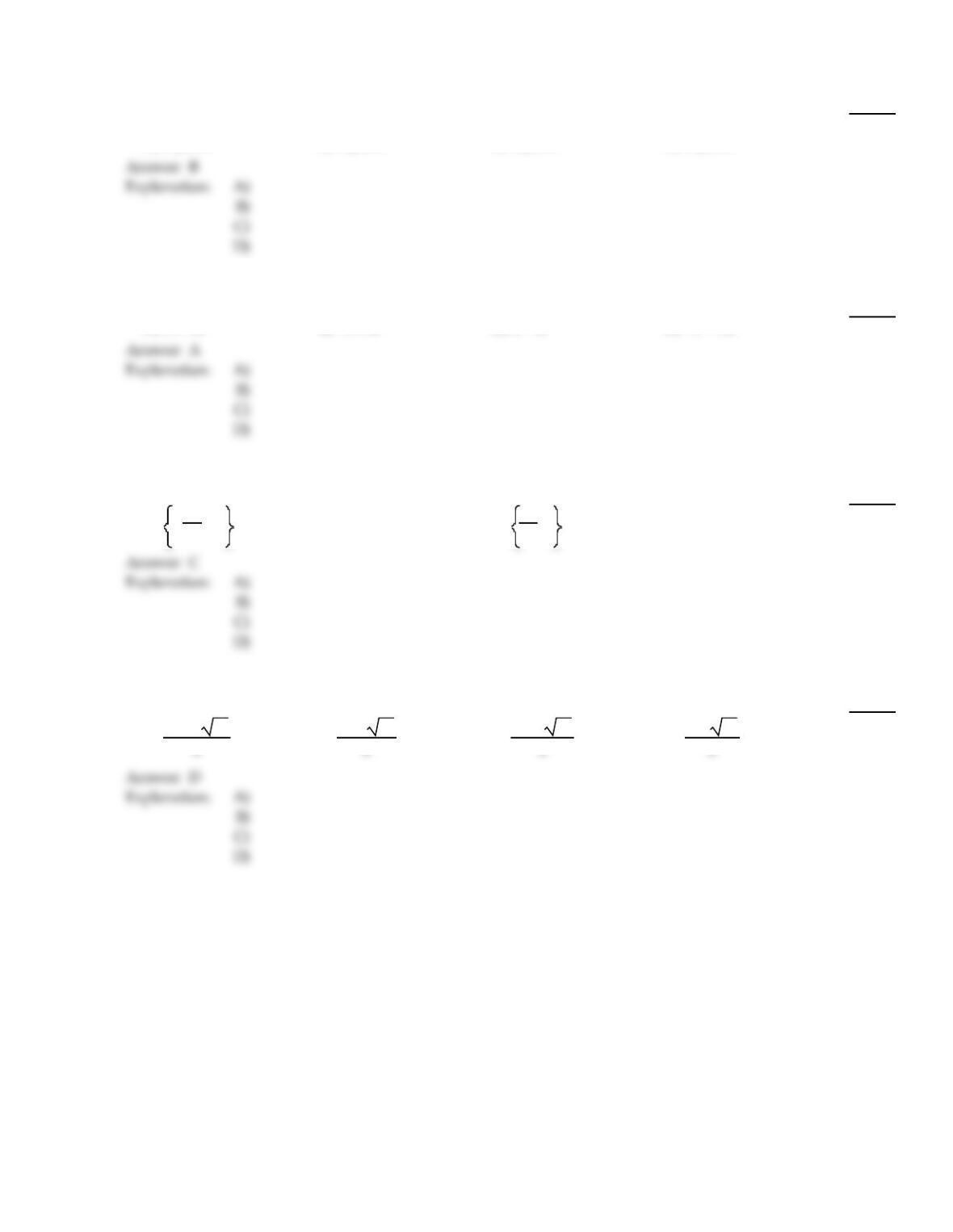
Solve the problem.
160)
The equation V = – 3000t +25,000 describes the value in dollars of a certain model of car after it is t
years old. If a car is worth $13,000, substitute 13,000 into the equation to find the age of the car.
160)
A)
5 years
B)
4 years
C)
6 years
D)
3 years
Add or subtract as indicated and write the result in standard form.
161)
9i – (–2– i)
161)
A)
2+ 10i
B)
–2+ 8i
C)
2– 8i
D)
–2– 10i
Solve the equation by making an appropriate substitution.
162)
x–2– 11x–1+10 = 0
162)
A)
–1
10 , –1
B)
{1, 10}
C)
1
10 , 1
D)
{–1, –10}
Find all values of x satisfying the given conditions.
163)
y1= (x +2), y2= (x –7), and y1y2=4
163)
A)
–5±i97
2
B)
5±i97
2
C)
–5±97
2
D)
5±97
2
56
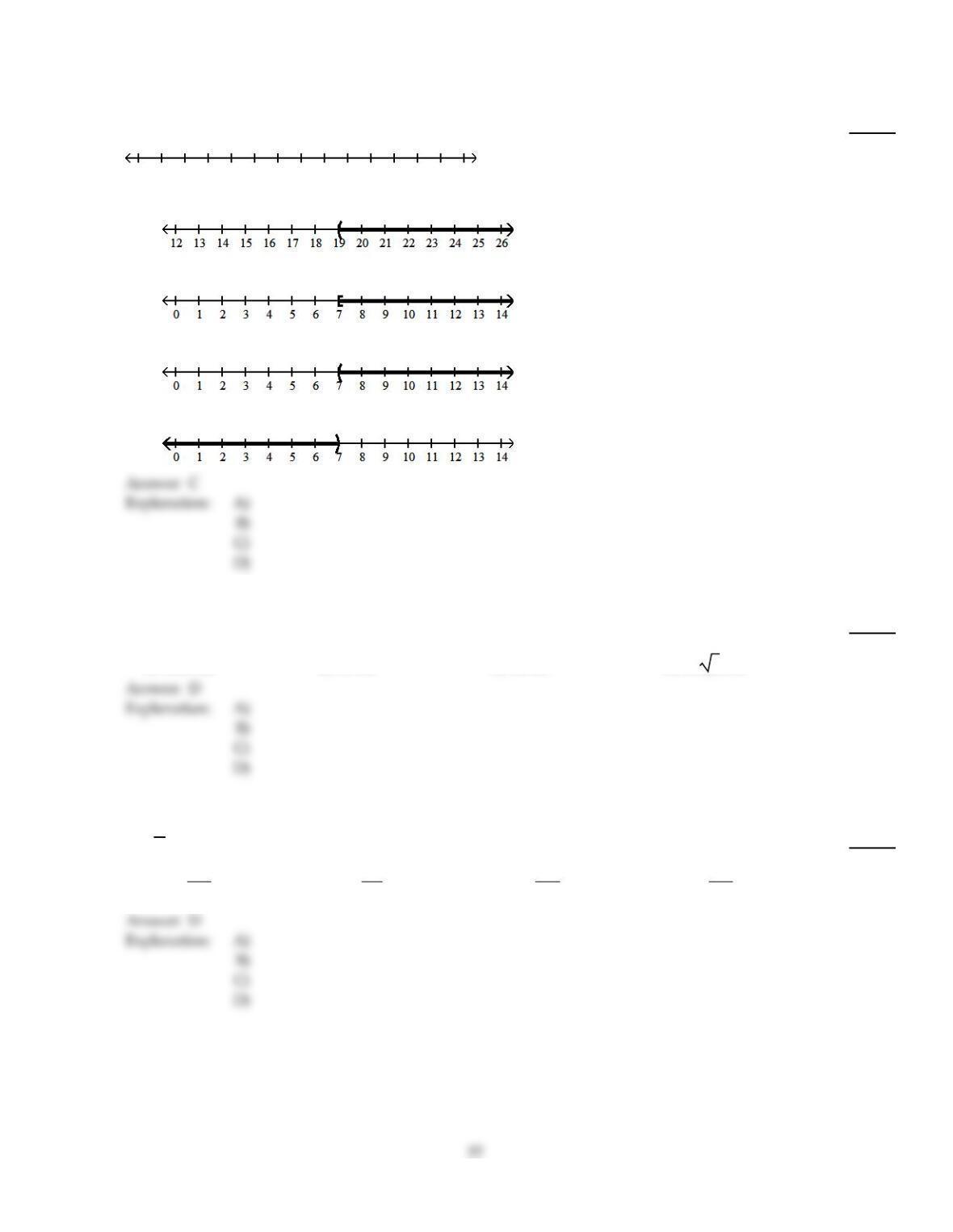
Solve the linear inequality. Other than , use interval notation to express the solution set and graph the solution set on a
number line.
164)
24x + 36 >6(3x + 13)
164)
A)
(19, )
B)
[7, )
C)
(7, )
D)
(–, 7)
Solve the problem.
165)
A square sheet of paper measures 28 centimeters on each side. What is the length of the diagonal of
this paper?
165)
A)
1568 cm
B)
56 cm
C)
28 cm
D)
28 2 cm
Solve the formula for the specified variable.
166)
A =1
2bh for b
166)
A)
b=h
2A
B)
b=A
2h
C)
b=Ah
2
D)
b=2A
h
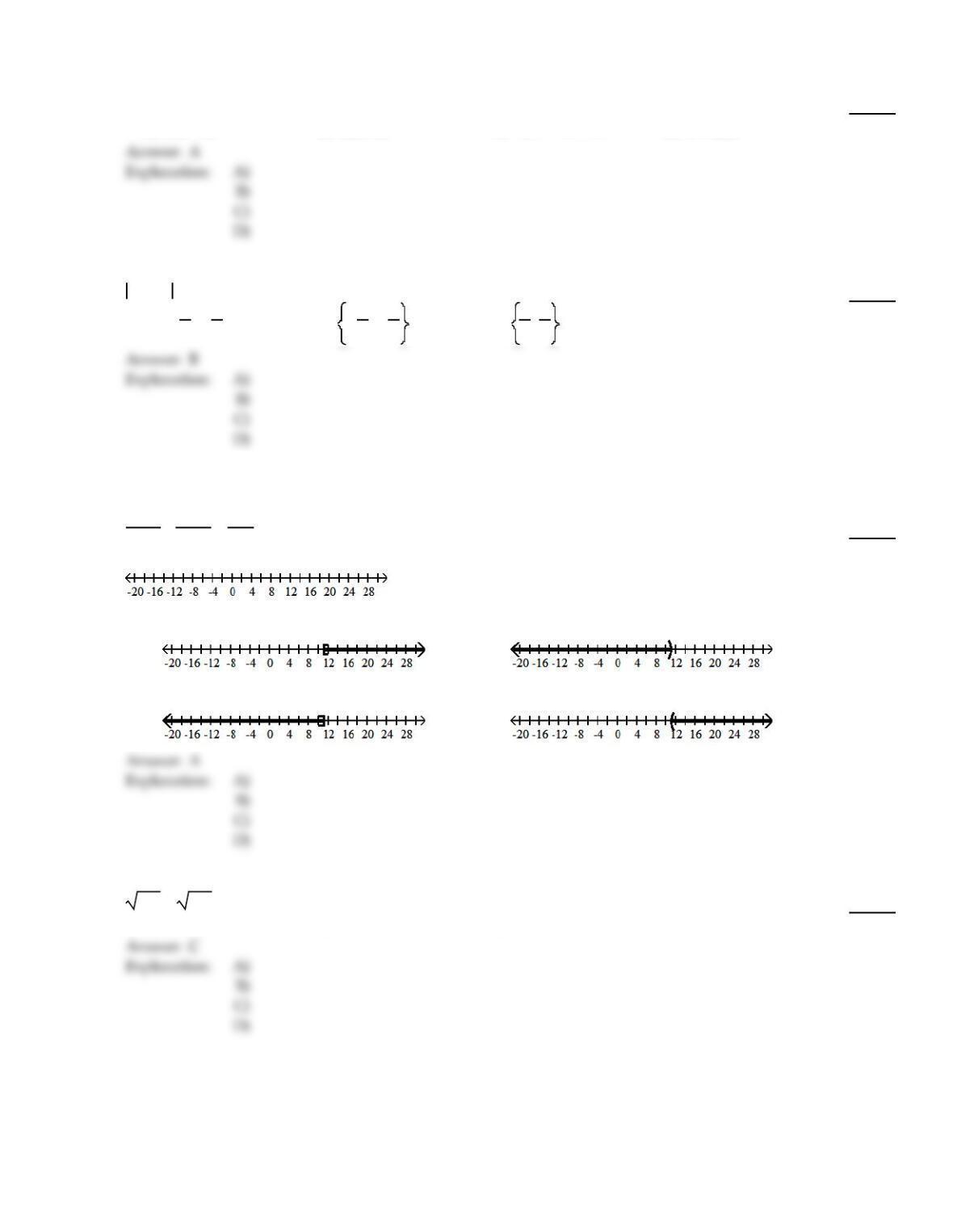
Find the product and write the result in standard form.
167)
(9 + 8i)(6– 6i)
167)
A)
102 – 6i
B)
102 + 6i
C)
–48i2– 6i + 54
D)
6+ 102i
Solve the absolute value equation or indicate that the equation has no solution.
168)
8x + 6 + 4 =7
168)
A)
{–3
2, –1
2}
B)
–9
8, –3
8
C)
3
8, 9
8
D)
B
Solve the linear inequality. Other than , use interval notation to express the solution set and graph the solution set on a
number line.
169)
x –5
20 x –4
24 +1
120
169)
A)
[11, )
B)
(–, 11)
C)
(–, 11]
D)
(11, )
A
Perform the indicated operations and write the result in standard form.
170)
–16 + – 64
170)
A)
32i
B)
–12i
C)
12i
D)
–12
C
58
A
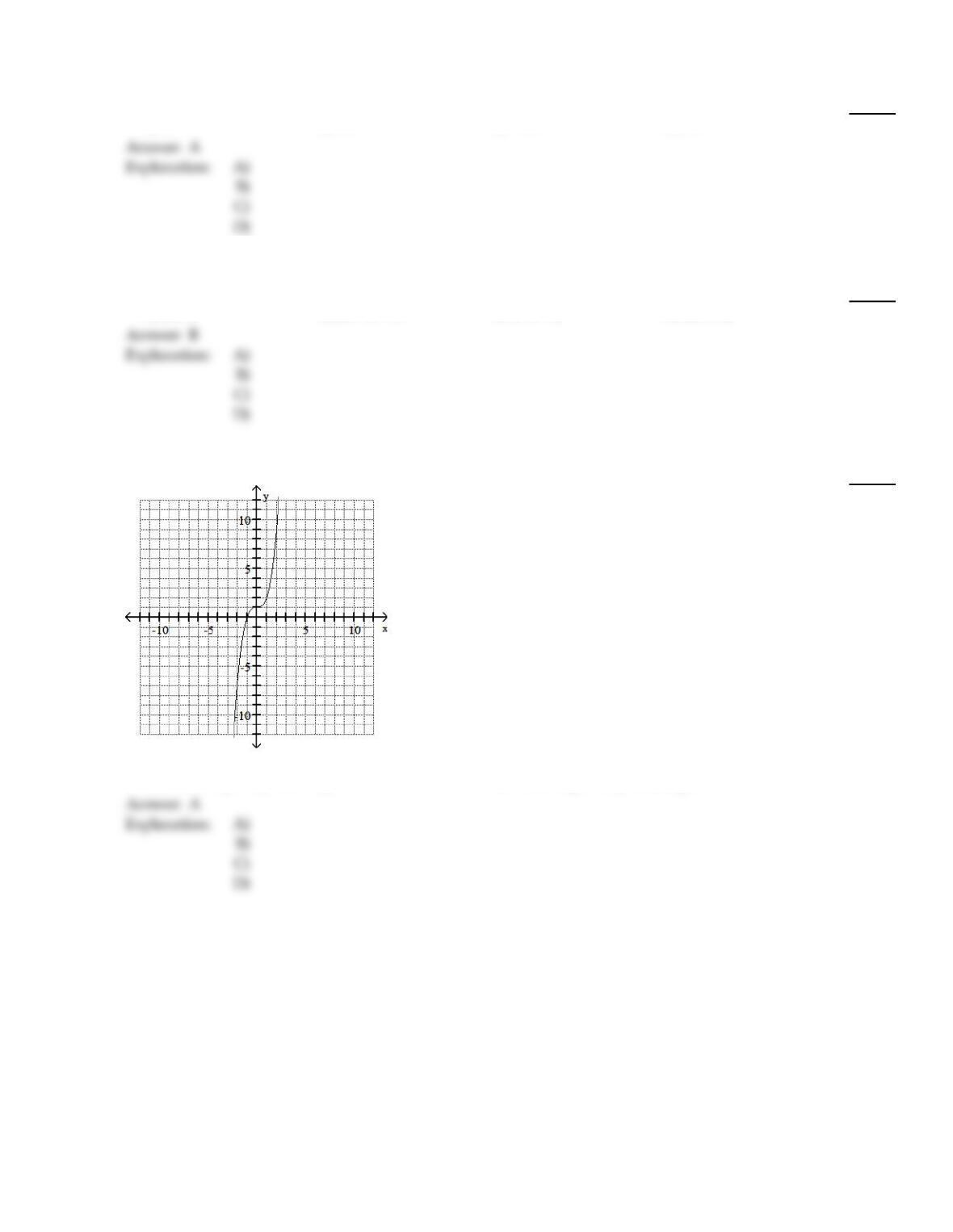
Use the five–step strategy for solving word problems to find the number or numbers described in the following exercise.
171)
When four times the number is added to 7 times the number, the result is 44. What is the number?
171)
A)
4
B)
6.3
C)
–6.3
D)
0.7
Solve the polynomial equation by factoring and then using the zero product principle.
172)
x3+ 8x2+ 15x = 0
172)
A)
{5, 3}
B)
{0, –5, –3}
C)
{–5, –3}
D)
{0, 5, 3}
Use the graph to determine the x– and y–intercepts.
173)
173)
A)
x–intercept: –1; y–intercept: 1
B)
x–intercept: 1; y–intercept: 1
C)
x–intercept: 1; y–intercept: –1
D)
x–intercept: –1; y–intercept: –1
Find the x–intercept(s) of the graph of the equation. Graph the equation.
59
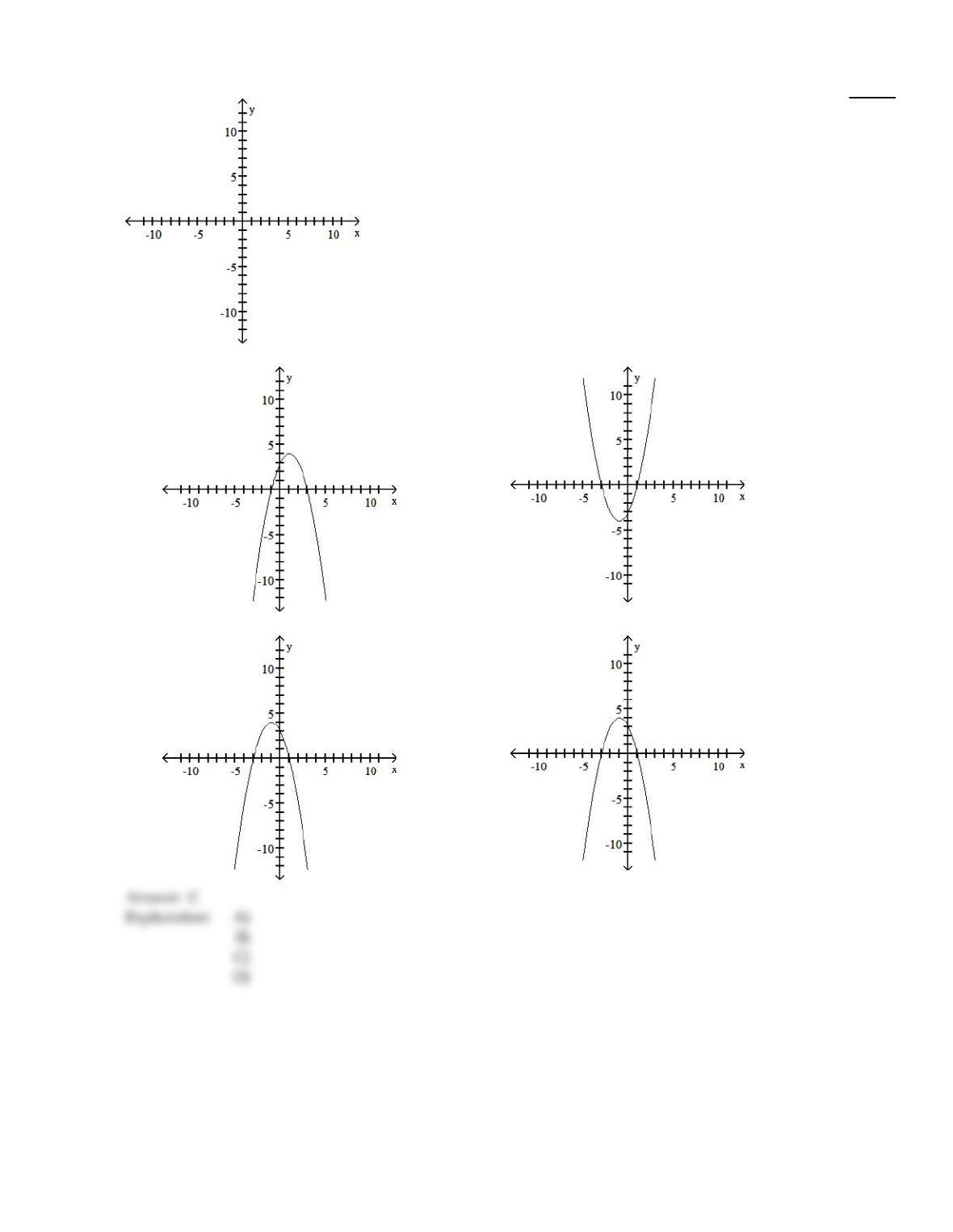
174)
y = – x2– 2x + 3
174)
A)
x–intercepts: –1 and 3
B)
x–intercepts: –3 and 1
C)
x–intercepts: –3 and 1
D)
x–intercepts: –1 and 3
60