26) The factor 10-3 corresponds to which prefix?
A) deka
B) deci
C) milli
D) centi
27) What decimal power does the abbreviation f represent?
A) 1 × 10⁶
B) 1 × 10³
C) 1 × 10⁻¹
D) 1 × 10-15
E) 1 × 10-12
28) What decimal power does the abbreviation pico represent?
A) 1 × 10⁶
B) 1 × 10⁹
C) 1 × 10⁻¹
D) 1 × 10-12
E) 1 × 10-15
29) Which of the following are examples of intensive properties?
A) density
B) volume
C) mass
D) None of the above are examples of intensive properties.
E) All of the above are examples of intensive properties.
30) Which of the following are examples of extensive properties?
A) mass
B) color
C) density
D) temperature
E) odor
31) Identify the common substance that has the highest density.
A) sugar
B) ice
C) glass
D) mercury
E) aluminum
32) Identify the common substance that has the lowest density.
A) ethanol
B) aluminum
C) titanium
D) table salt
E) sugar
33) What is the volume (in cm3) of a 43.6 g piece of metal with a density of 2.71 g/cm3?
A) 16.1
B) 19.5
C) .425
D) 6.65
E) none of the above
34) A piece of metal ore weighs 8.25 g. When a student places it into a graduated cylinder containing
water, the liquid level rises from 21.25 mL to 26.47 mL. What is the density of the ore?
A) 0.312 g/mL
B) 0.633 g/mL
C) 1.58 g/mL
D) 3.21 g/mL
35) A mass of mercury occupies 0.950 L. What volume would an equal mass of ethanol occupy? The
density of mercury is 13.546 g/mL and the density of ethanol is 0.789 g/mL.
A) 0.0553 L
B) 0.0613 L
C) 16.3 L
D) 18.1 L
36) If the melting point of vanadium metal is 1910°C, what is its melting point in Kelvin?
A) 1029 K
B) 1637 K
C) 2183 K
D) 3470 K
37) If the temperature is 128°F, what is the temperature in degrees celsius?
A) 262.4°C
B) 401°C
C) 53.3°C
D) -145°C
E) 328°C
38) If a solution has a temperature of 255 K, what is its temperature in degrees celsius?
A) 491°C
B) 528°C
C) 123.9°C
D) 355°C
E) -18°C
39) Determine the mass of an object that has a volume of 88.6 mL and a density of 9.77 g/mL.
A) 98.37 g
B) 0.110 g
C) 9.07 g
D) 78.8 g
E) 866 g
40) The outside air temperature is 40°F, what is the temperature in Kelvin?
A) 313 K
B) 377 K
C) 281 K
D) 277 K
41) The outside temperature is 55°C, what is the temperature in °F?
A) 131°F
B) 12.8°F
C) 23°F
D) 77°F
E) 99°F
42) Which of the following is the lowest temperature?
A) 42°C
B) 57°F
C) 318 K
D) All of these temperatures are all equal.
43) How many significant figures are in the measurement 5.34 g?
A) 1
B) 2
C) 4
D) 3
E) 5
44) How many significant figures are in 0.00523980 mL?
A) 3
B) 4
C) 5
D) 6
E) 7
45) How many significant figures are in 3.876 x 10⁴ m?
A) 3
B) 4
C) 5
D) 7
E) 8
46) How many significant figures are in the measurement, 463.090 m?
A) 2
B) 3
C) 4
D) 5
E) 6
47) How many significant figures are in the measurement, 0.005890 g?
A) 4
B) 5
C) 6
D) 7
E) 8
48) The correct answer (reported to the proper number of significant figures) to the following is
________.
11.5 × 8.78 = ________
49) Round the following number to four significant figures and express the result in standard
exponential notation: 0.00222755
A) 0.2228 × 10⁻²
B) 0.002228
C) 2.228 × 10³
D) 2.228 × 10⁻³
E) 22.28 × 10²
50) Which of the following numbers has the greatest number of significant figures?
A) 0.5070
B) 0.201
C) 418000
D) 6.02 × 1024
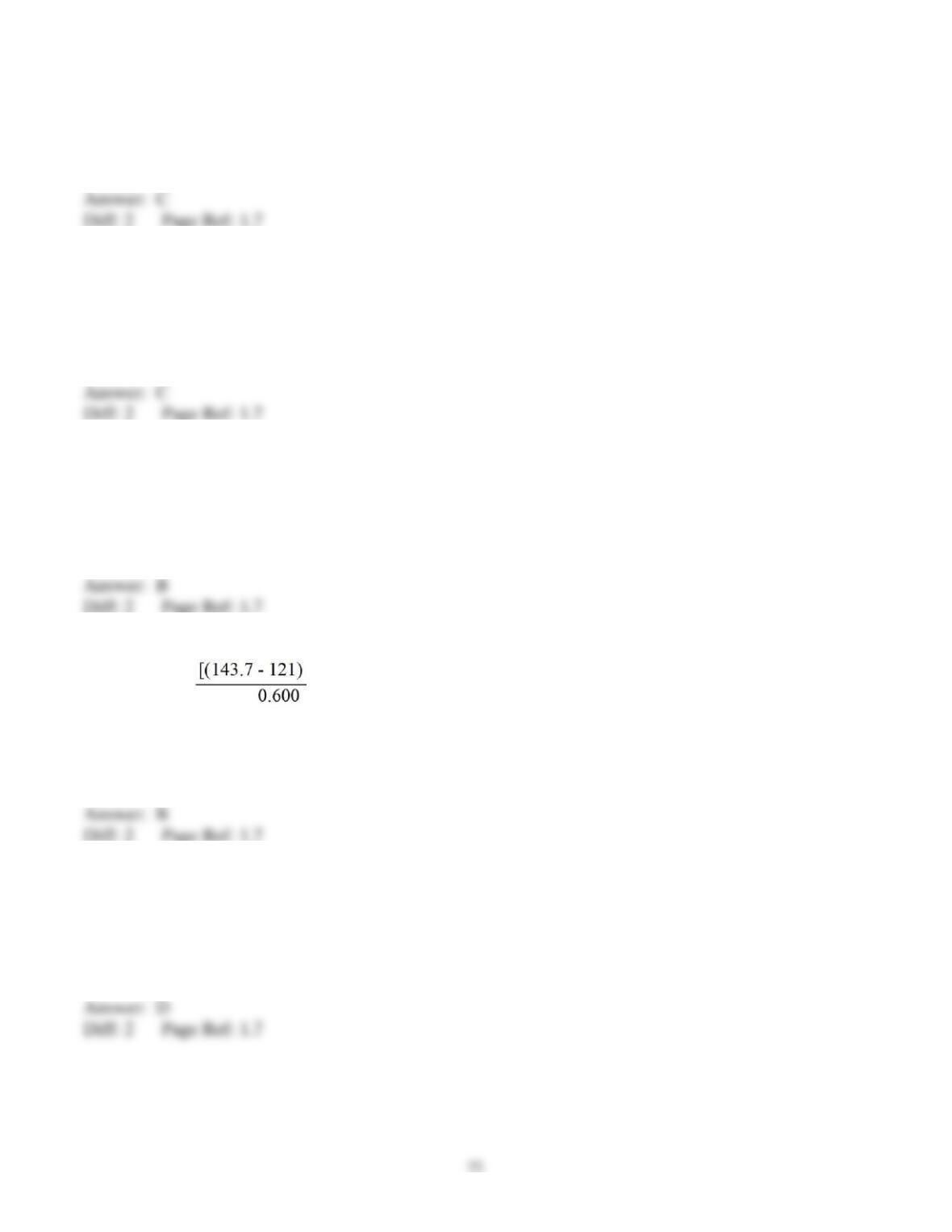
51) How many of the following numbers contain 3 significant figures?
0.408 9.040 0.0400 9.05 × 1024
A) one
B) two
C) three
D) four
52) How many significant figures are there in the answer to the following problem?
(9.992 × 3.200) + 0.610 = ?
A) one
B) two
C) three
D) four
53) How many significant figures are there in the answer for the following problem?
56.4 + 0.8822 + 21 = ?
A) one
B) two
C) three
D) four
54) How many significant figures are there in the answer for the following problem?
= ?
A) one
B) two
C) three
D) four
55) An acetylene molecule contains 2 atoms of carbon. The number 2 represents how many significant
figures?
A) one
B) two
C) three
D) infinite
56) Round off 00907506 to four significant figures.
A) 0091
B) 9076
C) 9100
D) 9.075 × 10⁵
57) The width, length, and height of a large, custom-made shipping crate are 1.22 m, 3.22 m, and 0.83
m, respectively. The volume of the box using the correct number of significant figures is ________ m3.
A) 3.26057
B) 3.3
C) 3.26
D) 3.261
E) 3.2606
58) The correct answer (reported to the proper number of significant figures) to the following is
________.
(1815 – 1806) × (9.11 × 7.92) = ________
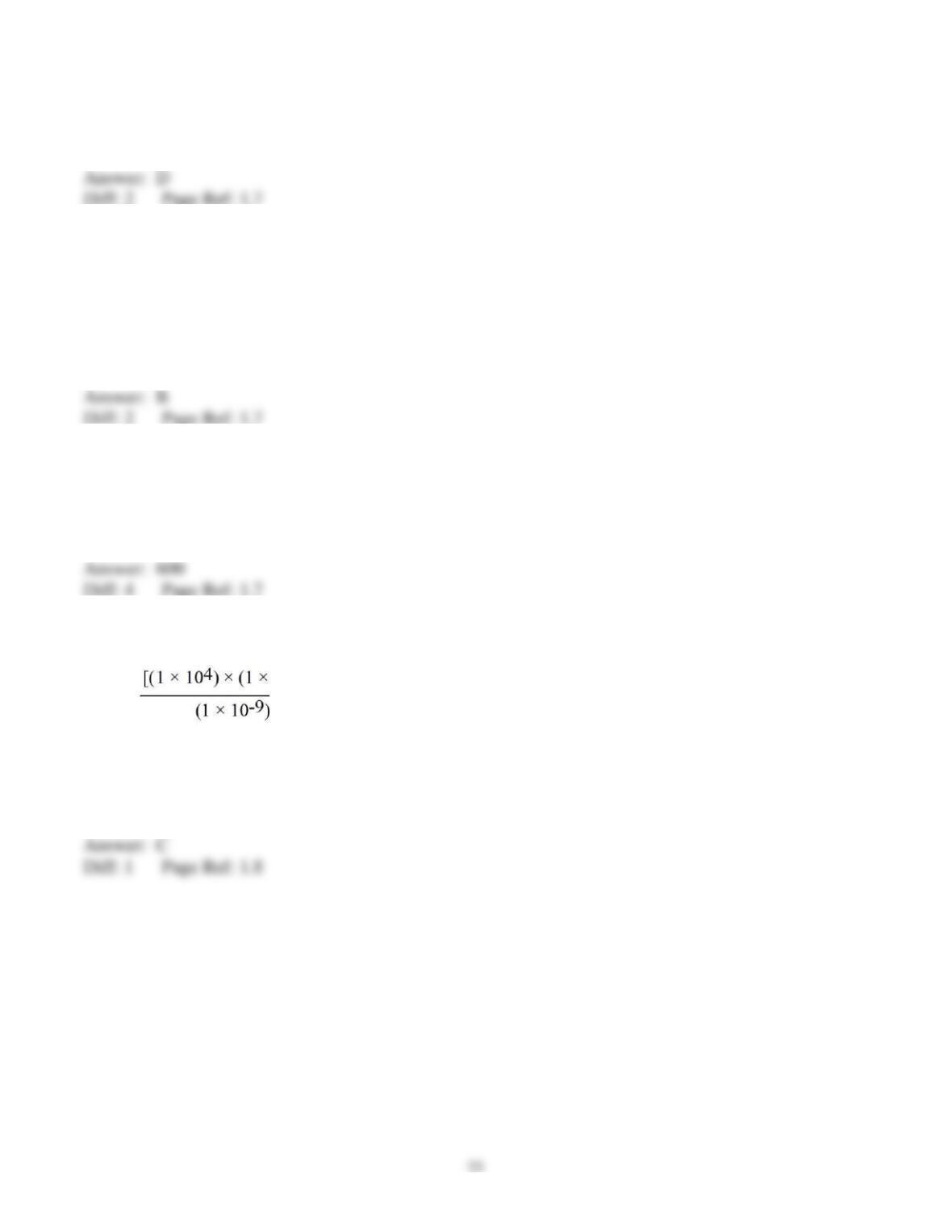
59) Without using a calculator, solve the following problem:
A) 1 × 10⁻⁴
B) 1 × 10⁵
C) 1 × 10²³
D) 1 × 1032
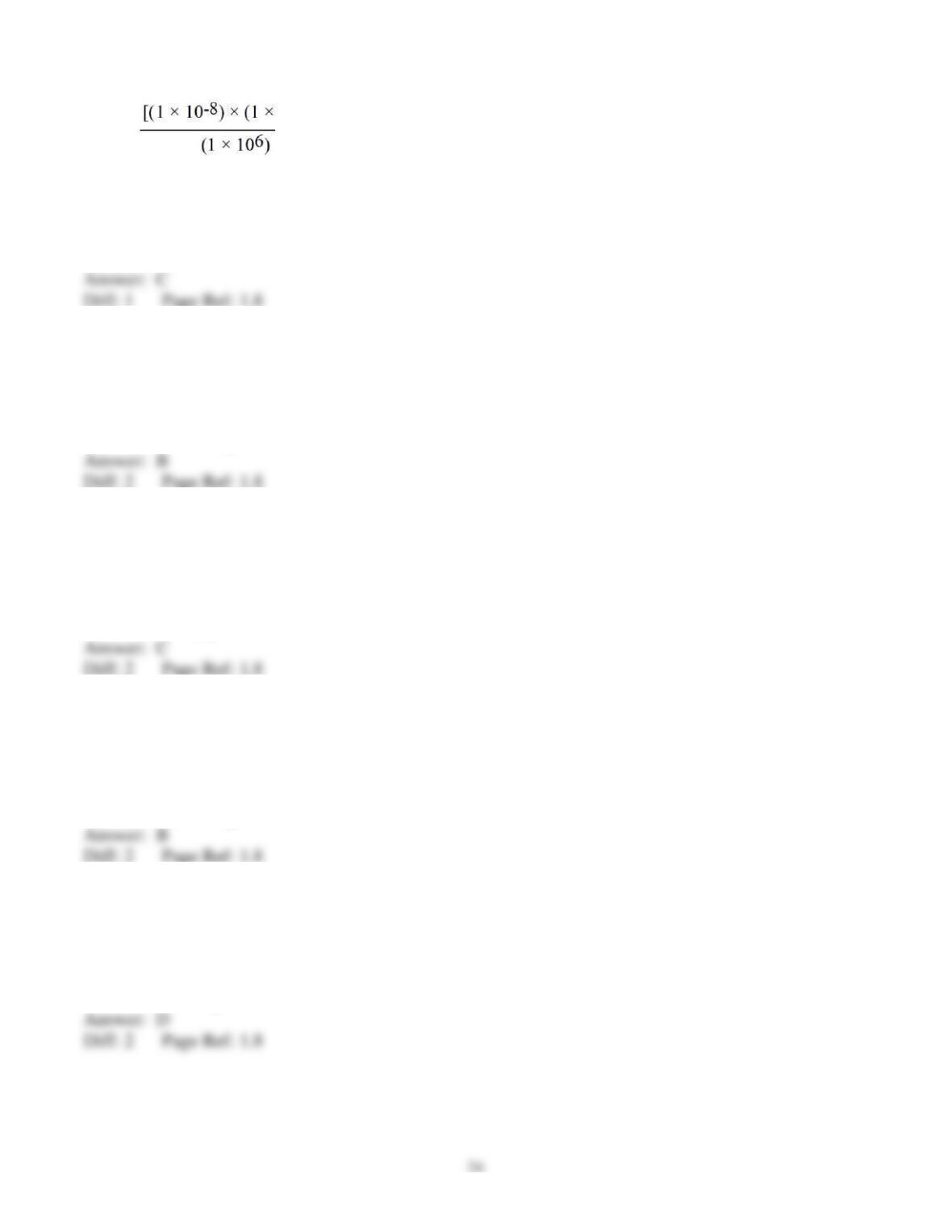
60) Without using a calculator, solve the following problem:
A) 1 × 10⁶
B) 1 × 100
C) 1 × 10-12
D) 1 × 10-18
61) Which of the following is the greatest mass?
A) 1000 μg
B) 1.000 × 10⁻⁴ kg
C) 1.000 × 10⁻⁴ cg
D) 1.000 × 10⁻⁸ Mg
62) The mass of a proton is 1.67 × 10⁻²⁷ kg. What is the mass of a proton in picograms?
A) 1.67 × 10⁻¹⁸ pg
B) 1.67 × 10⁻¹⁵ pg
C) 1.67 × 10⁻¹² pg
D) 1.67 × 10⁻⁹ pg
63) The mass of a single zinc atom is 1.086 × 10⁻²² g. This is the same mass as
A) 1.086 × 10⁻¹⁶ mg.
B) 1.086 × 10⁻²⁵ kg.
C) 1.086 × 10⁻²⁸ μg.
D) 1.086 × 10⁻³¹ ng.
64) A student weighed 30.00 μg of sulfur in the lab. This is the same mass as
A) 3.000 × 10⁻⁸ g.
B) 3.000 × 10⁻⁵ kg.
C) 3.000 × 10⁻⁵ mg.
D) 3.000 × 10⁴ ng.
65) Convert 2 μm to meters.
A) 2 × 10⁻⁹ m
B) 2 × 10⁻⁶ m
C) 2 × 10⁻³ m
D) 2 × 10⁶ m
66) The average distance between nitrogen and oxygen atoms is 115 pm in a compound called nitric
oxide. What is this distance in millimeters?
A) 1.15 × 10⁻⁸ mm
B) 1.15 × 10⁻⁷ mm
C) 1.15 × 1013 mm
D) 1.15 × 1017 mm
67) The diameter of an atom is approximately 1 × 10⁻¹⁰ m. What is the diameter in millimeters?
A) 1 × 10-16 mm
B) 1 × 10-13 mm
C) 1 × 10⁻⁷ mm
D) 1 × 10⁻⁴ mm
68) Which of the following volumes is equal to 40 mL?
A) 40 cm3
B) 40 dm3
C) 0.40 L
D) 0.00040 kL
69) Convert 10 cm3 to m3.
A) 1 × 10⁻⁵ m3
B) 1 × 10⁻¹ m3
C) 1 × 10³ m3
D) 1 × 10⁷ m3
70) Convert 35 m3 to liters.
A) 3.5 × 10⁻² L
B) 3.5 L
C) 3.5 × 10² L
D) 3.5 × 10⁴ L
71) What wavelength of light would you report in units of nm, if the light had a wavelength of
9.90 x 10⁻¹⁰ m?
A) 9.90 × 10⁻³ nm
B) 9.90 × 10⁻¹⁹ nm
C) 9.90 nm
D) 0.990 nm
E) 990 nm
72) How many mg does a 690 kg sample contain?
A) 6.90 × 10⁻⁴ mg
B) 6.90 × 10⁷ mg
C) 6.90 × 10⁻³ mg
D) 6.90 × 10⁶ mg
E) 6.90 × 10⁸ mg
73) How many kL does a 8.55 × 10⁸ cL sample contain?
A) 8.55 × 10³ kL
B) 8.55 × 10¹³ kL
C) 8.55 × 10⁴ kL
D) 8.55 × 10¹² kL
E) 8.55 × 10² kL
74) How many cm3 are contained in 3.77 × 104 mm3?
A) 3.77 × 104 cm3
B) 3.77 × 101 cm3
C) 3.77 × 10⁻¹⁰ cm3
D) 3.77 × 1020 cm3
E) 3.77 × 106 cm3
75) How many mL are in 7.59 L?
A) 7.59 × 10⁻³ mL
B) 7.59 × 101 mL
C) 7.59 × 10³ mL
D) 7.59 × 10⁻¹ mL
E) 7.59 × 10² mL
76) 38.325 lb = ________ grams. (1 lb = 454 g)
77) If 1.4% of the mass of a human body is calcium, how many kilograms of calcium are there in a 165-
pound man?
A) 1.0 kg Ca
B) 5.1 kg Ca
C) 1.0 × 10² kg Ca
D) 5.1 × 10² kg
78) A fishing boat accidentally spills 3.0 barrels of diesel oil into the ocean. Each barrel contains 42
gallons. If the oil film on the ocean is 2.5 × 10² nm thick, how many square meters will the oil slick
cover?
A) 1.9 × 10⁻³ m2
B) 1.9 × 10⁶ m2
C) 1.9 × 10⁷ m2
D) none of these
79) Because of the high heat and low humidity in the summer in Death Valley, California, a visitor
requires about one quart of water for every two miles traveled on foot. Calculate the approximate
number of liters required for a person to walk 10. kilometers in Death Valley.
A) 2.9 L
B) 12 L
C) 30 L
D) 47 L
80) The estimated costs for remodelling the interior of an apartment are: three 1-gallon cans of paint at
$13.22 each, two paint brushes at $9.53 each, and $135 for a helper. The total estimated cost with the
appropriate significant figures is $________.
A) 193.72
B) 1.9 × 10²
C) 194
D) 2 × 10²
E) 193.7
81) How many liters of wine can be held in a wine barrel whose capacity is 22.0 gal?
1 gal = 4 qt = 3.7854 L.
A) 1.72 × 10⁻⁴
B) 0.172
C) 83.3
D) 5.81 × 10³
E) 5.81
82) The recommended adult dose of Elixophyllin , a drug used to treat asthma, is 6.00 mg/kg of body
mass. Calculate the dose in milligrams for a 115-lb person. 1 lb = 453.59 g.
A) 24
B) 1,521
C) 1.5
D) 313
E) 3.1 × 10⁵
83) The density of air under ordinary conditions at 25°C is 1.19 g/L. How many kilograms of air are in a
room that measures 11.0 ft × 11.0 ft and has an 10.0 ft ceiling? 1 in. = 2.54 cm (exactly); 1 L = 103 cm3
A) 3.66
B) 0.152
C) 4.08 × 10⁴
D) 0.0962
E) 40.8
84) How many liters of air are in a room that measures 10.0 ft × 11.0 ft and has an 8.00 ft ceiling?
1 in. = 2.54 cm (exactly); 1 L = 103 cm3
A) 2.49 × 10⁴
B) 92.8
C) 26.8
D) 2.68 ×
E) 8.84 × 10⁵
85) A recipe requires 1.66 liters of milk for a soup base. How many quarts are needed?
A) 1.57 qts
B) 1.75 qts
C) 1.66 qts
D) 3.65 qts
E) 0.754 qts
86) If a room requires 25.4 square yards of carpeting, what is the area of the floor in units of ft2?
(3 ft = 1 yd)
A) 76.2 ft2
B) 8.47 ft2
C) 152.4 ft2
D) 229 ft2
E) 64.5 ft2
87) A person is 68.00 inches tall. How tall is she in cm?
A) 172.7 cm
B) 26.77 cm
C) 27.20 cm
D) 204.0 cm
E) 136.0 cm
88) A person weighs 77.1 kg. What is his weight in pounds?
A) 154 pounds
B) 170 pounds
C) 35.0 pounds
D) 30.8 pounds
E) 193 pounds
89) A person is 2.000 yards tall. How tall is he in cm?
A) 182.9 cm
B) 28.35 cm
C) 0.1411 cm
D) 5.080 cm
E) 15.24 cm
90) An alligator is 152.4 cm long. How long is he in feet?
A) 5.00 feet
B) 60.0 ft
C) 12.7 ft
D) 32.2 ft
E) 720.0 ft
91) How many cm are in 23.2 ft?
A) 9.14 cm
B) 278 cm
C) 58.9 cm
D) 707 cm
E) 0.761 cm
Matching Questions
Match the following.
A) 10-1
B) 10-2
C) 10-9
D) 106
E) 10-6
F) 103
G) 10-3
1) kilo
Diff: 1 Page Ref: 1.6
2) centi
Diff: 1 Page Ref: 1.6
3) milli
Diff: 1 Page Ref: 1.6
4) nano
Diff: 1 Page Ref: 1.6
5) micro
Diff: 1 Page Ref: 1.6
6) deci
Diff: 1 Page Ref: 1.6
7) mega
Diff: 1 Page Ref: 1.6
Short Answer Questions
1) Define an atom.
2) Define matter.
3) A sample of liquid isopropyl alcohol is placed in a sealed container. Some of the volatile isopropyl
alcohol vaporizes. Does the mass of the sealed container and its contents change during the
vaporization? Explain.
4) What is the difference between a physical property and a chemical property? Give an example of
each.
5) Define energy.
6) Define the law of the conservation of energy.
7) A flash drive contains 4 gigabytes. How many bytes does it contain?
8) Describe the difference between an intensive and extensive property using examples.
9) What happens to the density of a sample of iron metal as it is heated from room temperature to
100°C? (This is below the melting point of iron.)
10) What does it mean to be an exact number? Give an example of an exact number.
11) Define random error.