21
64) The charge-to-mass ratio of an electron was established by
A) Millikan’s oil drop experiment.
B) Rutherford’s gold foil experiment.
C) Thomson’s cathode ray tube experiment.
D) None of the above.
65) The current model of the atom in which essentially all of an atom’s mass is contained in a
very small nucleus, whereas most of an atom’s volume is due to the space in which the atom’s
electrons move was established by
A) Millikan’s oil drop experiment.
B) Rutherford’s gold foil experiment.
C) Thomson’s cathode ray tube experiment.
D) None of the above.
66) The existence of neutrons in the nucleus of an atom was demonstrated by
A) Millikan’s oil drop experiment.
B) Rutherford’s gold foil experiment.
C) Thomson’s cathode ray tube experiment.
D) None of the above.
67) Most of the alpha particles directed at a thin gold foil in Rutherford’s experiment
A) bounced directly back from the foil.
B) passed directly through the foil undeflected.
C) passed through the foil but were deflected at an angle.
D) were absorbed by the foil.
68) Which subatomic particle has the smallest mass?
A) a proton
B) a neutron
C) an electron
D) an alpha particle
69) Which of the following two atoms are isotopes?
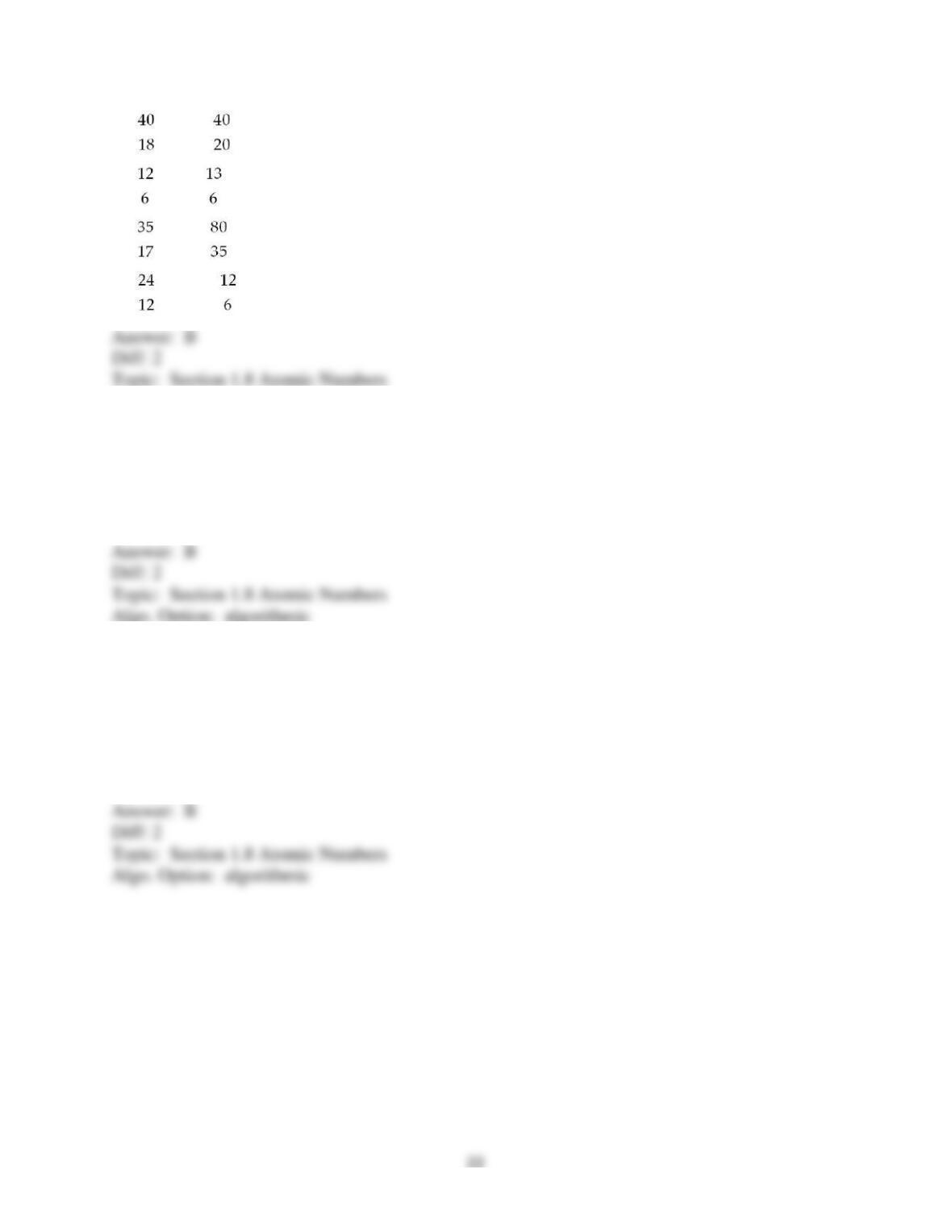
A) Ar and Ca
B) C and C
C) Cl and Br
D) Mg and C
70) Which are isotopes? An atom that has an atomic number of 34 and a mass number of 76 is
an isotope of an atom that has
A) an atomic number of 32 and a mass number of 76.
B) an atomic number of 34 and a mass number of 80.
C) 42 neutrons and 34 protons.
D) 42 protons and 34 neutrons.
71) Which of the following represent isotopes?
A:
25
21
[ ] B:
21
25
[ ] C:
27
21
[ ] D:
25
23
[ ]
A) A and B
B) A and C
C) A and D
D) C and D
23
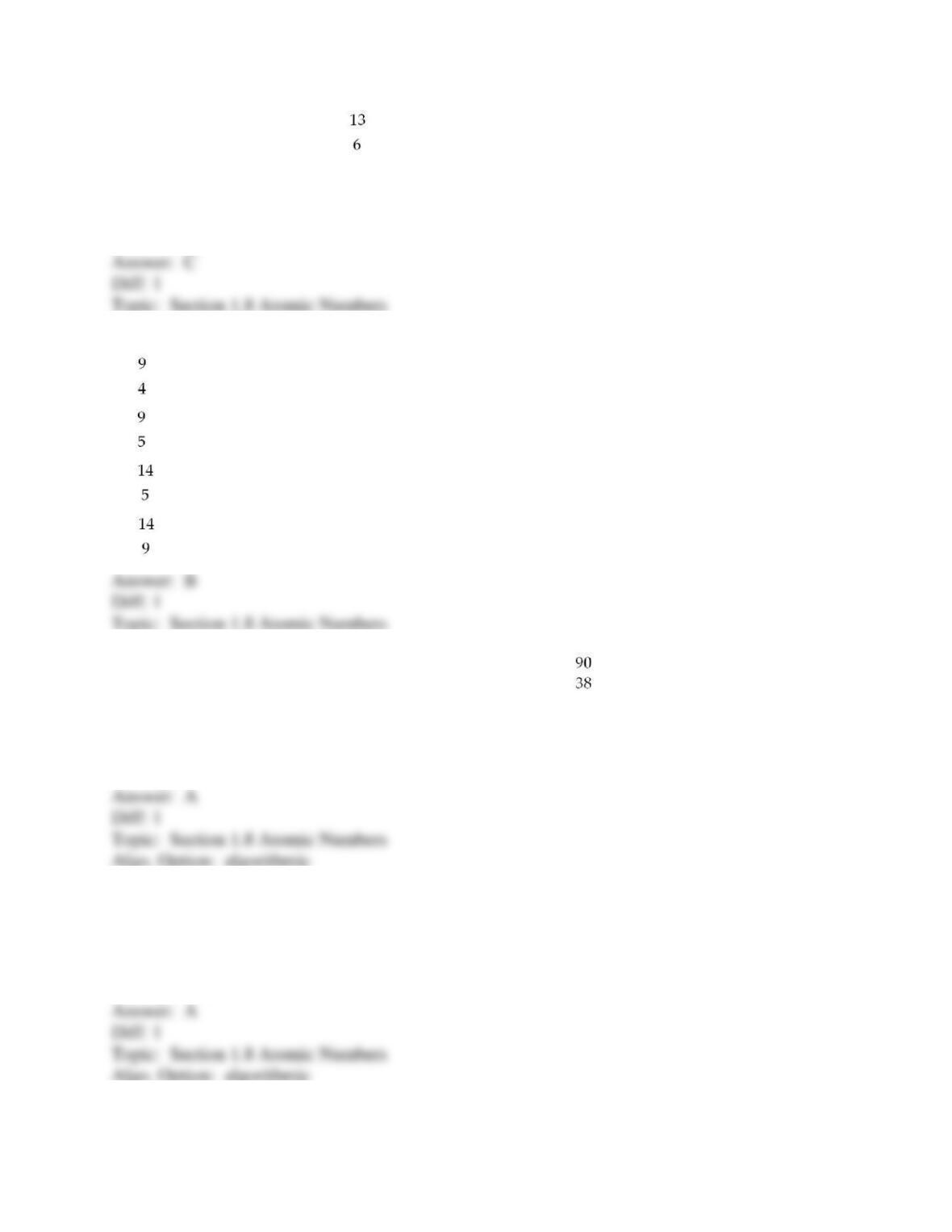
72) The isotope represented by C is named
A) carbon-6.
B) carbon-7.
C) carbon-13.
D) carbon-19.
73) Boron-9 can be represented as
A) Be.
B) B.
C) B.
D) B.
74) How many protons (p) and neutrons (n) are in an atom of Sr?
A) 38 p, 52 n
B) 38 p, 90 n
C) 52 p, 38 n
D) 90 p, 38 n
75) How many protons (p) and neutrons (n) are in an atom of calcium-46?
A) 20 p, 26 n
B) 20 p, 46 n
C) 26 p, 20 n
D) 46 p, 60 n
76) What is the chemical symbol for an atom that has 29 protons and 36 neutrons?
A) Cu
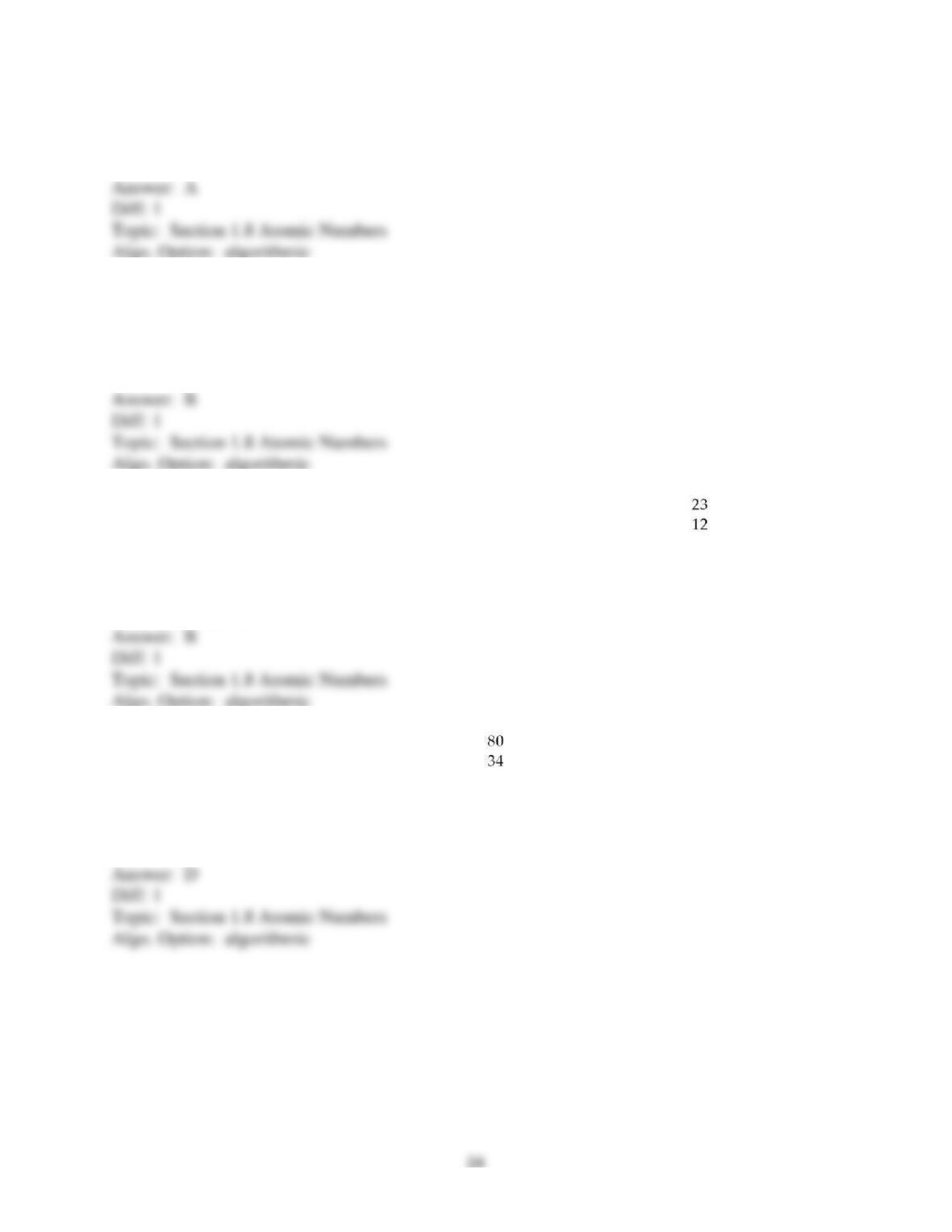
B) Kr
C) N
D) Tb
77) How many electrons are in a neutral atom of iodine-131?
A) 1
B) 53
C) 54
D) 131
78) How many protons (p), neutrons (n), and electrons (e) are in one atom of Mg?
A) 12 p, 12 n, 12 e
B) 12 p, 11 n, 12 e
C) 12 p, 11 n, 10 e
D) 12 p, 11 n, 14 e
79) Identify the chemical symbol of element Q in Q.
A) Br
B) Hg
C) Pd
D) Se
80) The atoms of a particular element all have the same number of protons as neutrons. Which of
the following must be true?
A) The atomic weight must be a whole number.
B) The mass number for each atom must equal the atomic weight of the element.
C) The mass number must be exactly twice the atomic number for each atom.
D) All of the above are true.
81) Fullerenes are molecules composed of only carbon atoms. One fullerene is , a carbon
molecule containing 60 carbon atoms. What is the mass of one molecule?
A) 1.20 × g
B) 8.29 × g
C) 3.32 × g
D) 4.41 × g
82) Fullerenes are molecules composed of only carbon atoms. One fullerene is , a carbon
molecule containing 70 carbon atoms. What is the mass of one molecule?
A) 1.40 × 1 g
B) 9.68 × g
C) 2.85 × g
D) 3.28 × g
83) Fullerenes are molecules composed of only carbon atoms. A molecule of one fullerene has a
mass of 1.516 × g. How many carbon atoms are in a single molecule of this fullerene
molecule?
A) 76
B) 70
C) 60
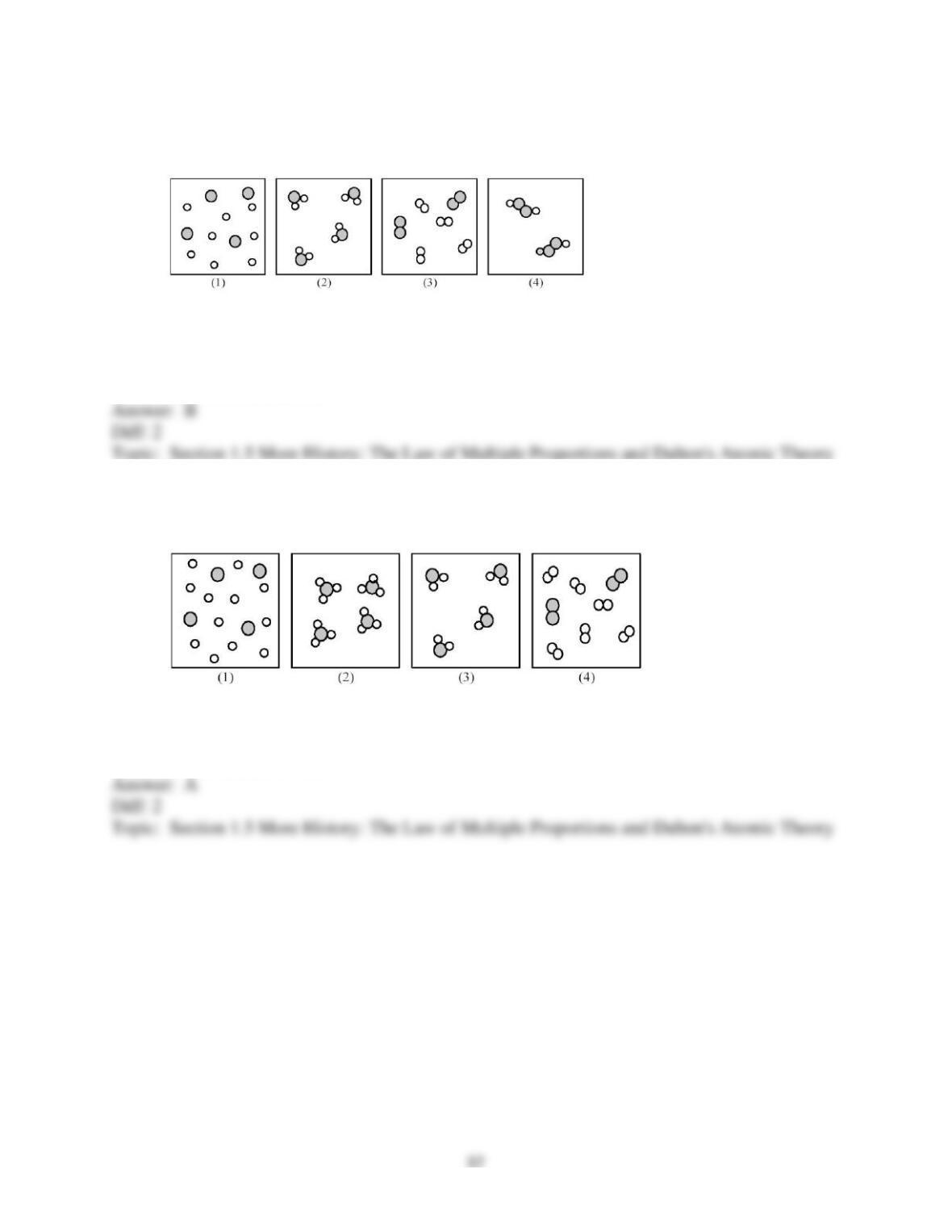
D) 84
84) Fullerenes are molecules composed of only carbon atoms. A molecule of one fullerene has a
mass of 1.675 × g. How many carbon atoms are in a single molecule of this fullerene
molecule?
A) 76
B) 70
C) 60
D) 84
85) The smallest sample of carbon atoms that can be observed with the naked eye has a mass of
approximately 2 × 10⁻⁸ g. Given that 1 g = 6.02 × 10²³ amu, and that carbon has an atomic
weight of 12.01 amu, determine the number of carbon atoms present in the sample.
A) 1 × 10¹⁵
B) 1 × 10¹⁶
C) 1 × 10¹⁷
D) 6 × 10²³
86) An element has two naturally occurring isotopes. One has an abundance of 37.40% and an
isotopic mass of 184.953 amu, and the other has an abundance of 62.60% and a mass of 186.956
amu. What is the atomic weight of the element?
A) 185.7 amu
B) 186.0 amu
C) 186.2 amu
D) 187.0 amu
87) The element antimony has an atomic weight of 121.757 amu and only two naturally-
occurring isotopes. One isotope has an abundance of 57.30% and an isotopic mass of 120.904
amu. Based on these data, what is the mass of the other isotope?
A) 121.8 amu
B) 122.4 amu
C) 122.6 amu
D) 122.9 amu
88) What is the standard isotope that is used to define the number of atoms in a mole?
A) 1H
B) 12C
C) 16O
D) 20Ne
89) One mole of which element has the smallest mass?
A) Co
B) Cu
C) Ni
D) Zn
90) 24.0 g of which element contains the greatest number of atoms?
A) B
B) C
C) N
D) O
91) How many moles and how many atoms of zinc are in a sample weighing 34.9 g?
A) 0.533 mol, 8.85 × atoms
B) 0.533 mol, 3.21 × atoms
C) 1.87 mol, 3.10 × atoms
D) 1.87 mol, 1.13 × atoms
92) Which statement about nuclear reactions is true?
A) New elements are never produced in a nuclear reaction.
B) Nuclear reactions involve valence electrons.
C) The rate of a nuclear reaction is affected by catalysts.
D) Tremendous amounts of energy are involved in nuclear reactions.
93) The term “nucleons” refers to the number of ________ in the atom.
A) neutrons
B) protons
C) protons and neutrons
D) protons, neutrons, and electrons
94) The number of nucleons in an atom or ion is the same as the
A) atomic number.
B) charge on the atom or ion.
C) mass number.
D) none of these
95) The number of nucleons in a U2+ nucleus is
A) 92.
B) 144.
C) 236.
D) 328.
96) The number of neutrons in Fe2+ is
A) 26.
B) 29.
C) 53.
D) 55.
97) “Isotopes” are atoms with the same number of ________ but different number of ________.
A) electrons, protons
B) neutrons, protons
C) protons, electrons
D) protons, neutrons
29
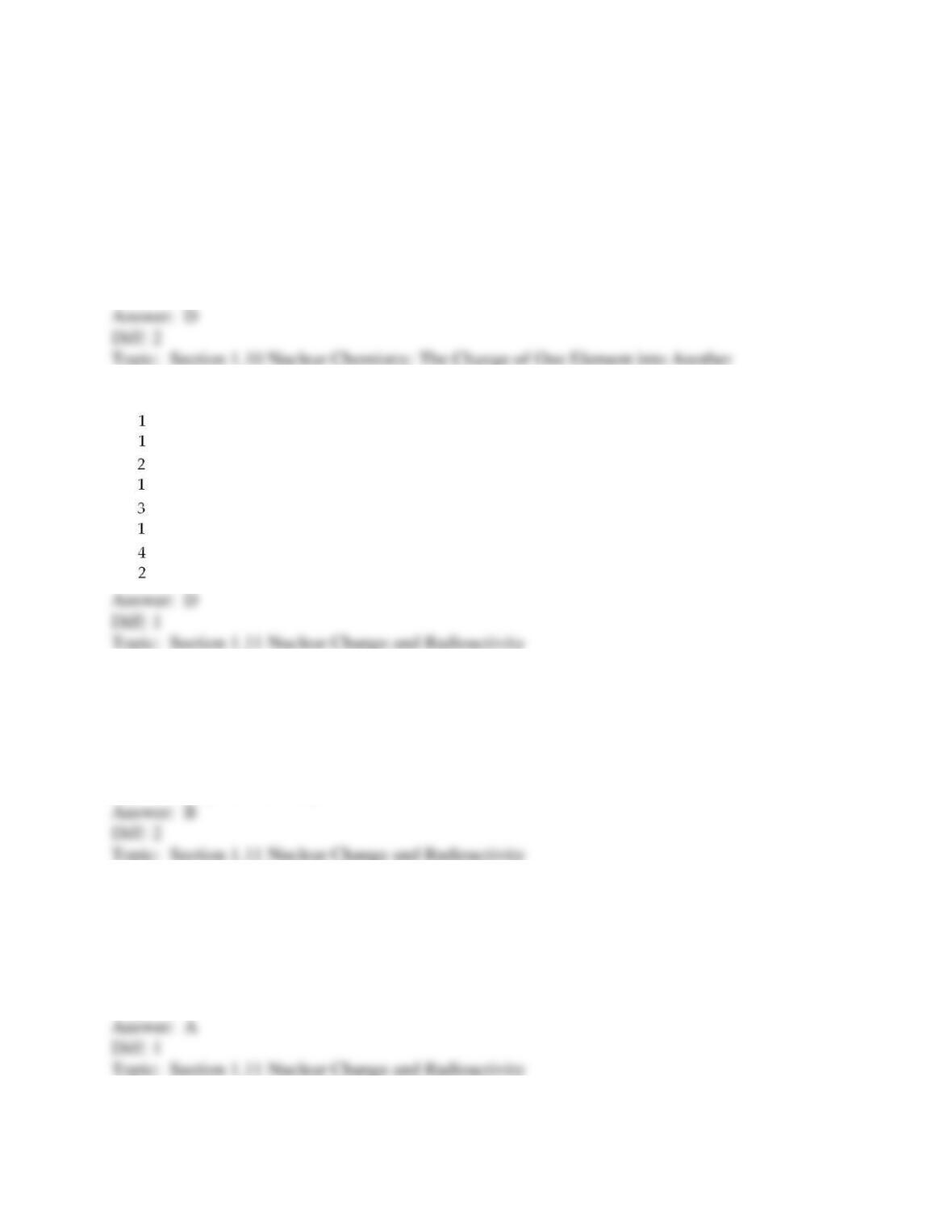
98) Which of the following statements is not correct when balancing a nuclear equation?
I. The mass numbers must be conserved on both sides of the reaction arrow.
II. The ionic charges must be conserved on both sides of the reaction arrow.
III. The atomic numbers must be conserved on both sides of the reaction arrow.
IV. The elements must be the same on both sides of the reaction arrow.
A) II only
B) II and III
C) I and III
D) II and IV
99) An alpha particle is
A) H+.
B) H+.
C) H+.
D) He2+.
100) When a substance decays by alpha radiation, the mass number of the nucleus ________ and
the atomic number ________.
A) increases by 4, increases by 2
B) reduces by 4, reduces by 2
C) increases by 2, increases by 4
D) reduces by 2, reduces by 4
101) The nuclear decay process that involves the particle having the greatest mass is ________
emission.
A) alpha
B) beta
C) gamma
D) positron
102) A beta particle is
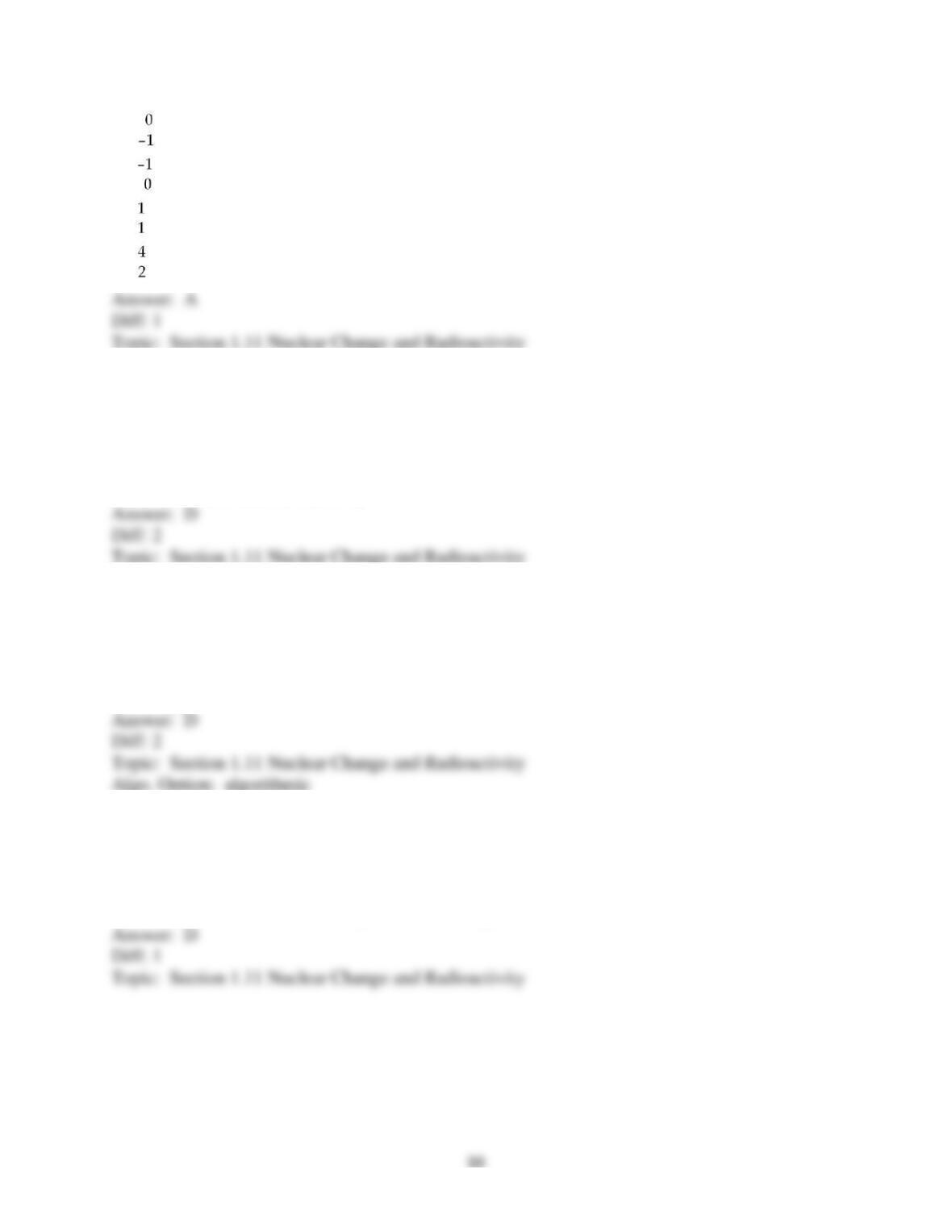
A) e.
B) e.
C) p.
D) He.
103) When a substance decays by beta emission, the mass number of the nucleus ________ and
the atomic number ________.
A) decreases by 1, remains the same
B) increases by 1, remains the same
C) remains the same, decreases by 1
D) remains the same, increases by 1
104) Beta decay of 24Na produces a beta particle and
A) 20F.
B) 23Na.
C) 24Ne.
D) 24Mg.
105) Which of the following statements about gamma radiation is false?
A) It almost always accompanies alpha or beta emission.
B) It is a mechanism to release excess energy in the nucleus.
C) Gamma rays are high energy photons.
D) The mass number decreases by one with each gamma emitted.
106) Gamma radiation can be described as
A) a helium nucleus.
B) a negatively charged free electron.
C) high energy electromagnetic radiation.
D) a positively charged free electron.
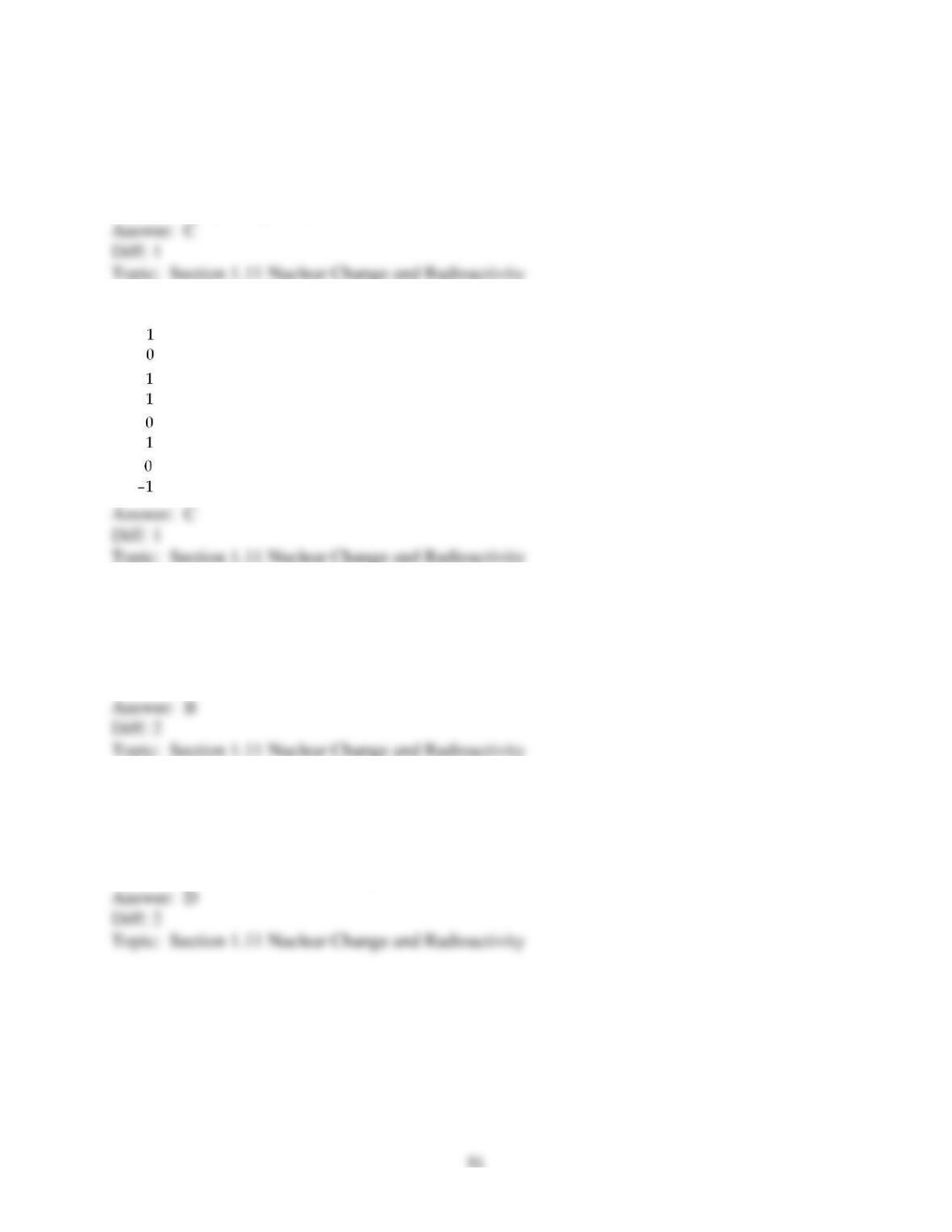
107) A positron is
A) n.
B) p.
C) e.
D) e.
108) Positron emission changes the atomic number of an element by
A) -2.
B) -1.
C) +1.
D) +2.
109) Which of the following statements about positrons is false?
A) The positron has same mass as an electron.
B) A positron is ejected from the nucleus during the conversion of a proton into a neutron.
C) A positron is a positive electron.
D) When positron emission occurs, the atomic number of the nucleus increases.
110) Which of the following statements about electron capture is false?
A) The electron is used to convert a proton to a neutron.
B) The electron involved is most likely an outer shell valence electron.
C) In electron capture decay, the atomic number decreases by one.
D) In electron capture decay, the mass number remains unchanged.
111) Which one of the following processes does not result in transmutation to another element?
A) alpha emission
B) beta emission
C) electron capture
D) gamma emission
112) Which of the following decay processes give a product nuclide whose atomic number is one
less than the starting nuclide?
A) alpha decay
B) beta decay and positron decay
C) gamma decay and beta decay
D) positron decay and electron capture
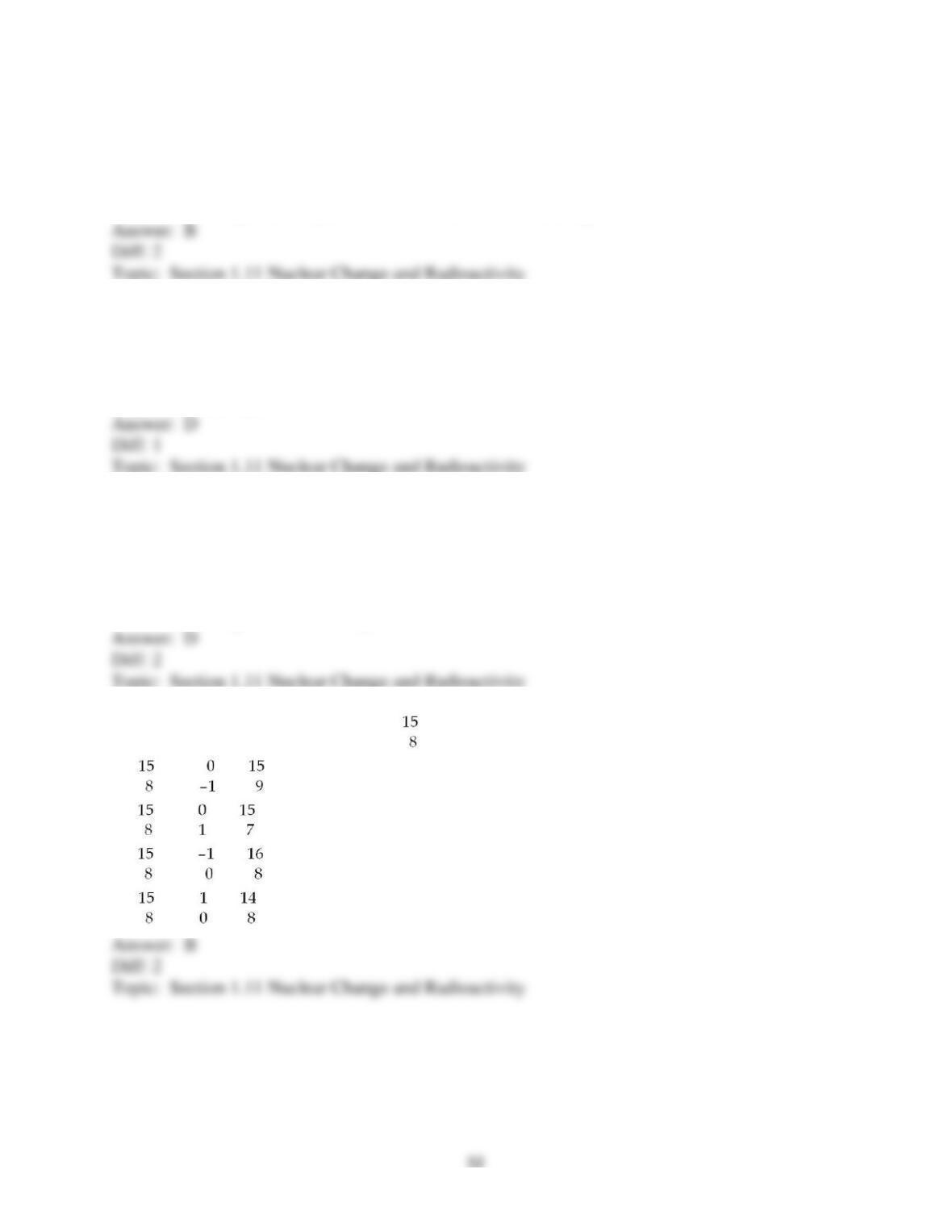
113) Which reaction below represents O decay by positron emission?
A) O → e + Ra
B) O → e + N
C) O → e + O
D) O → e + O
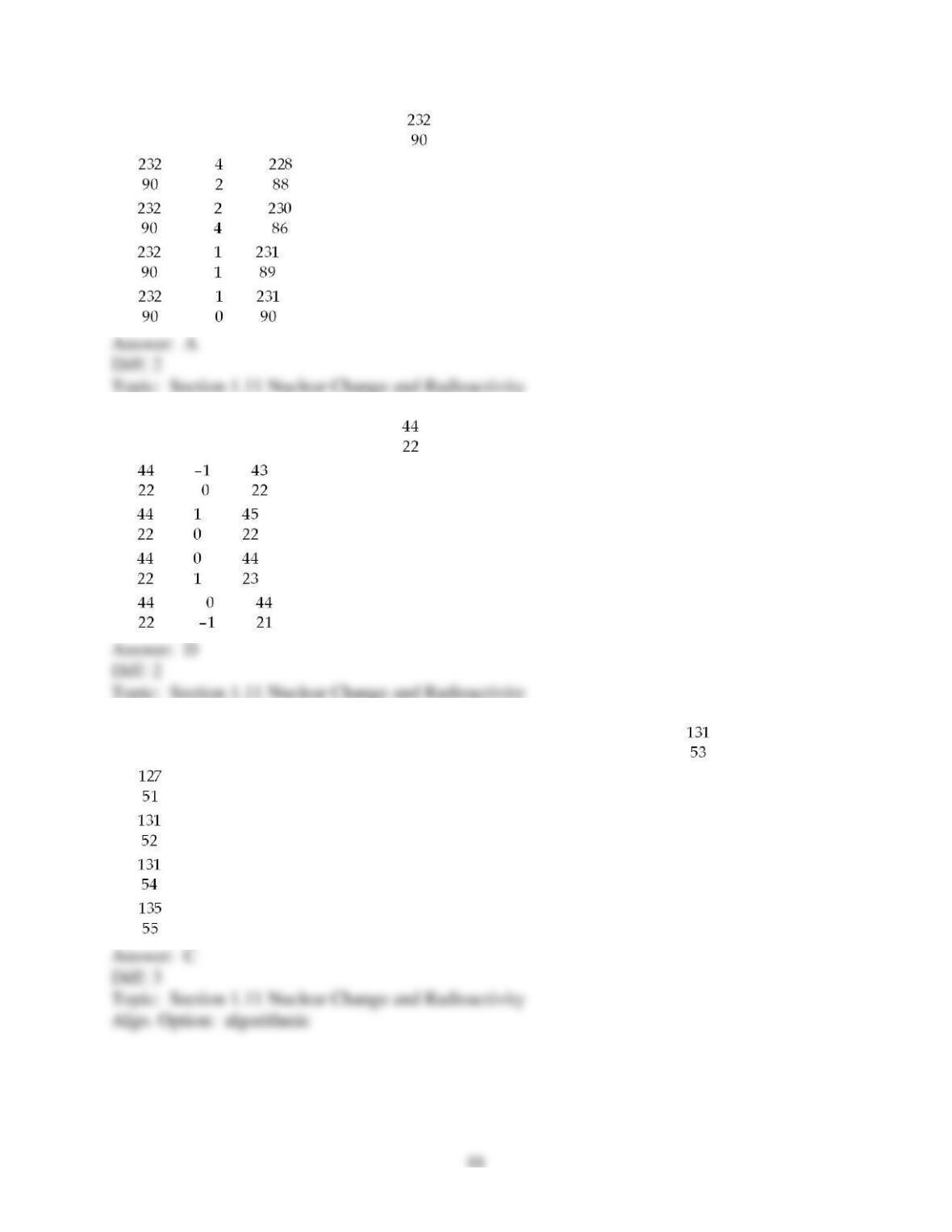
114) Which reaction below represents Th decay by alpha emission?
A) Th → He + Ra
B) Th → He + Ra
C) Th → p + Ac
D) Th → n + Th
115) Which reaction below represents Ti decay by electron capture?
A) Ti + e → Ti
B) Ti + e → Ti
C) Ti + e → Ti
D) Ti + e → Sc
116) In addition to a beta particle, what is the other product of beta decay of I?
A) Sb
B) Te
C) Xe
D) Cs
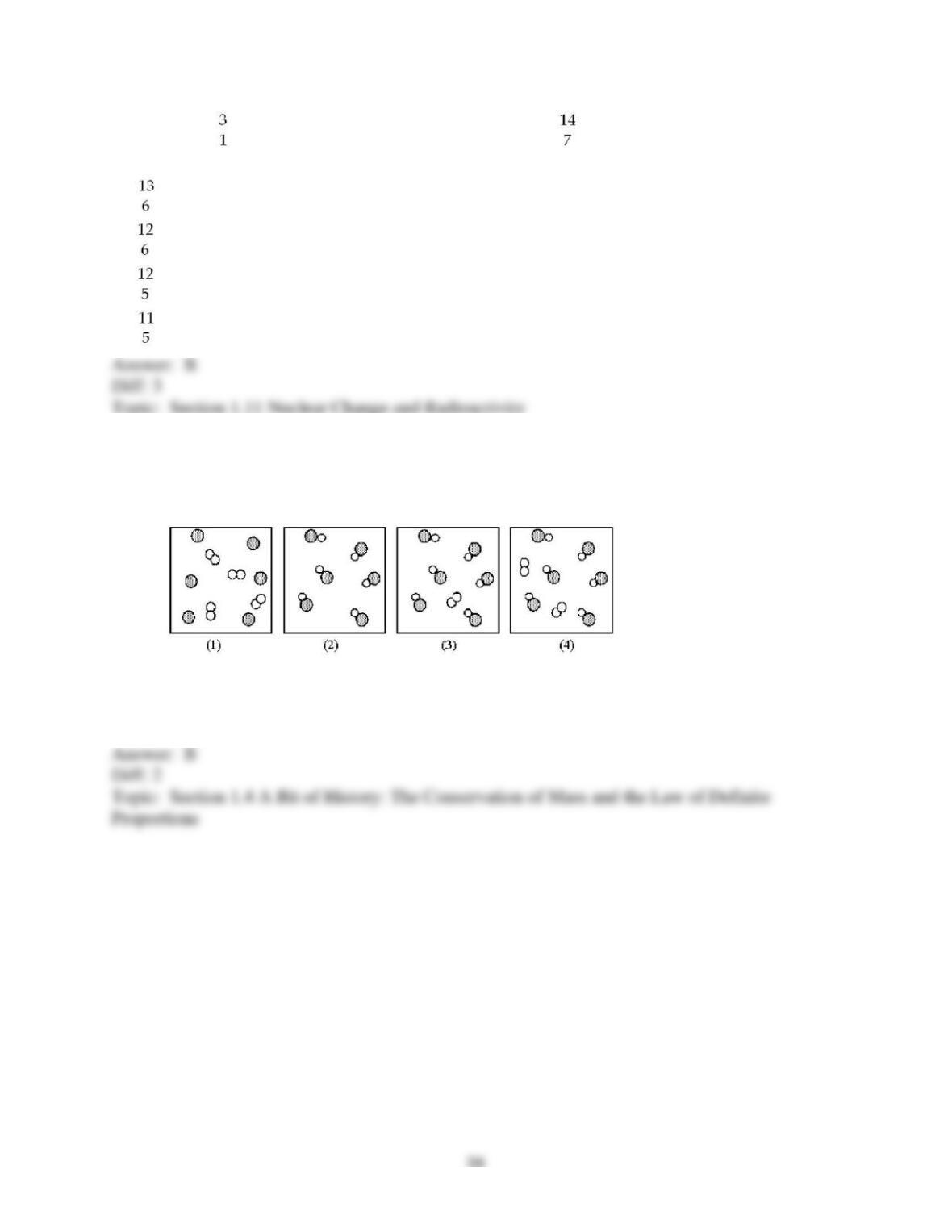
117) Tritium, H, is formed in the upper atmosphere when N captures a neutron and then
decays. What is the other product of this reaction?
A) C
B) C
C) B
D) B
118) Assume that the mixture of substances in drawing (1) undergoes a chemical reaction.
Which of the drawings (2)-(4) represents a product mixture that is consistent with the law of
mass conservation?
A) drawing (2)
B) drawing (3)
C) drawing (4)
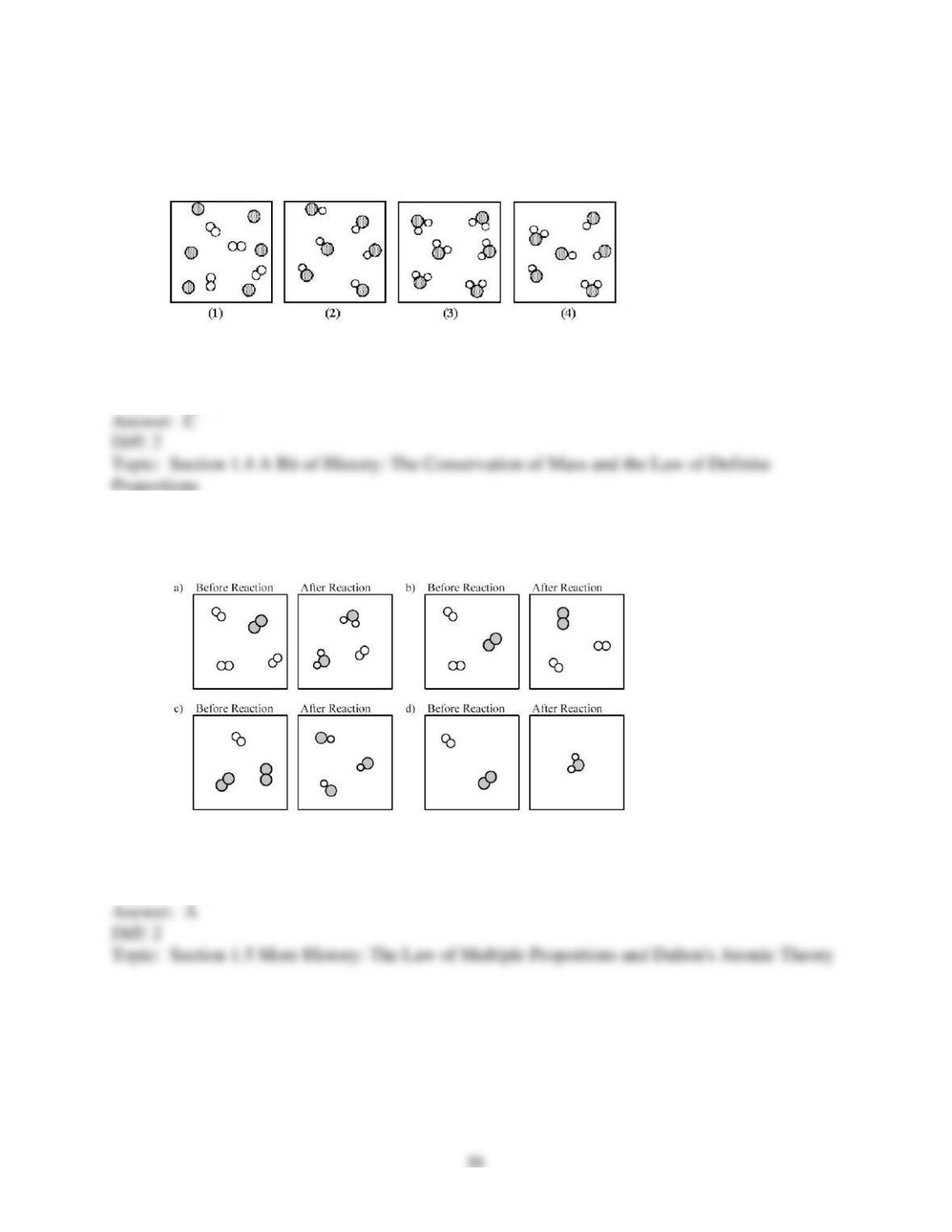
119) Assume that the mixture of substances in drawing (1) undergoes a chemical reaction.
Which of the drawings (2)-(4) represents a product mixture that is consistent with the law of
mass conservation?
A) drawing (2)
B) drawing (3)
C) drawing (4)
120) Which of the following drawings depicts a chemical reaction consistent with Dalton’s
atomic theory?
A) drawing a)
B) drawing b)
C) drawing c)
D) drawing d)
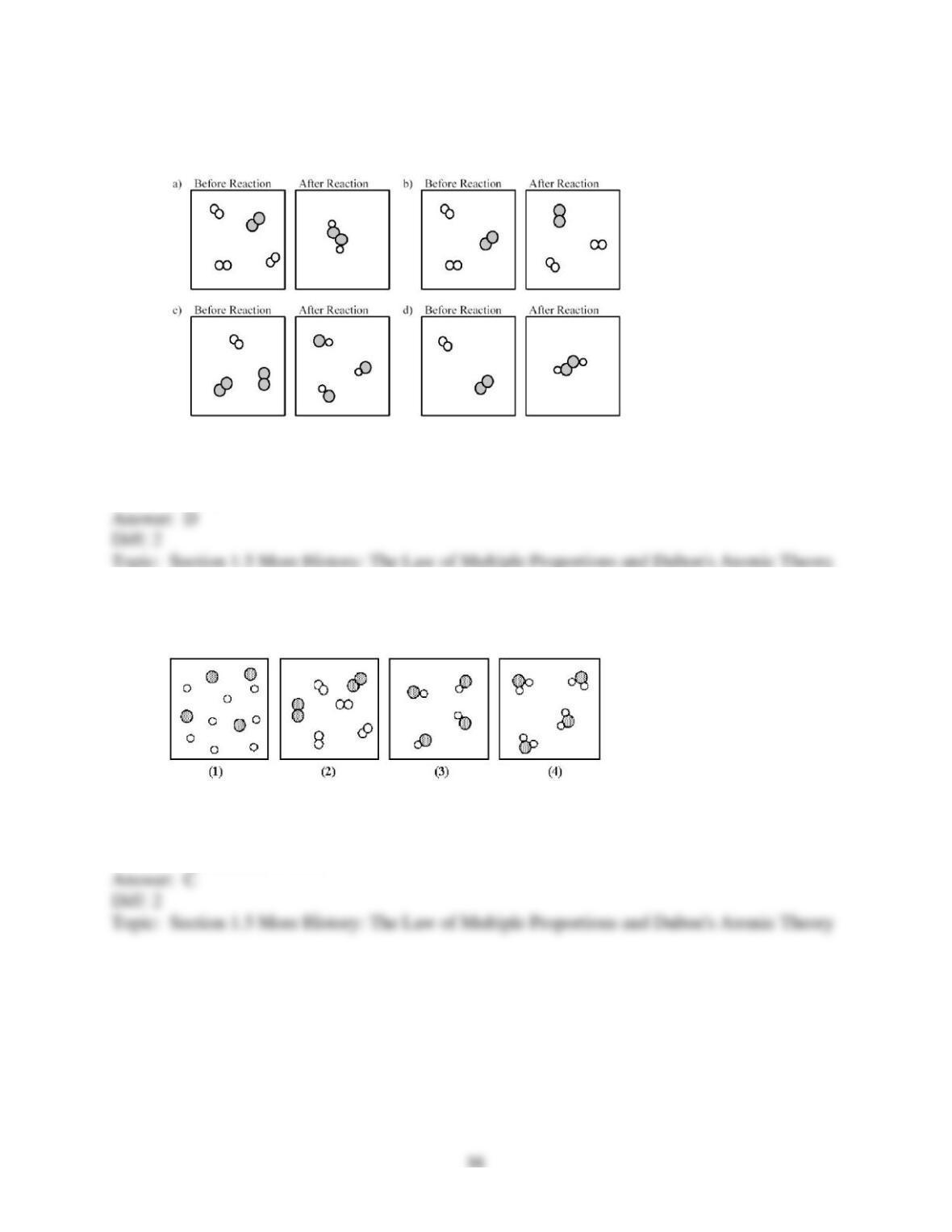
121) Which of the following drawings depicts a chemical reaction consistent with Dalton’s
atomic theory?
A) drawing a)
B) drawing b)
C) drawing c)
D) drawing d)
122) If shaded and unshaded spheres represent atoms of different elements, as shown in drawing
(1), which drawings (2)-(4) represent the law of multiple proportions?
A) only drawings (2) and (3)
B) only drawings (2) and (4)
C) only drawings (3) and (4)
D) drawings (2), (3), and (4)
123) If shaded and unshaded spheres represent atoms of different elements, as shown in drawing
(1), which drawings (2)-(4) represent the law of multiple proportions?
A) only drawings (2) and (3)
B) only drawings (2) and (4)
C) only drawings (3) and (4)
D) drawings (2), (3), and (4)
124) If shaded and unshaded spheres represent atoms of different elements, as shown in drawing
(1), which drawings (2)-(4) represent the law of multiple proportions?
A) only drawings (2) and (3)
B) only drawings (2) and (4)
C) only drawings (3) and (4)
D) drawings (2), (3), and (4)