
20) Ceteris paribus is the same as rise / run.
21) A small, one-unit change in value is called a marginal change.
22) A key assumption of most economic analysis is that people act rationally, meaning they
respond to incentives.
23) A key assumption of most economic analysis is that people are altruistic, meaning that they
act in their own self-interest.
24) Economists assume that individuals make informed decisions and act in their own self-
interest.

25) The congestion tax implemented in London reduced traffic volume and cut travel time for
cars and buses in half.
26) To determine an appropriate congestion tax, an economist has to assume that people respond
to incentives.
Recall the Application about unwanted commercial e-mail, or spam, to answer the
following question(s).
27) Recall the application. One idea to reduce the volume of e-mail spam is to charge the sender
for each commercial e-mail sent.
28) What is meant by the term “marginal change”?
1.4 Preview of Coming Attractions: Macroeconomics
1) Macroeconomics is best described as the study of
A) very large issues.
B) the choices made by individual households, firms, and governments.
C) the nation’s economy as a whole.
D) the relationship between inflation and wage inequality.
2) Which of the following is a macroeconomic question?
A) Should we have a constitutional amendment requiring the government to implement a
national consumption tax to replace the current income tax?
B) Why did a leading computer manufacturer establish call centers in India?
C) Why does a pharmaceutical manufacturer try to lower its production costs?
D) Should the government put a tax on alcohol in an attempt to assist in the funding of support
groups like Alcoholics Anonymous?
3) Which of the following is NOT a macroeconomic question?
A) Should we have a constitutional amendment requiring the federal government to balance the
budget each year?
B) Should restaurants be required to list the number of calories for each product on their menus?
C) How does a fiscal stimulus package affect gross domestic product?
D) Should Congress enact tougher immigration laws to reduce unemployment?

4) We can use macroeconomic analysis to
A) learn how to balance a checkbook.
B) study the choices made by households.
C) understand marginal changes in the macroeconomy.
D) understand why economies grow.
5) Macroeconomics involves the study of the decision-making of individual firms or individuals.
6) Macroeconomics helps explain economic fluctuations, why the economy shrinks and expands
and why some of the economy’s resources are idle.
7) Describe the field of economics known as macroeconomics.
8) Explain three ways we can use macroeconomic analysis.
1.5 Preview of Coming Attractions: Microeconomics
1) The study of the choices made by individual households, firms, and government is called
A) macroeconomics.
B) microeconomics.
C) managerial economics.
D) market economics.
2) Microeconomics is best described as the study of
A) the choices made by individual households, firms, and governments.
B) inflation, unemployment, gross national product, and the nation’s economy as a whole.
C) how markets interact in the aggregate economy.
D) marginal changes in the economy.
3) Which of the following is a microeconomic question?
A) Should companies pay for employees’ health insurance?
B) Why do some countries have higher economic growth rates than other countries?
C) Should Congress and the president take action to reduce the unemployment rate?
D) Should the Fed attempt to influence the interest rate to control potential inflation?
4) Which of the following is a microeconomic question?
A) Should the government decrease unemployment benefits to reduce the unemployment rate?
B) Why do some countries have higher inflation rates than other countries?
C) Should the government subsidize corn farmers to encourage the production of ethanol?
D) Should congress decrease taxes to help stimulate the economy?
5) Microeconomics helps explain economic fluctuations, why the economy shrinks and expands
and why some of the economy’s resources are idle.
6) Microeconomics is the study of aggregate behavior in the economy.

7) One example of a microeconomic question is, “How will prices in the clothing industry
change if the government bans imports from China?”
8) One example of a microeconomic question is, “Should unemployment benefits be increased?”
9) Describe the field of economics known as microeconomics.
10) Explain three ways we can use microeconomic analysis.
1.6 Appendix A: Using Graphs and percentages
1) There is a positive relationship between two variables if
A) they move in opposite directions.
B) they move in the same direction.
C) one variable changes and the other does not.
D) neither variable moves.
2) There is a negative relationship between two variables if
A) they move in opposite directions.
B) they move in the same direction.
C) one variable changes and the other does not.
D) neither variable moves.
3) The slope of a curve measures
A) the change in one variable in response to the change in the other variable.
B) the length of the curve.
C) only the change in the horizontal variable.
D) only the change in the vertical variable.
4) Slope is calculated as the
A) change in the vertical variable divided by the change in the horizontal variable.
B) change in the horizontal variable divided by the change in the vertical variable.
C) the vertical axis divided by the horizontal axis.
D) change in the vertical variable.
5) The slope of a straight line
A) is constant.
B) is negative.
C) is zero.
D) changes along the curve.
6) If the variable on the vertical axis increases by 20 and the variable on the horizontal axis
increases by 5, the slope of the line is
A) 0.25.
B) 4.
C) 15.
D) 100.
7) If the variable on the vertical axis increases by 24 and the variable on the horizontal axis
decreases by 3, the slope of the line is
A) -24.
B) -8.
C) 3.
D) 72.
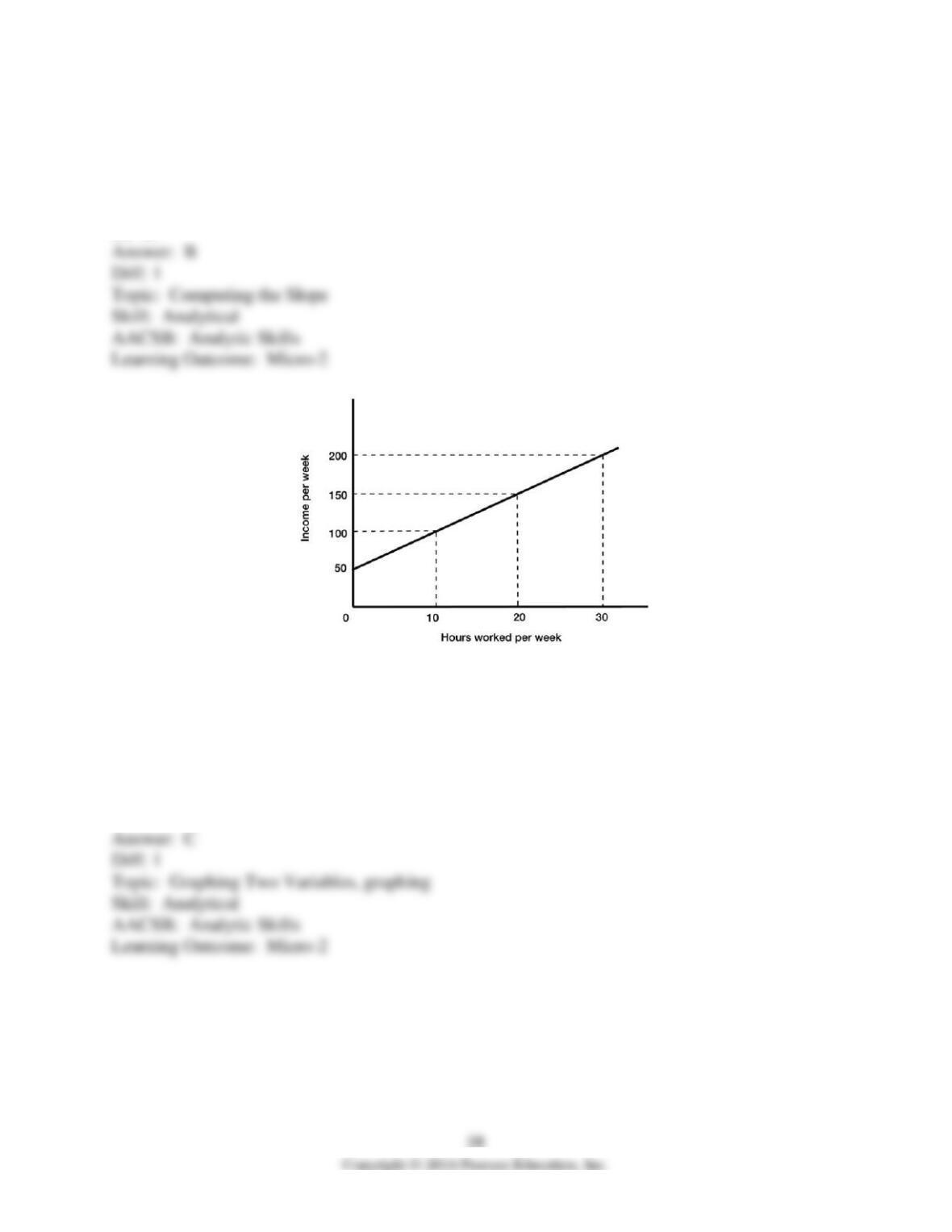
Figure 1A.1
8) Refer to Figure 1A.1. If the hours worked per week is 20, the income per week is
A) 50.
B) 100.
C) 150.
D) 200.
9) Refer to Figure 1A.1. If the hours worked per week is 30, the income per week is
A) 50.
B) 100.
C) 150.
D) 200.
10) Refer to Figure 1A.1. The slope of the line between the points where income equals 50 and
income equals 200 is
A) 0.2.
B) 5.
C) 10.
D) 50.
11) Refer to Figure 1A.1. The slope of the line between the points where hours worked per week
are 20 and hours worked per week are 30 is
A) 0.2.
B) 5.
C) 10.
D) 50.
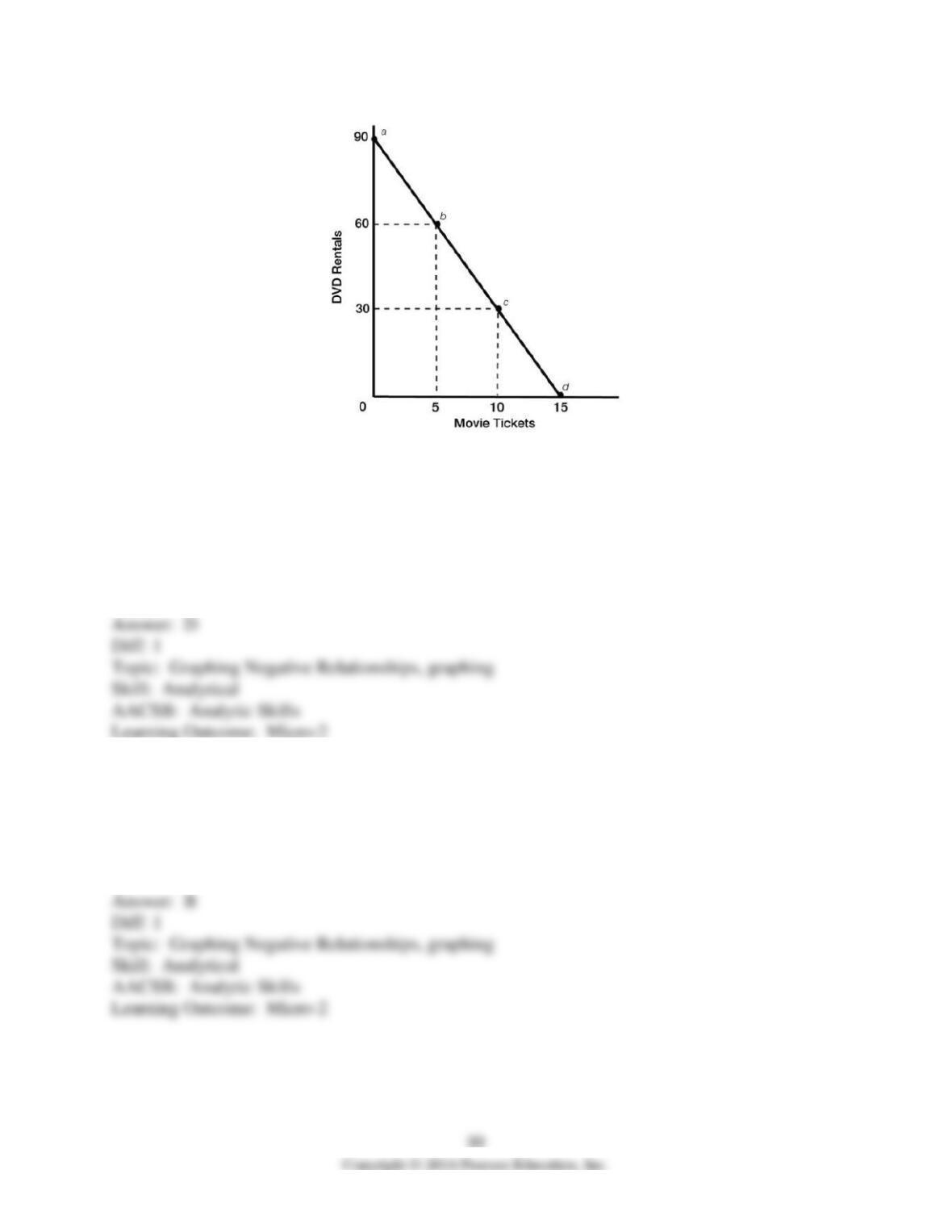
Figure 1A.2
12) Refer to Figure 1A.2. If this consumer rents zero DVDs, how many movie tickets will she
purchase?
A) 0
B) 5
C) 10
D) 15
13) Refer to Figure 1A.2. If this consumer rents 60 DVDs, how many movie tickets will she
purchase?
A) 0
B) 5
C) 10
D) 15
14) Refer to Figure 1A.2. The slope of the curve
A) is negative.
B) is positive.
C) is zero.
D) changes along the curve.
15) Refer to Figure 1A.2. The slope between points a and c is
A) -5.
B) -6.
C) 10.
D) 30.
16) The slope of a nonlinear curve
A) is constant.
B) is negative.
C) is zero.
D) changes along the curve.
17) If the price of monthly satellite TV service increases from $40 to $50, the percentage change
is
A) 5%.
B) 20%.
C) 25%.
D) 45%.
18) If the price of a 32GB memory card decreases from $25 to $20, the percentage change is
A) -20%.
B) -33%.
C) -50%.
D) -60%.
Recall the Application about the government of Mexico City repainting highway lane lines
to transform a 4-lane highway into a 6-lane highway to answer the following question(s).
19) Recall the application. When the government converted the highway from 4 lanes into 6
lanes, they claimed the capacity had increased by 50%. When the government switched the
highway back from 6 lanes to 4 lanes, they claimed the capacity had been decreased by 33%.
Had the government used the midpoint method, the percentage increase would have been
________% and the percentage decrease would have been ________%.
A) 33; 50
B) 33; 33
C) 40; 40
D) 50; 50
20) Recall the application. When computing percentage changes, using the simple approach
results in increases and decreases which are
A) identical.
B) symmetric.
C) not symmetric.
D) more accurate than using the midpoint method.
21) If you work 4 extra hours, and the slope of the curve showing the relationship between your
income and work hours is 8, your income will increase by
A) $2.
B) $4.
C) $12.
D) $32.

22) To increase income by $120 when the slope of the curve showing the relationship between
your income and work hours is 8, how many extra hours will you need to work?
A) 8
B) 15
C) 112
D) 960
23) The origin of a graph is the intersection of the two axes, where the value of both variables is
zero.
24) Positive relationships are also referred to as inverse relationships.
25) Negative relationships are also referred to as inverse relationships.
26) Slope is calculated as rise / run.
27) Slope is calculated as a change in the variable on the horizontal axis divided by a change in
the variable on the vertical axis.