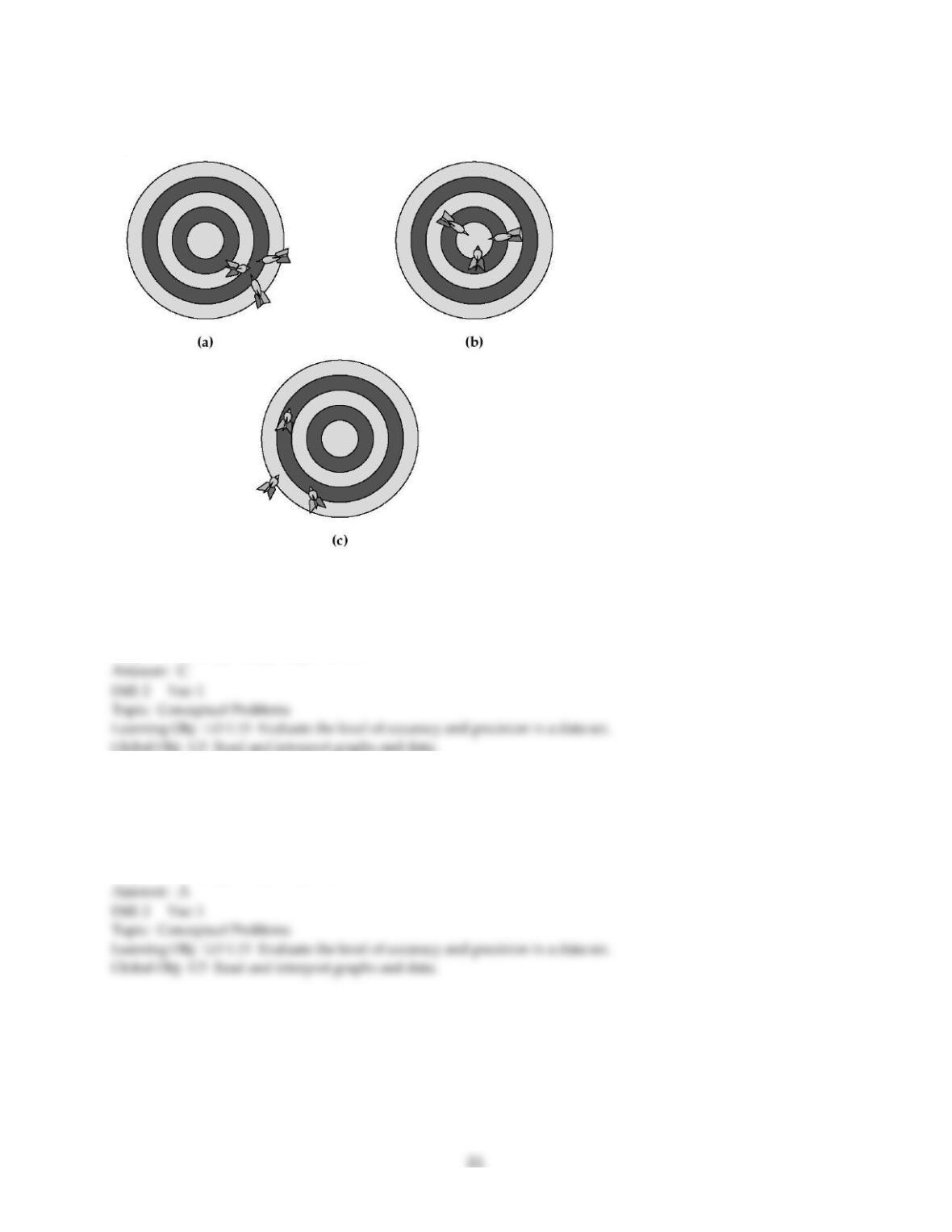
Use the drawings below to answer the following questions.
62) If hitting the bull’s-eye is the desired result, Figure (a) represents
A) good accuracy and good precision.
B) good accuracy and poor precision.
C) poor accuracy and good precision.
D) poor accuracy and poor precision.
63) If hitting the bull’s-eye is the desired result, Figure (b) represents
A) good accuracy and good precision.
B) good accuracy and poor precision.
C) poor accuracy and good precision.
D) poor accuracy and poor precision.
64) If hitting the bull’s-eye is the desired result, Figure (c) represents
A) good accuracy and good precision.
B) good accuracy and poor precision.
C) poor accuracy and good precision.
D) poor accuracy and poor precision.
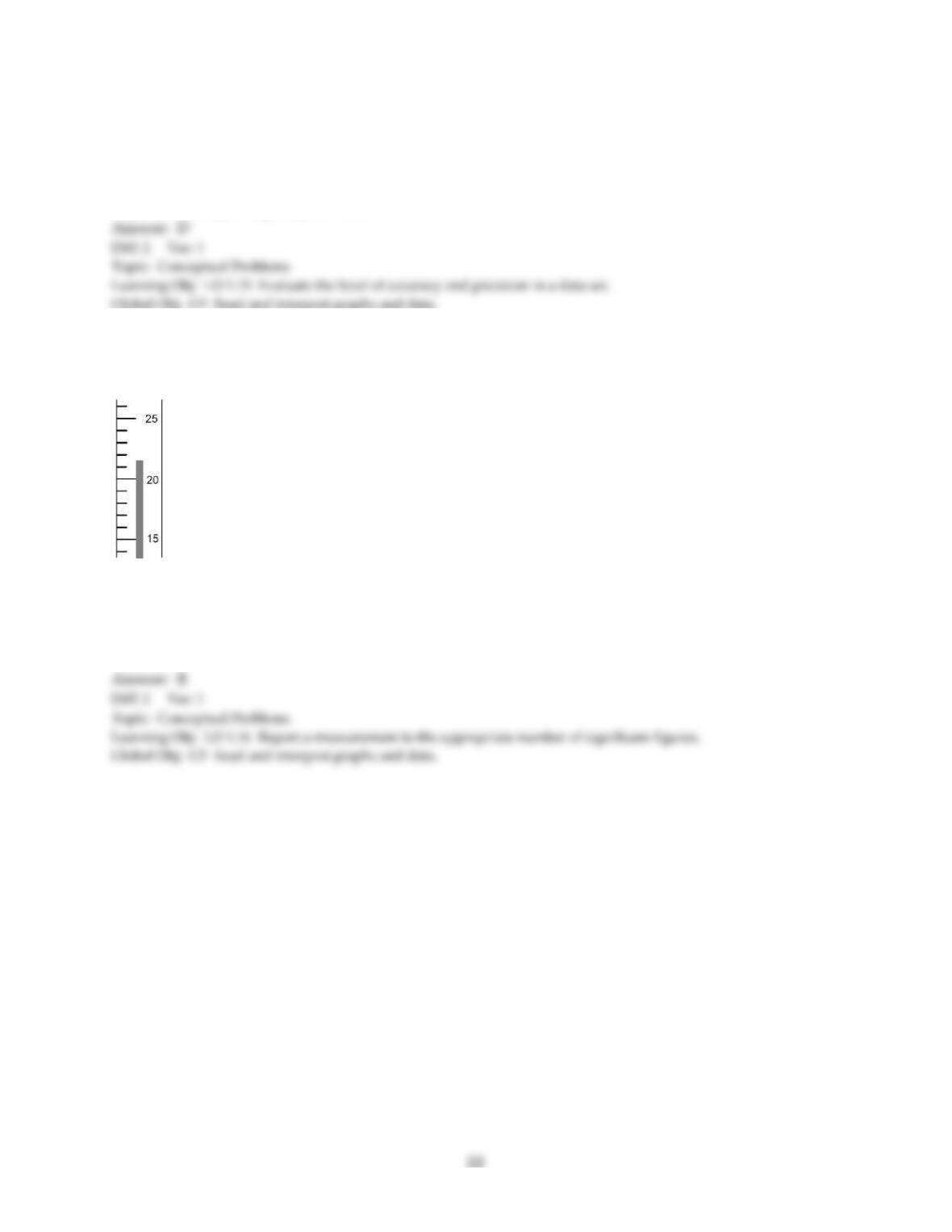
65) To the correct number of significant figures, what is the temperature reading on the following Celsius
thermometer?
A) 21°C
B) 21.7°C
C) 21.70°C
D) 22°C
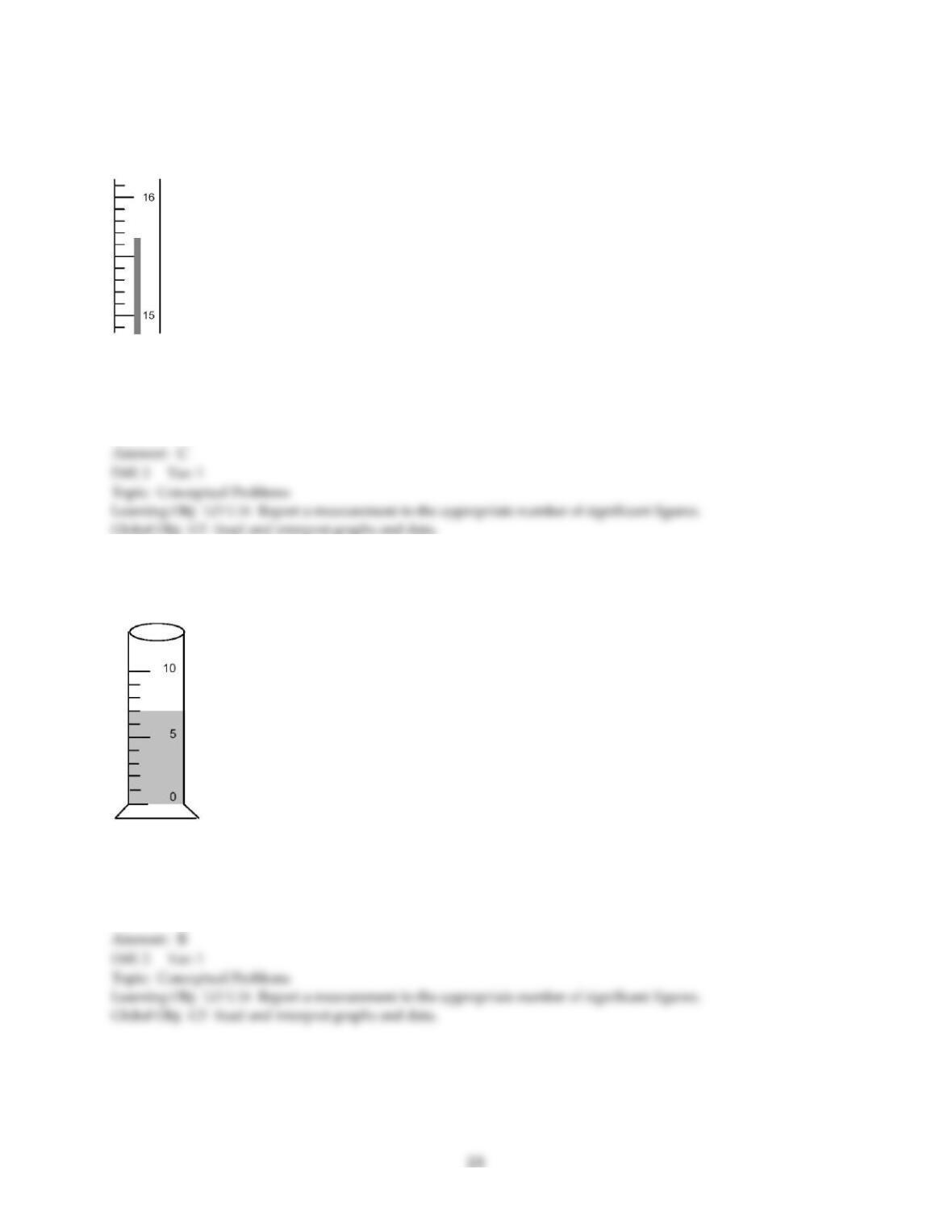
66) To the correct number of significant figures, what is the temperature reading on the following Celsius
thermometer?
A) 15°C
B) 15.6°C
C) 15.67°C
D) 16°C
67) To the correct number of significant figures, what is the volume of the liquid in the graduated
cylinder?
A) 7 mL
B) 7.0 mL
C) 7.7 mL
D) 8 mL
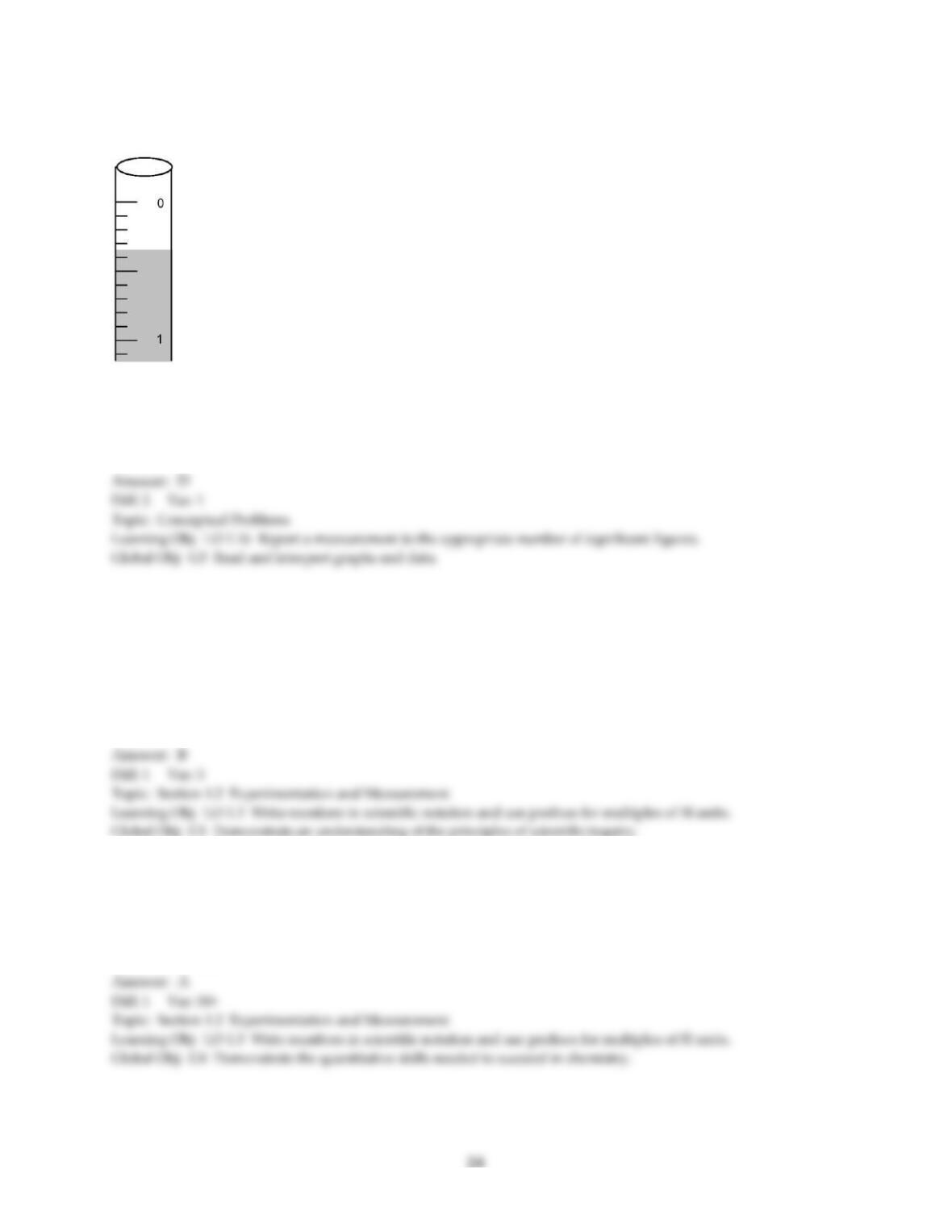
68) To the correct number of significant figures, what is the level of the liquid in the buret?
A) 0.2 mL
B) 0.29 mL
C) 0.3 mL
D) 0.35 mL
1.2 Algorithmic Questions
1) What symbol is used to represent the factor 10-2?
A) M
B) c
C) μ
D) n
2) Which of the following is the smallest unit?
A) 13 centi
B) 3.0 deci
C) 3.3 × 10³ milli
D) 1.5 × 10⁶ nano
25
3) What symbol is used to represent the factor 109?
A) M
B) m
C) μ
D) G
4) The factor 10 corresponds to which prefix?
A) centi
B) deci
C) deka
D) milli
5) The factor 106 corresponds to which prefix?
A) deka
B) deci
C) mega
D) milli
6) Without using a calculator, solve the following problem:
A) 1 × 10²
B) 1 × 10⁸
C) 1 × 10²⁰
D) 1 × 1026
7) Without using a calculator, solve the following problem:
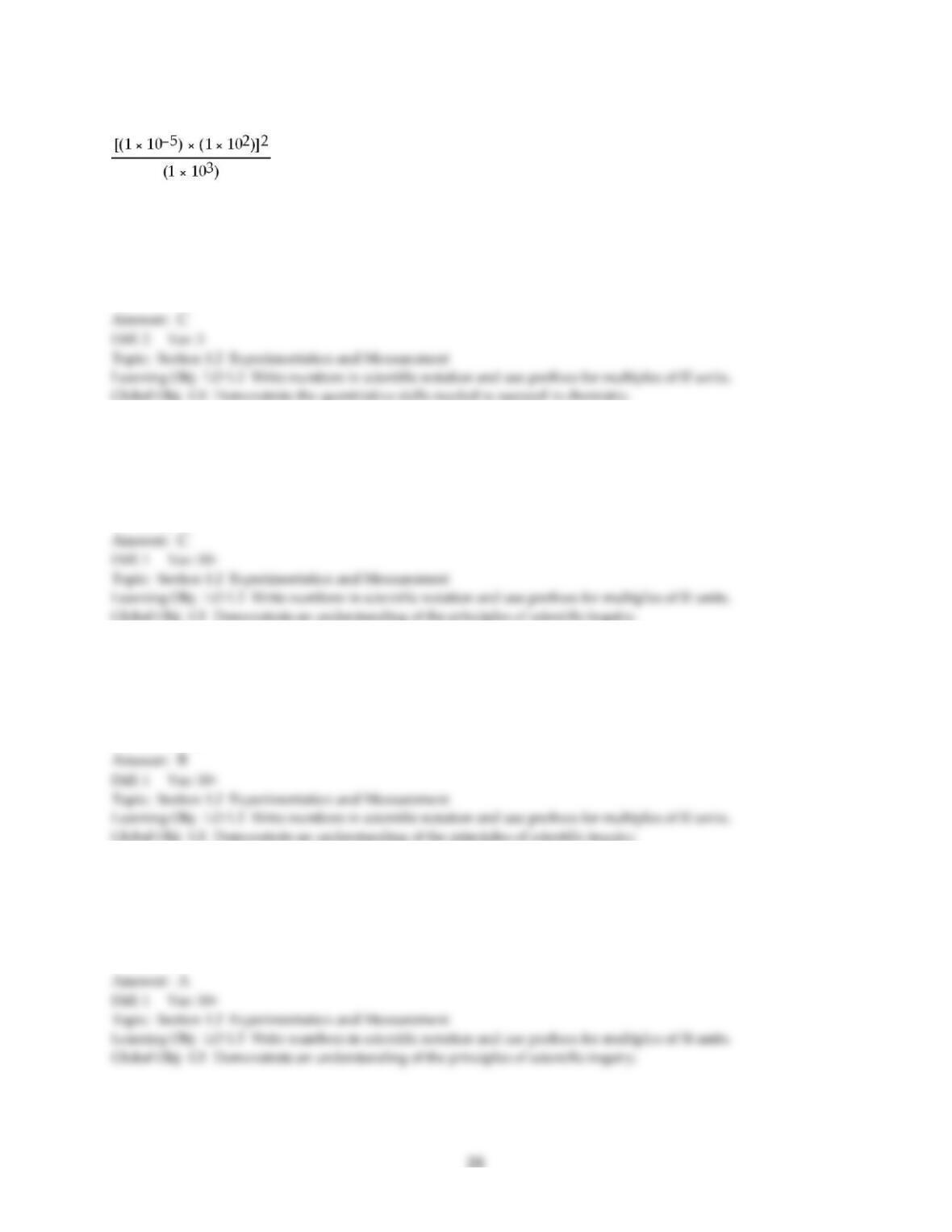
A) 1 × 100
B) 1 × 10⁻³
C) 1 × 10⁻⁹
D) 1 × 10–12
8) The fundamental SI unit of mass is the
A) gigagram.
B) microgram.
C) kilogram.
D) decigram.
9) Which of the following is a fundamental SI Unit?
A) millimeter
B) meter
C) hectometer
D) nanometer
10) All of the following are fundamental SI units except the
A) year.
B) kilogram.
C) mole.
D) Kelvin.
11) What symbol is used to represent the factor 10-9?
A) G
B) c
C) μ
D) n
12) Convert 4.300 × 10⁻³ to ordinary notation.
A) 0.0004300
B) 0.004300
C) 430.0
D) 4300
13) Convert 0.009723 to standard scientific notation.
A) 9.723 × 10⁻³
B) 9723 × 10-6
C) 9.723 × 10³
D) 9723 × 106
14) Which of the following is the greatest mass?
A) 10,000 μg
B) 1.000 × 10⁻³ kg
C) 1.000 × 10⁻³ cg
D) 1.000 × 10⁻⁷ Mg
15) The mass of a proton is 1.67 × 10⁻²⁷ kg. What is the mass of a proton in Megagrams?
A) 1.67 × 10–36 Mg
B) 1.67 × 10⁻³³ Mg
C) 1.67 × 10⁻³⁰ Mg
D) 1.67 × 10⁻²⁷ Mg
16) The mass of a single copper atom is 1.055 × 10⁻²² g. This is the same mass as
A) 1.055 × 10⁻¹⁶ mg.
B) 1.055 × 10⁻²⁵ kg.
C) 1.055 × 10⁻²⁸ μg.
D) 1.055 × 10⁻³¹ ng.
17) A student weighed 3.000 μg of sulfur in the lab. This is the same mass as
A) 3.000 × 10⁻⁹ g.
B) 3.000 × 10⁻⁶ kg.
C) 3.000 × 10⁻⁶ mg.
D) 3.000 × 10³ ng.
18) Which of the following is the greatest mass?
A) 10 μg
B) 1.000 × 10⁻⁴ kg
C) 1.000 × 10⁻² cg
D) 1.000 × 10⁻⁸ Mg
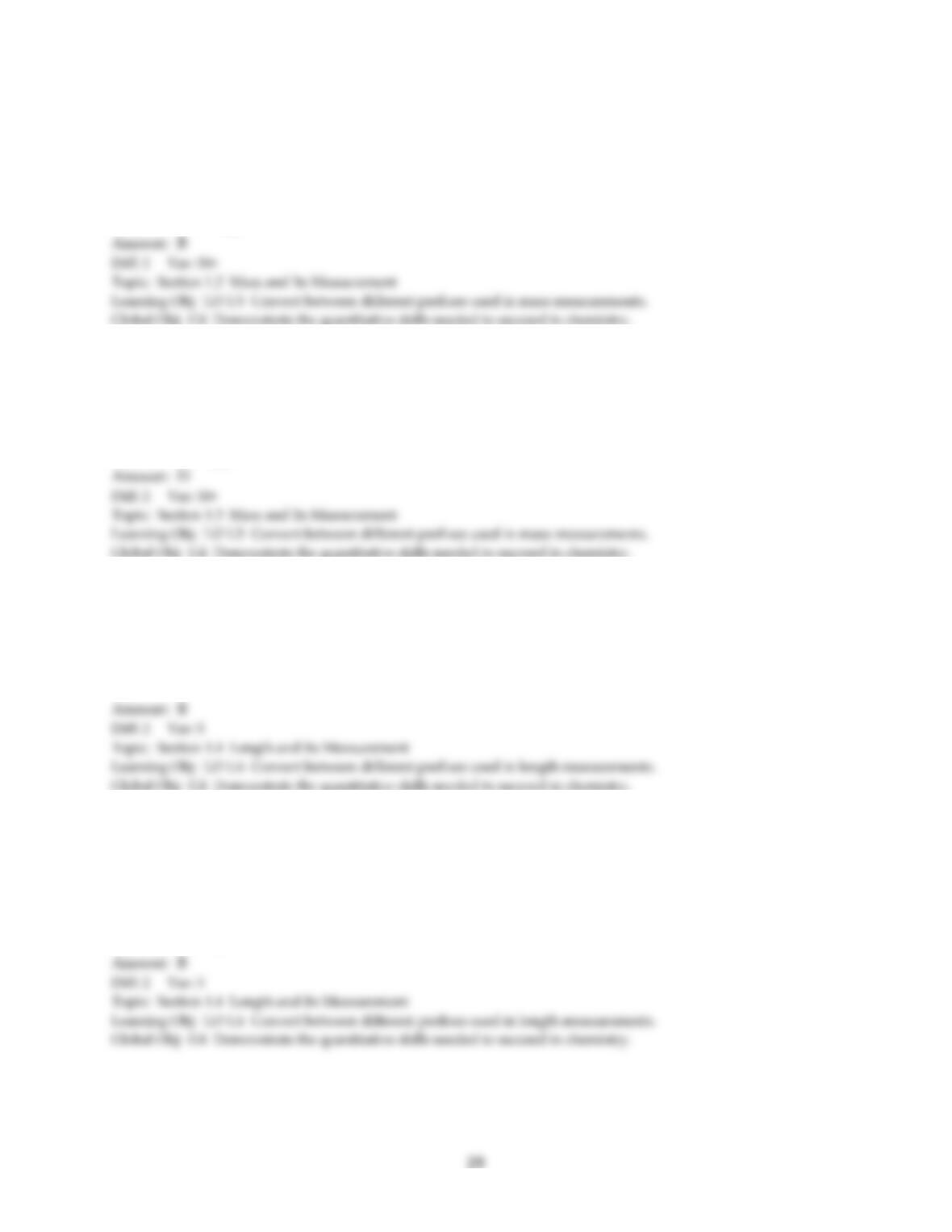
19) The mass of a single copper atom is 1.055 × 10⁻²² g. This is the same mass as
A) 1.055 × 10⁻¹⁷ dg.
B) 1.055 × 10⁻²⁸ mg.
C) 1.055 × 10⁻²⁸ μg.
D) 1.055 × 10⁻³³ pg.
20) A student weighed 9000. μg of sulfur in the lab. This is the same mass as
A) 9.000 × 10⁻⁶ g.
B) 9.000 × 10⁻³ kg.
C) 9.000 × 10² cg.
D) 9.000 × 10⁹ pg.
21) Convert 1 μm to meters.
A) 1 × 10⁻⁹ m
B) 1 × 10⁻⁶ m
C) 1 × 10⁻³ m
D) 1 × 10⁶ m
22) The average distance between nitrogen and oxygen atoms is 115 pm in a compound called nitric
oxide. What is this distance in nanometers?
A) 1.15 × 10⁻² nm
B) 1.15 × 10⁻¹ nm
C) 1.15 × 10¹⁵ nm
D) 1.15 × 10¹⁹ nm
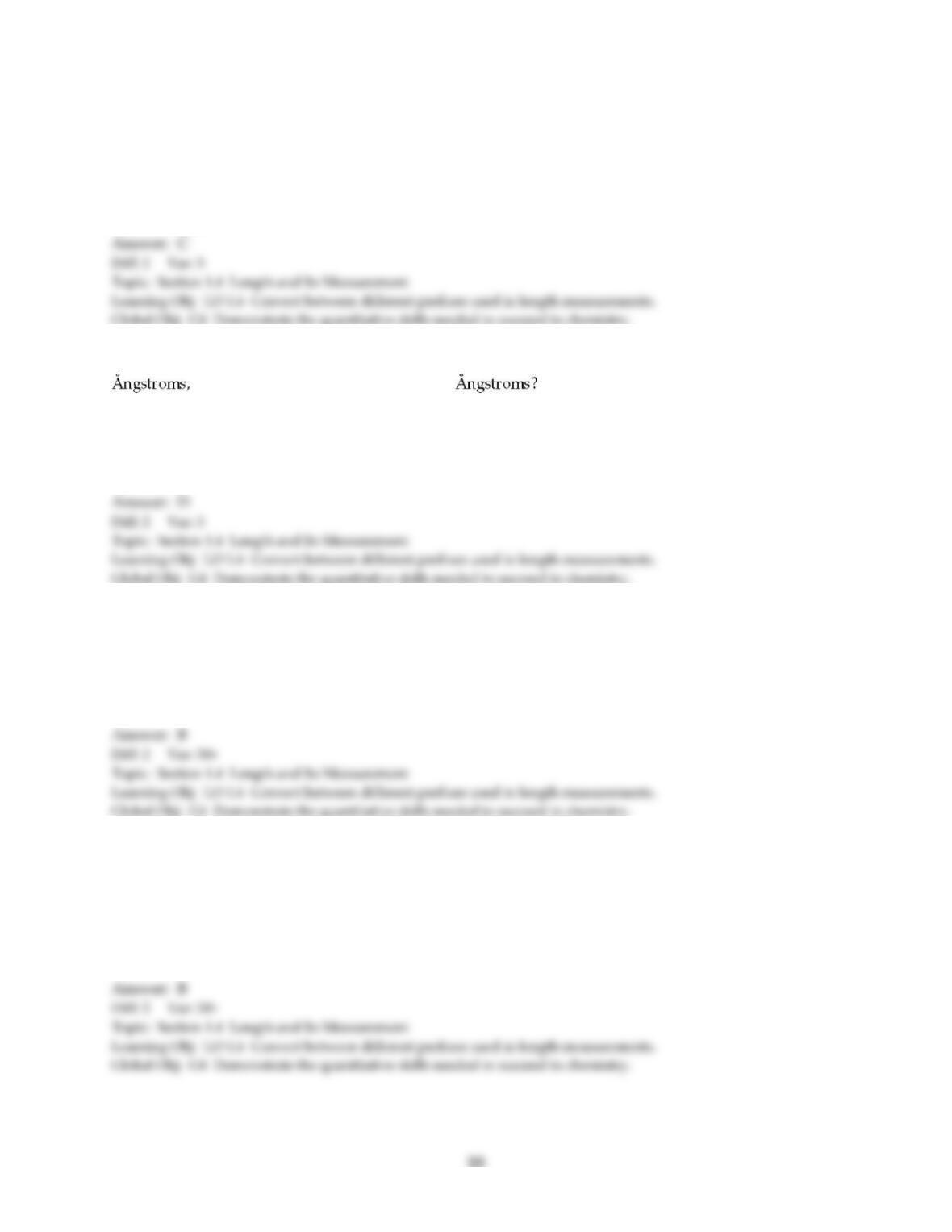
23) The diameter of an atom is approximately 1 × 10⁻¹⁰ m. What is the diameter in centimeters?
A) 1 × 10–13 cm
B) 1 × 10-12 cm
C) 1 × 10⁻⁸ cm
D) 1 × 10⁻⁷ cm
24) The diameter of the nucleus of an atom is approximately 1 × 10–13 cm. If 1 nm is equal to 10
what is the diameter of the nucleus in
A) 1 × 10–23 Å
B) 1 × 10⁻⁸ Å
C) 1 × 10⁻⁷ Å
D) 1 × 10⁻⁵ Å
25) Convert 5.0 μm to meters.
A) 5.0 × 10+9 m
B) 5.0 × 10⁻⁶ m
C) 5.0 × 10+3 m
D) 5.0 × 10⁶ m
26) The average distance between nitrogen and oxygen atoms is 115 pm in a compound called nitric
oxide. What is this distance in centimeters?
A) 1.15 × 10⁻⁷ cm
B) 1.15 × 10⁻⁸ cm
C) 1.15 × 1013 cm
D) 1.15 × 1018 cm
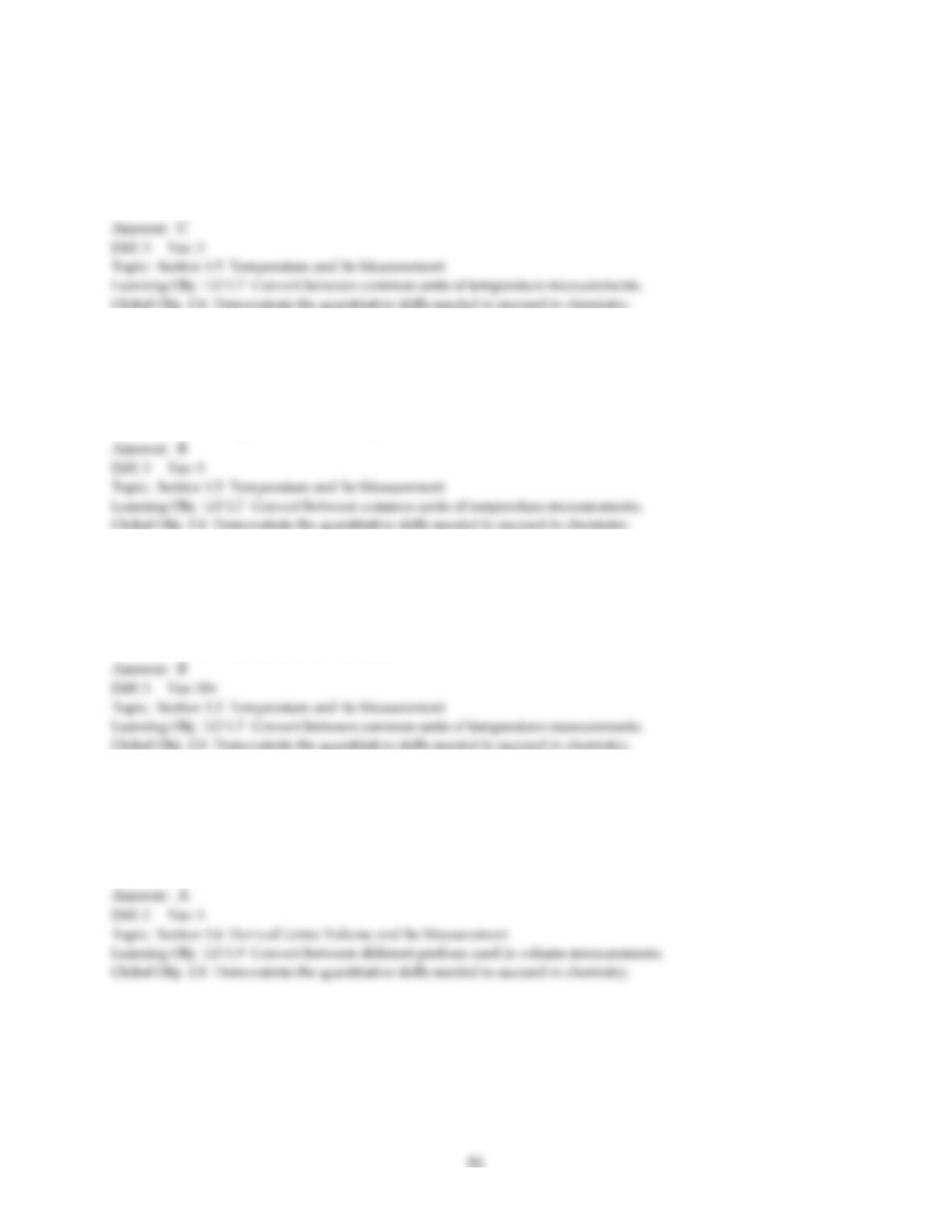
27) If the melting point of copper metal is 1085°C, what is its melting point in Kelvin?
A) 571 K
B) 812 K
C) 1358 K
D) 1985 K
28) Which of the following is the lowest temperature?
A) 37°C
B) 54°F
C) 313 K
D) All of these temperatures are all equal.
29) Which of the following is the lowest temperature?
A) 35°C
B) 57°F
C) 313 K
D) All of these temperatures are all equal.
30) Which of the following volumes is equal to 50 mL?
A) 50 cm3
B) 50 dm3
C) 0.50 L
D) 0.00050 kL
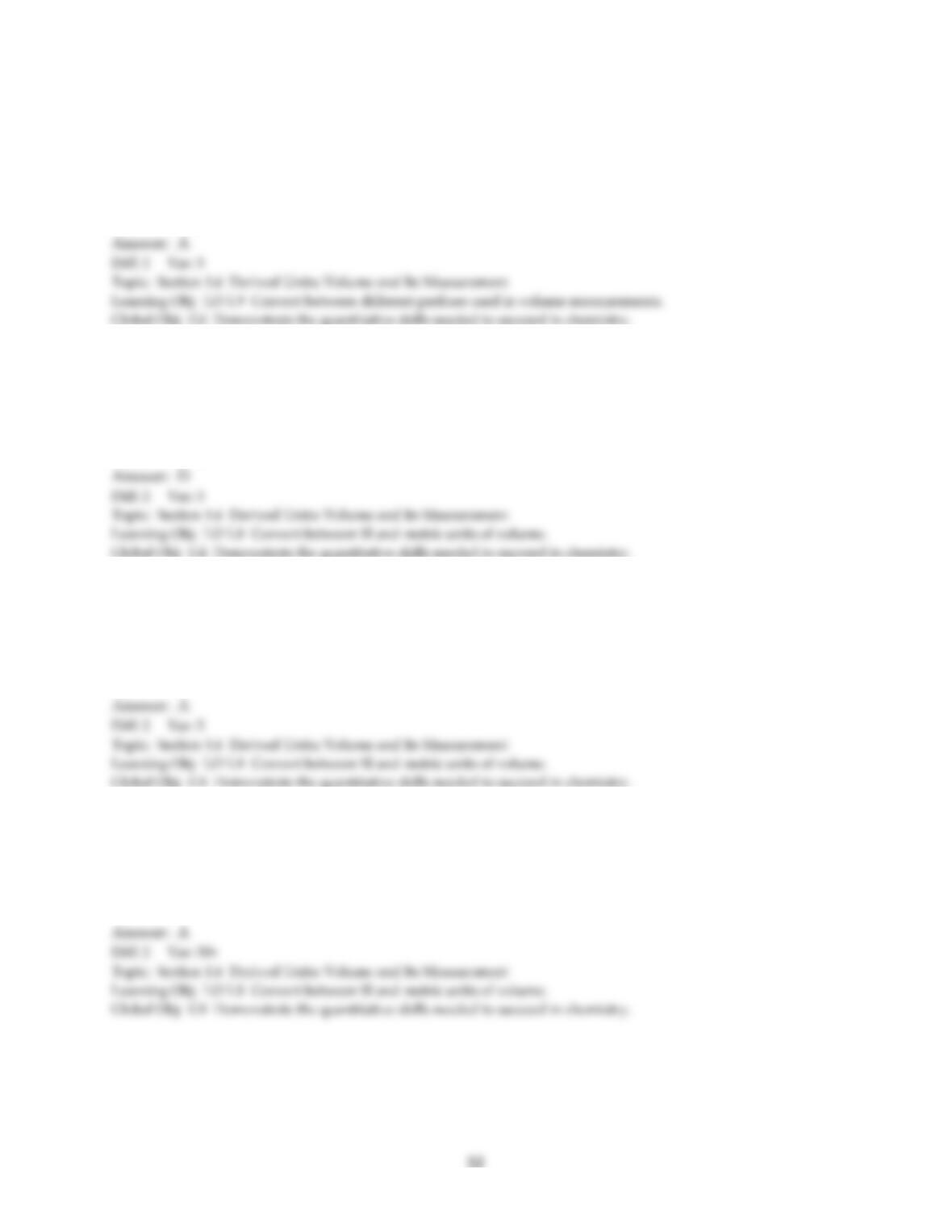
31) Convert 10,000 cm3 to m3.
A) 1 × 10⁻² m3
B) 1 × 10² m3
C) 1 × 10⁶ m3
D) 1 × 10¹⁰ m3
32) Convert 55 m3 to liters.
A) 5.5 × 10⁻² L
B) 5.5 L
C) 5.5 × 10² L
D) 5.5 × 10⁴ L
33) Which of the following is the smallest volume?
A) 11 cm3
B) 0.25 dL
C) 1.4 × 10³ mL
D) 2.5 × 10⁷ nL
34) Which of the following volumes is equal to 60.0 mL?
A) 60.0 cm3
B) 60.0 mm3
C) 0.600 L
D) 0.000600 GL
35) Convert 98.6 cm3 to m3.
A) 98.6 × 10⁻⁴ m3
B) 98.6 × 101 m3
C) 98.6 × 10⁶ m3
D) 98.6 × 10⁸ m3
36) Convert 17 m3 to liters.
A) 1.7 × 10⁻² L
B) 1.7 L
C) 1.7 × 10² L
D) 1.7 × 10⁴ L
37) A piece of metal ore weighs 8.50 g. When a student places it into a graduated cylinder containing
water, the liquid level rises from 21.25 mL to 26.47 mL. What is the density of the ore?
A) 0.321 g/mL
B) 0.614 g/mL
C) 1.63 g/mL
D) 3.11 g/mL
38) A mass of mercury occupies 0.950 L. What volume would an equal mass of methylene chloride
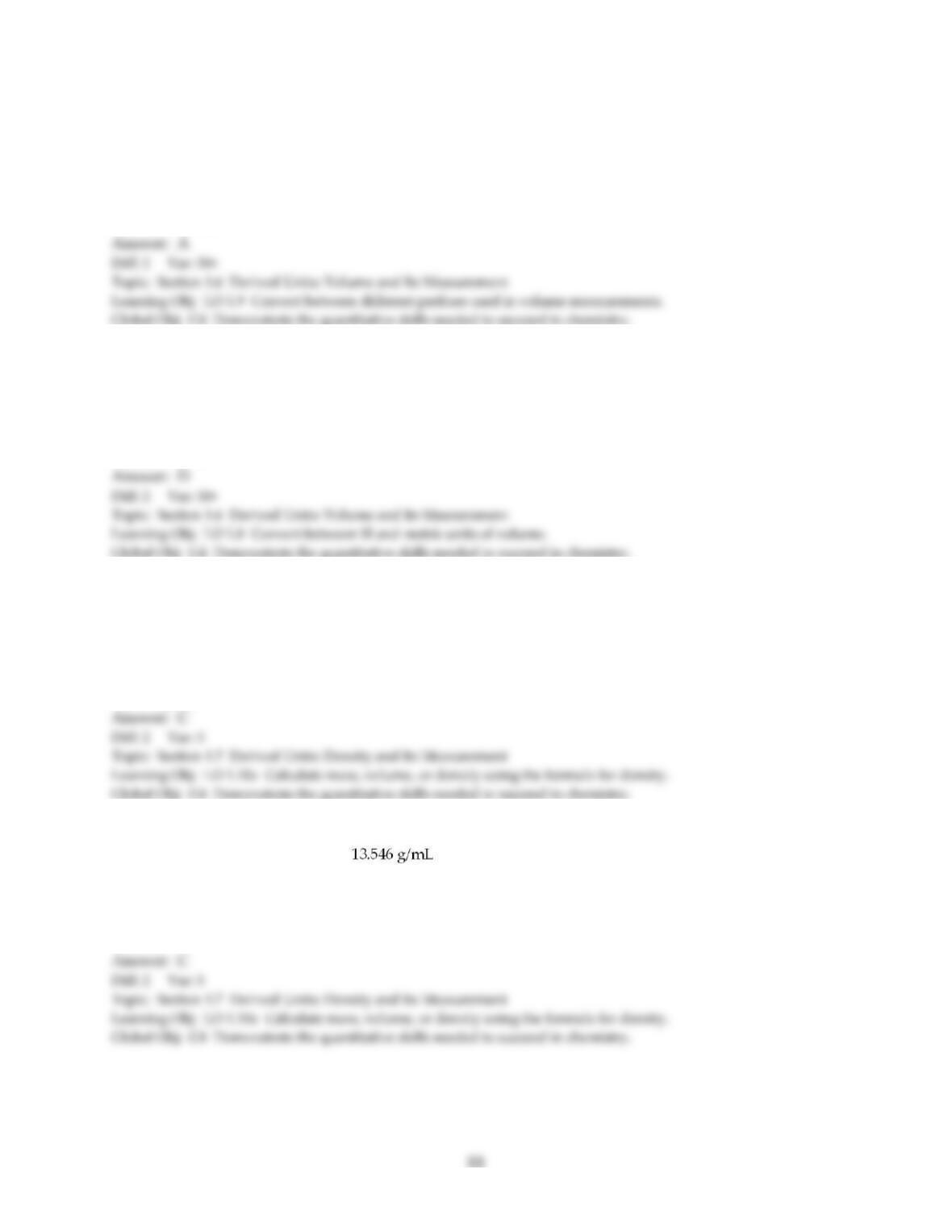
occupy? The density of mercury is and the density of methylene chloride is 1.325 g/mL.
A) 0.00929 L
B) 0.0613 L
C) 9.71 L
D) 18.1 L