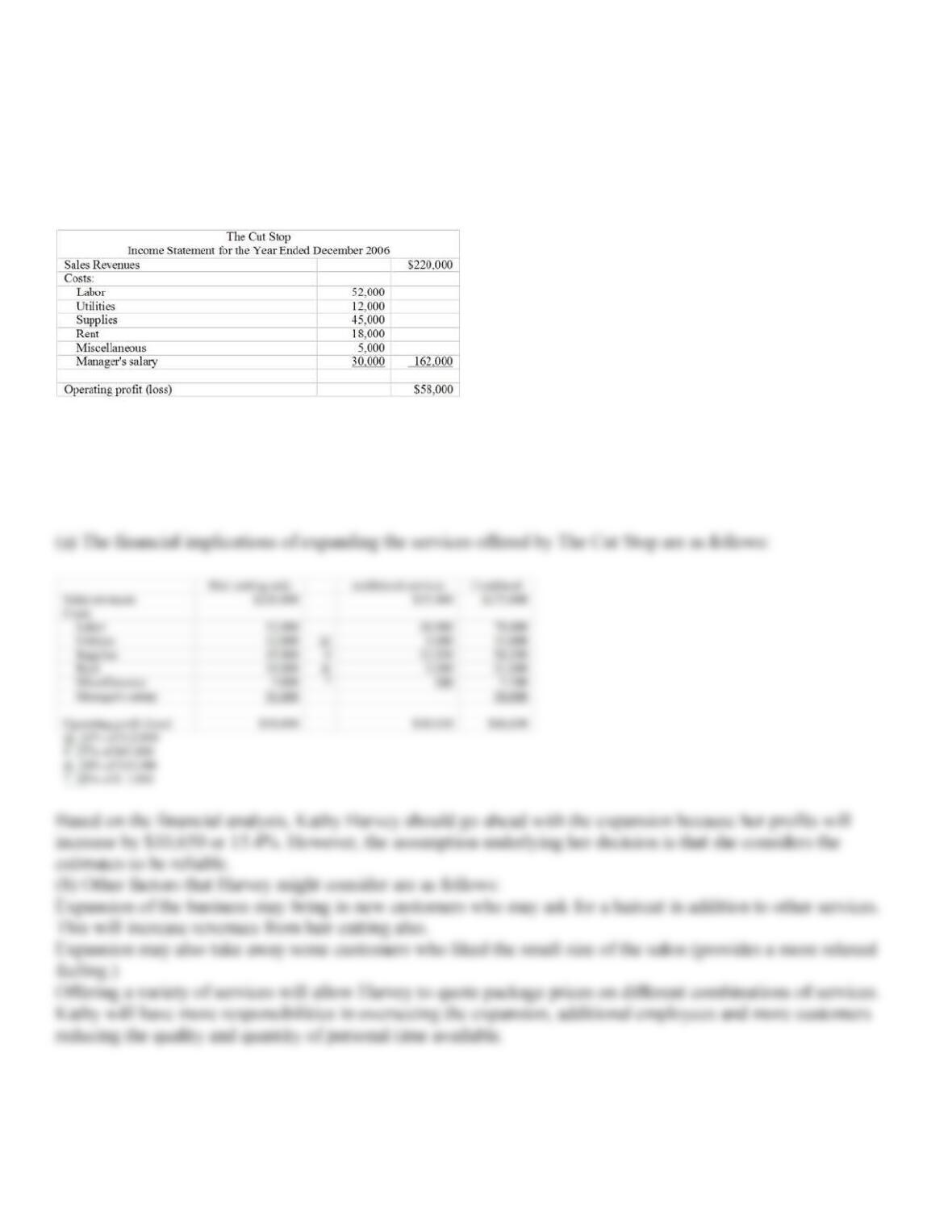
61. The Cut Stop is a small but prosperous hair cutting salon. Kathy Harvey, the manager of the salon, has been
asked by several clients if she will ever offer other “hair related” services (e.g., perm, dye, etc). After careful
thought, Harvey is considering expanding her offerings. However, in order to do so, she will have to hire one
additional stylist at a salary of $26,000 per year. Other expenses will increase as follows: rent by 20%, supplies
and utilities by 25%, and miscellaneous expenses by 10%. Her revenues from additional services are likely to
be $55,000 for the next year (i.e., 2007). The Cut Stop‘s income statement for the most recent year is presented
below.
Required:
(a) Based on your financial analysis, should Kathy Harvey go ahead with the expansion?
(b) What other factors must Harvey consider before making a final decision?

62. Anika Linden, the Vice-President for Human Resources in Educational Toys, Inc. was concerned about a
recent memo she had recently received from the CEO’s office regarding the possibility of outsourcing the
payroll function to Salary Experts, a growing provider of a variety of human resource services. She was
shocked that the CEO’s office had discussed this matter with the Board of Directors, but failed to consult her.
Linden was preparing for a meeting with the CEO. In reading the memo and its attachments, Linden observed
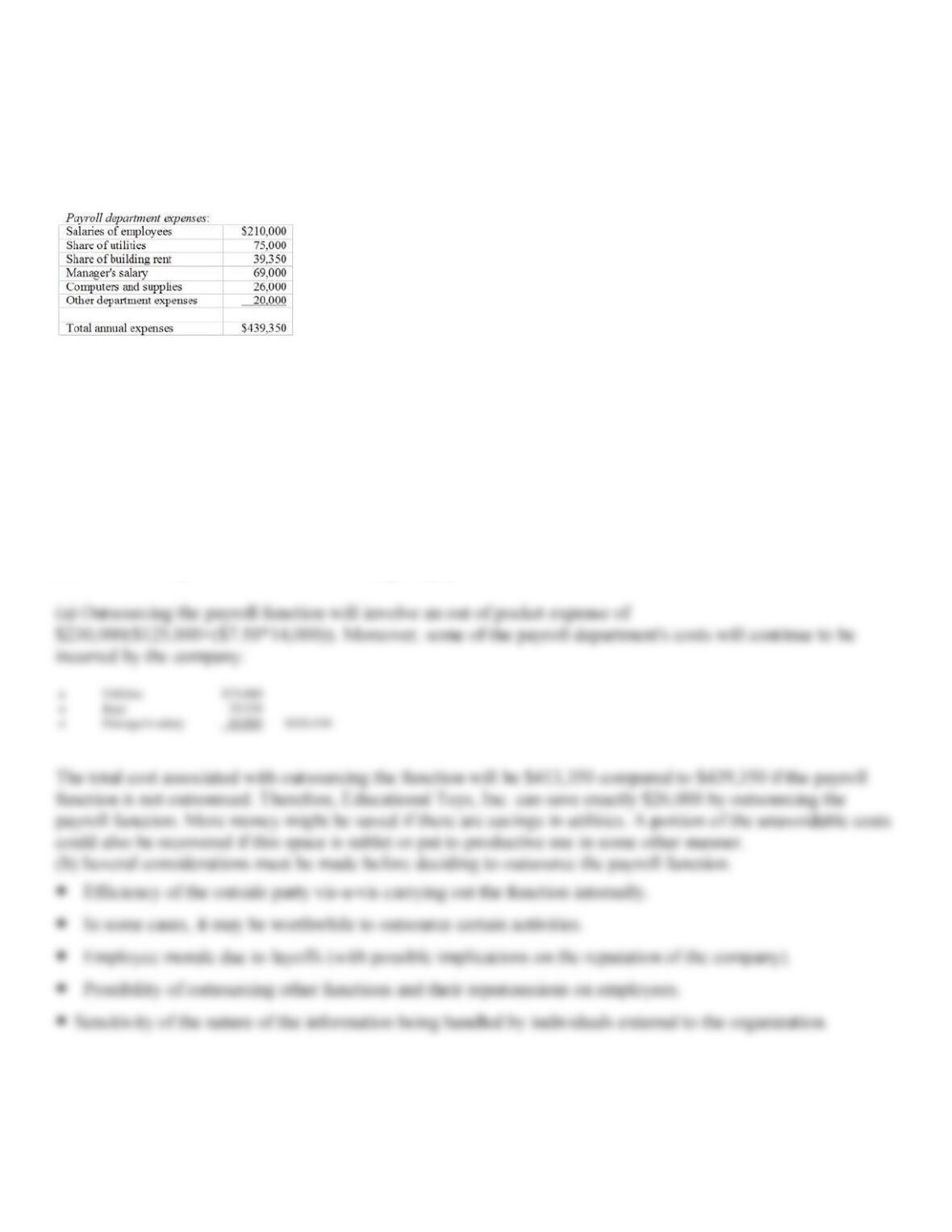
the following comparison of costs in a report prepared by the controller‘s office:
Linden also noted that Salary Experts quoted a fixed fee of $125,000 and variable processing costs of $7.50 per
employee transaction. She did not believe that the company will actually save money by outsourcing the payroll
function. For one, she did not think that the company will actually save all of the above mentioned amounts.
She knew that the payroll department manager could not be removed from the company because he had to
oversee the payroll function and serve as a liaison with the outside company. However, all other employees in
the department would likely not be required.
Required:
(a) Assume Educational Toys has 14,000 employees on its payroll. Can the company save money by
outsourcing the payroll function?
(b) What are the pros and cons of outsourcing the payroll function?

63. Julie King, the production manager of Mussell Corporation is frustrated by the company’s policy of not
scrapping defective units but reworking them. She has pointed out several times to senior management that
some units are beyond rework and should be scrapped. According to her, in most cases, it would be cheaper to
scrap and build a new unit from scratch rather than trying to rework a defective unit. However, Paul Oasis, the
CEO, is not convinced. She wants her controller, Mandie Castagna, to gather some information.
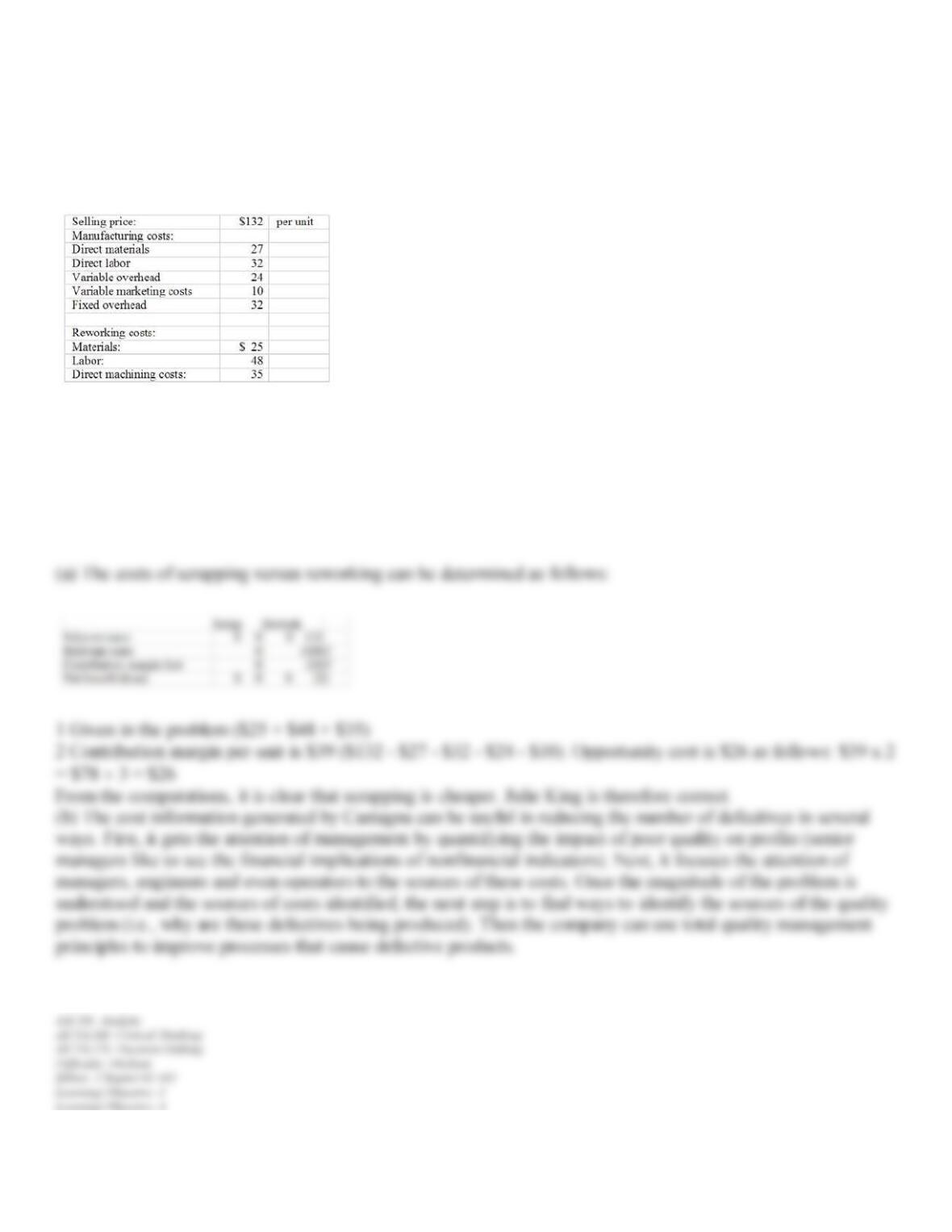
After researching the problem, Castagna provides the following information:
Castagna also observes that reworking a defective product consumes more labor time than making a unit from
scratch. As a result, for every three units reworked, Mussell forgoes the production and sale of two units.
Required:
(a) Do you agree with Julie King that it is cheaper to scrap than rework a defective unit? Show your
computations.
(b) How can the cost information generated by Castagna be useful in reducing the number of defectives?
64. Laurie Riley is a purchasing agent for a motorcycle manufacturer. Laurie is evaluating two potential
suppliers of seats for the company’s motercycles. One supplier (A) quotes a price of $165 per seat and assures
100% quality and delivery standards. The second supplier (B) quotes a price of $135 per seat but does not give
any written assurances on quality or delivery. Riley is not sure which supplier should be awarded the contract.
Assume you are the management accountant for the motorcycle manufacturer. Riley asks you to prepare an
estimate of the related costs of buying the seats from supplier B. She tells you that the estimate is needed
because unless dollar estimates are attached to nonfinancial factors, such as lost production costs, her supervisor
will not give it full attention. Riley provides you with the following information:
Ⴠ Production output is 2,000 motorcycles per year based on 250 production days a year.
Ⴠ Production time per day is 8 hours at a cost of $4,000 per hour to run the production line.
Ⴠ Lost production time due to poor quality is 1%.
Ⴠ Satisfied customers purchase, on average, three motorcycles during a lifetime.
Ⴠ Satisfied customers recommend the product, on average, to 5 other people.
Ⴠ Marketing estimates that using the seat from supplier B will result in 5 lost customers per year from repeat
business and referrals.
Ⴠ Average contribution margin per motorcycle is $5,000.
Required:
Estimate the costs of buying motorcycle seats from supplier B. (Note: This problem requires you to think
creatively and make reasonable estimates; therefore, there is more than one correct answer.)

65. Thompson Metal Corporation (TMC) supplies various types of machine tools to manufacturing companies.
TMC has always paid a lot of attention to the quality of its products. Recently, an outside supplier has
approached TMC to supply an important and intricate component of one of its more advanced tools that TMC
has been manufacturing in-house. Sam Weiss, a junior accountant at TMC, has collected the following
information regarding this proposal.
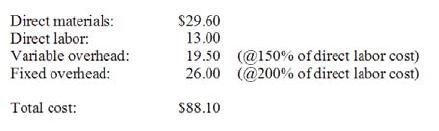
The cost of manufacturing one unit of this component internally are as follows:
The outside supplier has quoted a price of $90 per unit for supplying this component. The following is a
conversation that took place among the manufacturing manager (Dana Rice), buyer (Emily Scanlon) and Sam
Weiss.
Weiss: I think that we should continue to manufacture internally because we can save $1.90 per unit on this
component.
Rice: According to your report, we would save $1.90 per unit, but I do not agree with those numbers.
Weiss: What do you mean? I have followed the same costing guidelines this company has used for years. I have
even cross-checked my numbers with historical data and know for sure that the overhead rates which I have
used are correct.
Rice: I am sure you have done your job thoroughly, but I think that our costing system is archaic. This
component is complex and difficult to manufacture. I believe that our overhead allocation method does not
accurately capture the production difficulties and the additional resources that are devoted to the manufacture of
this component. For example, a significant portion of our quality problems are due to this component. We spend
close to a third of our quality inspection time on just this component alone, but that is not reflected. These
quality problems cause delays in getting this component to the assembly department, and that causes a delay in
getting the final product to the customers. Many of our customers are expecting just-in-time deliveries, and they
get upset when we’re late.
Scanlon: I know that the supplier that has approached us has a strong reputation for quality. Therefore, we can
rest assured that we will have negligible quality problems.
Rice: Sam, your report does not consider this additional benefit from buying outside. I would appreciate if you
can rework your numbers to better reflect the true costs associated with manufacturing this component
internally.
Required:
(a) Assume the role of Sam Weiss. What are the different elements of costs that are likely to be associated with
the manufacture of the component? Does the current costing system capture these costs?
(b) Recommend improvements in the costing system.
(c) How can Weiss quantify “qualitative” benefits such as quality and on-time delivery?
66. Streamline Shoe Company, a manufacturer of women‘s shoes, recently implemented a quality improvement
program aimed at streamlining the manufacturing process. Carl Silverman, an industrial engineer and a resident
expert on process improvement, was assigned the task of implementing the program.
Silverman’s first task was to educate all the employees involved with the production process. He sent a memo to
representatives in product design and development, materials management (including purchasing), marketing,
distribution, customer service and accounting, in addition to those in the production department, inviting them
to attend an information session on the improvement program.
He began the meeting by thanking all those who were present (over 35 in number) and spent the first hour
explaining the need for such a program. Soon after, the attendees were engaged in a discussion. Several
questions were raised during the discussion. Among these, three questions stood out. What is the need for
including members from design, marketing, and other functional areas when the improvement program’s focus
is on streamlining the manufacturing process? What is the role of the cost management expert in this program?
Finally, why should the machine operators be involved, as they are not engineers?
Required:
Consider the three questions that stood out in the discussion. Assume the role of Carl Silverman and prepare a
response addressing the questions.
67. Consider the following management activities:
Ⴠ Choose the organization’s long-term strategy
Ⴠ Plan and organize the use of resources into efficient operations
Ⴠ Implement plans and organizational change
Ⴠ Measure and report results
Ⴠ Define the organization’s scale and scope of operations
Required: (a) Identify the sequence in which the decisions must be carried out. Why is it important to carry out
these activities sequentially?
(b) How can an effective cost management system support the above activities?
68. Greg Piff, a new assistant sales manager was faced with a dilemma. His supervisor, Kathleen Holbrook,
instructed him to prepare an invoice for $300,000 in the name of General Builders, a regular customer. Upon
refusing to comply with the request because no order was received, Holbrook explained to Piff that this was
normal practice during the end of the year in order to meet or exceed the annual sales target. Holbrook also
clarified that the goods will not be physically delivered to the customer and a reverse entry will be made in the
accounting records during the next year.
Piff is unsure about what is to be done because the amount is significant. He recollected that Holbrook had
promised to give him a favorable review if he complied with the instruction. Piff has come to seek your advice
as a professional, regarding the proper way to handle the situation in order to minimize the effects of any
repercussions his actions may have.
Required:
(a) Does Greg have an ethical responsibility to take a course of action?
(b) What course of action would you take? What course of action should Piff take?
(c) Why is it important that such actions are curbed?

69. Cleary Yard Equipment Corporation manufactures lawn mowers and snow blowers. It also manufactures
engines that are used by the Lawn Mower Assembly Division (LMAD). The Engine Division (ED) also sells
about 40% of its output to the outside market (these are multipurpose engines). Its annual capacity is 150,000
units and annual output 135,000 units. All engines sold internally to the LMAD are priced at cost plus 20%
markup.
In January 2007, the Snow Blower Assembly Division (SBAD) approached the ED to ‘buy’ 20,000 engines.
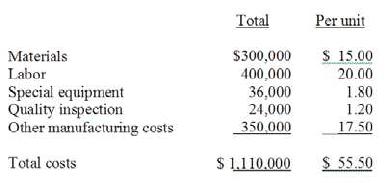
Diane Holinger, the controller of ED, computed the costs of manufacturing these engines as follows:
Holinger quoted a price of $66.60 for each engine transferred to the SBAD. John Hargreaves, the manager of
SBAD, was furious to note that the ED was “trying to make money off a sister division.” He argued that the
price must include only the cost of materials, as all other costs will be incurred irrespective of whether or not
SBAD places the order for 20,000 engines. Matt Hall, the production manager of ED, pointed out that the
special equipment will be purchased only for fulfilling this internal order. Moreover, he argued that inspection
must also be done just like on all other engines; therefore, the inspection costs must also be included. Labor is
paid a flat monthly salary. Other manufacturing costs include both variable and fixed components (in roughly
equal proportion).
Required:
(a) Given that excess capacity exists, what is the minimum price that the ED must charge to the SBAD?
(b) What are the pros and cons of internal sourcing?
70. In September, 2006, Paul Otellini, CEO of Intel Inc., a computer chipmaker, announced the company’s plan
to eliminate 10,000 jobs, approximately 10% of the company’s worldwide workforce of 100,000 employees.
Many of the job cuts would be in the marketing area, as company studies concluded that the company’s ratio of
marketing personnel to salespeople was higher than that of competitors. This move follows the layoff of 1,000
managers in July, 2006. The strategic moves were in response to Intel’s lost market share to rival Advanced
Micro Devices in recent years and 57% drop in net income and 13% drop in revenues from the previous fiscal
year. (News.Com. September 5, 2006)
Required:
(a) Describe the quantitative aspects of Intel’s decision.
(b) Describe the quantitative aspects of Intel”s decision.
(c) What step in Intel’s value chain is impacted by this decision?
71. In a presentation to the investment community, Sam Palmisano, CEO of IBM Corporation, stated: “We
intend to continue to take share, as we have in the past two or three years, in our core businesses.” Palmisano
contended that the category of business-process transformation services, such as customer support, human
resources, and other administrative overhead, represents an untapped market of $500 billion dollars if
businesses outsourced these functions to companies like IBM. IBM’s expressed goal is to capture 10% of this
new market. Palmisano also cited new business opportunities in information technology. The company’s new
chief financial officer, John Loughridge, stated that IBM‘s goal was to achieve high-single digit annual
percentage gains in sales and greater than 10% yearly increases in earnings per share. (Source: Barron’s: May
24, 2004)
Required:
(a) Does the strategy described by IBM’s management fall into the build, hold, harvest or divest category of
strategic missions? Explain your answer with specific examples related to the general characteristics of that
category of strategic mission.
(b) Identify the types of risks and rewards normally encountered by a company with the strategic mission
described by IBM’s management.
72. Briefly explain this statement: Cost Management is important to organizations because it is more than
measuring and reporting product and service costs. It is a philosophy, an attitude and a set of techniques to
create more value at lower costs.