Chemistry: A Molecular Approach, 3e (Tro)
Chapter 1 Matter, Measurement, and Problem Solving
Multiple Choice Questions
1) Molecules can be described as
A) mixtures of two or more pure substances.
B) mixtures of two or more elements that has a specific ratio between components.
C) two or more atoms chemically joined together.
D) heterogeneous mixtures.
E) homogeneous mixtures.
2) Give the composition of water.
A) two hydrogen atoms and two oxygen atoms
B) one hydrogen atom and one oxygen atom
C) two hydrogen atoms and one oxygen atom
D) one hydrogen atom and two oxygen atoms
3) Give the composition of hydrogen peroxide.
A) two hydrogen atoms and two oxygen atoms
B) one hydrogen atom and one oxygen atom
C) two hydrogen atoms and one oxygen atom
D) one hydrogen atom and two oxygen atoms
4) Which of the following represents a hypothesis?
A) Sodium reacts with water to form sodium hydroxide and hydrogen gas.
B) Nitrogen gas is a fairly inert substance.
C) Nickel has a silvery sheen.
D) When a substance combusts, it combines with air.
E) When wood burns, heat is given off.
5) Which of the following represents a valid hypothesis?
A) Neon does not react with oxygen.
B) Sodium metal reacts violently with water.
C) Lead is soft and malleable.
D) Oxygen is a gas at room temperature.
E) Metals tend to lose electrons.
6) The statement, “In a chemical reaction, matter is neither created nor destroyed” is called
A) the Law of Conservation of Mass.
B) Dalton’s Atomic Theory.
C) the Scientific Method.
D) the Law of Multiple Proportions.
E) the Law of Definite Proportions.
7) Dalton’s Atomic Theory states
A) that all elements have several isotopes.
B) that matter is composed of small indestructible particles.
C) that the properties of matter are determined by the properties of atoms.
D) that energy is neither created nor destroyed during a chemical reaction.
E) that an atom is predominantly empty space.
8) The Scientific Method
A) is just a theory.
B) is a strict set of rules and procedures that lead to inarguable fact.
C) isn’t used much in modern chemistry.
D) is based on continued observation and experiment.
E) is a framework for proving an argument you know to be true.
9) Which of the following statements is TRUE?
A) A scientific law is fact.
B) Once a theory is constructed, it is considered fact.
C) A hypothesis is speculation that is difficult to test.
D) An observation explains why nature does something.
E) A scientific law summarizes a series of related observations.
10) Identify a liquid.
A) definite volume and definite shape
B) definite volume and no definite shape
C) no definite shape and definite volume
D) no definite shape and no definite volume
11) Identify a solid.
A) definite volume and definite shape
B) definite volume and no definite shape
C) no definite shape and definite volume
D) no definite shape and no definite volume
12) Identify a gas.
A) definite volume and definite shape
B) definite volume and no definite shape
C) no definite shape and definite volume
D) no definite shape and no definite volume
13) Which of the following statements about crystalline and amorphous solids is TRUE?
A) A crystalline solid is composed of atoms or molecules arranged with long-range repeating order.
B) An example of a crystalline solid is glass.
C) An example of an amorphous solid is table salt (NaCl).
D) An amorphous solid is composed of atoms or molecules with a majority of its volume empty.
E) All of the above statements are TRUE.
14) Which of the following statements about the phases of matter is TRUE?
A) In both solids and liquids, the atoms or molecules pack closely to one another.
B) Solids are highly compressible.
C) Gaseous substances have long-range repeating order.
D) There is only one type of geometric arrangement that the atoms or molecules in any solid can adopt.
E) Liquids have a large portion of empty volume between molecules.
15) A substance that can’t be chemically broken down into simpler substances is
A) a homogeneous mixture.
B) an element.
C) a heterogeneous mixture.
D) a compound.
E) an electron.
16) A substance composed of two or more elements in a fixed, definite proportion is
A) a homogeneous mixture.
B) a heterogeneous mixture.
C) a compound.
D) a solution.
E) an alloy.
17) Decanting is
A) a process in which the more volatile liquid is boiled off.
B) dissolving a solid into a liquid.
C) separating a solid from a liquid by pouring off the liquid.
D) pouring a mixture through a filter paper to separate the solid from the liquid.
E) heating a mixture of two solids to fuse them together.
18) Distillation is
A) a process in which the more volatile liquid is boiled off.
B) dissolving a solid into a liquid.
C) separating a solid from a liquid by pouring off the liquid.
D) pouring a mixture through a filter paper to separate the solid from the liquid.
E) heating a mixture of two solids to fuse them together.
19) Filtration is
A) a process in which the more volatile liquid is boiled off.
B) dissolving a solid into a liquid.
C) separating a solid from a liquid by pouring off the liquid.
D) pouring a mixture through a filter paper to separate the solid from the liquid.
E) heating a mixture of two solids to fuse them together.
20) Two or more substances in variable proportions, where the composition is constant throughout are
A) a compound.
B) an element.
C) a heterogeneous mixture.
D) a homogeneous mixture.
E) a crystalline solid.
21) Two or more substances in variable proportions, where the composition is variable throughout are
A) a solution.
B) a homogeneous mixture.
C) a compound.
D) an amorphous solid..
E) a heterogeneous mixture.
22) A physical change
A) occurs when iron rusts.
B) occurs when sugar is heated into caramel.
C) occurs when glucose is converted into energy within your cells.
D) occurs when water is evaporated.
E) occurs when propane is burned for heat.
23) A chemical change
A) occurs when methane gas is burned.
B) occurs when paper is shredded.
C) occurs when water is vaporized.
D) occurs when salt is dissolved in water.
E) occurs when powdered lemonade is stirred into water.
24) Which of the following represents a physical property?
A) Sodium metal is extremely reactive with chlorine gas.
B) Mercury is a silvery liquid at room temperature.
C) Aluminum has a tendency to “rust.”
D) Butane is highly flammable.
E) Argon has an unreactive nature.
25) Which of the following represents a chemical property of hydrogen gas?
A) It is gaseous at room temperature.
B) It is less dense than air.
C) It reacts explosively with oxygen.
D) It is colorless.
E) It is tasteless.
26) Which of the following statements about energy is FALSE?
A) Energy can be converted from one type to another.
B) The total energy of a system remains constant.
C) Kinetic energy is the energy associated with its position or composition.
D) Energy is the capacity to do work.
E) Systems tend to change in order to lower their potential energy.
27) Define thermal energy.
A) energy associated with the temperature of an object
B) energy associated with the motion of an object
C) energy associated with the force of an object
D) energy associated with the gravity of an object
E) energy associated with the position or composition of an object
28) Define kinetic energy.
A) energy associated with the temperature of an object
B) energy associated with the motion of an object
C) energy associated with the force of an object
D) energy associated with the gravity of an object
E) energy associated with the position or composition of an object
29) Define potential energy.
A) energy associated with the temperature of an object
B) energy associated with the motion of an object
C) energy associated with the force of an object
D) energy associated with the gravity of an object
E) energy associated with the position or composition of an object
30) All of the following are SI base units of measurement, EXCEPT
A) meter
B) gram
C) second
D) kelvin
E) mole
7
31) The outside temperature is 35°C, what is the temperature in K?
A) -238 K
B) 308 K
C) 95 K
D) 31 K
E) 63 K
32) Determine the density of an object that has a mass of 149.8 g and displaces 12.1 mL of water when
placed in a graduated cylinder.
A) 8.08 g/mL
B) 1.38 g/mL
C) 12.4 g/mL
D) 18.1 g/mL
E) 11.4 g/mL
33) Determine the volume of an object that has a mass of 455.6 g and a density of 19.3 g/cm3.
A) 87.9 mL
B) 42.4 mL
C) 18.5 mL
D) 23.6 mL
E) 31.2 mL
34) A student performs an experiment to determine the density of a sugar solution. She obtains the
following results: 1.11 g/mL, 1.81 g/mL, 1.95 g/mL, 1.75 g/mL. If the actual value for the density of
the sugar solution is 1.75 g/mL, which statement below best describes her results?
A) Her results are precise, but not accurate.
B) Her results are accurate, but not precise.
C) Her results are both precise and accurate
D) Her results are neither precise nor accurate.
E) It isn’t possible to determine with the information given.
35) A student performs an experiment to determine the density of a sugar solution. She obtains the
following results: 1.71 g/mL, 1.73 g/mL, 1.67 g/mL, 1.69 g/mL. If the actual value for the density of
the sugar solution is 1.40 g/mL, which statement below best describes her results?
A) Her results are precise, but not accurate.
B) Her results are accurate, but not precise.
C) Her results are both precise and accurate
D) Her results are neither precise nor accurate.
E) It isn’t possible to determine with the information given.
36) A student performs an experiment to determine the density of a sugar solution. She obtains the
following results: 1.79 g/mL, 1.81 g/mL, 1.80 g/mL, 1.81 g/mL. If the actual value for the density of
the sugar solution is 1.80 g/mL, which statement below best describes her results?
A) Her results are precise, but not accurate.
B) Her results are accurate, but not precise.
C) Her results are both precise and accurate
D) Her results are neither precise nor accurate.
E) It isn’t possible to determine with the information given.
37) Systematic error is defined as
A) error that tends to be too high or too low.
B) error that has equal probability of being too high and too low.
C) error that averages out with repeated trials.
D) error that is random.
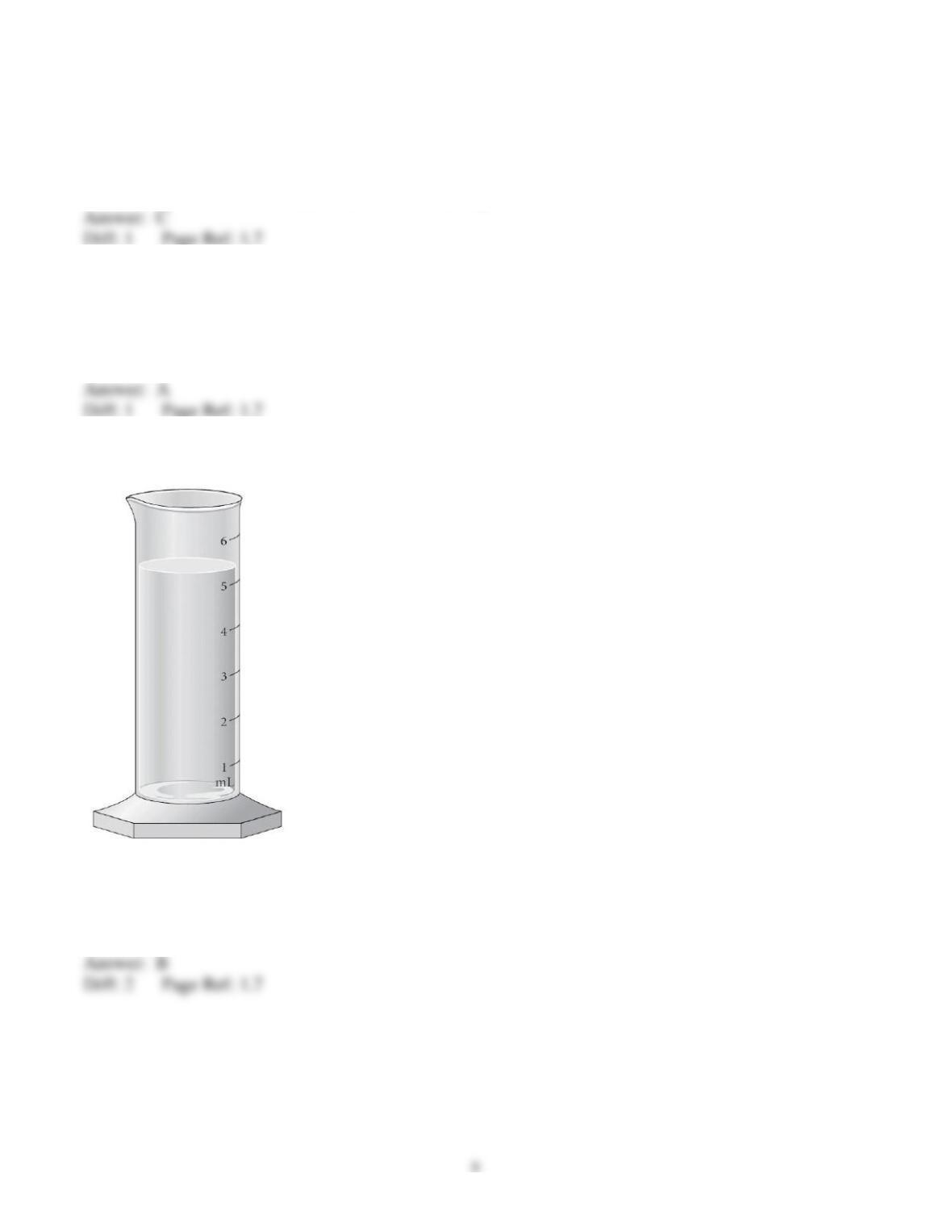
38) Read the water level with the correct number of significant figures.
A) 5 mL
B) 5.3 mL
C) 5.32 mL
D) 5.320 mL
E) 5.3200 mL
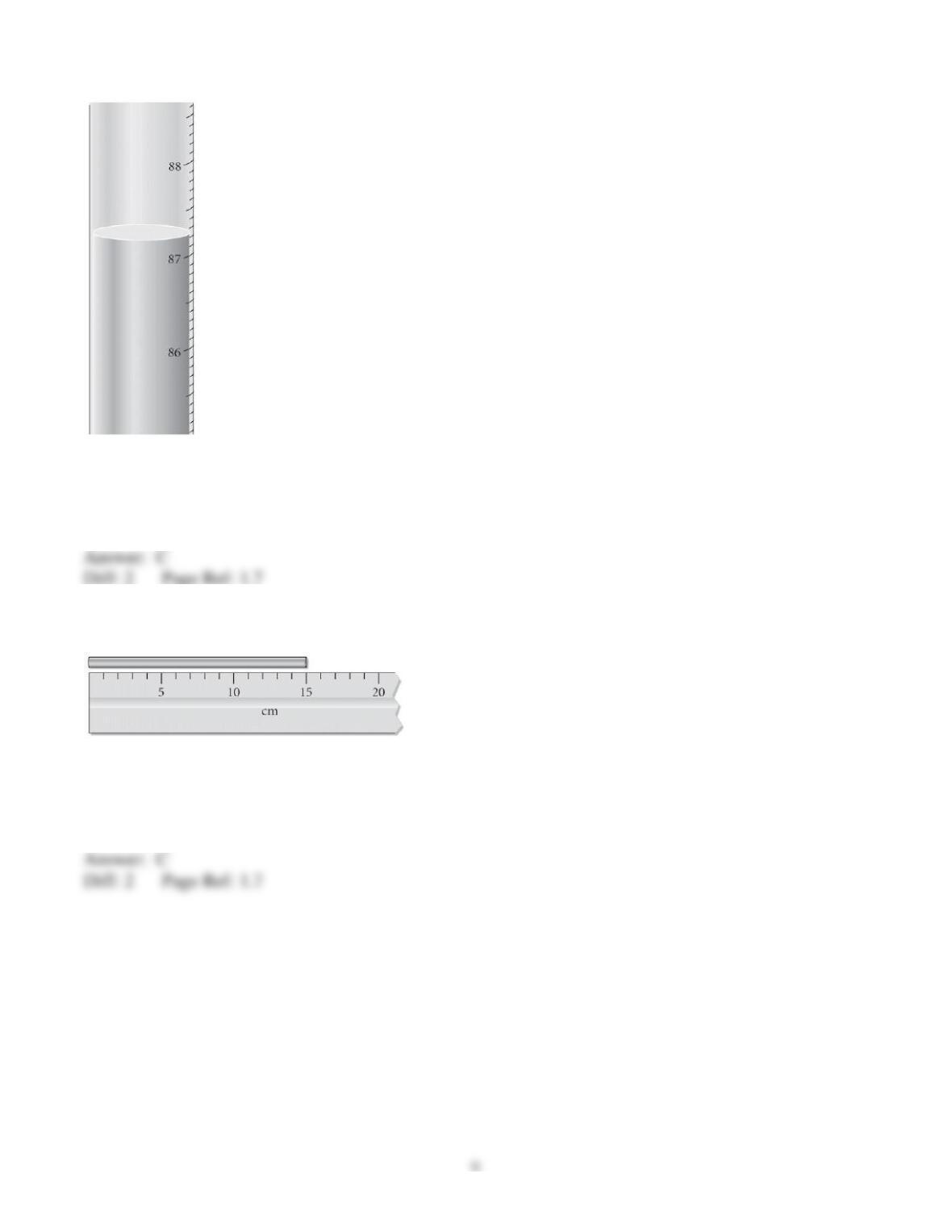
39) Read the temperature with the correct number of significant figures.
A) 87°C
B) 87.2°C
C) 87.20°C
D) 87.200°C
E) 87.2000°C
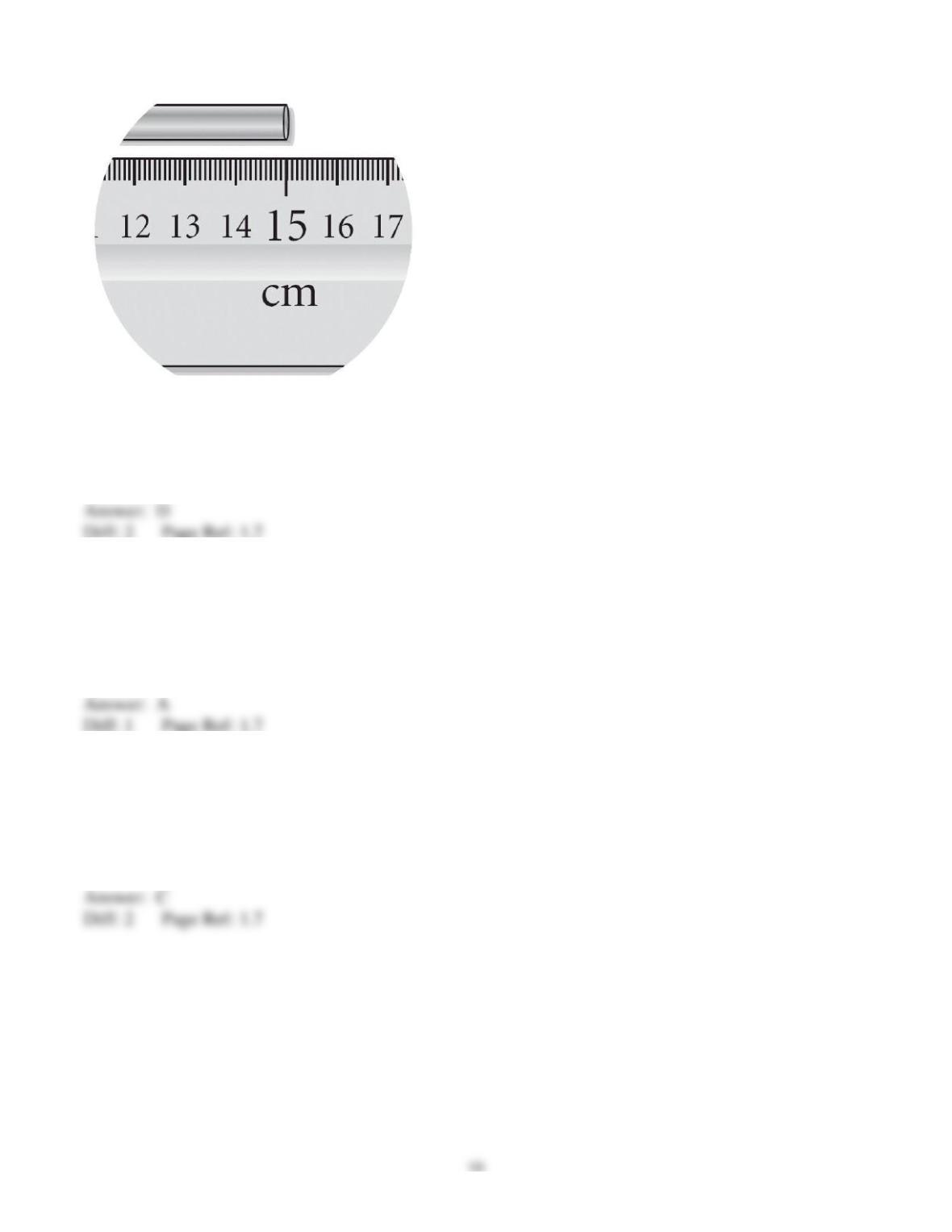
40) Read the length of the metal bar with the correct number of significant figures.
A) 20 cm
B) 15 cm
C) 15.0 cm
D) 15.00 cm
E) 15.000 cm
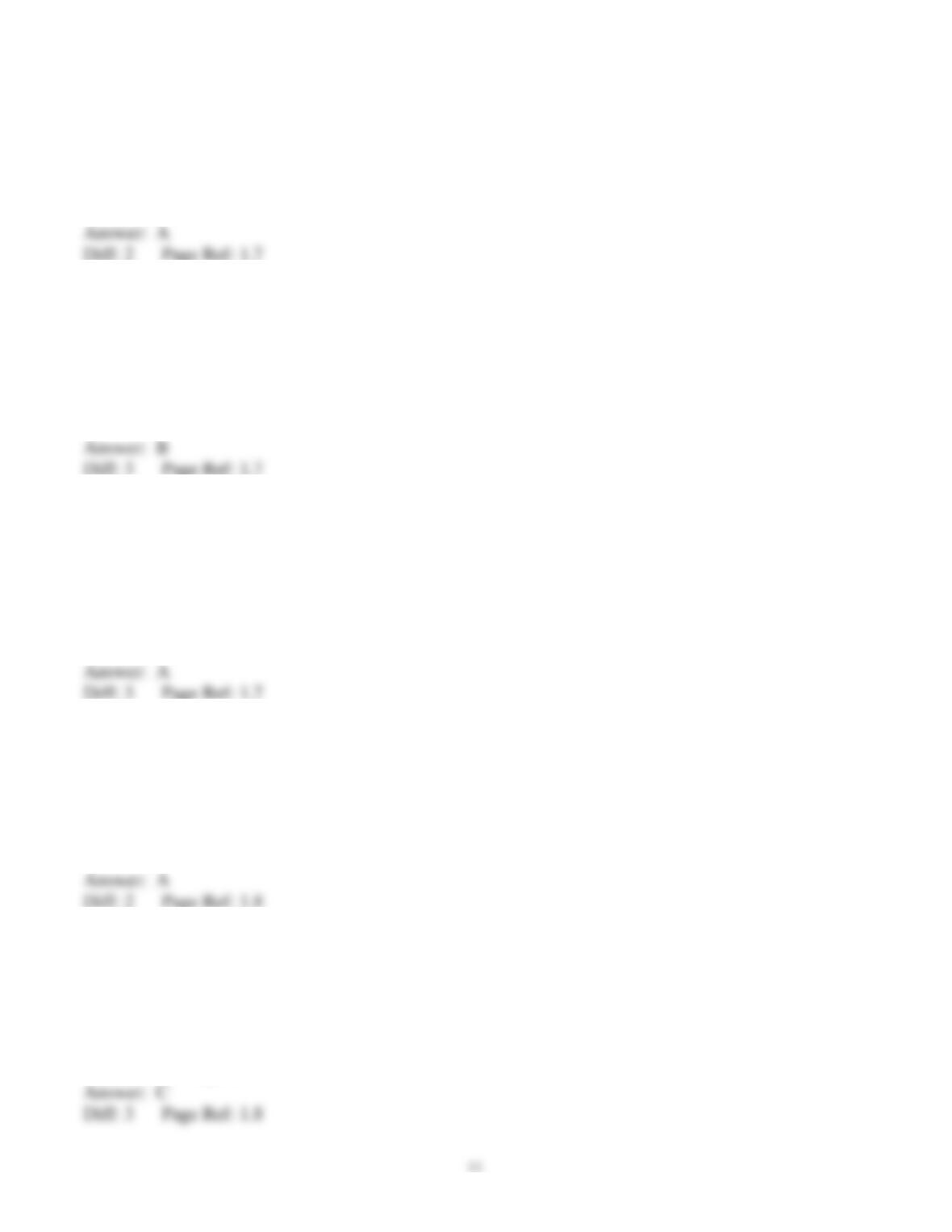
41) Read the length of the metal bar with the correct number of significant figures.
A) 20 cm
B) 15 cm
C) 15.0 cm
D) 15.00 cm
E) 15.000 cm
42) Identify the exact number
A) 2
B) 2.0
C) 2.00
D) 2.000
E) 2.0000
43) How many significant figures are in the measurement, 20.300 m?
A) 3
B) 4
C) 5
D) 1
E) 2
44) What answer should be reported, with the correct number of significant figures, for the following
calculation? (433.621 – 333.9) × 11.900
A) 1.19 × 10³
B) 1.187 × 10³
C) 1.1868 × 10³
D) 1.18680 × 10³
E) 1.186799 × 10³
45) What answer should be reported, with the correct number of significant figures, for the following
calculation? (249.362 + 41) / 63.498
A) 4.6
B) 4.57
C) 4.573
D) 4.5728
E) 4.57277
46) What answer should be reported, with the correct number of significant figures, for the following
calculation? (965.43 × 3.911) + 9413.4136
A) 13189
B) 13189.2
C) 1.32 × 10⁴
D) 1.3 × 10⁴
E) 1.319 × 10⁴
47) How many mm are in 3.20 cm?
A) 3.20 × 10 1 mm
B) 3.20 × 10 -1 mm
C) 3.20 × 10 -2 mm
D) 3.20 × 10 2 mm
E) 3.20 × 10 3 mm
48) If an object has a density of 8.65 g/cm3, what is its density in units of kg/m3?
A) 8.65 × 10⁻³ kg/m3
B) 8.65 × 10⁻⁷ kg/m3
C) 8.65 × 10³ kg/m3
D) 8.65 × 101 kg/m3
E) 8.65 × 10⁻¹ kg/m3
49) If the walls in a room are 955 square feet in area, and a gallon of paint covers 15 square yards, how
many gallons of paint are needed for the room? (3 ft = 1 yd)
A) 47 gallons
B) 21 gallons
C) 7.1 gallons
D) 24 gallons
E) 2.3 gallons
50) Gas is sold for $1.399 per liter in Toronto, Canada. Your car needs 12.00 gallons. How much will
your credit card be charged in Canadian dollars?
A) $16.79
B) $67.15
C) $4.44
D) $63.54
1) In the blood, hemoglobin is the carrier of
A) oxygen
B) carbon monoxide
C) nitrogen
D) hydrogen
E) helium
2) Identify the crystalline solid.
A) plastic
B) glass
C) table salt
D) water
E) bleach
3) Choose the pure substance from the list below.
A) tea
B) a casserole
C) carbon monoxide
D) sugar water
E) pomegranate juice
13
4) A blueberry scone is an example of
A) a compound.
B) an element.
C) a heterogeneous mixture.
D) a homogeneous mixture.
5) Hydrochloric acid is an example of
A) a compound.
B) an element.
C) a heterogeneous mixture.
D) a homogeneous mixture.
6) Gold is an example of
A) a compound.
B) an element.
C) a heterogeneous mixture.
D) a homogeneous mixture.
7) Ammonia is an example of
A) a compound.
B) an element.
C) a heterogeneous mixture.
D) a homogeneous mixture.
8) Identify a solid.
A) copper
B) oxygen
C) water
D) helium
E) air
9) Identify a liquid.
A) oxygen
B) copper
C) salt
D) mercury
E) sugar
10) Choose the pure substance from the list below.
A) sea water
B) diamond
C) air
D) tea
E) milk
11) Choose the element from the list below.
A) sodium chloride
B) water
C) hydrogen peroxide
D) helium
E) rust
12) Choose the compound from the list below.
A) gold
B) butane
C) neon
D) helium
E) lithium
13) Choose the heterogeneous mixture from the list below.
A) sports drink
B) chlorine gas
C) beer
D) lasagna
E) carbon (graphite)
14) Choose the homogeneous mixture from the list below.
A) cola
B) mud
C) ice water
D) dirt
E) salsa
15) Choose the homogeneous mixture from the list below.
A) carbonated soda
B) air
C) chocolate chip cookies
D) trail mix
E) blood
16) Which of the following are examples of physical change?
A) sugar is dissolved in water
B) tea is brewed
C) dry ice sublimes
D) water freezes
E) All of these are examples of physical change.
17) Which of the following are examples of physical change?
A) dew forms on a blade of grass
B) a halloween light stick glows after shaking
C) browning meat
D) hydrogen balloon explodes when contacted with a flame
E) None of the above are physical changes.
18) Which of the following are examples of a chemical change?
A) copper building materials develop a green patina over time
B) a candle burns
C) rubbing alcohol evaporates
D) Both A and B are examples of chemical change.
E) All of the above are examples of chemical change.
19) Which of the following are examples of a chemical change?
A) coffee brewing
B) water freezing
C) leaves turning color in the fall
D) salt dissolves in water
E) None of the above are chemical changes.
20) Identify the unit of measurement which is a SI base unit of measurement.
A) second
B) Celsius
C) quart
D) ton
E) kilometer
21) Kilogram is a measure of
A) mass
B) time
C) length
D) temperature
E) volume
22) What symbol is used to represent the factor 103?
A) M
B) k
C) μ
D) n
23) Which of the following is the smallest volume?
A) 22 cm3
B) 0.50 dL
C) 2.8 × 10³ mL
D) 5.0 × 10⁷ nL
24) What symbol is used to represent the factor 10-1?
A) M
B) m
C) μ
D) d
25) The factor 10 corresponds to which prefix?
A) centi
B) deci
C) deka
D) milli