1
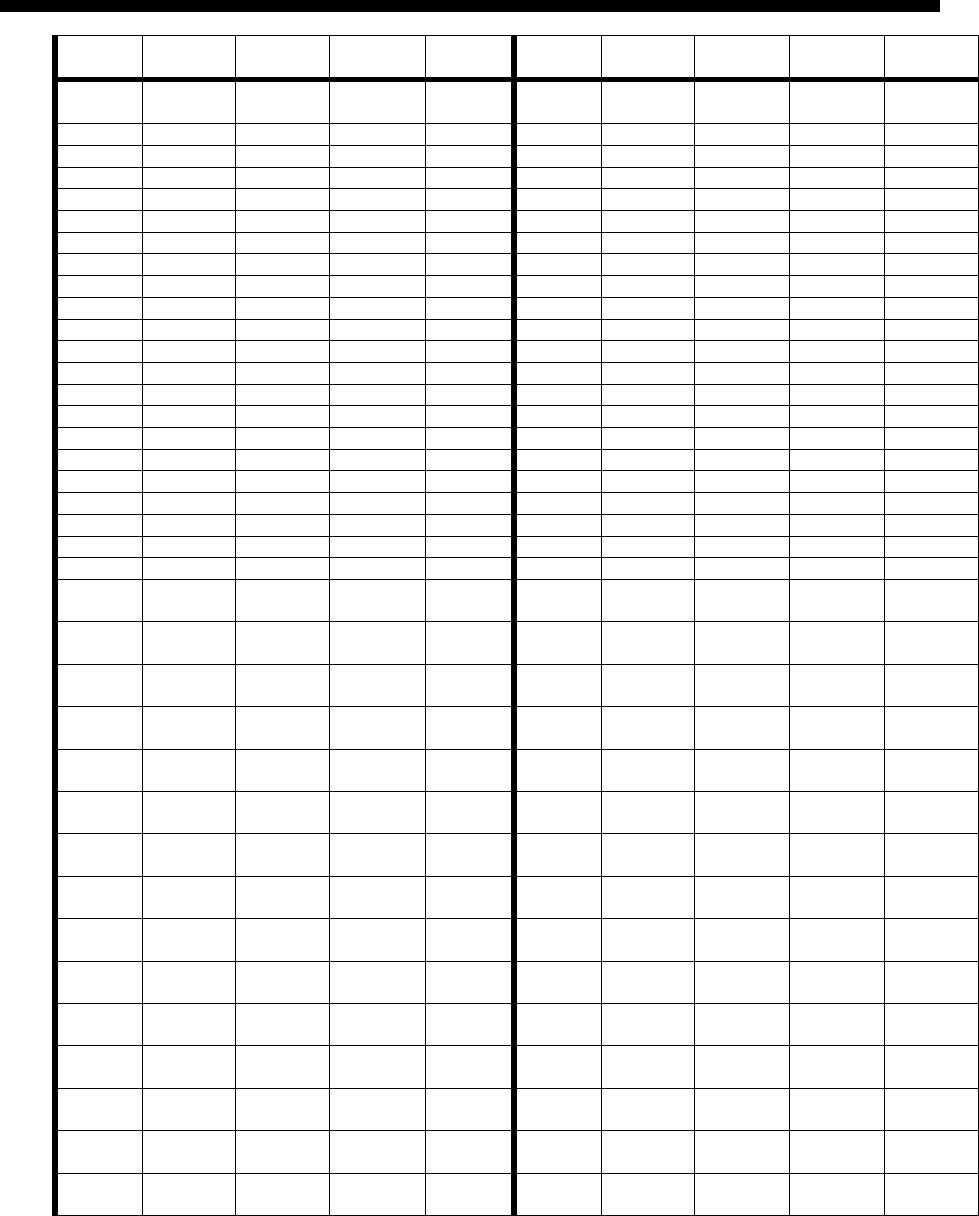
Chapter 1—The Role of Accounting in Business
Multiple
Choice
Learning
Goal(s)
Level of
Difficulty
AACSB
Tag
AICPA
Tag
Multiple
Choice
Learning
Goal(s)
Level Of
Difficulty
AACSB
Tag
AICPA
Tag
1
1
Easy
Analytic
Industry
38
2
Moderate
Reflective
Resource
Mgt.
2
1
Easy
Analytic
Industry
39
3
Easy
Reflective
Reporting
3
1
Moderate
Reflective
Industry
40
3
Moderate
Analytic
Reporting
4
1
Easy
Reflective
Industry
41
4
Easy
Analytic
Reporting
5
1
Easy
Reflective
Industry
42
4
Easy
Analytic
Reporting
6
1
Easy
Reflective
Industry
43
4
Easy
Analytic
Reporting
7
1
Easy
Reflective
Industry
44
4
Easy
Analytic
Reporting
8
1
Easy
Analytic
Industry
45
4
Easy
Analytic
Reporting
9
1
Easy
Analytic
Industry
46
4
Easy
Analytic
Reporting
10
1
Easy
Analytic
Industry
47
4
Easy
Analytic
Reporting
11
1
Easy
Reflective
Industry
48
4
Moderate
Analytic
Reporting
12
1
Moderate
Reflective
Industry
49
4
Moderate
Reflective
Measure
13
1
Moderate
Reflective
Industry
50
4
Moderate
Analytic
Reporting
14
1
Easy
Reflective
Industry
51
4
Easy
Analytic
Reporting
15
1
Easy
Reflective
Industry
52
4
Moderate
Analytic
Reporting
16
1
Easy
Reflective
Industry
53
4
Moderate
Analytic
Reporting
17
1
Moderate
Reflective
Industry
54
4
Easy
Reflective
Reporting
18
1
Moderate
Reflective
Industry
55
4
Easy
Reflective
Reporting
19
1
Easy
Reflective
Industry
56
4
Moderate
Reflective
Reporting
20
1
Moderate
Reflective
Industry
57
4
Moderate
Analytic
Reporting
21
1
Moderate
Reflective
Industry
58
4
Difficult
Analytic
Reporting
22
1
Easy
Reflective
Industry
59
4
Moderate
Analytic
Reporting
23
2
Easy
Reflective
Resource
Mgt.
60
4
Difficult
Analytic
Reporting
24
2
Easy
Reflective
Resource
Mgt.
61
4
Difficult
Analytic
Reporting
25
2
Easy
Reflective
Resource
Mgt.
62
4
Difficult
Analytic
Reporting
26
2
Moderate
Reflective
Resource
Mgt.
63
5
Easy
Reflective
Legal
27
2
Moderate
Reflective
Resource
Mgt.
64
5
Moderate
Reflective
Measure
28
2
Moderate
Reflective
Resource
Mgt.
65
5
Moderate
Reflective
Measure
29
2
Easy
Reflective
Resource
Mgt.
66
5
Easy
Reflective
Reporting
30
2
Moderate
Reflective
Resource
Mgt.
67
5
Moderate
Reflective
Reporting
31
2
Easy
Reflective
Resource
Mgt.
68
5
Moderate
Ethics
Legal
32
2
Moderate
Reflective
Resource
Mgt.
69
5
Easy
Ethics
Legal
33
2
Moderate
Reflective
Resource
Mgt.
70
6
Easy
Reflective
Risk
34
2
Moderate
Reflective
Resource
Mgt.
71
6
Difficult
Analytic
Risk
35
2
Moderate
Reflective
Resource
Mgt.
72
6
Moderate
Analytic
Risk
36
2
Moderate
Reflective
Resource
Mgt.
73
6
Difficult
Analytic
Risk
37
2
Moderate
Reflective
Resource
Mgt.
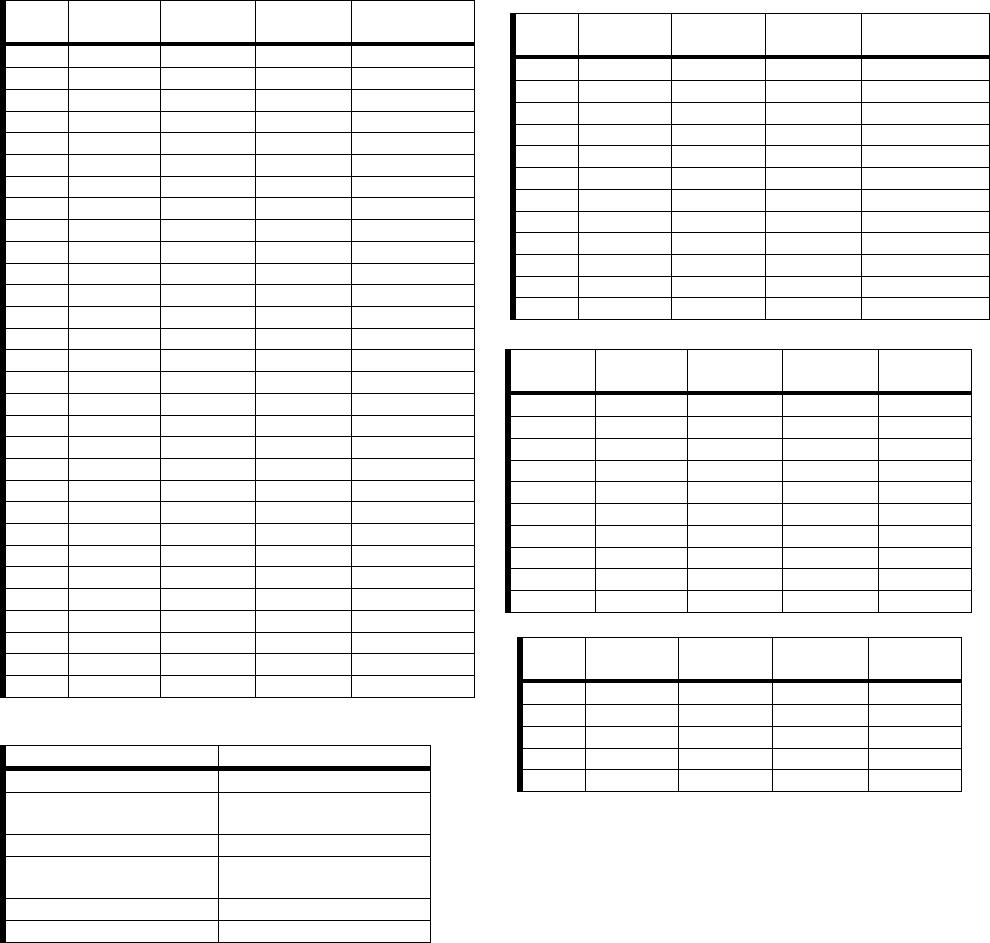
2 ♦ Chapter 1
True/
False
Learning
Goal(s)
Level of
Difficulty
AACSB
Tag
AICPA
Tag
1
1
Easy
Reflective
Industry
2
1
Easy
Analytic
Industry
3
1
Easy
Reflective
Industry
4
1
Easy
Reflective
Industry
5
1
Easy
Reflective
Industry
6
1
Easy
Reflective
Industry
7
1
Easy
Reflective
Industry
8
1
Moderate
Reflective
Industry
9
1
Moderate
Analytic
Industry
10
1
Moderate
Analytic
Industry
11
1
Difficult
Reflective
Industry
12
1
Easy
Reflective
Industry
13
1
Moderate
Reflective
Industry
14
1
Moderate
Reflective
Industry
15
2
Easy
Reflective
Resource Mgt
16
2
Moderate
Reflective
Resource Mgt
17
2
Easy
Reflective
Resource Mgt
18
2
Moderate
Reflective
Measure
19
2
Moderate
Reflective
Measure
20
3
Easy
Analytic
Reporting
21
4
Easy
Reflective
Reporting
22
4
Easy
Reflective
Reporting
23
4
Easy
Reflective
Reporting
24
4
Moderate
Reflective
Reporting
25
4
Moderate
Reflective
Reporting
26
4
Easy
Reflective
Reporting
27
5
Easy
Reflective
Reporting
28
5
Moderate
Ethics
Reporting
29
5
Easy
Ethics
Legal
30
6
Easy
Analytic
Risk
Essay
Learning
Goal(s)
Level of
Difficulty
AACSB
Tag
AICPA
Tag
1
1
Moderate
Reflective
Industry
2
1
Moderate
Reflective
Industry
3
1
Moderate
Reflective
Industry
4
1
Moderate
Reflective
Industry
5
1
Easy
Reflective
Industry
6
2
Moderate
Reflective
Resource Mgt.
7
2
Moderate
Reflective
Resource Mgt.
8
3
Moderate
Reflective
Industry
9
4
Moderate
Reflective
Reporting
10
4
Moderate
Analytic
Reporting
11
5
Moderate
Reflective
Reporting
12
6
Difficult
Reflective
Risk
Problem
Learning
Goal(s)
Level of
Difficulty
AACSB
Tag
AICPA
Tag
1
4
Difficult
Analytic
Reporting
2
4
Difficult
Analytic
Reporting
3
4
Difficult
Analytic
Reporting
4
4
Difficult
Analytic
Reporting
5
4
Difficult
Analytic
Reporting
6
5
Difficult
Reflective
Reporting
7
2
Difficult
Analytic
Reporting
8
4
Difficult
Reflective
Reporting
9
4
Difficult
Reflective
Reporting
10
4
Difficult
Analytic
Reporting
Cases
Learning
Goal(s)
Level of
Difficulty
AACSB
Tag
AICPA
Tag
1
1
Difficult
Reflective
Industry
2
4
Difficult
Analytic
Reporting
3
4
Difficult
Analytic
Reporting
4
4
Difficult
Analytic
Reporting
5
6
Difficult
Analytic
Risk
Difficulty Ratings Guide:
Easy
Taken nearly verbatim
from the text
Moderate
Using different expression
or application of concept
Difficult
Several reasoning steps
The Role of Accounting in Business ♦ 3
MULTIPLE CHOICE
1. The objective of a __________ type of business is to provide some benefit to society (as opposed
to making a profit).
a.
Not-for-Profit
b.
Corporation
c.
Partnership
d.
Sole Proprietorship
2. Which of the following type(s) of businesses operate for profit?
a.
Manufacturing
b.
Merchandising
c.
Service Businesses
d.
All of the above
3. Which of the following would NOT be an example of a merchandising business?
a.
Ford Motor Company
b.
Pottery Barn
c.
Barnes & Noble
d.
Lands End
4. Which of the following is NOT a normal form of business?
a.
IRS 1040
b.
Corporation
c.
Partnership
d.
Sole Proprietorship
5. More that 70% of businesses are organized as what type of business?
a.
Not-for-Profit
b.
Corporation
c.
Partnership
d.
Sole Proprietorship
4 ♦ Chapter 1
6. Which form of ownership is characterized by ownership by two or more individuals and is
prevalent in about 10% of the businesses?
a.
proprietorship
b.
partnership
c.
corporation
d.
service business
7. A primary advantage of the corporate form is the ability to obtain large amounts of resources by
issuing __________.
a.
Stock
b.
Cash
c.
Loans
d.
Products
8. Which form of business is taxed as a separate legal entity?
a.
proprietorship
b.
partnership
c.
corporation
d.
limited liability company
9. Which form of organizational ownership offers limited legal liability?
a.
proprietorship
b.
merchandiser
c.
partnership
d.
corporation
10. The form of business ownership that does NOT have a limitation on its life is the
a.
proprietorship
b.
partnership
c.
corporation
d.
limited liability company
11. A business strategy consists of decisions about how to make money by
a.
deciding which products or services to offer
b.
gaining competitive advantage over its competitors
c.
both a and b are correct
d.
neither a nor b is correct
The Role of Accounting in Business ♦ 5
12. Under a premium-price emphasis, a business designs products that possess __________ for which
customers are willing to pay a premium price.
a.
Unique attributes
b.
High costs
c.
Competitive efficiencies
d.
Longer warranties
13. A low-cost emphasis strives to provide
a.
no frills, standardized products and services.
b.
products and services that provide unique market needs.
c.
products and services that provide prestige and image for their customers.
d.
products and services that compete on features other than price.
14. A person or entity that has an interest in the economic performance or well being of a business is
called a ____________.
a.
Business operation
b.
Business strategy
c.
Business competitor
d.
Business stakeholder
15. Which of the following would NOT be considered a business stakeholder?
a.
employees
b.
product or service market
c.
capital markets
d.
a,b,c are all business stakeholders
16. Which of the following are business stakeholders?
a.
Stockholders
b.
Suppliers
c.
Customers
d.
All of these are correct
17. Which of the following is NOT an example of a capital market stakeholder?
a.
Banks
b.
Owners
c.
Employees
d.
Stockholders
6 ♦ Chapter 1
18. Capital market stakeholders expect to receive a return on their investments proportionate to their
degree of __________.
a.
Stock
b.
Investment
c.
Profit
d.
Risk
19. Who has first preference to assets in case a business fails?
a.
Stockholders
b.
Long-term creditors
c.
Customers
d.
Employees
20. Internal stakeholders are the __________.
a.
Stockholders
b.
Suppliers
c.
Customers
d.
Employees
21. Governments have an interest in the economic performance of business because of __________.
a.
Tax collections
b.
Roads and highways
c.
Business incentives
d.
All of theses are correct
22. Managers are evaluated primarily on the business’ __________.
a.
Tax collections
b.
Growth
c.
Economic performance
d.
All of these are correct
23. Financing activities involve obtaining __________ to operate a business.
a.
Products
b.
Customers
c.
Business incentives
d.
Funds
The Role of Accounting in Business ♦ 7
24. When a business borrows money, it incurs a(n) __________.
a.
Tax
b.
Liability
c.
Cash payment
d.
All of these are correct
25. When a business borrows from a vendor the liability is called a(n) __________.
a.
Account payable
b.
Financing activity
c.
Business incentives
d.
Credit card transaction
26. The typical time to pay back an account payable liability is __________.
a.
10 days
b.
20 days
c.
30 days
d.
Two months
27. Bonds are what type of financing?
a.
Long-term
b.
Short-term
c.
Accounts payable
d.
Investing activity
28. Interest due on a bond payable is reported as __________.
a.
Interest payable
b.
Bonds payable
c.
Accounts payable
d.
Dividends payable
29. A note payable requires payment of the amount borrowed plus __________.
a.
Interest
b.
Cash
c.
Accounts payable
d.
Investments
8 ♦ Chapter 1
30. Shares of ownership are evidenced by issuing __________.
a.
Bonds payable
b.
Commercial paper
c.
Shares of stock
d.
Notes payable
31. The resources a business owns are called __________.
a.
Assets
b.
Liabilities
c.
Products
d.
Stockholders’ equity
32. A business may acquire assets through which type of activities?
a.
Financing
b.
Investing
c.
Operating
d.
All of the above
33. Which of the following is an example of an intangible asset?
a.
Patent
b.
Cash
c.
Land
d.
Equipment
34. Rights to payments from customers are __________.
a.
Liabilities
b.
Prepaid expenses
c.
Accounts Receivable
d.
Accounts Payable
35. Which of the following is considered an asset until consumed?
a.
Copyright
b.
Prepaid expense
c.
Accounts receivable
d.
Stockholders’ equity
The Role of Accounting in Business ♦ 9
36. __________ is the increase in assets from selling products or services.
a.
Revenue
b.
Liabilities
c.
Products
d.
Stockholders’ equity
37. Costs used to earn revenue are called __________.
a.
Prepaid expenses
b.
Expenses
c.
Products
d.
Liabilities
38. When a product is sold, this cost is often called __________.
a.
Cost of goods sold
b.
Revenue
c.
Products
d.
Retained earnings
39. Accounting is sometimes called the __________.
a.
Language of business
b.
Report function
c.
Results of operations
d.
Stockholders’ equity report
40. Reporting the financial condition of a business at a point in time, and the changes in the financial
condition of a business over a period of time are the two major objectives of __________.
a.
Tax accounting
b.
Union contracts
c.
Managerial accounting
d.
Financial accounting
41. Which of the following is part of the four basic financial statements?
a.
Income statement
b.
Balance sheet
c.
Statement of cash flows
d.
All of these are correct
10 ♦ Chapter 1
42. Which statement is normally prepared first?
a.
Income statement
b.
Balance sheet
c.
Statement of cash flows
d.
Retained earnings statement
43. A summary of revenue and expenses for a specific period of time is a(n) __________.
a.
Income statement
b.
Balance sheet
c.
Statement of cash flows
d.
Retained earnings statement
44. A summary of changes in the earnings retained in the corporation for a specific period of time is
a(n) __________.
a.
Income statement
b.
Balance sheet
c.
Statement of cash flows
d.
Retained earnings statement
45. A list of assets, liabilities, and owners’ equity as of a specific date is a(n) __________.
a.
Income statement
b.
Balance sheet
c.
Statement of cash flows
d.
Retained earnings statement
46. A summary of the cash receipts and cash payments for a specific period of time is a(n)
__________.
a.
Income statement
b.
Balance sheet
c.
Statement of cash flows
d.
Retained earnings statement
47. The income statement is based on the ___________ concept.
a.
retained earnings
b.
asset
c.
matching
d.
financing
48. The sales of an organization would be found on what statement?
a.
balance sheet
b.
statement of retained earnings
c.
income statement
d.
statement of cash flows
49. Costs incurred in operating a business are also known as __________.
a.
Revenues
b.
Expenses
c.
Liabilities
d.
Dividends
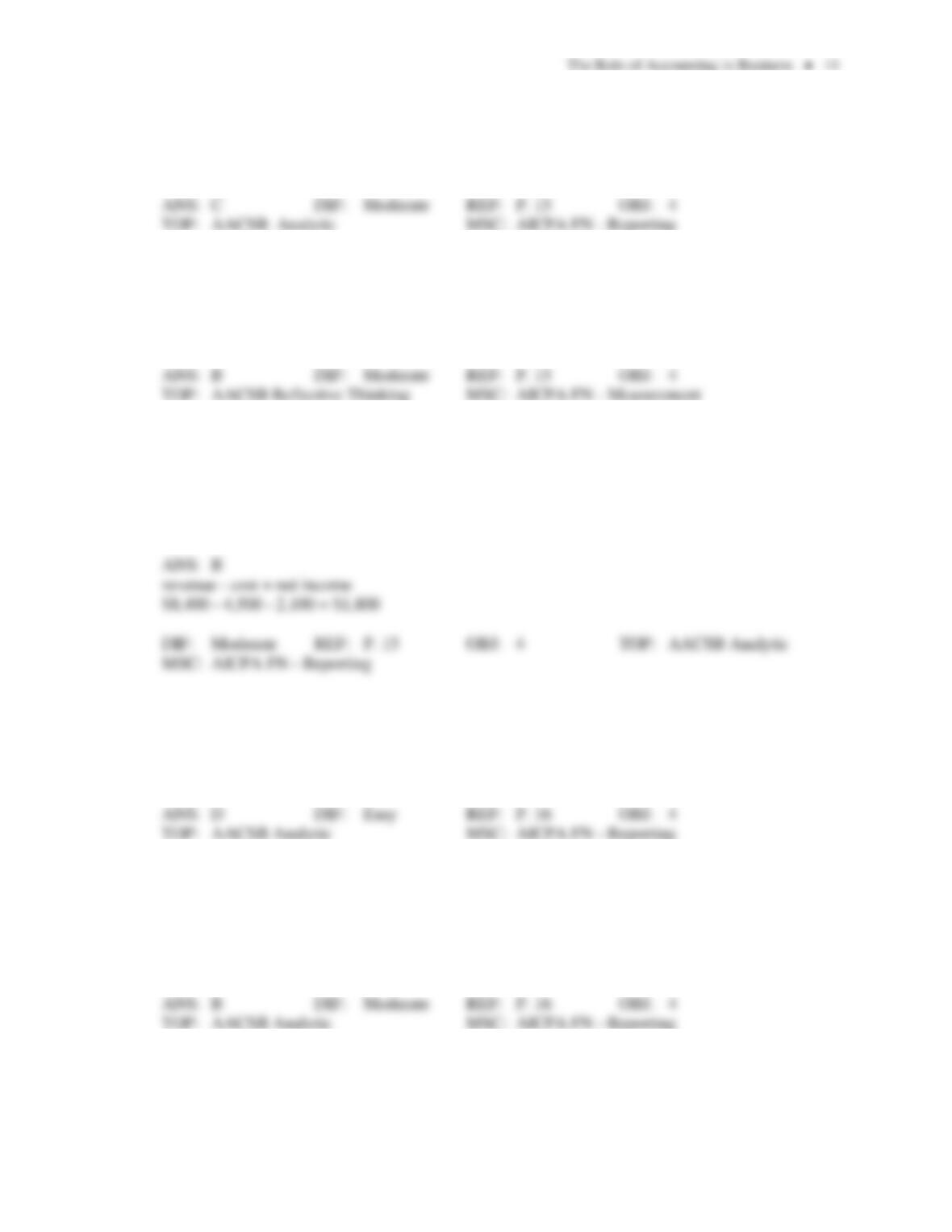
50. The Bondi Company had cost of sales of $4,500, other expenses of $2,100, and sales of $8,400.
What is the net income?
a.
$ 2,400
b.
$ 1,800
c.
$ 6,600
d.
$15,000
51. The portion of a corporation’s net income retained in the business is called __________.
a.
Income statement
b.
Balance sheet
c.
Statement of cash flows
d.
Retained earnings
52. If there was no beginning retained earnings, net income of $10,000, and ending retained earnings
of $6,000, how much were dividends?
a.
$10,000
b.
$4,000
c.
$6,000
d.
Zero dollars
12 ♦ Chapter 1
53. Which statement would show the amount of dividends paid?
a.
balance sheet
b.
income statement
c.
retained earnings
d.
cash flows
54. The financial condition of the firm at one point in time is described by reporting
a.
assets, liabilities, equity
b.
revenues, expenses
c.
net income, dividends
d.
operating, investing, financing activities
55. Which of the following is an appropriate representation of the accounting equation?
a.
Assets + liabilities = stockholders’ equity
b.
Assets = liabilities + stockholders’ equity
c.
Assets = liabilities
d.
Assets = liabilities + Retained earnings
56. Which of the following is NOT a satisfactory statement of the accounting equation?
a.
Assets = Liabilities + Stockholder’s Equity
b.
Assets – Stockholder’s Equity = Liabilities
c.
Assets = Liabilities – Owners’ Equity
d.
Stockholder’s Equity = Assets – Liabilities
57. Assets are best described as
a.
Resources owned by a business
b.
Amounts earned in operating the business
c.
Cash owned by the company
d.
Owners’ investments in the business
The Role of Accounting in Business ♦ 13
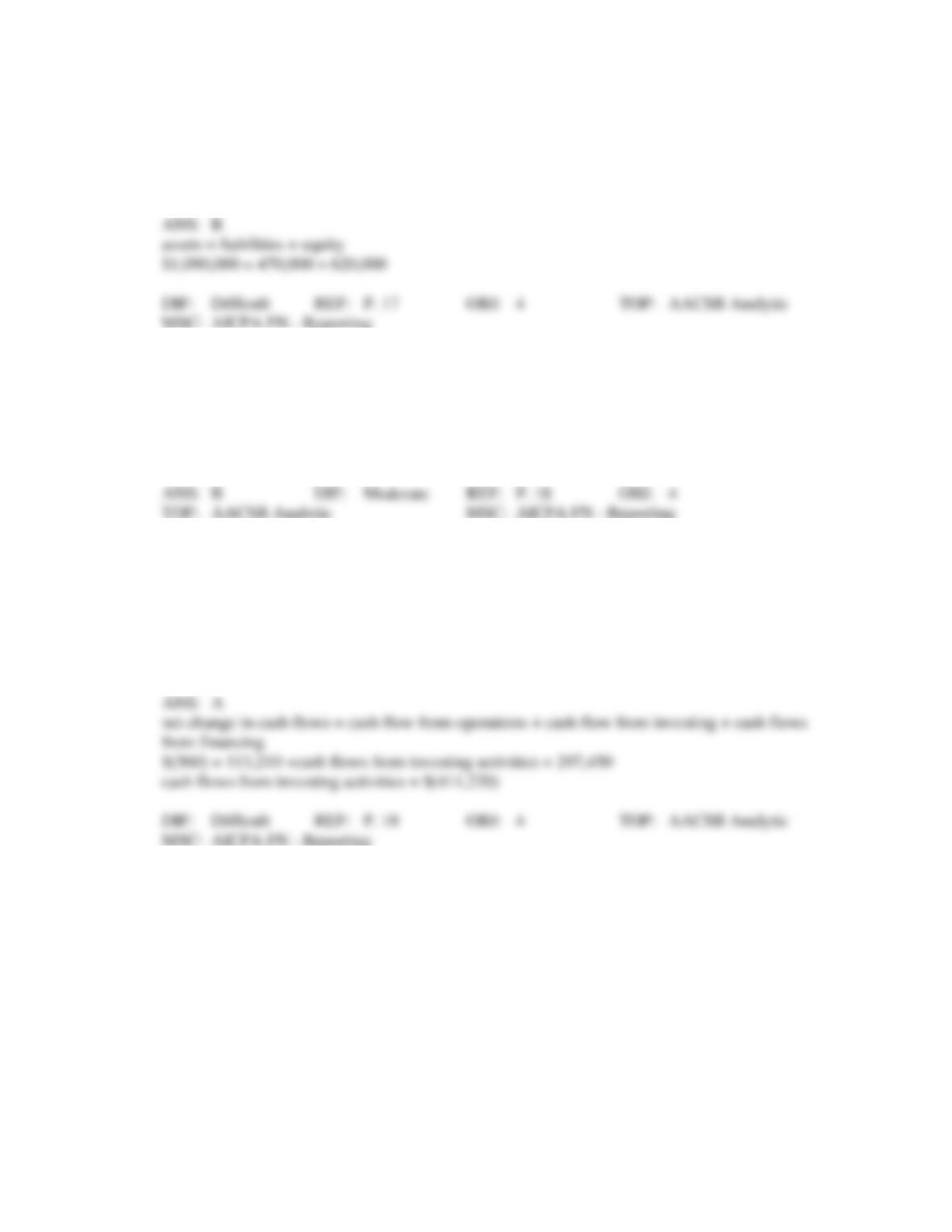
58. The Lido Company has liabilities of $470,000, paid dividends of $40,000, had equity of
$620,000, and sales of $330,000. What is the amount of their total assets?
a.
$ 150,000
b.
$ 330,000
c.
$1,090,000
d.
$1,380,000
59. ________________ reports the change in condition of a company by reporting changes in the
operating activities, investing activities, and financing activities.
a.
income statement
b.
statement of cash flows
c.
statement of retained earnings
d.
balance sheet
60. The Ipenema Company had a net decrease in cash of $ 560 during 2006. Net cash inflows from
financing activities were $297,450 and the net cash inflows from operating activities amounted to
$113,210. What is the net cash flow from investing activities?
a.
$ (411,220)
b.
$ 410,100
c.
$ 184,240
d.
$ 112,650
14 ♦ Chapter 1
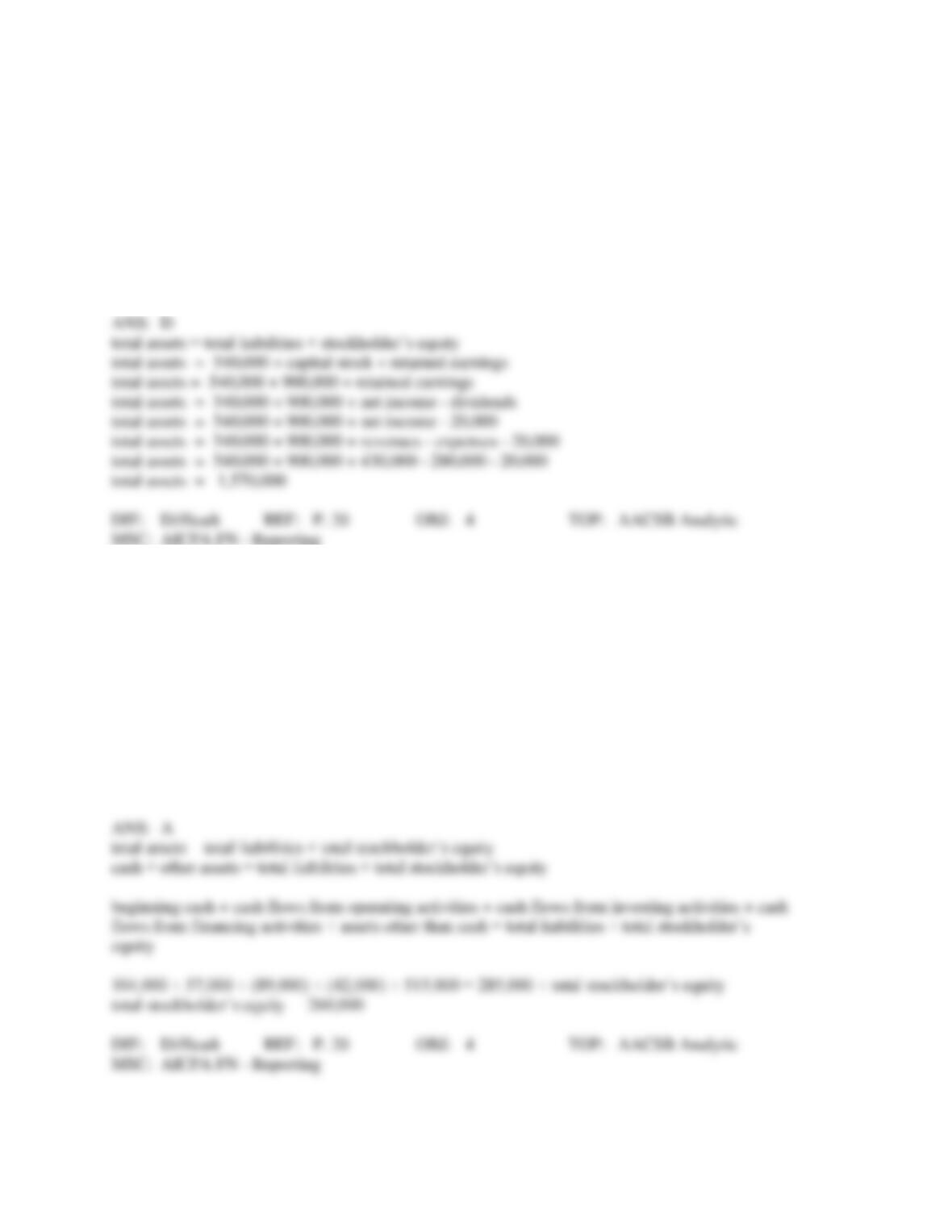
61. The Coco Company, a new company, had the following accounts:
Revenues $ 430,000
Expenses 280,000
Dividends 20,000
Capital stock 900,000
Total liabilities 540,000
What is the amount of their total assets?
a.
$ 1,440,000
b.
$ 2,170,000
c.
$ 150,000
d.
$ 1,570,000
62. The Key West Company had the following accounts:
Assets other than cash $515,000
Total Liabilities 295,000
Cash inflows from operating activities 57,000
Cash outflows from investing activities ( 89,000)
Cash outflows from financing activities ( 42,000)
Beginning cash 104,000
What is the total stockholder’s equity?
a.
$ 830,000
b.
$ 324,000
c.
$ 260,000
d.
$1,102,000
The Role of Accounting in Business ♦ 15
63. The “rules” of accounting are called __________.
a.
Income tax regulations
b.
SEC regulations
c.
Internet rules
d.
Generally Accepted Accounting Principles
64. The accounting concept that allows financial and economic data to be prepared for stakeholders of
a business is the ____________.
a.
entity concept
b.
matching concept
c.
unit of measure concept
d.
accounting period concept
65. Which concept determines the amount initially entered into the records for purchases?
a.
Cost concept
b.
Going concern concept
c.
Business entity concept
d.
Objectivity concept
66. The _______________ concept requires that the accounting records and the data reported on the
financial statements be based on objective evidence.
a.
matching concept
b.
objectivity concept
c.
business entity concept
d.
adequate disclosure
67. The financial history of a business can be shown by the financial reports for each period of time.
The ________________ concept underlies this phenomena.
a.
accounting period
b.
adequate disclosure
c.
unit of measure
d.
going concern
68. Which of the following is NOT a failure contributing to the accounting frauds of the 2000s?
a.
individual character
b.
going concern
c.
firm culture
d.
laws and enforcement
16 ♦ Chapter 1
69. As a result of the financial frauds of the early 2000’s, the Sarbanes Oxley Act created a new
oversight body called the ______________.
a.
FASB
b.
AICPA
c.
GAAP
d.
PCAOB
70. The type of analysis that involves comparing items on the financial statements in two different
years and showing the percentage change is known as
a.
stakeholder analysis
b.
proprietorship
c.
horizontal analysis
d.
accounting equation
71. If the sales increased by 7% from 2006 to 2007 and the cost of sales increased by 9% during the
same period, these events would be considered
a.
unfavorable because gross profit would decline.
b.
unfavorable because selling and administrative expenses would increase.
c.
favorable because sales are increasing.
d.
favorable because net income would probably increase.
72. An accountant was performing horizontal analysis. If plant assets increased from $234,750 in year
1 to $239,445 in year 2, what is the percentage change?
a.
1.96%
b.
2.00%
c.
46.95%
d.
98.03%
The Role of Accounting in Business ♦ 17
73. In performing horizontal analysis, the data from year 1 was lost. If the accountant knew that the
results of the analysis showed that year 2 inventory was$39,050 and this was an increase of 10%,
what was the amount for inventory in year1?
a.
$3, 905
b.
$35,145
c.
$35,500
d.
$42,955
TRUE/FALSE
1. The objective of most businesses is to maximize profits.
2. Profit is the difference between the amounts received from customers for goods provided and the
amounts received for the inputs used to provide the goods.
3. Manufacturing businesses change basic inputs into products that are sold to individual customers.
4. Service businesses produce products rather than provide services to customers.
5. A partnership is owned by two or more individuals.
6. The ownership of a corporation is divided into cash.
7. Over 90% of the total dollars of business receipts are received by corporations.
18 ♦ Chapter 1
8. Merchandising businesses must be corporations.
9. The popularity of the sole proprietorship is due to the ease and low cost of organizing.
10. The primary disadvantage of a sole proprietorship is that the financial resources available to the
business come from banks.
11. Intel employs a premium-price emphasis by creating its brand name “Pentium” and by registering
it as a trademark.
12. A business stakeholder has an interest in the economic performance of a business.
13. Since creditors have first preference to assets in case a business fails, their risk is greater than that
of the owners.
14. Businesses often use poor economic performance to argue for employee concessions such as wage
decreases.
15. A liability is a legal obligation to repay the amount borrowed according to the terms of the
borrowing agreement.
16. The basic type of stock issued to owners is called preferred stock.
17. Assets are acquired through investing activities when resources are purchased.
The Role of Accounting in Business ♦ 19
18. Selling expenses relate to costs such as corporate office expenses.
19. A net loss occurs when expenses exceed revenues.
20. The income statement reports financial condition.
21. The objective of the balance sheet is to report the change in financial condition.
22. Dividends are reported on the income statement.
23. On the balance sheet, stockholder’s equity is presented first so that stockholders can see their
claims first.
24. The cash receipts from selling used machinery would be reported in the investing section of the
statement of cash flows.
25. The balance sheet is prepared before the other financial statements.
26. The generally accepted accounting principles (GAAP) supports and determines the content of
financial statements.
27. The adequate disclosure concept requires that all economic data be recorded in dollars.
20 ♦ Chapter 1
28. Violations of accounting concepts can lead to ethical lapses that may be prosecuted.
29. The ethical lapses of the 2000’s led to the passage of the Sarbanes Oxley Act of 2002 which
created new oversight for the accounting profession.
30. Horizontal analysis is the comparison of items on the financial statements between two different
companies.
ESSAY
1. Name the three different types of businesses that operate for profit and their respective
characteristics.
2. Which type of business organization is most prevalent in America? Why?